
Foundation June 2019 Paper 3 Q15
15
(a) 50 sweets weigh 200 g.
If each sweet weighs the same, work out the weight of 7 sweets. [2]
(b) \(b\) is directly proportional to \(a\).
\(b\) is 10 when \(a\) is 8.
\(b\) is 10 when \(a\) is 8.
Work out \(b\) when \(a\) is 9. [2]
(c) A graph is drawn below.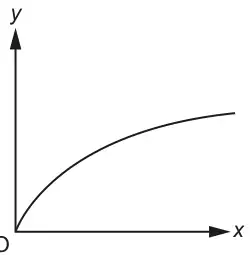
Explain how you know that \(y\) is not directly proportional to \(x\). [1]
| Answer | Marks | Part marks and guidance | |
|---|---|---|---|
| 28 nfww | 2 | M1 for \(\dfrac{200}{50}\) [\(\times\) 7] oe soi by 4 or \(\dfrac{7}{50}\) [\(\times\) 200] soi 0.14 or [\(200 \div\)] \(\dfrac{50}{7}\) soi 7.14[…] | Note \(200 \div 7 = 28.5[7…]\) is wrong method and scores 0 even if truncated to give an answer of 28 |
| Answer | Marks | Part marks and guidance | |
|---|---|---|---|
| 11.25 oe | 2 | M1 for \(\dfrac{9}{8}\) [\(\times\) 10] oe soi 1.125 or \(\dfrac{10}{8}\) [\(\times\) 9] oe soi 1.25 | Inverse methods eg [\(9 \div\)] \(\dfrac{8}{10}\) are oe |
| Answer | Marks | Part marks and guidance | |
|---|---|---|---|
| Not straight oe or it’s curved oe | 1 | Mark the best part if no contradiction or wrong statement | |