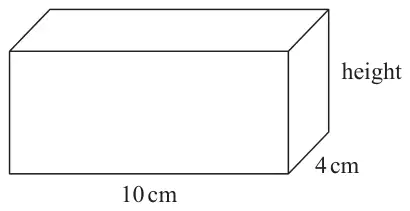
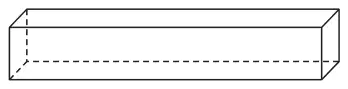
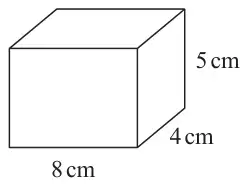
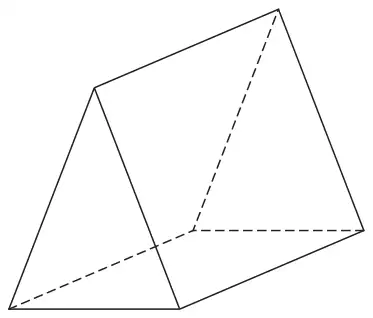
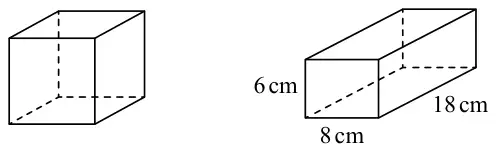
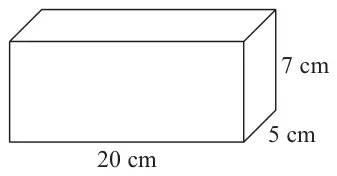
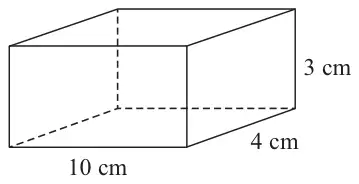
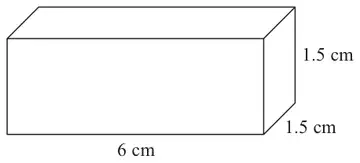
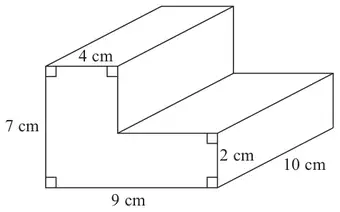
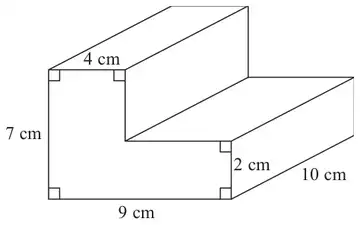
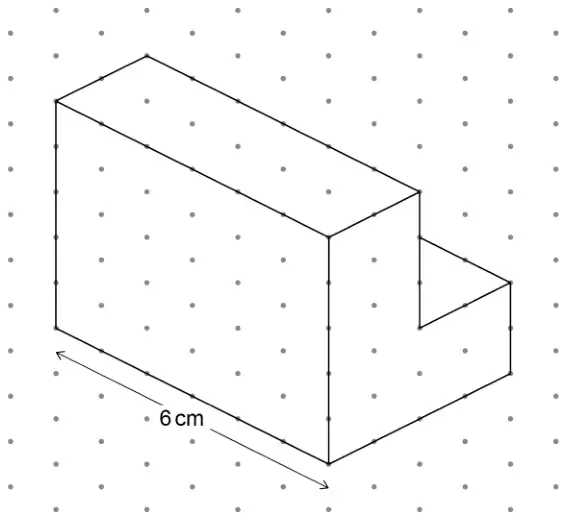
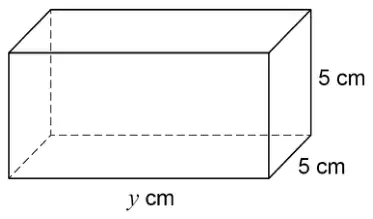
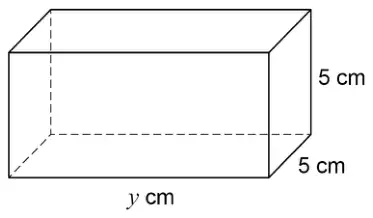
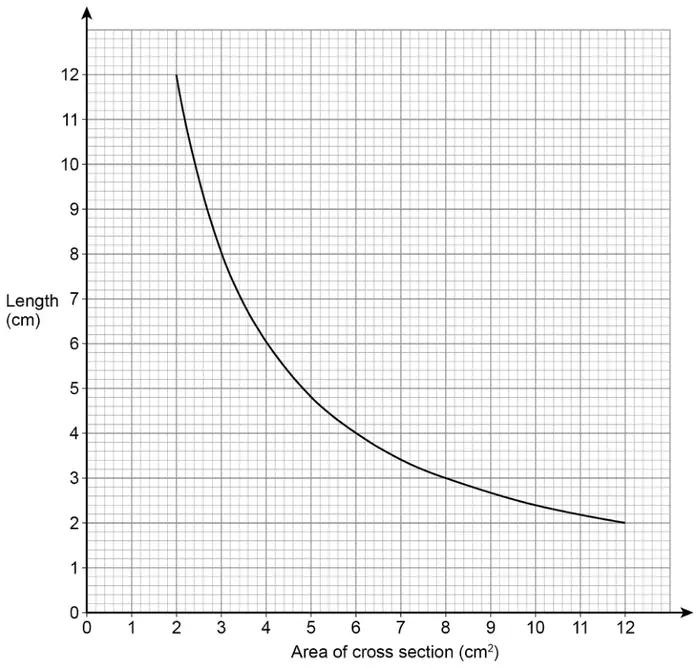
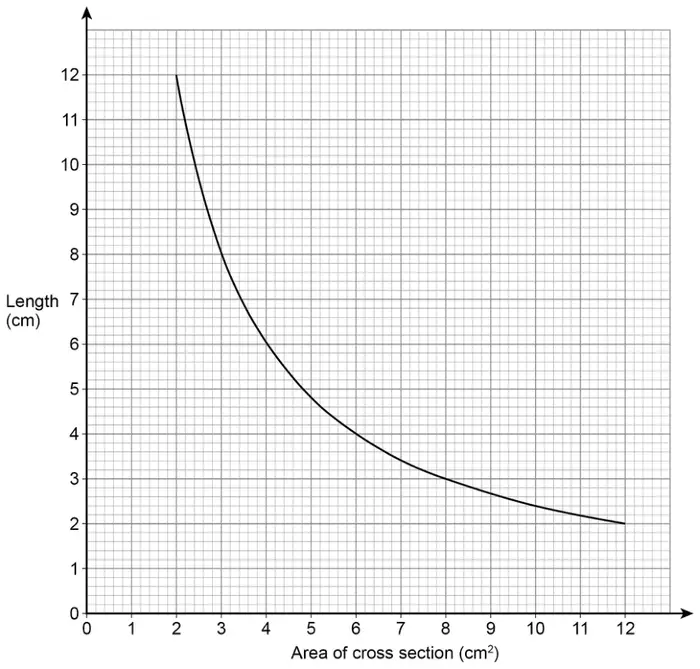
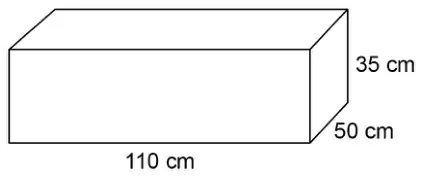
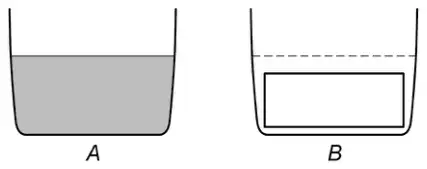
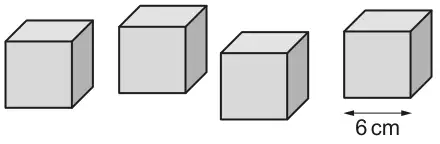
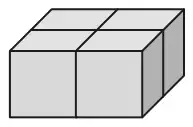
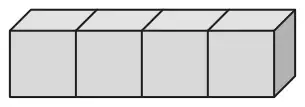
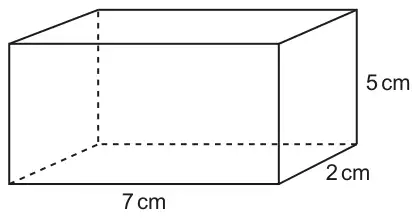
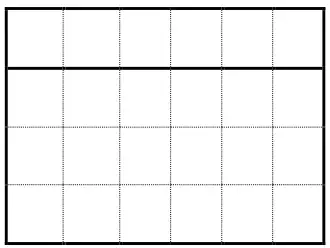
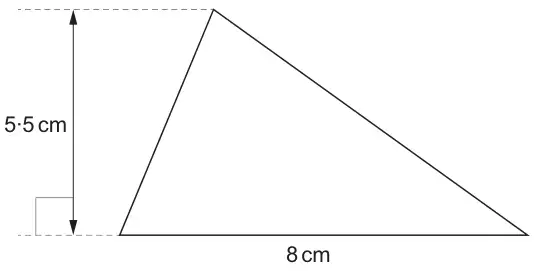
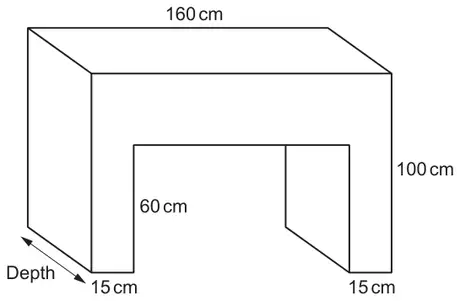
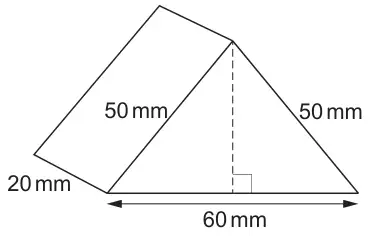
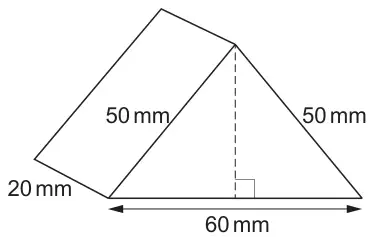
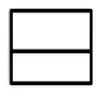
14 Here is a cuboid of length 10 cm and width 4 cm.
The cuboid has a volume of 200 cm3
(a) Work out the height of the cuboid. (2)
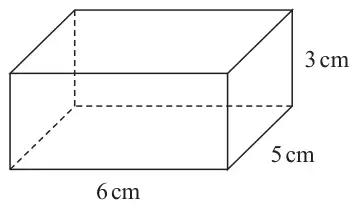
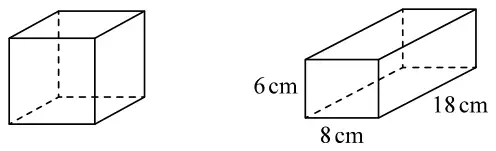
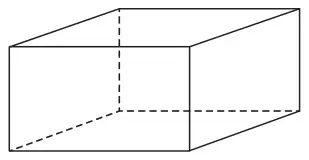
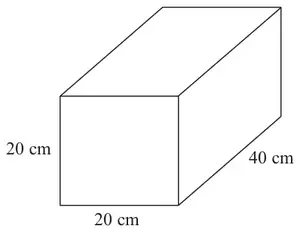
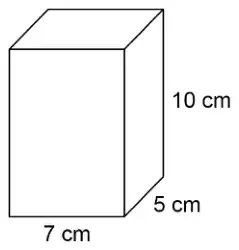
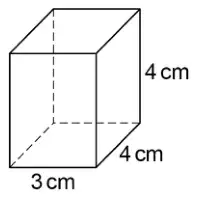
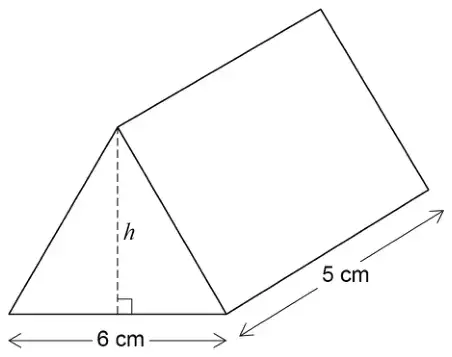
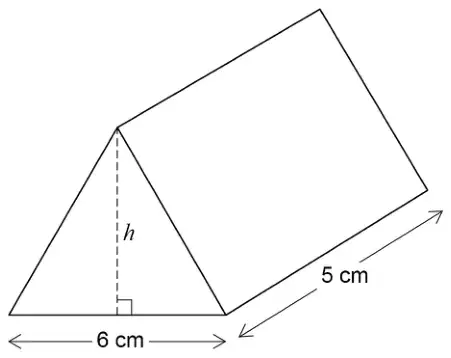
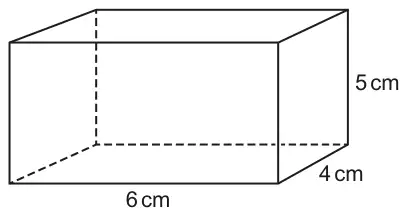
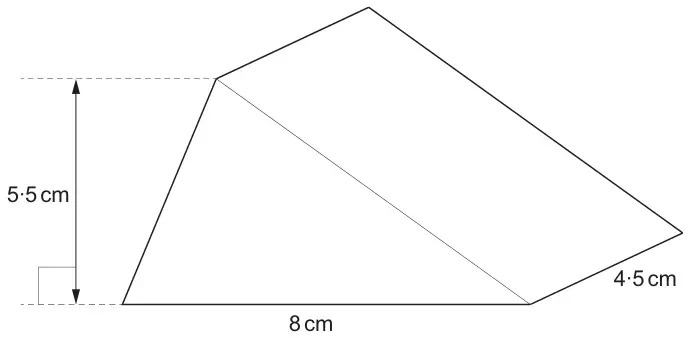
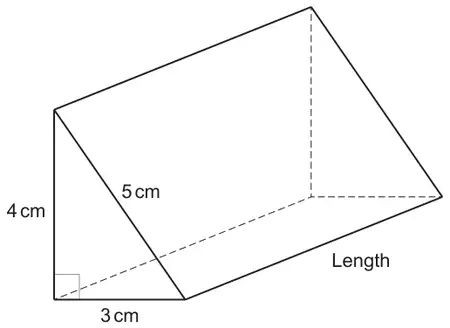
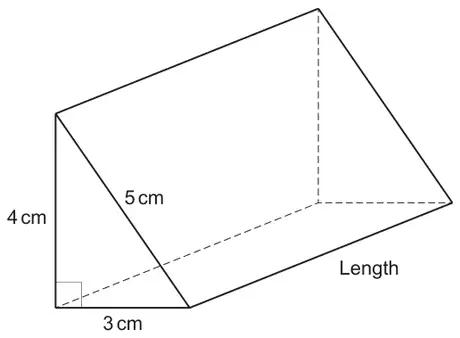
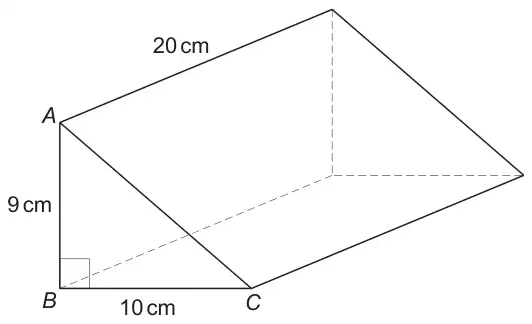
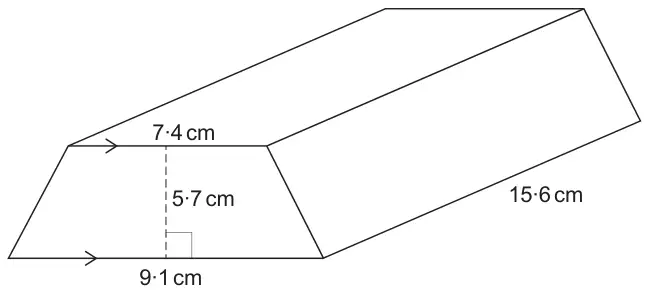
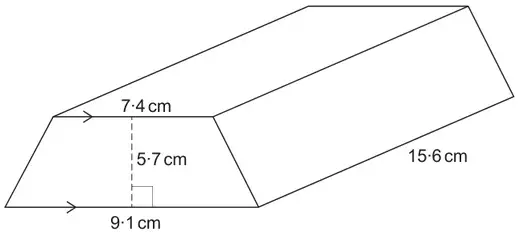
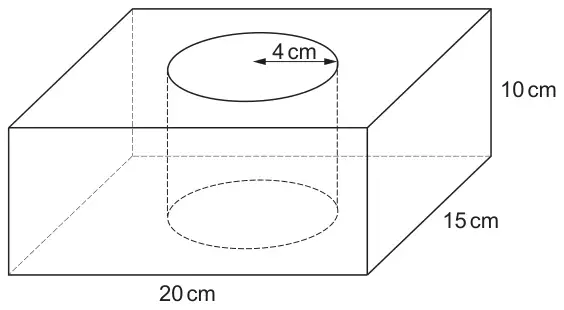
Here is a different cuboid.
(b) Work out the total surface area of this cuboid. (3)
Mark scheme (a)
Answer
Mark
Mark scheme
5
P1
for a start of a method to find the height, eg \(10 \times 4\ (= 40)\) or \(200 \div 10\ (= 20)\) or \(200 \div 4\ (= 50)\)
or for forming a correct equation \(10 \times 4 \times h = 200\)
A1
cao
Mark scheme (b)
Answer
Mark
Mark scheme
126
M1
for a start to find the area of at least one face, eg \(6 \times 3\ (= 18)\) or \(5 \times 3\ (= 15)\) or \(6 \times 5\ (= 30)\)
M1
for combining the area of at least three of the correct faces eg \(\text{``}18\text{''} + \text{``}15\text{''} + \text{``}30\text{''}\ (= 63)\) or \(2 \times \text{``}18\text{''} + \text{``}15\text{''}\)
A1
cao
Additional guidance
Do not award first M if multiplied by a third length (ie volume calculation)
May be part of a larger addition including incorrect areas. Do not award if more than 6 areas added.
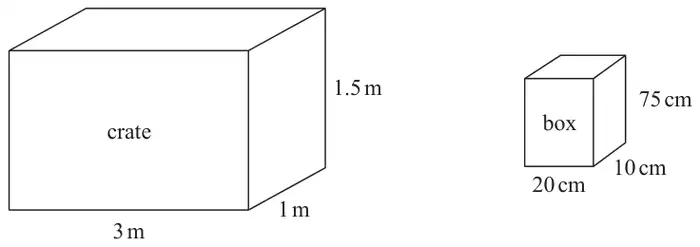
The crate is 3 m by 1 m by 1.5 m. The crate is completely filled with boxes. Each box is 20 cm by 10 cm by 75 cm.
Work out the number of boxes in the crate. (4)
Mark scheme
Answer
Mark
Mark scheme
300
B1
(indep) for process to convert to common units, eg \(3 \times 100\ (= 300)\) or \(1 \times 100\ (= 100)\) or \(1.5 \times 100\ (= 150)\) or \(20 \div 100\ (= 0.2)\) or \(10 \div 100\ (= 0.1)\) or \(75 \div 100\ (= 0.75)\) or \(\text{``}4.5\text{''} \times 100^3\ (= 4\,500\,000)\) or \(\text{``}15\,000\text{''} \div 100^3\ (= 0.015)\)
P1
for finding the volume of either shape, eg \(3 \times 1 \times 1.5\ (= 4.5)\) or \([300] \times [100] \times [150]\ (= 4\,500\,000)\) or \(20 \times 10 \times 75\ (= 15\,000)\) or \([0.2] \times [0.1] \times [0.75]\ (= 0.015)\)
OR
for start of the process to find the number of boxes using one dimension, eg \([300] \div 20\ (= 15)\) or \([100] \div 10\ (= 10)\) or \([150] \div 75\ (= 2)\) or \(3 \div [0.2]\ (= 15)\) or \(1 \div [0.1]\ (= 10)\) or \(1.5 \div [0.75]\ (= 2)\)
P1
(dep on P1) for a complete process with or without unit conversion eg \(\text{``}4\,500\,000\text{''} \div \text{``}15\,000\text{''}\) or \(\text{``}4.5\text{''} \div \text{``}0.015\text{''}\)
or \(\text{``}15\text{''} \times \text{``}10\text{''} \times \text{``}2\text{''}\)
A1
cao
Additional guidance
This mark can be awarded at any stage One correct conversion for their process is enough for the award of this mark Working may be seen on the diagram
[300] = 3 or 30 or “300” or 3000 [100] = 1 or 10 or “100” or 1000 [150] = 1.5 or 15 or “150” or 1500 [0.2] = 20 or 2 or “0.2” or 0.02 [0.1] = 10 or 1 or “0.1” or 0.01 [0.75] = 75 or 7.5 “0.75” or 0.075
May be implied by correctly dividing the areas of the corresponding faces eg \(\dfrac{[300] \times [100]}{20 \times 10}\)
Condone an incorrect attempt to convert volume before division
22 A cube has a total surface area of 150 cm\(^2\)
Work out the volume of the cube. (4)
Mark scheme
Answer
Mark
Mark scheme
125
P1
for process to find area of one face, eg \(150 \div 6\ (= 25)\) or \(6x^2 = 150\)
P1
for process to find side length, eg \(\sqrt{\text{``}25\text{''}}\ (= 5)\)
P1
for a complete process to find volume, eg \(\text{``}5\text{''} \times \text{``}5\text{''} \times \text{``}5\text{''}\) or \(\text{``}25\text{''} \times \text{``}5\text{''}\)
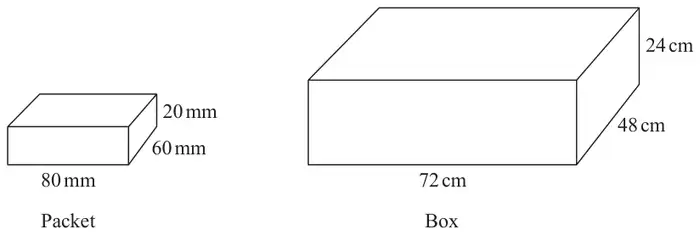
Each packet is a cuboid, 80 mm by 60 mm by 20 mm. Each box is a cuboid, 72 cm by 48 cm by 24 cm.
Work out the greatest number of packets that can be put into each box. (4)
Mark scheme
Answer
Mark
Mark scheme
864
B1
(indep) for process to convert to common units, eg \(72 \times 10\ (= 720)\) or \(48 \times 10\ (= 480)\) or \(24 \times 10\ (= 240)\) or \(80 \div 10\ (= 8)\) or \(60 \div 10\ (= 6)\) or \(20 \div 10\ (= 2)\) or or \(\text{``}96000\text{''} \div 10^3\ (= 96)\) or \(\text{``}82944\text{''} \times 10^3\ (= 82944000)\) or \(\text{``}0.864\text{''} \times 10^3\)
P1
for using volume, eg \(80 \times 60 \times 20\ (= 96000)\) or \(72 \times 48 \times 24\ (= 82944)\) or for start of process to find number of packets using one dimension, eg \(\text{``}720\text{''} \div 80\ (= 9)\) or \(\text{``}480\text{''} \div 60\ (= 8)\) or \(\text{``}240\text{''} \div 20\ (= 12)\) or \(48 \div \text{``}8\text{''}\ (= 6)\) or \(72 \div \text{``}2\text{''}\ (= 36)\) or \(24 \div \text{``}6\text{''}\ (= 4)\)
P1
for full process with or without unit conversion, eg \(\text{``}82\,944\,000\text{''} \div \text{``}96000\text{''}\) or \(\text{``}82944\text{''} \div \text{``}96\text{''}\) or for \(\text{``}9\text{''} \times \text{``}8\text{''} \times \text{``}12\text{''}\) or \(\text{``}36\text{''} \times \text{``}6\text{''} \times \text{``}4\text{''}\) or \(\text{``}0.9\text{''} \times \text{``}0.8\text{''} \times \text{``}1.2\text{''}\ (= 0.864)\)
A1
cao
Additional guidance
This mark can be awarded at any stage One correct conversion for their method is enough for the award of this mark
Working may be seen on diagram. May be implied by correctly dividing the areas of corresponding faces
for process to find area of one face, eg \(150 \div 6\ (= 25)\)
or \(6x^2 = 150\)
P1
for process to find side length, eg \(\sqrt{\text{``}25\text{''}}\ (= 5)\)
P1
for a complete process to find volume, eg \(\text{``}5\text{''} \times \text{``}5\text{''} \times \text{``}5\text{''}\) or \(\text{``}25\text{''} \times \text{``}5\text{''}\)
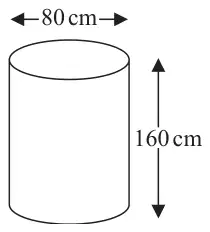
24 Karina has 4 tanks on her tractor. Each tank is a cylinder with diameter 80 cm and height 160 cm.
The 4 tanks are to be filled completely with a mixture of fertiliser and water.
The fertiliser has to be mixed with water in the ratio \(1 : 100\) by volume. Karina has 32 litres of fertiliser.
1 litre = 1000 cm\(^3\)
Has Karina enough fertiliser for the 4 tanks? You must show how you get your answer. (4)
Mark scheme
Answer
Mark
Mark scheme
Yes (supported)
P1
for a process to find the volume of 1 tank eg \(\pi \times 40^2 \times 160\ (= 804247.7… \text{ or } 804.2... \text{ or } 256000\pi)\)
P1
for complete process to find the volume of 4 tanks, [volume of tank] \(\times\ 4\) eg \(\pi \times 40^2 \times 160 \times 4\ (= 3216990.8… \text{ or } 3216.9... \text{ or } 1024000\pi)\) or for process to find volume of fertiliser available per tank eg \(32 \times 1000 \div 4\ (= 8000)\)
P1
for a process to find the amount of mixture for 1 tank eg [volume of tank] \(\div\ 101\ (= 7962.8...)\) or 4 tanks \((= 31851.3…)\) OR for a process to find volume of mixture that 32 litres of fertiliser will make eg \(32000 \times 101\ (= 3232000)\) or \(32 \times 101\ (= 3232)\)
C1
for Yes supported by correct figures shown eg a comparable figure in the range 31.8 to 31.9 (litres) or in the range 31800 to 31900 with 32000 (cm³) or in the range 3216 to 3217 with 3232 (litres) or in the range 3216000 to 3217000 with 3232000 (cm³) or in the range 7958 to 7963 with 8000 (cm³)
Additional guidance
First P1: Could be truncated or rounded
Second P1: For this mark [volume of tank] must come from a calculation involving \(\pi\), \(r^2\), \(h\)
Third P1: For this mark [volume of tank] must come from a calculation involving \(\pi\), \(r^2\), \(h\) or be stated as their volume
C1: There are other possible pairs of values which can be used in the comparison
for a process to find the total surface area of at least 5 faces for each solid, eg \(\text{``}35\text{''} \times 2 + \text{``}30\text{''} \times 2 + \text{``}42\text{''}\) and \(\text{``}16\text{''} \times 6\) or \(\text{``}35\text{''} \times 2 + \text{``}30\text{''} \times 2 + \text{``}42\text{''} \times 2\) and \(\text{``}16\text{''} \times 5\)
A1
cao
Additional guidance
Total surface area of cuboid = 214 Total surface area of cube = 96
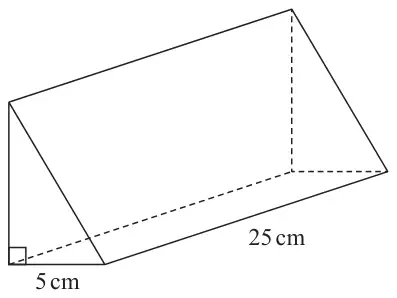
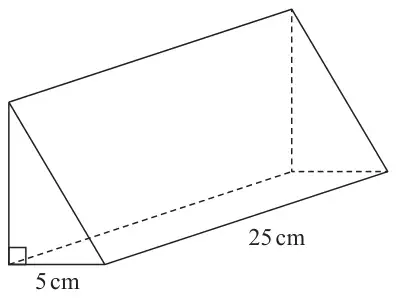
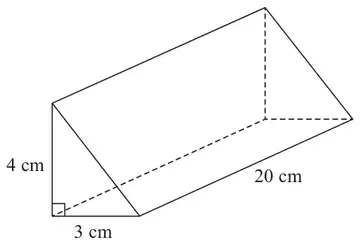
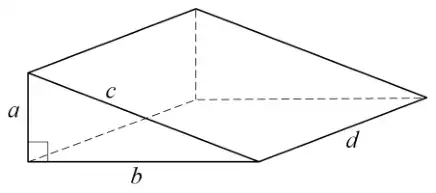
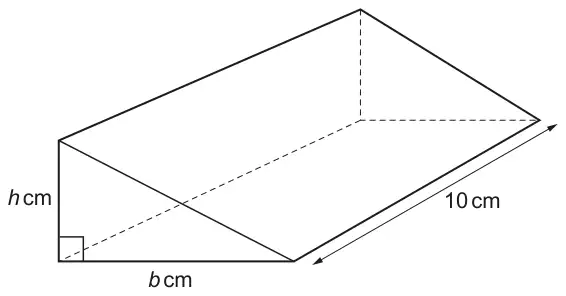
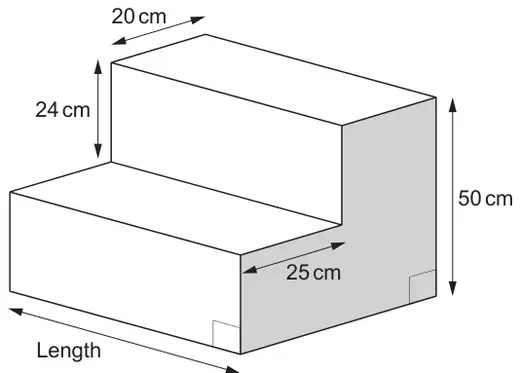
The cross section of the prism is a right-angled triangle. The base of the triangle has length 5 cm
The prism has length 25 cm The prism has volume 750 cm3
Work out the height of the prism. (3)
Mark scheme
Answer
Mark
Mark scheme
12
P1
for a process to find the area of cross section, eg \(750 \div 25\ (= 30)\) oe or \(\dfrac{1}{2} \times 5 \times h\) oe
P1
for a correct equation in \(h\), eg \(750 \div 25 = \dfrac{1}{2} \times 5 \times h\) oe or \(\dfrac{1}{2} \times 5 \times h \times 25 = 750\) oe or for a complete process to find \(h\), eg \(\dfrac{750}{25} \times \dfrac{2}{5}\) oe or \(\text{``}30\text{''} \times 2 \div 5\)
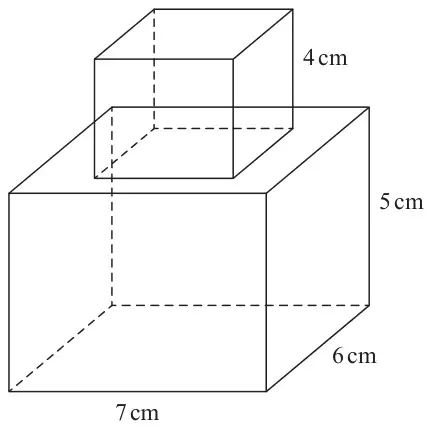
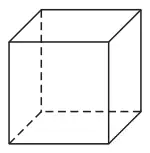
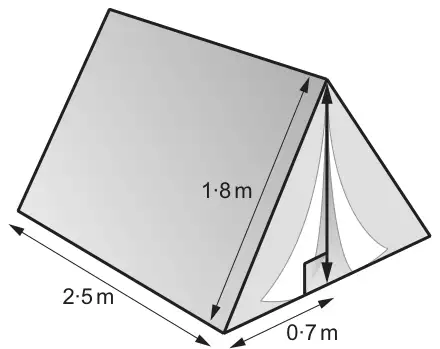
The total surface area of the cube is equal to the total surface area of the cuboid.
Janet says,
“The volume of the cube is equal to the volume of the cuboid.”
Is Janet correct? You must show how you get your answer. (5)
Mark scheme
Answer
Mark
Mark scheme
No (supported)
P1
for finding the area of 3 or more faces of the cuboid and adding eg \((6 \times 8) + (8 \times 18) + (6 \times 18) \ldots\) or \(\text{``}48\text{''} + \text{``}144\text{''} + \text{``}108\text{''} \ldots\ (= 300)\)
P1
complete process to find surface area of cuboid, eg \(6 \times 8 \times 2 + 6 \times 18 \times 2 + 8 \times 18 \times 2\ (= 600)\)
P1
for process to find side length of cube, eg [surface area] \(\div\ 6\) and square rooting \((= 10)\) OR for a process to find the volume of the cuboid \(6 \times 8 \times 18\ (= 864)\) and cube rooting \((= 9.52...)\) to find a side length
P1
(dep on previous P1) for processes to find volume of cube and volume of cuboid, eg [side length]\(^3\ (= 1000)\) and \(6 \times 8 \times 18\ (= 864)\) OR (dep on previous P1) for process to find surface area of cube, eg. \((\text{``}9.52...\text{''})^2 \times 6\ (= 544.28...)\)
A1
No with 1000 and 864 OR No with 600 and 544(.28...)
Additional guidance
Could be an addition of any three faces eg 48 + 48 + 144 etc.
[surface area] must come from the addition of at least three attempts at area, but not from volume.
The third and fourth marks are printed in two columns: the first method in each of those rows goes with the first method in the other, and the method after OR goes with the method after OR.
The total surface area of the cube is equal to the total surface area of the cuboid.
Janet says,
“The volume of the cube is equal to the volume of the cuboid.”
Is Janet correct? You must show how you get your answer. (5)
Mark scheme
Answer
Mark
Mark scheme
No (supported)
P1
for finding the area of 3 or more faces of the cuboid and adding eg \((6 \times 8) + (8 \times 18) + (6 \times 18) \ldots\) or \(\text{``}48\text{''} + \text{``}144\text{''} + \text{``}108\text{''} \ldots\ (= 300)\)
P1
complete process to find surface area of cuboid, eg \(6 \times 8 \times 2 + 6 \times 18 \times 2 + 8 \times 18 \times 2\ (= 600)\)
P1
for process to find side length of cube, eg [surface area] \(\div\, 6\) and square rooting (= 10) or for a process to find the volume of the cuboid \(6 \times 8 \times 18\ (= 864)\) and cube rooting \((= 9.52\ldots)\) to find a side length
P1
(dep on previous P1) for processes to find volume of cube and volume of cuboid, eg [side length]\(^3\ (= 1000)\) and \(6 \times 8 \times 18\ (= 864)\) or (dep on previous P1) for process to find surface area of cube, eg. \((\text{``}9.52\ldots\text{''})^2 \times 6\ (= 544.28\ldots)\)
A1
No with 1000 and 864 OR No with 600 and 544(.28…)
Additional guidance
Could be an addition of any three faces eg \(48 + 48 + 144\) etc.
[surface area] must come from the addition of at least three attempts at area, but not from volume.
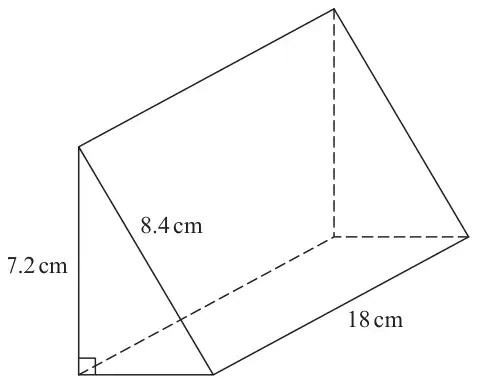
Work out the volume of the prism. Give your answer correct to 3 significant figures. (5)
Mark scheme
Answer
Mark
Mark scheme
280
P1
for starting to use Pythagoras to find the missing side eg \(8.4^2 - 7.2^2\ (= 18.72)\)
P1
for a complete process to find the missing side eg \(\sqrt{70.56 - 51.84}\) or \(\sqrt{18.72}\) (=4.32....)
P1
(dep P1) for a process to find the area of the triangular face eg ([length of base] \(\times\ 7.2) \div 2\) (=15.57..) OR the volume of the cuboid eg [length of base] \(\times\ 7.2 \times 18\) (=560.7..)
P1
for a complete process to find the volume of the prism eg \(\text{``}15.5..\text{''} \times 18\) or \(\text{``}560.7..\text{''} \div 2\)
A1
answer in the range 278 – 281
Additional guidance
Award P1 for a correct Pythagorean statement eg \(x^2 + 7.2^2 = 8.4^2\)
4.3 truncated or rounded can imply P2
Uses a figure they show as the length of the base of the right angled triangle but dep on P1 Allow 15.57.. truncated or rounded if unsupported
If an answer is given in the range 278 to 281 but then incorrectly given to 3 sig fig this mark can still be awarded.
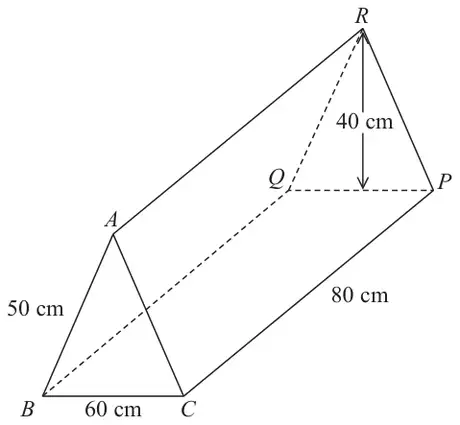
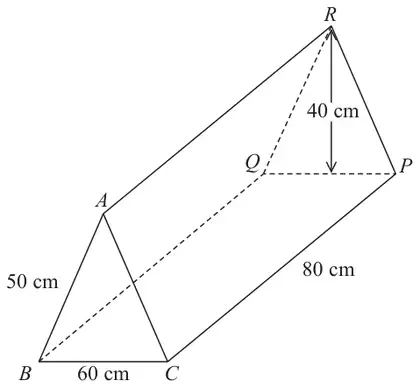
23 Frances grows plants in a container. Each of the 5 faces of the container is made of glass.
Diagram NOT accurately drawn
The container is in the shape of a prism. The cross section of the prism is an isosceles triangle with height 40 cm.
\(BC = 60\) cm \(AB = AC = 50\) cm \(CP = 80\) cm
Work out the total area of glass needed to make the container. (3)
Mark scheme
Answer
Mark
Notes
15 200
3
M1 for a method to obtain at least two different areas from \(50 \times 80\) (= 4000), \(\frac{1}{2} \times 40 \times 60\) (= 1200), \(60 \times 80\) (= 4800) M1 (dep on M1) for adding at least 4 correct face areas A1 cao
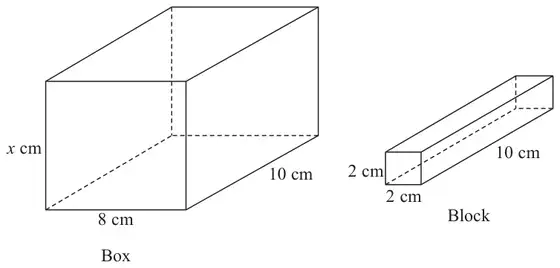
Each box is a cuboid \(x\) cm by 8 cm by 10 cm. Each block is a cuboid 2 cm by 2 cm by 10 cm.
24 blocks completely fill a box.
Work out the value of \(x\). (4)
Mark scheme
Answer
Mark
Notes
12
4
M1 for a correct expression for the volume of a block e.g. \(2 \times 2 \times 10\) (= 40) M1 for a correct expression for the volume of a box e.g. \(10 \times 8 \times x\) or for \(\text{``}40\text{''} \times 24\) M1 for a complete method to find \(x\) e.g. \((\text{``}40\text{''} \times 24) \div (10 \times 8)\) A1 cao
or M1 for a method to find number of blocks that can fit in a bottom row of the box \(8 \div 2\) (= 4) M1 for a method to find the number of rows \(24 \div 4\) (= 6) M1 for a complete method to find \(x\) e.g. \(\text{``}6\text{''} \times 2\) A1 cao
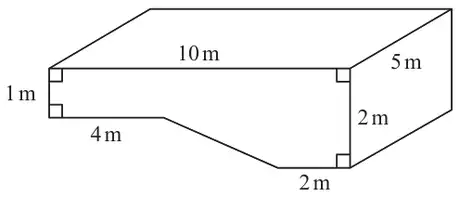
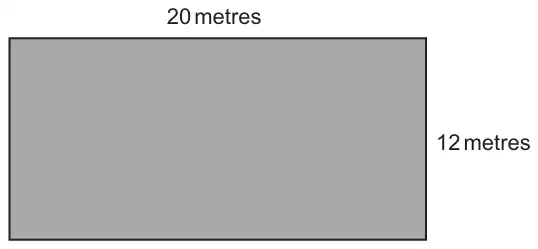
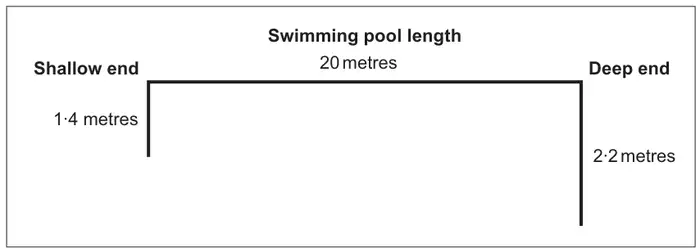
*16 The diagram shows a swimming pool in the shape of a prism.
Diagram NOT accurately drawn
The swimming pool is empty.
Water from 3 water tankers is going to be put into the pool. There are 20 000 litres of water in each water tanker.
Sam thinks that the surface of the water in the pool will be 10 cm below the top of the pool.
Is Sam correct? You must show how you get your answer. (1 m\(^3\) = 1000 litres) (5)
Mark scheme
Answer
Mark
Notes
No with correct calculations
5
M1 for splitting the cross section into separate areas and a method to find the area of one part OR for splitting up the pool into smaller prisms and a method to find the volume of one prism, e.g. a cuboid M1 (dep) for a complete method to find the cross-sectional area OR for a method to find the volume of more than one prism M1 (dep) for a complete method to find the vol of the pool (= 70 (m\(^3\))) OR for a complete method to find the depth of 60000L of water M1 for method to find figure for comparison, eg distance between surface and top of pool \((\text{``}70\text{''} - \text{``}60\text{''}) \div (5 \times 10)\) C1 No, with correct calculations, eg water level is 20cm below top of pool
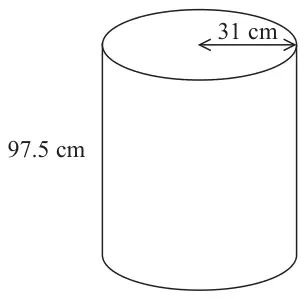
12 Sanders has a water tank for storing rainwater.
Diagram NOT accurately drawn
The tank is in the shape of a cylinder. The radius of the cylinder is 31 cm. The height of the cylinder is 97.5 cm.
The tank is full of water. Work out an estimate for the volume of water in the tank. Give your answer in litres. You must show your working.
Use 1000 cm\(^3\) = 1 litre. (3)
Mark scheme
Answer
Mark
Notes
270
3
M1 for correct use of formula for volume of a cylinder using exact or (some) approximate figures eg \(\pi \times 31^2 \times 97.5\) or \(\pi \times 31^2 \times 100\) or using an estimate of \(\pi\) eg \(\pi = 3\) in the volume formula
M1 for a complete method to find an estimate for the volume in cm\(^3\) with at least 2 values rounded eg \(\pi \times 30^2 \times 100\) (= 270 000) eg \(3.1 \times 30^2 \times 100\) eg \(3 \times 31^2 \times 100\)
A1 accept answer in the range 270 − 300 from a method using estimates
7 Frances grows plants in a container. Each of the 5 faces of the container is made of glass.
Diagram NOT accurately drawn
The container is in the shape of a prism. The cross section of the prism is an isosceles triangle with height 40 cm.
\(BC = 60\) cm \(AB = AC = 50\) cm \(CP = 80\) cm
Work out the total area of glass needed to make the container. (3)
Mark scheme
Answer
Mark
Notes
15 200
3
M1 for a method to obtain at least 2 different areas from \(50 \times 80\) (= 4000), \(\dfrac{1}{2} \times 40 \times 60\) (= 1200), \(60 \times 80\) (= 4800) M1 (dep on M1) for adding at least 4 correct face areas A1 cao
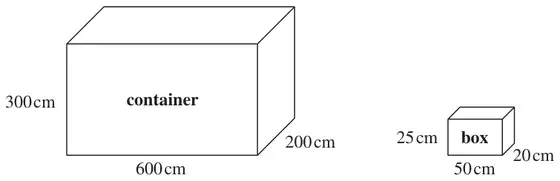
The container is a cuboid, 600 cm by 300 cm by 200 cm. Each box is a cuboid, 50 cm by 25 cm by 20 cm.
Work out the largest number of boxes that can be packed into the container. (3)
Mark scheme
Answer
Mark
Notes
1440
3
M1 for correct method to find volume of a cuboid eg \(300 \times 600 \times 200\) (= 36000000) or \(25 \times 50 \times 20\) (= 25000) M1 (dep) for “volume of container” \(\div\) “volume of box” A1 cao Ignore units.
OR M1 for correct method to find number of boxes along one edge eg \(300 \div 25\) (= 12) or \(600 \div 50\) (= 12) or \(200 \div 20\) (= 10) M1 (dep) for intention to use 3 values to find total number of boxes A1 cao Ignore units.
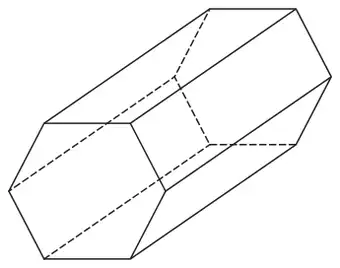
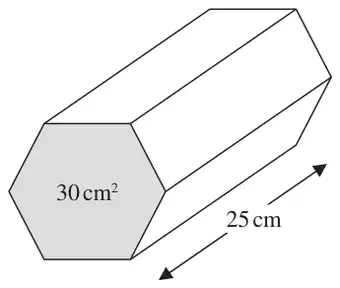
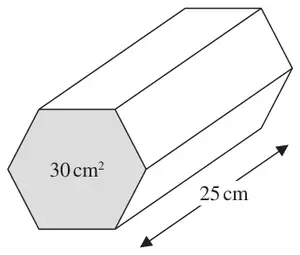
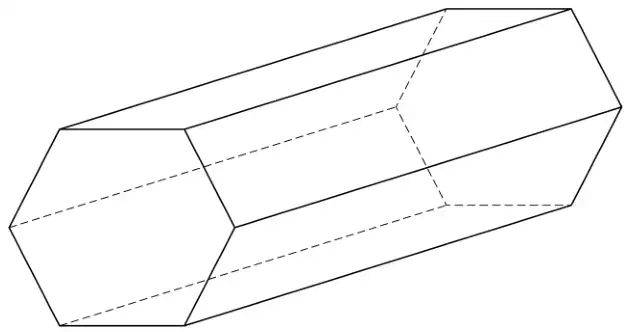
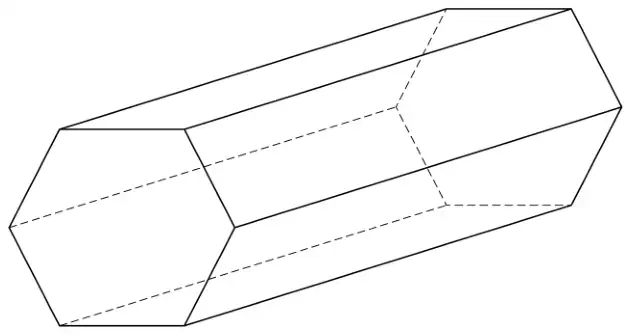
The cross section of the prism is a regular hexagon.
(b) In the space below, sketch a net of the prism. (2)
Diagram NOT accurately drawn
The area of the cross section of the prism is 30 cm2. The length of the prism is 25 cm.
(c) Work out the volume of the prism. (3)
Mark scheme (a)
Answer
Mark
Notes
(i) 12 (ii) 8
2
(i) B1 cao (ii) B1 cao
Mark scheme (b)
Answer
Mark
Notes
Sketch of net
2
M1 for attempt to draw net with 2 of the following 3 features: 6 rectangles 2 polygon faces with at least 5 edges a net with correct connections to give at least one vertex with 3 faces meeting. A1 for a correct net
Mark scheme (c)
Answer
Mark
Notes
750 cm3
3
M1 for \(30 \times 25\) A1 for 750 B1 (indep) for cm3
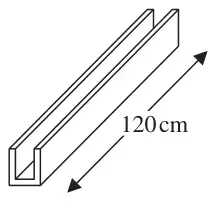
14 The diagram shows a metal bar in the shape of a prism.
Diagram NOT accurately drawn
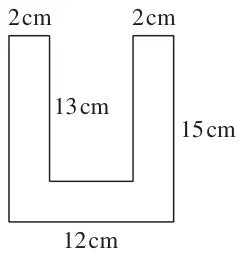
The length of the metal bar is 120 cm. The cross section of the metal bar is shown below.
Diagram NOT accurately drawn
All corners are right angles.
The metal bar is made from steel with density 8 g/cm\(^3\).
Sean has a trolley. The trolley can carry a maximum mass of 250 kg.
How many metal bars can the trolley carry at the same time? You must show your working. (5)
Mark scheme
Answer
Mark
Notes
3
5
M1 for a complete method to find the area of the cross section, eg. \(15 \times 2 + \text{``}(12 - 4)\text{''} \times 2 + 15 \times 2\) (= 76) or for finding the volume of a relevant prism, eg. \(15 \times 2 \times 120\) (= 3600) NB: "(12 − 4)" maybe just seen on the diagram
M1 for a method to find the volume of the bar, eg. \(\text{``}76\text{''} \times 120\) (= 9120) or ft "area of cross section" \(\times\) 120 provided "area of cross section" includes a method to find the area of at least two relevant rectangles
M1 for "volume" \(\times\) 8, eg. \(\text{``}9120\text{''} \times 8\) (= 72960) or \(250 \times 1000 \div 8\) (= 31250) NB "volume" must be dimensionally correct
M1 (dep on previous M1) for \(250 \div (\text{``}\text{volume}\text{''} \times 8 \div 1000)\), eg. \(250 \div \text{``}72960 \div 1000\text{''}\) (= 3.4265….) or \(\text{``}31250\text{''} \div \text{``}9120\text{''}\)
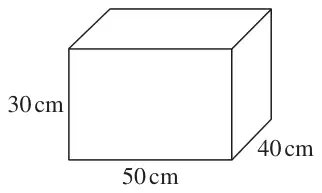
*23 The diagram shows a container for oil. The container is in the shape of a cuboid. The container is empty.
Diagram NOT accurately drawn
Sally has to fill the container with oil. A bottle of oil costs £3.50 There are 3000 cm3 of oil in each bottle.
Sally must not spend more than £60 buying the oil.
Can Sally buy enough oil to fill the container? You must show all your working. (4)
Mark scheme
Answer
Mark
Notes
NO with evidence
4
M1 for \(50 \times 40 \times 30\) (= 60 000) M1 for \(\text{``}60\,000\text{''} \div 3000\) (= 20) M1 for \(\text{``}20\text{''} \times £3.50\) C1 for (£)70 and comparison resulting in NO
OR
M1 for \(60 \div 3.50\) (= 17 bottles) M1 for \(\text{``}17\text{''} \times 3000\) (= 51,000) M1 for \(50 \times 40 \times 30\) (= 60,000) C1 for 51,000 and 60,000 and comparison resulting in NO
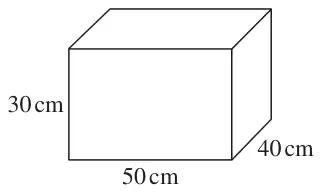
The diagram shows a container for oil. The container is in the shape of a cuboid. The container is empty.
Sally has to fill the container with oil. A bottle of oil costs £3.50 There are 3000 cm\(^3\) of oil in each bottle. Sally must not spend more than £60 buying the oil.
Can Sally buy enough oil to fill the container?
You must show all your working.(4)
Mark scheme
Answer
Mark
Notes
NO with evidence
4
M1 for \(50 \times 40 \times 30\) (=60000) M1 for \(\text{``}60000\text{''} \div 3000\) (=20) M1 for "20" × £3.50 C1 eg for 70 and comparison resulting in NO
OR M1 for £60 ÷ 3.50 (=17 bottles) M1 for \(\text{``}17\text{''} \times 3000\) (=51000) M1 for \(50 \times 40 \times 30\) (=60000) C1 eg for 51000 and 60000 and comparison resulting in NO
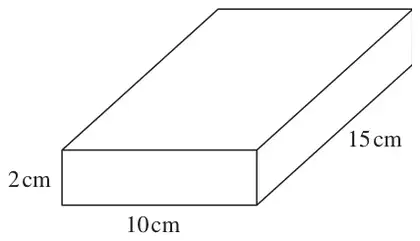
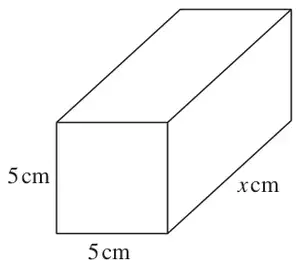
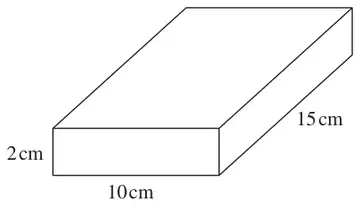
21 Jane makes cheese. The cheese is in the shape of a cuboid.
Diagram NOT accurately drawn
Jane is going to make a new cheese. The new cheese will also be in the shape of a cuboid. The cross section of the cuboid will be a 5 cm by 5 cm square.
Diagram NOT accurately drawn
Jane wants the new cuboid to have the same volume as the 2 cm by 10 cm by 15 cm cuboid.
Work out the value of \(x\). (3)
Mark scheme
Answer
Mark
Notes
12
3
M1 for a method to find volume of a cuboid, eg. \(2 \times 10 \times 15\) (= 300) or \(5 \times 5 \times x\) (= \(25x\)) M1 (dep) for \(\text{``}300\text{''} \div \text{``}25\text{''}\) oe A1 cao
OR
M1 for \(10 \div 5\) (= 2) and \(15 \div 5\) (= 3) or \(10 \div 5\) (= 2) and \(2 \div 5\) (= 0.4) M1 (dep) for \(2 \times \text{``}2\text{''} \times \text{``}3\text{''}\) or \(15 \times \text{``}2\text{''} \times \text{``}0.4\text{''}\) A1 cao
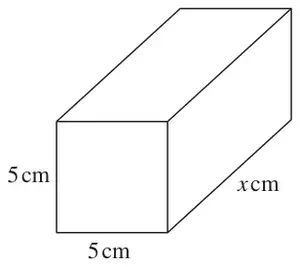
5 Jane makes cheese. The cheese is in the shape of a cuboid.
Diagram NOT accurately drawn
Jane is going to make a new cheese. The new cheese will also be in the shape of a cuboid. The cross section of the cuboid will be a 5 cm by 5 cm square.
Diagram NOT accurately drawn
Jane wants the new cuboid to have the same volume as the 2 cm by 10 cm by 15 cm cuboid.
Work out the value of \(x\). (3)
Mark scheme
Answer
Mark
Notes
12
3
M1 for a method to find volume of a cuboid, eg. \(2 \times 10 \times 15\) (= 300) or \(5 \times 5 \times x\) (= \(25x\)) M1 (dep) for \(\text{``}300\text{''} \div \text{``}25\text{''}\) oe A1 cao
OR M1 for \(10 \div 5\) (= 2) and \(15 \div 5\) (= 3) or \(10 \div 5\) (= 2) and \(2 \div 5\) (= 0.4) M1 (dep) for \(2 \times \text{``}2\text{''} \times \text{``}3\text{''}\) or \(15 \times \text{``}2\text{''} \times \text{``}0.4\text{''}\) A1 cao
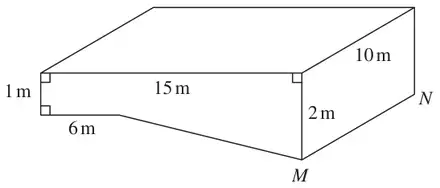
13 The diagram shows a swimming pool in the shape of a prism.
Diagram NOT accurately drawn
The swimming pool is empty. The swimming pool is filled with water at a constant rate of 50 litres per minute.
(a) Work out how long it will take for the swimming pool to be completely full of water. Give your answer in hours. (1 m\(^3\) = 1000 litres) (5)
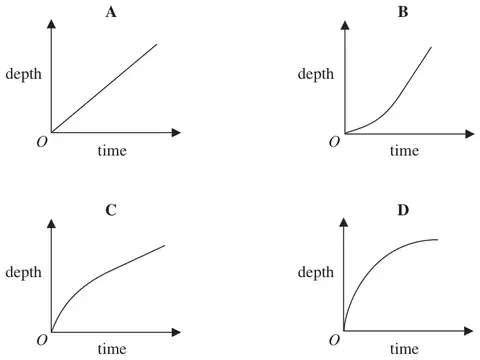
Here are four graphs.
(b) Write down the letter of the graph that best shows how the depth of the water in the pool above the line MN changes with time as the pool is filled. (1)
Mark scheme (a)
Answer
Mark
Notes
65
5
M1 for splitting up the cross section into separate areas and a method to find the area of one part OR for splitting up the pool into smaller prisms and a method to find the volume of one small prism, e.g. a cuboid M1 (dep) for a complete method to find the area of the cross section [with correct dimensions] OR for a method to find the total volume of more than one correct prism M1 (dep) for a complete method to find the volume of the pool [with correct dimensions] (= 195) M1 for \(\text{``}195\text{''} \times 1000 \div 50\) (=3900) oe where “195” comes from a volume A1 cao
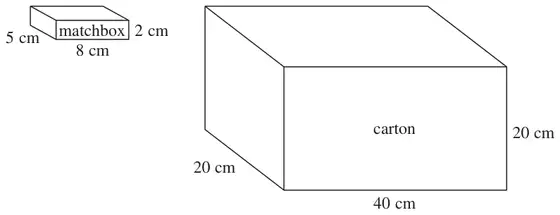
A matchbox is 5 cm by 8 cm by 2 cm. A carton is 20 cm by 40 cm by 20 cm.
The carton is completely filled with matchboxes.
Work out the number of matchboxes in the carton. (3)
Mark scheme
Answer
Mark
Notes
200
3
M1 for 20 × 40 × 20 (=16000) or 5 × 8 × 2 (=80) M1 (dep) for “16000” ÷ “80” A1 cao OR M1 attempt one division (eg 20 ÷ 5), may be implied by marks or number on one edge of diagram M1 (dep) for “(20 ÷ 5)” × “(40 ÷ 8)” × “(20 ÷ 2)” A1 cao
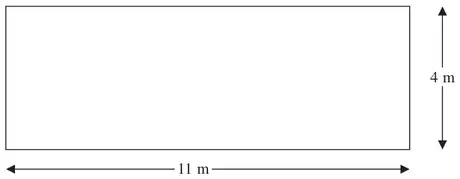
Martin is going to cover his driveway with gravel. The gravel will be 6 cm deep.
Gravel is sold in bags. There are 0.4 m\(^3\) of gravel in each bag. Each bag of gravel costs £38
Martin gets a discount of 30% off the cost of the gravel.
Work out the total amount of money Martin pays for the gravel. (5)
Mark scheme
Answer
Mark
Notes
186.20
5
M1 for use of consistent units to find volume, \(11 \times 4 \times 0.06\) (=2.64) or \(1100 \times 400 \times 6\) (=2640000) M1 (dep on vol calculation) for attempt to find number of bags needed, eg \(\text{``}2.64\text{''} \div 0.4\) (=6.6, 7) M1 for the cost of gravel before discount eg \(\text{``}6.6\text{''} \times 38\) or \(\text{``}7\text{''} \times 38\) M1 for attempt to find the total cost after discount \(\text{``}266\text{''} \times 0.7\) oe A1 for 186.2(0)
OR
M1 for cost of gravel per bag after discount, \(38 \times 0.7\) (=26.60) M1 for use of consistent units to find volume, \(11 \times 4 \times 0.06\) (=2.64) or \(1100 \times 400 \times 6\) (=2640000) M1 (dep on vol calculation) for attempt to find number of bags needed, eg \(\text{``}2.64\text{''} \div 0.4\) M1 for total cost of gravel after discount \(\text{``}7\text{''} \times \text{``}26.6\text{''}\) A1 for 186.2(0)
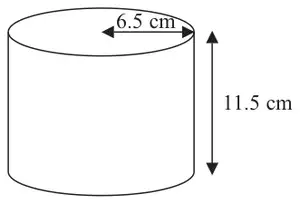
24 The diagram shows a large tin of pet food in the shape of a cylinder.
Diagram NOT accurately drawn
The large tin has a radius of 6.5 cm and a height of 11.5 cm.
A pet food company wants to make a new size of tin. The new tin will have a radius of 5.8 cm. It will have the same volume as the large tin.
Calculate the height of the new tin. Give your answer correct to one decimal place. (3)
Mark scheme
Answer
Mark
Notes
14.4
3
M1 for \(\pi \times 6.5^2 \times 11.5\) (=1526.42...) M1 (dep) for \(\dfrac{\text{‘}1526.42...\text{’}}{\pi \times 5.8^2}\) A1 for 14.4 - 14.5
OR
M1 for \(\dfrac{5.8}{6.5}\) or \(\dfrac{6.5}{5.8}\) or 0.89(23…) or 1.12(06896…) M1 for \(11.5 \div \left(\dfrac{5.8}{6.5}\right)^2\) or \(11.5 \times \left(\dfrac{6.5}{5.8}\right)^2\) A1 for 14.4 - 14.5
Notes
Corrected from the printed mark scheme, which shows the second method as \(11.5 \div \left(\dfrac{6.5}{5.8}\right)^2\); dividing by this gives 9.16, not the height.
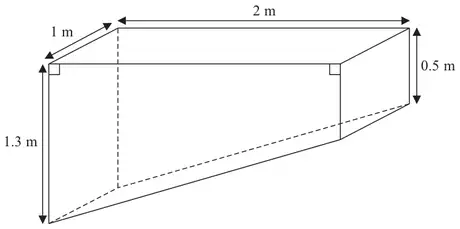
The pond is completely full of water. Sumeet wants to empty the pond so he can clean it. Sumeet uses a pump to empty the pond.
The volume of water in the pond decreases at a constant rate. The level of the water in the pond goes down by 20 cm in the first 30 minutes.
Work out how much more time Sumeet has to wait for the pump to empty the pond completely. (6)
Mark scheme
Answer
Mark
Notes
1 hour 45 mins
6
M1 for method to find volume of pond, eg \(\frac{1}{2}(1.3 + 0.5) \times 2 \times 1\) (= 1.8) M1 for method to find the volume of water emptied in 30 minutes, eg \(1 \times 2 \times 0.2\) (= 0.4), \(100 \times 200 \times 20\) (= 400000) A1 for correct rate, eg 0.8 m³/hr, 0.4 m³ in 30 minutes M1 for correct method to find total time taken to empty the pond, eg \(\text{``}1.8\text{''} \div \text{``}0.8\text{''}\) M1 for method to find extra time, eg 2 hrs 15 minutes − 30 minutes A1 for 1.75 hours, \(1\frac{3}{4}\) hours, 1 hour 45 mins or 105 mins
OR
M1 for method to find volume of water emptied in 30 minutes, eg. \(1 \times 2 \times 0.2\) (= 0.4), \(100 \times 200 \times 20\) (= 400000) M1 for method to work out rate of water loss eg. \(\text{``}0.4\text{''} \times 2\) A1 for correct rate, eg 0.8 m³/hr M1 for correct method to work out remaining volume of water eg. \(\frac{1}{2}(1.1 + 0.3) \times 2 \times 1\) (= 1.4) M1 for method to work out time, eg \(\text{``}1.4\text{''} \div \text{``}0.8\text{''}\) A1 for 1.75 hours, \(1\frac{3}{4}\) hours, 1 hour 45 mins or 105 mins
NB working could be in 3D or in 2D and in metres or cm throughout
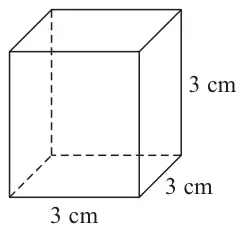
Work out the total surface area of the cuboid. (3)
Mark scheme
Answer
Mark
Notes
40.5
3
M1 for \(1.5 \times 6\) or \(1.5 \times 1.5\) M1 for adding area of 5 or 6 faces provided at least 3 are the correct area A1 cao NB: anything that leads to a volume calculation 0 marks.
M1 for a correct method to find the area of the cross section M1 (dep) for a complete correct method for the volume of the prism A1 cao OR M1 for a correct method to find the volume of one cuboid M1 (dep) for a complete correct method for the volume of the prism A1 cao
M1 for a correct method to find the area of the cross section M1 (dep) for a complete correct method for the volume of the prism A1 cao OR M1 for a correct method to find the volume of one cuboid M1 (dep) for a complete correct method for the volume of the prism A1 cao
M1 for 4×7 + 5×2 (=38) or 9×2 + 5×4 (=38) or 4×7×10 or (7×9 − 5×5) or 5×2×10 (=100) or 9×2×10 (=180) or 5×4×10 (=200) or 9×7×10 (=630) or 5×5×10 (=250) M1 (dep) for ‘38’×10 or 380 or 4×7×10 + 5×2×10 or 9×2×10 + 5×4×10 or ×10 A1 cao
12 Jane has a carton of orange juice. The carton is in the shape of a cuboid.
Diagram NOT accurately drawn
The depth of the orange juice in the carton is 8 cm.
Jane closes the carton. Then she turns the carton over so that it stands on the shaded face.
Work out the depth, in cm, of the orange juice now. (3)
Mark scheme
Working
Answer
Mark
Notes
6 × 10 × 8 = 480 480 ÷ (6 × 20) =
4
3
M1 for 6 × 10 × 8 or 480 seen M1 (dep) for ‘480’ ÷ (6 × 20) oe A1 cao OR M1 for 20 ÷ 10 (=2) or 10 ÷ 20 (\(= \frac{1}{2}\)) or \(\frac{8}{20}\) oe or \(\frac{20}{8}\) oe M1 (dep) for 8 ÷ ‘2’ or \(8 \times \frac{1}{2}\) or \(\frac{8}{20} \times 10\) oe or \(10 \div \frac{20}{8}\) A1 cao SC : B2 for answer of 16 coming from \(\dfrac{20 \times 8 \times 6}{10 \times 6}\) oe
\(\sqrt[3]{\text{their } \dfrac{125}{8}}\) or \(\dfrac{5}{2}\) or 2.5
M1dep
oe eg \((L = 2)\ \sqrt[3]{\text{their } \dfrac{125}{64}}\) or \(\dfrac{5}{4}\) or 1.25
\(2 \times 3 \times\) their \(2.5 + 2 \times 4 \times\) their 2.5 \(+\ 2 \times 5 \times\) their 2.5 \(+\ 3 \times 12 \times\) their 2.5
M1dep
oe eg \((L = 2)\) \(2 \times 6 \times\) their \(1.25 + 2 \times 8 \times\) their 1.25 \(+\ 2 \times 10 \times\) their 1.25 \(+\ 3 \times 24 \times\) their 1.25
150
A1
SC4 [119, 119.1]
Alternative method 2: works out a value of \(a\), \(b\), \(c\) or \(d\)
Correct expression for volume in terms of \(a\) or \(b\) eg \(\dfrac{1}{2} \times a \times \dfrac{4a}{3} \times \dfrac{12a}{3}\) or \(\dfrac{8a^3}{3}\) or \(\dfrac{1}{2} \times \dfrac{3b}{4} \times b \times \dfrac{12b}{4}\) or \(\dfrac{9b^3}{8}\)
M1
oe in terms of \(c\) or \(d\) eg \(\dfrac{1}{2} \times \dfrac{3c}{5} \times \dfrac{4c}{5} \times \dfrac{12c}{5}\) or \(\dfrac{72c^3}{125}\) or \(\dfrac{1}{2} \times \dfrac{3d}{12} \times \dfrac{4d}{12} \times d\) or \(\dfrac{d^3}{24}\) may be implied by an equation eg \(a \times \dfrac{4a}{3} \times \dfrac{12a}{3} = 1125 \times 2\)
\(a^3 = 1125 \div\) their \(\dfrac{8}{3}\) or \(a^3 = \dfrac{3375}{8}\) or \(b^3 = 1125 \div\) their \(\dfrac{9}{8}\) or \(b^3 = 1000\)
M1dep
oe eg \(c^3 = 1125 \div\) their \(\dfrac{72}{125}\) or \(c^3 = \dfrac{15\,625}{8}\) or \(d^3 = 1125 \div\) their \(\dfrac{1}{24}\) or \(d^3 = 27\,000\)
\(a = \sqrt[3]{\text{their } \dfrac{3375}{8}}\) or \(a = 7.5\) or \(b = \sqrt[3]{1000}\) or \(b = 10\)
M1dep
oe eg \(c = \sqrt[3]{\text{their } \dfrac{15\,625}{8}}\) or \(c = 12.5\) or \(d = \sqrt[3]{27\,000}\) or \(d = 30\)
\(2 \times\) their \(a + 2 \times \dfrac{4}{3} \times\) their \(a\) \(+\ 2 \times \dfrac{5}{3} \times\) their \(a + 3 \times \dfrac{12}{3} \times\) their \(a\) or \(2 \times \dfrac{3}{4} \times\) their \(b + 2 \times\) their \(b\) \(+\ 2 \times \dfrac{5}{4} \times\) their \(b + 3 \times 3 \times\) their \(b\)
M1dep
oe correct method using their \(c\) or their \(d\)
150
A1
SC4 [119, 119.1]
Additional guidance
Up to M3 may be awarded for correct work with no answer or incorrect answer, even if this is seen amongst multiple attempts
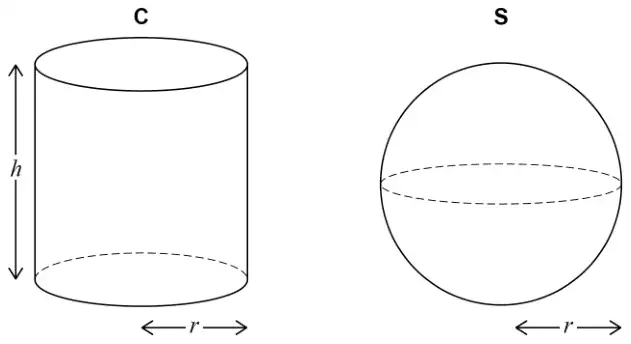
21 A cylinder, C, and a sphere, S, each have radius \(r\)
C has height \(h\)
Volume of a sphere \(= \dfrac{4}{3}\pi r^3\) where \(r\) is the radius
(a) volume of C \(=\) volume of S
Work out the ratio \(\quad r : h\)
You must show your working. [3 marks]
(b) A different cylinder has radius \(3r\) and height \(2h\).
How many times bigger is the volume of this cylinder than the volume of C? [2 marks]
Mark scheme (a)
Answer
Mark
Comments
Alternative method 1
\(\dfrac{4}{3}\pi r^3 = \pi r^2 h\)
M1
\(\dfrac{4}{3}r = h\) or \(4r = 3h\)
M1dep
oe equation with \(\pi\) and \(r^2\) cancelled
3 : 4 with M2 awarded
A1
oe ratio eg \(\dfrac{3}{4} : 1\) or \(1 : \dfrac{4}{3}\) accept 1.33 or better for \(\dfrac{4}{3}\)
Alternative method 2
\(\dfrac{4}{3}\pi r^3 = \pi r^2 h\) or substitution of the same value of \(r\) into \(\dfrac{4}{3}\pi r^3\) and \(\pi r^2 h\)
M1
the substitution must be shown
Substitution of the same value of \(r\) into \(\dfrac{4}{3}\pi r^3\) and \(\pi r^2 h\) and correct value of \(h\) for their value of \(r\)
A1
the substitution must be shown their \(h\) should be exactly \(\dfrac{4}{3} \times\) their \(r\) eg \(r = 2\) and \(h = \dfrac{8}{3}\) (oe fraction) do not allow rounded values
3 : 4 with M1A1 awarded
A1
oe ratio eg \(\dfrac{3}{4} : 1\) or \(1 : \dfrac{4}{3}\) accept 1.33 or better for \(\dfrac{4}{3}\)
Additional guidance
Accept \(h : r = 4 : 3\) for final mark with M2 or M1A1 awarded
Mark scheme (b)
Answer
Mark
Comments
\((\pi)(3r)^2(2h)\) or \(3^2 \times 2\)
M1
oe ft their formula for a cylinder from part (a) in the form \(k\pi r^2 h\) with \(k\) as a positive constant
18
A1
Additional guidance
Answer 18 from choosing values for \(r\) and \(h\) eg \(\pi \times 3^2 \times 4 = 36\pi\) and \(\pi \times 9^2 \times 8 = 648\pi\) and \(648\pi \div 36\pi = 18\)
Correct method or evaluation of the area of any face or correct method or evaluation of the volume of any relevant cuboid of length 6 cm
M1
eg \(5 \times 6\) or 30 or \(2 \times 6\) or 12 or \(3 \times 6\) or 18 or \(4 \times 6\) or 24 or \(2 \times 5 + 2 \times 2\) or \(10 + 4\) or 14 or \(2 \times 5 \times 6\) or 60 or \(2 \times 2 \times 6\) or 24 or \(2 \times 3 \times 6\) or 36 or \(4 \times 2 \times 6\) or 48 or \(5 \times 4 \times 6\) or 120
Correct method for volume of prism
M1dep
eg \(2 \times 5 \times 6 + 2 \times 2 \times 6\) or \(60 + 24\) or \(14 \times 6\)
84
A1
Additional guidance
The first M1 may be awarded even if this is seen amongst multiple attempts
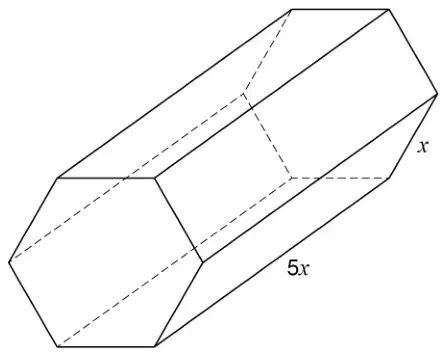
23 A chocolate box in the shape of a prism is being designed.
All lengths are in centimetres.
The cross section is a regular hexagon with side \(x\) The length is \(5x\)
An expression for the area of the cross section, in cm\(^2\), is \(\;\dfrac{3\sqrt{3}}{2}x^2\)
The total surface area of the box must be less than 650 cm\(^2\)
Work out the largest possible integer value of \(x\).
You must show your working. [4 marks]
Mark scheme
Answer
Mark
Comments
\(x \times 5x\) or \(5x^2\)
M1
oe may be implied eg \(30x^2\)
\(2 \times \dfrac{3\sqrt{3}}{2}x^2 + 6 \times x \times 5x\) or \(3\sqrt{3}\,x^2 + 30x^2\)
M1dep
oe eg \(35.19(6…)x^2\) or \(35.2x^2\)
\(650 \div (3\sqrt{3} + 30)\) or [18.4, 18.5] or [4.2, 4.3] or \(3\sqrt{3} \times 4^2 + 30 \times 4^2\) or 563.(…) and \(3\sqrt{3} \times 5^2 + 30 \times 5^2\) or 879.(…) or 880
M1dep
oe dep on M2 calculation or [18.4, 18.5] may be seen in a square root
trials \(x = 4\) and \(x = 5\) ignore substitution of other integer values of \(x\)
Correct method or evaluation of the area of any face or correct method or evaluation of the volume of any relevant cuboid of length 6 cm
M1
eg \(5 \times 6\) or 30 or \(2 \times 6\) or 12 or \(3 \times 6\) or 18 or \(4 \times 6\) or 24 or \(2 \times 5 + 2 \times 2\) or \(10 + 4\) or 14 or \(2 \times 5 \times 6\) or 60 or \(2 \times 2 \times 6\) or 24 or \(2 \times 3 \times 6\) or 36 or \(4 \times 2 \times 6\) or 48 or \(5 \times 4 \times 6\) or 120
Correct method for volume of prism
M1dep
eg \(2 \times 5 \times 6 + 2 \times 2 \times 6\) or \(60 + 24\) or \(14 \times 6\)
84
A1
Additional guidance
The first M1 may be awarded even if this is seen amongst multiple attempts
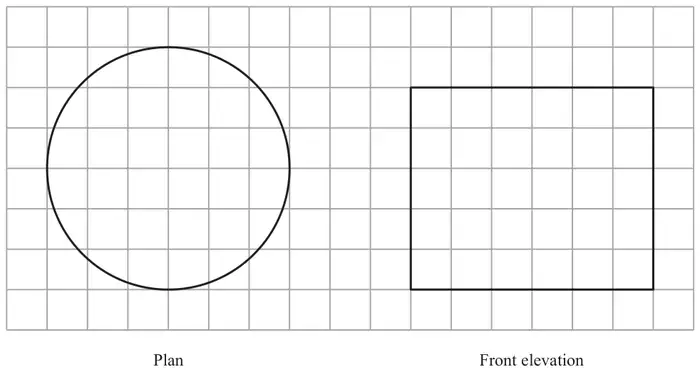
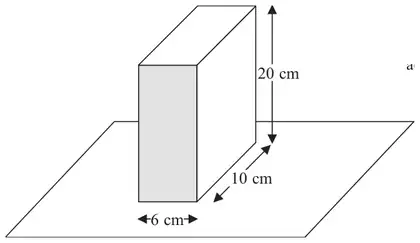
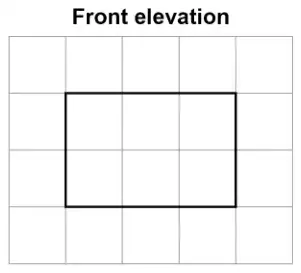
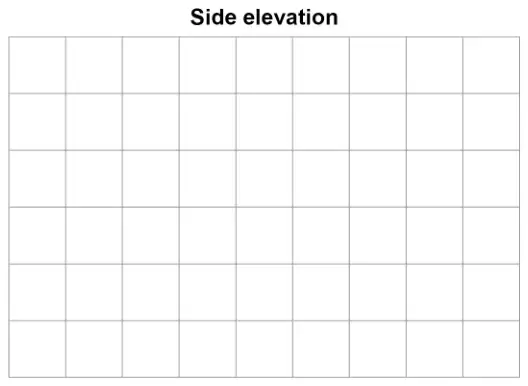
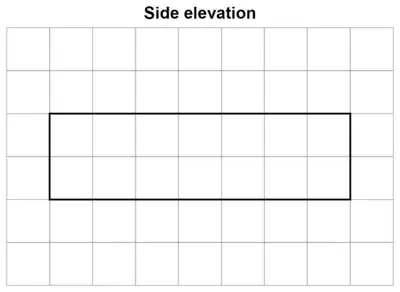
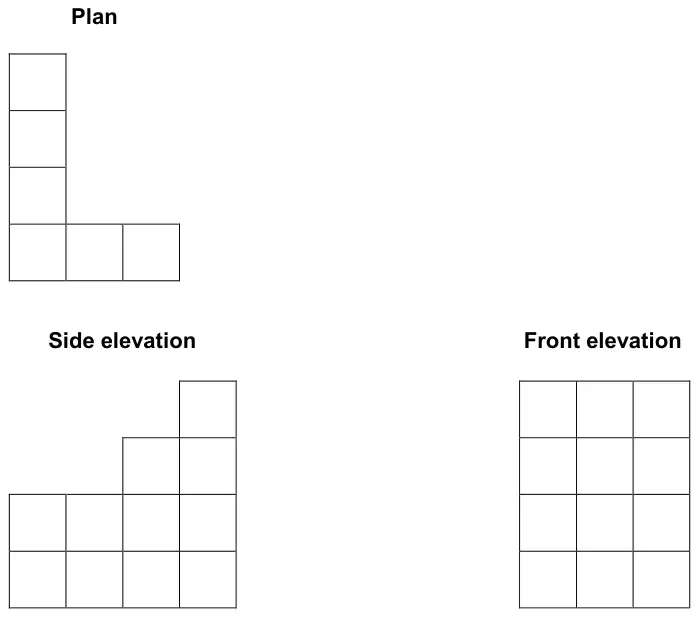
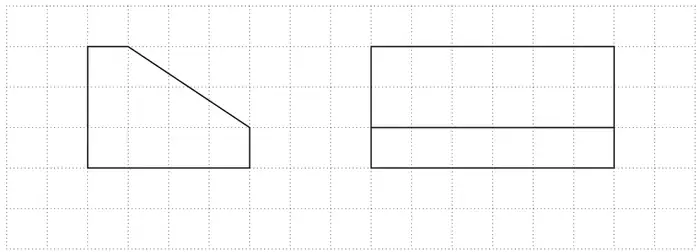
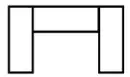
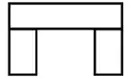
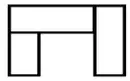
Here are the plan, side elevation and front elevation of the shape.
Centimetre cubes are added to make this cuboid.
How many cubes are added? [3 marks]
Mark scheme
Answer
Mark
Comments
29
B3
B2 answer 27, 28, 30 or 31 B1 answer 25, 26, 32 or 33 or \(4 \times 4 \times 3\) or 48 (total cubes) or \(2 \times 3 \times 4\) or 24 (missing cuboid) or 19 seen (cubes in original shape)
Additional guidance
Beware of 29 or close to 29 arising from (clear) adding of the squares in the original diagrams. This alone is B0, however B1 can still be scored for either 48, 24 or 19 (or the appropriate products leading to 48 or 24)
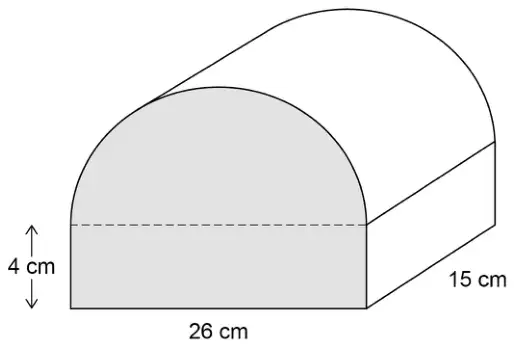
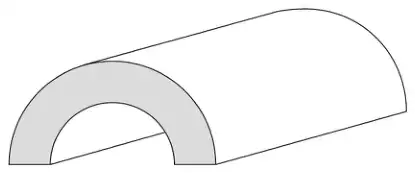
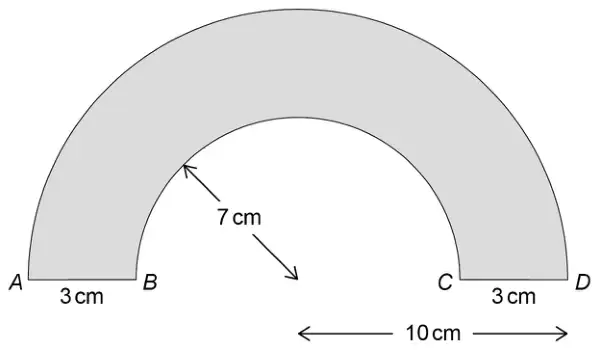
The diagram below shows the cross section of the tunnel.
Not drawn accurately
\(AD\) is a semicircular arc of radius 10 cm \(BC\) is a semicircular arc of radius 7 cm The length of the tunnel is 30 cm
Work out the total area of all six faces of the tunnel.
Give your answer in terms of \(\pi\). [5 marks]
Mark scheme
Answer
Mark
Comments
\(\pi \times 10^2 - \pi \times 7^2\) or \(100\pi - 49\pi\) or \(51\pi\) or \(\dfrac{1}{2} \times \pi \times 10^2 - \dfrac{1}{2} \times \pi \times 7^2\) or \(\dfrac{1}{2} \times 100\pi - \dfrac{1}{2} \times 49\pi\) or \(\dfrac{1}{2} \times 51\pi\) or \(25.5\pi\)
M1
oe implied by \(102\pi\) method to work out front and/or back faces – must not be part of a method to work out volume (\(\times\) 30) may be taken to be full circles
\(2 \times \pi \times 10 \times 30\) or \(600\pi\) or \(\dfrac{1}{2} \times 2 \times \pi \times 10 \times 30\) or \(300\pi\) or \(2 \times \pi \times 7 \times 30\) or \(420\pi\) or \(\dfrac{1}{2} \times 2 \times \pi \times 7 \times 30\) or \(210\pi\) or \(1020\pi\) or \(510\pi\)
M1
oe method to work out outer and/or inner curved surfaces may be taken to be full circles \(1122\pi\) implies M1M1
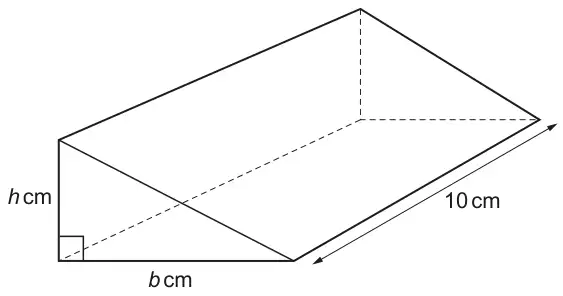
The cross-section of the prism is a right-angled triangle. The base, \(b\) cm, is 2 cm longer than the height, \(h\) cm. The volume of the prism is 240 cm3.
A student is explaining how they worked out the value of \(b\).
They say
\(b\) is 6 because that means \(h\) is 4 and \(6 \times 4 \times 10 = 240\).
Describe the student’s error and find the correct value of \(b\). [3]
Mark scheme
Answer
Marks
Part marks and guidance
Correct explanation \(\dfrac{1}{2}\) omitted from the area of the cross section oe
1
See appendix Do not ignore incorrect statements
8
2
M1 for \(\dfrac{1}{2} \times b \times h = 24\) seen, either as a formula or with values
M1 implied by \(b \times h = 48\) or a correct factor pair of 48 or e.g. \(h(h+2) = 48\) oe M1 may be seen in their explanation of the error
Appendix
Exemplar responses for Q20
Response
Mark
Has found [the volume of] a cuboid
1
He needs to halve the volume of a cuboid (BOD referring to the calculation rather than 240)
1
They forgot to ÷2 to work out the area of the front face
1
He did not divide the [area of the] cross section by 2
1
She did not do half base times height
1
The area of the cross section is ½ b × h
1
The area of the triangle needs to be halved
1
It has the cross section of a triangle so it needs to be divided by 2 (referring to cross section)
1
That the student has to divide h × b by 2
1
It’s a triangle, they didn’t half 24 after they did 4 × 6
1
So it would be 6 × 4 / 2 = 12
1
6 × 4 / 2 × 10 = 120 (BOD describes that triangle should be divided by 2)
1
He forgot to half the 10 (incorrect – needs to refer to triangle area)
0
They didn’t find the area of the triangle before ×10 (not sufficient does not describe the error)
0
The student did not work out that it is a triangle (similar to above)
0
Calculated a cube instead of a triangle (incorrect)
0
He did not halve it (not referring to what the ‘it’ is)
0
They did not multiply the volume by 2 (the volume is given as 240)
0
He did not divide the volume by 2
0
Wrong formula
0
They did not halve the answer (not specific to the cross section)
0
They needed to divide by 2 (not specific to cross section)
The cross-section of the prism is a right-angled triangle. The base, \(b\) cm, is 2 cm longer than the height, \(h\) cm. The volume of the prism is 240 cm3.
A student is explaining how they worked out the value of \(b\).
They say
\(b\) is 6 because that means \(h\) is 4 and 6 × 4 × 10 = 240.
Describe the student’s error and find the correct value of \(b\). [3]
Mark scheme
Answer
Marks
Part marks and guidance
Correct explanation \(\frac{1}{2}\) omitted from the area of the cross section oe
1
See appendix 1 Do not ignore incorrect statements
8
2
M1 for \(\frac{1}{2} \times b \times h = 24\) seen, either as a formula or with values
M1 implied by \(b \times h = 48\) or a correct factor pair of 48 or e.g. \(h(h + 2) = 48\) oe M1 may be seen in their explanation of the error
Appendix 1: exemplar responses for Q4
Response
Mark
1
Has found [the volume of] a cuboid
1
2
He needs to halve the volume of a cuboid (BOD referring to the calculation rather than 240)
1
3
They forgot to ÷2 to work out the area of the front face
1
4
He did not divide the [area of the] cross section by 2
1
5
She did not do half base [times height]
1
6
The area of the cross section is ½ \(b \times h\)
1
7
The area of the triangle needs to be halved
1
8
It has the cross section of a triangle so it needs to be divided by 2 (referring to cross section)
1
9
That the student has to divide \(h \times b\) by 2
1
10
It’s a triangle, they didn’t half 24 after they did 4 × 6
1
11
So it would be 6 × 4 / 2=12
1
12
6 × 4 / 2 × 10 =120 (BOD describes that triangle should be divided by 2)
1
13
He forgot to half the 10 (incorrect – needs to refer to triangle area)
0
14
They didn’t find the area of the triangle before ×10 (not sufficient does not describe the error)
0
15
The student did not work out that it is a triangle. (similar to above)
0
16
Calculated a cube instead of a triangle (incorrect)
0
17
He did not halve it (not referring to what the ‘it’ is)
0
18
They did not multiply the volume by 2 (the volume is given as 240)
0
19
He did not divide the volume by 2
0
20
Wrong formula
0
21
They did not halve the answer (not specific to the cross section)
0
22
They needed to divide by 2 (not specific to cross section)
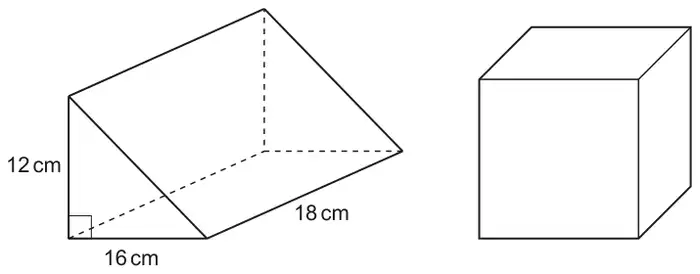
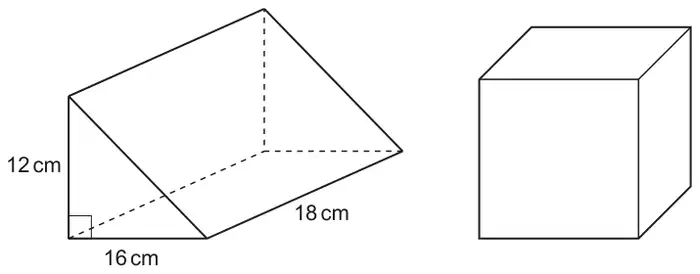
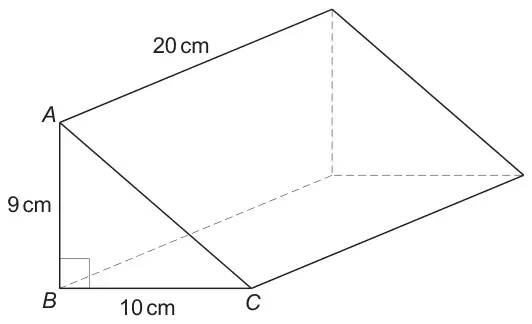
26 The diagram shows a triangular prism and a cube. The ends of the prism are right-angled triangles with base 16 cm and height 12 cm. The prism is 18 cm long.
The volume of the prism is equal to the volume of the cube. Find the surface area of the cube. You must show your working. [6]
Mark scheme
Answer
Marks
Part marks and guidance
864 with correct working
6
M1 for \(\dfrac{12 \times 16}{2} \times 18\) oe A1 for 1728 or M1 for \(\dfrac{12 \times 16}{2}\) oe
AND
M1 for \(\sqrt[3]{\textit{their } 1728}\) A1 for 12
AND
M1 for \(6 \times (\textit{their } 12)^2\)
If 0, 1 or 2 scored, instead award SC3 for 864 as final answer with no working or insufficient working
If 0 or M1 scored, instead award SC2 for 12 seen as dimension of cube or \(\left(\sqrt[3]{3456}\right)^2 \times 6\) soi 1371 to 1372 with no working or insufficient working
If 0 scored, award SC1 for 1728 or \(\sqrt[3]{3456}\) soi 15.1[…] with no working or insufficient working
“correct working” requires at least M1M1
Accept e.g. \(12 \times 8 \times 18\) or \(96 \times 18\)
Allow \(12^3 = 1728\) for M1A1 1728 must be from correct method for volume of triangular prism
their 12 must come from use of volume of triangular prism and cube root
10 The diagram shows a triangular prism and a cube. The ends of the prism are right-angled triangles with base 16 cm and height 12 cm. The prism is 18 cm long.
The volume of the prism is equal to the volume of the cube.
Find the surface area of the cube. You must show your working. [6]
Mark scheme
Answer
Marks
Part marks and guidance
864 with correct working
6
M1 for \(\dfrac{12 \times 16}{2} \times 18\) A1 for 1728 or M1 for \(\dfrac{12 \times 16}{2}\)
“correct working” requires at least M1M1 Accept e.g. 12 × 8 × 18 or 96 × 18 Allow \(12^3 = 1728\) for M1A1
AND M1 for \(\sqrt[3]{\textit{their } 1728}\) A1 for 12
Their 1728 must be from correct method for volume of triangular prism
AND M1 for \(6 \times (\textit{their } 12)^2\)
Their 12 must come from use of volume of triangular prism and cube root
If 0, 1 or 2 scored, instead award SC3 for 864 as final answer with no working or insufficient working If 0 or M1 scored, instead award SC2 for 12 seen as dimension of cube or \((\sqrt[3]{3456})^2 \times 6\) soi 1371 to 1372 with no working or insufficient working If 0 scored, award SC1 for 1728 or \(\sqrt[3]{3456}\) soi 15.1[…] with no working or insufficient working
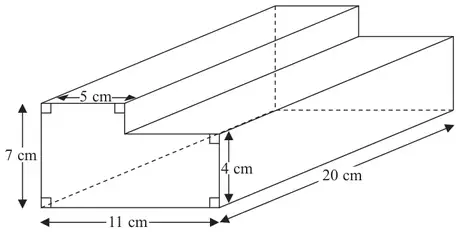
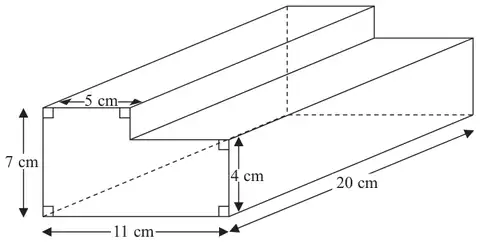
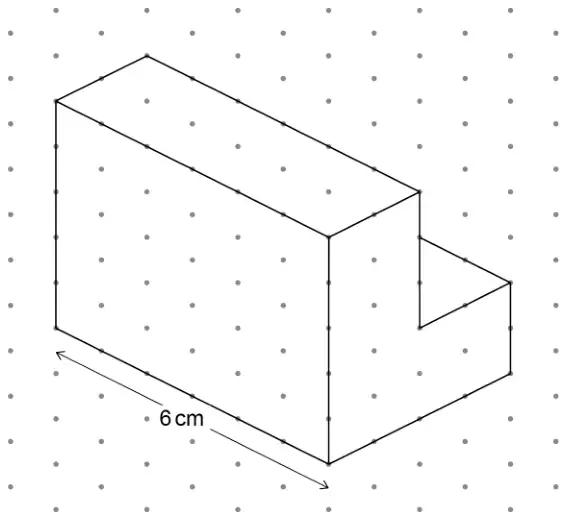
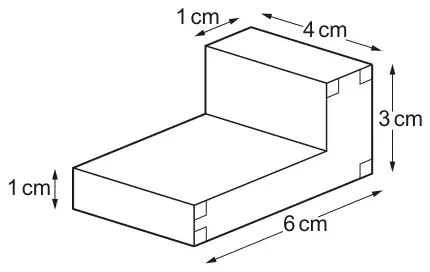
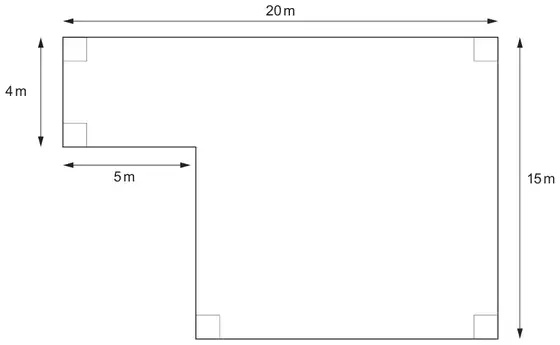
M2 for correct method to find area of L shaped face e.g 6 × 3 – 5 × 2 or M1 for finding one of the relevant partial lengths of 2 or 5 M1 for their area × 4
M1 could be on diagram
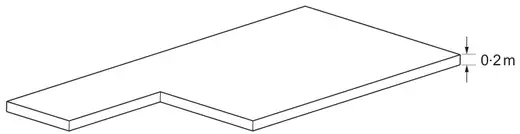
OR M1 for 3 × 4 × 1 M1 for 5 × 4 × 1 A1 for 12 or 20
Treat extra volumes as choice A1 Implies M1 Mark as oe for other correct products if split into two different cuboids that make the solid
OR M1 for 6 × 3 × 4 M1 for 2 × 5 × 4 A1 for 72 or 40
Not 6 × 3 × 4 × 1 × 1 Treat extra volumes as choice A1 implies M1 unless 72 comes from 6 × 3 × 4 × 1 × 1
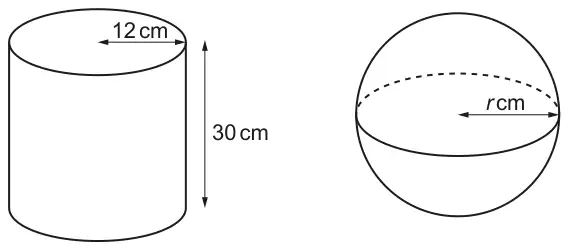
The cylinder has radius 12 cm and height 30 cm. The cylinder and the sphere have the same volume.
Work out the radius \(r\) cm of the sphere.
[The volume \(V\) of a sphere with radius \(r\) is \(V = \frac{4}{3}\pi r^3\).] [5]
Mark scheme
Answer
Marks
Part marks and guidance
14.79 to 14.8
5
M2 for \(\pi \times 12^2 \times 30\) soi by 13 564 to 13 574 or M1 for \(\pi \times 12^2\) soi 452 to 453 B1 for \(\frac{4}{3}\pi r^3\) = their 13 571 M1 for their 13 571 ÷ \(\frac{4}{3}\pi\) or 3240
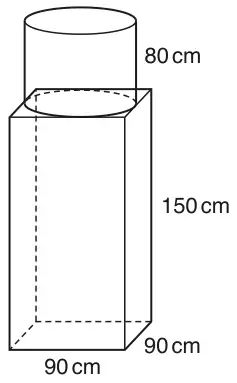
A sculpture is formed from a cylinder resting on top of a cuboid. The cylinder has radius 45 cm and height 80 cm. The cuboid measures 90 cm by 90 cm by 150 cm.
The sculpture is made of granite. The granite has a density of 2.7 g/cm\(^3\).
Calculate the total mass of the sculpture in tonnes. [5]
Mark scheme
Answer
Marks
Part marks and guidance
4.653 to 4.655 or 4.65 or 4.7 or 5
5
Volume of cuboid M1 for \(90 \times 90 \times 150\) soi 1 215 000
Volume of cylinder M1 for \(\pi \times 45^2 \times 80\) soi 508 680 to 509 004
Total volume M1 for their 1 215 000 + their 508 938.1 soi 1 723 680 to 1 723 938.1
Find mass using density M1 for any of their volumes \(\times\) 2.7
Answers of 4.7 or 5 require supporting working
Answers from values of \(\pi\) \(\pi\) = 508 938.0099 3.142 = 509 004 3.14 = 508 680
Their volumes must be seen to come from the product of three relevant lengths
Dependent on a calculated volume for cuboid, cylinder or total If total consists of one volume and one non-volume but is \(\times\) 2.7, final M1 scored
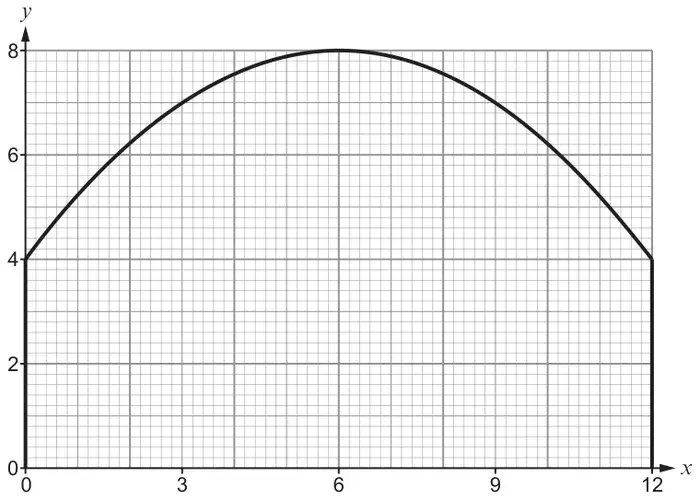
23. In this question, \(x\) and \(y\) are horizontal and vertical distances in metres. An engineer designs a tunnel. He models the uniform cross-section of this tunnel using the graph shown in the diagram.
The tunnel is 50 metres long and will cost £250 per m3 to excavate.
Use the graph with four vertical strips of equal width to calculate an estimate of the cost of excavating this tunnel. [6]
May be embedded in further work Or equivalent correct calculation e.g. \(\tfrac{1}{2} \times 3 \times (4 + 4 + 2(7 + 8 + 7))\)
OR for the sum of the compounded areas (formed by splitting of the correct trapezia) e.g. (12+4.5)+(21+1.5)+(21+1.5)+(12+4.5) from using rectangles and triangles
M2 for the sum of the 4 correct trapezium areas with at most one error (possibly repeated) in the y-values OR for the sum of the compounded areas (formed by splitting of the correct trapezia) with at most one error (possibly repeated) e.g. rectangles and triangles
M1 for the sum of the 4 correct trapezium areas with at most 2 errors included (possibly repeated) errors in the y-values OR for the sum of the compounded areas (formed by splitting of the correct trapezia) with at most 2 errors (possibly repeated)
Note: If including the volume, values are: 2(825 + 1125) = 3900 If including volume and cost, values are: 2(206250 + 281250) = 975000
78 (m2)
A1
CAO
78 \(\times\) 50 \(\times\) 250
M1
FT If no marks awarded FT ‘their area’ if in the range 76-80 providing answer derived from incorrect ‘trapezia’
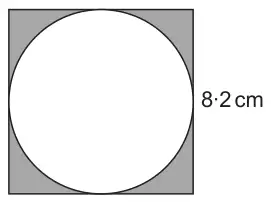
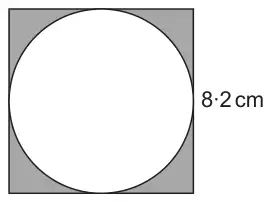
M2 for sight of (area of circle =) \(\pi\times\left(\dfrac{8.2}{2}\right)^2\;(= 52.81....)\) oe or M1 for sight of (area of square =) 8.22 (= 67.24) AND for (radius of circle =) 4.1 (look on diagram) May be embedded in an incorrect calculation
M2 for sight of (area of circle =) \(\pi \times \left(\dfrac{8.2}{2}\right)^2\ (= 52.81\ldots.)\) oe or M1 for sight of (area of square =) 8.22 (= 67.24) AND for (radius of circle =) 4.1 (look on diagram) May be embedded in an incorrect calculation
Tick (✓) the two correct statements about \(3xy(y + 2) \equiv 3xy^2 + 6xy\). [2]
It is an equation.
It is true for all values of \(x\) and \(y\).
It is an identity.
It is only true for certain values of \(x\) and \(y\).
It is an inequality.
It is true for only one value of \(x\) and one value of \(y\).
(b)
In this part of the question all lengths are in centimetres.
Diagram not drawn to scale
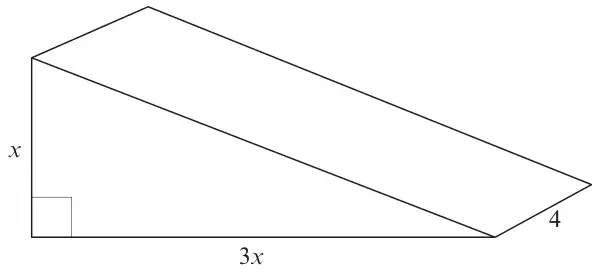
The diagram shows a prism. The cross-section of the prism is a triangle with height \(x\) and base \(3x\). The volume of the prism is \(216\,\text{cm}^3\).
Use an algebraic method to find the height of the triangle. [5]
Mark scheme (a)
Scheme
Marks
Comments
Second and third statements indicated and no others
B2
Award B1 for one of the following:
One correct statement and up to one incorrect statement indicated
Two correct statements and exactly one incorrect statement indicated
Mark scheme (b)
Scheme
Marks
Comments
May be done in parts
(Area of cross-section = ) \(\frac{1}{2} \times 3x \times x\)
M1
Accept \(\frac{1}{2}\) base x height oe
(Volume = ) \(\frac{1}{2} \times 3x \times x \times 4\)
M1
FT ‘their \(\frac{1}{2} \times 3x \times x\)’ \(\times\) 4, provided at least two terms in \(x\).
\(\frac{1}{2} \times 3x \times x \times 4 = 216\) oe
A1
CAO
\(x^2 = 216 \times 2 \div 4 \div 3\) (= 36)
M1
FT ‘their \(k\)’\(\times x^2 = 216\)
6 (cm)
A1
Mark final answer. FT Final 2 marks can be awarded if trials used on an equation of the form ‘their \(k\)’\(\times x^2 = 216\) to find a correct or correct FT answer. If \(x^2\) is a square number, \(x\) must be given as a whole number. Otherwise, it may be written as an unsimplified surd.
(7)
Alternative
Scheme
Marks
Comments
(Area of cross-section = ) \(216 \div 4\) (=54)
B1
(Area of cross-section = ) \(\frac{1}{2} \times 3x \times x\)
M1
Accept \(\frac{1}{2}\) base x height oe
\(\frac{1}{2} \times 3x \times x = 54\) oe,
A1
CAO
\(x^2 = 54 \times 2 \div 3\) (= 36)
M1
FT ‘their \(k\)’\(\times x^2\) = ‘their 54’
6 (cm)
A1
Mark final answer. FT Final 2 marks can be awarded if trials used on an equation of the form ‘their \(k\)’\(\times x^2\) = ‘their 54’ to find a correct or correct FT answer If \(x^2\) is a square number, \(x\) must be given as a whole number. Otherwise, it may be written as an unsimplified surd.
Notes
If no marks award SC3 for a complete correct method using trials leading to an answer of 6
OR SC2 for a correct trial with height > 3, e.g. \(\frac{1}{2} \times 15 \times 5 \times 4\) (and comparison with 216) si OR a correct trial with height > 3. e.g. \(\frac{1}{2} \times 15 \times 5\) and comparison with 54 si
(a) Tick (✓) the two correct statements about \(3xy(y + 2) \equiv 3xy^2 + 6xy\). [2]
It is an equation.
It is true for all values of \(x\) and \(y\).
It is an identity.
It is only true for certain values of \(x\) and \(y\).
It is an inequality.
It is true for only one value of \(x\) and one value of \(y\).
(b) In this part of the question all lengths are in centimetres.
Diagram not drawn to scale
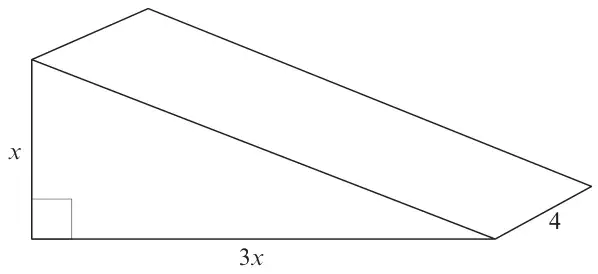
The diagram shows a prism. The cross-section of the prism is a triangle with height \(x\) and base \(3x\). The volume of the prism is 216 cm3.
Use an algebraic method to find the height of the triangle. [5]
Mark scheme (a)
Scheme
Marks
Comments
Second and third statements indicated and no others
B2
Award B1 for one of the following:
One correct statement and up to one incorrect statement indicated
Two correct statements and exactly one incorrect statement indicated
Mark scheme (b)
Scheme
Marks
Comments
May be done in parts
(Area of cross-section =) \(\tfrac12 \times 3x \times x\)
M1
Accept ½ base x height oe
(Volume =) \(\tfrac12 \times 3x \times x \times 4\)
M1
FT ‘their \(\tfrac12 \times 3x \times x\)’ \(\times\, 4\), provided at least two terms in \(x\).
\(\tfrac12 \times 3x \times x \times 4 = 216\) oe
A1
CAO
\(x^2 = 216 \times 2 \div 4 \div 3\ (= 36)\)
M1
FT ‘their \(k\)’\(\times x^2 = 216\)
6 (cm)
A1
Mark final answer. FT Final 2 marks can be awarded if trials used on an equation of the form ‘their \(k\)’\(\times x^2 = 216\) to find a correct or correct FT answer. If \(x^2\) is a square number, \(x\) must be given as a whole number. Otherwise, it may be written as an unsimplified surd.
Alternative method
Scheme
Marks
Comments
(Area of cross-section =) \(216 \div 4\ (=54)\)
B1
(Area of cross-section =) \(\tfrac12 \times 3x \times x\)
M1
Accept ½ base x height oe
\(\tfrac12 \times 3x \times x = 54\) oe,
A1
CAO
\(x^2 = 54 \times 2 \div 3\ (= 36)\)
M1
FT ‘their \(k\)’\(\times x^2 =\) ‘their 54’
6 (cm)
A1
Mark final answer. FT Final 2 marks can be awarded if trials used on an equation of the form ‘their \(k\)’\(\times x^2 =\) ‘their 54’ to find a correct or correct FT answer If \(x^2\) is a square number, \(x\) must be given as a whole number. Otherwise, it may be written as an unsimplified surd.
Notes
If no marks award SC3 for a complete correct method using trials leading to an answer of 6 OR SC2 for a correct trial with height > 3, e.g. \(\tfrac12 \times 15 \times 5 \times 4\) (and comparison with 216) si OR a correct trial with height > 3. e.g. \(\tfrac12 \times 15 \times 5\) and comparison with 54 si
(b) The triangle is the cross-section of the prism shown.
Diagram not drawn to scale
Calculate the volume of the prism. [1]
(c) Another triangular prism has the same cross-section as the one in (b). The length of the prism is 50 mm. Without finding the volume of this prism, explain why it has a greater volume than the prism in part (b). [1]
Mark scheme (a)
Scheme
Marks
Comments
½ (8 x 5.5) = 22 (\(\text{cm}^2\))
M1 A1
Mark scheme (b)
Scheme
Marks
Comments
(22 x 4.5) = 99 (\(\text{cm}^3\))
B1
FT ‘their 22’ correctly evaluated.
Mark scheme (c)
Scheme
Marks
Comments
Explains that 50mm is bigger than 4.5cm, the other measurements have not changed so the volume must be bigger. Or equivalent.
12. The diagram shows the aerial view of a hotel swimming pool.
Diagram not drawn to scale
A poster at the swimming pool gives the following information.
Diagram not drawn to scale
The swimming pool is filled to the top with water.
Calculate the possible volume of the water in the swimming pool. Give your answer in m3.
You must state any assumption you make in calculating the volume.
Show how this assumption impacts on your solution. [6]
Mark scheme
Scheme
Marks
Comments
Idea to work with the area of the cross-section × width of the pool
S1
Area of the cross-section, e.g. trapezium \(\tfrac12(1.4 + 2.2) \times 20\), or 2 rectangles \(x \times 1.4 + (20 - x) \times 2.2\) where \(x\) is a value used \(\lt 20\), or other more complex split of areas
M1
Candidates may split the area into a number of trapezia or rectangles Allow 1 slip or 1 error
Area of cross-section \(\times\ 12\)
m1
Volume, e.g. Using: Trapezium or 2 rectangles \(x = 10\) 432 (m3), Two rectangles \(x = 8\) 451.2 (m3), Two rectangles \(x = 12\) 412.8 (m3)
A1
Volume calculated correctly Do not FT from 1 slip or 1 error
Two rectangles \(x = 1\) 518.4 (m3) Two rectangles \(x = 19\) 345.6 (m3)
Assumption, e.g. correct description of the pool floor used, i.e. cross-section is a trapezium or split into rectangles, OR e.g. correct description of the sides being vertical
E1
FT provided S1 awarded
Showing or describing the impact of the assumption, with the actual volume possibly being the same or greater or less than the one calculated
14. A solid triangular prism is placed along the bottom of a door to stop draughts. The length of the triangular prism is equal to the width of the door.
The triangular prism is shown below.
Diagram not drawn to scale
The volume of the triangular prism is 546 cm3. Calculate the width of the door. You must show all your working. [3]
From the formula list: Volume of prism = area of cross-section × length
Mark scheme
Scheme
Marks
Comments
(Width of the door) 546 ÷ (½ × 3 × 4)
M2
M1 for the area of the cross-section ½ × 3 × 4 (= 6)
91 (cm)
A1
CAO. Mark final answer
If no marks, award SC2 for (546 ÷ (3 × 4) =) 45.5 (cm) or SC1 for 546 ÷ (3 × 4)
8. A solid triangular prism is placed along the bottom of a door to stop draughts. The length of the triangular prism is equal to the width of the door.
The triangular prism is shown below.
Diagram not drawn to scale
The volume of the triangular prism is 546 cm3. Calculate the width of the door. You must show all your working. [3]
From the formula list: Volume of prism = area of cross-section × length
Mark scheme
Scheme
Marks
Comments
(Width of the door) 546 ÷ (½ × 3 × 4)
M2
M1 for the area of the cross-section ½ × 3 × 4 (= 6)
91 (cm)
A1
CAO. Mark final answer
If no marks, award SC2 for (546 ÷ (3 × 4) =) 45.5 (cm) or SC1 for 546 ÷ (3 × 4)
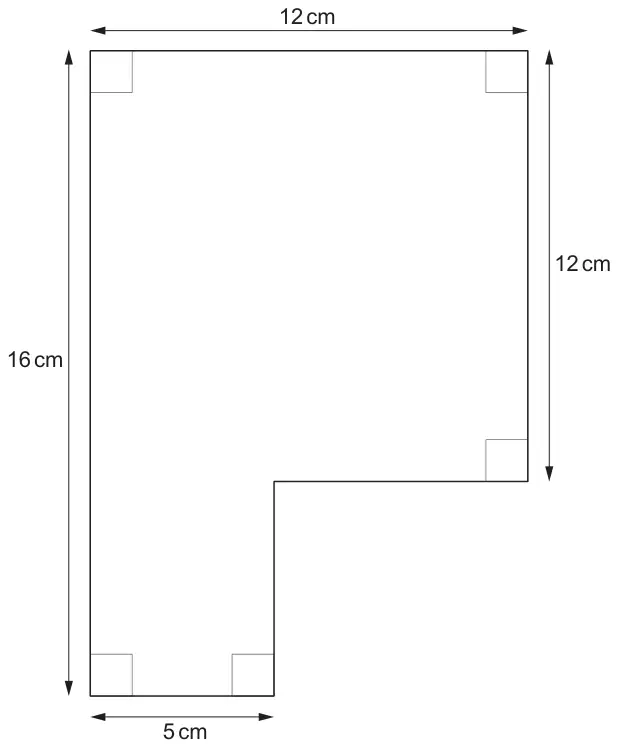
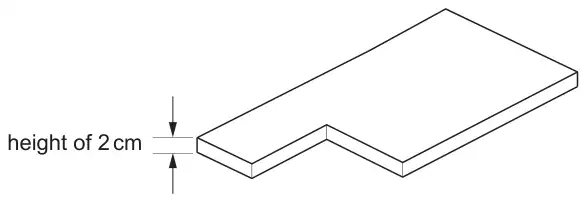
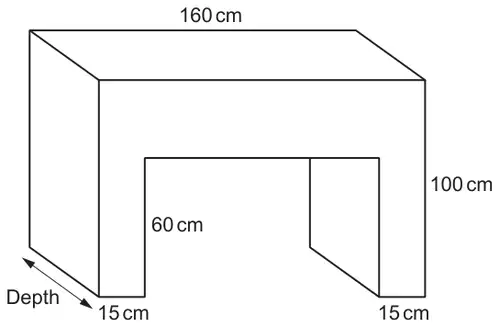
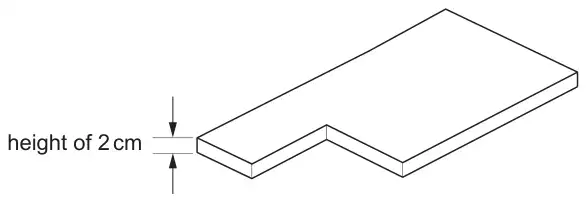
14. The diagram below shows the cross-section of a solid.
The solid has a height of 2 cm.
Diagrams not drawn to scale
Find the volume of the solid. You must show all your working. [4]
Mark scheme
Scheme
Marks
Comments
Complete method to find the volume
For example: Square and rectangle (allow any equivalent valid method)
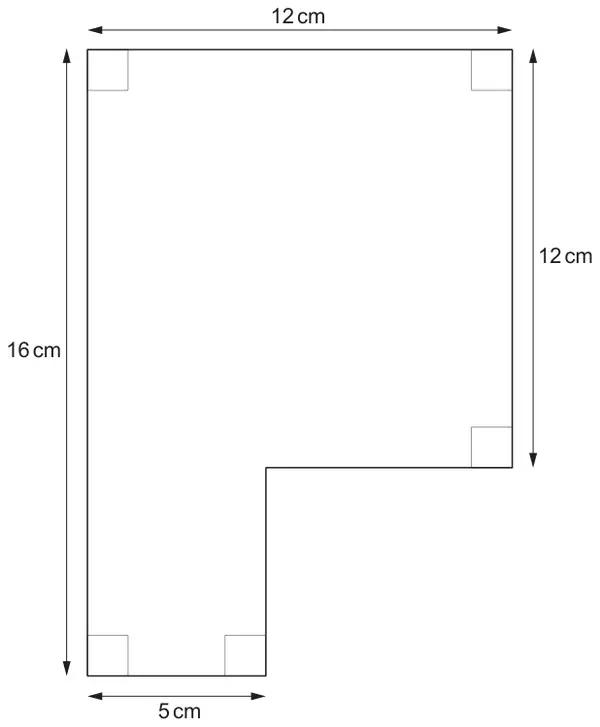
2 × (12 × 12 + 5 × (16 – 12))
2 × (12 × 12 + 5 × 4)
2 × (144 + 20)
288 + 40
2 × 164
Two rectangles (allow any equivalent valid method)
2 × (5 × 16 + 12 × (12 – 5))
2 × (5 × 16 + 12 × 7)
2 × (80 + 84)
160 + 168
2 × 164
Three rectangles (allow any equivalent valid method)
2 × (12 × (12 – 5) + 5 × 12 + 5 × 4)
2 × (12 × 7 + 5 × 12 + 5 × 4)
2 × (84 + 60 + 20)
168 + 120 + 40
2 × 164
Larger rectangle – smaller rectangle (allow any equivalent valid method)
2 × (16 × 12 – (16 – 12) × (12 – 5))
2 × (16 × 12 – 4 × 7)
2 × (192 – 28)
2 × 164
384 – 56
M3
Note: check diagram for the area and missing lengths If not M3 award M2 or M1 depending on the entries in the table. Calculations such as 12 × 12 × 5 × 16 × 2 are awarded M0. For M2 and M1, FT ‘their (16 – 12)’ or ‘their (12 – 5) where appropriate.
Award M2 for one of the following: (summing two areas/subtracting two areas/finding one volume)
Award M1 for one of the following: (calculating one area)
The board's mark scheme printed “2 × (12 × (12 – 5) + 5 × 12 + 5 × 4))”. Changed to “2 × (12 × (12 – 5) + 5 × 12 + 5 × 4)” because there is one closing bracket too many; the next line shows the expression with matching brackets.
Original: see the board's mark scheme PDF (link above).
Signs-R-Us is a company that makes national speed limit signs for roads. The national speed limit sign is white with a black strip across it.
Signs-R-Us needs to calculate the area of a sign that is white and the area that is black.
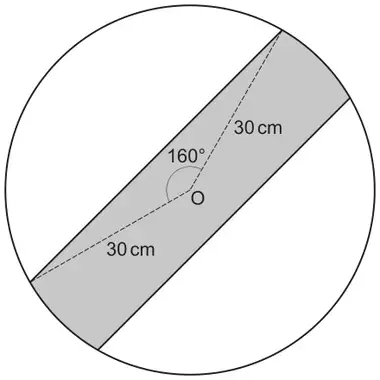
The diagram below shows some of the dimensions of the national speed limit sign. The sign is a circle of radius 30 cm, centre O. The centre of the black region is also at O. The black region is not a rectangle.
Diagram not drawn to scale
Calculate the area of the sign that is white. Hence, calculate the area of the sign that is black. [6]
Area that is white = …………… cm\(^2\) Area that is black = …………… cm\(^2\)
(b)
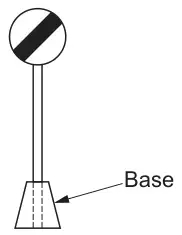
Signs-R-Us makes temporary road signs for roadworks. These signs need to be moved easily. For each sign, Signs-R-Us makes a base with a vertical hole drilled through it, so that a pole can be placed inside.
Diagram not drawn to scale
Signs-R-Us makes these bases for different-sized poles. The radius of a hole is related to the mass of a base. This is shown by the formula,
\[r = \sqrt[3]{\dfrac{M}{125(46 - 3\pi)}}\]
where: \(r\) is the radius in centimetres, and \(M\) is the mass in kilograms.
Rearrange this formula to make \(M\) the subject. [2]
(c)
As well as the national speed limit sign, Signs-R-Us makes 3 other road signs. The table below shows the number of road signs Signs-R-Us hopes to make every month.
Type of sign
Stop
Give way
One way
National speed limit
Number to be made each month
148
185
115
87
Each month, Signs-R-Us plans to take a stratified sample of 60 signs to check the quality of their production.
Calculate the number of each type of road sign that Signs-R-Us should include in their sample. You must show all your working. [3]
Type of sign
Stop
Give way
One way
National speed limit
Number in the sample
……………
……………
……………
……………
(d)
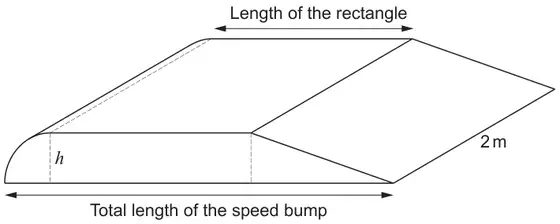
Signs-R-Us also makes a speed bump, as shown below. It has a uniform cross-sectional area, consisting of a quarter circle, a rectangle and a right-angled triangle.
Diagram not drawn to scale
The height of the speed bump is shown as \(h\) in the diagram above. The length of the rectangle is 4 times the height. The total length of the speed bump is 8 times the height.
The width of the speed bump is 2 m, and its volume is 0·1 m\(^3\).
Calculate the height of the speed bump. [6]
From the formula list: Volume of prism = area of cross-section × length; In any triangle \(ABC\): Area of triangle \(= \dfrac{1}{2}ab\sin C\)
Mark scheme (a)
Scheme
Marks
Comments
(Area that is white =) \(2 \times \left(\dfrac{160}{360} \times \pi \times 30^2 - \dfrac{1}{2} \times 30^2 \times \sin 160\right)\) or equivalent
[ 2×((1256 to 1257 (or 400\(\pi\))) – (153.9(09…) to 154))]
M3
Note: 2 × \(\dfrac{(\sin 80 \times 30) \times (\cos 80 \times 30)}{2}\) is equivalent to \(\dfrac{1}{2} \times 30^2 \times \sin 160\) M2 for any one of the following:
sight of \(\dfrac{160}{360} \times \pi \times 30^2\) (= 1256 to 1257 (or 400\(\pi\)))
sight of \(\dfrac{1}{2} \times 30^2 \times \sin 160\) (= 153.9(09…) to 154)
= 2204 to 2206.2 (cm\(^2\))
A1
CAO
(Area that is black =) \(\pi \times 30^2\) − (2204 to 2206.2) [(2826 to 2827.8) − (2204 to 2206.2)]
M1
FT their white area provided at least M1 previously awarded OR a correct full alternative method (see below)
= 621.6 to 622 (cm\(^2\))
A1
Alternative
Alternative method:
Scheme
Marks
Comments
(Area that is black =) \(2 \times \left(\dfrac{180-160}{360} \times \pi \times 30^2 + \dfrac{1}{2} \times 30^2 \times \sin 160(^\circ)\right)\)
[ 2×((157 to 157.1 (or 50\(\pi\))) + (153.9(09…) to 154))]
M3
Note: 2 × \(\dfrac{(\sin 80 \times 30) \times (\cos 80 \times 30)}{2}\) is equivalent to \(\dfrac{1}{2} \times 30^2 \times \sin 160\) M2 for any one of the following:
sight of \(\dfrac{180-160}{360} \times \pi \times 30^2\)(= 157 to 157.1(or 50\(\pi\)))
sight of \(\dfrac{1}{2} \times 30^2 \times \sin 160\) (= 153.9(09…) to 154)
= 621.8 to 622.2 (cm\(^2\))
A1
CAO
(Area that is white =) \(\pi \times 30^2\) − (621.8 to 622.2) [(2826 to 2827.8) − (621.8 to 622.2)]
M1
FT their black area provided at least M1 previously awarded OR a correct full alternative method (see above)
= 2204.2 to 2205.6(cm\(^2\))
A1
Mark scheme (b)
Scheme
Marks
Comments
\(M = 125r^3(46 - 3\pi)\) or \(M = 5750r^3 - 375\pi r^3\) or \(M = 4571.75r^3\) to \(4572.5r^3\)
B2
Mark final answer B1 for \(r^3 = \dfrac{M}{125(46 - 3\pi)}\) or \(r^3 = \dfrac{M}{5750 - 375\pi}\) or \(r^3 = \dfrac{M}{4571.75 \text{ to } 4572.5}\) or B1 for \(125r^3(46 - 3\pi)\) or \(5750r^3 - 375\pi r^3\) or \(4571.75r^3\) to \(4572.5r^3\) (omitting M =)
Sight of this calculation for any type of sign Allow (number of signs to be made) ÷ 8·9(166…)
(List of unrounded answers) 16.5(98…) or 16.6, 20.7(47…), 12.8(97…) or 12.9, 9.7(57…) or 9.8
A1
OR A1 for final answers of 17, 21, 13, 10
(Number in the sample =) 16, 21, 13, 10
A1
Award M1A1A1 for 16, 21, 13, 10 provided no incorrect work seen
If M1A0 awarded, A1 on FT from their unrounded answers for equivalent difficulty i.e. provided:
their correctly rounded answers sum to 59 or 61 AND
the correct numbers in the sample are given from their unrounded answers, including any decisions regarding rounding up or down AND
the numbers in the sample add to 60
Mark scheme (d)
Scheme
Marks
Comments
Sight of base of triangle = 3h
B1
Any letter or word may be used for the height Needs to be convincing. May be seen on diagram
\(\left(\dfrac{\pi \times h^2}{4} + 4h^2 + \dfrac{3h^2}{2}\right) \times 2 = 0.1\) or \(\dfrac{2\pi \times h^2}{4} + 8h^2 + \dfrac{6h^2}{2} = 0.1\) or (12.57 to 12.571)h\(^2\) = 0.1 or equivalent
M2
Ignore a place value error from an incorrect attempt to convert m\(^3\) into cm\(^3\) and/or m into cm for M and m marks only but A0 Allow omission of ×2 for M2 or M1 and possibly m1 M1 for:
the sum of appropriate terms equated to 0.1, with no more than 1 error in the terms
h\(^2\) = \(\dfrac{0.1}{2(\frac{\pi}{4} + 5.5)}\) or equivalent
m1
FT if possible from M1 provided h\(^2\) in every term Note: \(\pi\)/4 + 5.5 = 6.285 to 6.2855 \(\pi\)/2 + 11 = 12.57 to 12.571
h = 0.089 to 0.0892 (m) or equivalent
A2
CAO Ignore an incorrect attempt to convert to cm or mm Accept 0.09 (m) from correct working A1 for h = \(\sqrt{\dfrac{0.1}{2(\frac{\pi}{4} + 5.5)}}\) or \(\sqrt{\dfrac{1}{5\pi + 110}}\) or h = \(\sqrt{0.00795\ldots}\)
Alternative
Alternative method:
Scheme
Marks
Comments
Base of trapezium = 7h
B1
Any letter or word may be used for the height Needs to be convincing. May be seen on diagram
\(\left(\dfrac{\pi \times h^2}{4} + \dfrac{(4h + 7h) \times h}{2}\right) \times 2 = 0.1\) or \(\dfrac{2\pi \times h^2}{4} + 11h^2 = 0.1\) or (12.57 to 12.571)h\(^2\) = 0.1 or equivalent
M2
Ignore a place value error from an incorrect attempt to convert m\(^3\) into cm\(^3\) and/or m into cm for M and m marks only but A0 Allow omission of ×2 for M2 or M1 and possibly m1 M1 for:
the sum of appropriate terms equated to 0.1, with no more than 1 error in the terms
h\(^2\) = \(\dfrac{0.1}{(\frac{\pi}{2} + 11)}\) or equivalent
m1
FT if possible from M1 provided h\(^2\) in every term Note: \(\pi\)/2 + 11 = 12.57 to 12.571
h = 0.089 to 0.0892 (m) or equivalent
A2
CAO Ignore an incorrect attempt to convert to cm or mm Accept 0.09 (m) from correct working A1 for h = \(\sqrt{\dfrac{0.1}{2(\frac{\pi}{4} + 5.5)}}\) or \(\sqrt{\dfrac{1}{5\pi + 110}}\) or h = \(\sqrt{0.00795\ldots}\)
5.In this question, you will be assessed on the quality of your organisation, communication and accuracy in writing.
The diagram below shows the cross-section of a solid.
The solid has a height of 2 cm.
Diagrams not drawn to scale
Find the volume of the solid. You must show all your working. [4 + 2 OCW]
From the formula list: Volume of prism = area of cross-section × length
Mark scheme
Scheme
Marks
Comments
Complete method to find the volume
For example: Square and rectangle (allow any equivalent valid method)
2 × (12 × 12 + 5 × (16 – 12))
2 × (12 × 12 + 5 × 4)
2 × (144 + 20)
288 + 40
2 × 164
Two rectangles (allow any equivalent valid method)
2 × (5 × 16 + 12 × (12 – 5))
2 × (5 × 16 + 12 × 7)
2 × (80 + 84)
160 + 168
2 × 164
Three rectangles (allow any equivalent valid method)
2 × (12 × (12 – 5) + 5 × 12 + 5 × 4)
2 × (12 × 7 + 5 × 12 + 5 × 4)
2 × (84 + 60 + 20)
168 + 120 + 40
2 × 164
Larger rectangle – smaller rectangle (allow any equivalent valid method)
2 × (16 × 12 – (16 – 12) × (12 – 5))
2 × (16 × 12 – 4 × 7)
2 × (192 – 28)
2 × 164
384 – 56
M3
Note: check diagram for the area and missing lengths If not M3 award M2 or M1 depending on the entries in the table. Calculations such as 12 × 12 × 5 × 16 × 2 are awarded M0. For M2 and M1, FT ‘their (16 – 12)’ or ‘their (12 – 5)’ where appropriate. (See the M2/M1 table below.)
(Volume =) 328 (cm\(^3\))
A1
CAO
Organisation and Communication.
OC1
For OC1, candidates will be expected to:
present their response in a structured way
explain to the reader what they are doing at each step of their response
lay out their explanation and working in a way that is clear and logical
write a conclusion that draws together their results and explains what their answer means
Accuracy of writing.
W1
For W1, candidates will be expected to:
show all their working
make few, if any, errors in spelling, punctuation and grammar
use correct mathematical form in their working
use appropriate terminology, units, etc
M2 / M1 table
Award M2 for one of the following: (summing two areas/subtracting two areas/finding one volume)
Award M1 for one of the following: (calculating one area)
Square and rectangle
12 × 12 + 5 × (16 – 12)
12 × 12 + 5 × 4
144 + 20
164
2 × 12 × 12
2 × 144
288
2 × 5 × (16 – 12)
2 × 5 × 4
2 × 20
40
12 × 12
144
5 × (16 – 12)
5 × 4
20
Two rectangles
5 × 16 + 12 × (12 – 5)
5 × 16 + 12 × 7
80 + 84
164
2 × (5 × 16)
2 × 80
160
2 × 12 × (12 – 5)
2 × 12 × 7
2 × 84
168
5 × 16
80
12 × (12 – 5)
12 × 7
84
Three rectangles
12×(12–5)+ 5 ×12+5×4
12 × 7 + 5 × 12 + 5 × 4
84 + 60 + 20
164
2 × 12 × (12 – 5)
2 × 12 × 7
2 × 84
168
2 × 5 × 12
2 × 60
120
2 × 5 × 4
2 × 20
40
12 × (12 – 5)
12 × 7
84
5 × 12
60
5 × 4
20
Larger rectangle – smaller rectangle
16 ×12–(16 –12)×(12–5)
16 × 12 – 4 × 7
192 – 28
164
2 × 16 × 12
2 × 192
384
2 × (16 – 12) × (12 – 5)
2 × 4 × 7
2 × 28
56
16 × 12
192
(16 –12)×(12 – 5)
4 × 7
28
Corrected by Westie's Workshop
The board's mark scheme printed “2 × (12 × (12 – 5) + 5 × 12 + 5 × 4))”. Changed to “2 × (12 × (12 – 5) + 5 × 12 + 5 × 4)” because there is one closing bracket too many.
The board's mark scheme printed “FT ‘their (16 – 12)’ or ‘their (12 – 5) where appropriate.”. Changed to “FT ‘their (16 – 12)’ or ‘their (12 – 5)’ where appropriate.” because the closing quotation mark was missing.
Original: see the board's mark scheme PDF (link above).
50 people living by the sea were asked how often they went for a walk along the sea wall each week.
The results were as follows:
Number of walks each week
Frequency
0 to 2
8
3 to 5
12
6 to 8
20
9 to 13
4
14 to 18
6
Calculate an estimate of the mean number of walks per person each week. [4]
(b)
High tide in the morning is, on average, 35 minutes later each day. The morning high tide on 3rd March was at 08:03. At what time was the morning high tide on 1st March? [1]
(c)
A new concrete sea-defence wall is to be built. The sea-defence wall will have a uniform cross-section. A sketch of the new wall is shown below.
Diagram not drawn to scale
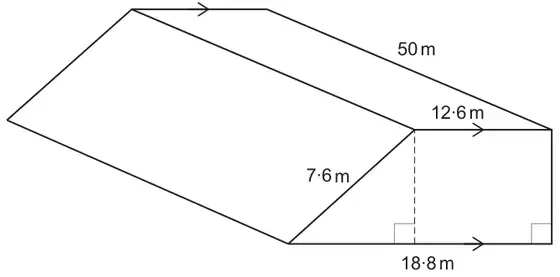
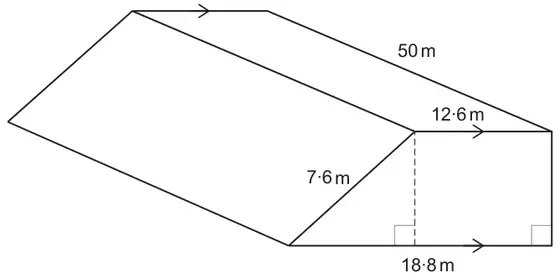
Calculate the volume of concrete needed to make this new sea-defence wall. You must show all your working. [7]
From the formula list: Area of trapezium \(= \dfrac{1}{2}(a+b)h\); Volume of prism = area of cross-section × length
FT ‘their midpoints’ provided at least 4 lie within the appropriate group, including bounds throughout Use of lower bounds gives 276 Use of upper bounds gives 396
÷ 50
m1
6.72 or 6.7 (walks)
A1
Allow rounded to 7 (walks) from appropriate working Use of lower bounds gives 5.5(2 walks) or 6 (walks) Use of upper bounds gives 7.9(2 walks) or 8 (walks)
Mark scheme (b)
Scheme
Marks
Comments
06(:)53 or 6(:)53 a.m.
B1
Allow 06(:)53 a.m. or 6(:)53 Do not accept (0)6(:)53 p.m.
or \(\cos^{-1}\left(\dfrac{18.8-12.6}{7.6}\right)\) = 35(.3345…)° and sin 35(.33…)° = \(\dfrac{\text{Height}}{7.6}\) or tan 35(.33…)° = \(\dfrac{\text{Height}}{6.2}\)
M2
M1 for sight of 18.8 – 12.6 with
any attempt to use Pythagoras’ Theorem (including summing rather than subtraction)
\(\cos^{-1}\left(\dfrac{18.8-12.6}{7.6}\right)\) = 35(.33…)° and an attempt to use sine or tan
Height\(^2\) = 19.32 or (Height = ) \(\sqrt{19.32}\) or (Height =) 7.6 × sin 35(.33…)° or (Height =) 6.2 × tan 35(.33…)°
A1
(Height =) 4.39(54... m) or 4.4(m)
A1
Do not allow 4.3(m) from premature rounding of 35.3345…° May be implied in further working Provided at least M2 previously awarded, FT from √’their 19.32’ provided < 7.6 (m)
(Volume of concrete) ½ × (12.6 + 18.8) × 4.4 × 50 or ½ × 31.4 × 4.4 × 50 or ½ × (18.8 – 12.6) × 4.4 × 50 + 12.6 × 4.4 × 50 or ½ × 6.2 × 4.4 × 50 + 12.6 × 4.4 × 50
M2
FT ‘their derived 4.4’ provided
‘their derived 4.4’ < 7.6
‘their derived 4.4’ ≠ 6.2
‘their derived 4.4’ ≠ ‘their 18.8 – 12.6’
May be seen in stages, e.g. with ‘× 50’ in further working
M1 for any one of the following: (Area of cross-section)
½ × (12.6 + 18.8) × 4.4 (= 69.08 or 69.1m\(^{2}\))
C-clips are used in motors and turbines as a type of fastener. Clip Zone makes metal C-clips. They have a uniform cross-section, as shown below.
Diagrams not drawn to scale
\(O\) is the centre of the circular arcs \(AC\) and \(BD\). \(OAB\) and \(OCD\) are straight lines. \(OA = OC =\) 50 mm. \(AB = CD =\) 4 mm. The C-clips have a uniform thickness of 2 mm.
C-clips are made by melting down metal bars and re-casting them. Calculate the number of C-clips that can be made from a metal bar with a volume of 1 500 000 mm\(^3\). You must show all your working. [5]
(b)
Clip Zone makes four types of fastener. The table below shows the number of each type produced each week.
Type of fastener
C-clips
Jubilee clips
Screws
Bolts
Number made each week
23 000
11 000
70 000
45 000
Clip Zone takes a sample of these 149 000 fasteners to check the quality of its products. A stratified sample of 1500 fasteners is taken, based on the type of fastener.
Calculate the number of each type of fastener that should be included in the sample. You must show all your working. [3]
Type of fastener
C-clips
Jubilee clips
Screws
Bolts
Number in the sample
……………
……………
……………
……………
Mark scheme (a)
Scheme
Mark
Comments
Accept use of values of \(\boldsymbol{\pi}\) from 3.14 to 3.142 Note: Accept (54\(^2\) – 50\(^2\)) written as (54 + 50) × (54 – 50)
\(\dfrac{360 - 38}{360}\) × \(\boldsymbol{\pi}\) × (54\(^2\) – 50\(^2\)) (× 2) or equivalent (= 1168.35 to 1169.11 or 16744\(\boldsymbol{\pi}\)/45)
50 people living by the sea were asked how often they went for a walk along the sea wall each week.
The results were as follows:
Number of walks each week
Frequency
0 to 2
8
3 to 5
12
6 to 8
20
9 to 13
4
14 to 18
6
Calculate an estimate of the mean number of walks per person each week. [4]
(b)
High tide in the morning is, on average, 35 minutes later each day. The morning high tide on 3rd March was at 08:03. At what time was the morning high tide on 1st March? [1]
(c)
A new concrete sea-defence wall is to be built. The sea-defence wall will have a uniform cross-section. A sketch of the new wall is shown below.
Diagram not drawn to scale
Calculate the volume of concrete needed to make this new sea-defence wall. You must show all your working. [7]
From the formula list: Area of trapezium \(= \dfrac{1}{2}(a+b)h\); Volume of prism = area of cross-section × length
FT ‘their midpoints’ provided at least 4 lie within the appropriate group, including bounds throughout Use of lower bounds gives 276 Use of upper bounds gives 396
÷ 50
m1
6.72 or 6.7 (walks)
A1
Allow rounded to 7 (walks) from appropriate working Use of lower bounds gives 5.5(2 walks) or 6 (walks) Use of upper bounds gives 7.9(2 walks) or 8 (walks)
Mark scheme (b)
Scheme
Mark
Comments
06(:)53 or 6(:)53 a.m.
B1
Allow 06(:)53 a.m. or 6(:)53 Do not accept (0)6(:)53 p.m.
or cos\(^{-1}\)(\(\dfrac{18.8-12.6}{7.6}\)) = 35(.3345…)° and sin 35(.33…)° = \(\dfrac{\text{Height}}{7.6}\) or tan 35(.33…)° = \(\dfrac{\text{Height}}{6.2}\)
M2
M1 for sight of 18.8 – 12.6 with
any attempt to use Pythagoras’ Theorem (including summing rather than subtraction)
cos\(^{-1}\)(\(\dfrac{18.8-12.6}{7.6}\)) = 35(.3345…)° and an attempt to use sine or tan
Height\(^2\) = 19.32 or (Height = ) √19.32 or (Height =) 7.6 × sin 35(.33…)° or (Height =) 6.2 × tan 35(.33…)°
A1
(Height =) 4.39(54... m) or 4.4(m)
A1
Do not allow 4.3(m) from premature rounding of 35.3345…° May be implied in further working Provided at least M2 previously awarded, FT from √’their 19.32’ provided < 7.6 (m)
(Volume of concrete) ½ × (12.6 + 18.8) × 4.4 × 50 or ½ × 31.4 × 4.4 × 50 or ½ × (18.8 – 12.6) × 4.4 × 50 + 12.6 × 4.4 × 50 or ½ × 6.2 × 4.4 × 50 + 12.6 × 4.4 × 50
M2
FT ‘their derived 4.4’ provided
‘their derived 4.4’ < 7.6
‘their derived 4.4’ ≠ 6.2
‘their derived 4.4’ ≠ ‘their 18.8 – 12.6’
May be seen in stages, e.g. with ‘× 50’ in further working
M1 for any one of the following: (Area of cross-section)
(a) Confetti for the party is packed in small boxes. Each box is in the shape of a triangular prism. The cross-section of each box is an isosceles triangle. The measurements are shown on the diagram below.
Diagram not drawn to scale
(i) Show that the perpendicular height of the cross-section of a confetti box is 40 mm. You must show all your working. [3]
(ii) This is the label on a confetti box.
The volume of this box is at least 20 000 mm3.
Calculate the volume of a confetti box to show that the statement on the label is correct. [3]
(b) Rhodri finds 2 venues that arrange party nights.
Friar Hall Party night special
£105 hall hire charge + £5 per person
Minfelin Lodge Party night special
£207 room hire charge + £3 per person
Rhodri calculates the total cost of organising the party at each venue. He finds that the total costs are the same. For how many people is Rhodri planning the 21st birthday party? You must show all your working. [3]
From the formula list: Volume of prism = area of cross-section × length
Mark scheme (a)
Scheme
Marks
Comments
(i) Correct statement of Pythagoras’ theorem
(Height2 =) 502 – (60 ÷ 2)2
(Height2 =) 502 – 302
502 = height2 + (60 ÷ 2)2
502 = height2 + 302
M1
Clear indication that all measurements have been converted to 3cm, 5cm, 4cm may be awarded all marks
Correct stage of evaluation
(Height2 =) 2500 – 900
(Height2 =) 1600
sight of √1600
(Height =) √(502 – 302)
A1
Working must be seen Allow M1 A1 for a slip in the initial notation then corrected at this evaluation stage
Mark final answer A0 for an incorrect statement, e.g. √1600 = 402
(ii) (Volume) ½ × 60 × 40 × 20 or equivalent
M2
M1 for sight of area of X-section possibly in stages, ½ × 60 × 40 or ½×30×40 + ½×30×40 (= 1200 mm2)
24 000 (mm3) (> 20 000 mm3)
A1
CAO
Alternative method 1 (a)(i)
Scheme
Marks
Comments
Identifies the relationship ‘3, 4, 5’ and relates to the given (right-angled) triangle, e.g. sight of
3, 4, 5 and 30(mm), 40(mm), 50(mm)
3cm, 4cm, 5cm
3, 4, 5 and ‘× 10’
30, 40, 50 and ‘÷ 10’
AND a statement or conclusion, e.g.
Pythagorean triple
Right-angled triangle
3, 4, 5 triangle means it would be 30, 40, 50 triangle
B3
For B3 there must be an accompanying statement or conclusion
B2 for identifying the relationship ‘3, 4, 5’ and relates to the given(right-angled) triangle
without a conclusion or statement, or
with an incorrect conclusion or statement
B1 for sight of any one of the following:
‘3, 4, 5’
30 (mm) and 40 (mm) appropriately indicated on the diagram
A right-angled triangle drawn (with or without 90° indicated) appropriately labelled 30 (mm), 40 (mm) and 50 (mm)
Alternative method 2 (a)(i)
Scheme
Marks
Comments
Assuming height as 40mm with use of 50mm or 30mm within a correct statement of Pythagoras’ Theorem, e.g.
((½ base)2 =) 502 – 402
502 = 402 + x2
((hypotenuse)2 =) 402 + 302
M1
Clear indication that all measurements have been converted to 3cm, 5cm, 4cm may be awarded all marks
Correct stage of evaluation, e.g.
((½ base)2 = 502 – 402 =) 900
( ½ base =) √900
((hypotenuse)2 = 402 + 302 =) 2500
(hypotenuse =) ( ½ base =) √2500
A1
Working must be seen
Appropriate full evaluation, e.g.
( ½ base =) 30 (mm)
(hypotenuse =) 50 (mm)
A1
Mark final answer
The alternative methods are printed in italics in the original.
Mark scheme (b)
Scheme
Marks
Comments
Sight of or implication that: 5 × number of people + 105 = 207 + 3 × number of people or 5x + 105 = 207 + 3x
M1
Implication includes attempt to balance costing for the same number of people ≥ 3 at each venue, e.g.
(10 people) 5 × 10 + 105 with 207 + 3 × 10
(110, 115,) 120 with (210, 213,) 216
(5 – 3) × number of people = 207 – 105 or number of people = \(\frac{207-105}{5-3}\) or 5x – 3x = 207 – 105 or 2x = 102
m1
Includes correctly evaluated trial to attempt to balance costing for the same number of people at each venue provided ‘their trial for 30 ≤ the number of people ≤ 70’, e.g. correct costing for both venues for 40 people as (FH) (£)305 and (ML) (£)327
From M1, allow 1 slip in the rearrangement of ‘their equation’ provided ‘their equation’ is then simplified to ax = b, where a ≠ 0 and b ≠ 0
Sight of cost (£)360 for each venue implies M1 m1
51 (people)
A1
CAO
If no marks, award SC1 for finding the number of (whole) people for the same cost at each venue, provided the cost is > (£) 220
(a) Confetti for the party is packed in small boxes. Each box is in the shape of a triangular prism. The cross-section of each box is an isosceles triangle. The measurements are shown on the diagram below.
Diagram not drawn to scale
(i) Show that the perpendicular height of the cross-section of a confetti box is 40 mm. You must show all your working. [3]
(ii) This is the label on a confetti box..
The volume of this box is at least 20 000 mm3.
Calculate the volume of a confetti box to show that the statement on the label is correct. [3]
(b) Rhodri finds 2 venues that arrange party nights.
Friar Hall Party night special
£105 hall hire charge + £5 per person
Minfelin Lodge Party night special
£207 room hire charge + £3 per person
Rhodri calculates the total cost of organising the party at each venue. He finds that the total costs are the same. For how many people is Rhodri planning the 21st birthday party? You must show all your working. [3]
From the formula list: Volume of prism = area of cross-section × length
Mark scheme (a)
Scheme
Marks
Comments
(i) Correct statement of Pythagoras’ theorem
(Height2 =) 502 – (60 ÷ 2)2
(Height2 =) 502 – 302
502 = height2 + (60 ÷ 2)2
502 = height2 + 302
M1
Clear indication that all measurements have been converted to 3cm, 5cm, 4cm may be awarded all marks
Correct stage of evaluation
(Height2 =) 2500 – 900
(Height2 =) 1600
sight of \(\sqrt{1600}\)
(Height =) \(\sqrt{(50^{2} - 30^{2})}\)
A1
Working must be seen Allow M1 A1 for a slip in the initial notation then corrected at this evaluation stage
Mark final answer A0 for an incorrect statement, e.g. \(\sqrt{1600}\) = 402
1(a)(i) Alternative method 1
Scheme
Marks
Comments
Identifies the relationship ‘3, 4, 5’ and relates to the given (right-angled) triangle, e.g. sight of
3, 4, 5 and 30(mm), 40(mm), 50(mm)
3cm, 4cm, 5cm
3, 4, 5 and ‘× 10’
30, 40, 50 and ‘÷ 10’
AND a statement or conclusion, e.g.
Pythagorean triple
Right-angled triangle
3, 4, 5 triangle means it would be 30, 40, 50 triangle
B3
For B3 there must be an accompanying statement or conclusion
B2 for identifying the relationship ‘3, 4, 5’ and relates to the given(right-angled) triangle
without a conclusion or statement, or
with an incorrect conclusion or statement
B1 for sight of any one of the following:
‘3, 4, 5’
30 (mm) and 40 (mm) appropriately indicated on the diagram
A right-angled triangle drawn (with or without 90° indicated) appropriately labelled 30 (mm), 40 (mm) and 50 (mm)
1(a)(i) Alternative method 2
Scheme
Marks
Comments
Assuming height as 40mm with use of 50mm or 30mm within a correct statement of Pythagoras’ Theorem, e.g.
((½ base)2 =) 502 – 402
502 = 402 + x2
((hypotenuse)2 =) 402 + 302
M1
Clear indication that all measurements have been converted to 3cm, 5cm, 4cm may be awarded all marks
Correct stage of evaluation, e.g.
((½ base)2 = 502 – 402 =) 900
( ½ base =) \(\sqrt{900}\)
((hypotenuse)2 = 402 + 302 =) 2500
(hypotenuse =) \(\sqrt{2500}\)
A1
Working must be seen
Appropriate full evaluation, e.g.
( ½ base =) 30 (mm)
(hypotenuse =) 50 (mm)
A1
Mark final answer
Scheme
Marks
Comments
(ii) (Volume) ½ × 60 × 40 × 20 or equivalent
M2
M1 for sight of area of X-section possibly in stages, ½×60×40 or ½×30×40 + ½×30×40 (= 1200 mm2)
24 000 (mm3) (> 20 000 mm3)
A1
CAO
Corrected by Westie's Workshop
The board's mark scheme printed “(hypotenuse =) ( ½ base =) \(\sqrt{2500}\)”. Changed to “(hypotenuse =) \(\sqrt{2500}\)” because the square root of 2500 is the hypotenuse (50 mm), not half the base (30 mm), so the extra “( ½ base =)” was removed.
Original: see the board's mark scheme PDF (link above).
Mark scheme (b)
Scheme
Marks
Comments
Sight of or implication that: 5 × number of people + 105 = 207 + 3 × number of people or 5x + 105 = 207 + 3x
M1
Implication includes attempt to balance costing for the same number of people ≥ 3 at each venue, e.g.
(10 people) 5 × 10 + 105 with 207 + 3 × 10
(110, 115,) 120 with (210, 213,) 216
(5 – 3) × number of people = 207 – 105 or number of people = \(\frac{207-105}{5-3}\) or 5x – 3x = 207 – 105 or 2x = 102
m1
Includes correctly evaluated trial to attempt to balance costing for the same number of people at each venue provided ‘their trial for 30 ≤ the number of people ≤ 70’, e.g. correct costing for both venues for 40 people as (FH) (£)305 and (ML) (£)327
From M1, allow 1 slip in the rearrangement of ‘their equation’ provided ‘their equation’ is then simplified to ax = b, where a ≠ 0 and b ≠ 0
Sight of cost (£)360 for each venue implies M1 m1
51 (people)
A1
CAO
If no marks, award SC1 for finding the number of (whole) people for the same cost at each venue, provided the cost is > (£) 220, e.g.
11. Safety Cones is a company that makes traffic cones. Its traffic cones have a base in the shape of an octagonal prism, with a hollow cone shape sitting on top of the base. The bases of the traffic cones are symmetrical and have a circular hole in them to allow the traffic cones to be stacked.
The dimensions of the octagonal base are shown below. The height of this octagonal base is 5 cm.
Diagram not drawn to scale
The cone that sits on top of the octagonal base is shown below. It has a height of 60 cm and a circular base area of 800 cm2.
Diagram not drawn to scale
Gary is transporting a stack of 10 of these traffic cones in the back of his van.
Diagram not drawn to scale
Calculate the volume of the space that this stack of 10 traffic cones takes up in the back of Gary’s van. Give your answer in cm3. You should assume that the space taken up includes the space underneath the bottom traffic cone and any gaps between the cones. [7]
From the formula list: Area of trapezium \(= \dfrac{1}{2}(a+b)h\); Volume of prism = area of cross-section × length; Volume of cone \(= \dfrac{1}{3}\pi r^2 h\)
May be embedded within a volume calculation 50 × 20 may be seen as 20×20 + 2×20×((50 – 20)/2) or 20×20 + 2×20×15 2 × \(\dfrac{1}{2}\) × (50 + 20) × ((50 – 20)/2) may be seen as 2 × (20×((50 – 20)/2) + 2×\(\dfrac{1}{2}\)×(50–20)/2×(50–20)/2) or 2 × (20×15 + 2×\(\dfrac{1}{2}\)×15×15)
M1 for 50 × 20 + \(\dfrac{1}{2}\) × (50 + 20) × ((50 – 20)/2) or M1 for 50 × 20 + \(\dfrac{1}{2}\) × 70 × 15 OR M1 for ……… + 2 × \(\dfrac{1}{2}\) × (50 + 20) × ((50 – 20)/2) or M1 for ……… + 2 × \(\dfrac{1}{2}\) × 70 × 15
× 5 × 10 = 102 500 (cm3)
m1 A1
FT from M1 CAO If M0m0A0 awarded, and from an incorrect assumption that the octagon is regular, award SC1 for areas of:
8 × (20 × 25)/2 = 2000 (possibly leading to a volume of 100 000) or
502 – 202 = 2100 (possibly leading to a volume of 105 000)
(Volume of a cone =) \(\dfrac{1}{3}\) × 800 × 60
M1
Award M1A0 if this is multiplied by 10
= 16 000 (cm3)
A1
CAO
(Total volume = 102 500 + 16 000 =) 118 500 (cm3)
B1
FT ‘their 102 500’ and ‘their 16 000’ provided at least one M1 mark awarded and is the sum of the volumes of their 10 octagonal bases and 1 (or 10) cone/s
The direct straight-line distance between Llangollen and the Pontcysyllte Aqueduct is 5·6 km. On the map this distance is 5·6 cm. What is the scale of the map? Circle your answer. [1]
(b) The Pontcysyllte Aqueduct was built to carry the Llangollen canal over a valley.
The following facts about the section of the canal over the aqueduct were found on the internet.
It has a rectangular uniform cross-section.
It is 300 m in length.
It holds 1 500 000 litres of water.
It takes 2 hours to drain the water.
(i) The section of the canal over the aqueduct is to be drained.
Calculate the number of litres of water that drain from this section of the canal per minute. You may assume that the water drains from the canal at a constant rate. You must show all your working. [3]
(ii) Calculate the area of the canal’s uniform cross-section. Give your answer in cm2. [3]
Mark scheme (a)
Scheme
Marks
Comments
1 : 100 000
B1
Mark scheme (b)
(i)
Scheme
Marks
Comments
1 500 000 ÷ (2 × 60)
M2
With no other further working May be shown in stages
M1 for any one of the following, that may be embedded in further incorrect working:
1 500 000 ÷ 2 (or 750 000)
1 500 000 ÷ 60 (or 25 000)
12500 (litres/min)
A1
CAO
(ii)
Scheme
Marks
Comments
Sight of 30 000 (cm) AND 1 500 000 000 (cm3)
B1
Or two values of the correct comparative order, not for 1 500 000 and 300
1 500 000 000 ÷ 30 000 or equivalent
M1
For the intention of this division, allow with place value error (including 1 500 000 ÷ 300) for M1 only
8. Emma wants to know how much water is in a pond near her house. She has taken width measurements of the pond every 3 m along its length. These width measurements are shown on the plan view of the pond below.
Diagram not drawn to scale
Emma has used these width measurements to sketch the following graph.
Diagram not drawn to scale
Emma knows that the pond has a uniform depth of 1·2 m. Use the trapezium rule with 4 strips to calculate an estimate for the volume of water in the pond. [5]
Estimate of the volume of water in the pond = …………… m3
From the formula list: Area of trapezium \(= \dfrac{1}{2}(a+b)h\)
13. A box for mints is to be made in the shape of a hexagonal prism. The cross-section of the box is a regular hexagon. The volume of the box must be greater than 230 000 mm3.
Diagrams not drawn to scale
From the formula list: Volume of prism = area of cross-section × length
Using the measurements above, show that this would make a suitable box for the mints. You must show all your working. [5]
Mark scheme
Scheme
Marks
Comments
In all alternative methods for answering this question accept alternative working in cm, if place value error in conversion of units penalise -1 once only
(Area of cross-section) 6 × ½ × 30 × (52 ÷ 2)
M3
M2 for ½ × 30 × (52 ÷ 2) (= 390) M1 for any use of 52 ÷ 2 (= 26) (May be embedded)
2340 (mm2)
A1
(Volume of the box) 234000 (mm3) OR for a comparison 2340 (mm2) > 2300 (mm2)
A1
FT ‘their 2340’ × 100 correctly evaluated provided at least M2 previously awarded
13. Alternative method (trapezia)
Scheme
Marks
Comments
(Area of cross-section) 2 × ½ × (52÷2) ×(30 + 2×30)
M3
M2 for ½ × (52÷2) ×(30 + 2×30) (= 1170) M1 for use of 52 ÷ 2 (= 26)
2340 (mm2)
A1
(Volume of the box) 234000 (mm3) OR for a comparison 2340 (mm2) > 2300 (mm2)
A1
FT ‘their 2340’ × 100 correctly evaluated provided at least M2 previously awarded
13. Alternative method (½absinC)
Scheme
Marks
Comments
(Area of cross-section) 6 × ½ × 30 × 30 × \(\dfrac{\sqrt{3}}{2}\)
M3
M2 for ½ × 30 × 30 × \(\dfrac{\sqrt{3}}{2}\) M1 for (6 ×) ½ × 30 × 30 ×sin 60°
\(1350\sqrt{3}\) or 2338(.2 mm2) or 2340 (mm2)
A1
(Volume of box) 233820 mm3 or 234000 (mm3) OR for a comparison 2338(.2 mm2) > 2300 (mm2)
A1
FT ‘their 2340’ × 100 correctly evaluated provided at least M2 previously awarded
13. Alternative method (triangle area)
Scheme
Marks
Comments
(Area of triangle) ½ × 30 × (52 ÷ 2)
M2
(= 390)
(Minimum area of triangle required) 2300 ÷ 6 383(.33...)
M1 A1
Comparison 390 > 383(.33...)
A1
The alternative method is printed in italics in the original.
Or 31827π/400 (cm2) May be implied by 488.5 to 489 (cm2) (total area) May be implied by volume of 149800 to 150001 (cm3)
(Number of litres that can be added =) (249.9(686…) + 238.7(025)) × 600 (÷1000)
or (488.5 to 489) × 600 (÷1000)
M2
FT ‘their 238.7(025)’ and ‘their 249.9(686…)’ provided M1 previously awarded M1 (may be embedded within incorrect work) for
(249.9(686…) + 238.7(025)) or
(249.9(686…) + ……) × 600
OR M1 (may be embedded within incorrect work) for
(……… + 238.7(025)) × 600
where previous M1 may not have been awarded
= 293 to 293.4 (litres)
A2
FT from M2 only A1 for 293 000 to 293 400 (cm3)
Alternative
Alternative method:
Scheme
Marks
Comments
Area of semicircle subtract (area of the large sector – area of triangle)
S1
(Area of large sector =) \(\dfrac{150}{360}\) × π × 30.92 or equivalent
M1
May be embedded in a volume calculation i.e.× 600
= 1249 to 1250 (cm2)
A1
Or 31827π/80 (cm2) 749 400 to 750 000 (cm3) if volumes considered
(Number of litres that can be added =) (π × 30.92 ÷ 2 – (1249.8(…) – 238.7(025))) × 600 (÷1000) or ((1499 to 1500.01) – (1010…to 1011.3)) × 600 (÷1000)
M2
FT ‘their 238.7(025)’ and ‘their 1249.8(…)’ provided M1 previously awarded M1 (may be embedded within incorrect work) for
(a) A company makes a chicken run in the shape of a triangular prism, as shown below. The uniform cross-section of the chicken run is an isosceles triangle.
The run covers a rectangular ground area of 5·46 m2.
The vertical height of the run is 1·5 m.
Diagram not drawn to scale
Each face of the chicken run is to be covered in wire mesh, apart from the base. The wire mesh costs £5.60 per m2.
Calculate the cost of the wire mesh that is needed for the chicken run. [7]
Cost of the wire mesh = £ …………………………
(b) The company also makes chicken coops that are mathematically similar.
Medium coop
Capacity = 8 m3
Area of wire mesh = 3 m2
Large coop
Capacity = 27 m3
Use the above information to calculate the area of wire mesh in the large coop. [4]
Mark scheme (a)
Scheme
Marks
Comments
(Width of rectangle/Base of triangle =) 1.3 (m) (Sloping length2 =) 1.52 + 0.652 Sloping length2 = 2.6725 or
(Sloping length =) √2.6725
B1 M1 A1
May be implied by use of 0.65 in further work FT ‘their 1.3/2’
(Sloping length =) 1.63(…) (m)
A1
FT from M1 for the correctly evaluated square root of ‘their 2.6725’ provided their answer > 1.5 If trigonometry used to calculate the sloping length, M1 for base angle = tan-1(1.5/(1.3÷2)) (= 66.5(71…º)) or apex angle = tan-1((1.3÷2)/1.5) (= 23.4(28…º)) m1 for correct rearrangement of a sin or cos equation using their base or apex angle with 1.5 or 1.3÷2 A1 for (Sloping length =) 1.63(…) (m)
(Cost of wire mesh =) ( 2×0.5×1.3×1.5 + 2×1.63(…)×4.2 ) (× 5.6(0)) 2×0.5×1.3×1.5: 1.95 m2, (£) 10.92 2×1.63(…)×4.2: 13.69 to 13.73(…) m2, (£) 76.66(…) to (£) 76.91
M2
FT ‘their 1.63(…)’ provided Pythagoras or trigonometry attempted and ‘their 1.3’ M1 for
0.5×1.3×1.5 + 1.63(…)×4.2 or
…… + 2×1.63(…)×4.2 or
2×1.63(…)×4.2 × 5.6(0)
OR M1 for
2×0.5×1.3×1.5 + …… or
2×0.5×1.3×1.5 × 5.6(0)
where Pythagoras or trigonometry may not have been attempted
= (£) 87.58 to (£) 87.83
A1
FT from previous M2 only Note: A sloping length of 1.6 (m) leads to an answer of (£)86.18(4)
Mark scheme (b)
Scheme
Marks
Comments
\(\sqrt[3]{\dfrac{27}{8}}\) or \(\sqrt[3]{\dfrac{8}{27}}\) OR \(\left(\dfrac{27}{8}\right)^{2}\) or \(\left(\dfrac{8}{27}\right)^{2}\) or 3:2 or 2:3 or equivalent
B1
(= 1.5 or 0.666… OR 11.3(9…) or 0.08(7…))
\(\left(\sqrt[3]{\dfrac{27}{8}}\right)^{2}\) OR \(\left(\sqrt[3]{\dfrac{8}{27}}\right)^{2}\) or 32:22 or 22:32 or equivalent
B1
(= 2.25 OR 0.444…)
(Area of wire mesh = ) 3 × \(\left(\sqrt[3]{\dfrac{27}{8}}\right)^{2}\) or equivalent
7. A box for mints is to be made in the shape of a hexagonal prism. The cross-section of the box is a regular hexagon. The volume of the box must be greater than 230 000 mm3.
Diagrams not drawn to scale
From the formula list: Volume of prism = area of cross-section × length
Using the measurements above, show that this would make a suitable box for the mints. You must show all your working. [5]
Mark scheme
In all alternative methods for answering this question accept alternative working in cm, if place value error in conversion of units penalise -1 once only
Scheme
Marks
Comments
(Area of cross-section) 6 × ½ × 30 × (52 ÷ 2)
M3
M2 for ½ × 30 × (52 ÷ 2) (= 390) M1 for any use of 52 ÷ 2 (= 26) (May be embedded)
2340 (mm2)
A1
(Volume of the box) 234000 (mm3) OR for a comparison 2340 (mm2) > 2300 (mm2)
A1
FT ‘their 2340’ × 100 correctly evaluated provided at least M2 previously awarded
Alternative method (trapezia)
Scheme
Marks
Comments
(Area of cross-section) 2 × ½ × (52÷2) ×(30 + 2×30)
M3
M2 for ½ × (52÷2) ×(30 + 2×30) (= 1170) M1 for use of 52 ÷ 2 (= 26)
2340 (mm2)
A1
(Volume of the box) 234000 (mm3) OR for a comparison 2340 (mm2) > 2300 (mm2)
A1
FT ‘their 2340’ × 100 correctly evaluated provided at least M2 previously awarded
Alternative method (½absinC)
Scheme
Marks
Comments
(Area of cross-section) 6 × ½ × 30 × 30 × \(\dfrac{\sqrt{3}}{2}\)
M3
M2 for ½ × 30 × 30 × \(\dfrac{\sqrt{3}}{2}\) M1 for (6 ×) ½ × 30 × 30 ×sin 60°
1350√3 or 2338(.2... mm2) or 2340 (mm2)
A1
(Volume of box) 233820 mm3 or 234000 (mm3) OR for a comparison 2338(.2 mm2) > 2300 (mm2)
A1
FT ‘their 2340’ × 100 correctly evaluated provided at least M2 previously awarded
9. The picture shows a solid concrete step. The step:
stands on horizontal ground,
has all of its edges vertical or horizontal,
has a uniform cross-section.
Diagram not drawn to scale
(a) Draw a sketch of the plan view of the concrete step. [1]
(b)
The volume of concrete in the step is 66 000 cm3.
From the formula list: Volume of prism = area of cross-section × length
(i)
The concrete to make the step costs 39p per litre.
A builder charges a rate of £27 per hour. Any fraction of an hour is charged as that fraction of his hourly rate. (For example, half an hour is charged at half of £27.)
It takes him 1 hour 20 minutes to make the step.
There were no other costs. Calculate the total cost of making the step. [3]
(ii) Calculate the length of the step. Give your answer in cm. You must show all your working. [5]
Mark scheme (a)
Scheme
Marks
Comments
in any orientation
B1
Allow:
intention of straight lines and right angles
two equal rectangles joined
Do not accept if end elevation also drawn, unless plan view is labelled
Mark scheme (b)
Scheme
Marks
Comments
(i) (Concrete costs) 66 × 39(p) or equivalent
M1
(=£25.74) Allow M1 for sight of a multiplication involving the digits 66... with 39(p) or equivalent
(Builder charges) 27 + ⅓ × 27 or equivalent
M1
(= £36) Allow methods breaking down the hour to find the cost for 20 minutes provided sufficient evidence seen Do not allow:
27 + 0.3 × 27 = 27 + 8.10 = £35.10
27 + ⅓ × 27 = 27 + 8.10 = £35.10
Allow 27 + 0.33 × 27 = £35.91 or better
(Total cost of making the step) (£) 61.74
A1
CAO
(ii) (Area cross-section) as sum of two products: 50 × (20+25) – 24×25 (= 2250 – 600) or (20+25) × (50–24) + 20×24 (= 1170 + 480) or 50×20 + 25×(50–24) (= 1000 + 650) OR (Area cross-section) as sum of three products: 24×20 + 26×20 + 26×25 (= 480 + 520 + 650)
M2
Check diagram for working Accept a similar method given by an equation or expressions
M1 for sight of either:
difference or sum of 2 products, with 1 correct
sum of 3 products with 2 correct
all products correct but no attempt to sum
(Area cross-section) 1650 (cm2)
A1
CAO
(Length = Volume ÷ area cross-section) 66 000 ÷ 1650
M1
FT 66000 ÷ ‘their 1650’ provided ‘their 1650’ is dimensionally correct
40 (cm)
A1
ISW FT 66000 ÷ ‘their 1650’ only allowing rounding or truncation of decimals
7. A solid object is made by drilling a cylindrical hole of radius 4 cm through a cuboid measuring 20 cm by 15 cm by 10 cm as shown below.
Diagram not drawn to scale
(a) Calculate the volume of the object. Give your answer in cm3. [3]
Volume = …………………… cm3
(b) The object is made from a material which has a density of 2·4 g/cm3. Calculate the mass of the object. Give your answer in kg, correct to the nearest kg. [3]
Mass = …………………… kg
Mark scheme (a)
Scheme
Marks
Comments
20 × 15 – π × 42
M1
× 10
m1
2497(·….) OR 3000 − 160 π
A1
Accept an answer between 2497 and 2498 inclusive OR 2500. SC1 for sight of π × 42 × 10 OR 160 π (accept 502 to 503 inclusive).
Mark scheme (b)
Scheme
Marks
Comments
(Mass =) 2497·(..) × 2·4 OR 2497·(..) × 0·0024
M1
F.T. ‘their volume in (a)’
= 5993·6(..)(g) OR 5·9936..(kg)
A1
Accept value truncated or rounded to a whole number. Ignore units.
6(kg)
A1
F.T. from ‘their 5993·6..g’ or ‘their 5·9936..kg’ ONLY if M1 awarded AND ‘their 5993·6..g’ > 500g or ‘their 5·9936..kg’ > 0.5kg
If no marks awarded, allow SC1 for (Mass =) ‘their volume’ × density, where density may have incorrect place value e.g. ‘2497·(..) × 0·024’
2. The picture shows a solid concrete step. The step:
stands on horizontal ground,
has all of its edges vertical or horizontal,
has a uniform cross-section.
Diagram not drawn to scale
(a) Draw a sketch of the plan view of the concrete step. [1]
(b) The volume of concrete in the step is 66 000 cm3.
(i) The concrete to make the step costs 39p per litre.
A builder charges a rate of £27 per hour. Any fraction of an hour is charged as that fraction of his hourly rate. (For example, half an hour is charged at half of £27.)
It takes him 1 hour 20 minutes to make the step.
There were no other costs. Calculate the total cost of making the step. [3]
(ii) Calculate the length of the step. Give your answer in cm. You must show all your working. [5]
Mark scheme (a)
Scheme
Marks
Comments
in any orientation
B1
Allow:
intention of straight lines and right angles
two equal rectangles joined
Do not accept if end elevation also drawn, unless plan view is labelled
Mark scheme (b)
Scheme
Marks
Comments
(i) (Concrete costs) 66 × 39(p) or equivalent
M1
(=£25.74) Allow M1 for sight of a multiplication involving the digits 66... with 39(p) or equivalent
(Builder charges) 27 + ⅓ × 27 or equivalent
M1
(= £36) Allow methods breaking down the hour to find the cost for 20 minutes provided sufficient evidence seen Do not allow:
27 + 0.3 × 27 = 27 + 8.10 = £35.10
27 + ⅓ × 27 = 27 + 8.10 = £35.10
Allow 27 + 0.33 × 27 = £35.91 or better
(Total cost of making the step) (£) 61.74
A1
CAO
(ii) (Area cross-section) as sum of two products: 50 × (20+25) – 24×25 (= 2250 – 600) or (20+25) × (50–24) + 20×24 (= 1170 + 480) or 50×20 + 25×(50–24) (= 1000 + 650) OR (Area cross-section) as sum of three products: 24×20 + 26×20 + 26×25 (= 480 + 520 + 650)
M2
Check diagram for working Accept a similar method given by an equation or expressions
M1 for sight of either:
difference or sum of 2 products, with 1 correct
sum of 3 products with 2 correct
all products correct but no attempt to sum
(Area cross-section) 1650 (cm2)
A1
CAO
(Length = Volume ÷ area cross-section) 66 000 ÷ 1650
M1
FT 66000 ÷ ‘their 1650’ provided ‘their 1650’ is dimensionally correct
40 (cm)
A1
ISW FT 66000 ÷ ‘their 1650’ only allowing rounding or truncation of decimals
(Perpendicular height is) h = 1.658(...m) or 1.66 (m) or 1.7 (m)
A1
Accept √11 ⁄ 2 Do not accept truncation to 1.6(m) or 1.65 (m) (But FT allowed) FT from M1, A0 for the correctly evaluated square root of ‘their 2.75’ provided ‘their answer’ <1.8 (m)
(Volume of Luned’s tent =) ½ × (0.7+0.7) × 1.658.... × 2.5 or equivalent
M1
FT ‘their derived 1.658(....)’ provided ≠1.8 or ≠0.7
(Volume) Answer in the inclusive range 2.9 (m3) to 2.98(m3) or 3(.0m3)
A1
Check from correct working (in particular for an answer of 3(m3)) FT 1.6m or 1.65m to an answer in the range 2.8(m3) to 2.89(m3) FT from previous M1 awarded for a similar range
h2 = 2.75 or (h =) √2.75 (Perpendicular height is) h = 1.658(...m) or 1.66 (m) or 1.7 (m)
A1 A1
Accept √11 ⁄ 2 Accept √11 ⁄ 2 Do not accept truncation to 1.6(m) or 1.65 (m) (But FT allowed) FT from M1, A0 for the correctly evaluated square root of ‘their 2.75’ provided ‘their answer’ <1.8 (m)
(Volume of Luned’s tent =) ½ × (0.7+0.7) × 1.658.... × 2.5 or equivalent
M1
FT ‘their derived 1.658(....)’ provided ≠1.8 or ≠0.7
(Volume) Answer in the inclusive range 2.9 (m3) to 2.98(m3) or 3(.0m3)
A1
Check from correct working (in particular for an answer of 3(m3)) FT 1.6m or 1.65m to an answer in the range 2.8(m3) to 2.89(m3) FT from previous M1 awarded for a similar range
Organisation and communication
OC1
For OC1, candidates will be expected to: • present their response in a structured way • explain to the reader what they are doing at each step of their response • lay out their explanations and working in a way that is clear and logical • write a conclusion that draws together their results and explains what their answer means
Writing
W1
For W1, candidates will be expected to: • show all their working • make few, if any, errors in spelling, punctuation and grammar • use correct mathematical form in their working • use appropriate terminology, units, etc.
(a) The concrete base of Miss Morgan’s new bungalow is shown below.
Diagram not drawn to scale
The concrete base of Miss Morgan’s bungalow is 0·2 m thick.
Diagram not drawn to scale
Calculate the volume of the concrete base. You must show all your working. [4]
Volume of concrete is …………… m3
(b) Mr Graham is building a garage. A concrete mixer lorry holds a maximum load of 6 m3 of concrete. There is a fixed standard delivery charge of £35 per load. The concrete costs £45 per m3.
Mr Graham orders \(\dfrac{2}{3}\) of the maximum load of concrete for the base of his garage floor.
What is the total cost of Mr Graham’s order? [4]
Total cost is £ ……………
Mark scheme (a)
Scheme
Marks
Comments
(Total area =) 15×15 + 4×5 or 20×4 + 11×15 or 20 × 15 - 11 × 5 or equivalent
M1
Note: check diagram for the area Accept any correct area calculation
(Volume = total area ) × 0.2
M1
Allow for ‘their total area’ × 0.2 where ‘their area’ includes a product, or for one rectangular (or square) area × 0.2
(Volume =) 49 (m3)
A2
FT from 1 measurement error in a sum or difference of two products, i.e. only one measurement incorrect within one product (M0 M1 A2 is possible to award)
A1 for calculations with evaluated terms as shown (in bold and underlined)
FT from M1, M0 (area 225+ 20 or 80 + 165 or 300 - 55) 245(m2),
OR
FT from M1, M1: for one area product correctly evaluated within ‘their area’ AND ×0.2 correctly evaluated
45 + 4×5× 0.2 (m3), or 15×15×0.2 + 4(m3), or 16 + 11×15×0.2 (m3), or 20×4×0.2 + 33(m3), or 60 – 11 × 5 × 0.2 (m3), or 20 × 15 ×0.2 – 11 (m3)
Accept implied correctly evaluated area product, e.g. 4×5 + 15×15 = 20 + 125 = 145 With 145 × 0.2 = 29 (m3), award M1, M1, A1 (although 125 is incorrect)
Mark scheme (b)
Scheme
Marks
Comments
2/3 × 6 OR 2/3 × 45 × 45 × 6 or equivalent
M1 m1
Allow sight of 2/3 of 6 or 2/3 of 45 (= 4 × 45 or 30 × 6 or 2/3 × 270) (= 180)
(a)In this part of the question, you will be assessed on the quality of your organisation, communication and accuracy in writing.
The concrete base of Miss Morgan’s new bungalow is shown below.
Diagram not drawn to scale
The concrete base of Miss Morgan’s bungalow is 0·2 m thick.
Diagram not drawn to scale
Calculate the volume of the concrete base. You must show all your working. [4 + 2 OCW]
(b)
Mr Graham is building a garage.
A concrete mixer lorry holds a maximum load of 6 m3 of concrete. There is a fixed standard delivery charge of £35 per load. The concrete costs £45 per m3.
Mr Graham orders \(\dfrac{2}{3}\) of the maximum load of concrete for the base of his garage floor.
What is the total cost of Mr Graham’s order? [4]
Total cost is £ ……………………
Mark scheme (a)
Scheme
Marks
Comments
(Total area =) 15×15 + 4×5 or 20×4 + 11×15 or 20 × 15 - 11 × 5 or equivalent
M1
Note: check diagram for the area Accept any correct area calculation
(Volume = total area ) × 0.2
M1
Allow for ‘their total area’ × 0.2 where ‘their area’ includes a product, or for one rectangular (or square) area × 0.2
(Volume =) 49 (m3)
A2
FT from 1 measurement error in a sum or difference of two products, i.e. only one measurement incorrect within one product (M0 M1 A2 is possible to award)
A1 for calculations with evaluated terms as shown (in bold and underlined)
FT from M1, M0 (area 225+ 20 or 80 + 165 or 300 - 55) 245(m2),
OR
FT from M1, M1: for one area product correctly evaluated within ‘their area’ AND ×0.2 correctly evaluated
45 + 4×5× 0.2 (m3), or 15×15×0.2 + 4(m3), or 16 + 11×15×0.2 (m3), or 20×4×0.2 + 33(m3), or 60 – 11 × 5 × 0.2 (m3), or 20 × 15 ×0.2 – 11 (m3)
Accept implied correctly evaluated area product, e.g. 4×5 + 15×15 = 20 + 125 = 145 With 145 × 0.2 = 29 (m3), award M1, M1, A1 (although 125 is incorrect)
Organisation and communication
OC1
For OC1, candidates will be expected to: • present their response in a structured way • explain to the reader what they are doing at each step of their response • lay out their explanations and working in a way that is clear and logical • write a conclusion that draws together their results and explains what their answer means
Writing
W1
For W1, candidates will be expected to: • show all their working • make few, if any, errors in spelling, punctuation and grammar • use correct mathematical form in their working • use appropriate terminology, units, etc.
Mark scheme (b)
Scheme
Marks
Comments
2/3 × 6 × 45 OR 2/3 × 45 × 6 or equivalent
M1 m1
Allow sight of 2/3 of 6 or 2/3 of 45 (= 4 × 45 or 30 × 6 or 2/3 × 270) (= 180)
12. A triangular prism of length 2 metres is shown below.
Diagram not drawn to scale
AC = 21 cm, BC = 35 cm and \(B\widehat{A}C\) = 90°.
(a) Calculate the area of triangle ABC. Give your answer in cm2. You must show all your working.[5]
(b) Calculate the volume of the prism. You must give the units of your answer. [3]
From the formula list: Volume of prism = area of cross-section × length
Mark scheme (a)
Scheme
Marks
Comments
Work for 12(a) must be seen in 12(a) and not awarded retrospectively from work in 12(b). In (a) allow correctly working in metres BUT final answer must be in cm2.
352 = 212 + AB2 OR (AB2 =) 352 − 212
M1
( AB2 =) 784 or (AB =) √784
A1
F.T. ’their784’ if M1 gained and if <1225
(AB =) 28(cm)
A1
(Area ABC =) \(\dfrac{21 \times 28}{2}\)
M1
F.T. (21 × ‘their stated or shown AB’) / 2 AND (AB ≠ 35 and ≠ 21)
= 294(cm2)
A1
Alternative method.
Scheme
Marks
Comments
Cos C = 21/35
M1
C = cos−1 0·6
m1
ACB = 53(·13..)(°)
A1
F.T. ‘their 53°’
Area ABC = ½ × 21 × 35 × sin 53·13°
M1
= 294(cm2)
A1
Answer from a ‘FT angle’ must be correct to at least 1dp. (Note using 53° leads to 293·498….)
Mark scheme (b)
Scheme
Marks
Comments
Work for 12(b) must be seen in 12(b).
Use of ‘Volume = area ABC × length’.
M1
Allow this M1 even if using ‘mixed units’. Where ‘area ABC’ is that shown in 12(a) or calculated using ‘their AB’ from 12(a) AND the length is ‘2×10n’. (Note: using ‘their AB’ as an area is M0.)
(Volume =) 294 × 200 OR 0·0294 × 2
m1
F.T. ‘their area of ABC’ OR 294 AND using ‘consistent’ units.
= 58800 cm3 OR 0·0588 m3.
A1
Correct units must be shown. Mark final answer. An unsupported 588 × 10n implies M1.
4. A triangular prism of length 2 metres is shown below.
Diagram not drawn to scale
\(AC\) = 21 cm, \(BC\) = 35 cm and \(B\hat{A}C\) = 90°.
(a)
In this part of the question, you will be assessed on the quality of your organisation, communication and accuracy in writing.
Calculate the area of triangle \(ABC\). Give your answer in cm2. You must show all your working. [5 + 2 OCW]
(b) Calculate the volume of the prism. You must give the units of your answer. [3]
From the formula list: Volume of prism = area of cross-section × length
Mark scheme (a)
Scheme
Marks
Comments
Work for 4(a) must be seen in 4(a) and not awarded retrospectively from work in 4(b). In (a) allow correctly working in metres BUT final answer must be in cm2.
352 = 212 + AB2 OR (AB2 =) 352 − 212
M1
( AB2 =) 784 or (AB =) √784
A1
F.T. ’their784’ if M1 gained and if <1225
(AB =) 28(cm)
A1
(Area ABC =) \(\dfrac{21 × 28}{2}\)
M1
F.T. (21 × ‘their stated or shown AB’) / 2 AND (AB ≠ 35 and ≠ 21)
= 294(cm2)
A1
OC1
Organisation and Communication. For OC1, candidates will be expected to:
present their response in a structured way
explain to the reader what they are doing at each step of their response
lay out their explanation and working in a way that is clear and logical
W1
Accuracy of writing. For W1, candidates will be expected to:
show all their working
make few, if any, errors in spelling, punctuation and grammar
use correct mathematical form in their working
use appropriate terminology, units, etc
Alternative method.
Scheme
Marks
Comments
Cos C = 21/35
M1
C = cos−1 0·6
m1
ACB = 53(·13..)(°)
A1
Area ABC = ½ × 21 × 35 × sin 53·13°
M1
F.T. ‘their 53°’
= 294(cm2)
A1
Answer from a ‘FT angle’ must be correct to at least 1dp. (Note using 53° leads to 293·498….)
Mark scheme (b)
Scheme
Marks
Comments
Use of ‘Volume = area ABC × length’.
M1
Work for 4(b) must be seen in 4(b). Allow this M1 even if using ‘mixed units’. Where ‘area ABC’ is that shown in 4(a) or calculated using ‘their AB’ from 4(a) AND the length is ‘2×10n’’. (Note: using ‘their AB’ as an area is M0.)
(Volume =) 294 × 200 OR 0·0294 × 2
m1
F.T. ‘their area of ABC’ OR 294 AND using ‘consistent’ units.
= 58800 cm3 OR 0·0588 m3.
A1
Correct units must be shown. Mark final answer. An unsupported 588 × 10n implies M1.
We'd like to use Google Analytics cookies to count visits and see which pages help most. They're optional, and the site works exactly the same either way. Privacy policy