17 Prove that, for any three numbers which are consecutive multiples of 4, the difference between the square of the largest number and the square of the smallest number is always a multiple of 64
an expression that clearly shows the numerator is – 19 times the denominator eg \(\dfrac{-38x - 57}{2x + 3}\;(= n)\)
M1
Working required Answer: –19
A1
(4)
(4 marks)
Notes
M1indep: [NB: the two fractions when divided and cancelled give an answer of \(4(2x - 3)\) or \(2(4x - 6)\) or \(8x - 12\) (any one of these gain 2 marks) ]
M2 for any fraction with completely simplified non-linear numerator and non-linear denominator that will cancel to –19
M1: a linear expression that should give the correct value for \(n\) (this mark implies previous M marks as not all factorising is necessary)
\(8x + 30x = 32.6 - 12 + 25\) or oe eg \(38x = 45.6\) or \(190x = 228\)
M1
working required Answer: 1.2
A1
(4)
(7 marks)
Notes
M1: Writing fractions over a common denominator(can be 2 fractions) or for a method to remove the denominator by multiplying each term by eg 20 or 100 etc (if expanded numerator, allow one error) or \(20(2x + 3) + 25(6x - 5) = 163\) (could all be written over 100)
M1: Removing brackets and fractions on the LHS in an equation with no more than one error from expanding on the numerator or an equation with terms on numerator of fraction simplified with no more than one error from expanding on the numerator
M1: Terms in \(x\) on one side and number terms the other in a correct equation.
Working required Answer: \(x = 0.07\) and \(y = 0.12\)
A1
(3)
(5 marks)
Notes
M1: for a correct method to eliminate \(x\) or \(y\): coefficients of \(x\) or \(y\) the same and correct operator to eliminate selected variable (condone any one arithmetic error in multiplication) or writing \(x\) or \(y\) in terms of the other variable and correctly substituting (condone missing brackets)
M1: dep on first M1 for a correct method to find other variable by substitution of found variable into one equation or for repeating the above method to find the second variable.
Working required Answer: \(x = 0.07\) and \(y = 0.12\)
A1
(3)
(5 marks)
Notes
M1: for a correct method to eliminate \(x\) or \(y\): coefficients of \(x\) or \(y\) the same and correct operator to eliminate selected variable (condone any one arithmetic error in multiplication) or writing \(x\) or \(y\) in terms of the other variable and correctly substituting (condone missing brackets)
M1: dep on first M1 for a correct method to find other variable by substitution of found variable into one equation or for repeating the above method to find the second variable.
Working required Answer: 68 and 69 or 68 and 1 more needed
A1
(4)
(4 marks)
Notes
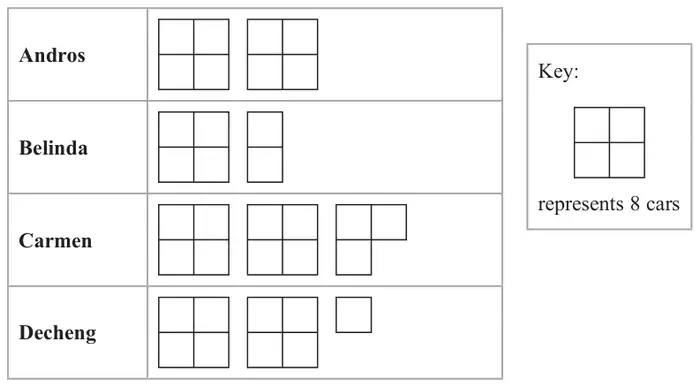
M2: for a method to find the total cars sold in April with at least 3 out of 4 correct and intention to add or sight of 68
(M1 for a method to find the totals for each employee with at least 3 out of 4 correct OR method to find the totals for 2 employees and intention to add)
M1: (indep) for a method to increase 60 by 15% or 15% of 60 or sight of 69 or 9
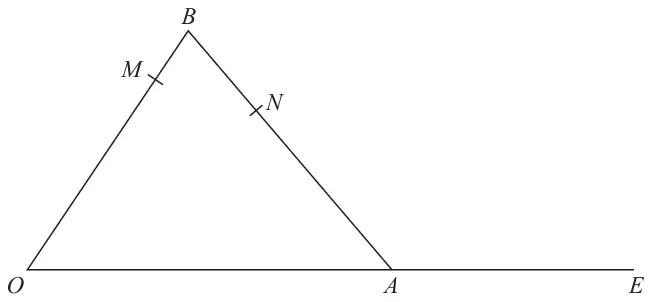
M1ft: for one of \(\overrightarrow{ME}\), \(\overrightarrow{NE}\) or \(\overrightarrow{MN}\) or one of \(\overrightarrow{EM}\), \(\overrightarrow{EN}\) or \(\overrightarrow{NM}\)
ft (dep on M1 in (a)) their expression for \(\overrightarrow{ON}\) for this mark only
(corrected from the printed mark scheme, which shows \(\dfrac{11}{3}\mathbf{a}\) here: \(\overrightarrow{OE} = \dfrac{8}{5}\mathbf{a}\))
M1: for two of \(\overrightarrow{ME}\), \(\overrightarrow{NE}\) or \(\overrightarrow{MN}\) or two of \(\overrightarrow{EM}\), \(\overrightarrow{EN}\) or \(\overrightarrow{NM}\) must be correct
A1: eg \(\overrightarrow{ME} = 4 \times \overrightarrow{MN}\) or \(\overrightarrow{NE} = 3 \times \overrightarrow{MN}\) or \(\overrightarrow{ME} = \dfrac{4}{3} \times \overrightarrow{NE}\)
or showing they are multiples of the same vector eg \(\overrightarrow{MN} = \dfrac{1}{5}(2\mathbf{a} - \mathbf{b})\) and \(\overrightarrow{NE} = \dfrac{3}{5}(2\mathbf{a} - \mathbf{b})\)
20 The weight of a cake is 2.75 kg, correct to 2 decimal places.
(a) Write down the lower bound of the weight of the cake. (1)
(b) Write down the upper bound of the weight of the cake. (1)
Penny has worked out \(\dfrac{81.3 \times 59.2}{1.9^2}\) on her calculator.
Her answer is 13 332.299 17
Penny’s answer is not sensible.
(c) By rounding each number to one significant figure, work out a suitable estimate to show that her answer is not sensible. Show your working clearly. (2)
Mark scheme (a)
Scheme
Marks
2.745
B1
(1)
Mark scheme (b)
Scheme
Marks
2.755
B1
(1)
Mark scheme (c)
Scheme
Marks
(80 × 60) ÷ 22
M1
eg (80 × 60) ÷ 22 = 1200 working with rounded values seen required Answer: 1200
A1
(2)
(4 marks)
Notes
M1: For two of 80, 60, 2 or 4 rather than 22 oe
A1: dep on M1 for answer coming from the use of the 3 rounded numbers – if 1200 seen then ignore any other working and comments
M1: for 3 consecutive even numbers in algebraic form (any letter can be used)
M1: for the sum of the squares of the largest and smallest even numbers and adding or the square of the middle even number multiplied by 2 (no need to expand or simplify for this mark)
A1: dep on M2 for use of algebra to show correct conclusion
(SCB1 for eg \((p + 4)^2 + p^2\) or \(2(p + 2)^2\) or \(2(p + 2)^2 + 8\))
(SCB2 for use of eg \((p + 4)^2 + p^2 = 2p^2 + 8p + 16\) and \(2(p + 2)^2 + 8 = 2p^2 + 8p + 16\)
If the student shows this and also says “it is true for all numbers, so it must be true for even numbers” oe or defines \(p\), \(p + 2\), \(p + 4\) as even numbers, then this would gain M2A1
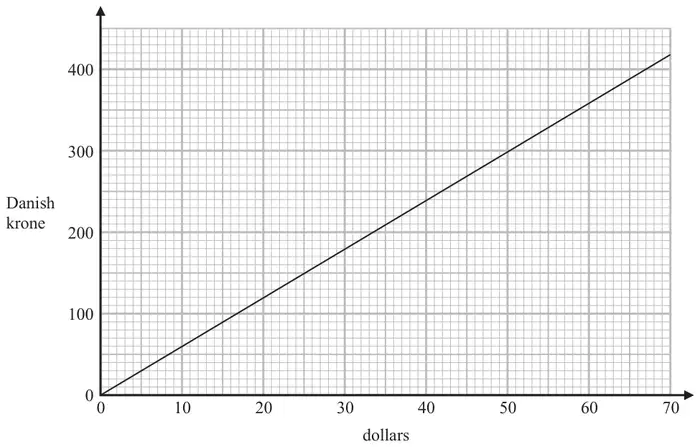
10 The graph below can be used to change between dollars and Danish krone.
(a) Change 40 dollars to Danish krone. (1)
(b) Change 350 Danish krone to dollars. (1)
Robert needs 950 Danish krone to pay for a hotel stay. He has 170 dollars.
(c) Show that Robert has enough money to pay for his hotel stay. (2)
Mark scheme (a)
Scheme
Marks
240
B1
(1)
Notes
B1: Accept 235 - 245
Mark scheme (b)
Scheme
Marks
58
B1
(1)
Notes
B1: Accept 58 -59
Mark scheme (c)
Scheme
Marks
e.g.
950 ÷ 6 or
\(950 \div \dfrac{240}{40}\) oe or
50 × 3 + 8or
e.g.
170 × 6 or
\(170 \times \dfrac{240}{40}\) oe or
300 × 2 + 420
(1 dollar = 6 krone)
M1
Working required Answer: All figures accurate eg 950 Danish krone = 150 - 165 dollars (or clearly showing 170 is enough) or 170 dollars = 1000 - 1040 Danish krone (or clearly showing that 950 is less than 170 dollars) oe
A1
(2)
(4 marks)
Notes
M1: for a correct method that gives the exchange for 950 Danish krone to dollars or 170 dollars to Danish krone
5 The weight of a cake is 2.75 kg, correct to 2 decimal places.
(a) Write down the lower bound of the weight of the cake. (1)
(b) Write down the upper bound of the weight of the cake. (1)
Penny has worked out \(\;\dfrac{81.3 \times 59.2}{1.9^2}\;\) on her calculator.
Her answer is 13 332.299 17
Penny’s answer is not sensible.
(c) By rounding each number to one significant figure, work out a suitable estimate to show that her answer is not sensible. Show your working clearly. (2)
Mark scheme (a)
Scheme
Marks
2.745
B1
(1)
Mark scheme (b)
Scheme
Marks
2.755
B1
(1)
Notes
B1: allow \(2.754\dot{9}\)
Mark scheme (c)
Scheme
Marks
\((80 \times 60) \div 2^2\)
M1
eg \((80 \times 60) \div 2^2 = 1200\) oe working with rounded values seen required Answer: 1200
A1
(2)
(4 marks)
Notes
M1: For two of 80, 60, 2 or 4 rather than \(2^2\) oe
A1: dep on M1 for answer coming from use of the 3 rounded numbers – if 1200 seen then ignore any other working and comments
18 Kaidan and Sonja went on two different car journeys.
For Kaidan’s journey
distance = 80 km correct to the nearest 5 km time = 2.7 hours correct to 1 decimal place
For Sonja’s journey
distance = 33 km correct to 2 significant figures time = 1 hour correct to the nearest 0.1 hour
Kaidan says,
“My average speed could have been greater than Sonja’s average speed.”
By considering bounds, show that Kaidan is correct. Show your working clearly.
(4)
Mark scheme
Scheme
Marks
77.5 or 82.5 or 2.65 or 2.75 or 32.5 or 33.5 or 0.95 or 1.05 or 77500 or 82500 or 159 or 165 or 32500 or 33500 or 57 or 63
B1
eg 82.5 ÷ 2.65 (= 31.13…) or 82500 ÷ 159 (= 518.867…) or km/min or m/h
M1
eg 32.5 ÷ 1.05 (= 30.95…) or 32500 ÷ 63 (= 515.873……) or km/min or m/h
M1
UB K = 31132…..m/h LB S = 30952……m/h UB K = 0.51886….km/min LB S = 0.51587…km/min Answer: Shown
A1
(4)
(4 marks)
Notes
B1: For a UB or LB for one of the distances or times in hours or in minutes
M1: for a method to find the upper bound of Kaidan’s average speed eg \(UB_K \div LB_K\) where \(80 \lt UB_K \leqslant 82.5\) and \(2.65 \leqslant LB_K \lt 2.7\) or use of m/min to find upper bound for Kaidan’s average speed eg \(UB_K \div LB_K\) where \(80000 \lt UB_K \leqslant 82500\) and \(159 \leqslant LB_K \lt 162\) can use km/min or m/h
M1: indep for a method to find the lower bound of Sonja’s average speed eg \(LB_S \div UB_S\) where \(32.5 \leqslant LB_S \lt 33\) and \(1 \lt UB_S \leqslant 1.05\) or use of m/min to find lower bound for Sonja’s average speed \(LB_S \div UB_S\) where \(32500 \leqslant LB_S \lt 33000\) and \(60 \lt UB_S \leqslant 63\) can use km/min or m/h
A1: shown with accurate figures in the same units – sufficient figures for comparison (can be truncated) but must be from correct working and UB for Kaidan and LB for Sonja selected eg UB Kaidan = 31.13… (km/h) and LB Sonja = 30.95…( km/h) or UB Kaidan = 518.867…(m/min) and LB Sonja = 515.873…( m/min) (dep on correct method)
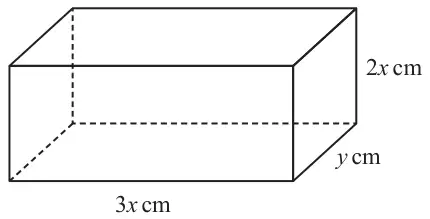
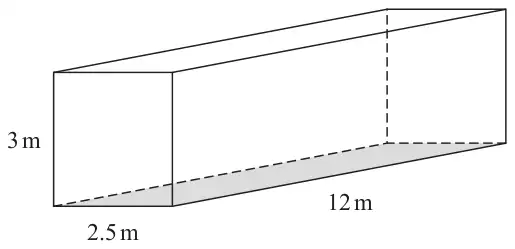
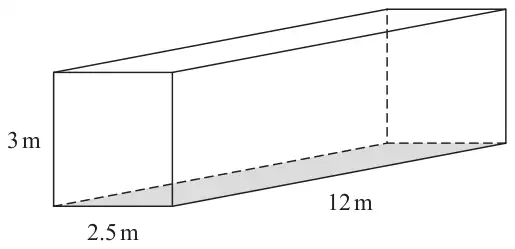
24 Jonty has a storage container in the shape of a cuboid, as shown in the diagram.
Diagram NOT accurately drawn
Jonty is going to paint the outside of his storage container, apart from the base which is shown shaded in the diagram. He needs enough paint to cover the four sides and the top.
Each tin of paint covers an area of 15 m²
The cost of each tin of paint recently increased by 10% After the increase, the cost of each tin of paint is £26.95
Jonty says
“Before the increase, I could have bought enough paint for less than £200”
Show that Jonty is correct. Show your working clearly.
(6)
Mark scheme
Scheme
Marks
3 × 2.5 (= 7.5) oe or 2 × 3 × 2.5 (= 15) oe or 12 × 3 (= 36) oe or 2 × 12 × 3 (= 72) oe or 12 × 2.5 (= 30)
M1: for setting up a correct algebraic expression (any letter can be used) must have intention to add (may come after expanding)
M1: correct expansion of brackets and correct signs or a correct result.
A1: conclusion dep on M2 for eg \(8n^2 + 2\) and a suitable conclusion (may be shown as a calculation/in numbers). The conclusion must be an intention to show that the result is a multiple of 8 and there is 2 remaining.
15 Using algebra, prove that, given any 3 consecutive whole numbers, the sum of the square of the smallest number and the square of the largest number is always 2 more than twice the square of the middle number.
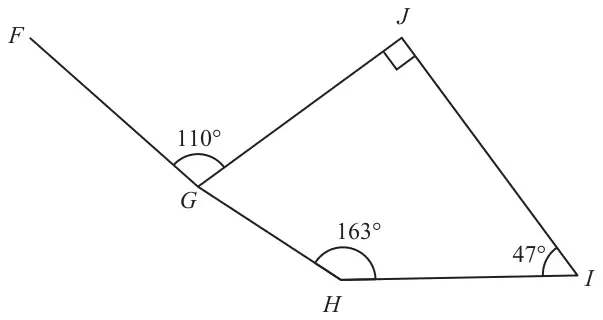
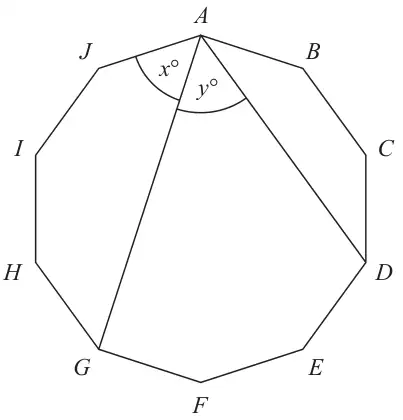
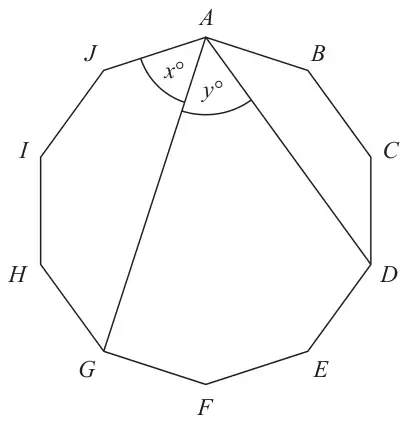
There are other correct methods. Please check for correct working. Answer: \(x = 54\) \(y = 54\)
A1
(4)
(4 marks)
Notes
M1: method to find interior or exterior angle. (angles may be seen on diagram)
M1: method to find \(x\) (must show it is intended to be \(x\)) eg use of int angle − 90° use of ext angle + \(x\) = 90° use of pentagon \(GHIJA\) All figures in “ ” must come from correct working
M1: A correct method to find an angle of 36° within the shape (not exterior angle) or 36° shown in correct place in diagram
A1: dep on M3 to find each of \(x\) and \(y\) and the correct value of 54 for both from correct working
10 Jonty has a storage container in the shape of a cuboid, as shown in the diagram.
Diagram NOT accurately drawn
Jonty is going to paint the outside of his storage container, apart from the base which is shown shaded in the diagram. He needs enough paint to cover the four sides and the top.
Each tin of paint covers an area of 15 m2
The cost of each tin of paint recently increased by 10% After the increase, the cost of each tin of paint is £26.95
Jonty says
“Before the increase, I could have bought enough paint for less than £200”
Show that Jonty is correct. Show your working clearly.
(6)
Mark scheme
Scheme
Marks
3 × 2.5 (= 7.5) oe or 2 × 3 × 2.5 (= 15) oe or 12 × 3 (= 36) oe or 2 × 12 × 3 (= 72) oe or 12 × 2.5 (= 30)
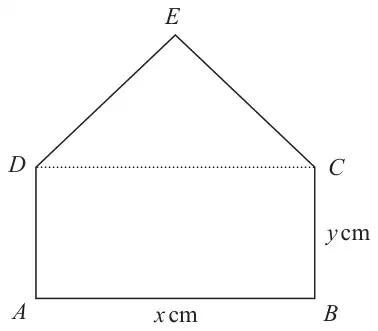
\(ABCD\) is a rectangle. \(CED\) is an equilateral triangle.
\(AB = x\) cm\(\qquad BC = y\) cm
The perimeter of \(ABCED\) is 100 cm. The area of \(ABCED\) is \(R\) cm2
(a) Show that \(R = \dfrac{x}{4}\left(200 - \left[6 - \sqrt{3}\right]x\right)\) (3)
(b)
(i) Find the value of \(x\) for which \(R\) has its maximum value. Give your answer in the form \(\dfrac{p}{q - \sqrt{3}}\) where \(p\) and \(q\) are integers. (2)
(ii) Explain why the maximum value of \(R\) is given by this value of \(x\). (1)
17 Using algebra, prove that, given any 3 consecutive even numbers, the difference between the square of the largest number and the square of the smallest number is always 8 times the middle number.
M1: 3 consecutive even numbers in algebraic form (any letter can be used)
M1: for squaring the largest and smallest even numbers and subtracting (no need to expand or simplify for this mark)
A1: dep on M2 for use of algebra to show correct conclusion (SCB1 for eg \((p + 4)^2 - p^2\)) (SCB2 for use of eg \((p + 4)^2 - p^2 = 8p + 16 = 8(p + 2)\) If the student shows this and also says “it is true for all numbers, so it must be true for even numbers” oe then this would gain M2A1
Mark scheme (ALT)
Scheme
Marks
eg \(a\), \(b\), \(c\) are consecutive even numbers where \(a \lt b \lt c\)
and one of \(b = \dfrac{a + c}{2}\) or \(a + c = 2b\) or \(c - a = 4\) oe
M1
eg \(a\), \(b\), \(c\) are consecutive even numbers where \(a \lt b \lt c\)
and all of \(b = \dfrac{a + c}{2}\) and \(a + c = 2b\) and \(c - a = 4\) oe
M1
Now \(c^2 - a^2 = (c - a)(c + a) = 4 \times 2b = 8b\) Answer: Correctly shown
A1
Notes
M1: 3 numbers defined as consecutive even numbers with one correct equation, writing one term in terms of one or more of the others or \(c - a = 4\)
M1: 3 numbers defined as consecutive even numbers with three correct equations that involve all letters in some place
A1: dep on M2 for use of algebra to show correct conclusion
eg \(4mn + 2m + 2n + 1\) or eg \(4n^2 + 4n + 1\) or eg \(4n^2 - 1\) or eg \(4n^2 + 8n + 3\)
M1
eg \(2(2mn + m + n) + 1\) therefore odd
Working required Answer: Proved
A1
(4)
(4 marks)
Notes
M2: Product of 2 different odd numbers (in the form \(2n + k\) where \(k\) is odd). Must have different letters/variables. (M1 for the product of same or different odd numbers where the variable is the same eg \((2n + 1)(2n - 1)\) or \((2n + 1)(2n + 3)\))
M1: dep M1 Multiplying out the two brackets with odd numbers correctly.
A1: dep M3 Factorising and a conclusion or stating that the 3 leading terms are all even, hence result is odd.
Working required Answer: Correct vectors and conclusion including parallel and trapezium
A1
(3)
(3 marks)
Notes
M1: Correct diagram (condone missing vector labels or arrows – with \(C\) on line segment \(OA\) and \(D\) on line segment \(OB\)) OR for finding \(\overrightarrow{AB}\) or \(\overrightarrow{BA}\) - may be seen as part of later working
M1: Method to find \(\overrightarrow{CD}\) or \(\overrightarrow{DC}\)
A1: eg \(\overrightarrow{AB}\) (\(AB\)) and \(\overrightarrow{CD}\) (\(CD\)) are parallel therefore \(ABDC\) is a trapezium
17 Prove that the difference between two consecutive square numbers is always an odd number. Show clear algebraic working.
(3)
Mark scheme
Scheme
Marks
e.g. \(n^2 - (n - 1)^2\) or \((n + 1)^2 - n^2\)
M1
e.g. \(n^2 - n^2 + 2n - 1\) or \(n^2 + 2n + 1 - n^2\)
M1
Working required Answer: e.g. \(2n - 1\) is always odd
A1
(3)
(3 marks)
Notes
M1: for setting up a correct algebraic expression (any letter can be used)
M1: Correct expansion of brackets and correct signs or a correct result
A1: dep on M2 for eg \(2n - 1\) or \(2n + 1\) or \(-(2n + 1)\) oe and a suitable conclusion SCB1 for eg \((2n)^2 - (2n - 1)^2\) or \((2n + 1)^2 - (2n)^2\) oe
M1: for the correct differentiation of at least 2 correct terms from 16 or \(-2x\) or \((3 \times -2x^2)\)
A1: for a correct differentiated expression
M1: (dep on M1) for equating their differentiated expression to zero
M1: (dep on M1) for a complete method to solve their 3-term quadratic equation (allow one sign error and some simplification – allow as far as \(\dfrac{-2 \pm \sqrt{4 + 384}}{12}\))
A1: dep on M1 for answer in range 1.47 – 1.5 from correct working (Must reject −1.80 to −1.81 if calculated)
21 \((2x + 23)\), \((8x + 2)\) and \((20x - 52)\) are three consecutive terms of an arithmetic sequence. Prove that the common difference of the sequence is 12
\(x = 5.5\) or \(x = 1.5\) from \((2x + 23) - 12 = (8x + 2)\) or \(x = 3.5\) from \((8x + 2) - 12 = (20x - 52)\)
A1
Working required \(2 \times 5.5 + 23\) (=34) and \(8 \times 5.5 + 2\) (=46) and \(20 \times 5.5 - 52\) (=58) OR \((2x + 23) + 12 = (8x + 2)\) and \((8x + 2) + 12 = (20x - 52)\) and gets \(x = 5.5\) both times Answer: shown
A1
Notes
M2: for a correct equation If not M2 then award M1 for a correct expression for the common difference in terms of \(x\) brackets must be present or removed correctly e.g \((8x + 2) - (2x + 23)\) (\(= 6x - 21\)) or \((20x - 52) - (8x + 2)\) (\(= 12x - 54\))
A1: for explicitly showing both common differences are 12 OR solves both \((2x + 23) + 12 = (8x + 2)\) and \((8x + 2) + 12 = (20x - 52)\) and gets \(x = 5.5\) both times
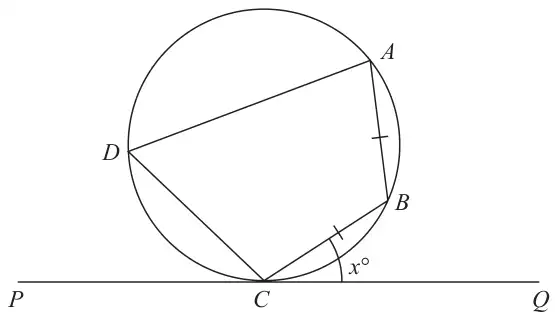
\(A\), \(B\), \(C\) and \(D\) are points on a circle. \(PCQ\) is a tangent to the circle. \(AB = CB\).
Angle \(BCQ = x°\)
Prove that angle \(CDA = 2x°\) Give reasons for each stage in your working.
(5)
Mark scheme
Scheme
Marks
angle \(CDB = x\) or angle \(CAB = x\)
M1
angle \(CBA = 180 - 2x\)
M1
angle \(CDA = 180 - (180 - 2x) = 2x\)
M1
B1
proof with reasons
A1
(5)
(5 marks)
Notes
B1: dep on M1 for any one appropriate circle theorem reason
A1: for complete proof with full reasons alternate segment theorem, angles in a triangle sum to 180º, isosceles triangle, opposite angles of a cyclic quadrilateral sum to 180º
Mark scheme (ALT 1)
Scheme
Marks
Alternative method angle \(CDB = x\) or angle \(CAB = x\)
M1
angle \(ACB = x\)
M1
angle \(ACQ = 2x\) and angle \(CDA = 2x\)
M1
B1
proof with reasons
A1
Notes
B1: dep on M1 for any one appropriate circle theorem reason
A1: for complete proof with full reasons alternate segment theorem, isosceles triangle
Mark scheme (ALT 2)
Scheme
Marks
Alternative method angle \(OCB = 90 - x\)
M1
angle \(BOC = 180 - 2(90 - x)\) (\(=2x\))
M1
angle \(AOB = 2x\) and angle \(CDA = 2x\)
M1
B1
proof with reasons
A1
Notes
B1: dep for any one appropriate circle theorem reason
A1: for complete proof with full reasons angle between tangent and radius is 90º oe, angles in a triangle sum to 180º, isosceles triangle, angle at centre is twice angle at circumference oe
Mark scheme (ALT 3)
Scheme
Marks
Alternative method where students assume \(CDA = 2x\) and must work to show that \(BCQ = x\) eg angle \(ABC = 180 - 2x\)
B1: Dep on M1 for any one appropriate circle theorem reason
A1: For complete proof with reasons e.g. opposite angles of cyclic quadrilateral sum to 180° angles in triangle sum to 180° isosceles triangle alternate segment theorem
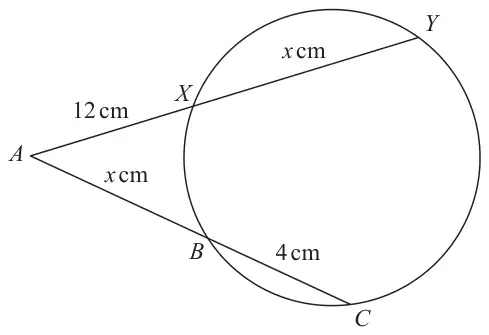
\(\dfrac{--6 \pm \sqrt{36 - -8800}}{2 \times 8}\) or \(\dfrac{6 \pm \sqrt{36 + 8800}}{16}\) or \(\dfrac{6 \pm \sqrt{8836}}{16}\)
or \((4x - 25)(2x + 11)\) (=0)
M2
6.25 oe
A1
(3)
(6 marks)
Notes
M2: If not M2 then award M1 for \(\dfrac{--6 \pm \sqrt{(-6)^2 - 4 \times 8 \times -275}}{2 \times 8}\)
Condone one sign error in substitution; allow evaluation of individual terms e.g. 36 in place of \((-6)^2\) [allow \(-6^2\) or \(6^2\) in place of \((-6)^2\), throughout allow + rather than \(\pm\)]
or
\((4x \pm 25)(2x \pm 11)\) (=0)
(if student gains M1 and shows both answers the 2nd M1 can be awarded)
ft from an incorrect 3 term quadratic equation
A1: dep on M1 and 6.25 oe alone given as final answer
The numerators of the fractions form the sequence of whole numbers 1 2 3 4 … The denominators of the fractions form the sequence of odd numbers 1 3 5 7 …
(a) Write down an expression, in terms of \(n\), for the \(n\)th term of this sequence of fractions. (2)
(b) Using algebra, prove that when the square of any odd number is divided by 4 the remainder is 1 (3)
Mark scheme (a)
Scheme
Marks
M1
\(\dfrac{n}{2n - 1}\)
A1
(2)
Notes
M1: for \(2n \pm k\) oe as the denominator
A1: oe
Mark scheme (b)
Scheme
Marks
\((2n - 1)^2 = 4n^2 - 4n + 1\)
M1
\(4(n^2 - n) + 1\) or \(\dfrac{4n^2 - 4n + 1}{4} = n^2 - n + \dfrac{1}{4}\)
M1
Proved
A1
(3)
(5 marks)
Notes
M1: or \((2n + 1)^2 = 4n^2 + 4n + 1\) ft on \(2n \pm k\) (\(k\) non zero)
M1: or \(4(n^2 + n) + 1\) or \(\dfrac{4n^2 + 4n + 1}{4} = n^2 + n + \dfrac{1}{4}\)
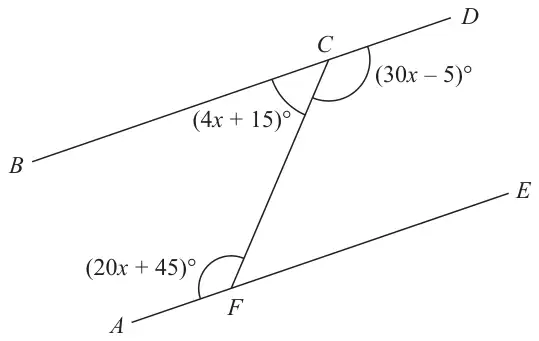
\(BCD\) and \(AFE\) are straight lines. Show that \(BCD\) is parallel to \(AFE\). Give reasons for your working.
(5)
Mark scheme
Scheme
Marks
E.g. \(4x + 15 + 30x - 5 = 180\) OR \(20x + 45 + 4x + 15 = 180\) OR \(4x + 15 + 20x + 45 = 180\) OR \(30x - 5 = 20x + 45\)
M1
\(x = 5\)
A1
E.g. \(20 \times \text{``}{5}\text{''} + 45\) (=145) or \(4 \times \text{``}{5}\text{''} + 15\) (=35) or \(30 \times \text{``}{5}\text{''} - 5\) (=145) OR E.g. \(4x + 15 + 30x - 5 = 180\) AND \(30x - 5 = 20x + 45\)
M1
E.g. \(AFC = 145\) and \(FCD = 145\) OR \(AFC = 145\) and \(BCF = 35\) OR \(x = 5\) from the solution of two equations
A1
Working required Answer: Shown correctly with reasons
B1
(5)
(5 marks)
Notes
M1: for forming an appropriate equation
A1: dep on previous M1
M1: for substituting their value for \(x\) into the expression NOT used to form the equation solved OR forms a second equation in \(x\)
A1: dep on previous M1 NB : It must be clear which angles are being found
B1: For full reasons: Alternate angles are equal andangles in a straight line add to 180ºOR Allied angles (or co-interior) add to 180ºandangles in a straight line add to 180º
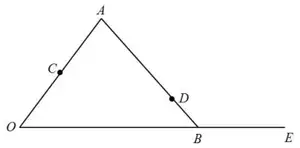
\(C\) is the midpoint of \(OA\). \(D\) is the point on \(AB\) such that \(AD : DB = 3 : 1\) \(E\) is the point such that \(\overrightarrow{OB} = 2\overrightarrow{BE}\)
Using a vector method, prove that the points \(C\), \(D\) and \(E\) lie on the same straight line.
Correct simplified vectors for two of \(\overrightarrow{CD}\), \(\overrightarrow{DE}\), \(\overrightarrow{CE}\) with a correct explanation
A1
(5)
(5 marks)
Notes
M1: Correct diagram (only points needed, condone missing vector labels) OR for finding \(\overrightarrow{AB}\) or \(\overrightarrow{BA}\) – may be seen as part of later working
M1: method to find \(\overrightarrow{AD}\) or \(\overrightarrow{DA}\) or \(\overrightarrow{DB}\) or \(\overrightarrow{BD}\) – may be seen as part of later working
M1: oe, method to find \(\overrightarrow{CD}\) or \(\overrightarrow{DE}\) or \(\overrightarrow{CE}\)
M1: A correct vector expression in terms of \(\mathbf{a}\) and \(\mathbf{b}\) for two of \(\overrightarrow{CD}\), \(\overrightarrow{DE}\), \(\overrightarrow{CE}\)
A1: A correct conclusion eg \(\overrightarrow{CD} = \overrightarrow{DE}\) so \(CDE\) is a straight line \(\overrightarrow{CE} = 2\overrightarrow{CD}\) so \(CDE\) is a straight line \(\overrightarrow{CE} = 2\overrightarrow{DE}\) so \(CDE\) is a straight line
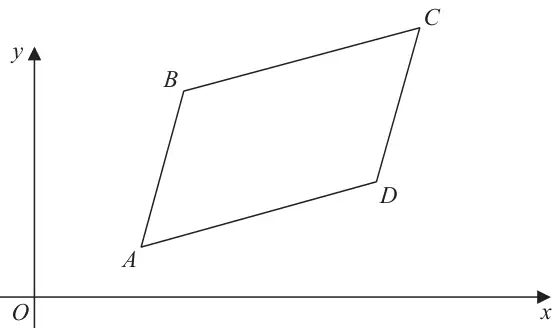
\(\begin{pmatrix}5\\8\end{pmatrix} + \text{``}{\begin{pmatrix}8\\4\end{pmatrix}}\text{''}\) or \(\begin{pmatrix}10\\11\end{pmatrix} + \text{``}{\begin{pmatrix}3\\1\end{pmatrix}}\text{''}\)
M1
(13, 12)
A1
(3)
Notes
M1: or coordinates (5 – 2, 8 – 7) (= (3, 1)) assigned to \(A\) (may be seen in vector form) or (13, \(y\)) or (\(x\), 12) given as coordinates for \(C\)
M1: for coordinates (5 – 2 + 10, 8 – 7 + 11) assigned to \(C\)
Mark scheme (b)
Scheme
Marks
e.g. \(\begin{pmatrix}63\\211\end{pmatrix} - \begin{pmatrix}5\\8\end{pmatrix} \left(= \begin{pmatrix}58\\203\end{pmatrix}\right)\)
with
e.g. “58” ÷ 2 (=29) and “203” ÷ 7 (=29)
OR
e.g. \(\begin{pmatrix}63\\211\end{pmatrix} - \begin{pmatrix}3\\1\end{pmatrix} \left(= \begin{pmatrix}60\\210\end{pmatrix}\right)\)
with
e.g. “60” ÷ 2 (=30) and “210” ÷ 7 (=30)
M1
Proof
A1
(2)
(5 marks)
Notes
M1: may work with \(A\) and \(E\), in which case may need to ft for method mark from (a)
A1: proof with justification eg. \(\overrightarrow{BE} = 29\begin{pmatrix}2\\7\end{pmatrix}\) (or \(\overrightarrow{AE} = 30\begin{pmatrix}2\\7\end{pmatrix}\)) with \(ABE\) is a straight line or 210 ÷ 60 = 3.5 and 7 ÷ 2 = 3.5 so \(ABE\) is a straight line
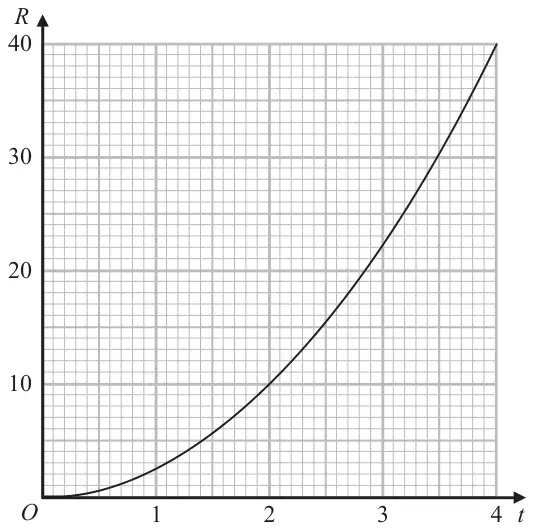
The graph shows the relationship between \(R\) and \(t\) for \(0 \leqslant t \leqslant 4\)
(a) Find a formula for \(R\) in terms of \(t\). (3)
Given also that \(R = \dfrac{8}{5x}\)
(b) show that \(t\) is inversely proportional to \(\sqrt{x}\) for \(t \gt 0\) (2)
Mark scheme (a)
Scheme
Marks
\(R = kt^2\) oe
M1
eg \(10 = k \times 2^2\) or \(40 = k \times 4^2\) or \(k = 2\tfrac{1}{2}\)
M1
Working required
Answer: \(R = \dfrac{5}{2}t^2\)
A1
(3)
Notes
M1: Equation consistent with \(R \propto t^2\)
M1: Substitute values at any point on the graph or find the value of \(k\). (Implies first M1.) Allow readings from graph for \(t\) ± 0.1 and \(R\) ± 1
A1: Award for \(R = kt^2\) if the value of \(k\) is shown clearly in (a) or (b).