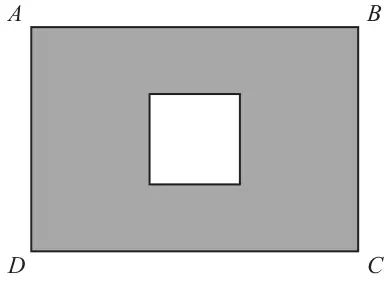
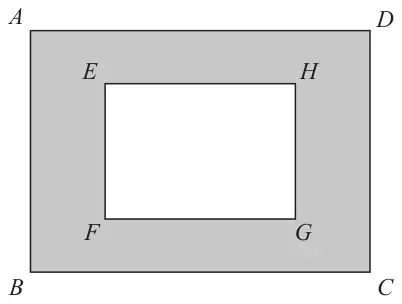
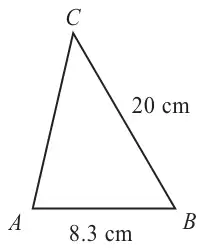
22 The diagram shows a square inside rectangle \(ABCD\)
Diagram NOT accurately drawn
The total area of the region shown shaded in the diagram is \(X\) cm2
\(AB = 11.5\) cm correct to the nearest 0.5 cm \(BC = 9.2\) cm correct to 2 significant figures side of square = 4.1 cm correct to 2 significant figures
By considering bounds, work out the value of \(X\) to a suitable degree of accuracy. Show your working clearly.
(4)
Mark scheme
Scheme
Marks
11.25, 11.75, 9.15, 9.25, 4.05, 4.15
B1
\(11.75 \times 9.25 - 4.05^2\) (= 92.285)
M1
\(11.25 \times 9.15 - 4.15^2\) (= 85.715)
M1
Working required Answer: 90
A1
(4)
(4 marks)
Notes
B1: for a correct bound
Accept \(11.74\dot{9}\) for 11.75 or \(11.74\overline{9}\) for 11.75 \(9.24\dot{9}\) for 9.25 or \(9.24\overline{9}\) for 9.25 \(4.14\dot{9}\) for 4.15 or \(4.14\overline{9}\) for 4.15
M1: for a correct method to find the UB of \(X\), allow
\((11.5 \lt AB \leqslant 11.75) \times (9.2 \lt BC \leqslant 9.25) - \left((4.05 \leqslant s \lt 4.1)^2\right)\)
M1: for a correct method to find the LB of \(X\), allow
\((11.25 \leqslant AB \lt 11.5) \times (9.15 \leqslant BC \lt 9.2) - \left((4.1 \lt s \leqslant 4.15)^2\right)\)
A1: dep on M2 90 and both UB and LB correct using correct values 11.25, 11.75, 9.15, 9.25, 4.05 and 4.15
B1: For a correct upper or lower bound Allow \(8.4\dot{9}\) for 8.5, \(6.624\dot{9}\) for 6.625, \(1.24\dot{9}\) for 1.25 (corrected from the printed mark scheme: “6.6249 for 6.5”)
\(a = 8.3\) correct to 2 significant figures \(c = 2\) correct to 1 significant figure \(y = 15\) correct to the nearest 5
Work out the upper bound for the value of \(P\) Show your working clearly.
(3)
Mark scheme
Scheme
Marks
8.25, 8.35, 2.5, 1.5, 17.5, 12.5
B1
8.35(2.5 + 17.5) oe
M1
Working required Answer: 167
A1
(3 marks)
Notes
B1: For any one of these stated or used; accept 8.349…, 2.49…, 17.49…
M1: For \(\text{UB}_a(\text{UB}_c + \text{UB}_y)\) 8.3 < UBa ≤ 8.35, 2 < UBc ≤ 2.5, 15 < UBy ≤ 17.5 (this allows for the student who uses some sort of upper value, but is slightly inaccurate, eg using 17.4 for \(y\))
25 A solid sphere has a radius of 2.8 centimetres, correct to 1 decimal place. The sphere has a mass of \(\;M\pi\;\) grams, where \(M = 260\) correct to 2 significant figures.
Work out the upper bound for the density of the sphere. Give your answer in g/cm³ correct to 2 decimal places. Show your working clearly.
(4)
Mark scheme
Scheme
Marks
255 or 265 or 2.85 or 2.75
B1
\((V =)\; \dfrac{4}{3}\pi \times (2.75)^3\)
\(\left(= \dfrac{1331}{48}\pi \text{ or } 87.1137….\right)\)
(condone missing \(\pi\) for \(265\pi\) (also may have cancelled out \(\pi\)))
M1
9.56
A1
(4)
(4 marks)
Notes
B1: for sight of a correct upper or lower bound
M1: calculation to find \(V\) using \(V = \dfrac{4}{3}\pi {r_{LB}}^3\) where \(2.75 \leqslant r_{LB} \lt 2.8\) or use of 2.85
M1: method to find UB of density, using LB of \(V\) and UB of \(M\) for correct substitution into \(D = \dfrac{\pi M_{UB}}{V_{LB}}\) where \(260 \lt M_{UB} \leqslant 265\) and \(87.11... \leqslant V_{LB} \lt 91.95...\) oe
A1: dep on M2 and all correct bounds used allow 9.55 - 9.56
The total length of the fence is 50 metres, correct to the nearest 5 metres. The length of each fence panel is 1.3 metres, correct to the nearest 10 cm.
The cost of each fence panel is £8.65
Diego may only buy complete fence panels. Diego only pays for the number of panels he needs to build the fence.
Work out the greatest difference in the possible amounts that Diego could pay to build the fence. Show your working clearly.
(4)
Mark scheme
Scheme
Marks
47.5 or 52.5 or 1.25 or 1.35
B1
eg
\(\dfrac{47.5}{1.35}\;(= 35.18\ldots)\)
or
\(\dfrac{52.5}{1.25}\;(= 42)\)
M1
eg ("42" − "36") × 8.65 or “42” × 8.65 – “36” × 8.65 or 363.3 – 311.4
M1
Working required Answer: 51.9(0)
A1
(4)
(4 marks)
Notes
B1: for a correct bound, accept 4750 or 5250 or 125 or 135 if working in cm
M1: for correct substitution of \(47.5 \leqslant LB_F \lt 50\) and \(1.3 \lt UB_{FP} \leqslant 1.35\) or \(50 \lt UB_F \leqslant 52.5\) and \(1.25 \leqslant LB_{FP} \lt 1.3\)
M1: (dep on M1) for using their lower and upper bounds for the number of fence panels needed to find the cost – lower bound and/or upper bound must be an integer rounded up
20 The weight of a cake is 2.75 kg, correct to 2 decimal places.
(a) Write down the lower bound of the weight of the cake. (1)
(b) Write down the upper bound of the weight of the cake. (1)
Penny has worked out \(\dfrac{81.3 \times 59.2}{1.9^2}\) on her calculator.
Her answer is 13 332.299 17
Penny’s answer is not sensible.
(c) By rounding each number to one significant figure, work out a suitable estimate to show that her answer is not sensible. Show your working clearly. (2)
Mark scheme (a)
Scheme
Marks
2.745
B1
(1)
Mark scheme (b)
Scheme
Marks
2.755
B1
(1)
Mark scheme (c)
Scheme
Marks
(80 × 60) ÷ 22
M1
eg (80 × 60) ÷ 22 = 1200 working with rounded values seen required Answer: 1200
A1
(2)
(4 marks)
Notes
M1: For two of 80, 60, 2 or 4 rather than 22 oe
A1: dep on M1 for answer coming from the use of the 3 rounded numbers – if 1200 seen then ignore any other working and comments
5 The weight of a cake is 2.75 kg, correct to 2 decimal places.
(a) Write down the lower bound of the weight of the cake. (1)
(b) Write down the upper bound of the weight of the cake. (1)
Penny has worked out \(\;\dfrac{81.3 \times 59.2}{1.9^2}\;\) on her calculator.
Her answer is 13 332.299 17
Penny’s answer is not sensible.
(c) By rounding each number to one significant figure, work out a suitable estimate to show that her answer is not sensible. Show your working clearly. (2)
Mark scheme (a)
Scheme
Marks
2.745
B1
(1)
Mark scheme (b)
Scheme
Marks
2.755
B1
(1)
Notes
B1: allow \(2.754\dot{9}\)
Mark scheme (c)
Scheme
Marks
\((80 \times 60) \div 2^2\)
M1
eg \((80 \times 60) \div 2^2 = 1200\) oe working with rounded values seen required Answer: 1200
A1
(2)
(4 marks)
Notes
M1: For two of 80, 60, 2 or 4 rather than \(2^2\) oe
A1: dep on M1 for answer coming from use of the 3 rounded numbers – if 1200 seen then ignore any other working and comments
18 Kaidan and Sonja went on two different car journeys.
For Kaidan’s journey
distance = 80 km correct to the nearest 5 km time = 2.7 hours correct to 1 decimal place
For Sonja’s journey
distance = 33 km correct to 2 significant figures time = 1 hour correct to the nearest 0.1 hour
Kaidan says,
“My average speed could have been greater than Sonja’s average speed.”
By considering bounds, show that Kaidan is correct. Show your working clearly.
(4)
Mark scheme
Scheme
Marks
77.5 or 82.5 or 2.65 or 2.75 or 32.5 or 33.5 or 0.95 or 1.05 or 77500 or 82500 or 159 or 165 or 32500 or 33500 or 57 or 63
B1
eg 82.5 ÷ 2.65 (= 31.13…) or 82500 ÷ 159 (= 518.867…) or km/min or m/h
M1
eg 32.5 ÷ 1.05 (= 30.95…) or 32500 ÷ 63 (= 515.873……) or km/min or m/h
M1
UB K = 31132…..m/h LB S = 30952……m/h UB K = 0.51886….km/min LB S = 0.51587…km/min Answer: Shown
A1
(4)
(4 marks)
Notes
B1: For a UB or LB for one of the distances or times in hours or in minutes
M1: for a method to find the upper bound of Kaidan’s average speed eg \(UB_K \div LB_K\) where \(80 \lt UB_K \leqslant 82.5\) and \(2.65 \leqslant LB_K \lt 2.7\) or use of m/min to find upper bound for Kaidan’s average speed eg \(UB_K \div LB_K\) where \(80000 \lt UB_K \leqslant 82500\) and \(159 \leqslant LB_K \lt 162\) can use km/min or m/h
M1: indep for a method to find the lower bound of Sonja’s average speed eg \(LB_S \div UB_S\) where \(32.5 \leqslant LB_S \lt 33\) and \(1 \lt UB_S \leqslant 1.05\) or use of m/min to find lower bound for Sonja’s average speed \(LB_S \div UB_S\) where \(32500 \leqslant LB_S \lt 33000\) and \(60 \lt UB_S \leqslant 63\) can use km/min or m/h
A1: shown with accurate figures in the same units – sufficient figures for comparison (can be truncated) but must be from correct working and UB for Kaidan and LB for Sonja selected eg UB Kaidan = 31.13… (km/h) and LB Sonja = 30.95…( km/h) or UB Kaidan = 518.867…(m/min) and LB Sonja = 515.873…( m/min) (dep on correct method)
19 The diagram shows rectangle \(ABCD\) with rectangle \(EFGH\) cut out to form the shaded region.
Diagram NOT accurately drawn
\(AD = 8.3\) cm correct to one decimal place \(DC = 7.2\) cm correct to one decimal place \(EH = 6.2\) cm correct to one decimal place \(HG = 5.3\) cm correct to one decimal place
Work out the upper bound of the area of the shaded region. Show your working clearly.
18 The length of a book is 33.8 cm, correct to one decimal place.
(a) Write down the lower bound of the length of the book. (1)
(b) Write down the upper bound of the length of the book. (1)
Mark scheme (a)
Scheme
Marks
33.75
B1
(1)
Notes
B1: oe eg 33.750
Mark scheme (b)
Scheme
Marks
33.85
B1
(1)
(2 marks)
Notes
B1: allow \(33.84\dot{9}\) or 33.849r or “33.8499…” do NOT allow 33.849 without indication of recurring “9” (corrected from the printed mark scheme: “33.879”)
17 A metal block has a mass of 5 kg, correct to the nearest 50 grams. The block has a volume of \((1.84 \times 10^{-3})\) m3, correct to 3 significant figures.
Work out the upper bound for the density of the block. Give your answer in kg/m3 correct to 1 decimal place. Show your working clearly.
(4)
Mark scheme
Scheme
Marks
5025 or 5.025 or 4975 or 4.975
B1
\(1.845 \times 10^{-3}\) oe or \(1.835 \times 10^{-3}\) oe
5 The length of a book is 33.8 cm, correct to one decimal place.
(a) Write down the lower bound of the length of the book. (1)
(b) Write down the upper bound of the length of the book. (1)
Mark scheme (a)
Scheme
Marks
33.75
B1
(1)
Notes
B1: oe eg 33.750
Mark scheme (b)
Scheme
Marks
33.85
B1
(1)
(2 marks)
Notes
B1: allow \(33.84\dot{9}\) or 33.849r or “33.8499…” do NOT allow 33.849 without indication of recurring “9” (corrected from the printed mark scheme: it prints 33.879)
\(a = 3.46\) correct to 3 significant figures. \(b = 6.3\) correct to 1 decimal place. Work out the upper bound for the value of \(x\). Give your answer as a decimal correct to 3 significant figures. Show your working clearly.
(3)
Mark scheme
Scheme
Marks
3.455 or 3.465 or 6.25 or 6.35
M1
\(\dfrac{6 \times 3.465}{6.25 - 3.465}\)
M1
Working required Answer: 7.46
A1
(3)
(3 marks)
Notes
M1: Accept \(3.464\dot{9}\) for 3.465 or \(6.34\dot{9}\) for 6.35
M1: \(\dfrac{6 \times \text{UB}_a}{\text{LB}_b - \text{UB}_a}\) where \(3.46 \lt \text{UB}_a \leqslant 3.465\) and \(6.25 \leqslant \text{LB}_b \lt 6.3\)
21 Correct to 2 significant figures, \(a = 58\), \(b = 28\) and \(c = 18\) Calculate the upper bound for the value of \(\dfrac{a}{b - c}\) Show your working clearly.
19 Rachael walks to school. The distance to school is 2.8 km, correct to the nearest 0.1 km. She walks at a speed of 5 km/h, correct to the nearest km/h.
Calculate the upper bound, in minutes, for the time Rachael takes to walk to school.
(3)
Mark scheme
Scheme
Marks
2.85 x 60 ÷ 4.5 oe
M2
38
A1
(3 marks)
Notes
M2: M1 for 4.5 or 2.85 selected or used. Accept \(4.4\dot{9}\) or \(2.84\dot{9}\)
A1: 38 must come from correct working, although 38 without working gets M2A1
14 Rob is making a scale model of the Solar System on the school field. He wants the distance from the Sun to Jupiter to be 8 metres on his scale model.
The real distance from the Sun to Jupiter is \(7.8 \times 10^8\) kilometres.
(a) Find the scale of the model. Give your answer in the form \(1 : n\), where \(n\) is written in standard form. (3)
Rob wants to put the position of a space probe on the scale model. The real distance of the space probe from the Sun is \(1.9 \times 10^{10}\) kilometres, correct to 2 significant figures.
(b) Work out the maximum distance of the space probe from the Sun on the scale model. Give your answer in metres. (3)
Mark scheme (a)
Scheme
Marks
\(7.8 \times 10^8 \times 1000\) or \(7.8 \times 10^{11}\) oe or 8 ÷ 1000 or 0.008
21 There are 1300 sheets of paper, correct to the nearest 100 sheets, in a pile. Each sheet is of equal thickness. The height of the pile is 160 mm, correct to the nearest 10 mm.
Calculate the upper bound, in millimetres, for the thickness of one sheet of paper.
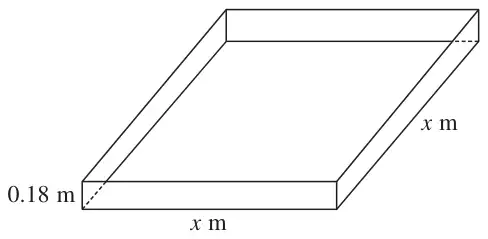
Trena wants to build a sandpit in the shape of a cuboid. The volume of sand in the sandpit will be 1.0 m3, correct to 1 decimal place. The depth of sand in the sandpit will be 0.18 metres, correct to 2 decimal places. The sandpit will have a square base with sides of length \(x\) metres.
Find the upper bound for \(x\) Give your answer correct to 3 significant figures.
(4)
Mark scheme
Scheme
Marks
1.05 selected
B1
0.175 selected
B1
\(\sqrt{\dfrac{1.05}{0.175}}\) oe
M1
2.45
A1
(4)
(4 marks)
Notes
M1: Allow \(\sqrt{6}\) or “\(x\)”\(^2\) = 6 or 6 (from 1.05 ÷ 0.175)
A1: (2.44948) awrt 2.45 dependent on M1
The mark scheme states that for this question the correct answer alone does not imply a correct method.
(a) Correct to the nearest millimetre, the length of a side of a regular hexagon is 3.6 cm. Calculate the upper bound for the perimeter of the regular hexagon. (2)
(b) Correct to 1 significant figure, the area of a rectangle is 80 cm2 Correct to 2 significant figures, the length of the rectangle is 12 cm. Calculate the lower bound for the width of the rectangle. Show your working clearly. (3)
Mark scheme (a)
Scheme
Marks
3.65 × 6
M1
21.9
A1
(2)
Notes
M1: for 3.65 or \(3.64\dot{9}\) or 3.6499...
A1: Also accept \(21.8\dot{9}\) or 21.899...
Mark scheme (b)
Scheme
Marks
75 or 12.5 or \(12.4\dot{9}\)
M1
\(\dfrac{75}{12.5}\) or 75 = w × 12.5 or
\(\dfrac{75}{12.4\dot{9}}\) or 75 = w × \(12.4\dot{9}\)
M1
6
A1
(3)
Notes
M1: for 75 and 12.5 (or \(12.4\dot{9}\)) used correctly
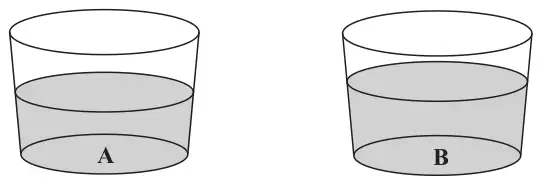
Glass A contains 122 millilitres of water, correct to the nearest millilitre. Glass B contains 168 millilitres of water, correct to the nearest millilitre.
Calculate the upper bound of the difference, in millilitres, between the volume of water in glass A and the volume of water in glass B.
(2)
Mark scheme
Scheme
Marks
168.5 − 121.5
M1
47
A1
(2)
Notes
M1: for 168.5 or \(168.4\dot{9}\) or 168.499... or 121.5
9 The length of a fence is 137 metres, correct to the nearest metre. Write down
(i) the lower bound for the length of the fence,
(ii) the upper bound for the length of the fence.
(2)
Mark scheme
Scheme
Marks
(i) 136.5
B1
(ii) 137.5 or \(137.4\dot{9}\) or 137.499..
B1
(Total 2 marks)
Notes
B1: dot above 9 for recurring or 137.499..... (i.e .499 or better)
Apart from questions 5b, 8, 15d, 20b, 21b, 23, 24b (where the mark scheme states otherwise) the correct answer, unless clearly obtained by an incorrect method, should be taken to imply correct working.
23 In a race, Paula runs 25 laps of a track. Each lap of the track is 400 m, correct to the nearest metre. Paula’s average speed is 5.0 m/s, correct to one decimal place.
Calculate the upper bound for the time that Paula takes to run the race. Give your answer in minutes and seconds, correct to the nearest second.
14 The volume of oil in a tank is 1000 litres, correct to the nearest 10 litres. The oil is poured into tins of volume 2.5 litres, correct to one decimal place.
Calculate the upper bound of the number of tins which will be required.
We'd like to use Google Analytics cookies to count visits and see which pages help most. They're optional, and the site works exactly the same either way. Privacy policy