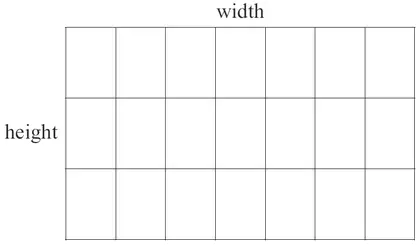
(a) Make \(y\) the subject of \(\quad w = 3y - d\) (2)
Diego buys \(b\) boxes of crayons and \(p\) packets of crayons.
There are 12 crayons in each box. There are 3 crayons in each packet.
Diego buys a total of \(T\) crayons.
(b) Write down a formula for \(T\) in terms of \(b\) and \(p\) (3)
Mark scheme (a)
Scheme
Marks
\(w + d = 3y\) oe or \(-3y = -w - d\) oe or
\(\dfrac{w}{3} = y - \dfrac{d}{3}\) oe or \(\dfrac{w + d}{3}\) oe or \(y = w + d \div 3\)
M1
Working not required, so correct answer scores full marks (unless from obvious incorrect working)
Answer: \(y = \dfrac{w + d}{3}\)
A1
(2)
Notes
M1: for a correct first step
A1: oe eg \(y = \dfrac{-d - w}{-3}\) or \(y = \dfrac{w}{3} + \dfrac{d}{3}\) oe or
\(y = (w + d) \div 3\)
(must see \(y\) = … on answer line or in working)
Mark scheme (b)
Scheme
Marks
\(T = 12b + 3p\)
B3
(3)
(5 marks)
Notes
B3: for \(T = 12b + 3p\) oe [accept \(T = 12 \times b + 3 \times p\)]
B2 for \(12b + 3p\) or \(T = 12b + xp\) or \(T = yb + 3p\) or a correct equation with other letters eg \(T = 12m + 3n\)
B1 for \(12b + xp\) or \(12b\) or \(yb + 3p\) or \(3p\) or \(12p + 3b\) or \(T = kb + cp\) where \(k \neq 0\) or \(k \neq 12\) and \(c \neq 0\) or \(c \neq 3\)
Accept upper or lower case for \(T\), \(b\) and \(p\) including a mixture of these for B3, B2 and B1
He has \(n\) red cars. He has twice as many blue cars as red cars. He has 7 more green cars than red cars.
(a) Write an expression, in terms of \(n\), for the total number of red cars, blue cars and green cars that Kye has. Write your answer in its simplest form. (2)
The total number of cars that Kye has is \(T\)
(b) Write an expression, in terms of \(T\) and \(n\), for the number of cars that Kye has that are not red cars, blue cars or green cars. (1)
Mark scheme (a)
Scheme
Marks
\(2n\) or \(n + 7\)
M1
Correct answer scores full marks (unless from obvious incorrect working) Answer: \(4n + 7\)
(a) Simplify \(\quad e \times e \times e \times e \times e\) (1)
(b) Simplify \(\quad m + m + m\) (1)
(c) Simplify \(\quad 3g^2 + 7g^2 - 4g^2\) (1)
(d) Expand \(\quad a(a + 8)\) (1)
(e) Factorise \(\quad 15x + 20\) (1)
Sophia sells \(d\) packs of toy cars and \(h\) boxes of toy cars.
Each pack contains 3 toy cars. Each box contains 5 toy cars.
The total number of toy cars that Sophia sells is \(T\)
(f) Write down a formula for \(T\) in terms of \(d\) and \(h\) (3)
Mark scheme (a)
Scheme
Marks
\(e^5\)
B1
(1)
Mark scheme (b)
Scheme
Marks
\(3m\)
B1
(1)
Mark scheme (c)
Scheme
Marks
\(6g^2\)
B1
(1)
Mark scheme (d)
Scheme
Marks
\(a^2 + 8a\)
B1
(1)
Mark scheme (e)
Scheme
Marks
\(5(3x + 4)\)
B1
(1)
Mark scheme (f)
Scheme
Marks
\(T = 3d + 5h\)
B3
(3)
(8 marks)
Notes
B3: Allow \(T = d3 + h5\) or \(T = d \times 3 + h \times 5\)
(B2 for \(3d + 5h\) or \(T = 3d + xh\) or \(T = yd + 5h\) or \(T = 5d + 3h\)) [where \(x \neq 0\) and \(y \neq 0\) and can be negative]
(B1 for \(3d + xh\) or \(yd + 5h\) [where \(x \neq 0\) and \(y \neq 0\) and can be negative] or \(5d + 3h\) or for \(T\) = an incorrect expression in \(d\) and \(h\) eg \(T = d + h\), \(T = d \times h\) etc or \(T = 3d\ (+\, c)\) or \(T = (k\ +)\ 5h\))
\(\dfrac{\text{``}{2800}\text{''} - \text{``}{700}\text{''}}{5}\) or \(\dfrac{2.8 - \text{``}{0.7}\text{''}}{5}\) or \(\dfrac{\text{``}{2.1}\text{''}}{5}\) or \(\dfrac{\text{``}{2100}\text{''}}{5}\)
M1
Correct answer scores full marks (unless from obvious incorrect working) Answer: 420
A1
(4)
(4 marks)
Notes
B1: correct conversion (could be implied by further working)
M1: Also award for
\(\dfrac{2.8 - \text{``}{0.35}\text{''}}{5}\) or \(\dfrac{2800 - \text{``}{350}\text{''}}{5}\)
Working not required, so correct answer scores full marks (unless from obvious incorrect working) Answer: 6.4
A1
(5)
(5 marks)
Notes
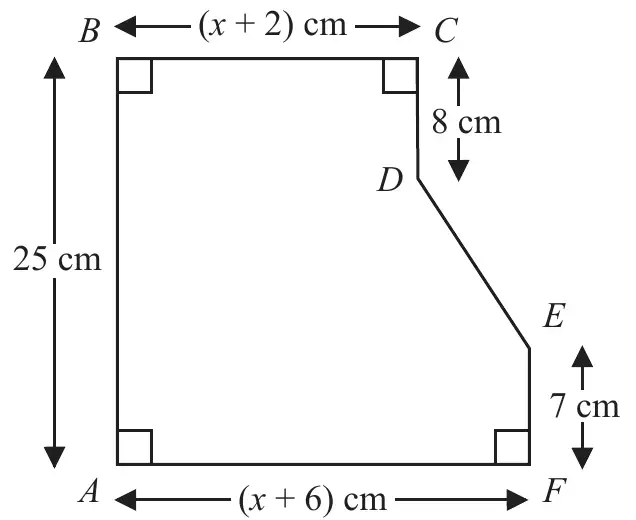
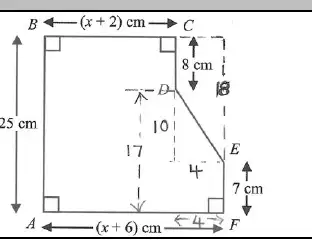
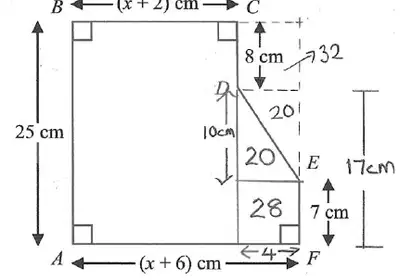
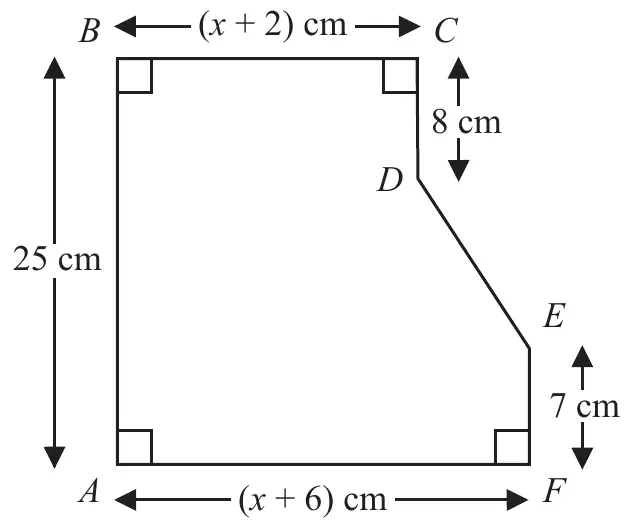
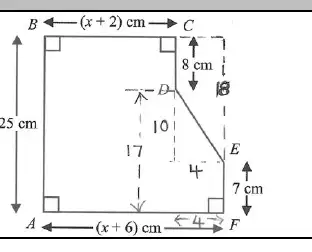
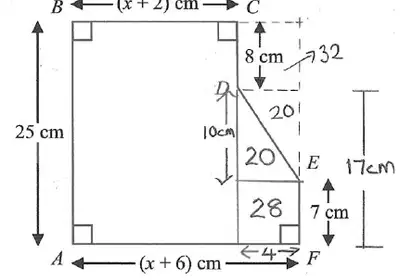
B1: for a length of 4 (cm) or 17 (cm) or 25 – 7 – 8 (=10 (cm)) or 18 (cm) in the correct place on the diagram or calculated or used correctly in working.
M2: for 2 correct expressions or values for the area of any 2 parts of the shape that do not overlap (unless subtracting) (need not be added or subtracted) (figures to be correct or come from correct working to award marks) (M1 for one correct expression)
M1: for an equation that is correct or from correct working. This need not have expanded terms and may not equal 258 if other work has been done. All parts for their method must be included with no overlaps OR a complete numerical method
\(y\) metal bars are gold. \((3y + 7)\) metal bars are silver. \((2y - 5)\) metal bars are zinc.
(b) Work out the number of metal bars that are zinc. Show clear algebraic working.(4)
Mark scheme (a)
Scheme
Marks
\(6p(2q - 3)\)
B2
(2)
Notes
B2: If not B2 then award B1 for any correct partial factorisation with 2 factors taken out (\(2p\) or \(3p\) or 6 (2×3)) outside of the bracket \(2p(6q - 9)\) or \(3p(4q - 6)\) or \(6(2pq - 3p)\) or allow \(6p\) and one error inside the bracket eg \(6p(2q - a)\) or \(6p(b - 3)\) oe eg \(6p(2q + 3)\)
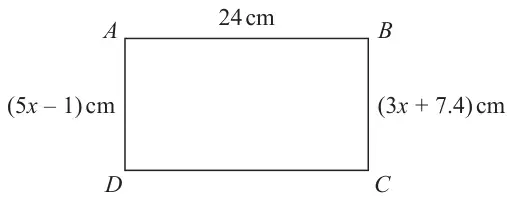
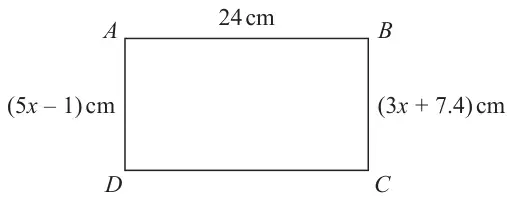
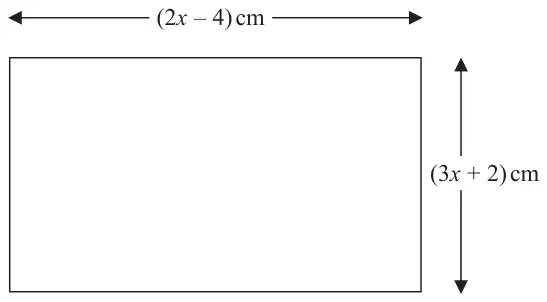
M1: a correct equation to find \(x\) or a correct expression for the perimeter in terms of \(x\)
A1: the correct value of \(x\) (implies previous mark)
M1: dep on a correct method to find the perimeter – use of positive \(x\) from correct working (1st M1 awarded for an equation) and only if used the same measurement for \(AD\) and \(BC\)
(a) Simplify \(c \times c \times c \times c \times c \times c\) (1)
(b) Simplify \(2h^3 + 5h^3 - h^3\) (1)
(c) Expand \(x(x + 5)\) (1)
(d) Factorise \(9y - 12\) (1)
Rosanna sells \(m\) small bags of marbles and \(p\) large bags of marbles.
Each small bag contains 15 marbles. Each large bag contains 40 marbles.
The total number of marbles that Rosanna sells is \(T\)
(e) Write down a formula for \(T\) in terms of \(m\) and \(p\) (3)
Mark scheme (a)
Scheme
Marks
\(c^6\)
B1
(1)
Mark scheme (b)
Scheme
Marks
\(6h^3\)
B1
(1)
Mark scheme (c)
Scheme
Marks
\(x^2 + 5x\)
B1
(1)
Mark scheme (d)
Scheme
Marks
\(3(3y - 4)\)
B1
(1)
Mark scheme (e)
Scheme
Marks
\(T = 15m + 40p\)
B3
(3)
(7 marks)
Notes
B3: ((B2 for \(15m + 40p\) or \(T = 15m + xp\) or \(T = ym + 40p\) or \(T = 40m + 15p\)) (B1 for \(15m + xp\) or \(ym + 40p\) or \(40m + 15p\) or for \(T =\) an incorrect expression in \(m\) and \(p\) eg \(T = mp\))) Allow \(15 \times m\) or \(m15\) etc
9 3 cups each contain 200 millilitres of water. 4 jugs each contain \(x\) millilitres of water.
Emma pours all the water from the 3 cups and the 4 jugs into a container. The total amount of water that Emma pours into the container from the 3 cups and 4 jugs is 3.5 litres.
Work out the value of \(x\)
(4)
Mark scheme
Scheme
Marks
200 (m\(l\)) written as 0.2 (\(l\)) or 3.5 (\(l\)) written as 3500 (m\(l\))
Alisa picks \(C\) cucumbers. Jena picks 5 fewer cucumbers than Alisa. Mikael picks twice as many cucumbers as Alisa.
The total number of cucumbers picked by Alisa, Jena and Mikael is \(T\)
Find a formula for \(T\) in terms of \(C\) Give your formula in its simplest form.
(3)
Mark scheme
Scheme
Marks
\(C - 5\) oe or \(2C\) oe or \(T =\) a linear expression in \(C\)
M1
\(C + C - 5 + 2C\) (\(= 4C - 5\)) oe or for \(T =\) an expression in \(C\) with the expression in \(C\) coming from adding at least 2 of \(C\), \(2C\), \(C - 5\) eg \(T = 2C + C - 5\) or \(T = C + C^2 + C - 5\)
M1
\(T = 4C - 5\)
A1
(3)
(3 marks)
Notes
M1: for one of \(C - 5\) oe or \(2C\) oe or \(T =\) linear expression in \(C\)
A1: oe but must be simplified eg allow \(T = 4 \times C - 5\)
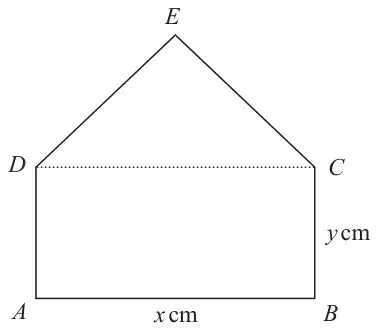
\(ABCD\) is a rectangle. \(CED\) is an equilateral triangle.
\(AB = x\) cm\(\qquad BC = y\) cm
The perimeter of \(ABCED\) is 100 cm. The area of \(ABCED\) is \(R\) cm2
(a) Show that \(R = \dfrac{x}{4}\left(200 - \left[6 - \sqrt{3}\right]x\right)\) (3)
(b)
(i) Find the value of \(x\) for which \(R\) has its maximum value. Give your answer in the form \(\dfrac{p}{q - \sqrt{3}}\) where \(p\) and \(q\) are integers. (2)
(ii) Explain why the maximum value of \(R\) is given by this value of \(x\). (1)
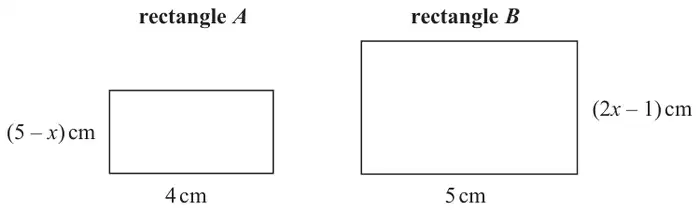
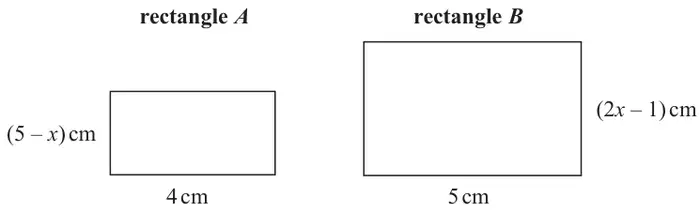
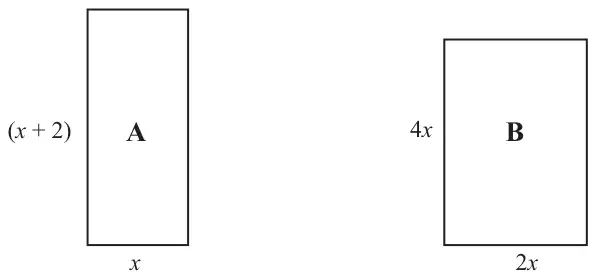
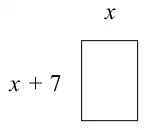
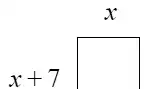
18 Here are two rectangles, rectangle \(A\) and rectangle \(B\).
Diagram NOT accurately drawn
The area of rectangle \(B\) is twice the area of rectangle \(A\).
Work out the value of \(x\). Show your working clearly.
(4)
Mark scheme
Scheme
Marks
\(4 \times (5 - x)\) or \(5 \times (2x - 1)\) or \(20 - 4x\) or \(10x - 5\) oe
M1
one from: \(4(5 - x) = 20 - 4x\) or \(2 \times 4(5 - x) = 40 - 8x\) or \(0.5 \times 4(5 - x) = 10 - 2x\) oe and one from: \(5(2x - 1) = 10x - 5\) or \(2 \times 5(2x - 1) = 20x - 10\) or \(0.5 \times 5(2x - 1) = 5x - 2.5\) oe
M1
eg \(10x + 8x = 40 + 5\) or \(-5 - 40 = -10x - 8x\) or \(18x = 45\) or \(-45 = -18x\) or \(4x + 5x = 20 + 2.5\) oe
M1
Working required Answer: 2.5
A1
(4)
(4 marks)
Notes
M1: for setting up a correct expression for area A or area B (could be seen as part of an equation) (condone lack of brackets for multiplying if meaning is clear for this mark)
M1: for expanding 2 sets of brackets correctly (one for each shape) [We will allow for ×2 or ÷2 for the wrong shape for this expansion mark]
M1: for a correct equation with terms in \(x\) on one side and number terms the other side
E.g. \(5a + 3(\text{``}{0.22}\text{''}) = 1.96\) or \(3a + 2(\text{``}{0.22}\text{''}) = 1.22\)or E.g. \(5(\text{``}{0.26}\text{''}) + 3p = 1.96\) or \(3(\text{``}{0.26}\text{''}) + 2p = 1.22\)or E.g. \(a + p = 0.48\) oe
M1
\(10 \times \text{``}{0.26}\text{''} + 10 \times \text{``}{0.22}\text{''}\) or
\((a + p =)\ 0.48 \times 10\) oe or
\(k(a + p) = k(0.48) \times \dfrac{10}{k}\)
M1
Working required Answer: 4.8(0)
A1
(5)
(5 marks)
Notes
M1: for setting up both equations oe allow apples and pears oe throughout e.g. 5 apples + 3 pears = 1.96 and 3 apples + 2 pears = 1.22
M1: for a correct method to eliminate a or p: coefficients of a or p the same and correct operation to eliminate the selected variable (condone any one arithmetic error) or to find the cost of 1 apple and 1 pear
M1: (dep on M2) for substituting their value found (must be > 0) of one variable into one of the equations, or for repeating the above method to find the second variable, or for the third working column allow k(a + p) = k(0.48), or for a complete arithmetical method to find the other value
M1: (dep on M3) can be implied by 10(a + p) provided a and p must be > 0
A1: dep M2
M2 for an arithmetical method (must see the calculation to find 0.22 or 0.26 or 0.74 and 0.48 oe) E.g. 6.1(0) – 5.88 (= 0.22) oe or 3.92 – 3.66 (= 0.26) oe or 1.96 – 1.22 (= 0.74) oe and 1.22 – “0.74” (= 0.48)
A complete arithmetical method to find the other value: e.g. 3 × 0.22 (= 0.66), 1.96 – “0.66” (= 1.3(0)), “1.3(0)” ÷ 5 (= 0.26) or 5 × 0.26 (= 1.3(0)), 1.96 – “1.3(0)” (= 0.66), “0.66” ÷ 3 (= 0.22) or Apple and pear is 0.48 oe
Mark scheme (ALT: substitution)
Scheme
Marks
\(5a + 3p = 1.96\) and \(3a + 2p = 1.22\) oe or \(5a + 3p = 196\) and \(3a + 2p = 122\) oe
M1
E.g.
\(3\left(\dfrac{1.96 - 3p}{5}\right) + 2p = 1.22\) or
\(5\left(\dfrac{1.22 - 2p}{3}\right) + 3p = 1.96\) or
\(3a + 2\left(\dfrac{1.96 - 5a}{3}\right) = 1.22\) or
M1: for setting up both equations oe allow apples and pears oe throughout e.g. 5 apples + 3 pears = 1.96 and 3 apples + 2 pears = 1.22
M1: for correctly writing a or p in terms of the other variable and correctly substituting (condone any one arithmetic error)
M1: (dep on M2) substituting their value found (must be > 0) of one variable into one of the equations or repeating the above method to find the second variable
M1: (dep on M3) can be implied by 10(a + p) provided a and p must be > 0
2 Here are two rectangles, rectangle \(A\) and rectangle \(B\).
Diagram NOT accurately drawn
The area of rectangle \(B\) is twice the area of rectangle \(A\).
Work out the value of \(x\). Show your working clearly.
(4)
Mark scheme
Scheme
Marks
\(4 \times (5 - x)\) or \(5 \times (2x - 1)\) or \(20 - 4x\) or \(10x - 5\) oe
M1
one from: \(4(5 - x) = 20 - 4x\) or \(2 \times 4(5 - x) = 40 - 8x\) or \(0.5 \times 4(5 - x) = 10 - 2x\) oe and one from: \(5(2x - 1) = 10x - 5\) or \(2 \times 5(2x - 1) = 20x - 10\) or \(0.5 \times 5(2x - 1) = 5x - 2.5\) oe
M1
eg \(10x + 8x = 40 + 5\) or \(-5 - 40 = -10x - 8x\) or \(18x = 45\) or \(-45 = -18x\) or \(4x + 5x = 20 + 2.5\) oe
M1
Working required Answer: 2.5
A1
(4)
(4 marks)
Notes
M1: for setting up a correct algebraic expression for area A or area B (could be seen as part of an equation) (condone lack of brackets for multiplying if meaning is clear for this mark only)
M1: for expanding 2 sets of brackets correctly (one for each shape) [allow ×2 or ÷2 for the wrong shape for this mark] Need not be in an equation at this stage.
M1: for a correct equation with terms in \(x\) on one side and number terms the other side
17 Using algebra, prove that, given any 3 consecutive even numbers, the difference between the square of the largest number and the square of the smallest number is always 8 times the middle number.
M1: 3 consecutive even numbers in algebraic form (any letter can be used)
M1: for squaring the largest and smallest even numbers and subtracting (no need to expand or simplify for this mark)
A1: dep on M2 for use of algebra to show correct conclusion (SCB1 for eg \((p + 4)^2 - p^2\)) (SCB2 for use of eg \((p + 4)^2 - p^2 = 8p + 16 = 8(p + 2)\) If the student shows this and also says “it is true for all numbers, so it must be true for even numbers” oe then this would gain M2A1
Mark scheme (ALT)
Scheme
Marks
eg \(a\), \(b\), \(c\) are consecutive even numbers where \(a \lt b \lt c\)
and one of \(b = \dfrac{a + c}{2}\) or \(a + c = 2b\) or \(c - a = 4\) oe
M1
eg \(a\), \(b\), \(c\) are consecutive even numbers where \(a \lt b \lt c\)
and all of \(b = \dfrac{a + c}{2}\) and \(a + c = 2b\) and \(c - a = 4\) oe
M1
Now \(c^2 - a^2 = (c - a)(c + a) = 4 \times 2b = 8b\) Answer: Correctly shown
A1
Notes
M1: 3 numbers defined as consecutive even numbers with one correct equation, writing one term in terms of one or more of the others or \(c - a = 4\)
M1: 3 numbers defined as consecutive even numbers with three correct equations that involve all letters in some place
A1: dep on M2 for use of algebra to show correct conclusion
Correct answer scores full marks (unless from obvious incorrect working)
Answer: \(2 \lt x \lt \dfrac{7}{2}\)
A1
(5)
(5 marks)
Notes
M1: condone incorrect symbol
M1: expanding and rearranging to get a correct 3 term quadratic, condone incorrect symbol
M1: first step to find the critical values dep on M1 for solving their 3 term quadratic using any correct method (allow one sign error and some simplification – allow as far as the equivalent of \(\dfrac{11 \pm \sqrt{121 + 840}}{12}\)) or if factorising, allow brackets which expanded give 2 out of 3 terms correct)
A1: oe the positive critical value only or both critical values (if both they must be correct)
A1: accept \(2 \leqslant x \lt \dfrac{7}{2}\) may be seen as two separate inequalities \(x \gt 2\) (\(x \geqslant 2\)) and \(x \lt \dfrac{7}{2}\)
(corrected from the printed mark scheme: “(\(x \leqslant 2\))”)
B3: for \(T = 6g + 12h\) oe (B2 for \(6g + 12h\) oe or \(T = 6g + ah\) or \(T = bg + 12h\) or \(T = 12g + 6h\) oe) (B1 for \(6g + ah\) or \(bg + 12h\) or \(12g + 6h\) or for an incorrect expression in \(g\) and \(h\) eg \(T = g + h\))
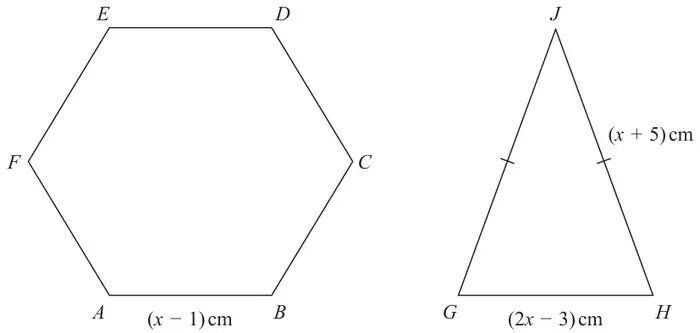
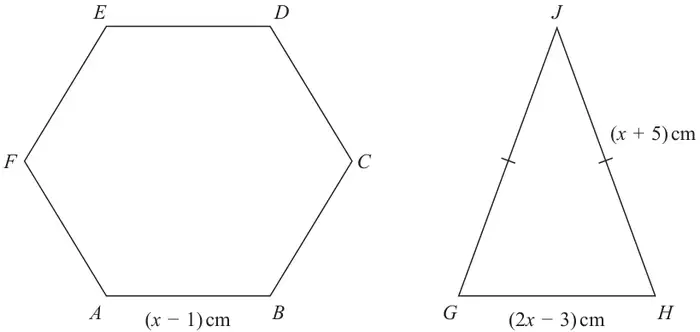
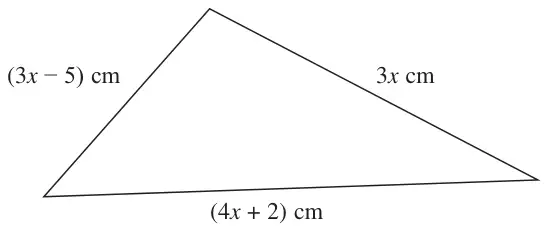
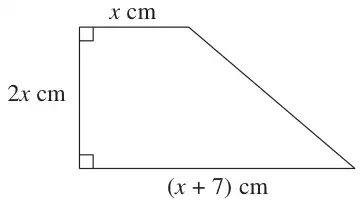
M1: method to find expression for perimeter of hexagon
M1: method to find expression for perimeter of triangle
M1: (dep on at least M1) for equating both expressions
M1: (dep on previous M1 and equation of the form \(ax + b = cx + d\)) for rearranging the \(x\) terms on one side and the numerical terms on the other and all expansions correct
17 Three tins, \(A\), \(B\) and \(C\), each contain buttons.
Tin \(A\) contains \(x\) buttons. Tin \(B\) contains 4 times the number of buttons that tin \(A\) contains. Tin \(C\) contains 7 fewer buttons than tin \(A\).
The total number of buttons in the three tins is 137
Work out the number of buttons in tin \(C\).
(4)
Mark scheme
Scheme
Marks
\(4x\) or \(x - 7\)
M1
\(x + 4x + x - 7 = 137\) oe
M1
\(x = 144 \div 6\ (= 24)\) or \(6x = 144\)
M1
17
A1
(4)
(4 marks)
Notes
M1: Correct expression for \(B\) or \(C\)
M1: Correct equation
M1: Gathering up the \(x\)’s and numbers Dep on previous M1
(c) Make \(p\) the subject of the formula \(\quad f = 3p - d\) (2)
Sergio buys \(m\) boxes of seeds and \(n\) packets of seeds.
Each box contains 10 seeds. Each packet contains 6 seeds.
The total number of seeds that Sergio buys is \(T\).
(d) Write down a formula for \(T\) in terms of \(m\) and \(n\). (3)
Mark scheme (a)
Scheme
Marks
\(5x - x^2\)
B1
(1)
Mark scheme (b)
Scheme
Marks
\(3(y - 7)\)
B1
(1)
Mark scheme (c)
Scheme
Marks
\(f + d = 3p\) or \(\dfrac{f}{3} = p - \dfrac{d}{3}\)
M1
\(p = \dfrac{f + d}{3}\)
A1
(2)
Notes
M1: A correct first stage in a correct formula
A1: for \(p = \dfrac{f + d}{3}\) (must see \(p =\) … at some stage)
(SCB1 for \(p = \dfrac{f - d}{3}\))
Mark scheme (d)
Scheme
Marks
\(T = 10m + 6n\)
B3
(3)
(7 marks)
Notes
B3: for \(T = 10m + 6n\) oe (B2 for \(10m + 6n\) or \(T = 10m + an\) or \(T = bm + 6n\) or \(T = 6m + 10n\)) (B1 for \(10m + an\) or \(bm + 6n\) or \(6m + 10n\)) or for \(T =\) an incorrect expression in \(m\) and \(n\)
M1: method to find expression for perimeter of hexagon
M1: method to find expression for perimeter of triangle
M1: (dep on at least M1) for equating both expressions
M1: (dep on previous M1 and equation of the form \(ax + b = cx + d\)) for rearranging the \(x\) terms on one side and the numerical terms on the other and all expansions correct.
M1: for a first step of subtracting 7 or dividing by 4 in a correct equation
A1: oe
Note: the printed scheme lists \(-g = \dfrac{r - 7}{4}\) among the correct first steps. This is not a correct equation: from \(-4g = 7 - r\) it should be \(-g = \dfrac{7 - r}{4}\) (or \(g = \dfrac{r - 7}{4}\)).
Mark scheme (c)
Scheme
Marks
e.g. \(6y - 2y = 8 + 3\) or \(2y - 6y = -3 - 8\) oe
e.g. \(4y - 3 = 8\) or \(6y = 2y + 11\) or \(-3 = -4y + 8\) or \(6y - 11 = 2y\)
M1
e.g. \(4y = 11\) or \(-4y = -11\) or
M1
\(\dfrac{11}{4}\)
A1
(3)
(8 marks)
Notes
M1: for correct rearrangement with \(y\) terms on one side and numbers on the other side e.g. \(6y - 2y = 8 + 3\) or for the correct simplification of either \(y\) terms or numbers on one side in a correct equation e.g. \(4y - 3 = 8\) or \(6y = 2y + 11\)
M1: for correct rearrangement with \(y\) terms on one side and numbers on the other and correct simplification of terms on both sides or for \(4y - 11 = 0\) or for \(11 - 4y = 0\)
A1: dep on M1 accept 2.75 or \(2\dfrac{3}{4}\) oe
Award full marks for a correct answer if at least 1 method mark awarded
If no correct algebraic working then award no marks
\(\dfrac{--6 \pm \sqrt{36 - -8800}}{2 \times 8}\) or \(\dfrac{6 \pm \sqrt{36 + 8800}}{16}\) or \(\dfrac{6 \pm \sqrt{8836}}{16}\)
or \((4x - 25)(2x + 11)\) (=0)
M2
6.25 oe
A1
(3)
(6 marks)
Notes
M2: If not M2 then award M1 for \(\dfrac{--6 \pm \sqrt{(-6)^2 - 4 \times 8 \times -275}}{2 \times 8}\)
Condone one sign error in substitution; allow evaluation of individual terms e.g. 36 in place of \((-6)^2\) [allow \(-6^2\) or \(6^2\) in place of \((-6)^2\), throughout allow + rather than \(\pm\)]
or
\((4x \pm 25)(2x \pm 11)\) (=0)
(if student gains M1 and shows both answers the 2nd M1 can be awarded)
ft from an incorrect 3 term quadratic equation
A1: dep on M1 and 6.25 oe alone given as final answer
Each pen costs 24 cents. Each ruler costs 37 cents.
Mike spends a total of \(T\) cents buying pens and rulers.
Write down a formula for \(T\) in terms of \(c\) and \(r\).
(3)
Mark scheme
Scheme
Marks
\(T = 24c + 37r\)
B3
(3)
Notes
B3: for a correct final answer (award B2 if \(T = 24c + 37r\) is incorrectly simplified)
If not B3 then B2 for \(T = 24c + kr\) or \(T = kc + 37r\) (\(k\) may be 0) or \(24c + 37r\) B1 for \(24c\) or \(37r\) or \(T\) = (linear expression in \(c\) and \(r\) eg \(T = c + r\) but not \(T = cr\))
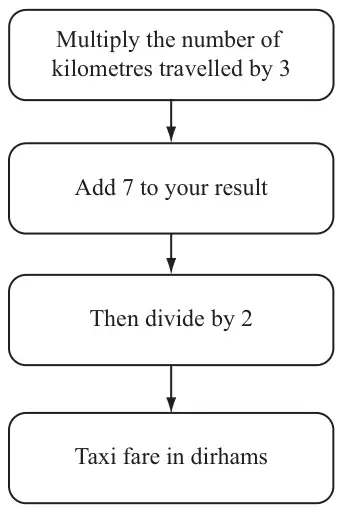
7 You can use this rule to work out the number of minutes it takes to cook a piece of meat.
15 minutes plus 40 minutes for every 500 grams the piece of meat weighs
A piece of meat weighs 1500 grams.
(a) Use the rule to work out the number of minutes it takes to cook this piece of meat. (3)
It takes \(3\dfrac{1}{4}\) hours to cook a different piece of meat.
(b) How much, in grams, does this piece of meat weigh? (3)
Becky is going to cook a chicken. She knows that it needs to be in the oven for 1 hour and 50 minutes. Becky wants to take the chicken out of the oven at 13 30
(c) At what time should Becky put the chicken in the oven? (2)
Mark scheme (a)
Scheme
Marks
1500 ÷ 500 (= 3) or 500 + 500 + 500 oe
M1
“3” × 40 + 15
M1
135
A1
(3)
Mark scheme (b)
Scheme
Marks
\(\dfrac{180}{40}\;(= 4.5)\)
M1
e.g. \(\dfrac{180}{40} \times 500\)
M1
2250
A1
(3)
Notes
M1:or ft from (a) eg. \(3 \times 60 + 15 - \text{“}135\text{”}\;(= 60)\)
M1: complete method or \(\dfrac{\text{“}60\text{”}}{40} \times 500 + 1500\)
A1: [SCB1 for \(\dfrac{195}{40} \times 500\) or \(\dfrac{190}{40} \times 500\) seen as working]
Mark scheme (c)
Scheme
Marks
11 40 (am)
B2
(2)
Notes
B2: B1 for a time using 11(am) eg 11 20 or for a time with hours and 40 (mins) where the hours < 13, eg 10 40
Each pen costs 24 cents. Each ruler costs 37 cents.
Mike spends a total of \(T\) cents buying pens and rulers.
Write down a formula for \(T\) in terms of \(c\) and \(r\).
(3)
Mark scheme
Scheme
Marks
\(T = 24c + 37r\)
B3
(3)
Notes
B3: for a correct final answer (award B2 if \(T = 24c + 37r\) is incorrectly simplified)
If not B3 then B2 for \(T = 24c + kr\) or \(T = kc + 37r\) (\(k\) may be 0) or \(24c + 37r\) B1 for \(24c\) or \(37r\) or \(T\) = (linear expression in \(c\) and \(r\) eg \(T = c + r\) but not \(T = cr\))
19 There are 6 batteries in a small packet of batteries. There are 9 batteries in a large packet of batteries.
Chow buys \(m\) small packets of batteries and \(g\) large packets of batteries.
The total number of batteries Chow buys is \(T\).
Write down a formula, in terms of \(m\) and \(g\), for \(T\).
(3)
Mark scheme
Scheme
Marks
\(T = 6m + 9g\)
B3
(3)
(3 marks)
Notes
B3: Or \(T = 3(2m + 3g)\) [award B2 if \(T = 6m + 9g\) is incorrectly simplified](condone \(T = 6 \times m + 9 \times g\)) if not B3 then B2 for \(T = 6m + kg\) or \(T = km + 9g\) (\(k\) may be zero) or \(6m + 9g\) if not B2 then B1 for \(6m\) or \(9g\) or \(T = am + bg\) (where \(a \neq 0\) or 6 and \(b \neq 0\) or 9)
Condone one sign error in substitution; allow partial evaluation
A1: Award M2A1 for answers in range 4.796 – 4.8 (and no other answer) with sufficient correct working that would gain at least M1 [Award M2A0 for working sufficient for M1 with both the –ve and +ve answers (–8.13 & 4.80)]
6 There are 6 batteries in a small packet of batteries. There are 9 batteries in a large packet of batteries.
Chow buys \(m\) small packets of batteries and \(g\) large packets of batteries.
The total number of batteries Chow buys is \(T\).
Write down a formula, in terms of \(m\) and \(g\), for \(T\).
(3)
Mark scheme
Scheme
Marks
\(T = 6m + 9g\)
B3
(3)
(3 marks)
Notes
B3: Or \(T = 3(2m + 3g)\) [award B2 if \(T = 6m + 9g\) is incorrectly simplified](condone \(T = 6 \times m + 9 \times g\)) if not B3 then B2 for \(T = 6m + kg\) or \(T = km + 9g\) (\(k\) may be zero) or \(6m + 9g\) if not B2 then B1 for \(6m\) or \(9g\) or \(T = am + bg\) (where \(a \neq 0\) or 6 and \(b \neq 0\) or 9)
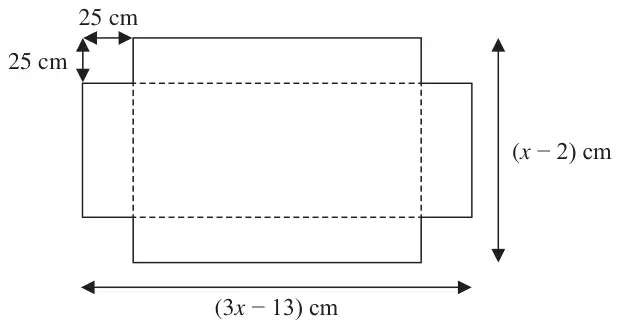
21 A rectangular piece of card has length \((3x - 13)\) cm and width \((x - 2)\) cm. A square, with sides of length 25 cm, is removed from each corner of the card.
Diagram NOT accurately drawn
The card is then folded along the dashed lines to make an open box with height 25 cm as shown below.
Diagram NOT accurately drawn
(a) Show that the length of the open box is \((3x - 63)\) cm. (1)
The volume of the open box is 81 900 cm\(^3\)
(b) Find the value of \(x\). Show clear algebraic working. (5)
There are 4 pens in a small box of pens. There are 10 pens in a large box of pens.
Ami buys \(x\) small boxes of pens and \(y\) large boxes of pens. She buys a total of \(T\) pens.
(b) Write down a formula for \(T\) in terms of \(x\) and \(y\). (3)
Mark scheme (a)
Scheme
Marks
\(2 \times (-5)^2 + 6 \times -2\) or \(2(-5)^2 + 6(-2)\) or 50 and −12
M1
38
A1
(2)
Mark scheme (b)
Scheme
Marks
\(T = 4x + 10y\) oe
B3
(3)
Notes
B3: for a correct final answer (award B2 if \(T = 4x + 10y\) is incorrectly simplified) If not B3 then B2 for \(T = 4x + ky\) or \(T = kx + 10y\) (\(k\) may be 0)) or \(4x + 10y\) B1 for \(4x\) or \(10y\) or \(T\) = (linear expression in \(x\) and \(y\))
M1: for correct substitution; condone one sign error in substitution Accept + in place of ± NB. Terms may be simplified eg. accept 4 in place of 2×2 in denominator
M1: (independent) for correct simplification of discriminant (if evaluated at least 3sf rounded or truncated)
A1: dep on 1st M mark scored for value rounding to 1.65 given as final answer Award 3 marks if first M1 scored and answer correct
\(\sqrt{833}\) or \(\sqrt{81 + 752}\) or \(7\sqrt{17}\) or 28.8…..
M1
2.48, − 4.73
A1
(3)
Notes
M1: for correct substitution; condone one sign error; brackets not necessary; condone + instead of ± in formula There may be partial evaluation – if so, this must be correct
M1: (independent) for correct simplification of discriminant (if evaluated, at least 3sf rounded or truncated)
A1: awrt 2.48 and −4.73 NB. If negative solution is discarded (or omitted at any stage) then full marks can still be obtained Award 3 marks if first M1 scored and answer correct
M1: for \(\left(x + \dfrac{9}{8}\right) = \pm\sqrt{\dfrac{833}{64}}\) oe
A1: awrt 2.48 and −4.73 NB. If negative solution is discarded (or omitted) then full marks can still be obtained Award 3 marks if first M1 scored and answer correct
The mark scheme states that for this question the correct answer alone does not imply a correct method.
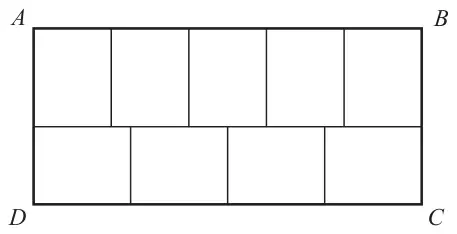
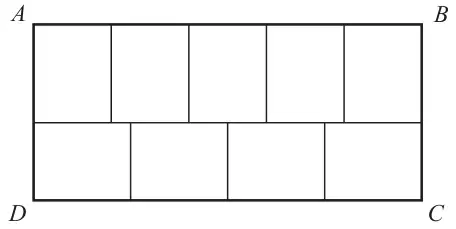
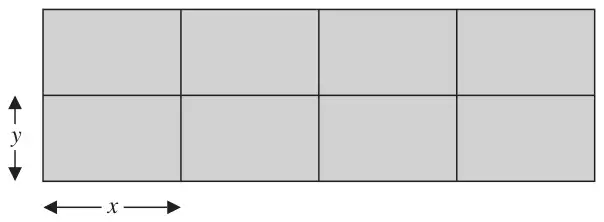
14 A farmer has 180 metres of fencing. With the 180 metres of fencing, he makes an enclosure divided into eight equal, rectangular pens. The fencing is used for the perimeter of each pen.
The length of each pen is \(x\) metres and the width of each pen is \(y\) metres.
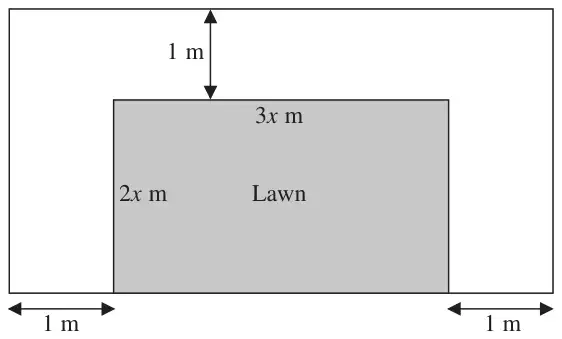
M1: or \((2x \times 3x) + 2(2x + 1) + 3x = 100\) oe or \((2x \times 3x) + (2 \times 2x(\times 1)) + 1) + 3x + 1 + 1 = 100\) oe other partitions are acceptable but partitioning must go on to form a correct equation.
A1: Accept \(6x^2 + 7x + 2 = 100\) if M1 awarded * Answer given
The mark scheme states that for this part the correct answer alone does not imply a correct method.
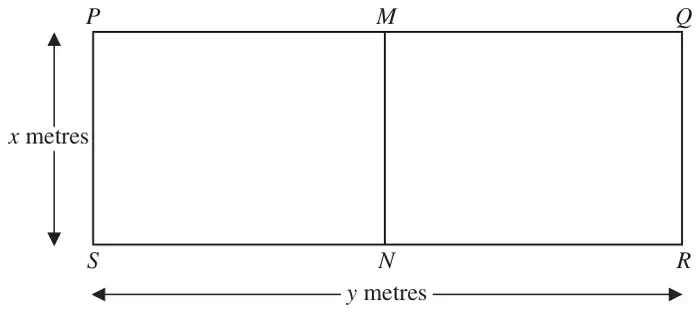
15 A farmer has 120 metres of fencing. He is going to make a rectangular enclosure \(PQRS\) with the fencing. He is also going to divide the enclosure into two equal parts by fencing along \(MN\).
The width of the enclosure is \(x\) metres. The length of the enclosure is \(y\) metres.
(a)
(i) Show that \(y = 60 - 1.5x\)
The area of the enclosure \(PQRS\) is \(A\) m2
(ii) Show that \(A = 60x - 1.5x^2\)
(3)
(b) Find \(\dfrac{\mathrm{d}A}{\mathrm{d}x}\) (2)
(c) Find the maximum value of \(A\). (3)
Mark scheme (a)
Scheme
Marks
(i) \(3x + 2y = 120\)
B1
\(2y = 120 - 3x\) or \(1.5x + y = 60\) Answer: \(y = 0.5(120 - 3x)\) *
B1
(ii) \(A = x \times y\) \(A = x \times (60 - 1.5x)\) Answer: \(A = 60x - 1.5x^2\) *
B1
(3)
Notes
B1: B1 dependent on first B1 * Answer given on question paper.
B1: * Answer given on question paper.
The mark scheme states that for this part the correct answer alone does not imply a correct method.
4 This rule can be used to work out the shortest distance from the screen a viewer should sit to watch TV.
Multiply the width of the screen by 3
(a) Tola is going to watch his TV. The width of the screen is 55 cm. Work out the shortest distance from the screen he should sit. (1)
(b) Roseva is going to watch her TV. The shortest distance from the screen she should sit is 219 cm. Work out the width of the screen. (2)
(c) The width of a TV screen is \(w\) cm. The shortest distance from the screen a viewer should sit to watch this TV is \(d\) cm. Write down a formula for \(d\) in terms of \(w\). (2)
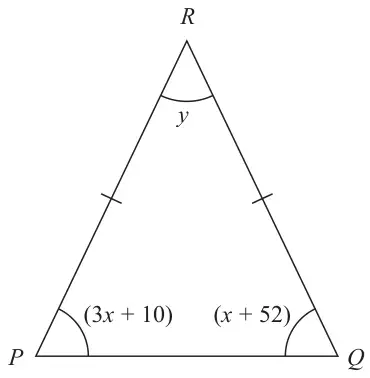
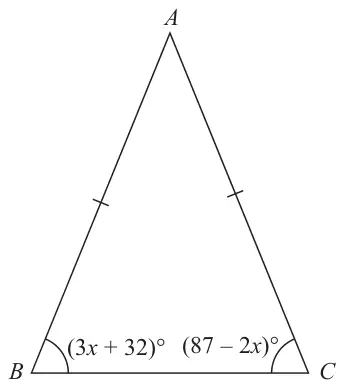
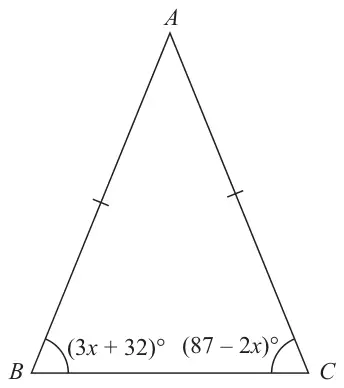
In the isosceles triangle \(ABC\), \(AB = AC\) angle \(B = (3x + 32)^\circ\) angle \(C = (87 - 2x)^\circ\)
Work out the value of \(x\). Show clear algebraic working.
(4)
Mark scheme
Scheme
Marks
\(3x + 32 = 87 - 2x\)
M1
\(5x = 55\) or \(5x - 55 = 0\) or \(5x = 87 - 32\) or \(3x + 2x = 55\)
M2
11
A1
(4)
Notes
M1: for \(3x + 32 = 87 - 2x\)
M2: for correct rearrangement with \(x\) terms on one side and numbers on the other AND correct collection of terms on at least one side or for correct collection to 2 terms M1 for correct rearrangement with \(x\) terms on one side and numbers on the other e.g \(3x + 2x = 87 - 32\) or correct collection and simplification of either numbers or \(x\) terms eg. \(5x + 32 = 87\) or \(5x = a\) or \(bx = 55\)
A1: cao Award full marks if first method mark scored and answer is 11
21 A bag contains \(x\) counters. 7 of the counters are blue. Sam takes at random a counter from the bag and does not replace it. Jill then takes a counter from the bag. The probability they both take a blue counter is 0.2
(a) Form an equation involving \(x\). Show that your equation can be expressed as \(x^2 - x - 210 = 0\) (2)
(b) Solve \(x^2 - x - 210 = 0\) Show clear algebraic working. (3)
Mark scheme (a)
Scheme
Marks
\(\dfrac{7}{x} \times \dfrac{6}{x - 1} = 0.2\)
\(42 = 0.2x(x - 1)\)
\(210 = x^2 - x\)
M1
\(x^2 - x - 210\ (=0)\)
A1*
(2)
Notes
M1: for \(\dfrac{7}{x} \times \dfrac{6}{x - 1} = 0.2\) or \(\dfrac{7}{x} \times \dfrac{6}{x - 1} = \dfrac{1}{5}\)
(corrected from the printed mark scheme: the working column prints \(\dfrac{6}{x+1}\))
A1*: * answer given; sufficient steps must be seen to get to correct quadratic
Mark scheme (b)
Scheme
Marks
\((x - 15)(x + 14)\ (=0)\)
M2
−14 , 15
A1
(3)
Notes
M2: M1 for \((x \pm 15)(x \pm 14)\)
A1: (dep on M2) for −14, 15 or 15
M1 \(\dfrac{-(-1) \pm \sqrt{(-1)^2 - 4 \times 1 \times (-210)}}{2}\) (may be partially evaluated, condone no brackets around negative numbers, accept \(1^2\))
M1 (indep) for \(\sqrt{841}\) or 29 A1 (dep on M1) for −14, 15 or 15
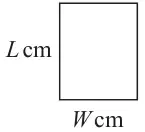
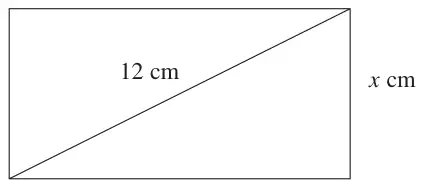
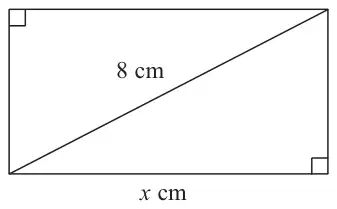
The diagram shows a rectangle. The length of the rectangle is \(x\) cm. The length of a diagonal of the rectangle is 8 cm. The perimeter of the rectangle is 20 cm.
(a) Show that \(x^2 - 10x + 18 = 0\) (4)
(b) Solve \(x^2 - 10x + 18 = 0\) Give your solutions correct to 3 significant figures. Show your working clearly. (3)
Mark scheme (a)
Scheme
Marks
\(\dfrac{20 - 2x}{2}\) or \(10 - x\) seen as the width
M1: accept \(\dfrac{20 - 2x}{2}\) in place of \(10 - x\) for all method marks
M1: (dep on previous M1) for correct expansion of \((10 - x)^2\) or correct expansion of \((20 - 2x)^2\)
A1: for correct manipulation resulting in given equation
Mark scheme (b)
Scheme
Marks
\(\dfrac{--10 \pm \sqrt{(-10)^2 - 4 \times 1 \times 18}}{2 \times 1}\) or for this expression with one or more of \((--10)\), \((-10)^2\), \(10^2\), \(-4 \times 1 \times 18\), \(2 \times 1\), \((-10)^2 - 4 \times 1 \times 18\) evaluated e.g. \(\dfrac{10 \pm \sqrt{28}}{2}\)
M1
\(\sqrt{28}\) or \(2\sqrt{7}\) or \(\sqrt{100 - 72}\) or 5.29...
M1
2.35 7.65
A1
(3)
Notes
M1: correct substitution brackets not necessary (accept \(10^2\)) or \((x - 5)^2 - 25 + 18 = 0\) oe
M1: (independent) for correct simplification of discriminant (if evaluated at least 3sf rounded or truncated)
or \(x - 5 = \pm\sqrt{7}\) oe
A1: for values rounding to 2.35 and 7.65 (2.35424... 7.64575...) Award full marks for correct solutions if at least 1 method mark scored.
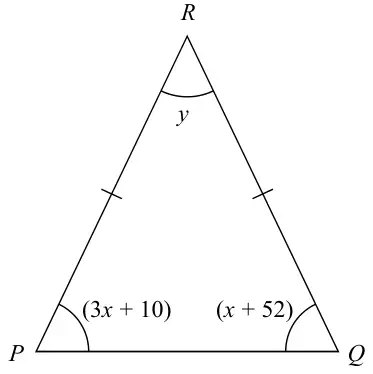
In the isosceles triangle \(ABC\), \(AB = AC\) angle \(B = (3x + 32)^\circ\) angle \(C = (87 - 2x)^\circ\)
Work out the value of \(x\). Show clear algebraic working.
(4)
Mark scheme
Scheme
Marks
\(3x + 32 = 87 - 2x\)
M1
\(5x = 55\) or \(5x - 55 = 0\) or \(5x = 87 - 32\) or \(3x + 2x = 55\)
M2
11
A1
(4)
Notes
M1: for \(3x + 32 = 87 - 2x\)
M2: for correct rearrangement with \(x\) terms on one side and numbers on the other AND correct collection of terms on at least one side or for correct collection to 2 terms M1 for correct rearrangement with \(x\) terms on one side and numbers on the other e.g \(3x + 2x = 87 - 32\) or correct collection and simplification of either numbers or \(x\) terms eg \(5x + 32 = 87\) or \(5x = a\) or \(bx = 55\)
(ii) \(4x + 4 = 12x\) or \(2x + 2 = 6x\) \(4 = 8x\) or \(2 = 4x\)
M1
0.5
A1
(4)
Notes
B2: Must be an equation based on perimeter or semi-perimeter with \(x\)’s on both sides of equation If not B2 then B1 for \(\{2x + 2(x+2)\}\) or \(\{2 \times 2x + 2 \times 4x\}\) or \(\{4x + 4\}\) or \(12x\) i.e correct perimeter of A or B or \(\{x + (x+2)\}\) or \(\{2x + 4x\}\) or \(\{2x + 2\}\) or \(6x\) i.e correct semi-perimeter of A or B
M1: One step from correct equation
A1: Allow numerical methods. Correct answer only = M1A1
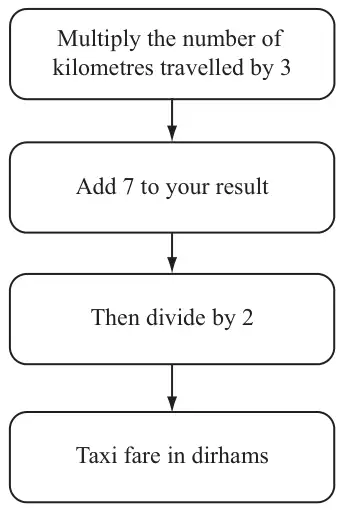
8 This formula can be used to work out the cost, in Riyals, of hiring a car in Qatar for a number of days.
Cost = 85 × number of days
(a) Daisha hired a car for 12 days. Work out the cost. (1)
(b) Yusuf hired a car. The cost was 765 Riyals. Work out the number of days for which Yusuf hired the car. (2)
(c) \(C\) Riyals is the cost of hiring a car for \(n\) days. Write down a formula for \(C\) in terms of \(n\). (2)
(d) As a special offer, the cost of hiring a car for a month is 1800 Riyals. Awad wants to hire a car for a number of days. He works out that 1800 Riyals is less than the cost of hiring the car at 85 Riyals for each day. Work out the smallest number of days for which Awad wants to hire a car. (2)
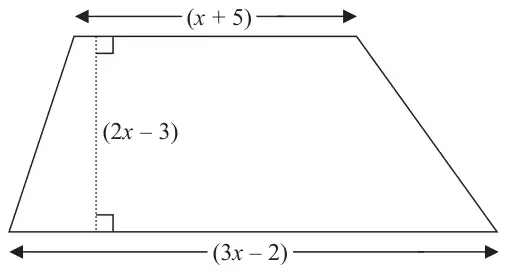
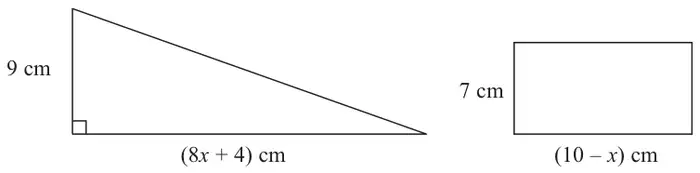
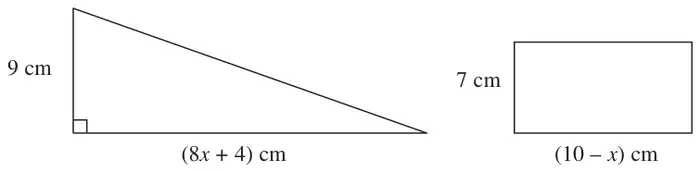
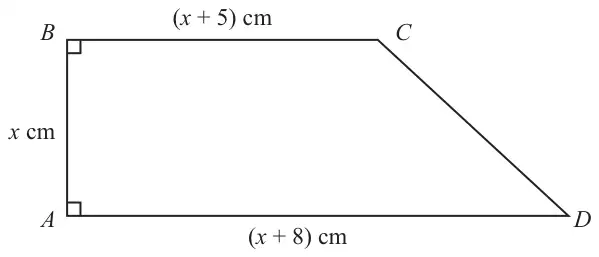
The diagram shows a trapezium \(ABCD\) with \(AD\) parallel to \(BC\). \(AB = x\) cm, \(BC = (x + 5)\) cm and \(AD = (x + 8)\) cm. The area of the trapezium is 42 cm\(^2\).
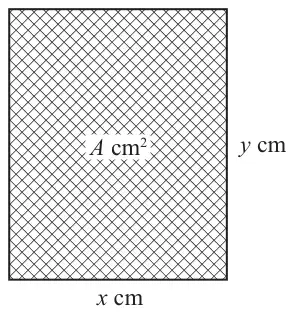
The diagram shows a rectangular photo frame of area \(A\) cm\(^2\). The width of the photo frame is \(x\) cm. The height of the photo frame is \(y\) cm. The perimeter of the photo frame is 72 cm.
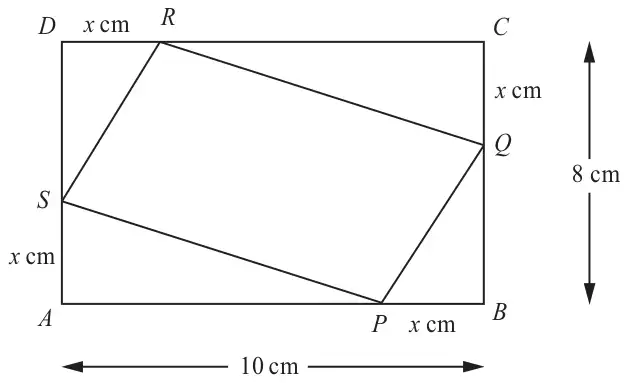
\(ABCD\) is a rectangle. \(AB\) = 10 cm. \(BC\) = 8 cm. \(P\), \(Q\), \(R\) and \(S\) are points on the sides of the rectangle. \(BP = CQ = DR = AS = x\) cm.
(a) Show that the area, \(A\) cm\(^2\), of the quadrilateral \(PQRS\) is given by the formula \[A = 2x^2 - 18x + 80\] (3)
(b) For \(A = 2x^2 - 18x + 80\)
(i) find \(\dfrac{\mathrm{d}A}{\mathrm{d}x}\),
(ii) find the value of \(x\) for which \(A\) is a minimum.
(iii) Explain how you know that \(A\) is a minimum for this value of \(x\).
(5)
Mark scheme (a)
Scheme
Marks
Use of areas to obtain a correct expression for \(A\), which must be correctly punctuated. For example
or \(80 - 2\left(\dfrac{10x - x^2}{2}\right) - 2\left(\dfrac{8x - x^2}{2}\right)\)
B2
Correct simplification of a correct expression for \(A\) to obtain an expression which is equivalent to \(2x^2 - 18x + 80\) For example \((A =)\ 80 - 10x + x^2 - 8x + x^2\) or \(80 - (10x - x^2) - (8x - x^2)\) or \(80 - (5x - \frac{1}{2}x^2) - (5x - \frac{1}{2}x^2) - (4x - \frac{1}{2}x^2) - (4x - \frac{1}{2}x^2)\)
B1
(3)
Notes
B2: B1 for expression for area of triangle or pair of congruent triangles, for example \(\frac{1}{2}x(10 - x)\) or \(\frac{1}{2}x(8 - x)\) or \(x(10 - x)\) or \(x(8 - x)\) Condone omission of brackets for award of B1
B1: dep on B2
Mark scheme (b)
Scheme
Marks
(i) \(4x - 18\)
B2
(ii) “\(4x - 18\)” = 0
M1
4.5 oe
A1
(iii) eg positive coefficient of \(x^2\) or U shape
or \(\dfrac{\mathrm{d}^2A}{\mathrm{d}x^2} = 4\) which > 0
Apart from questions 5b, 8, 15d, 20b, 21b, 23, 24b (where the mark scheme states otherwise) the correct answer, unless clearly obtained by an incorrect method, should be taken to imply correct working.
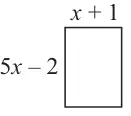
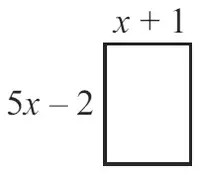
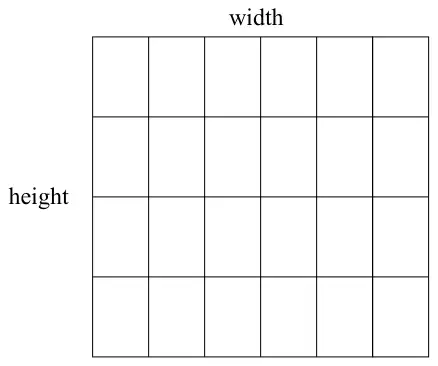
20. Rectangular tiles have width \((x + 1)\) cm and height \((5x - 2)\) cm.
Diagram NOT accurately drawn
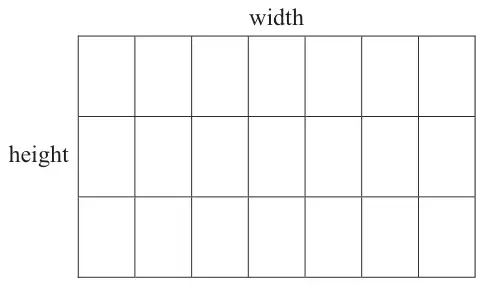
Some of these tiles are used to form a large rectangle. The large rectangle is 7 tiles wide and 3 tiles high.
Diagram NOT accurately drawn
The perimeter of the large rectangle is 68 cm.
(a) Write down an equation in \(x\). (3)
(b) Solve this equation to find the value of \(x\). (3)
Mark scheme (a)
Scheme
Marks
\(7(x + 1)\) or \(3(5x - 2)\)
M1
\(7(x + 1) + 3(5x - 2)\)
M1
\(7(x + 1) + 3(5x - 2) = 34\) oe
A1
(3)
Notes
M1: or doubled or mult out correctly
M1: or doubled or mult out correctly (and stated intention to +)
A1: i.e. \(14(x + 1) + 6(5x - 2) = 68\) can then isw
Mark scheme (b)
Scheme
Marks
\(7x + 7\) or \(14x + 14\) or \(15x - 6\) or \(30x - 12\)
M1
\(22x = 33\) or \(44x = 66\)
M1
1.5 oe
A1
(3)
(Total 6 marks)
Notes
M1: can be awarded from (a)
M1: s.c. M1 for \(22x = 67\)
A1: cao dep on M2 scored
The following questions require a seen valid method before the accuracy mark can be awarded: Q13b & c, Q20. For other questions a correct answer implies a correct method.
2 Angelou has \(x\) sweets. He eats 5 of these sweets. He puts all the sweets he has left into a bag.
(i) Nina has 3 times as many sweets as the number that Angelou put into the bag. Nina has 39 sweets. Use this information to write down an equation in \(x\).
(ii) Solve your equation to find the value of \(x\).
(5)
Mark scheme
Scheme
Marks
(i) \(3x - 15 = 39\) or \(3(x - 5) = 39\) or \(x - 5 = 39/3\)
B3
(ii) \(3x = 54\) or \(x - 5 = 13\)
M1
18
A1
(5)
(5 marks)
Notes
B3: do not accept \(x - 5 = 13\) B2 for \(3x - 5 = 39\) if \(x - 5\) seen otherwise B1 B1 for \(x - 5\) seen B0 for \(x = 39/3 + 5\) oe
M1: ft from any linear equation \(ax + b = c\), \(a \gt 1\), \(b, c \ne 0\) \(ax = c - b\) or \(x = c/a - b/a\)
A1: 18 with no working for answer in i) or ii) gets M1 A1
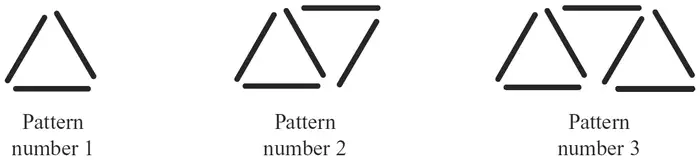
This rule can be used to find the number of sticks in one of these patterns.
Multiply the pattern number by 2 and then add 1
(a) \(n\) is the number of sticks in Pattern number \(p\). Write down a formula for \(n\) in terms of \(p\). (3)
(b) Make \(p\) the subject of your formula. (2)
Mark scheme (a)
Scheme
Marks
\(n = 2p + 1\) oe
B3
(3)
Notes
B3: for \(n = 2p + 1\) oe eg \(n = p2 + 1\), \(1 + p \times 2 = n\), \(n = p + p + 1\) B2 for \(2p + 1\) oe B1 for \(n =\) linear function of \(p\) eg \(n = p + 1\)
Mark scheme (b)
Scheme
Marks
\(2p = n - 1\) or \(\dfrac{n}{2} = p + \dfrac{1}{2}\)
M1
\(\dfrac{n - 1}{2}\) oe
A1
(2)
(5 marks)
Notes
M1: for \(2p = n - 1\) or \(\dfrac{n}{2} = p + \dfrac{1}{2}\)
A1: for \(\dfrac{n - 1}{2}\) oe inc \(\dfrac{n}{2} - \dfrac{1}{2}\)
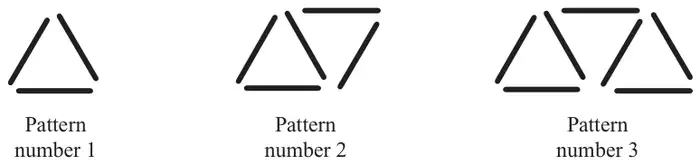
This rule can be used to find the number of sticks in one of these patterns.
Multiply the pattern number by 2 and then add 1
(b) Work out the number of sticks in Pattern number 10 (2)
(c) Work out the Pattern number of the pattern with 37 sticks. (2)
(d) Explain why it is not possible to make one of these patterns with 60 sticks. (1)
(e) \(n\) is the number of sticks in Pattern number \(p\). Write down a formula for \(n\) in terms of \(p\). (3)
Mark scheme (a)
Scheme
Marks
B1
(1)
Mark scheme (b)
Scheme
Marks
10 × 2 + 1
M1
21
A1
(2)
Notes
A1: cao
Mark scheme (c)
Scheme
Marks
\(\dfrac{37 - 1}{2}\)
M1
18
A1
(2)
Notes
A1: cao
Mark scheme (d)
Scheme
Marks
eg 60 is even, number of matchsticks is always odd, first number is odd and 2 is added each time, multiplying by 2 and adding 1 will always give an odd number of sticks
B1
(1)
Notes
B1: May refer to number sequence of matchstick pattern – need not do both
Mark scheme (e)
Scheme
Marks
\(n = 2p + 1\)
B3
(3)
(Total 9 marks)
Notes
B3: B2 for \(2p + 1\) B1 for \(n =\) linear function of \(p\) eg \(n = p + 1\)
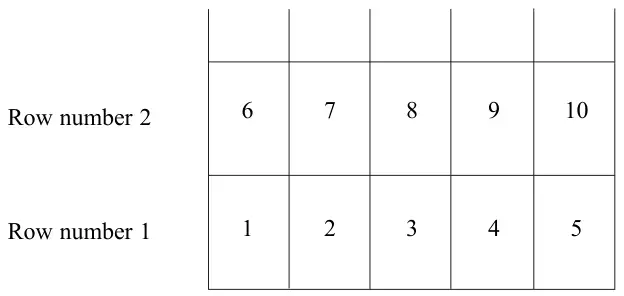
5 A sports club has 50 lockers. The lockers are in 10 rows of five. The lockers are numbered from 1 to 50 The diagram shows the first two rows of lockers and how they are numbered.
(a) Write down the number of the locker which is directly above locker number 9 (1)
(b) Write down the number of the locker which is directly below locker number 27 (1)
(c) In which row is locker number 41? (1)
(d) Locker number \(p\) has a locker directly above it. Write down an expression for the number of the locker which is directly above locker number \(p\). (1)
(e) Write down an expression for the greatest locker number in row number \(q\). (1)
Faye chooses one of the 50 lockers at random.
(f) Find the probability that she chooses
(i) locker number 39
(ii) a locker in row number 2 (3)
Mark scheme (a)
Scheme
Marks
14
B1
(1)
Notes
B1: cao
No official mark scheme was available for this paper; this one was written by Westie's Workshop.
Mark scheme (b)
Scheme
Marks
22
B1
(1)
Notes
B1: cao
No official mark scheme was available for this paper; this one was written by Westie's Workshop.
Mark scheme (c)
Scheme
Marks
9
B1
(1)
Notes
B1: cao
No official mark scheme was available for this paper; this one was written by Westie's Workshop.
Mark scheme (d)
Scheme
Marks
\(p + 5\)
B1
(1)
Notes
B1: oe
No official mark scheme was available for this paper; this one was written by Westie's Workshop.
Mark scheme (e)
Scheme
Marks
\(5q\)
B1
(1)
Notes
B1: oe e.g. \(5 \times q\), \(q \times 5\)
No official mark scheme was available for this paper; this one was written by Westie's Workshop.
Mark scheme (f)
Scheme
Marks
(i) \(\frac{1}{50}\)
B1
(ii) \(\frac{5}{50}\) or \(\frac{1}{10}\)
B2
(3)
(Total 8 marks)
Notes
B1: oe e.g. 0.02
B2: oe e.g. 0.1 B1 for a fraction with numerator 5 or denominator 50 (less than 1)
No official mark scheme was available for this paper; this one was written by Westie's Workshop.
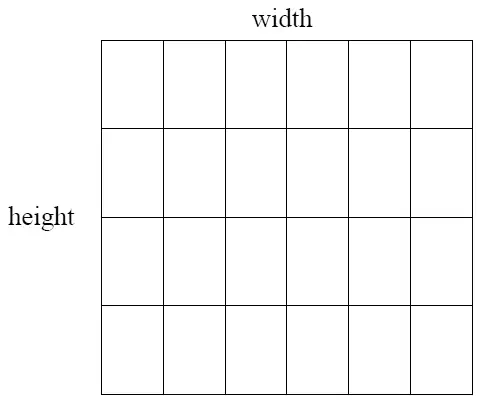
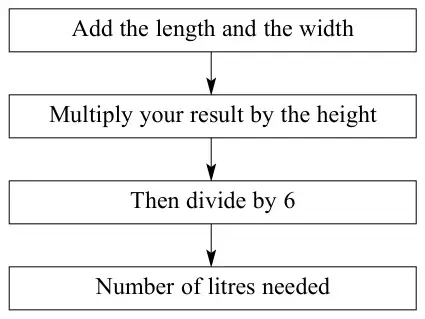
12 This rule can be used to work out the number of litres of paint needed to cover the walls of a room, using the length, width and height, in metres, of the room.
The length of a living room is 8 m. Its width is 4 m and its height is 3 m.
(a) Work out the number of litres of paint needed to cover the walls of the living room. (2)
The length of a bedroom is 6 m and its width is 4 m. 5 litres of paint are needed to cover the walls of the bedroom.
(b) Work out the height of the bedroom. (2)
The length of a bathroom is 5.5 m. Its height is 2.4 m. 4 litres of paint are needed to cover the walls of the bathroom.
(c) Work out the width of the bathroom. (2)
A room has length \(L\) metres, width \(W\) metres and height \(H\) metres. \(N\) litres of paint are needed to cover the walls of the room.
(d) Find a formula for \(N\) in terms of \(L\), \(W\) and \(H\). (3)
Mark scheme (a)
Scheme
Marks
\((8 + 4) \times 3 \div 6\)
M1
6
A1
(2)
Notes
A1: cao
No official mark scheme was available for this paper; this one was written by Westie's Workshop.
Mark scheme (b)
Scheme
Marks
\(5 \times 6 \div (6 + 4)\) or \(30 \div 10\)
M1
3
A1
(2)
Notes
A1: cao
No official mark scheme was available for this paper; this one was written by Westie's Workshop.
Mark scheme (c)
Scheme
Marks
\(4 \times 6 \div 2.4\) or 10
M1
4.5
A1
(2)
Notes
M1: for working back through the rule as far as 10
A1: cao
No official mark scheme was available for this paper; this one was written by Westie's Workshop.
Mark scheme (d)
Scheme
Marks
\(N = \dfrac{H(L + W)}{6}\) oe
B1 B2
(3)
(9 marks)
Notes
B1: for \(N\) = expression with \(L, W, H\)
B2: for \(\dfrac{H(L + W)}{6}\) oe (B1 for \(\dfrac{L + WH}{6}\), \(L + \dfrac{WH}{6}\) etc)
Mark scheme taken from the matching question on the Higher paper.
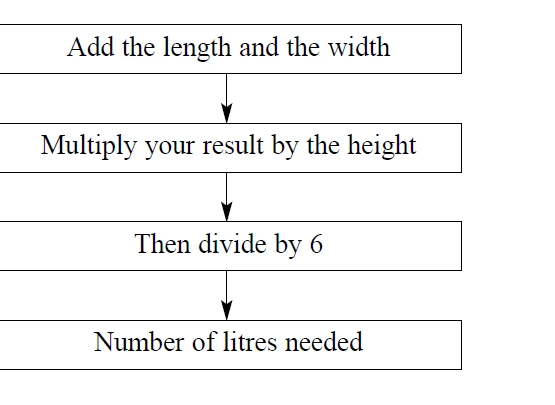
8 This rule can be used to work out the number of litres of paint needed to cover the walls of a room, using the length, width and height, in metres, of the room.
A room has length \(L\) metres, width \(W\) metres and height \(H\) metres. \(N\) litres of paint are needed to cover the walls of the room.
(a) Find a formula for \(N\) in terms of \(L\), \(W\) and \(H\). (3)
The perimeter of the room is \(P\) metres.
(b) Find a formula for \(N\) in terms of \(P\) and \(H\). (2)
Mark scheme (a)
Scheme
Marks
\(N = \dfrac{H(L + W)}{6}\) oe
B1 B2
(3)
Notes
B1: for \(N\) = expression with \(L, W, H\)
B2: for \(\dfrac{H(L + W)}{6}\) oe (B1 for \(\dfrac{L + WH}{6}\), \(L + \dfrac{WH}{6}\) etc)
Mark scheme (b)
Scheme
Marks
\(P = 2L + 2W\)
M1
\((N =) \dfrac{PH}{12}\)
A1
(2)
(5 marks)
Notes
A1: for \(\dfrac{PH}{12}\) oe; condone missing \(N =\)
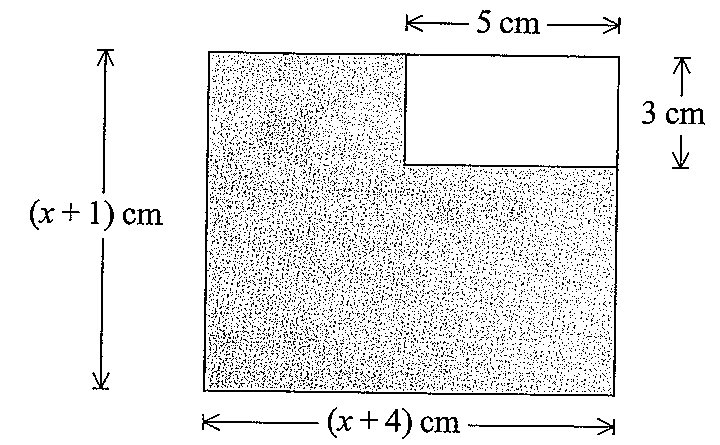
A rectangular piece of card has length \((x + 4)\) cm and width \((x + 1)\) cm. A rectangle 5 cm by 3 cm is cut from the corner of the piece of card. The remaining piece of card, shown shaded in the diagram, has an area of 35 cm².
(a) Show that \(x^2 + 5x - 46 = 0\) (3)
(b) Solve \(x^2 + 5x - 46 = 0\) to find the value of \(x\). Give your answer correct to 3 significant figures. (3)
M1: for correct substitution into the quadratic formula; condone one sign error. Completing the square: \((x + 2.5)^2 = 52.25\) scores M1
M1: for \(\sqrt{209}\) or \(\sqrt{25 + 184}\) or \(x = -2.5 \pm \sqrt{52.25}\)
A1: for 4.73 (4.7284…) only; ignore −9.73 if also given, but A0 if −9.73 is chosen as the answer. Trial and improvement scores 3 only for 4.73 with enough trials to justify 3 s.f.
No official mark scheme was available for this question; this one was written by Westie's Workshop.
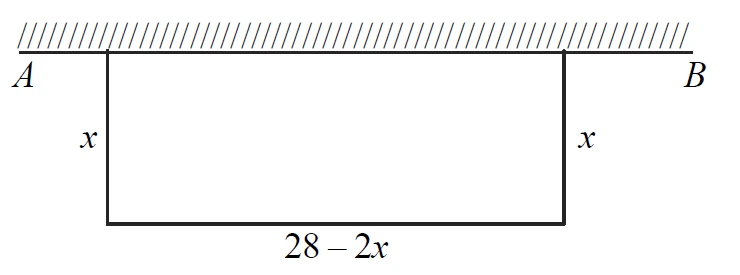
14 A farmer wants to make a rectangular pen for keeping sheep. He uses a wall, \(AB\), for one side. For the other three sides, he uses 28 m of fencing. He wants to make the area of the pen as large as possible.
Diagram NOT accurately drawn
The width of the pen is \(x\) metres. The length parallel to the wall is \((28 - 2x)\) metres.
(a) The area of the pen is \(y\) m². Show that \(y = 28x - 2x^2\). (1)
(b) For \(y = 28x - 2x^2\),
(i) find \(\dfrac{\mathrm{d}y}{\mathrm{d}x}\),
(ii) find the value of \(x\) for which \(y\) is a maximum.
(iii) Explain how you know that this value gives a maximum. (5)
(c) Find the largest possible area of the pen. (2)
Mark scheme (a)
Scheme
Marks
\(x(28 - 2x)\) seen
B1
(1)
Notes
B1: Brackets essential
Mark scheme (b)
Scheme
Marks
(i) \(28 - 4x\)
B1 B1
(ii) “\(28 - 4x\)” = 0
M1
\(x = 7\)
A1
(iii) negative coeff. of \(x^2\) or ∩ shape or \(\dfrac{\mathrm{d}^2y}{\mathrm{d}x^2} = -4\), which is negative
B1
(5)
Notes
B1B1: Ignore “\(y =\)”
B1: Not “the value is negative.” ft her \(28 - 4x\)
5 Each of these shapes is made from a square and a triangle.
Diagrams NOT accurately drawn
This rule can be used to find the perimeter, in cm, of the shapes.
To find the perimeter Multiply the length of one side of the square by 3 Then add 30
(a) For shape A, the length of one side of the square is 7 cm. Work out the perimeter of shape A. (2)
(b) The perimeter of shape B is 57 cm. Work out the length of one side of the square for shape B. (2)
(c) For shape C, the length of one side of the square is \(y\) cm. Write down, in terms of \(y\), an expression for the perimeter, in cm, of shape C. Give your expression as simply as possible. (2)
Mark scheme (a)
Scheme
Marks
7 × 3 + 30
M1
51
A1
(2)
Notes
No official mark scheme was available for this paper; this one was written by Westie's Workshop.
A1: cao
Mark scheme (b)
Scheme
Marks
(57 – 30) ÷ 3 or 27 seen
M1
9
A1
(2)
Notes
No official mark scheme was available for this paper; this one was written by Westie's Workshop.
A1: cao
Mark scheme (c)
Scheme
Marks
\(3y + 30\)
B2
(2)
(Total 6 marks)
Notes
No official mark scheme was available for this paper; this one was written by Westie's Workshop.
B2: oe eg \(30 + 3y\) B1 for \(y \times 3 + 30\) or \(3y\) seen
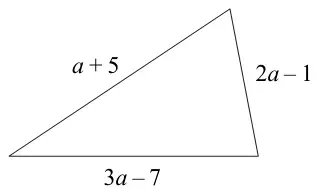
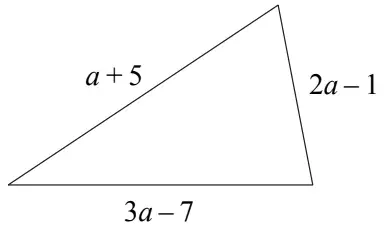
The lengths, in cm, of the sides of a triangle are \((a + 5)\), \((3a - 7)\) and \((2a - 1)\). The perimeter of the triangle is 24 cm. Work out the value of \(a\).
(3)
Mark scheme
Scheme
Marks
\(a + 5 + 3a - 7 + 2a - 1 = 24\)
M1
\(6a - 3 = 24\)
M1
4.5 oe
A1
(3)
(3 marks)
Notes
Mark scheme taken from the matching question on the Higher paper.
The lengths, in cm, of the sides of a triangle are \((a + 5)\), \((3a - 7)\) and \((2a - 1)\). The perimeter of the triangle is 24 cm. Work out the value of \(a\).
We'd like to use Google Analytics cookies to count visits and see which pages help most. They're optional, and the site works exactly the same either way. Privacy policy