M1: for a correct method to eliminate \(x\) or \(y\): coefficients of \(x\) or \(y\) the same and correct operator to eliminate selected variable (condone any one arithmetic error in multiplication) or writing \(x\) or \(y\) in terms of the other variable and correctly substituting (condone missing brackets)
NB The mark is for the method and not for the result of the method. However, if the correct result of the method is seen, the mark can be awarded.
M1: dep on first M1 for a correct method to find other variable by substitution of found variable into one equation or for repeating the above method to find the second variable.
eg \(192 = 2a + 29(\text{``}{6}\text{''})\) oe or \(123 = a + 19(\text{``}{6}\text{''})\) oeor eg \(192 = 2(\text{``}{9}\text{''}) + 29d\) oe or \(123 = \text{``}{9}\text{''} + 19d\) oe
M1
Working required Answer: \(a = 9\) \(d = 6\)
A1
(5)
(5 marks)
Notes
M1: for using \(U_n = a + (n - 1)d\)
M1: for using \(S_n = \dfrac{n}{2}\left(2a + (n - 1)d\right)\)
M1: (dep on M2) for a correct method to find \(a\) or \(d\):
coefficients of \(a\) or \(d\) the same in correct equations and correct operator to eliminate selected variable resulting in an equation in \(a\) only or in \(d\) only
or
writing \(a\) or \(d\) in terms of the other variable and correctly substituting (condone missing brackets)
M1: (dep on M3) for substituting their found value of \(a\) or \(d\) into a correct equation
A1: dep on M2 \(a\) and \(d\) must be clearly identified
M1: for a correct expression or equation using the common difference, may be in terms of \(d\) for this mark we will allow an expression for \(-d\) or \(-2d\)
M1: for a correct equation for the sum of 9 terms in \(x\) and \(d\) or in terms of \(x\) and \(y\) or in terms of \(x\) or in terms of \(d\)
for “\(3y - 2x - 9\)” we will allow \((3y - 4) - (2x + 5)\) or for using their incorrect simplification from \((3y - 4) - (2x + 5)\) shown
for “\(4x - 3y + 2\)” we will allow \((4x - 2) - (3y - 4)\) or for using their incorrect simplification from \((4x - 2) - (3y - 4)\) shown
similarly for their “\(x - 3.5\)” and their “\(d + 3.5\)”
M2:left hand column 2 correct equations in terms of \(x\) and \(y\) in the form \(px + qy = r\) oe or 2 correct equations in terms of \(x\) and \(d\) in the form \(px + qd = r\) oe
right hand column 2 correct equations in terms of \(x\) and \(y\) where one is substituted into the other to get a correct equation in the form \(px + q = r\) or \(py + q = r\) or 2 correct equations in terms of \(x\) and \(d\) where one is substituted into the other to get a correct equation in the form \(px + q = r\) or \(pd + q = r\)
If not M2 then M1 for one correct equation in any of the required forms from the left hand or right hand column
A2: (dep on M2) oe (allow 7.3(33…))
(A1 for \(x = \dfrac{11}{2}\) or \(y = \dfrac{22}{3}\))
Answer: \(x = -\dfrac{1}{2}\) and \(y = \dfrac{3}{2}\)
\(x = -3\) and \(y = -1\)
A1
(5)
(5 marks)
Notes
M1: for substitution of \(y = x + 2\) (or \(x = \pm y \pm 2\)) into \(x^2 + 3y + y^2 = 7\) to obtain an equation in \(x\) only (or \(y\) only)
M1ft: dep on previous M1 for multiplying out and collecting terms, forming a three term quadratic in any form of \(ax^2 + bx + c\;(= 0)\) where at least 2 coefficients (\(a\) or \(b\) or \(c\)) are correct
M1ft: dep on first M1 method to solve their 3 term quadratic using any correct method (allow one sign error and some simplification – allow as far as eg \(\dfrac{-7 \pm \sqrt{49 - 24}}{4}\) or \(\dfrac{1 \pm \sqrt{1 + 24}}{4}\)
or if factorising allow brackets which expanded give 2 out of 3 terms correct)
or correct values for \(x\)
or correct values for \(y\)
M1ft: dep on previous M1 for substituting their 2 found values of \(x\) or \(y\) into one of the two given equations or fully correct values for the other variable (correct labels for \(x\) / \(y\)) or for one correct pair of values
A1: oe dep on M2 (allow coordinates)
If they find the values of \(y\) but think they are the values of \(x\) then the maximum mark is 3
M1: substitution of \(y = \pm 2x \pm 3\) (or \(x = \dfrac{\pm y \pm 3}{2}\)) into \(x^2 + y^2 = 41\) to obtain an equation in \(x\) only (or \(y\) only)
M1ft: dep on previous M1 for multiplying out and collecting terms, forming a three term quadratic in any form of \(ax^2 + bx + c\;(= 0)\) where at least 2 coefficients (\(a\) or \(b\) or \(c\)) are correct
M1ft: dep on M1 method to solve their 3 term quadratic using any correct method (allow one sign error and some simplification – allow as far as eg \(\dfrac{12 \pm \sqrt{144 + 640}}{10}\) or \(\dfrac{6 \pm \sqrt{36 + 3100}}{10}\) or if factorising allow brackets which expanded give 2 out of 3 terms correct) or correct values for \(x\) or correct values for \(y\)
M1ft: dep on previous M1 for substituting their 2 found values of \(x\) or \(y\) into one of the two given equations or their rearranged equation used in the substitution or for one correct pair of values
A1: oe dep on M2 for all 4 values (allow coordinates)
If they find the values of \(y\) but think they are the values of \(x\) then the maximum mark is 3
M1: a correct method to eliminate \(x\) or \(y\): coefficients of \(x\) or \(y\) are the same and the correct operation to eliminate is selected; if operator not written, the correct operation can be implied by 2 out of 3 terms correct Allow one arithmetic error if multiplying to equate coefficients or for a correct substitution of one variable into the other equation
NB: the mark is for the method and not for the result of the method. However, if the correct result of this method is seen, the mark can be awarded
M1: dep on M1 a correct substitution to find the value of the second variable using their value or for starting again with elimination or substitution (as above)
M1: for a correct method to eliminate \(x\) or \(y\): coefficients of \(x\) or \(y\) the same and correct operator to eliminate selected variable (condone any one arithmetic error in multiplication) or writing \(x\) or \(y\) in terms of the other variable and correctly substituting (condone missing brackets)
NB The mark is for the method and not for the result of the method. However, if the correct result of the method is seen, the mark can be awarded.
M1: dep on first M1 for a correct method to find other variable by substitution of found variable into one equation or for repeating the above method to find the second variable.
M1: a correct method to eliminate \(x\) or \(y\): coefficients of \(x\) or \(y\) are the same and the correct operation to eliminate is selected; if operator not written, the correct operation can be implied by 2 out of 3 terms correct Allow one arithmetic error if multiplying to equate coefficients or for a correct substitution of one variable into the other equation
NB: the mark is for the method and not for the result of the method. However, if the correct result of this method is seen, the mark can be awarded
M1: dep on M1 a correct substitution to find the value of the second variable using their value or for starting again with elimination or substitution (as above)
M1: substitution of linear equation into quadratic – allow one sign error in substituted expression
M1: Dep on M1 simplified to a 3 term quadratic with 2 or 3 of 3 terms correct
M1ft: dep on M1 for solving their 3 term quadratic equation using any correct method (if factorising, allow brackets which expanded give 2 out of 3 terms correct ) (if using formula allow one sign error and some simplification – allow as far as \(\dfrac{3 \pm \sqrt{9 - 8}}{4}\) or \(\dfrac{-5 \pm \sqrt{25 - 24}}{4}\) ) or if completing the square then as far as shown on LHS OR the correct values for \(x\) OR the correct values for \(y\)
M1: dep on previous M1 for correct method to find both other values or a correct pair of values
or eg \(6x + 4\left(\dfrac{8 - 3x}{5}\right) = 1\) or \(3\left(\dfrac{1 - 4y}{6}\right) + 5y = 8\)
M1
M1dep
working required Answer: \(x = -1.5\), \(y = 2.5\)
A1oe
(3)
(3 marks)
Notes
M1: A correct method to eliminate \(x\) or \(y\) – multiplying one or both equations so that one value can be eliminated and the correct operation to eliminate which can be shown by 2 out of 3 terms correct for subtraction or addition (allow one arithmetic error in multiplying) or for a correct substitution of one variable into the other equation.
NB: the mark is for the method and not for the result of the method – although if the correct result is seen, this means the mark is awarded
M1dep: A correct method to calculate the value of the other letter (dep on M1) eg substitution of found variable into an equation (equation does not need to be solved) or starting again with elimination or substitution
A1oe: dep on M1
Must be a vulgar fraction or mixed number or a decimal
M1: for substitution of \(y = 3x - 1\) (or \(x = \dfrac{\pm y \pm 1}{3}\)) into \(x^2 + y^2 = y + 11\) to obtain an equation in \(x\) only (or \(y\) only)
M1ft: dep on previous M1 for multiplying out and collecting terms, forming a three term quadratic in any form of \(ax^2 + bx + c\) (= 0) where at least 2 coefficients (\(a\) or \(b\) or \(c\)) are correct
M1ft: dep on first M1 method to solve their 3 term quadratic using any correct method (allow one sign error and some simplification – allow as far as eg \(\dfrac{9 \pm \sqrt{81 + 360}}{20}\) or \(\dfrac{7 \pm \sqrt{49 + 3920}}{20}\)
or if factorising allow brackets which expanded give 2 out of 3 terms correct)
or correct values for \(x\)
or correct values for \(y\)
(Allow incorrect labels for \(x\) or \(y\) for this mark only)
M1ft: dep on previous M1 for substituting their 2 found values of \(x\) or \(y\) into one of the two given equations or fully correct values for the other variable
A1: oe dep on M2 for 4 correct values correctly labelled or correctly shown as coordinates
eg \(x + 8 = 5\) and \(x + -4 = 5\) (correct labels for \(x\)/\(y\))or eg \(y = 5 - 9\) and \(y = 5 - -3\) (correct labels for \(x\)/\(y\))
M1ft
working required Answer: (9, –4) ( –3, 8)
A1
(5)
(5 marks)
Notes
M1: substitution of \(x = \pm 5 \pm y\) or \(y = \pm 5 \pm x\) into \(2x^2 + 3y^2 = 210\) or a correct equation formed by using \(x = \pm 5 \pm y\) or \(y = \pm 5 \pm x\) to obtain an equation in \(x\) only or \(y\) only
M1: dep on previous M1 for multiplying out and collecting terms, forming a three term quadratic in any form of \(ax^2 + bx + c\) (= 0) where at least 2 coefficients (\(a\) or \(b\) or \(c\)) are correct
M1: (dep on first M1) for a complete method to solve their 3-term quadratic equation (\(ax^2 + bx + c\))= 0); correct factorisation or substitution into formula (allow one sign error and some simplification – allow as far as \(\dfrac{4 \pm \sqrt{16 + 128}}{2}\) or \(\dfrac{6 \pm \sqrt{36 + 108}}{2}\)) or completing the square
or for seeing \(x = 9\), \(x = -3\) or \(y = 8\), \(y = -4\)
M1ft: dep on previous M1 for substituting their 2 found values of \(x\) or \(y\) in a suitable equation (allow use of quadratic equation) or fully correct values for the other variable must see substitution for incorrect \(x\)/\(y\) values
or eg \(4x + 3\left(\dfrac{16.8 - 6x}{5}\right) = 9.6\) or
\(6\left(\dfrac{9.6 - 3y}{4}\right) + 5y = 16.8\)
M1
\(x = -1.2\) oe or \(y = 4.8\) oe
A1
M1
Working required Answer: \(x = -1.2\) oe and \(y = 4.8\) oe
A1
(4)
(4 marks)
Notes
M1: for multiplication of one or both equation(s) with correct operation selected (allow one arithmetic error) (if + or – is not shown then assume it is the operation that at least 2 of the 3 terms have been calculated for) or correct rearrangement of one equation with substitution into the second
A1: dep on M1
M1: (dep on M1) for substitution of found variable
or
repeating the steps in first M1 for the second variable
or eg \(6x + 4\left(\dfrac{8 - 3x}{5}\right) = 1\) or \(3\left(\dfrac{1 - 4y}{6}\right) + 5y = 8\)
M1
M1dep
working required Answer: \(x = -1.5\), \(y = 2.5\)
A1oe
(3)
(3 marks)
Notes
M1: A correct method to eliminate \(x\) or \(y\) – multiplying one or both equations so that one value can be eliminated and the correct operation to eliminate which can be shown by 2 out of 3 terms correct for subtraction or addition (allow one arithmetic error in multiplying) or for a correct substitution of one variable into the other equation.
NB: the mark is for the method and not for the result of the method – although if the correct result is seen, this means the mark is awarded
M1dep: A correct method to calculate the value of the other letter (dep on M1) eg substitution of found variable into an equation (equation does not need to be solved) or starting again with elimination or substitution
A1oe: dep on M1
Must be a vulgar fraction or mixed number or a decimal
Working required Answer: (1, 2) and \(\left(\dfrac{23}{7}, \dfrac{6}{7}\right)\)
A1
(5 marks)
Notes
M1: (first) substitution of linear equation into quadratic allow \(\pm 5 \pm 2y\) or \(\dfrac{5 - x}{2}\) oe
M1: (second) dep on M1 simplified to a 3 term quadratic (in any form) with at least 2 correct coefficients
M1ft: (third) dep on M1 for solving their 3 term quadratic equation using any correct method (if factorising, allow brackets which expanded give 2 out of 3 terms correct) (if using formula allow one sign error and some simplification) or both correct values for the correct equation
M1: (fourth) Dep on previous M1 for correct method to find both other values or correct other values
A1: oe (allow (3.2(8), 0.85(7)) oe 2 sf or better rounded or truncated) dep on M2
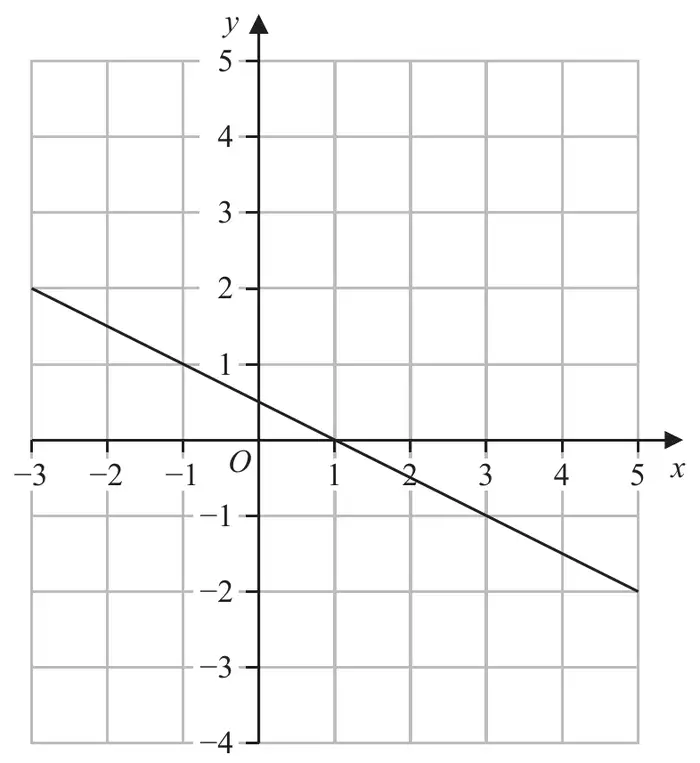
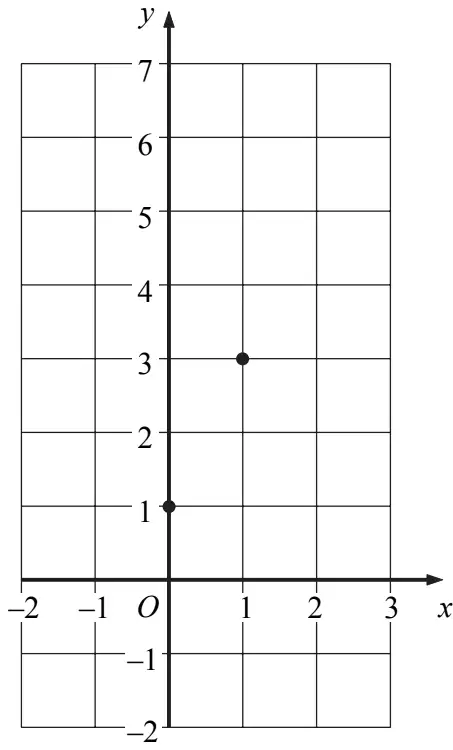
14 Here is the graph of the equation \(2y + x = 1\) drawn on a grid.
By drawing another straight line on the grid, solve the simultaneous equations
\[\begin{aligned} y - x - 2 &= 0 \\ 2y + x &= 1 \end{aligned}\]
(3)
Mark scheme
Scheme
Marks
For drawing the line \(y - x - 2 = 0\) (\(y = x + 2\)) Goes through (−2, 0) (−1, 1) (0, 2) (1, 3) (2, 4) etc
M1
Answer: \(x = -1\), \(y = 1\)
A2
(3 marks)
Notes
M1: At least long enough for the intercept with the other line and to clearly see that it is the correct line
A2: for both values correct, dep on M1 (A1 dep on M1 for one correct value or both values the wrong way round) [if more than one line is drawn, one of which is correct, and the correct coordinates given, please give credit]
This question is testing use of graphs to solve simultaneous equations, therefore please ignore any algebraic methods to solve the equations.
Working required Answer: \(x = 0.07\) and \(y = 0.12\)
A1
(3)
(5 marks)
Notes
M1: for a correct method to eliminate \(x\) or \(y\): coefficients of \(x\) or \(y\) the same and correct operator to eliminate selected variable (condone any one arithmetic error in multiplication) or writing \(x\) or \(y\) in terms of the other variable and correctly substituting (condone missing brackets)
M1: dep on first M1 for a correct method to find other variable by substitution of found variable into one equation or for repeating the above method to find the second variable.
eg \(10x + 4y = 20\) and \(-10x + 25y = 154\) oe, with operation of addition or
\(25x + 10y = 50\) and \(-4x + 10y = 61.6\) oe, with operation of subtraction or
\(x = \dfrac{5}{2}y - \dfrac{154}{10}\) oe or \(y = \dfrac{2}{5}x + \dfrac{154}{25}\) oe substituted in other equation
M1
Coordinates of intersection of \(AC\) and \(BD\): \(x = -\dfrac{2}{5}\), \(y = 6\)
M1
Correct answer scores full marks (unless from obvious incorrect working) Answer: (4.6, 8)
A1
(6)
(6 marks)
Notes
M1: A correct method to find the gradient of \(AC\)
M1: ft (if M1 scored) correct equation of \(AC\)
M1: ft (if first M1 scored) equation of \(BD\) or correct equation using gradient of \(BD\)
M1: Solve equation OR Solve simultaneously the correct equations of lines of \(AC\) and \(BD\) or correct equation from gradient or other correct equation. If elimination: same coefficient of \(x\) or \(y\) with suitable sign used to eliminate. If substitution: \(x\) or \(y\) substituted into other equation.
M1: oe value of \(x\) and \(y\) at intersection of \(AC\) and \(BD\)
A1: oe coordinates of \(D\)
24 ALT (working with \(AD = AB\), \(CD = CB\) or gradients)
M1: A correct method to find \(AB^2\) or \(CB^2\) or \(AB\) or \(CB\) or a correct gradient expression for \(AC\) or \(DB\)
M1: Using \(D\) (\(x\), \(y\)) form a correct equation \(AD^2 = AB^2\) or \(CD^2 = CB^2\) or gradients \(AC \times DB = -1\) (Using \(D\) (\(x\), \(y\)))
M1: uses rearrangement or solving simultaneous equations to find a correct 3 term linear equation
M1: uses substitution to obtain a correct quadratic equation in one unknown
M1: for a 3 term quadratic that can be used to find the value of \(x\) or the value of \(y\) at \(D\)
Working required Answer: \(x = 0.5\) and \(y = 1.5\)
A1
(3)
(3 marks)
Notes
M1: for a correct method to eliminate \(x\) or \(y\): multiplication of one or both equation(s) with correct operation selected (allow one arithmetic error) (if + or – is not shown then assume it is the operation that at least 2 of the 3 terms have been calculated for) or correct rearrangement of one equation with substitution into second
M1: (dep on previous M1 but not on a correct first value) correct method to find second unknown – this could be a correct substitution into one of the equations given or calculated or starting again with the same style of working as for the first method mark
M1: for substitution of \(y = \pm 2x \pm 1\) (or \(x = \dfrac{\pm y \pm 1}{2}\)) into \(y^2 + xy = 7\) to obtain an equation in \(x\) only (or \(y\) only)
M1ft: dep on previous M1 for multiplying out and collecting terms, forming a three term quadratic in any form of \(ax^2 + bx + c\;(= 0)\) where at least 2 coefficients (\(a\) or \(b\) or \(c\)) are correct
M1ft: dep on first M1 method to solve their 3 term quadratic using any correct method (allow one sign error and some simplification – allow as far as eg \(\dfrac{-5 \pm \sqrt{25 + 144}}{12}\) or \(\dfrac{1 \pm \sqrt{1 + 168}}{6}\) or if factorising allow brackets which expanded give 2 out of 3 terms correct)
or correct values for \(x\) or correct values for \(y\)
Accept (\(x\) =) 0.6(66..) rounded or truncated or (\(y\) =) 2.3(33…)
M1ft: dep on previous M1 for substituting their 2 found values of \(x\) or \(y\) into one of the two given equations or fully correct values for the other variable (correct labels for \(x\) / \(y\))
A1: oe dep on M2 allow \(x = -1.5\), \(y = -2\) \(x = 0.66(6\ldots)\), \(y = 2.33(3\ldots)\) truncated or rounded
eg \(\dfrac{2 + 1}{3}\) and \(\dfrac{-\frac{16}{7} + 1}{3}\)
M1ft
Working required
Answer: \(x = 2\), \(y = 1\) and
\(x = -\dfrac{16}{7}\), \(y = -\dfrac{3}{7}\)
A1
(5)
(5 marks)
Notes
M1: substitution of linear equation into quadratic
M1: dep on previous M1 for multiplying out and collecting terms, forming a three term quadratic in any form of \(ax^2 + bx + c\) (= 0) with at least 2 coefficients (\(a\) or \(b\) or \(c\)) correct
M1: dep on M1 for solving their 3 term quadratic equation using any correct method (if factorising, allow brackets which expanded give 2 out of 3 terms correct ) (if using formula allow one sign error in subst terms and some simplification – allow as far as eg \(\dfrac{12 \pm \sqrt{144 + 756}}{42}\) or \(\dfrac{-2 \pm \sqrt{4 + 896}}{14}\) )(if completing the square allow as far as shown (allow error in final constant) or correct values for \(x\) or correct values for \(y\)
M1ft: dep on previous M1 for substituting (must be shown) their 2 found values of \(x\) or \(y\) in a suitable equation (use 2dp or better for substitution) or fully correct values for the other variable (correct labels for \(x\) / \(y\))
A1: dep on M2 (allow coordinates) must be paired correctly allow \(x = -2.28(57…)\) and \(y = -0.42(85…)\) (even if obtained from premature rounding of the other variable.)
Working required Answer: \(x = 0.07\) and \(y = 0.12\)
A1
(3)
(5 marks)
Notes
M1: for a correct method to eliminate \(x\) or \(y\): coefficients of \(x\) or \(y\) the same and correct operator to eliminate selected variable (condone any one arithmetic error in multiplication) or writing \(x\) or \(y\) in terms of the other variable and correctly substituting (condone missing brackets)
M1: dep on first M1 for a correct method to find other variable by substitution of found variable into one equation or for repeating the above method to find the second variable.
Working required Answer: \(x = 0.5\) and \(y = 1.5\)
A1
(3)
(3 marks)
Notes
M1: for a correct method to eliminate \(x\) or \(y\): multiplication of one or both equation(s) with correct operation selected (allow one arithmetic error) (if + or – is not shown then assume it is the operation that at least 2 of the 3 terms have been calculated for) or correct rearrangement of one equation with substitution into second
M1: (dep on previous M1 but not on a correct first value) correct method to find second unknown – this could be a correct substitution into one of the equations given or calculated or starting again with the same style of working as for the first method mark
M1: substitution of \(y = \pm 3 \pm 2x\) (or \(x = \dfrac{\pm 3 \pm y}{2}\)) into \(2y^2 + x^2 = -6x + 42\) to obtain an equation in \(x\) only (or \(y\) only)
M1ft: (dep on previous M1) for multiplying out and collecting terms, forming a three term quadratic in any form of \(ax^2 + bx + c\;(= 0)\) where at least 2 coefficients (\(a\) or \(b\) or \(c\)) are correct
M1ft: (dep on M1) method to solve their 3 term quadratic using any correct method (allow one sign error and some simplification – allow as far as eg \(\dfrac{-10 \pm \sqrt{100 + 96}}{6}\) or \(\dfrac{2 \pm \sqrt{4 + 780}}{6}\))
or if factorising allow brackets which expanded give 2 out of 3 terms correct) or correct values for \(x\) (allow 0.66(6…) or 0.67) or correct values for \(y\) (allow −4.33(3…))
M1: (dep on previous M1) for substituting their 2 found values of \(x\) or \(y\) in a suitable equation (use 2dp or better for substitution) or fully correct values for the other variable (correct labels for \(x\) / \(y\))
A1: oe (dep on M1) and a correct quadratic (allow coordinates) allow \(x = 0.66(6\ldots)\) or 0.67, \(y = -4.33(3\ldots)\), \(x = -4\), \(y = 5\)
eg \(5 \times \text{“}1.2\text{”} + 4y = -2\) or \(2 \times \text{“}1.2\text{”} - y = 4.4\)or eg \(5x + 4 \times \text{“}{-2}\text{”} = 4.4\) or \(2x - \text{“}{-2}\text{”} = 4.4\)
M1
Working required Answer: \(x = 1.2\) \(y = -2\)
A1
(3)
(3 marks)
Notes
M1: multiplication of one or both equation(s) with correct operation selected (allow one arithmetic error) (if + or – is not shown then assume it is the operation that at least 2 of the 3 terms have been calculated for) or correct rearrangement of one equation with substitution into second
M1: (dep on previous M1 but not on a correct first value) correct method to find second unknown – this could be a correct substitution into one of the equations given or calculated or starting again with the same style of working as for the first method mark
eg \(x + 2 \times 4 = 15\) or \(7 + 2 \times y = 15\)
M1
Working required Answer: \(x = 7\), \(y = 4\)
A1
(3)
(3 marks)
Notes
M1: Correct method to eliminate \(x\) or \(y\): coefficients of \(x\) or \(y\) the same and correct operator to eliminate selected variable (condone any one arithmetic error in multiplication) or correctly writing \(x\) or \(y\) in terms of the other variable and correctly substituting.
M1: dep correct method to find second variable using their value from a correct method to find first variable or for repeating above method to find second variable.
eg \(y = 7 - 2 \times 5\) and \(y = 7 - 2 \times 0.6\) (correct labels for \(x\)/\(y\))or eg \(5.8 = 7 - 2x\) and \(-3 = 7 - 2x\) (correct labels for \(x\)/\(y\))
M1ft
Working must be shown Answer: \(x = 0.6\), \(y = 5.8\) \(x = 5\), \(y = -3\)
A1
(5)
(5 marks)
Notes
M1: substitution of linear equation into quadratic
M1: dep on previous M1 for multiplying out and collecting terms, forming a three term quadratic in any form of \(ax^2 + bx + c\;(= 0)\) where at least 2 coefficients (\(a\) or \(b\) or \(c\)) are correct and all are non-zero
M1ft: dep on M1 for solving their 3 term quadratic equation using any correct method (if factorising, allow brackets which expanded give 2 out of 3 terms correct) (if using formula allow one sign error and some simplification – allow as far as \(\dfrac{28 \pm \sqrt{784 - 300}}{10}\) or \(\dfrac{14 \pm \sqrt{196 + 1740}}{10}\))
(if completing the square allow as far as shown) or
correct values for \(x\) or correct values for \(y\) dep on correct quadratic
M1ft: dep on previous M1 for substituting their 2 found values of \(x\) or \(y\) in a suitable equation or correct values for the other variable
A1: dep on M1 and the correct quadratic (allow coordinates) must be paired correctly
eg \(5 \times \text{``}{1.2}\text{''} + 4y = -2\) or \(2 \times \text{``}{1.2}\text{''} - y = 4.4\)or eg \(5x + 2 \times \text{``}{-2}\text{''} = 4.4\) or \(2x - \text{``}{-2}\text{''} = 4.4\)
M1
Working required Answer: \(x = 1.2\) \(y = -2\)
A1
(3)
(3 marks)
Notes
M1: multiplication of one or both equation(s) with correct operation selected (allow one arithmetic error) (if + or – is not shown then assume it is the operation that at least 2 of the 3 terms have been calculated for) or correct rearrangement of one equation with substitution into second
M1: (dep on previous M1 but not on a correct first value) correct method to find second unknown – this could be a correct substitution into one of the equations given or calculated or starting again with the same style of working as for the first method mark
eg \(x + 2 \times 4 = 15\) or \(7 + 2 \times y = 15\)
M1
Working required Answer: \(x = 7\) \(y = 4\)
A1
(3)
(3 marks)
Notes
M1: Correct method to eliminate \(x\) or \(y\): coefficients of \(x\) or \(y\) the same and correct operator to eliminate selected variable (condone any one arithmetic error in multiplication) or correctly writing \(x\) or \(y\) in terms of the other variable and correctly substituting.
M1: dep correct method to find second variable using their value from a correct method to find first variable or for repeating above method to find second variable.
or eg \(7x + 3(3x - 7) = 3\) or \(7\left(\dfrac{7 + y}{3}\right) + 3y = 3\)
M1
If first M1 gained then they can substitute an incorrect value if from ‘correct’ method to gain this mark.
M1
Working required Answer: \(x = 1.5\), \(y = -2.5\)
A1
(3)
(3 marks)
Notes
M1: a correct method to eliminate \(x\) or \(y\) – multiplying one or both equations so that one variable can be eliminated (allow a total of one error in multiplication) and the correct operation to eliminate or for substitution of one variable into the other equation.
M1: dep on M1 for a correct method to calculate the value of other letter eg substitution or starting again with elimination
M1: for a correct expression for the sum of the first 10 terms (\(S_{10}\)) or the first 5 terms (\(S_5\)) or a correct equation for the 8th term Take 9 as their 10 – 1 and 4 as their 5 – 1 and 7 as their 8 – 1
M1: for a correct equation relating \(S_{10}\) and \(S_5\)
M1: (dep on M1) for \(d\) in terms of \(a\), or vice-versa (must be correct) or for \(a + 7d = 45\) oe and correctly reducing the equation relating \(S_{10}\) and \(S_5\) to an equation with one term in \(a\) and one term in \(d\) eg \(10a - 5d = 0\) oe or substituting a correct expression into their correct equation to obtain an equation in just \(d\)
M1: (dep on M2) for a correct equation in just \(a\) or for \(d = 6\) or for a correct method to eliminate \(a\) or \(d\): coefficients of \(a\) or \(d\) the same and correct operation to eliminate selected variable (condone 1 arithmetical error)
M1: For the correct equation of the line passing through \(BD\) or for a correct expression involving the \(x\) and \(y\) coordinates of point \(B\) or point \(D\)
M1: A correct equation in \(x\) and \(y\) to find the coordinates of \(B\) and \(D\)
M1: Brackets expanded
M1: For a correct substitution into a correct equation to get an equation in either \(x\) only or \(y\) only
M1: A fully correct simplified equation in \(x\) or in \(y\) – all brackets expanded and like terms grouped.
A1: correct coordinates SCB3 for one pair of correct coordinates or both \(x\) values correct or both \(y\) values correct
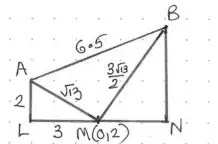
eg (0, 2) is translated \(\begin{pmatrix} 3 \\ 4.5 \end{pmatrix}\) or \((0 + 3, 2 + 4.5)\;(= (3, 6.5))\) or (0, 2) is translated \(\begin{pmatrix} -3 \\ -4.5 \end{pmatrix}\) or \((0 - 3, 2 - 4.5)\;(= (-3, -2.5))\) oe or \(3.25x^2 = 29.25\)
M1
(3, 6.5) (−3, −2.5)
A1
Notes
M1: Use of Pythagoras for point \(A\) to point \(M\)
M1: A correct method to find the length of \(BM\) or \(DM\)
M1: A correct method to find the SF of the enlargement of the sides \(AM\) to \(BM\) or angle \(LAM\) OR \(LMA\)
M1: A correct method to find the translation of at least one component of \(MB\) or \(MD\) (need not be written in vector form) OR correct Pythagoras statement using the SF to find \(x\) coordinates OR 1 correct trig statement to find translations from \(M\)
M1: A correct method to find the translation of both components of \(MB\) or \(MD\) (need not be written in vector form) OR correct Pythagoras statement with no brackets using the SF to find \(x\) coordinates OR 2 correct trig statements to find translations from \(M\)
M1: correct method to find the coordinates of \(B\) or \(D\) or one pair of correct coordinates or a correct method to find both \(x\) coordinates or both \(y\) coordinates OR a fully correct simplified equation in \(x\) all brackets expanded and like terms grouped.
A1: correct coordinates SCB3 for one correct coordinate or both \(x\) values correct or both \(y\) values correct
M1: for using correct substitution of a linear equation into the quadratic – all terms shown correctly
A1: for a correct 3 term quadratic
M1: dep on M1 method to solve their 3 term quadratic using any correct method (allow one sign error and some simplification – allow as far as eg \(\dfrac{-16 \pm \sqrt{256 - 60}}{6}\) or \(\dfrac{-14 \pm \sqrt{196 + 588}}{6}\) or if factorising allow brackets which expanded give 2 out of 3 terms correct)
or correct values for \(x\) or correct values for \(y\)
M1ft: dep on previous M1 for substituting their 2 found values of \(x\) or \(y\) in a suitable equation (use 2dp or better for substitution) or fully correct values for the other variable (correct labels for \(x\) / \(y\))
A1: dep on M1 (allow coordinates) must be paired correctly allow \(x = -7\), \(y = -5\) \(x = 2.33(3\ldots)\), \(y = -0.33(3\ldots)\)
M1: for a correct method to eliminate \(x\) or \(y\): coefficients of \(x\) or \(y\) the same and correct operation to eliminate selected variable (condone 1 arithmetical error) or for correctly writing \(x\) or \(y\) in terms of the other variable and correctly substituting
A1: dep on M1 for \(x = 5\) or \(y = -2\)
M1: dep on M1 for substitution of found variable or repeating the steps in first M1 for the second variable
A1: cao, dep on M1 a correct answer without working scores no marks
or eg \(7x + 3(3x - 7) = 3\) or \(7\left(\dfrac{7 + y}{3}\right) + 3y = 3\)
M1
If first M1 gained then they can substitute an incorrect value if from ‘correct’ method to gain this mark.
M1
Working required Answer: \(x = 1.5\), \(y = -2.5\)
A1
(3)
(3 marks)
Notes
M1: a correct method to eliminate \(x\) or \(y\) – multiplying one or both equations so that one variable can be eliminated (allow a total of one error in multiplication) and the correct operation to eliminate or for substitution of one variable into the other equation.
M1: dep on M1 for a correct method to calculate the value of other letter eg substitution or starting again with elimination
M1: for correct method to eliminate one variable – multiplying one or both equations so the coefficient of \(x\) or \(y\) is the same in both (condone one arithmetic error), with the intention to subtract all 3 terms to eliminate one variable (intention to subtract is clearly showing a minus sign or subtracting 2 or 3 out of 3 terms)
or isolating \(x\) or \(y\) in one equation and substituting into the other
M1: dep. Substitute found value into one equation or correct method to eliminate second unknown.
\(6p - 7\left(\dfrac{-84 - 9p}{15}\right) = -22\) or
\(9\left(\dfrac{-22 + 7q}{6}\right) + 15q = -84\) or
\(9p + 15\left(\dfrac{6p + 22}{7}\right) = -84\)
M1
\(p = -6\) and \(q = -2\)
A1
(5)
(5 marks)
Notes
M1: for finding the gradient of \(AB\) or \(BC\) or \(AC\) This may be seen embedded in \(m_1 \times m_2 = -1\)
or
for finding the length of \(AB\) or \(BC\) or \(AC\) (or \(AB^2\) etc)
M2: for two out of the three of: • using \(m_1 \times m_2 = -1\) • using the gradient of \(AC\) to form an equation. • using Pythagoras theorem
If not M2, then M1 for one of the equations. Alternative for the second point obtaining this equation by using \(y = mx + c\) with coordinates of \(A\) and \(C\) separately, and then eliminating c)
M1: (dep M3) for correct method to eliminate one variable – multiplying one or both equations so the coefficient of \(x\) or \(y\) is the same in both, with the correct operation to eliminate one variable (condone one arithmetic error)
or
isolating \(p\) or \(q\) in one equation and substituting into the other (condone one arithmetic error).
A1: for \(p = -6\) and \(q = -2\) Must be clearly identified
M1: Correct substitution of \(x\) for \(y\) (or \(y\) for \(x\))
M1: for a correct equation in the form \(ax^2 + bx + c\;(= 0)\) oe or \(ax^2 + bx = -c\)
M1ft: dep on M1 for solving their quadratic equation using any correct method - if factorising, allow brackets which expanded give 2 out of 3 terms correct (if using formula or completing the square allow one sign error and some simplification – allow as far as \(\dfrac{9 \pm \sqrt{81 - 80}}{10}\) oe or \(\dfrac{-12 \pm \sqrt{144 - 140}}{10}\) oe or \(5\left(x - \dfrac{9}{10}\right)^2 - \dfrac{1}{20}\) oe or \(5\left(y + \dfrac{6}{5}\right)^2 - \dfrac{1}{5}\) oe
\((y =)\ \dfrac{\text{‘}{27}\text{’} + 1}{2}\) and \(\dfrac{\text{‘}{-3}\text{’} + 1}{2}\) oe
M1
Working required Answer: \((27, 14)\) and \((-3, -1)\)
A1
(5)
(5 marks)
Notes
M1: substitution of linear equation into quadratic.
A1: (dep on M1) writing the correct quadratic expression in form \(ax^2 + bx + c\ (= 0)\)
allow \(ax^2 + bx = c\)
M1: (dep on M1) for the first stage to solve their 3-term quadratic equation (allow one sign error and some simplification – allow as far as \(\dfrac{13 \pm \sqrt{169 + 56}}{2}\) or \(\dfrac{24 \pm \sqrt{576 + 324}}{2}\)
or eg \(\left(x - \dfrac{24}{2}\right)^2 - 225\) oe
M1: (dep on previous M1) may be implied by values of \(y\) or \(x\) that are consistent with a correct substitution.
A1: for both solutions dep on M2 Must be paired correctly. accept \(x = 27\), \(y = 14\) and \(x = -3\), \(y = -1\)
M1: for correct method to eliminate one variable – multiplying one or both equations so the coefficient of \(x\) or \(y\) is the same in both (condone one arithmetic error), with the intention to subtract all 3 terms to eliminate one variable (intention to subtract is clearly showing a minus sign or subtracting 2 or 3 out of 3 terms) or isolating \(x\) or \(y\) in one equation and substituting into the other
M1: dep. Substitute found value into one equation or correct method to eliminate second unknown.
M1: substitution of their linear equation into quadratic in \(x\) or \(y\) alone (even if B0 scored)
M1ft: from their substitution (dep on previous M1) for a complete correct method to get a 3-term or 2-term quadratic expression in the form \(ax^2 + bx\ (+ c)\ (= 0)\) [allow \(ax^2 + bx = c\)]
M1: (dep on M1) for a complete method to solve their 3-term or 2-term quadratic equation \((ax^2 + bx\ (+ c) = 0)\) – correct factorisation or substitution into formula or completing square (allow one sign error and some simplification – allow as far as \(\dfrac{-1 \pm \sqrt{1 + 24}}{2}\) or \(\dfrac{-7 \pm \sqrt{49 - 24}}{2}\))
or for seeing \(x = 2\), \(x = -3\) or \(y = -1\), \(y = -6\)
A1: (dep on M2) for \(x = 2\), \(x = -3\) and \(y = -1\), \(y = -6\) or one correct midpoint ie \(x = -\dfrac{1}{2}\) or \(y = -\dfrac{7}{2}\)
18 Alison buys 5 apples and 3 pears for a total cost of \(\$\)1.96 Greg buys 3 apples and 2 pears for a total cost of \(\$\)1.22
Michael buys 10 apples and 10 pears.
Work out how much Michael pays for his 10 apples and 10 pears. Show your working clearly.
(5)
Mark scheme (elimination)
Scheme
Marks
\(5a + 3p = 1.96\) and \(3a + 2p = 1.22\) oe or \(5a + 3p = 196\) and \(3a + 2p = 122\) oe
M1
E.g. \(15a + 9p = 5.88\) \(15a + 10p = 6.10\) Subtracting \((-p = -0.22)\)or E.g. \(10a + 6p = 3.92\) \(9a + 6p = 3.66\) Subtracting \((a = 0.26)\)or E.g. \(5a + 3p = 1.96\) and \(6a + 4p = 2.44\) oe Subtractingor M2 for an arithmetical method (must see the calculation to find 0.22 or 0.26 or 0.74 and 0.48 oe) E.g. 6.1(0) – 5.88 (= 0.22) oe or 3.92 – 3.66 (= 0.26) oe or 1.96 – 1.22 (= 0.74) oe and 1.22 – “0.74” (= 0.48)
M1
E.g. \(5a + 3(\text{``}{0.22}\text{''}) = 1.96\) or \(3a + 2(\text{``}{0.22}\text{''}) = 1.22\)or E.g. \(5(\text{``}{0.26}\text{''}) + 3p = 196\) or \(3(\text{``}{0.26}\text{''}) + 2p = 1.22\)or E.g. \(a + p = 0.48\) oeor E.g. 3 × 0.22 (= 0.66) 1.96 – “0.66” (= 1.3(0)) “1.3(0)” ÷ 5 (= 0.26) or 5 × 0.26 (= 1.3(0)) 1.96 – “1.3(0)” (= 0.66) “0.66” ÷ 3 (= 0.22) or Apple and pear is 0.48 oe
M1
\(10 \times \text{``}{0.26}\text{''} + 10 \times \text{``}{0.22}\text{''}\) or \((a + p =)\ 0.48 \times 10\) oe or \(k(a + p) = k(0.48) \times \dfrac{10}{k}\)
M1
Working required Answer: 4.8(0)
A1
(5)
(5 marks)
Notes
M1: for setting up both equations oe Allow the use of apples and pears oe throughout, e.g. 5 apples + 3 pears = 1.96 and 3 apples + 2 pears = 1.22
M1: for a correct method to eliminate \(a\) or \(p\): coefficients of \(a\) or \(p\) the same and correct operation to eliminate selected variable (condone any one arithmetic error) or to find the cost of 1 apple and 1 pear
M1: (dep on M2) for substituting their value found (must be > 0) of one variable into one of the equations or for repeating above method to find second variable or for third working column allow \(k(a + p) = k(0.48)\) or for a complete arithmetical method to find the other value
M1: (dep on M3) can be implied by \(10(a + p)\) provided \(a\) and \(p\) must be > 0
A1: dep M2
Mark scheme (substitution)
Scheme
Marks
\(5a + 3p = 1.96\) and \(3a + 2p = 1.22\) oe or \(5a + 3p = 196\) and \(3a + 2p = 122\) oe
M1
E.g.
\(3\left(\dfrac{1.96 - 3p}{5}\right) + 2p = 1.22\) or
\(5\left(\dfrac{1.22 - 2p}{3}\right) + 3p = 1.96\) or
\(3a + 2\left(\dfrac{1.96 - 5a}{3}\right) = 1.22\) or
\(5a + 3\left(\dfrac{1.22 - 3a}{2}\right) = 1.96\) or
\(p = 0.22\) or \(a = 0.26\)
M1
E.g.
\((a =)\ \dfrac{1.96 - 3(0.22)}{5}\) or \((a =)\ \dfrac{1.22 - 2(0.22)}{3}\) or
M1: for setting up both equations oe Allow the use of apples and pears oe throughout, e.g. 5 apples + 3 pears = 1.96 and 3 apples + 2 pears = 1.22
M1: for correctly writing \(a\) or \(p\) in terms of the other variable and correctly substituting (condone any one arithmetic error)
M1: (dep on M2) for substituting their value found (must be > 0) of one variable into one of the equations or for repeating above method to find second variable
M1: (dep on M3) can be implied by \(10(a + p)\) provided \(a\) and \(p\) must be > 0
E.g. \(5a + 3(\text{``}{0.22}\text{''}) = 1.96\) or \(3a + 2(\text{``}{0.22}\text{''}) = 1.22\)or E.g. \(5(\text{``}{0.26}\text{''}) + 3p = 1.96\) or \(3(\text{``}{0.26}\text{''}) + 2p = 1.22\)or E.g. \(a + p = 0.48\) oe
M1
\(10 \times \text{``}{0.26}\text{''} + 10 \times \text{``}{0.22}\text{''}\) or
\((a + p =)\ 0.48 \times 10\) oe or
\(k(a + p) = k(0.48) \times \dfrac{10}{k}\)
M1
Working required Answer: 4.8(0)
A1
(5)
(5 marks)
Notes
M1: for setting up both equations oe allow apples and pears oe throughout e.g. 5 apples + 3 pears = 1.96 and 3 apples + 2 pears = 1.22
M1: for a correct method to eliminate a or p: coefficients of a or p the same and correct operation to eliminate the selected variable (condone any one arithmetic error) or to find the cost of 1 apple and 1 pear
M1: (dep on M2) for substituting their value found (must be > 0) of one variable into one of the equations, or for repeating the above method to find the second variable, or for the third working column allow k(a + p) = k(0.48), or for a complete arithmetical method to find the other value
M1: (dep on M3) can be implied by 10(a + p) provided a and p must be > 0
A1: dep M2
M2 for an arithmetical method (must see the calculation to find 0.22 or 0.26 or 0.74 and 0.48 oe) E.g. 6.1(0) – 5.88 (= 0.22) oe or 3.92 – 3.66 (= 0.26) oe or 1.96 – 1.22 (= 0.74) oe and 1.22 – “0.74” (= 0.48)
A complete arithmetical method to find the other value: e.g. 3 × 0.22 (= 0.66), 1.96 – “0.66” (= 1.3(0)), “1.3(0)” ÷ 5 (= 0.26) or 5 × 0.26 (= 1.3(0)), 1.96 – “1.3(0)” (= 0.66), “0.66” ÷ 3 (= 0.22) or Apple and pear is 0.48 oe
Mark scheme (ALT: substitution)
Scheme
Marks
\(5a + 3p = 1.96\) and \(3a + 2p = 1.22\) oe or \(5a + 3p = 196\) and \(3a + 2p = 122\) oe
M1
E.g.
\(3\left(\dfrac{1.96 - 3p}{5}\right) + 2p = 1.22\) or
\(5\left(\dfrac{1.22 - 2p}{3}\right) + 3p = 1.96\) or
\(3a + 2\left(\dfrac{1.96 - 5a}{3}\right) = 1.22\) or
M1: for setting up both equations oe allow apples and pears oe throughout e.g. 5 apples + 3 pears = 1.96 and 3 apples + 2 pears = 1.22
M1: for correctly writing a or p in terms of the other variable and correctly substituting (condone any one arithmetic error)
M1: (dep on M2) substituting their value found (must be > 0) of one variable into one of the equations or repeating the above method to find the second variable
M1: (dep on M3) can be implied by 10(a + p) provided a and p must be > 0
Working required Answer: \(a = 2.25\) \(c = -0.625\)
A1
(3)
(3 marks)
Notes
M1: multiplication of one or both equation(s) with correct operation selected (allow one arithmetic error) (if + or – is not shown then assume it is the operation that at least 2 of the 3 terms have been calculated for) or correct rearrangement of one equation with substitution into second
M1: (dep on previous M1 but not on a correct first value) correct method to find second unknown – this could be a correct substitution into one of the equations given or calculated or starting again with the same style of working as for the first method mark
A1: oe eg \(a = \dfrac{9}{4}\), \(c = -\dfrac{5}{8}\) for both solutions
\(x = -0.6\) and \(x = 3\) OR \(y = 4.2\) and \(y = -3\)
A1
Working must be shown Answer: \(x = -0.6,\ y = 4.2\) \(x = 3,\ y = -3\)
A1
(5)
(5 marks)
Notes
M1: substitution of linear equation into quadratic
M1: simplified to a correct 3 term quadratic
M1ft: dep on M1 for solving their 3 term quadratic equation using any correct method (if factorising, allow brackets which expanded give 2 out of 3 terms correct) (if using formula allow one sign error and some simplification – allow as far as \(\dfrac{12 \pm \sqrt{144 + 180}}{10}\) or \(\dfrac{6 \pm \sqrt{36 + 1260}}{10}\)) (if completing the square allow as far as shown)
A1: oe dep on M2 for both \(x\)-values OR both \(y\)-values
A1: oe dep on M2 (must be clearly shown as correct pairs), accept answers given as coordinates
Working required Answer: \(a = 2.25\) \(c = -0.625\)
A1
(3)
(3 marks)
Notes
M1: multiplication of one or both equation(s) with correct operation selected (allow one arithmetic error) (if + or − is not shown then assume it is the operation that at least 2 of the 3 terms have been calculated for) or correct rearrangement of one equation with substitution into second
M1: (dep on previous M1 but not on a correct first value) correct method to find second unknown – this could be a correct substitution into one of the equations given or calculated or starting again with the same style of working as for the first method mark
A1: oe eg \(a = \dfrac{9}{4},\ c = -\dfrac{5}{8}\) for both solutions
e.g. \(\left(x + \dfrac{9}{2}\right)^2 - \left(\dfrac{9}{2}\right)^2 = -14\)
M1
\(y = \dfrac{3}{2}\) oe and \(y = 4\)or
\(x = -7\) and \(x = -2\)
A1
Working required
Answer: \(x = -2\), \(y = \dfrac{3}{2}\) oe
and
\(x = -7\), \(y = 4\)
A1
(5)
(5 marks)
Notes
M1: substitution of linear equation into quadratic
A1: (dep on M1) writing the correct quadratic expression in the form \(ax^2 + bx + c\;(= 0)\)
allow \(ax^2 + bx = c\)
M1: (dep on M1) for a complete method to solve their 3-term quadratic equation (allow one sign error and some simplification – allow as far as \(\dfrac{11 \pm \sqrt{121 - 72}}{4}\) or \(\dfrac{-9 \pm \sqrt{81 - 56}}{2}\))
A1: (dep on M1) both \(x\)-values or both \(y\)-values
M1: for substitution of linear equation into quadratic or multiplying linear equation by \(y\) e.g. \(xy - 6y^2 = 5y\) and intention to subtract the two equations
A1: (dep on M1) writing the correct quadratic expression in form \(ax^2 + bx + c\;(= 0)\)
allow \(ax^2 + bx = c\)
M1: (dep on M1) for a complete method to solve their 3-term quadratic equation (allow one sign error and some simplification – allow as far as \(\dfrac{-5 \pm \sqrt{25 + 96}}{8}\) or \(\dfrac{5 \pm \sqrt{25 + 1064}}{4}\))
A1: Dep on first M1 for having two correct \(x\) values or two correct \(y\) values
A1: Dep on first M1 Must be paired and labelled correctly
or eg \(5\left(\dfrac{17 - 7y}{2}\right) + 3y = -1\)
or eg \(5x + 3\left(\dfrac{17 - 2x}{7}\right) = -1\)
M1
M1
Working required Answer: \(x = -2\)
A1
\(y = 3\)
A1
(4)
(4 marks)
Notes
M1: for correct method to eliminate one variable – multiplying one or both equations so the coefficient of x or y is the same in both, with the correct operation to eliminate one variable (condone one arithmetic error) or isolating x or y in one equation and substituting into the other (condone one arithmetic error).
M1: dep 1st M1 Substitute found value into one equation or correct method to eliminate second unknown.
M1: for substituting linear equation into the quadratic equation
A1: for a correct equation in the form \(ax^2 + bx + c = 0\) or \(ax^2 + bx = -c\) or equations of the same form but in \(y\)
M1ft: For solving their 3 term quadratic equation using any correct method.
If factorising, allow brackets which expanded give 2 out of 3 terms correct (if using formula or completing the square allow one sign error and some simplification – allow as far as eg
M1: Correct method to eliminate \(x\) or \(y\): coefficients of \(x\) or \(y\) the same and correct operation to eliminate selected variable (condone any one arithmetic error in multiplication) or writing \(x\) or \(y\) in terms of the other variable and correctly substituting
M1: (dep) correct method to find second variable – could start process again or use substitution
M1: correct first step eg substitution by eg \(x = 1 + 2y\) or \(y = \dfrac{x - 1}{2}\) to get an equation in a single variable
or
writing 2nd equation with \(x\) the subject and substituting into 1st
or
multiplying 2nd equation by \(3y\) and subtracting from 1st oe
A1: for a correct simplified quadratic
M1ft: dep on M1 for solving their 3 term quadratic equation using any correct method (allow one sign error and some simplification – allow as far as \(\dfrac{-3 \pm \sqrt{9 + 160}}{10}\)) or if factorising, allow brackets which expanded give 2 out of 3 terms correct)
M1: for a correct method to eliminate \(x\) or \(y\): coefficients of \(x\) or \(y\) the same and correct operation to eliminate selected variable (condone 1 arithmetical error) or for correctly writing \(x\) or \(y\) in terms of the other variable and correctly substituting
A1: dep on M1 for \(x = 4\) or \(y = -3\)
M1: dep on M1 for substitution of found variable or repeating the steps in first M1 for the second variable
A1: cao A correct answer without working scores no marks
\((-4, -2)\) and \((3, 5)\) Working required Answer: \((-4, -2)\) and \((3, 5)\)
A1
(5)
(5 marks)
Notes
M1: for substituting linear equation into the quadratic equation
A1: for a correct equation in the form \(ax^2 + bx + c = 0\) or \(ax^2 + bx = -c\)
M1ft: dep on M1 for solving their quadratic equation using any correct method (allow one sign error and some simplification – allow as far as \(\dfrac{-1 \pm \sqrt{1 + 48}}{2}\)) or if factorising, allow brackets which expanded give 2 out of 3 terms correct)
\((-4, -2)\) and \((3, 5)\) Working required Answer: \((-4, -2)\) and \((3, 5)\)
A1
Notes
M1: for substituting linear equation into the quadratic equation
A1: for a correct equation in the form \(ay^2 + by + c = 0\) or \(ay^2 + by = -c\)
M1ft: dep on M1 for solving their quadratic equation using any correct method (allow one sign error and some simplification – allow as far as \(\dfrac{3 \pm \sqrt{9 + 40}}{2}\)) or if factorising, allow brackets which expanded give 2 out of 3 terms correct
M1: Correct method to eliminate \(x\) or \(y\): coefficients of \(x\) or \(y\) the same and correct operator to eliminate selected variable or correct substitution for \(x\) or \(y\) into 2nd equation
(adding) \(10x = -5\) or \(21x + 35y = 42\) and \(21x - 15y = -33\) then \(50y = 75\)
M1
\(x = -0.5\) oe
A1
Working required Answer: \(y = 1.5\) oe
A1
(3)
(3 marks)
Notes
M1: Correct method to eliminate \(x\) or \(y\) Or making coefficients of \(x\) or \(y\) the same and correct operator has been applied to eliminate \(x\) or \(y\) (2 out of 3 terms correct implies a correct operator) or correct algebraic substitution for \(x\) or \(y\) into other equation
(corrected from the printed mark scheme, which has \(x\) in place of \(y\) here)
M1
\(x = 4.5\) and \(x = 6\)or \(y = 4.5\) and \(y = 3\)
A1
Working required Answer: (4.5, 4.5) and (6, 3)
A1
(5)
(5 marks)
Notes
M1: substitution of linear equation into quadratic
A1: (dep on M1) writing the correct quadratic expression in form \(ax^2 + bx + c\) (= 0) allow \(ax^2 + bx = c\)
M1: (dep on M1) for a complete method to solve their 3-term quadratic equation (allow one sign error and some simplification – allow as far as \(\dfrac{21 \pm \sqrt{441 - 432}}{4}\))
A1: (dep on M1) both \(x\)-values or both \(y\)-values
\[\begin{aligned} x + 2y &= -0.5 \\ 3x - y &= 16 \end{aligned}\]
Show clear algebraic working.
(3)
Mark scheme
Scheme
Marks
Using elimination then substitution e.g. \(\begin{aligned} &x + 2y = -0.5 \\ +\; &6x - 2y = 32 \end{aligned}\) (\(7x = 31.5\))or e.g. \(\begin{aligned} &3x + 6y = -1.5 \\ -\; &3x - y = 16 \end{aligned}\) (\(7y = -17.5\))
M1
e.g. ‘4.5’ + \(2y = -0.5\) or 3 × ‘4.5’ – \(y\) = 16or e.g. \(x\) + 2 × ‘−2.5’ = −0.5 or \(3x\) – ‘−2.5’ = 16
M1
Working required Answer: \(x = 4.5\) \(y = -2.5\)
A1
(3)
(3 marks)
Notes
M1: for a correct method to eliminate \(x\) or \(y\): coefficients of \(x\) or \(y\) the same and correct operation to eliminate selected variable (condone any one arithmetic error)
M1: (dep) for substituting their value found of one variable into one of the equations or for repeating above method to find second variable
e.g. \(\begin{aligned} 4x + 5y &= 4 \\ 4x - 2y &= 18 \end{aligned}\) with the operation of subtraction
\(\begin{aligned} 4x + 5y &= 4 \\ 10x - 5y &= 45 \end{aligned}\) With the operation of adding
\(y = 2x - 9\) and \(4x + 5(2x - 9) = 4\)
M1
M1
\(x = 3.5\) oe, \(y = -2\)
A1
(3)
(3 marks)
Notes
M1: for correct method to eliminate one variable – multiplying one or both equations so the coefficient of \(x\) or \(y\) is the same in both with the intention to add or subtract to eliminate one variable (condone one arithmetic error) or isolating \(x\) or \(y\) in one equation and substituting into the other equation
M1: (dep) for substitution of found variable into one equation or correct method to eliminate second variable
M1: correct method to eliminate \(x\) or \(y\): coefficients of \(x\) or \(y\) the same and correct operation to eliminate the selected variable (condone any one arithmetic error in multiplication) or writing \(x\) or \(y\) in terms of the other variable and correctly substituting
M1: (dep) correct method to find second variable using their value from a correct method to find first variable or for repeating above method to find second variable
e.g. \(4x + 5y = 4\) \(4x - 2y = 18\) with the operation of subtraction
\(4x + 5y = 4\) \(10x - 5y = 45\) With the operation of adding
\(y = 2x - 9\) and \(4x + 5(2x - 9) = 4\)
M1
M1
\(x = 3.5\) oe, \(y = -2\)
A1
(3)
(3 marks)
Notes
M1: for correct method to eliminate one variable – multiplying one or both equations so the coefficient of \(x\) or \(y\) is the same in both with the intention to add or subtract to eliminate one variable (condone one arithmetic error) or isolating \(x\) or \(y\) in one equation and substituting into the other equation
M1: (dep) for substitution of found variable into one equation or correct method to eliminate second variable
M1: correct method to eliminate \(x\) or \(y\): coefficients of \(x\) or \(y\) the same and correct operation to eliminate the selected variable (condone any one arithmetic error in multiplication) or writing \(x\) or \(y\) in terms of the other variable and correctly substituting
M1: (dep) correct method to find second variable using their value from a correct method to find first variable or for repeating above method to find second variable
\(6.5 + y = 15\) or \(x + 8.5 = 15\) or \(7 \times 6.5 - 5y = 3\) or \(7x - 5 \times 8.5 = 3\)
M1
Working required Answer: \(x = 6.5\), \(y = 8.5\)
A1oe
(3)
(3 marks)
Notes
M1: Correct method to eliminate \(x\) or \(y\): coefficients of \(x\) or \(y\) the same and correct operation to eliminate selected variable (condone any one arithmetic error in multiplication) or writing \(x\) or \(y\) in terms of the other variable and correctly substituting
M1: dep Correct method to find second variable using their value from a correct method to find first variable or for repeating above method to find second variable
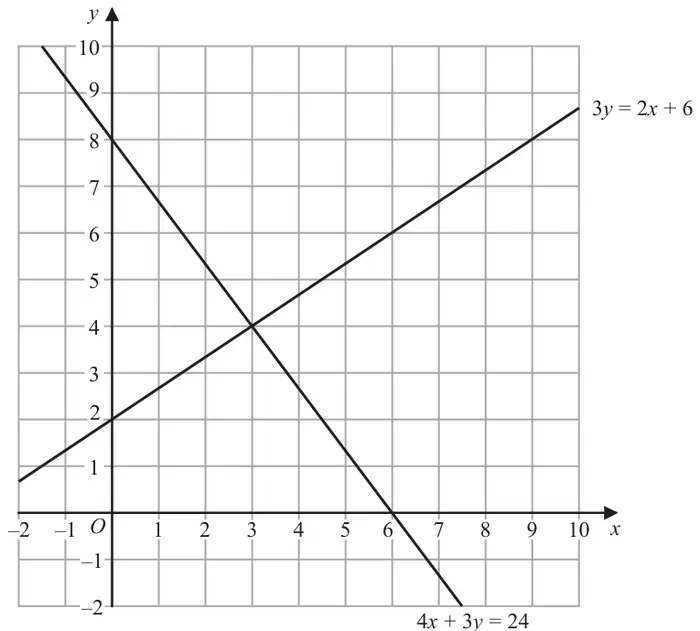
12 The diagram shows two straight lines drawn on a grid.
(a) Write down the solution of the simultaneous equations\[\begin{aligned}3y &= 2x + 6\\ 4x + 3y &= 24\end{aligned}\] (1)
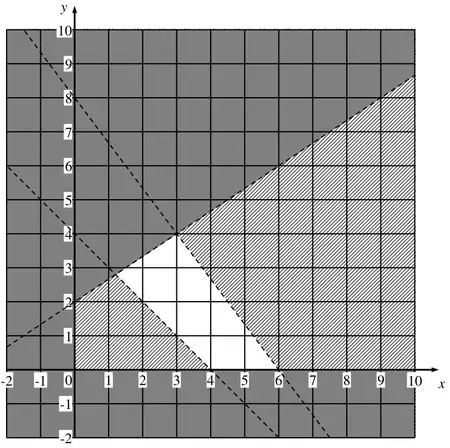
(b) Show, by shading on the grid, the region defined by all five of the inequalities\[x \geqslant 0 \qquad y \geqslant 0 \qquad x + y \geqslant 4 \qquad 3y \leqslant 2x + 6 \qquad 4x + 3y \leqslant 24\]Label the region R. (3)
Mark scheme (a)
Scheme
Marks
\(x = 3\), \(y = 4\)
B1
(1)
Mark scheme (b)
Scheme
Marks
Answer: Correct region (graph at end of mark scheme)
B3
(3)
(4 marks)
Notes
B3: for correct region identified If not B3 then award B2 for \(x + y = 4\) drawn (with no additional lines drawn) and a region identified that satisfies at least 3 of the 5 given inequalities If not B2 then award B1 for line \(x + y = 4\) drawn NB. May shade wanted or unwanted regions; lines may be solid or dashed
\(\text{``}{6.5}\text{''} + y = 15\) or \(x + \text{``}{8.5}\text{''} = 15\) or \(7 \times \text{``}{6.5}\text{''} - 5y = 3\) or \(7x - 5 \times \text{``}{8.5}\text{''} = 3\)
M1
Working required Answer: \(x = 6.5\), \(y = 8.5\)
A1oe
(3)
(3 marks)
Notes
M1: Correct method to eliminate \(x\) or \(y\): coefficients of \(x\) or \(y\) the same and correct operation to eliminate selected variable (condone any one arithmetic error in multiplication) or writing \(x\) or \(y\) in terms of the other variable and correctly substituting
M1: dep Correct method to find second variable using their value from a correct method to find first variable or for repeating above method to find second variable
e.g. \(y^2 + \left(\dfrac{3 - y}{2}\right)^2 = 18\)
M1: indep for correct expansion
e.g. \(\dfrac{y^2 - 3y - 3y + 9}{4}\)
A1: for correct simplified quadratic equation (terms may not all be ‘on the same side’) e.g. \(5y^2 - 6y - 63\;(= 0)\) NB dep on first M1
M1: ft if first M1 awarded and equation is a 3 term quadratic for correct factorisation or correct substitution into formula e.g. \((5y - 21)(y + 3) = 0\) or \(\dfrac{--6 \pm \sqrt{(-6)^2 - 4 \times 5 \times -63}}{2 \times 5}\)
A1:or \(y = -3\) and \(y = 4.2\) correct \(x\) or \(y\) values implies previous M1 dep on first A1 awarded
A1: Values for \(x\) and \(y\) must be correctly paired dep on first A1 awarded
M1: for coefficient of \(x\) or \(y\) the same and correct operation to eliminate selected variable (condone any one arithmetic error in multiplication) or for correct rearrangement of one equation followed by correct substitution in the other.
A1: cao (dep on M1)
M1: (dep on 1st M1) for substituting their found value into one of the equations or correct method of elimination to find the second variable (as for first M1)
A1: cao Award 4 marks for correct values if at least first M1 scored
e.g. 7 × “3” + \(2y\) = 16 or \(7x + 2 \times -2.5 = 16\)
M1
\(x = 3\) oe, \(y = -2.5\)
A1
(3)
Notes
M1: for addition of given equations or a complete method to eliminate \(y\) or \(x\) (condone one arithmetic error)
M1: (dep) for method to find second variable
A1: dep on M1 for both values correct. NB. Candidates showing no working score zero
Mark scheme (b)
Scheme
Marks
\(k^2 + 9k - 5k - 45\)
M1
\(k^2 + 4k - 45\)
A1
(2)
Notes
M1: for 3 terms correct or all 4 terms correct ignoring signs or \(k^2 + 4k + \ldots\) or … \(+ 4k - 45\) (corrected from the printed mark scheme: “\(y^2 + 4k + \ldots\)”)
Mark scheme (c)
Scheme
Marks
eg \(\left(\dfrac{1}{8x^6y^3}\right)^{-\frac{1}{3}}\) or \(\left(\dfrac{8x^6y^8}{y^5}\right)^{\frac{1}{3}}\) or
e.g. \(4\left(\dfrac{27 + 2y}{3}\right) + 5y = 13\)
M1
\(23y = -69\); \(y = -3\)
A1
\(12x + 15 \times -3 = 39\)
M1
\(x = 7\); \(y = -3\)
A1
(4)
Notes
M1: for multiplication to give coefficients of \(x\) or \(y\) the same and correct operation selected to eliminate one variable (condone any one error in multiplication) or for correct rearrangement of one equation followed by correct substitution in the other
A1: cao depends on M1
M1: (dep on 1st M1) for substituting the found variable or starting again to find second variable as M1 above
A1: Award 4 marks for correct values if at least M1 scored
M1: for coefficients of \(x\) or \(y\) the same with the correct operation to eliminate one variable (allow one error) or for correct rearrangement of one equation followed by substitution in the other.
A1: ( dep on M1)
M1: (dep on M1) for substituting for the other variable or starting again to eliminate the other variable
A1: Correct simplified 3 part quadratic equation (may not be equated to zero) \(10y^2 - 4y - 176 = 0\) or \(5y^2 - 2y - 88 = 0\)
M1: for correct factorisation or substitution into quadratic formula ft (dep on at least 1 previous M1 scored) a 3 term quadratic for this mark only eg. \((5y - 22)(y + 4) = 0\)
A1: for both \(x\) values (or both \(y\) values)
A1: for both solutions with \(x\) and \(y\) values correctly paired
Eg \(5c = 35\) or \(25d = -100\) or \(4(-13 - 5d) - 5d = 48\) oe
M1
\(c = 7\)
A1
\(d = -4\)
A1
(3)
Notes
M1: For eliminating either variable by using the correct operation or for a correct rearrangement of one equation followed by a substitution into the other equation. Condone 1 arithmetic error.
M1: for appropriate multiplication to get coefficients of \(x\) or \(y\) the same (condone one arithmetic error) with the correct operation to eliminate one variable or for correct rearrangement of one equation followed by substitution in the other (condone one arithmetic error).
M1(dep): to find value of second variable ft from value of their first variable
A1: Award 3 marks for correct values if at least first M1 scored
M1: M1 for appropriate multiplication to get coefficients of \(x\) or \(y\) the same (condone one arithmetic error) with the correct operation to eliminate one variable or for correct rearrangement of one equation followed by substitution in the other (condone one arithmetic error). NB: Could work with \(x + y = 3\) throughout rather than \(3x + 3y = 9\)
A1: (dep on M1)
M1: (dep) for substituting into an equation to find the second variable or for a fully correct method to find second variable
A1: Award 4 marks for correct values if at least first M1 scored
Mark scheme (b)
Scheme
Marks
\(y = \dfrac{-4x + 13}{2}\) or \(y = -2x + 6.5\) or
Substitution of their found value above into one of the equations
M1
\(x = 3\); \(y = -1\)
A1
(4 marks)
Notes
M1: for coefficient of \(x\) or \(y\) the same and correct operation to eliminate selected (condone any one arithmetic error in multiplication) or for correct rearrangement of one equation followed by correct substitution in the other
A1: cao dep on M1
M1: (dep on 1st M1) for substituting to find the other variable or correct method of elimination to find second variable (as first M1)
A1: cao Award 4 marks for correct values if at least first M1 scored
or \(3x + 4\left(\dfrac{11 - 5x}{6}\right) = 6\) oe
or \(3\left(\dfrac{11 - 6y}{5}\right) + 4y = 6\) oe
M1
\(y = -1\frac{1}{2}\) or \(x = 4\)
A1
Eg. 3x + 4(−1.5) = 6 oe
M1
\(x = 4,\; y = -1\frac{1}{2}\)
A1
(4)
(4 marks)
Notes
M1: For coefficient of \(x\) or \(y\) the same and correct operation to eliminate selected one (condone any one arithmetic error in multiplication) or For correct rearrangement of one equation followed by correct substitution in the other.
A1: Cao dep on M1
M1: (dep on 1st M1) for substituting the other variable
A1: Award 4 marks for correct values if at least first M1 scored
M1: Factorising correctly or correct use of quadratic formula
A1 A1: A1 Both correct \(x\) values or 1 correct pairing, dependent on previous M1 A1 4 fully correct values (pairing need not be explicit), dependent on previous M1
The mark scheme states that for this question the correct answer alone does not imply a correct method.
M1: for coefficients of \(x\) or \(y\) the same or for correct rearrangement of one equation followed by substitution in the other eg \(3x + 5\left(\dfrac{4 - 4x}{3}\right) = 14\)
A1: dep on M1
M1: (dep on first M1) for substituting for the other variable
A1: cao dep Award full marks for correct values if at least first M1 scored
The mark scheme states that for this question the correct answer alone does not imply a correct method.
M1: for coefficients of \(x\) or \(y\) the same or for correct rearrangement of one equation followed by substitution in the other eg \(5x + 3\left(\dfrac{7x - 25}{2}\right) = 9\)
M1: (dep on first M1) for substituting for the other variable
A1: cao dep Award full marks for correct values if at least first M1 scored
(a) Find the gradient of the line with equation \(3x + 4y = 10\) (3)
(b) Find the coordinates of the point of intersection of the line with equation \(3x + 4y = 10\) and the line with equation \(5x - 6y = 23\) Show your working clearly. (5)
M1: May be implied by second M1 or by \(y = -\frac{3}{4}x + c\) even if value of \(c\) is incorrect. or finds coordinates of 2 points on the line eg (0, 2.5), \(x = 2\), \(y = 1\), table, diagram.
M1: or for clear attempt to evaluate \(\dfrac{\text{vert diff}}{\text{horiz diff}}\) for their pts
A1: Award 3 marks for correct answer if either first M1scored or no working shown. SC If M0, award B1 for \(-\frac{3}{4}x\)
Apart from Questions 3, 13(b) and 17(f) (where the mark scheme states otherwise), the correct answer, unless clearly obtained by an incorrect method, should be taken to imply a correct method.
B1: (indep) for correct expansion of \((2x - 3)^2\) even if unsimplified
B1: for correct simplification Condone omission of ‘= 0’
B1: for correct factorisation or for correct substitution into quadratic formula and correct evaluation of ‘\(b^2 - 4ac\)’ or for using square completion correctly as far as indicated
A1: for both values of \(x\) dep on all preceding marks
A1: for complete, correct solutions (need not be paired) dep on all preceding marks No marks for \(x = 1\), \(y = -1\) with no working
2 lines where coefficients of \(x\) or \(y\) are equal
M1
\(x = 1.5\), \(y = -2\)
A1 A1
(3)
(3 marks)
Notes
M1: e.g. \(6x - 15y = 39\), \(6x + 3y = 3\) or \(6x - 15y = 39\), \(30x + 15y = 15\) and then add/subtract (condone 1 arithmetic error) leads to \(18y = -36\) or \(36x = 54\) or make \(x\) or \(y\) subject and substitute correctly
B1: (indep) for correct expansion of \((3x + 4)^2\) even if unsimplified
B1: for correct simplification Condone omission of ‘= 0’
B1: for correct factorisation Condone omission of ‘= 0’ or for correct substitution into the quadratic formula and correct evaluation of ‘\(b^2 - 4ac\)’ or for using square completion correctly as far as indicated
A1: for both values of \(x\)
A1: for complete, correct solutions Need not be explicitly paired
Alternative (eliminating \(x\)): \(x = \frac{y - 4}{3}\) B1; \(\left(\frac{y - 4}{3}\right)^2 + y^2 = 34\) M1; \(\frac{y^2 - 4y - 4y + 16}{9} + y^2 = 34\) or \(y^2 - 8y + 16 + 9y^2 = 306\) B1 (indep) for correct expansion of \((y - 4)^2\) even if unsimplified; \(10y^2 - 8y - 290\ (= 0)\) B1; \((5y - 29)(y + 5)\ (= 0)\) or \(\frac{8 \pm \sqrt{11664}}{20}\) or \(\frac{4 \pm \sqrt{2916}}{10}\) or \(\frac{2}{5} \pm \frac{\sqrt{729}}{5}\) B1; \(y = 5\frac{4}{5}\) or \(y = -5\) A1 for both values of \(y\); complete, correct solutions A1
M1: eg \(4x - 6y = 6\) and \(3x + 6y = 1\) or \(6x - 9y = 9\) and \(6x + 12y = 2\) and then add/subtract (condone 1 num. error) or make \(x\) or \(y\) the subject in either equation & subst.
B1: (indep) for correct expansion of \((3x - 1)^2\) even if unsimplified
B1: for correct simplification
B1: for correct factorisation or for correct substitution into the quadratic formula and correct evaluation of ‘\(b^2 - 4ac\)’ or for using square completion correctly as far as indicated
We'd like to use Google Analytics cookies to count visits and see which pages help most. They're optional, and the site works exactly the same either way. Privacy policy