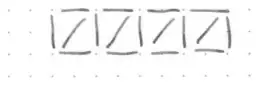
eg \(192 = 2a + 29(\text{``}{6}\text{''})\) oe or \(123 = a + 19(\text{``}{6}\text{''})\) oeor eg \(192 = 2(\text{``}{9}\text{''}) + 29d\) oe or \(123 = \text{``}{9}\text{''} + 19d\) oe
M1
Working required Answer: \(a = 9\) \(d = 6\)
A1
(5)
(5 marks)
Notes
M1: for using \(U_n = a + (n - 1)d\)
M1: for using \(S_n = \dfrac{n}{2}\left(2a + (n - 1)d\right)\)
M1: (dep on M2) for a correct method to find \(a\) or \(d\):
coefficients of \(a\) or \(d\) the same in correct equations and correct operator to eliminate selected variable resulting in an equation in \(a\) only or in \(d\) only
or
writing \(a\) or \(d\) in terms of the other variable and correctly substituting (condone missing brackets)
M1: (dep on M3) for substituting their found value of \(a\) or \(d\) into a correct equation
A1: dep on M2 \(a\) and \(d\) must be clearly identified
M1: for a correct expression or equation using the common difference, may be in terms of \(d\) for this mark we will allow an expression for \(-d\) or \(-2d\)
M1: for a correct equation for the sum of 9 terms in \(x\) and \(d\) or in terms of \(x\) and \(y\) or in terms of \(x\) or in terms of \(d\)
for “\(3y - 2x - 9\)” we will allow \((3y - 4) - (2x + 5)\) or for using their incorrect simplification from \((3y - 4) - (2x + 5)\) shown
for “\(4x - 3y + 2\)” we will allow \((4x - 2) - (3y - 4)\) or for using their incorrect simplification from \((4x - 2) - (3y - 4)\) shown
similarly for their “\(x - 3.5\)” and their “\(d + 3.5\)”
M2:left hand column 2 correct equations in terms of \(x\) and \(y\) in the form \(px + qy = r\) oe or 2 correct equations in terms of \(x\) and \(d\) in the form \(px + qd = r\) oe
right hand column 2 correct equations in terms of \(x\) and \(y\) where one is substituted into the other to get a correct equation in the form \(px + q = r\) or \(py + q = r\) or 2 correct equations in terms of \(x\) and \(d\) where one is substituted into the other to get a correct equation in the form \(px + q = r\) or \(pd + q = r\)
If not M2 then M1 for one correct equation in any of the required forms from the left hand or right hand column
A2: (dep on M2) oe (allow 7.3(33…))
(A1 for \(x = \dfrac{11}{2}\) or \(y = \dfrac{22}{3}\))
\(S_n\) must come from correct substitution of \(a\) and \(d\) into \(\dfrac{n}{2}\big[2a + (n - 1)d\big]\)
M1: dep on M2 for multiplying out and collecting terms, forming a three term quadratic in any form of \(an^2 + bn + c\) (= 0) where at least 2 coefficients (\(a\) or \(b\) or \(c\)) are correct
M1ft: dep on M2 method to solve their 3 term quadratic using any correct method (allow one sign error and some simplification – allow as far as eg \(\dfrac{49 \pm \sqrt{2401 - 720}}{2}\)
or
if factorising allow brackets which expanded give 2 out of 3 terms correct)
or
correct value for \(n = 45\) (ignore \(n = 4\))
M1: dep on previous M1 NB \(n \gt 5\)
A1: dep on M5 Accept 7560 or 7480
24 ALT
Scheme
Marks
\(\dfrac{n}{2}\big[2(96) + (n - 1)(-4)\big]\) or \(\dfrac{n}{2}\big[192 - 4n + 4\big]\) or \(\dfrac{n}{2}\big[196 - 4n\big]\) oe
or
\(98n - 2n^2\) oe
M1
\(\dfrac{n}{2}\big[2(96) + (n - 1)(-4)\big] = 360\) or
M1: for correctly substituting into \(S_n = \dfrac{n}{2}\big[2a + (n - 1)d\big]\) using exterior angles
M1: for equating \(S_n\) with 360
\(S_n\) must come from correct substitution of \(a\) and \(d\) into \(\dfrac{n}{2}\big[2a + (n - 1)d\big]\)
M1: dep on M2 for multiplying out and collecting terms, forming a three term quadratic in any form of \(an^2 + bn + c\) (= 0) where at least 2 coefficients (\(a\) or \(b\) or \(c\)) are correct
M1ft: dep on M2 method to solve their 3 term quadratic using any correct method (allow one sign error and some simplification – allow as far as eg \(\dfrac{49 \pm \sqrt{2401 - 720}}{2}\)
or
if factorising allow brackets which expanded give 2 out of 3 terms correct)
16 Here are the first four terms of an arithmetic sequence.
1 4 7 10
(a) Find an expression, in terms of \(n\), for the \(n\)th term of this sequence. (2)
The \(n\)th term of a different arithmetic sequence is \(5n + 17\)
(b) Find the 12th term of this sequence. (1)
Mark scheme (a)
Scheme
Marks
M1
Working not required, so correct answer scores full marks (unless from obvious incorrect working) Answer: \(3n - 2\)
A1
(2)
Notes
M1: for \(3n + k\) (\(k \neq -2\)) or \(3 \times n + k\) (\(k \neq -2\)) or \(n \times 3 + k\) (\(k \neq -2\)) (\(k\) may be zero or absent)
A1: oe eg \(1 + (n - 1)3\) oe or \(3 \times n - 2\) oe or \(n \times 3 - 2\) oe
NB: award full marks for eg \(x = 3n - 2\) oe or \(x = 3 \times n - 2\) oe or \(x = n \times 3 - 2\) oe or \(n\)th term = \(3n - 2\) oe or \(n\)th term = \(3 \times n - 2\) oe or \(n\)th term = \(n \times 3 - 2\) oe or \(3x - 2\) Allow eg \(T_n\) or \(U_n\) or \(a_n\) for \(n\)th term but only M1 for \(n = 3n - 2\) oe or \(x = 3x - 2\)
7 Here are the first five terms of a number sequence.
−3 5 13 21 29
(a)
(i) Write down the next term of the sequence. (1)
(ii) Explain how you worked out your answer. (1)
(b) Explain why 326 cannot be a term of the sequence. (1)
Mark scheme (a)
Scheme
Marks
(i) Answer: 37
B1
(ii) Answer: Added 8
B1
(2)
Notes
B1: eg ‘added 8’, ‘add 8’, +8, rule is \(8n - 11\), goes up by 8, \(8 \times 6 - 11\) (= 37)
Mark scheme (b)
Scheme
Marks
Acceptable answers 1. (the) sequence is odd 2. (326) is even or not odd 3. ‘nth term is \(8n - 11\) which will always be odd’ 4. ‘sequence goes 325, 333’ 5. (the) 42nd term is 325 6. should be 325 (not 326) 7. it would be 333 (not 326) 8. \(8n - 11\) so \(n\) is not an integer/whole number 9. \(337 \div 8\) oe (= 42.125) not an integer/whole number 10. not 11 less than a multiple of 8 11. does not end with 1, 3, 5, 7 and 9 (must have all 5 numbers) 12. each digit has an odd digit at the end/does not end in an odd number
Not acceptable answers 1. adding 8 each time will not lead to 326 2. it goes past 326 3. \(326 \div 8\) (= 40.75) not an integer/whole number 4. 326 cannot be divided by 8 Answer: Correct explanation
4 Here are the first five terms of a number sequence.
106 99 92 85 78
(a)
(i) Write down the next term of the sequence. (1)
(ii) Explain how you found your answer to part (a)(i) (1)
The 9th term of the sequence is 50
(b) Work out the 12th term of the sequence. (1)
Umberto says 7 is a term in the sequence. Umberto is wrong.
(c) Explain why. (1)
Mark scheme (a)
Scheme
Marks
(i) Answer: 71
B1
(ii) Allow “decreasing by –7 “ Answer: –7
B1
(2)
Notes
B1: oe eg ‘take 7’or ‘subtract 7’ each number is going down by 7 78 – 7 \(-7n + 113\) –7 × 6 + 113 If words used, please accept incorrect spelling if meaning is clear
Mark scheme (b)
Scheme
Marks
29
B1
(1)
Mark scheme (c)
Scheme
Marks
Acceptable 1. The numbers are not in the 7 times table 2. It isn’t going down by the multiples of 7 3. 8 is in the sequence but not 7 4. It starts from 1 and you keep adding on 7 5. 15 – 7 = 8 6. The sequence is the 7 times table plus 1 7. Should be 8 8. 15 – 7 does not equal 7
Not acceptable 1. Because 7 won’t make the sequence correct 2. 7 isn’t in the sequence 3. Umberto is wrong 4. Because if you keep going down in 7s you will get to 9 (or 6 etc…ie they are incorrect) 5. It will pass 7 Answer: Correct reason
B1
(1)
(4 marks)
Notes
B1: eg the sequence is \(-7n + 113\) or it goes ....15, 8, (1...) oe
1 Here are the first four terms of an arithmetic sequence.
\[1 \qquad\quad 4 \qquad\quad 7 \qquad\quad 10\]
(a) Find an expression, in terms of \(n\), for the \(n\)th term of this sequence. (2)
The \(n\)th term of a different arithmetic sequence is \(5n + 17\)
(b) Find the 12th term of this sequence. (1)
Mark scheme (a)
Scheme
Marks
M1
Working not required, so correct answer scores full marks (unless from obvious incorrect working) Answer: \(3n - 2\)
A1
(2)
Notes
M1: for \(3n + k\) \((k \neq -2)\) or \(3 \times n + k\) \((k \neq -2)\) or \(n \times 3 + k\) \((k \neq -2)\) (\(k\) may be zero or absent)
A1: oe eg \(1 + (n - 1)3\) oe or \(3 \times n - 2\) oe or \(n \times 3 - 2\) oe
NB: award full marks for eg \(x = 3n - 2\) oe or \(x = 3 \times n - 2\) oe or \(x = n \times 3 - 2\) oe or \(n\)th term = \(3n - 2\) oe or \(n\)th term = \(3 \times n - 2\) oe or \(n\)th term = \(n \times 3 - 2\) oe or \(3x - 2\) Allow eg \(T_n\) or \(U_n\) or \(a_n\) for \(n\)th term but only M1 for \(n = 3n - 2\) oe or \(x = 3x - 2\)
M1: (first) for \(a\) and \(d\) (can be embedded in the formula for \(S_n\))
M1: (second) Allow \(n = x\)
M1ft: (third) dep on previous M1 for forming a three term quadratic in any form of \(ax^2 + bx + c\;(= 0)\) where at least 2 coefficients (\(a\) or \(b\) or \(c\)) are correct
M1ft: (fourth) dep on previous M1 for a method to solve their 3 term quadratic using any correct method Allow one sign error and some simplification
A1: (first) dep on M3 Ignore negative values
A1: (second) cao dep on M3 SCB2 if not shown clear algebraic working but give an answer of 239 (with method shown involving \(a = 3\) and \(d = 4\)) as question asks for algebraic working. 239 alone gains zero marks
M1: for substituting into the sum of arithmetic series formula
M1: for substituting into the nth term of arithmetic sequence formula
M1: solve the correct equations simultaneously, eg make the coefficients of \(a\) or \(d\) the same and show the intention to subtract or rearrange one equation to make \(a\) or \(d\) the subject and substitute into the other equation
A1: dep on M2
M1: correctly substituting the found values of \(a\) and \(d\) into a correct equation, can be their values of \(a\) and \(d\) as long as clearly stated
19 Here are the first four terms of an arithmetic sequence.
38 31 24 17
Find an expression, in terms of \(n\), for the \(n\)th term of the sequence.
(2)
Mark scheme
Scheme
Marks
M1
Correct answer scores full marks (unless from obvious incorrect working) Answer: \(45 - 7n\)
A1
(2)
(2 marks)
Notes
M1: for \(-7n + k\;(k \neq 45)\) or \(-7 \times n + k\;(k \neq 45)\) or \(n \times -7 + k\;(k \neq 45)\) (\(k\) may be zero or absent or negative)
A1: oe eg \(45 - 7 \times n\) oe or \(-7 \times n + 45\) oe or \(U_n = 45 - 7n\) oe or \(38 - 7(n - 1)\) oe NB: award full marks for eg \(x = 45 - 7n\) oe or \(n\)th term = \(-7 \times n + 45\) oe or but only M1 for \(n = 45 - 7n\) oe
5 Here are the first four terms of a number sequence.
2 6 10 14
Elsie correctly works out that the next term in the sequence is 18
(a) Explain how she was able to work this out. (1)
(b) Explain why 217 cannot be a number in the sequence. (1)
Mark scheme (a)
Scheme
Marks
Correct explanation
B1
(1)
Notes
B1: eg ‘she added 4’, ‘add 4’, +4, rule is \(4n - 2\), goes up by 4, \(4 \times 5 - 2\) (= 18)
Mark scheme (b)
Scheme
Marks
Acceptable answers 1. (the) sequence is even 2. (217) is odd or not even 3. ‘\(n\)th term is \(4n - 2\) which will always be even’ 4. ‘sequence goes 214, 218’ 5. (the) 54th term is 214 6. it would be 218 (not 217) 7. \(4n - 2\) so \(n\) is not an integer/whole number 8. 219 ÷ 4 oe (= 54.75) not an integer/whole number 9. not 2 less than a multiple of 4 10. does not end with 0, 2, 4, 6 and 8 (must have all 5 numbers) 11. each digit has an even digit at the end/does not end in an even number Not acceptable answers 1. adding 4 each time will not lead to 217 2. it goes past 217 3. 217 ÷ 4 (= 54.25) not an integer/whole number Answer: Correct explanation
4 Here are the first four terms of an arithmetic sequence.
38 31 24 17
Find an expression, in terms of \(n\), for the \(n\)th term of the sequence.
(2)
Mark scheme
Scheme
Marks
M1
Correct answer scores full marks (unless from obvious incorrect working) Answer: \(45 - 7n\)
A1
(2)
(2 marks)
Notes
M1: for \(-7n + k\;(k \ne 45)\) or \(-7 \times n + k\;(k \ne 45)\) or \(n \times -7 + k\;(k \ne 45)\) (\(k\) may be zero or absent or negative)
A1: oe eg \(45 - 7 \times n\) oe or \(-7 \times n + 45\) oe or \(U_n = 45 - 7n\) oe or \(38 - 7(n - 1)\) oe NB: award full marks for eg \(x = 45 - 7n\) oe or \(n\)th term \(= -7 \times n + 45\) oe or but only M1 for \(n = 45 - 7n\) oe
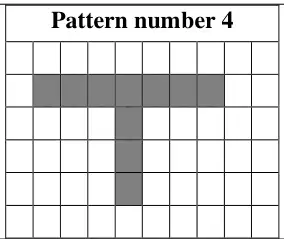
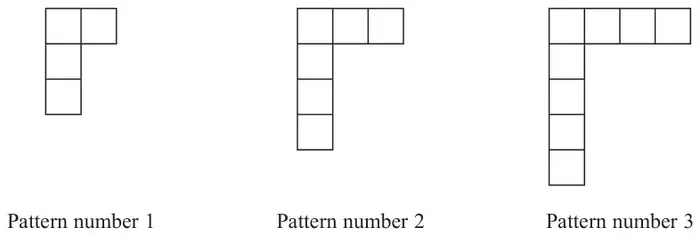
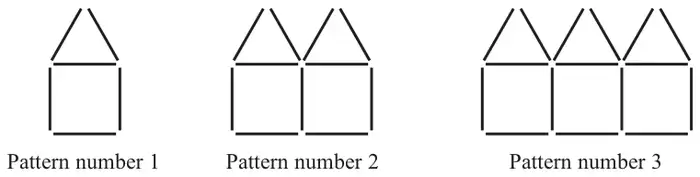
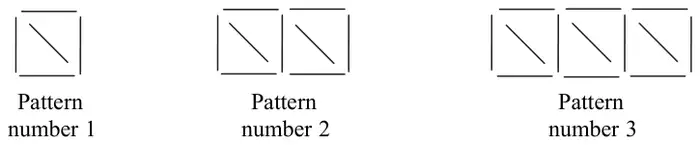
4 Here is a sequence of patterns made from sticks.
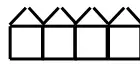
(a) In the space below, draw Pattern number 4 (1)
(b) Complete the table.
Pattern number
1
2
3
4
5
Number of sticks
5
9
13
(1)
(c) Work out the number of sticks in Pattern number 10 (1)
Connor says that in Pattern number 25 there are 102 sticks.
(d) Explain why Connor is wrong. (1)
Mark scheme (a)
Scheme
Marks
B1
(1)
Mark scheme (b)
Scheme
Marks
17, 21
B1
(1)
Notes
B1: Ignore any extra numbers if the 2 that are required are there
Mark scheme (c)
Scheme
Marks
41
B1
(1)
Mark scheme (d)
Scheme
Marks
A correct reason
B1
(1)
(4 marks)
Notes
B1: The numbers of sticks are always an odd number (always ends in 1,3,5,7,9) 102 is even, pattern 25 has 101 sticks, The pattern goes …97, 101, 105… It is \(4n + 1\) oe \(4 \times 25 + 1 = 101\) (or does not =102) The pattern never ends in a 2
\(3n - 2 = 42\) does not have a whole number (integer) answer/it’s a decimal or 42 is a multiple of 3 or 42 is in the 3 times table or 40 and 43 are in the sequence or 40 is in the sequence and 40 + 3 does not equal 42 or its 1 less than 43
M1: for a correct expression for the sum of the first 10 terms (\(S_{10}\)) or the first 5 terms (\(S_5\)) or a correct equation for the 8th term Take 9 as their 10 – 1 and 4 as their 5 – 1 and 7 as their 8 – 1
M1: for a correct equation relating \(S_{10}\) and \(S_5\)
M1: (dep on M1) for \(d\) in terms of \(a\), or vice-versa (must be correct) or for \(a + 7d = 45\) oe and correctly reducing the equation relating \(S_{10}\) and \(S_5\) to an equation with one term in \(a\) and one term in \(d\) eg \(10a - 5d = 0\) oe or substituting a correct expression into their correct equation to obtain an equation in just \(d\)
M1: (dep on M2) for a correct equation in just \(a\) or for \(d = 6\) or for a correct method to eliminate \(a\) or \(d\): coefficients of \(a\) or \(d\) the same and correct operation to eliminate selected variable (condone 1 arithmetical error)
When arranged in order of size, starting with the largest number, the sizes of the interior angles of the polygon, in degrees, are the terms of an arithmetic sequence.
Here are the first five terms of this sequence.
177 175 173 171 169
Find the value of \(n\) Show clear algebraic working.
(6)
Mark scheme
Scheme
Marks
\(d = -2\)
M1
\((S_n =)\;\dfrac{n}{2}\left[2(177) + (n - 1)(-2)\right]\) or
\((S_n =)\;\dfrac{n}{2}\left[354 - 2n + 2\right]\) or
16 Here are the first five terms of an arithmetic sequence.
1 5 9 13 17
(a) Find an expression, in terms of \(n\), for the \(n\)th term of this sequence. (2)
The \(n\)th term of another arithmetic sequence is \(3n + 5\)
(b) Find an expression, in terms of \(m\), for the \((2m)\)th term of this sequence. (1)
Mark scheme (a)
Scheme
Marks
M1
\(4n - 3\)
A1
(2)
Notes
M1: for \(4n + k\;(k \neq -3)\) or \(4 \times n + k\;(k \neq -3)\) or \(n \times 4 + k\;(k \neq -3)\) (\(k\) may be zero or absent)
A1: oe e.g. \(1 + (n - 1)4\) oe or \(4 \times n - 3\) oe or \(n \times 4 - 3\) oe NB: award full marks for eg \(x = 4n - 3\) oe or \(x = 4 \times n - 3\) oe or \(x = n \times 4 - 3\) oe or \(n\)th term \(= 4n - 3\) oe or \(n\)th term \(= 4 \times n - 3\) oe or \(n\)th term \(= n \times 4 - 3\) oe but only M1 for \(n = 4n - 3\) oe
Mark scheme (b)
Scheme
Marks
\(6m + 5\)
B1
(1)
(3 marks)
Notes
B1: for \(3(2m) + 5\) oe or \(6m + 5\) or \(3 \times 2m + 5\) oe or \(6 \times m + 5\) Allow \(3(2n) + 5\) or \(6n + 5\) oe
3 Here are the first five terms of a number sequence.
7 13 19 25 31
(a)
(i) Write down the next term of the sequence. (1)
(ii) Explain how you found your answer to part (a)(i) (1)
The 30th term of the sequence is 181
(b) Work out the 28th term of the sequence. (1)
Brian says that 96 is a number in the sequence. Brian is wrong.
(c) Explain why. (1)
Mark scheme (a)
Scheme
Marks
(i) Answer: 37
B1
(ii) Answer: +6
B1
(2)
Notes
B1: oe eg ‘added 6’ or ‘plus 6’ or \(6n + 1\) allow 31 + 6 = 37 increase by 6 / goes up by 6
Mark scheme (b)
Scheme
Marks
169
B1
(1)
Mark scheme (c)
Scheme
Marks
All the numbers in the sequence are odd numbers
B1
(1)
(4 marks)
Notes
B1: 96 is not odd / 96 is even 96 is a multiple of 6 (and terms are not multiples of 6) or No numbers in the sequence end in 6 / all end in 1, 3, 5, 7, 9 or the sequence is \(6n + 1\) or it goes ....91, 97, ... oe or it should be 97 They need to add 1
1 Here are the first five terms of an arithmetic sequence.
1 5 9 13 17
(a) Find an expression, in terms of \(n\), for the \(n\)th term of this sequence. (2)
The \(n\)th term of another arithmetic sequence is \(3n + 5\)
(b) Find an expression, in terms of \(m\), for the \((2m)\)th term of this sequence. (1)
Mark scheme (a)
Scheme
Marks
M1
\(4n - 3\)
A1
(2)
Notes
M1: for \(4n + k\) \((k \ne -3)\) or \(4 \times n + k\) \((k \ne -3)\) or \(n \times 4 + k\) \((k \ne -3)\) (\(k\) may be zero or absent)
A1: oe e.g. \(1 + (n - 1)4\) oe or \(4 \times n - 3\) oe or \(n \times 4 - 3\) oe NB: award full marks for eg \(x = 4n - 3\) oe or \(x = 4 \times n - 3\) oe or \(x = n \times 4 - 3\) oe or \(n\)th term = \(4n - 3\) oe or \(n\)th term = \(4 \times n - 3\) oe or \(n\)th term = \(n \times 4 - 3\) oe but only M1 for \(n = 4n - 3\) oe
Mark scheme (b)
Scheme
Marks
\(6m + 5\)
B1
(1)
(3 marks)
Notes
B1: for \(3(2m) + 5\) oe or \(6m + 5\) or \(3 \times 2m + 5\) oe or \(6 \times m + 5\) Allow \(3(2n) + 5\) or \(6n + 5\) oe
Correct answer scores full marks (unless from obvious incorrect working) Answer: 1575
A1
(5)
(5 marks)
Notes
M1: for finding the common difference (\(d\)) in terms of \(k\)
M1: dep equating 2 different expressions in terms of \(k\) using their value(s) of \(d\) in terms of \(k\) (or from working using \(k\)) or other correct method to find \(k\)
M1: dep on previous M1 for correctly substituting, into
\((S_n =)\ \dfrac{30}{2}\left[2k + (30 - 1)d\right]\) or
M1: for at least 1 correct equation or for \(d = 1.5\)
A1: both values correct
M1: A correct equation for the total of the first \(N\) terms of the series with \(a\) and \(d\) substituted in. The mark can be gained by using their values of \(a\) and \(d\) even if no previous marks awarded.
M1: A correct method dep on the previous M1 for solving their 3 term quadratic equation using any correct method (allow one sign error and some simplification – allow as far as \(\dfrac{-25 \pm \sqrt{625 + 14016}}{6}\)) oe (may be ± or just +) or if factorising, allow brackets which expanded give 2 out of 3 terms correct, or if completing the square allow as far as the stage \(3\left(\left(N + \dfrac{25}{6}\right)^2 - \dfrac{25^2}{6^2}\right) - 1168\ (= 0)\)
17 Here are the first 4 terms of an arithmetic sequence.
85 79 73 67
Find an expression, in terms of \(n\), for the \(n\)th term of the sequence.
(2)
Mark scheme
Scheme
Marks
\(91 - 6n\)
B2
(2)
(2 marks)
Notes
B2: for a correct answer in any form eg \(91 - 6 \times n\) or \(-6n + 91\) or \(85 + (n - 1)(-6)\) oe (B1 for \(-6n + k\) oe (\(k\) may be zero or absent)) NB: award full marks for eg \(x = 91 - 6n\) or \(n\)th term \(= 91 - 6n\) but only B1 for \(n = 91 - 6n\)
2 Here are the first 4 terms of an arithmetic sequence.
85 79 73 67
Find an expression, in terms of \(n\), for the \(n\)th term of the sequence.
(2)
Mark scheme
Scheme
Marks
\(91 - 6n\)
B2
(2)
(2 marks)
Notes
B2: For a correct answer in any form eg \(91 - 6 \times n\) or \(-6n + 91\) or \(85 + (n - 1)(-6)\) oe (B1 for \(-6n + k\) oe (\(k\) may be zero or absent)) NB: award full marks for eg \(x = 91 - 6n\) or \(n\)th term \(= 91 - 6n\) but only B1 for \(n = 91 - 6n\)
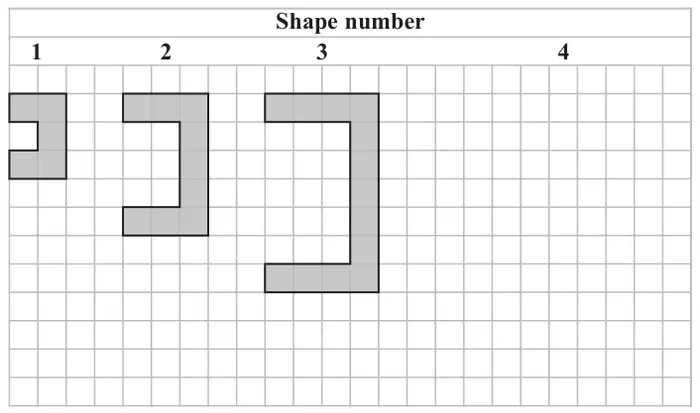
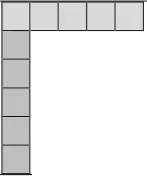
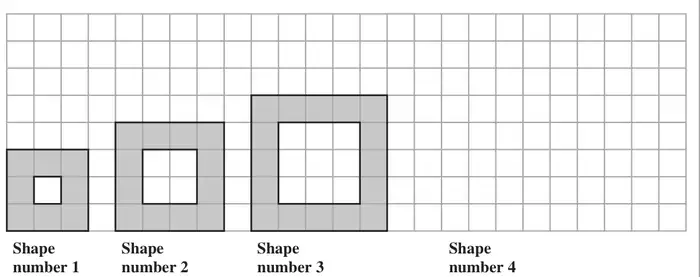
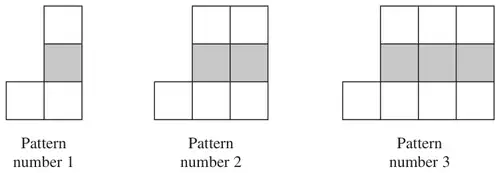
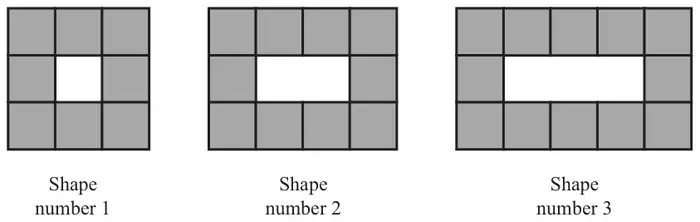
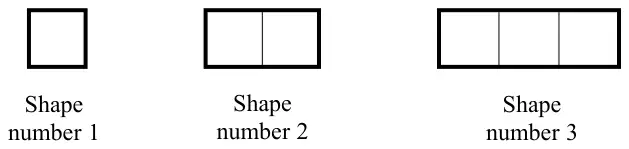
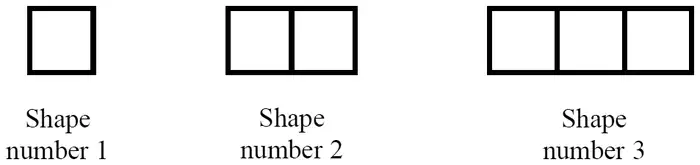
5 A sequence of shapes is made by shading squares on a square grid.
(a) On the grid, draw Shape number 4 (1)
(b) Complete the table. (1)
Shape number
1
2
3
4
5
Number of shaded squares
5
9
13
(c) Find the number of shaded squares in Shape number 8 (1)
(d) Explain why no shape in the sequence is made by shading exactly 50 squares. (1)
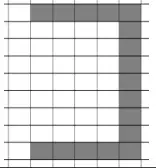
Mark scheme (a)
Scheme
Marks
Answer: Correct shape
B1
(1)
Notes
B1: cao
Mark scheme (b)
Scheme
Marks
17, 21
B1
(1)
Notes
B1: cao
Mark scheme (c)
Scheme
Marks
33
B1
(1)
Notes
B1: cao
Mark scheme (d)
Scheme
Marks
The numbers of shaded squares are odd numbers
B1
(1)
(4 marks)
Notes
B1: Accept e.g. 50 is an even number or the sequence is all odd numbers or 49 is in the sequence so 50 can't be as it's only one more or 53 is the next number after 49 or 49 and 53 are in the sequence (so not 50) or nth term is \(4n + 1\) and for 50 \(n\) = 12.25 / not an integer
M1: allow list of numbers going up in 4’s up to 71 or more (allow one error)
Mark scheme (d)
Scheme
Marks
Working required No and identifying all terms in sequence are odd OR No and method to count on as far as 95 (or clearly showing 95) OR No and method to find \(n\) when term is 96 e.g. solving \(4n - 1 = 96\) Answer: No with reason
B1
(1)
(5 marks)
Notes
B1: must have ‘No’ oe or ‘is not’ oe and a reason.
19 The 25th term of an arithmetic series is 44.5 The sum of the first 30 terms of this arithmetic series is 765 Find the 16th term of the arithmetic series. Show your working clearly.
M1: for continuing the sequence to at least 62 (list of values may be seen in earlier parts of question)
Mark scheme (d)
Scheme
Marks
For identifying all terms in sequence end in 2 or 7 or none of the numbers end in 3 or method to count on as far as 122 e.g. No, 122 and 127 are both in sequence oe e.g. No, 122 in sequence or method to find n when term is 123 e.g. solving 5n + 2 = 123 or (123 – 2) ÷ 5 (= 24.2) or e.g. 121 not multiple of 5 or 121 ÷ 5 not whole number/it’s a decimal Answer: No with reason
21 \((2x + 23)\), \((8x + 2)\) and \((20x - 52)\) are three consecutive terms of an arithmetic sequence. Prove that the common difference of the sequence is 12
\(x = 5.5\) or \(x = 1.5\) from \((2x + 23) - 12 = (8x + 2)\) or \(x = 3.5\) from \((8x + 2) - 12 = (20x - 52)\)
A1
Working required \(2 \times 5.5 + 23\) (=34) and \(8 \times 5.5 + 2\) (=46) and \(20 \times 5.5 - 52\) (=58) OR \((2x + 23) + 12 = (8x + 2)\) and \((8x + 2) + 12 = (20x - 52)\) and gets \(x = 5.5\) both times Answer: shown
A1
Notes
M2: for a correct equation If not M2 then award M1 for a correct expression for the common difference in terms of \(x\) brackets must be present or removed correctly e.g \((8x + 2) - (2x + 23)\) (\(= 6x - 21\)) or \((20x - 52) - (8x + 2)\) (\(= 12x - 54\))
A1: for explicitly showing both common differences are 12 OR solves both \((2x + 23) + 12 = (8x + 2)\) and \((8x + 2) + 12 = (20x - 52)\) and gets \(x = 5.5\) both times
The numerators of the fractions form the sequence of whole numbers 1 2 3 4 … The denominators of the fractions form the sequence of odd numbers 1 3 5 7 …
(a) Write down an expression, in terms of \(n\), for the \(n\)th term of this sequence of fractions. (2)
(b) Using algebra, prove that when the square of any odd number is divided by 4 the remainder is 1 (3)
Mark scheme (a)
Scheme
Marks
M1
\(\dfrac{n}{2n - 1}\)
A1
(2)
Notes
M1: for \(2n \pm k\) oe as the denominator
A1: oe
Mark scheme (b)
Scheme
Marks
\((2n - 1)^2 = 4n^2 - 4n + 1\)
M1
\(4(n^2 - n) + 1\) or \(\dfrac{4n^2 - 4n + 1}{4} = n^2 - n + \dfrac{1}{4}\)
M1
Proved
A1
(3)
(5 marks)
Notes
M1: or \((2n + 1)^2 = 4n^2 + 4n + 1\) ft on \(2n \pm k\) (\(k\) non zero)
M1: or \(4(n^2 + n) + 1\) or \(\dfrac{4n^2 + 4n + 1}{4} = n^2 + n + \dfrac{1}{4}\)
2 Here are the first five terms of an arithmetic sequence.
7 11 15 19 23
Write down an expression, in terms of \(n\), for the \(n\)th term of this sequence.
(2)
Mark scheme
Scheme
Marks
\(4n + 3\)
B2oe
(2)
(2 marks)
Notes
B2oe: e.g. \(7 + 4(n - 1)\) or \(4n + (7 - 4)\) etc allow \(T_n = 4n + 3\) or \(x = 4n + 3\) etc If not B2 then award B1 for answer of \(4n + k\) (\(k \ne 3\)) or \(n = 4n + 3\)
3 Here are the first five terms of a number sequence.
3 10 17 24 31
(a) Write down the next two terms of the sequence. (2)
(b) Explain how you worked out your terms. (1)
(c) Work out the 18th term of the sequence. (2)
The 35th term of the sequence is 241
(d) Work out the 34th term of the sequence. (1)
Mark scheme (a)
Scheme
Marks
38, 45
B2
(2)
Notes
B2: B1 for 38 shown as sixth term B1 for 45 shown as seventh term ft from their "38" + 7
Mark scheme (b)
Scheme
Marks
added 7
B1
(1)
Notes
B1: for correct explanation E.g. +7, 7 more, jumped forward by 7 oe or \(7n - 4\)
Mark scheme (c)
Scheme
Marks
\(3 + 17 \times 7\) or \(7 \times 18 - 4\) or \(7n - 4\) or 3, 10, 17, 24, 31, 38, 45, 52, 59, 66, 73, 80, 87, 94, 101, 108, 115, 122 or E.g. 45 + 11 × 7
M1
122
A1
(2)
Notes
M1: NB: If a list is given then must show a clear intention of adding 7 with at least 4 terms after 45 (condone 1 arithmetic error) E.g. 45, 52, 59, 66, 73 E.g. 38, 45, 52, 59, 66, 73
12 Here are the first five terms of a number sequence.
7 10 13 16 19
(a) Write down the next term of the sequence. (1)
(b) Explain how you found your answer. (1)
(c) Find the 11th term of the sequence. (1)
(d) Explain why 60 cannot be a term of the sequence. (1)
Mark scheme (a)
Scheme
Marks
22
B1
(1)
Mark scheme (b)
Scheme
Marks
Added 3
B1
(1)
Notes
B1: Accept +3, 3 more, jumped forward by 3, difference = 3 oe or \(3n + 4\) oe
Mark scheme (c)
Scheme
Marks
37
B1
(1)
Mark scheme (d)
Scheme
Marks
Correct reasoning
B1
(1)
Notes
B1: For a correct reason. For example: \(3n + 4 = 60\) does not have an integer solution or 60 is a multiple of 3 or 60 is in the 3 times table or 58 are 61 are in the sequence or 58 is in the sequence and 58 + 3 does not equal 60
7 Here are the first five terms of a number sequence.
18 22 26 30 34
(a) Write down the next two terms of the sequence. (2)
(b) Explain how you found your terms. (1)
(c) Work out the 20th term of the sequence. (2)
Mark scheme (a)
Scheme
Marks
38, 42
B2
(2)
Notes
B2: B1 for 1 correct Allow ft, eg 37, 41 NB: B0 for 36, 38, etc
Mark scheme (b)
Scheme
Marks
Add 4
B1
(1)
Mark scheme (c)
Scheme
Marks
18 + 19 × 4 or 14 + 20 × 4 or \(4n + 14\) or 18, 22, 26, 30, ........, 90, 94
M1
94
A1
(2)
Notes
M1: Allow 18 + 20 × 4 or 90 or 98 List should show a clear intention of adding 4 with at least 5 terms (can count 42 as one of the 5 terms but not 18, 22, 26, 30, 34, 38). Condone 1 arithmetic error.
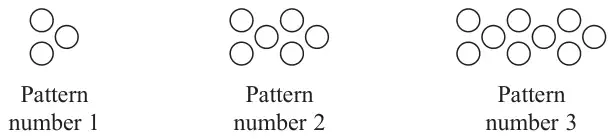
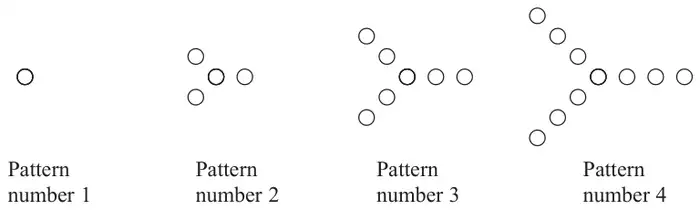
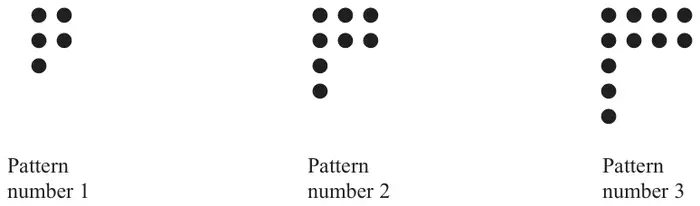
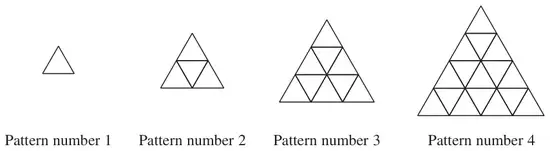
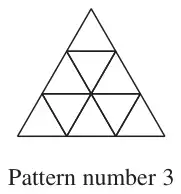
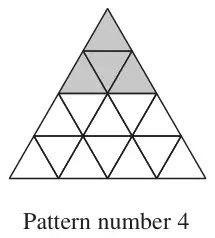
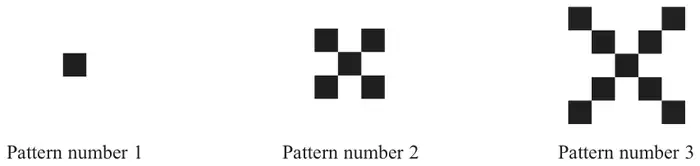
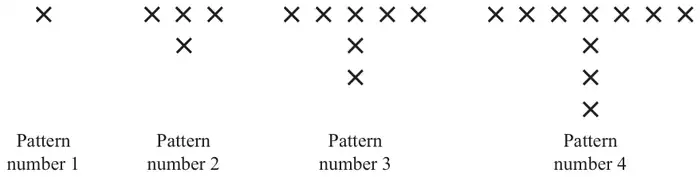
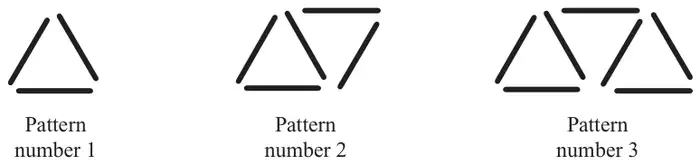
This rule can be used to find the number of dots in a pattern of the sequence.
Multiply the Pattern number by 3 and then add 2
(b) Work out the number of dots in Pattern number 7 (2)
A pattern has exactly 41 dots.
(c) Work out the Pattern number. (2)
\(T\) is the number of dots in Pattern number \(n\).
(d) Write down a formula for \(T\) in terms of \(n\). (3)
Mark scheme (a)
Scheme
Marks
B1
(1)
Mark scheme (b)
Scheme
Marks
7 × 3 + 2
M1
23
A1
(2)
Mark scheme (c)
Scheme
Marks
(41 – 2) ÷ 3
M1
13
A1
(2)
Mark scheme (d)
Scheme
Marks
\(T = 3n + 2\)
B3
(3)
Total 8 marks
Notes
B3: If not B3 then B2 for \(3n + 2\) or \(T = 3n + k\) (\(k\) may be zero) or \(T = an + 2\) (\(a \neq 0\)) If not B2 then B1 for \(T\) = linear function in \(n\) or \(3n\)
5 Here are the first five terms of a number sequence.
13 20 27 34 41
(a) Write down the next two terms of the sequence. (2)
(b) Explain how you worked out your answer. (1)
(c) Work out the 20th term of the sequence. (2)
Mark scheme (a)
Scheme
Marks
48
B1
55
B1
(2)
Notes
B1: shown as sixth term
B1: shown as seventh term ft from their (a) “48” + 7
Mark scheme (b)
Scheme
Marks
Added 7
B1
(1)
Notes
B1: accept +7, 7 more, jumped forward by 7, difference = 7 oe or \(7n + 6\)
Mark scheme (c)
Scheme
Marks
13 + 19 × 7 or 20 × 7 + 6 or \(7n + 6\) Or 13, 20, 27, …., 139, 146 (list of 20 terms)
M1
146
A1
(2)
(5 marks)
Notes
M1: allow 13 + 20 × 7 or 139 or 153 List should show a clear intention of adding 7 with at least 5 terms (including 55). Condone 1 arithmetic error. Eg 55, 62, 69, 76, 82 Eg 48, 55, 62, 69, 76, 82
B1: “Series would have to start at 4” or “100 is a multiple of 4” or “100 divides by 4” or “100 is in the 4 times table”, or “\(4n + 6 = 100\) leading to 23.5 (which is not an integer value)” etc.
4 Here are the first four terms of a number sequence.
2 5 8 11
(a) Find the 5th term of the sequence. (1)
(b) Explain how you found your term. (1)
(c) Work out the difference between the 17th term and the 19th term of the sequence. (2)
Mark scheme (a)
Scheme
Marks
14
B1
(1)
Mark scheme (b)
Scheme
Marks
Add 3
B1
(1)
Notes
B1: Allow any correct and complete explanation. E.g. “Multiply number term by 3 then subtract 1” or “They go up in threes” or “3n – 1” NB do not allow “n + 3”
(a) Find the next two terms of this number sequence.
17 21 25 29 33 37 ........ ........
(2)
(b) Explain how you found your terms. (1)
(c) The 1st term, 17, and the 6th term, 37, of the number sequence both end with the number 7 What number does the 32nd term of the sequence end with? (1)
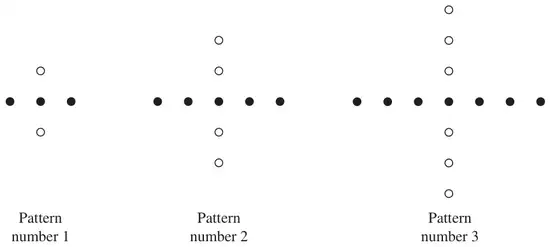
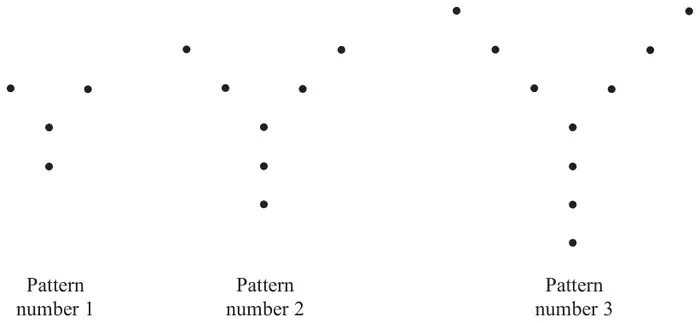
5 Here is a sequence of patterns made from white dots and black dots.
(a) Draw Pattern number 4 (1)
(b) Complete the table.
Pattern number
1
2
3
4
5
Number of white dots
2
4
6
Number of black dots
3
5
7
(2)
(c) Work out the number of white dots in Pattern number 19 (1)
(d)
(i) Work out the number of black dots in Pattern number 27
(ii) Explain how you found your answer to part (d)(i).
(2)
(e) Work out the Pattern number of the pattern with 65 black dots. (2)
(f) \(W\) is the number of white dots in Pattern number \(n\). Write down a formula for \(W\) in terms of \(n\). (2)
Mark scheme (a)
Scheme
Marks
Correct pattern
B1
(1)
Mark scheme (b)
Scheme
Marks
8 10 9 11
B2
(2)
Notes
B2: B1 for 8 10 B1 for 9 11
Mark scheme (c)
Scheme
Marks
38
B1
(1)
Notes
B1: cao
Mark scheme (d)
Scheme
Marks
(i) Answer: 55
B1
(ii) Answer: eg ‘doubled 27 then added 1’, ‘kept adding 2’
B1
(2)
Notes
B1: cao
B1: eg. \(2n + 1\); pattern number add next pattern number
Mark scheme (e)
Scheme
Marks
\(\dfrac{65 - 1}{2}\) or \(2x + 1 = 65\)
M1
32
A1
(2)
Notes
A1: cao
Mark scheme (f)
Scheme
Marks
\(W = 2n\)
B2
(2)
(Total 10 marks)
Notes
B2: Also accept \(W = n2\), \(W = 2 \times n\), \(W = n \times 2\), \(W = n + n\) B1 for \(2n\) oe or for \(W\) = (expression in \(n\)) or for \(n = W \div 2\) (correct formula with \(n\) the subject)
6 Here are the first five terms of a number sequence.
36 33 30 27 24
(a) Find the next two terms of the sequence. (2)
(b) Explain how you found your terms. (1)
(c) Find the 13th term of the sequence. (1)
Mark scheme (a)
Scheme
Marks
21 18
B2
(2)
Notes
B2: B1 for 21 B1 for 18 Also award B1 for 39 B1 for 42
Mark scheme (b)
Scheme
Marks
eg take away 3
B1
(1)
Notes
B1: See Additional Guidance
Additional Guidance
3 may be explicitly stated eg Accept Subtract 3 Take away 3 −3 goes down in threes 3 less \(n - 3\) \(39 - 3n\) but do not accept just ‘3’
3 may be implied eg Accept Count from 36 to 33 [‘down’ implied] I counted the difference between 36 and 33 I found the difference [Condone imprecise use of ‘difference’.]
the fact that the terms are multiples of 3 may be stated or implied eg Accept Multiples of 3 3 times table
as 39, 42 are now acceptable answers to part (a), we must extend the range of answers to part (b) eg Accept I counted up in 3s Add 3 goes up in 3s
Do not accept a non-specific description eg I looked at the numbers and found a pattern.
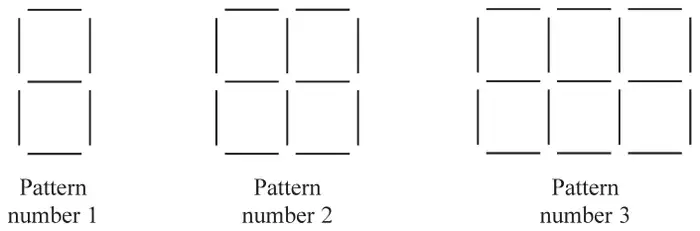
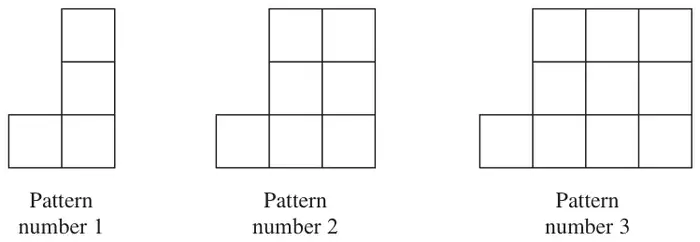
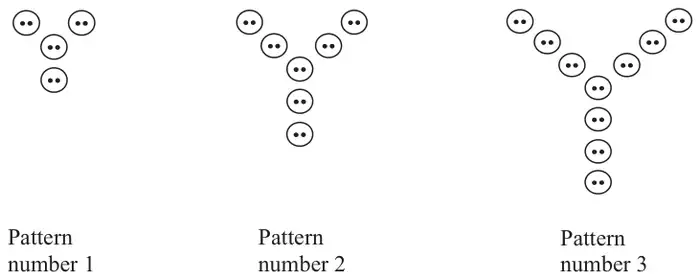
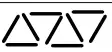
This rule can be used to find the number of sticks in one of these patterns.
Multiply the pattern number by 2 and then add 1
(b) Work out the number of sticks in Pattern number 10 (2)
(c) Work out the Pattern number of the pattern with 37 sticks. (2)
(d) Explain why it is not possible to make one of these patterns with 60 sticks. (1)
(e) \(n\) is the number of sticks in Pattern number \(p\). Write down a formula for \(n\) in terms of \(p\). (3)
Mark scheme (a)
Scheme
Marks
B1
(1)
Mark scheme (b)
Scheme
Marks
10 × 2 + 1
M1
21
A1
(2)
Notes
A1: cao
Mark scheme (c)
Scheme
Marks
\(\dfrac{37 - 1}{2}\)
M1
18
A1
(2)
Notes
A1: cao
Mark scheme (d)
Scheme
Marks
eg 60 is even, number of matchsticks is always odd, first number is odd and 2 is added each time, multiplying by 2 and adding 1 will always give an odd number of sticks
B1
(1)
Notes
B1: May refer to number sequence of matchstick pattern – need not do both
Mark scheme (e)
Scheme
Marks
\(n = 2p + 1\)
B3
(3)
(Total 9 marks)
Notes
B3: B2 for \(2p + 1\) B1 for \(n =\) linear function of \(p\) eg \(n = p + 1\)
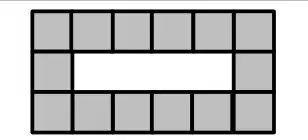
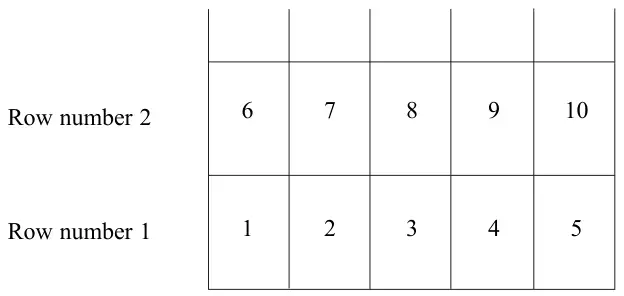
5 A sports club has 50 lockers. The lockers are in 10 rows of five. The lockers are numbered from 1 to 50 The diagram shows the first two rows of lockers and how they are numbered.
(a) Write down the number of the locker which is directly above locker number 9 (1)
(b) Write down the number of the locker which is directly below locker number 27 (1)
(c) In which row is locker number 41? (1)
(d) Locker number \(p\) has a locker directly above it. Write down an expression for the number of the locker which is directly above locker number \(p\). (1)
(e) Write down an expression for the greatest locker number in row number \(q\). (1)
Faye chooses one of the 50 lockers at random.
(f) Find the probability that she chooses
(i) locker number 39
(ii) a locker in row number 2 (3)
Mark scheme (a)
Scheme
Marks
14
B1
(1)
Notes
B1: cao
No official mark scheme was available for this paper; this one was written by Westie's Workshop.
Mark scheme (b)
Scheme
Marks
22
B1
(1)
Notes
B1: cao
No official mark scheme was available for this paper; this one was written by Westie's Workshop.
Mark scheme (c)
Scheme
Marks
9
B1
(1)
Notes
B1: cao
No official mark scheme was available for this paper; this one was written by Westie's Workshop.
Mark scheme (d)
Scheme
Marks
\(p + 5\)
B1
(1)
Notes
B1: oe
No official mark scheme was available for this paper; this one was written by Westie's Workshop.
Mark scheme (e)
Scheme
Marks
\(5q\)
B1
(1)
Notes
B1: oe e.g. \(5 \times q\), \(q \times 5\)
No official mark scheme was available for this paper; this one was written by Westie's Workshop.
Mark scheme (f)
Scheme
Marks
(i) \(\frac{1}{50}\)
B1
(ii) \(\frac{5}{50}\) or \(\frac{1}{10}\)
B2
(3)
(Total 8 marks)
Notes
B1: oe e.g. 0.02
B2: oe e.g. 0.1 B1 for a fraction with numerator 5 or denominator 50 (less than 1)
No official mark scheme was available for this paper; this one was written by Westie's Workshop.
We'd like to use Google Analytics cookies to count visits and see which pages help most. They're optional, and the site works exactly the same either way. Privacy policy