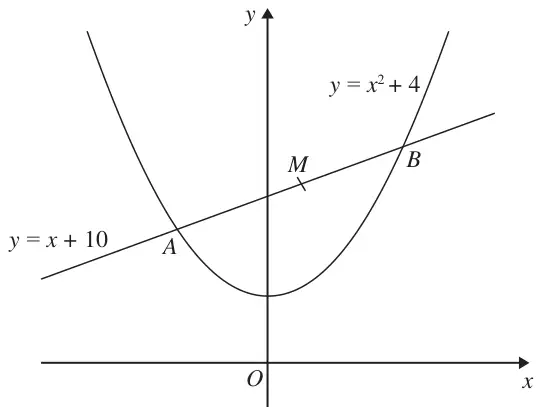
Answer: \(x = -\dfrac{1}{2}\) and \(y = \dfrac{3}{2}\)
\(x = -3\) and \(y = -1\)
A1
(5)
(5 marks)
Notes
M1: for substitution of \(y = x + 2\) (or \(x = \pm y \pm 2\)) into \(x^2 + 3y + y^2 = 7\) to obtain an equation in \(x\) only (or \(y\) only)
M1ft: dep on previous M1 for multiplying out and collecting terms, forming a three term quadratic in any form of \(ax^2 + bx + c\;(= 0)\) where at least 2 coefficients (\(a\) or \(b\) or \(c\)) are correct
M1ft: dep on first M1 method to solve their 3 term quadratic using any correct method (allow one sign error and some simplification – allow as far as eg \(\dfrac{-7 \pm \sqrt{49 - 24}}{4}\) or \(\dfrac{1 \pm \sqrt{1 + 24}}{4}\)
or if factorising allow brackets which expanded give 2 out of 3 terms correct)
or correct values for \(x\)
or correct values for \(y\)
M1ft: dep on previous M1 for substituting their 2 found values of \(x\) or \(y\) into one of the two given equations or fully correct values for the other variable (correct labels for \(x\) / \(y\)) or for one correct pair of values
A1: oe dep on M2 (allow coordinates)
If they find the values of \(y\) but think they are the values of \(x\) then the maximum mark is 3
M1: substitution of \(y = \pm 2x \pm 3\) (or \(x = \dfrac{\pm y \pm 3}{2}\)) into \(x^2 + y^2 = 41\) to obtain an equation in \(x\) only (or \(y\) only)
M1ft: dep on previous M1 for multiplying out and collecting terms, forming a three term quadratic in any form of \(ax^2 + bx + c\;(= 0)\) where at least 2 coefficients (\(a\) or \(b\) or \(c\)) are correct
M1ft: dep on M1 method to solve their 3 term quadratic using any correct method (allow one sign error and some simplification – allow as far as eg \(\dfrac{12 \pm \sqrt{144 + 640}}{10}\) or \(\dfrac{6 \pm \sqrt{36 + 3100}}{10}\) or if factorising allow brackets which expanded give 2 out of 3 terms correct) or correct values for \(x\) or correct values for \(y\)
M1ft: dep on previous M1 for substituting their 2 found values of \(x\) or \(y\) into one of the two given equations or their rearranged equation used in the substitution or for one correct pair of values
A1: oe dep on M2 for all 4 values (allow coordinates)
If they find the values of \(y\) but think they are the values of \(x\) then the maximum mark is 3
\(S_n\) must come from correct substitution of \(a\) and \(d\) into \(\dfrac{n}{2}\big[2a + (n - 1)d\big]\)
M1: dep on M2 for multiplying out and collecting terms, forming a three term quadratic in any form of \(an^2 + bn + c\) (= 0) where at least 2 coefficients (\(a\) or \(b\) or \(c\)) are correct
M1ft: dep on M2 method to solve their 3 term quadratic using any correct method (allow one sign error and some simplification – allow as far as eg \(\dfrac{49 \pm \sqrt{2401 - 720}}{2}\)
or
if factorising allow brackets which expanded give 2 out of 3 terms correct)
or
correct value for \(n = 45\) (ignore \(n = 4\))
M1: dep on previous M1 NB \(n \gt 5\)
A1: dep on M5 Accept 7560 or 7480
24 ALT
Scheme
Marks
\(\dfrac{n}{2}\big[2(96) + (n - 1)(-4)\big]\) or \(\dfrac{n}{2}\big[192 - 4n + 4\big]\) or \(\dfrac{n}{2}\big[196 - 4n\big]\) oe
or
\(98n - 2n^2\) oe
M1
\(\dfrac{n}{2}\big[2(96) + (n - 1)(-4)\big] = 360\) or
M1: for correctly substituting into \(S_n = \dfrac{n}{2}\big[2a + (n - 1)d\big]\) using exterior angles
M1: for equating \(S_n\) with 360
\(S_n\) must come from correct substitution of \(a\) and \(d\) into \(\dfrac{n}{2}\big[2a + (n - 1)d\big]\)
M1: dep on M2 for multiplying out and collecting terms, forming a three term quadratic in any form of \(an^2 + bn + c\) (= 0) where at least 2 coefficients (\(a\) or \(b\) or \(c\)) are correct
M1ft: dep on M2 method to solve their 3 term quadratic using any correct method (allow one sign error and some simplification – allow as far as eg \(\dfrac{49 \pm \sqrt{2401 - 720}}{2}\)
or
if factorising allow brackets which expanded give 2 out of 3 terms correct)
M1: for substitution of \(y = 3x - 1\) (or \(x = \dfrac{\pm y \pm 1}{3}\)) into \(x^2 + y^2 = y + 11\) to obtain an equation in \(x\) only (or \(y\) only)
M1ft: dep on previous M1 for multiplying out and collecting terms, forming a three term quadratic in any form of \(ax^2 + bx + c\) (= 0) where at least 2 coefficients (\(a\) or \(b\) or \(c\)) are correct
M1ft: dep on first M1 method to solve their 3 term quadratic using any correct method (allow one sign error and some simplification – allow as far as eg \(\dfrac{9 \pm \sqrt{81 + 360}}{20}\) or \(\dfrac{7 \pm \sqrt{49 + 3920}}{20}\)
or if factorising allow brackets which expanded give 2 out of 3 terms correct)
or correct values for \(x\)
or correct values for \(y\)
(Allow incorrect labels for \(x\) or \(y\) for this mark only)
M1ft: dep on previous M1 for substituting their 2 found values of \(x\) or \(y\) into one of the two given equations or fully correct values for the other variable
A1: oe dep on M2 for 4 correct values correctly labelled or correctly shown as coordinates
eg \(x + 8 = 5\) and \(x + -4 = 5\) (correct labels for \(x\)/\(y\))or eg \(y = 5 - 9\) and \(y = 5 - -3\) (correct labels for \(x\)/\(y\))
M1ft
working required Answer: (9, –4) ( –3, 8)
A1
(5)
(5 marks)
Notes
M1: substitution of \(x = \pm 5 \pm y\) or \(y = \pm 5 \pm x\) into \(2x^2 + 3y^2 = 210\) or a correct equation formed by using \(x = \pm 5 \pm y\) or \(y = \pm 5 \pm x\) to obtain an equation in \(x\) only or \(y\) only
M1: dep on previous M1 for multiplying out and collecting terms, forming a three term quadratic in any form of \(ax^2 + bx + c\) (= 0) where at least 2 coefficients (\(a\) or \(b\) or \(c\)) are correct
M1: (dep on first M1) for a complete method to solve their 3-term quadratic equation (\(ax^2 + bx + c\))= 0); correct factorisation or substitution into formula (allow one sign error and some simplification – allow as far as \(\dfrac{4 \pm \sqrt{16 + 128}}{2}\) or \(\dfrac{6 \pm \sqrt{36 + 108}}{2}\)) or completing the square
or for seeing \(x = 9\), \(x = -3\) or \(y = 8\), \(y = -4\)
M1ft: dep on previous M1 for substituting their 2 found values of \(x\) or \(y\) in a suitable equation (allow use of quadratic equation) or fully correct values for the other variable must see substitution for incorrect \(x\)/\(y\) values
Working required Answer: (1, 2) and \(\left(\dfrac{23}{7}, \dfrac{6}{7}\right)\)
A1
(5 marks)
Notes
M1: (first) substitution of linear equation into quadratic allow \(\pm 5 \pm 2y\) or \(\dfrac{5 - x}{2}\) oe
M1: (second) dep on M1 simplified to a 3 term quadratic (in any form) with at least 2 correct coefficients
M1ft: (third) dep on M1 for solving their 3 term quadratic equation using any correct method (if factorising, allow brackets which expanded give 2 out of 3 terms correct) (if using formula allow one sign error and some simplification) or both correct values for the correct equation
M1: (fourth) Dep on previous M1 for correct method to find both other values or correct other values
A1: oe (allow (3.2(8), 0.85(7)) oe 2 sf or better rounded or truncated) dep on M2
M1: (first) for \(a\) and \(d\) (can be embedded in the formula for \(S_n\))
M1: (second) Allow \(n = x\)
M1ft: (third) dep on previous M1 for forming a three term quadratic in any form of \(ax^2 + bx + c\;(= 0)\) where at least 2 coefficients (\(a\) or \(b\) or \(c\)) are correct
M1ft: (fourth) dep on previous M1 for a method to solve their 3 term quadratic using any correct method Allow one sign error and some simplification
A1: (first) dep on M3 Ignore negative values
A1: (second) cao dep on M3 SCB2 if not shown clear algebraic working but give an answer of 239 (with method shown involving \(a = 3\) and \(d = 4\)) as question asks for algebraic working. 239 alone gains zero marks
eg \(\dfrac{2 + 1}{3}\) and \(\dfrac{-\frac{16}{7} + 1}{3}\)
M1ft
Working required
Answer: \(x = 2\), \(y = 1\) and
\(x = -\dfrac{16}{7}\), \(y = -\dfrac{3}{7}\)
A1
(5)
(5 marks)
Notes
M1: substitution of linear equation into quadratic
M1: dep on previous M1 for multiplying out and collecting terms, forming a three term quadratic in any form of \(ax^2 + bx + c\) (= 0) with at least 2 coefficients (\(a\) or \(b\) or \(c\)) correct
M1: dep on M1 for solving their 3 term quadratic equation using any correct method (if factorising, allow brackets which expanded give 2 out of 3 terms correct ) (if using formula allow one sign error in subst terms and some simplification – allow as far as eg \(\dfrac{12 \pm \sqrt{144 + 756}}{42}\) or \(\dfrac{-2 \pm \sqrt{4 + 896}}{14}\) )(if completing the square allow as far as shown (allow error in final constant) or correct values for \(x\) or correct values for \(y\)
M1ft: dep on previous M1 for substituting (must be shown) their 2 found values of \(x\) or \(y\) in a suitable equation (use 2dp or better for substitution) or fully correct values for the other variable (correct labels for \(x\) / \(y\))
A1: dep on M2 (allow coordinates) must be paired correctly allow \(x = -2.28(57…)\) and \(y = -0.42(85…)\) (even if obtained from premature rounding of the other variable.)
M1: ft, for equating their \(\mathrm{d}y/\mathrm{d}x\) to 4
M1: (dep on M1) ft their \(\mathrm{d}y/\mathrm{d}x\) in the form \(ax^2 + bx\,(+ c)\)
M1: for solving their three-term quadratic equation using any correct method - if factorising, allow brackets which expanded give 2 out of 3 terms correct (if using formula or completing the square allow one sign error and some simplification – allow as far as eg \(\dfrac{-2 \pm \sqrt{4 + 1152}}{24}\) oe)
A1: (dep on M2) oe, allow 1.33(3...) for \(\dfrac{4}{3}\), both values – isw any attempt to find \(y\) coordinates
For one of: \(10^{4n} = (5 \times 2)^{4n}\) or \(5^{4n} \times 2^{4n}\) or oe \(20^2 = (5 \times 2^2)^2\) or \(5^2 \times 2^4\) or \(5^2 \times 2^2 \times 2^2\) or cancelling \(5^2\) on numerator with \(20^2\) to get 16 or \(2^4\)
M1
for getting numerator to the stage (this scores M1M1) \(2^{4n} \times 2^{3n^2 - 15n} \times 5^2\) oe eg \(2^{3n^2 - 11n} \times 5^{-4n + 4n + 2}\) oe
or for two of \(10^{4n} = (5 \times 2)^{4n}\) or \(5^{4n} \times 2^{4n}\) or oe \(20^2 = (5 \times 2^2)^2\) or \(5^2 \times 2^4\) or \(5^2 \times 2^2 \times 2^2\) or cancelling \(5^2\) on numerator with \(20^2\) to get 16 or \(2^4\) or getting the numerator to the stage
M1
\(\dfrac{2^{4n} \times 2^{3n^2} \times 2^{-15n}}{2^4}\;[= 1 \text{ or } 2^0]\) or \(2^{4n} \times 2^{3n^2} \times 2^{-15n} = 2^4\) oe
M1
\(3n^2 - 11n - 4\;[= 0]\)
A1
working required
Answer: \(-\dfrac{1}{3}\), 4
A1
(5)
(5 marks)
Notes
M1: for writing \(10^{4n}\) correctly as a product of 5 and 2 to the power \(4n\) oe or writing \(20^2\) correctly as a product of 5 and \(2^2\) to the power 2 oe or cancelling \(5^2\) on numerator with \(20^2\) to get 16 or \(2^4\)
B2: fully correct or B1 for a correct partial factorisation with at least two terms outside the bracket ie \(3c(6c^2d^2 - 7c)\) or \(c^2(18cd^2 - 21)\) or the fully correct factor outside the bracket with two terms inside the bracket and at most one mistake \(3c^2(\ldots\ldots)\)
M1: substitution of \(y = \pm 3 \pm 2x\) (or \(x = \dfrac{\pm 3 \pm y}{2}\)) into \(2y^2 + x^2 = -6x + 42\) to obtain an equation in \(x\) only (or \(y\) only)
M1ft: (dep on previous M1) for multiplying out and collecting terms, forming a three term quadratic in any form of \(ax^2 + bx + c\;(= 0)\) where at least 2 coefficients (\(a\) or \(b\) or \(c\)) are correct
M1ft: (dep on M1) method to solve their 3 term quadratic using any correct method (allow one sign error and some simplification – allow as far as eg \(\dfrac{-10 \pm \sqrt{100 + 96}}{6}\) or \(\dfrac{2 \pm \sqrt{4 + 780}}{6}\))
or if factorising allow brackets which expanded give 2 out of 3 terms correct) or correct values for \(x\) (allow 0.66(6…) or 0.67) or correct values for \(y\) (allow −4.33(3…))
M1: (dep on previous M1) for substituting their 2 found values of \(x\) or \(y\) in a suitable equation (use 2dp or better for substitution) or fully correct values for the other variable (correct labels for \(x\) / \(y\))
A1: oe (dep on M1) and a correct quadratic (allow coordinates) allow \(x = 0.66(6\ldots)\) or 0.67, \(y = -4.33(3\ldots)\), \(x = -4\), \(y = 5\)
B2: fully correct or B1 for a correct partial factorisation with at least two terms outside the bracket ie \(3c(6c^2d^2 - 7c)\) or \(c^2(18cd^2 - 21)\) or the fully correct factor outside the bracket with two terms inside the bracket and at most one mistake \(3c^2(\ldots\ldots\ldots)\)
When arranged in order of size, starting with the largest number, the sizes of the interior angles of the polygon, in degrees, are the terms of an arithmetic sequence.
Here are the first five terms of this sequence.
177 175 173 171 169
Find the value of \(n\) Show clear algebraic working.
(6)
Mark scheme
Scheme
Marks
\(d = -2\)
M1
\((S_n =)\;\dfrac{n}{2}\left[2(177) + (n - 1)(-2)\right]\) or
\((S_n =)\;\dfrac{n}{2}\left[354 - 2n + 2\right]\) or
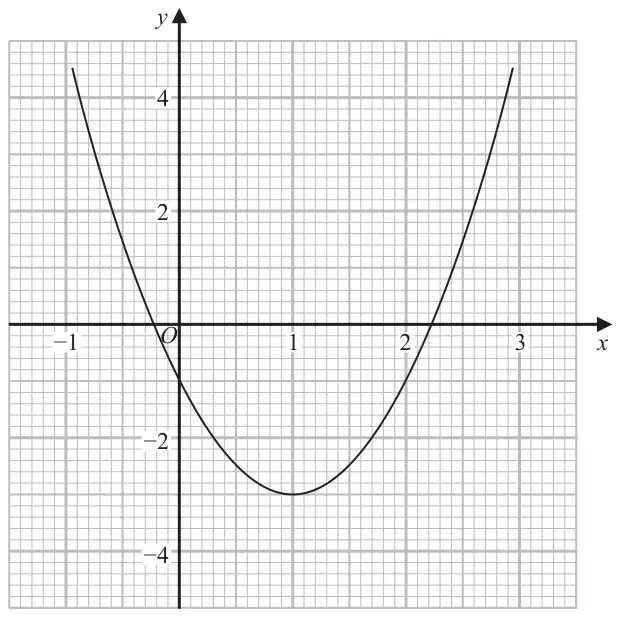
21 Part of the graph of \(y = 2x^2 - 4x - 1\) is shown on the grid.
(a) Use the graph to find estimates for the solutions of the equation \(2x^2 - 4x - 1 = 0\) Give your solutions correct to one decimal place. (2)
(b) By drawing a suitable straight line on the grid, find estimates for the solutions of the equation \(x^2 - x - 1 = 0\) Show your working clearly. Give your solutions correct to one decimal place. (3)
Mark scheme (a)
Scheme
Marks
–0.2 and 2.2
B2
(2)
Notes
B2: Both correct to 1 decimal place (B1 for (–0.2, 0), (2.2, 0) or a single correct value to 1 decimal place or both values within –0.2 to –0.23 and 2.2 to 2.23)
Mark scheme (b)
Scheme
Marks
\((y =)\;-2x + 1\) oe seen
M1
\(y = -2x + 1\) drawn
M1
Working required Answer: –0.6 and 1.6
A1
(3)
(5 marks)
Notes
M1: Written – could be label on graph
M1: dep on previous M1 for drawing \(y = -2x + 1\) passing through (–1, 3) and (2, –3) (allow 1 square tolerance)
M1: substitution of their linear equation into quadratic in \(x\) or \(y\) alone (even if B0 scored)
M1ft: from their substitution (dep on previous M1) for a complete correct method to get a 3-term or 2-term quadratic expression in the form \(ax^2 + bx\ (+ c)\ (= 0)\) [allow \(ax^2 + bx = c\)]
M1: (dep on M1) for a complete method to solve their 3-term or 2-term quadratic equation \((ax^2 + bx\ (+ c) = 0)\) – correct factorisation or substitution into formula or completing square (allow one sign error and some simplification – allow as far as \(\dfrac{-1 \pm \sqrt{1 + 24}}{2}\) or \(\dfrac{-7 \pm \sqrt{49 - 24}}{2}\))
or for seeing \(x = 2\), \(x = -3\) or \(y = -1\), \(y = -6\)
A1: (dep on M2) for \(x = 2\), \(x = -3\) and \(y = -1\), \(y = -6\) or one correct midpoint ie \(x = -\dfrac{1}{2}\) or \(y = -\dfrac{7}{2}\)
M1: for at least 1 correct equation or for \(d = 1.5\)
A1: both values correct
M1: A correct equation for the total of the first \(N\) terms of the series with \(a\) and \(d\) substituted in. The mark can be gained by using their values of \(a\) and \(d\) even if no previous marks awarded.
M1: A correct method dep on the previous M1 for solving their 3 term quadratic equation using any correct method (allow one sign error and some simplification – allow as far as \(\dfrac{-25 \pm \sqrt{625 + 14016}}{6}\)) oe (may be ± or just +) or if factorising, allow brackets which expanded give 2 out of 3 terms correct, or if completing the square allow as far as the stage \(3\left(\left(N + \dfrac{25}{6}\right)^2 - \dfrac{25^2}{6^2}\right) - 1168\ (= 0)\)
Working not required, so correct answer scores full marks Answer: \((x + 6)(x - 4)\)
A1
(2)
Notes
M1: or \((x + a)(x + b)\) where \(ab = -24\) or \(a + b = 2\)
Mark scheme (ii)
Scheme
Marks
Answer must come from the factors in (i) as the questions says ‘Hence solve…’ Answer: −6, 4
B1
(1)
(3 marks)
Notes
B1: Must follow through from their factors in (i), so even if the answers 8 and –6 are given, the mark can only be awarded if it follows from the factorisation in (i) (dep on 2 factors)
NB: Some students may show the whole of their working in the space for (i) or (ii). Please award the marks for (i) and (ii) so long as there is no ambiguity.
\(x = -0.6\) and \(x = 3\) OR \(y = 4.2\) and \(y = -3\)
A1
Working must be shown Answer: \(x = -0.6,\ y = 4.2\) \(x = 3,\ y = -3\)
A1
(5)
(5 marks)
Notes
M1: substitution of linear equation into quadratic
M1: simplified to a correct 3 term quadratic
M1ft: dep on M1 for solving their 3 term quadratic equation using any correct method (if factorising, allow brackets which expanded give 2 out of 3 terms correct) (if using formula allow one sign error and some simplification – allow as far as \(\dfrac{12 \pm \sqrt{144 + 180}}{10}\) or \(\dfrac{6 \pm \sqrt{36 + 1260}}{10}\)) (if completing the square allow as far as shown)
A1: oe dep on M2 for both \(x\)-values OR both \(y\)-values
A1: oe dep on M2 (must be clearly shown as correct pairs), accept answers given as coordinates
Working not required, so correct answer scores full marks Answer: \((x + 6)(x - 4)\)
A1
(2)
Notes
M1: or \((x + a)(x + b)\) where \(ab = -24\) or \(a + b = 2\)
Mark scheme (ii)
Scheme
Marks
Answer must come from the factors in (i) as the questions says ‘Hence solve…’ Answer: −6, 4
B1ft
(1)
(3 marks)
Notes
B1ft:Must follow through from their factors in (i), so even if the answers 4 and −6 are given the mark can only be awarded if it follows from the factorisation in (i) (dep on 2 factors)
NB: Some students may show the whole of their working in the space for (i) or (ii). Please award the marks for (i) and (ii) so long as there is no ambiguity.
or \(\left(x - \dfrac{21}{2}\right)^2 - \left(\dfrac{21}{2}\right)^2 + 20 = 0\)
M1
\((x - 20)(x - 1)\)or
eg \(\dfrac{21 \pm \sqrt{441 - 80}}{2}\) or \(\dfrac{21 \pm \sqrt{361}}{2}\) or \(\dfrac{21 \pm 19}{2}\)
or \(x = \pm\sqrt{\dfrac{361}{4}} + \dfrac{21}{2}\) oe
M1
Working required Answer: 1, 20
A1
(3)
(3 marks)
Notes
M1: If factorising, allow brackets which expanded give 2 out of 3 terms correct – if using formula or completing the square allow one sign error and some simplification – allow as far as eg \(\dfrac{21 \pm \sqrt{441 - 80}}{2}\) or eg \(\left(x - \dfrac{21}{2}\right)^2 - \dfrac{361}{4} = 0\) oe
M1: dep on M1 for correct factorisation, or a correct expression for \(x\) if completing the square. or a correct substitution into quadratic formula with some processing.
A1: for both correct values, dep on 1st M1 with no incorrect working.
e.g. \(\left(x + \dfrac{9}{2}\right)^2 - \left(\dfrac{9}{2}\right)^2 = -14\)
M1
\(y = \dfrac{3}{2}\) oe and \(y = 4\)or
\(x = -7\) and \(x = -2\)
A1
Working required
Answer: \(x = -2\), \(y = \dfrac{3}{2}\) oe
and
\(x = -7\), \(y = 4\)
A1
(5)
(5 marks)
Notes
M1: substitution of linear equation into quadratic
A1: (dep on M1) writing the correct quadratic expression in the form \(ax^2 + bx + c\;(= 0)\)
allow \(ax^2 + bx = c\)
M1: (dep on M1) for a complete method to solve their 3-term quadratic equation (allow one sign error and some simplification – allow as far as \(\dfrac{11 \pm \sqrt{121 - 72}}{4}\) or \(\dfrac{-9 \pm \sqrt{81 - 56}}{2}\))
A1: (dep on M1) both \(x\)-values or both \(y\)-values
M1: Factorising \(x^2 + 2x\) in correct expression on LHS or for writing the two fractions over a common denominator.
M1: Correct simplified single fraction = 2 or correct equation with no fractions.
M1: Correct 3 term quadratic
M1ft: independent
For solving their 3 term quadratic equation using any correct method.
If factorising, allow brackets which expanded give 2 out of 3 terms correct (if using formula or completing the square allow one sign error and some simplification – allow as far as eg \(\dfrac{1 \pm \sqrt{1 + 24}}{4}\) or eg \(\left(x - \dfrac{1}{4}\right)^2 = \dfrac{25}{16}\) oe
M1: for substitution of linear equation into quadratic or multiplying linear equation by \(y\) e.g. \(xy - 6y^2 = 5y\) and intention to subtract the two equations
A1: (dep on M1) writing the correct quadratic expression in form \(ax^2 + bx + c\;(= 0)\)
allow \(ax^2 + bx = c\)
M1: (dep on M1) for a complete method to solve their 3-term quadratic equation (allow one sign error and some simplification – allow as far as \(\dfrac{-5 \pm \sqrt{25 + 96}}{8}\) or \(\dfrac{5 \pm \sqrt{25 + 1064}}{4}\))
A1: Dep on first M1 for having two correct \(x\) values or two correct \(y\) values
A1: Dep on first M1 Must be paired and labelled correctly
or \(\left(x - \dfrac{21}{2}\right)^2 - \left(\dfrac{21}{2}\right)^2 + 20 = 0\)
M1
\((x - 20)(x - 1)\)or
eg \(\dfrac{21 \pm \sqrt{441 - 80}}{2}\) or \(\dfrac{21 \pm \sqrt{361}}{2}\) or \(\dfrac{21 \pm 19}{2}\)
or \(x = \pm\sqrt{\dfrac{361}{4}} + \dfrac{21}{2}\) oe
M1
Working required Answer: 1, 20
A1
(3)
(3 marks)
Notes
M1: If factorising, allow brackets which expanded give 2 out of 3 terms correct – if using formula or completing the square allow one sign error and some simplification – allow as far as eg \(\dfrac{21 \pm \sqrt{441 - 80}}{2}\) or eg \(\left(x - \dfrac{21}{2}\right)^2 - \dfrac{361}{4} = 0\) oe
M1: dep on M1 for correct factorisation, or a correct expression for x if completing the square. or a correct substitution into quadratic formula with some processing.
A1: for both correct values, dep on 1st M1 with no incorrect working.
M1: for substituting linear equation into the quadratic equation
A1: for a correct equation in the form \(ax^2 + bx + c = 0\) or \(ax^2 + bx = -c\) or equations of the same form but in \(y\)
M1ft: For solving their 3 term quadratic equation using any correct method.
If factorising, allow brackets which expanded give 2 out of 3 terms correct (if using formula or completing the square allow one sign error and some simplification – allow as far as eg
M1: for solving their 3 term quadratic equation using any correct method - if factorising, allow brackets which expanded give 2 out of 3 terms correct (if using formula or completing the square allow one sign error and some simplification – allow as far as e.g. \(\dfrac{14 \pm \sqrt{196 + 60}}{6}\) oe)
M1: correct first step eg substitution by eg \(x = 1 + 2y\) or \(y = \dfrac{x - 1}{2}\) to get an equation in a single variable
or
writing 2nd equation with \(x\) the subject and substituting into 1st
or
multiplying 2nd equation by \(3y\) and subtracting from 1st oe
A1: for a correct simplified quadratic
M1ft: dep on M1 for solving their 3 term quadratic equation using any correct method (allow one sign error and some simplification – allow as far as \(\dfrac{-3 \pm \sqrt{9 + 160}}{10}\)) or if factorising, allow brackets which expanded give 2 out of 3 terms correct)
M1: ft, for equating their \(\mathrm{d}y/\mathrm{d}x\) to 2
M1: (dep on M1) ft their three-term quadratic
M1: for solving their quadratic equation using any correct method - if factorising, allow brackets which expanded give 2 out of 3 terms correct (if using formula or completing the square allow one sign error and some simplification – allow as far as e.g. \(\dfrac{2 \pm \sqrt{4 + 480}}{30}\) oe)
A1: oe, dep on M2 (allow −0.66 or better), Both values – isw any attempt to find \(y\) coordinates
\(\dfrac{3 \pm \sqrt{169}}{2}\) or \(\dfrac{3 \pm 13}{2}\)
M1
8, −5
A1
(3)
(5 marks)
Notes
M1:or \((x + a)(x + b)\) where \(ab = -40\) or \(a + b = -5\) OR correct substitution into quadratic formula (condone one sign error in \(a\), \(b\) or \(c\) and missing brackets) (if + rather than ± shown then award M1 only unless recovered with answers)
M1: \(\dfrac{3 \pm \sqrt{169}}{2}\) or \(\dfrac{3 \pm 13}{2}\)
\((-4, -2)\) and \((3, 5)\) Working required Answer: \((-4, -2)\) and \((3, 5)\)
A1
(5)
(5 marks)
Notes
M1: for substituting linear equation into the quadratic equation
A1: for a correct equation in the form \(ax^2 + bx + c = 0\) or \(ax^2 + bx = -c\)
M1ft: dep on M1 for solving their quadratic equation using any correct method (allow one sign error and some simplification – allow as far as \(\dfrac{-1 \pm \sqrt{1 + 48}}{2}\)) or if factorising, allow brackets which expanded give 2 out of 3 terms correct)
\((-4, -2)\) and \((3, 5)\) Working required Answer: \((-4, -2)\) and \((3, 5)\)
A1
Notes
M1: for substituting linear equation into the quadratic equation
A1: for a correct equation in the form \(ay^2 + by + c = 0\) or \(ay^2 + by = -c\)
M1ft: dep on M1 for solving their quadratic equation using any correct method (allow one sign error and some simplification – allow as far as \(\dfrac{3 \pm \sqrt{9 + 40}}{2}\)) or if factorising, allow brackets which expanded give 2 out of 3 terms correct
22 Triangle \(HJK\) is isosceles with \(\;HJ = HK\;\) and \(\;JK = \sqrt{80}\)
\(H\) is the point with coordinates \((-4, 1)\) \(J\) is the point with coordinates \((j, 15)\) where \(\;j \lt 0\) \(K\) is the point with coordinates \((6, k)\)
\(M\) is the midpoint of \(JK\). The gradient of \(HM\) is 2
Find the value of \(j\) and the value of \(k\).
(6)
Mark scheme
Scheme
Marks
gradient of \(JK = -0.5\) or \(m \times 2 = -1\)
M1
\(\dfrac{k - 15}{6 - j} = -\dfrac{1}{2}\) or \(2k - j = 24\) or \(j = 2k - 24\) or \(k = \dfrac{j + 24}{2}\) oe
M1: for finding the gradient of \(JK\) using \(m_1 \times m_2 = -1\)
M1: for expressing the gradient of \(JK\) in terms of \(j\) and \(k\) or a correct equivalent equation
M1: for finding equation of \(JK\) in terms of \(j\) and \(k\) or for finding the midpoint of \(M\) or for equating length \(HJ\) with length \(HK\)
M1: (dep on M3) writing a correct quadratic expression in the form \(ax^2 + bx + c\;(= 0)\) (allow \(ax^2 + bx = c\)) or A correct equation for the gradient of \(HM\) in terms of \(j\) and \(k\) or a correct equivalent equation
M1: (dep on M3) for a complete method to solve their 3-term quadratic equation (allow one sign error in the use of the quadratic formula)
or
a correct method to eliminate either \(j\) or \(k\)
M1: for expressing the gradient of \(HM\) in terms of \(j\) and \(k\) or a correct equivalent equation (corrected from the printed mark scheme: it prints “gradient of \(JK\)”; the working is the gradient of \(HM\))
M1: for finding the length of \(JK\) in terms of \(j\) and \(k\) or for equating length \(HJ\) with length \(HK\)
M1: (dep on M3) writing the correct quadratic expression in form \(ax^2 + bx + c\;(= 0)\) allow \(ax^2 + bx = c\)
M1: (dep on M3) for a complete method to solve their 3-term quadratic equation (allow one sign error in the use of the quadratic formula)
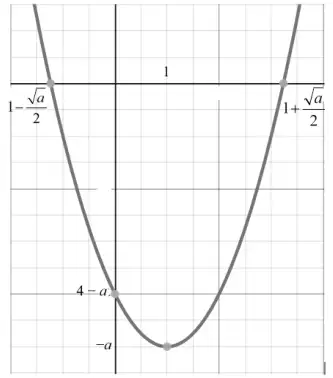
M1: for finding the turning point (may be seen marked on the graph as \((1, -a)\))
M1: for finding one of the intercepts (or award for any one correct coordinate shown on graph)
\((0, 4 - a)\) or \(\left(1 + \dfrac{\sqrt{a}}{2}, 0\right)\) or \(\left(1 - \dfrac{\sqrt{a}}{2}, 0\right)\)
Note: The 0’s can be ignored (as shown in the diagram)
A1: for a fully correct graph
• quadratic shape with minimum in the fourth quadrant and marked as \((1, -a)\) oe
• \(x\)-axis intercepts marked as \(\left(1 + \dfrac{\sqrt{a}}{2}, 0\right)\) oe on the positive \(x\)-axis and \(\left(1 - \dfrac{\sqrt{a}}{2}, 0\right)\) oe on the negative \(x\)-axis
• \(y\)-axis intercept marked as \((0, 4 - a)\) oe
Note: The 0’s can be ignored (as shown in the diagram)
\(\dfrac{5 \pm \sqrt{169}}{2}\) or \(\dfrac{5 \pm 13}{2}\)
M1
Working required Answer: 9, −4
A1
(3)
(3 marks)
Notes
M1: or \((x + a)(x + b)\) where \(ab = -36\) or \(a + b = -5\) OR correct substitution into quadratic formula (condone one sign error in \(a\), \(b\) or \(c\)) (if + rather than ± shown then award M1 only unless recovered with answers)
M1: or \(\dfrac{5 \pm \sqrt{169}}{2}\) or \(\dfrac{5 \pm 13}{2}\)
\(\dfrac{3 \pm \sqrt{169}}{2}\) or \(\dfrac{3 \pm 13}{2}\)
M1
Working required Answer: 8, −5
A1
(3)
(5 marks)
Notes
M1:or \((x + a)(x + b)\) where \(ab = -40\) or \(a + b = -5\) OR correct substitution into quadratic formula (condone one sign error in \(a\), \(b\) or \(c\) and missing brackets) (if + rather than ± shown then award M1 only unless recovered with answers)
M1: \(\dfrac{3 \pm \sqrt{169}}{2}\) or \(\dfrac{3 \pm 13}{2}\)
\(\dfrac{5 \pm \sqrt{169}}{2}\) or \(\dfrac{5 \pm 13}{2}\)
M1
Working required Answer: 9, −4
A1
(3)
(3 marks)
Notes
M1:or \((x + a)(x + b)\) where \(ab = -36\) or \(a + b = -5\) OR correct substitution into quadratic formula (condone one sign error in \(a\), \(b\) or \(c\)) (if + rather than ± shown then award M1 only unless recovered with answers)
M1:or \(\dfrac{5 \pm \sqrt{169}}{2}\) or \(\dfrac{5 \pm 13}{2}\)
\(\dfrac{--6 \pm \sqrt{36 - -8800}}{2 \times 8}\) or \(\dfrac{6 \pm \sqrt{36 + 8800}}{16}\) or \(\dfrac{6 \pm \sqrt{8836}}{16}\)
or \((4x - 25)(2x + 11)\) (=0)
M2
6.25 oe
A1
(3)
(6 marks)
Notes
M2: If not M2 then award M1 for \(\dfrac{--6 \pm \sqrt{(-6)^2 - 4 \times 8 \times -275}}{2 \times 8}\)
Condone one sign error in substitution; allow evaluation of individual terms e.g. 36 in place of \((-6)^2\) [allow \(-6^2\) or \(6^2\) in place of \((-6)^2\), throughout allow + rather than \(\pm\)]
or
\((4x \pm 25)(2x \pm 11)\) (=0)
(if student gains M1 and shows both answers the 2nd M1 can be awarded)
ft from an incorrect 3 term quadratic equation
A1: dep on M1 and 6.25 oe alone given as final answer
(a) Express \(7 - 4x - x^2\) in the form \(p - (x + q)^2\) where \(p\) and \(q\) are constants. (2)
(b) Use your answer to part (a) to solve the equation \(7 - 4(y + 3) - (y + 3)^2 = 0\) Give your solutions in the form \(e \pm \sqrt{f}\) where \(e\) and \(f\) are integers. (3)
The curve \(C\) has equation \(y = 3 - 5(x + 1)^2\) The point \(A\) is the maximum point on \(C\).
(c) Write down the coordinates of \(A\). (1)
Mark scheme (a)
Scheme
Marks
M1
\(11 - (x + 2)^2\)
A1
(2)
Notes
M1: For \(11 - (x + q)^2\) or \(p - (x + 2)^2\)
A1: fully correct, accept \(p = 11\), \(q = 2\)
Mark scheme (b)
Scheme
Marks
\((y + 3 + 2)^2 = 11\) or \(11 - (y + 3 + 2)^2\)
M1
\(y + 3 + 2 = \pm\sqrt{11}\)
M1
\(-5 \pm \sqrt{11}\)
A1
(3)
Notes
M1: substituting \(x = y + 3\) into their \(p - (x + q)^2\)
A1: Both answers correct, ft their answer from (a) eg \(-(3 + \text{``}{q}\text{''}) \pm \sqrt{\text{``}{p}\text{''}}\)
Mark scheme (b) (Alternative scheme)
Scheme
Marks
M2
\(-5 \pm \sqrt{11}\)
A1
Notes
M2: for \(-y^2 - 10y - 14 = 0\) or \(y^2 + 10y + 14 = 0\)
M1: for substituting values from their quadratic equation into the formula (condone one sign error in substitution) or a correct first step for completing the square
Condone one sign error in substitution; allow partial evaluation
A1: Award M2A1 for answers in range 4.796 – 4.8 (and no other answer) with sufficient correct working that would gain at least M1 [Award M2A0 for working sufficient for M1 with both the –ve and +ve answers (–8.13 & 4.80)]
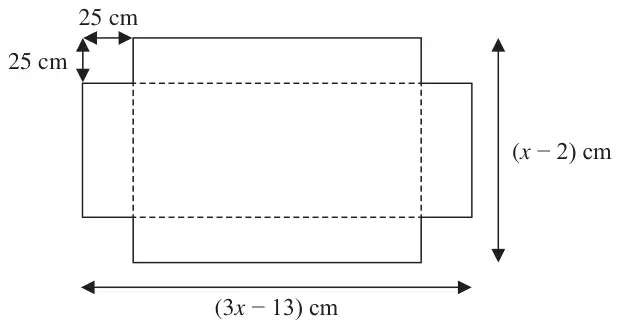
21 A rectangular piece of card has length \((3x - 13)\) cm and width \((x - 2)\) cm. A square, with sides of length 25 cm, is removed from each corner of the card.
Diagram NOT accurately drawn
The card is then folded along the dashed lines to make an open box with height 25 cm as shown below.
Diagram NOT accurately drawn
(a) Show that the length of the open box is \((3x - 63)\) cm. (1)
The volume of the open box is 81 900 cm\(^3\)
(b) Find the value of \(x\). Show clear algebraic working. (5)
20 A curve has equation \(\;y = x^3 - 4x^2 + 5x + 4\)
(a) Find \(\dfrac{\mathrm{d}y}{\mathrm{d}x}\) (2)
(b) Find the \(x\) coordinates of the points where the curve with equation \(\;y = x^3 - 4x^2 + 5x + 4\;\) has a gradient of 1 Show clear algebraic working. (4)
Mark scheme (a)
Scheme
Marks
M1
\(3x^2 - 8x + 5\)
A1
(2)
Notes
M1: for any 2 of \(3x^2\) or \(-8x\) or \(+5\) differentiated correctly
Mark scheme (b)
Scheme
Marks
\(3x^2 - 8x + 5 = 1\)
M1
\(3x^2 - 8x + 4 = 0\)
M1
eg \((3x - 2)(x - 2) = 0\)
M1
\(\dfrac{2}{3}\) , 2
A1
(4)
(6 marks)
Notes
M1: ft from (a)
M1: ft rearrange ready to solve, ft as long as \(ax^2 - bx + c\)
M1: ft correct method to solve quadratic – if using formula, every term to be substituted correctly as long as \(ax^2 - bx + c\)
A1: cao dep on M2 Ignore any attempts to find y values
M1: condone one sign error, brackets not necessary. Some simplification may already be done – if so this must be correct. (accept \(6^2\) for \((-6)^2\))
12 A stone is thrown vertically upwards from a point \(O\). The height above \(O\) of the stone \(t\) seconds after it was thrown from \(O\) is \(h\) metres, where \(h = 17t - 5t^2\) Work out the values of \(t\) when the height of the stone above \(O\) is 12 metres. Show your working clearly.
or \(\dfrac{17 \pm \sqrt{49}}{10}\) or \(\dfrac{17 \pm 7}{10}\)
M1
\(t = 1\) \(t = 2.4\) oe
A1
(3)
Notes
M1: Correct three term quadratic. e.g. \(17t - 5t^2 = 12\)
M1: For \((5t \pm 12)(t \pm 1)\) or for a correct substitution into the quadratic formula (condone 1 sign error) Condone \(17^2\) and omission of brackets around \(-17\)
M1: for correct substitution; condone one sign error in substitution Accept + in place of ± NB. Terms may be simplified eg. accept 4 in place of 2×2 in denominator
M1: (independent) for correct simplification of discriminant (if evaluated at least 3sf rounded or truncated)
A1: dep on 1st M mark scored for value rounding to 1.65 given as final answer Award 3 marks if first M1 scored and answer correct
\(\sqrt{76}\) or \(\sqrt{36 + 40}\) or \(2\sqrt{19}\) or 8.71.....
M1
1.47, −0.272
A1
(3)
Notes
M1: for correct substitution; condone one sign error ; condone missing brackets around \((-6)^2\); accept 6 and \(6^2\) in place of \(--6\) and \((-6)^2\) There may be partial evaluation – if so, this must be correct
M1: (independent) for correct simplification of discriminant (if evaluated, at least 3sf rounded or truncated)
A1: for −0.27 to −0.272 and 1.47 to 1.472 Award 3 marks if first M1 scored and answer correct
\(\sqrt{833}\) or \(\sqrt{81 + 752}\) or \(7\sqrt{17}\) or 28.8…..
M1
2.48, − 4.73
A1
(3)
Notes
M1: for correct substitution; condone one sign error; brackets not necessary; condone + instead of ± in formula There may be partial evaluation – if so, this must be correct
M1: (independent) for correct simplification of discriminant (if evaluated, at least 3sf rounded or truncated)
A1: awrt 2.48 and −4.73 NB. If negative solution is discarded (or omitted at any stage) then full marks can still be obtained Award 3 marks if first M1 scored and answer correct
M1: for \(\left(x + \dfrac{9}{8}\right) = \pm\sqrt{\dfrac{833}{64}}\) oe
A1: awrt 2.48 and −4.73 NB. If negative solution is discarded (or omitted) then full marks can still be obtained Award 3 marks if first M1 scored and answer correct
The mark scheme states that for this question the correct answer alone does not imply a correct method.
(b) The point \(P\) lies on the curve with equation \(y = 2x^3 + 3x^2 + 2\) The gradient of the curve at \(P\) is \(-\dfrac{3}{2}\) Find the coordinates of \(P\). (5)
Mark scheme (a)
Scheme
Marks
\(6x^2 + 6x\)
B2
(2)
Notes
B2: Award B1 for any two terms differentiated correctly (remember \(\frac{\mathrm{d}}{\mathrm{d}x}(2) = 0\) is a term)
M1: Factorising correctly or correct use of quadratic formula
A1 A1: A1 Both correct \(x\) values or 1 correct pairing, dependent on previous M1 A1 4 fully correct values (pairing need not be explicit), dependent on previous M1
The mark scheme states that for this question the correct answer alone does not imply a correct method.
M1: or \((2x \times 3x) + 2(2x + 1) + 3x = 100\) oe or \((2x \times 3x) + (2 \times 2x(\times 1)) + 1) + 3x + 1 + 1 = 100\) oe other partitions are acceptable but partitioning must go on to form a correct equation.
A1: Accept \(6x^2 + 7x + 2 = 100\) if M1 awarded * Answer given
The mark scheme states that for this part the correct answer alone does not imply a correct method.
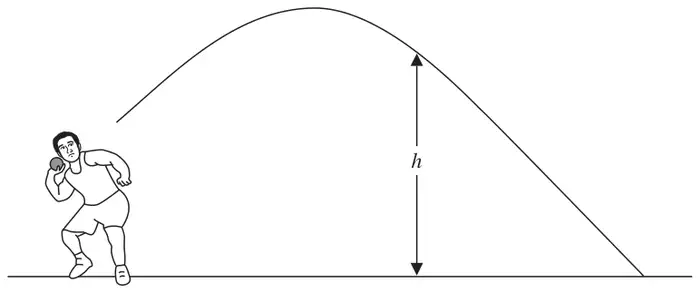
Ivan is a shot putter. The formula \(h = 2 + 6t - 5t^2\) gives the height, \(h\) metres, of the shot above the ground \(t\) seconds after he has released the shot.
(i) Solve \(\;2 + 6t - 5t^2 = 0\) Give your solutions correct to 3 significant figures. Show your working clearly.
The shot hits the ground after \(T\) seconds.
(ii) Write down the value of \(T\). Give your answer correct to 3 significant figures.
\(\dfrac{-6 \pm \sqrt{76}}{-10}\) or \(\dfrac{-6 \pm \sqrt{36 + 40}}{-10}\)
M1
−0.272 1.47
A1
(ii) Answer: 1.47
B1
(4)
(4 marks)
Notes
M1: for correct substitution condone + in place of \(\pm\) and condone one sign error in substitution
M1: for correct simplification
A1: Award for answers which round to −0.272 (−0.2717...) and 1.47 (1.4717…) Award 3 marks for correct answers, if at least M1 scored. Condone missing negative solution
B1: for answer which rounds to 1.47 ft from (i) if only one positive solution given
The mark scheme states that for this question the correct answer alone does not imply a correct method.
21 A bag contains \(x\) counters. 7 of the counters are blue. Sam takes at random a counter from the bag and does not replace it. Jill then takes a counter from the bag. The probability they both take a blue counter is 0.2
(a) Form an equation involving \(x\). Show that your equation can be expressed as \(x^2 - x - 210 = 0\) (2)
(b) Solve \(x^2 - x - 210 = 0\) Show clear algebraic working. (3)
Mark scheme (a)
Scheme
Marks
\(\dfrac{7}{x} \times \dfrac{6}{x - 1} = 0.2\)
\(42 = 0.2x(x - 1)\)
\(210 = x^2 - x\)
M1
\(x^2 - x - 210\ (=0)\)
A1*
(2)
Notes
M1: for \(\dfrac{7}{x} \times \dfrac{6}{x - 1} = 0.2\) or \(\dfrac{7}{x} \times \dfrac{6}{x - 1} = \dfrac{1}{5}\)
(corrected from the printed mark scheme: the working column prints \(\dfrac{6}{x+1}\))
A1*: * answer given; sufficient steps must be seen to get to correct quadratic
Mark scheme (b)
Scheme
Marks
\((x - 15)(x + 14)\ (=0)\)
M2
−14 , 15
A1
(3)
Notes
M2: M1 for \((x \pm 15)(x \pm 14)\)
A1: (dep on M2) for −14, 15 or 15
M1 \(\dfrac{-(-1) \pm \sqrt{(-1)^2 - 4 \times 1 \times (-210)}}{2}\) (may be partially evaluated, condone no brackets around negative numbers, accept \(1^2\))
M1 (indep) for \(\sqrt{841}\) or 29 A1 (dep on M1) for −14, 15 or 15
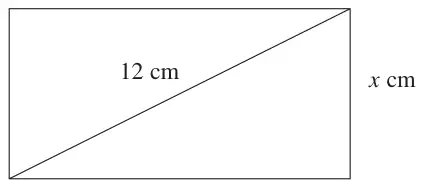
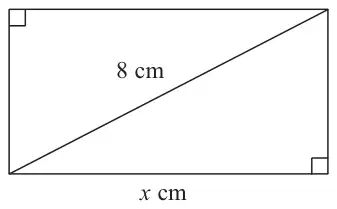
The diagram shows a rectangle. The length of the rectangle is \(x\) cm. The length of a diagonal of the rectangle is 8 cm. The perimeter of the rectangle is 20 cm.
(a) Show that \(x^2 - 10x + 18 = 0\) (4)
(b) Solve \(x^2 - 10x + 18 = 0\) Give your solutions correct to 3 significant figures. Show your working clearly. (3)
Mark scheme (a)
Scheme
Marks
\(\dfrac{20 - 2x}{2}\) or \(10 - x\) seen as the width
M1: accept \(\dfrac{20 - 2x}{2}\) in place of \(10 - x\) for all method marks
M1: (dep on previous M1) for correct expansion of \((10 - x)^2\) or correct expansion of \((20 - 2x)^2\)
A1: for correct manipulation resulting in given equation
Mark scheme (b)
Scheme
Marks
\(\dfrac{--10 \pm \sqrt{(-10)^2 - 4 \times 1 \times 18}}{2 \times 1}\) or for this expression with one or more of \((--10)\), \((-10)^2\), \(10^2\), \(-4 \times 1 \times 18\), \(2 \times 1\), \((-10)^2 - 4 \times 1 \times 18\) evaluated e.g. \(\dfrac{10 \pm \sqrt{28}}{2}\)
M1
\(\sqrt{28}\) or \(2\sqrt{7}\) or \(\sqrt{100 - 72}\) or 5.29...
M1
2.35 7.65
A1
(3)
Notes
M1: correct substitution brackets not necessary (accept \(10^2\)) or \((x - 5)^2 - 25 + 18 = 0\) oe
M1: (independent) for correct simplification of discriminant (if evaluated at least 3sf rounded or truncated)
or \(x - 5 = \pm\sqrt{7}\) oe
A1: for values rounding to 2.35 and 7.65 (2.35424... 7.64575...) Award full marks for correct solutions if at least 1 method mark scored.
18 Solve \(5x^2 + 2x - 4 = 0\) Give your solutions correct to 3 significant figures. Show your working clearly.
(3)
Mark scheme
Scheme
Marks
\(\dfrac{-2 \pm \sqrt{2^2 - 4 \times 5 \times -4}}{2 \times 5}\) or for this expression with one or more of \(2^2\), \(4 \times 5 \times (-4)\), \(2 \times 5\) or \(2^2 - 4 \times 5 \times (-4)\) evaluated eg \(\dfrac{-2 \pm \sqrt{84}}{10}\)
M1
\(\sqrt{84}\) or \(\sqrt{4 + 80}\) or \(2\sqrt{21}\) or 9.165…
M1
−1.12, 0.717
A1
(3)
Notes
M1: for correct substitution (brackets not necessary)
M1: (independent) for correct simplification of discriminant (if evaluated, at least 3sf rounded or truncated)
A1: for values rounding to −1.12 and 0.717 (−1.11651…, 0.71651…) Award 3 marks if first M1 scored and answer correct.
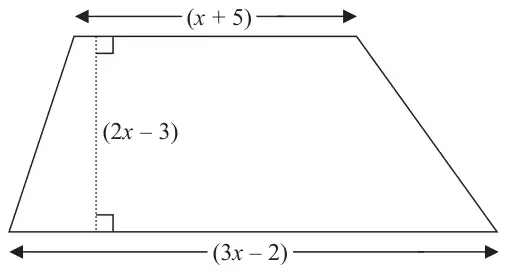
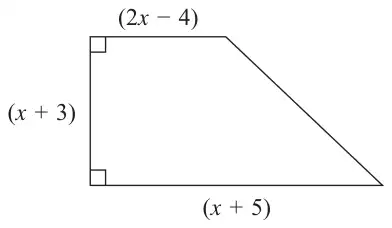
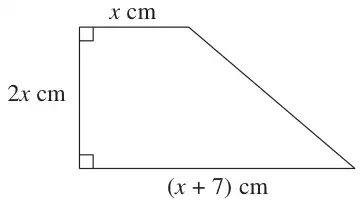
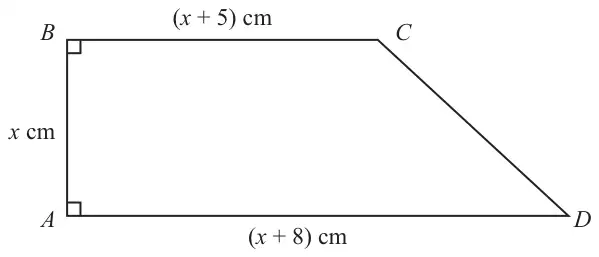
The diagram shows a trapezium \(ABCD\) with \(AD\) parallel to \(BC\). \(AB = x\) cm, \(BC = (x + 5)\) cm and \(AD = (x + 8)\) cm. The area of the trapezium is 42 cm\(^2\).
B1: (indep) for correct expansion of \((2x - 3)^2\) even if unsimplified
B1: for correct simplification Condone omission of ‘= 0’
B1: for correct factorisation or for correct substitution into quadratic formula and correct evaluation of ‘\(b^2 - 4ac\)’ or for using square completion correctly as far as indicated
A1: for both values of \(x\) dep on all preceding marks
A1: for complete, correct solutions (need not be paired) dep on all preceding marks No marks for \(x = 1\), \(y = -1\) with no working
Apart from questions 5b, 8, 15d, 20b, 21b, 23, 24b (where the mark scheme states otherwise) the correct answer, unless clearly obtained by an incorrect method, should be taken to imply correct working.
18 Solve \(3x^2 + 8x + 2 = 0\) Give your solutions correct to 3 significant figures.
(3)
Mark scheme
Scheme
Marks
\(\dfrac{-8 \pm \sqrt{8^2 - 4 \times 3 \times 2}}{2 \times 3}\) or for this expression with one or more of \(8^2\), \(4 \times 3 \times 2\) or \(2 \times 3\) correctly evaluated
M1
obtains \(\sqrt{40}\) or \(\sqrt{64 - 24}\) or \(2\sqrt{10}\) or 6.32...
M1
−0.279, −2.39
A1
(3)
(3 marks)
Notes
M1: for correct substitution
M1: (independent) for correct simplification of discriminant
A1: dep on both method marks for values rounding to −0.279 and −2.39 (−0.27924... , −2.38742...)
B1: (indep) for correct expansion of \((3x + 4)^2\) even if unsimplified
B1: for correct simplification Condone omission of ‘= 0’
B1: for correct factorisation Condone omission of ‘= 0’ or for correct substitution into the quadratic formula and correct evaluation of ‘\(b^2 - 4ac\)’ or for using square completion correctly as far as indicated
A1: for both values of \(x\)
A1: for complete, correct solutions Need not be explicitly paired
Alternative (eliminating \(x\)): \(x = \frac{y - 4}{3}\) B1; \(\left(\frac{y - 4}{3}\right)^2 + y^2 = 34\) M1; \(\frac{y^2 - 4y - 4y + 16}{9} + y^2 = 34\) or \(y^2 - 8y + 16 + 9y^2 = 306\) B1 (indep) for correct expansion of \((y - 4)^2\) even if unsimplified; \(10y^2 - 8y - 290\ (= 0)\) B1; \((5y - 29)(y + 5)\ (= 0)\) or \(\frac{8 \pm \sqrt{11664}}{20}\) or \(\frac{4 \pm \sqrt{2916}}{10}\) or \(\frac{2}{5} \pm \frac{\sqrt{729}}{5}\) B1; \(y = 5\frac{4}{5}\) or \(y = -5\) A1 for both values of \(y\); complete, correct solutions A1
B2: B1 for \(3pq(...)\) or \(...(3p + 4q)\) or \(3p(3pq + 4q^2)\) or \(3q(3p^2 + 4pq)\) or \(pq(9p + 12q)\) or \(3(3p^2q + 4pq^2)\) ie for two factors, one of which is \(3pq\) or \((3p + 4q)\), or for correct, but incomplete, factorisation
Mark scheme (c)
Scheme
Marks
(i) Answer: \((x - 2)(x + 8)\)
B2
(ii) Answer: 2, \(-8\)
B1
(3)
(6 marks)
Notes
B2: B1 for one correct factor or \((x + 2)(x - 8)\)
B1: (indep) for correct expansion of \((3x - 1)^2\) even if unsimplified
B1: for correct simplification
B1: for correct factorisation or for correct substitution into the quadratic formula and correct evaluation of ‘\(b^2 - 4ac\)’ or for using square completion correctly as far as indicated
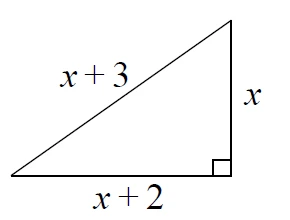
11 A right-angled triangle has sides of length \(x\) cm, \((x + 2)\) cm and \((x + 3)\) cm.
(a) Use Pythagoras’ theorem to write down an equation in \(x\). (1)
(b) Show that your equation simplifies to \(x^2 - 2x - 5 = 0\) (2)
(c) By solving the equation \(x^2 - 2x - 5 = 0\), find the length of each side of the triangle. Give your answers correct to one decimal place. (3)
Mark scheme (a)
Scheme
Marks
\(x^2 + (x + 2)^2 = (x + 3)^2\)
B1
(1)
Notes
Note: the source has no mark scheme for this question (the slide repeats the scheme for November 2005 Paper 3 Q14). This is a suggested scheme, not Edexcel’s.
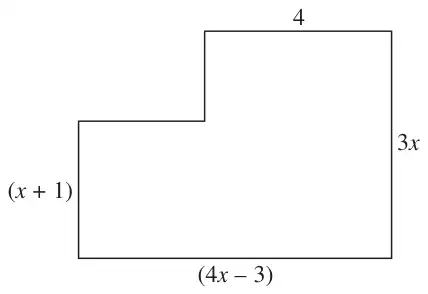
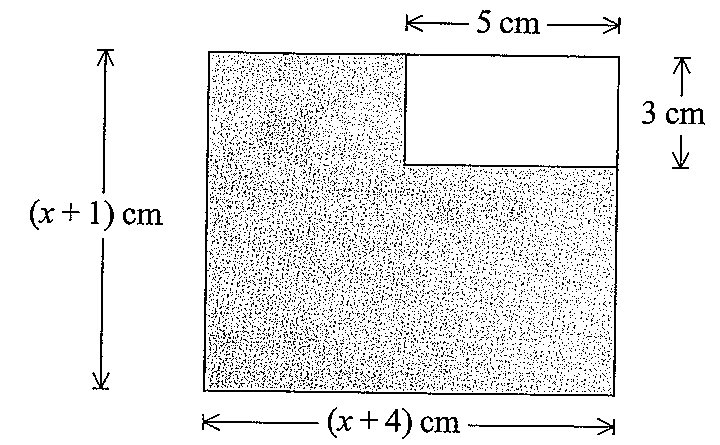
A rectangular piece of card has length \((x + 4)\) cm and width \((x + 1)\) cm. A rectangle 5 cm by 3 cm is cut from the corner of the piece of card. The remaining piece of card, shown shaded in the diagram, has an area of 35 cm².
(a) Show that \(x^2 + 5x - 46 = 0\) (3)
(b) Solve \(x^2 + 5x - 46 = 0\) to find the value of \(x\). Give your answer correct to 3 significant figures. (3)
M1: for correct substitution into the quadratic formula; condone one sign error. Completing the square: \((x + 2.5)^2 = 52.25\) scores M1
M1: for \(\sqrt{209}\) or \(\sqrt{25 + 184}\) or \(x = -2.5 \pm \sqrt{52.25}\)
A1: for 4.73 (4.7284…) only; ignore −9.73 if also given, but A0 if −9.73 is chosen as the answer. Trial and improvement scores 3 only for 4.73 with enough trials to justify 3 s.f.
No official mark scheme was available for this question; this one was written by Westie's Workshop.
We'd like to use Google Analytics cookies to count visits and see which pages help most. They're optional, and the site works exactly the same either way. Privacy policy