Higher June 2025 Paper 2R Q19
19 The functions f and g are such that
\[\begin{aligned} \mathrm{f}(x) &= 3x - 4 \quad \text{where } x \gt 2 \\ \mathrm{g}(x) &= \dfrac{x}{2x + 1} \end{aligned}\]
(a) State the value of \(x\) that cannot be included in any domain of g (1)
(b) Find \(\mathrm{gf}(x)\)(2)
Mark scheme (a) Mark scheme (b)
Mark scheme (a) Scheme Marks \(-\dfrac{1}{2}\) B1 (1)
Notes B1: oe
Accept \(x = -\dfrac{1}{2}\), accept \(x \ne -\dfrac{1}{2}\)
Do not allow inequalities, eg \(x \gt -\dfrac{1}{2}\) or \(x \leqslant -\dfrac{1}{2}\)
Mark scheme (b) Scheme Marks \(\dfrac{3x - 4}{2(3x - 4) + 1}\) M1 Correct answer only scores full marks (unless from obviously incorrect working)
Answer: \(\dfrac{3x - 4}{6x - 7}\)
A1 (2) (3 marks)
Notes M1: for a correct unsimplified expression for \(\mathrm{gf}(x)\)
A1: oe eg \(\dfrac{4 - 3x}{7 - 6x}\)
Correct answer seen followed by incorrect subsequent working scores M1A0
Higher June 2025 Paper 1 Q16
16 \(\mathrm{f}(x) = 9 - \sqrt{x}\) where \(x \geqslant 0\)
(a) Find \(\mathrm{f}(9)\) (1)
(b) Solve \(\mathrm{fg}(x) \lt 0\)(3)
Mark scheme (a) Mark scheme (b)
Mark scheme (a) Mark scheme (b) Scheme Marks \(9 - \sqrt{4x^2}\;(\lt 0)\) M1 eg \(9 - 2x\;(\lt 0)\) or \(9 \lt 2x\) or \(81 \lt 4x^2\) or \(9^2 \lt 4x^2\) M1 Working required
Answer: \(x \gt \dfrac{9}{2}\)
A1 (3) (4 marks)
Notes M1: for substituting \(\mathrm{g}(x)\) in \(\mathrm{f}(x)\), allow incorrect inequality sign or = sign
M1: for removing the square root, allow incorrect inequality sign or = sign
A1: (dep on M1)
oe eg \(x \gt 4.5\), \(\dfrac{9}{2} \lt x\), \(4.5 \lt x\)
Higher November 2024 Paper 1 Q25
25 The function f is such that \(\mathrm{f}(x) = 2x^2 - 24x + 7\) where \(x \geqslant 6\)
Find the inverse function \(\mathrm{f}^{-1}(x)\)
(4)
Mark scheme Mark scheme (ALT)
Mark scheme Scheme Marks \((y =)\;2(x^2 - 12x) + 7\) or
\((y =)\;2\left(x^2 - 12x + \dfrac{7}{2}\right)\) or
\(\dfrac{y - 7}{2} = x^2 - 12x\)
or \((x =)\;2(y^2 - 12y) + 7\) or
\((x =)\;2\left(y^2 - 12y + \dfrac{7}{2}\right)\) or
\(\dfrac{x - 7}{2} = y^2 - 12y\)
M1 eg
\((y =)\;2\left((x - 6)^2 - 6^2\right) + 7\)
or
\((y =)\;2\left((x - 6)^2 - 6^2 + \dfrac{7}{2}\right)\)
or
\((y =)\;2(x - 6)^2 - 65\) oe
or
\(\dfrac{y - 7}{2} = (x - 6)^2 - 6^2\) oe
or eg
\((x =)\;2\left((y - 6)^2 - 6^2\right) + 7\)
or
\((x =)\;2\left((y - 6)^2 - 6^2 + \dfrac{7}{2}\right)\)
or
\((x =)\;2(y - 6)^2 - 65\) oe
or
\(\dfrac{x - 7}{2} = (y - 6)^2 - 6^2\) oe
M1 \((x - 6)^2 = \dfrac{y + 65}{2}\) oe or
\((x - 6)^2 = \dfrac{y - 7}{2} + 6^2\) oe
or \((y - 6)^2 = \dfrac{x + 65}{2}\) oe or
\((y - 6)^2 = \dfrac{x - 7}{2} + 6^2\) oe
M1 Correct answer scores full marks (unless from obvious incorrect working)
Answer: \(6 + \sqrt{\dfrac{x + 65}{2}}\)
A1 (4) (4 marks)
Notes M1: for a correct first step in order to complete the square
M1: dep on M1
A1: oe eg \(6 + \sqrt{\dfrac{x - 7}{2} + 36}\)
Must be in terms of \(x\)
M3A0 for \(6 \pm \sqrt{\dfrac{x + 65}{2}}\) or \(6 \pm \sqrt{\dfrac{y + 65}{2}}\)
or \(6 + \sqrt{\dfrac{y + 65}{2}}\)
Note: Allow candidates to swap \(x\) and \(y\) when finding the inverse
Mark scheme (ALT) Scheme Marks \(2x^2 - 24x + 7 - y\;(= 0)\) M1 \((x =)\;\dfrac{24 \pm \sqrt{576 - 8(7 - y)}}{4}\)
or
\((x =)\;\dfrac{24 + \sqrt{576 - 8(7 - y)}}{4}\)
or \(2\left((x - 6)^2 - 6^2\right) + 7 - y\;(= 0)\)
or
\(2\left((x - 6)^2 - 6^2 + \dfrac{7}{2}\right) - y\;(= 0)\)
M1 \((x =)\;6 \pm \sqrt{\dfrac{y + 65}{2}}\)
or \((x - 6)^2 = \dfrac{y + 65}{2}\)
M1 Correct answer scores full marks (unless from obvious incorrect working)
Answer: \(6 + \sqrt{\dfrac{x + 65}{2}}\)
A1
Notes M1: for a correct first step
M1: dep on M1
A1: oe eg \(6 + \sqrt{\dfrac{x - 7}{2} + 36}\)
Must be in terms of \(x\)
M3A0 for \(6 \pm \sqrt{\dfrac{x + 65}{2}}\) or \(6 \pm \sqrt{\dfrac{y + 65}{2}}\)
or \(6 + \sqrt{\dfrac{y + 65}{2}}\)
Note: Allow candidates to swap \(x\) and \(y\) when finding the inverse
Higher June 2024 Paper 2R Q17
17 \(\mathrm{f}(x) = \dfrac{x}{2x - 4} \qquad \mathrm{g}(x) = 3x + 1\)
Given that \(\mathrm{fg}(k) = 2\)
work out the value of \(k\)
(3)
Mark scheme
Mark scheme Scheme Marks \((\mathrm{fg}(k) =)\, \dfrac{3k + 1}{2(3k + 1) - 4}\) oe or \(\dfrac{3k + 1}{2(3k + 1) - 4} = 2\) oe or
\((\mathrm{fg}(k) =)\, \dfrac{3k + 1}{6k - 2}\) oe or \(\dfrac{3k + 1}{6k - 2} = 2\) oe or
\(x = 2(2x - 4)\) or \(x = 4x - 8\) or \(x = \dfrac{8}{3}\) oe
M1 \(3k + 1 = 2(6k - 2)\) oe or
\(3k + 1 = 2\big(2(3k + 1) - 4\big)\) oe or
\(3k + 1 = 12k - 4\) oe or
\(3k + 1 = \dfrac{8}{3}\) oe
M1 Working not required, so correct answer scores full marks (unless from obvious incorrect working)
Answer: \(\dfrac{5}{9}\)
A1 (3) (3 marks)
Notes M1: for a correct expression for fg(\(k\)) or fg(\(x\)) or
M1: dep on M1 for correctly removing the denominator to form a correct equation
or
for g(\(k\)) = \(\dfrac{8}{3}\)
A1: oe eg 0.55(555…) rounded or truncated
Higher June 2024 Paper 1 Q15
15 The function f is defined as
\[\mathrm{f} : x \mapsto \frac{3x + 1}{x - 2}\]
(a) State the value of \(x\) that cannot be included in any domain of the function f (1)
(b) Express the inverse function \(\mathrm{f}^{-1}\) in the form \(\mathrm{f}^{-1}(x) = \ldots\) (3)
Mark scheme (a) Mark scheme (b)
Mark scheme (a) Scheme Marks \((x =)\; 2\) B1 (1)
Notes B1: Accept \(x = 2\) and \(x \neq 2\)DO NOT ACCEPT WHEN WRITTEN WITH INEQUALITY SIGNS DO NOT ACCEPT
Mark scheme (b) Scheme Marks \(y(x - 2) = 3x + 1\) oe oror M1 \(x(y - 3) = 1 + 2y\) oeor M1 Working not required, so correct answer scores full marks (unless from obvious incorrect working)
Answer: \(\dfrac{1 + 2x}{x - 3}\)
A1 (3) (4 marks)
Notes M1: for factorising correctly
A1: oe eg \(\dfrac{-1 - 2x}{3 - x}\) (must be in terms of \(x\))
Higher November 2023 Paper 2 Q19 19 The functions f and g are such that
\[\mathrm{f}: x \mapsto 5x + 7\]\[\mathrm{g}: x \mapsto \dfrac{5}{2x - 9}\]
(a) State which value of \(x\) cannot be included in any domain of g (1)
(b) Find fg(4) (2)
The function h is such that
\[\mathrm{h}: x \mapsto 3x^2 - 12x + 8 \quad \text{where } x > 2\]
(c) Express the inverse function \(\mathrm{h}^{-1}\) in the form \(\mathrm{h}^{-1}: x \mapsto \ldots\) (4)
Mark scheme (a) Mark scheme (b) Mark scheme (c)
Mark scheme (a) Scheme Marks Answer: 4.5 B1 (1)
Notes B1: oe 4.5, \(x = 4.5\), \(x \neq 4.5\)
Mark scheme (b) Scheme Marks \((\mathrm{g}(4) =)\; \dfrac{5}{2 \times 4 - 9}\;(= -5)\) or \(5\left(\dfrac{5}{2 \times 4 - 9}\right) + 7\) oe M1 Working not required, so correct answer scores full marks (unless from obvious incorrect working) A1 (2)
Mark scheme (c) Scheme Marks \((y =)\; 3(x^2 - 4x) + \ldots\) or \(y = 3(x^2 - 4x + \ldots)\) where … can be number(s) or nothing M1 \((y =)\; 3(x - 2)^2 + \ldots\) or \(y = 3[(x - 2)^2 + \ldots]\); could have \(y - 8 = 3[(x - 2)^2 + \ldots]\) oe M1 \((x - 2)^2 = \dfrac{y + 4}{3}\) oe or an answer of \(2 \pm \sqrt{\dfrac{4 + y}{3}}\) or \(x = 2 \pm \sqrt{\dfrac{4 + y}{3}}\) (may have + rather than ±) M1 Working not required, so correct answer scores full marks (unless from obvious incorrect working) A1 (4) (7 marks)
Notes A1: oe eg \(2 + \sqrt{\dfrac{12 + 3x}{9}}\)
NB: Allow candidates to swap \(x\) and \(y\) (or other letter) at any stage when finding the inverse – but the answer must be in terms of \(x\)
Higher June 2023 Paper 1 Q17
17 The functions g and h are such that
\[\mathrm{g}(x) = \frac{11}{2x - 5}\]
\[\mathrm{h}(x) = x^2 + 4 \qquad x \geqslant 0\]
(a) What value of \(x\) must be excluded from any domain of g? (1)
(b) Solve \(\;\mathrm{gh}(x) = 1\) (3)
Mark scheme (a) Mark scheme (b)
Mark scheme (a) Notes B1: oe e.g. \(2\frac{1}{2}\), \(\dfrac{5}{2}\)
Accept \(x = 2.5\) oe and \(x \neq 2.5\) oe
Any response that contains 2.5 oe is also acceptable, APART FROM \(x \gt 2.5\) oe or \(x \lt 2.5\) oe or \(x \geqslant 2.5\) oe or \(x \leqslant 2.5\) oe
Mark scheme (b) Scheme Marks (gh(\(x\)) =) \(\dfrac{11}{2(x^2 + 4) - 5}\;(= 1)\) M1 \(11 - 3 = 2x^2\) oe eg \(x^2 = 4\)or \(2x^2 - 8 = 0\) or \(x^2 - 4 = 0\) M1 Correct answer scores full marks (unless from obvious incorrect working) A1 (3) (4 marks)
Notes M1: correct expansion and rearrangement with \(x\) term on one side and number terms the other side or all terms on one side in an equation
A1: cao, an answer of ±2 gains M2 only
Higher January 2023 Paper 2 Q25
25 The function f is such that \(\;\mathrm{f}(x) = 3x^2 - 12x + 7\;\) where \(\;x \leqslant 2\)
Express the inverse function \(\mathrm{f}^{-1}\) in the form \(\;\mathrm{f}^{-1}(x) = \ldots\)
(4)
Mark scheme Mark scheme (ALT)
Mark scheme Scheme Marks \(y = 3(x^2 - 4x) + 7\) or \(y = 3\left(x^2 - 4x + \dfrac{7}{3}\right)\) or \(\dfrac{y - 7}{3} = x^2 - 4x\)
or \(y = 3(x - 2)^2\ldots\)
M1 eg \(y = 3\left((x - 2)^2 - 2^2\right) + 7\) or \(y = 3\left((x - 2)^2 - 2^2 + \dfrac{7}{3}\right)\) or
\(y = 3(x - 2)^2 - 5\) oe or
M1 \((x - 2)^2 = \dfrac{y + 5}{3}\) oe eg \((x - 2)^2 = \dfrac{y - 7}{3} + 4\) or
\(x - 2 = (\pm)\sqrt{\dfrac{y + 5}{3}}\) oe
M1 Correct answer scores full marks (unless from obvious incorrect working)
Answer: \(2 - \sqrt{\dfrac{x + 5}{3}}\)
A1 oe (4) (4 marks)
Notes M1: for a correct equation for a first step to complete the square
A1 oe: NB: note only negative square root.any equivalent form
Note: Allow candidates to swap \(x\) and \(y\) when finding the inverse
Mark scheme (ALT) Scheme Marks \(3x^2 - 12x + (7 - y) = 0\) M1 \((x =)\;\dfrac{12 \pm \sqrt{144 - 12(7 - y)}}{6}\) M1 \((x =)\;2 \pm \sqrt{\dfrac{60 + 12y}{36}}\) oe M1 Correct answer scores full marks (unless from obvious incorrect working)
Answer: \(2 - \sqrt{\dfrac{x + 5}{3}}\)
A1 oe
Notes M1: for a correct first step
A1 oe: NB: note only negative square root.any equivalent form
Higher January 2023 Paper 1R Q16
16 The function f is such that
\(\mathrm{f}(x) = \dfrac{2}{3x - 5}\;\) where \(\;x \ne \dfrac{5}{3}\)
(a) Find \(\;\mathrm{f}\left(\dfrac{1}{3}\right)\) (1)
(b) Find \(\;\mathrm{f}^{-1}(x)\) (2)
The function g is such that
\(\mathrm{g}(x) = 5x^2 - 20x + 23\)
(c) Express \(\mathrm{g}(x)\) in the form \(\;a(x - b)^2 + c\) (3)
Mark scheme (a) Mark scheme (b) Mark scheme (c) Mark scheme (c) ALT
Mark scheme (a) Notes B1: oe eg \(-\dfrac{1}{2}, \dfrac{-1}{2}, \dfrac{1}{-2}\), −1/2
Mark scheme (b) Scheme Marks \((3x - 5)y = 2\) or \((3y - 5)x = 2\) or
\(3xy - 5y = 2\) or \(3xy - 5x = 2\) oe or
\(3y - 5 = \dfrac{2}{x}\) or \(3x - 5 = \dfrac{2}{y}\) oe
M1 Correct answer scores full marks (unless from obvious incorrect working)
Answer: \(\dfrac{2 + 5x}{3x}\)
A1oe (2)
Notes M1: remove denominator or get to the stage \(3y - 5 = \dfrac{2}{x}\) or \(3x - 5 = \dfrac{2}{y}\)
A1oe: eg \(\dfrac{2}{3x} + \dfrac{5}{3}\) or \(\dfrac{\frac{2}{x} + 5}{3}\) must be in terms of \(x\)
Mark scheme (c) Scheme Marks \(5(x^2 - 4x)\ldots\ldots\) or \(5(x^2 - 4x\ldots\ldots)\) or \(5(x - 2)^2\ldots\) M1 \(5\left[(x - 2)^2 - (-2)^2\right]\ldots\ldots\) or \(5\left[(x - 2)^2 - (-2)^2\ldots\ldots\right]\)
or \(5(x - 2)^2 - 20\ldots\ldots\) or \(5\left[(x - 2)^2 + \dfrac{3}{5}\right]\)
M1 Correct answer scores full marks (unless from obvious incorrect working) A1 (3) (6 marks)
Notes M1: \((-2)^2\) can be \(2^2\) or 4 or \(\left(\pm\dfrac{4}{2}\right)^2\)
Mark scheme (c) ALT Scheme Marks \(ax^2 - 2abx + ab^2 + c\) M1 2 of: M1 \(5(x - 2)^2 + 3\) A1
Notes M1: for multiplying out \(a(x - b)^2 + c\) to obtain \(ax^2 - 2abx + ab^2 + c\) oe
M1: for equating coefficients and making 2 correct statements
Higher June 2022 Paper 2 Q19
19 \(a = \dfrac{14}{3x - 7}\) \(x = \dfrac{7}{4y - 3}\)
Express \(a\) in the form \(\dfrac{py + q}{ry + s}\) where \(p\), \(q\), \(r\) and \(s\) are integers.
Give your answer in its simplest form.
(3)
Mark scheme Mark scheme (ALT)
Mark scheme Scheme Marks \((a =)\;\dfrac{14}{3 \times \dfrac{7}{4y - 3} - 7}\) M1 \((a =)\;\dfrac{14(4y - 3)}{21 - 7(4y - 3)}\) oe eg \(\dfrac{56y - 42}{21 - 28y + 21}\) M1 \(\dfrac{4y - 3}{3 - 2y}\) A1 (3) (3 marks)
Notes M1: For a correct substitution
M1: or for a correct but unsimplified answer in the form \(\dfrac{m}{n}\) ie the denominator should be simplified to remove the fraction
A1: oe but must be simplified
Mark scheme (ALT) Scheme Marks \(x = \dfrac{14 + 7a}{3a}\) and
\(\dfrac{14 + 7a}{3a} = \dfrac{7}{4y - 3}\)
M1 \(a(42 - 28y) = 56y - 42\) oe eg
\((a =)\;\dfrac{56y - 42}{21 - 28y + 21}\)
M1 \(\dfrac{4y - 3}{3 - 2y}\) A1
Notes M1: For rearranging ‘\(x\)’ to be in terms of \(a\) and equating two expressions for \(a\)
M1: or for a correct but unsimplified answer in the form \(\dfrac{m}{n}\)
A1: oe but must be simplified
Higher June 2022 Paper 2R Q19
19 \(\mathrm{f}(x) = x^2 - 4\)
Solve \(\mathrm{fg}(x) \gt 0\)
(4)
Mark scheme
Mark scheme Scheme Marks eg \((\mathrm{fg}(x) =)\;(2x + 1)^2 - 4\) M1 eg \(4x^2 + 4x - 3\;(\gt 0)\) or \(4x^2 + 4x - 3\;(= 0)\)or \((2x + 1)^2 \gt 4\) or \((2x + 1)^2 = 4\) M1 \(-\dfrac{3}{2}\) oe (and ) \(\dfrac{1}{2}\) oe A1 Working required
Answer: \(x \lt -\dfrac{3}{2}\), \(x \gt \dfrac{1}{2}\)
A1 (4) (4 marks)
Notes M1: for finding \(\mathrm{fg}(x)\)
M1: For a correct expansion and \(\mathrm{fg}(x)\) written as a 3 term quadratic
A1: for finding the two correct critical values (dep on previous M1) (values seen with any signs between)
A1: two fully correct inequalities, oe (dep on 2nd M1)
Higher June 2022 Paper 1 Q14
14 The function f is defined as
\[\mathrm{f} : x \mapsto \dfrac{2x}{x - 6} \qquad x \ne 6\]
(a) Find \(\mathrm{f}(10)\) (1)
(b) Express the inverse function \(\mathrm{f}^{-1}\) in the form \(\mathrm{f}^{-1} : x \mapsto \ldots\) (3)
Mark scheme (a) Mark scheme (b)
Mark scheme (a) Mark scheme (b) Scheme Marks \(y(x - 6) = 2x\) oror M1 \(x(y - 2) = 6y\)or M1 \(\dfrac{6x}{x - 2}\) A1 (3) (4 marks)
Notes M1: for multiplying the denominator
M1: for isolating the \(x\) or \(y\) terms and factorising
A1: accept \(\dfrac{-6x}{2 - x}\) (must be a function of \(x\))
Higher January 2022 Paper 2 Q25
25 The function g is defined as
\(\mathrm{g} : x \mapsto 5 + 6x - x^2\) with domain \(\{x : x \geqslant 3\}\)
(a) Express the inverse function \(\mathrm{g}^{-1}\) in the form \(\mathrm{g}^{-1} : x \mapsto \ldots\) (4)
(b) State the domain of \(\mathrm{g}^{-1}\) (1)
Mark scheme (a) Mark scheme (b)
Mark scheme (a) Scheme Marks \((x - 3)^2\) or \((3 - x)^2\) or \((y - 3)^2\) or \((3 - y)^2\) M1 14 or – 14 M1 \(3 \pm \sqrt{14 - x}\) or \(3 \pm \sqrt{14 - y}\) M1 \(3 + \sqrt{14 - x}\) A1 (4)
Notes M1: As part of an expression in \(x\) or \(y\) or an equation in \(x\) and \(y\)
M1: Can be \(\pm\) or – or +
A1: oe must be in \(x\)
ALTERNATIVE Scheme Marks Alternative method: M1 \(y = \dfrac{6 \pm \sqrt{36 - 4(x - 5)}}{2}\) or \(x = \dfrac{6 \pm \sqrt{36 - 4(y - 5)}}{2}\) M1 \(3 \pm \sqrt{14 - x}\) or \(3 \pm \sqrt{14 - y}\) M1 \(3 + \sqrt{14 - x}\) A1
Notes M1: rearrange to form a quadratic in \(x\) or \(y\)
M1: correct substitution into quadratic formula
M1: Can be \(\pm\) or – or +
A1: oe must be in \(x\)
Mark scheme (b) Scheme Marks \(x \leqslant 14\) B1 (1) (5 marks)
Notes B1: oe must ft from part (a) dep on an answer in correct form
Higher January 2022 Paper 2R Q23
23 The functions f and g are such that
\(\mathrm{f}(x) = x + 25 \qquad \mathrm{g}(x) = x^2 - 12x\)
The function h is such that \(\mathrm{h}(x) = \mathrm{fg}(x)\)
The domain of h is \(\{x : x \leqslant 6\}\)
Express the inverse function \(\mathrm{h}^{-1}\) in the form \(\mathrm{h}^{-1}(x) = \ldots\)
(4)
Mark scheme
Mark scheme Scheme Marks \(x^2 - 12x + 25\) M1 \((x - 6)^2 - 6^2\ (+ 25)\) or \((x - 6)^2 - 11\)or or M1ft \((x - 6)^2 = y + 11\) or \((y - 6)^2 = x + 11\)
or
\(x = \dfrac{12 \pm \sqrt{144 - 4(25 - y)}}{2}\) oe
or \(x = 6 \pm \sqrt{11 + y}\)
M1ft \(6 - \sqrt{11 + x}\) A1 (4) (4 marks)
Notes M1: for substituting \(\mathrm{g}(x)\) into \(\mathrm{f}(x)\)
M1ft: (dep on M1) for a correct first step in order to complete the square. Allow \(y\) in place of \(x\).or
M1ft: (dep on M2) for a correct rearrangement for their completed the square quadraticor
A1: oe must be in terms of \(x\) and have minus only before the square root.
Higher November 2021 Paper 2 Q15
15 The functions f and g are such that
\(\mathrm{f}(x) = 2x - 3\)
(a) State the value of \(x\) that cannot be included in any domain of g (1)
(b) Find \(\mathrm{gf}(x)\)(2)
(c) Express the inverse function \(\mathrm{g}^{-1}\) in the form \(\mathrm{g}^{-1}(x) = \ldots\) (3)
Mark scheme (a) Mark scheme (b) Mark scheme (c)
Mark scheme (a) Scheme Marks \(-\dfrac{1}{3}\) B1 (1)
Notes B1: oe allow \(-0.\dot{3}\) or −0.33 or better
allow \(x = -\dfrac{1}{3}\) or \(x \neq -\dfrac{1}{3}\)
Mark scheme (b) Scheme Marks \(\dfrac{2x - 3}{3(2x - 3) + 1}\) M1 Correct answer scores full marks (unless from obvious incorrect working)
Answer: \(\dfrac{2x - 3}{6x - 8}\)
A1 (2)
Notes M1: for substituting f(\(x\)) into g(\(x\))
Allow \(\dfrac{\mathrm{f}}{3\mathrm{f} + 1}\)
A1: oe (do not isw incorrect cancelling)
Mark scheme (c) Scheme Marks \(y(3x + 1) = x\) andor M1 \(x(1 - 3y) = y\) oror M1 Correct answer scores full marks (unless from obvious incorrect working)
Answer: \(\dfrac{x}{1 - 3x}\)
A1 (3) (6 marks)
Notes M1: for moving the denominator to the other side of the equation and expanding correctly
M1: for collecting and factorising the variable on one side in a correct equation
A1: oe eg \(-\dfrac{x}{3x - 1}\) or \(\dfrac{-x}{-1 + 3x}\) oe
Higher June 2021 Paper 1 Q24
24 The functions f and g are defined as
\(\mathrm{f}(x) = 5x^2 - 10x + 7 \qquad\) where \(x \geqslant 1\)
(a) Find \(\mathrm{fg}(2)\) (2)
(b) Express the inverse function \(\mathrm{f}^{-1}\) in the form \(\mathrm{f}^{-1}(x) = \ldots\) (4)
Mark scheme (a) Mark scheme (b) Mark scheme (b) (ALT)
Mark scheme (a) Scheme Marks \(\mathrm{g}(2) = 7 \times 2 - 6\ (= 8)\)or \(5(7 \times 2 - 6)^2 - 10(7 \times 2 - 6) + 7\) M1 Working not required, so correct answer scores full marks A1 (2)
Mark scheme (b) Scheme Marks eg \(y = 5(x^2 - 2x) + 7\)
or \(y = 5\left(x^2 - 2x + \dfrac{7}{5}\right)\) oe
or eg \(x = 5(y^2 - 2y) + 7\)
or \(x = 5\left(y^2 - 2y + \dfrac{7}{5}\right)\)
M1 eg \(y = 5[(x - 1)^2 - 1^2] + 7\)
or \(y = 5\left((x - 1)^2 - 1^2 + \dfrac{7}{5}\right)\)
oe
or eg \(x = 5\left((y - 1)^2 - 1^2\right) + 7\) or
\(x = 5\left((y - 1)^2 - 1^2 + \dfrac{7}{5}\right)\) oe
M1 \((x - 1)^2 = \dfrac{y - 2}{5}\) oe
or \((y - 1)^2 = \dfrac{x - 2}{5}\) oe
M1 Working not required, so correct answer scores full marks (unless from obvious incorrect working)
Answer: \(1 + \sqrt{\dfrac{x - 2}{5}}\)
A1 (4) (6 marks)
Notes M1: or eg \(\dfrac{y - 7}{5} = x^2 - 2x\)
M1: or eg \(\dfrac{y - 7}{5} = (x - 1)^2 - 1^2\)
M1: or eg \((x - 1)^2 = \dfrac{y - 7}{5} + 1\)
A1: Must be in terms of \(x\), oe eg \(1 + \sqrt{\dfrac{x - 7}{5} + 1}\)
(NB: \(\mathrm{f}^{-1}(x) = 1 \pm \sqrt{\dfrac{x - 2}{5}}\) is 3 marks)
Mark scheme (b) (ALT) Scheme Marks Let \(x = 5y^2 - 10y + 7\ [\Leftrightarrow]\ 5y^2 - 10y + (7 - x) = 0\) oe M1 \([y =]\ \dfrac{10 \pm \sqrt{100 - 20(7 - x)}}{10}\) M1 \(1 \pm \sqrt{\dfrac{x - 2}{5}}\) M1 Working not required, so correct answer scores full marks (unless from obvious incorrect working)
Answer: \(1 + \sqrt{\dfrac{x - 2}{5}}\)
A1
Notes A1: Must be in terms of \(x\)
Higher January 2021 Paper 1 Q22
22 The function f is such that \(\mathrm{f}(x) = x^2 - 8x + 5\) where \(x \leqslant 4\)
Express the inverse function \(\mathrm{f}^{-1}\) in the form \(\mathrm{f}^{-1}(x) = \ldots\)
(3)
Mark scheme Mark scheme (ALT 1) Mark scheme (ALT 2)
Mark scheme Scheme Marks \(y = (x - 4)^2 - 4^2\;(+5)\) oe or \(x = (y - 4)^2 - 4^2\;(+5)\) M1 \(y = 4 \pm \sqrt{11 + x}\) or \(x = 4 \pm \sqrt{11 + y}\) A1 Correct answer scores full marks (unless from obvious incorrect working)
Answer: \(4 - \sqrt{x + 11}\)
A1 (3) (3 marks)
Notes M1: for a correct first step in order to complete the square
A1: allow \(y = 4 + \sqrt{11 + x}\)
or \(x = 4 + \sqrt{11 + y}\)
A1: oe
Mark scheme (ALT 1) Scheme Marks \(x^2 - 8x + (5 - y) = 0\)
\((x =)\;\dfrac{8 \pm \sqrt{(-8)^2 - 4 \times 1 \times (5 - y)}}{2 \times 1}\)
or \(y^2 - 8y + (5 - x) = 0\)
\((y =)\;\dfrac{8 \pm \sqrt{(-8)^2 - 4 \times 1 \times (5 - x)}}{2 \times 1}\)
M1 \(y = 4 \pm \sqrt{11 + x}\) or \(x = 4 \pm \sqrt{11 + y}\) A1 Correct answer scores full marks (unless from obvious incorrect working)
Answer: \(4 - \sqrt{x + 11}\)
A1
Notes M1: for a correct first step in preparation for use of quadratic formula and substitution into the quadratic formula (allow one sign error)
A1: allow \(y = 4 + \sqrt{11 + x}\)
or \(x = 4 + \sqrt{11 + y}\)
A1: oe
Mark scheme (ALT 2) Scheme Marks Using \(ax^2 + bx + c = a(x + p)^2 + q\)
\(\left(p = \dfrac{b}{2a}\right) = \dfrac{-8}{2}\;(= -4)\) and \(q = (4)^2 - 8(4) + 5\;(= -11)\)
M1 \(y = 4 \pm \sqrt{11 + x}\) or \(x = 4 \pm \sqrt{11 + y}\) A1 Correct answer scores full marks (unless from obvious incorrect working)
Answer: \(4 - \sqrt{x + 11}\)
A1
Notes M1: for finding \(p\) and \(q\)
A1: allow \(y = 4 + \sqrt{11 + x}\)
or \(x = 4 + \sqrt{11 + y}\)
A1: oe
Higher January 2021 Paper 2R Q17
17 The functions f and g are defined as
\(\mathrm{f}(x) = x^2 + 6\)
(a) Find \(\mathrm{fg}(3)\) (2)
(b) Solve the equation \(\mathrm{fg}(x) = \mathrm{f}(x)\)(3)
The function h is defined as \(\mathrm{h}(x) = \dfrac{2x - 4}{x}\)
(c) State the value of \(x\) that cannot be included in the domain of h (1)
(d) Express the inverse function \(\mathrm{h}^{-1}\) in the form \(\mathrm{h}^{-1}(x) = \ldots\) (3)
Mark scheme (a) Mark scheme (b) Mark scheme (c) Mark scheme (d)
Mark scheme (a) Scheme Marks \(\mathrm{g}(3) = -7\)or \(\mathrm{f}(3 - 10) = (3 - 10)^2 + 6\)or \(3^2 - 20 \times 3 + 106\) oe M1 Correct answer scores full marks (unless from obvious incorrect working) A1 (2)
Mark scheme (b) Scheme Marks \((x - 10)^2 + 6 = x^2 + 6\) M1 \(x^2 - 10x - 10x + 100\) oe M1 Working required A1 (3)
Notes M1: Using \(\mathrm{f}(x - 10)\) and setting equal to \(x^2 + 6\)
M1: for \((x - 10)^2\) expanded correctly.
A1: dep 1st M1
Mark scheme (c) Notes B1: accept \(x \neq 0\) or \(x = 0\)
Mark scheme (d) Scheme Marks eg \(yx = 2x - 4\) oeor M1 eg \(4 = x(2 - y)\) oe
or \(\dfrac{4}{x} = 2 - y\)
or \(\dfrac{4}{2 - y} = x\)
or \(4 = y(2 - x)\) oe
\(\dfrac{4}{y} = 2 - x\)
\(\dfrac{4}{2 - x} = y\)
M1 Correct answer scores full marks (unless from obvious incorrect working)
Answer: \(\dfrac{4}{2 - x}\) or \(\dfrac{-4}{x - 2}\)
A1 (3) (9 marks)
Notes M1: Removing denominator
M1: for correct factorisation or implied factorisation
A1: oe
Foundation January 2021 Paper 2 Q5
5 Here is a number machine.
(a) Work out the output when the input is 7 (1)
(b) Work out the input when the output is 160 (2)
When the input is \(n\), the output is \(P\).
(c) Find a formula for \(P\) in terms of \(n\). (2)
Mark scheme (a) Mark scheme (b) Mark scheme (c)
Mark scheme (a) Mark scheme (b) Scheme Marks 160 × 2 (=320)or “160 × 2” – 5 or M1 105 A1 (2)
Notes M1: One correct inverse operation used
Mark scheme (c) Scheme Marks \(P = \dfrac{3n + 5}{2}\) B2 (2) (5 marks)
Notes B2: oe (B1 for \(\dfrac{3n + 5}{2}\) oe or \(P = 3n + 5 \div 2\)
or for \(P\) = a formula including \(n\) with 2 operations correct eg \(P = 3n + 5\) or for \(n = \dfrac{2P - 5}{3}\) or \(P = \dfrac{2n - 5}{3}\))
Higher November 2020 Paper 2 Q21
21 The function f is such that \(\mathrm{f}(x) = 5 + 6x - x^2 \quad\) for \(x \leqslant 3\)
(a) Express \(5 + 6x - x^2\) in the form \(p - (x - q)^2\) where \(p\) and \(q\) are constants. (2)
(b) Using your answer to part (a), find the range of values of \(x\) for which \(\mathrm{f}^{-1}(x)\) is positive. (5)
Mark scheme (a) Mark scheme (b)
Mark scheme (a) Scheme Marks \(5 - (x \pm q)^2 + 9\) oe or \(p - (x - 3)^2\) oeor or \(p - q^2 = 5\) M1 Correct answer scores full marks (unless from obvious incorrect working) A1 (2)
Notes M1: may be seen in working eg \(-[(x - 3)^2 - 9 - 5]\)or
A1: fully correct
Mark scheme (b) Scheme Marks e.g. \((x - 3)^2 = 14 - y\) M1 \(x = 3 \pm \sqrt{14 - y}\)
[or \(y = 3 \pm \sqrt{14 - x}\)]
M1 \((\mathrm{f}^{-1}(x) =)\; 3 - \sqrt{14 - x}\) M1 M1 Correct answer scores full marks (unless from obvious incorrect working) A1 (5) (7 marks)
Notes M1: correct steps to isolate their bracket
M1: complete method to find \(y\) in terms of \(x\) or \(x\) in terms of \(y\). Condone + for \(\pm\)
M1: for the correct inverse
M1: method to solve \(0 \lt 3 - \sqrt{14 - x}\) or a lower bound of 5 clearly shown, eg \(x \gt 5\) as part of the answer
A1: cao
Higher November 2020 Paper 1R Q16
16 The functions f and g are defined as
\[\begin{aligned} \mathrm{f} &: x \mapsto 5x - 7\\ \mathrm{g} &: x \mapsto \dfrac{5x}{x + 4} \end{aligned}\]
(a) Write down the value of \(x\) that must be excluded from any domain of g (1)
(b) Find gf(2.6) (2)
(c) Solve fg(\(x\)) = 2 (3)
(d) Express the inverse function \(\mathrm{g}^{-1}\) in the form \(\mathrm{g}^{-1} : x \mapsto \ldots\) (3)
Mark scheme (a) Mark scheme (b) Mark scheme (c) Mark scheme (d)
Mark scheme (a) Mark scheme (b) Scheme Marks (f(2.6) =) 5 × 2.6 − 7 (= 6) or \(\mathrm{gf}(x) = \dfrac{5(5x - 7)}{5x - 7 + 4}\) oe M1 3 A1 (2)
Notes M1: for finding f(2.6) or gf(\(x\))
Mark scheme (c) Scheme Marks \(5\left(\dfrac{5x}{x + 4}\right) - 7 = 2\) or \(\dfrac{5x}{x + 4} = \dfrac{2 + 7}{5}\) oe M1 \(25x = 9(x + 4)\) oe M1 2.25 A1 (3)
Notes M1: for removing the denominator (\(x\) + 4) in a correct equation
A1: oe
ALT (c) Scheme Marks fg(\(x\)) = 2 \(\Rightarrow\) g(\(x\)) = \(\mathrm{f}^{-1}\)(2) (=9/5) and attempt at \(\mathrm{f}^{-1}\) or \(\mathrm{f}^{-1}\)(2) M1 \(x = \mathrm{g}^{-1}\)(“9/5”) M1 2.25 A1
Mark scheme (d) Scheme Marks \(y = \dfrac{5x}{x + 4}\) or \(x = \dfrac{5y}{y + 4}\)
\(y(x + 4) = 5x\) \(x(y + 4) = 5y\)
M1 e.g. \(4y = x(5 - y)\) or e.g. \(4x = y(5 - x)\) M1 \(\dfrac{4x}{5 - x}\) A1 (3) (9 marks)
Notes M1: for a correct rearrangement and factorising
A1: oe e.g. \(\dfrac{-4x}{x - 5}\)
Higher January 2020 Paper 1 Q21
21 The functions f and g are such that
\(\mathrm{f}(x) = x^2 - 2x \qquad\qquad \mathrm{g}(x) = x + 3\)
The function h is such that \(\;\mathrm{h}(x) = \mathrm{fg}(x)\;\) for \(\;x \geqslant -2\)
Express the inverse function \(\;\mathrm{h}^{-1}(x)\;\) in the form \(\;\mathrm{h}^{-1}(x) = \ldots\)
(5)
Mark scheme
Mark scheme Scheme Marks \((\mathrm{fg}(x) =)\; (x + 3)^2 - 2(x + 3)\) oe M1 \((\mathrm{fg}(x) =)\; x^2 + 4x + 3\) A1 \((x + 2)^2 - 4 + 3\) or \((x + 2)^2 - 1\)or or M1 \((x + 2)^2 = y + 1\) or \((y + 2)^2 = x + 1\)
or
\(x = \dfrac{-4 \pm \sqrt{16 - 4(3 - y)}}{2}\) or \(x = -2 \pm \sqrt{1 + y}\)
M1 \(-2 + \sqrt{x + 1}\) A1 (5) (5 marks)
Notes M1: for substituting \(\mathrm{g}(x)\) into \(\mathrm{f}(x)\)
A1: Allow \(y^2 + 4y + 3\)
M1: ft (dep on M1) for correctly completing the square on their 3 term quadraticor
M1: ft (dep on M2) for a correct rearrangement for their completed the square quadraticor
A1: oe
Higher January 2020 Paper 1R Q17
17 The function f is such that \(\;\mathrm{f}(x) = (x - 4)^2\;\) for all values of \(x\).
(a) Find \(\mathrm{f}(1)\) (1)
(b) State the range of the function f. (1)
The function g is such that \(\;\mathrm{g}(x) = \dfrac{4}{x + 3} \qquad x \neq -3\)
(c) Work out \(\mathrm{fg}(2)\) (2)
Mark scheme (a) Mark scheme (b) Mark scheme (c)
Mark scheme (a) Mark scheme (b) Scheme Marks \(\mathrm{f}(x) \geqslant 0\) B1 (1)
Notes B1: accept \(y \geqslant 0\) or \(\mathrm{f} \geqslant 0\)
Mark scheme (c) Scheme Marks (g(2) =) \(\dfrac{4}{2 + 3}\left(= \dfrac{4}{5}\right)\) oe M1 10.24 A1 (2) (4 marks)
Notes M1: or for sight of fg(\(x\)) e.g. \(\left(\dfrac{4}{x + 3} - 4\right)^2\)
A1: oe e.g. \(\dfrac{256}{25}\)
Higher June 2019 Paper 2 Q24
24 The function f is such that \(\mathrm{f}(x) = 3x - 2\)
(a) Find \(\mathrm{f}(5)\) (1)
The function g is such that \(\mathrm{g}(x) = 2x^2 - 20x + 9\) where \(x \geqslant 5\)
(b) Express the inverse function \(\mathrm{g}^{-1}\) in the form \(\mathrm{g}^{-1}(x) = \ldots\) (4)
Mark scheme (a) Mark scheme (b) Mark scheme (b) ALT 1 Mark scheme (b) ALT 2
Mark scheme (a) Mark scheme (b) Scheme Marks \(y = 2(x^2 - 10x) + 9\) or
\(y = 2\left(x^2 - 10x + \dfrac{9}{2}\right)\)
M1 e.g.
\(y = 2\left((x - 5)^2 - 5^2\right) + 9\) or
\(y = 2\left((x - 5)^2 - 5^2 + \dfrac{9}{2}\right)\) or
\(y = 2(x - 5)^2 - 41\) oe
M1 \((x - 5)^2 = \dfrac{y + 41}{2}\) oe M1 \(5 + \sqrt{\dfrac{x + 41}{2}}\) A1 (4) (5 marks)
Notes M1: for a correct equation for a first step in order to complete the square
M1: dep
A1: oe
Note: Allow candidates to swap \(x\) and \(y\) when finding the inverse
Mark scheme (b) ALT 1 Scheme Marks \(2x^2 - 20x + (9 - y) = 0\) M1 \(x = \dfrac{20 \pm \sqrt{400 - 8(9 - y)}}{4}\) or
\(x = \dfrac{20 + \sqrt{400 - 8(9 - y)}}{4}\)
M1 \(x = 5 \pm \sqrt{\dfrac{41 + y}{2}}\) oe M1 \(5 + \sqrt{\dfrac{x + 41}{2}}\) A1
Notes M1: for a correct first step
M1: dep
A1: oe
Note: Allow candidates to swap \(x\) and \(y\) when finding the inverse
Mark scheme (b) ALT 2 Scheme Marks \(2x^2 - 20x + (9 - y)\;(= 0)\) M1 e.g.
\(2\left((x - 5)^2 - 5^2\right) + 9 - y\) (= 0) or
\(2\left((x - 5)^2 - 5^2 + \dfrac{9}{2}\right) - y\) (= 0) or
\(2(x - 5)^2 - 41 - y\) (= 0)
M1 \((x - 5)^2 = \dfrac{y + 41}{2}\) oe M1 \(5 + \sqrt{\dfrac{x + 41}{2}}\) A1
Notes M1: for a correct first step
M1: dep
A1: oe
Note: Allow candidates to swap \(x\) and \(y\) when finding the inverse
Higher June 2019 Paper 2R Q18
18 The functions f and g are defined as
\[\text{f}(x) = \dfrac{x}{4x - 3} \quad \text{and} \quad \text{g}(x) = x - 5\]
(a) State which value of \(x\) must be excluded from any domain of the function f. (1)
(b) Find \(\text{fg}(x)\).(2)
(c) Express the inverse function \(\text{f}^{-1}\) in the form \(\text{f}^{-1}(x) = \ldots\) (3)
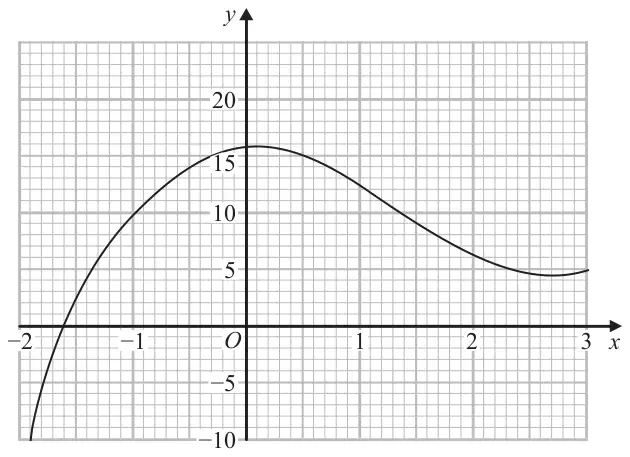
Part of the curve with equation \(y = \text{h}(x)\) is shown on the grid.
(d) Find an estimate for the gradient of the curve at the point where \(x = -0.5\)(3)
Mark scheme (a) Mark scheme (b) Mark scheme (c) Mark scheme (d)
Mark scheme (a) Scheme Marks \(\dfrac{3}{4}\) oe B1 (1)
Mark scheme (b) Scheme Marks \(\dfrac{x - 5}{4(x - 5) - 3}\) M1 \(\dfrac{x - 5}{4x - 23}\) A1 (2)
Mark scheme (c) Scheme Marks \(y = \dfrac{x}{4x - 3}\) or \(x = \dfrac{y}{4y - 3}\)
\(y(4x - 3) = x\) or \(x(4y - 3) = y\)
M1 \(4xy - 3y = x\) or \(4xy - 3x = y\) M1 \(\dfrac{3x}{4x - 1}\) oe A1 (3)
Notes M1: Moving the denominator to the other side of the equation
M1: Factorising the variable on one side in a correct expression
Mark scheme (d) Scheme Marks Tangent drawn at \(x = -0.5\) M1 (G =) 18 ÷ 3 oe M1 Working required A1 (3) (9 marks)
Notes M1: Drawing a tangent at \(x = -0.5\)
M1: Correct method to work out the gradient of the tangent at \(x = -0.5\) or \(x = +0.5\)
A1: Dep on 1st M1SC B1 B1 for drawing a tangent at \(x = +0.5\) and gradient = −3 → −4
Foundation June 2019 Paper 1R Q10
10 Here is a number machine.
(a) Work out the output when the input is 8 (1)
(b) Work out the input when the output is 82 (2)
The input is \(y\).
(c) Find an expression, in terms of \(y\), for the output. (2)
Mark scheme (a) Mark scheme (b) Mark scheme (c)
Mark scheme (a) Mark scheme (b) Scheme Marks (82 + 9) ÷ 7 or 82 + 9 (= 91) M1 13 A1 (2)
Mark scheme (c) Scheme Marks \(7y - 9\) B2 (2) (5 marks)
Notes B2: oe e.g. \(y \times 7 - 9\)or \(y - 9\) or \(y = 7y - 9\)
Higher January 2019 Paper 1R Q23
23 The function f is defined as \(\mathrm{f}(x) = \dfrac{\sqrt{x^2 + k^2}}{x}\) for \(x \gt 0\) and where \(k\) is a positive number.
(a) Find the value of \(p\) for which \(\mathrm{f}^{-1}(p) = k\) (3)
The function g is defined as \(\mathrm{g}(x) = x^2\) for \(x \gt 0\)
(b) Given that \(\mathrm{gf}(a) = k\) for \(k \gt 1\)(3)
Mark scheme (a) Mark scheme (a) (Alternative method) Mark scheme (b)
Mark scheme (a) Scheme Marks \(y = \dfrac{\sqrt{x^2 + k^2}}{x}\), \(x^2y^2 = x^2 + k^2\) \(x^2(y^2 - 1) = k^2\) M1 \(\dfrac{k}{\sqrt{p^2 - 1}} = k\) M1 \(\sqrt{2}\) A1 (3)
Notes M1: for squaring and rearranging correctly to the form \(x^2(y^2 - 1) = k^2\)
M1: (dep) for “\(\mathrm{f}^{-1}(p)\)” = \(k\)
Mark scheme (a) (Alternative method) Scheme Marks \(p = \mathrm{f}(k)\) M1 \(p = \dfrac{\sqrt{k^2 + k^2}}{k}\) M1 \(\sqrt{2}\) A1
Mark scheme (b) Scheme Marks \((\mathrm{gf}(a) =)\left(\dfrac{\sqrt{a^2 + k^2}}{a}\right)^2\) or \((\mathrm{gf}(x) =)\left(\dfrac{\sqrt{x^2 + k^2}}{x}\right)^2\) M1 \(ka^2 - a^2 = k^2\) M1 \(\dfrac{k}{\sqrt{k - 1}}\) A1 (3) (6 marks)
Notes M1: (dep) for rearranging gf = \(k\) and isolating correctly the terms in \(a^2\)
A1: oe eg \(\sqrt{\dfrac{k^2}{k - 1}}\)
Higher January 2019 Paper 1 Q19
19 g is the function with domain \(x \geqslant -3\) such that \(\text{g}(x) = x^2 + 6x\)
(a) Write down the range of \(\text{g}^{-1}\) (1)
(b) Express the inverse function \(\text{g}^{-1}\) in the form \(\text{g}^{-1} : x \mapsto \ldots\) (4)
Mark scheme (a) Mark scheme (b)
Mark scheme (a) Scheme Marks \(y \geqslant -3\) B1 (1)
Notes B1: Accept \(\text{g}^{-1}(x) \geqslant -3\)
Mark scheme (b) Scheme Marks \((x + 3)^2 - 3^2\) or \((x + 3)^2 - 9\) or \((y + 3)^2 - 3^2\) or \((y + 3)^2 - 9\) M1 \(y + 9 = (x + 3)^2\) or \(x + 9 = (y + 3)^2\) M1 \(\sqrt{y + 9} = x + 3\) or \(\sqrt{x + 9} = y + 3\) M1 \(-3 + \sqrt{x + 9}\) A1 (4) (5 marks)
Notes M1: for completing the square
A1: oe
M3A0 for \(-3 + \sqrt{y + 9}\) and for \(-3 \pm \sqrt{x + 9}\)
Higher January 2019 Paper 2 Q17
17 f is the function such that \(\mathrm{f}(x) = 4 - 3x\)
(a) Work out \(\mathrm{f}(5)\) (1)
g is the function such that \(\mathrm{g}(x) = \dfrac{1}{1 - 2x}\)
(b) Find the value of \(x\) that cannot be included in any domain of g (1)
(c) Work out \(\mathrm{fg}(-1.5)\) (2)
Mark scheme (a) Mark scheme (b) Mark scheme (c)
Mark scheme (a) Mark scheme (b) Mark scheme (c) Scheme Marks \(\mathrm{g}(-1.5) = 1 \div (1 - 2 \times -1.5)\) (=0.25) or
\(\mathrm{fg}(x) = 4 - 3 \times \left(\dfrac{1}{1 - 2x}\right)\) oe
M1 3.25 oe A1 (2) (4 marks)
Notes M1: \(\mathrm{g}(-1.5)\) must be the correct calculation alone.
Foundation January 2019 Paper 2R Q7
7 Here is a number machine.
(a) Work out the output when the input is 8 (1)
(b) Work out the input when the output is 120 (2)
Mark scheme (a) Mark scheme (b)
Mark scheme (a) Mark scheme (b) Scheme Marks M1 220 A1 (2) (3 marks)
Notes M1: For −10, × 2 or 110
Higher June 2018 Paper 1R Q20
20 Two functions, f and g are defined as
\(\mathrm{f} : x \mapsto 1 + \dfrac{1}{x}\) for \(x \gt 0\)
\(\mathrm{g} : x \mapsto \dfrac{x + 1}{2}\) for \(x \gt 0\)
Given that \(\mathrm{h} = \mathrm{fg}\)
express the inverse function \(\mathrm{h}^{-1}\) in the form \(\mathrm{h}^{-1} : x \mapsto \ldots\)
(4)
Mark scheme Mark scheme (Alternative scheme)
Mark scheme Scheme Marks \(\mathrm{h} = \mathrm{f}\left(\dfrac{x + 1}{2}\right) = 1 + \dfrac{1}{\frac{x + 1}{2}} \left(= 1 + \dfrac{2}{x + 1}\right)\) M1 \(\left(y = 1 + \dfrac{2}{x + 1}\right)\)
\(y - 1 = \dfrac{2}{x + 1}\) or \(y(x + 1) = 1(x + 1) + 2\)
M1 \(x + 1 = \dfrac{2}{y - 1}\) or \(xy - x = 3 - y\) M1 \(x = \dfrac{2}{y - 1} - 1\) or \(x = \dfrac{3 - y}{y - 1}\)
Answer: \(\dfrac{2}{x - 1} - 1\) or \(\dfrac{3 - x}{x - 1}\)
A1 (4) (4 marks)
Notes M1: for \(1 + \dfrac{1}{\frac{x + 1}{2}}\)
M1: (dep on M1) for a correct first step to change the subject
M1: (dep on M1)
A1: oe
Note: Allow candidates to swap \(x\) and \(y\) when finding the inverse
Mark scheme (Alternative scheme) Scheme Marks \(\mathrm{h} = \mathrm{f}\left(\dfrac{x + 1}{2}\right) = 1 + \dfrac{1}{\frac{x + 1}{2}} \left(= 1 + \dfrac{2}{x + 1} = \dfrac{x + 3}{x + 1}\right)\) M1 \(\left(y = \dfrac{x + 3}{x + 1}\right)\)
\(y(x + 1) = (x + 3)\)
M1 \(xy - x = 3 - y\) M1 \(x = \dfrac{3 - y}{y - 1}\)
Answer: \(\dfrac{3 - x}{x - 1}\)
A1
Notes M1: for \(1 + \dfrac{1}{\frac{x + 1}{2}}\)
M1: (dep on M1) for a correct first step to change the subject
M1: (dep on M1)
A1: oe
Higher June 2018 Paper 1 Q14
14 The function f is such that
\(\mathrm{f}(x) = \dfrac{3x - 5}{4}\)
(a) Find \(\mathrm{f}(-7)\) (1)
(b) Express the inverse function \(\mathrm{f}^{-1}\) in the form \(\mathrm{f}^{-1}(x) = \ldots\) (2)
The function g is such that
\(\mathrm{g}(x) = \sqrt{19 - x}\)
(c) Find \(\mathrm{fg}(3)\) (2)
(d) Which values of \(x\) cannot be included in any domain of g? (2)
Mark scheme (a) Mark scheme (b) Mark scheme (c) Mark scheme (d)
Mark scheme (a) Mark scheme (b) Scheme Marks \(4y = 3x - 5\) or \(4x = 3y - 5\) M1 \(\dfrac{4x + 5}{3}\) oe A1 (2)
Mark scheme (c) Scheme Marks \(\sqrt{19 - 3}\) oe or f(4) or \(\dfrac{3\sqrt{19 - 3} - 5}{4}\)
or \(\dfrac{3\sqrt{19 - x} - 5}{4}\) oe
M1 1.75 oe A1 (2)
Notes A1: for 1.75 oe (and no other solution)
Mark scheme (d) Scheme Marks \(x \gt 19\) B2 (2) (7 marks)
Notes B2: for (\(x\)) > 19 or an equivalent statement in words
Foundation June 2018 Paper 1R Q6
6 Here is a number machine.
(a) Work out the output when the input is 18 (1)
(b) Work out the input when the output is 20 (2)
Here is a different number machine.
For this number machine, when the input is 8 the output is 50
(c) Work out the value of \(x\). (2)
Mark scheme (a) Mark scheme (b) Mark scheme (c)
Mark scheme (a) Mark scheme (b) Scheme Marks 20 + 8 = 28 M1 7 A1 (2)
Mark scheme (c) Scheme Marks M1 10 A1 (2) (5 marks)
4MA0 Higher January 2018 Paper 3R Q23
23 f is the function such that \(\mathrm{f}(x) = (x + 1)^2\) for \(x > 0\)
(a) Find the value of \(a\) for which \(\mathrm{f}(a) = \dfrac{25}{9}\)(3)
g is the function such that \(\mathrm{g}(x) = \dfrac{1}{x}\) for \(x > 0\)
(b) Show that \(x^2\mathrm{fg}(x) = \mathrm{f}(x)\) for all \(x > 0\) (2)
h is the function such that \(\mathrm{hf}(x) = x\) for all \(x > 1\)
(c) Find the function h in the form \(\mathrm{h}(x) = \ldots\) (2)
Mark scheme (a) Mark scheme (b) Mark scheme (c)
Mark scheme (a) Scheme Marks \((a + 1)^2 = \dfrac{25}{9}\) M1 \(a + 1 = (\pm)\dfrac{5}{3}\) M1 \(\dfrac{2}{3}\) A1 (3)
Notes M1: or \(a + 1 = \dfrac{5}{3}\) or solving a correct quadratic equation of the form \(ax^2 + bx + c = 0\) e.g. \(a^2 + 2a - \dfrac{16}{9} = 0\) followed by \(\left(a - \dfrac{2}{3}\right)\left(a + \dfrac{8}{3}\right)(= 0)\)
or \(a = \dfrac{-2 \pm \sqrt{2^2 - 4 \times 1 \times -\dfrac{16}{9}}}{2}\) (allow 1 sign error)
A1: (DEP on at least M1) for \(\dfrac{2}{3}\) as the only value
Mark scheme (b) Scheme Marks \(\mathrm{fg}(x) = \mathrm{f}\left(\dfrac{1}{x}\right) = \left(\dfrac{1}{x} + 1\right)^2\) M1 \(x^2\left(\dfrac{1}{x} + 1\right)^2 = \) etc.
Answer: Shown
A1 (2)
Mark scheme (c) Scheme Marks \(y = (x + 1)^2 \therefore \sqrt{y} = x + 1\) or
\(x = (y + 1)^2 \therefore \sqrt{x} = y + 1\)
M1 \(\sqrt{x} - 1\) A1 (2)
Notes M1: (accept \(\pm\sqrt{y} = x + 1\) or \(\pm\sqrt{x} = y + 1\))
4MA0 Higher January 2018 Paper 3 Q23
23 f is the function such that \(\mathrm{f}(x) = \dfrac{3x}{x - 2}\) where \(x \neq 2\)
g is the function such that \(\mathrm{g}(x) = \dfrac{4x}{5}\)
(a) Find \(\mathrm{gf}(-4)\) (2)
(b) Express the composite function fg in the form \(\mathrm{fg}(x) = \ldots\)(3)
(c) Express the inverse function \(\mathrm{f}^{-1}\) in the form \(\mathrm{f}^{-1}(x) = \ldots\) (3)
Mark scheme (a) Mark scheme (b) Mark scheme (c)
Mark scheme (a) Scheme Marks \((\mathrm{f}(-4) =)\;\dfrac{3 \times -4}{-4 - 2}\;(= 2)\) or
\((\mathrm{gf}(x) =)\;\dfrac{4\left(\dfrac{3x}{x - 2}\right)}{5}\) oe or \(\dfrac{4\left(\dfrac{3 \times -4}{-4 - 2}\right)}{5}\)
M1 1.6 A1 (2)
Mark scheme (b) Scheme Marks \(\dfrac{3 \times \dfrac{4x}{5}}{\dfrac{4x}{5} - 2}\) M1 E.g. \(\dfrac{12x}{4x - 10}\) oe M1 \(\dfrac{6x}{2x - 5}\) A1 (3)
Notes M1: for a correct first expression for \(\mathrm{fg}(x)\)
M1: for a correct unsimplified fraction of the form \(\dfrac{ax}{bx - c}\) where \(a\), \(b\) and \(c\) are integers
A1: cao
SC : Award B2 for \(\dfrac{3x}{x - 2.5}\)
Mark scheme (c) Scheme Marks \(y = \dfrac{3x}{x - 2}\) or \(x = \dfrac{3y}{y - 2}\)
\(y(x - 2) = 3x\) or \(x(y - 2) = 3y\)
M1 \(xy - 3x = 2y\) or \(x(y - 3) = 2y\)or M1 \(\dfrac{2x}{x - 3}\) A1 (3)
Notes M1: for writing function in the form \(y = \dfrac{3x}{x - 2}\) or \(x = \dfrac{3y}{y - 2}\) and multiplying both sides by the denominator
M1: isolating terms in \(x\) (or \(y\))
A1: oe must be in terms of \(x\)
4MA0 Higher June 2017 Paper 4R Q20
20 The functions f and g are such that
\[\mathrm{f}(x) = \frac{1}{x + 5} \quad \text{and} \quad \mathrm{g}(x) = 2x + 3\]
(a) State which value of \(x\) must be excluded from any domain of f. (1)
(b) Find g(10) (1)
(c) Calculate gf(−7) (2)
(d) Express the inverse function \(\mathrm{g}^{-1}\) in the form \(\mathrm{g}^{-1}(x) = \ldots\) (2)
Mark scheme (a) Mark scheme (b) Mark scheme (c) Mark scheme (d)
Mark scheme (a) Mark scheme (b) Mark scheme (c) Scheme Marks (f(−7)) = \(\dfrac{1}{-7 + 5}\) or (f(−7)) = \(-\dfrac{1}{2}\) or
\(2\left(\dfrac{1}{-7 + 5}\right) + 3\) or \(2 \times -\dfrac{1}{2} + 3\)
M1 2 A1 (2)
Mark scheme (d) Scheme Marks \(x - 3 = 2y\) or \(\dfrac{x}{2} = y + \dfrac{3}{2}\) or
\(y - 3 = 2x\) or \(\dfrac{y}{2} = x + \dfrac{3}{2}\) or
\(\dfrac{y - 3}{2}\) or \(\dfrac{y}{2} - \dfrac{3}{2}\)
M1 \(\dfrac{x - 3}{2}\) A1 (2) (6 marks)
Notes A1: oe
Eg \(\dfrac{x}{2} - \dfrac{3}{2}\)
4MA0 Higher June 2017 Paper 3 Q19
19 \(\mathrm{f}(x) = \dfrac{4}{x - 3}\)
\(\mathrm{g}(x) = \dfrac{x - 2}{x}\)
(a) Express the inverse function \(\mathrm{f}^{-1}\) in the form \(\mathrm{f}^{-1}(x) = \ldots\) (3)
(b) Solve \(\mathrm{fg}(a) = 1\)(3)
Mark scheme (a) Mark scheme (b)
Mark scheme (a) Scheme Marks \(x = \dfrac{4}{y - 3}\)
\(x(y - 3) = 4\)
or \(y = \dfrac{4}{x - 3}\)
\(y(x - 3) = 4\)
M1 \(xy = 4 + 3x\) or
\(y - 3 = \dfrac{4}{x}\)
or \(xy = 4 + 3y\) or
\(x - 3 = \dfrac{4}{y}\)
M1 \(\dfrac{4 + 3x}{x}\) oe A1 (3)
Notes M1: for \(x(y - 3) = 4\) or \(y(x - 3) = 4\)
M1: (implies the first M1)
A1: for \(\dfrac{4 + 3x}{x}\) oe e.g. \(\dfrac{4}{x} + 3\)
Mark scheme (b) Scheme Marks E.g. \((\mathrm{fg}(a) =)\;\dfrac{4}{\dfrac{a - 2}{a} - 3}\) or \(4 = \dfrac{a - 2}{a} - 3\) or
\(\dfrac{4a}{a - 2 - 3a}\;(= 1)\)
M1 E.g. \(4a = a - 2 - 3a\) or M1 \(a = -\dfrac{1}{3}\) oe A1 (3) (6 marks)
Notes M1: for a correct expression for \(\mathrm{fg}(a)\)
M1: for a correct equation where the fraction has been removed.
A1: dep on M1
Alternative scheme Scheme Marks E.g. \(\mathrm{g}(a) = \mathrm{f}^{-1}(1)\) or \(\mathrm{g}(a) = \dfrac{4 + 3 \times 1}{1}\) oe or
\(\dfrac{4 + 3 \times 1}{1} = \dfrac{a - 2}{a}\) or \(7 = \dfrac{a - 2}{a}\)
M1 E.g. \(7a = a - 2\) M1 \(a = -\dfrac{1}{3}\) oe A1
Notes M1: for use of \(\mathrm{f}^{-1}\mathrm{fg}(a) = \mathrm{f}^{-1}(1)\)
M1: for a correct equation where the fraction has been removed.
A1: dep on M1
4MA0 Higher January 2017 Paper 3R Q19
19 The function f is defined as \(\;\mathrm{f}(x) = \dfrac{3}{2 - x}\)
(a) State the value of \(x\) which cannot be included in any domain of f. (1)
(b) Find f(–4) (1)
(c) Express the inverse function \(\mathrm{f}^{-1}\) in the form \(\mathrm{f}^{-1}(x) = \ldots\) (2)
The function g is defined as \(\;\mathrm{g}(x) = \dfrac{2x + 1}{3}\)
(d) Express the function fg in the form \(\mathrm{fg}(x) = \ldots\)(2)
Mark scheme (a) Mark scheme (b) Mark scheme (c) Mark scheme (d)
Mark scheme (a) Mark scheme (b) Mark scheme (c) Scheme Marks \(y(2 - x) = 3\) or \(x(2 - y) = 3\) oe M1 \(\dfrac{2x - 3}{x}\) A1 (2)
Notes A1: \(\dfrac{3 - 2x}{-x}\) or \(2 - \dfrac{3}{x}\)
must be in terms of \(x\)
Mark scheme (d) Scheme Marks \(\dfrac{3}{2 - \dfrac{2x + 1}{3}}\) oe M1 \(\dfrac{9}{5 - 2x}\) A1 (2) (6 marks)
4MA0 Higher January 2017 Paper 4 Q18
18 The function f is such that \(\quad\mathrm{f}(x) = \dfrac{2x}{3x + 5}\)
(a) Find \(\;\mathrm{f}(-2)\) (1)
The function g is such that \(\quad\mathrm{g}(x) = \dfrac{3}{x + 4}\)
(b) Find \(\;\mathrm{g}^{-1}(6)\) (2)
(c) Find \(\;\mathrm{fg}(-5)\) (2)
(d) Solve the equation \(\;\mathrm{f}(x) = \mathrm{g}(x)\)(4)
Mark scheme (a) Mark scheme (b) Mark scheme (c) Mark scheme (d)
Mark scheme (a) Mark scheme (b) Scheme Marks \(6 = \dfrac{3}{x + 4}\) or (\(x =\)) \(\dfrac{3}{6} - 4\) or \(\dfrac{3 - 4 \times 6}{6}\) oe M1 \(-3\frac{1}{2}\) A1 (2)
Notes M1: or \(\left(\mathrm{g}^{-1}(x) =\right) \dfrac{3}{x} - 4\) or \(\dfrac{3 - 4x}{x}\)
A1: oe
Mark scheme (c) Scheme Marks f(−3) or \(\dfrac{2 \times -3}{3 \times -3 + 5}\) or \(\dfrac{2 \times \dfrac{3}{-5 + 4}}{3 \times \dfrac{3}{-5 + 4} + 5}\) M1 \(1\dfrac{1}{2}\) A1 (2)
Notes M1: Or for (g(−5) =) \(\dfrac{3}{-5 + 4}\) or −3
A1: or \(\dfrac{6}{4}\) or \(\dfrac{3}{2}\) or 1.5
Mark scheme (d) Scheme Marks \(2x(x + 4) = 3(3x + 5)\) or \(2x^2 + 8x = 9x + 15\) oe or
\(\dfrac{2x(x + 4)}{(3x + 5)(x + 4)} = \dfrac{3(3x + 5)}{(3x + 5)(x + 4)}\) or
\(\dfrac{2x(x + 4)}{(3x + 5)(x + 4)} - \dfrac{3(3x + 5)}{(3x + 5)(x + 4)}\) (= 0)
M1 \(2x^2 - x - 15\) (= 0) or \(\dfrac{2x^2 - x - 15}{(3x + 5)(x + 4)}\) (= 0) A1 \((2x + 5)(x - 3)\) (= 0) or \(\dfrac{(2x + 5)(x - 3)}{(3x + 5)(x + 4)}\) (= 0) M1 \(-2\frac{1}{2}\), 3 A1 (4) (9 marks)
Notes M1: or correct substitution into quadratic formula
A1: dep on previous M1
4MA0 Higher June 2016 Paper 3R Q18
18 f is the function such that
\[\mathrm{f}(x) = \dfrac{x}{3x + 1}\]
(a) Find \(\mathrm{f}(0.5)\) (1)
(b) Find \(\mathrm{ff}(-1)\) (2)
(c) Find the value of \(x\) that cannot be included in any domain of f (1)
(d) Express the inverse function \(\mathrm{f}^{-1}\) in the form \(\mathrm{f}^{-1}(x) = \ldots\)Show clear algebraic working. (3)
Mark scheme (a) Mark scheme (b) Mark scheme (c) Mark scheme (d)
Mark scheme (a) Scheme Marks \(\dfrac{1}{5}\) B1oe (1)
Mark scheme (b) Scheme Marks M1 \(\dfrac{1}{5}\) A1oe (2)
Notes M1: \(\mathrm{f}(-1) = \dfrac{1}{2}\) or substitution of \(x = -1\) into \(\dfrac{\left(\dfrac{x}{3x + 1}\right)}{\left(\dfrac{3x}{3x + 1}\right) + 1}\)
Mark scheme (c) Scheme Marks \(-\dfrac{1}{3}\) B1 (1)
Mark scheme (d) Scheme Marks \(x = \dfrac{y}{3y + 1}\)
\(x(3y + 1) = y\) or \(3xy + x = y\)
or
\(y = \dfrac{x}{3x + 1}\)
\(y(3x + 1) = x\) or \(3xy + y = x\)
M1 \(3xy - y = -x\) oror M1 \(\dfrac{x}{1 - 3x}\) or \(\dfrac{-x}{3x - 1}\) A1 (3)
Notes M1: For writing function in the form \(x = \dfrac{y}{3y + 1}\) or \(y = \dfrac{x}{3x + 1}\) and multiplying both sides by the denominator
M1: For gathering terms in \(x\) or \(y\) (whichever is applicable) correctly
A1: Dep on M1
4MA0 Higher June 2016 Paper 4 Q17
17 f is the function such that \(\mathrm{f}(x) = 2x - 5\)
(a) Find \(\mathrm{f}(4)\) (1)
(b) Find \(\mathrm{fg}(-4)\) (2)
(c) Express the inverse function \(\mathrm{f}^{-1}\) in the form \(\mathrm{f}^{-1}(x) = \ldots\) (2)
(d) Solve \(\mathrm{gf}(x) = -1\) (4)
Mark scheme (a) Mark scheme (b) Mark scheme (c) Mark scheme (d)
Mark scheme (a) Mark scheme (b) Notes M1: For \(2((-4)^2 - 10) - 5\) oe or
Mark scheme (c) Scheme Marks \(2x = y + 5\) or \(2y = x + 5\) or
\(\dfrac{1}{2}(y + 5)\)
M1 \(\dfrac{1}{2}(x + 5)\) A1 (2)
Mark scheme (d) Scheme Marks \((2x - 5)^2 - 10\) (= −1) or M1 \(4x^2 - 20x + 16\) (= 0) or M1 \((4x - 4)(x - 4)\) (= 0) or
\((2x - 2)(x - 4)\) (= 0) or
\((x - 4)(x - 1)\) (= 0) or
\(2x - 5 = \pm 3\)
\(\dfrac{--5 \pm \sqrt{(-5)^2 - 4(1)(4)}}{2(1)}\)
(may be partially evaluated; condone lack of brackets around negative numbers)
M1 \(x = 1\), \(x = 4\) A1 (4)
Notes M1: For a correct expression for \(\mathrm{gf}(x)\)
M1: For a correct 3 part quadratic or
M1: For factorising a correct equation or for use of quadratic formula with a correct equation or
Alternative method Scheme Marks Eg \(a^2 - 10 = -1\) oe M1 \(a^2 = 9\) M1 \(2x - 5 = \pm 3\) M1 \(x = 1\), \(x = 4\) A1
Notes M1: For a correct equation relating to \(\mathrm{g}(a) = -1\)
M1: For \(a^2 = 9\)
M1: For \(2x - 5 = \pm 3\)
4MA0 Higher January 2016 Paper 3R Q16
16
\[\mathrm{f}(x) = \frac{2x}{x - 1}\]
(a) Find the value of f(11) (1)
(b) State which value of \(x\) must be excluded from any domain of f (1)
(c) Find \(\mathrm{f}^{-1}(x)\) (3)
(d) State the value which cannot be in any range of f (1)
Mark scheme (a) Mark scheme (b) Mark scheme (c) Mark scheme (d)
Mark scheme (a) Notes B1: Accept \(\dfrac{22}{10}\), \(\dfrac{11}{5}\), \(2\dfrac{1}{5}\)
Mark scheme (b) Mark scheme (c) Scheme Marks \(y(x - 1) = 2x\) or \(yx - y = 2x\) or \(x(y - 1) = 2y\) or \(xy - x = 2y\) M1 \(x(y - 2) = y\) or \(y(x - 2) = x\) M1 \(\dfrac{x}{x - 2}\) A1 (3)
Notes A1: oe Eg \(\dfrac{-x}{2 - x}\)
M2A0 for \(\dfrac{y}{y - 2}\)
Mark scheme (d) Notes B1: ft from (c) if a rational function with a linear denominator
4MA0 Higher January 2016 Paper 3 Q15
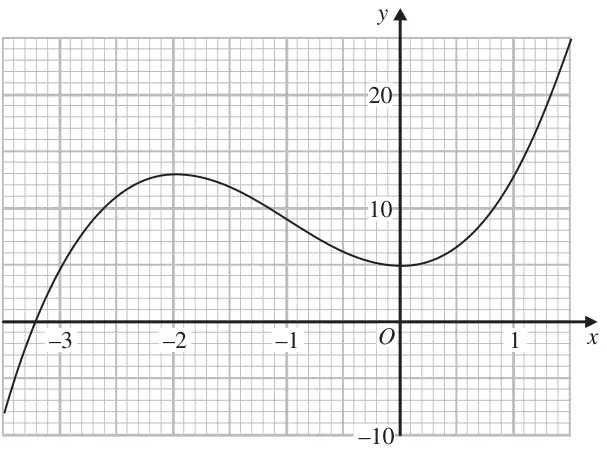
15 The diagram shows the graph of \(y = \mathrm{f}(x)\) for \(-3.5 \leqslant x \leqslant 1.5\)
(a) Find \(\mathrm{f}(0)\) (1)
(b) For which values of \(k\) does the equation \(\mathrm{f}(x) = k\) have only one solution? (2)
(c) Find an estimate for the gradient of the curve at the point where \(x = -2.5\) (3)
\(\mathrm{g}(x) = \dfrac{1}{2 + x}\)
(d) State which value of \(x\) must be excluded from any domain of g (1)
(e) Find \(\mathrm{fg}(-3)\) (2)
Mark scheme (a) Mark scheme (b) Mark scheme (c) Mark scheme (d) Mark scheme (e)
Mark scheme (a) Mark scheme (b) Scheme Marks (\(-7 \leqslant\) ) \(k \lt 5\), B2 (2)
Notes B2: accept \(k \leqslant 5\), \(k \geqslant 13\)or \(k \lt 5\) or \(k \gt 13\)
Mark scheme (c) Scheme Marks tangent drawn at \(x = -2.5\) M1 M1 7.5 A1 (3)
Notes M1: complete method to find gradient
A1: accept answers in range 7 - 8 with working seen
Mark scheme (d) Mark scheme (e) Scheme Marks \(\dfrac{1}{2 + -3}\) or −1 or \(\mathrm{f}(-1)\) M1 9 A1 (2)
4MA0 Higher June 2015 Paper 3R Q20
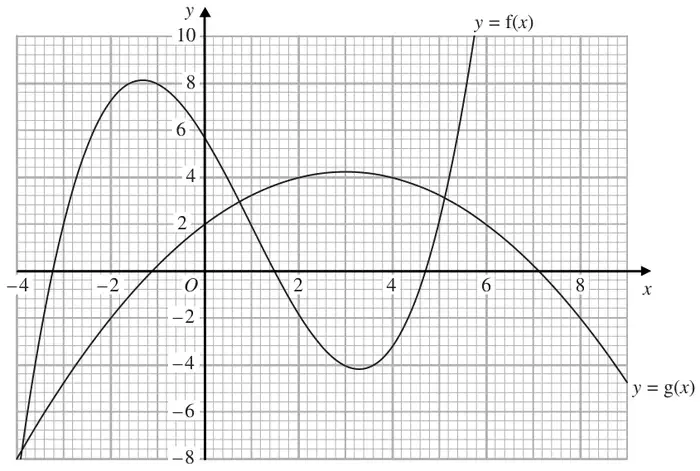
20 The diagram shows parts of the graphs of \(y = \mathrm{f}(x)\) and \(y = \mathrm{g}(x)\).
(a) Find g(0) (1)
(b) Find gf(–1) (2)
(c) Calculate an estimate for the gradient of the curve \(y = \mathrm{f}(x)\) at the point on the curve where \(x = 3\) (3)
Mark scheme (a) Mark scheme (b) Mark scheme (c)
Mark scheme (a) Mark scheme (b) Scheme Marks f(–1) = 8 M1 – 2 A1 (2)
Notes M1: may see on graph
Mark scheme (c) Scheme Marks Line drawn with negative gradient at (3, –4) M1 M1 –1 A1 (3)
Notes M1: correct method to find gradient (vertical / horizontal ignore sign at this stage – must use scale on graph )
A1: accept –0.7 to –1.4 inc dep on method seen
4MA0 Higher June 2015 Paper 3 Q17
17 \(\mathrm{f}(x) = \dfrac{3}{x + 1} + \dfrac{1}{x - 2}\)
(a) State one value of \(x\) which cannot be included in any domain of f. (1)
(b) Find the value of f(0) (1)
(c) Find the value of \(x\) for which f(\(x\)) = 0(3)
Mark scheme (a) Mark scheme (b) Mark scheme (c)
Mark scheme (a) Notes B1: for −1 or for 2 or both
Mark scheme (b) Scheme Marks \(\dfrac{5}{2}\) oe B1 (1)
Mark scheme (c) Scheme Marks \(\dfrac{3(x - 2)}{(x + 1)(x - 2)} + \dfrac{x + 1}{(x + 1)(x - 2)}\) or
\(\dfrac{3(x - 2)(x + 1)}{(x + 1)} + \dfrac{(x - 2)(x + 1)}{(x - 2)}\) or
\(3(x - 2) + x + 1\)
M1 \(3(x - 2) + x + 1 = 0\) oe or M1 \(\dfrac{5}{4}\) oe A1 (3)
Notes M1: for correct method to clear fractions
M1: for clearing fractions and obtaining a correct equation
A1: (depending on at least M1)
4MA0 Higher January 2015 Paper 3R Q21
21 The functions g and h are defined as
\[\mathrm{g}(x) = \dfrac{x}{2x - 5}\]
\[\mathrm{h}(x) = x + 4\]
(a) Find the value of \(\mathrm{g}(1)\) (1)
(b) State which value of \(x\) must be excluded from any domain of g (1)
(c) Find \(\mathrm{gh}(x)\)(2)
(d) Express the inverse function \(\mathrm{g}^{-1}\) in the form \(\mathrm{g}^{-1}(x) = \ldots\) (3)
Mark scheme (a) Mark scheme (b) Mark scheme (c) Mark scheme (d)
Mark scheme (a) Scheme Marks \(-\dfrac{1}{3}\) B1 (1)
Mark scheme (b) Mark scheme (c) Scheme Marks \(\dfrac{x + 4}{2(x + 4) - 5}\) M1 \(\dfrac{x + 4}{2x + 3}\) A1 (2)
Mark scheme (d) Scheme Marks \(y(2x - 5) = x\) M1 \(2xy - x = 5y\) M1 \(\dfrac{5x}{2x - 1}\) A1 (3) (7 marks)
Notes M1: or \(2xy - 5y = x\)
or or \(x(2y - 5) = y\) oe
M1: or \(x(2y - 1) = 5y\)
or or \(2xy - y = 5x\) oe
A1: \(\dfrac{5y}{2y - 1}\) is M2 only
4MA0 Higher January 2015 Paper 3 Q20
20 \(\mathrm{f}: x \mapsto 2x^2 + 1 \qquad \mathrm{g}: x \mapsto \dfrac{2x}{x - 1}\) where \(x \neq 1\)
(a) Express the composite function gf in the form \(\mathrm{gf}: x \mapsto \ldots\)(2)
(b) Express the inverse function \(\mathrm{g}^{-1}\) in the form \(\mathrm{g}^{-1}: x \mapsto \ldots\) (3)
Mark scheme (a) Mark scheme (b)
Mark scheme (a) Scheme Marks Eg \(\dfrac{2(2x^2 + 1)}{(2x^2 + 1) - 1}\) M1 \(\dfrac{(2x^2 + 1)}{x^2}\) A1 (2)
Notes M1: For a correct expression
A1: Accept \(2 + \dfrac{1}{x^2}\) or \(2 + x^{-2}\)
M1A0 for \(\dfrac{4x^2 + 2}{2x^2}\)
Mark scheme (b) Scheme Marks \(y(x - 1) = 2x\) or \(yx - y = 2x\) M1 \(x(y - 2) = y\) M1 \(\dfrac{x}{x - 2}\) A1 (3) (5 marks)
Notes M1: \(x(y - 1) = 2y\) or \(xy - x = 2y\)
M1: \(y(x - 2) = x\)
A1: Allow \(\dfrac{-x}{2 - x}\)
4MA0 Higher June 2014 Paper 3 Q21
21 The function f is defined as \(\mathrm{f}(x) = \dfrac{3}{4 + x}\)
(a) Find the value of \(\mathrm{f}(1)\) (1)
(b) State which value of \(x\) must be excluded from any domain of f. (1)
The function g is defined as \(\mathrm{g}(x) = 5 + x\)
(c) Given that \(\mathrm{g}(a) = 7\), find the value of \(a\). (1)
(d) Calculate \(\mathrm{fg}(1)\) (2)
(e) Find \(\mathrm{fg}(x)\)(2)
Mark scheme (a) Mark scheme (b) Mark scheme (c) Mark scheme (d) Mark scheme (e)
Mark scheme (a) Scheme Marks \(\dfrac{3}{5}\) B1 (1)
Notes B1: \(\frac{3}{5}\) or 0.6
Mark scheme (b) Scheme Marks \((x =)\ -4\) B1 (1)
Notes B1: accept \(x \neq -4\)
Mark scheme (c) Mark scheme (d) Scheme Marks \(\mathrm{g}(1) = 6\) M1 \(\dfrac{3}{10}\) A1 (2)
Notes M1: \(\dfrac{3}{4 + 5 + 1}\) or \(\dfrac{3}{4 + 6}\) or 6 or f(6)
A1: \(\frac{3}{10}\) or 0.3
Mark scheme (e) Scheme Marks \(\dfrac{3}{4 + 5 + x}\) M1 \(\dfrac{3}{9 + x}\) A1 (2) (7 marks)
4MA0 Higher June 2014 Paper 3R Q11
11 The functions f and g are defined as \[\mathrm{f}(x) = \dfrac{1}{2}x + 4\] \[\mathrm{g}(x) = \dfrac{2x}{x + 1}\]
(a) Work out \(\mathrm{f}(6)\) (1)
(b) Work out \(\mathrm{fg}(-3)\) (2)
(c) \(\mathrm{g}(a) = -2\)(2)
(d) Express the inverse function \(\mathrm{f}^{-1}\) in the form \(\mathrm{f}^{-1}(x) = \ldots\) (3)
Mark scheme (a) Mark scheme (b) Mark scheme (c) Mark scheme (d)
Mark scheme (a) Mark scheme (b) Scheme Marks \(\mathrm{g}(-3) = \dfrac{2 \times -3}{-3 + 1}\left(= \dfrac{-6}{-2} = 3\right)\) M1 \(5\frac{1}{2}\) A1 (2)
Notes M1: for correct expression for \(\mathrm{g}(-3)\)
A1: or 5.5 or 11/2
Mark scheme (c) Scheme Marks \(-2(a + 1) = 2a\) or \(-2a - 2 = 2a\) M1 \(-\frac{1}{2}\) A1 (2)
Notes M1: for correct equation with fraction cleared (allow \(x\))
A1: Accept \(-0.5\)
Mark scheme (d) Scheme Marks \(y = \frac{1}{2}x + 4\) or \(x = \frac{1}{2}y + 4\) (any two different variables) M1 \(x = 2(y - 4)\) or \(x = 2y - 8\)
Or \(y = 2x - 8\) or \(y = 2(x - 4)\)
or \(x = \dfrac{y - 4}{0.5}\) or \(y = \dfrac{x - 4}{0.5}\)
M1 \(2(x - 4)\) A1 (3) (8 marks)
Notes M1: For full method to correctly change the subject.
A1: or \(2x - 8\) or \(\dfrac{x - 4}{0.5}\) oe
Do not allow other variables.
SC : Award B2 for \(f^{-1}(x) = 2y - 8\) if no working shown.
4MA0 Higher January 2014 Paper 3R Q22
22 The functions f and g are such that \(\;\mathrm{f}(x) = x + 3\;\) and \(\;\mathrm{g}(x) = \dfrac{1}{x - 2}\)
(a) Find \(\mathrm{fg}(x)\)(3)
(b) Express the inverse function \(\mathrm{g}^{-1}\) in the form \(\mathrm{g}^{-1}(x) = \ldots\) (3)
Mark scheme (a) Mark scheme (b)
Mark scheme (a) Scheme Marks \(\dfrac{1}{x - 2} + 3\) M1 \(\dfrac{1 + 3(x - 2)}{x - 2}\) or \(\dfrac{1 + 3x - 6}{x - 2}\) M1 \(\dfrac{3x - 5}{x - 2}\) A1 (3)
Mark scheme (b) Scheme Marks \(y(x - 2) = 1\) or \(xy - 2y + 1\) M1 \(xy = 2y + 1\) M1 \(\dfrac{2x + 1}{x}\) A1 (3) (6 marks)
Notes A1: or \(\dfrac{1}{x} + 2\)
Alternative method \(x(y - 2) = 1\) or \(xy - 2x = 1\)
(corrected from the printed mark scheme: the question total is printed as “Total 5 marks”; the parts are worth 3 + 3 = 6 marks, as on the question paper)
4MA0 Higher January 2014 Paper 3 Q20
20 f is the function \(\;\mathrm{f}(x) = 2x + 5\)
(a) Find \(\mathrm{f}(3)\) (1)
(b) Express the inverse function \(\mathrm{f}^{-1}\) in the form \(\mathrm{f}^{-1}(x) =\) (2)
g is the function \(\;\mathrm{g}(x) = x^2 - 25\)
(c) Find \(\mathrm{g}(-3)\) (1)
(d) (i) Find \(\mathrm{gf}(x)\)
(ii) Solve \(\mathrm{gf}(x) = 0\)
(5) Mark scheme (a) Mark scheme (b) Mark scheme (c) Mark scheme (d)
Mark scheme (a) Mark scheme (b) Scheme Marks \(y = 2x + 5\)or M1 \(\dfrac{x - 5}{2}\) oe A1 (2)
Notes M1: for a correct first stage – subtract 5 from both sides or divide all terms by 2
Mark scheme (c) Mark scheme (d) Scheme Marks (i) \((2x + 5)^2 - 25\) M1 \(4x^2 + 10x + 10x + 25\) oe B1 \(4x^2 + 20x\) A1 (ii) \(4x(x + 5)\;(= 0)\) or \(x(4x + 20)\;(=0)\) M1 \(x = 0,\; x = -5\) A1 (5) (9 marks)
Notes B1: for correct expansion of \((2x + 5)^2\)
A1: or a correct fully or partially factorised expression
M1: or for eg \(\dfrac{-20 \pm \sqrt{20^2 - 4 \times 4 \times 0}}{2 \times 4}\)
A1: for both solutions
4MA0 Higher June 2013 Paper 4R Q23
23
(a) Show that \(\dfrac{x^2 + 3x}{2x^2 + 5x - 3}\) can be written as \(\dfrac{x}{kx - 1}\)(2)
(b) \(\mathrm{f}(x) = \dfrac{x}{2x - 1}\)(3)
Mark scheme (a) Mark scheme (b)
Mark scheme (a) Scheme Marks \(\dfrac{x(x+3)}{(2x-1)(x+3)}\) M1 2 A1 (2)
Notes M1: for factorising numerator and denominator
A1: cao dep on method mark
Mark scheme (b) Scheme Marks \(y = \dfrac{x}{2x - 1}\) M1 \(2xy - x = y\) or \(x(2y - 1) = y\) M1 \(\dfrac{x}{2x - 1}\) A1 (3)
Notes M1: for isolating \(x\) terms (or \(y\) terms in alt method)
A1: dep on both method marks.
Accept \(\dfrac{-x}{-2x + 1}\)
Alternative method
4MA0 Higher June 2013 Paper 4 Q17
17 The function f is defined as
\[\mathrm{f}(x) = \dfrac{x - 6}{2}\]
(a) Find \(\mathrm{f}(8)\) (1)
(b) Express the inverse function \(\mathrm{f}^{-1}\) in the form \(\mathrm{f}^{-1}(x) = \ldots\) (2)
The function g is defined as
\[\mathrm{g}(x) = \sqrt{x - 4}\]
(c) Which values of \(x\) cannot be included in a domain of g? (2)
(d) Express the function gf in the form \(\mathrm{gf}(x) = \ldots\)(2)
Mark scheme (a) Mark scheme (b) Mark scheme (c) Mark scheme (d)
Mark scheme (a) Mark scheme (b) Scheme Marks \(y = (x - 6) / 2\) M1 \(2x + 6\) A1 (2)
Notes M1: M1 or for a correct flowchart including inverse
Mark scheme (c) Scheme Marks \((x) \lt 4\) B2 (2)
Notes B2: B1 for \((x) \leqslant 4\)
Mark scheme (d) Scheme Marks \(\sqrt{\dfrac{x-6}{2} - 4}\) M1 \(\sqrt{\dfrac{x-14}{2}}\) A1 (2)
Notes A1: accept \(\sqrt{\dfrac{x}{2} - 7}\) condone ±
4MA0 Higher January 2013 Paper 4 Q23
23 f is a function such that \[\text{f}(x) = \frac{1}{x^2 + 1}\]
(a) Find \(\text{f}\left(\tfrac{1}{2}\right)\) (1)
g is a function such that \(\text{g}(x) = \sqrt{x - 1}\), \(x \geqslant 1\)
(b) Find \(\text{fg}(x)\)(2)
Mark scheme (a) Mark scheme (b)
Mark scheme (a) Scheme Marks \(\tfrac{4}{5}\) oe B1 (1)
Mark scheme (b) Scheme Marks \(\dfrac{1}{(\sqrt{x - 1})^2 + 1}\) or \(\dfrac{1}{x - 1 + 1}\) M1 \(\dfrac{1}{x}\) A1 (2)
Notes A1: Also accept \(x^{-1}\)
4MA0 Higher June 2012 Paper 4 Q19
19 \[\begin{aligned} \mathrm{f}(x) &= 3x - 2 \\ \mathrm{g}(x) &= \dfrac{10}{x + 2} \end{aligned}\]
(a) Express the inverse function \(\mathrm{f}^{-1}\) in the form \(\mathrm{f}^{-1}(x) = ...\) (2)
(b) Find \(\mathrm{gf}(x)\)(2)
Mark scheme (a) Mark scheme (b)
Mark scheme (a) Scheme Marks \(y = 3x - 2\) M1 \((x + 2)/3\) A1 (2)
Notes M1: or \(x = 3y - 2\)
A1: Ans only = M1A1 must be a function of \(x\)
Apart from questions 5, 7, 13c, 16b, 20, 21 and 22 (where the mark scheme states otherwise) the correct answer, unless clearly obtained by an incorrect method, should be taken to imply a correct method.
Mark scheme (b) Scheme Marks \(\dfrac{10}{3x - 2 + 2}\) M1 \(\dfrac{10}{3x}\) A1 cao (2) (Total 4 marks)
Notes A1 cao: Do not isw if correct answer is seen in body and extra incorrect operations take place. Ans only = M1A1
4MA0 Higher January 2012 Paper 4 Q17
17 \[\mathrm{f}(x) = \sqrt{x - 6}\]
(a) Find \(\mathrm{f}(10)\) (1)
(b) State which values of \(x\) must be excluded from a domain of f (2)
The diagram shows part of the graph of \(y = \mathrm{g}(x)\)
(c) Find \(\mathrm{g}(2)\) (1)
(d) Find \(\mathrm{fg}(0)\) (2)
(e) One of the solutions of \(\mathrm{g}(x) = k\), where \(k\) is a number, is \(x = 1\)(3)
(f) Find an estimate for the gradient of the curve at the point where \(x = 3.5\)(3)
Mark scheme (a) Mark scheme (b) Mark scheme (c) Mark scheme (d) Mark scheme (e) Mark scheme (f)
Mark scheme (a) Notes B1: cao
Apart from Questions 3, 13(b) and 17(f) (where the mark scheme states otherwise), the correct answer, unless clearly obtained by an incorrect method, should be taken to imply a correct method.
Mark scheme (b) Scheme Marks \(x \lt 6\) B2 (2)
Notes B2: cao B1 for eg \(x \leqslant 6\)SC B1 for \(x \geqslant 6\)
Mark scheme (c) Mark scheme (d) Scheme Marks \(\mathrm{g}(0) = 15\) M1 3 A1 (2)
Notes M1: for 15 seen
A1: cao If M0, award B1 for ± 3 oe
Mark scheme (e) Scheme Marks \(k = 12\) M1 −0.7 or −0.8 3.8 A2 (3)
Notes M1: May be stated or indicated on diagram. May be implied by one correct solution.
A2: A1 for solution rounding to −0.7 or −0.8
Mark scheme (f) Scheme Marks tan drawn at \(x = 3.5\) M1 \(\dfrac{\text{vertical difference}}{\text{horizontal difference}}\) M1 6.5 – 11 inc A1 (3) (Total 12 marks)
Notes M1: tan or tan produced passes between points (3, \(3 \leqslant y \leqslant 6\)) and (4, \(11 \leqslant y \leqslant 14\))
M1: finds their \(\dfrac{\text{vertical difference}}{\text{horizontal difference}}\) for two points on tan
or finds their \(\dfrac{\text{vertical difference}}{\text{horizontal difference}}\) for two points on curve, where one of the points has an \(x\)-coordinate between 3 and 3.5 inc and the other point has an \(x\)-coordinate between 3.5 and 4 inc
A1: dep on both M marks
4MA0 Higher June 2011 Paper 4 Q20
20 \[\begin{aligned} \mathrm{f}(x) &= \dfrac{2}{x} \\ \mathrm{g}(x) &= \dfrac{x + 1}{x} \end{aligned}\]
(a) State which value of \(x\) cannot be included in the domain of f or g. (1)
(b) Solve \(\mathrm{gf}(a) = 3\) (3)
(c) Express the inverse function \(\mathrm{g}^{-1}\) in the form \(\mathrm{g}^{-1}(x)\) (3)
Mark scheme (a) Mark scheme (b) Mark scheme (c)
Mark scheme (a) Scheme Marks (\(x\)=)0 B1 (1)
Notes B1: Accept (\(x\))≠0
Apart from questions 5b, 8, 15d, 20b, 21b, 23, 24b (where the mark scheme states otherwise) the correct answer, unless clearly obtained by an incorrect method, should be taken to imply correct working.
Mark scheme (b) Scheme Marks \(\left(\dfrac{2}{a} + 1\right) / \dfrac{2}{a} = 3\) M1 \(\dfrac{2}{a} + 1 = \dfrac{6}{a}\) or \(1 + \dfrac{a}{2} = 3\) oe M1 4 A1 (3)
Notes M1: (Any letter in place of \(a\) acceptable) Solve g(\(x\))=3 (\(x\)=0.5)
M1: Solve f(a)=0.5
A1: dep on M2
Mark scheme (c) Scheme Marks \(y = \dfrac{x + 1}{x}\) M1 \(x(y - 1) = 1\)
\(x = \dfrac{1}{y - 1}\)
M1 \(\dfrac{1}{x - 1}\) A1 (3) (Total 7 marks)
Notes M1: one occurrence of \(x\)
A1: reverse labels \(x\) and \(y\)
Alternative: \(x = \dfrac{y + 1}{y}\) reverse labels \(x\) and \(y\); \(y(x - 1) = 1\) one occurrence of \(y\)
4400 Higher November 2010 Paper 3 Q21
21
(a) \(\mathrm{f}(x) = 2x + 1\)(2)
(b) \(\mathrm{g}(x) = 2 + x\)(3)
Mark scheme (a) Mark scheme (b)
Mark scheme (a) Scheme Marks \(y = 2x + 1\)
\(x = \dfrac{y - 1}{2}\)
M1 \(\mathrm{f}^{-1}(x) = (x - 1)/2\) oe A1 (2)
Notes M1: \(x = 2y + 1\)
\(y = \dfrac{x - 1}{2}\)
A1: answer only = M1A1
Mark scheme (b) Scheme Marks \((2 + x)^2 = x^2\) M1 \(4 + 4x + x^2 = x^2\) M1 \(x = -1\) A1 (3) (5 marks)
Notes M1: M1 for \((2 + x)^2\)
M1: or \(2 + x = -x\) (from rooting both sides)
A1: Answer only = M0A0A0
4400 Higher June 2010 Paper 4 Q20
20 \(\mathrm{f}(x) = (x - 1)^2\)
(a) Find \(\mathrm{f}(8)\) (1)
(b) The domain of \(\mathrm{f}\) is all values of \(x\) where \(x \geqslant 7\)(2)
\(\mathrm{g}(x) = \dfrac{x}{x - 1}\)
(c) Solve the equation \(\mathrm{g}(x) = 1.2\) (2)
(d) (i) Express the inverse function \(\mathrm{g}^{-1}\) in the form \(\mathrm{g}^{-1}(x) = \ldots\ldots\)
(ii) Hence write down \(\mathrm{gg}(x)\) in terms of \(x\).
(6) Mark scheme (a) Mark scheme (b) Mark scheme (c) Mark scheme (d)
Mark scheme (a) Mark scheme (b) Scheme Marks \((7 - 1)^2\) or 36 seen M1 \(\mathrm{f}(x) \geqslant 36\) or \(y \geqslant 36\) A1 (2)
Notes A1: allow \(\mathrm{f} \geqslant 36\) \(\quad x \geqslant 36\): M1A0 (don’t accept >)
Mark scheme (c) Scheme Marks \(\dfrac{x}{x - 1} = 1.2\)
\(x = 1.2(x - 1)\)
M1 6 A1 (2)
Notes M1: Do not accept \(\mathrm{g}(1.2) = 6\) method
A1: cao Answer only = M0 A0 Algebra method reqd.
Mark scheme (d) Scheme Marks (i) \(y = \dfrac{x}{x - 1}\) M1 \(y(x - 1) = x\) M1 \(xy - x = y\) M1 \(x = \dfrac{y}{y - 1}\) M1 \(\dfrac{x}{x - 1}\) A1 (ii) B1 (6) (11 marks)
Notes M1: \(x = \dfrac{y}{y - 1}\)
M1: \(x(y - 1) = y\)
M1: \(xy - y = x\)
B1: accept \([x/(x - 1)]/[(x/(x - 1) - 1]\) do not isw
4400 Higher November 2009 Paper 3 Q24
24 \(\mathrm{f}(x) = x^2\)
(a) (i) Find \(\mathrm{gf}(x)\)
(ii) Find \(\mathrm{g}^{-1}(x)\) (2)
(b) Solve the equation \(\mathrm{gf}(x) = \mathrm{g}^{-1}(x)\) (3)
Mark scheme (a) Mark scheme (b)
Mark scheme (a) Scheme Marks (i) B1 (ii) B1 (2)
Notes B1: accept “\(y\) =” \(x^2 - 3\)
B1: accept “\(y\) =” \(x + 3\)
Mark scheme (b) Scheme Marks “\(x^2 - 3\)” = “\(x + 3\)” M1ft \(x^2 - x - 6 = 0\) M1 \(x = 3\) \(\quad x = -2\) A1 (3) (5 marks)
Notes M1ft: quadratic = linear (\(ax + b\)) \(a, b \ne 0\)
M1: or formula reaching \((x =)\ (1 \pm \sqrt{25})/2\)
A1: cao algebraic method reqd
4400 Higher June 2009 Paper 3 Q15
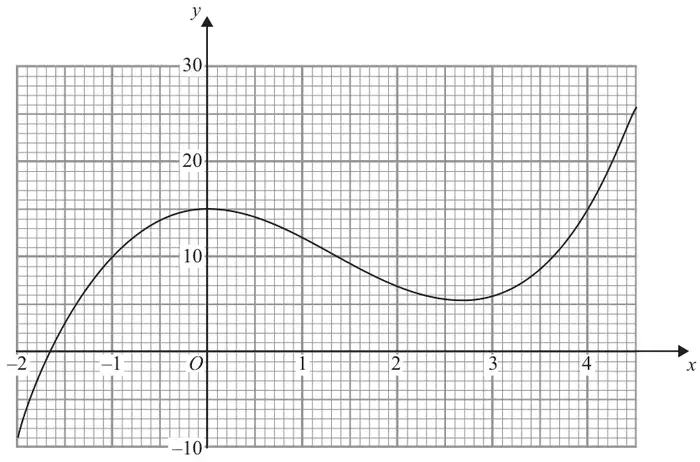
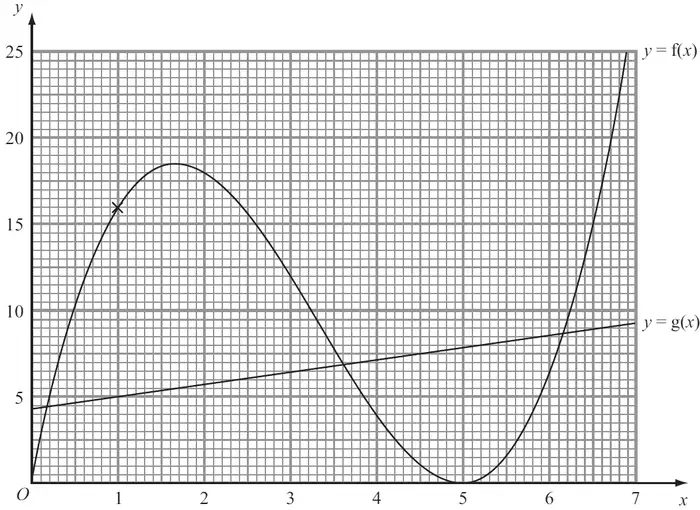
15 The diagram shows part of the graph of \(y = \mathrm{f}(x)\) and part of the graph of \(y = \mathrm{g}(x)\).
(a) Find \(\mathrm{f}(3)\). (1)
(b) Solve \(\mathrm{f}(x) = \mathrm{g}(x)\).(2)
(c) Find \(\mathrm{fg}(1)\). (2)
(d) Find an estimate for the gradient of the graph of \(y = \mathrm{f}(x)\) at the point (1, 16). (3)
Mark scheme (a) Mark scheme (b) Mark scheme (c) Mark scheme (d)
Mark scheme (a) Notes B1: cao Do not accept (3, 12)
Mark scheme (b) Scheme Marks 0.2 3.6 6.1 or 6.2 or values rounding to these B2 (2)
Notes B2: for all 3 correct solutions
Mark scheme (c) Scheme Marks 5 seen M1 0 A1 (2)
Mark scheme (d) Scheme Marks tan drawn at (1, 16) M1 \(\dfrac{\text{vertical difference}}{\text{horizontal difference}}\) M1 6 − 10 inc A1 (3) (8 marks)
Notes M1: tan or tan produced passes between points (0.5, \(11 \leqslant y \leqslant 13\)) and (1.5, \(19 \leqslant y \leqslant 21\))
M1: finds their \(\dfrac{\text{vertical difference}}{\text{horizontal difference}}\) for two points on tan
or finds the intercept of their tangent on the \(y\)-axis and substitutes \(y = 16\), \(x = 1\) and their \(c\) into \(y = mx + c\)
or finds their \(\dfrac{\text{vertical difference}}{\text{horizontal difference}}\) for two points on curve, where one of the points has an \(x\)-coordinate between 0.5 and 1 inc and the other point has an \(x\)-coordinate between 1 and 1.5 inc
A1: dep on both M marks
4400 Higher November 2008 Paper 4 Q21
21 The function f is defined as\[\mathrm{f}(x) = \frac{1}{x + 3}\]
(a) Find the value of \(\mathrm{f}(2)\) (1)
(b) State which value(s) of \(x\) must be excluded from the domain of f. (1)
(c) Given that \(\mathrm{f}(a) = \dfrac{1}{10}\), find the value of \(a\). (1)
(d) The function g is defined as\[\mathrm{g}(x) = x + 2\]Express the function gf in the form \(\mathrm{gf}(x) = .....\)(2)
Mark scheme (a) Mark scheme (b) Mark scheme (c) Mark scheme (d)
Mark scheme (a) Scheme Marks \(\frac{1}{5}\) oe B1 (1)
Mark scheme (b) Notes B1: or \(x \ne -3\) or \(\mathrm{f}(-3)\) or \(x = -3\)
Mark scheme (c) Mark scheme (d) Scheme Marks \(\dfrac{1}{x + 3} + 2\) M1 \(\dfrac{2x + 7}{x + 3}\) A1 (2) (5 marks)
4400 Higher June 2008 Paper 4 Q23
23
(a) Simplify \(\dfrac{x^2 - 9}{x^2 + 3x}\) (3)
\(\mathrm{f}(x) = \dfrac{x^2 - 9}{x^2 + 3x} \qquad \mathrm{g}(x) = \dfrac{1}{x^2}\)
(b) Use your answer to part (a) to find and simplify \(\mathrm{fg}(x)\). (2)
Mark scheme (a) Mark scheme (b)
Mark scheme (a) Scheme Marks \((x - 3)(x + 3)\) M1 \(x(x + 3)\) M1 \(\dfrac{x - 3}{x}\) A1 (3)
Notes A1: \(1 - \dfrac{3}{x}\)
Mark scheme (b) Scheme Marks \(\dfrac{\frac{1}{x^2} - 3}{\frac{1}{x^2}}\) or \(1 - \dfrac{3}{\frac{1}{x^2}}\) M1 \(1 - 3x^2\) A1 (2) (5 marks)
Notes M1: ft \(\dfrac{x + 3}{x}\) only
A1: cao
4400 Higher November 2007 Paper 4 Q23
23
\[\mathrm{f}: x \mapsto 3x + 2 \qquad \mathrm{g}: x \mapsto 2x - 5\]
(a) Express the composite function fg in the form \(\mathrm{fg}: x \mapsto \ldots\)(2)
(b) Express the inverse function \(\mathrm{f}^{-1}\) in the form \(\mathrm{f}^{-1}: x \mapsto \ldots\) (2)
Mark scheme (a) Mark scheme (b)
Mark scheme (a) Scheme Marks \(3(2x - 5) + 2\) or \(6x - 15 + 2\) M1 \(6x - 13\) A1 (2)
Mark scheme (b) Scheme Marks eg \(\begin{matrix} \times 3 \to +2 \\ \div 3 \leftarrow -2 \end{matrix}\) or attempt to make \(x\) the subject of \(y = 3x + 2\) or \(x = 3y + 2\) M1 \(\dfrac{x - 2}{3}\) oe A1 (2) (4 marks)
4400 Higher June 2007 Paper 4 Q17
17 The functions f and g are defined as follows.
\[\mathrm{f}(x) = \frac{1}{x + 2}\]\[\mathrm{g}(x) = \sqrt{x - 1}\]
(a) (i) State which value of \(x\) cannot be included in the domain of f.
(ii) State which values of \(x\) cannot be included in the domain of g. (3)
(b) Calculate \(\mathrm{fg}(10)\) (3)
(c) Express the inverse function \(\mathrm{g}^{-1}\) in the form \(\mathrm{g}^{-1}(x) = \ldots\) (4)
Mark scheme (a) Mark scheme (b) Mark scheme (c)
Mark scheme (a) Scheme Marks (i) B1 (ii) B2 (3)
Notes B1: or \(x \ne -2\) or \(x = -2\)
B2: B1 for \(x \leqslant 1\) or 0, −1, −2, −3 . . .
Mark scheme (b) Scheme Marks \(\sqrt{9}\) or \(\sqrt{10 - 1}\) M1 \(\dfrac{1}{\text{her}\sqrt{9} + 2}\) M1 \(\frac{1}{5}\) or 0.2 A1 (3)
Notes M1: or \(\dfrac{1}{\sqrt{x - 1} + 2}\)
A1: ignore ans = −1
Mark scheme (c) Scheme Marks \(y = \sqrt{x - 1}\) M1 \(y^2 = x - 1\) M1 \(x = y^2 + 1\) M1 (\(\mathrm{g}^{-1}(x) =\)) \(x^2 + 1\) oe A1 (4) (10 marks)
Notes Alternative −1, \(\sqrt{\ }\) M1 Reverse order M1dep squ, + 1 M1
Alternative \(y = \sqrt{x - 1}\) M1 \(x = \sqrt{y - 1}\) M1dep \(x^2 = y - 1\) M1
condone \(\sqrt{x} - 1\) if next step correct
\(y^2 + 1\) M3
4400 Higher November 2006 Paper 3 Q17
17 The function f is defined as \(\mathrm{f}(x) = \dfrac{x}{x - 1}\).
(a) Find the value of
(i) \(\mathrm{f}(3)\),
(ii) \(\mathrm{f}(-3)\). (2)
(b) State which value(s) of \(x\) must be excluded from the domain of f. (1)
(c) (i) Find \(\mathrm{ff}(x)\).
(ii) What does your answer to (c)(i) show about the function f? (4)
Mark scheme (a) Mark scheme (b) Mark scheme (c)
Mark scheme (a) Scheme Marks (i) B1 (ii) B1 (2)
Notes B1: Don’t accept \(\dfrac{-3}{-4}\)
Mark scheme (b) Mark scheme (c) Scheme Marks (i)
\(\dfrac{\frac{x}{x - 1}}{\frac{x}{x - 1} - 1}\)
M1 \(\dfrac{\frac{x}{x - 1}}{\frac{x - (x - 1)}{x - 1}}\) or \(\dfrac{x}{x - (x - 1)}\) oe M1 \(x\) A1 (ii) B1 (4) (7 marks)
Notes A1: cao
B1: dep on correct ci
SC B1 for \(\mathrm{ff}(x)\) evaluated correctly for two values of \(x\) and an answer of \(x\)
4400 Higher June 2006 Paper 3 Q23
23 \(\mathrm{f}(x) = x^2\)
Solve \(\mathrm{fg}(x) = \mathrm{f}(x)\).
(5)
Mark scheme
Mark scheme Scheme Marks \((2x + 3)^2 = x^2\) M1 \(4x^2 + 12x + 9 = x^2\) or \(4x^2 + 6x + 6x + 9 = x^2\) M1 \(3x^2 + 12x + 9 = 0\) M1 \((x + 1)(x + 3)\) M1 −1 \(\quad\) −3 A1 (5) (5 marks)
Notes M1: for \((2x + 3)^2\) seen
M1: Accept \((3x + 3)(x + 3)\) & \((3x + 9)(x + 1)\) or \(\dfrac{-12 \pm 6}{6}\) or \(\dfrac{-4 \pm 2}{2}\)
A1: for both solutions isw
Alternative \((2x + 3)^2 = x^2\) M1 \(2x + 3 = \pm x\) M2 \(x + 3 = 0\) or \(3x + 3 = 0\) M1 −1 \(\quad\) −3 A1
M2: (M1 for \(2x + 3 = x\))M1: for bothA1: for both solutions isw. Condone coordinates
4400 Higher November 2005 Paper 3 Q17
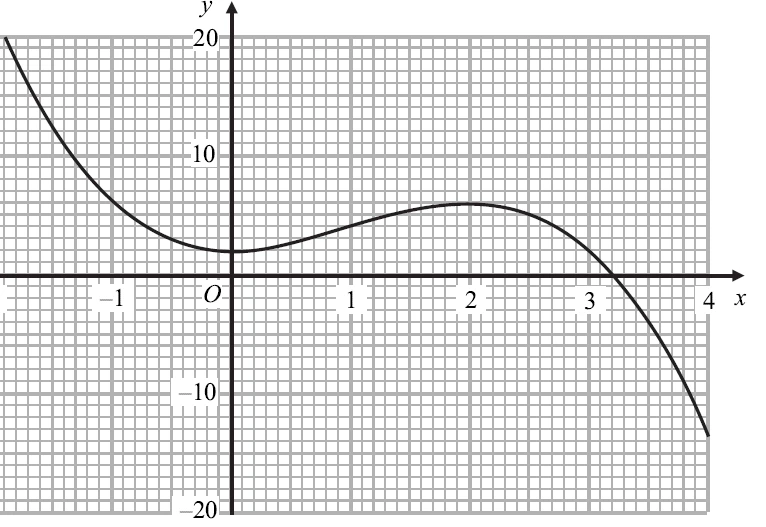
17 The diagram shows part of the graph of \(y = \mathrm{f}(x)\).
(a) Find \(\mathrm{f}(3)\). (1)
(b) Solve \(\mathrm{f}(x) = 6\) (2)
(c) Find \(\mathrm{ff}(1)\). (2)
(d) Find an estimate for the gradient of the curve at the point where \(x = -1\)
(3) The equation \(\mathrm{f}(x) = k\), where \(k\) is a number, has 3 solutions between \(x = -2\) and \(x = 4\)
(e) Complete the inequalities which \(k\) must satisfy.(2)
Mark scheme (a) Mark scheme (b) Mark scheme (c) Mark scheme (d) Mark scheme (e)
Mark scheme (a) Mark scheme (b) Notes B1: cao
B1: accept 1.9
Mark scheme (c) Scheme Marks f(4) M1 −14 A1 (2)
Notes A1: accept −13 to −14 inclusive
Mark scheme (d) Scheme Marks tangent drawn at \((-1, 6)\) M1 \(\dfrac{\text{vertical difference}}{\text{horizontal difference}}\) M1 \(\approx -9\) A1 (3)
Notes M1: within guidelines
M1: of points on tang or chord near \((-1, 6)\)
A1: dep on second M1
Mark scheme (e) Scheme Marks 2 B1 6 B1 (2) (10 marks)
4400 Higher November 2005 Paper 4 Q17
17 Three functions are defined as follows:
(a) Find the range of \(\mathrm{f}\). (2)
(b) Given that the range of \(\mathrm{h}\) is the same as the range of \(\mathrm{g}\), find a value of \(p\) and a value of \(q\). (3)
Mark scheme (a) Mark scheme (b)
Mark scheme (a) Scheme Marks \(-1 \leqslant \mathrm{f}(x) \leqslant 1\) B1 B1 (2)
Mark scheme (b) Scheme Marks range of g : 0 to 1 \(p = 0,\ q = 45\) B3 (3) (5 marks)
Notes B3: both correct : B3or one end correct : B1
4400 Higher June 2005 Paper 4 Q13
13 \(\mathrm{f}\) and \(\mathrm{g}\) are functions.
(a) Calculate \(\mathrm{f}(-4)\) (2)
(b) Given that \(\mathrm{f}(a) = 5\), find the value of \(a\). (2)
(c) Calculate \(\mathrm{gf}(6)\) (2)
(d) Which values of \(x\) cannot be included in the domain of \(\mathrm{g}\)? (1)
(e) Find the inverse function \(\mathrm{g}^{-1}\) in the form \(\mathrm{g}^{-1} : x \mapsto \ldots\) (3)
Mark scheme (a) Mark scheme (b) Mark scheme (c) Mark scheme (d) Mark scheme (e)
Mark scheme (a) Scheme Marks \(2(-4) - 3\) M1 −11 A1 (2)
Mark scheme (b) Scheme Marks \(2a - 3 = 5\) or \((5 + 3)/2\) M1 4 A1 (2)
Mark scheme (c) Scheme Marks \(\sqrt{(2 \times 6 - 3)} + 1\) M1 4 A1 (2)
Mark scheme (d) Scheme Marks Negative or \(x < 0\) B1 (1)
Mark scheme (e) Scheme Marks \(y = 1 + \sqrt{x}\) M1 M1 \(\mathrm{g}^{-1} : x \to (x - 1)^2\) or \(y = (x - 1)^2\) A1 (3) (10 marks)
Notes M1: Or \(x = 1 + \sqrt{y}\)
A1: Or \(\mathrm{g}^{-1}(x) = (x - 1)^2\) or \((x - 1)^2\)
4400 Higher November 2004 Paper 4 Q22
22
\[\mathrm{f}(x) = x^2\] \[\mathrm{g}(x) = x - 6\]
Solve the equation \(\mathrm{fg}(x) = \mathrm{g}^{-1}(x)\)
(5)
Mark scheme
Mark scheme Scheme Marks \((x - 6)^2 = x + 6\) B1 \(x^2 - 12x + 36 = x + 6\) M1 \((x - 10)(x - 3) = 0\) M1 \(x = 10\) or \(x = 3\) A1 (5) (5 marks)
Notes B1: for \((x - 6)^2\)
B1: for \(x + 6\)
M1: for \(x^2 - 13x + 30 = 0\)
M1: for \((x - 10)(x - 3) = 0\)
A1: cao
4400 Higher June 2004 Paper 3 Q19
19
\[\mathrm{f} : x \mapsto 2x - 1\] \[\mathrm{g} : x \mapsto \frac{3}{x},\ x \neq 0\]
(a) Find the value of
(i) \(\mathrm{f}(3)\),
(ii) \(\mathrm{fg}(6)\). (2)
(b) Express the inverse function \(\mathrm{f}^{-1}\) in the form \(\mathrm{f}^{-1} : x \mapsto\) ... (2)
(c) (i) Express the composite function \(\mathrm{gf}\) in the form \(\mathrm{gf} : x \mapsto\) ...
(ii) Which value of \(x\) must be excluded from the domain of \(\mathrm{gf}\)? (2)
Mark scheme (a) Mark scheme (b) Mark scheme (c)
Mark scheme (a) Scheme Marks (i) B1 (ii) B1 (2)
Mark scheme (b) Scheme Marks eg \(\begin{matrix} \times 2 \to -1 \\ \div 2 \leftarrow +1 \end{matrix}\) or attempt to make \(x\) the subject of \(y = 2x - 1\) M1 \(\dfrac{x + 1}{2}\) oe A1 (2)
Mark scheme (c) Scheme Marks (i)
Answer: \(\dfrac{3}{2x - 1}\)
B1 (ii) B1 (2) (6 marks)
No questions match these filters.