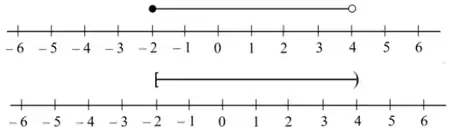
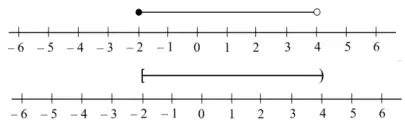
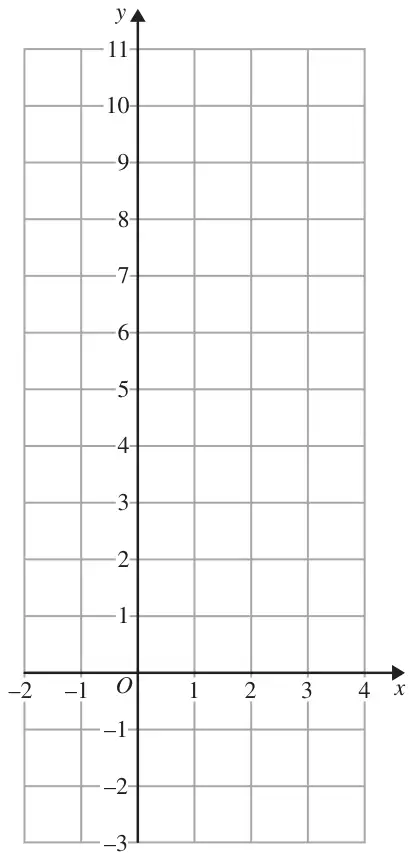
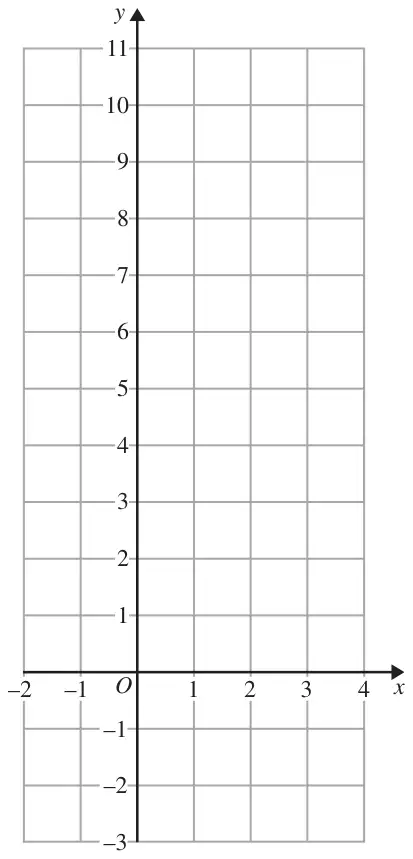
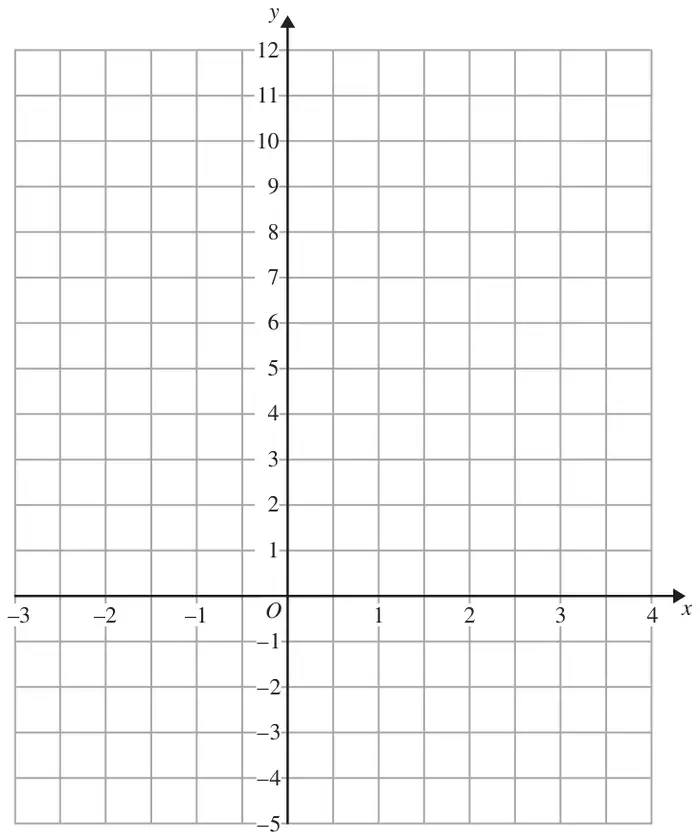
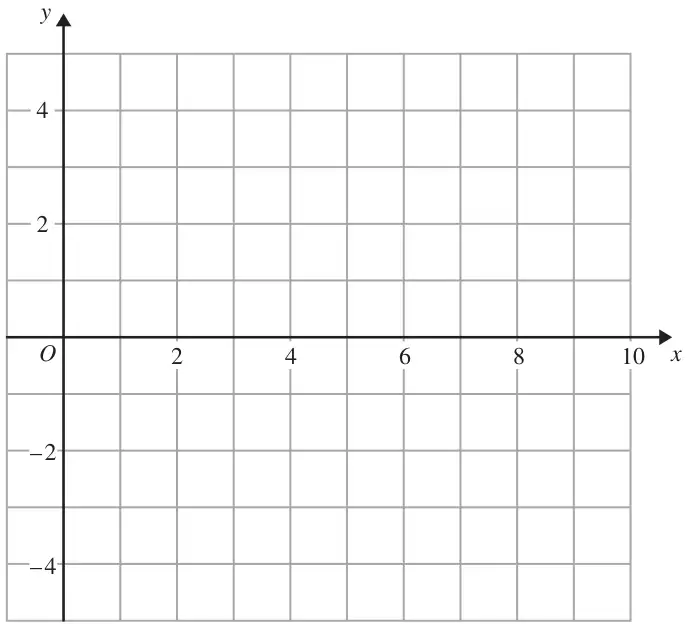
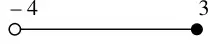
(a) Write down the inequality shown on the number line. (2)
(b) Solve the inequality \(7a - 5 \leqslant 3a + 28\) Show clear algebraic working. (2)
Mark scheme (a)
Scheme
Marks
\(-2 \lt x \leqslant 1\)
B2
(2)
Notes
B2: accept \(1 \geqslant x \gt -2\) or \(x \gt -2, x \leqslant 1\) if not B2 then B1 for \(-2 \lt x\) or \(x \leqslant 1\) or \(-2 \leqslant x \lt 1\) or \(-2 \leqslant x \leqslant 1\) or \(-2 \lt x \lt 1\) Condone use of a variable other than \(x\) but not 0
Mark scheme (b)
Scheme
Marks
\(7a - 3a \leqslant 28 + 5\) or \(4a \leqslant 33\) or \(-5 - 28 \leqslant 3a - 7a\) or \(-33 \leqslant -4a\)
M1
Working required Answer: \(a \leqslant 8.25\)
A1
(2)
(4 marks)
Notes
M1: for \(a\) terms on one side and numbers on the other. Condone = rather than \(\leqslant\) or any other sign for this mark.
A1: (dep on M1) oe eg \(a \leqslant \dfrac{33}{4}\) or \(a \leqslant 8\dfrac{1}{4}\) or \(8.25 \geqslant a\)
must have correct sign on answer line
(sight of correct answer in working space and just 8.25 on answer line gains M1 only).
(a) Explain what Lui has done wrong in his working. (1)
Oni thinks of a number. She calls the number \(Y\)
\(Y\) is a positive, odd number and \(Y \leqslant 9\)
(b) Write down all the possible values of \(Y\) (2)
Mark scheme (a)
Scheme
Marks
A correct reason
B1
(1)
Notes
B1: He should have got 30 + 20 oe The answer should be 50 oe −4 ×−5 = (+) 20 oe Minus and minus gives a positive oe etc
Mark scheme (b)
Scheme
Marks
1, 3, 5, 7, 9
B2
(2)
(3 marks)
Notes
B2: for 1, 3, 5, 7, 9 with no extras (in any order) (B1 for four correct values with no more than one incorrect or for five correct values with no more than one incorrect)
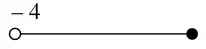
(a) Write down the inequality shown on the number line. (2)
(b) Solve the inequality \(7a - 5 \leqslant 3a + 28\) Show clear algebraic working. (2)
Mark scheme (a)
Scheme
Marks
\(-2 \lt x \leqslant 1\)
B2
(2)
Notes
B2: accept \(1 \geqslant x \gt -2\) or \(x \gt -2, x \leqslant 1\) if not B2 then B1 for \(-2 \lt x\) or \(x \leqslant 1\) or \(-2 \leqslant x \lt 1\) or \(-2 \leqslant x \leqslant 1\) or \(-2 \lt x \lt 1\) Condone use of a variable other than \(x\) but not 0
Mark scheme (b)
Scheme
Marks
\(7a - 3a \leqslant 28 + 5\) or \(4a \leqslant 33\) or \(-5 - 28 \leqslant 3a - 7a\) or \(-33 \leqslant -4a\)
M1
Working required Answer: \(a \leqslant 8.25\)
A1
(2)
(4 marks)
Notes
M1: for \(a\) terms on one side and numbers on the other. Condone = rather than \(\leqslant\) or any other sign for this mark.
A1: (dep on M1) oe eg \(a \leqslant \dfrac{33}{4}\) or \(a \leqslant 8\dfrac{1}{4}\) or \(8.25 \geqslant a\)
must have correct sign on answer line
(sight of correct answer in working space and just 8.25 on answer line gains M1 only).
Correct answer scores full marks (unless from obvious incorrect working) Answer: \((x + 8)(x - 3)\)
A1
(2)
(ii) Answer: –8 and 3
B1
(1)
Notes
M1: for \((x \pm 8)(x \pm 3)\) or \((x + a)(x + b)\) where \(ab = -24\) or \(a + b = 5\) and, \(a\) and \(b\) are integers
A1: for \((x + 8)(x - 3)\) Allow any letter for \(x\)
Must be in the form \((x + a)(x + b)\) where \(a\) and \(b\) are integers
B1: must ft from their answer in (a)(i) ft from their incorrect factors in the form \((x + a)(x + b)\) Award B0 for –8 and 3 if no marks scored in (a)(i)
Mark scheme (b)
Scheme
Marks
\(3y - 7y \gt -10 - 5\) or \(5 + 10 \gt 7y - 3y\)
M1
\(-4y \gt -15\) or \(15 \gt 4y\) or \(y = \dfrac{15}{4}\) oe or
M1
Working required
Answer: \(y \lt \dfrac{15}{4}\)
A1
(3)
(6 marks)
Notes
M1: allow use of = or condone incorrect inequality sign
M1: allow use of = or condone incorrect inequality sign
A1: dep on M1
oe eg \(y \lt 3.75\) or \(\dfrac{15}{4} \gt y\) or \(3.75 \gt y\)
Must have correct sign on answer line
NB Sight of correct answer in working space and just \((y =)\;\dfrac{15}{4}\) oe on answer line gains M2 only
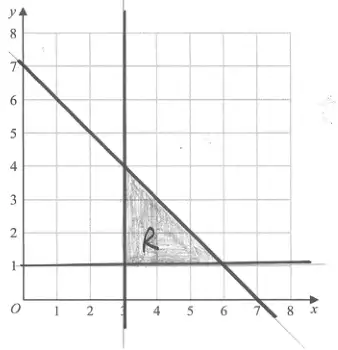
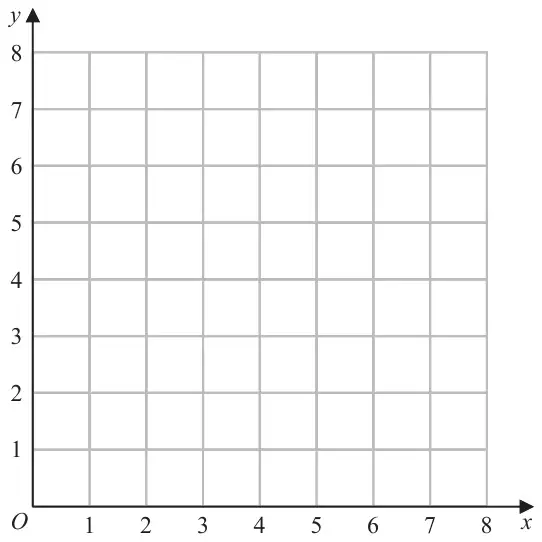
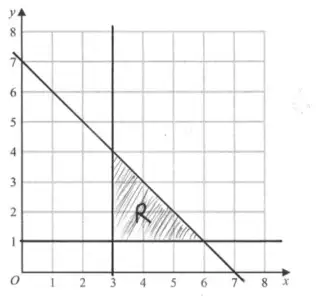
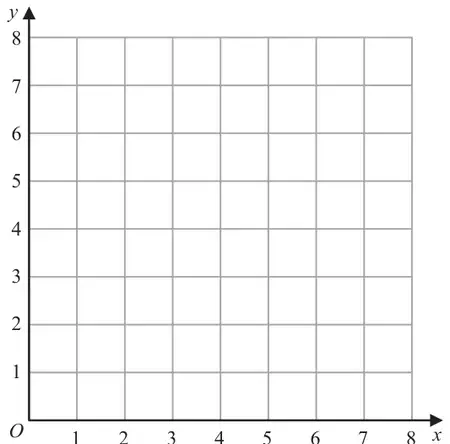
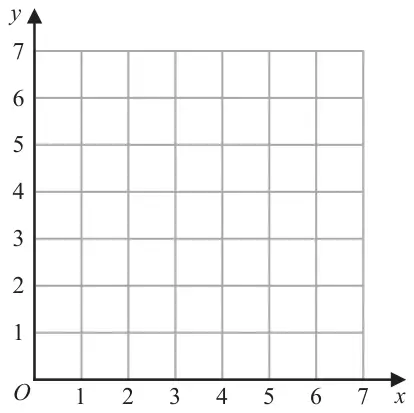
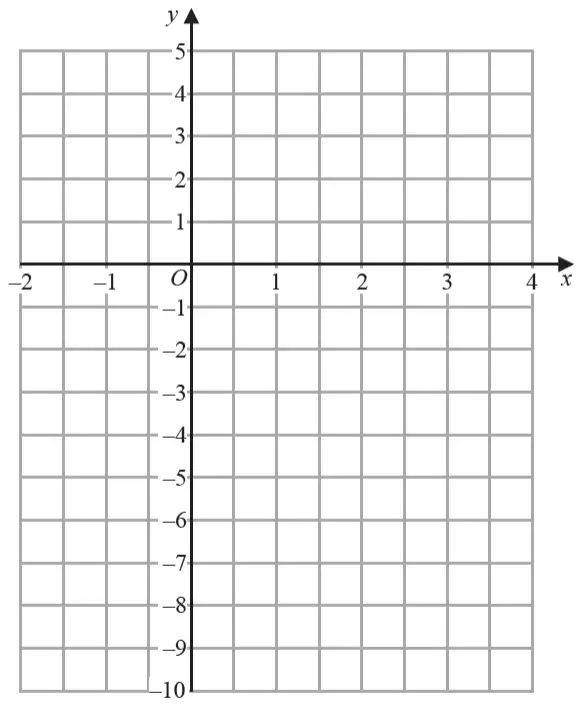
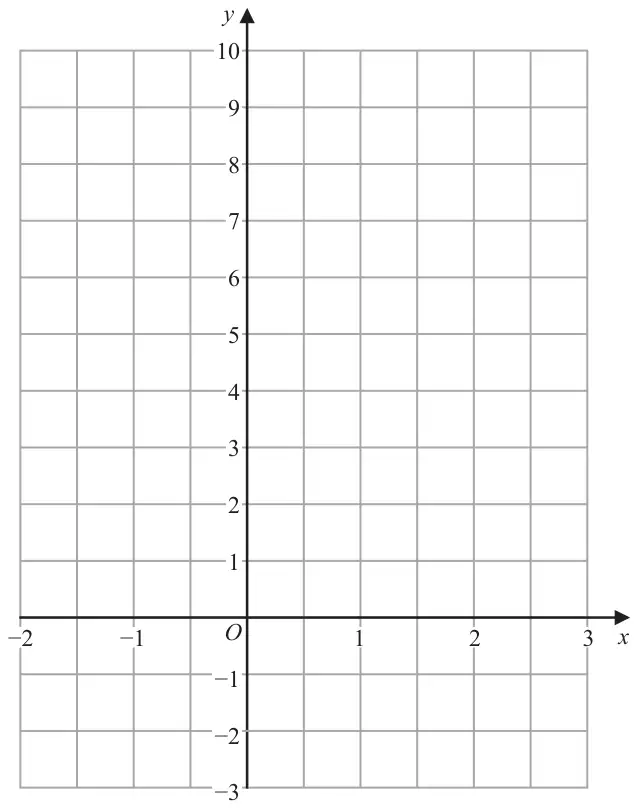
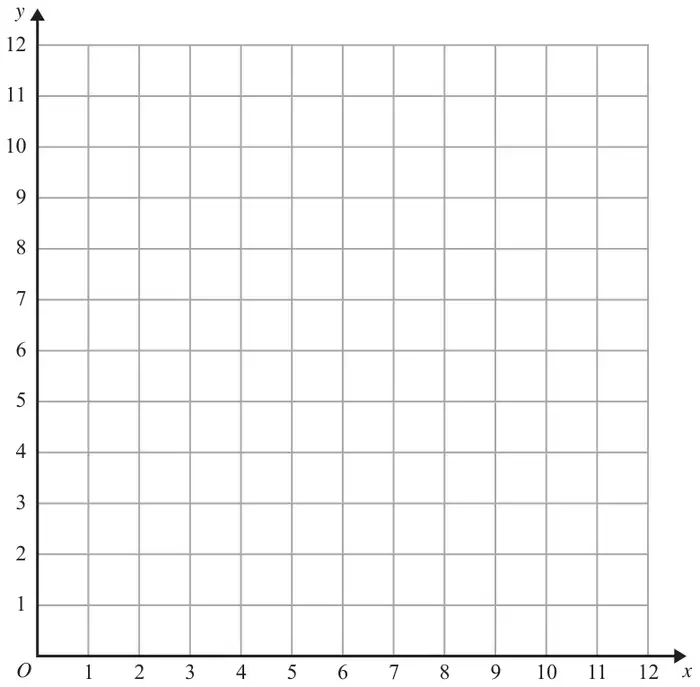
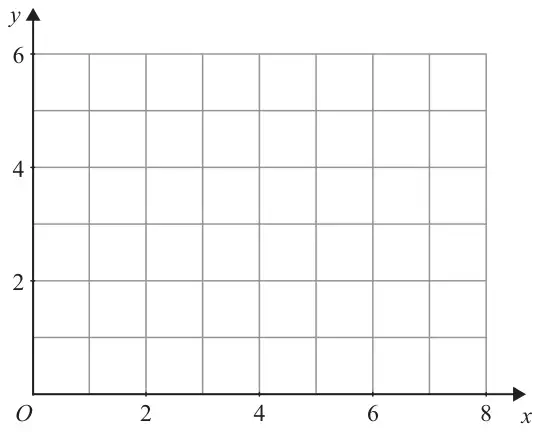
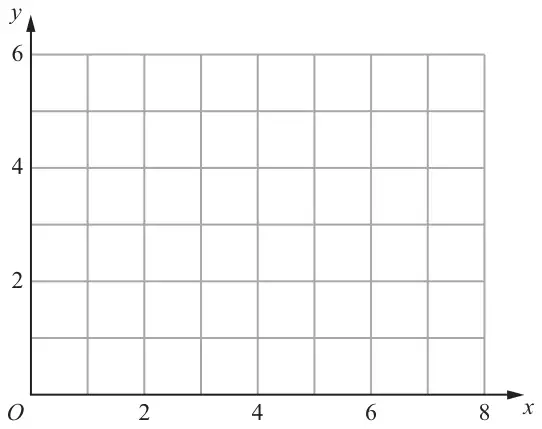
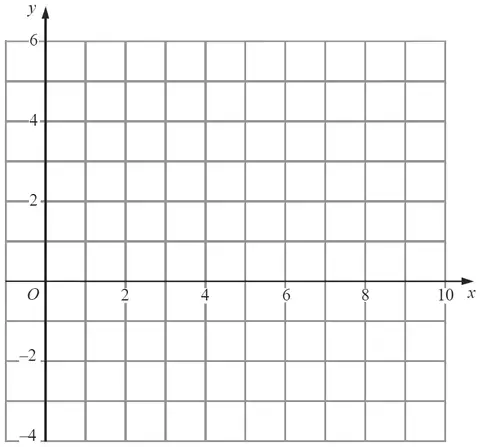
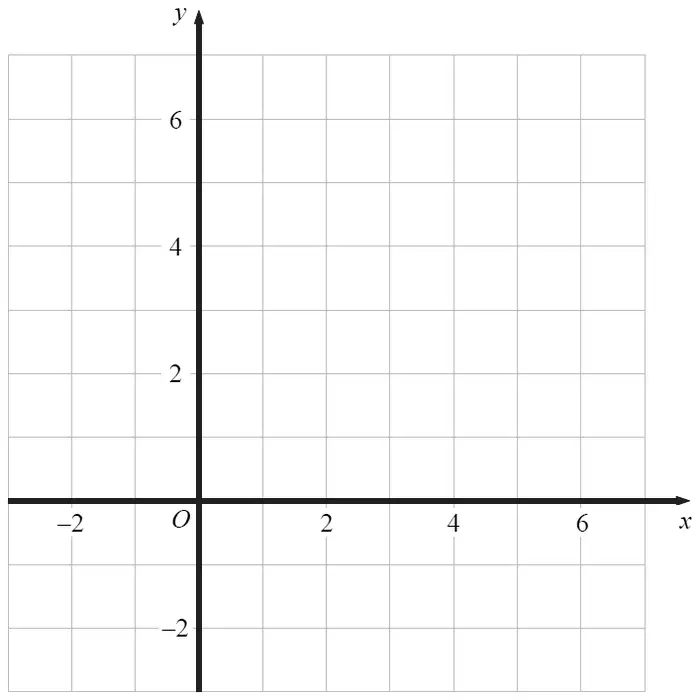
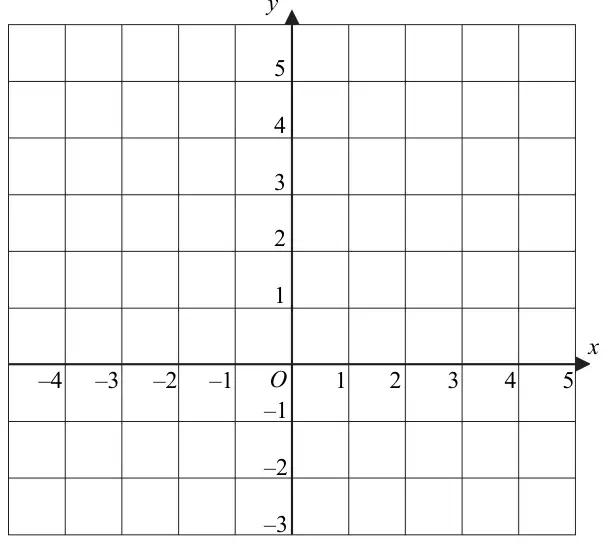
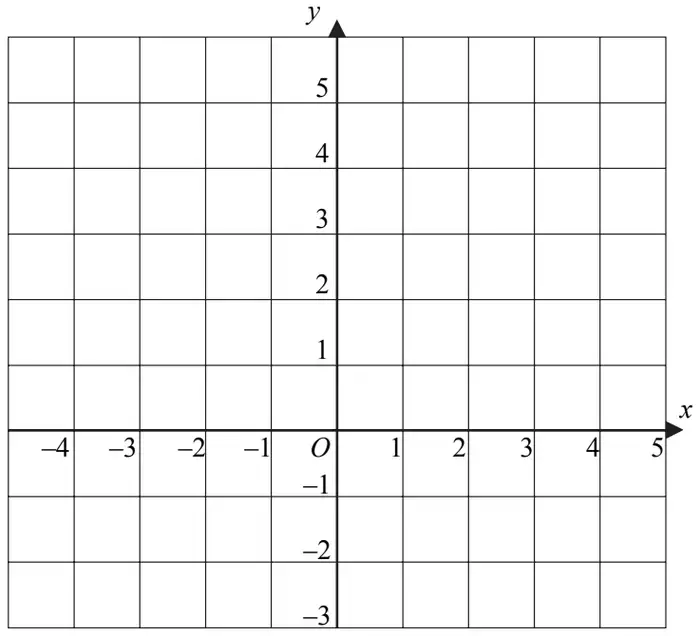
(a) On the grid, draw the straight line with equation
(i) \(x = 3\) (ii) \(y = 1\) (iii) \(x + y = 7\) Label each line with its equation. (3)
(b) Show, by shading on the grid, the region that satisfies all three of the inequalities \(x \geqslant 3 \qquad y \geqslant 1 \qquad x + y \leqslant 7\) Label the region R(1)
Mark scheme (a)
Scheme
Marks
(i)
B1
(ii)
B1
(iii) Line length 2 cm + but shaded area must be enclosed for the mark in (b)
If unlabelled, award: \(x = 3\) and \(y = 3\) B1 B0 \(y = 1\) and \(x = 1\) B0 B1 \(x = 3\) and \(x = 1\) and \(y = 1\) B0 B1 \(x = 3\) and \(y = 1\) and \(y = 3\) B1 B0
\(x = 3\) and \(x = 1\), \(y = 1\) and \(y = 3\) B0 B0
B1
(3)
Notes
B1: \(x = 3\) drawn
B1: \(y = 1\) drawn
B1: \(x + y = 7\) drawn
Allow dashed lines or solid lines for graphs of minimum length 2 squares condone lack of labels if unambiguous
Mark scheme (b)
Scheme
Marks
B1
(1)
(4 marks)
Notes
B1: correct region shaded – shaded in or out – labelled R or clear intention to be the required region (ft only for one vertical line (not \(x = 0\)), one horizontal line (not \(y = 0\)) and one line with a negative gradient eg \(x = 1\), \(y = 3\) and \(x + y = 7\))
or \(-y \lt \dfrac{-19}{5}\) or \(y \lt \dfrac{19}{5}\)
or \(y = \dfrac{19}{5}\) oe
M1
Correct answer scores full marks (unless from obvious incorrect working)
Answer: \(y \gt \dfrac{19}{5}\)
A1
(3)
(9 marks)
Notes
M1: for rearrangement with \(y\) terms on one side and numerical terms on the other in a correct inequality or the correct simplification of \(y\) terms or numbers on one side in a correct inequality
sign can be = or the incorrect inequality sign
M1: for the correct simplification of \(y\) terms on one side and numbers on the other side in a correct inequality or a correct inequality with the wrong sign
sign can be = or the incorrect inequality sign
A1: oe eg \(y \gt 3.8\) or \(3.8 \lt y\) Must be given as the correct inequality on the answer line
B2: for \(5k^5 + 20k^2\) (B1 for \(5k^5\) or \(20k^2\))
Mark scheme (c)
Scheme
Marks
(i) \((x \pm 7)(x \pm 9)\)
M1
Correct answer scores full marks (unless from obvious incorrect working) Answer: \((x + 7)(x - 9)\)
A1
(2)
(ii) Answer: –7, 9
B1
(1)
Notes
M1: for \((x \pm 7)(x \pm 9)\) or for \((x + a)(x + b)\) where \(ab = -63\) or \(a + b = -2\) where \(a\) and \(b\) are integers
A1: for correct factors
B1: must ft from (c)(i) dep on factorising in the form \((x + p)(x + q)\) where \(p\) and \(q\) are integers
Mark scheme (d)
Scheme
Marks
\(-2y - 3y \lt -12 - 7\) or \(7 + 12 \lt 3y + 2y\) or \(7 \lt 5y - 12\) or \(7 - 5y \lt -12\) or \(-2y \lt 3y - 19\) or \(19 - 2y \lt 3y\)
M1
\(-5y \lt -19\) or \(19 \lt 5y\)
or \(-y \lt \dfrac{-19}{5}\) or \(y \lt \dfrac{19}{5}\)
or \(y = \dfrac{19}{5}\) oe
M1
Correct answer scores full marks (unless from obvious incorrect working)
Answer: \(y \gt \dfrac{19}{5}\)
A1
(3)
(9 marks)
Notes
M1: for rearrangement with \(y\) terms on one side and numerical terms on the other in a correct inequality or the correct simplification of \(y\) terms or numbers on one side in a correct inequality
sign can be = or the incorrect inequality sign
M1: for the correct simplification of \(y\) terms on one side and numbers on the other side in a correct inequality or a correct inequality with the wrong sign
sign can be = or the incorrect inequality sign
A1: oe eg \(y \gt 3.8\) or \(3.8 \lt y\) Must be given as the correct inequality on the answer line
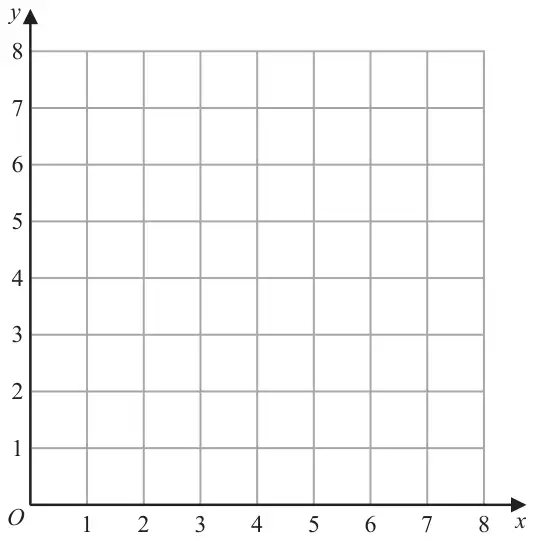
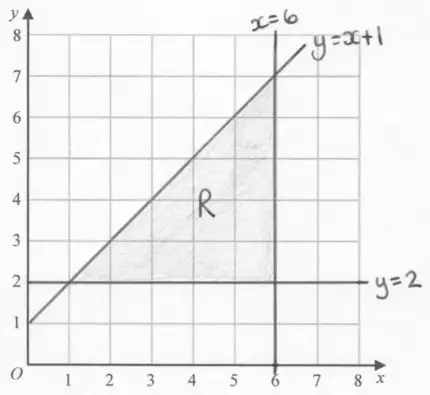
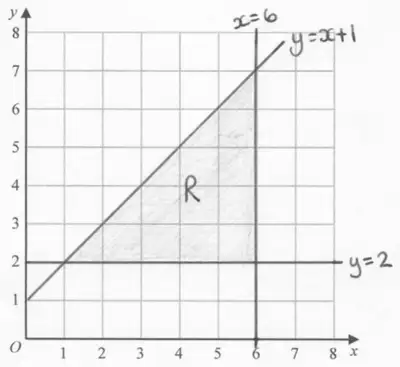
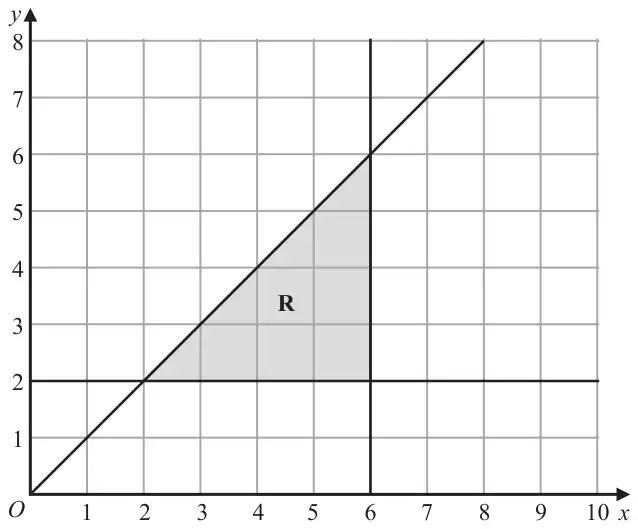
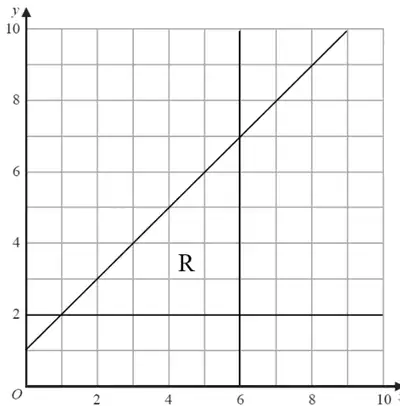
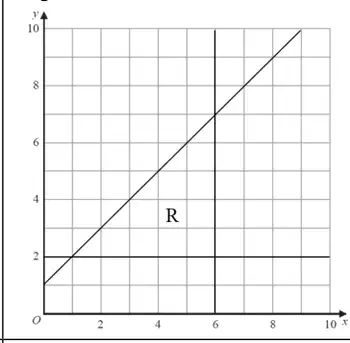
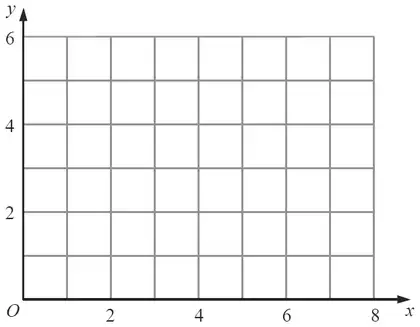
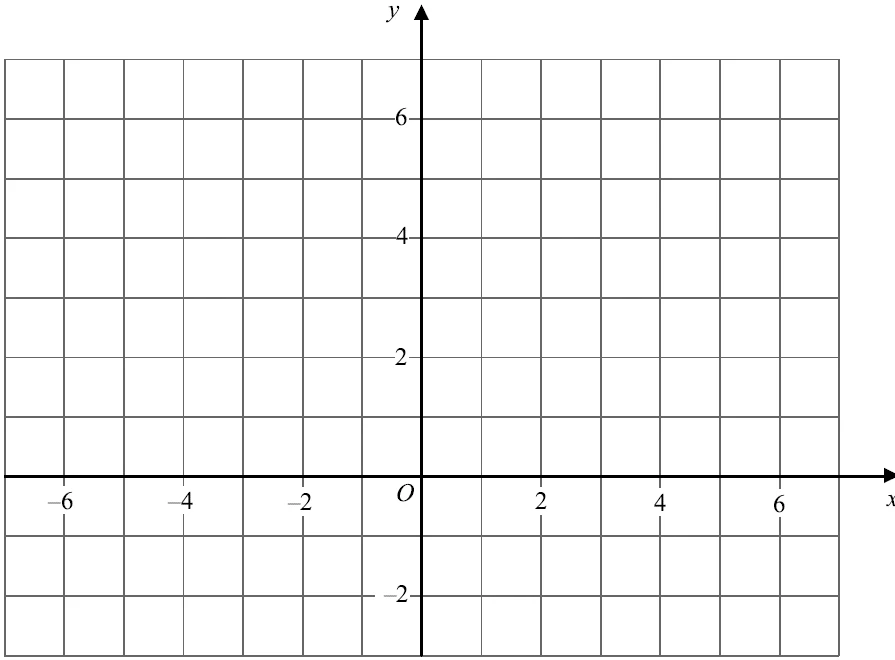
(a) On the grid, draw the straight line with equation
(i) \(y = 2\)
(ii) \(x = 6\)
(iii) \(y = x + 1\)
Label each line with its equation.(3)
(b) Show, by shading on the grid, the region that satisfies all three of the inequalities
\[y \geqslant 2 \qquad\qquad x \leqslant 6 \qquad\qquad y \leqslant x + 1\]
Label the region R(1)
Mark scheme (a)
Scheme
Marks
(a)(i) Answer: \(y = 2\) drawn
B1
(ii) Answer: \(x = 6\) drawn
B1
(iii) Answer: \(y = x + 1\) drawn
B1
(3)
Notes
Lines (can be solid, dotted or dashed) must be at least 2 cm long and need not be labelled
Mark scheme (b)
Scheme
Marks
B1ft
(1)
(4 marks)
Notes
B1ft: Correct region indicated ft dep on at least B2 scored in (a) and a vertical line, a horizontal line and a diagonal line with a positive gradient
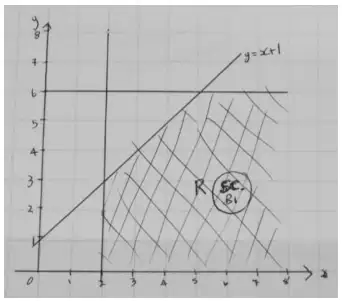
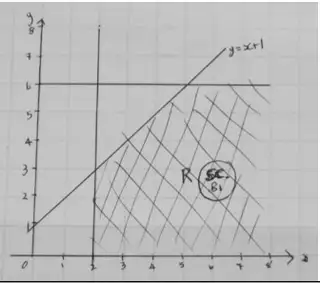
SCB1 for \(y = x + 1\), \(y = 6\) and \(x = 2\) and area shaded as shown below
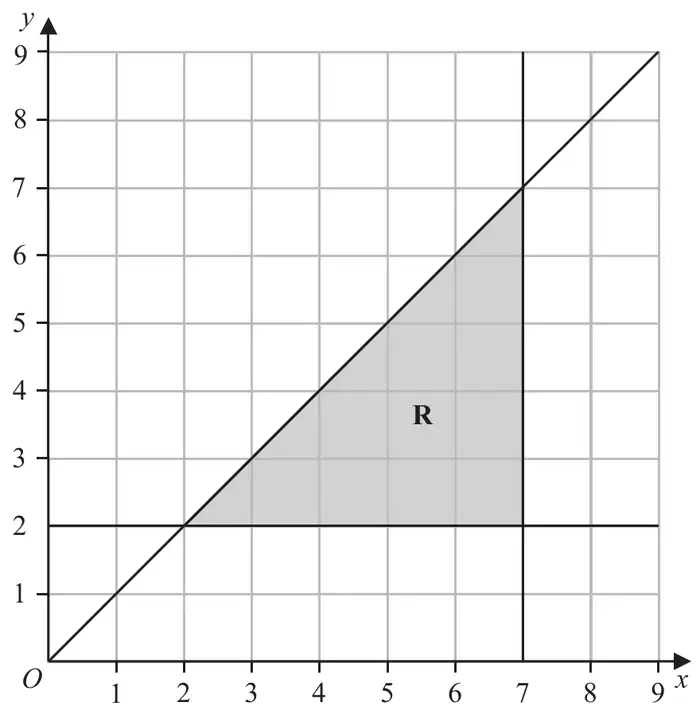
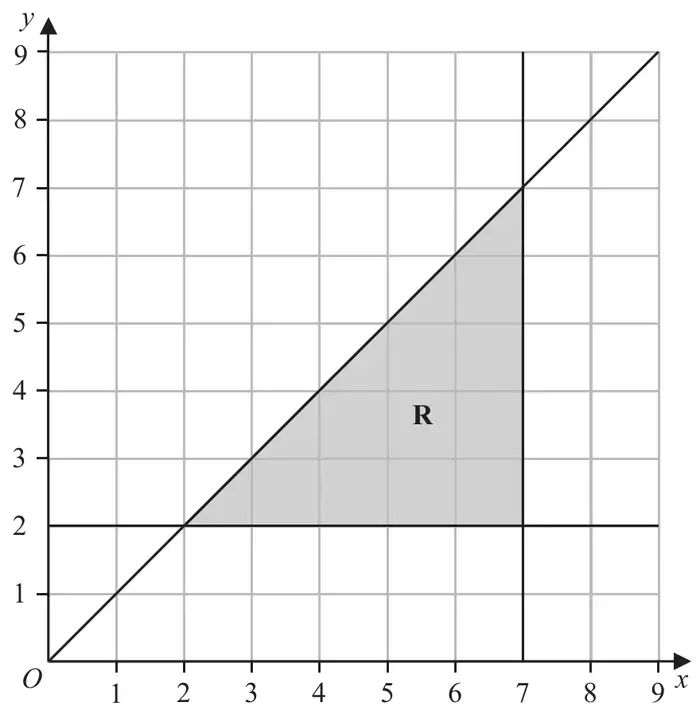
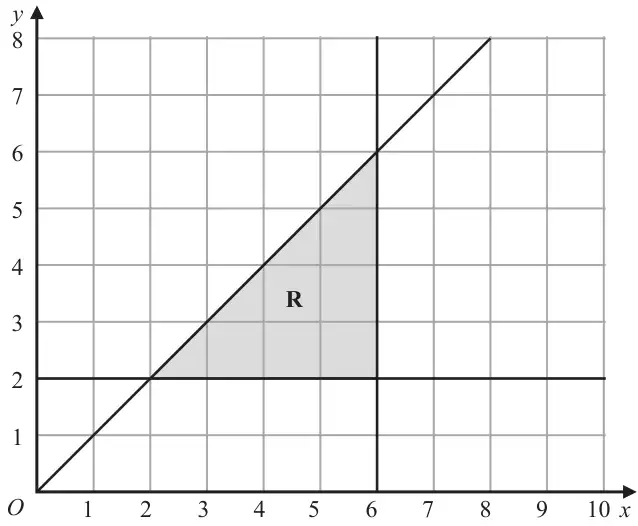
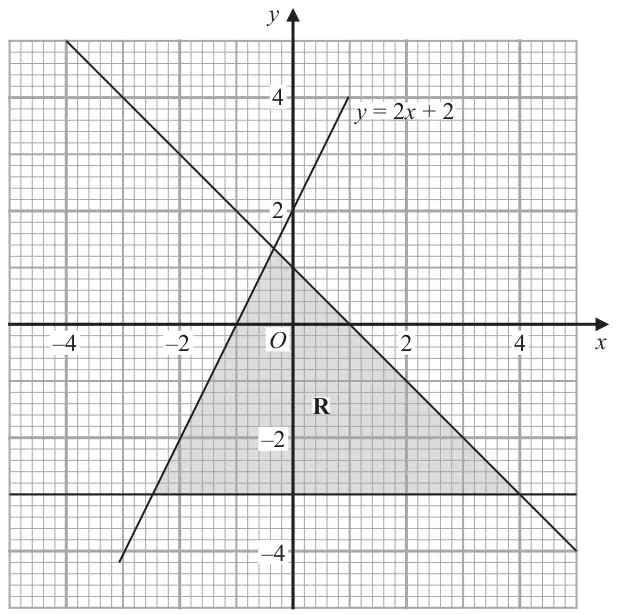
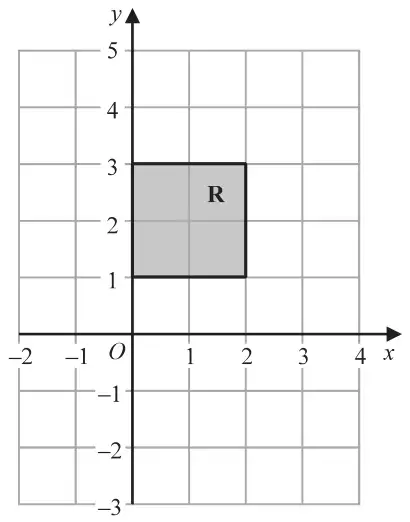
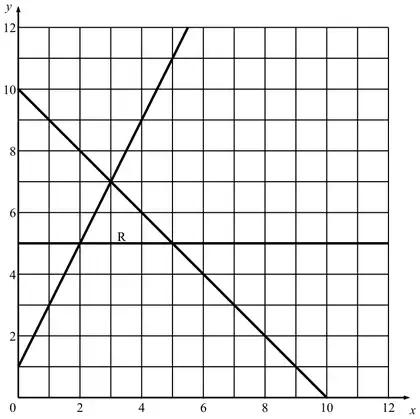
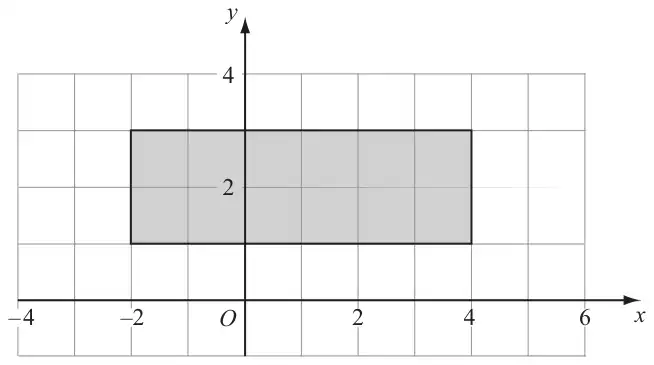
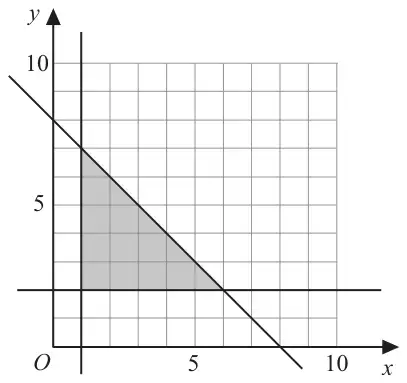
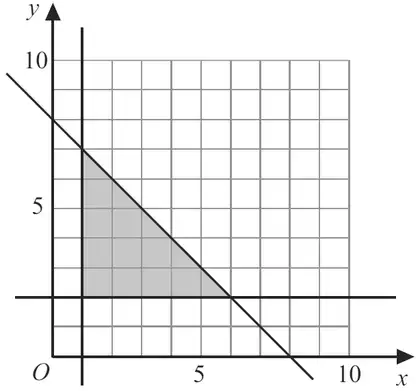
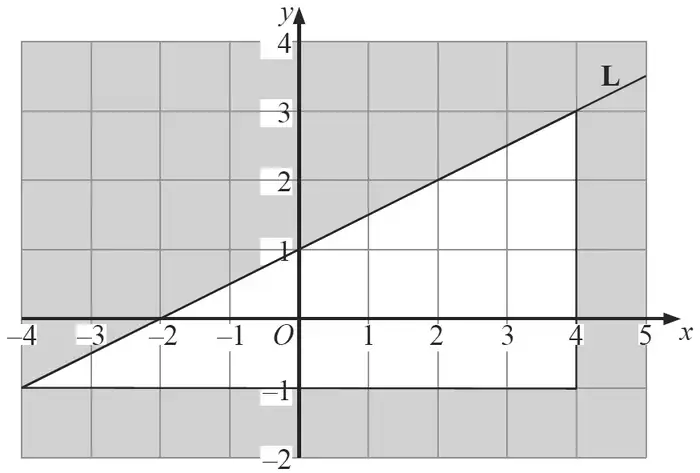
The region R, shown shaded in the diagram, is bounded by three straight lines.
(b) Write down the three inequalities that define the region R(3)
Mark scheme (a)
Scheme
Marks
\(8x - 3x \geqslant -10 + 4\) or \(5x \geqslant -6\) or \(10 - 4 \geqslant -8x + 3x\) or \(6 \geqslant -5x\)
M1
Working not required, so correct answer scores full marks (unless from obvious incorrect working) Answer: \(x \geqslant -\dfrac{6}{5}\)
A1
(2)
Notes
M1: for \(x\) terms on one side and numbers on the other. Condone = rather than \(\leqslant\) or any other sign for this mark.
A1: oe eg \(-\dfrac{6}{5} \leqslant x\) Must have correct sign on answer line (sight of correct answer in working space and just −1.2 on answer line gains M1 only)
Mark scheme (b)
Scheme
Marks
\(y \geqslant 2\)
B1
\(x \leqslant 7\)
B1
\(y \leqslant x\)
B1
(3)
(5 marks)
Notes
B1: oe eg \(y - 2 \geqslant 0\) allow > in place of \(\geqslant\)
B1: oe eg \(x - 7 \leqslant 0\) allow < in place of \(\leqslant\)
B1: oe eg \(y - x \leqslant 0\) allow < in place of \(\leqslant\)
SCB1 for \(y = 2\), \(x = 7\) and \(y = x\) SCB2 for \(y \leqslant 2\), \(x \geqslant 7\) and \(y \geqslant x\) or \(y < 2\), \(x > 7\) and \(y > x\) Allow < in place of \(\leqslant\) or vice versa
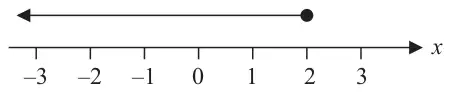
(b) Write down the inequality shown on the number line.(1)
Mark scheme (a)
Scheme
Marks
–3, –2, –1, 0, 1
B2
(2)
Notes
B2: for –3, –2, –1, 0, 1
If not B2 then award B1 for 4 correct values and no incorrect values (eg –3, –2, –1, 0) or for 6 values with no more than one incorrect value (eg –4, –3, –2, –1, 0, 1)
(b) Write down the inequality shown on the number line.
(1)
Mark scheme (a)
Scheme
Marks
−3, −2, −1, 0, 1
B2
(2)
Notes
B2: for −3, −2, −1, 0, 1
If not B2 then award B1 for 4 correct values and no incorrect values (eg −3, −2, −1, 0) or for 6 values with no more than one incorrect value (eg −4, −3, −2, −1, 0, 1)
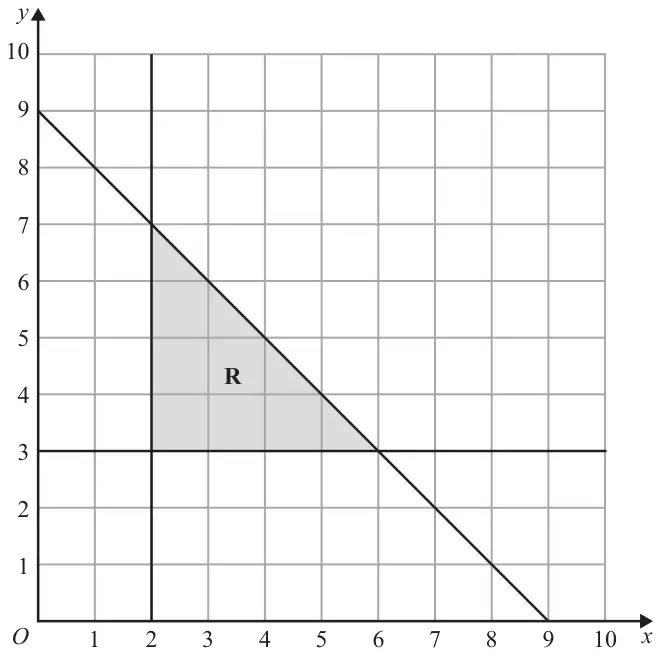
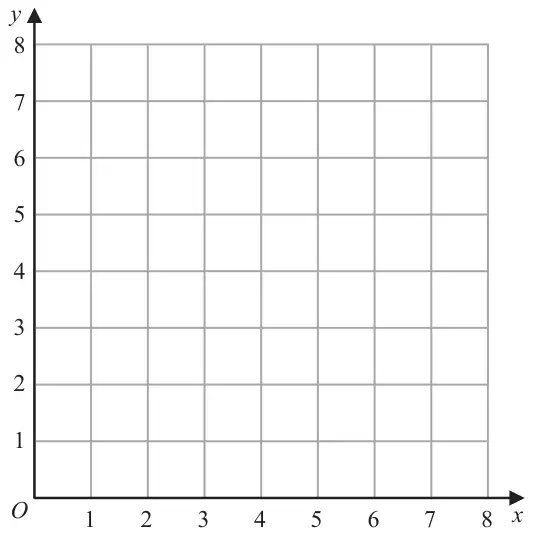
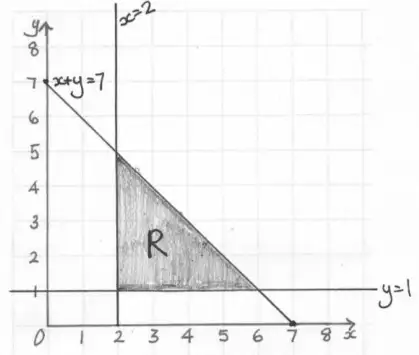
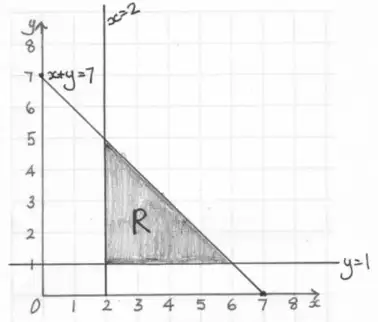
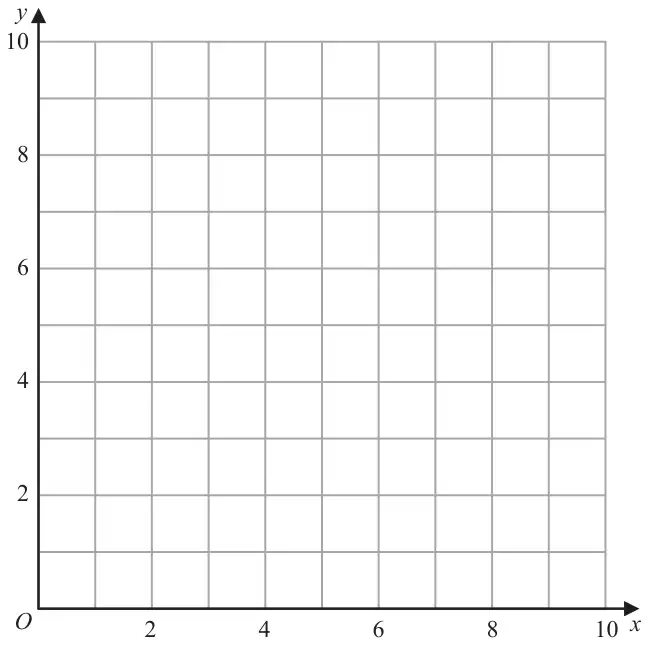
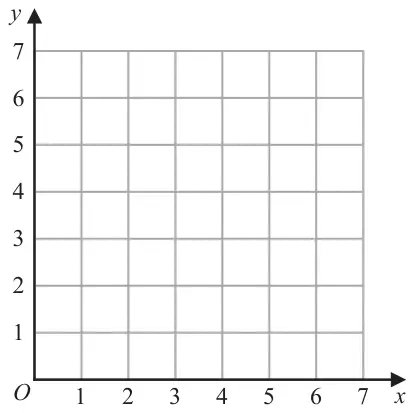
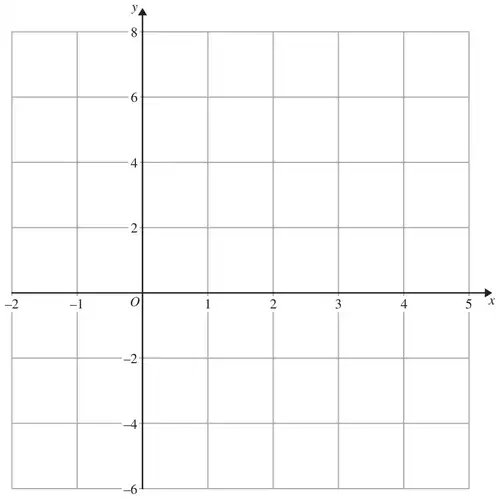
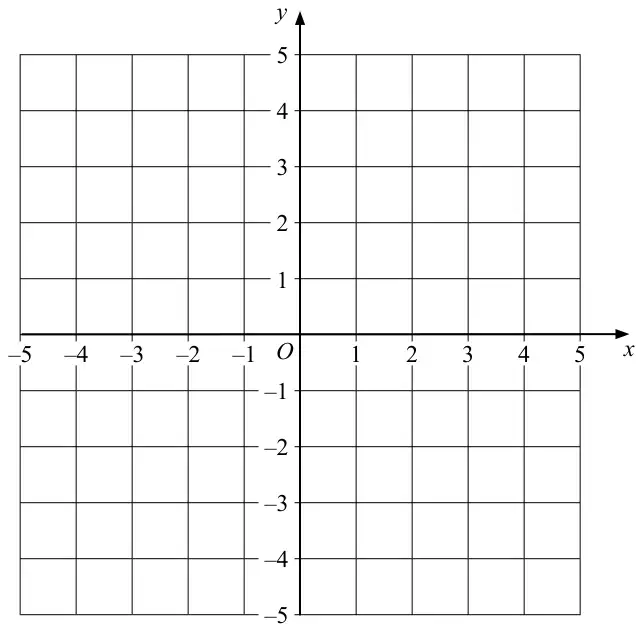
(a) On the grid, draw and label with its equation the straight line with equation (i) \(y = 1\) (ii) \(x = 2\) (iii) \(x + y = 7\)(3)
(b) Show, by shading on the grid, the region that satisfies all three of the inequalities \(y \geqslant 1 \qquad x \geqslant 2 \qquad x + y \leqslant 7\)Label the region R. (1)
Mark scheme (a)
Scheme
Marks
Line length 2cm + but shaded area must be enclosed for the mark in (b)
(i)
B1
(ii)
B1
(iii)
B1
(3)
Notes
B1: \(y = 1\) drawn
B1: \(x = 2\) drawn
B1: \(x + y = 7\) drawn
Allow dashed lines or solid lines for graphs condone lack of labels if unambiguous
Mark scheme (b)
Scheme
Marks
B1
(1)
(4 marks)
Notes
B1: correct region shaded – shaded in or out – labelled R or clear intention to be the required region (ft only for one vertical line, one horizontal line and one line with a negative gradient)
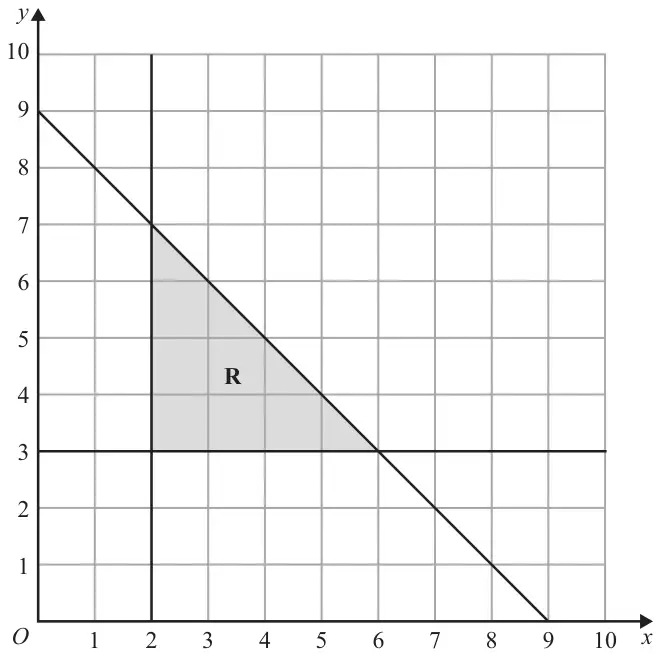
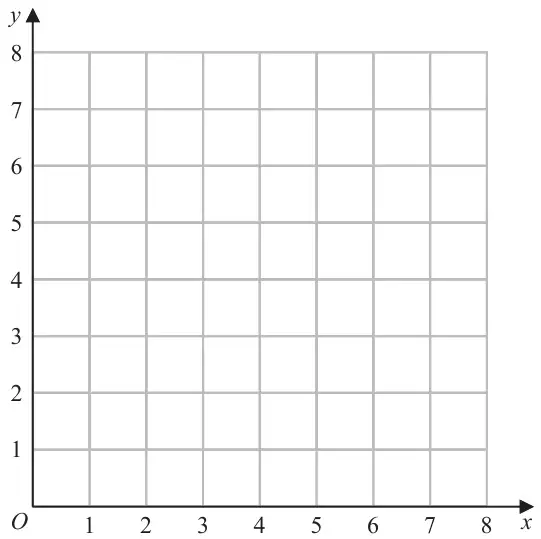
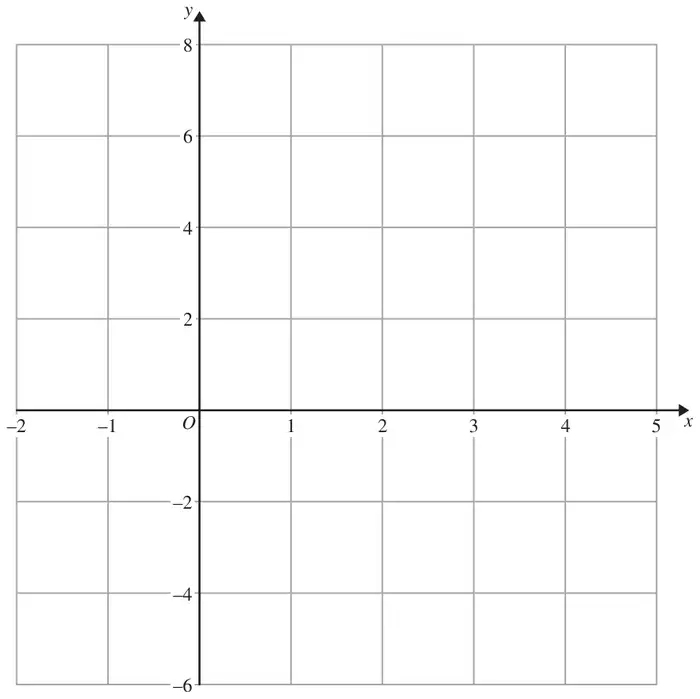
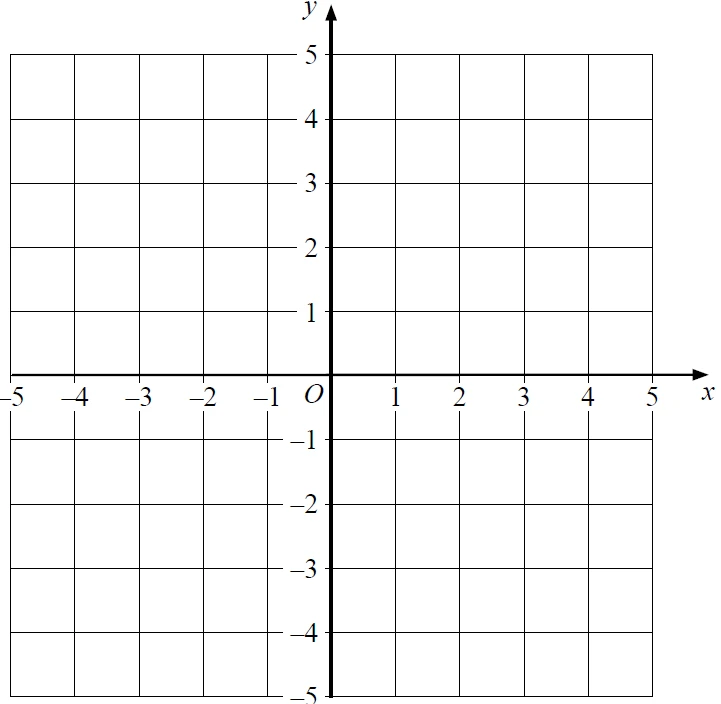
(a) On the grid, draw and label with its equation the straight line with equation (i) \(y = 1\) (ii) \(x = 2\) (iii) \(x + y = 7\) (3)
(b) Show, by shading on the grid, the region that satisfies all three of the inequalities \[y \geqslant 1 \qquad x \geqslant 2 \qquad x + y \leqslant 7\]Label the region R. (1)
Mark scheme (a)
Scheme
Marks
Line length 2cm + but shaded area must be enclosed for the mark in (b)
B1
B1
B1
(3)
Notes
B1: \(y = 1\) drawn
B1: \(x = 2\) drawn
B1: \(x + y = 7\) drawn
Allow dashed lines or solid lines for graphs condone lack of labels if unambiguous
Mark scheme (b)
Scheme
Marks
B1
(1)
(4 marks)
Notes
B1: correct region indicated – shaded in or out – labelled R or clear intention to be the required region (ft only for one vertical line, one horizontal line and one line with a negative gradient)
(a) Write down an equation of the straight line with gradient \(-3\) and which passes through the point with coordinates (0, 5) (2)
(b) Show, by shading on the grid, the region defined by all three of the inequalities \(x \leqslant 6 \qquad\qquad y \geqslant 2 \qquad\qquad y \leqslant x + 1\)Label the region R(3)
(a) Write down all the values of \(n\) such that \(-2 \leqslant n \lt 3\) (2)
(b) On the number line, represent the inequality \(y \leqslant 1\)(1)
Mark scheme (a)
Scheme
Marks
−2, −1, 0, 1, 2
B2
(2)
Notes
B2: for −2, −1, 0, 1, 2 with no additions or repeats (B1 for 4 of −2, −1, 0, 1, 2 with no additions or repeats or for 6 values with no more than one incorrect value e.g. all of −2, −1, 0, 1, 2, 3 or for 5 values with one error)
Mark scheme (b)
Scheme
Marks
Answer: Closed circle at \(x = 1\) and a line with an arrow to the left
B1
(1)
(3 marks)
Notes
B1: for a closed circle at \(x = 1\) and a line with an arrow of any length to the left
Allow ] for a closed circle
Allow a line without an arrow if it reaches to at least −3
(a) Write down an equation of the straight line with gradient \(-3\) and which passes through the point with coordinates \((0, 5)\) (2)
(b) Show, by shading on the grid, the region defined by all three of the inequalities \(x \leqslant 6 \qquad y \geqslant 2 \qquad y \leqslant x + 1\) Label the region R(3)
(a) Write down all the values of \(n\) such that \(-2 \leqslant n \lt 3\) (2)
(b) On the number line, represent the inequality \(y \leqslant 1\) (1)
Mark scheme (a)
Scheme
Marks
\(-2, -1, 0, 1, 2\)
B2
(2)
Notes
B2: for \(-2, -1, 0, 1, 2\) with no additions or repeats (B1 for 4 of \(-2, -1, 0, 1, 2\) with no additions or repeats or for 6 values with no more than one incorrect value e.g. all of \(-2, -1, 0, 1, 2, 3\) or for 5 values with one error)
Mark scheme (b)
Scheme
Marks
Answer: Closed circle at \(x = 1\) and a line with an arrow to the left
B1
(1)
(3 marks)
Notes
B1: for a closed circle at \(x = 1\) and a line with an arrow of any length to the left
Allow ] for a closed circle
Allow a line without an arrow if it reaches to at least \(-3\)
\(\dfrac{-7 + 3}{2} \leqslant x \lt \dfrac{5 + 3}{2}\) or
\(\dfrac{-7}{2} + \dfrac{3}{2} \leqslant x \lt \dfrac{5}{2} + \dfrac{3}{2}\)
or \(\dfrac{-7 + 3}{2} \leqslant x\) oe and \(x \lt \dfrac{5 + 3}{2}\)
or \((x =)\ {-2}\) and \((x =)\ 4\)
M1
Correct answer scores full marks (unless from obvious incorrect working) Answer: \(-2 \leqslant x \lt 4\)
A1
(3)
Notes
M1: or one side of the inequality correct, i.e. \(x \geqslant -2\) oe or \(x \lt 4\) Condone = rather than \(\leqslant\) or \(\lt \) or any other sign for the M marks.
M1: ft for drawing a line from −2 to 4 or (indep) for a closed circle or [ at −2 or (indep) for an open circle or ) or [ at 4 Only allow a follow through for a double ended inequality
A1: ft for correct diagram Only allow a follow through for a double ended inequality
B3: for all 3 correct inequalities (B2 for 2 correct inequalities B1 for 1 correct inequality) Allow \(\lt \) instead of \(\leqslant\) and \(\gt \) instead of \(\geqslant\)
\(\dfrac{-7 + 3}{2} \leqslant x \lt \dfrac{5 + 3}{2}\) or
\(\dfrac{-7}{2} + \dfrac{3}{2} \leqslant x \lt \dfrac{5}{2} + \dfrac{3}{2}\)
or \(\dfrac{-7 + 3}{2} \leqslant x\) oe and \(x \lt \dfrac{5 + 3}{2}\)
or \((x =)\ -2\) and \((x =)\ 4\)
M1
Correct answer scores full marks (unless from obvious incorrect working) Answer: \(-2 \leqslant x \lt 4\)
A1
(3)
Notes
M1: or one side of the inequality correct, i.e. \(x \geqslant -2\) oe or \(x \lt 4\) Condone = rather than \(\leqslant\) or \(\lt \) or any other sign for the M marks.
M1ft: for drawing a line from −2 to 4 or (indep) for a closed circle or [ at −2 or (indep) for an open circle or ) or [ at 4 Only allow a follow through for a double ended inequality in (i)
A1ft: for correct diagram Only allow a follow through for a double ended inequality in (i)
(ii) On the number line below, represent the solution set of the inequality solved in part (c)(i)(1)
Mark scheme (a)
Scheme
Marks
\(8x^2 + 20x - 6x^2 + 9x\)
M1
\(2x^2 + 29x\)
A1
(2)
Notes
M1: 3 correct terms or all 4 terms condoning incorrect signs
Mark scheme (b)
Scheme
Marks
\(y^5 \times y^n = y^{19}\) or \(y^{-1} \times y^n = y^{13}\) or \(5 + n - 6 = 13\)
M1
14
A1
(2)
Notes
M1: Use of 1 rule of indices or a correct equation in \(n\)
A1: Accept \(y^{14}\)
Mark scheme (c)
Scheme
Marks
(i) \(7t - 2t \lt 7 + 8\) oe eg \(5t \lt 15\) oe
M1
\(t \lt 3\)
A1
(2)
(ii) Answer: open circle at \(t = 3\) and a line with an arrow to the left
B1ft
(1)
(7 marks)
Notes
M1: Terms in \(t\) on one side and number terms the other side – may be in an equation or the incorrect inequality sign or an answer of \(t = 3\) or eg \(t \geqslant 3\)
A1: Must be a correct inequality given as answer
B1ft: Allow a line without an arrow if it reaches to at least −5, with an arrow it can be any length
(a) On the grid, draw and label the straight line with equation
(i) \(x = 1.5\)
(ii) \(y = x\)
(iii) \(x + y = 6\) (3)
(b) Show, by shading on the grid, the region that satisfies all three of the inequalities \(x \geqslant 1.5 \qquad\quad y \geqslant x \qquad\quad x + y \leqslant 6\) Label the region R. (1)
Mark scheme (a)
Scheme
Marks
(i) Answer: Correct line
B1
(ii) Answer: Correct line
B1
(iii) Answer: Correct line
B1
(3)
Notes
B1: For \(x = 1.5\) drawn
B1: For \(y = x\) drawn
B1: For \(x + y = 6\) drawn
Mark scheme (b)
Scheme
Marks
Correct region
B1
(1)
(4 marks)
Notes
B1: dep on B3 for correctly shading the region R accept unlabelled or unshaded if clear. Shading can be ‘in’ or ‘out’.
(a) On the number line, show the inequality \(\;-2 \leqslant y \lt 1\)(2)
\(n\) is an integer.
(b) Write down all the values of \(n\) that satisfy \(\;-3.4 \lt n \leqslant 2\) (2)
Mark scheme (a)
Scheme
Marks
Correct number line
B2
(2)
Notes
B2: for a fully correct number line e.g. shaded circle at −2, unshaded circle at 1 and a line drawn between them (B1 for a shaded circle at −2 or an unshaded circle at 1 or circles at −2 and 1 with line in between but shading incorrect)
Mark scheme (b)
Scheme
Marks
−3, −2, −1, 0, 1, 2
B2
(2)
(4 marks)
Notes
B2: fully correct values with no extras (B1 for 5 correct values and none incorrect or all 6 correct values with no more than one additional incorrect value)
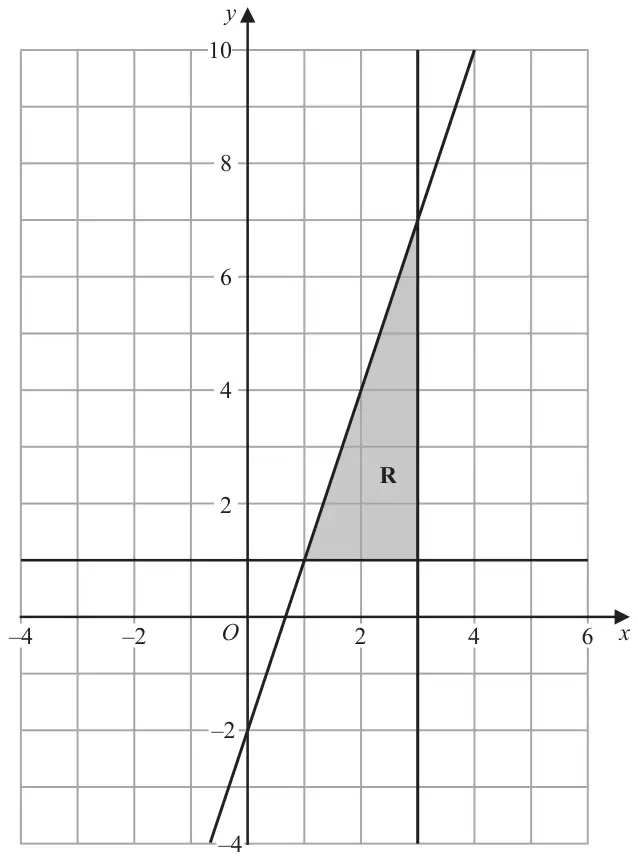
18 The shaded region R, shown in the diagram below, is bounded by the straight line with equation \(y = 3x - 2\) and by two other straight lines.
Write down the three inequalities that define region R.
(3)
Mark scheme
Scheme
Marks
\(y \geqslant 1\) oe
B1
\(x \leqslant 3\) oe
B1
\(y \leqslant 3x - 2\)
B1
(3)
(3 marks)
Notes
B1: Condone \(\lt\) and \(\gt\) in place of \(\leqslant\) and \(\geqslant\) throughout.
SC B1 if no marks awarded, recognition of lines \(x = 3\) and \(y = 1\). Allow incorrect inequality and condone use of equals signs eg \(y \lt 1\), \(x = 3\) may be seen on diagram.
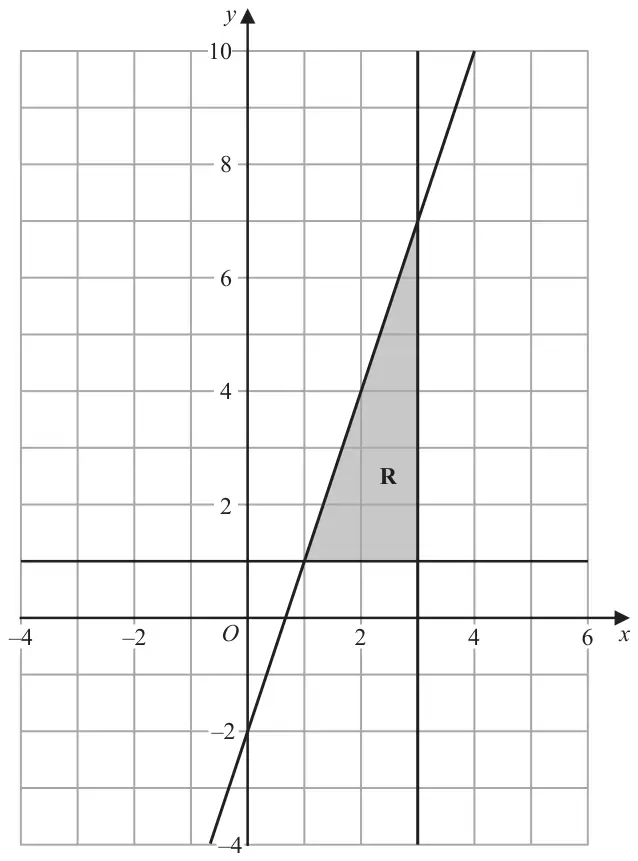
7 The shaded region R, shown in the diagram below, is bounded by the straight line with equation \(y = 3x - 2\) and by two other straight lines.
Write down the three inequalities that define region R.
(3)
Mark scheme
Scheme
Marks
\(y \geqslant 1\) oe
B1
\(x \leqslant 3\) oe
B1
\(y \leqslant 3x - 2\) oe
B1
(3)
(3 marks)
Notes
B1: Allow \(1 \leqslant y \leqslant 7\)
B1: Allow \(1 \leqslant x \leqslant 3\)
Condone \(\lt\) and \(\gt\) in place of \(\leqslant\) and \(\geqslant\) throughout.
SC B1 if no marks awarded, recognition of lines \(x = 3\) and \(y = 1\). Allow incorrect inequality and condone use of equals signs eg \(y \lt 1\), \(x = 3\) may be seen on diagram.
(ii) On the number line below, represent the solution set of the inequality solved in part (c)(i)(1)
Mark scheme (a)
Scheme
Marks
\(8x^2 + 20x - 6x^2 + 9x\)
M1
Correct answer scores full marks (unless from obvious incorrect working) Answer: \(2x^2 + 29x\)
A1
(2)
Notes
M1: 3 correct terms or all 4 terms condoning incorrect signs
Mark scheme (b)
Scheme
Marks
eg \(y^5 \times y^n = y^{19}\) or \(y^{-1} \times y^n = y^{13}\) or \(5 + n - 6 = 13\)
M1
Correct answer scores full marks (unless from obvious incorrect working) Answer: 14
A1
(2)
Notes
M1: Use of 1 rule of indices or a correct linear equation in \(n\)
A1: Accept \(y^{14}\)
Mark scheme (c)
Scheme
Marks
(i) \(7t - 2t \lt 7 + 8\) oe eg \(5t \lt 15\) oe
M1
\(t \lt 3\)
A1
(ii) Answer: open circle at \(t = 3\) and a line with an arrow to the left
B1ft
(3)
(7 marks)
Notes
M1: Terms in \(t\) on one side and number terms the other side – may be in an equation or the incorrect inequality sign or an answer of \(t = 3\) or eg \(t \geqslant 3\)
B1ft: ft their inequality Allow a line without an arrow if it reaches to at least −5, with an arrow it can be any length
(a) On the grid, draw and label the straight line with equation
(i) \(x = 1.5\) (ii) \(y = x\) (iii) \(x + y = 6\) (3)
(b) Show, by shading on the grid, the region that satisfies all three of the inequalities \(x \geqslant 1.5 \qquad y \geqslant x \qquad x + y \leqslant 6\) Label the region R. (1)
Mark scheme (a)
Scheme
Marks
(i) Answer: Correct line
B1
(ii) Answer: Correct line
B1
(iii) Answer: Correct line
B1
(3)
Notes
B1: For \(x = 1.5\) drawn
B1: For \(y = x\) drawn
B1: For \(x + y = 6\) drawn
Mark scheme (b)
Scheme
Marks
Correct region
B1
(1)
(4 marks)
Notes
B1: dep on B3 for correctly indicating the region R accept unlabelled or unshaded if clear. Shading can be ‘in’ or ‘out’.
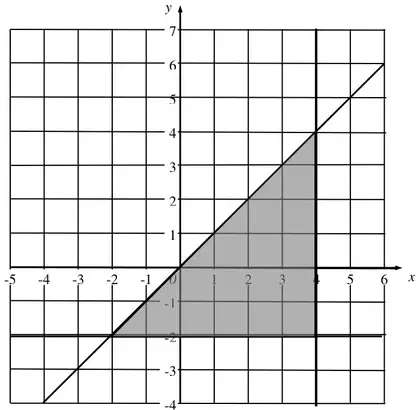
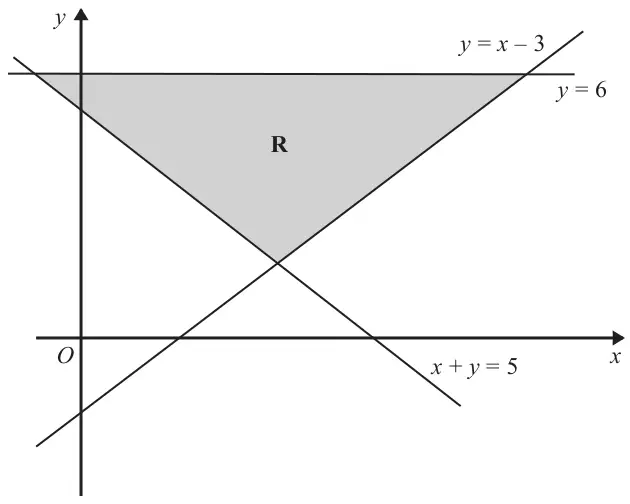
(a) Write down the integer values of \(x\) that satisfy the inequality \(\;-2 \lt x \leqslant 4\) (2)
The region R, shown shaded in the diagram, is bounded by three straight lines.
Diagram NOT accurately drawn
(b) Write down the three inequalities that define the region R. (2)
Mark scheme (a)
Scheme
Marks
−1, 0, 1, 2, 3, 4
B2
(2)
Notes
B2: B1 for −2, −1, 0, 1, 2, 3, 4 or −1, 0, 1, 2, 3
Mark scheme (b)
Scheme
Marks
\(y \leqslant 6\) \(x + y \geqslant 5\) \(y \geqslant x - 3\)
B2
(2)
(4 marks)
Notes
B2: B2 for 3 correct inequalities B1 for 2 correct inequalities (In both cases allow \(\lt \) in place of \(\leqslant\), and \(\gt \) in place of \(\geqslant\))
\(\dfrac{3 \pm \sqrt{169}}{2}\) or \(\dfrac{3 \pm 13}{2}\)
M1
8, −5
A1
(3)
(5 marks)
Notes
M1:or \((x + a)(x + b)\) where \(ab = -40\) or \(a + b = -5\) OR correct substitution into quadratic formula (condone one sign error in \(a\), \(b\) or \(c\) and missing brackets) (if + rather than ± shown then award M1 only unless recovered with answers)
M1: \(\dfrac{3 \pm \sqrt{169}}{2}\) or \(\dfrac{3 \pm 13}{2}\)
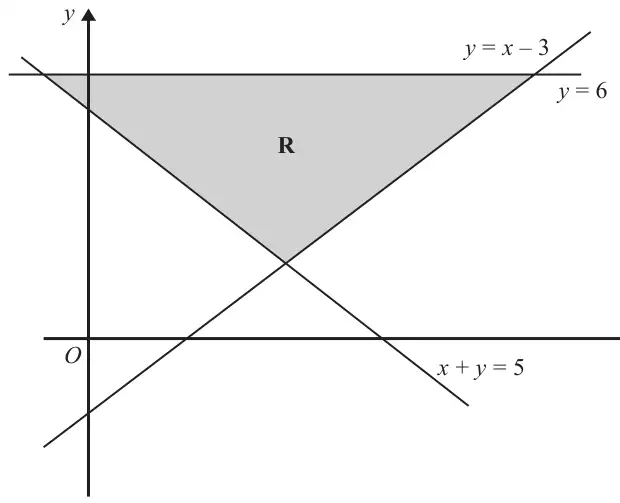
(a) Write down the integer values of \(x\) that satisfy the inequality \(\;-2 \lt x \leqslant 4\) (2)
The region R, shown shaded in the diagram, is bounded by three straight lines.
Diagram NOT accurately drawn
(b) Write down the three inequalities that define the region R. (2)
Mark scheme (a)
Scheme
Marks
−1, 0, 1, 2, 3, 4
B2
(2)
Notes
B2: B1 for −2, −1, 0, 1, 2, 3, 4 or −1, 0, 1, 2, 3
Mark scheme (b)
Scheme
Marks
\(y \leqslant 6\) oe \(x + y \geqslant 5\) oe \(y \geqslant x - 3\) oe
B2
(2)
(4 marks)
Notes
B2: B2 for 3 correct inequalities B1 for 2 correct inequalities SC B2 for \(y \geqslant 6\) oe and \(x + y \leqslant 5\) oe and \(y \leqslant x - 3\) oe (In all cases allow \(\lt \) in place of \(\leqslant\), and \(\gt \) in place of \(\geqslant\))
\(\dfrac{3 \pm \sqrt{169}}{2}\) or \(\dfrac{3 \pm 13}{2}\)
M1
Working required Answer: 8, −5
A1
(3)
(5 marks)
Notes
M1:or \((x + a)(x + b)\) where \(ab = -40\) or \(a + b = -5\) OR correct substitution into quadratic formula (condone one sign error in \(a\), \(b\) or \(c\) and missing brackets) (if + rather than ± shown then award M1 only unless recovered with answers)
M1: \(\dfrac{3 \pm \sqrt{169}}{2}\) or \(\dfrac{3 \pm 13}{2}\)
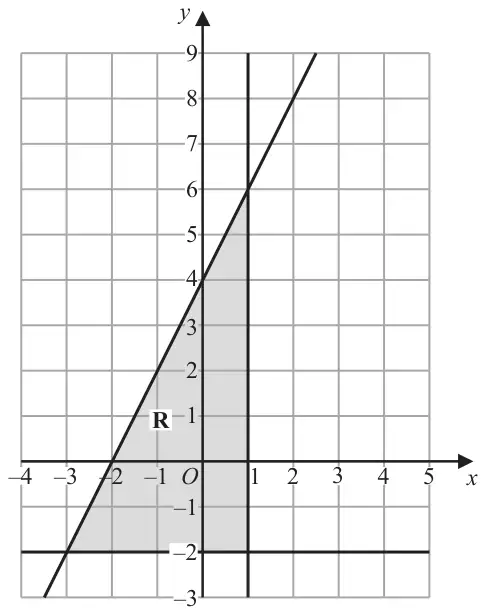
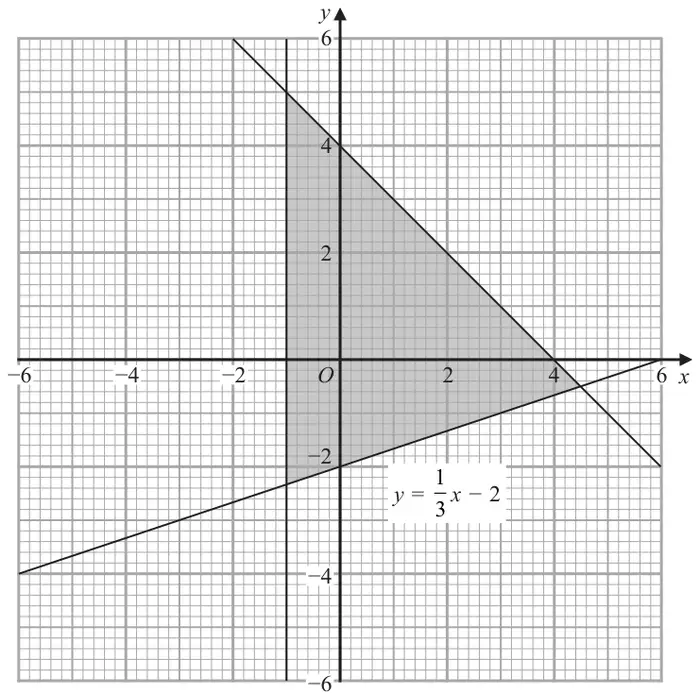
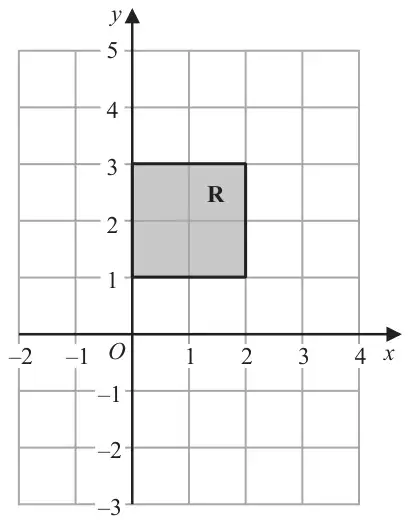
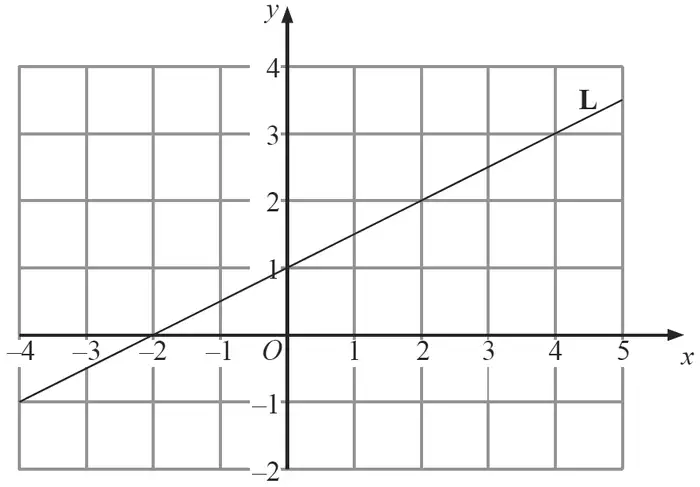
22 The straight line L has gradient 5 and passes through the point with coordinates \((0, -3)\)
(a) Write down an equation for L. (2)
(b)The region R, shown shaded in the diagram, is bounded by four straight lines. Write down the inequalities that define R. (2)
Mark scheme (a)
Scheme
Marks
\(y = 5x - 3\) oe
B2
(2)
Notes
B2: fully correct equation eg \(y = 5x + -3\) or \(y - -3 = 5(x - 0)\) If not B2 then B1 for \(y = 5x\) or \(y = 5x + a\) or \(y = bx - 3\) (\(b \ne 0\)) or (\(L =\)) \(5x - 3\)
Mark scheme (b)
Scheme
Marks
\(x \geqslant 0\), \(x \leqslant 2\), \(y \geqslant 1\), \(y \leqslant 3\) or Answer: \(0 \leqslant x \leqslant 2\) \(1 \leqslant y \leqslant 3\)
B2
(2)
(4 marks)
Notes
B2: fully correct oe (B1 for 2 or 3 out of 4 inequalities correct) (Treat double-ended inequalities as two separate inequalities) (SC B2 \(y \gt 3\), \(y \lt 1\), \(x \lt 0\), \(x \gt 2\)) Accept <, ≤, > and ≥ throughout
(a)Write down the inequality shown on the number line. (1)
(b) Solve the inequality \(\;4y - 13 \leqslant y + 8\) (2)
Mark scheme (a)
Scheme
Marks
\(x \gt -3\)
B1
(1)
Notes
B1: Accept \(-3 \lt x\)
Mark scheme (b)
Scheme
Marks
\(4y - y \leqslant 8 + 13\)
M1
\(y \leqslant 7\)
A1
(2)
(3 marks)
Notes
M1: Arranging \(y\)’s on one side and the numbers on the other side. (allow \(4y - y = 8 + 13\) oe or \(4y - y \lt 8 + 13\) oe or \(4y - y \gt 8 + 13\) oe or \(4y - y \geqslant 8 + 13\) oe)
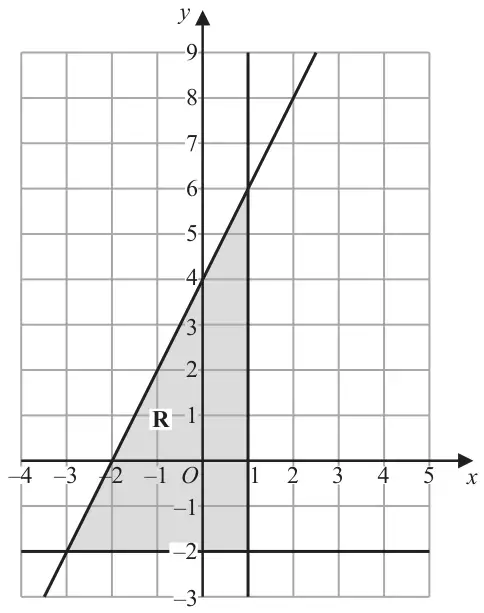
10 The straight line L has gradient 5 and passes through the point with coordinates \((0, -3)\)
(a) Write down an equation for L. (2)
(b)
The region R, shown shaded in the diagram, is bounded by four straight lines.
Write down the inequalities that define R. (2)
Mark scheme (a)
Scheme
Marks
\(y = 5x - 3\) oe
B2
(2)
Notes
B2: fully correct equation eg \(y = 5x + -3\) or \(y - -3 = 5(x - 0)\) If not B2 then B1 for \(y = 5x\) or \(y = 5x + a\) or \(y = bx - 3\) or (\(L\)=) \(5x - 3\)
Mark scheme (b)
Scheme
Marks
\(x \geqslant 0\), \(x \leqslant 2\), \(y \geqslant 1\), \(y \leqslant 3\) or Answer: \(0 \leqslant x \leqslant 2\) \(1 \leqslant y \leqslant 3\)
B2
(2)
(4 marks)
Notes
B2: fully correct oe (B1 for 2 or 3 out of 4 inequalities correct) (Treat double−ended inequalities as two separate inequalities) (SC B2 \(y \gt 3\), \(y \lt 1\), \(x \lt 0\), \(x \gt 2\)) Accept \(\lt \), \(\leqslant\), \(\gt \) and \(\geqslant\) throughout
(a)Write down the inequality shown on the number line. (1)
(b) Solve the inequality \(4y - 13 \leqslant y + 8\) (2)
Mark scheme (a)
Scheme
Marks
\(x \gt -3\)
B1
(1)
Notes
B1: Accept \(-3 \lt x\)
Mark scheme (b)
Scheme
Marks
\(4y - y \leqslant 8 + 13\)
M1
\(y \leqslant 7\) oe
A1
(2)
(3 marks)
Notes
M1: Arranging \(y\)’s on one side and the numbers on the other side. (allow \(4y - y = 8 + 13\) oe or \(4y - y \lt 8 + 13\) oe or \(4y - y \gt 8 + 13\) oe or \(4y - y \geqslant 8 + 13\) oe)
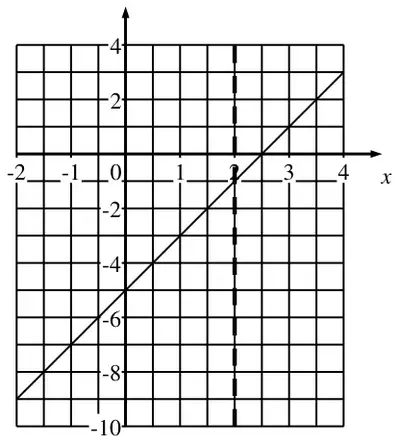
(a) Complete the table of values for \(y = 2x - 5\)
\(x\)
−2
−1
0
1
2
3
4
\(y\)
−7
−1
1
(2)
(b) On the grid, draw the graph of \(y = 2x - 5\) for values of \(x\) from −2 to 4(2)
(c) Mark with a cross (×) a point on the grid that has coordinates satisfying both \[x \lt 2 \quad \text{and} \quad y \gt 2x - 5\]Label this point \(P\). (2)
Mark scheme (a)
Scheme
Marks
−9, (−7), −5, −3, (−1), (1), 3 Answer: Table
B2
(2)
Notes
B2: all correct (B1 2 or 3 correct)
Mark scheme (b)
Scheme
Marks
Correct line
M1
A1
(2)
Notes
M1: for at least 5 of their points plotted correctly ( ft if at least B1 earned in (a))
Mark scheme (c)
Scheme
Marks
× \(P\) in a correct place
M1
A1
(2)
(6 marks)
Notes
M1: for a point marked above their line or for a point marked to the left of \(x = 2\)
A1: for a point marked above their line and marked to the left of \(x = 2\) (SC B1 for the correct region identified but no point plotted)
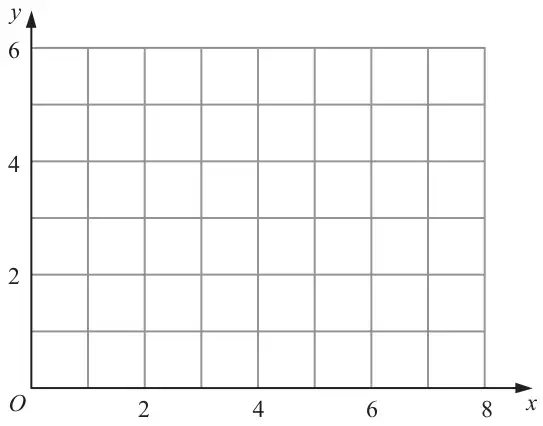
(a) On the grid, draw the graph of \(y = 2x + 3\) for values of \(x\) from −2 to 3(3)
(b) Show, by shading on the grid, the region that satisfies all three of the inequalities\[x \leqslant 2 \qquad y \geqslant 1 \qquad y \leqslant 2x + 3\]Label the region R. (2)
Mark scheme (a)
Scheme
Marks
\(x\)
−2
−1
0
1
2
3
\(y\)
−1
1
3
5
7
9
B3
B2
B1
(3)
Notes
B3: For a correct line between \(x = -2\) and \(x = 3\)
B2: For a correct straight line segment through at least 3 of (−2, −1) (−1, 1) (0, 3) (1, 5) (2, 7) (3, 9) OR for all of (−2, −1) (−1, 1) (0, 3) (1, 5) (2, 7) (3, 9) plotted but not joined
B1: For at least 2 correct points plotted or stated (ignore incorrect points) OR for a line drawn with a positive gradient through (0, 3) and clear intention to use a gradient of 2 (eg. a line through (0, 3) and (0.5, 5) OR a line drawn with a gradient of 2
Mark scheme (b)
Scheme
Marks
M1
A1
(2)
(5 marks)
Notes
M1: for \(x = 2\) and \(y = 1\) drawn
A1: for correct region identified
NB: Region may be unshaded or shaded, condone missing label
M1: Any correct partially factorised expression with at least 2 terms in the common factor or for the correct common factor and a 2 term expression inside the brackets with just one error
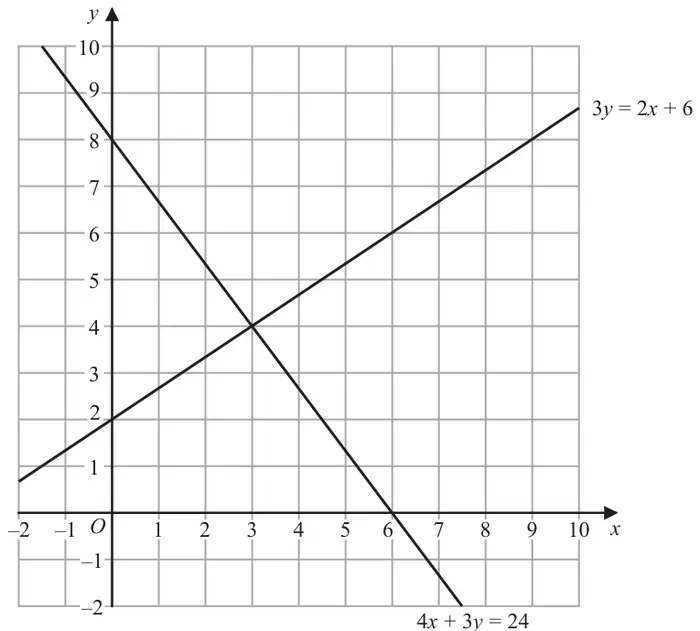
12 The diagram shows two straight lines drawn on a grid.
(a) Write down the solution of the simultaneous equations\[\begin{aligned}3y &= 2x + 6\\ 4x + 3y &= 24\end{aligned}\] (1)
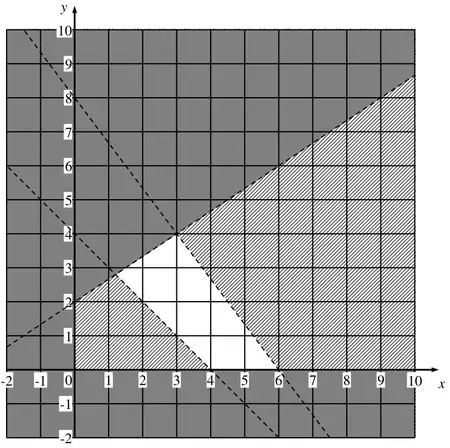
(b) Show, by shading on the grid, the region defined by all five of the inequalities\[x \geqslant 0 \qquad y \geqslant 0 \qquad x + y \geqslant 4 \qquad 3y \leqslant 2x + 6 \qquad 4x + 3y \leqslant 24\]Label the region R. (3)
Mark scheme (a)
Scheme
Marks
\(x = 3\), \(y = 4\)
B1
(1)
Mark scheme (b)
Scheme
Marks
Answer: Correct region (graph at end of mark scheme)
B3
(3)
(4 marks)
Notes
B3: for correct region identified If not B3 then award B2 for \(x + y = 4\) drawn (with no additional lines drawn) and a region identified that satisfies at least 3 of the 5 given inequalities If not B2 then award B1 for line \(x + y = 4\) drawn NB. May shade wanted or unwanted regions; lines may be solid or dashed
M1: Any correct partially factorised expression with at least 2 terms in the common factor or for the correct common factor and a 2 term expression inside the brackets with just one error
e.g. \(-6y - 2y = -7 - 3\) or \(3 + 7 = 2y + 6y\) or \(-8y = -10\) or \(8y = 10\)
M1
1.25 oe
A1
(3)
Notes
M1: for multiplying out brackets in a correct equation or dividing all terms by 3
M1: for isolating the terms in \(y\) ft from \(3 - 2y = 2y - 7\) or \(1 - 6y = 2y - 7\)
A1: dep on M1 awarded
Mark scheme (b)
Scheme
Marks
\(-3 \lt x \leqslant 4\)
B2
(2)
Notes
B2: also accept \(x > -3\) and \(x \leqslant 4\) or \(4 \geqslant x > -3\) If not B2 then award B1 for a double-ended inequality which is correct at one end (ignore the other end) eg. \(-3 \lt x \lt 4\), \(-3 \leqslant x \leqslant 4\), \(-3 \lt x > 4\) or for an answer of \(x > -3\) oe or \(x \leqslant 4\) oe
or the wrong variable in an otherwise correct inequality eg. \(-3 \lt y \leqslant 4\)
SC : Award B1 for \(-3 \leqslant x \lt 4\)
Mark scheme (c)
Scheme
Marks
e.g. \(2m \geqslant 8 - 13\)
M1
\(m \geqslant -2.5\) oe
A1
(2)
Notes
M1: for isolating terms in \(m\) (in an equation or inequality) e.g. \(2m \geqslant -5\) or −2.5 oe
(a) On the grid, draw the graph of \(y = -2x + 4\) for values of \(x\) from −1 to 5(4)
(b) Show by shading on the grid, the region defined by all three of the inequalities \[\begin{aligned} y &\leqslant -2x + 4 \\ y &\geqslant -4 \\ x &\geqslant 1 \end{aligned}\] Label your region R. (3)
Mark scheme (a)
Scheme
Marks
(−1, 6) (0, 4) (1, 2) (2, 0) (3, −2) (4, −4) (5, −6) Answer: Correct line between \(x = -1\) and \(x = 5\)
B4
B3
B2
B1
(4)
Notes
B4: For a correct line between \(x = -1\) and \(x = 5\)
B3: For a correct line through at least 3 of (−1, 6) (0, 4) (1, 2) (2, 0) (3, −2) (4, −4) (5, −6) OR for all of (−1, 6) (0, 4) (1, 2) (2, 0) (3, −2) (4, −4) (5, −6) plotted but not joined.
B2: For at least 2 correct points plotted
B1: For at least 2 correct points stated (may be in a table) or seen in working OR for a line drawn with a negative gradient through (0, 4) OR for a line with the correct gradient.
Mark scheme (b)
Scheme
Marks
M1
M1
For correct region identified
A1ft
(3)
(7 marks)
Notes
M1: for \(y = -4\) drawn; accept full or dashed line NB A shaded rectangle implies a choice of lines so M0
M1: for \(x = 1\) drawn; accept full or dashed line NB A shaded rectangle implies a choice of lines so M0
A1ft: for correct region identified. Condone no label if region clear. ft from an incorrect straight line in part (a)
(−1, 6) (0, 4) (1, 2) (2, 0) (3, −2) (4, −4) (5, −6) Answer: Correct line between \(x = -1\) and \(x = 5\)
B4
(4)
Notes
B4: For a correct line between \(x = -1\) and \(x = 5\)
B3: For a correct line through at least 3 of (−1, 6) (0, 4) (1, 2) (2, 0) (3, −2) (4, −4) (5, −6) OR for all of (−1, 6) (0, 4) (1, 2) (2, 0) (3, −2) (4, −4) (5, −6) plotted but not joined.
B2: For at least 2 correct points plotted
B1: For at least 2 correct points stated (may be in a table) or seen in working OR for a line drawn with a negative gradient through (0, 4) OR for a line with the correct gradient.
Mark scheme (b)
Scheme
Marks
M1
M1
For correct region identified
A1ft
(3)
(7 marks)
Notes
M1: for \(y = -4\) drawn; accept full or dashed line NB A shaded rectangle implies a choice of lines so M0
M1: for \(x = 1\) drawn; accept full or dashed line NB A shaded rectangle implies a choice of lines so M0
A1ft: for correct region identified. Condone no label if region clear. ft from an incorrect straight line in part (a)
(b) Write down the integer values of \(x\) which satisfy \(-4 \lt 3x + 5 \leqslant 11\) (2)
Mark scheme (a)
Scheme
Marks
\(-9 \lt 3x \leqslant 6\) or \(3x \gt -9\) and \(3x \leqslant 6\) or
\(-\dfrac{4}{3} \lt x + \dfrac{5}{3} \leqslant \dfrac{11}{3}\) or \(x + \dfrac{5}{3} \gt -\dfrac{4}{3}\) and \(x + \dfrac{5}{3} \leqslant \dfrac{11}{3}\)
or \(x \gt -3\) or \(x \leqslant 2\)
M2
\(-3 \lt x \leqslant 2\)
A1
(3)
Notes
M2: For both ends correct for \(3x\) or \(x + \dfrac{5}{3}\) or one end correct for \(x\)
M1 for one end correct for \(3x\) or \(x + \dfrac{5}{3}\), eg \(3x \gt -9\) or \(3x \leqslant 6\) or answers of \(x = -3\) & \(x = 2\)
Mark scheme (b)
Scheme
Marks
−2, −1, 0, 1, 2
B2ft
(2)
Notes
B2ft: B1 for five correct values and one incorrect value or four correct values with no incorrect value Only ft from an inequality in the form \(a \lt x \leqslant b\)
(b) Write down the integer values of \(x\) which satisfy \(-4 \lt 3x + 5 \leqslant 11\) (2)
Mark scheme (a)
Scheme
Marks
\(-9 \lt 3x \leqslant 6\) or \(3x \gt -9\) and \(3x \leqslant 6\) or
\(-\dfrac{4}{3} \lt x + \dfrac{5}{3} \leqslant \dfrac{11}{3}\) or \(x + \dfrac{5}{3} \gt -\dfrac{4}{3}\) and \(x + \dfrac{5}{3} \leqslant \dfrac{11}{3}\)
or \(x \gt -3\) or \(x \leqslant 2\)
M2
\(-3 \lt x \leqslant 2\)
A1
(3)
Notes
M2: For both ends correct for \(3x\) or \(x + \dfrac{5}{3}\) or one end correct for \(x\)
M1 for one end correct for \(3x\) or \(x + \dfrac{5}{3}\), eg \(3x \gt -9\) or \(3x \leqslant 6\) or
answers of \(x = -3\) & \(x = 2\)
A1: Accept \(x \gt -3\), \(x \leqslant 2\)
Mark scheme (b)
Scheme
Marks
– 2, – 1, 0, 1, 2
B2ft
(2)
Notes
B2ft: B1 for five correct values and one incorrect value or four correct values with no incorrect value Only ft from an inequality in the form \(a \lt x \leqslant b\)
\(x^2 + 2x\) or \(2x + x^2\) or \(x2 + x^2\) Answer: \(x^2 + 2x\)
B1
(1)
Mark scheme (b)
Scheme
Marks
\(-2t + 4\) Answer: \(-2t + 4\)
B2
(2)
Notes
B2: B1 for \(-2t\) or 4
Mark scheme (c)
Scheme
Marks
\(4x \gt 3 + 7\) or \(4x \gt 10\)
M1
\(x \gt 2.5\)
A1
(2)
Notes
M1: for \(4x \gt 3 + 7\) or \(4x \gt 10\) or \(4x = 3 + 7\) or \(4x = 10\) or \(x = 2.5\) or \(x \lt 2.5\) or an answer of 2.5 following \(x \gt 2.5\) in working
B3: for \(y = 2x + 3\) drawn from \(x = -2\) to 4 if not B3 then B2 for a correct straight line segment through at least 3 of (−2, −1) (−1, 1) (0, 3) (1, 5) (2, 7) (3, 9) (4, 11) OR for all of (−2, −1) (−1, 1) (0, 3) (1, 5) (2, 7) (3, 9) (4, 11) plotted but not joined if not B2 then B1 for any 2 correct points stated (could be in a table) or plotted OR a line with a positive gradient through (0, 3) OR a line with gradient 2
Mark scheme (b)
Scheme
Marks
M1
correct region
A1
(2)
Notes
M1: for \(x = 3\) and \(y = 2\) drawn
A1: for correct region identified (R need not be labelled) Accept shaded or unshaded
(a) On the grid, draw the graph of \(y = 2x + 3\) for values of \(x\) from −2 to 4 (3)
(b) Show, by shading on the grid, the region that satisfies all three of the inequalities \[x \leqslant 3 \quad\text{and}\quad y \geqslant 2 \quad\text{and}\quad y \leqslant 2x + 3\] Label your region R. (2)
if not B3 then B2 for a correct straight line segment through at least 3 of (−2, −1) (−1, 1) (0 , 3) (1 , 5) (2, 7) (3 , 9) (4 , 11) OR for all of (−2, −1) (−1, 1) (0 , 3) (1 , 5) (2, 7) (3 , 9) (4 , 11) plotted but not joined
if not B2 then B1 for any 2 correct points stated (could be in a table) or plotted OR a line with a positive gradient through (0, 3) OR a line with gradient 2
Mark scheme (b)
Scheme
Marks
M1
correct region
A1
(2)
Notes
M1: for \(x = 3\) and \(y = 2\) drawn
A1: for correct region identified (R need not be labelled) Accept shaded or unshaded
M1: for \(4x \gt 3 + 7\) or \(4x \gt 10\) or \(4x = 3 + 7\) or \(4x = 10\) or \(x = 2.5\) or \(x \lt 2.5\) or an answer of 2.5 following \(x \gt 2.5\) in working
A1: allow \(x \gt \dfrac{10}{4}\) oe
must have correct inequality sign
Mark scheme (c)
Scheme
Marks
\(3 - 5m = 8 \times 4\) or \(3 - 5m = 32\) or \(32 + 5m = 3\)
M1
\(-5m\) = ‘32’ – 3 or 3 – ‘32’ = \(5m\) \(-5m = 29\) or \(-29 = 5m\)
M1
−5.8
A1
(3)
Notes
M1: Multiplying both sides by 4 as a correct first step
M1: for isolating \(5m\) or \(-5m\) in a correct equation
A1: oe eg \(\dfrac{-29}{5}\) dependent on at least M1
(a) Solve the inequalities \(-5 \lt x + 4 \leqslant 3\) (2)
(b) \(n\) is an integer. Write down all the values of \(n\) that satisfy \(-3 \leqslant n \lt 2\) (2)
Mark scheme (a)
Scheme
Marks
\(-5 - 4 \lt x \leqslant 3 - 4\)
M1
\(-9 \lt x \leqslant -1\)
A1
(2)
Notes
M1: subtraction of 4 from either side in an inequality or one side of inequality correct (eg \(x \leqslant -1\)) or for \(-5 - 4\) (\(= -9\)) and \(3 - 4\) (\(= -1\))
(a) On the grid, draw the graph of \(y = 3x + 2\) for values of \(x\) from –2 to 3 (3)
(b) Mark with a cross (×) a point on the grid that satisfies both the inequalities \(x \gt 2\) and \(y \gt 3x + 2\) Label this point \(P\). (2)
Mark scheme (a)
Scheme
Marks
(−2, −4), (−1, −1), (0, 2), (1, 5), (2, 8), (3, 11) Answer: correct line drawn from between \(x = -2\) and \(x = 3\)
B3
(3)
Notes
B3: For a correct line between \(x = -2\) and \(x = 3\). If not B3, then B2 for: at least 2 correct points plotted or for a line passing through at least 2 correct points or for a line drawn with positive gradient through (0, 2) and clear intention to use a gradient of 3 (eg. a line through and (0, 2) and (0.5, 5)) If not B2 then B1 for: at least 2 correct points stated (may be in a table) or for a line drawn with a positive gradient through # (0, 2) or for a line with gradient 3.
Mark scheme (b)
Scheme
Marks
M1
correct point
A1
(2)
Notes
M1: ft for a point marked above their \(y = 3x + 2\) if at least B1 scored in (a) or for a point to the right of \(x = 2\)
A1: Point marked above \(y = 3x + 2\) and to the right of \(x = 2\) (not on lines). Label \(P\) may be omitted if unambiguous. SCB1 for the correct region identified by either shading in or shading out.
A1: for \(x \lt 9\) or \(9 \gt x\) NB: Final answer must be an inequality SC : B1 for \(x \leqslant 9\) or \(x = 9\) or 9 as an answer
Mark scheme (b)
Scheme
Marks
\(-2 \lt x \leqslant 4\) oe
B2
(2)
(4 marks)
Notes
B2: B1 for one end of inequality correct ie. \(-2 \lt x\) or \(x \leqslant 4\) OR \(-2 \leqslant x \lt 4\) condone the use of a variable other than \(x\) but not O
A1: for \(x \lt 9\) or \(9 \gt x\) NB: Final answer must be an inequality
SC : B1 for \(x \leqslant 9\) or \(x = 9\) or 9 as an answer
Mark scheme (b)
Scheme
Marks
\(-2 \lt x \leqslant 4\) oe
B2
(2)
(4 marks)
Notes
B2: B1 for one end of inequality correct ie. \(-2 \lt x\) or \(x \leqslant 4\) OR \(-2 \leqslant x \lt 4\) condone the use of a variable other than \(x\) but not O
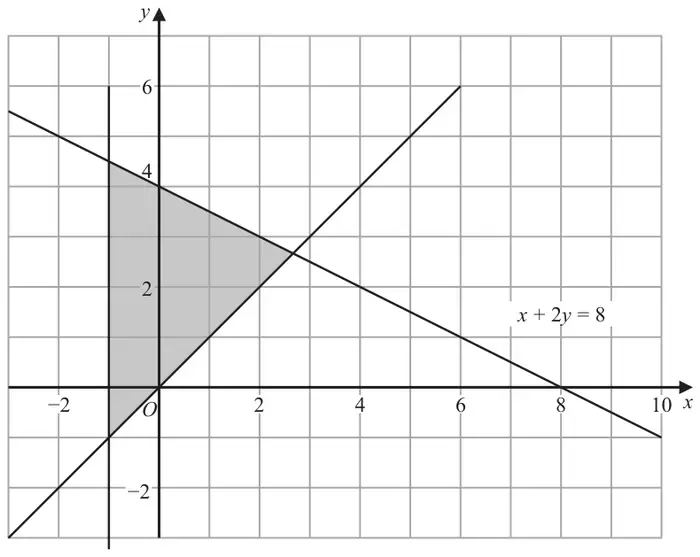
B2: Must be a single straight line passing through at least 3 of (0,4) (2,3) (4,2) (6,1) (8,0) (10,-1) If not B2 then B1 for a single straight line with a negative gradient passing through either (0,4 ) or (8,0) or at least 3 of (0,4) (2,3) (4,2) (6,1) (8,0) (10,-1) plotted or calculated
Mark scheme (b)
Scheme
Marks
\(x = 2\) drawn
B1
\(y = 1\) drawn
B1
Correct region identified
B1
(3)
(5 marks)
Notes
B1: Ignore extra lines Accept R shaded or Rʹ shaded. Condone omission of label
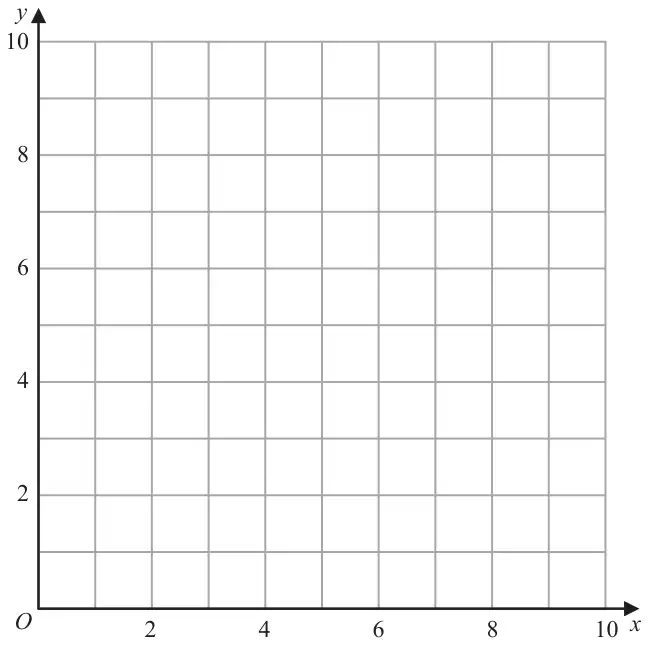
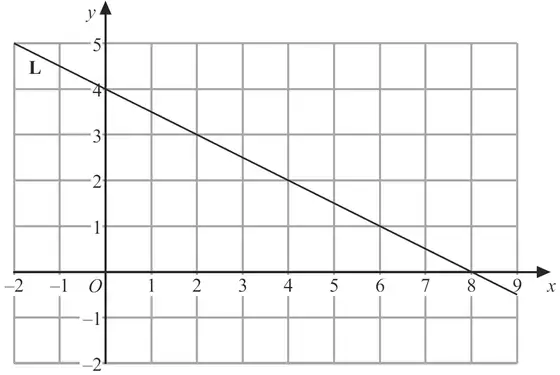
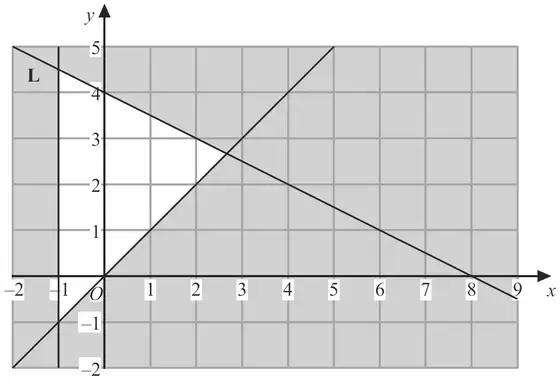
(a) On the grid, draw the line with equation \(x + 2y = 8\) for values of \(x\) from 0 to 9(2)
(b) Show, by shading on the grid, the region defined by all three inequalities \(x + 2y \leqslant 8\) \(x \geqslant 2\) \(y \geqslant 1\) Label your region R. (3)
Mark scheme (a)
Scheme
Marks
Correct line drawn
B2
(2)
Notes
B2: Must be a single straight line passing through at least 3 of (0,4) (2,3) (4,2) (6,1) (8,0) (10,-1) If not B2 then B1 for a single straight line with a negative gradient passing through either (0,4 ) or (8,0) or at least 3 of (0,4) (2,3) (4,2) (6,1) (8,0) (10,-1) plotted or calculated
Mark scheme (b)
Scheme
Marks
\(x = 2\) drawn
B1
\(y = 1\) drawn
B1
Correct region identified
B1
(3)
(5 marks)
Notes
B1: Ignore extra lines Accept R shaded or R′ shaded. Condone omission of label R
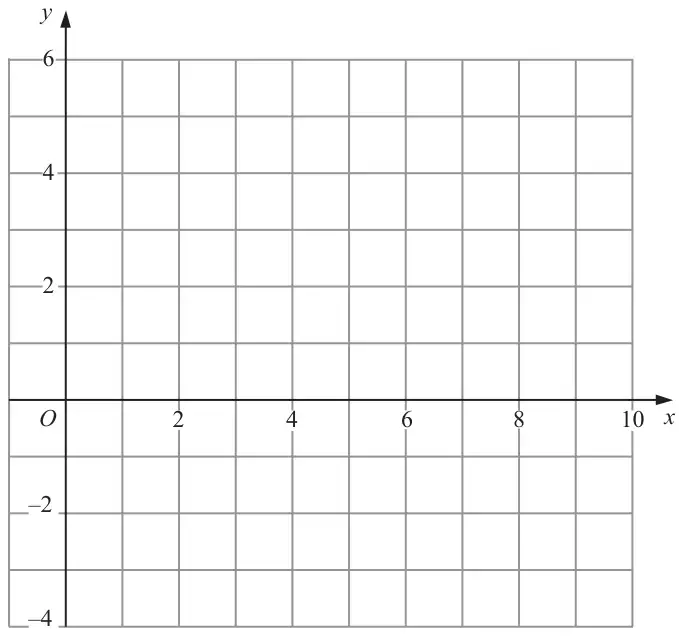
(a) Complete the table of values for \(2x + y = 4\)
\(x\)
−1
2
4
\(y\)
(2)
(b) On the grid, draw the graph of \(2x + y = 4\) for values of \(x\) from −1 to 4(2)
(c) Show, by shading on the grid, the region which satisfies all three of the inequalities \[x \geqslant -1, \quad y \geqslant 2 \quad \text{and} \quad 2x + y \leqslant 4\] Label the region R. (2)
Mark scheme (a)
Scheme
Marks
6, 0, −4
B2
(2)
Notes
B2: Award B1 for any one correct.
Mark scheme (b)
Scheme
Marks
(−1, 6), (2, 0), (4, −4)
M1ft
correct line
A1
(2)
Notes
M1ft: Plot any two points, from table with no ft errors, (dependent on at least B1 above).
A1: Straight line joining (−1, 6) to (4, −4)
Mark scheme (c)
Scheme
Marks
M1
A1
(2)
(Total 6 marks)
Notes
M1: Draw lines \(x = -1\) and \(y = 2\)
A1: Correct region identified (R need not be labelled). Accept shaded or unshaded.
(a)An inequality is shown on the number line. Write down this inequality. (2)
(b)
(i) Solve the inequality \(2(y - 3) \geqslant 1\)
(ii) Write down the lowest integer which satisfies this inequality.
(4)
Mark scheme (a)
Scheme
Marks
\(-1 \lt x \leqslant 4\)
B2
(2)
Notes
B2: Also accept \(x > -1\) and \(x \leqslant 4\) or \(4 \geqslant x > -1\) B1 for a double-ended inequality which is correct at one end (ignore the other end) eg. \(-1 \leqslant x \leqslant 4\), \(-1 \lt x > 4\) or \(-1 \leqslant x \lt 4\) or award B1 for an answer of \(x > -1\) or \(x \leqslant 4\)
Mark scheme (b)
Scheme
Marks
(i) \(2y - 6 \geqslant 1\)
M1
\(2y \geqslant 7\)
M1
\(y \geqslant 3\tfrac{1}{2}\) oe
A1
(ii) Answer: 4
B1
(4)
(Total 6 marks)
Notes
M1: M2 for \(y - 3 \geqslant \dfrac{1}{2}\)
For method marks condone use of > instead of \(\geqslant\)
(a) Complete the table of values for \(2x + y = 4\)
\(x\)
–1
2
4
\(y\)
(2)
(b) On the grid, draw the graph of \(2x + y = 4\) for values of \(x\) from –1 to 4 (2)
(c) Show, by shading on the grid, the region which satisfies all three of the inequalities \[x \geqslant -1, \quad y \geqslant 2 \quad \text{and} \quad 2x + y \leqslant 4\] Label the region \(\mathbf{R}\). (2)
Mark scheme (a)
Scheme
Marks
6, 0, −4
B2
(2)
Notes
B2: Award B1 for any one correct.
Mark scheme (b)
Scheme
Marks
(−1, 6), (2, 0), (4, −4)
M1ft
correct line
A1
(2)
Notes
M1ft: Plot any two points, from table with no ft errors, (dependent on B1).
A1: Straight line joining (−1, 6) to (4, −4) or better.
Mark scheme (c)
Scheme
Marks
M1
A1
(2)
(6 marks)
Notes
M1: Draw lines \(x = -1\) and \(y = 2\)
A1: Correct region identified (R need not be labelled). Accept shaded or unshaded.
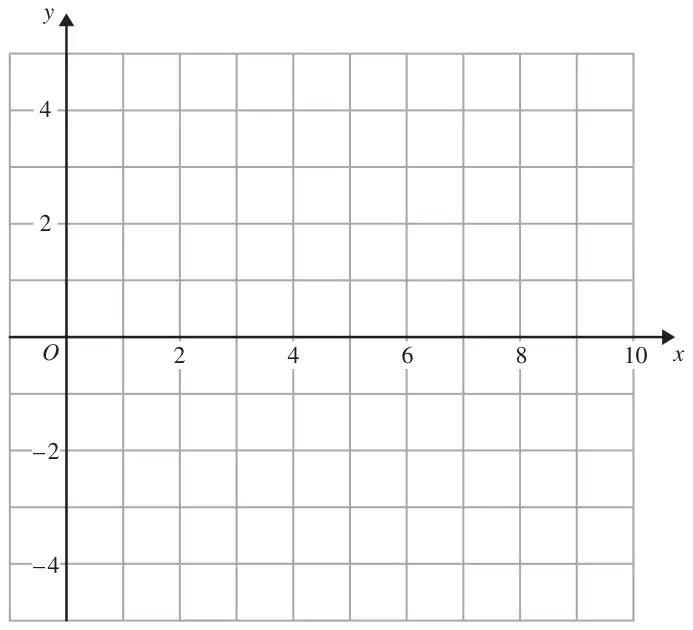
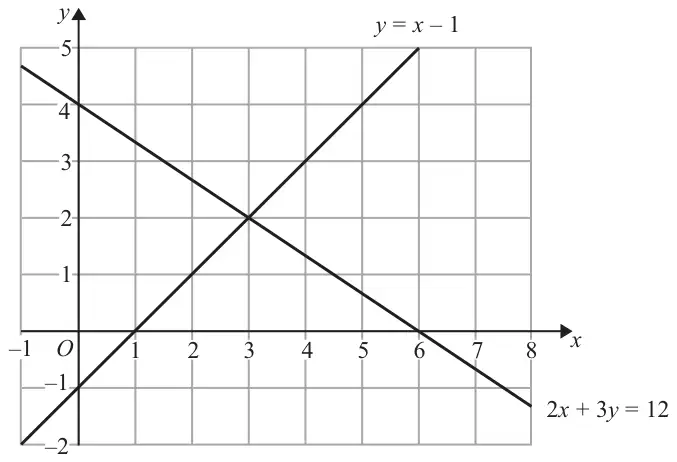
The diagram shows two straight lines. The equations of the lines are \(y = x - 1\) and \(2x + 3y = 12\)
(a) Write down the solution of the simultaneous equations \[\begin{aligned} y &= x - 1 \\ 2x + 3y &= 12 \end{aligned}\] (1)
(b) Find an equation of the line which is parallel to the line with equation \(2x + 3y = 12\) and passes through the point (0, 10) (4)
(c) On the grid, mark with a cross (×) each point which satisfies both these inequalities \(y > x - 1\) and \(2x + 3y < 12\) and whose coordinates are positive integers. (2)
Mark scheme (a)
Scheme
Marks
\(x = 3,\ y = 2\)
B1
(1)
Notes
B1: cao
Mark scheme (b)
Scheme
Marks
Use of gradient and \(y = mx + c\)
or clear attempt to use \(\dfrac{\text{vertical difference}}{\text{horizontal difference}}\) eg \(\dfrac{2}{3}\) oe
or \(y = \text{“}{-\tfrac{2}{3}}\text{”}x + 10\) oe
A1
(4)
Notes
M1: Throughout question accept \(\dfrac{2}{3}\) written as a decimal rounded or truncated to 2 or more decimal places
M1: ft from “\(-\dfrac{2}{3}\)”
A1: ft from “\(-\dfrac{2}{3}\)”
Alternative scheme: Use of \(2x + 3y = k\)
Scheme
Marks
\(2x + 3y = k\)
M1
2× 0 + 3×10 (=\(k\))
M1
\(k = 30\)
A1
\(2x + 3y = 30\) oe
A1
Notes
M1: Substitution of (0, 10) into \(2x + 3y = k\)
Mark scheme (c)
Scheme
Marks
(1,1) (1,2) (1,3) (2,2) marked
B2
(2)
Notes
B2: B1 for 3 correct points marked and none wrong or for all correct points and either one or more of points on \(y\) axis ie. (0,−1) (0,0) (0,1) (0,2) (0,3) (0,4) points on \(y = x - 1\) ie (0,−1) (1,0) (2,1) (3,2)
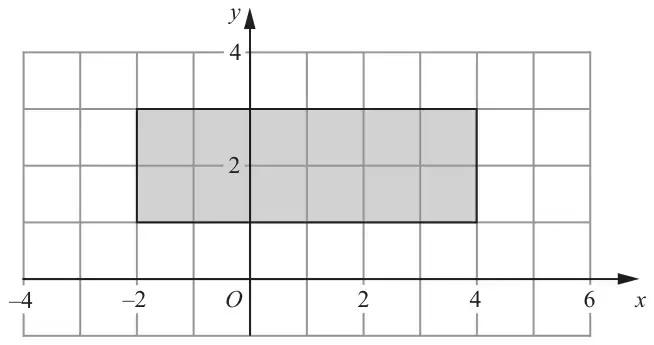
Write down inequalities to fully define the shaded region.
(3)
Mark scheme
Scheme
Marks
\(-2 \leqslant x \leqslant 4\), \(1 \leqslant y \leqslant 3\) or \(x \geqslant -2\), \(x \leqslant 4\), \(y \geqslant 1\), \(y \leqslant 3\)
B3
(3)
Notes
B3: B2 for 3 correct inequalities B1 for 2 correct inequalities (Treat double-ended inequalities as two separate inequalities) Accept \(\lt\) and \(\gt\) throughout
B1: Condone omission of label Accept shading in or shading out, if consistent Award full marks for correct region labelled R even if no shading
Apart from Questions 9, 13, 18, 20 and 21 (where the mark scheme states otherwise) the correct answer, unless clearly obtained by an incorrect method, should be taken to imply a correct method.
(i) Solve the inequalities \(-6 \lt 4x \leqslant 8\)
(ii) \(n\) is an integer. Write down all the values of \(n\) which satisfy \(-6 \lt 4n \leqslant 8\)
(4)
Mark scheme
Scheme
Marks
(i) \(-1\frac{1}{2} \lt x \leqslant 2\)
B2
(ii) −1 0 1 2
B2
(Total 4 marks)
Notes
B2: Also accept \(-\frac{3}{2} \lt x \leqslant 2\) or answer expressed as two separate inequalities B1 for \(-1\frac{1}{2} \lt x\) or \(-\frac{3}{2} \lt x\) or \(x \leqslant 2\) (these may be as part of a double-ended inequality) or \(-\frac{6}{4} \lt x \leqslant \frac{8}{4}\)
B2: B1 for 4 correct and 1 wrong or for 3 correct and 0 wrong
Apart from Questions 3, 13(b) and 17(f) (where the mark scheme states otherwise), the correct answer, unless clearly obtained by an incorrect method, should be taken to imply a correct method.
(ii) \(n\) is a negative integer. Write down all the values of \(n\) which satisfy \(2n + 13 \geqslant 6\)
(4)
Mark scheme
Scheme
Marks
(i) \(2x \geqslant 6 - 13\) oe
M1
\(x \geqslant -3.5\) oe
A1
(ii) −3, −2, −1
B2
(Total 4 marks)
Notes
M1: Condone \(2x \gt 6 - 13\) oe
A1: mark response on answer line (do not isw) correct answer with no working = M1A1
B2: any order B1 for −3, −2, −1, 0
Apart from questions 5b, 8, 15d, 20b, 21b, 23, 24b (where the mark scheme states otherwise) the correct answer, unless clearly obtained by an incorrect method, should be taken to imply correct working.
(a)An inequality is shown on the number line. Write down this inequality. (2)
(b)
(i) Solve the inequality \(2x + 9 \gt 1\)
(ii) \(n\) is a negative integer. Write down all the values of \(n\) which satisfy \(2n + 9 \gt 1\)
(4)
Mark scheme (a)
Scheme
Marks
\(-4 \leqslant x \lt 3\)
B2
(2)
Notes
B2: Also accept ‘\(x \lt 3\) and \(x \geqslant -4\)’ B1 for \(-4 \leqslant x \leqslant 3\), \(-4 \lt x \lt 3\), \(-4 \lt x \leqslant 3\), a double-ended inequality which is correct at one end (ignore the other end) Also award B1 for \(x \geqslant -4\), \(x \lt 3\), ‘\(x \lt 3\) or \(x \geqslant -4\)’
Mark scheme (b)
Scheme
Marks
(i) \(2x \gt -8\)
M1
\(x \gt -4\)
A1
(ii) Answer: −3 −2 −1
B2
(4)
(Total 6 marks)
Notes
M1: for \(2x \gt -8\) or \(x + 4.5 \gt 0.5\)
A1: for \(x \gt -4\) as final answer
B2: B1 for 3 correct and 1 wrong or for 2 correct and none wrong
(a)An inequality is shown on the number line. Write down this inequality. (2)
(b)
(i) Solve the inequality \(2x + 9 > 1\)
(ii) \(n\) is a negative integer. Write down all the values of \(n\) which satisfy \(2n + 9 > 1\)
(4)
Mark scheme (a)
Scheme
Marks
\(-4 \leqslant x \lt 3\)
B2
(2)
Notes
B2: Also accept ‘\(x \lt 3\) and \(x \geqslant -4\)’ B1 for \(-4 \leqslant x \leqslant 3\), \(-4 \lt x \lt 3\), \(-4 \lt x \leqslant 3\), a double-ended inequality which is correct at one end (ignore the other end) Also award B1 for \(x \geqslant -4\), \(x \lt 3\), ‘\(x \lt 3\) or \(x \geqslant -4\)’
Mark scheme (b)
Scheme
Marks
(i) \(2x > -8\)
M1
\(x > -4\)
A1
(ii) Answer: −3 −2 −1
B2
(4)
(6 marks)
Notes
M1: for \(2x > -8\) or \(x + 4.5 > 0.5\)
A1: for \(x > -4\) as final answer
B2: B1 for 3 correct and 1 wrong or for 2 correct and none wrong
(a) On the grid, draw the graph of \(2x - 3y = 6\) from \(x = 0\) to \(x = 9\)(2)
(b) On the grid, show by shading the region which satisfies the inequalities
\(3 \leqslant x \leqslant 6\) and \(2 \leqslant y \leqslant 4\)
Label your region R.(3)
Mark scheme (a)
Scheme
Marks
Correct line
B2
(2)
Notes
B2: Must be a single straight line passing through at least 3 of (0, −2), (3, 0), (6, 2), (9, 4) B1 for a single straight line with a positive gradient passing through either (0, −2) or (3, 0) or for 3 of 4 points (0, −2), (3, 0), (6, 2), (9, 4) correct with at most 1 point incorrect Allow ± 2mm
Mark scheme (b)
Scheme
Marks
Lines \(x = 3\) and \(x = 6\) drawn
B1
Lines \(y = 2\) and \(y = 4\) drawn
B1
\(R\) shown
B1
(3)
(Total 5 marks)
Notes
B1: Condone omission of label Accept shading in or shading out, if consistent Award 3 marks for correct labelled rectangle, even if not shaded Award 2 marks for a correct unshaded rectangle without a correct label SC B1 for region bounded by \(2 \lt x \lt 4\) and \(3 \lt y \lt 6\)
(a) On the grid, draw the graph of \(2x - 3y = 6\) from \(x = 0\) to \(x = 9\)(2)
(b) On the grid, show by shading the region which satisfies the inequalities \[3 \leqslant x \leqslant 6 \quad \text{and} \quad 2 \leqslant y \leqslant 4\] Label your region \(\mathbf{R}\).(3)
Mark scheme (a)
Scheme
Marks
Correct line
B2
(2)
Notes
B2: Must be a single straight line passing through at least 3 of (0, −2), (3, 0), (6, 2), (9, 4) B1 for a single straight line with a positive gradient passing through either (0, −2) or (3, 0) or for 3 of 4 points (0, −2), (3, 0), (6, 2), (9, 4) correct with at most 1 point incorrect Allow ± 2mm
Mark scheme (b)
Scheme
Marks
Lines \(x = 3\) and \(x = 6\) drawn
B1
Lines \(y = 2\) and \(y = 4\) drawn
B1
\(\mathbf{R}\) shown
B1
(3)
(5 marks)
Notes
B1: Condone omission of label. Accept shading in or shading out, if consistent. Award 3 marks for correct labelled rectangle, even if not shaded. Award 2 marks for a correct unshaded rectangle without a correct label. SC B1 for region bounded by \(2 \leqslant x \leqslant 4\) and \(3 \leqslant y \leqslant 6\)
9 Show, by shading on the grid, the region which satisfies these inequalities \(1 \leqslant x \leqslant 3 \quad\) and \(\quad -4 \leqslant y \leqslant -2\)
Label your region \(\mathbf{R}\).
(3)
Mark scheme
Scheme
Marks
\(\mathbf{R}\) shown
B3
(3)
(3 marks)
Notes
B3: for correct \(\mathbf{R}\) shaded in or out Condone omission of label
B2: for single shaded shape with 3 correct boundaries or for parts of both regions unambiguously shown or for 3 or 4 correct lines + 0 incorrect
B1: for single shaded shape with 2 correct boundaries or for square parts of both regions ambiguously shown or for 2, 3 or 4 correct lines + one or more incorrect
SC B1: for region bounded by \(1 \leqslant y \leqslant 3\) and \(-4 \leqslant x \leqslant -2\)
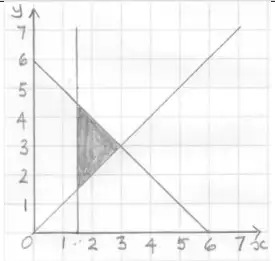
13 Show, by shading on the grid, the region which satisfies all three of these inequalities. \(x \geqslant 1 \qquad y \geqslant x \qquad x + 2y \leqslant 6\)
(b) On the grid, show clearly the region defined by the inequalities \[x + y \geqslant 4\] \[x \leqslant 3\] \[y \lt 4\] (4)
Mark scheme (a)
Scheme
Marks
Correct line
B1
(1)
Notes
B1: thro’ \(\geqslant\) 3 pts ± 2 mm
Mark scheme (b)
Scheme
Marks
\(x = 3\) OR \(y = 4\) drawn
B1
Correct region clear
B3
(4)
(5 marks)
Notes
B3: B1 \(x + y \geqslant 4\) B1 \(x \leqslant 3\) OR \(y \lt 4\) B1 if correct region clear. ft his (a) and/or his \(x = 3\) & \(y = 4\) so long as vert & horiz pair
We'd like to use Google Analytics cookies to count visits and see which pages help most. They're optional, and the site works exactly the same either way. Privacy policy