\(P\) is the point with coordinates \((4, 7)\) \(R\) is the point with coordinates \((8, -5)\)
Find an equation of the straight line that passes through the points \(Q\) and \(S\) Give your answer in the form \(ay = bx + c\) where \(a\), \(b\) and \(c\) are integers.
(5)
Mark scheme
Scheme
Marks
\(\left(\dfrac{4 + 8}{2}, \dfrac{7 - 5}{2}\right)\) oe or (6, 1)
\(\text{``}{-3}\text{''} \times m = -1\) oe or \((m =)\dfrac{-1}{\text{``}{-3}\text{''}}\) or \((m =)\dfrac{1}{3}\)
M1ft
\(\text{``}{1}\text{''} = \text{``}{\dfrac{1}{3}}\text{''}\left(\text{``}{6}\text{''}\right) + c\) oe or \(c = -1\)
or \(y - 1 = \dfrac{1}{3}(x - 6)\) or \(y = \dfrac{1}{3}x - 1\)
M1ft
Correct answer scores full marks (unless from obvious incorrect working) Answer: \(3y = x - 3\)
A1
(5)
(5 marks)
Notes
M1: for finding the midpoint of \(PR\)
M1: for method to find the gradient of \(PR\)
M1ft: for finding the gradient of \(QS\), may be seen embedded in an equation, ft their gradient of \(PR\)
M1ft: (dep on previous M1) for finding the equation through \(QS\), ft their gradient of \(PR\) and their midpoint of \(PR\), do not allow (4, 7) or (8, –5) as midpoint \(PR\)
A1: oe eg \(6y = 2x - 6\) or \(3y - x + 3 = 0\) etc but must be integer coefficients accept \(a = 3\), \(b = 1\), \(c = -3\)
Correct answer only scores full marks (unless from obviously incorrect working) Answer: \(y = -3x + 7\)
A1
(6)
(6 marks)
Notes
M1: for forming a correct equation in terms of \(a\); brackets must be used correctly, but allow recovery from missing or incorrect brackets to be recovered
condone \(4\sqrt{10}^2\) in place of \((4\sqrt{10})^2\)
M1: dep on M1 for a complete method to solve a correct equation for \(a\); condone inclusion of \(\pm\)
M1ft: for a method to find the gradient of \(PQ\)
where [2] is what they believe the value of \(a\) to be; must be positive and clearly identified
M1ft: for a method to find the gradient of the perpendicular bisector
where \(\left[\dfrac{a}{6}\right]\) or \(\left[\dfrac{1}{3}\right]\) is what they believe to be the gradient of \(PQ\); must be clearly identified
M1ft: for a method to find the \(x\) coordinate and \(y\) coordinate of the midpoint of \(PQ\); condone if the coordinates are the wrong way around
where [2] is what they believe the value of \(a\) to be; must be positive and clearly identified
A1: oe correct equation in required form eg \(y = 7 - 3x\)
10 A straight line, L, is parallel to the line with equation \(y = 2 - 5x\) The line L passes through the point \((0, 6)\)
Find an equation of the line L
(2)
Mark scheme
Scheme
Marks
eg \(y = -5x\;(+ k)\) or \(y - a = -5(x - b)\) or eg \(y = mx + 6\) or \(y - 6 = m(x - 0)\) or eg \(-5x + 6\) or \(\mathbf{L} = -5x + 6\)
M1
Correct answer scores full marks (unless from obvious incorrect working) Answer: \(y = -5x + 6\)
A1
(2)
(2 marks)
Notes
M1: for the equation of any line with gradient \(-5\) other than \(y = 2 - 5x\) or for the equation of any line passing through the point \((0, 6)\) or the correct line missing ‘\(y =\)’ or with the wrong subject
Correct answer scores full marks (unless from obvious incorrect working)
Answer: \(y = \dfrac{1}{2}x + 7\)
A1oe
(4)
(4 marks)
Notes
M1: a rearrangement with the correct \(x\) term or stating that the gradient of given line is –2
M1ft: For a statement that the gradient of the perpendicular line is \(\dfrac{1}{2}\) or implication by equation of line with gradient \(\dfrac{1}{2}\)
(if a student goes straight to this stage then M2 is awarded)
This mark can also be awarded for the perpendicular gradient of what they indicate the gradient of the original line to be
M1dep: dep on previous M1 being awarded; a correct method to find the equation of the perpendicular line by using their gradient of the perpendicular line and (8, 11)
A1oe: a correct equation for the line in the form \(y = mx + c\) (as requested)
If no other marks awarded then award SCB1 for \(y = -\dfrac{1}{2}x + 15\)
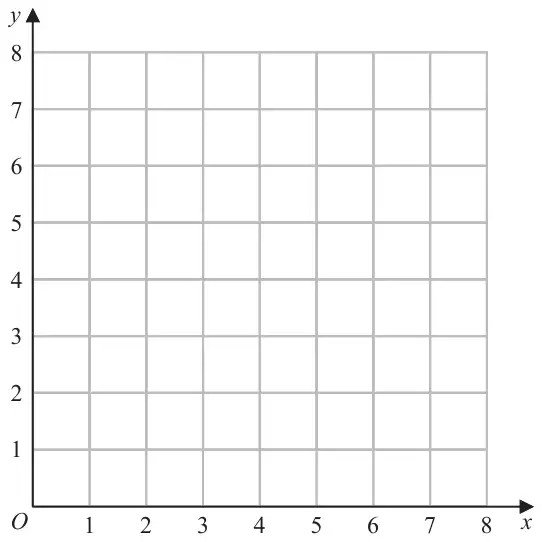
(a) On the grid, draw the straight line with equation
(i) \(x = 3\) (ii) \(y = 1\) (iii) \(x + y = 7\) Label each line with its equation. (3)
(b) Show, by shading on the grid, the region that satisfies all three of the inequalities \(x \geqslant 3 \qquad y \geqslant 1 \qquad x + y \leqslant 7\) Label the region R(1)
Mark scheme (a)
Scheme
Marks
(i)
B1
(ii)
B1
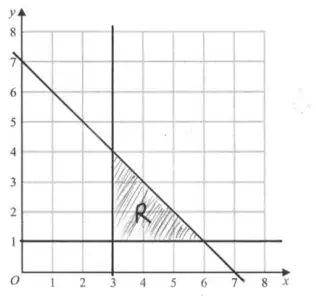
(iii) Line length 2 cm + but shaded area must be enclosed for the mark in (b)
If unlabelled, award: \(x = 3\) and \(y = 3\) B1 B0 \(y = 1\) and \(x = 1\) B0 B1 \(x = 3\) and \(x = 1\) and \(y = 1\) B0 B1 \(x = 3\) and \(y = 1\) and \(y = 3\) B1 B0
\(x = 3\) and \(x = 1\), \(y = 1\) and \(y = 3\) B0 B0
B1
(3)
Notes
B1: \(x = 3\) drawn
B1: \(y = 1\) drawn
B1: \(x + y = 7\) drawn
Allow dashed lines or solid lines for graphs of minimum length 2 squares condone lack of labels if unambiguous
Mark scheme (b)
Scheme
Marks
B1
(1)
(4 marks)
Notes
B1: correct region shaded – shaded in or out – labelled R or clear intention to be the required region (ft only for one vertical line (not \(x = 0\)), one horizontal line (not \(y = 0\)) and one line with a negative gradient eg \(x = 1\), \(y = 3\) and \(x + y = 7\))