M1: for correct removal of fraction and expansion of bracket in a correct equation or separating fraction (RHS) in an equation
M1ft: (dep on 4 terms) correctly rearranging their 4 term equation for terms in \(x\) on one side of equation and number terms on the other
A1: oe eg 6.75 or \(6\dfrac{3}{4}\), dep on M1
Mark scheme (b)
Scheme
Marks
(i) \((y \pm 6)(y \pm 5)\) or \((6 \pm y)(5 \pm y)\) or \(y(y - 6) - 5(y - 6)\) or \(y(y - 5) - 6(y - 5)\)
M1
Correct answer scores full marks (unless from obvious incorrect working) Answer: \((y - 6)(y - 5)\)
A1
(2)
(ii) Answer: (\(y\) =) 6, (\(y\) =) 5
B1
(1)
(6 marks)
Notes
M1: for \((y \pm 6)(y \pm 5)\) or \((6 \pm y)(5 \pm y)\) or for \((y + a)(y + b)\) where \(ab = 30\) or \(a + b = -11\) or \(y(y + a) + b(y + a)\) or \(y(y + b) + a(y + b)\) where \(ab = 30\) or \(a + b = -11\)
A1: oe, allow any letter for \(y\)
B1: must ft from their answer in (b)(i) ft from their factors in the form \((y + a)(y + b)\)
(B1 for \(9(2c - 5cd)\) or \(c(18 - 45d)\) or \(3c(6 - 15d)\) or \(3(6c - 15cd)\) or \(9c(p + qd)\) where \(p\) and \(q\) are non-zero integers or \((2 - 5d)\) as a factor)
Mark scheme (b)
Scheme
Marks
eg
\(5 - 2x = 18x - 24\)
or
\(\dfrac{5}{6} - \dfrac{2}{6}x = 3x - 4\)
M1
\(5 + 24 = 18x + 2x\) oe or \(29 = 20x\) oe
or
\(\dfrac{5}{6} + 4 = \dfrac{2}{6}x + 3x\) oe
M1ft
Working required Answer: 1.45
A1
(3)
(5 marks)
Notes
M1: for removal of the fraction and correctly multiplying out RHS by 6 in an equation or separating fractions on the LHS in an equation
M1ft: dep on 4 terms for correctly rearranging their 4 term equation for terms in \(x\) on one side of the equation and number terms on the other
Correct answer scores full marks (unless from obvious incorrect working) Answer: \((x + 8)(x - 3)\)
A1
(2)
(ii) Answer: –8 and 3
B1
(1)
Notes
M1: for \((x \pm 8)(x \pm 3)\) or \((x + a)(x + b)\) where \(ab = -24\) or \(a + b = 5\) and, \(a\) and \(b\) are integers
A1: for \((x + 8)(x - 3)\) Allow any letter for \(x\)
Must be in the form \((x + a)(x + b)\) where \(a\) and \(b\) are integers
B1: must ft from their answer in (a)(i) ft from their incorrect factors in the form \((x + a)(x + b)\) Award B0 for –8 and 3 if no marks scored in (a)(i)
Mark scheme (b)
Scheme
Marks
\(3y - 7y \gt -10 - 5\) or \(5 + 10 \gt 7y - 3y\)
M1
\(-4y \gt -15\) or \(15 \gt 4y\) or \(y = \dfrac{15}{4}\) oe or
M1
Working required
Answer: \(y \lt \dfrac{15}{4}\)
A1
(3)
(6 marks)
Notes
M1: allow use of = or condone incorrect inequality sign
M1: allow use of = or condone incorrect inequality sign
A1: dep on M1
oe eg \(y \lt 3.75\) or \(\dfrac{15}{4} \gt y\) or \(3.75 \gt y\)
Must have correct sign on answer line
NB Sight of correct answer in working space and just \((y =)\;\dfrac{15}{4}\) oe on answer line gains M2 only
an expression that clearly shows the numerator is – 19 times the denominator eg \(\dfrac{-38x - 57}{2x + 3}\;(= n)\)
M1
Working required Answer: –19
A1
(4)
(4 marks)
Notes
M1indep: [NB: the two fractions when divided and cancelled give an answer of \(4(2x - 3)\) or \(2(4x - 6)\) or \(8x - 12\) (any one of these gain 2 marks) ]
M2 for any fraction with completely simplified non-linear numerator and non-linear denominator that will cancel to –19
M1: a linear expression that should give the correct value for \(n\) (this mark implies previous M marks as not all factorising is necessary)
Correct answer scores full marks (unless from obvious incorrect working) Answer: \((x + 8)(x - 3)\)
A1
(2)
(ii) Answer: –8 and 3
B1
(1)
Notes
M1: for \((x \pm 8)(x \pm 3)\) or \((x + a)(x + b)\) where \(ab = -24\) or \(a + b = 5\) and, \(a\) and \(b\) are integers
A1: for \((x + 8)(x - 3)\) Allow any letter for \(x\)
Must be in the form \((x + a)(x + b)\) where \(a\) and \(b\) are integers
B1: must ft from their answer in (a)(i) ft from their incorrect factors in the form \((x + a)(x + b)\) Award B0 for –8 and 3 if no marks scored in (a)(i)
Mark scheme (b)
Scheme
Marks
\(3y - 7y \gt -10 - 5\) or \(5 + 10 \gt 7y - 3y\)
M1
\(-4y \gt -15\) or \(15 \gt 4y\) or \(y = \dfrac{15}{4}\) oe or
M1
Working required
Answer: \(y \lt \dfrac{15}{4}\)
A1
(3)
(6 marks)
Notes
M1: allow use of = or condone incorrect inequality sign
M1: allow use of = or condone incorrect inequality sign
A1: dep on M1
oe eg \(y \lt 3.75\) or \(\dfrac{15}{4} \gt y\) or \(3.75 \gt y\)
Must have correct sign on answer line
NB Sight of correct answer in working space and just \((y =)\;\dfrac{15}{4}\) oe on answer line gains M2 only
Working not required, so correct answer scores full marks (unless from obvious incorrect working)
Answer: \(\dfrac{9}{x + 2}\)
A1
(4)
(4 marks)
Notes
M1: for correctly factorising \(3x^2 + x - 10\) to give \((3x - 5)(x + 2)\) (may be seen later on in working) OR combining 2 fractions into a correct single fraction
M1: for inverting and cancelling giving a correct fraction OR for a correct single fraction where the denominator is factorised
M1: for a correct single fraction or two correct fractions with a common denominator
or \(-y \lt \dfrac{-19}{5}\) or \(y \lt \dfrac{19}{5}\)
or \(y = \dfrac{19}{5}\) oe
M1
Correct answer scores full marks (unless from obvious incorrect working)
Answer: \(y \gt \dfrac{19}{5}\)
A1
(3)
(9 marks)
Notes
M1: for rearrangement with \(y\) terms on one side and numerical terms on the other in a correct inequality or the correct simplification of \(y\) terms or numbers on one side in a correct inequality
sign can be = or the incorrect inequality sign
M1: for the correct simplification of \(y\) terms on one side and numbers on the other side in a correct inequality or a correct inequality with the wrong sign
sign can be = or the incorrect inequality sign
A1: oe eg \(y \gt 3.8\) or \(3.8 \lt y\) Must be given as the correct inequality on the answer line
B2: for \(5k^5 + 20k^2\) (B1 for \(5k^5\) or \(20k^2\))
Mark scheme (c)
Scheme
Marks
(i) \((x \pm 7)(x \pm 9)\)
M1
Correct answer scores full marks (unless from obvious incorrect working) Answer: \((x + 7)(x - 9)\)
A1
(2)
(ii) Answer: –7, 9
B1
(1)
Notes
M1: for \((x \pm 7)(x \pm 9)\) or for \((x + a)(x + b)\) where \(ab = -63\) or \(a + b = -2\) where \(a\) and \(b\) are integers
A1: for correct factors
B1: must ft from (c)(i) dep on factorising in the form \((x + p)(x + q)\) where \(p\) and \(q\) are integers
Mark scheme (d)
Scheme
Marks
\(-2y - 3y \lt -12 - 7\) or \(7 + 12 \lt 3y + 2y\) or \(7 \lt 5y - 12\) or \(7 - 5y \lt -12\) or \(-2y \lt 3y - 19\) or \(19 - 2y \lt 3y\)
M1
\(-5y \lt -19\) or \(19 \lt 5y\)
or \(-y \lt \dfrac{-19}{5}\) or \(y \lt \dfrac{19}{5}\)
or \(y = \dfrac{19}{5}\) oe
M1
Correct answer scores full marks (unless from obvious incorrect working)
Answer: \(y \gt \dfrac{19}{5}\)
A1
(3)
(9 marks)
Notes
M1: for rearrangement with \(y\) terms on one side and numerical terms on the other in a correct inequality or the correct simplification of \(y\) terms or numbers on one side in a correct inequality
sign can be = or the incorrect inequality sign
M1: for the correct simplification of \(y\) terms on one side and numbers on the other side in a correct inequality or a correct inequality with the wrong sign
sign can be = or the incorrect inequality sign
A1: oe eg \(y \gt 3.8\) or \(3.8 \lt y\) Must be given as the correct inequality on the answer line
\(\dfrac{f}{3} = \dfrac{4}{2}f - \dfrac{17}{2}\) or \(\dfrac{f}{3} = 2f - \dfrac{17}{2}\) or \(0.3f = 2f - 8.5\) or
\(f = 6f - \dfrac{51}{2}\) or \(f = 6f - 25.5\) or
\(17 = 4f - \dfrac{2}{3}f\) or \(17 = 4f - 0.6f\) or \(17 = 4f - 0.7f\) or
\(\dfrac{2}{3}f - 4f = -17\) or \(0.6f - 4f = -17\) or \(0.7f - 4f = -17\)
M1
eg
\(-10f = -51\) or
\(10f = 51\) or
\(\dfrac{5f}{3} = \dfrac{17}{2}\) or
\(5f = \dfrac{51}{2}\) or
\(17 = \dfrac{10f}{3}\) or
\(3.3f = 17\) or
\(-\dfrac{10f}{3} = -17\) or
\(-3.3f = -17\)
M1
Working required
Answer: \(\dfrac{51}{10}\)
A1
(3)
Notes
M1: for a correct first step – multiplying both sides by 3 correctly and expanding to find \(2f = 12f - 51\) or \(2f = -51 + 12f\)
or
writing the RHS as 2 terms each over 2
(Allow decimals to 1dp or better – rounded or truncated)
M1: for a correct 2 term equation in the form \(af = b\)
ft the following equations only \(2f = 12f - 17\) oe \(2f = 4f - 51\) oe \(6f = 12f - 51\) oe
(Allow decimals to 1dp or better – rounded or truncated)
A1: (dep on at least M1) oe
Mark scheme (b)
Scheme
Marks
1
B1
(1)
Mark scheme (c)
Scheme
Marks
\(3a^3h^4\)
B2
(2)
Notes
B2: for \(3a^3h^4\) oe
B1 for a product in the form \(ka^ph^q\) where 2 from \(k\), \(p\) or \(q\) are correct (allow multiplication signs)
eg \(5a^3h^4\) or \(\dfrac{12a^3h^4}{4}\)
(Allow \(3a^3\) or \(a^3h^4\) or \(3h^4\) as long as not added to any other term)
Mark scheme (d)
Scheme
Marks
\(4x^3y(5x^2 + 3y^3)\)
B2
(2)
(8 marks)
Notes
B2: for \(4x^3y(5x^2 + 3y^3)\) B1 for any correct factorisation with at least a 2 term factor outside the bracket eg \(2x^3y(10x^2 + 6y^3)\) or \(x^3y(20x^2 + 12y^3)\) or \(2x(10x^4y + 6x^2y^4)\) or \(4y(5x^5 + 3x^3y^3)\) or \(4x^3(5x^2y + 3y^4)\) etc or the correct highest common factor and a 2 term expression with at most one incorrect term eg \(4x^3y(5x^2 + \ldots)\) or \(4x^3y(\ldots + 3y^3)\)
M1: (first) For adding the terms in the brackets correctly eg \(\dfrac{x + 3x - 4}{x(3x - 4)}\) oe and may be 2 fractions with a common denominator
M1: (second) indep (score best method if both shown) For factorising the numerator of the first fraction correctly or factorising the denominator of the first fraction correctly OR expanding the numerators correctly or expanding the denominators correctly
M1: (third) (assumes previous mark if this is awarded) All terms factorised (some terms may be cancelled) or showing an expression that will cancel or the correct fraction with all terms correctly expanded
M1: (fourth) Cancelling and LHS = RHS or allow up to a quadratic on the LHS – must be division of top by bottom = 20 and correct LHS = RHS
A1: oe dep on a fully correct method shown, ie all steps that lead to the correct answer
\(y\) metal bars are gold. \((3y + 7)\) metal bars are silver. \((2y - 5)\) metal bars are zinc.
(b) Work out the number of metal bars that are zinc. Show clear algebraic working.(4)
Mark scheme (a)
Scheme
Marks
\(6p(2q - 3)\)
B2
(2)
Notes
B2: If not B2 then award B1 for any correct partial factorisation with 2 factors taken out (\(2p\) or \(3p\) or 6 (2×3)) outside of the bracket \(2p(6q - 9)\) or \(3p(4q - 6)\) or \(6(2pq - 3p)\) or allow \(6p\) and one error inside the bracket eg \(6p(2q - a)\) or \(6p(b - 3)\) oe eg \(6p(2q + 3)\)
(B2 for \(8h + 20j\) or \(T = 8h + aj\) or \(T = bh + 20j\) or \(T = 20h + 8j\) or a correct equation with letters such as \(S\) and \(L\) eg \(T = 8S + 20L\))
(B1 for \(8h + aj\) or \(bh + 20j\) or \(20h + 8j\) or for \(T\) = an incorrect expression in \(h\) and \(j\))
Correct answer scores full marks (unless from obvious incorrect working)
Answer: \(\dfrac{136}{x + 5}\)
A1
(4)
(4 marks)
Notes
M2: for factorising at least 2 of the quadratics correctly – could be implied by 2 factors cancelled correctly
(M1 for factorising at least 1 of the 3 quadratics correctly)
M1: for writing the correct fractions over a common denominator of \((x + 5)\) with or without brackets removed – need not be in simplest form. Could be written as 2 separate fractions.
B2: fully correct or B1 for a correct partial factorisation with at least two terms outside the bracket ie \(3c(6c^2d^2 - 7c)\) or \(c^2(18cd^2 - 21)\) or the fully correct factor outside the bracket with two terms inside the bracket and at most one mistake \(3c^2(\ldots\ldots)\)
(a) Write down the value of \(\;(m + 2)^0\;\) where \(m\) is a positive integer. (1)
(b) Simplify \(\;(3a^2b^4)^3\) (2)
(c) Factorise fully \(\;14x^2y^4 + 21x^3y^2\) (2)
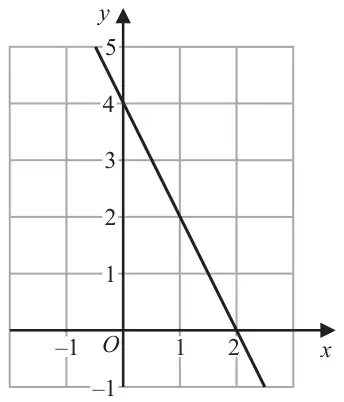
The diagram shows a straight line drawn on a grid.
(d) Write down an equation of the line. (2)
Mark scheme (a)
Scheme
Marks
1
B1
(1)
Mark scheme (b)
Scheme
Marks
\(27a^6b^{12}\)
B2
(2)
Notes
B2: (B1 for 2 of 3 parts in a product)
Mark scheme (c)
Scheme
Marks
\(7x^2y^2(2y^2 + 3x)\)
B2
(2)
Notes
B2: B1 for a correct factorisation with at least 2 factors outside (eg \(7x\), \(x^2\), \(xy\), etc) eg \(7x(2xy^4 + 3x^2y^2)\) eg \(x^2y^2(14y^2 + 21x)\) or for the correct common factor with just one mistake inside the bracket eg \(7x^2y^2(2y + 3x)\) which is missing the squared on the \(y\) term
Mark scheme (d)
Scheme
Marks
\(y = mx + 4\) where \(m \ne 0\) oe (eg \(y = 2x + 4\)) or \(y = -2x + c\) or \(y + 2x = c\) oe or \(-2x + 4\) or \(\mathrm{f}(x) = -2x + 4\) oe
M1
Correct answer scores full marks (unless from obvious incorrect working) Answer: \(y = -2x + 4\)
B2: fully correct or B1 for a correct partial factorisation with at least two terms outside the bracket ie \(3c(6c^2d^2 - 7c)\) or \(c^2(18cd^2 - 21)\) or the fully correct factor outside the bracket with two terms inside the bracket and at most one mistake \(3c^2(\ldots\ldots\ldots)\)
M1: for at least 3 correct terms for the multiplying of the 2 brackets
M1: 2 of the 3 correct terms in an expression in the form \(ax^2 + bx + c\) where \(a\), \(b\) and \(c\) are integers
A1: can be any order
Mark scheme (b)
Scheme
Marks
\(2y - 4y + 8 - y^2\)
M1
\(8 - 2y - y^2\)
A1
(2)
Notes
M1: for 3 correct terms or for 4 correct terms ignoring signs or \(\ldots - 2y - y^2\) or \(8 - 2y - \ldots\)
A1: Any order but simplified.
Mark scheme (c)
Scheme
Marks
\(5b^3c(3b^2 - 7c^8)\)
B2
(2)
(7 marks)
Notes
B2: fully correct or B1 for a correct partial factorisation with at least two terms outside the bracket eg \(5b^3(3b^2c - 7c^9)\) or \(5c\,(3b^5 - 7b^3c^8)\) etc or the fully correct factor outside the bracket with a two term expression in terms of \(b\) and \(c\) inside the bracket eg \(5b^3c(15b^2 - c^8)\)
M1: for 3 correct terms or for 4 correct terms ignoring signs or \(\ldots - 2y - y^2\) or \(8 - 2y - \ldots\)
A1: Any order but simplified
Mark scheme (b)
Scheme
Marks
\(5b^3c(3b^2 - 7c^8)\)
B2
(2)
(4 marks)
Notes
B2: fully correct or B1 for a correct partial factorisation with at least two terms outside the bracket eg \(5b^3(3b^2c - 7c^9)\) or \(5c(3b^5 - 7b^3c^8)\) etc or the fully correct factor outside the bracket with a two term expression in terms of \(b\) and \(c\) inside the bracket eg \(5b^3c(15b^2 - c^8)\)
Correct answer scores full marks (unless from obvious incorrect working) Answer: \((6y + 5)(y - 1)\)
A1
(2)
Notes
M1: for \((6y \pm 5)(y \pm 1)\) or \((6y \pm 1)(y \pm 5)\) or \((ay + 5)(by - 1)\) where \(ab = 6\) or \(5b - a = -1\) or \((6y + p)(y + q)\) where \(pq = -5\) or \(6q + p = -1\) Condone use of a different letter to \(y\)
Correct answer scores full marks (unless from obvious incorrect working)
Answer: \(f = \dfrac{8w - 3}{2 + w}\)
A1
(3)
Notes
M1: for multiplying by denominator and expanding in a correct equation
M1: for gathering terms in \(f\) on one side and other terms the other side in a correct equation ft their equation dep on 2 terms in \(f\) and two other terms
B2: If not B2 then award B1 for any correct factorisation with at least 2 of: the 5, a term in \(a\), a term in \(c\), outside the bracket eg \(5ac(5a^3c^6d + 9a^8c^2h)\) or \(a^2c(25a^2c^6d + 45a^7c^2h)\) (NB: not just \(a^4\) etc as we want to know students have considered more than just one letter or the number) or the correct common factor and a 2 term expression inside the bracket eg \(5a^4c^3(5c^4 + 9a^5)\) (this is missing \(d\) in first term and \(h\) in the second but the common factor is correct)
Working not required, so correct answer scores full marks (unless from obvious incorrect working eg −1.75 oe from \(2x^2 + 20x + 25 = 2x^2 + 4x - 3\) scores M2A0) Answer: −1.75
A1
(3)
(5 marks)
Notes
M1: Correct expansion of \((2x + 5)^2\) or \((2x + 3)(2x - 1)\) or expansion of both sets of brackets with at least 3 of 4 terms correct in both (NB: if written as a 3 term quadratic (and not seen as 4 terms) then the middle term must be correct as it is equivalent to 2 correct terms) (eg (RHS) \(4x^2 + 4x + 3\) has 1 error, \(2x^2 + 4x - 3\) has 1 error, \(4x^2 + 10x - 3\) has 2 errors)
M1: ft if previous mark awarded. For terms in \(x\) on one side and number terms on the other side in a correct ft equation dependent on a linear equation
A1: or \(-1\tfrac{3}{4}\) or \(-\dfrac{7}{4}\) or \(-\dfrac{28}{16}\) or \(-1\tfrac{12}{16}\) oe
Working not required, so correct answer scores full marks Answer: \((x + 6)(x - 4)\)
A1
(2)
Notes
M1: or \((x + a)(x + b)\) where \(ab = -24\) or \(a + b = 2\)
Mark scheme (ii)
Scheme
Marks
Answer must come from the factors in (i) as the questions says ‘Hence solve…’ Answer: −6, 4
B1
(1)
(3 marks)
Notes
B1: Must follow through from their factors in (i), so even if the answers 8 and –6 are given, the mark can only be awarded if it follows from the factorisation in (i) (dep on 2 factors)
NB: Some students may show the whole of their working in the space for (i) or (ii). Please award the marks for (i) and (ii) so long as there is no ambiguity.
B2: If not B2 then award B1 for any correct factorisation with at least 2 of: the 5, a term in \(a\), a term in \(c\), outside the bracket eg \(5ac(5a^3c^6d + 9a^8c^2h)\) or \(a^2c(25a^2c^6d + 45a^7c^2h)\) (NB: not just \(a^4\) etc as we want to know students have considered more than just one letter or the number) or the correct common factor and a 2 term expression inside the bracket eg \(5a^4c^3(5c^4 + 9a^5)\) (this is missing \(d\) in first term and \(h\) in the second but the common factor is correct)
Working not required, so correct answer scores full marks (unless from obvious incorrect working eg -1.75 oe from \(2x^2 + 20x + 25 = 2x^2 + 4x - 3\) scores M2A0) Answer: −1.75
A1
(3)
(5 marks)
Notes
M1: Correct expansion of \((2x + 5)^2\) or \((2x + 3)(2x - 1)\) or expansion of both sets of brackets with at least 3 of 4 terms correct in both (NB: if written as a 3 term quadratic (and not seen as 4 terms) then the middle term must be correct as it is equivalent to 2 correct terms) (eg (RHS) \(4x^2 + 4x + 3\) has 1 error, \(2x^2 + 4x - 3\) has 1 error, \(4x^2 + 10x - 3\) has 2 errors)
M1: ft if previous mark awarded. For terms in \(x\) on one side and number terms on the other side in a correct ft equation dependent on a linear equation
A1:or \(-1\dfrac{3}{4}\) or \(-\dfrac{7}{4}\) or \(-\dfrac{28}{16}\) or \(-1\dfrac{12}{16}\) oe
Working not required, so correct answer scores full marks Answer: \((x + 6)(x - 4)\)
A1
(2)
Notes
M1: or \((x + a)(x + b)\) where \(ab = -24\) or \(a + b = 2\)
Mark scheme (ii)
Scheme
Marks
Answer must come from the factors in (i) as the questions says ‘Hence solve…’ Answer: −6, 4
B1ft
(1)
(3 marks)
Notes
B1ft:Must follow through from their factors in (i), so even if the answers 4 and −6 are given the mark can only be awarded if it follows from the factorisation in (i) (dep on 2 factors)
NB: Some students may show the whole of their working in the space for (i) or (ii). Please award the marks for (i) and (ii) so long as there is no ambiguity.
M2: For factorising at least 2 of the quadratics correctly – could be implied by 2 factors cancelled correctly (M1 For factorising at least 1 of the 3 quadratics correctly)
M1: (indep (ft if M2 awarded)) For writing the fractions over a common denominator with or without brackets removed – need not be in simplest form Could be written as 2 separate fractions over a common denominator
B2: for \(5y^3(3y + 4u)\) (B1 for \(5y(3y^3 + 4uy^2)\) or \(5y^2(3y^2 + 4uy)\) or \(y^2(15y^2 + 20uy)\) or \(y^3(15y + 20u)\) or \(5y^3(\ldots)\) where there is only one mistake in the brackets)
Mark scheme (b)
Scheme
Marks
\(4 \times (4 - 3x) = 5 - 8x\) oe
or \(16 - 12x = 5 - 8x\) oe
or \(4 - 3x = \dfrac{5}{4} - 2x\) oe
M1
e.g. \(16 - 5 = 12x - 8x\)
or \(11 = 4x\) oe
or \(4 - \dfrac{5}{4} = 3x - 2x\)
M1
Working required Answer: 2.75
A1
(3)
(5 marks)
Notes
M1: for removal of fraction in a correct equation
M1: for terms in \(x\) on one side and numbers on the other side in an equation, allow correct rearrangement of their equation in the form \(ax + b = cx + d\)
A1: (dep on M1) oe e.g. \(2\dfrac{3}{4}\) or \(\dfrac{11}{4}\)
(B1 for \(5y(3y^3 + 4uy^2)\) or \(5y^2(3y^2 + 4uy)\) or \(y^2(15y^2 + 20uy)\) or \(y^3(15y + 20u)\) or \(5y^3(\ldots)\) where there is only one mistake in the brackets)
Mark scheme (b)
Scheme
Marks
\(4 \times (4 - 3x) = 5 - 8x\) oe
or \(16 - 12x = 5 - 8x\) oe
or \(4 - 3x = \dfrac{5}{4} - 2x\) oe
M1
e.g. \(16 - 5 = 12x - 8x\)
or \(11 = 4x\) oe
or \(4 - \dfrac{5}{4} = 3x - 2x\)
M1
Working required Answer: 2.75
A1
(3)
(5 marks)
Notes
M1: for removal of fraction in a correct equation
M1: for terms in \(x\) on one side and numbers on the other side in an equation, allow correct rearrangement of their equation in the form \(ax + b = cx + d\)
A1: (dep on M1) oe e.g. \(2\dfrac{3}{4}\) or \(\dfrac{11}{4}\)
E.g. \(20 - 7 = -3x + 5x\) or \(-5x + 3x = 7 - 20\)
M1
Working required Answer: 6.5 oe
A1
(3)
Notes
M1: for expansion of bracket
M1: ft from a 4-term equation for a correct process of isolating terms in \(x\) on one side of the equation and numbers on the other side
A1: dep on M2 awarded
Mark scheme (b)
Scheme
Marks
M1
\(8m^2g^3(2m + 3g^2)\)
A1
(2)
Notes
M1: for any correct partial factorisation with at least 2 factors, one of which must be a letter or the correct common factor with no more than 1 error inside the bracket
E.g. \(20 - 7 = -3x + 5x\) or \(-5x + 3x = 7 - 20\)
M1
Working required Answer: 6.5 oe
A1
(3)
Notes
M1: for expansion of bracket
M1: ft from a 4-term equation for a correct process of isolating terms in \(x\) on one side of the equation and numbers on the other side
A1: dep on M1 awarded and from correct working
Mark scheme (b)
Scheme
Marks
M1
Correct answer scores full marks (unless from obvious incorrect working) Answer: \(8m^2g^3(2m + 3g^2)\)
A1
(2)
Notes
M1: for any correct partial factorisation with at least 2 factors, one of which must be a letter or the correct common factor with no more than 1 error inside the bracket
Mark scheme (c)
Scheme
Marks
(i) \((y \pm 6)(y \pm 8)\)
M1
Correct answer scores full marks (unless from obvious incorrect working) Answer: \((y - 8)(y + 6)\)
\(\dfrac{5 \pm \sqrt{169}}{2}\) or \(\dfrac{5 \pm 13}{2}\)
M1
Working required Answer: 9, −4
A1
(3)
(3 marks)
Notes
M1: or \((x + a)(x + b)\) where \(ab = -36\) or \(a + b = -5\) OR correct substitution into quadratic formula (condone one sign error in \(a\), \(b\) or \(c\)) (if + rather than ± shown then award M1 only unless recovered with answers)
M1: or \(\dfrac{5 \pm \sqrt{169}}{2}\) or \(\dfrac{5 \pm 13}{2}\)
\(x(2x + 5)(3x - 1)\) or \((2x + 5)(3x^2 - x)\) or \((2x + 5)(2x - 5)\) oe
M1
\(x(2x + 5)(3x - 1)\) or \((2x + 5)(3x^2 - x)\) and \((2x + 5)(2x - 5)\) oe
M1
\(\dfrac{x(3x - 1)}{2x - 5}\)
A1
(3)
(3 marks)
Notes
M1: for a correct factorisation of the numerator into 2 or 3 factors where one of the factors must be \((2x + 5)\) or denominator into 2 brackets where one of the factors must be \((2x + 5)\)
M1: for a correct factorisation of the numerator into 2 or 3 factors where one of the factors must be \((2x + 5)\) and denominator into 2 brackets where one of the factors must be \((2x + 5)\)
A1: accept \(\dfrac{3x^2 - x}{2x - 5}\) oe Do not ISW
(c) Write \(\dfrac{\sqrt[4]{y}}{y}\) in the form \(y^b\) where \(b\) is a fraction. (2)
Mark scheme (a)
Scheme
Marks
\((2x - 3)(x - 2)\)
B2
(2)
Notes
B2: or \((3 - 2x)(2 - x)\) (B1 for \((2x + a)(x + b)\) where \(ab = 6\) or \(2b + a = -7\) eg \((2x + 3)(x + 2)\), \((2x - 5)(x - 1)\)), etc or for
Mark scheme (b)
Scheme
Marks
\(4m + 9 = 3(7 - 2m)\)
M1
\(4m + 9 = 21 - 6m\)
M1
\(4m + 6m = 21 - 9\) or \(10m = 12\) or \(-21 + 9 = -6m - 4m\) or \(-10m = -12\)
M1
Working required
Answer: \(\dfrac{12}{10}\) oe
A1
(4)
Notes
M1: for removing fraction
M1: for correct expansion of bracket in a correct equation
M1: for a correct equation with \(m\) terms isolated on one side ft their equation if first M1 awarded
A1: dep on at least M2 [SC: B2 for an answer of \(m = 2\) with working shown (from \(4m + 9 = 21 - 2m\) oe) or \(m = -0.2\) oe with working shown (from \(4m + 9 = 7 - 6m\) oe)]
Mark scheme (b) ALT
Scheme
Marks
\(\dfrac{4}{3}m + 3 = 7 - 2m\)
M1
\(\dfrac{4}{3}m + 2m = 7 - 3\) oe
M1
\(10m = 3 \times 4\) oe
M1
Working required
Answer: \(\dfrac{12}{10}\) oe
A1
Notes
M1: Division of each term on LHS by 3
M1: for a correct equation with \(m\) terms isolated on one side ft their equation if first M1 awarded
M1: For removing fraction in a fully correct equation
A1: dep on at least M2
Mark scheme (c)
Scheme
Marks
\(\dfrac{y^{\frac{1}{4}}}{y}\) or \(\sqrt[4]{y} = y^{\frac{1}{4}}\) or \(y^{\frac{1}{4} - 1}\)
M1: for 3 correct terms or 4 correct terms ignoring signs or \(x^2 + 7x + c\) or \(\ldots + 7x - 18\)
Mark scheme (d)
Scheme
Marks
\(4cp^2(4c^3 + 5p)\)
B2
(2)
(6 marks)
Notes
B2: if not B2 then award B1 for any correct factorisation with at least 2 factors outside the bracket eg \(4cp(4c^3p + 5p^2)\), \(cp^2(16c^3 + 20p)\), \(2p(8pc^4 + 10cp^2)\) etc or the correct common factor and a 2 term expression with just one error
M1: for rearranging the \(x\) terms on one side and the numerical terms on the other. ft rearranging their expansion \(ax + b = cx + d\) eg \(7x - 2 = 12x + 4\)
\(\dfrac{y^{13}}{y^4}\) or \(y^{(1)} \times y^8\) or \(y^5 \times y^4\) or \(y^{5 + 8 - 4}\)
M1
\(y^9\)
A1
(2)
Mark scheme (d)
Scheme
Marks
\(x^2 + 7x - 3x - 21\)
M1
\(x^2 + 4x - 21\)
A1
(2)
Notes
M1: 3 terms correct with signs or 4 terms correct ignoring signs or \(x^2 + 4x \pm \ldots\) or \(\ldots + 4x - 21\)
Mark scheme (e)
Scheme
Marks
\(9p^3m(4m + 3p^2)\)
B2
(2)
Notes
B2: B1 for any correct partial factorisation with at least 2 letters or one letter and one number outside the bracket eg. \(3m(12p^3m + 9p^5)\) or correct highest common factor with a 2 term expression in \(m\) and \(p\) inside the bracket
(a) Explain why \(2n + 1\) is an odd number for all values of \(n\). (1)
(b) Show, using algebra, that the sum of any 4 consecutive odd numbers is always a multiple of 8 (3)
Mark scheme (a)
Scheme
Marks
Eg. \(2n\) is always even so \(2n + 1\) is odd Answer: explanation
B1
(1)
Mark scheme (b)
Scheme
Marks
\((2n + 1) + (2n + 3) + (2n + 5) + (2n + 7)\) oe
M1
\(8n + 16\)
M1dep
\(8(n + 2)\) Answer: show
A1
(3)
Notes
A1: or a complete explanation from correct algebraic working
Alternative
Scheme
Marks
let \(x\) be an even number \(x + 1 + x + 3 + x + 5 + x + 7\) oe
M1
\(4x + 16\)
M1dep
\(4(x + 4)\)
A1
Notes
M1: For defining \(x\) (at beginning or end) and summing 4 consecutive odd numbers
A1: For a complete explanation from correct algebraic working., eg \(x + 4\) must be even and 4 times an even number = 4 × 2\(n\) which is a multiple of 8
Alternative
Scheme
Marks
Let \(y\) be an odd number \(y + y + 2 + y + 4 + y + 6\) oe
M1
\(4y + 12\)
M1dep
\(4(y + 3)\)
A1
Notes
M1: For defining \(y\) (at beginning or end) and summing 4 consecutive odd numbers
A1: For a complete explanation from correct algebraic working. eg \((y + 3)\) is (odd + odd) which is even and therefore a multiple of 2, and 4 × 2n is a multiple of 8
B2: Award B2 also for \((g \pm 0)(g + 4)\) oe B1 for factors which, when expanded and simplified, give two terms, one of which is correct except B0 for \((g + 2)(g - 2)\)
B2: (B1 for \(ny^3, n \ne 20\) or \(20y^m\) \(m \ne 3\))
Mark scheme (b)
Scheme
Marks
\(\dfrac{3e}{5f^2}\)
B2
(2)
Notes
B2: B2 \(\dfrac{3e}{5f^2}\) or \(\dfrac{3}{5}ef^{-2}\) or \(0.6\dfrac{e}{f^2}\) or \(0.6ef^{-2}\)
(B1 for \(k\dfrac{e}{f^2}\) with \(k \ne 0.6\) oe or \(\dfrac{3ef}{5f^3}\) or \(\dfrac{3e^2}{5ef^2}\))
Mark scheme (c)
Scheme
Marks
\((3p + 2q)(2p - 3q)\)
M1 A1
(2)
Notes
M1 A1: M1 for \((ap + bq)(cp + dq)\) with \(ac = 6\) and \(bd = -6\) (ie. the coefficients of \(p\) multiply to give 6 and the coefficients of \(q\) multiply to give −6) A1 oe
B2: Award B2 also for \((g \pm 0)(g + 4)\) oe B1 for factors which, when expanded and simplified, give two terms, one of which is correct except B0 for \((g + 2)(g - 2)\)
B1: Allow \((e + 0)(e + 4)\) ignore missing bracket at end
Mark scheme (c)
Scheme
Marks
Eg. \(7x - 2x = -3 - 8\)
M1
\(5x = -11\)
M1
−2.2 oe
A1
(3)
Notes
M1: for correct rearrangement with \(x\) terms on one side and numbers on the other or the correct simplification of either \(x\) terms or numbers on one side in a correct equation eg. \(5x + 8 = -3\) ; \(7x = 2x - 11\)
M1: Award also for \(-5x = 11\)
A1: −2.2 oe dependent on at least M1 awarded; if no correct algebraic working then award no marks
Mark scheme (d)
Scheme
Marks
\(y^2 + 10y - 2y - 20\)
M1
\(y^2 + 8y - 20\)
A1
(2)
Notes
M1: for 3 correct terms out of 4 or for 4 correct terms ignoring signs or for \(y^2 + 8y + c\) for any non-zero value of \(c\) or for ... \(+ 8y - 20\)
A1: cao
Mark scheme (e)
Scheme
Marks
\(4e^2 f(5e^3 f - 4)\)
B2
(2)
Notes
B2: B1 for a correct but incomplete factorised answer with a minimum of 2 out of 4, \(\boldsymbol{e^2}\) or \(\boldsymbol{f}\) outside the bracket, ie \(4e^2(5e^3f^2 - 4f)\), \(4f(5e^5f - 4e^2)\), \(e^2f(20e^3f - 16)\), \(4ef(5e^4f - 4e)\), \(2e^2f(10e^3f - 8)\) or \(4e^2f\)(a two term algebraic expression)
B2: Award B2 also for \((c \pm 0)(c - 5)\) or \(c \times (c - 5)\) B1 for factors which, when expanded and simplified, give two terms, one of which is correct
Mark scheme (b)
Scheme
Marks
\(d^{12}\)
B1
(1)
Mark scheme (c)
Scheme
Marks
\((x + 6)(x - 5)\)
B2
(2)
Notes
B2: B1 for \((x \pm 6)(x \pm 5)\)
Mark scheme (d)
Scheme
Marks
\(\dfrac{2P}{a} = b^2\)
M1
\(b = \sqrt{\dfrac{2P}{a}}\)
A1
(2)
Notes
M1: oe with \(b^2\) as the subject
A1: oe with \(b\) as the subject or \(b = \pm\sqrt{\dfrac{2P}{a}}\)
(d) \(H = g^3 + 6g\) Work out the value of \(H\) when \(g = 2\) (2)
Mark scheme (a)
Scheme
Marks
\(56d^2\)
B1
(1)
Notes
B1: cao
Mark scheme (b)
Scheme
Marks
\(12e - 20\)
B1
(1)
Notes
B1: Accept \(-20 + 12e\)
Mark scheme (c)
Scheme
Marks
\(f(f - 2)\)
B2
(2)
Notes
B2: Accept \((f \pm 0)(f - 2)\) oe If not B2 then B1 for factors when expanded and simplified give 2 terms, 1 of which is correct except B0 for \((f + a)(f - a)\)
B2: Award B1 for \(d\)(sum or difference of any other two terms which when multiplied out would give one term correct).
Mark scheme (b)
Scheme
Marks
\(x^2 + 2x + 5x + 10\)
M1
\(x^2 + 7x + 10\)
A1
(2)
(4 marks)
Notes
M1: For 3 correct terms out of a maximum of 4 Or for 4 correct terms ignoring signs Or for \(x^2 + 7x + k\) for any non-zero value of \(k\) Or for \(\ldots + 7x + 10\)
(d) \(H = g^3 + 6g\) Work out the value of \(H\) when \(g = 2\) (2)
Mark scheme (a)
Scheme
Marks
\(56d^2\)
B1
(1)
Notes
B1: cao
Mark scheme (b)
Scheme
Marks
\(12e - 20\)
B1
(1)
Notes
B1: Accept \(-20 + 12e\)
Mark scheme (c)
Scheme
Marks
\(f(f - 2)\)
B2
(2)
Notes
B2: Accept \((f \pm 0)(f - 2)\) oe If not B2 then B1 for factors when expanded and simplified give 2 terms, 1 of which is correct except B0 for \((f + a)(f - a)\)
B2: Also award B2 for \((t + 0)(t + 6)\) B1 for factors which, when expanded and simplified, give two terms, one of which is correct.
Mark scheme (b)
Scheme
Marks
\(7x - 5x = -4 + 5\) or \(2x - 5 = -4\) or \(7x = 5x + 1\) etc
M1
\(2x = 1\)
M1
\(\dfrac{1}{2}\) oe
A1
(3)
Notes
M1: for correct rearrangement with \(x\) terms on one side and numbers on the other or for correct collection of either \(x\) terms or numbers on one side in a correct equation
M1: Award also for \(-2x = -1\)
A1: Award all 3 marks if answer is correct and at least one method mark scored
In this part a correct answer does not on its own imply a correct method.
Mark scheme (c)
Scheme
Marks
\(8y + 12 + 2y - 12\)
M1
\(10y\)
A1
(2)
(Total 7 marks)
Notes
M1: For 3 terms with correct signs or 4 terms without signs
(c) Work out the value of \(y^3 + 5y\) when \(y = 2\) (2)
Mark scheme (a)
Scheme
Marks
\(20c^2\)
B1
(1)
Notes
B1: Also accept \(c^2 20\)
Mark scheme (b)
Scheme
Marks
\(x(x + 4)\) or \(x(4 + x)\)
B2
(2)
Notes
B2: Award B2 also for \((x \pm 0)(x + 4)\) oe Award B1 for factors which, when expanded and simplified, give two terms, one of which is correct except B0 for \((x + 2)(x - 2)\)
B1 for factors which, when expanded and simplified, give two terms, one of which is correct.
Mark scheme (b)
Scheme
Marks
\(7x - 5x = -4 + 5\) or \(2x - 5 = -4\) or \(7x = 5x + 1\) etc
M1
\(2x = 1\)
M1
\(\frac{1}{2}\) oe
A1
(3)
Notes
M1: for correct rearrangement with \(x\) terms on one side and numbers on the other or for correct collection of either \(x\) terms or numbers on one side in a correct equation
M1: Award also for \(-2x = -1\)
A1: Award 3 marks if answer is correct and at least one method mark scored
The mark scheme states that for this part the correct answer alone does not imply a correct method.
Mark scheme (c)
Scheme
Marks
\(8y + 12 + 2y - 12\)
M1
\(10y\)
A1
(2)
(7 marks)
Notes
M1: For 3 terms with correct signs or 4 terms without signs
B2: Also accept \((p + 0)(p - 5)\) for B2 B1 for factors which, when expanded and simplified, give two terms, one of which is correct. SC: B1 for \(p(p - 5p)\)
Mark scheme (c)
Scheme
Marks
\(7x - 3 = 2x\)
M1
\(7x - 2x = 3\) or \(5x = 3\)
M1
\(\dfrac{3}{5}\) oe
A1
(3)
Notes
M1: for \(7x - 3 = 2x\) or \(7x - 3 = 2 \times x\) or \(\dfrac{7x}{2} - \dfrac{3}{2} = x\) oe
M1: for \(7x - 2x = 3\) or \(5x = 3\) or \(5x - 3 = 0\) or \(\dfrac{7x}{2} - x = \dfrac{3}{2}\) or \(\dfrac{5x}{2} = \dfrac{3}{2}\)
NB. All these examples could be written with all terms ‘on the other side’ eg. \(-5x = -3\) etc
A1:Award full marks if at least one method mark awarded and answer correct.
B1: letters and numbers in any order but no × signs
B2: B1 for \(5m\) or \(-3n\)
Mark scheme (b)
Scheme
Marks
\(t(t - 10)\)
B2
(2)
Notes
B2: Also accept \((t \pm 0)(t - 10)\) for B2 B1 for factors which, when expanded and simplified, give only two terms, one of which is correct. SC B1 for \(t(t - 10t)\)
B2: also accept \((t \pm 0)(t - 10)\) for B2 B1 for factors which, when expanded and simplified, give only two terms, one of which is correct. SC B1 for \(t(t - 10t)\)
Mark scheme (c)
Scheme
Marks
\(3x = 7 - 2x\)
M1
\(5x = 7\) or \(5x - 7 = 0\)
M1
1.4oe
A1
(3)
Notes
M1:or \(x = \dfrac{7}{3} - \dfrac{2x}{3}\)
M1:or \(\dfrac{5x}{3} = \dfrac{7}{3}\) or \(x + \dfrac{2x}{3} = \dfrac{7}{3}\)
B2: Also accept \((p+0)(p-5)\) for B2 B1 for factors which, when expanded and simplified, give two terms, one of which is correct. SC B1 for \(p(p - 5p)\)
Mark scheme (c)
Scheme
Marks
\(7x - 3 = 2x\)
M1
\(7x - 2x = 3\) or \(5x = 3\)
M1
\(\dfrac{3}{5}\) oe
A1
(3)
Notes
M1: for \(7x - 3 = 2x\)
or \(7x - 3 = 2 \times x\)
or \(\dfrac{7x}{2} - \dfrac{3}{2} = x\) oe
M1: for \(7x - 2x = 3\) or \(5x = 3\)
or \(5x - 3 = 0\)
or \(\dfrac{7x}{2} - x = \dfrac{3}{2}\)
or \(\dfrac{5x}{2} = \dfrac{3}{2}\)
NB. All these examples could be written with all terms ‘on the other side’ eg \(-5x = -3\) etc
A1:Award full marks if at least one method mark awarded and answer correct.
B2: Award B2 also for \((n \pm 0)(n + 8)\) B1 for factors which, when expanded & simplified, give two terms, one of which is correct SC B1 for \(n(n + 8n)\)
Mark scheme (b)
Scheme
Marks
\(6x - 15 - 4x - 12\)
M1
\(2x - 27\)
A1
(2)
Notes
M1: for 3 correct terms
A1: cao
Mark scheme (c)
Scheme
Marks
\(y^2 + 2y + 7y + 14\)
M1
\(y^2 + 9y + 14\)
A1
(2)
Notes
M1: for 3 correct terms out of 4 or for 4 correct terms ignoring signs or for \(y^2 + 9y + c\) for any non-zero value of \(c\) or for \(\ldots + 9y + 14\)
B2: Award B2 also for \((w \pm 0)(w - 9)\) B1 for factors which, when expanded and simplified, give two terms, one of which is correct except B0 for \((w + 3)(w - 3)\) SC B1 for \(w(w - 9w)\)
Mark scheme (b)
Scheme
Marks
\(3x = -6\) or \(3x = 1 - 7\) or \(5x - 2x = -6\) oe
M2
−2
A1
(3)
Notes
M2: for correct rearrangement with \(x\) terms on one side and numbers on the other AND correct collection of terms on at least one side M1 for \(5x - 2x = 1 - 7\) oe ie correct rearrangement with \(x\) terms on one side and numbers on the other
A1: cao dep on M2
Mark scheme (c)
Scheme
Marks
\(y^2 + 3y - 7y - 21\)
M1
\(y^2 - 4y - 21\)
A1
(2)
(Total 7 marks)
Notes
M1: for 3 correct terms out of 4 or for 4 correct terms ignoring signs or for \(y^2 - 4y + n\) for any non-zero value of \(n\)
(c) Make \(q\) the subject of the formula \(p = \sqrt{q} - 5r\) (2)
(d) Solve \(\dfrac{4}{y - 4} = 5\) (3)
Mark scheme (a)
Scheme
Marks
Correct cancelling 8 & 4 or brackets
M1
\(2(x - 3)\) oe
A1
(2)
Notes
Apart from questions 5b, 8, 15d, 20b, 21b, 23, 24b (where the mark scheme states otherwise) the correct answer, unless clearly obtained by an incorrect method, should be taken to imply correct working.
Mark scheme (b)
Scheme
Marks
\((a + 12)(a - 12)\)
B2
(2)
Notes
B2: B1 for \((a \pm 12)(a \pm 12)\)
Mark scheme (c)
Scheme
Marks
\(p + 5r\) (\(=\sqrt{q}\))
M1
\((p + 5r)^2\) oe
A1
(2)
Notes
A1: do not isw (e.g. proceed onto \(p^2 + 25r^2\))
Mark scheme (d)
Scheme
Marks
\(4 = 5(y - 4)\) oe
M1
\(4 + (5 \times 4) = 5y\) Answer: must be 5 × 4 or 20 or LHS = 24
B2: Award B2 also for \((w \pm 0)(w - 9)\) B1 for factors which, when expanded & simplified, give two terms, one of which is correct except B0 for \((w + 3)(w - 3)\) SC B1 for \(w(w - 9w)\)
Mark scheme (b)
Scheme
Marks
\(3x = -6\) or \(3x = 1 - 7\) or \(5x - 2x = -6\) oe
M2
−2
A1
(3)
Notes
M2: for correct rearrangement with \(x\) terms on one side and numbers on the other AND correct collection of terms on at least one side M1 for \(5x - 2x = 1 - 7\) oe ie correct rearrangement with \(x\) terms on one side and numbers on the other
A1: cao dep on M2
Mark scheme (c)
Scheme
Marks
\(y^2 + 3y - 7y - 21\)
M1
\(y^2 - 4y - 21\)
A1
(2)
(Total 7 marks)
Notes
M1: for 3 correct terms out of 4 or for 4 correct terms ignoring signs or for \(y^2 - 4y + n\) for any non-zero value of \(n\)
(a) Simplify \(d \times d \times d \times d \times d\) (1)
(b) Simplify \(5x - 4y + 2 + 3x + y\) (2)
(c) Factorise \(n^2 - 4n\) (2)
Mark scheme (a)
Scheme
Marks
\(d^5\)
B1
(1)
Notes
B1: cao
Mark scheme (b)
Scheme
Marks
\(8x - 3y + 2\)
B2
(2)
Notes
B2: B1 for two terms correct
Mark scheme (c)
Scheme
Marks
\(n(n - 4)\)
B2
(2)
(Total 5 marks)
Notes
B2: B1 for factors which, when expanded and simplified, give two terms, one of which is correct except \((n + 2)(n - 2)\) and similar SC B1 for \(n(n - 4n)\)
B2: B1 for factors which, when expanded and simplified, give two terms, one of which is correct except \((n + 2)(n - 2)\) and similar SC B1 for \(n(n - 4n)\)
Mark scheme (b)
Scheme
Marks
\(5x = 8 - 2\) or \(-5x = 2 - 8\) or \(5x = 6\) or \(-5x = -6\)
B2: Also accept \((p + 0)(p + 7)\) for B2 B1 for factors which, when expanded and simplified, give two terms, one of which is correct. SC B1 for \(p(p + 7p)\)
Mark scheme (b)
Scheme
Marks
\(5x = 2\) or \(-5x = -2\)
M2
\(\dfrac{2}{5}\) or 0.4
A1
(3)
Notes
M2: for \(5x = 2\) or \(-5x = -2\) or \(\dfrac{5x}{5} = \dfrac{2}{5}\)
M1 for \(4 = 5x + 2\) or \(5x = 4 - 2\) or \(-5x = 2 - 4\) or \(5x - 2 = 0\)
A1: dep on at least M1
Mark scheme (c)
Scheme
Marks
\(t^9\)
B1
(1)
Notes
B1: cao
Mark scheme (d)
Scheme
Marks
\(12y + 15 - 10y - 15\)
M1
\(2y\)
A1
(2)
(Total 8 marks)
Notes
M1: for 3 correct terms inc correct signs or for \(12y + 15 - (10y + 15)\)
B1 B1 B1: B1 for factorising numerator as \((5x - 1)(x + 3)\) B1 for factorising denominator as \(2(25x^2 - 1)\) B1 for factorising \(25x^2 - 1\) as \((5x + 1)(5x - 1)\) or B2 for factorising denominator as \((5x - 1)(10x + 2)\) or \((5x + 1)(10x - 2)\)
B2: Also accept \((p + 0)(p + 7)\) for B2 B1 for factors which, when expanded and simplified, give two terms, one of which is correct. SC B1 for \(p(p + 7p)\)
Mark scheme (b)
Scheme
Marks
\(5x = 2\) or \(-5x = -2\)
M2
\(\frac{2}{5}\) or 0.4
A1
(3)
Notes
M2: for \(5x = 2\) or \(-5x = -2\) or \(\frac{5x}{5} = \frac{2}{5}\) M1 for \(4 = 5x + 2\) or \(5x = 4 - 2\) or \(-5x = 2 - 4\) or \(5x - 2 = 0\)
A1: for 4 correct B1 for 2 correct
Mark scheme (c)
Scheme
Marks
\(t^9\)
B1
(1)
Notes
B1: cao
Mark scheme (d)
Scheme
Marks
\(12y + 15 - 10y - 15\)
M1
\(2y\)
A1
(2)
(8 marks)
Notes
M1: for 3 correct terms inc correct signs or for \(12y + 15 - (10y + 15)\)
B2: B1 for \(3pq(...)\) or \(...(3p + 4q)\) or \(3p(3pq + 4q^2)\) or \(3q(3p^2 + 4pq)\) or \(pq(9p + 12q)\) or \(3(3p^2q + 4pq^2)\) ie for two factors, one of which is \(3pq\) or \((3p + 4q)\), or for correct, but incomplete, factorisation
Mark scheme (c)
Scheme
Marks
(i) Answer: \((x - 2)(x + 8)\)
B2
(ii) Answer: 2, \(-8\)
B1
(3)
(6 marks)
Notes
B2: B1 for one correct factor or \((x + 2)(x - 8)\)
B2: B1 for factors, which, when expanded and simplified, give two terms, one of which is correct except \((y + 6)(y - 6)\) and similar SC B1 for \(y(y + 6y)\)
B2: B1 for factors, which, when expanded and simplified, give two terms, one of which is correct except \((y + 6)(y - 6)\) and similar SC B1 for \(y(y + 6y)\)
B1: For correct single fraction even if unsimplified, or for correct sum of two fractions with the same denominator ft from incorrect factorisation
B1: For expanding brackets correctly in numerator
B1: For simplifying their numerator
B1: For factorising a correct numerator
B1: cao SC If no denominator, award 3rd B1 for \(2x + 8 + x - 11\) or \(2x^2 + 6x - 8 + x^2 - 11x - x + 11\) and 4th B1 for \(3x - 3\) or \(3x^2 - 6x + 3\)
We'd like to use Google Analytics cookies to count visits and see which pages help most. They're optional, and the site works exactly the same either way. Privacy policy