eg \((5^9 \times 5^{-3} =)\;5^6\) or \((5^9 \div 5^{-2} =)\;5^{11}\) or \((5^{-3} \div 5^{-2} =)\;5^{-1}\) or \((5^k \times 5^{-2} =)\;5^{k - 2}\)
or \(9 - 3 = k - 2\) oe or \(9 - 3 - -2\) or \(9 - 3 + 2\)
M1
Correct answer scores full marks (unless from obvious incorrect working) Answer: 8
A1
(2)
Notes
M1: for one correct application of an index rule (must be seen in powers of 5) this could be after an initial mistake – working will need to be clearly seen or for forming a correct equation in the indices alone or for a complete method for the value of \(k\)
A1: condone \(5^8\)
Mark scheme (c)
Scheme
Marks
\(8d^{12}e^{15}\)
B2
(2)
(5 marks)
Notes
B2: for a correct answer
(B1 for answer of the form \(kd^me^n\) where at least two of \(k = 8\), \(m = 12\) and \(n = 15\) are correct)
(B1 for a product in the form \(ka^pr^q\) where 2 from \(k\), \(p\) or \(q\) are correct eg \(5a^{12}r^6\) Allow \(125a^{12}\) or \(125r^6\) or \(a^{12}r^6\) so as long as not added to any other terms)
eg \(\dfrac{125a^{12}}{c^{-6}}\) or \(\dfrac{125c^6}{a^{-12}}\) or \(\dfrac{125}{a^{-12}c^{-6}}\) or \(\dfrac{a^{12}}{125^{-1}c^{-6}}\) or \(\dfrac{1}{125^{-1}a^{-12}c^{-6}}\) or \(\dfrac{a^{12}c^6}{125^{-1}}\)
B2 for 2 correct terms (Allow eg \(125a^{12}\) or \(125c^6\) or \(ka^{12}c^6\) as long as not added to any other terms)
B1 for one correct term (allow eg \(a^{12}\) or \(a^{-12}c^6\) or \(\dfrac{1}{125^{-1}}\) or \(\dfrac{1000a^{21}c^6}{8a^9}\) as long as not added to any other terms)
eg \((5^9 \times 5^{-3} =)\;5^6\) or \((5^9 \div 5^{-2} =)\;5^{11}\) or \((5^{-3} \div 5^{-2} =)\;5^{-1}\) or \((5^k \times 5^{-2} =)\;5^{k - 2}\)
or \(9 - 3 = k - 2\) oe or \(9 - 3 - -2\) or \(9 - 3 + 2\)
M1
Correct answer scores full marks (unless from obvious incorrect working) Answer: 8
A1
(2)
Notes
M1: for one correct application of an index rule (must be seen in powers of 5) this could be after an initial mistake – working will need to be clearly seen or for forming a correct equation in the indices alone or for a complete method for the value of \(k\)
A1: condone \(5^8\)
Mark scheme (c)
Scheme
Marks
\(8d^{12}e^{15}\)
B2
(2)
(5 marks)
Notes
B2: for a correct answer
(B1 for answer of the form \(kd^me^n\) where at least two of \(k = 8\), \(m = 12\) and \(n = 15\) are correct)
(B1 for a product in the form \(ka^pr^q\) where 2 from \(k\), \(p\) or \(q\) are correct eg \(5a^{12}r^6\) Allow \(125a^{12}\) or \(125r^6\) or \(a^{12}r^6\) so as long as not added to any other terms)
B1 for a product in the form \(ka^pc^q\) where 2 from \(k\), \(p\) or \(q\) are correct eg \(5a^{12}c^6\) or \(125a^{12}3c^6\) Accept multiplication signs between terms (Allow \(125a^{12}\) or \(125c^6\) or \(a^{12}c^6\) as long as not added to any other terms)
eg \(3^3\) or \((3^{-2})\times3^{-5}\) or \(\dfrac{3^3}{(3^{10})}\) or \(\dfrac{(3^5)}{3^{12}}\) or \(\dfrac{(3^{-2})}{3^5}\) or \(3^{-12}(\times3^5)\) oe
or \(-2 + 5 - 10\) oe or \(-12 + 5\) oe or \(3 - 10\) oe
M1
Working not required, so correct answer scores full marks (unless from obvious incorrect working) Answer: −7
A1
(2)
(2 marks)
Notes
M1: for a correct application of an index rule as a first step or a correct calculation for n
eg \(2f = 12f - 51\) or \(\dfrac{f}{3} = \dfrac{4}{2}f - \dfrac{17}{2}\) or \(\dfrac{f}{3} = 2f - \dfrac{17}{2}\) or \(0.3f = 2f - 8.5\) or \(f = 6f - \dfrac{51}{2}\) or \(f = 6f - 25.5\) or \(17 = 4f - \dfrac{2}{3}f\) or \(17 = 4f - 0.6f\) or \(17 = 4f - 0.7f\) or \(\dfrac{2}{3}f - 4f = -17\) or \(0.6f - 4f = -17\) or \(0.7f - 4f = -17\)
M1
eg \(-10f = -51\) or \(10f = 51\) or \(\dfrac{5f}{3} = \dfrac{17}{2}\) or \(5f = \dfrac{51}{2}\) or \(17 = \dfrac{10f}{3}\) or \(3.3f = 17\) or \(-\dfrac{10f}{3} = -17\) or \(-3.3f = -17\)
M1
Working required
Answer: \(\dfrac{51}{10}\)
A1
(3)
Notes
M1: for a correct first step – multiplying both sides by 3 correctly and expanding to find \(2f = 12f - 51\) or \(2f = -51 + 12f\) or writing the RHS as 2 terms each over 2 (Allow decimals to 1dp or better – rounded or truncated)
M1: for a correct 2 term equation in the form \(af = b\) ft the following equations only \(2f = 12f - 17\) oe, \(2f = 4f - 51\) oe, \(6f = 12f - 51\) oe (Allow decimals to 1dp or better – rounded or truncated)
A1: (dep on at least M1) oe
Mark scheme (b)
Scheme
Marks
1
B1
(1)
Mark scheme (c)
Scheme
Marks
\(3a^3h^4\)
B2
(2)
Notes
B2: for \(3a^3h^4\) oe
B1 for a product in the form \(ka^ph^q\) where 2 from \(k\), \(p\) or \(q\) are correct (allow multiplication signs) eg \(5a^3h^4\) or \(\dfrac{12a^3h^4}{4}\) (Allow \(3a^3\) or \(a^3h^4\) or \(3h^4\) as long as not added to any other term)
Mark scheme (d)
Scheme
Marks
\(4x^3y(5x^2 + 3y^3)\)
B2
(2)
(8 marks)
Notes
B2: for \(4x^3y(5x^2+3y^3)\) B1 for any correct factorisation with at least a 2 term factor outside the bracket eg \(2x^3y(10x^2 + 6y^3)\) or \(x^3y(20x^2 + 12y^3)\) or \(2x(10x^4y + 6x^2y^4)\) or \(4y(5x^5 + 3x^3y^3)\) or \(4x^3(5x^2y + 3y^4)\) etc or the correct highest common factor and a 2 term expression with at most one incorrect term eg \(4x^3y(5x^2 + \ldots)\) or \(4x^3y(\ldots + 3y^3)\)
Correct answer scores full marks (unless from obvious incorrect working) Answer: \(-3x^3 - 7x^2 + 22x + 8\)
A1
(3)
Notes
M1: for a correct method to expand two brackets with at least 3 terms correct out of 4 terms (or 2 terms correct out of 3 terms). Do not award this mark for eg \(6x - 3x^2 + 2 - x + 8 + 2x - 4x - x^2\) or \(6x - 3x^2 + 2 - x + 4 + x\)
M1: ft dep on M1 and a quadratic for a correct method to multiply by the 3rd bracket – allow one further error
A1: oe but must be simplified eg \(22x - 3x^3 - 7x^2 + 8\) if no working shown then award B2 for 3 out of a maximum of 4 terms correct
M2: for a complete expansion with 8 terms present of which at least 4 are correct (M1 for at least 4 correct terms from any number of terms)
A1: oe but must be simplified eg \(22x - 3x^3 - 7x^2 + 8\) if no working shown then award B2 for 3 out of a maximum of 4 terms correct
Mark scheme (b)
Scheme
Marks
\(\left(\dfrac{1}{a^6b^4}\right)^{-\frac{1}{2}}\) or \(\left(a^{-6}b^{-4}\right)^{-\frac{1}{2}}\) or \(\left(\dfrac{a^{1.5}b^{0.5}}{a^{4.5}b^{2.5}}\right)^{-1}\)
or \(\left(\dfrac{a^9b^5}{a^3b}\right)^{\frac{1}{2}}\) or \(\left(\dfrac{a^{-3}b^{-1}}{a^{-9}b^{-5}}\right)^{\frac{1}{2}}\) oe
M1
\(\left(\dfrac{1}{a^3b^2}\right)^{-1}\) or \(\left(a^{-3}b^{-2}\right)^{-1}\) or \(\dfrac{a^{4.5}b^{2.5}}{a^{1.5}b^{0.5}}\)
or \(\left(a^6b^4\right)^{\frac{1}{2}}\) or \(\left(\dfrac{a^{-1.5}b^{-0.5}}{a^{-4.5}b^{-2.5}}\right)\) oe
M1
Correct answer scores full marks (unless from obvious incorrect working) Answer: \(a^3b^2\)
A1
(3)
(6 marks)
Notes
M1: for simplifying the \(a\) and the \(b\) term in the fraction or for applying the power ½ to at least 3 out of 4 of \(a^3\), \(b\), \(a^9\), \(b^5\) or for applying the negative power to at least 3 out of 4 of \(a^3\), \(b\), \(a^9\), \(b^5\)
M1: for two of simplifying the \(a\) and the \(b\) term in the fraction or for applying the power ½ to at least 3 out of 4 of \(a^3\), \(b\), \(a^9\), \(b^5\) or for applying the negative power to at least 3 out of 4 of \(a^3\), \(b\), \(a^9\), \(b^5\)
(a) Simplify \(\quad (2p)^0 \quad\) where \(p \gt 0\) (1)
\(y^9 \times y^{-3} = y^n\)
(b) Find the value of \(n\) (1)
(c) Simplify fully \(\quad (5a^4c^2)^3\) (2)
Mark scheme (a)
Scheme
Marks
1
B1
(1)
Mark scheme (b)
Scheme
Marks
6
B1
(1)
Notes
B1: Accept \(y^6\)
Mark scheme (c)
Scheme
Marks
\(125a^{12}c^6\)
B2
(2)
(4 marks)
Notes
B2: for \(125a^{12}c^6\)
B1 for a product in the form \(ka^pc^q\) where 2 from \(k\), \(p\) or \(q\) are correct eg \(5a^{12}c^6\) or \(125a^{12}3c^6\) Accept multiplication signs between terms (Allow \(125a^{12}\) or \(125c^6\) or \(a^{12}c^6\) as long as not added to any other terms)
\(3^3\) or \(\left(3^{-2}\right) \times 3^{-5}\) or \(\dfrac{3^3}{\left(3^{10}\right)}\) or \(\dfrac{\left(3^5\right)}{3^{12}}\) or \(\dfrac{\left(3^{-2}\right)}{3^5}\) or \(3^{-12}\left(\times 3^5\right)\) oe
or
– 2 + 5 – 10 oe or
– 12 + 5 oe or
3 – 10 oe
M1
Working not required, so correct answer scores full marks (unless from obvious incorrect working) Answer: –7
A1
(2)
(2 marks)
Notes
M1: for a correct application of an index rule as a first step or a correct calculation for \(n\)
Here is some information about solid A and solid B
solid A
solid B
Height (cm)
\(3^x\)
Area (cm\(^2\))
7776
486
Volume (cm\(^3\))
\(8^x\)
\(2^{x+4}\)
Work out the height of solid B Give your answer as a decimal.
(5)
Mark scheme
Scheme
Marks
\(\sqrt{\dfrac{7776}{486}}\) or 16 or 4 oe or \(\sqrt{\dfrac{486}{7776}}\) or \(\dfrac{1}{16}\) or \(\dfrac{1}{4}\) oe
M1
\(\dfrac{8^x}{\text{“}4\text{”}^3} = 2^{x+4}\) oe eg \(\dfrac{8^x}{4^3} = 2^{x+4}\) oe or \(\left(\text{“}\dfrac{1}{4}\text{”}\right)^3 \times 8^x = 2^{x+4}\) oe Alternative for M2 (a correct equation linking area and volume): \(\left(\dfrac{486}{7776}\right)^{\frac{3}{2}} = \dfrac{2^{x+4}}{8^x}\) oe or \(\left(\dfrac{7776}{486}\right)^{\frac{3}{2}} = \dfrac{8^x}{2^{x+4}}\) oe
M1
eg \(2^{3x} = 2^6 \times 2^{x+4}\) or \(\dfrac{2^{3x}}{2^{6}} = 2^{x+4}\) oe or \(\dfrac{1}{2^{12}} = \dfrac{2^{x+4}}{2^{3x}}\) or \(12 = 6x - 2x - 8\) oe or \(3x - 6 = x + 4\) oe or \(x = 5\)
M1
\(\dfrac{3^5}{4}\) oe or \(3^5 \times \dfrac{1}{4}\) oe
M1
Answer: 60.75 cm
A1
(5 marks)
Notes
M1: (first) for a correct linear scale factor
M1: (second) for setting up a correct equation for volume
M1: (third) for a correct equation using just powers of 2 or powers of 4 (or 8 or 16) or a correct linear equation in \(x\) or the correct value for \(x\)
M1: (fourth) a correct calculation for the height of solid B
\(2x - 12x = -30 - 5\) or \(-10x = -35\) or \(5 + 30 = 12x - 2x\) or \(35 = 10x\) oe or \(\dfrac{5}{6} + 5 = 2x - \dfrac{1}{3}x\) oe or \(1\dfrac{2}{3}x = 5\dfrac{5}{6}\) oe
M1ft
Working required Answer: 3.5
A1
(3)
Notes
M1: For multiplying both sides by 6 or separating values in fraction correctly in an equation. (decimals 2 dp or better)
M1ft: For a method to collect the terms in \(x\) on one side and the number terms on the other side. ft from incorrect expansion dep on a number term and a term in \(x\) on both sides.
A1: dep on M1 oe eg \(\dfrac{7}{2}\) or \(3\dfrac{1}{2}\)
Mark scheme (b)
Scheme
Marks
\(h^{12}\)
B1
(1)
Notes
B1: Allow \(x^{12}\) or another letter to the power 12 but do not allow just 12
Mark scheme (c)
Scheme
Marks
Working not required, so correct answer scores full marks (unless from obvious incorrect working) Answer: \(16g^{12}k^{20}\)
B2
(2)
Notes
B2: B1 for 2 terms correct in a product [must be 16 and not \(2^4\) ]
Mark scheme (d)
Scheme
Marks
eg \(\dfrac{y^n}{y^2} = y^{12}\) or \(y^{-2} \times y^n = y^{12}\) or \(y^5 \times y^{n-7} = y^{12}\) or \(\dfrac{y^{5+n}}{y^7} = y^{12}\) \(y^5 \times y^n = y^{19}\) or \(y^{5+n-7} = y^{12}\) or \(\dfrac{y^5}{y^{7-n}} = y^{12}\) or \(y^{5+n} = y^{12+7}\) or 5 + \(n\) – 7 = 12 oe
M1
Working not required, so correct answer scores full marks (unless from obvious incorrect working) Answer: 14
A1
(2)
(8 marks)
Notes
M1: for one correct application of an index rule (must be seen in powers of \(y\)) this could be after one initial mistake – working will need to be clearly seen or for a correct equation in \(n\) (no mistakes allowed)
\(2^7 \times 2^{10} = 2^{2x}\) oe eg writing 45 and 4x as powers of 2 or \(4^{3.5} \times 4^5 = 4^x\) oe eg writing 27 as a power of 4 or LHS written as \(2^{17}\)
M1
Working not required, so correct answer scores full marks (unless from obvious incorrect working) Answer: 8.5
\(2x - 12x = -30 - 5\) or \(-10x = -35\) or \(5 + 30 = 12x - 2x\) or \(35 = 10x\) oe or \(\dfrac{5}{6} + 5 = 2x - \dfrac{1}{3}x\) oe or \(1\dfrac{2}{3}x = 5\dfrac{5}{6}\) oe
M1ft
Working required Answer: 3.5
A1
(3)
Notes
M1: For multiplying both sides by 6 or separating values in fraction correctly in an equation. (decimals 2 dp or better)
M1ft: For a method to collect the terms in \(x\) on one side and the number terms on the other side. ft from incorrect expansion dep on a number term and a term in \(x\) on both sides.
A1: dep on M1 oe eg \(\dfrac{7}{2}\) or \(3\dfrac{1}{2}\)
Mark scheme (b)
Scheme
Marks
\(h^{12}\)
B1
(1)
Notes
B1: Allow \(x^{12}\) or another letter to the power 12 but do not allow just 12
Mark scheme (c)
Scheme
Marks
Working not required, so correct answer scores full marks (unless from obvious incorrect working) Answer: \(16g^{12}k^{20}\)
B2
(2)
Notes
B2: B1 for 2 terms correct in a product [must be 16 and not \(2^4\) ]
Mark scheme (d)
Scheme
Marks
eg \(\dfrac{y^n}{y^2} = y^{12}\) or \(y^{-2} \times y^n = y^{12}\) or \(y^5 \times y^{n-7} = y^{12}\) or \(\dfrac{y^{5+n}}{y^7} = y^{12}\) \(y^5 \times y^n = y^{19}\) or \(y^{5+n-7} = y^{12}\) or \(\dfrac{y^5}{y^{7-n}} = y^{12}\) or \(y^{5+n} = y^{12+7}\) or 5 + \(n\) – 7 = 12 oe
M1
Working not required, so correct answer scores full marks (unless from obvious incorrect working) Answer: 14
A1
(2)
(8 marks)
Notes
M1: for one correct application of an index rule (must be seen in powers of \(y\)) this could be after one initial mistake – working will need to be clearly seen or for a correct equation in \(n\) (no mistakes allowed)
\(4^{\frac{1}{2}n}\), \(4^{\frac{1}{2}x^2}\), \(4^{2x}\) and \(4^{\frac{3}{2}}\)or \(8^{\frac{1}{3}n}\), \(8^{\frac{1}{3}x^2}\) and \(8^{\frac{4}{3}x}\)or \(16^{\frac{1}{4}n}\), \(16^{\frac{1}{4}x^2}\) and \(16^{\frac{3}{4}}\)
M1
\(n = x^2 + 4x + 3\) oe or \(x^2 + 4x + 3 - n = 0\)
B2: B1 for a product in the form \(ax^py^q\) where 2 from \(a\), \(p\) or \(q\) are correct eg \(3x^{12}y^{16}\) (Allow \(9x^{12}\) or \(9y^{16}\) or \(x^{12}y^{16}\) so as long as not added to any other terms)
11 Express \(\left(\dfrac{m^6k^{10}}{25}\right)^{\frac{3}{2}}\;\) in the form \(\;\dfrac{m^ak^b}{c}\;\) where \(a\), \(b\) and \(c\) are integers to be found.
(2)
Mark scheme
Scheme
Marks
\(\dfrac{m^9k^{15}}{125}\)
B2
(2)
(2 marks)
Notes
B2: oe for all 3 correct eg \(125^{-1}m^9k^{15}\) or \(\dfrac{1}{125}m^9k^{15}\)
Accept \(a = 9\), \(b = 15\) and \(c = 125\)
B1 for a quotient in the form of \(\dfrac{m^pk^q}{r}\) or a product in the form \(r^{-1}m^pk^q\) where 2 from \(p\) or \(q\) or \(r\) are correct
eg \(\dfrac{m^9k^{15}}{25}\) or \(125m^9k^{15}\)
Allow \(m^9k^{15}\) or \(\dfrac{m^9}{125}\) or \(125^{-1}m^9\) or \(\dfrac{k^{15}}{125}\) or \(125^{-1}k^{15}\) so long as not added to any other terms
Accept two from \(a = 9\) or \(b = 15\) or \(c = 125\)
Accept \(y125^{-1}m^9k^{15}\) or \(\dfrac{ym^9k^{15}}{125}\) where \(y\) is constant
B2: B1 for a product in the form \(ax^py^q\) where 2 from \(a\), \(p\) or \(q\) are correct eg \(3x^{12}y^{16}\) (Allow \(9x^{12}\) or \(9y^{16}\) or \(x^{12}y^{16}\) so as long as not added to any other terms)
For one of: \(10^{4n} = (5 \times 2)^{4n}\) or \(5^{4n} \times 2^{4n}\) or oe \(20^2 = (5 \times 2^2)^2\) or \(5^2 \times 2^4\) or \(5^2 \times 2^2 \times 2^2\) or cancelling \(5^2\) on numerator with \(20^2\) to get 16 or \(2^4\)
M1
for getting numerator to the stage (this scores M1M1) \(2^{4n} \times 2^{3n^2 - 15n} \times 5^2\) oe eg \(2^{3n^2 - 11n} \times 5^{-4n + 4n + 2}\) oe
or for two of \(10^{4n} = (5 \times 2)^{4n}\) or \(5^{4n} \times 2^{4n}\) or oe \(20^2 = (5 \times 2^2)^2\) or \(5^2 \times 2^4\) or \(5^2 \times 2^2 \times 2^2\) or cancelling \(5^2\) on numerator with \(20^2\) to get 16 or \(2^4\) or getting the numerator to the stage
M1
\(\dfrac{2^{4n} \times 2^{3n^2} \times 2^{-15n}}{2^4}\;[= 1 \text{ or } 2^0]\) or \(2^{4n} \times 2^{3n^2} \times 2^{-15n} = 2^4\) oe
M1
\(3n^2 - 11n - 4\;[= 0]\)
A1
working required
Answer: \(-\dfrac{1}{3}\), 4
A1
(5)
(5 marks)
Notes
M1: for writing \(10^{4n}\) correctly as a product of 5 and 2 to the power \(4n\) oe or writing \(20^2\) correctly as a product of 5 and \(2^2\) to the power 2 oe or cancelling \(5^2\) on numerator with \(20^2\) to get 16 or \(2^4\)
(a) Write down the value of \((m + 2)^0\) where \(m\) is a positive integer. (1)
(b) Simplify \((3a^2b^4)^3\) (2)
(c) Factorise fully \(14x^2y^4 + 21x^3y^2\) (2)
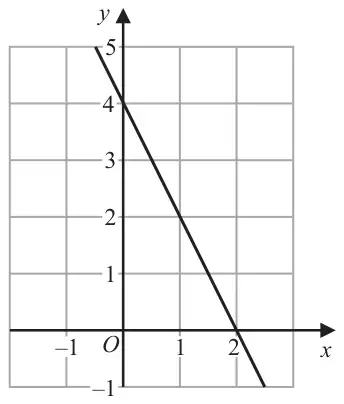
The diagram shows a straight line drawn on a grid.
(d) Write down an equation of the line. (2)
Mark scheme (a)
Scheme
Marks
1
B1
(1)
Mark scheme (b)
Scheme
Marks
\(27a^6b^{12}\)
B2
(2)
Notes
B2: (B1 for 2 of 3 parts in a product)
Mark scheme (c)
Scheme
Marks
\(7x^2y^2(2y^2 + 3x)\)
B2
(2)
Notes
B2: B1 for a correct factorisation with at least 2 factors outside (eg \(7x\), \(x^2\), \(xy\), etc) eg \(7x(2xy^4 + 3x^2y^2)\) eg \(x^2y^2(14y^2 + 21x)\) or for the correct common factor with just one mistake inside the bracket eg \(7x^2y^2(2y + 3x)\) which is missing the squared on the \(y\) term
Mark scheme (d)
Scheme
Marks
\(y = mx + 4\) where \(m \neq 0\) oe (eg \(y = 2x + 4\)) or \(y = -2x + c\) or \(y + 2x = c\) oe or \(-2x + 4\) or \(\mathrm{f}(x) = -2x + 4\) oe
M1
Correct answer scores full marks (unless from obvious incorrect working) Answer: \(y = -2x + 4\)
Correct answer scores full marks (unless from obvious incorrect working) Answer: \(30x^3 + 25x^2 - 20x\)
A1
(3)
(6 marks)
Notes
M1: for a correct intention to multiply all 3 factors by multiplying 2 factors only, allow one error
M1: (dep)ft for expanding by the third factor, allow one error (some may do the expansion in one stage and will get to \(30x^3 - 15x^2 + 40x^2 - 20x\) without firstly expanding two factors – this gains M2, allow one error)
A1: isw correct factorisation (\(30x^3 + 25x^2 - 20x\) must be seen previously to award 3 marks) eg \(5(6x^3 + 5x^2 - 4x)\) \(x(30x^2 + 25x - 20)\) \(5x(6x^2 + 5x - 4)\)
do not isw incorrect simplification eg \(30x^3 + 25x^2 - 20x = 6x^3 + 5x^2 - 4x\) gets M2A0
(a) Write down the value of \(\;(m + 2)^0\;\) where \(m\) is a positive integer. (1)
(b) Simplify \(\;(3a^2b^4)^3\) (2)
(c) Factorise fully \(\;14x^2y^4 + 21x^3y^2\) (2)
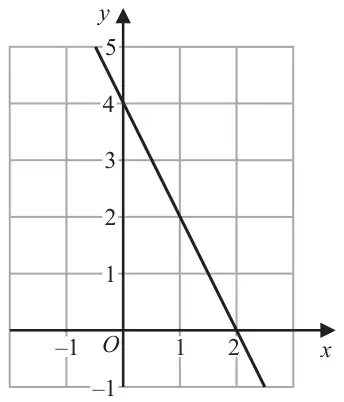
The diagram shows a straight line drawn on a grid.
(d) Write down an equation of the line. (2)
Mark scheme (a)
Scheme
Marks
1
B1
(1)
Mark scheme (b)
Scheme
Marks
\(27a^6b^{12}\)
B2
(2)
Notes
B2: (B1 for 2 of 3 parts in a product)
Mark scheme (c)
Scheme
Marks
\(7x^2y^2(2y^2 + 3x)\)
B2
(2)
Notes
B2: B1 for a correct factorisation with at least 2 factors outside (eg \(7x\), \(x^2\), \(xy\), etc) eg \(7x(2xy^4 + 3x^2y^2)\) eg \(x^2y^2(14y^2 + 21x)\) or for the correct common factor with just one mistake inside the bracket eg \(7x^2y^2(2y + 3x)\) which is missing the squared on the \(y\) term
Mark scheme (d)
Scheme
Marks
\(y = mx + 4\) where \(m \ne 0\) oe (eg \(y = 2x + 4\)) or \(y = -2x + c\) or \(y + 2x = c\) oe or \(-2x + 4\) or \(\mathrm{f}(x) = -2x + 4\) oe
M1
Correct answer scores full marks (unless from obvious incorrect working) Answer: \(y = -2x + 4\)
\(\sqrt{27}\) to be changed to a power of 3 and not \(3\sqrt{3}\) unless recovered
M1
eg \(\dfrac{3 \times 3^{6n + 9}}{3^{4n + 16}}\) or \(\dfrac{3^{6n + 10}}{3^{4n + 16}}\) or \(\dfrac{3 \times 3^{1.5(4n + 6)}}{3^{2(2n + 8)}}\) or
\(\dfrac{3^2 \times 3^{6n + 9}}{3 \times 3^{4n + 16}}\) or \(\dfrac{3^{6n + 11}}{3^{4n + 17}}\) oe or
eg \(3^{6n + 11} = 3^x \times 3^{4n + 17}\) oe
M1
Working required Answer: \(2n - 6\)
A1
(3)
(3 marks)
Notes
M1: For 2 of:
• writing 18 as \(2 \times 3^2\) oe and 6 as \(2 \times 3\) OR cancelling 6 & 18 fully
• writing \(\sqrt{27}\) as \(3^{\frac{3}{2}}\) or \(3 \times 3^{\frac{1}{2}}\) OR \(\left(\sqrt{27}\right)^{4n + 6}\) as \(\left(3^3\right)^{2n + 3}\) or \(3^{6n + 9}\)
• writing 9 as \(3^2\) OR \(9^{2n + 8}\) as \(3^{2(2n + 8)}\) or \(3^{4n + 16}\)
M1: For a correct expression or equation using only powers of 3 (powers of 3 but not necessarily a single power)
M1: for writing \(4^n\) as \((2^2)^n\) or \(2^{2n}\) or for writing each term in terms of 4 ie \(2^k = 4^{\frac{1}{2}k}\) and \(2^x = 4^{\frac{1}{2}x}\) If these things are seen in working, award this mark even if followed by incorrect working – if not a choice of methods
eg \(10p - 3p = -5\) or \(7p = -5\) or \(p - \dfrac{3p}{10} = -\dfrac{5}{10}\) or \(0.7p = -0.5\)
M1ft
\(-\dfrac{5}{7}\)
A1
(3)
Notes
M1: for a correct first step – multiplying both sides by 10 correctly or writing the RHS as 2 terms each over 10 or each term as a decimal [must be in a correct equation]
M1ft: (ft a 3 term equation) for collecting terms in \(p\) on one side and number the other
A1: (dep on at least M1) for \(-\dfrac{5}{7}\) oe, accept −0.71(4...) allow −0.7 if you have seen \(-\dfrac{5}{7}\) or −5 ÷ 7
Mark scheme (b)
Scheme
Marks
1
B1
(1)
Mark scheme (c)
Scheme
Marks
\(\dfrac{y^2}{2x}\)
B2
(2)
Notes
B2: for \(\dfrac{y^2}{2x}\) oe eg \(\dfrac{0.5y^2}{x}\), \(0.5y^2x^{-1}\), \(\dfrac{y^2x^{-1}}{2}\), \(\dfrac{1}{2xy^{-2}}\) oe
If not B2, award B1 for 2 of number, \(x\), \(y\) correct eg \(\dfrac{ky^2}{x}\) where \(k \ne \dfrac{1}{2}\) or \(\dfrac{y^2}{2x^m}\) where \(m \ne 1\) or \(0.5y^2\) or \(\dfrac{y^p}{2x}\) where \(p \ne 2\)) oe [one term can be missing with 2 correct for B1]
Mark scheme (d)
Scheme
Marks
\(5cd^2(2c^2 + 3d^2)\)
B2
(2)
(8 marks)
Notes
B2: for \(5cd^2(2c^2 + 3d^2)\) B1 for a correct partial factorisation eg \(5(2c^3d^2 + 3cd^4)\) or \(cd^2(10c^2 + 15d^2)\) or \(5d^2(2c^3 + 3cd^2)\) or \(5c(2c^2d^2 + 3d^4)\) or \(5cd(2c^2d + 3d^3)\) etc or \(5cd^2\)(a 2 term expression with just one error)
M1: for a correct intention to multiply all 3 factors by multiplying 2 factors only, allow one error
M1: (dep)ft for expanding by the third factor, allow one error
ALTERNATIVE
Scheme
Marks
\(9x^3 + 3x^2 + 18x^2 + 6x - 3x^2 - x - 6x - 2\)
M2
\(9x^3 + 18x^2 - x - 2\)
A1
Notes
M2: for a complete expansion with 8 terms present, at least 4 of which must be correct
Mark scheme (b)
Scheme
Marks
\(\left(\dfrac{8xy^2}{2x^5}\right)^2\) or \(\left(\dfrac{x^4}{4y^2}\right)^{-2}\) or \(\left(\dfrac{4x^{10}}{64x^2y^4}\right)^{-1}\)
M1
\(\left(\dfrac{4y^2}{x^4}\right)^2\) or \(\left(\dfrac{x^8}{16y^4}\right)^{-1}\) or \(\dfrac{64x^2y^4}{4x^{10}}\) or \(\dfrac{\frac{1}{4}x^{-10}}{\frac{1}{64}x^{-2}y^{-4}}\)
M1
\(\dfrac{16y^4}{x^8}\)
A1
(3)
(6 marks)
Notes
M1: for one of reciprocating or simplifying or squaring
M1: for two of reciprocating or simplifying or squaring
A1: accept \(16y^4x^{-8}\) or \(\dfrac{16}{y^{-4}x^8}\) or \(\dfrac{16x^{-8}}{y^{-4}}\) oe
ALTERNATIVE
Scheme
Marks
M2
\(\dfrac{16y^4}{x^8}\)
A1
Notes
M2: for 2 correct terms (M1 for 1 correct term)
A1: accept \(16y^4x^{-8}\) or \(\dfrac{16}{y^{-4}x^8}\) or \(\dfrac{16x^{-8}}{y^{-4}}\) oe
M1: for writing \(4^n\) as \(\left(2^2\right)^n\) or \(2^{2n}\) or for writing each term in terms of 4 ie \(2^k = 4^{\frac{1}{2}k}\) and \(2^x = 4^{\frac{1}{2}x}\)
If these things are seen in working, award this mark even if followed by incorrect working – if not a choice of methods
or \(p - \dfrac{3p}{10} = -\dfrac{5}{10}\) or \(0.7p = -0.5\)
M1ft
Working required
Answer: \(-\dfrac{5}{7}\)
A1
(3)
Notes
M1: for a correct first step – multiplying both sides by 10 correctly or writing the RHS as 2 terms each over 10 or each term as a decimal [must be in a correct equation]
M1ft: (ft a 3 term equation) for collecting terms in \(p\) on one side and number the other
A1: (dep on at least M1)
for \(-\dfrac{5}{7}\) oe, accept −0.71(4…)
allow −0.7 if you have seen \(-\dfrac{5}{7}\) or −5 ÷ 7
Mark scheme (b)
Scheme
Marks
1
B1
(1)
Mark scheme (c)
Scheme
Marks
\(\dfrac{y^2}{2x}\)
B2
(2)
Notes
B2: for \(\dfrac{y^2}{2x}\) oe eg \(\dfrac{0.5y^2}{x}\), \(0.5y^2x^{-1}\), \(\dfrac{y^2x^{-1}}{2}\), \(\dfrac{1}{2xy^{-2}}\) oe
If not B2, award B1 for 2 of number, \(x\), \(y\) correct eg
\(\dfrac{ky^2}{x}\) where \(k \ne \dfrac{1}{2}\) or
\(\dfrac{y^2}{2x^m}\) where \(m \ne 1\) or
\(0.5y^2\) or
\(\dfrac{y^p}{2x}\) where \(p \ne 2\)) oe
[one term can be missing with 2 correct for B1]
Mark scheme (d)
Scheme
Marks
\(5cd^2(2c^2 + 3d^2)\)
B2
(2)
(8 marks)
Notes
B2: for \(5cd^2(2c^2 + 3d^2)\) B1 for a correct partial factorisation eg \(5(2c^3d^2 + 3cd^4)\) or \(cd^2(10c^2 + 15d^2)\) or \(5d^2(2c^3 + 3cd^2)\) or \(5c(2c^2d^2 + 3d^4)\) \(5cd(2c^2d + 3d^3)\) etc or \(5cd^2\)(a 2 term expression with just one error)
(d) Make \(t\) the subject of \(\quad c = t^3 - 8v\) (2)
Mark scheme (a)
Scheme
Marks
\(a^{11}\)
B1
(1)
Mark scheme (b)
Scheme
Marks
\(w^{12}\)
B1
(1)
Mark scheme (c)
Scheme
Marks
\(64x^{10}y^6\)
B2
(2)
Notes
B2: if not B2 then award B1 for 2 correct parts as part of a product eg \(kx^{10}y^6\) where \(k \neq 64\) or \(64x^ky^6\) where \(k \neq 10\) or \(64x^{10}y^k\) where \(k \neq 6\)
Mark scheme (d)
Scheme
Marks
\(c + 8v = t^3\)
M1
\(t = \sqrt[3]{c + 8v}\)
A1
(2)
(6 marks)
Notes
A1: oe
SCB1 for an answer of \(t = \dfrac{c + 8v}{3}\) oe
M1: for a correct intention to multiply all 3 factors by starting to multiply 2 factors only, allow one error
M1: (dep)ft for expanding by the third factor, allow one error (some may do the expansion in one stage and will get to \(15x^3 - 20x^2 + 30x^2 - 40x\) without firstly expanding two factors, allow two errors)
\(\left(\dfrac{2w^2}{y^5}\right)^{-3}\) or \(\left(\dfrac{y^{20}}{16w^8}\right)^{\frac{3}{4}}\) or \(\left(\dfrac{4096w^{24}}{y^{60}}\right)^{-\frac{1}{4}}\)
M1
\(\left(\dfrac{8w^6}{y^{15}}\right)^{-1}\) or \(\dfrac{2^{-3}w^{-6}}{y^{-15}}\) or \(\dfrac{\frac{1}{8}w^{-6}}{y^{-15}}\) or \(\left(\dfrac{y^5}{2w^2}\right)^3\) or \(\left(\dfrac{y^{60}}{4096w^{24}}\right)^{\frac{1}{4}}\)
or \(\dfrac{0.125y^{15}}{w^6}\) or \(\dfrac{0.125w^{-6}}{y^{-15}}\) or \(\dfrac{0.125}{y^{-15}w^6}\) oe
M1
\(\dfrac{y^{15}}{8w^6}\)
A1
(3)
(6 marks)
Notes
M1: for one of fourth rooting or reciprocating or cubing
M1: for two of fourth rooting or reciprocating or cubing
A1: allow \(\dfrac{y^{15}}{8w^6}\) or \(\dfrac{y^{15}w^{-6}}{8}\) or \(0.125y^{15}w^{-6}\) or \(\dfrac{1}{8}y^{15}w^{-6}\) or \(\dfrac{w^{-6}}{8y^{-15}}\) or \(\dfrac{1}{8y^{-15}w^6}\)
ALTERNATIVE
Scheme
Marks
M2
\(\dfrac{y^{15}}{8w^6}\)
A1
Notes
M2: for 2 correct terms (M1 for 1 correct term)
A1: allow \(\dfrac{y^{15}}{8w^6}\) or \(\dfrac{y^{15}w^{-6}}{8}\) or \(0.125y^{15}w^{-6}\) or \(\dfrac{1}{8}y^{15}w^{-6}\) or \(\dfrac{w^{-6}}{8y^{-15}}\) or \(\dfrac{1}{8y^{-15}w^6}\)
(d) Make \(t\) the subject of \(c = t^3 - 8v\) (2)
Mark scheme (a)
Scheme
Marks
\(a^{11}\)
B1
(1)
Mark scheme (b)
Scheme
Marks
\(w^{12}\)
B1
(1)
Mark scheme (c)
Scheme
Marks
\(64x^{10}y^6\)
B2
(2)
Notes
B2: if not B2 then award B1 for 2 correct parts as part of a product eg \(kx^{10}y^6\) where \(k \ne 64\) or \(64x^ky^6\) where \(k \ne 10\) or \(64x^{10}y^k\) where \(k \ne 6\)
Mark scheme (d)
Scheme
Marks
\(c + 8v = t^3\)
M1
\(t = \sqrt[3]{c + 8v}\)
A1
(2)
(6 marks)
Notes
A1: oe
SCB1 for an answer of \(t = \dfrac{c + 8v}{3}\) oe
B3: Accept \(\dfrac{4}{3}x^{-2}y^5\) or \(\dfrac{4x^{-2}y^5}{3}\) or \(1.\dot{3}x^{-2}y^5\) oe NB: Must see 4 and 3 and not \(16^{\frac{1}{2}}\) or \(9^{\frac{1}{2}}\) or \(16^{-\frac{1}{2}}\) or \(9^{-\frac{1}{2}}\) (allow use of 1.3[33..])
If not B3 then B2 for 2 of:
correct fraction (\(\dfrac{4}{3}\) or \(1.\dot{3}\)) (allow use of 1.3[33..]) or
\(x\) term correct (\(x^2\) on denominator or \(x^{-2}\) on numerator) or
\(y\) term correct (\(y^5\) on numerator or \(y^{-5}\) on denominator)
If not B2 then B1 for 1 of:
correct fraction or \(x\) term correct or \(y\) term correct
or
for one of
applying negative power to at least 3 out of 4 of 9, \(x^4\), 16, \(y^{10}\) or
applying square root to at least 3 out of 4 of 9, \(x^4\), 16, \(y^{10}\)
eg at least 3 of the 4 parts of \(\dfrac{16y^{10}}{9x^4}\) or \(\dfrac{16x^{-4}}{9y^{-10}}\) or \(\dfrac{\frac{1}{9}x^{-4}}{\frac{1}{16}y^{-10}}\) or \(\dfrac{3x^2}{4y^5}\) oe
(a) Find the value of \(x\). Show your working clearly. (2)
\(\dfrac{(11^{-6})^5}{11^4} = 11^n\)
(b) Find the value of \(n\). Show your working clearly. (2)
Mark scheme (a)
Scheme
Marks
\(2^{\frac{1}{2}} \times 2^4\) or eg \(2 \times (2^4)^2 = (2^x)^2\) or \(2^9 = 2^{2x}\)
M1
Working required
Answer: \(\dfrac{9}{2}\)
A1
(2)
Notes
M1: for a correct expression in powers of 2 that is equivalent to \(2^x\) eg \(2^{\frac{1}{2}} \times 2^4\)
or for showing \(\sqrt{2} = 2^{\frac{1}{2}}\) and \(16 = 2^4\)
or for writing the equation in powers of 2 eg \(2 \times (2^4)^2 = (2^x)^2\) or \(2^9 = 2^{2x}\)
A1:or 4.5 or 4½ dependent on M1
Mark scheme (b)
Scheme
Marks
\(\dfrac{11^{-30}}{11^4}\)
or
\(-30 - 4 = n\) or \(-30 = n + 4\) oe
M1
Working required Answer: −34
A1
(2)
(4 marks)
Notes
M1: For \((11^{-6})^5\) written as \(11^{-30}\) in the equation or \((11^{-6})^5 = 11^{-30}\) shown in working or a correct equation with indices only (no marks for \(3.914\ldots \times 10^{-36}\))
(a) Simplify \(\quad w \times w \times w \times w \times w\) (1)
(b) Simplify \(\quad 5a \times 3c\) (1)
(c) Simplify \(\quad 3e + 2f - e + 5f\) (2)
(d) Solve \(\quad 5x - 7 = x + 12\) Show clear algebraic working. (3)
Mark scheme (a)
Scheme
Marks
\(w^5\)
B1
(1)
Mark scheme (b)
Scheme
Marks
\(15ac\)
B1
(1)
Notes
B1: or \(a15c\) or \(ac15\) or \(c15a\) oe (NB: no multiplication signs)
Mark scheme (c)
Scheme
Marks
\(2e + 7f\)
B2
(2)
Notes
B2: (B1 for \(2e\) or \(+7f\) or \(7f\) but not for \(-7f\)) Do not isw so if you see \(2e + 7f = 9ef\) award B1 only
Mark scheme (d)
Scheme
Marks
eg \(5x - x = 12 + 7\) or \(-7 - 12 = x - 5x\) or \(4x - 7 = 12\) or \(5x = x + 19\) oe
M1
\(4x = 19\) or \(-4x = -19\)
M1
Working required Answer: 4.75
A1
(3)
(7 marks)
Notes
M1: for rearrangement with \(x\) terms on one side and numerical terms on the other in a correct equation or the correct simplification of \(x\) terms or numbers on one side in a correct equation
M1: \(x\) terms simplified and number terms simplified correctly in an equation
A1: oe, eg \(\dfrac{19}{4}\) or \(4\dfrac{3}{4}\) dep on M1
Correct answer scores full marks (unless from obvious incorrect working)
Answer: \(\dfrac{10x - 5}{12}\)
A1
(3)
Notes
M1: for expressing both fractions correctly with a common denominator.
Allow as two separate fractions.
M1: for removing brackets correctly in a correct single fraction
A1: accept \(\dfrac{5(2x - 1)}{12}\)
Mark scheme (c)
Scheme
Marks
\((4^{k+3} =)\;(2^2)^{k+3}\) oe or \((16 =)\;2^4\)
\((16 =)\;4^2\) or \((2^k =)\;\left(4^{\frac{1}{2}}\right)^k\) oe
\((4^{k+3} =)\;\left(16^{\frac{1}{2}}\right)^{k+3}\) oe or \((2^k =)\;\left(16^{\frac{1}{4}}\right)^k\) oe
M1
\((4^{k+3} =)\;(2^2)^{k+3}\) oe and \((16 =)\;2^4\)
\((16 =)\;4^2\) and \((2^k =)\;\left(4^{\frac{1}{2}}\right)^k\) oe
\((4^{k+3} =)\;\left(16^{\frac{1}{2}}\right)^{k+3}\) oe and \((2^k =)\;\left(16^{\frac{1}{4}}\right)^k\) oe
M1
E.g.
\(2k + 6 = 4 + k\) or
\(k + 3 = 2 + \dfrac{1}{2}k\) or
\(\dfrac{1}{2}(k + 3) = 1 + \dfrac{1}{4}k\)
M1
Working required Answer: \(-2\)
A1
(4)
(9 marks)
Notes
M1: for \((2^2)^{k+3}\) oe or \(2^4\) or \(4^2\) or \(\left(4^{\frac{1}{2}}\right)^k\) oe or \(\left(16^{\frac{1}{2}}\right)^{k+3}\) oe or \(\left(16^{\frac{1}{4}}\right)^k\) oe
M1: for \((2^2)^{k+3}\) oe and \(2^4\) or \(4^2\) and \(\left(4^{\frac{1}{2}}\right)^k\) oe or \(\left(16^{\frac{1}{2}}\right)^{k+3}\) oe and \(\left(16^{\frac{1}{4}}\right)^k\) oe
M1: for a correct linear equation in \(k\)
A1: dep on at least M2
In the first two rows, \(4^{k+3}\) is written as \(\left(16^{\frac{1}{2}}\right)^{k+3}\) (corrected from the printed mark scheme: “\(\left(16^{\frac{1}{4}}\right)^{k+3}\)”).
(definition of part: there are 3 parts: one part is the number, one part the letter \(t\) and one part the letter \(w\) Definition of terms: there are 6 terms: 2 number terms, 2 terms in \(t\) and 2 terms in \(w\))
M1 indep
M1 indep
Correct answer scores full marks (unless from obvious incorrect working) Answer: \(4t^4w^2\)
A1
(3)
(3 marks)
Notes
M1 indep: Fully correct cancellation of any two parts of their fraction at any stage of working
M1 indep: correctly apply the negative power to the whole of their bracket (all parts or all terms) or correctly square all parts or terms of their bracket or correctly apply the negative power AND square of at least two parts (maybe 4 terms) of their bracket
A1: Allow \((2t^2w)^2\) after the correct answer
Mark scheme (ALTERNATIVE)
Scheme
Marks
M2
Correct answer scores full marks (unless from obvious incorrect working) Answer: \(4t^4w^2\)
M1: for solving their 3 term quadratic equation using any correct method - if factorising, allow brackets which expanded give 2 out of 3 terms correct (if using formula or completing the square allow one sign error and some simplification – allow as far as e.g. \(\dfrac{14 \pm \sqrt{196 + 60}}{6}\) oe)
M1: Correct method to eliminate \(x\) or \(y\): coefficients of \(x\) or \(y\) the same and correct operation to eliminate selected variable (condone any one arithmetic error in multiplication) or writing \(x\) or \(y\) in terms of the other variable and correctly substituting
M1: (dep) correct method to find second variable – could start process again or use substitution
find the value of \(x\). Show clear algebraic working.
(3)
Mark scheme
Scheme
Marks
\(3^4 = \dfrac{3^x}{9^{3x}}\) or \(81 = \dfrac{3^x}{(3^2)^{3x}}\)or
\(9^2 = \dfrac{3^x}{9^{3x}}\) or \(81 = \dfrac{(9^{0.5})^x}{9^{3x}}\)
M1
eg \(4 + 6x = x\) or \(4 = x - 2(3x)\) oeor eg \(2 = 0.5x - 3x\) oe
M1
Working required Answer: \(-0.8\)
A1
(3)
(3 marks)
Notes
M1: replacing 81 with \(3^4\) or \(9^{3x}\) with \((3^2)^{3x}\) (or \(3^{6x}\)) or replacing 81 with \(9^2\) or \(3^x\) with \((9^{0.5})^x\) (in an equation)
\(\dfrac{y^{-4}}{2^{-4}}\) or \(\left(\dfrac{y^4}{16}\right)^{-1}\) or \(\dfrac{y^{-4}}{0.0625}\) or \(\left(\dfrac{2}{y}\right)^4\) or \(\dfrac{16}{y^4}\) or \(\left(\dfrac{1}{\frac{y}{2}}\right)^4\) or \(\dfrac{1}{\left(\frac{y}{2}\right)^4}\)
M1
Correct answer scores full marks (unless from obvious incorrect working) Answer: \(16y^{-4}\)
20 \(a = 25 \times 10^{14n}\) where \(n\) is an integer. Find an expression, in terms of \(n\), for \(a^{\frac{3}{2}}\) Give your answer in standard form.
M1: for 3 correct terms or 4 correct terms ignoring signs or \(x^2 + 7x + c\) or …. \(+ 7x - 18\)
Mark scheme (e)
Scheme
Marks
\(4cp^2(4c^3 + 5p)\)
B2
(2)
(8 marks)
Notes
B2: if not B2 then award B1 for any correct factorisation with at least 2 factors outside the bracket eg \(4cp(4c^3p + 5p^2)\), \(cp^2(16pc^3 + 20p)\), \(2p(8c^4 + 10cp^2)\) etc or the correct common factor and a 2 term expression with just one error
M1: for 3 correct terms or 4 correct terms ignoring signs or \(x^2 + 7x + c\) or \(\ldots + 7x - 18\)
Mark scheme (d)
Scheme
Marks
\(4cp^2(4c^3 + 5p)\)
B2
(2)
(6 marks)
Notes
B2: if not B2 then award B1 for any correct factorisation with at least 2 factors outside the bracket eg \(4cp(4c^3p + 5p^2)\), \(cp^2(16c^3 + 20p)\), \(2p(8pc^4 + 10cp^2)\) etc or the correct common factor and a 2 term expression with just one error
(b) Express \(\dfrac{1}{9x^2 - 25} - \dfrac{1}{6x + 10}\) as a single fraction in its simplest form. (3)
Mark scheme (a)
Scheme
Marks
E.g. \(\left(\dfrac{y^8}{256x^{20}}\right)^{\frac{1}{4}}\) or \(\left(\dfrac{4x^5}{y^2}\right)^{-1}\) or \(\dfrac{x^{-5}}{4y^{-2}}\) or \(\dfrac{\frac{1}{4}x^{-5}}{y^{-2}}\)
or \(k\dfrac{y^a}{x^b}\) or \(\dfrac{ky^a}{x^b}\) with 2 of \(k = \dfrac{1}{4}\) oe, \(a = 2\), \(b = 5\)
or \(\dfrac{y^a}{mx^b}\) with 2 of \(m = 4\), \(a = 2\), \(b = 5\)
M1
\(\dfrac{y^2}{4x^5}\)
A1
(2)
Notes
M1: for a correct first step leading to a correct partially simplified expression
A1: for \(\dfrac{y^2}{4x^5}\) or \(\dfrac{\frac{1}{4}y^2}{x^5}\) or \(0.25\dfrac{y^2}{x^5}\) or \(0.25y^2x^{-5}\)
\(\dfrac{\sqrt{a} \times a}{a^{-2}}\) can be written in the form \(a^k\)
(c) Find the value of \(k\). (2)
(d) Simplify \(\dfrac{2^n - 1}{4^n - 1}\) (2)
Mark scheme (a)
Scheme
Marks
\(8e^6f^9\)
B2
(2)
Notes
B2: B1 for 2 correct terms in a product of 3 terms
Mark scheme (b)
Scheme
Marks
\(3x^2 + 9xy - 4yx - 12y^2\)
M1
\(3x^2 + 5xy - 12y^2\)
A1
(2)
Notes
M1: M1 for 3 correct terms out of 4 or for 4 correct terms ignoring signs or for \(3x^2 + 5xy + c\) for any non zero value of \(c\) or for \(d + 5xy - 12y^2\) for any non zero value of \(d\)
Mark scheme (c)
Scheme
Marks
\(a^{\frac{1}{2}} \times a = a^{\frac{3}{2}}\) or \(\dfrac{a}{a^{-2}} = a^3\)
or \(\dfrac{a^{\frac{1}{2}}}{a^{-2}} = a^{\frac{5}{2}}\)
(b) Given that \(2^{\frac{1}{2}} \times 2^{\frac{n}{3}} = \dfrac{8^x}{4^n}\) express \(x\) in terms of \(n\). (4)
Mark scheme (a)
Scheme
Marks
eg \(\left(\dfrac{27f^3}{125e^{12}}\right)^{\frac{2}{3}}\) or \(\dfrac{1}{\left(\dfrac{125e^{12}}{27f^3}\right)^{\frac{2}{3}}}\) or \(\left(\dfrac{15625e^{24}}{729f^6}\right)^{-\frac{1}{3}}\) or
\(\left(\dfrac{5e^4}{3f}\right)^{-2}\)
M1
eg \(\left(\dfrac{3f}{5e^4}\right)^2\) or \(\dfrac{1}{\left(\dfrac{15625e^{24}}{729f^6}\right)^{\frac{1}{3}}}\) or \(\left(\dfrac{25e^8}{9f^2}\right)^{-1}\) or
\(\dfrac{1}{\left(\dfrac{5e^4}{3f}\right)^2}\) or \(\left(\dfrac{729f^6}{15625e^{24}}\right)^{\frac{1}{3}}\)
M1
\(\dfrac{9f^2}{25e^8}\)
A1
(3)
Notes
M1: For dealing with either negative index or cube root or square
or an expression including
\(\dfrac{9}{25}\) or \(\left(\dfrac{25}{9}\right)^{-1}\) or \(\dfrac{f^2}{e^8}\) or \(\dfrac{e^{-8}}{f^{-2}}\) (oe)
M1: For dealing with two elements
or a correct expression not simplified eg \(\dfrac{\frac{1}{25}e^{-8}}{\frac{1}{9}f^{-2}}\), \(\dfrac{0.04e^{-8}}{0.\dot{1}f^{-2}}\)
22 \(m = 8 \times 10^{9n}\) where \(n\) is an integer.
Express \(m^{-\frac{1}{3}}\) in standard form. Give your answer, in terms of \(n\), as simply as possible.
(3)
Mark scheme
Scheme
Marks
e.g. \(\left(\dfrac{1}{8 \times 10^{9n}}\right)^{\frac{1}{3}}\) or \(\left(2 \times 10^{3n}\right)^{-1}\) or \(\dfrac{1}{\sqrt[3]{8 \times 10^{9n}}}\) or
\(\left(\sqrt[3]{8 \times 10^{9n}}\right)^{-1}\) or \(\left(8^{\frac{-1}{3}} \times 10^{\frac{-9n}{3}}\right)\) or
\(\left[\dfrac{1}{8^{\frac{1}{3}}}\text{ and }\dfrac{1}{\left(10^{9n}\right)^{\frac{1}{3}}}\right]\) or \(\left[2^{-1}\text{ and }(10^{3n})^{-1}\right]\) oe
M1
e.g. \(\dfrac{1}{2 \times 10^{3n}}\) or \(0.5 \times 10^{-3n}\) oe or
\(\left[8^{\frac{-1}{3}} = 0.5\text{ and }(10^{9n})^{\frac{-1}{3}} = 10^{-3n}\right]\) oe
M1
\(5 \times 10^{-3n - 1}\)
A1
(3)
(3 marks)
Notes
M1: Correct first stage.
M1: For dealing with \(8^{-1/3}\) (shown as ½ or 0.5) and \((10^{9n})^{-1/3}\) shown as \(10^{-3n}\)
(a) Express \(gh\) as a product of powers of its prime factors. Simplify your answer. (2)
\(\dfrac{g}{h} = 2^a \times 3^b \times 7^c\)
(b) Find the value of \(a\), the value of \(b\) and the value of \(c\). (2)
(c) Show that \(\;\left(7 - 2\sqrt{5}\right)\left(7 + 2\sqrt{5}\right) = 29\) Show your working clearly. (2)
\(\dfrac{1}{\sqrt[3]{9^4}} = 3^n\)
(d) Work out the exact value of \(n\). (3)
Mark scheme (a)
Scheme
Marks
\(2^{3+1} \times 3^{1+1} \times 7^{2+3}\)
M1
\(2^4 \times 3^2 \times 7^5\)
A1
(2)
Notes
M1: or for a product of powers of 2, 3 and 7 with two powers correct, or for an attempt to find prime factors of 2420208 (allow one arithmetical error) or for \(2^4\), \(3^2\), \(7^5\)
e.g. 7 × “3” + \(2y\) = 16 or \(7x + 2 \times -2.5 = 16\)
M1
\(x = 3\) oe, \(y = -2.5\)
A1
(3)
Notes
M1: for addition of given equations or a complete method to eliminate \(y\) or \(x\) (condone one arithmetic error)
M1: (dep) for method to find second variable
A1: dep on M1 for both values correct. NB. Candidates showing no working score zero
Mark scheme (b)
Scheme
Marks
\(k^2 + 9k - 5k - 45\)
M1
\(k^2 + 4k - 45\)
A1
(2)
Notes
M1: for 3 terms correct or all 4 terms correct ignoring signs or \(k^2 + 4k + \ldots\) or … \(+ 4k - 45\) (corrected from the printed mark scheme: “\(y^2 + 4k + \ldots\)”)
Mark scheme (c)
Scheme
Marks
eg \(\left(\dfrac{1}{8x^6y^3}\right)^{-\frac{1}{3}}\) or \(\left(\dfrac{8x^6y^8}{y^5}\right)^{\frac{1}{3}}\) or
Eg \(25y = 5 \times 24\) or \(25y = 120\) or \(y = 5 \div 1\dfrac{1}{24}\) or
\(y = \dfrac{5}{1.041\dot{6}}\) or \(y = \dfrac{5}{\frac{2}{3} + \frac{3}{8}}\)
M1
4.8
A1oe
(3)
Notes
M1: For simplifying the LHS or multiplying both sides by 24
M1: Dep on 1st M1 gained For the removal of the denominator(s) as part of a correct equation or for correctly isolating \(y\)
A1oe: Dep on 1st M1 gained. ScM2 for \(16y + 9y = 120\) M0A0 for trial and improvement NB: Decimals must be exact to gain any credit: Eg Award M0 for \(y(0.667 + 0.375)\)
(b) Make \(p\) the subject of \(p + 4q = 3p + 5\) (2)
(c) Expand and simplify \((2y + 3)(4y - 1)\) (2)
(d) Simplify \((8a^6b^3)^{\frac{1}{3}}\) (2)
Mark scheme (a)
Scheme
Marks
e.g. \(\dfrac{a^{11}}{a^7}\) or \(\dfrac{a^6}{a^2}\) or \(\dfrac{a^9}{a^5}\) oe
M1
\(a^4\)
A1
(2)
Notes
M1: For \(\dfrac{a^{11}}{a^7}\) or any index law used correctly
Mark scheme (b)
Scheme
Marks
\(4q - 5 = 3p - p\) oe eg \(-2p = 5 - 4q\)
M1
\(p = \dfrac{4q - 5}{2}\)
A1
(2)
Notes
M1: For correctly collecting terms in \(p\) one side and other terms on the other side
A1: oe, eg \(p = 2q - 2.5\)
Mark scheme (c)
Scheme
Marks
\(8y^2 - 2y + 12y - 3\)
M1
\(8y^2 + 10y - 3\)
A1
(2)
Notes
M1: For any three correct terms or for 4 correct terms ignoring signs or for \(8y^2 + 10y + k\) for any non-zero value of \(k\) or for \(\ldots + 10y - 3\)
Mark scheme (d)
Scheme
Marks
\(2a^2b\)
B2
(2)
Notes
B2: B1 for two of 2 or \(a^2\) or \(b\) as part of a product
M1: for 3 correct terms out of a maximum of 4 terms or for 4 correct terms ignoring signs or for \(x^2 + 4x + k\) for any non-zero value of \(k\) or for \(\ldots + 4x - 5\)
Mark scheme (d)
Scheme
Marks
M1
\(\dfrac{6m^3}{5k^2}\)
A1
(2)
Notes
M1: for any one correct application of index laws in a product or quotient
B2: (B1 for \(ny^3, n \ne 20\) or \(20y^m\) \(m \ne 3\))
Mark scheme (b)
Scheme
Marks
\(\dfrac{3e}{5f^2}\)
B2
(2)
Notes
B2: B2 \(\dfrac{3e}{5f^2}\) or \(\dfrac{3}{5}ef^{-2}\) or \(0.6\dfrac{e}{f^2}\) or \(0.6ef^{-2}\)
(B1 for \(k\dfrac{e}{f^2}\) with \(k \ne 0.6\) oe or \(\dfrac{3ef}{5f^3}\) or \(\dfrac{3e^2}{5ef^2}\))
Mark scheme (c)
Scheme
Marks
\((3p + 2q)(2p - 3q)\)
M1 A1
(2)
Notes
M1 A1: M1 for \((ap + bq)(cp + dq)\) with \(ac = 6\) and \(bd = -6\) (ie. the coefficients of \(p\) multiply to give 6 and the coefficients of \(q\) multiply to give −6) A1 oe
Apart from Questions 9, 13, 18, 20 and 21 (where the mark scheme states otherwise) the correct answer, unless clearly obtained by an incorrect method, should be taken to imply a correct method.
(a) Write \(2^3 \times 2^6\) as a single power of 2 (1)
(b) Write \(\dfrac{3^9}{3^4}\) as a single power of 3 (1)
(c) \[\dfrac{5^n}{5^4 \times 5^6} = 5^3\] Find the value of \(n\). (2)
Mark scheme (a)
Scheme
Marks
\(2^9\)
B1
(1)
Notes
B1: cao
Apart from Questions 9, 13, 18, 20 and 21 (where the mark scheme states otherwise) the correct answer, unless clearly obtained by an incorrect method, should be taken to imply a correct method.
Mark scheme (b)
Scheme
Marks
\(3^5\)
B1
(1)
Notes
B1: cao
Mark scheme (c)
Scheme
Marks
\(5^{n-4-6} = 5^3\) oe or \(5^{n-10} = 5^3\) oe or \(n - 4 - 6 = 3\) oe or \(n - 10 = 3\) oe or \(5^n = 5^3 \times 5^{10}\) oe or \(5^n = 5^{3+10}\) or \(5^n = 5^{13}\)
(b) Given that \(2^p \times 8^q = 2^n\) express \(n\) in terms of \(p\) and \(q\). (2)
Mark scheme (a)
Scheme
Marks
\(8y^6\)
B2
(2)
Notes
B2: B1 for 8 B1 for \(y^6\)
Apart from Questions 3, 13(b) and 17(f) (where the mark scheme states otherwise), the correct answer, unless clearly obtained by an incorrect method, should be taken to imply a correct method.
8 \[\dfrac{y^3 \times y^n}{y} = y^6\] Find the value of \(n\).
(2)
Mark scheme
Scheme
Marks
\(y^{3+n-1} = y^6\) oe or \(y^{3+n} = y^7\) oe
or \(3 + n - 1 = 6\) oe
or \(y^n = \dfrac{y^7}{y^3}\) or \(y^n = \dfrac{y^6}{y^2}\) or \(y^n = y^4\)
M1
4
A1
(Total 2 marks)
Notes
A1: cao
SC if M0, award B1 for an answer of \(y^4\)
Apart from Questions 3, 13(b) and 17(f) (where the mark scheme states otherwise), the correct answer, unless clearly obtained by an incorrect method, should be taken to imply a correct method.
We'd like to use Google Analytics cookies to count visits and see which pages help most. They're optional, and the site works exactly the same either way. Privacy policy