(a) Write \(28 + 24x - 6x^2\) in the form \(a - b(x - c)^2\) where \(a\), \(b\) and \(c\) are integers. (3)
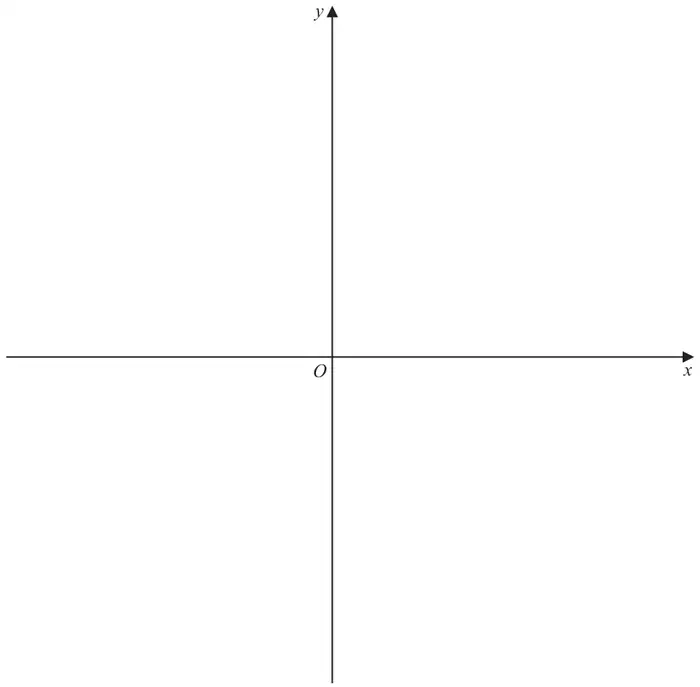
(b) On the axes below, sketch the graph of \(y = 28 + 24x - 6x^2\) Show clearly the coordinates of the turning point and the coordinates of the point of intersection of the graph with the \(y\)-axis. (3)
Mark scheme (a)
Scheme
Marks
\(\pm 6\left(x \pm \dfrac{4}{2}\right)^2\ldots\ldots\) or \(\pm 6(x \pm 2)^2\ldots\ldots\)
or
\(\pm 6\left[(x \pm 2)^2\ldots\ldots\right]\) or \(\pm 6\left[\left(x \pm \dfrac{4}{2}\right)^2\ldots\ldots\right]\)
Working not required, so correct answer scores full marks (unless from obvious incorrect working) Answer: \(52 - 6(x - 2)^2\)
A1
(3)
Notes
M1: for a start to completing the square
or
correct substitution into \(a\left(x + \dfrac{b}{2a}\right)^2 + \ldots\) from the formula \(a\left(x + \dfrac{b}{2a}\right)^2 - \dfrac{(b)^2}{4a} + c\)
M1: for correctly completing the square but terms do not need to be simplified and 28 may or may not be present
or
correct simplification of the first two parts of \(a\left(x + \dfrac{b}{2a}\right)^2 - \dfrac{(b)^2}{4a}(+c)\)
NB: Please refer to ALT mark scheme after (b) for comparison of coefficients method
A1: oe eg \(-6(x - 2)^2 + 52\)
25(a) ALT
Scheme
Marks
\(-bx^2 + 2bcx - bc^2 + a\) and \(b = 6\) or \(b = -6\)
M1
\(2bc = 24\) or \(-bc^2 + a = 28\)
M1
Working not required, so correct answer scores full marks (unless from obvious incorrect working) Answer: \(52 - 6(x - 2)^2\)
A1
Notes
M1: for multiplying out \(a - b(x - c)^2\) and \(b = 6\) or \(b = -6\)
M1: for equating coefficients
A1: oe eg \(-6(x - 2)^2 + 52\)
Mark scheme (b)
Scheme
Marks
‘∩’ or ‘∪’ shaped symmetrical quadratic curve
B1
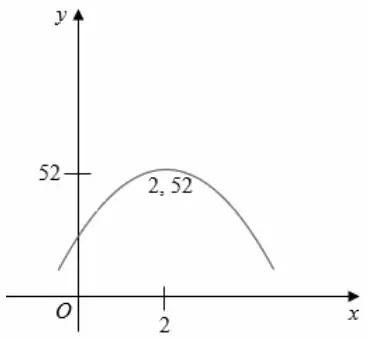
Answer: Turning point marked as (2, 52)
B1
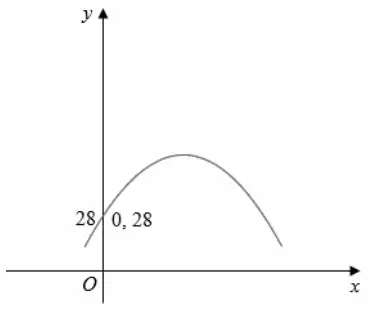
Answer: Intersection with \(y\)-axis marked as (0, 28) or crossing at 28 marked
B1
(3)
(6 marks)
Notes
B1: for drawing a ‘∩’ or ‘∪’ shaped symmetrical quadratic curve with the turning point in any quadrant
B1: for drawing a ‘∩’ shaped symmetrical quadratic curve in the correct quadrant with a turning point at (2, 52)
B1: for drawing a ‘∩’ shaped symmetrical quadratic curve in the correct quadrant with an intersection on the \(y\)-axis marked as (0, 28) or marked as 28 on the \(y\)-axis
Write \(\mathrm{f}(x)\) in the form \(\;a - b(x - c)^2\;\) where \(a\), \(b\) and \(c\) are constants.
(4)
Mark scheme
Scheme
Marks
\(\pm 3(x^2 \pm 4x)\)……… or \(\pm 3(x^2 \pm 4x\ldots\ldots\ldots)\) or \(b = 3\)
M1
\(-3\big[(x - 2)^2 \ldots\ldots\ldots\big]\) or \(-3(x - 2)^2\)………
M1
\(-3\big[(x - 2)^2 - (2)^2\big]\)…….. oe or \(-3(x - 2)^2 + 12\)…….. or \(-3\big[(x - 2)^2 - (2)^2 \ldots\ldots\ldots\big]\) oe
M1
Working not required, so correct answer scores full marks (unless from obvious incorrect working) Answer: \(29 - 3(x - 2)^2\)
A1
(4)
(4 marks)
Notes
M1: for factorising \(-3x^2 + 12x\) or stating the correct value of \(b\) or \(b = 3\) embedded in an incorrect final answer in the form \(a - 3(x - c)^2\)
M1: for a correct first step to complete the square
M1: for a correct second step to complete the square
A1: oe eg \(-3(x - 2)^2 + 29\)
25 ALT
Scheme
Marks
\(-bx^2 + 2bcx - bc^2 + a\) oe or \(b = 3\)
M1
\(2bc = 12\) or \(a - bc^2 = 17\) oe
M1
\(2 \times \text{``}{3}\text{''} \times c = 12\) or \(a - \text{``}{3}\text{''} \times \text{``}{2}\text{''}^2 = 17\) oe
M1
Working not required, so correct answer scores full marks (unless from obvious incorrect working) Answer: \(29 - 3(x - 2)^2\)
A1
(4 marks)
Notes
M1: for multiplying out \(a - b(x - c)^2\) or stating the correct value of \(b\) or \(b = 3\) embedded in an incorrect final answer in the form \(a - 3(x - c)^2\)
M1: for equating coefficients
M1: for finding at least 2 from \(a\) or \(b\) or \(c\)
Working not required, so correct answer scores full marks (unless from obvious incorrect working) Answer: \(-18\)
A1
(2)
Mark scheme (c)
Scheme
Marks
\((y =)\; 3(x^2 - 4x) + \ldots\) or \(y = 3(x^2 - 4x + \ldots)\) where … can be number(s) or nothing or \(3x^2 - 12x + (8 - y) = 0\) oe
M1
\((y =)\; 3(x - 2)^2 + \ldots\) or \(y = 3[(x - 2)^2 + \ldots]\); could have \(y - 8 = 3[(x - 2)^2 + \ldots]\) oe or \(x = \dfrac{12 \pm \sqrt{144 - 12(8 - y)}}{6}\) (may have + rather than ±)
M1
\((x - 2)^2 = \dfrac{y + 4}{3}\) oe or an answer of \(2 \pm \sqrt{\dfrac{4 + y}{3}}\) or \(x = 2 \pm \sqrt{\dfrac{4 + y}{3}}\) (may have + rather than ±)
M1
Working not required, so correct answer scores full marks (unless from obvious incorrect working) Answer: \(\mathrm{h}^{-1}: x \mapsto 2 + \sqrt{\dfrac{x + 4}{3}}\)
A1
(4)
(7 marks)
Notes
A1: oe eg \(2 + \sqrt{\dfrac{12 + 3x}{9}}\)
NB: Allow candidates to swap \(x\) and \(y\) (or other letter) at any stage when finding the inverse – but the answer must be in terms of \(x\)
B3: for all 3 correct values eg 3, −90, 2 or −3, 90, 2 (If not B3 then B2 for any 2 correct values NB. 2 values from 3, −90, 2 or 2 values from −3, 90, 2 NB: accept a value of (90 + 360n) in place of 90 or (−90 + 360n) in place of −90 where n is an integer (could be negative) If not B2 then B1 for any 1 correct value or the graph of \(y = \cos x°\) for \(0 \leqslant x \leqslant 360\))
22 The curve S has equation \(y = \mathrm{f}(x)\) where \(\mathrm{f}(x) = x^2\)
The curve T has equation \(y = \mathrm{g}(x)\) where \(\mathrm{g}(x) = 2x^2 - 12x + 13\)
By writing \(\mathrm{g}(x)\) in the form \(a(x - b)^2 - c\), where \(a\), \(b\) and \(c\) are constants, describe fully a series of transformations that map the curve S onto the curve T.
(4)
Mark scheme
Scheme
Marks
\([\mathrm{g}(x) =]\ 2(x - 3)^2 - 5\)
B2
stretch \(y\) direction scale factor 2 oe [ft their \(a\)] or translation \(\begin{pmatrix} 3 \\ -5 \end{pmatrix}\) (ft correct use of their \(b\) and \(c\)) oe
M1
Correct transformations in correct order
A1
(4)
(4 marks)
Notes
B2: for \(a = 2\), \(b = 3\) and \(c = 5\) correct (stated or shown) (B1 for one of \(a = 2\), \(b = 3\) and \(c = 5\) correct)
M1:Stretch and a correct description of the stretch or translation and a correct description of the translation NB: must include the word translation (or translate) and stretch
A1: Stretch \(y\) direction scale factor 2 followed by translation \(\begin{pmatrix} 3 \\ -5 \end{pmatrix}\) oe eg translation \(\begin{pmatrix} 3 \\ 0 \end{pmatrix}\), stretch SF2 in \(y\) direction followed by translation \(\begin{pmatrix} 0 \\ -5 \end{pmatrix}\)
Mark scheme (ALT)
Scheme
Marks
\([\mathrm{g}(x) =]\ 2(x - 3)^2 - 5\)
B2
translation \(\begin{pmatrix} 3 \\ -2.5 \end{pmatrix}\) (ft correct use of their \(b\) and \(0.5c\)) oe or stretch \(y\) direction scale factor 2 (ft their \(a\))
M1
Correct transformations in correct order
A1
Notes
B2: for \(a = 2\), \(b = 3\) and \(c = 5\) correct (stated or shown) (B1 for one of \(a = 2\), \(b = 3\) and \(c = 5\) correct)
M1: A correct description of the stretch or the translation
A1: Translation \(\begin{pmatrix} 3 \\ -2.5 \end{pmatrix}\) oe followed by stretch \(y\) direction scale factor 2
Correct answer scores full marks (unless from obvious incorrect working) Answer: \(5 \lt x \leqslant 14\)
A1
(5)
(7 marks)
Notes
M1: correct steps to isolate their bracket ft from (a) dep on expression in form \(\pm p \pm (x - q)^2\)
M1: complete method to find \(y\) in terms of \(x\) or \(x\) in terms of \(y\). Condone + for \(\pm\) ft from (a) dep on expression in form \(\pm p \pm (x - q)^2\)
M1: for the correct inverse
M1: method to solve \(0 \lt 3 - \sqrt{14 - x}\) or a lower bound of 5 clearly shown, eg \(x \gt 5\) as part of the answer
23 A particle moves along a straight line. The fixed point \(O\) lies on this line. The displacement of the particle from \(O\) at time \(t\) seconds, \(t \geqslant 0\), is \(s\) metres where
\[s = t^3 + 4t^2 - 5t + 7\]
At time \(T\) seconds the velocity of \(P\) is \(V\) m/s where \(\;V \geqslant -5\)
Find an expression for \(T\) in terms of \(V\).
Give your expression in the form \(\;\dfrac{-4 + \sqrt{k + mV}}{3}\;\) where \(k\) and \(m\) are integers to be found.
(6)
Mark scheme
Scheme
Marks
(\(v\) =) \(3t^2 + 2 \times 4t - 5\)
M1
\(3T^2 + 8T - 5 = V\) OR \(3T^2 + 8T - 5 - V = 0\)
A1
\(3\left(T^2 + \dfrac{8}{3}T\right) - 5\)
OR \(3\left(T^2 + \dfrac{8}{3}T - \dfrac{5}{3}\right)\)or
M1: attempt to complete the square OR use quadratic formula (condone one sign error in \(a\), \(b\) or \(c\) and ft their quadratic with mistake in \(a\) or \(b\)) (condone + instead of ±)
M1: sight of this method mark implies the previous M1 (condone + instead of ±) (ft their quadratic with mistake in \(a\) or \(b\))
M1: (condone + instead of ±) (ft their quadratic with mistake in \(a\) or \(b\))
\(a + b(x^2 + 2cx + c^2)\) \(2bc = -12\) or \(a + bc^2 = 7\) or \(b = -2\)
M1
\(2 \times -2 \times c = -12\) or \(c = 3\)
M1
\(a + -2 \times (3)^2 = 7\) or \(a = 25\) seen
A1
Notes
M1: Equating coefficients or stating value of \(b\)
M1: Equating coefficients or stating value of \(c\)
A1: Equating coefficients or stating value of \(a\)
Special Cases: SC B2 for answer of \(-2(x + 3)^2\) + constant or \(25 - 2(x + \text{positive constant})^2\) SC B1 for answer of \(-2(x - 3)^2\) + constant
M1: for substituting \(\mathrm{g}(x)\) into \(\mathrm{f}(x)\)
A1: Allow \(y^2 + 4y + 3\)
M1: ft (dep on M1) for correctly completing the square on their 3 term quadratic or Correctly setting up an equation
M1: ft (dep on M2) for a correct rearrangement for their completed the square quadratic or correctly substituting into the quadratic formula Allow same equations with \(x\) and \(y\) swapped
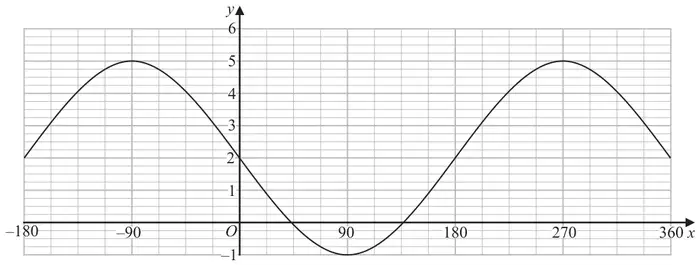
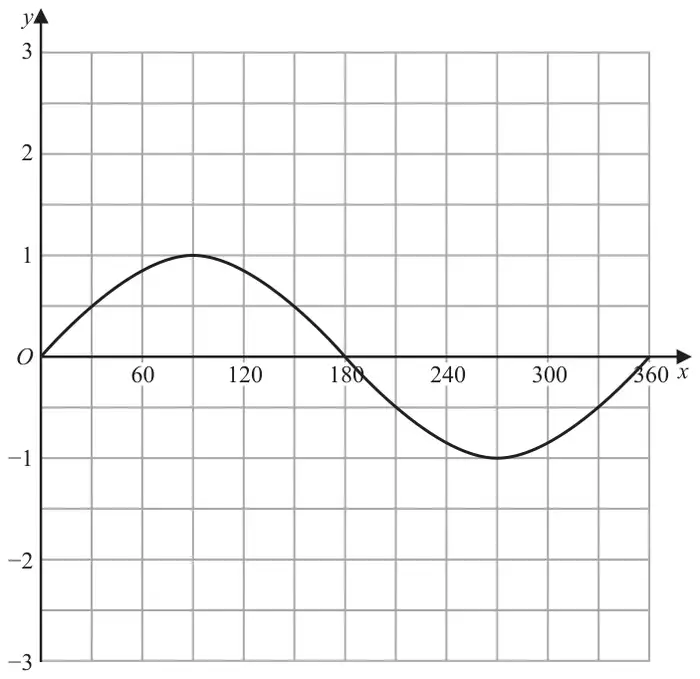
22 The graph of \(y = \sin x^\circ\) for \(0 \leqslant x \leqslant 360\) is drawn on the grid.
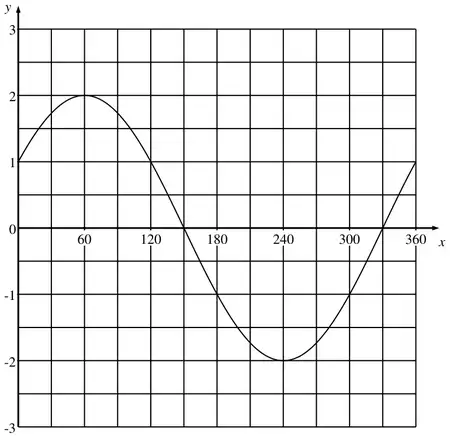
(a) On the grid, draw the graph of \(y = 2\sin(x + 30)^\circ\) for \(0 \leqslant x \leqslant 360\) (2)
(b)
(i) Write \(x^2 - 6x + 10\) in the form \((x - a)^2 + b\) where \(a\) and \(b\) are integers. (2)
(ii) Hence, describe fully the single transformation that maps the curve with equation \(y = x^2\) onto the curve with equation \(y = x^2 - 6x + 10\) (2)
Mark scheme (a)
Scheme
Marks
Answer: correct graph (see end of mark scheme) [must go through (60, 2), (150, 0), (240, −2), (330, 0)] and not through (0, 0)
B2
(2)
Notes
B2: if not B2 then award B1 for a graph of the correct shape going through 2 or 3 of the given points or for a clear stretch of SF2 (ie a maximum point on graph at (\(x_1\), 2) and a minimum point at (\(x_2\), −2)) or a clear translation of \(\begin{pmatrix}-30\\0\end{pmatrix}\) (ie a point on graph at (150, \(y\)) and a point at (330, \(y\)))
Mark scheme (b)
Scheme
Marks
(i) Answer: \((x - 3)^2 + 1\)
B2
(ii) Answer: translation of \(\begin{pmatrix}3\\1\end{pmatrix}\)
B1
B1
(4)
(6 marks)
Notes
B2: (B1 for \(\left(x - \dfrac{6}{2}\right)^2 + n\) (where \(n \ne 1\)) or for \((x - m)^2 + 1\) (where \(m \ne 3\)) or for
\(x^2 - ax - ax + a^2 + b\) with \(2a = 6\) or \(a^2 + b = 10\))
B1: for translation
B1: For \(\begin{pmatrix}3\\1\end{pmatrix}\) ft from (b)(i) must be column vector
M1: Factorising by extracting −2 in a correct expression
M1: Correct expression equivalent to \(5 + 12x - 2x^2\)
M1: Correct expression equivalent to \(5 + 12x - 2x^2\)
A1:Award full marks if \(a\), \(b\), and \(c\) are correctly stated and \(23 - 2(x - 3)^2\) is not stated anywhere. SC B3 for \(23 - 2(3 - x)^2\) SC B2 for \(-2(x - 3)^2\) + constant or \(23 - 2(x + \text{constant})^2\) SC B1 for \(-2(x + 3)^2\) +constant
Mark scheme (ALT)
Scheme
Marks
\(a + b(x^2 + 2cx + c^2)\)
M1
\(2bc = 12\) or \(a + bc^2 = 5\) or \(b = -2\)
M1
\(2 \times -2 \times c = 12\) or \(c = -3\)
M1
\(a + -2 \times (-3)^2 = 5\) or \(a = 23\) seen Answer: \(23 - 2(x - 3)^2\)
M1
Notes
M1: Multiplying out expression correctly
M1: Equating coefficients or stating value of \(b\)
M1: Method to calculate \(c\)
M1: Method to calculate \(a\) SC B3 for \(23 - 2(3 - x)^2\)
(a) Express \(7 - 4x - x^2\) in the form \(p - (x + q)^2\) where \(p\) and \(q\) are constants. (2)
(b) Use your answer to part (a) to solve the equation \(7 - 4(y + 3) - (y + 3)^2 = 0\) Give your solutions in the form \(e \pm \sqrt{f}\) where \(e\) and \(f\) are integers. (3)
The curve \(C\) has equation \(y = 3 - 5(x + 1)^2\) The point \(A\) is the maximum point on \(C\).
(c) Write down the coordinates of \(A\). (1)
Mark scheme (a)
Scheme
Marks
M1
\(11 - (x + 2)^2\)
A1
(2)
Notes
M1: For \(11 - (x + q)^2\) or \(p - (x + 2)^2\)
A1: fully correct, accept \(p = 11\), \(q = 2\)
Mark scheme (b)
Scheme
Marks
\((y + 3 + 2)^2 = 11\) or \(11 - (y + 3 + 2)^2\)
M1
\(y + 3 + 2 = \pm\sqrt{11}\)
M1
\(-5 \pm \sqrt{11}\)
A1
(3)
Notes
M1: substituting \(x = y + 3\) into their \(p - (x + q)^2\)
A1: Both answers correct, ft their answer from (a) eg \(-(3 + \text{``}{q}\text{''}) \pm \sqrt{\text{``}{p}\text{''}}\)
Mark scheme (b) (Alternative scheme)
Scheme
Marks
M2
\(-5 \pm \sqrt{11}\)
A1
Notes
M2: for \(-y^2 - 10y - 14 = 0\) or \(y^2 + 10y + 14 = 0\)
We'd like to use Google Analytics cookies to count visits and see which pages help most. They're optional, and the site works exactly the same either way. Privacy policy