(a) Complete the table of values for \(y = x^3 - 3x + 1\) (2)
\(x\)
\(-2\)
\(-1\)
0
1
2
\(y\)
\(-1\)
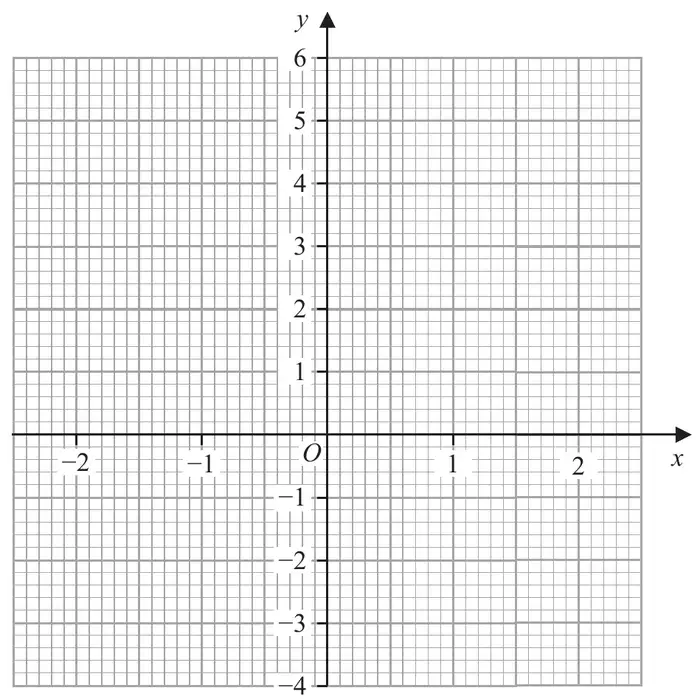
(b) On the grid, draw the graph of \(y = x^3 - 3x + 1\) for values of \(x\) from \(-2\) to 2 (2)
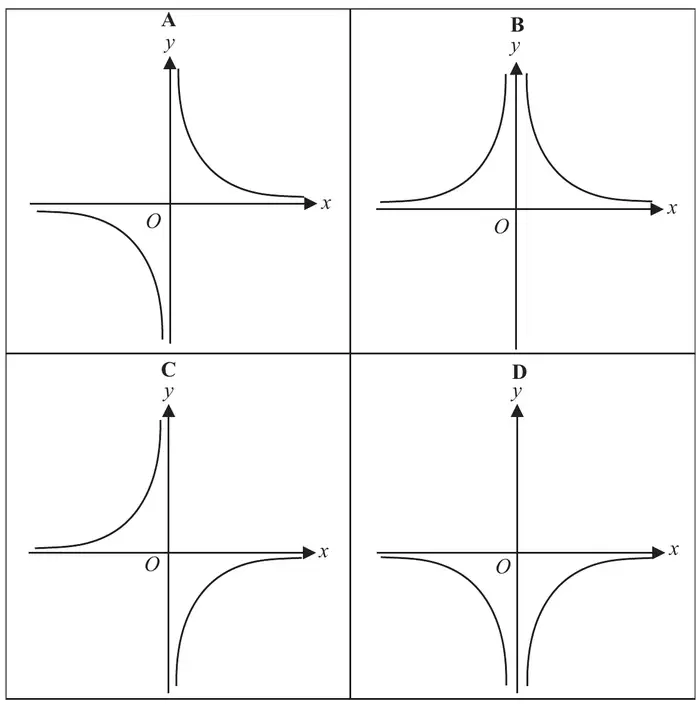
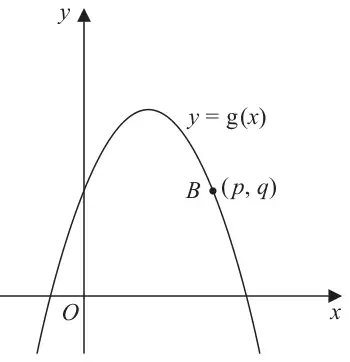
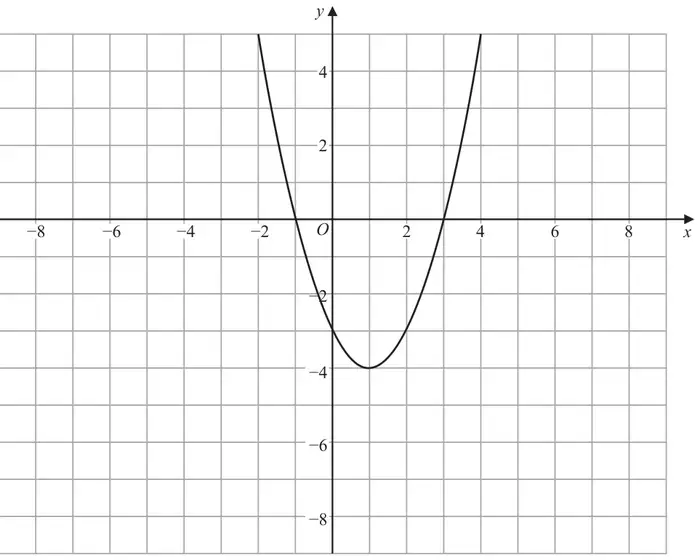
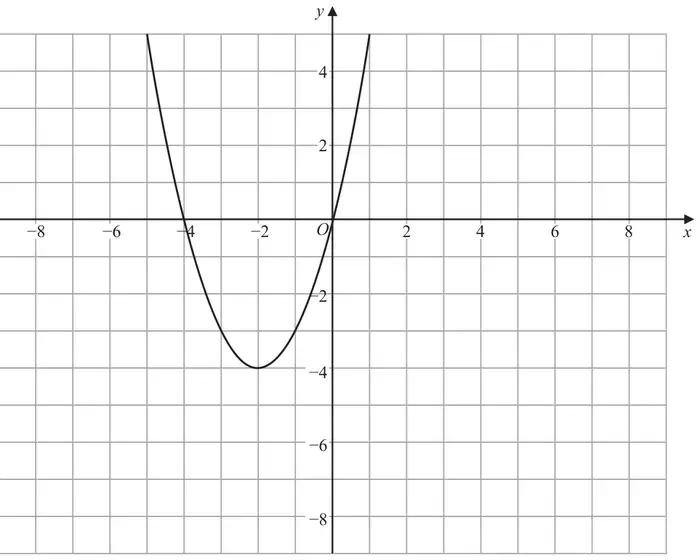
Here are four graphs.
(c) Write down the letter of the graph that could have the equation \(y = -\dfrac{1}{x^2}\) (1)
Mark scheme (a)
Scheme
Marks
\(x\)
\(-2\)
\(-1\)
0
1
2
\(y\)
\(-1\)
3
1
(\(-1\))
3
B2
(2)
Notes
B2: for all correct (B1 for 2 or 3 correct)
Mark scheme (b)
Scheme
Marks
Correct graph: the points (−2, −1), (−1, 3), (0, 1), (1, −1), (2, 3) plotted and joined with a smooth curve
M1 A1
(2)
Notes
M1: ft their table dep on B1 scored in (a) for 4 or 5 points plotted correctly (tolerance within or on the circles on the overlay)
A1: for a fully correct graph – points plotted correctly (within or on the circles on the overlay) and intention to join with a smooth curve (be generous if intention is clearly a smooth curve through all points) Ignore curve drawn for \(x < -2\) and \(x > 2\)
B3: for all 3 correct values eg 3, −90, 2 or −3, 90, 2 (If not B3 then B2 for any 2 correct values NB. 2 values from 3, −90, 2 or 2 values from −3, 90, 2 NB: accept a value of (90 + 360n) in place of 90 or (−90 + 360n) in place of −90 where n is an integer (could be negative) If not B2 then B1 for any 1 correct value or the graph of \(y = \cos x°\) for \(0 \leqslant x \leqslant 360\))
22 The curve S has equation \(y = \mathrm{f}(x)\) where \(\mathrm{f}(x) = x^2\)
The curve T has equation \(y = \mathrm{g}(x)\) where \(\mathrm{g}(x) = 2x^2 - 12x + 13\)
By writing \(\mathrm{g}(x)\) in the form \(a(x - b)^2 - c\), where \(a\), \(b\) and \(c\) are constants, describe fully a series of transformations that map the curve S onto the curve T.
(4)
Mark scheme
Scheme
Marks
\([\mathrm{g}(x) =]\ 2(x - 3)^2 - 5\)
B2
stretch \(y\) direction scale factor 2 oe [ft their \(a\)] or translation \(\begin{pmatrix} 3 \\ -5 \end{pmatrix}\) (ft correct use of their \(b\) and \(c\)) oe
M1
Correct transformations in correct order
A1
(4)
(4 marks)
Notes
B2: for \(a = 2\), \(b = 3\) and \(c = 5\) correct (stated or shown) (B1 for one of \(a = 2\), \(b = 3\) and \(c = 5\) correct)
M1:Stretch and a correct description of the stretch or translation and a correct description of the translation NB: must include the word translation (or translate) and stretch
A1: Stretch \(y\) direction scale factor 2 followed by translation \(\begin{pmatrix} 3 \\ -5 \end{pmatrix}\) oe eg translation \(\begin{pmatrix} 3 \\ 0 \end{pmatrix}\), stretch SF2 in \(y\) direction followed by translation \(\begin{pmatrix} 0 \\ -5 \end{pmatrix}\)
Mark scheme (ALT)
Scheme
Marks
\([\mathrm{g}(x) =]\ 2(x - 3)^2 - 5\)
B2
translation \(\begin{pmatrix} 3 \\ -2.5 \end{pmatrix}\) (ft correct use of their \(b\) and \(0.5c\)) oe or stretch \(y\) direction scale factor 2 (ft their \(a\))
M1
Correct transformations in correct order
A1
Notes
B2: for \(a = 2\), \(b = 3\) and \(c = 5\) correct (stated or shown) (B1 for one of \(a = 2\), \(b = 3\) and \(c = 5\) correct)
M1: A correct description of the stretch or the translation
A1: Translation \(\begin{pmatrix} 3 \\ -2.5 \end{pmatrix}\) oe followed by stretch \(y\) direction scale factor 2
25 The curve with equation \(y = \mathrm{g}(x)\) is transformed to the curve with equation \(y = -\mathrm{g}(x)\) by the single transformation T.
(a) Describe fully the transformation T. (1)
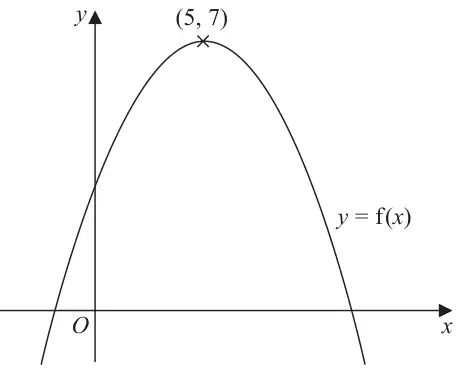
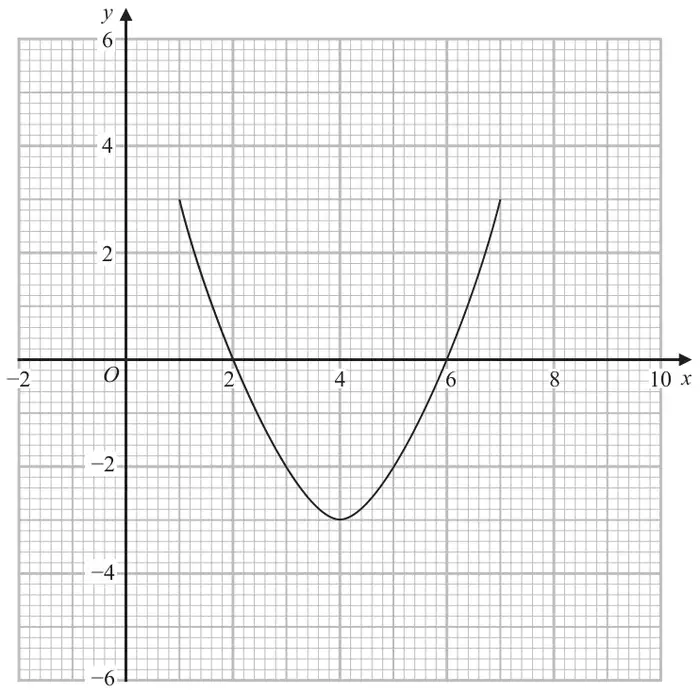
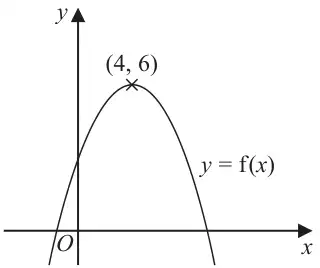
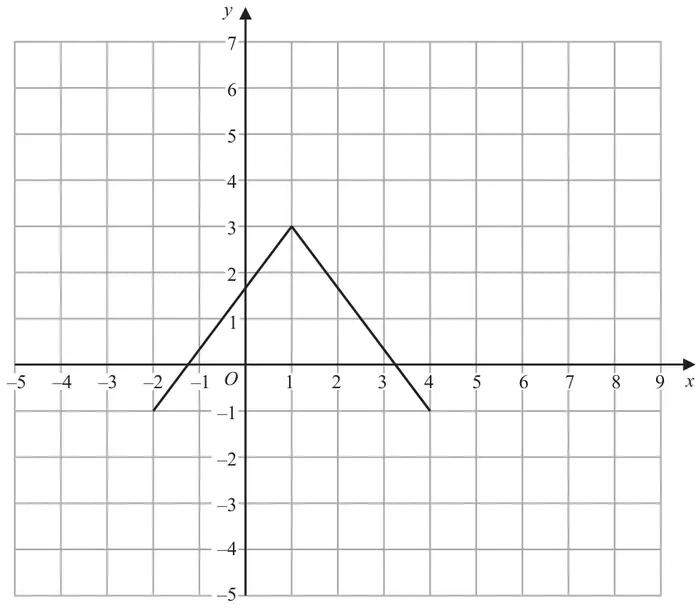
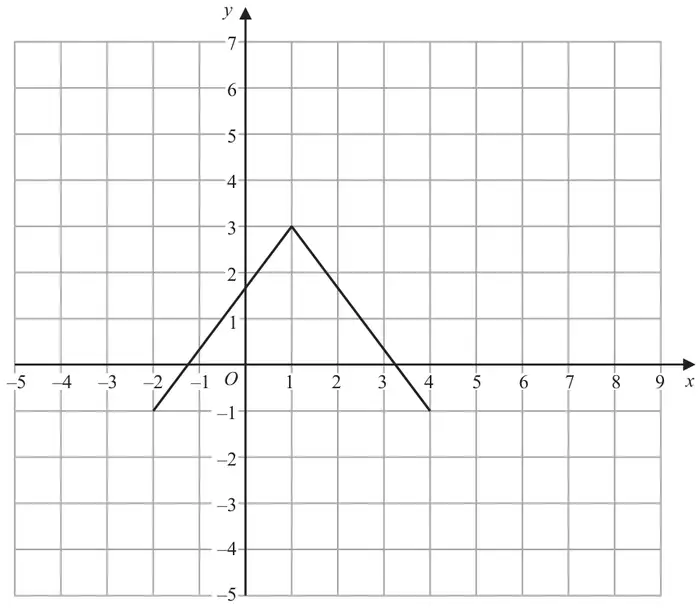
The diagram shows the graph of \(y = \mathrm{f}(x)\)
(b) On the grid, draw the graph of \(y = 2\mathrm{f}(x - 1)\) (2)
Mark scheme (a)
Scheme
Marks
Reflection in \(y = 0\)
B1
(1)
Notes
B1: accept alternative for \(y = 0\) e.g. \(x\) axis ; if more than one transformation then B0
Mark scheme (b)
Scheme
Marks
U shaped curve through (2, 6) (3, 0) (5, −6) (7, 0) (8, 6)
B2
(2)
(3 marks)
Notes
B2: for a U shaped curve passing through (2, 6) (3, 0) (5, −6) (7, 0) (8, 6)
If not B2 then award B1 for either \(2\mathrm{f}(x - 1)\) passing through at least 3 points from (2, 6) (3, 0) (5, −6) (7, 0) (8, 6) or \(2\mathrm{f}(x + 1)\) passing through (0, 6) (1, 0) (3, −6) (5, 0) (6, 6) or \(2\mathrm{f}(x)\) passing through all of (1, 6) (2, 0) (4, −6) (6, 0) (7, 6) or \(\mathrm{f}(x - 1)\) passing through all of (2, 3) (3, 0) (5, −3) (7, 0) (8, 3) or \(2\mathrm{f}(x \pm k)\) passing through all of \((1 \pm k, 6)\) \((2 \pm k, 0)\) \((4 \pm k, -6)\) \((6 \pm k, 0)\) \((7 \pm k, 6)\) or A clear translation of the curve using the vector \(\begin{pmatrix} 1 \\ k \end{pmatrix}\)
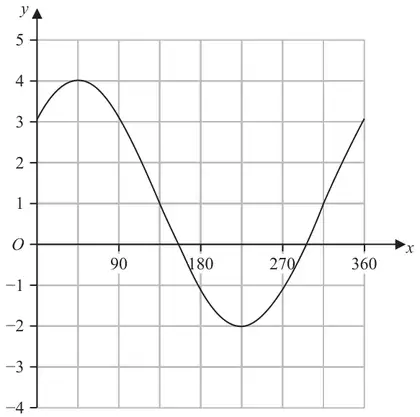
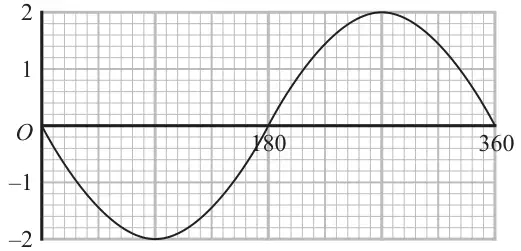
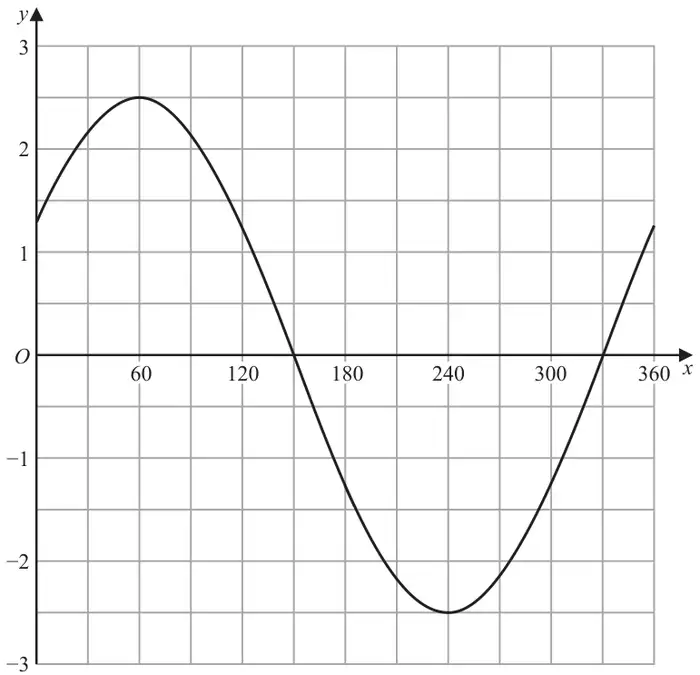
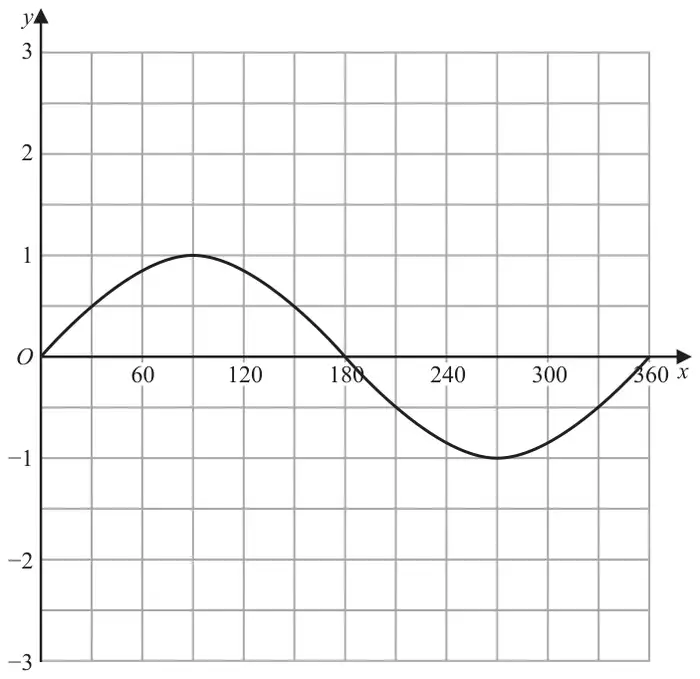
22 The graph of \(y = \sin x^\circ\) for \(0 \leqslant x \leqslant 360\) is drawn on the grid.
(a) On the grid, draw the graph of \(y = 2\sin(x + 30)^\circ\) for \(0 \leqslant x \leqslant 360\) (2)
(b)
(i) Write \(x^2 - 6x + 10\) in the form \((x - a)^2 + b\) where \(a\) and \(b\) are integers. (2)
(ii) Hence, describe fully the single transformation that maps the curve with equation \(y = x^2\) onto the curve with equation \(y = x^2 - 6x + 10\) (2)
Mark scheme (a)
Scheme
Marks
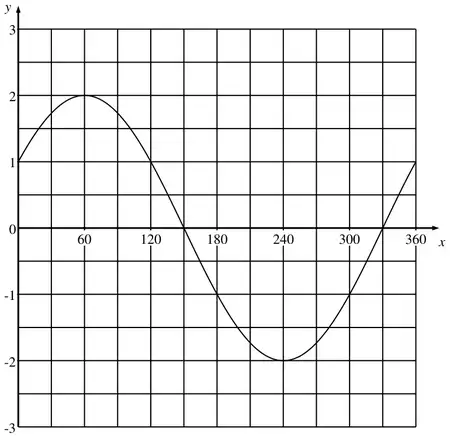
Answer: correct graph (see end of mark scheme) [must go through (60, 2), (150, 0), (240, −2), (330, 0)] and not through (0, 0)
B2
(2)
Notes
B2: if not B2 then award B1 for a graph of the correct shape going through 2 or 3 of the given points or for a clear stretch of SF2 (ie a maximum point on graph at (\(x_1\), 2) and a minimum point at (\(x_2\), −2)) or a clear translation of \(\begin{pmatrix}-30\\0\end{pmatrix}\) (ie a point on graph at (150, \(y\)) and a point at (330, \(y\)))
Mark scheme (b)
Scheme
Marks
(i) Answer: \((x - 3)^2 + 1\)
B2
(ii) Answer: translation of \(\begin{pmatrix}3\\1\end{pmatrix}\)
B1
B1
(4)
(6 marks)
Notes
B2: (B1 for \(\left(x - \dfrac{6}{2}\right)^2 + n\) (where \(n \ne 1\)) or for \((x - m)^2 + 1\) (where \(m \ne 3\)) or for
\(x^2 - ax - ax + a^2 + b\) with \(2a = 6\) or \(a^2 + b = 10\))
B1: for translation
B1: For \(\begin{pmatrix}3\\1\end{pmatrix}\) ft from (b)(i) must be column vector
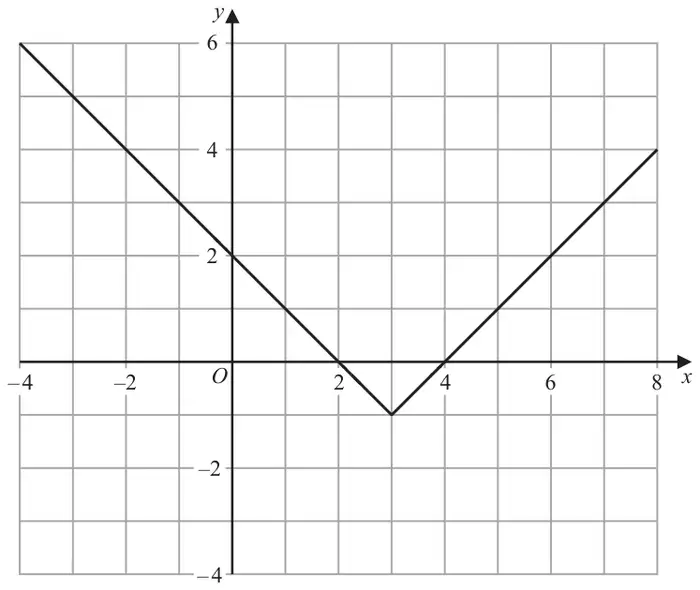
B2: For a parabola with minimum \((2, -4)\) through at least 5 of \((-4, 5), (-2, 0), (0, -3), (4, -3), (6, 0), (8, 5)\) If not B2 then B1 For u-shaped parabola with minimum \((2, -4)\) or For u-shaped parabola through \((-2, 0), (6, 0)\) or For u-shaped parabola through \((-4, 5), (8, 5)\)
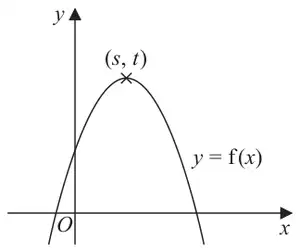
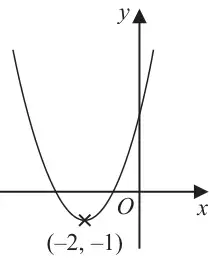
The diagram shows the curve with equation \(y = \mathrm{f}(x)\) The coordinates of the minimum point of the curve are (−2, −1)
(a) Write down the coordinates of the minimum point of the curve with equation
(i) \(y = \mathrm{f}(x - 5)\)
(ii) \(y = \dfrac{1}{2}\mathrm{f}(x)\) (2)
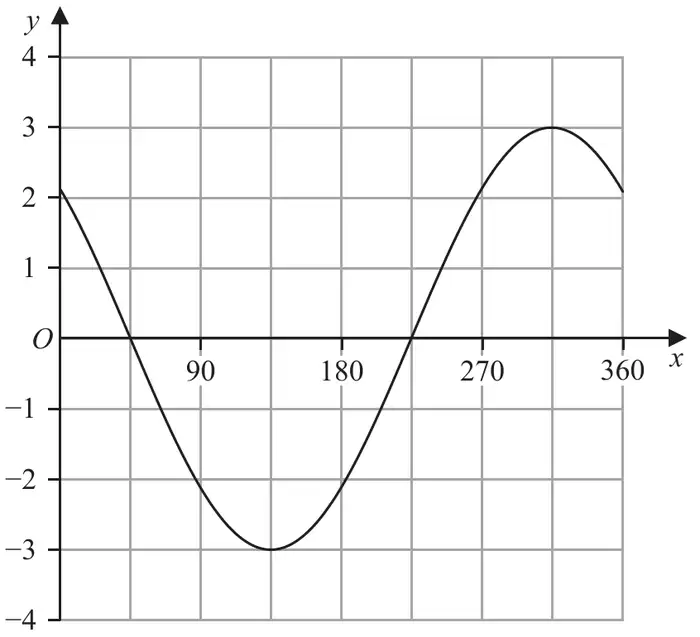
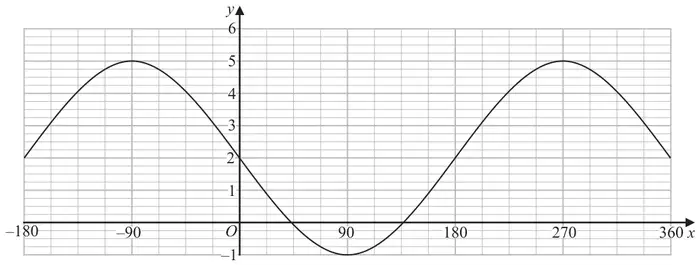
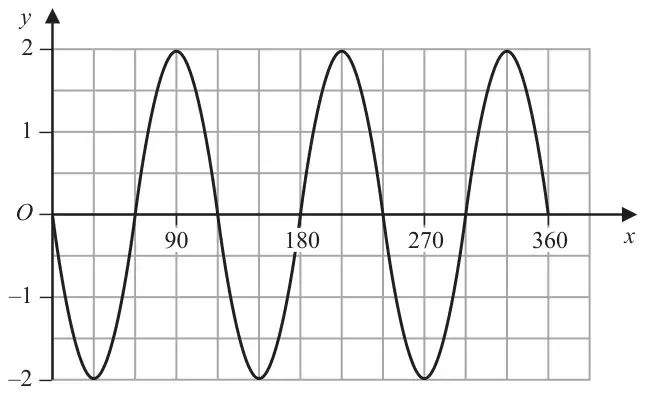
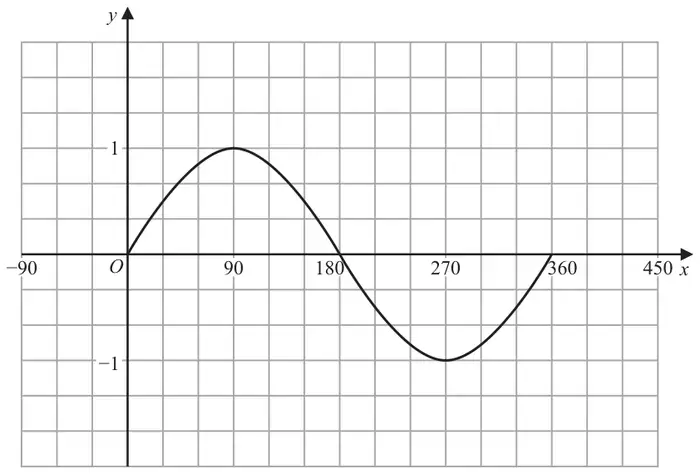
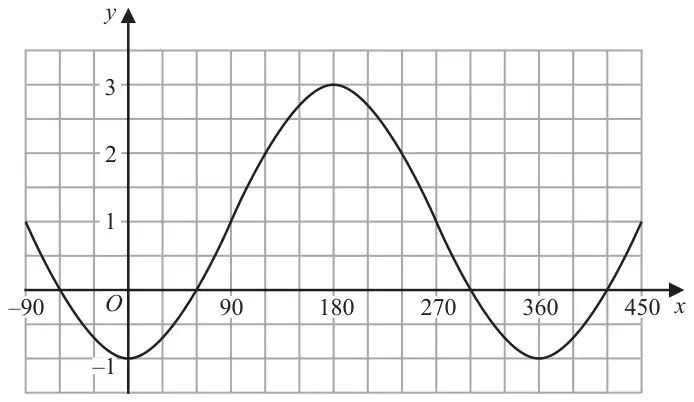
The graph of \(y = a\sin(x - b)^\circ + c\) for \(-90 \leqslant x \leqslant 450\) is drawn on the grid below.
(b) Find the value of \(a\), the value of \(b\) and the value of \(c\). (3)
Mark scheme (a)
Scheme
Marks
(i) (3, −1)
B1
(ii) (−2, −0.5) oe
B1
(2)
Mark scheme (b)
Scheme
Marks
e.g. 2, 90, 1
B3
(3)
(5 marks)
Notes
B3: for all 3 correct values e.g. 2, 90, 1 or −2, 270, 1 If not B3 then B2 for any 2 correct values NB. 2 values from 2, 90, 1 OR 2 values from −2, 270, 1 NB: accept a value of (90 + 360n) in place of 90 or (270 + 360n) in place of 270 where n is an integer (could be negative) If not B2 then B1 for any 1 correct value or the graph of \(y = \sin x^\circ\) for \(0 \leqslant x \leqslant 360\)
We'd like to use Google Analytics cookies to count visits and see which pages help most. They're optional, and the site works exactly the same either way. Privacy policy