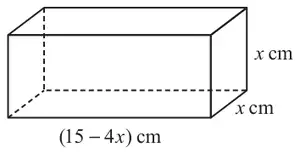
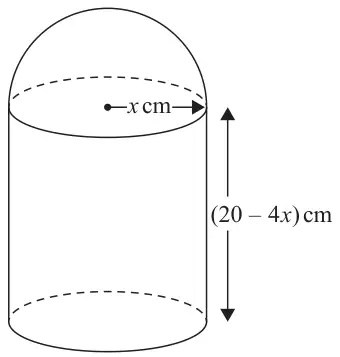
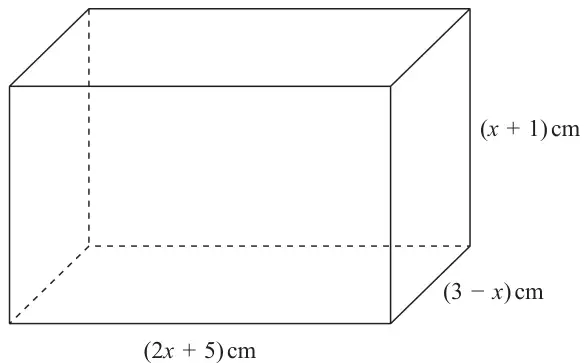
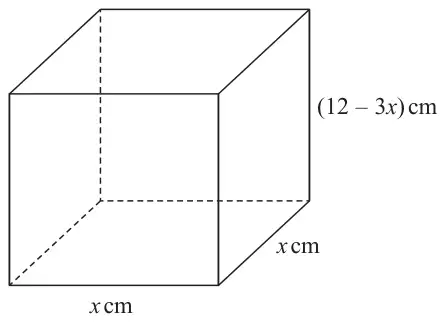
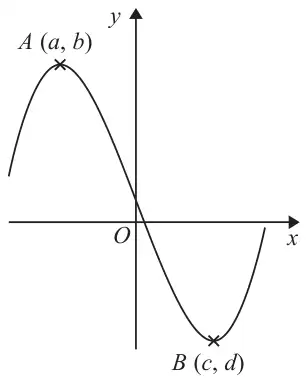
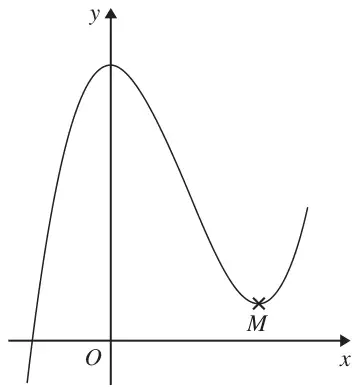
or \((V =)\;15(\text{``}{2.5}\text{''})^2 - 4(\text{``}{2.5}\text{''})^3\)
M1
Correct answer only scores full marks (unless from obviously incorrect working) Answer: 31.25
A1
(5)
(5 marks)
Notes
M1: for a correct expression for the volume (condone missing \(V = \ldots\))
M1ft: ft dep on a \(V\) of the form \(ax^3 + bx^2\) where \(a, b \ne 0\)
for a two-term derivative with at least one term correct for their \(V\)
eg \(15(2)x\) or \(30x\) or \(-3(4)x^2\) or \(-12x^2\)
M1ft: dep on previous M mark
for equating their 2-term first derivative to 0 and solving to get a value of \(x\) (the value of \(x\) obtained must be greater than 0 and must not be where their second derivative is equal to 0) or the correct value of \(x\)
M1: dep on M3 for a full and correct substitution of their value of \(x\)
M1: ft dep on M1 for a correct method to solve their 3 term quadratic equation (with at least 2 correct coefficients) using any correct method (if factorising, allow brackets which expanded give 2 out of 3 terms correct) (if using formula allow one sign error and some simplification – allow as far as \(\dfrac{-10 \pm \sqrt{100 - 96}}{24}\)) Derivative must be a 3 term quadratic for this M mark
NB Can be implied by answers of \((x =)-\dfrac{1}{2}\) and \((x =)-\dfrac{1}{3}\)
A1: oe dep on previous M1 Allow –0.33(333) or \(-0.\dot{3}\) for correct \(x\) values
M1: ft dep on previous M1 for substituting at least one \(x\) value into \(y\)
NB Can be implied by one correct value of \(y\)
A1: oe dep on M1 for correct coordinates \((-0.5, -0.25)\), \((-0.33, -0.25(9\ldots))\)
20 The curve with equation \(y = 2x^4 - 64x\) has a minimum point.
Find an equation of the tangent to the curve at the minimum point. Show clear algebraic working.
(4)
Mark scheme
Scheme
Marks
\(4 \times 2x^3\) or \(8x^3\) or \(\pm 64\)
M1
\(8x^3 - 64 = 0\) oe
M1
\(x = \sqrt[3]{\dfrac{64}{8}}\;(= 2)\)
M1
Working required Answer: \(y = -96\)
A1
(4)
(4 marks)
Notes
M1: for differentiating one term correctly
M1: dep on M1 The equation must be in the form \(ax^3 - 64 = 0\) oe where \(a \ne 0\) or \(8x^3 + b = 0\) oe where \(b \ne 0\) where \(a\) and \(b\) are constants
M1: dep on previous M1 for solving for \(x\). The equation must be in the form \(ax^3 - 64 = 0\) oe where \(a \ne 0\) or \(8x^3 + b = 0\) oe where \(b \ne 0\) where \(a\) and \(b\) are constants
A1: oe eg \(y + 96 = 0\) or \(y = 0x - 96\) or \(-y = 96\)
M1: for differentiation with at least 2 terms correct
M1ft: (dep on previous M1) for their \(\dfrac{\mathrm{d}y}{\mathrm{d}x} = 0\)
M1ft: (dep on 1st M1)
for the correct \(x\) value (of 6) – ignore other \(x\) value
OR
for solving their 3 term quadratic equation using any correct method
(if factorising, allow brackets which expanded give 2 out of 3 terms correct)
(if using formula allow one sign error and some simplification – allow as far as \(\dfrac{16 \pm \sqrt{256 + 144}}{6}\))
(if completing the square then as far as shown on LHS)
The award of this mark implies the previous M mark
M1ft: (dep on 1st M1) for \(x = 6\) substituted into correct equation for curve \(C\) OR (dep on 1st M1 and 2 values for \(x\)) for their greatest \(x\) value substituted into correct equation for curve \(C\) (ignore any attempt to substitute their least \(x\) value)
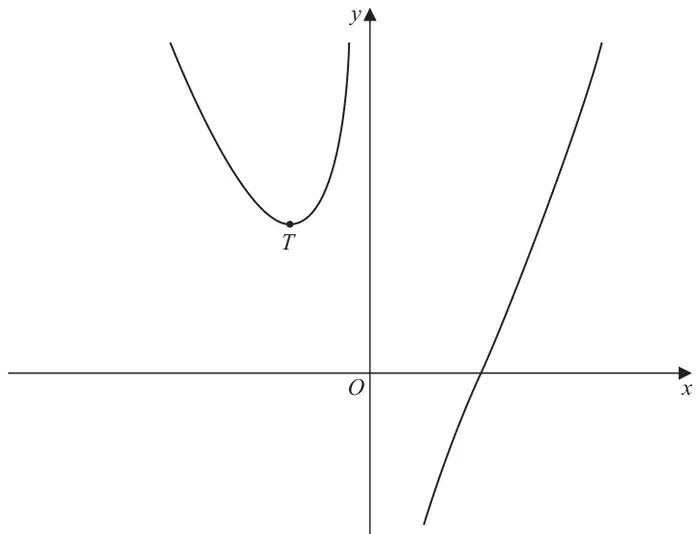
21 The curve T has equation \(\;y = x^3 - 2x^2 - 9x + 15\)
(a) Find \(\dfrac{\mathrm{d}y}{\mathrm{d}x}\) (2)
(b) Find the range of values of \(x\) for which T has a positive gradient. Give your values correct to 3 significant figures. Show your working clearly. (4)
Mark scheme (a)
Scheme
Marks
\(3x^2\) or \(-2 \times 2x\) or \(-4x\) or \(-9\) oe
M1
\(3x^2 - 4x - 9\)
A1
(2)
Notes
M1: for differentiating one term correctly
A1: for a correct expression Allow \(3x^2 - 2 \times 2x - 9\)
or \(3\left[\left(x - \dfrac{2}{3}\right)^2 - \left(\dfrac{2}{3}\right)^2\right] - 9\;(= 0)\)
M1
\(-1.19\) and 2.52
A1
\(x \lt -1.19\)
A1
\(x \gt 2.52\)
A1
(4)
(6 marks)
Notes
M1: for finding the critical values for a 3-term quadratic using any correct method - if using formula or completing the square allow one sign error and some simplification
– allow as far as eg \(\dfrac{4 \pm \sqrt{16 + 108}}{6}\) oe
or eg \(3\left(x - \dfrac{2}{3}\right)^2 - 10\dfrac{1}{3}\) oe)
A1: for critical values of \(-1.19\) and 2.52 or better
(for this A1 mark allow \(-1.2\) or \(-1.18\) and 2.5
M1: ft, for equating their \(\mathrm{d}y/\mathrm{d}x\) to 4
M1: (dep on M1) ft their \(\mathrm{d}y/\mathrm{d}x\) in the form \(ax^2 + bx\,(+ c)\)
M1: for solving their three-term quadratic equation using any correct method - if factorising, allow brackets which expanded give 2 out of 3 terms correct (if using formula or completing the square allow one sign error and some simplification – allow as far as eg \(\dfrac{-2 \pm \sqrt{4 + 1152}}{24}\) oe)
A1: (dep on M2) oe, allow 1.33(3...) for \(\dfrac{4}{3}\), both values – isw any attempt to find \(y\) coordinates
M1: for equating their \(8t \pm at^{-2}\) oe or \(bt \pm 125t^{-2}\) oe to zero and solving for \(t\) ie must have correct powers of \(t\) and at least one correct coefficient and correct isolation of \(t\)
M1: dep on previous M mark for substituting into \(s\)
M1: for differentiation of \(s\) with 2 out of 3 terms correct (can be implied by subsequent working)
M1: (dep on previous M1) for equating at least a 2TQ to zero (allow inequality signs), E.g. \(3t^2 - 8t = 0\) or \(3t^2 + 5 = 0\) (can be implied by subsequent working)
A1: for \(\dfrac{5}{3}\) (and \(t = 1\) may be crossed out or absent)
(allow \(\dfrac{5}{3}\) = 1.6(66666) to 2 sf truncated or rounded)
M1: for differentiation of \(x\) to find \(at + b = 0\) (allow inequality signs) where \(a = 2\) and \(b = -4\)
A1: for a correct value of \(t\)
A1: oe \((t \gt 1)\ t \lt \dfrac{5}{3}\) and \(t \gt 2\)
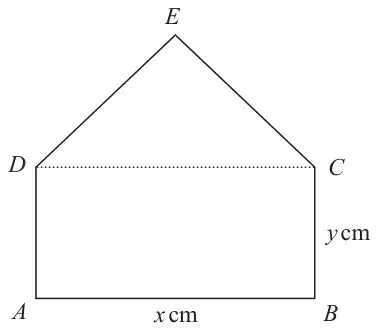
\(ABCD\) is a rectangle. \(CED\) is an equilateral triangle.
\(AB = x\) cm\(\qquad BC = y\) cm
The perimeter of \(ABCED\) is 100 cm. The area of \(ABCED\) is \(R\) cm2
(a) Show that \(R = \dfrac{x}{4}\left(200 - \left[6 - \sqrt{3}\right]x\right)\) (3)
(b)
(i) Find the value of \(x\) for which \(R\) has its maximum value. Give your answer in the form \(\dfrac{p}{q - \sqrt{3}}\) where \(p\) and \(q\) are integers. (2)
(ii) Explain why the maximum value of \(R\) is given by this value of \(x\). (1)
eg \(\dfrac{8}{27}k = 8\) or \(\dfrac{4}{3}k = 36\) or \(k = 27\) oe
M1
Working must be seen Answer: 36
A1
(5)
(5 marks)
Notes
M2: for both terms differentiated correctly (M1) for one term differentiated correctly
M1: ft dep on M1
M1: (not ft) for substituting \(x = \dfrac{2}{3}\) into their correct equation for \(k\) and getting as far as one step from the value of \(k\) or the correct value of \(k\)
Correct answer scores full marks (unless from obvious incorrect working)
Answer: \(\dfrac{194}{27}\)
A1
(5)
(5 marks)
Notes
M1: For at least 2 terms differentiated correctly
M1: Their \(v = 0\) dep on M1 could be implied by correct values
M1: dep on M1 for correct values for \(t\) or for \(t = \dfrac{2}{3}\)
or
correct method to solve their 3 term quadratic equation:
If factorising, allow brackets which when expanded give 2 out of 3 terms correct (If using formula or completing the square allow one sign error and some simplification – allow as far as eg \(\dfrac{-10 \pm \sqrt{100 + 96}}{6}\) oe
M1: ft, for equating their \(\mathrm{d}y/\mathrm{d}x\) to 2
M1: (dep on M1) ft their three-term quadratic
M1: for solving their quadratic equation using any correct method - if factorising, allow brackets which expanded give 2 out of 3 terms correct (if using formula or completing the square allow one sign error and some simplification – allow as far as e.g. \(\dfrac{2 \pm \sqrt{4 + 480}}{30}\) oe)
A1: oe, dep on M2 (allow −0.66 or better), Both values – isw any attempt to find \(y\) coordinates
23 A particle moves along a straight line. The fixed point \(O\) lies on this line. The displacement of the particle from \(O\) at time \(t\) seconds, \(t \geqslant 0\), is \(s\) metres where
\[s = t^3 + 4t^2 - 5t + 7\]
At time \(T\) seconds the velocity of \(P\) is \(V\) m/s where \(\;V \geqslant -5\)
Find an expression for \(T\) in terms of \(V\).
Give your expression in the form \(\;\dfrac{-4 + \sqrt{k + mV}}{3}\;\) where \(k\) and \(m\) are integers to be found.
(6)
Mark scheme
Scheme
Marks
(\(v\) =) \(3t^2 + 2 \times 4t - 5\)
M1
\(3T^2 + 8T - 5 = V\) OR \(3T^2 + 8T - 5 - V = 0\)
A1
\(3\left(T^2 + \dfrac{8}{3}T\right) - 5\)
OR \(3\left(T^2 + \dfrac{8}{3}T - \dfrac{5}{3}\right)\)or
M1: attempt to complete the square OR use quadratic formula (condone one sign error in \(a\), \(b\) or \(c\) and ft their quadratic with mistake in \(a\) or \(b\)) (condone + instead of ±)
M1: sight of this method mark implies the previous M1 (condone + instead of ±) (ft their quadratic with mistake in \(a\) or \(b\))
M1: (condone + instead of ±) (ft their quadratic with mistake in \(a\) or \(b\))
M1: for the correct differentiation of at least 2 correct terms from 16 or \(-2x\) or \((3 \times -2x^2)\)
A1: for a correct differentiated expression
M1: (dep on M1) for equating their differentiated expression to zero
M1: (dep on M1) for a complete method to solve their 3-term quadratic equation (allow one sign error and some simplification – allow as far as \(\dfrac{-2 \pm \sqrt{4 + 384}}{12}\))
A1: dep on M1 for answer in range 1.47 – 1.5 from correct working (Must reject −1.80 to −1.81 if calculated)
24 A particle \(P\) is moving along a straight line that passes through the fixed point \(O\). The displacement, \(s\) metres, of \(P\) from \(O\) at time \(t\) seconds is given by
\[s = t^3 - 6t^2 + 5t - 4\]
Find the value of \(t\) for which the acceleration of \(P\) is 3 m/s2
(4)
Mark scheme
Scheme
Marks
(\(v\) =) \(3t^2 - 6 \times 2t + 5\) (+ 0)
M1
(\(a\) =) \(3 \times 2t - 12\)
M1
\(6t - 12 = 3\)
M1
2.5 oe
A1
(4)
(4 marks)
Notes
M1: for differentiating at least 2 terms correctly
M1: dep ft
M1: dep on at least M1 for equating their acceleration in terms of \(t\) to 3
16 A particle \(P\) is moving along a straight line. The fixed point \(O\) lies on this line. At time \(t\) seconds, the displacement, \(s\) metres, of \(P\) from \(O\) is given by
\[s = 4t^3 - 6t^2 + 5t\]
At time \(t\) seconds, the velocity of \(P\) is \(v\) m/s.
(a) Find an expression for \(v\) in terms of \(t\). (2)
(b) Find the time at which the acceleration of the particle is 6 m/s2(3)
Mark scheme (a)
Scheme
Marks
\(3 \times 4t^2 - 2 \times 6t + 5\)
M1
\(12t^2 - 12t + 5\)
A1
(2)
Notes
M1: For 2 terms correct
A1: Fully correct
Mark scheme (b)
Scheme
Marks
\(24t - 12\)
M1
\(\text{``}{24t - 12}\text{''} = 6\)
M1
0.75
A1
(3)
(5 marks)
Notes
M1: Method to differentiate their \(v\), ft a 3 term quadratic expression from (a)
12 The curve \(C\) has equation \(y = \dfrac{1}{3}x^3 - 9x + 1\)
(a) Find \(\dfrac{\text{d}y}{\text{d}x}\) (2)
(b) Find the range of values of \(x\) for which \(C\) has a negative gradient. (3)
Mark scheme (a)
Scheme
Marks
\(3 \times \dfrac{1}{3}x^2 - 9\)
M1
\(x^2 - 9\) oe
A1
(2)
Notes
M1: for \(3 \times \dfrac{1}{3}x^2\) oe or −9 oe
A1: or for \(1x^2 - 9\) oe
Mark scheme (b)
Scheme
Marks
\(-3 \lt x \lt 3\) oe
B3
(3)
(5 marks)
Notes
B3: may be seen as two separate inequalities if not B3 then award B2 for \(x \lt 3\) or \(x \gt -3\) or \(-3 \leqslant x \leqslant 3\) if not B2 then award B1 for \(x^2 - 9 \lt 0\) or \(x^2 \lt 9\) oe or for \((x - 3)(x + 3)\) or for (\(x\) =) \(\pm 3\) (values maybe seen in incorrect inequalities) SC: If no marks awarded and M1 awarded in (a) then award B1 for “quadratic” < 0
M1: for either substituting \(x = 3\) or \(x = -3\) into the \(y\) expression. Only award this mark if \(k\) or a number representing \(k\) is in the expression for \(b\) or \(d\)
M1: dep on all previous M marks Expressions for \(b\) and \(d\) must have \(k\) or the same number representing \(k\)
M1: ft from “their (a)” (=0) for 3 term quadratic, for correct factorisation or correct use of quadratic formula to find the two critical values, allow 1 sign error. [−(−4) could be 4 and (−4)² could be 4²] (condone missing brackets)
M1: Both critical values correct Accept -1.66… rounded or truncated to 3SF.
17 The curve C has equation \(y = 2x^3 - 9x^2 + 7\)
(a) Find \(\dfrac{\mathrm{d}y}{\mathrm{d}x}\) (2)
The point \(P\) lies on the curve C.
The gradient at point \(P\) of the curve C is \(-\dfrac{27}{2}\)
(b) Find the coordinates of \(P\). Show clear algebraic working. (4)
Mark scheme (a)
Scheme
Marks
\(6x^2 - 18x\)
B2
(2)
Notes
B2: B1 for \(3 \times 2x^2\) (= \(6x^2\)) or \(-9 \times 2x\) (= \(-18x\))
Mark scheme (b)
Scheme
Marks
\(6x^2 - 18x = -\dfrac{27}{2}\) oe
M1
e.g. \((2x \pm 3)(2x \pm 3)\;(= 0)\) or correct substitution into quadratic formula (condone one sign error)
M1
\(x = 1.5\) oe
M1
(1.5, −6.5) oe
A1
(4)
Notes
M1: ft from (a)
M1: method to solve correct quadratic equation (terms may not all be ‘on the same side’) (\(12x^2 - 36x = -27\) or \(4x^2 - 12x + 9\) (=0) or \(6x^2 - 18x + 13.5\) (=0) oe) by factorising or correct substitution into formula
20 A curve has equation \(\;y = x^3 - 4x^2 + 5x + 4\)
(a) Find \(\dfrac{\mathrm{d}y}{\mathrm{d}x}\) (2)
(b) Find the \(x\) coordinates of the points where the curve with equation \(\;y = x^3 - 4x^2 + 5x + 4\;\) has a gradient of 1 Show clear algebraic working. (4)
Mark scheme (a)
Scheme
Marks
M1
\(3x^2 - 8x + 5\)
A1
(2)
Notes
M1: for any 2 of \(3x^2\) or \(-8x\) or \(+5\) differentiated correctly
Mark scheme (b)
Scheme
Marks
\(3x^2 - 8x + 5 = 1\)
M1
\(3x^2 - 8x + 4 = 0\)
M1
eg \((3x - 2)(x - 2) = 0\)
M1
\(\dfrac{2}{3}\) , 2
A1
(4)
(6 marks)
Notes
M1: ft from (a)
M1: ft rearrange ready to solve, ft as long as \(ax^2 - bx + c\)
M1: ft correct method to solve quadratic – if using formula, every term to be substituted correctly as long as \(ax^2 - bx + c\)
A1: cao dep on M2 Ignore any attempts to find y values
17 A particle moves along a straight line. The fixed point \(O\) lies on this line. The displacement of the particle from \(O\) at time \(t\) seconds is \(s\) metres where
\[s = 4t^2 - \frac{9}{t}\]
Find the velocity of the particle at time 5 seconds.
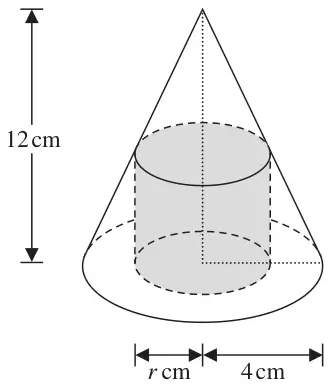
15 The diagram shows a cylinder inside a cone on a horizontal base. The cone and the cylinder have the same vertical axis. The base of the cylinder lies on the base of the cone. The circumference of the top face of the cylinder touches the curved surface of the cone.
Diagram NOT accurately drawn
The height of the cone is 12 cm and the radius of the base of the cone is 4 cm.
(a) Work out the curved surface area of the cone. Give your answer correct to 3 significant figures. (3)
The cylinder has radius \(r\) cm and volume \(V\) cm3
(b) Show that \(V = 12\pi r^2 - 3\pi r^3\) (3)
(c) \(V = 12\pi r^2 - 3\pi r^3\) Find the value of \(r\) for which \(V\) is a maximum. (4)
Mark scheme (a)
Scheme
Marks
\(l^2 = 12^2 + 4^2\)
M1
\(\pi \times 4 \times \sqrt{12^2 + 4^2}\) or \(\pi \times 4 \times \sqrt{160}\) or
\(\pi \times 4 \times 12.6(4911064\ldots)\) or \(50.56\pi\) or \(\dfrac{1264}{25}\pi\)
M1
159
A1
(3)
Notes
M1: For \(12^2 + 4^2\)
M1: For a correct expression of the curved surface area.
A1: Accept 158 – 159
Mark scheme (b)
Scheme
Marks
\(\dfrac{12 - h}{r} = \dfrac{12}{4}\) or \(4(12 - h) = 12r\) or \(\dfrac{h}{12} = \dfrac{4 - r}{4}\) or
\(4 : 12 = r : 12 - h\) oe
M1
\(h = \dfrac{12(4 - r)}{4}\) or \(h = 3(4 - r)\) or \(h = 12 - 3r\)
M1
\(V = 12\pi r^2 - 3\pi r^3\)
A1
(3)
Notes
M1: For \(\dfrac{h}{12} = \dfrac{r}{4}\) or \(4h = 12r\) or \(4 : 12 = r : h\) oe
M1: \(h = 3r\)
A1: Dep. For \((V =)\;\pi r^2(12 - 3r)\) Dep on M2 cso
Mark scheme (c)
Scheme
Marks
\(\dfrac{\mathrm{d}V}{\mathrm{d}r} = 24\pi r - 9\pi r^2\)
B2
\(24\pi r - 9\pi r^2 = 0\)
M1
\(2\tfrac{2}{3}\)
A1
(4)
Notes
B2: B1 for each term.
M1: ft their \(\dfrac{\mathrm{d}V}{\mathrm{d}r} = 0\)
The curve with equation \(y = x^3 + 6x^2 + 5\) has two turning points.
(b) Work out the coordinates of these two turning points. Show your working clearly. (4)
Mark scheme (a)
Scheme
Marks
\(3x^2 + 12x\)
B2
(2)
Notes
B2: B1 for \(3x^2\) or \(12x\)
Mark scheme (b)
Scheme
Marks
" \(3x^2 + 12x\) " = 0
M1
\(3x(x + 4) = 0\) or \(x(x + 4) = 0\) or \(x(3x + 12) = 0\) or correct use of the formula (all values correctly substituted) or completing the square (as far as \((3)((x + 2)^2 - 4) = 0\))
M1
\(x = 0\) and \(x = -4\)
A1
(0, 5) and (−4, 37)
A1
(4)
Notes
M1: ft
M1: ft as long as in the form of a quadratic equation.
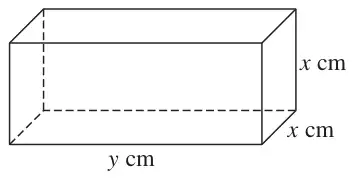
The diagram shows a cuboid of volume \(V\) cm3 The length of the cuboid is \(y\) cm The width and height of the cuboid are both \(x\) cm The total length of all the edges of the cuboid is 112 cm
(a) Show that \(V = 28x^2 - 2x^3\) (3)
(b) Find \(\dfrac{\mathrm{d}V}{\mathrm{d}x}\) (2)
(c) Find the maximum value of \(V\) Give your answer correct to 3 significant figures. (3)
(b) The point \(P\) lies on the curve with equation \(y = 2x^3 + 3x^2 + 2\) The gradient of the curve at \(P\) is \(-\dfrac{3}{2}\) Find the coordinates of \(P\). (5)
Mark scheme (a)
Scheme
Marks
\(6x^2 + 6x\)
B2
(2)
Notes
B2: Award B1 for any two terms differentiated correctly (remember \(\frac{\mathrm{d}}{\mathrm{d}x}(2) = 0\) is a term)
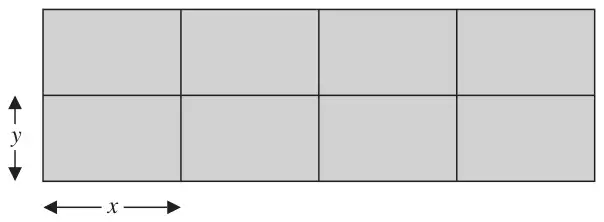
14 A farmer has 180 metres of fencing. With the 180 metres of fencing, he makes an enclosure divided into eight equal, rectangular pens. The fencing is used for the perimeter of each pen.
The length of each pen is \(x\) metres and the width of each pen is \(y\) metres.
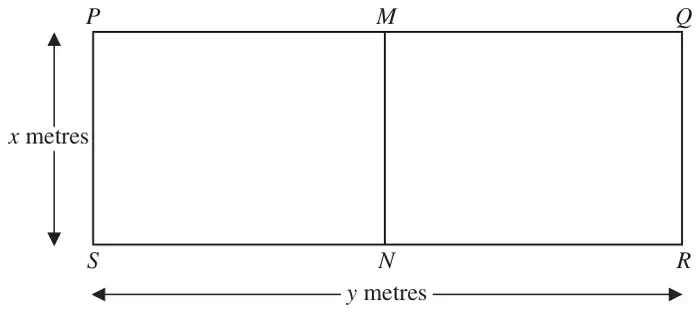
15 A farmer has 120 metres of fencing. He is going to make a rectangular enclosure \(PQRS\) with the fencing. He is also going to divide the enclosure into two equal parts by fencing along \(MN\).
The width of the enclosure is \(x\) metres. The length of the enclosure is \(y\) metres.
(a)
(i) Show that \(y = 60 - 1.5x\)
The area of the enclosure \(PQRS\) is \(A\) m2
(ii) Show that \(A = 60x - 1.5x^2\)
(3)
(b) Find \(\dfrac{\mathrm{d}A}{\mathrm{d}x}\) (2)
(c) Find the maximum value of \(A\). (3)
Mark scheme (a)
Scheme
Marks
(i) \(3x + 2y = 120\)
B1
\(2y = 120 - 3x\) or \(1.5x + y = 60\) Answer: \(y = 0.5(120 - 3x)\) *
B1
(ii) \(A = x \times y\) \(A = x \times (60 - 1.5x)\) Answer: \(A = 60x - 1.5x^2\) *
B1
(3)
Notes
B1: B1 dependent on first B1 * Answer given on question paper.
B1: * Answer given on question paper.
The mark scheme states that for this part the correct answer alone does not imply a correct method.
15 A particle moves along a straight line. The fixed point \(O\) lies on this line. The displacement of the particle from \(O\) at time \(t\) seconds is \(s\) metres, where \[s = t^3 - 6t + 3\]
(a) Find an expression for the velocity, \(v\) m/s, of the particle at time \(t\) seconds. (2)
(b) Find the acceleration of the particle at time 5 seconds. .................... m/s2(2)
Mark scheme (a)
Scheme
Marks
\(3t^2 - 6\)
B2
(2)
Notes
B2: for \(3t^2 - 6\) B1 for two of three terms differentiated correctly
19 A particle is moving in a straight line which passes through a fixed point \(O\). The displacement, \(s\) metres, of the particle from \(O\) at time \(t\) seconds is given by
\[s = 10 + 9t^2 - t^3\]
(a) Find an expression for the velocity, \(v\) m/s, of the particle at time \(t\) seconds. (2)
(b) Find the time at which the acceleration of the particle is zero. (2)
Mark scheme (a)
Scheme
Marks
\((v =)\ 18t - 3t^2\)
B2
(2)
Notes
B2: for \(18t - 3t^2\) oe seen as final answer B1 for \(18t\) or \(3t^2\) or \(-3t^2\)
Mark scheme (b)
Scheme
Marks
\((a =)\ \text{“}18 - 6t\text{”}\ (=0)\)
M1ft
\((t =)\ 3\)
A1ft
(2)
Notes
M1ft: ft if differentiating correctly a quadratic with 2 or 3 terms
(b) The curve with equation \(y = 8x^2 + \dfrac{2}{x}\) has one turning point. Find the coordinates of this turning point. Show your working clearly. (4)
(a) Complete the table of values for \(y = x^3 - 3x - 1\)
\(x\)
−2
−1
0
1
2
3
\(y\)
1
(2)
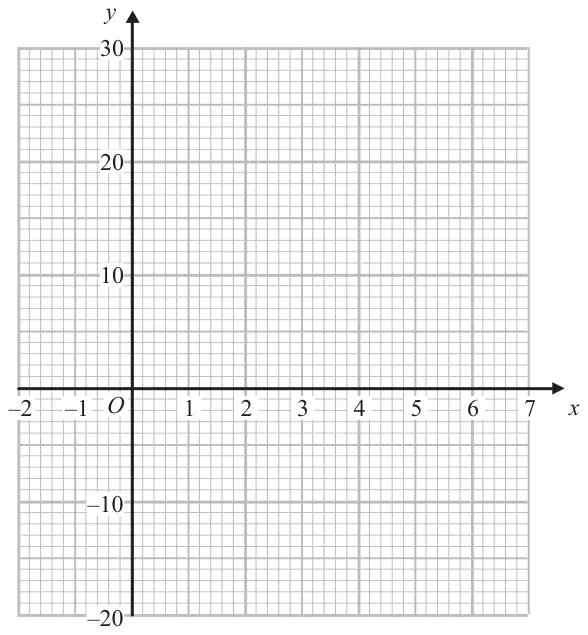
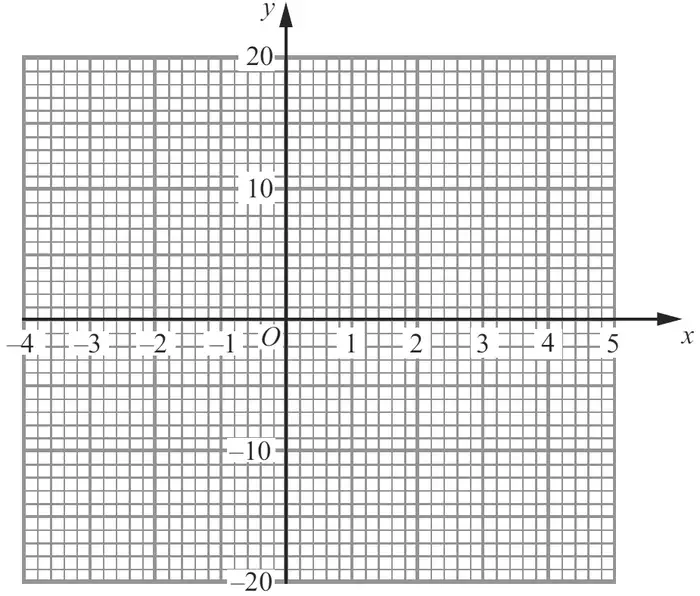
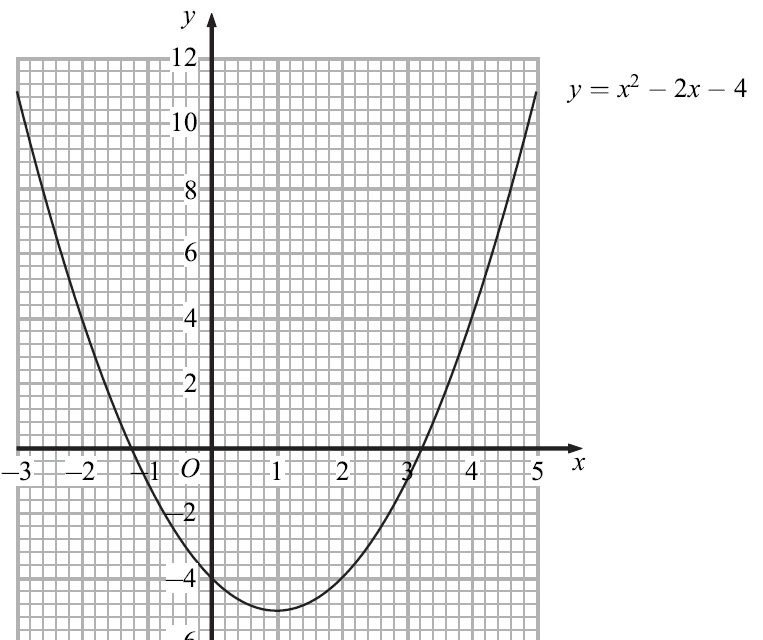
(b) On the grid, draw the graph of \(y = x^3 - 3x - 1\) for \(-2 \leqslant x \leqslant 3\)(2)
(c) By drawing a suitable straight line on the grid, find an estimate for the solution of the equation \(x^3 - 3x - 6 = 0\) Give your answer correct to 1 decimal place. (2)
(d) For the curve with equation \(y = x^3 - 3x - 1\)
(i) find \(\dfrac{\mathrm{d}y}{\mathrm{d}x}\)
(ii) find the gradient of the curve at the point where \(x = 4\)
(4)
Mark scheme (a)
Scheme
Marks
−3, (1), −1, −3, 1, 17
B2
(2)
Notes
B2: for all correct, B1 for 3 or 4 correct
Apart from questions 5, 7, 13c, 16b, 20, 21 and 22 (where the mark scheme states otherwise) the correct answer, unless clearly obtained by an incorrect method, should be taken to imply a correct method.
Mark scheme (b)
Scheme
Marks
All points plotted correctly from their table
B1
Curve
B1
(2)
Notes
B1: B1 ft if at least B1 scored in (a) Plotting tolerance ± ½ sq
B1: B1 ft if B1 scored from plotting points. Must be attempt at a smooth curve & not line segments
Mark scheme (c)
Scheme
Marks
Line segment at \(y = 5\) drawn
M1
2.2 → 2.5 inc
A1
(2)
Notes
M1: M1 for \(x^3 - 3x - 1 = 5\) stated or evidence of reading from \(y = 5\) or \(y\)=5 stated
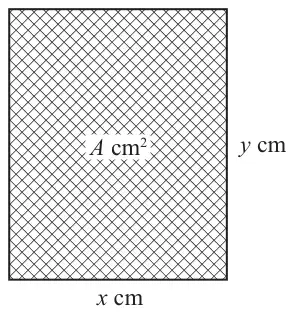
The diagram shows a rectangular photo frame of area \(A\) cm\(^2\). The width of the photo frame is \(x\) cm. The height of the photo frame is \(y\) cm. The perimeter of the photo frame is 72 cm.
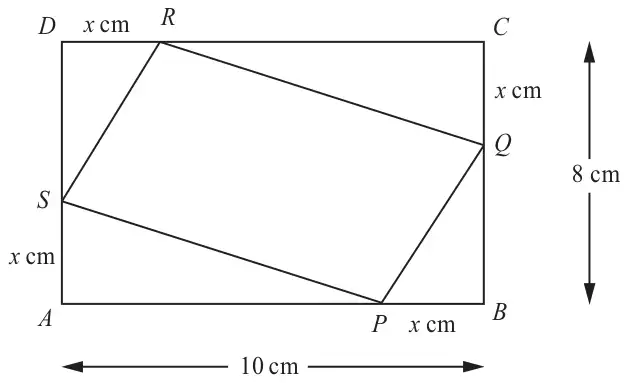
\(ABCD\) is a rectangle. \(AB\) = 10 cm. \(BC\) = 8 cm. \(P\), \(Q\), \(R\) and \(S\) are points on the sides of the rectangle. \(BP = CQ = DR = AS = x\) cm.
(a) Show that the area, \(A\) cm\(^2\), of the quadrilateral \(PQRS\) is given by the formula \[A = 2x^2 - 18x + 80\] (3)
(b) For \(A = 2x^2 - 18x + 80\)
(i) find \(\dfrac{\mathrm{d}A}{\mathrm{d}x}\),
(ii) find the value of \(x\) for which \(A\) is a minimum.
(iii) Explain how you know that \(A\) is a minimum for this value of \(x\).
(5)
Mark scheme (a)
Scheme
Marks
Use of areas to obtain a correct expression for \(A\), which must be correctly punctuated. For example
or \(80 - 2\left(\dfrac{10x - x^2}{2}\right) - 2\left(\dfrac{8x - x^2}{2}\right)\)
B2
Correct simplification of a correct expression for \(A\) to obtain an expression which is equivalent to \(2x^2 - 18x + 80\) For example \((A =)\ 80 - 10x + x^2 - 8x + x^2\) or \(80 - (10x - x^2) - (8x - x^2)\) or \(80 - (5x - \frac{1}{2}x^2) - (5x - \frac{1}{2}x^2) - (4x - \frac{1}{2}x^2) - (4x - \frac{1}{2}x^2)\)
B1
(3)
Notes
B2: B1 for expression for area of triangle or pair of congruent triangles, for example \(\frac{1}{2}x(10 - x)\) or \(\frac{1}{2}x(8 - x)\) or \(x(10 - x)\) or \(x(8 - x)\) Condone omission of brackets for award of B1
B1: dep on B2
Mark scheme (b)
Scheme
Marks
(i) \(4x - 18\)
B2
(ii) “\(4x - 18\)” = 0
M1
4.5 oe
A1
(iii) eg positive coefficient of \(x^2\) or U shape
or \(\dfrac{\mathrm{d}^2A}{\mathrm{d}x^2} = 4\) which > 0
(a) Complete the table of values for \(y = x^3 - 12x + 2\)
\(x\)
−3
−2
−1
0
1
2
3
4
\(y\)
11
−7
18
(2)
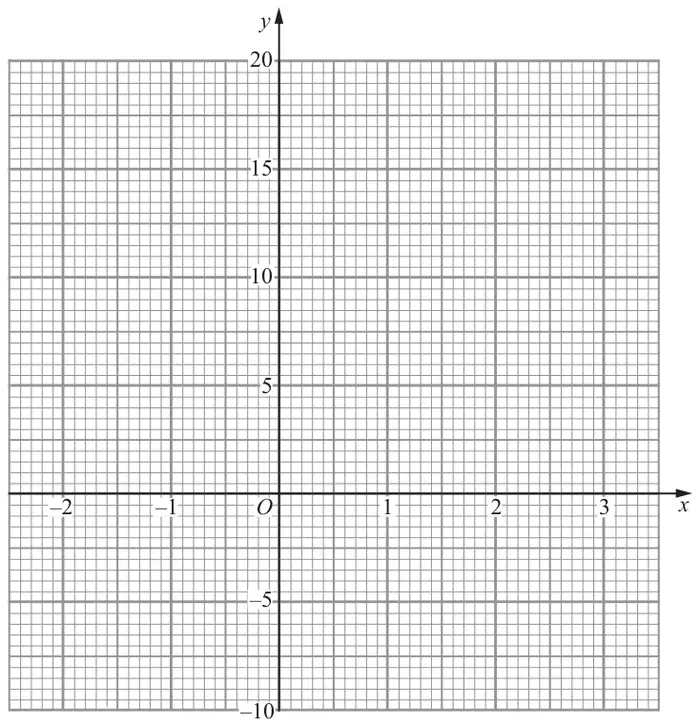
(b) On the grid, draw the graph of \(y = x^3 - 12x + 2\) for values of \(x\) from −3 to 4(2)
(c) For the curve with equation \(y = x^3 - 12x + 2\)
(i) find \(\dfrac{\mathrm{d}y}{\mathrm{d}x}\)
(ii) find the gradient of the curve at the point where \(x = 5\)
(4)
Mark scheme (a)
Scheme
Marks
18 13 2 −9 −14
B2
(2)
Notes
B2: for all correct B1 for 3 or 4 correct
Mark scheme (b)
Scheme
Marks
Points
B1
Curve
B1
(2)
Notes
B1: ± ½ sq ft from (a) if at least B1 in (a)
B1: ft if B1 awarded for points or if there is not more than one point incorrectly plotted and at least B1 scored in (a) Award for single curve (not line segments) which does not miss more than one plotted point by more than ½ square
Mark scheme (c)
Scheme
Marks
(i) Answer: \(3x^2 - 12\)
B2
(ii) \(3 \times 5^2 - 12\)
M1
63
A1
(4)
(8 marks)
Notes
B2: B2 for \(3x^2 - 12\) B1 for two of three terms differentiated correctly
M1: for substn \(x = 5\) in their (c)(i) if at least B1 scored in (c)(i)
19 A particle moves in a straight line through a fixed point \(O\). The displacement, \(s\) metres, of the particle from \(O\) at time \(t\) seconds is given by \[s = t^3 - 5t^2 + 8\]
(a) Find an expression for the velocity, \(v\) m/s, of the particle after \(t\) seconds. (2)
(b) Find the time at which the acceleration of the particle is 20 m/s2. (2)
Mark scheme (a)
Scheme
Marks
\(3t^2 - 10t\)
B2
(2)
Notes
B2: B1 for \(3t^2\) or \(-10t\) Ignore further differentiation seen in body or on answer line
Mark scheme (b)
Scheme
Marks
\(6t - 10 = 20\)
M1
5
A1
(2)
(4 marks)
Notes
M1: for linear expression including either \(6t\) or \(-10\)
19 A particle moves in a straight line through a fixed point \(O\). The displacement of the particle from \(O\) at time \(t\) seconds is \(s\) metres, where\[s = t^2 - 6t + 10\]
(a) Find \(\dfrac{\mathrm{d}s}{\mathrm{d}t}\) (2)
(b) Find the velocity of the particle when \(t = 5\) (2)
(c) Find the acceleration of the particle. (2)
Mark scheme (a)
Scheme
Marks
\(2t - 6\)
B1 B1
(2)
Mark scheme (b)
Scheme
Marks
\(2 \times 5 - 6\)
M1f
4
A1
(2)
Notes
M1f: Sub \(t = 5\) in “\(\mathrm{d}s/\mathrm{d}t\)” dep on linear f(\(t\)) M0 for \((2 \times 5 - 6)/5\)
17 A curve has equation \(y = x^2 + \dfrac{16}{x}\) The curve has one turning point. Find \(\dfrac{\mathrm{d}y}{\mathrm{d}x}\) and use your answer to find the coordinates of this turning point.
(a) For the equation \(y = 5000x - 625x^2\), find \(\dfrac{\mathrm{d}y}{\mathrm{d}x}\). (2)
(b) Find the coordinates of the turning point on the graph of \(y = 5000x - 625x^2\). (3)
(c)
(i) State whether this turning point is a maximum or a minimum.
(ii) Give a reason for your answer. (2)
(d) A publisher has to set the price for a new book. The profit, £\(y\), depends on the price of the book, £\(x\), where \[y = 5000x - 625x^2\]
(i) What price would you advise the publisher to set for the book?
(ii) Give a reason for your answer. (2)
Mark scheme (a)
Scheme
Marks
\(5000 - 1250x\)
B2
(2)
Notes
B2: B1 for 5000 B1 for \(-1250x\)
Mark scheme (b)
Scheme
Marks
\(5000 - 1250x = 0\)
M1
\(x = 4\)
M1
4 10 000
A1
(3)
Notes
M1: ft from a if at least B1 scored and a is linear
Mark scheme (c)
Scheme
Marks
(i) Answer: max
B1
(ii)
coeff of \(x^2 \lt 0\) or \(\dfrac{\mathrm{d}y}{\mathrm{d}x} \gt 0\) for \(x\) value \(\lt 4\) and \(\dfrac{\mathrm{d}y}{\mathrm{d}x} \lt 0\) for \(x\) value \(\gt 4\) or \(y \lt 10\,000\) for \(x\) value \(\lt 4\) and for \(x\) value \(\gt 4\) or \(\dfrac{\mathrm{d}^2y}{\mathrm{d}x^2} = -1250 \lt 0\)
B1
(2)
Notes
B1: independent
B1: Note: the printed scheme has \(\dfrac{\mathrm{d}y}{\mathrm{d}x} \gt 0\) for \(x\) value \(\gt 4\); corrected here to \(\lt 0\)
18 A particle moves along a line. For \(t \geqslant 1\), the distance of the particle from \(O\) at time \(t\) seconds is \(x\) metres, where \(x = \dfrac{20}{t}\)
Find an expression for the acceleration of the particle.
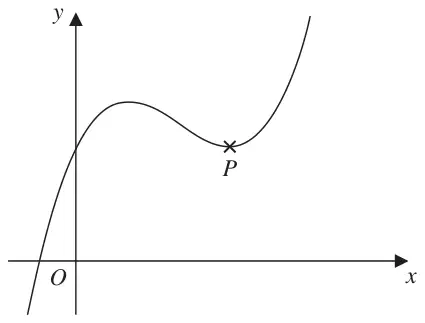
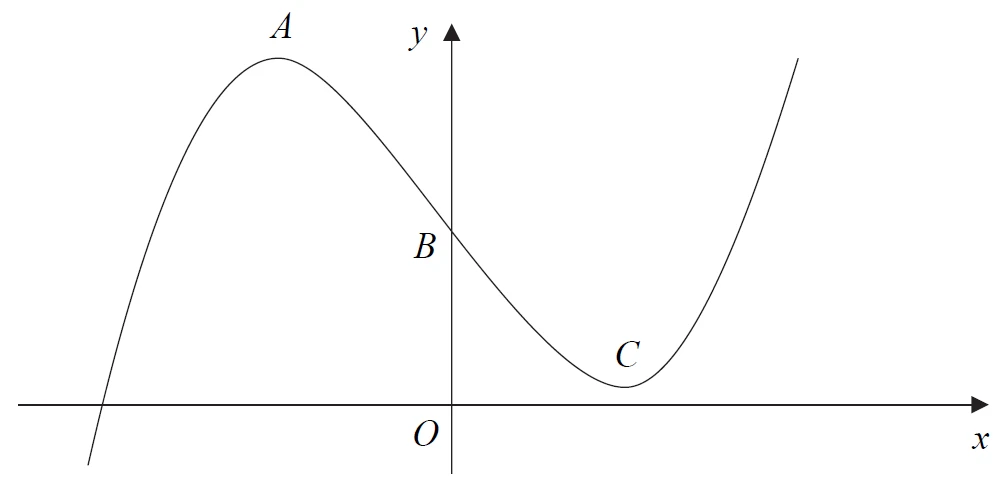
15 The diagram shows the graph of \(y = x^3 - 12x + 17\) \(A\) is the maximum point on the curve. \(C\) is the minimum point on the curve. The curve crosses the \(y\) axis at \(B\).
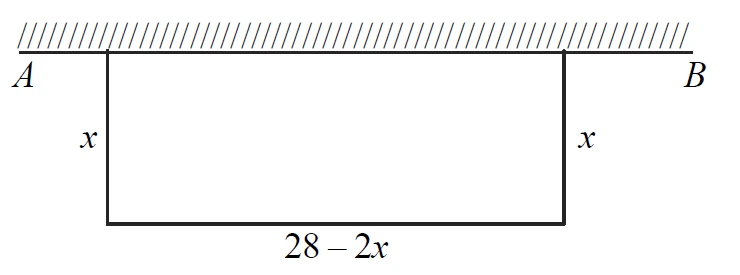
14 A farmer wants to make a rectangular pen for keeping sheep. He uses a wall, \(AB\), for one side. For the other three sides, he uses 28 m of fencing. He wants to make the area of the pen as large as possible.
Diagram NOT accurately drawn
The width of the pen is \(x\) metres. The length parallel to the wall is \((28 - 2x)\) metres.
(a) The area of the pen is \(y\) m². Show that \(y = 28x - 2x^2\). (1)
(b) For \(y = 28x - 2x^2\),
(i) find \(\dfrac{\mathrm{d}y}{\mathrm{d}x}\),
(ii) find the value of \(x\) for which \(y\) is a maximum.
(iii) Explain how you know that this value gives a maximum. (5)
(c) Find the largest possible area of the pen. (2)
Mark scheme (a)
Scheme
Marks
\(x(28 - 2x)\) seen
B1
(1)
Notes
B1: Brackets essential
Mark scheme (b)
Scheme
Marks
(i) \(28 - 4x\)
B1 B1
(ii) “\(28 - 4x\)” = 0
M1
\(x = 7\)
A1
(iii) negative coeff. of \(x^2\) or ∩ shape or \(\dfrac{\mathrm{d}^2y}{\mathrm{d}x^2} = -4\), which is negative
B1
(5)
Notes
B1B1: Ignore “\(y =\)”
B1: Not “the value is negative.” ft her \(28 - 4x\)
13 A body is moving in a straight line which passes through a fixed point \(O\). The displacement, \(s\) metres, of the body from \(O\) at time \(t\) seconds is given by
\[s = t^3 + 4t^2 - 5t\]
(a) Find an expression for the velocity, \(v\) m/s, at time \(t\) seconds. (2)
(b) Find the acceleration after 2 seconds. (2)
Mark scheme (a)
Scheme
Marks
\(3t^2 + 8t - 5\)
B2
(2)
Notes
B2: (B1 for 2 terms correct)
Mark scheme (b)
Scheme
Marks
\(6t + 8\)
M1
20
A1
(2)
(4 marks)
Notes
M1: for \(6t + 8\) or d(a)/d\(t\) if at least B1 scored
We'd like to use Google Analytics cookies to count visits and see which pages help most. They're optional, and the site works exactly the same either way. Privacy policy