Foundation June 2025 Paper 2R Q27
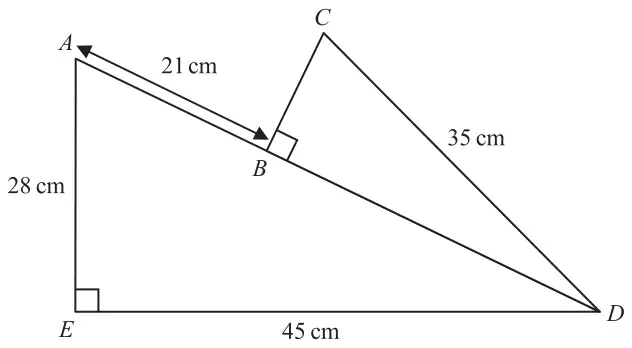
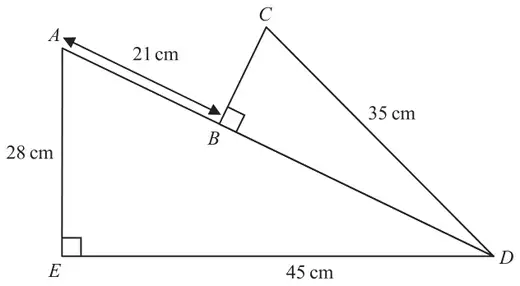
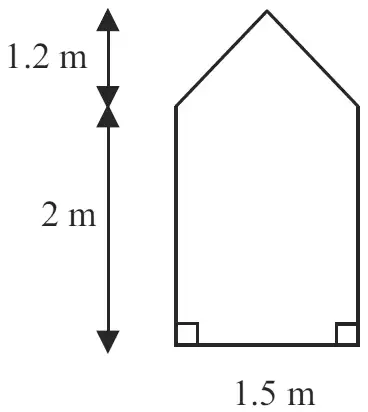
27 The diagram shows two triangles, \(ADE\) and \(CDB\)
Diagram NOT accurately drawn
\(ABD\) is a straight line.
\(AE = 28\) cm \(ED = 45\) cm \(AB = 21\) cm \(CD = 35\) cm
angle \(AED\) = angle \(CBD = 90^\circ\)
Work out the area of triangle \(CDB\)
(5)
Mark scheme
Mark scheme Scheme Marks \((AD^2 =)\;28^2 + 45^2\;(= 784 + 2025 = 2809)\)
or \((EDA =)\;\tan^{-1}\left(\dfrac{28}{45}\right)\;(= 31.8(9\ldots))\)
or \((EAD =)\;\tan^{-1}\left(\dfrac{45}{28}\right)\;(= 58.1(09\ldots))\)
M1 eg
\((AD =)\sqrt{28^2 + 45^2}\;\left(= \sqrt{784 + 2025} = \sqrt{2809} = 53\right)\) oe
or \((AD =)\;\dfrac{28}{\sin 31.8(9\ldots)}\;(= 53\ldots)\) or \((AD =)\;\dfrac{45}{\cos 31.8(9\ldots)}\;(= 53\ldots)\) oe
or \((AD =)\;\dfrac{45}{\sin 58.1\ldots}\;(= 53\ldots)\) or \((AD =)\;\dfrac{28}{\cos 58.1\ldots}\;(= 53\ldots)\) oe
M1 eg
\((BC =)\sqrt{35^2 - (\text{``}{53}\text{''} - 21)^2}\;\left(= \sqrt{1225 - 1024} = \sqrt{201} = 14.1(7\ldots)\right)\)
or \((BDC =)\;\cos^{-1}\left(\dfrac{\text{``}{53}\text{''} - 21}{35}\right)\;(= 23.8(9\ldots))\)
or \((BCD =)\;\sin^{-1}\left(\dfrac{\text{``}{53}\text{''} - 21}{35}\right)\;(= 66.1\ldots)\)
M1 eg
\(\dfrac{1}{2} \times \text{``}{14.1(7\ldots)}\text{''} \times (\text{``}{53}\text{''} - 21)\;(= 16\sqrt{201})\)
or \(\dfrac{1}{2} \times 35 \times (\text{``}{53}\text{''} - 21) \times \sin(\text{``}{23.8(9\ldots)}\text{''})\)
or \(\dfrac{1}{2} \times 35 \times \text{``}{14.1(7\ldots)}\text{''} \times \sin(\text{``}{66.1\ldots}\text{''})\)
M1 Correct answer scores full marks (unless from obvious incorrect working) A1 (5) (5 marks)
Notes M1: for a correct method to find \(AD^2\) or angle \(EDA\) or angle \(EAD\)
M1: for a correct method to find \(AD\)
M1: for correct method to find \(BC\) or angle \(BDC\) or angle \(BCD\)
M1: for a correct method to find the area of triangle \(CDB\)
A1: awrt 227
accept \(16\sqrt{201}\)
Foundation June 2025 Paper 1 Q26
26
Diagram NOT accurately drawn
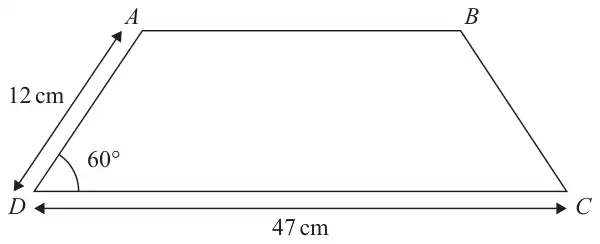
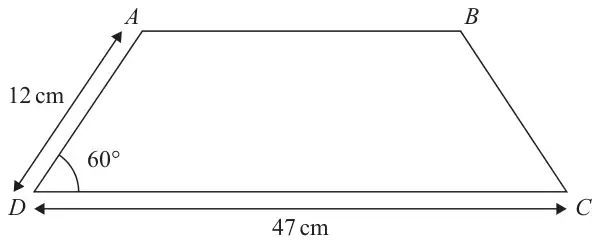
\(ABCD\) is a trapezium with one line of symmetry.
angle \(ADC = 60^\circ\) \(AD = 12\) cm \(DC = 47\) cm
Work out the area of the trapezium.
(5)
Mark scheme
Mark scheme Scheme Marks eg \(12\sin 60\left(= 6\sqrt{3} = 10.3(9\ldots)\right)\) or \(\sqrt{12^2 - \text{``}{6}\text{''}^2}\left(= 6\sqrt{3} = 10.3(9\ldots)\right)\)
or (Area \(ADC\) =) \(\dfrac{1}{2} \times 12 \times 47 \times \sin 60 \;(= 244.2\ldots)\)
M1 eg \(12\cos 60 (= 6)\) or \(\sqrt{12^2 - \left(\text{``}{6\sqrt{3}}\text{''}\right)^2}\;(= 6)\) M1 eg (\(AB\) =) 47 – “6” – “6” (= 35) M1 eg (Trapezium =) \(\dfrac{1}{2} \times \left(47 + \text{``}{35}\text{''}\right) \times \text{``}{10.3(9\ldots)}\text{''}\)
or (Rectangle + 2 × Triangle =) \(\text{``}{35}\text{''} \times \text{``}{10.3(9\ldots)}\text{''} + 2 \times \dfrac{1}{2} \times \text{``}{6}\text{''} \times \text{``}{10.3(9\ldots)}\text{''}\)
or (Rectangle + 2 × Triangle =) \(\text{``}{35}\text{''} \times \text{``}{10.3(9\ldots)}\text{''} + 2 \times \dfrac{1}{2} \times \text{``}{6}\text{''} \times 12 \times \sin 60\)
or (Triangle \(ADC\) + Triangle \(ABC\) =) \(\text{``}{244.2\ldots}\text{''} + \dfrac{1}{2} \times 12 \times \text{``}{35}\text{''} \times \sin 120\)
oe eg \(\left(47 - \text{``}{6}\text{''}\right) \times \text{``}{10.3(9\ldots)}\text{''}\)
M1 Working required A1 (5) (5 marks)
Notes M1: for a method find the height of the trapeziumor the area of triangle \(ADC\)
M1: (indep)
for a method find the base of the triangle, condone missing brackets around \(\text{``}{6\sqrt{3}}\text{''}\)
The first two M1 marks can be awarded in either order
M1: (dep on previous M1)
M1: for a complete method
A1: (dep on M1) allow 420 – 427 from correct working
Foundation June 2025 Paper 1 Q17
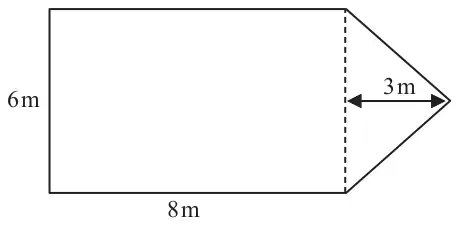
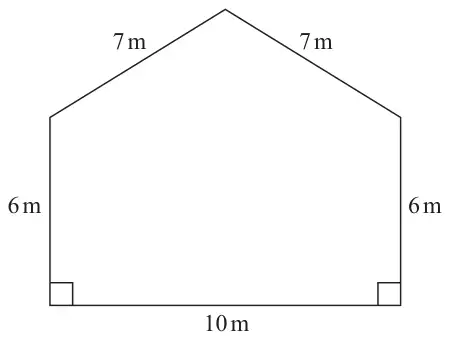
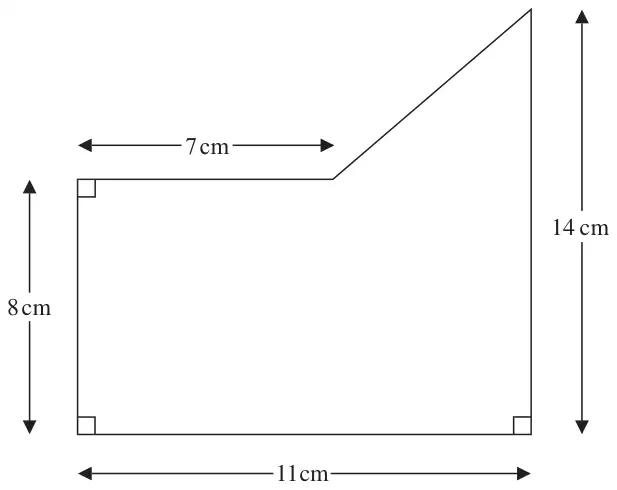
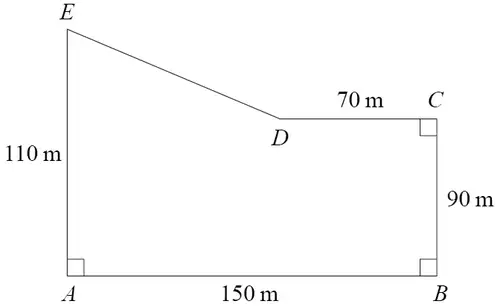
17 The diagram shows the plan of a stage.
The stage is made up of a rectangle and an isosceles triangle.
Diagram NOT accurately drawn
Yuko is going to cover the stage with varnish.
Each tin of varnish covers an area of 4 m2
Work out the smallest number of tins of varnish that Yuko needs to buy.
(4)
Mark scheme
Mark scheme Scheme Marks eg 6 × 8 (= 48) or \(\dfrac{1}{2} \times 6 \times 3\) (= 9) or \(\dfrac{1}{2} \times \dfrac{6}{2} \times 3\) (= 4.5)
or \(\dfrac{1}{2} \times (11 + 8) \times 3\) (= 28.5)
M1 eg “48” + “9” (= 57)or “48” + “4.5” + “4.5” (= 57)or “28.5” × 2 (= 57) or eg “48” ÷ 4 (= 12)or “9” ÷ 4 (= 2.25 or 3)or “4.5” ÷ 4 (= 1.125)or “28.5” ÷ 4 (= 7.125)
M1 eg “57” ÷ 4 (= 14.25)or their area ÷ 4and 66 ÷ 4 (= 16.5)or 15 × 4 (= 60)or using multiples of 4 for their areaand 17 × 4 (= 68) eg “12” + “2.25” (= 14.25)or “12” + “1.125” + “1.125” (= 14.25)or 2 × “7.125” (= 14.25)
M1 Working required A1 (4) (4 marks)
Notes M1: for a correct method to find one relevant area
M1: from this mark onwards follow either left hand column or right hand column left hand column for a complete method to find the total areaor right hand column a correct method to find the number of tins of paint for part of the stage
M1: left hand column (indep) for a method to find the number of tins for their area ft from any value that has come from a calculation that includes at least 2 of the given dimensionsor right hand column method to find the total number of tins of paint by adding number of tins from the parts of the stage
A1: dep on M2, must be from correct working
Foundation June 2025 Paper 2R Q16
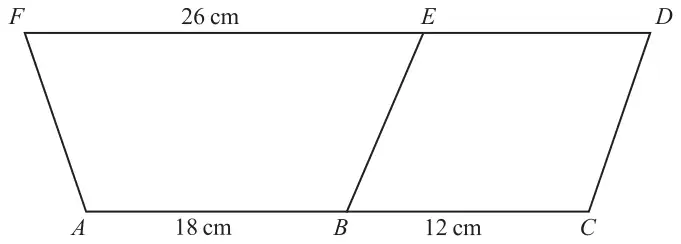
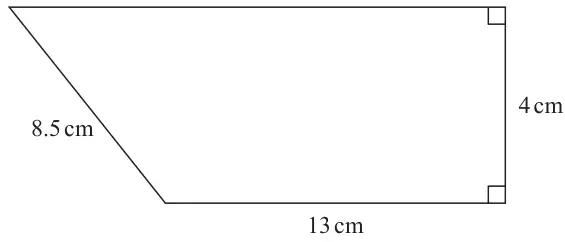
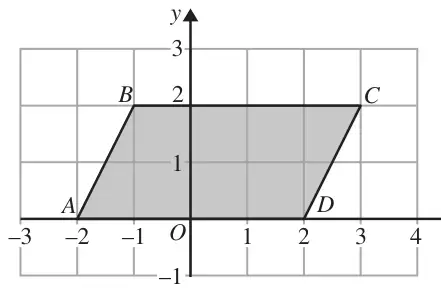
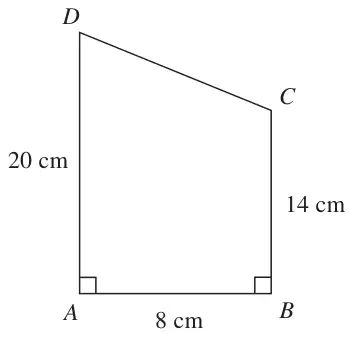
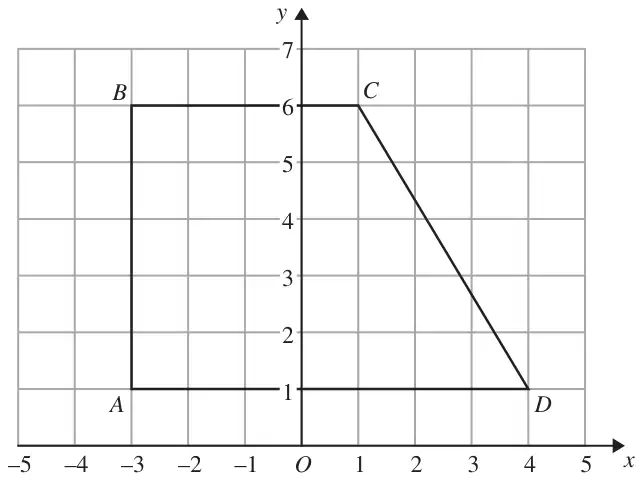
16 The diagram shows a quadrilateral \(ACDF\)
Diagram NOT accurately drawn
\(ABEF\) is a trapezium.
\[FE = 26\text{ cm} \qquad AB = 18\text{ cm} \qquad BC = 12\text{ cm}\]
The area of the parallelogram \(BCDE\) is 96 cm2
Work out the area of the trapezium \(ABEF\)
(3)
Mark scheme
Mark scheme Scheme Marks 96 ÷ 12 (= 8) M1 \(\dfrac{1}{2}(18 + 26) \times [8]\) M1 Correct answer scores full marks (unless from obvious incorrect working) A1 (3) (3 marks)
Notes M1: for a complete method to find the height of the parallelogram
M1: for a method to find the area of the trapezium (do not allow missing brackets unless recovered)
Foundation June 2025 Paper 1R Q14
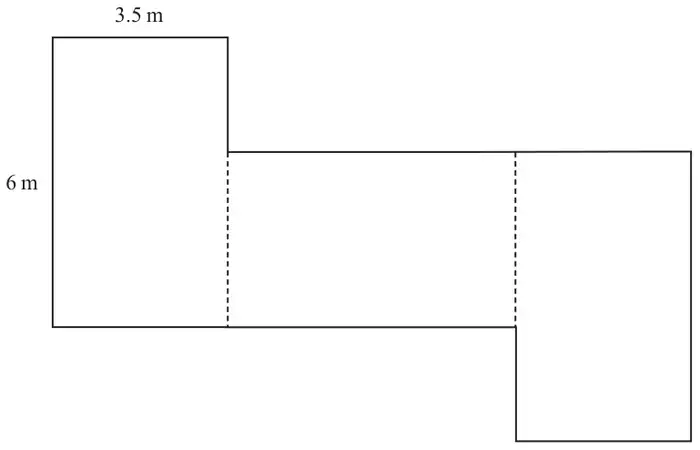
14 The diagram shows a plan of a garden made from three identical rectangles.
Diagram NOT accurately drawn
The length of each rectangle is 6 metres.
Jeremy puts a fence around the perimeter of the garden.
Work out how much Jeremy charges in total for the fence.
(4)
Mark scheme
Mark scheme Scheme Marks 6 – 3.5 (= 2.5)or or M1 4 × 6 + 4 × 3.5 + 2 × “2.5” (= 43) or M1 eg M1 Correct answer scores full marks (unless from obvious incorrect working) A1 (4) (4 marks)
Notes M1: for a method to find the ‘missing length’or or
M1: for a complete method to find the perimeter of the shape
M1: for a method to find the cost, allow use of their “43” as long as from adding at least 4 correct lengths including a length of 3.5 and a length of 6 eg 57 × 7.6(0) or 38 × 7.6(0)
Higher June 2025 Paper 2R Q11
11 The diagram shows two triangles, \(ADE\) and \(CDB\)
Diagram NOT accurately drawn
\(ABD\) is a straight line.
\(AE = 28\) cm \(ED = 45\) cm \(AB = 21\) cm \(CD = 35\) cm
angle \(AED\) = angle \(CBD = 90^\circ\)
Work out the area of triangle \(CDB\)
(5)
Mark scheme
Mark scheme Scheme Marks \((AD^2 =)\;28^2 + 45^2\;(= 784 + 2025 = 2809)\)
or \((EDA =)\;\tan^{-1}\left(\dfrac{28}{45}\right)\;(= 31.8(9\ldots))\)
or \((EAD =)\;\tan^{-1}\left(\dfrac{45}{28}\right)\;(= 58.1(09\ldots))\)
M1 eg
\((AD =)\sqrt{28^2 + 45^2}\;\left(= \sqrt{784 + 2025} = \sqrt{2809} = 53\right)\) oe
or \((AD =)\;\dfrac{28}{\sin 31.8(9\ldots)}\;(= 53\ldots)\) or \((AD =)\;\dfrac{45}{\cos 31.8(9\ldots)}\;(= 53\ldots)\) oe
or \((AD =)\;\dfrac{45}{\sin 58.1\ldots}\;(= 53\ldots)\) or \((AD =)\;\dfrac{28}{\cos 58.1\ldots}\;(= 53\ldots)\) oe
M1 eg
\((BC =)\sqrt{35^2 - (\text{``}{53}\text{''} - 21)^2}\;\left(= \sqrt{1225 - 1024} = \sqrt{201} = 14.1(7\ldots)\right)\)
or \((BDC =)\;\cos^{-1}\left(\dfrac{\text{``}{53}\text{''} - 21}{35}\right)\;(= 23.8(9\ldots))\)
or \((BCD =)\;\sin^{-1}\left(\dfrac{\text{``}{53}\text{''} - 21}{35}\right)\;(= 66.1\ldots)\)
M1 eg
\(\dfrac{1}{2} \times \text{``}{14.1(7\ldots)}\text{''} \times (\text{``}{53}\text{''} - 21)\;(= 16\sqrt{201})\)
or \(\dfrac{1}{2} \times 35 \times (\text{``}{53}\text{''} - 21) \times \sin(\text{``}{23.8(9\ldots)}\text{''})\)
or \(\dfrac{1}{2} \times 35 \times \text{``}{14.1(7\ldots)}\text{''} \times \sin(\text{``}{66.1\ldots}\text{''})\)
M1 Correct answer scores full marks (unless from obvious incorrect working) A1 (5) (5 marks)
Notes M1: for a correct method to find \(AD^2\) or angle \(EDA\) or angle \(EAD\)
M1: for a correct method to find \(AD\)
M1: for correct method to find \(BC\) or angle \(BDC\) or angle \(BCD\)
M1: for a correct method to find the area of triangle \(CDB\)
A1: awrt 227
accept \(16\sqrt{201}\)
Higher June 2025 Paper 1 Q9
9
Diagram NOT accurately drawn
\(ABCD\) is a trapezium with one line of symmetry.
angle \(ADC = 60^\circ\) \(AD = 12\) cm \(DC = 47\) cm
Work out the area of the trapezium.
(5)
Mark scheme
Mark scheme Scheme Marks eg \(12\sin 60\left(= 6\sqrt{3} = 10.3(9\ldots)\right)\) or \(\sqrt{12^2 - \text{``}{6}\text{''}^2}\left(= 6\sqrt{3} = 10.3(9\ldots)\right)\)
or (Area \(ADC\) =) \(\dfrac{1}{2} \times 12 \times 47 \times \sin 60 \;(= 244.2\ldots)\)
M1 eg \(12\cos 60 (= 6)\) or \(\sqrt{12^2 - \left(\text{``}{6\sqrt{3}}\text{''}\right)^2}\;(= 6)\) M1 eg (\(AB\) =) 47 – “6” – “6” (= 35) M1 eg (Trapezium =) \(\dfrac{1}{2} \times \left(47 + \text{``}{35}\text{''}\right) \times \text{``}{10.3(9\ldots)}\text{''}\)
or (Rectangle + 2 × Triangle =) \(\text{``}{35}\text{''} \times \text{``}{10.3(9\ldots)}\text{''} + 2 \times \dfrac{1}{2} \times \text{``}{6}\text{''} \times \text{``}{10.3(9\ldots)}\text{''}\)
or (Rectangle + 2 × Triangle =) \(\text{``}{35}\text{''} \times \text{``}{10.3(9\ldots)}\text{''} + 2 \times \dfrac{1}{2} \times \text{``}{6}\text{''} \times 12 \times \sin 60\)
or (Triangle \(ADC\) + Triangle \(ABC\) =) \(\text{``}{244.2\ldots}\text{''} + \dfrac{1}{2} \times 12 \times \text{``}{35}\text{''} \times \sin 120\)
oe eg \(\left(47 - \text{``}{6}\text{''}\right) \times \text{``}{10.3(9\ldots)}\text{''}\)
M1 Working required A1 (5) (5 marks)
Notes M1: for a method find the height of the trapeziumor the area of triangle \(ADC\)
M1: (indep)
for a method find the base of the triangle, condone missing brackets around \(\text{``}{6\sqrt{3}}\text{''}\)
The first two M1 marks can be awarded in either order
M1: (dep on previous M1)
M1: for a complete method
A1: (dep on M1) allow 420 – 427 from correct working
Higher November 2024 Paper 2 Q25
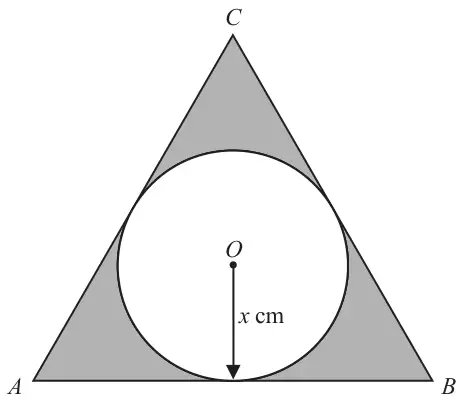
25 The diagram shows an equilateral triangle \(ABC\) and a circle with centre \(O\)
Diagram NOT accurately drawn
\(AB\), \(BC\) and \(CA\) are tangents to the circle.
The total area, in cm², of the regions shown shaded in the diagram is \(nx^2\)
Find the value of \(n\)
(5)
Mark scheme Mark scheme (using a value for the radius)
Mark scheme Scheme Marks eg \(\tan 30 = \dfrac{x}{0.5AB}\) or \(\tan 60 = \dfrac{0.5AB}{x}\) oe or
\(0.5AB = \dfrac{x}{\tan 30}\) or \(0.5AB = x\tan 60\) oe or \(\dfrac{1}{2}AB = \sqrt{3}x\)
M1 eg \((AB =)\;2x\tan 60\) or \(\dfrac{2x}{\tan 30}\) or \(2\sqrt{3}x\) or \(3.46..x\) oe
OR
area small triangle \(\left(\dfrac{1}{6}\textit{shape}\right) = \dfrac{1}{2} \times x\tan 60 \times x\) or \(\dfrac{1}{2} \times \sqrt{3}x \times x\) or \(\dfrac{\sqrt{3}}{2}x^2\)
M1 eg \(6 \times \dfrac{1}{2} \times x\tan 60 \times x\) or \(\dfrac{1}{2} \times (2x\tan 60)^2 \times \sin 60\) or \(\dfrac{1}{2}\left(\dfrac{2x}{\tan 30}\right)^2 \sin 60\)
or \(\dfrac{1}{2} \times 2\sqrt{3}x \times \sqrt{\left(2\sqrt{3}x\right)^2 - \left(\sqrt{3}x\right)^2}\) or \(0.5 \times 2\sqrt{3}x \times 3x\) or \(3\sqrt{3}x^2\) or \(5.19\ldots x^2\)
M1 \(6 \times \dfrac{\sqrt{3}}{2}x^2 - \pi x^2\) or \(3\sqrt{3}x^2 - \pi x^2\) or \(\text{``}{5.19\ldots}\text{''}x^2 - \pi x^2\)
or \(6 \times \dfrac{1}{2} \times \tan 60 \times x^2 - \pi x^2\) or \(\dfrac{1}{2}\left(\dfrac{2x}{\tan 30}\right)^2 \sin 60 - \pi x^2\) oe
M1 Correct answer scores full marks (unless from obvious incorrect working) Look for values written on the diagram A1 (5) (5 marks)
Notes M1: (off spec but a student who knows without calc that height of triangle = \(3x\): \(\tan 60 = \dfrac{3x}{0.5AB}\) or \(\sin 60 = \dfrac{3x}{BC}\) )
M1: Expression for side of triangle (\(AB\) or \(BC\) or \(AC\))OR
M1: a correct expression for the area of triangle \(ABC\)
M1: a correct expression for the area of the shaded parts of the diagram or a correct equation for the shaded parts of the diagram
A1: 2.05 – 2.06
Mark scheme (using a value for the radius) Scheme Marks eg \(\tan 30 = \dfrac{100}{0.5AB}\) or \(\tan 60 = \dfrac{0.5AB}{100}\) oe or
\(0.5AB = \dfrac{100}{\tan 30}\) or \(0.5AB = 100\tan 60\) oe or
\(\dfrac{1}{2}AB = \sqrt{3} \times 100\)
M1 eg \((AB =)\;200\tan 60\) or \(\dfrac{200}{\tan 30}\) or \(200\sqrt{3}x\) or \(346\ldots x\) )
or
area small triangle \(\left(\dfrac{1}{6}\textit{shape}\right) = \dfrac{1}{2} \times \text{``}{173\ldots}\text{''} \times 100\;(= 8660\ldots)\)
M1 eg \(\dfrac{1}{2} \times 200\sqrt{3} \times 200\sqrt{3} \times \sin 60\;(= 51961.52\ldots)\) or
or
\(6 \times \dfrac{1}{2} \times \text{``}{173\ldots}\text{''} \times 100\;(= 6 \times \text{``}{8660\ldots}\text{''} = 51961.52\ldots)\)
M1 eg \(\text{``}{51961.52}\text{''} - \pi \times 100^2 = 100^2 n\) M1 Correct answer scores full marks (unless from obvious incorrect working) A1
Notes M1: eg using radius = 100 ANY VALUE CAN BE USED CONSISTENTLY FOR AWARD OF MARKS
M1: Expression for side of triangle
M1: a correct expression for the area of the triangle
M1: a correct equation for the area of the shaded parts of the diagram.
A1: 2.05 – 2.06
Foundation November 2024 Paper 2 Q14
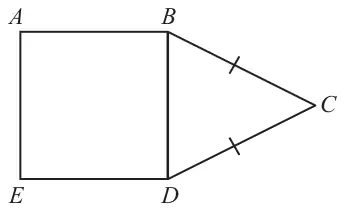
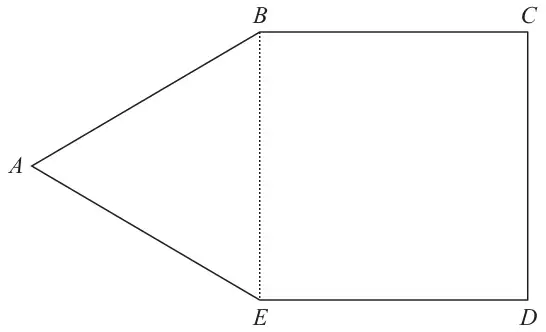
14 The diagram shows a shape \(ABCDE\) made from a square \(ABDE\) and an isosceles triangle \(BCD\)
Diagram NOT accurately drawn
\(BC = DC\)
The area of square \(ABDE\) is 49 cm2
Work out the perimeter of \(ABCDE\)
(3)
Mark scheme
Mark scheme Scheme Marks (side of square =) \(\sqrt{49}\;(= 7)\)
7 could also be seen as part of a calculation eg 7 + 7 + 7…..
M1 Other side of triangle = (27 – “7”) ÷ 2 (= 10) or M1 Correct answer scores full marks (unless from obvious incorrect working) A1 (3) (3 marks)
Notes M1: could be on the diagram
M1: dep on M1
but we will allow
use of their side of square when assuming 49 is the perimeter
eg \(\dfrac{27 - 12.25}{2}\;(= 7.375)\) or
27 – 12.25 (= 14.75)
Foundation November 2024 Paper 1 Q13
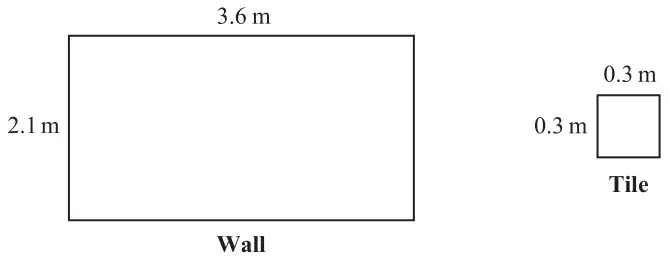
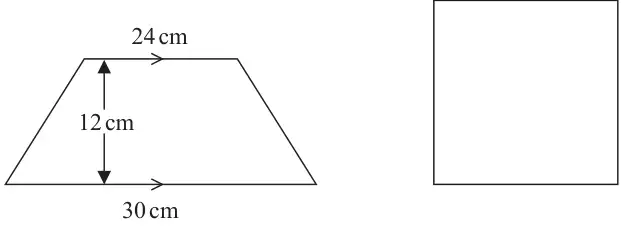
13 The diagram shows a rectangular wall and a square tile.
Diagram NOT accurately drawn
Hamish wants to cover all the wall with tiles.
The tiles are sold in boxes.
Work out the total cost of the tiles Hamish needs.
(4)
Mark scheme
Mark scheme Scheme Marks 3.6 × 2.1 (= 7.56) or M1 “7.56” ÷ “0.09” (= 84) or M1 “84” ÷ 6 × 17.5(0) oe M1 Correct answer scores full marks (unless from obvious incorrect working) A1 (4) (4 marks)
Notes M1: for a complete method
Foundation June 2024 Paper 2R Q26
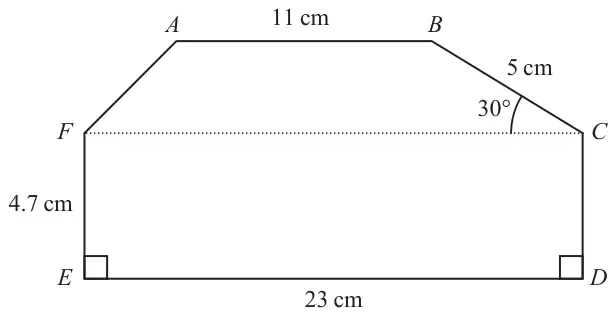
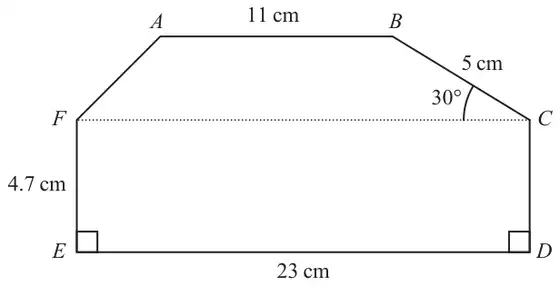
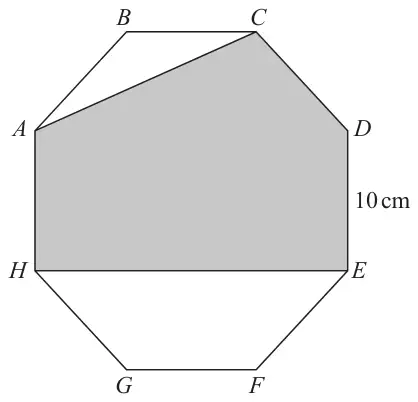
26 The diagram shows a hexagon \(ABCDEF\)
Diagram NOT accurately drawn
Angle \(BCF = 30°\)
Calculate the area of \(ABCDEF\)
(5)
Mark scheme
Mark scheme Scheme Marks \(23 \times 4.7\) (= 108.1) oe B1 \(\sin 30 = \dfrac{(x)}{5}\) or \(\dfrac{(x)}{\sin 30} = \dfrac{5}{\sin 90}\) oe
where \(x\) = height of trapezium
or \(5\cos30\) \(\left(= \dfrac{5\sqrt3}{2} = 4.33...\right)\) and (\(x^2 =\)) \(5^2 - \text{``}{5\cos30}\text{''}^2\) (= 6.25)
M1 (\(x =\)) \(5 \sin 30\) (= 2.5) oe or (\(x =\)) \(\dfrac{5}{\sin 90} \times \sin 30\) (= 2.5) oe
or (\(x =\)) \(\sqrt{5^2 - \text{``}{5\cos30}\text{''}^2}\) (= 2.5)
M1 \(\tfrac12\times(11+23)\times\text{``}{2.5}\text{''}\) (= 42.5) oe
or \(\left(\tfrac12\times\text{``}{2.5}\text{''}\times(23-11)\right) + (11\times\text{``}{2.5}\text{''})\) (= 42.5) oe
or \(\left(\tfrac12\times\text{``}{2.5}\text{''}\times(23-11-\text{``}{4.3}\text{''})\right) + (11\times\text{``}{2.5}\text{''}) + \left(\tfrac12\times\text{``}{2.5}\text{''}\times\text{``}{4.3}\text{''}\right)\) (= 42.5) oe
or \((11\times\text{``}{2.5}\text{''}) + \left(\tfrac12\times5\times(23-11)\times\sin 30\right)\) (= 42.5) oe
or \((23\times\text{``}{2.5}\text{''}) - \left(\tfrac12\times\text{``}{2.5}\text{''}\times(23-11-\text{``}{4.3}\text{''})\right) - \left(\tfrac12\times\text{``}{2.5}\text{''}\times\text{``}{4.3}\text{''}\right)\) (= 42.5) oe
or \((23\times(\text{``}{2.5}\text{''}+4.7)) - \left(\tfrac12\times\text{``}{2.5}\text{''}\times(23-11-\text{``}{4.3}\text{''})\right) - \left(\tfrac12\times\text{``}{2.5}\text{''}\times\text{``}{4.3}\text{''}\right)\) oe
M1 Working required A1 (5) (5 marks)
Notes B1: (indep) May be embedded in \(23 \times (4.7 + 2.5)\) (= 165.6)
M1: for a correct method to find the area of the trapezium or the whole shape
A1: dep on M1
awrt 150.6
Allow 151
Accept \(\dfrac{753}{5}\)
Foundation June 2024 Paper 2 Q23
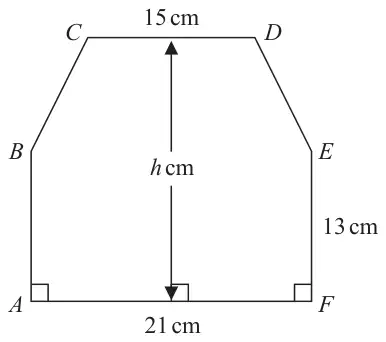
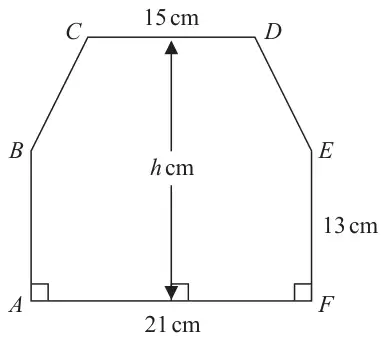
23 The diagram shows a 6-sided shape \(ABCDEF\)
Diagram NOT accurately drawn
\(AF = 21\) cm \(\qquad CD = 15\) cm \(\qquad AB = FE = 13\) cm
The perpendicular height of the shape is \(h\) cm
The area of the shape is 390 cm²
Work out the value of \(h\)
(4)
Mark scheme
Mark scheme Scheme Marks eg 13 × 21 (=273) or 21 × \(h\) (= 21\(h\))or 0.5(15 + 21) × \(y\) oe or 15(\(h\) – 13) or 2 ×½(3(\(h\) – 13))or ½(13 + \(h\)) ×3 (= 19.5 + 1.5\(h\)) or 15 × \(h\) (= 15\(h\)) M1 eg 390 – “273” (= 117) or 13 × 21 and 0.5(15 + 21)(\(h\) – 13) oeor and 0.5(15 + 21)\(y\) oeor and 2 ×½(3(\(h\) – 13)) oeor and 15(\(h\) – 13) and 2 ×½(3(\(h\) – 13)) oeor and 15 × \(h\) M1 “117” ÷ (0.5 × (15 + 21))(= 6.5)or or or or Typical equations here simplify to : M1 Correct answer scores full marks (unless from obvious incorrect working) A1oe (4) (4 marks)
Notes M1: A correct calculation for an area linked to the shape. (\(h\) – 13) might be written as \(x\) or \(y\) etc: this is acceptable (even allow \(h\))
M1: For considering the area of all parts of the shape (parts need not be added or subtracted for the whole shape)
M1: A correct calculation to find height of trapezium or height of shape or a correct equation involving height of trapezium or height of shape
A1oe: eg \(\dfrac{39}{2}\)
Foundation June 2024 Paper 1R Q23
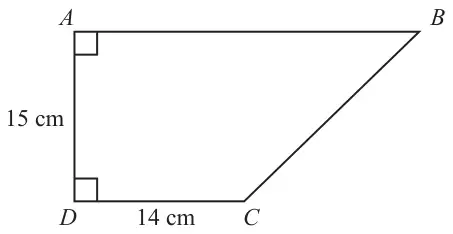
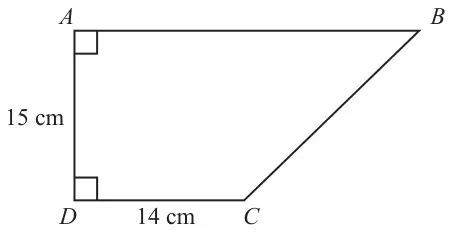
23 The diagram shows a trapezium, \(ABCD\)
Diagram NOT accurately drawn
\(DAB\) and \(ADC\) are right angles.
\(AD = 15\) cm \(\qquad DC = 14\) cm
The area of the trapezium is 360 cm²
Work out the perimeter of the trapezium.
(6)
Mark scheme
Mark scheme Scheme Marks \(\dfrac{14 + AB}{2} \times 15 = 360\) oe
or \(360 - 14 \times 15\ (= 150)\) oe
M1 \(AB = 34\) or \(MB = 20\) (where \(M\) is point on \(AB\) such that \(MC\) is perpendicular to \(AB\)) A1 \((CB^2 =)\ 15^2 + 20^2\ (= 625)\)or \((CB^2 =)\ 15^2 + MB^2\) M1 \((CB =)\ \sqrt{15^2 + 20^2}\ (= 25)\)
or \((CB =)\ \sqrt{15^2 + MB^2}\)
M1 14 + 15 + “34” + “25” oeor 14 + 15 + 14 + \(MB\) + \(CB\) oe M1ft Correct answer scores full marks (unless from obvious incorrect working) A1 (6) (6 marks)
Notes M1: for setting up an equation using the area of the trapezium or method to find the area of the triangle
A1: could be seen on diagram
M1: allow use of their \(MB\)
M1: allow use of their \(MB\)
M1ft: (dep on previous two M marks) for a method to find the perimeter of the trapezium, allow use of their \(MB\) and \(CB\)
A1: cao
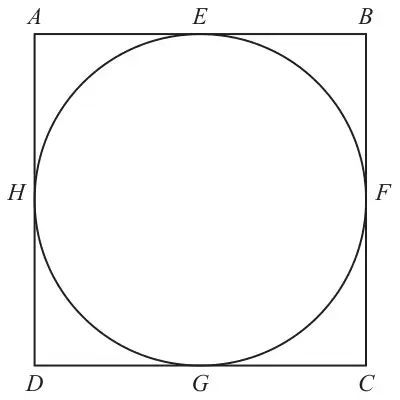
Foundation June 2024 Paper 2R Q21
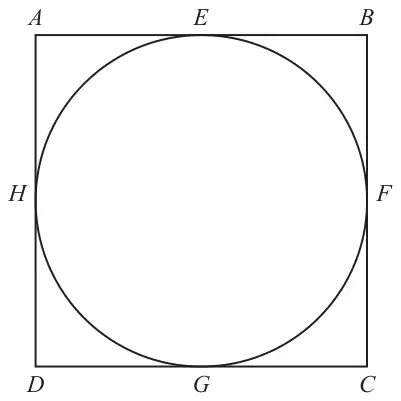
21 The diagram shows the design for a badge, which will be made using wire.
Diagram NOT accurately drawn
The circle touches the square at the points \(E\), \(F\), \(G\) and \(H\)
The area of the square is 81 cm²
Calculate the total length of wire that will be needed to make the square and the circle.
(4)
Mark scheme
Mark scheme Scheme Marks \(\sqrt{81}\) (= 9) or 9 or \(9 \times 9\) (= 81) M1 \(4 \times \text{``}{9}\text{''}\) (= 36) oe M1 eg \(\pi \times \text{``}{9}\text{''}\) (= 28.2(743...) or \(9\pi\)) M1 Working not required, so correct answer scores full marks (unless from obvious incorrect working) A1 (4) (4 marks)
Notes M1: for method to find the length of the side of the square (may be seen on the diagram)
M1: for the perimeter of the square (the first M mark can be implied by 36)
M1: for a correct expression for the circumference for using \(2\pi r\) or \(\pi D\) (the first M mark can be implied by 28.2(743…) rounded or truncated to 1 dp or by \(9\pi\))
A1: accept 64.26 – 64.3
Foundation June 2024 Paper 1 Q15
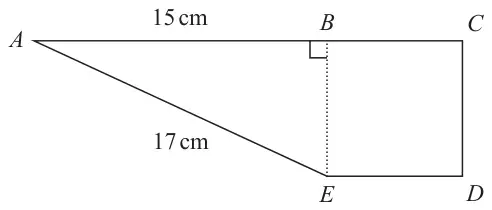
15 The diagram shows a shape \(ABCDE\) made from a right-angled triangle \(ABE\) and a square \(BCDE\)
Diagram NOT accurately drawn
\(ABC\) is a straight line.
\(AB = 15\) cm \(\qquad AE = 17\) cm
The perimeter of triangle \(ABE\) is 40 cm
Work out the area of the shape \(ABCDE\)
(4)
Mark scheme
Mark scheme Scheme Marks 40 – (17 + 15) (= 8) or
\(\sqrt{17^2 - 15^2}\left(= \sqrt{289 - 225} = \sqrt{64} = 8\right)\)
M1 “8” × “8” (= 64) M1 \(\dfrac{15 \times \text{``}{8}\text{''}}{2}\) (= 60) oe or M1 Working not required, so correct answer scores full marks (unless from obvious incorrect working) A1 (4) (4 marks)
Notes M1: may be seen on diagram
M1: for area of square (can be seen on diagram)
M1: for area of triangle (can be seen on diagram)
M2 for use of formula for area of trapezium
Higher June 2024 Paper 2R Q10
10 The diagram shows a hexagon \(ABCDEF\)
Diagram NOT accurately drawn
Angle \(BCF = 30^\circ\)
Calculate the area of \(ABCDEF\)
(5)
Mark scheme
Mark scheme Scheme Marks 23 × 4.7 (= 108.1) oe B1 \(\sin 30 = \dfrac{(x)}{5}\)
or
\(\dfrac{(x)}{\sin 30} = \dfrac{5}{\sin 90}\) oe
where \(x\) = height of trapezium
or \(5\cos 30\left(= \dfrac{5\sqrt{3}}{2} = 4.33...\right)\)
and
\((x^2 =)\, 5^2 - \text{``}{5\cos 30}\text{''}^2 \;(= 6.25)\)
M1 \((x =)\, 5\sin 30 \;(= 2.5)\) oe
or
\((x =)\, \dfrac{5}{\sin 90} \times \sin 30 \;(= 2.5)\) oe
or \((x =)\sqrt{5^2 - \text{``}{5\cos 30}\text{''}^2}\;(= 2.5)\)
M1 \(\dfrac{1}{2} \times (11 + 23) \times \text{``}{2.5}\text{''} (= 42.5)\) oe or \(\left(\dfrac{1}{2} \times \text{``}{2.5}\text{''} \times (23 - 11)\right) + \left(11 \times \text{``}{2.5}\text{''}\right) (= 42.5)\) oe or
\(\left(\dfrac{1}{2} \times \text{``}{2.5}\text{''} \times \left(23 - 11 - \text{``}{4.3}\text{''}\right)\right) + \left(11 \times \text{``}{2.5}\text{''}\right) + \left(\dfrac{1}{2} \times \text{``}{2.5}\text{''} \times \text{``}{4.3}\text{''}\right) (= 42.5)\) oe or
\(\left(11 \times \text{``}{2.5}\text{''}\right) + \left(\dfrac{1}{2} \times 5 \times (23 - 11) \times \sin 30\right) (= 42.5)\) oe or
\(\left(23 \times \text{``}{2.5}\text{''}\right) - \left(\dfrac{1}{2} \times \text{``}{2.5}\text{''} \times \left(23 - 11 - \text{``}{4.3}\text{''}\right)\right) - \left(\dfrac{1}{2} \times \text{``}{2.5}\text{''} \times \text{``}{4.3}\text{''}\right) (= 42.5)\) oe or
\(\left(23 \times \left(\text{``}{2.5}\text{''} + 4.7\right)\right) - \left(\dfrac{1}{2} \times \text{``}{2.5}\text{''} \times \left(23 - 11 - \text{``}{4.3}\text{''}\right)\right) - \left(\dfrac{1}{2} \times \text{``}{2.5}\text{''} \times \text{``}{4.3}\text{''}\right)\) oe
M1 Working required A1 (5) (5 marks)
Notes B1: (indep)
M1: for a correct method to find the area of the trapezium
A1: dep on M1 awrt 150.6
Allow 151
Accept \(\dfrac{753}{5}\)
Foundation June 2024 Paper 2 Q10
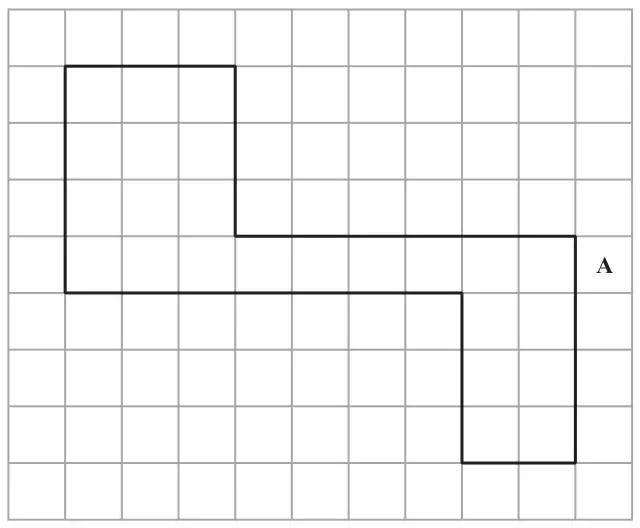
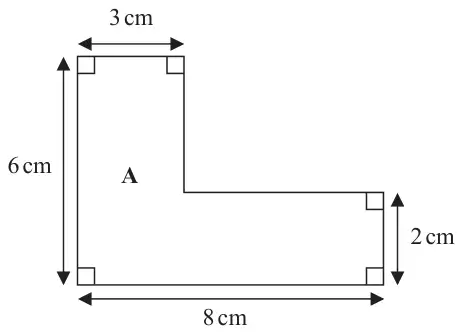
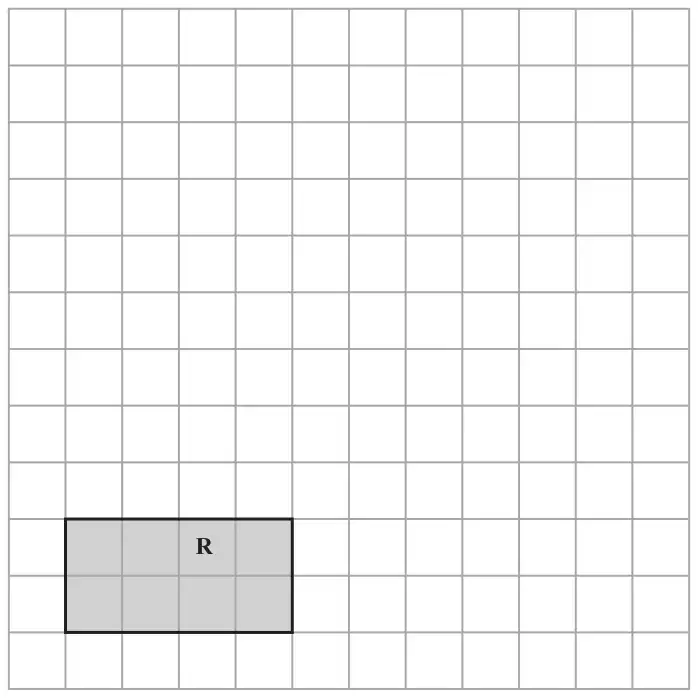
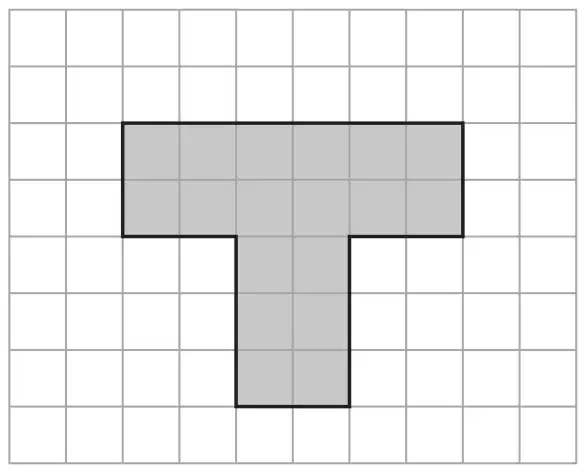
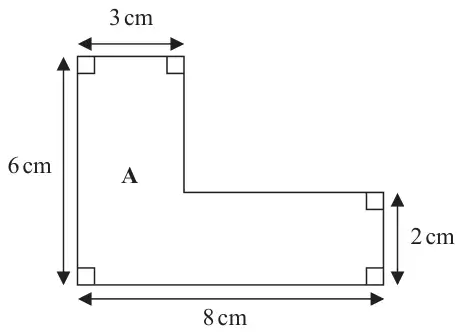
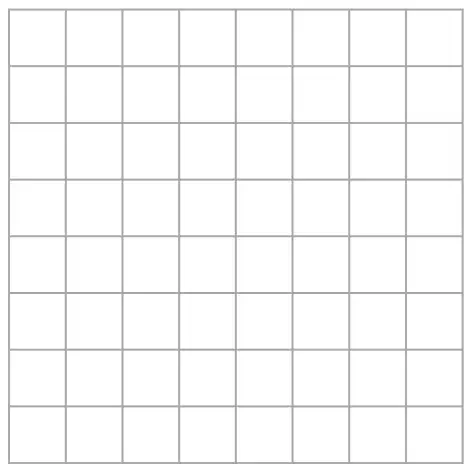
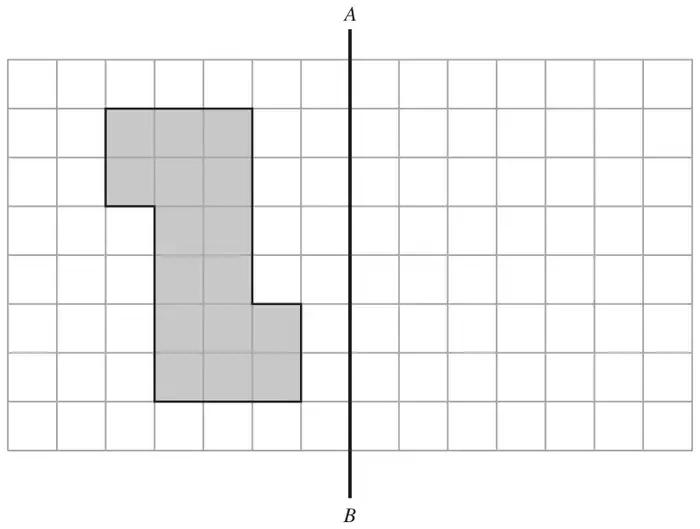
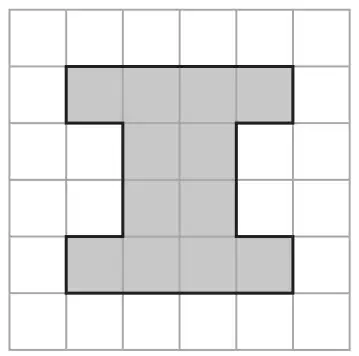
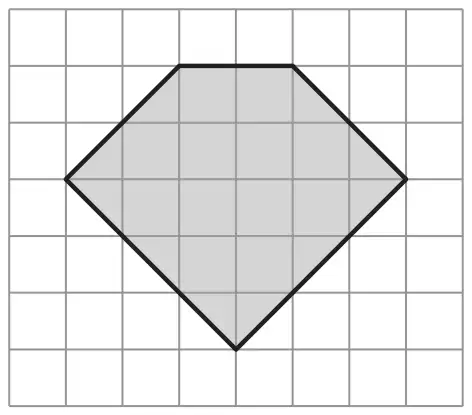
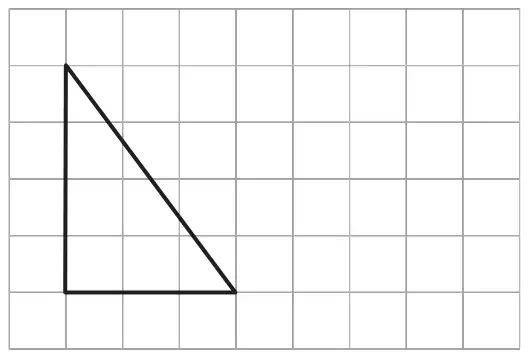
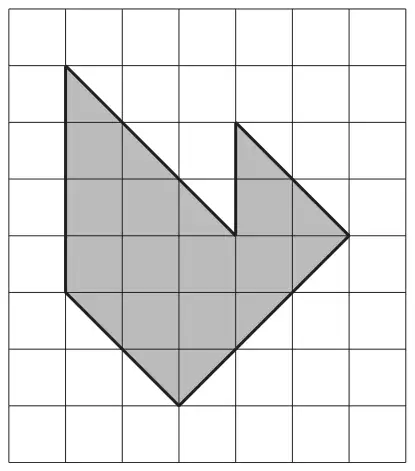
10 The diagram shows shape A drawn on a centimetre grid.
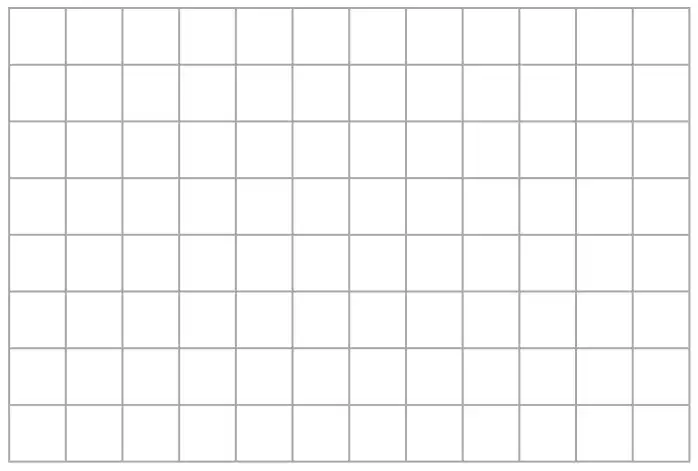
On the centimetre grid below, draw a rectangle that has the same area as shape A
(2)
Mark scheme
Mark scheme Scheme Marks A rectangle with area 24 cm² B2 (2) (2 marks)
Notes B2: For a correct rectangle
Higher June 2024 Paper 1R Q8
8 The diagram shows a trapezium, \(ABCD\)
Diagram NOT accurately drawn
\(DAB\) and \(ADC\) are right angles.
\(AD = 15\) cm \(\qquad DC = 14\) cm
The area of the trapezium is 360 cm²
Work out the perimeter of the trapezium.
(6)
Mark scheme
Mark scheme Scheme Marks \(\dfrac{14 + AB}{2} \times 15 = 360\) oe
or \(360 - 14 \times 15 (= 150)\) oe
M1 \(AB = 34\) or \(MB = 20\) (where \(M\) is point on \(AB\) such that \(MC\) is perpendicular to \(AB\)) A1 \((CB^2 =)\, 15^2 + 20^2 (= 625)\)or \((CB^2 =)\, 15^2 + MB^2\) M1 \((CB =)\sqrt{15^2 + 20^2}\,(= 25)\)
or \((CB =)\sqrt{15^2 + MB^2}\)
M1 14 + 15 + “34” + “25” oeor 14 + 15 + 14 + \(MB\) + \(CB\) oe M1ft Correct answer scores full marks (unless from obvious incorrect working) A1 (6) (6 marks)
Notes M1: for setting up an equation using the area of the trapezium or method to find the area of the triangle
A1: could be seen on diagram
M1: allow use of their \(MB\)
M1: allow use of their \(MB\)
M1ft: (dep on previous two M marks) for a method to find the perimeter of the trapezium, allow use of their \(MB\) and \(CB\)
A1: cao
Higher June 2024 Paper 2 Q7
7 The diagram shows a 6-sided shape \(ABCDEF\)
Diagram NOT accurately drawn
\(AF = 21\) cm \(\qquad CD = 15\) cm \(\qquad AB = FE = 13\) cm
The perpendicular height of the shape is \(h\) cm
The area of the shape is 390 cm\(^2\)
Work out the value of \(h\)
(4)
Mark scheme
Mark scheme Scheme Marks eg 13 × 21 (=273) or 21 × \(h\) (= 21\(h\))or 0.5(15 + 21) × \(y\) or 15(\(h\) – 13) or 2 ×½(3(\(h\) – 13))or ½(13 + \(h\)) ×3 (= 19.5 + 1.5\(h\)) or 15 × \(h\) (= 15\(h\)) M1 eg 390 – “273” (= 117) or 13 × 21 and 0.5(15 + 21)(\(h\) – 13)or and 0.5(15 + 21)\(y\) oeor and 2 ×½(3(\(h\) – 13)) oeor and 15(\(h\) – 13) and 2 ×½(3(\(h\) – 13)) oeor and 15 × \(h\) M1 “117” ÷ (0.5 × (15 + 21))(= 6.5) oror or or or Typical equations here simplify to : M1 Correct answer scores full marks (unless from obvious incorrect working) A1oe (4) (4 marks)
Notes M1: A correct calculation for an area linked to the shape. (\(h\) – 13) might be written as \(x\) or \(y\) etc: this is acceptable (even allow \(h\))
M1: For considering the area of all parts of the shape (parts need not be added or subtracted for the whole shape)
M1: A correct calculation to find height of trapezium or height of shape or a correct equation involving height of trapezium or height of shape
A1oe: eg \(\dfrac{39}{2}\)
Higher June 2024 Paper 2R Q5
5 The diagram shows the design for a badge, which will be made using wire.
Diagram NOT accurately drawn
The circle touches the square at the points \(E\), \(F\), \(G\) and \(H\)
The area of the square is 81 cm²
Calculate the total length of wire that will be needed to make the square and the circle.
(4)
Mark scheme
Mark scheme Scheme Marks \(\sqrt{81}\) (= 9) or 9 or 9 × 9 (= 81) M1 4 × “9” (= 36) oe M1 eg M1 Working not required, so correct answer scores full marks (unless from obvious incorrect working) A1 (4) (4 marks)
Notes M1: for method to find the length of the side of the square (may be seen on the diagram)
M1: for the perimeter of the square
M1: for a correct expression for the circumference for using \(2\pi r\) or \(\pi D\)
A1: accept 64.26 – 64.3
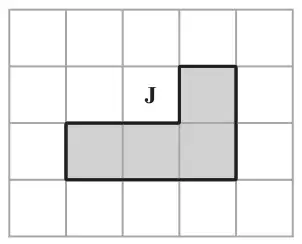
Foundation June 2024 Paper 2 Q2
2
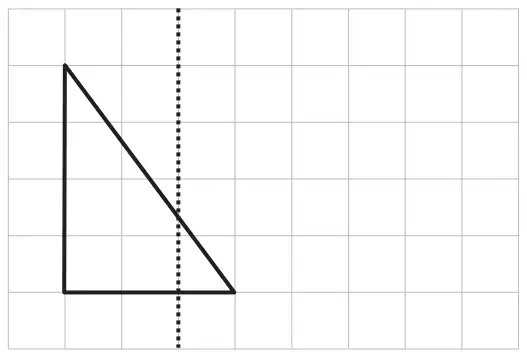
(a) On the grid, draw a shape that is congruent to shape J (1)
(b) On the grid, draw a shape that is an enlargement of shape J with scale factor 2 (2)
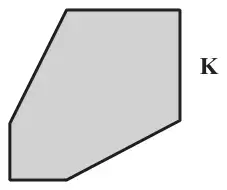
The diagram shows shape K K has exactly one line of symmetry.
(c) Draw this line of symmetry on shape K (1)
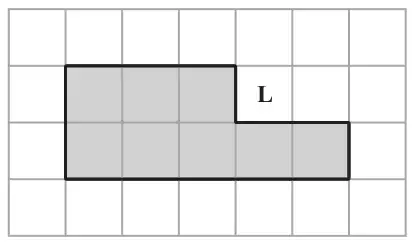
The diagram shows shape L drawn on a centimetre grid.
(d) Work out the perimeter of shape L (1)
(e) Work out the area of shape L (1)
Mark scheme (a) Mark scheme (b) Mark scheme (c) Mark scheme (d) Mark scheme (e)
Mark scheme (a) Scheme Marks Correct congruent shape B1 (1)
Notes B1: A shape of the same size and shape as given (can be reflected or rotated)
Mark scheme (b) Scheme Marks eg B2 (2)
Notes B2: A shape that is an enlargement of the given shape
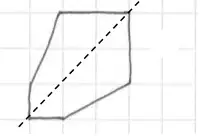
Mark scheme (c) Scheme Marks B1 (1)
Notes B1: correct line with no other lines
Mark scheme (d) Mark scheme (e) Scheme Marks 8 B1 (1) (6 marks)
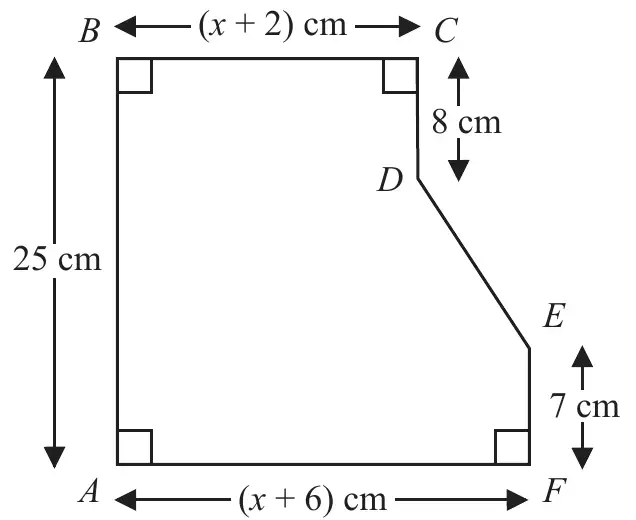
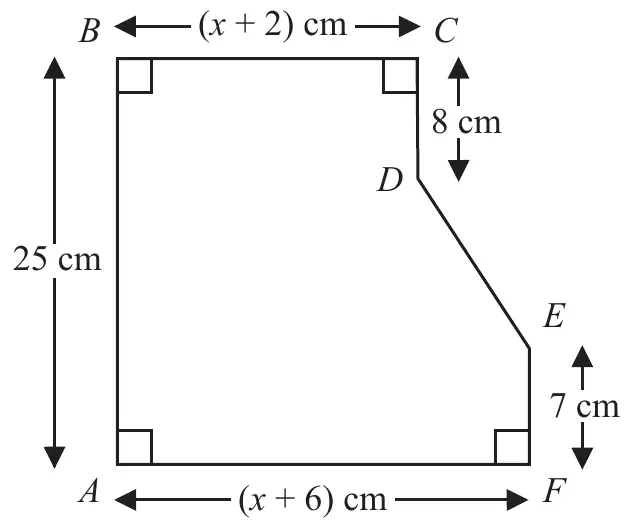
Foundation November 2023 Paper 2 Q26 26 The diagram shows a hexagon \(ABCDEF\)
Diagram NOT accurately drawn
\(AB = 25\) cm \(BC = (x + 2)\) cm \(CD = 8\) cm \(EF = 7\) cm \(AF = (x + 6)\) cm
The area of hexagon \(ABCDEF\) is 258 cm²
Work out the value of \(x\)
(5)
Mark scheme
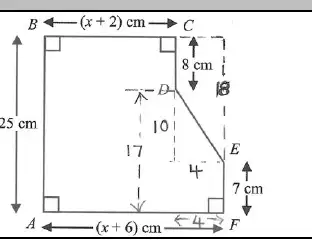
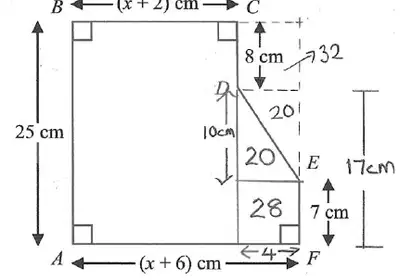
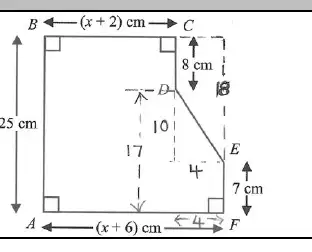
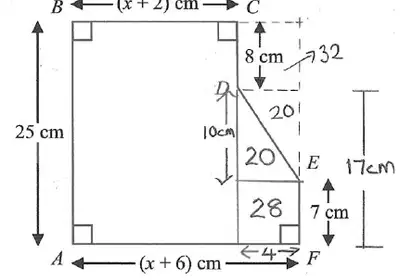
Mark scheme Scheme Marks B1 eg \(25(x + 2)\;(= 25x + 50)\) or \(\dfrac{7 + (25 - 8)}{2} \times ((x + 6) - (x + 2))\;(= 48)\) or or \(\left(\dfrac{8 + (25 - 7)}{2} \times 4\right)(= 52)\) or or \(\dfrac{(x + 2) + (x + 6)}{2} \times (25 - 8 - 7)\;(= 10x + 40)\) or or \(10(x + 2)\;(= 10x + 20)\) oror \((25 - 7) \times (x + 2)\;(= 18x + 36)\) or \(0.5(25 - 8 - 7) \times 4\;(= 20)\) M2 eg \(25x + 98 = 258\) or M1 Working not required, so correct answer scores full marks (unless from obvious incorrect working) A1 (5) (5 marks)
Notes B1: for a length of 4 (cm) or 17 (cm) or 25 – 7 – 8 (=10 (cm)) or 18 (cm) in the correct place on the diagram or calculated or used correctly in working.
M2: for 2 correct expressions or values for the area of any 2 parts of the shape that do not overlap (unless subtracting) (need not be added or subtracted) (figures to be correct or come from correct working to award marks)(M1 for one correct expression)
M1: for an equation that is correct or from correct working. This need not have expanded terms and may not equal 258 if other work has been done.
A1: oe eg \(\dfrac{160}{25}\)
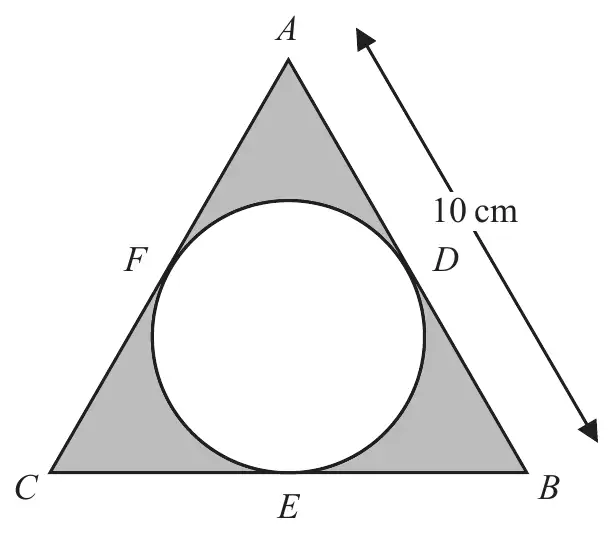
Higher November 2023 Paper 2 Q20 20 The diagram shows equilateral triangle \(ABC\) with sides of length 10 cm.
A circle is drawn inside the triangle.
Diagram NOT accurately drawn
\(D\), \(E\) and \(F\) are points on the circle.
\(ADB\), \(BEC\) and \(CFA\) are tangents to the circle.
Calculate the total area of the regions shown shaded in the diagram.
(4)
Mark scheme
Mark scheme Scheme Marks \(0.5 \times 10 \times 10 \times \sin 60\;(= 25\sqrt{3} = 43.3...)\) oe or M1 (radius =) \(5\tan 30\;\left(= \dfrac{5\sqrt{3}}{3} = \dfrac{5}{\sqrt{3}} = 2.886...\right)\) oe eg \(\dfrac{5 \sin 30}{\sin 60}\) or \(\dfrac{\sqrt{10^2 - 5^2}}{3}\) or M1 \(\pi \times \left(\dfrac{5\sqrt{3}}{3}\right)^2\) or \(\pi \times 2.886...^2\;\left(= \dfrac{25\pi}{3} = 26.17...\right)\) A1 Working not required, so correct answer scores full marks (unless from obvious incorrect working) A1 (4 marks)
Notes M1: (first) For a correct method to find the area of the triangle – this list is not exhaustive – please credit any relevant method
M1: (second) Indep – correct method to find radius – this list is not exhaustive – please credit any relevant method
A1: (first) A correct value or expression for the area of the circle
A1: (second) awrt 17.1
Higher November 2023 Paper 2 Q10 10 The diagram shows a hexagon \(ABCDEF\)
Diagram NOT accurately drawn
\(AB = 25\) cm \(BC = (x + 2)\) cm \(CD = 8\) cm \(EF = 7\) cm \(AF = (x + 6)\) cm
The area of hexagon \(ABCDEF\) is 258 cm²
Work out the value of \(x\)
(5)
Mark scheme
Mark scheme Scheme Marks B1 eg \(25(x + 2)\;(= 25x + 50)\) or \(\dfrac{7 + (25 - 8)}{2} \times ((x + 6) - (x + 2))\;(= 48)\) or or \(\left(\dfrac{8 + (25 - 7)}{2} \times 4\right)(= 52)\) or or \(\dfrac{(x + 2) + (x + 6)}{2} \times (25 - 8 - 7)\;(= 10x + 40)\) or or \(10(x + 2)\;(= 10x + 20)\) oror \((25 - 7) \times (x + 2)\;(= 18x + 36)\) or \(0.5(25 - 8 - 7) \times 4\;(= 20)\) M2 eg \(25x + 98 = 258\) or M1 Working not required, so correct answer scores full marks (unless from obvious incorrect working) A1 (5) (5 marks)
Notes B1: for a length of 4 (cm) or 17 (cm) or 25 – 7 – 8 (=10 (cm)) or 18 (cm) in the correct place on the diagram or calculated or used correctly in working.
M2: for 2 correct expressions or values for the area of any 2 parts of the shape that do not overlap (unless subtracting) (need not be added or subtracted) (figures to be correct or come from correct working to award marks)(M1 for one correct expression)
M1: for an equation that is correct or from correct working. This need not have expanded terms and may not equal 258 if other work has been done.
A1: oe eg \(\dfrac{160}{25}\)
Foundation November 2023 Paper 2 Q6 6 Here is a centimetre grid.
(a) On the grid, draw a right-angled triangle.
(1) Here is a centimetre grid.
(b) On the grid, draw a rectangle with an area of 20 cm\(^2\)
(2) Mark scheme (a) Mark scheme (b)
Mark scheme (a) Scheme Marks A right-angled triangle B1 (1)
Notes B1: For a right angled triangle drawn.
Mark scheme (b) Scheme Marks A rectangle with area 20 cm² B2 (2) (3 marks)
Notes B2: eg a rectangle with dimensions 2 cm by 10 cm or 4 cm by 5 cm or 2.5 cm by 8 cm etc
Foundation June 2023 Paper 1 Q20
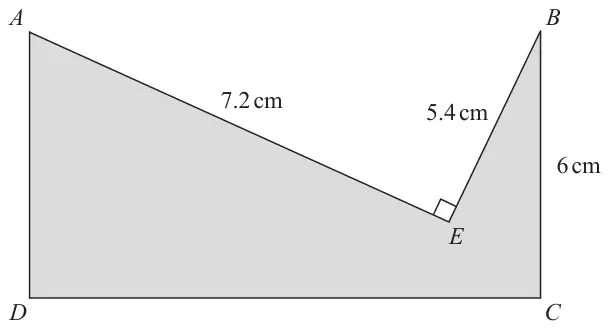
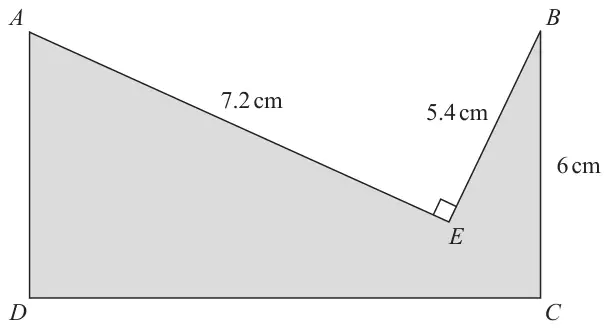
20 The diagram shows a shaded shape \(AEBCD\) made by removing triangle \(AEB\) from rectangle \(ABCD\)
Diagram NOT accurately drawn
\(AE\) = 7.2 cm \(BE\) = 5.4 cm \(BC\) = 6 cm angle \(AEB\) = 90°
Work out the perimeter of the shaded shape.
(4)
Mark scheme
Mark scheme Scheme Marks \(7.2^2 + 5.4^2\) (= 81) M1 \(\sqrt{7.2^2 + 5.4^2}\) (= 9) M1 \(7.2 + 5.4 + 6 + \text{``}{9}\text{''} + 6\) oe M1 Correct answer scores full marks (unless from obvious incorrect working) A1 (4) (4 marks)
Notes M1: for correct first step using Pythagoras
M1: for complete Pythagoras method to find length of \(AB\)/\(DC\) check the diagram for sight of 9, \(DC\) marked as 9 implies M2
M1: for a complete method to find the perimeter
A1: oe
If using trig:and \(\sin(\text{``}{36.8...}\text{''}) = \dfrac{5.4}{AB}\)
Foundation June 2023 Paper 2R Q20
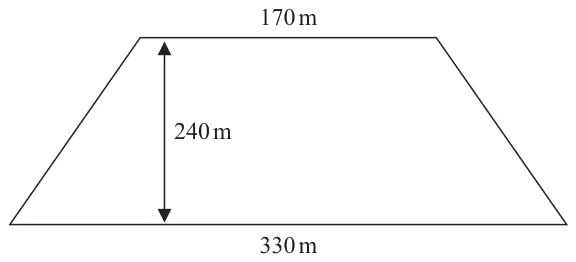
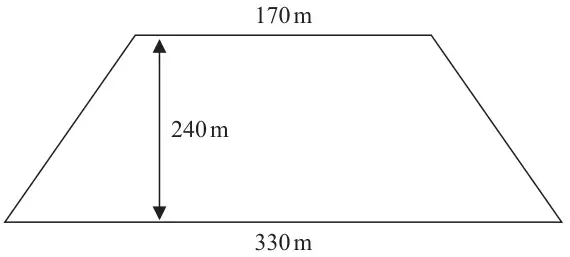
20 A field is in the shape of a trapezium.
Diagram NOT accurately drawn
The field is sold for a price of $49 650
Given that 1 hectare = 10 000 m2
(4)
Mark scheme
Mark scheme Scheme Marks \(\dfrac{1}{2}(330 + 170) \times 240\) (= 60 000) oe or
\(\left(\dfrac{80 \times 240}{2}\right) + (170 \times 240) + \left(\dfrac{80 \times 240}{2}\right)\) (= 60 000) oe or
(2 × 9600) + 40 800 (= 60 000) oe
M1 [60 000] ÷ 10 000 (= 6) or M1 49 650 ÷ [6] M1 Correct answer scores full marks (unless from obvious incorrect working) A1 (4) (4 marks)
Notes M1: for working out the area of the trapezium
M1: ft their area (must come from a two dimensional area)
Allow \(\dfrac{\text{their area}}{10\,000}\)
M1: dep on either previous M1 ft their number of hectares
Allow \(\dfrac{49\,650}{\text{their number of hectares}}\)
Foundation June 2023 Paper 1 Q13
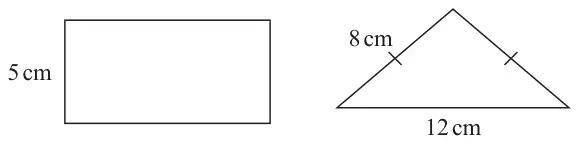
13 The diagram shows a rectangle and an isosceles triangle.
Diagram NOT accurately drawn
The perimeter of the rectangle is equal to the perimeter of the triangle.
(a) Find the area of the rectangle. (3)
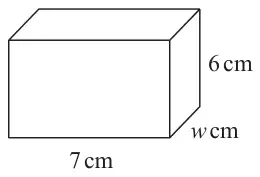
The diagram shows a cuboid.
Diagram NOT accurately drawn
The volume of the cuboid is 231 cm³
(b) Calculate the value of \(w\) (2)
Mark scheme (a) Mark scheme (b)
Mark scheme (a) Scheme Marks \(8 + 8 + 12\) (= 28) oe or \(\dfrac{8 + 8 + 12 - 2 \times 5}{2}\) (= 9) oe M1 \((\text{``}{28}\text{''} - 5 - 5) \div 2 \times 5\) oe eg \(\text{``}{9}\text{''} \times 5\) M1 Correct answer scores full marks (unless from obvious incorrect working) A1 (3)
Notes M1: for a method to find the perimeter of the triangle or for a method to find the length of the rectangle (check the diagram)
M1: for a complete method to find the area of the rectangle
Mark scheme (b) Scheme Marks \(231 \div (7 \times 6)\) or \(7 \times 6 \times w = 231\) oe M1 Correct answer scores full marks (unless from obvious incorrect working) A1 (2) (5 marks)
Notes M1: for a complete method to find the value of \(w\) or for setting up an equation for the volume of the cuboid
A1: oe \(\dfrac{11}{2}\), \(5\tfrac{1}{2}\)
Foundation June 2023 Paper 1R Q13
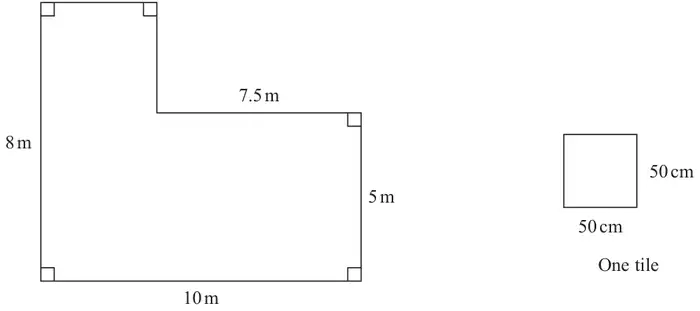
13 The diagram shows the plan of a garden.
Diagram NOT accurately drawn
Martyn covers the garden with square tiles of side length 50 cm.
It takes 4 minutes to lay each tile.
Work out how long it takes Martyn to cover the whole garden with tiles.
(5)
Mark scheme Mark scheme (ALT)
Mark scheme Scheme Marks eg 7.5 × 5 (= 37.5) oeor 8 × (10 – 7.5) (= 20) oeor 10 × 5 (= 50) oeor (10 – 7.5) × (8 – 5) (= 7.5) oeor 10 × 8 (= 80) oeor 7.5 × (8 – 5) (= 22.5) oeor or (10 – 7.5) ÷ 0.5 (= 5)or (8 – 5) ÷ 0.5 (= 6)or 10 ÷ 0.5 (= 20)or 5 ÷ 0.5 (= 10)or 7.5 ÷ 0.5 (= 15) M1 egor or or or “10” × “15” (= 150)or “5” × “6” (= 30)or “10” × “20” (= 200) M1 “57.5” ÷ \(0.5^2\) (= 230) oe oror or M1 “230” × 4 (= 920) M1 Correct answer scores full marks (unless from obvious incorrect working) A1 (5) (5 marks)
Notes M1: for a method to find a relevant areaOR
M1: for a method to find the total area of the shapeOR
M1: dep on M1 for a method to find the total number of tiles required
M1: dep on previous M1 for multiplying the total number of tiles by 4
A1: SCB1 for 0.5 × 0.5 (= 0.25) if no other marks are awarded
Mark scheme (ALT) Scheme Marks eg 750 × 500 (= 375 000) oeor 800 × (1000 – 750) (= 200 000) oeor 1000 × 500 (= 500 000) oeor (1000 – 750) × (800 – 500) (= 75 000) oeor 1000 × 800 (= 800 000) oeor 750 × (800 – 500) (= 225 000) oeor or (1000 – 750) ÷ 50 (= 5)or (800 – 500) ÷ 50 (= 6)or 1000 ÷ 50 (= 20)or 500 ÷ 50 (= 10)or 750 ÷ 50 (= 15) M1 egor or or or “10” × “15” (= 150)or “5” × “6” (= 30)or “10” × “20” (= 200) M1 “575 000” ÷ \(50^2\) (= 230) oe oror or M1 “230” × 4 (= 920) M1 Correct answer scores full marks (unless from obvious incorrect working) A1
Notes M1: for a method to find a relevant areaOR
M1: for a method to find the total area of the shapeOR
M1: dep on M1 for a method to find the total number of tiles required
M1: dep on previous M1 for multiplying the total number of tiles by 4
A1: SCB1 for 50 × 50 (= 2500) if no other marks are awarded
Foundation June 2023 Paper 1 Q7
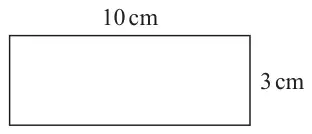
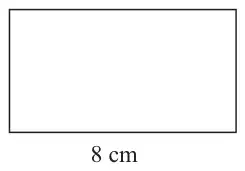
7 The diagram shows a rectangle measuring 10 cm by 3 cm.
Diagram NOT accurately drawn
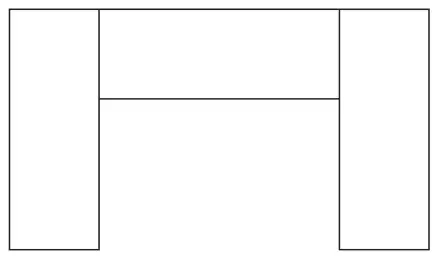
A shape is made by placing 3 of these rectangles together as shown in the diagram.
Work out the perimeter of the shape.
(3)
Mark scheme
Mark scheme Scheme Marks \(10 - 3\) (= 7) (could be on diagram)or \(10 + 3 + 10 + 3\) (= 26) oeor \((10 + 3 + 10 + 3) \times 3\) (= 78) oeor \(6 \times 10 + 4 \times 3\) (= 72) oeor \(4 \times 10 + 4 \times 3\) (= 52) oe M1 eg \(3 + 10 + 3 + 10 + 3 + 10 + 3 + \text{``}{7}\text{''} + 10 + \text{``}{7}\text{''}\) oeor \(4 \times 10 + 4 \times 3 + 2 \times \text{``}{7}\text{''}\) oeor \(\text{``}{78}\text{''} - (4 \times 3)\) oeor \(\text{``}{72}\text{''} - (2 \times 3)\) oeor \(\text{``}{52}\text{''} + (2 \times \text{``}{7}\text{''})\) oe M1 Correct answer scores full marks (unless from obvious incorrect working) A1 (3) (3 marks)
Notes M1: for \(10 - 3\) (= 7) (could be on diagram)or for finding the perimeter of one rectangleor for finding the perimeter of 3 rectanglesor for finding the perimeter including the internal sidesor for finding the perimeter excluding the two lengths of 7
M1: for a fully correct method to find the perimeter of the shape, with at most one error (which could be one length omitted or an extra length added)
Higher June 2023 Paper 2R Q5
5 A field is in the shape of a trapezium.
Diagram NOT accurately drawn
The field is sold for a price of $49 650
Given that 1 hectare = 10 000 m2
work out the average price of the field per hectare.
(4)
Mark scheme
Mark scheme Scheme Marks \(\dfrac{1}{2}(330 + 170) \times 240\) (= 60 000) oe or
\(\left(\dfrac{80 \times 240}{2}\right) + (170 \times 240) + \left(\dfrac{80 \times 240}{2}\right)\) (= 60 000) oe or
(2 × 9600) + 40 800 (= 60 000) oe
M1 [60 000] ÷ 10 000 (= 6) or M1 49 650 ÷ [6] M1 Correct answer scores full marks (unless from obvious incorrect working) A1 (4) (4 marks)
Notes M1: for working out the area of the trapezium
M1: ft their area (must come from a two dimensional area)
Allow \(\dfrac{\text{their area}}{10\,000}\)
M1: dep on either previous M1 ft their number of hectares
Allow \(\dfrac{49\,650}{\text{their number of hectares}}\)
Higher June 2023 Paper 1 Q5
5 The diagram shows a shaded shape \(AEBCD\) made by removing triangle \(AEB\) from rectangle \(ABCD\)
Diagram NOT accurately drawn
\(AE = 7.2\) cm \(\qquad BE = 5.4\) cm \(\qquad BC = 6\) cm \(\qquad\) angle \(AEB = 90^\circ\)
Work out the perimeter of the shaded shape.
(4)
Mark scheme
Mark scheme Scheme Marks 7.2² + 5.4² (= 81) M1 \(\sqrt{7.2^2 + 5.4^2}\) (= 9) M1 7.2 + 5.4 + 6 + “9” + 6 oe M1 Correct answer scores full marks (unless from obvious incorrect working) A1 (4) (4 marks)
Notes M1: for correct first step using Pythagoras
M1: for complete Pythagoras method to find length of \(AB\)/\(DC\) check the diagram for sight of 9,
M1: for a complete method to find the perimeter
A1: oe
Alternative (trigonometry): and \(\sin(\text{``}{36.8...}\text{''}) = \dfrac{5.4}{AB}\)
Foundation January 2023 Paper 2 Q25
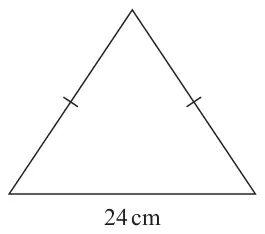
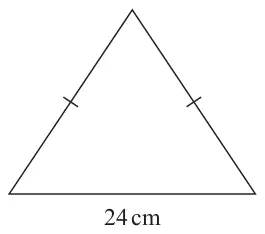
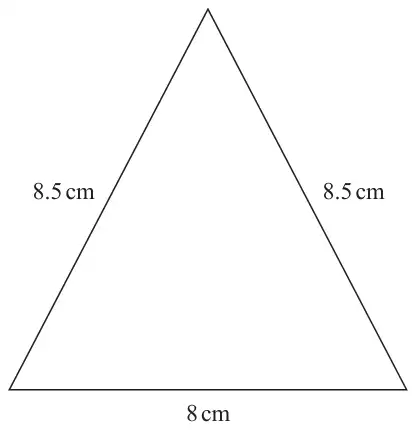
25 The diagram shows an isosceles triangle, with base length 24 cm.
Diagram NOT accurately drawn
The perimeter of the triangle is 54 cm.
Work out the area of the triangle.
(5)
Mark scheme Mark scheme (ALT)
Mark scheme Scheme Marks (54 – 24) ÷ 2 (=15) [may be marked on diagram] M1 \(\text{“}15\text{”}^2 - (24 \div 2)^2\;(= 81)\) M1 [height =] \(\sqrt{\text{“}15\text{”}^2 - (24 \div 2)^2}\;(= 9)\) M1 \((24 \times \text{“}9\text{”}) \div 2\) oe M1 Correct answer scores full marks (unless from obvious incorrect working) A1 (5) (5 marks)
Notes M1: ft their “15” (if > 12)
M1: ft their “15” (if > 12)
M1: figures must be from correct working
A1: allow 107.9 – 108.1
Mark scheme (ALT) Scheme Marks (54 – 24) ÷ 2 (=15) [may be marked on diagram] M1 or \(x = \cos^{-1}\left(\dfrac{\text{“}12\text{”}}{\text{“}15\text{”}}\right)(= 36.86...)\)
or \(y = \sin^{-1}\left(\dfrac{24 \div 2}{\text{“}15\text{”}}\right)(= 53.13...)\)
or \(A = \cos^{-1}\left(\dfrac{15^2 + 15^2 - 24^2}{2 \times 15 \times 15}\right)(= 106.2...)\)
or \(B = \cos^{-1}\left(\dfrac{15^2 + 24^2 - 15^2}{2 \times 15 \times 24}\right)(= 36.8....)\)
M1 or “12”tan”36.86…” (= 9) (allow 8.9… for these)or “15” × sin “36.86…” (= 9)or “15” × cos “53.13…” (= 9)M1 \((24 \times \text{“}9\text{”}) \div 2\) oe M1 Correct answer scores full marks (unless from obvious incorrect working) A1
Notes M1: ft their “15” (if > 12)
M1: ft their “15” (if > 12)
A1: allow 107.9 – 108.1
M2 for 0.5 × 24 × “15” × sin”36.86…” or 0.5 × “15” × “15” × sin(2 × “53.13…”) or 0.5 × “15” × “15” × sin(“106.2...”) or \(\sqrt{\text{“}27\text{”}(\text{“}27\text{”} - 24)(\text{“}27\text{”} - \text{“}15\text{”})(\text{“}27\text{”} - \text{“}15\text{”})}\)
Foundation January 2023 Paper 1R Q24
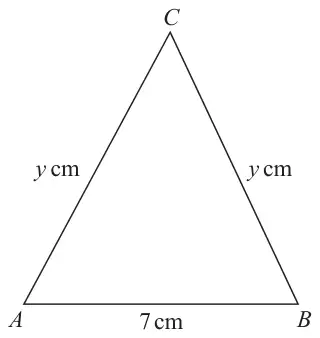
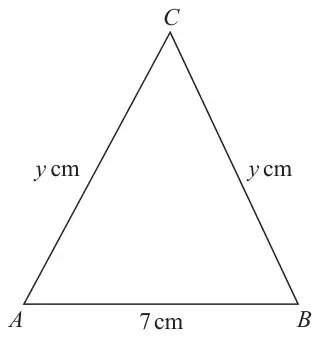
24 The diagram shows an isosceles triangle \(ABC\)
Diagram NOT accurately drawn
\(AB = 7\) cm
The area of the triangle is 42 cm2
Work out the value of \(y\)
(4)
Mark scheme
Mark scheme Scheme Marks \(\dfrac{1}{2} \times 7 \times h = 42\) oe or \((h =)\;\dfrac{42 \times 2}{7}\;(= 12)\) oe or
\(3.5^2 + h^2 = y^2\) or \(h = \sqrt{y^2 - 3.5^2}\) oe
M1 \(y^2 = \left(\dfrac{7}{2}\right)^2 + (\text{“}12\text{”})^2\) oe or \(\dfrac{1}{2} \times 7 \times \text{“}\sqrt{y^2 - 3.5^2}\text{”} = 42\) oe M1 \(y = \sqrt{\left(\dfrac{7}{2}\right)^2 + (\text{“}12\text{”})^2}\) oe M1 Correct answer scores full marks (unless from obvious incorrect working) A1 (4) (4 marks)
Notes M1: A correct equation involving the height or a correct expression for height – could be in terms of \(y\)
M1: (indep) use of their height (any found value that they have called ‘height’)
M1: all values must come from a correct method
A1: oe eg \(\dfrac{25}{2}\)
Foundation January 2023 Paper 1 Q15
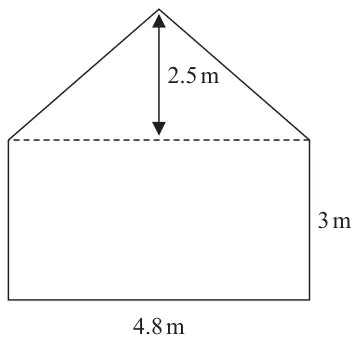
15 Here is a floor plan of a stage.
Diagram NOT accurately drawn
The stage manager is going to paint the floor.
One tin of paint covers an area of 1.8 m2
Paint can only be bought in full tins.
The stage manager has $190 to spend.
Does the stage manager have enough money to buy enough tins to paint all of the floor?
(5)
Mark scheme
Mark scheme Scheme Marks \(\dfrac{1}{2} \times 4.8 \times 2.5\) (= 6) oe or
3 × 4.8 (= 14.4) oe or
4.8 × (3 + 2.5) (= 26.4)
M1 \(\dfrac{1}{2} \times 4.8 \times 2.5\) (= 6) oe and
3 × 4.8 (= 14.4) oe
or
[4.8 × (3 + 2.5)] – [0.5 × 2.4 × 2.5 + 0.5 × 2.4 × 2.5] or
“26.4” – 6 (= 20.4) or
M1 (“6” + “14.4”) ÷ 1.8 (= 11.3…) or
“20.4” ÷ 1.8 (= 11.3…) or
\(\dfrac{\text{“}6\text{”}}{1.8} + \dfrac{\text{“}8\text{”}}{1.8}\;(3.3... + 8 = 11.3...)\)
M1 “12” × 16.4(0) (= 196.8(0)) M1 Working required A1 (5) (5 marks)
Notes M1: dep on M1 for a method to find the number of tins for their area
M1: dep on previous M1 for a method to calculate the cost for their number of tins (their number of tins must be rounded up to the next integer)
A1: dep on M2
Foundation January 2023 Paper 2R Q13
13 The diagram shows the plan of a floor.
Diagram NOT accurately drawn
Indira is going to paint the floor.
Each tin of paint covers an area of 7 m2
Indira buys the least possible number of tins of paint.
Work out the total cost of the tins of paint that Indira buys.
(5)
Mark scheme
Mark scheme Scheme Marks eg 8 × 12 (= 96) or 7 × 3 (= 21) or 3 × 15 (= 45)or 8 × 9 (= 72) or 15 × 12 (= 180) or 7 × 9 (= 63) M1 eg “96” + “21” (= 117) or “45” + “72” (= 117)or “180” – “63” (= 117) M1 eg 117 ÷ 7 (= 16.7... or 17) M1 eg “17” × 23.9 M1 Working required A1 (5) (5 marks)
Notes M1: for a method to find one relevant area
M1: for a complete method to find the total area
M1: (indep) for a method to find the number of tins for their area ft from any value that has come from a calculation that includes at least 2 of the given dimensions
M1: for a method to calculate the cost for their number of tins dependent on previous M1
A1: dep on M1
Higher January 2023 Paper 2 Q10
10 The diagram shows an isosceles triangle, with base length 24 cm.
Diagram NOT accurately drawn
The perimeter of the triangle is 54 cm.
Work out the area of the triangle.
(5)
Mark scheme Mark scheme (ALT)
Mark scheme Scheme Marks (54 – 24) ÷ 2 (= 15) [may be marked on diagram] M1 \(\text{``}{15}\text{''}^2 - (24 \div 2)^2\;(= 81)\) M1 [height =] \(\sqrt{\text{``}{15}\text{''}^2 - (24 \div 2)^2}\;(= 9)\) M1 \((24 \times \text{``}{9}\text{''}) \div 2\) oe M1 Correct answer scores full marks (unless from obvious incorrect working) A1 (5) (5 marks)
Notes M1: ft their “15” (if > 12)
M1: ft their “15” (if > 12)
M1: figures must be from correct working
A1: allow 107.9 – 108.1
Mark scheme (ALT) Scheme Marks (54 – 24) ÷ 2 (= 15) [may be marked on diagram] M1 or \(x = \cos^{-1}\left(\dfrac{\text{``}{12}\text{''}}{\text{``}{15}\text{''}}\right)(= 36.86\ldots)\)
or \(y = \sin^{-1}\left(\dfrac{24 \div 2}{\text{``}{15}\text{''}}\right)(= 53.13\ldots)\)
or \(A = \cos^{-1}\left(\dfrac{15^2 + 15^2 - 24^2}{2 \times 15 \times 15}\right)(= 106.2\ldots)\)
or \(B = \cos^{-1}\left(\dfrac{15^2 + 24^2 - 15^2}{2 \times 15 \times 24}\right)(= 36.8\ldots)\)
M1 or “12” tan “36.86…” (= 9) (allow 8.9… for these)or “15” × sin “36.86…” (= 9)or “15” × cos “53.13…” (= 9)M1 \((24 \times \text{``}{9}\text{''}) \div 2\) oe M1 Correct answer scores full marks (unless from obvious incorrect working) A1
Notes M1: ft their “15” (if > 12)
M1: ft their “15” (if > 12)
A1: allow 107.9 – 108.1
M2 for 0.5 × 24 × “15” × sin “36.86…” or 0.5 × “15” × “15” × sin(2 × “53.13…”) or 0.5 × “15” × “15” × sin(“106.2...”) or \(\sqrt{\text{``}{27}\text{''}(\text{``}{27}\text{''} - 24)(\text{``}{27}\text{''} - \text{``}{15}\text{''})(\text{``}{27}\text{''} - \text{``}{15}\text{''})}\)
Higher January 2023 Paper 1R Q9
9 The diagram shows an isosceles triangle \(ABC\)
Diagram NOT accurately drawn
\(AB = 7\) cm
The area of the triangle is 42 cm2
Work out the value of \(y\)
(4)
Mark scheme
Mark scheme Scheme Marks \(\dfrac{1}{2} \times 7 \times h = 42\) oe or \((h =)\;\dfrac{42 \times 2}{7}\;(= 12)\) oe
or \(3.5^2 + h^2 = y^2\) or \(h = \sqrt{y^2 - 3.5^2}\) oe
M1 \(y^2 = \left(\dfrac{7}{2}\right)^2 + (\text{``}{12}\text{''})^2\) oe or \(\dfrac{1}{2} \times 7 \times \text{``}{\sqrt{y^2 - 3.5^2}}\text{''} = 42\) oe M1 \(y = \sqrt{\left(\dfrac{7}{2}\right)^2 + (\text{``}{12}\text{''})^2}\) oe M1 Correct answer scores full marks (unless from obvious incorrect working) A1 (4) (4 marks)
Notes M1: A correct equation involving the height or a correct expression for height – could be in terms of \(y\)
M1: (indep) use of their height (any found value that they have called ‘height’)
M1: all values must come from a correct method
A1: oe eg \(\dfrac{25}{2}\)
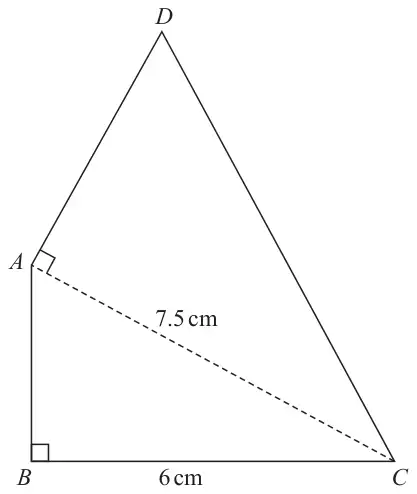
Foundation June 2022 Paper 1R Q27
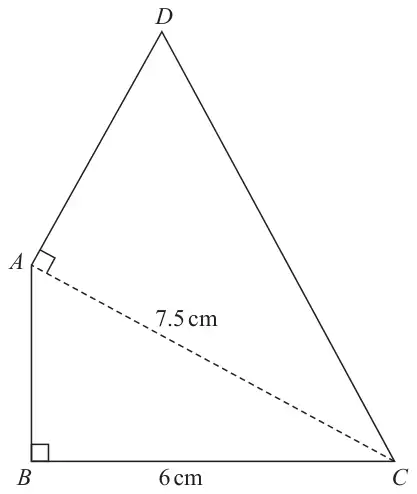
27 The diagram shows a quadrilateral \(ABCD\)
Diagram NOT accurately drawn
In the diagram, \(ABC\) and \(DAC\) are right-angled triangles.
\(BC = 6\) cm \(\qquad\) \(AC = 7.5\) cm
The area of quadrilateral \(ABCD\) is 31.5 cm2
Work out the length of \(AD\)
(6)
Mark scheme
Mark scheme Scheme Marks (\(AB^2\) =) \(7.5^2 - 6^2\) (= 20.25) or eg (\(BAC\) =) \(\sin^{-1}\left(\dfrac{6}{7.5}\right)\) (= 53.1...)
or \(\cos(BCA) = \dfrac{6}{7.5}\) (= 0.8)
M1 (\(AB\) =) \(\sqrt{7.5^2 - 6^2}\) (= 4.5) or (\(AB\) =) \(\dfrac{6}{\tan \text{“}53.1\text{”}}\) (= 4.5...)
or (\(AB\) =) \(7.5 \cos \text{“}53.1\text{”}\) (= 4.5...) or (\(BCA\) =) \(\cos^{-1}\left(\dfrac{6}{7.5}\right)\) (= 36.8...)
M1 (Area \(ABC\) =) \(\dfrac{1}{2} \times 6 \times \text{“}4.5\text{”}\) (= 13.5)
or (Area \(ABC\) =) \(\dfrac{1}{2} \times 6 \times 7.5 \times \sin(\text{“}36.8\text{”})\) (= 13.47... or 13.5)
M1 (Area \(DAC\) =) 31.5 – “13.5” (= 18)or “13.5” + 0.5 × 7.5 × \(AD\) = 31.5 oe M1 (\(AD\) =) (“18” ÷ 7.5) ÷ 0.5 oe M1 4.8 A1 (6) (6 marks)
Notes M1: for a correct first step to find \(AB\) or a complete method to find angle \(BAC\) or a correct first step to find angle \(BCA\)
M1: for a complete method to find \(AB\) or angle \(BCA\)
M1: ft [their labelled \(AB\)]
or [their labelled \(BCA\)]
eg for \(\dfrac{1}{2} \times 6 \times\) [their labelled \(AB\)] or
\(\dfrac{1}{2} \times 6 \times 7.5 \times \sin\)[their labelled \(BCA\)]
M1: ft (dep on previous M1)
M1: for a complete method to find \(AD\), dependent on correct working
A1: accept 4.78 – 4.81
Foundation June 2022 Paper 2R Q22
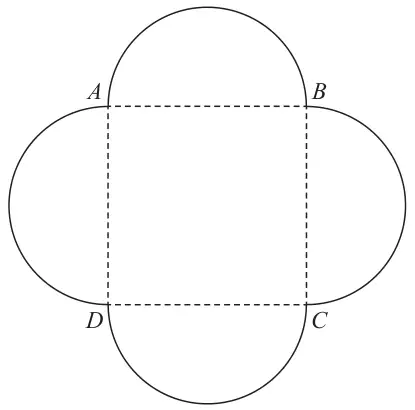
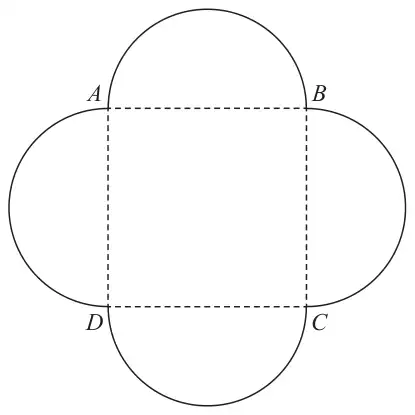
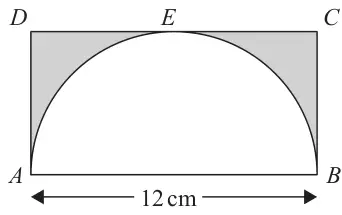
22 The diagram shows a shape made from a square \(ABCD\) and 4 identical semicircles.
Diagram NOT accurately drawn
As shown in the diagram, the semicircles have \(AB\), \(BC\), \(CD\) and \(DA\) as diameters.
The area of the square is 36 cm2
Calculate the total area of the shape.
(4)
Mark scheme
Mark scheme Scheme Marks \(\sqrt{36}\) (= 6) or 6 or 6 × 6 M1 eg \(\pi \times \left(\dfrac{[\text{their } 6]}{2}\right)^2 \div 2\) (= 14.1... or \(4.5\pi\) or \(\dfrac{9}{2}\pi\)) or \(\pi \times \left(\dfrac{[\text{their } 6]}{2}\right)^2\) (= 28.2... or \(9\pi\)) M1 eg 4 × “14.1” (= 56.5... or \(18\pi\)) or 2 × “28.2” (= 56.5... or \(18\pi\)) M1 Working required A1 (4) (4 marks)
Notes M1: for method to find the length of the square – may be seen in later working
M1: for method to find the area of one semicircle or circle or the incorrect number of semicircles or circles provided correct area of circle formula is seen
M1: for a complete method to find the total area of the semicircles ft from previous M1 [if the pupil multiplies again and uses the incorrect number of circles or semicircles this mark is not awarded]
A1: accept 92.4 – 92.6 (not in terms of \(\pi\))
Foundation June 2022 Paper 2 Q21
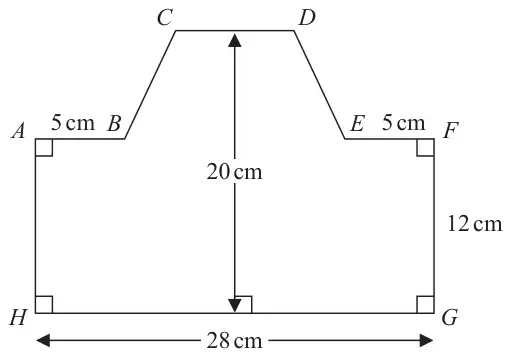
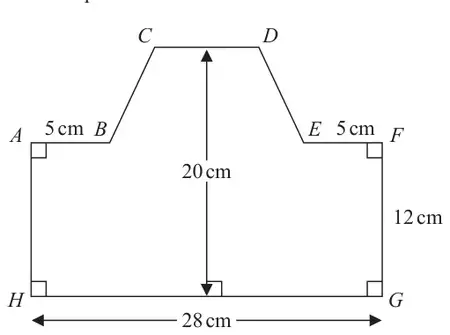
21 The diagram shows an 8-sided shape \(ABCDEFGH\).
Diagram NOT accurately drawn
\(HG = 28\) cm \(FG = 12\) cm \(AB = EF = 5\) cm
The area of shape \(ABCDEFGH\) is 434 cm\(^2\)
Find the length of \(CD\).
(4)
Mark scheme
Mark scheme Scheme Marks 28 × 12 (=336) or 5 × 12 (= 60) or 18 × 12 (= 216)
or
28 × 20 (=560) or \(\dfrac{1}{2}(CD + \text{``}{18}\text{''})\text{``}{8}\text{''}\) oe eg 72 +4\(CD\)
[numbers in “ ” come from correct working]
Check diagram for areas
M1 “336” + 0.5(“18”+ \(CD\))“8” = 434 oe eg
4(“18” + \(CD\)) = 98
or
eg 0.5(“18” + \(CD\))”8” = “98” oe eg \(\dfrac{1}{2}(18 + CD) = 12.25\)
or
\(\text{``}{560}\text{''} - 2\left(0.5(5 + x)\text{``}{8}\text{''}\right) = 434\) oe (where \(x\) is horizontal from \(D\) to perp with \(AF\))
[numbers in “ ” come from correct working]
M1 eg (\(CD\) =) \(\dfrac{196 - 144}{8}\left(= \dfrac{52}{8}\right)\) or (\(CD\) =) \(\dfrac{98 - 72}{4}\left(= \dfrac{26}{4}\right)\)
or (\(CD\) =) \(\dfrac{434 + 152 - 560}{4}\) or (\(CD\) =) 2 × 12.25 – 18 or
98 × 2(= 196), “196” ÷ 8(= 24.5), “24.5” – 18
M1 6.5 A1 (4) (4 marks)
Notes M1: For a correct method to find the area of a rectangle (may be seen as part calculation) or a correct expression for the area of the trapezium with numbers substituted.
M1: correct use of their values from correct working for an equation involving \(CD\) (\(CD\) could be labelled with any letter)
M1: a correct process to solve a correct equation or a correct process to find \(CD\) using correct values
A1: oe
Higher June 2022 Paper 2 Q20
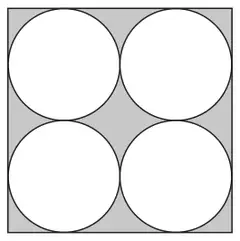
20 The diagram shows four identical circles drawn inside a square.
Diagram NOT accurately drawn
Each circle touches two other circles and two sides of the square.
The region inside the square that is outside the circles, shown shaded in the diagram, has a total area of 40 cm2
Work out the perimeter of the square.
(4)
Mark scheme
Mark scheme Scheme Marks eg \(2d \times 2d - 4 \times \pi \times \left(\dfrac{1}{2}d\right)^2\;(= 40)\) oe or
\(4r \times 4r - 4 \times \pi \times r^2\;(= 40)\) oe or
\(x^2 - 4\pi\left(\dfrac{1}{4}x\right)^2\;(= 40)\) oe or
\(w^2 - \pi\left(\dfrac{1}{2}w\right)^2\;(= 10)\) oe
M1 \(d = \sqrt{\dfrac{40}{4 - \pi}}\) (= 6.826...) or \(2d = \sqrt{\dfrac{160}{4 - \pi}}\) (= 13.652…) oe
\(r = \sqrt{\dfrac{40}{16 - 4\pi}}\) (3.413...) or \(4r = \sqrt{\dfrac{640}{16 - 4\pi}}\) (=13.652...) oe
\(x = \sqrt{\dfrac{40}{1 - 0.25\pi}}\) (13.652…) or \(w = \sqrt{\dfrac{10}{1 - 0.25\pi}}\) (= 6.826…)oe
M1 (perimeter =) M1ft 54.6 A1 (4) (4 marks)
Notes M1: oe a correct expression or a correct equation for the shaded area (must be in one unknown only)
M1: oe a correct expression for \(d\) or \(2d\) or \(r\) or \(4r\) or \(x\) or \(w\)
M1ft: dep on first M1 For substituting values into a calculation for the perimetertheir \(r\), \(d\), \(x\), \(w\)
A1: 54.4 - 54.7
Foundation June 2022 Paper 1 Q15
15 The diagram shows a shape \(ABCDEFG\) made from a square \(ABDF\) and three identical isosceles triangles \(BCD\), \(DEF\) and \(FGA\).
Diagram NOT accurately drawn
The perimeter of the square \(ABDF\) is 48 cm.
Work out the perimeter of the shape \(ABCDEFG\).
(4)
Mark scheme
Mark scheme Scheme Marks 48 ÷ 4 (=12) M1 30 – “48 ÷ 4” (= 18) or 9 M1 3 × “18” + “12” or 6 × “18 ÷ 2” + “12” or M1 66 A1 (4) (4 marks)
Notes M1: could be on diagram
M1: allow 9 on correct side of the triangle on the diagram
M1: for a complete correct method
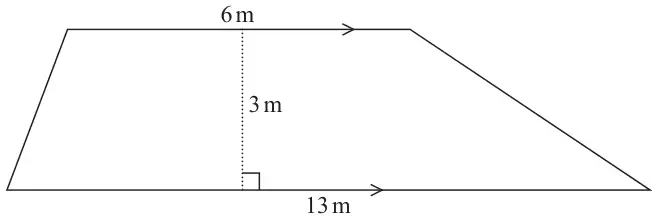
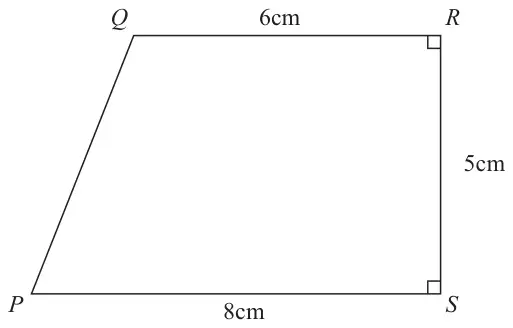
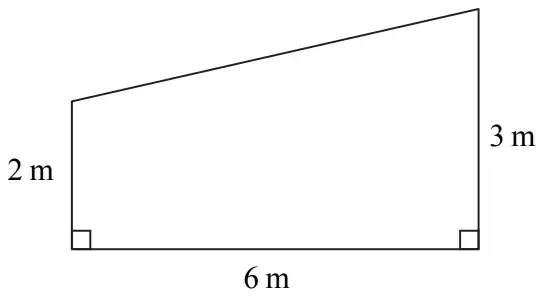
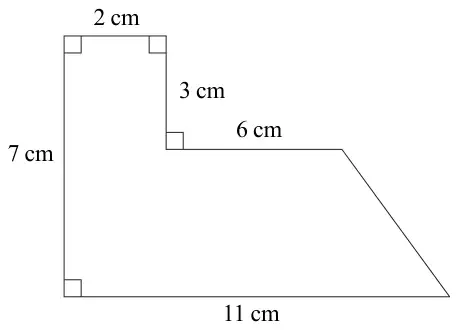
Foundation June 2022 Paper 2R Q13
13 The diagram shows a trapezium.
Diagram NOT accurately drawn
Work out the area of the trapezium.
(2)
Mark scheme
Mark scheme Scheme Marks e.g. 0.5 × (6 + 13) × 3 M1 28.5 A1 (2) (2 marks)
Notes M1: for a complete method
A1: oe
Higher June 2022 Paper 1R Q11
11 The diagram shows a quadrilateral \(ABCD\)
Diagram NOT accurately drawn
In the diagram, \(ABC\) and \(DAC\) are right-angled triangles.
\(BC = 6\) cm \(AC = 7.5\) cm
The area of quadrilateral \(ABCD\) is 31.5 cm2
Work out the length of \(AD\)
(6)
Mark scheme
Mark scheme Scheme Marks (\(AB^2\) =) \(7.5^2 - 6^2\) (= 20.25) or eg
(\(BAC\) =) \(\sin^{-1}\left(\dfrac{6}{7.5}\right)\) (= 53.1…) or \(\cos(BCA) = \dfrac{6}{7.5}\) (= 0.8)
M1 (\(AB\) =) \(\sqrt{7.5^2 - 6^2}\) (= 4.5) or (\(AB\) =) \(\dfrac{6}{\tan \text{``}{53.1}\text{''}}\) (= 4.5…)
or (\(AB\) =) \(7.5\cos \text{``}{53.1}\text{''}\) (= 4.5…) or
(\(BCA\) =) \(\cos^{-1}\left(\dfrac{6}{7.5}\right)\) (= 36.8…)
M1 (Area \(ABC\) =) \(\dfrac{1}{2} \times 6 \times \text{``}{4.5}\text{''}\) (= 13.5)
or (Area \(ABC\) =) \(\dfrac{1}{2} \times 6 \times 7.5 \times \sin(\text{``}{36.8}\text{''})\) (= 13.47… or 13.5)
M1 (Area \(DAC\) =) 31.5 – “13.5” (= 18)or \(\text{``}{13.5}\text{''} + 0.5 \times 7.5 \times AD = 31.5\) oe M1 (\(AD\) =) (“18” ÷ 7.5) ÷ 0.5 oe M1 4.8 A1 (6) (6 marks)
Notes M1: for a correct first step to find \(AB\) or a complete method to find angle \(BAC\) or a correct first step to find angle \(BCA\)
M1: for a complete method to find \(AB\) or angle \(BCA\)
M1: ft [their labelled \(AB\)] or [their labelled \(BCA\)]
eg for \(\dfrac{1}{2} \times 6 \times\) [their labelled \(AB\)] or \(\dfrac{1}{2} \times 6 \times 7.5 \times \sin\)[their labelled \(BCA\)]
M1: ft (dep on previous M1)
M1: for a complete method to find \(AD\), dependent on correct working
A1: accept 4.78 – 4.81
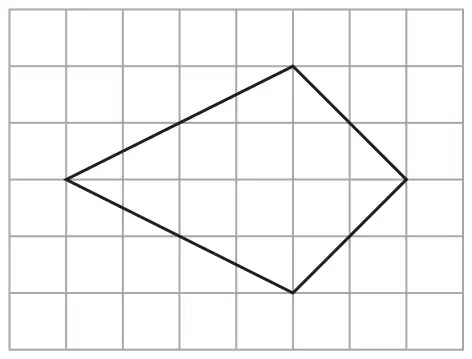
Foundation June 2022 Paper 2 Q10
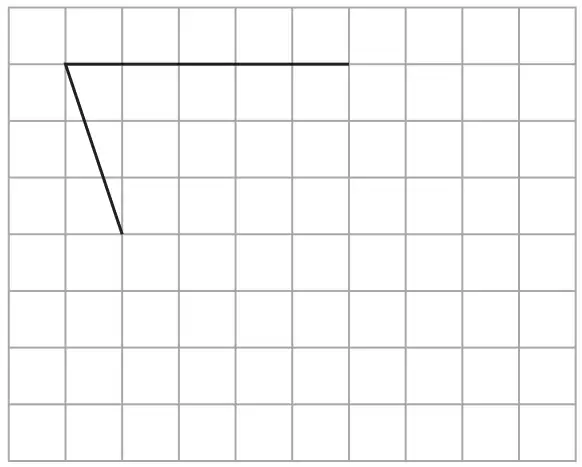
10 The diagram shows a kite drawn on a centimetre grid.
On the centimetre grid below, draw a rectangle that has the same area as the kite.
(3)
Mark scheme
Mark scheme Scheme Marks (Area of kite = )12 B1 M1 A1ft (3) (3 marks)
Notes B1: for a correct area of the kite – may be implied by their diagram
M1: for any rectangle
A1ft: A correct rectangle or ft for a rectangle with their stated area of the kite
Higher June 2022 Paper 2 Q5
5 The diagram shows an 8-sided shape \(ABCDEFGH\).
Diagram NOT accurately drawn
\(HG = 28\) cm \(FG = 12\) cm \(AB = EF = 5\) cm
The area of shape \(ABCDEFGH\) is 434 cm2
Find the length of \(CD\).
(4)
Mark scheme
Mark scheme Scheme Marks 28 × 12 (=336) or 5 × 12 (= 60) or 18 × 12 (= 216)
or
28 × 20 (=560) or \(\dfrac{1}{2}(CD + \text{``}{18}\text{''})\text{``}{8}\text{''}\) oe eg 72 +4\(CD\)
[numbers in “ ” come from correct working]
Check diagram for areas
M1 “336” + 0.5(“18”+ \(CD\))“8” = 434 oe eg
4(“18” + \(CD\)) = 98
or
eg 0.5(“18” + \(CD\))”8” = “98” oe eg \(\dfrac{1}{2}(18 + CD) = 12.25\)
or
\(\text{``}{560}\text{''} - 2\left(0.5(5 + x)\text{``}{8}\text{''}\right) = 434\) oe (where \(x\) is horizontal from \(D\) to perp with \(AF\))
[numbers in “ ” come from correct working]
M1 eg \((CD =)\;\dfrac{196 - 144}{8}\left(= \dfrac{52}{8}\right)\) or \((CD =)\;\dfrac{98 - 72}{4}\left(= \dfrac{26}{4}\right)\)
or \((CD =)\;\dfrac{434 + 152 - 560}{4}\) or \((CD =)\;2 \times 12.25 - 18\) or
\(98 \times 2\,(= 196)\), \(\text{``}{196}\text{''} \div 8\,(= 24.5)\), \(\text{``}{24.5}\text{''} - 18\)
M1 6.5 A1 (4) (4 marks)
Notes M1: For a correct method to find the area of a rectangle (may be seen as part calculation) or a correct expression for the area of the trapezium with numbers substituted.
M1: correct use of their values from correct working for an equation involving \(CD\) (\(CD\) could be labelled with any letter)
M1: a correct process to solve a correct equation or a correct process to find \(CD\) using correct values
A1: oe
Higher June 2022 Paper 2R Q5
5 The diagram shows a shape made from a square \(ABCD\) and 4 identical semicircles.
Diagram NOT accurately drawn
As shown in the diagram, the semicircles have \(AB\), \(BC\), \(CD\) and \(DA\) as diameters.
The area of the square is 36 cm2
Calculate the total area of the shape.
(4)
Mark scheme
Mark scheme Scheme Marks \(\sqrt{36}\;(= 6)\) or 6 or 6 × 6 M1 eg
\(\pi \times \left(\dfrac{[\text{their }6]}{2}\right)^2 \div 2\;\left(= 14.1\ldots\text{ or }4.5\pi\text{ or }\dfrac{9}{2}\pi\right)\)
or \(\pi \times \left(\dfrac{[\text{their }6]}{2}\right)^2\;(= 28.2\ldots\text{ or }9\pi)\)
M1 eg 4 × “14.1” (= 56.5… or \(18\pi\))or 2 × “28.2” (= 56.5… or \(18\pi\)) M1 92.5 A1 (4) (4 marks)
Notes M1: for method to find the length of the square – may be seen in later working
M1: for method to find the area of one semicircle or circle or the incorrect number of semicircles or circles provided correct area of circle formula is seen
M1: ft dep on previous M1
A1: accept 92.4 – 92.6
Foundation June 2022 Paper 2R Q4
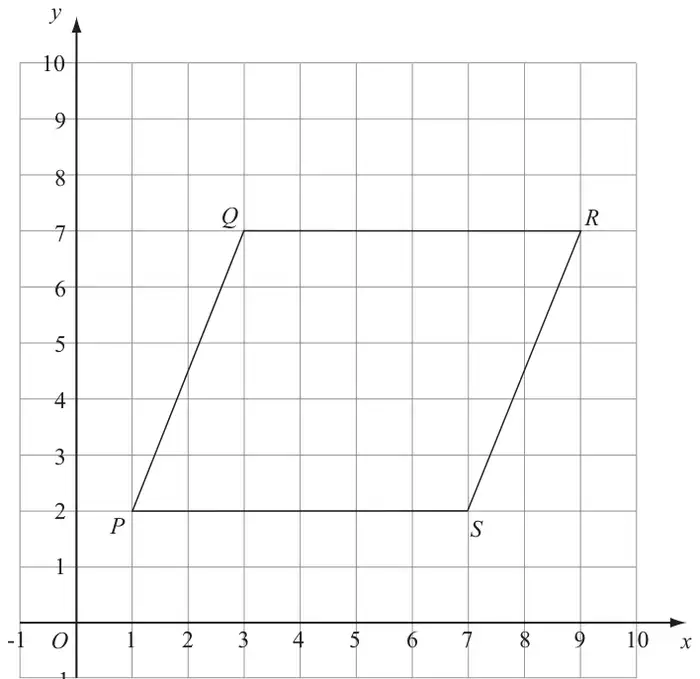
4 Here are two sides of a parallelogram.
(a) On the grid above, complete the parallelogram. (1)
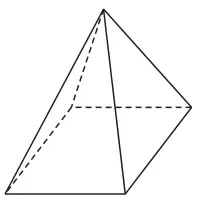
The diagram shows a 3-D shape.
(b) (i) What is the mathematical name of this 3-D shape? (1)
(ii) How many faces has this shape? (1)
Mark scheme (a) Mark scheme (b)
Mark scheme (a) Scheme Marks Parallelogram drawn B1 (1)
Mark scheme (b) Scheme Marks (i) B1 (ii) B1 (2) (3 marks)
Notes B1: accept square based pyramid or rectangular based pyramid
B1: Allow five
Foundation June 2022 Paper 2 Q2
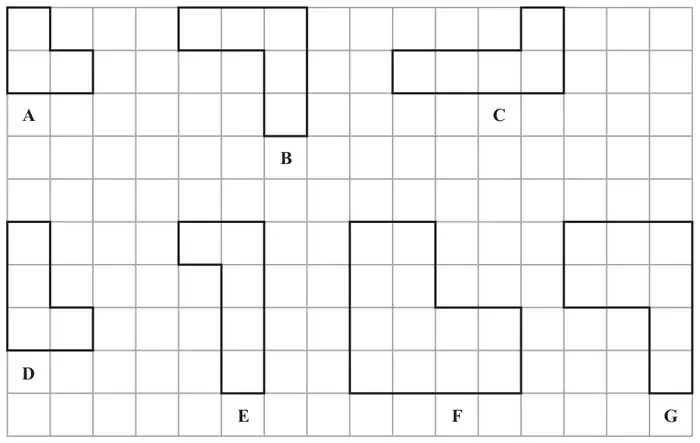
2 Here are seven shapes on a centimetre grid.
(a) Write down the letters of the two shapes that are congruent. (1)
Two of the seven shapes are similar but are not congruent.
(b) Write down the letters of these two shapes. (1)
Shape F has exactly one line of symmetry.
(c) On shape F on the grid, draw this line of symmetry. (1)
(d) Work out the perimeter of shape B . (1)
(e) Work out the area of shape G . (1)
Mark scheme (a) Mark scheme (b) Mark scheme (c) Mark scheme (d) Mark scheme (e)
Mark scheme (a) Notes B1: accept E and C as order does not matter
Mark scheme (b) Notes B1: accept F and A as order does not matter
Mark scheme (c) Scheme Marks B1 (1)
Notes B1: correct line with no other lines
Mark scheme (d) Mark scheme (e) Scheme Marks 8 B1 (1) (5 marks)
Foundation January 2022 Paper 1 Q24
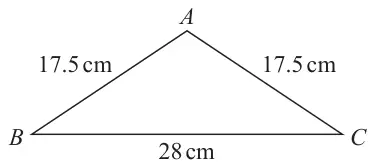
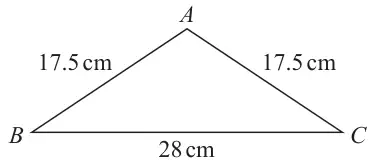
24 The diagram shows isosceles triangle \(ABC\)
Diagram NOT accurately drawn
\(AB = AC = 17.5\) cm \(\qquad\) \(BC = 28\) cm
Calculate the area of triangle \(ABC\)
(4)
Mark scheme
Mark scheme Scheme Marks \(17.5^2 - 14^2\) (= 110.25) M1 \(\sqrt{17.5^2 - 14^2}\) (= 10.5) M1 0.5 × 28 × “10.5” oe M1 147 A1 (4) (4 marks)
Notes M1: or for use of cosine rule to find one of the angles
eg \(28^2 = 17.5^2 + 17.5^2 - 2 \times 17.5 \times 17.5 \times \cos A\)
or eg \(\cos B = \dfrac{14}{17.5}\)
M1: or for rearranging the cosine rule to
eg \(\cos A = \dfrac{17.5^2 + 17.5^2 - 28^2}{2 \times 17.5 \times 17.5}\) (\(A\) = 106.26...)
or eg \(B = \cos^{-1}\left(\dfrac{14}{17.5}\right)\) (= 36.86...)
M1: or for 0.5 × 17.5 × 17.5 × sin106.26... oe
eg 0.5 × 17.5 × 28 × sin36.86...
[clear use of Heron’s formula:
M1 for S = 0.5(17.5 + 17.5 + 28) (= 31.5)
M2 for \(\sqrt{\text{“}31.5\text{”}(\text{“}31.5\text{”} - 17.5)^2(\text{“}31.5\text{”} - 28)}\) oe]
A1: accept awrt 147
Foundation January 2022 Paper 1R Q17
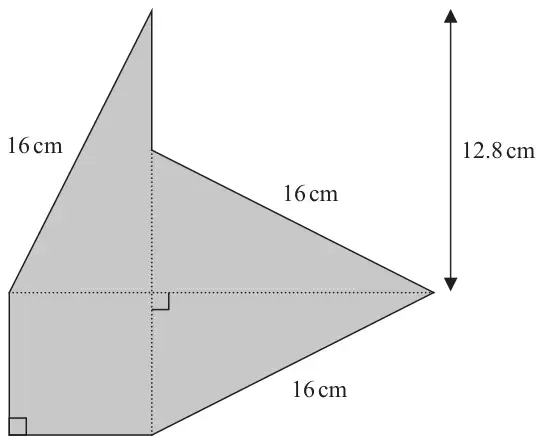
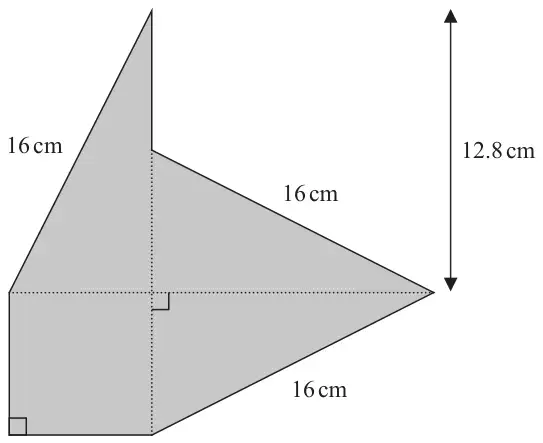
17 The shaded shape is made using three identical right-angled triangles and a square.
Diagram NOT accurately drawn
Work out the perimeter of the shaded shape.
(4)
Mark scheme
Mark scheme Scheme Marks \(12.8^2 + x^2 = 16^2\) oe or M1 \((x =)\sqrt{16^2 - 12.8^2}\; (= \sqrt{92.16})\) (= 9.6) or
\((x =)\sqrt{256 - 163.84}\; (= \sqrt{92.16})\) (= 9.6)
M1 (12.8 – “9.6”) + “9.6” + “9.6” + 16 + 16 + 16 oe M1 70.4 A1 (4) (4 marks)
Notes M1: for applying Pythagoras theorem correctly
Allow \(\cos^{-1}\left(\dfrac{12.8}{16}\right)(= 36.9\ldots)\) and \(\dfrac{x}{\sin(36.9\ldots)} = \dfrac{16}{(\sin 90)}\)
M1: for square rooting
Allow \(x = \dfrac{16}{(\sin 90)} \times \sin(36.9\ldots)\)
M1: (dep on M1) for a complete method to find the perimeter
A1: oe e.g. \(\dfrac{352}{5}\)
Foundation January 2022 Paper 1 Q13
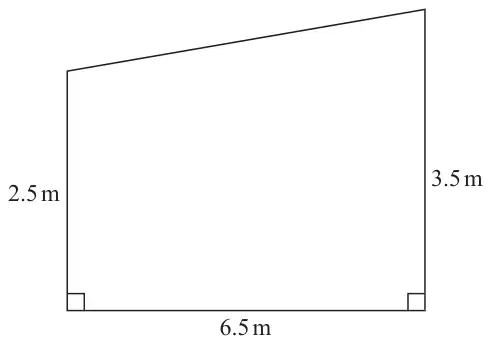
13 The diagram shows a classroom wall in the shape of a trapezium.
Diagram NOT accurately drawn
Dion wants to paint the classroom wall completely twice.2
He is going to have to buy all the paint he needs.
Work out the least number of tins of paint that Dion will need to buy.
(4)
Mark scheme
Mark scheme Scheme Marks eg 2.5 × 6.5 (= 16.25)or 0.5 × 6.5 × 1 (= 3.25)or 3.5 × 6.5 (= 22.75) M1 2.5 × 6.5 + 0.5 × 6.5 × 1 (= 19.5)or 2 × (2.5 × 6.5 + 0.5 × 6.5 × 1) (= 39)or 3.5 × 6.5 – 0.5 × 6.5 × 1 (= 19.5)or 2 × (3.5 × 6.5 – 0.5 × 6.5 × 1) (= 39) M1 2 × “19.5” ÷ 12 (= 3.25)or “39” ÷ 12 (= 3.25)or 12 + 12 + 12 + 12 (= 48)or 4 × 12 (= 48) M1 Working required A1 (4) (4 marks)
Notes M1: M2 foror
M1: or [their area] ÷ 12 (dep on M1)or using multiples of 12 for [their area]and 12 + 12 (= 24) or 2 × 12 (= 24)
A1: dep on M2, must be from correct working
Higher January 2022 Paper 1 Q9
9 The diagram shows isosceles triangle \(ABC\)
Diagram NOT accurately drawn
\(AB = AC = 17.5\) cm \(BC = 28\) cm
Calculate the area of triangle \(ABC\)
(4)
Mark scheme
Mark scheme Scheme Marks \(17.5^2 - 14^2\) (= 110.25) M1 \(\sqrt{17.5^2 - 14^2}\) (= 10.5) M1 0.5 × 28 × “10.5” oe M1 147 A1 (4) (4 marks)
Notes M1: or for use of cosine rule to find one of the angles eg \(28^2 = 17.5^2 + 17.5^2 - 2 \times 17.5 \times 17.5 \times \cos A\)
or eg \(\cos B = \dfrac{14}{17.5}\)
M1: or for rearranging the cosine rule to eg \(\cos A = \dfrac{17.5^2 + 17.5^2 - 28^2}{2 \times 17.5 \times 17.5}\) (\(A\) = 106.26…)
or eg \(B = \cos^{-1}\left(\dfrac{14}{17.5}\right)\) (= 36.86…)
M1: or for 0.5 × 17.5 × 17.5 × sin106.26… oe
eg 0.5 × 17.5 × 28 × sin36.86…
[clear use of Heron’s formula:
M1 for S = 0.5(17.5 + 17.5 + 28)(=31.5)
M2 for \(\sqrt{\text{``}{31.5}\text{''}(\text{``}{31.5}\text{''} - 17.5)^2(\text{``}{31.5}\text{''} - 28)}\) oe]
A1: accept awrt 147
Foundation January 2022 Paper 2R Q6
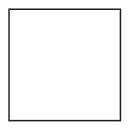
6 Here is a square.
Diagram NOT accurately drawn
The perimeter of the square is 24 cm.
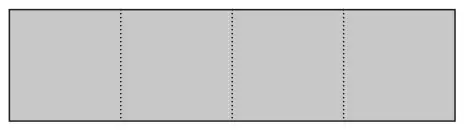
The shaded rectangle below is made from 4 of these squares.
Diagram NOT accurately drawn
Work out the perimeter of the shaded rectangle.
(3)
Mark scheme
Mark scheme Scheme Marks 24 ÷ 4 (= 6) or width = 24 M1 10 × ‘6’ oe or M1 60 A1 (3) (3 marks)
Notes M1: Could be clearly shown on diagram.
M1: dep M1
A1: SC if no other marks scored B1 for 24 × 4 (= 96)
Higher January 2022 Paper 1R Q3
3 The shaded shape is made using three identical right-angled triangles and a square.
Diagram NOT accurately drawn
Work out the perimeter of the shaded shape.
(4)
Mark scheme
Mark scheme Scheme Marks \(12.8^2 + x^2 = 16^2\) oe or M1 \((x =)\ \sqrt{16^2 - 12.8^2}\ (= \sqrt{92.16})\ (= 9.6)\) or
\((x =)\ \sqrt{256 - 163.84}\ (= \sqrt{92.16})\ (= 9.6)\)
M1 (12.8 – “9.6”) + “9.6” + “9.6” + 16 + 16 + 16 oe M1 70.4 A1 (4) (4 marks)
Notes M1: for applying Pythagoras theorem correctly
Allow \(\cos^{-1}\left(\dfrac{12.8}{16}\right)(= 36.9\ldots)\) and \(\dfrac{x}{\sin(36.9\ldots)} = \dfrac{16}{(\sin 90)}\)
M1: for square rooting
Allow \(x = \dfrac{16}{(\sin 90)} \times \sin(36.9\ldots)\)
M1: (dep on M1) for a complete method to find the perimeter
A1: oe e.g. \(\dfrac{352}{5}\)
Foundation November 2021 Paper 1 Q16
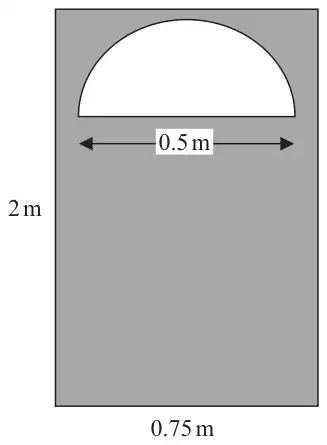
16 The diagram shows the front of a wooden door with a semicircular glass window.
Diagram NOT accurately drawn
Julie wants to apply 2 coats of wood varnish to the front of the door, shown shaded in the diagram.
250 millilitres of wood varnish covers 4 m2 of the wood.
Work out how many millilitres of wood varnish Julie will need.
(5)
Mark scheme
Mark scheme Scheme Marks 2 × 0.75 (= 1.5) oe or 2 × 0.75 × 2 (= 3) oe M1 \(\pi \times (0.5 \div 2)^2\ (= 0.1963)\) or
\(\dfrac{1}{2} \times \pi \times (0.5 \div 2)^2\ (= 0.09817)\)
M1 “1.5” – “0.09817” (= 1.4018…) or M1 “1.4018” × 2 × 250 ÷ 4 (= 175.228…) or M1 Correct answer scores full marks (unless from obvious incorrect working) A1 (5) (5 marks)
Notes M1: for area of rectangle
M1: for area of circle or area of semicircle
M1: or for 87 – 88
A1: Allow 175 – 176
Foundation November 2021 Paper 1 Q9
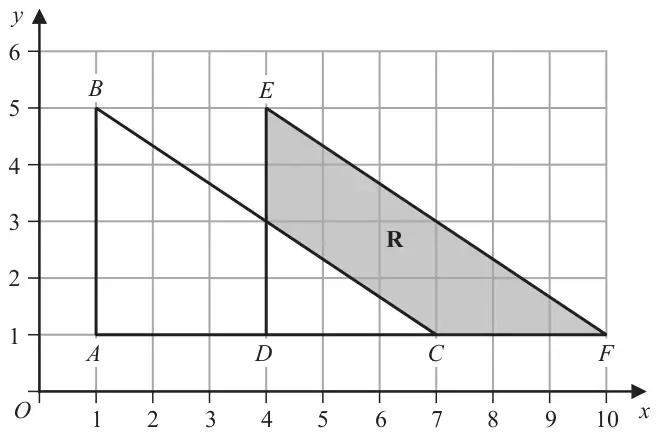
9 The diagram shows two congruent triangles, \(ABC\) and \(DEF\), drawn on a centimetre grid.
Find the area of the region R , shown shaded in the diagram.
(3)
Mark scheme
Mark scheme Scheme Marks (0.5 × 4 × 6) – (0.5 × 2 × 3) M2 9 A1 (3) (3 marks)
Notes M2: if not M2 then M1 for either 0.5 × 4 × 6 (= 12) or 0.5 × 2 × 3 (= 3)
Higher November 2021 Paper 1 Q4
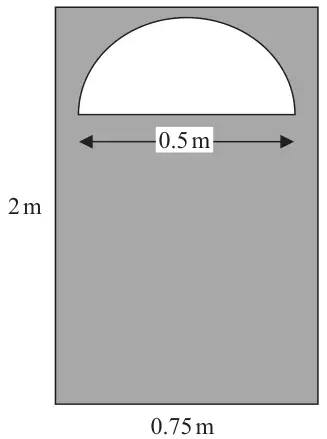
4 The diagram shows the front of a wooden door with a semicircular glass window.
Diagram NOT accurately drawn
Julie wants to apply 2 coats of wood varnish to the front of the door, shown shaded in the diagram.
250 millilitres of wood varnish covers 4 m2 of the wood.
Work out how many millilitres of wood varnish Julie will need.
(5)
Mark scheme
Mark scheme Scheme Marks 2 × 0.75 (= 1.5) oe or 2 × 0.75 × 2 (= 3) oe M1 \(\pi \times (0.5 \div 2)^2\ (= 0.1963)\) or
\(\dfrac{1}{2} \times \pi \times (0.5 \div 2)^2\ (= 0.09817)\)
M1 “1.5” – “0.09817” (= 1.4018…) or M1 “1.4018” × 2 × 250 ÷ 4 (= 175.228…) or M1 Correct answer scores full marks (unless from obvious incorrect working) A1 (5) (5 marks)
Notes M1: for area of rectangle
M1: for area of circle or area of semicircle
M1: or for 87 – 88
A1: Allow 175 – 176
Foundation June 2021 Paper 1 Q18
18
Diagram NOT accurately drawn
The diagram shows the shape \(ABCDE\).
The area of the shape is 91.8 cm2
Work out the value of \(x\).
(4)
Mark scheme
Mark scheme Scheme Marks \(8 \times x\ (= 8x)\) or \(14 \times x\ (= 14x)\) or \((14 - 8) \times x\ (= 6x)\) or
\(\tfrac{1}{2} \times (14 - 8) \times (13 - x)\ (= 39 - 3x)\) or
\(\dfrac{13 + x}{2} \times (14 - 8)\ (= 39 + 3x)\)
or \(\tfrac{1}{2} \times 13 \times (14 - 8)\ (= 39)\) or \(\dfrac{8 + 14}{2} \times x\ (= 11x)\)
or \(14 \times 13\ (= 182)\) or \(8 \times (13 - x)\ (= 104 - 8x)\)
or \(\left(\dfrac{8 + 14}{2} \times (13 - x)\right)\ (= 143 - 11x)\) oe
M1 \(14x + 6 \times \tfrac{1}{2} \times (13 - x)\) oe eg \(8x + \dfrac{x + 13}{2} \times 6\)
or \(\dfrac{8 + 14}{2} \times x + \dfrac{13 \times (14 - 8)}{2}\)
or \(\text{“}182\text{”} - \left(\dfrac{8 + 14}{2} \times (13 - x)\right)\) or \(11x + 39\) oe
M1 eg \(11x + 39 = 91.8\) or \(14x + 39 - 3x = 91.8\) or M1 Working not required, so correct answer scores full marks (unless from obvious incorrect working) A1 (4) (4 marks)
Notes M1: one correct area linked to the shape
M1: ft from correct working expression for total area of shape – with no parts omitted or duplicatedor Large rectangle subtracting trapezium (or subtracting (rectangle + triangle))
M1: fully correct equation with no fractions (allow 91.8 or multiples of 91.8 but no other decimals) and no brackets
A1: or \(4\dfrac{4}{5}\) oe or \(\dfrac{24}{5}\) oe
Foundation June 2021 Paper 1 Q7
7 The diagram shows a rectangle and a square.
Diagram NOT accurately drawn
The perimeter of the rectangle is equal to the perimeter of the square.
Work out by how much the area of the rectangle is less than the area of the square.
(4)
Mark scheme
Mark scheme Scheme Marks [perimeter =] 10 + 6 + 10 + 6 (= 32) or or M1 [area =] 10 × 6 (= 60) M1 \((\text{“}32\text{”} \div 4)^2 - \text{‘}60\text{’}\) or M1 Working not required, so correct answer scores full marks (unless from obvious incorrect working eg a wrong conversion) A1 (4) (4 marks)
Notes M1: for perimeter or semi perimeter of rectangle
M1: (indep) for area of rectangle
M1: for a completely correct method
Higher June 2021 Paper 1 Q3
3
Diagram NOT accurately drawn
The diagram shows the shape \(ABCDE\).
The area of the shape is 91.8 cm2
Work out the value of \(x\).
(4)
Mark scheme
Mark scheme Scheme Marks \(8 \times x\ (= 8x)\) or \(14 \times x\ (= 14x)\) or \((14 - 8) \times x\ (= 6x)\)
or \(\tfrac{1}{2} \times (14 - 8) \times (13 - x)\ (= 39 - 3x)\)
or \(\dfrac{13 + x}{2} \times (14 - 8)\ (= 39 + 3x)\)
or \(\tfrac{1}{2} \times 13 \times (14 - 8)\ (= 39)\) or \(\dfrac{8 + 14}{2} \times x\ (= 11x)\)
or \(14 \times 13\ (= 182)\) or \(8 \times (13 - x)\ (= 104 - 8x)\)
or \(\left(\dfrac{8 + 14}{2} \times (13 - x)\right)\ (= 143 - 11x)\) oe
M1 \(14x + 6 \times \tfrac{1}{2} \times (13 - x)\) oe eg \(8x + \dfrac{x + 13}{2} \times 6\)
or \(\dfrac{8 + 14}{2} \times x + \dfrac{13 \times (14 - 8)}{2}\)
or \(\text{“182”} - \left(\dfrac{8 + 14}{2} \times (13 - x)\right)\) or \(11x + 39\) oe
M1 eg \(11x + 39 = 91.8\) or \(14x + 39 - 3x = 91.8\)or \(182 - 143 + 11x = 91.8\)or \(16x + 6x + 78 = 183.6\) oe M1 Working not required, so correct answer scores full marks (unless from obvious incorrect working) A1 (4) (4 marks)
Notes M1: one correct area linked to the shape
M1: ft from correct working expression for total area of shape – with no parts omitted or duplicatedor large rectangle subtracting trapezium (or subtracting (rectangle + triangle))
M1: fully correct equation with no fractions (allow 91.8 or multiples of 91.8 but no other decimals) and no brackets
A1: or \(4\dfrac{4}{5}\) oe or \(\dfrac{24}{5}\) oe
Foundation January 2021 Paper 1R Q25
25 The diagram shows one face of a wall.
Diagram NOT accurately drawn
Omondi is going to paint this face of the wall once.
The paint in each tin of paint Omondi is going to buy will cover 16 m2 of the face of the wall.
Work out the least number of tins of paint Omondi will need to buy.
(5)
Mark scheme
Mark scheme Scheme Marks \(7^2 - (10 \div 2)^2\) (= 24) or \(\dfrac{\sin\left(\frac{1}{2}x\right)}{5} = \dfrac{\sin 90}{7}\) oe or
\(\cos x = \dfrac{7^2 + 7^2 - 10^2}{2 \times 7 \times 7}\) oe or \(\sin\left(\dfrac{1}{2}x\right) = \dfrac{5}{7}\) oe or \(\cos y = \dfrac{5}{7}\) oe
M1 \(\sqrt{7^2 - (10 \div 2)^2}\) (\(= \sqrt{24} = 2\sqrt{6}\) = 4.898...) or
(\(x\) =) \(2 \times \sin^{-1}\left(\dfrac{5 \times \sin 90}{7}\right)\) (= 91.169…) oe or
(\(x\) =) \(2 \times \sin^{-1}\left(\dfrac{5}{7}\right)\) (= 91.169…) oe or
(\(x\) =) \(\cos^{-1}\left(\dfrac{7^2 + 7^2 - 10^2}{2 \times 7 \times 7}\right)\) (= 91.169…) oe or
(\(x\) =) \(2\left(90 - \cos^{-1}\left(\dfrac{5}{7}\right)\right)\) (= 2(90 – 44.415)... = 91.169...)
Allow 5 from correct working
M1 E.g.
\(6 \times 10 + \dfrac{(10 \div 2) \times \text{‘}\sqrt{24}\text{’}}{2} \times 2\) (\(= 60 + 10\sqrt{6}\) = 84.494...) or
\(5 \times (6 + 6 + \text{‘}\sqrt{24}\text{’})\) (\(= 60 + 10\sqrt{6}\) = 84.494...) or
\(\left(\dfrac{1}{2} \times 7 \times 7 \times \sin \text{‘91.169...’} + 10 \times 6\right)\) (\(= 60 + 10\sqrt{6}\) = 84.494...)
M1 E.g.
‘84.494’ ÷ 16 (= 5.28...) or \((60 + 10\sqrt{6}) \div 16\) (= 5.28...)
M1 Working required A1 (5) (5 marks)
Notes M1: or use of sine rule or cosine rule to find angle (\(x\)) of the apex or angle \(y\) \(\left(= 90 - \dfrac{1}{2}x\right)\)
M1: for complete method to find height of triangle or the angle (\(x\)) of the apex
\(\cos^{-1}\left(\dfrac{5}{7}\right)\) (= 44.415...) and
\(5 \times \tan\) ‘44.415...’ (= 4.898...) or \(7 \times \sin\) ‘44.415...’ (= 4.898...)
or
\(\sin^{-1}\left(\dfrac{5}{7}\right)\) (= 45.584...) and
\(\dfrac{5}{\tan \text{‘45.584...’}}\) (= 4.898...) or \(7 \times \cos\) ‘45.584...’ (= 4.898...)
M1: for method to find the total area of the pentagon allow answers in the range 84.49 – 85
M1: for method to find the number of tins required using their area
A1: dep on at least M2
Higher January 2021 Paper 2 Q20
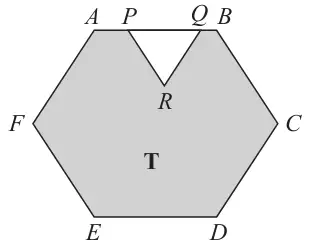
20
Diagram NOT accurately drawn
The diagram shows a shaded region T formed by removing an equilateral triangle \(PQR\) from a regular hexagon \(ABCDEF\).
The points \(P\) and \(Q\) lie on \(AB\) such that \(AB = 1.5 \times PQ\)
Given that the area of region T is \(72\sqrt{3}\) cm2
work out the length of \(PQ\).
(4)
Mark scheme
Mark scheme Scheme Marks eg \(0.5 \times x \times x \times \sin 60\;\left(= \dfrac{\sqrt{3}}{4}x^2 = 0.433...x^2\right)\) oe where \(x = PQ\)
eg \(0.5 \times 2n \times 2n \times \sin 60\;\left(= \sqrt{3}n^2 = 1.732...n^2\right)\) oe where \(2n = PQ\)
or use \(0.5 \times b \times h\) where \(h = \sqrt{x^2 - (0.5x)^2}\;\left(= \dfrac{\sqrt{3}}{2}x\right)\) oe
M1 eg \(6 \times 0.5 \times 1.5x \times 1.5x \times \sin 60\;\left(= \dfrac{27\sqrt{3}}{8}x^2 = 5.845...x^2\right)\) oe
eg \(6 \times 0.5 \times 3n \times 3n \times \sin 60\;\left(= \dfrac{27\sqrt{3}}{2}n^2 = 23.382...n^2\right)\) oe or
eg \(2\left(\dfrac{1}{2} \times 1.5x \times 1.5x \times \sin 120\right) + 1.5x \times AE\) where
\(AE = \sqrt{(1.5x)^2 + (1.5x)^2 - 2 \times 1.5x \times 1.5x \times \cos 120}\)
\(\left(= \dfrac{27\sqrt{3}}{8}x^2 = 5.845...x^2\right)\) or use of \(6 \times 0.5 \times b \times h\), finding \(h\) by Pythagoras
M1 eg \(6 \times 0.5 \times 1.5x \times 1.5x \times \sin 60 - 0.5 \times x \times x \times \sin 60 = 72\sqrt{3}\) oe or
\(\left(\dfrac{27\sqrt{3}}{8} - \dfrac{\sqrt{3}}{4}\right)x^2 = 72\sqrt{3}\) or (5.845… – 0.433…)\(x^2\) = 124.7… or
eg \(6 \times 0.5 \times 3n \times 3n \times \sin 60 - 0.5 \times 2n \times 2n \times \sin 60 = 72\sqrt{3}\) oe
\(\left(\dfrac{27\sqrt{3}}{2} - \sqrt{3}\right)n^2 = 72\sqrt{3}\) or (23.382… – 1.732…)\(n^2\) = 124.7…
M1 Correct answer scores full marks (unless from obvious incorrect working) A1 (4) (4 marks)
Notes M1: For expression for area of triangle
[using \(AB = x\) and \(PQ = \dfrac{2}{3}x\) gives \(\dfrac{\sqrt{3}}{9}x^2 = 0.192...x^2\)] (correct expression in 1 variable eg \(PQ\))
M1: for expression for area of hexagon
[using \(AB = x\) and \(PQ = \dfrac{2}{3}x\) gives \(\dfrac{3\sqrt{3}}{2}x^2 = 2.598...x^2\)]
(correct expression in 1 variable eg \(AB\))
M1: for a correct equation for shaded area
Foundation January 2021 Paper 2 Q14
14 The diagram shows a trapezium.
Diagram NOT accurately drawn
(a) Work out the area of the trapezium. (2)
The diagram shows a cuboid.
Diagram NOT accurately drawn
The volume of the cuboid is 806 cm3
(b) Work out the value of \(x\). (3)
Mark scheme (a) Mark scheme (b)
Mark scheme (a) Scheme Marks 0.5 × (13.5 + 17) × 10.4 M1 158.6 A1 (2)
Notes M1: for a complete method eg rectangle ±2 triangles
A1: allow 159
Mark scheme (b) Scheme Marks 15.5 × 8 (=124) or 15.5 × 8 × \(x\) M1 806 ÷ “124” M1 dep 6.5 A1 (3) (5 marks)
Foundation January 2021 Paper 2R Q12
12 The diagram shows a rectangle \(ABCD\) and a semicircle with diameter \(AB\) where \(AB\) = 12 cm. The point \(E\) lies on \(DC\) and also on the semicircle.
Diagram NOT accurately drawn
Work out the area of the shaded region.
(3)
Mark scheme
Mark scheme Scheme Marks \(0.5 \times \pi \times 6^2\) (= 56.54…) or 12 × 6 (= 72)or \(\pi \times 6^2\) oe M1 “72” – “56.54…” M1 15.5 A1 (3) (3 marks)
Notes M1: dep M1 for a complete method
A1: 15.4 to 15.5
Higher January 2021 Paper 1R Q10
10 The diagram shows one face of a wall.
Diagram NOT accurately drawn
Omondi is going to paint this face of the wall once.
The paint in each tin of paint Omondi is going to buy will cover 16 m2 of the face of the wall.
Work out the least number of tins of paint Omondi will need to buy.
(5)
Mark scheme
Mark scheme Scheme Marks \(7^2 - (10 \div 2)^2\;(= 24)\) or \(\dfrac{\sin\left(\frac{1}{2}x\right)}{5} = \dfrac{\sin 90}{7}\) oe or
\(\cos x = \dfrac{7^2 + 7^2 - 10^2}{2 \times 7 \times 7}\) oe or \(\sin\left(\dfrac{1}{2}x\right) = \dfrac{5}{7}\) oe or \(\cos y = \dfrac{5}{7}\) oe
M1 \(\sqrt{7^2 - (10 \div 2)^2}\;(= \sqrt{24} = 2\sqrt{6} = 4.898\ldots)\) or
\((x =)\; 2 \times \sin^{-1}\left(\dfrac{5 \times \sin 90}{7}\right)\;(= 91.169\ldots)\) oe or
\((x =)\; 2 \times \sin^{-1}\left(\dfrac{5}{7}\right)\;(= 91.169\ldots)\) oe or
\((x =)\; \cos^{-1}\left(\dfrac{7^2 + 7^2 - 10^2}{2 \times 7 \times 7}\right)\;(= 91.169\ldots)\) oe or
\((x =)\; 2\left(90 - \cos^{-1}\left(\dfrac{5}{7}\right)\right)\;(= 2(90 - 44.415)\ldots = 91.169\ldots)\)
Allow 5 from correct working
M1 E.g.
\(6 \times 10 + \dfrac{(10 \div 2) \times \text{‘}\sqrt{24}\text{’}}{2} \times 2\;(= 60 + 10\sqrt{6} = 84.494\ldots)\) or
\(5 \times (6 + 6 + \text{‘}\sqrt{24}\text{’})\;(= 60 + 10\sqrt{6} = 84.494\ldots)\) or
\(\left(\dfrac{1}{2} \times 7 \times 7 \times \sin \text{‘}91.169\ldots\text{’} + 10 \times 6\right)\;(= 60 + 10\sqrt{6} = 84.494\ldots)\)
M1 E.g.
‘84.494’ ÷ 16 (= 5.28...) or \(\left(60 + 10\sqrt{6}\right) \div 16\;(= 5.28\ldots)\)
M1 Working required A1 (5) (5 marks)
Notes M1: or use of sine rule or cosine rule to find angle (\(x\)) of the apex or angle \(y\) \(\left(= 90 - \dfrac{1}{2}x\right)\)
M1: for complete method to find height of triangle or the angle (\(x\)) of the apex
\(\cos^{-1}\left(\dfrac{5}{7}\right)\;(= 44.415\ldots)\) and
\(5 \times \tan \text{‘}44.415\ldots\text{’}\;(= 4.898\ldots)\) or
\(7 \times \sin \text{‘}44.415\ldots\text{’}\;(= 4.898\ldots)\)
or
\(\sin^{-1}\left(\dfrac{5}{7}\right)\;(= 45.584\ldots)\) and
\(\dfrac{5}{\tan \text{‘}45.584\ldots\text{’}}\;(= 4.898\ldots)\) or
\(7 \times \cos \text{‘}45.584\ldots\text{’}\;(= 4.898\ldots)\)
M1: for method to find the total area of the pentagon allow answers in the range 84.49 – 85
M1: for method to find the number of tins required using their area
A1: dep on at least M2
Higher January 2021 Paper 2R Q2
2 The diagram shows a rectangle \(ABCD\) and a semicircle with diameter \(AB\) where \(AB = 12\) cm. The point \(E\) lies on \(DC\) and also on the semicircle.
Diagram NOT accurately drawn
Work out the area of the shaded region.
(3)
Mark scheme
Mark scheme Scheme Marks \(0.5 \times \pi \times 6^2\;(= 56.54\ldots)\) or 12 × 6 (= 72)or \(\pi \times 6^2\) oe M1 “72” – “56.54…” M1 Correct answer scores full marks (unless from obvious incorrect working) A1 (3) (3 marks)
Notes M1: dep M1 for a complete method
A1: 15.4 to 15.5
Foundation November 2020 Paper 2 Q23
23 The diagram shows an isosceles triangle.
Diagram NOT accurately drawn
Work out the area of the triangle.
(4)
Mark scheme
Mark scheme Scheme Marks \(8.5^2 - (8 \div 2)^2\) (= 56.25) or \(\cos x = \dfrac{4}{8.5}\) M1 \(\sqrt{\text{“56.25”}}\) (= 7.5) or \(x = \cos^{-1}\left(\dfrac{4}{8.5}\right)\) (= 61.927...) M1 8 × “7.5” ÷ 2 oe or 0.5 × 8 × 8.5 × sin “61.927...” M1 30 A1 (4) (4 marks)
Notes M1: or eg \(\cos A = \dfrac{8^2 + 8.5^2 - 8.5^2}{2 \times 8 \times 8.5}\)
M1: or eg (\(A\) =) \(\cos^{-1}\left(\dfrac{8^2 + 8.5^2 - 8.5^2}{2 \times 8 \times 8.5}\right)\) (61.927...)
(other angle = 56.144...)
M1: or eg 0.5 × 8.5 × 8 × sin61.927...oe
Higher November 2020 Paper 1R Q22
22 The diagram shows a regular octagon \(ABCDEFGH\).
Diagram NOT accurately drawn
Each side of the octagon has length 10 cm.
Find the area of the shaded region \(ACDEH\).
(6)
Mark scheme
Mark scheme Scheme Marks Ext angle of octagon = 360 ÷ 8 (= 45)or Int angle of octagon (8 − 2) × 180 ÷ 8 oe (= 135) M1 e.g. 10 + 2 × 10 × sin45 (= \(10 + 10\sqrt{2}\) or 24.1...)
or e.g. \(\dfrac{10\sin 112.5}{\sin 22.5}\) (= 24.1…)
M1 e.g. 10 × (“\(10 + 10\sqrt{2}\)”) (= 100 + \(100\sqrt{2}\) or 241.4...)
or 10 × “24.1…” (= 241.4…)
M1 e.g. 10 × sin45° (= \(5\sqrt{2}\) or 7.07...)
or e.g. \(\sqrt{10^2 + 10^2 - 2 \times 10 \times 10 \times \cos\text{“}{135}\text{”}}\) (= 18.4…)
or \(\dfrac{10\sin\text{“}{135}\text{”}}{\sin 22.5}\) (= 18.4…)
M1 e.g. 0.5 × “24.1...” × “7.07…” (= 85.3...)or \(0.5 \times 10 \times \text{“}{18.4\ldots}\text{”} \times \sin 112.5\) (= 85.3…) M1 327 A1 (6) (6 marks)
Notes M1: for method to find the size of one exterior or one interior angle of a regular octagon
M1: method to find \(HE\) or \(AD\)
M1: area \(ADEH\)
M1: finds perpendicular height of triangle \(ACD\) (may be found before, but must realise this is also height of triangle) or finds the length of \(AC\)
M1: finds the area of triangle \(ACD\)
A1: accept 326 – 327
Alternative (splitting octagon into triangles and subtracting trapezium and triangle) Scheme Marks Ext angle of octagon = 360 ÷ 8 (= 45)or Int angle of octagon (8 − 2) × 180 ÷ 8 oe (= 135)or one of 8 angles at centre = 360 ÷ 8 (= 45) M1 e.g. 0.5 × 10 × 5 × tan67.5 (= 60.35...)
or \(0.5 \times \left(\dfrac{10\sin 67.5}{\sin 45}\right)^2 \times \sin 45 (= 60.35\ldots)\)
or Octagon = 8 × “60.35” (= 482.8...)
M1 e.g. 10 + 2 × 10 × sin45° (= \(10 + 10\sqrt{2}\) = 24.14..) M1 0.5 × (10 + \(10 + 10\sqrt{2}\)) × \(5\sqrt{2}\) (= 120.71...) M1 0.5 × 10 × 10 × sin135° (= 35.35...) M1 327 A1
Notes M1: for method to find the size of one exterior or one interior angle of a regular octagon or method to find one angle at centre of octagon when split into 8 equal triangles
M1: Area of one triangle (one-eighth of octagon) or octagon
M1: Method to find \(HE\)
M1: Method to find area of trapezium \(HEGF\)
M1: Method to find area of triangle \(ABC\)
A1: accept 326 – 327
Foundation November 2020 Paper 2 Q13
13 The diagram shows the plan of Sophia’s gym floor.
Diagram NOT accurately drawn
Sophia is going to paint all the gym floor.
Each tin of paint she is going to use covers an area of 20 m²
There is a special offer on the paint that Sophia is going to buy.
Special Offer
Work out the least amount of money that Sophia has to pay in order to buy all the paint she needs.
(5)
Mark scheme
Mark scheme Scheme Marks eg \(\dfrac{1}{2} \times (20 + 26) \times 12\) (= 276)
or \(12 \times 20 + \dfrac{1}{2} \times (26 - 20) \times 12\) (= 276)
or \(12 \times 26 - \dfrac{1}{2} \times (26 - 20) \times 12\) (= 276)
M2 “276” ÷ 20 (= 13.8) M1 eg 3 × $40 + 2 × $13 (= $146) or 14 × $13 (= $182) or 4 × $40 (= $160) M1 146 A1 (5) (5 marks)
Notes M2: complete method to find the area of the shape
M1 for method to find the area of a rectangle 12 × 20 (= 240) or 12 × 26 (= 312) or the area of the triangle \(\dfrac{1}{2} \times (26 - 20) \times 12\) (= 36)
M1: (indep) method to find the number of tins for their area ft any value from a calculation that includes at least two of 20, 26 & 12
M1: method to calculate a cost for their number of tins dep on previous M1 (NB: use \(n\) × $40 where \(n\) is the next multiple of 4 greater than the number of tins needed, divided by 4)
A1: cao dep on accurate figures
Higher November 2020 Paper 1 Q11
11 The diagram shows trapezium \(ABCD\) in which \(BC\) and \(AD\) are parallel.
Diagram NOT accurately drawn
The trapezium has exactly one line of symmetry.
\(BC = 8.4\) cm
The trapezium has area 179.4 cm2
Work out the size of angle \(ABC\).
(6)
Mark scheme
Mark scheme Scheme Marks (\(AX\) =) (17.6 – 8.4) ÷ 2 (= 4.6) M1 0.5 × (8.4 + 17.6) × \(h\) = 179.4 or or M1 (\(h\) =) 179.4 ÷ ‘13’ (=13.8) or M1 \(\tan ABX = \dfrac{\text{‘}4.6\text{’}}{\text{‘}13.8\text{’}}\) or
\(\tan BAX = \dfrac{\text{‘}13.8\text{’}}{\text{‘}4.6\text{’}}\)
M1 \((ABX =)\; \tan^{-1}\left(\dfrac{\text{‘}4.6\text{’}}{\text{‘}13.8\text{’}}\right)\;(= 18.4)\) or
\((BAX =)\; \tan^{-1}\left(\dfrac{\text{‘}13.8\text{’}}{\text{‘}4.6\text{’}}\right)\;(= 71.6)\)
M1 Correct answer scores full marks (unless from obvious incorrect working) A1 (6) (6 marks)
Notes M1: where \(X\) is the foot of the perpendicular from \(B\) to \(AD\)
M1: ft their \(h\) dep on second M1
\((AB =)\; \sqrt{\text{‘}4.6\text{’}^2 + \text{‘}13.8\text{’}^2} = \sqrt{211.6}\) (= 14.546…) and one from
\(\sin ABX = \dfrac{\text{‘}4.6\text{’}}{\text{‘}\sqrt{211.6}\text{’}}\) or \(\sin BAX = \dfrac{\text{‘}13.8\text{’}}{\text{‘}\sqrt{211.6}\text{’}}\) or
\(\cos ABX = \dfrac{\text{‘}13.8\text{’}}{\text{‘}\sqrt{211.6}\text{’}}\) or \(\cos BAX = \dfrac{\text{‘}4.6\text{’}}{\text{‘}\sqrt{211.6}\text{’}}\) or
\(\sin ABX = \dfrac{\text{‘}4.6\text{’} \times \sin 90}{\text{‘}\sqrt{211.6}\text{’}}\) or
\(\cos ABX = \dfrac{\text{‘}\sqrt{211.6}\text{’}^2 + \text{‘}13.8\text{’}^2 - \text{‘}4.6\text{’}^2}{2 \times \text{‘}\sqrt{211.6}\text{’} \times \text{‘}13.8\text{’}}\)
A1: awrt 108.4
Foundation November 2020 Paper 1R Q10
10 The diagram shows a square and an isosceles triangle.
Diagram NOT accurately drawn
The square has sides of length 6 cm.
The perimeter of the square is equal to the perimeter of the isosceles triangle.
The shaded shape is made by putting three of the isosceles triangles around the square as shown in the diagram below.
Diagram NOT accurately drawn
Work out the perimeter of the shaded shape.
(4)
Mark scheme
Mark scheme Scheme Marks e.g. 4 × 6 (= 24) M1 e.g. (“24” – 6) ÷ 2 (= 9) M1 e.g. 18 × 3 + 6 or “9” × 6 + 6 M1 Working required A1 (4) (4 marks)
Notes M1: for finding the perimeter of square
M1: for finding the length of the longest side in the triangle
M1: oe, allow their length of the longest side in the triangle as long as clearly stated or identified (could be on diagram)
A1: dep on M2
Higher November 2020 Paper 2 Q8
8 The diagram shows an isosceles triangle.
Diagram NOT accurately drawn
Work out the area of the triangle.
(4)
Mark scheme
Mark scheme Scheme Marks \(8.5^2 - (8 \div 2)^2\) (= 56.25) or \(\cos x = \dfrac{4}{8.5}\) oe M1 \(\sqrt{\text{“}56.25\text{”}}\) (= 7.5) or \(x = \cos^{-1}\left(\dfrac{4}{8.5}\right)\) (= 61.927...) oe M1 8 × “7.5” ÷ 2 oe or 0.5 × 8 × 8.5 × sin “61.927...” M1 Correct answer scores full marks (unless from obvious incorrect working) A1 (4) (4 marks)
Notes M1: or eg \(\cos A = \dfrac{8^2 + 8.5^2 - 8.5^2}{2 \times 8 \times 8.5}\)
M1: or eg \((A =)\cos^{-1}\left(\dfrac{8^2 + 8.5^2 - 8.5^2}{2 \times 8 \times 8.5}\right)\) (61.927...)
(other angle = 56.144...)
M1: or eg 0.5 × 8.5 × 8 × sin “61.927...” oe
Foundation November 2020 Paper 2R Q5
5 The diagram shows a quadrilateral \(ABCD\) drawn on a square grid.
(a) Measure the length of \(BC\). (1)
(b) Write down the mathematical name of quadrilateral \(ABCD\). (1)
(c) Write down the order of rotational symmetry of quadrilateral \(ABCD\). (1)
(d) On the diagram, mark an obtuse angle with the letter \(x\). (1)
Here is a diagram of a trapezium.
Diagram NOT accurately drawn
(e) Work out the area of the trapezium. (2)
Mark scheme (a) Mark scheme (b) Mark scheme (c) Mark scheme (d) Mark scheme (e)
Mark scheme (a) Scheme Marks 3.0 – 3.2 B1 (1)
Notes B1: for in the range 3.0 – 3.2
Mark scheme (b) Scheme Marks Parallelogram B1 (1)
Mark scheme (c) Mark scheme (d) Scheme Marks Correctly labelled B1 (1)
Notes B1: Angle \(DAB\) or angle \(DCB\) or both labelled
Mark scheme (e) Scheme Marks \(\dfrac{1}{2}(6 + 10) \times 4\) M1 32 A1 (2) (6 marks)
Notes M1: for correct application of formula
A1: cao
Foundation January 2020 Paper 1 Q16
16 The diagram shows a shape.
Diagram NOT accurately drawn
The shape has area 129 cm2
Work out the value of \(x\).
(4)
Mark scheme
Mark scheme Scheme Marks E.g.or (9 – 6) × \(x\) (= \(3x\)) M1 E.g.or or M1 E.g.
‘21’ ÷ (9 – 6) or
\(x = \dfrac{129 - \text{‘}108\text{’}}{3}\)
M1 7 A1 (4) (4 marks)
Notes M1: for one correct relevant area
M1: dep on M1 for 129 used correctly with another areaor
M1: for a complete method
Foundation January 2020 Paper 1R Q8
8 Here is a rectangle.
Diagram NOT accurately drawn
The area of the rectangle is 28 cm2
Three of these rectangles are used to make the shape below.
Diagram NOT accurately drawn
Work out the perimeter of the shape.
(4)
Mark scheme
Mark scheme Scheme Marks 28 ÷ 4 (= 7) M1 M1 e.g. “7” + “3” + 4 + “3” + “7” + 4 + “7” + 4 + “7” + 4 M1 50 A1 (4) (4 marks)
Notes M1: for using at least six lengths correctly (may be seen on diagram or in calculation)
M1: for a complete method to find perimeter
A1: SC Award B2 for an answer of 66 or 68
Higher January 2020 Paper 1 Q3
3 The diagram shows a shape.
Diagram NOT accurately drawn
The shape has area 129 cm²
Work out the value of \(x\).
(4)
Mark scheme
Mark scheme Scheme Marks E.g.or (9 – 6) × \(x\) (= \(3x\)) M1 E.g.or M1 E.g.
‘21’ ÷ (9 – 6) or
\(x = \dfrac{129 - \text{‘}108\text{’}}{9 - 6}\)
M1 7 A1 (4) (4 marks)
Notes M1: for one correct relevant area
M1: (dep on M1) for 129 used correctly with another areaor
M1: for a complete method
A1: Accept 7 cm
Foundation January 2020 Paper 2 Q3
3 Here is a rectangle made from 12 square tiles.
Diagram NOT accurately drawn
The perimeter of each tile is 20 cm.
Work out the area of the rectangle.
(3)
Mark scheme
Mark scheme Scheme Marks 20 ÷ 4 (= 5) or width = 15 or length = 20 M1 (4 × ‘5’) × (3 × ‘5’) or 20 × 15 or or 25 × 12 M1 300 A1 (3) (3 marks)
Notes M1: Could be clearly shown on diagram
M1: dep on M1
A1: for 300
Foundation June 2019 Paper 1R Q20
20 The diagram shows isosceles triangle \(ABC\).
Diagram NOT accurately drawn
\(AB = AC = 7.5\) cm.
Calculate the area of the triangle.
(4)
Mark scheme
Mark scheme Scheme Marks \(7.5^2 - 6^2\) (= 20.25) M1 \(\sqrt{7.5^2 - 6^2}\) (= 4.5) M1 “4.5”× 6 oe M1 27 A1 (4) (4 marks)
Notes M1: OR for a correct trig statement involving one of the angles e.g. \(\cos BAM = \dfrac{6}{7.5}\) or \(\sin ABC = \dfrac{6}{7.5}\) where \(M\) is the midpoint of \(BC\)
M1: OR for a method to find one of the angles in the triangle e.g. \(BAM = \cos^{-1}\left(\dfrac{6}{7.5}\right) (= 36.8\ldots)\) or \(ABC = \sin^{-1}\left(\dfrac{6}{7.5}\right) (= 53.1\ldots)\)
M1: for a complete method to find the area of triangle \(ABC\) e.g. \(2 \times \dfrac{1}{2} \times 7.5 \times 6 \times \sin(\text{"}36.8\text{"})\) oe or \(2 \times \dfrac{1}{2} \times 7.5 \times \sqrt{7.5^2 - 6^2} \times \sin(\text{"}53.1\text{"})\) oe
A1: cao
Foundation June 2019 Paper 2R Q10
10 The diagram shows kite \(ABCD\).
Diagram NOT accurately drawn
(a) Work out the size of the angle marked \(x\). (2)
The diagram shows kite \(PQRS\).
Diagram NOT accurately drawn
(b) Work out the area of kite \(PQRS\). (2)
Mark scheme (a) Mark scheme (b)
Mark scheme (a) Scheme Marks 360° − (90° + 90° + 140°) or M1 40° A1 (2)
Notes M1: or 180 – 140 or 90 + 90 + 140 + \(x\) = 360
Mark scheme (b) Scheme Marks 33 × 12 or \(\dfrac{1}{2} \times 33 \times 12 \times 2\) M1 396 A1 (2) (4 marks)
Higher June 2019 Paper 1R Q7
7 The diagram shows isosceles triangle \(ABC\).
Diagram NOT accurately drawn
\(AB = AC = 7.5\) cm.
(4)
Mark scheme
Mark scheme Scheme Marks \(7.5^2 - 6^2\) (= 20.25) M1 \(\sqrt{7.5^2 - 6^2}\) (= 4.5) M1 “4.5” × 6 oe M1 27 A1 (4) (4 marks)
Notes M1: OR for a correct trig statement involving one of the angles e.g. \(\cos BAM = \dfrac{6}{7.5}\) or \(\sin ABC = \dfrac{6}{7.5}\) where \(M\) is the midpoint of \(BC\)
M1: OR for a method to find one of the angles in the triangle e.g. \(BAM = \cos^{-1}\left(\dfrac{6}{7.5}\right)\) (= 36.8…) or \(ABC = \sin^{-1}\left(\dfrac{6}{7.5}\right)\) (= 53.1…)
M1: for a complete method to find the area of triangle \(ABC\) e.g. \(2 \times \dfrac{1}{2} \times 7.5 \times 6 \times \sin(\text{``}{36.8}\text{''})\) oe or \(2 \times \dfrac{1}{2} \times 7.5 \times \sqrt{7.5^2 - 6^2} \times \sin(\text{``}{53.1}\text{''})\) oe
A1: cao
Foundation June 2019 Paper 1R Q4
4 Here is a centimetre grid.
(a) On the grid, draw a rectangle with a perimeter of 14 cm. (2)
Here is a centimetre grid.
(b) On the grid, draw a right-angled triangle with an area of 12 cm² (2)
Mark scheme (a) Mark scheme (b)
Mark scheme (a) Scheme Marks M1 e.g. Rectangle 1 × 6, 2 × 5, 3 × 4, 3.5 × 3.5 A1 (2)
Mark scheme (b) Scheme Marks M1 Right-angled triangle with area 12 cm² A1 (2) (4 marks)
Notes M1: Any right-angled triangle or any triangle with area 12 cm²
A1: e.g. B 4 cm & H 6 cm,
Foundation January 2019 Paper 2 Q19
19 Calvin has 12 identical rectangular tiles.
He arranges the tiles to fit exactly round the edge of a shaded rectangle, as shown in the diagram below.
Diagram NOT accurately drawn
Work out the area of the shaded rectangle.
(5)
Mark scheme
Mark scheme Scheme Marks 123 – 67 (= 56) or \(2x = 123 - 67\) or \(2x + y = 67\) or \(4x + y = 123\) oe M1 e.g. “56” ÷ 2 (= 28) M1 67 – 56 (= 11) or 67 – 2 × “28” (= 11)or 123 – 4 × “28” (= 11) M1 (67 – 2 × “11”) × (123 – 2 × “11”)or M1 4545 A1 (5) (5 marks)
Notes M1: for method to find length or width
M1: for method to find other dimension
M1: dep on M2
Foundation January 2019 Paper 1 Q17
17 The diagram shows an isosceles triangle \(ABC\) and a semicircle with centre \(O\) and diameter 12 cm.
The point \(B\) lies on the semicircle.
Diagram NOT accurately drawn
The line \(OB\) is the line of symmetry of the diagram.
\(AC\) is 1 cm from the diameter of the semicircle and \(AC = 8\) cm.
Work out the area of the shaded region.
(4)
Mark scheme
Mark scheme Scheme Marks \(\dfrac{\pi \times 6^2}{2}\) oe or 56.5(4866....) or \(18\pi\) M2 \(\dfrac{1}{2} \times 8 \times (6 - 1)\) or 20 oe M1 36.5 A1 (4) (4 marks)
Notes M2: If not M2 then award M1 for \(\pi \times 6^2\) oe (= 113(.09)) or \(36\pi\)
M1: for the area of the triangle
A1: for 36.5 – 36.6
Foundation January 2019 Paper 2 Q12
12 A circle has radius 9 cm.
(a) Work out the circumference of the circle.(2)
The diagram shows the pentagon \(ABCDE\).
Diagram NOT accurately drawn
\(ABE\) is an equilateral triangle.
\(BCDE\) is a square with area 169 cm²
(b) Work out the perimeter of \(ABCDE\). (3)
Mark scheme (a) Mark scheme (b)
Mark scheme (a) Scheme Marks \(2 \times \pi \times 9\) or \(\pi \times 18\) M1 56.5 A1 (2)
Notes A1: for answer in range 56.5 – 56.6
Mark scheme (b) Scheme Marks \(\sqrt{169}\) (= 13) M1 5 × “13” oe M1 65 A1 (3) (5 marks)
Foundation January 2019 Paper 2R Q12
12 The diagram shows the plan of the floor in a room.
Diagram NOT accurately drawn
Alonso is going to cover the floor once with polish.
Each tin has enough polish to cover 14 m\(^2\) of the floor.
Work out the total cost of the tins that Alonso needs to buy.
(5)
Mark scheme
Mark scheme Scheme Marks 9 × 3 (=27) or 8 × 5 (=40) or 3 × 4 (=12) or 9 × 8 (=72) or 5 × 5 (= 25) or 4 × 5 (= 20) M1 9 × 3 + 5 × 5 or 5 × 8 + 3 × 4 or 9 × 8 – 5 × 4 (= 52) M1 ‘52’ ÷ 14 (=3.714....) M1 ‘4’ × 9.59 M1 38.36 A1 (5) (5 marks)
Notes M1: For correct method to find area of a relevant rectangle
M1: For a fully correct method to find the area of the floor
M1: For a correct method to find number of tins of polish needed
M1: Method to find total cost - must be a whole number of tins rounded up
Higher January 2019 Paper 1 Q8
8 The diagram shows an isosceles triangle.
Diagram NOT accurately drawn
The area of the triangle is 12 cm2
(4)
Mark scheme
Mark scheme Scheme Marks \(\dfrac{1}{2} \times 5 \times h = 12\) oe or \(\dfrac{1}{2} \times 2.5 \times h = 6\) oe
or \(h = 4.8\)
M1 (\(x\) =) \(\sqrt{2.5^2 + \text{``}{4.8^2}\text{''}}\) or (\(x\) =) \(\sqrt{\text{``}{29.29}\text{''}}\)
or 5.41(202…)
M1 \(2 \times \text{``}{5.41}\text{''} + 5\) M1 15.8 A1 (4) (4 marks)
Notes M1: NB: 4.8 may be seen on the diagram
M1: ft the candidate’s value for height for this mark (award of this mark does not depend on award of previous mark)
M1: dep on previous M1
A1: for 15.8 – 15.83
Higher January 2019 Paper 2 Q5
5 Calvin has 12 identical rectangular tiles.
Diagram NOT accurately drawn
Work out the area of the shaded rectangle.
(5)
Mark scheme
Mark scheme Scheme Marks \(123 - 67\) (=56) or \(2x = 123 - 67\) or \(2x + y = 67\) or \(4x + y = 123\) oe M1 e.g. \(\text{``}{56}\text{''} \div 2\) (=28) M1 \(67 - 56\) (=11) or \(67 - 2 \times \text{``}{28}\text{''}\) (=11)or \(123 - 4 \times \text{``}{28}\text{''}\) (=11) M1 \((67 - 2 \times \text{``}{11}\text{''}) \times (123 - 2 \times \text{``}{11}\text{''})\)or M1 4545 A1 (5) (5 marks)
Notes M1: for method to find length or width
M1: for method to find other dimension
M1: dep on M2
Foundation June 2018 Paper 1R Q16
16 Here is a hexagon \(ABCDEF\).
Diagram NOT accurately drawn
\(CD\) is parallel to \(AF\).
Work out the area of hexagon \(ABCDEF\).
(4)
Mark scheme Mark scheme (Alternative method 1) Mark scheme (Alternative method 2)
Mark scheme Scheme Marks 20 × 14 (= 280) M1 \(\dfrac{20 + 16}{2} \times (24 - 14)\) (= 180) M1 “280” + “180” M1 460 A1 (4) (4 marks)
Notes M1: (dep) on at least one of the previous M marks
Mark scheme (Alternative method 1) Scheme Marks (24 + 14) ÷ 2 (= 19) and (20 − 16) ÷ 2 (= 2) M1 2 × 19 (= 38) and 16 × 24 (= 384) M1 “38” + “38” + “384” M1 460 A1
Notes M1: (dep) on at least one of the previous M marks
Mark scheme (Alternative method 2) Scheme Marks 20 × 24 (= 480) M1 (20 − 16) ÷ 2 (= 2) and 24 − 14 (= 10) M1 “480” – “20” M1 460 A1
Notes M1: (dep) on at least one of the previous M marks
Foundation June 2018 Paper 2 Q12
12 The diagram shows a quadrilateral \(ABCD\) on a centimetre grid.
(a) Work out the area of triangle \(ABC\).(3)
(b) Give a reason why angle \(ACD\) is equal to angle \(CAB\). (1)
(c) Write down an equation for the straight line that passes through \(D\) and \(C\). (1)
Mark scheme (a) Mark scheme (b) Mark scheme (c)
Mark scheme (a) Scheme Marks 0.5 × 2 × 3 M1 3 cm2 A1 B1 (3)
Notes M1: Accept even if added to another area
A1: for 3
B1: for units
Mark scheme (b) Scheme Marks alternate angles B1 (1)
Notes B1: ‘alternate’ or ‘alternating’ or equivalent statement
Mark scheme (c) Scheme Marks \(y = 4\) B1 (1) (5 marks)
Higher June 2018 Paper 1 Q9
9 The diagram shows a right-angled triangle.
Diagram NOT accurately drawn
Five of these triangles are put together to make a shape.
Diagram NOT accurately drawn
Calculate the perimeter of the shape.
(5)
Mark scheme
Mark scheme Scheme Marks E.g. \(\tan 72 = \dfrac{12.8}{a}\) or \(\tan(90 - 72) = \dfrac{o}{12.8}\) or
\(\sin 72 = \dfrac{12.8}{h}\) or \(\cos(90 - 72) = \dfrac{12.8}{h}\)
M1 E.g. (shortest side) = \(\dfrac{12.8}{\tan 72}\) or \(12.8\tan(90 - 72)\) or 4.15(89…) or 4.16 or
(hypotenuse =) \(\dfrac{12.8}{\sin 72}\) or \(\dfrac{12.8}{\cos(90 - 72)}\) or 13.4(58…) or 13.5
M1 One of (shortest side =) \(\dfrac{12.8}{\tan 72}\) or \(12.8\tan(90 - 72)\) or 4.15(89…) or 4.16 or \(\sqrt{\text{``}{13.4\ldots}\text{''}^2 - 12.8^2}\)
AND
One of (hypotenuse =) \(\dfrac{12.8}{\sin 72}\) or \(\dfrac{12.8}{\cos(90 - 72)}\) or 13.4(58…) or 13.5 or \(\sqrt{12.8^2 + \text{``}{4.15\ldots}\text{''}^2}\)
M1 5 × (“13.4(58…)” – “4.15(89…)”) + 5 × 12.8 or M1 110 A1 (5) (5 marks)
Notes M1: substitutes correctly into a trig ratio (including the Sine rule)
M1: for a complete method to find one side of the triangle
M1: for a complete method to find both missing sides of triangle
M1: for method to use found lengths to find perimeter
A1: for answer in range 110 - 111
Foundation June 2018 Paper 1R Q2
2 A field is in the shape of a rectangle.
Fafa walks around the edge of the field 3 times.
Work out the total distance Fafa walks.
(3)
Mark scheme
Mark scheme Scheme Marks 70 + 100 + 70 + 100 = 340 M1 “340” × 3 M1 1020 A1 (3) (3 marks)
Notes M1: for working out the perimeter
M1: dep on first M mark
Higher June 2018 Paper 1R Q1
1 Here is a hexagon \(ABCDEF\).
Diagram NOT accurately drawn
\(CD\) is parallel to \(AF\).
Work out the area of hexagon \(ABCDEF\).
(4)
Mark scheme Mark scheme (Alternative scheme 1) Mark scheme (Alternative scheme 2)
Mark scheme Scheme Marks 20 × 14 (= 280) M1 \(\dfrac{20 + 16}{2} \times (24 - 14)\) (= 180) M1 “280” + “180” M1 460 A1 (4) (4 marks)
Notes M1: (dep) on at least one of the previous M marks
Mark scheme (Alternative scheme 1) Scheme Marks (24 + 14) ÷ 2 (= 19) and (20 − 16) ÷ 2 (= 2) M1 2 × 19 (= 38) and 16 × 24 (= 384) M1 “38” + “38” + “384” M1 460 A1
Notes M1: (dep) on at least one of the previous M marks
Mark scheme (Alternative scheme 2) Scheme Marks 20 × 24 (= 480) M1 (20 − 16) ÷ 2 (= 2) and 24 − 14 (= 10) M1 “480” – “20” M1 460 A1
Notes M1: (dep) on at least one of the previous M marks
4MA0 Foundation January 2018 Paper 1R Q19
19 Here is a trapezium and a square.
Diagram NOT accurately drawn
The lengths of the parallel sides of the trapezium are 24 cm and 30 cm.
The area of the square is equal to the area of the trapezium.
Work out the perimeter of the square.
(4)
Mark scheme
Mark scheme Scheme Marks \(\dfrac{(24 + 30)}{2} \times 12\;(= 324)\) M1 \(\sqrt{\text{'}324\text{'}}\;(= 18)\) M1 4 × '18' M1 72 A1 (4)
Notes M1: for a complete method for the area
4MA0 Foundation January 2018 Paper 2R Q18
18 The diagram shows shape A .
Diagram NOT accurately drawn
(a) Work out the area of shape A . (3)
Here is a prism with shape A as its cross section.
Diagram NOT accurately drawn
The volume of the prism is 350 cm³
(b) Work out the value of \(h\). (2)
Mark scheme (a) Mark scheme (b)
Mark scheme (a) Scheme Marks Eg 3 × 6 or 18 or 3 × 4 or 12 or 8 × 2 or 16 or 5 × 2 or 10 or 8 × 6 or 48 or 4 × 5 or 20 M1 Eg 3 × 6 + 5 × 2 or 3 × 4 + 8 × 2 or 8 × 6 – 4 × 5 M1 28 A1 (3)
Notes M1: For method to find the area of a rectangle
M1: Complete method
Mark scheme (b) Scheme Marks \(\dfrac{350}{\text{“}28\text{”}}\) or “28” × \(h\) = 350 M1ft 12.5 A1ft (2)
4MA0 Higher January 2018 Paper 4 Q11
11 Here is a trapezium.
Diagram NOT accurately drawn
Work out the area of the trapezium.
(4)
Mark scheme
Mark scheme Scheme Marks \(8.5^2 - 4^2\) (= 56.25) M1 \(\sqrt{8.5^2 - 4^2}\) or \(\sqrt{56.25}\) or 7.5 M1 \(\dfrac{1}{2}(13 + (13 + \text{“}7.5\text{”}) \times 4\) or 13 × 4 + 0.5 × (7.5 × 4)
oe
M1 67 A1 (4)
Notes M1: A correct method to find area dep on correct use of Pythagoras’ Theorem
4MA0 Foundation January 2018 Paper 1R Q5
5 Rectangle R is drawn on a centimetre grid.
(a) Find the perimeter of rectangle R . (1)
A square S has an area twice the area of rectangle R .
(b) On the grid, draw square S . (2)
Mark scheme (a) Mark scheme (b)
Mark scheme (a) Mark scheme (b) Scheme Marks M1 S drawn A1 (2)
Notes M1: Any square or non-square shape with area 16 cm²
A1: Square 4 by 4
4MA0 Higher January 2018 Paper 3R Q5
5 Here is a trapezium and a square.
Diagram NOT accurately drawn
The lengths of the parallel sides of the trapezium are 24 cm and 30 cm.
The area of the square is equal to the area of the trapezium.
Work out the perimeter of the square.
(4)
Mark scheme
Mark scheme Scheme Marks \(\dfrac{(24 + 30)}{2} \times 12\;(= 324)\) M1 \(\sqrt{\text{'}324\text{'}}\;(= 18)\) M1 4 × '18' M1 72 A1 (4)
Notes M1: for a complete method for the area
4MA0 Foundation January 2018 Paper 2 Q3
3 Here is a shaded shape drawn on a grid of centimetre squares.
(a) Find the area of the shape. (1)
(b) Find the perimeter of the shape. (1)
(c) How many lines of symmetry does the shape have? (1)
(d) In the space below, sketch a hexagon. (1)
Mark scheme (a) Mark scheme (b) Mark scheme (c) Mark scheme (d)
Mark scheme (a) Mark scheme (b) Mark scheme (c) Mark scheme (d) Scheme Marks hexagon drawn B1 (1)
4MA0 Higher January 2018 Paper 4R Q2
2 The diagram shows shape A .
Diagram NOT accurately drawn
(a) Work out the area of shape A . (3)
Here is a prism with shape A as its cross section.
Diagram NOT accurately drawn
The volume of the prism is 350 cm³
(b) Work out the value of \(h\). (2)
Mark scheme (a) Mark scheme (b)
Mark scheme (a) Scheme Marks Eg 3 × 6 or 18 or 3 × 4 or 12 or 8 × 2 or 16 or 5 × 2 or 10 or 8 × 6 or 48 or 4 × 5 or 20 M1 Eg 3 × 6 + 5 × 2 or 3 × 4 + 8 × 2 or 8 × 6 – 4 × 5 M1 28 A1 (3)
Notes M1: For method to find the area of a rectangle
M1: Complete method
Mark scheme (b) Scheme Marks \(\dfrac{350}{\text{“}28\text{”}}\) or “28” × \(h\) = 350 M1ft 12.5 A1ft (2) (5 marks)
4MA0 Foundation June 2017 Paper 1R Q14
14 Here is a square.
Diagram NOT accurately drawn
(a) Find the value of \(y\). (1)
Here is a rectangle.
Diagram NOT accurately drawn
The rectangle has an area of 80 cm²
(b) Find the value of \(t\). (2)
Mark scheme (a) Mark scheme (b)
Mark scheme (a) Mark scheme (b) Scheme Marks \(8 \times 2t = 80\) M1 5 A1 (2) (3 marks)
Notes M1: or for \(8 \times 2t\) or 80 ÷ 8 or 80 ÷ 2
4MA0 Foundation June 2017 Paper 2 Q12
12
Diagram NOT accurately drawn
(a) Work out the area of the shape. (3)
A cuboid has a volume of 360 cm³.
(b) Work out the height of the cuboid. (3)
Mark scheme (a) Mark scheme (b)
Mark scheme (a) Scheme Marks 11 × 18 (=198) or 10 × 11 (=110) or 18 × 5 (=90)or 5 × 8 (=40) or 10 × 6 (=60) or 6 × 8 (=48) M1 11 × 18 − 8 × 6 or 10 × 11 + 8 × 5 or M1 150 A1 (3)
Notes M1: method to find area of any rectangle
M1: complete method
A1: cao
Mark scheme (b) Scheme Marks 9 × 5 (=45) or 9×5×h = 360 or 360÷9(=40) or M1 360 ÷ (9×5) or “40”÷5 or “72”÷9 M1 8 A1 (3) (6 marks)
Notes M1: As part of working
M1: (dep)
A1: cao
4MA0 Foundation June 2017 Paper 2R Q9
9 The diagram shows a shape \(ABCDE\) made from a square \(BCDE\) and an equilateral triangle \(ABE\).
Diagram NOT accurately drawn
\(BCDE\) is a square of side 7 cm.
Work out the perimeter of shape \(ABCDE\).
(2)
Mark scheme
Mark scheme Scheme Marks M1 35 A1 (2) (2 marks)
Notes M1: 7 × 5 oe or 7×6 or 42
A1: 35
4MA0 Foundation June 2017 Paper 1 Q1
1 The diagram shows a shape on a centimetre grid.
(a) Find the area of the shape. (1)
(b) Find the perimeter of the shape. (1)
(c) Write down the order of rotational symmetry of the shape. (1)
(d) On the shape, draw all the lines of symmetry. (2)
Mark scheme (a) Mark scheme (b) Mark scheme (c) Mark scheme (d)
Mark scheme (a) Mark scheme (b) Mark scheme (c) Mark scheme (d) Scheme Marks 2 correct lines drawn with no incorrect lines B2 (2) (5 marks)
Notes B2: If not B2 then award B1 for one correct line (ignore any incorrect lines and any lines that may been drawn to assist with counting squares in (a))
4MA0 Foundation January 2017 Paper 1R Q19
19 Here is an isosceles triangle.
Diagram NOT accurately drawn
Work out the area of the triangle.
(4)
Mark scheme
Mark scheme Scheme Marks \(18^2 - (14 \div 2)^2\) (=275) M1 \(\sqrt{18^2 - (14 \div 2)^2}\) or \(\sqrt{275}\) or \(5\sqrt{11}\) or 16.5… or 16.6 M1 0.5 × 14 × “16.5…” or \(35\sqrt{11}\) M1 116 A1 (4) (4 marks)
Notes M1: or M1 for \(\cos x = \dfrac{7}{18}\) or \(\sin y = \dfrac{7}{18}\)
or \(\cos z = \dfrac{18^2 + 18^2 - 14^2}{2 \times 18 \times 18}\)
M1: or M1 for \(x = \cos^{-1}\left(\dfrac{7}{18}\right)\) or \(x = 67.1\ldots\)
or \(y = \sin^{-1}\left(\dfrac{7}{18}\right)\) or \(y = 22.8\ldots\)
or \(z = \cos^{-1}\left(\dfrac{18^2 + 18^2 - 14^2}{2 \times 18 \times 18}\right)\) or \(z = 45.77\ldots\)
M1: or M1 for 0.5×14×18×sin(“67.1…”) or or
A1: 116 – 116.1
Alternative scheme Scheme Marks 25(25 − 18)(25 − 18)(25 − 14)(= 13475) oe M2 \(\sqrt{13475}\) oe M1 116 A1
4MA0 Foundation January 2017 Paper 2R Q19
19 The diagram shows a rectangle and a circle.
Diagram NOT accurately drawn
The rectangle has length 30 cm and width 20 cm.
Work out the area of the shaded region.
(4)
Mark scheme
Mark scheme Scheme Marks 30 × 20 or 600 M1 \(\pi \times 8^2\) or 201.(0619298...) or \(64\pi\) M1 \(30 \times 20 - \pi \times 8^2\) M1 399 A1 (4) (4 marks)
Notes M1: For area of rectangle
M1: Indep for area of circle eg \(\pi \times 8^2\) or 201.(0619298..) or \(64\pi\)
A1: Accept 398 −399.1
4MA0 Foundation January 2017 Paper 1 Q17
17
Diagram NOT accurately drawn
The diagram shows a design made from wire.
The design is made from
Find the total length of wire needed for the design.
(4)
Mark scheme
Mark scheme Scheme Marks \(\pi \times (70 - 2 \times 15)\) or \(\pi \times 40\) (=125(.6…)) M1 4 × 15 (=60) and 4 × 70 (=280) or 340 M1 “125.6...” + “60” + “280” M1 466 A1 (4) (4 marks)
Notes M1: oe
M1: independent
M1: dep on M2
A1: for answer in range 465.6 – 466
4MA0 Foundation January 2017 Paper 1 Q14
14 \(ABCD\) is a square, with sides of length 10 cm, made from four rectangles.
Diagram NOT accurately drawn
\(EJG\) and \(HJF\) are straight lines.
Find the area of the shaded rectangle \(EBFJ\).
(4)
Mark scheme
Mark scheme Scheme Marks (\(HD/JG\) =) 12 ÷ 3 (=4) M1 (\(EB/JF/GC\) =) 10 − 3 (=7) or M1 10 × 10 − 3 × “6” − “4” × “7” − 12 or M1ft 42 A1 (4) (4 marks)
Notes M1: could be on diagram and may be part of a calculation eg 4×3=12
M1: could be on the diagram
M1ft: dep on M2
A1: cao
4MA0 Foundation January 2017 Paper 2R Q14
14
Diagram NOT accurately drawn
Work out the area of this trapezium.
(2)
Mark scheme
Mark scheme Scheme Marks \(\dfrac{4}{2}(6 + 10)\) M1 32 A1 (2) (2 marks)
Notes M1: For a complete method.
4MA0 Foundation January 2017 Paper 2 Q11
11 The diagram shows triangle P drawn on a centimetre grid.
(a) Work out the area of triangle P . (1)
Triangle E is an enlargement of triangle P with centre \(O\) and scale factor 2
(b) On the grid, draw triangle E . (2)
(c) On the grid, reflect triangle Q in the line \(x = 1\) (2)
Mark scheme (a) Mark scheme (b) Mark scheme (c)
Mark scheme (a) Mark scheme (b) Scheme Marks triangle drawn B2 (2)
Notes B2: B1 for any translation of the correct enlarged triangle or
Mark scheme (c) Scheme Marks M1 triangle drawn A1 (2) (5 marks)
Notes M1: For clearly identifying the line \(x = 1\)
A1: SCB1 for a correct reflection in \(y = 1\)
4MA0 Higher January 2017 Paper 3R Q10
10 Here is an isosceles triangle.
Diagram NOT accurately drawn
Work out the area of the triangle.
(4)
Mark scheme
Mark scheme Scheme Marks \(18^2 - (14 \div 2)^2\) (=275) M1 \(\sqrt{18^2 - (14 \div 2)^2}\) or \(\sqrt{275}\) or \(5\sqrt{11}\) or 16.5… or 16.6 M1 0.5 × 14 × “16.5…” or \(35\sqrt{11}\) M1 116 A1 (4) (4 marks)
Notes M1: or M1 for \(\cos x = \dfrac{7}{18}\) or \(\sin y = \dfrac{7}{18}\)
or \(\cos z = \dfrac{18^2 + 18^2 - 14^2}{2 \times 18 \times 18}\)
M1: or M1 for \(x = \cos^{-1}\left(\dfrac{7}{18}\right)\) or \(x\) = 67.1…
or \(y = \sin^{-1}\left(\dfrac{7}{18}\right)\) or \(y\) = 22.8…
or \(z = \cos^{-1}\left(\dfrac{18^2 + 18^2 - 14^2}{2 \times 18 \times 18}\right)\) or \(z\) = 45.77...
M1: or M1 for 0.5×14×18×sin(“67.1…”) or or
A1: 116 – 116.1
Alternative scheme Scheme Marks 25(25 – 18)(25 – 18)(25 – 14)(= 13475) oe M2 \(\sqrt{13475}\) oe M1 116 A1
4MA0 Higher January 2017 Paper 3 Q4
4
Diagram NOT accurately drawn
The diagram shows a design made from wire.
The design is made from
Find the total length of wire needed for the design.
(4)
Mark scheme
Mark scheme Scheme Marks π × ( 70 – 2 × 15) or π × 40 (=125(.6…)) M1 4 × 15 (=60) and 4 × 70 (=280) or 340 M1 “125.6...” + “60” + “280” M1 466 A1 (4) (4 marks)
Notes M1: oe
M1: independent
M1: dep on M2
A1: for answer in range 465.6 – 466
4MA0 Higher January 2017 Paper 4R Q4
4 The diagram shows a rectangle and a circle.
Diagram NOT accurately drawn
The rectangle has length 30 cm and width 20 cm.
Work out the area of the shaded region.
(4)
Mark scheme
Mark scheme Scheme Marks 30 × 20 or 600 M1 \(\pi \times 8^2\) or 201.(0619298...) or \(64\pi\) M1 \(30 \times 20 - \pi \times 8^2\) M1 399 A1 (4) (4 marks)
Notes M1: For area of rectangle
M1: Indep for area of circle
A1: Accept 398 - 399.1
4MA0 Foundation January 2017 Paper 2R Q3
3 The diagram shows a shape drawn on a centimetre grid.
(a) (i) Find the area of the shape.
(ii) Find the perimeter of the shape.
(iii) On the grid, draw the line of symmetry of the shape.
(3) Here is a different shape.
(b) On this shape, mark an obtuse angle.O (1)
Mark scheme (a) Mark scheme (b)
Mark scheme (a) Scheme Marks (i) 9 B1 (ii) 20 B1 (iii) Correct line of symmetry B1 (3)
Mark scheme (b) Scheme Marks Obtuse angle marked B1 (1) (4 marks)
4MA0 Higher June 2016 Paper 3 Q22
22 The diagram shows a pentagon.
Diagram NOT accurately drawn
Work out the area of the pentagon.
(6)
Mark scheme
Mark scheme Scheme Marks \(12^2 + 8^2 - 2 \times 12 \times 8 \times \cos(105)\) (=257...) M1 257(....) or \(\sqrt{257}\) (=16.05..) A1 eg.
(\(AH\) = ) \(\sqrt{\text{"16.05.."}^2 - 6.5^2}\) (=14.6...)
or (\(ADC\) =) \(\cos^{-1}\left(\dfrac{\text{"16.05"}^2 + 13^2 - \text{"16.05"}^2}{2 \times \text{"16.05"} \times 13}\right)\) (=66.08..)
M1 eg.or or or M1 eg.or M1 188 A1 (6)
Notes A1: for 257 or awrt 258 or 16 - 16.1
M1: (dep on first M1)
M1: any one relevant area
M1: (dep on first M1)
A1: accept answer in range 188 – 188.5
4MA0 Foundation June 2016 Paper 1 Q19
19 The diagram shows a circle inside a rectangle.
Diagram NOT accurately drawn
Work out the area of the shaded region.
(3)
Mark scheme
Mark scheme Scheme Marks \(\pi \times 2.5^2\) (=19.6...) or 13.8 × 7.6 (=104.88) M1 \(13.8 \times 7.6 - \pi \times 2.5^2\) M1 85.2 A1 (3)
Notes M1: correct method
A1: for answer in range 85 – 85.3
4MA0 Higher June 2016 Paper 3 Q10
10 The diagram shows a circle inside a rectangle.
Diagram NOT accurately drawn
Work out the area of the shaded region.
(3)
Mark scheme
Mark scheme Scheme Marks \(\pi \times 2.5^2\) (=19.6...) or 13.8 × 7.6 (=104.88) M1 \(13.8 \times 7.6 - \pi \times 2.5^2\) M1 85.2 A1 (3)
Notes M1: correct method
A1: for answer in range 85 – 85.3
4MA0 Foundation June 2016 Paper 2R Q9
9 Here is a rectangle.
Diagram NOT accurately drawn
(a) Work out the area of the rectangle. (1)
Two of these rectangles are placed together without overlapping to make this shaded shape.
Diagram NOT accurately drawn
(b) Work out the perimeter of the shaded shape. (2)
Mark scheme (a) Mark scheme (b)
Mark scheme (a) Mark scheme (b) Scheme Marks 4 + 6 + 4 + 6 + (6 − 4) + 4 + 6 or M1 32 A1 (2)
Notes M1: for a fully correct method to find the perimeter
4MA0 Foundation June 2016 Paper 2R Q1
1 The diagram shows a shaded shape drawn on a centimetre grid.
(a) (i) Write down the coordinates of A .
(ii) Write down the coordinates of B .
(2) (b) Find the area of the shaded shape. (2)
Mark scheme (a) Mark scheme (b)
Mark scheme (a) Scheme Marks (i) (3, 4) B1 (ii) (−5, 1) B1 (2)
Mark scheme (b) Scheme Marks 5 × 3 + 3 + 0.5 + 0.5 + 0.5 or M1 19.5 A1 (2)
4MA0 Foundation January 2016 Paper 2R Q18
18 Here are a rectangle and a square.
Diagram NOT accurately drawn
The rectangle has length 8 cm and area 48 cm²
Calculate the area of the square.
(4)
Mark scheme
Mark scheme Scheme Marks 48 ÷ 8 (= 6) M1 (8 + “6”) × 2 (= 28) M1 “28” ÷ 4 (= 7) M1 49 A1 (4) Total 4 marks
Notes M1: width of rectangle
M1: perimeter
M1: length of side
4MA0 Higher January 2016 Paper 4R Q11
11
Diagram NOT accurately drawn
The shaded shape is made by cutting a semicircle from a rectangular piece of card, \(ABCF\), as shown in the diagram.
Work out the perimeter of the shaded shape.
(3)
Mark scheme
Mark scheme Scheme Marks \(\pi \times (20 - 2 \times 4)\) oe or \(\pi \times 12\) oe or \(2 \times \pi \times 6\) or
37.6... or 37.7 or
\(\dfrac{1}{2} \times \pi \times (20 - 2 \times 4)\) oe or \(\dfrac{1}{2} \times \pi \times 12\) oe or \(\pi \times 6\) or
18.8…
M1 \(4 + 10 + 20 + 10 + 4 + \dfrac{1}{2} \times\) “37.6…” or
4 + 10 + 20 + 10 + 4 + “18.8…”
M1 66.8 A1 (3)
Notes M1: for a correct method to find the circumference or half of the circumference
M1: (dep on previous M1) for complete method
A1: 66.8 – 66.9
4MA0 Foundation January 2016 Paper 2 Q10
10
Diagram NOT accurately drawn
Work out the area of this shape.
(4)
Mark scheme
Mark scheme Scheme Marks Splits shape appropriately B1 eg. 8 × 11 or 88 or 0.5 × 4 × 6 or 12
or 8 × 7 or 56 or \(\dfrac{4}{2} \times (8 + 14)\) or 44
or 11 × 14 or 154 or \(\dfrac{6}{2} \times (7 + 11)\) or 54
M1 eg. 8 × 11 + 0.5 × 4 × 6 (=88+12)
or 8 × 7 + \(\dfrac{4}{2} \times (8 + 14)\) (=56+44)
or 11 × 14 or 154 – \(\dfrac{6}{2} \times (7 + 11)\) (=154−54)
M1 100 A1 (4)
Notes B1: If lines not present on diagram then can be implied by correct method for at least 2 areas (areas must not overlap or be contradictory)
M1: for area of one rectangle, triangle or trapezium from the diagram
M1: for complete method
4MA0 Foundation January 2016 Paper 1R Q8
8 The diagram shows a quadrilateral \(ABCD\) on a centimetre grid.
(a) Write down the coordinates of
(i) \(C\)
(ii) \(B\)
(2) (b) Write down the mathematical name for the quadrilateral \(ABCD\) (1)
(c) Write down the order of rotational symmetry of the quadrilateral \(ABCD\) (1)
(d) Work out the area of the quadrilateral \(ABCD\) (2)
(e) Find the coordinates of the midpoint of \(AC\) (2)
Mark scheme (a) Mark scheme (b) Mark scheme (c) Mark scheme (d) Mark scheme (e)
Mark scheme (a) Scheme Marks (i) B1 (ii) B1 (2)
Mark scheme (b) Scheme Marks parallelogram B1 (1)
Mark scheme (c) Mark scheme (d) Scheme Marks \(2 \times 4\) M1 8 A1 (2)
Notes M1: Accept any correct expression.
Mark scheme (e) Scheme Marks \(\left(\tfrac{1}{2}(-2 + 3), \tfrac{1}{2}(0 + 2)\right)\) M1 \(\left(\tfrac{1}{2}, 1\right)\) A1 (2) Total 8 marks
Notes M1: Also award for either \(x\) or \(y\) coordinate correct.
4MA0 Foundation January 2016 Paper 1 Q7
7 The diagram shows triangle ABC drawn on a centimetre grid.
(a) Write down the coordinates of point A . (1)
(b) Reflect triangle ABC in the \(x\)-axis. (1)
(c) Work out the area of triangle ABC .(2)
Mark scheme (a) Mark scheme (b) Mark scheme (c)
Mark scheme (a) Mark scheme (b) Scheme Marks Shape drawn with vertices (−3, −1) (−1, −1) (−1, −4) B1 (1)
Mark scheme (c) Scheme Marks 3 cm\(^2\) B2 (2)
Notes B2: for 3 cm\(^2\)
4MA0 Foundation January 2016 Paper 2R Q6
6 Here are six shapes made from centimetre squares.
(a) Write down the letter of a shape with rotational symmetry of order 2 (1)
(b) How many lines of symmetry has shape D ? (1)
(c) Work out the perimeter of shape E . (1)
Two of the shapes are congruent.
(d) Write down the letters of these two shapes. (1)
Mark scheme (a) Mark scheme (b) Mark scheme (c) Mark scheme (d)
Mark scheme (a) Notes B1: Either B or F or both
Mark scheme (b) Mark scheme (c) Mark scheme (d) Scheme Marks A & C B1 (1) Total 4 marks
4MA0 Higher January 2016 Paper 4R Q5
5 Here are a rectangle and a square.
Diagram NOT accurately drawn
The rectangle has length 8 cm and area 48 cm2
(4)
Mark scheme
Mark scheme Scheme Marks 48 ÷ 8 (= 6) M1 (8 + “6”) × 2 (= 28) M1 “28” ÷ 4 (= 7) M1 49 A1 (4)
Notes M1: width of rectangle
M1: perimeter
M1: length of side
4MA0 Foundation January 2016 Paper 2 Q4
4
(a) On the rectangle, draw all the lines of symmetry.
(2) (b) Write down the order of rotational symmetry of a rectangle. (1)
Here is a shape made from centimetre squares.
(c) Find the perimeter of the shape. (1)
Mark scheme (a) Mark scheme (b) Mark scheme (c)
Mark scheme (a) Scheme Marks Both lines of symmetry B2 (2)
Notes B2: B1 for one correct line.
Mark scheme (b) Mark scheme (c) 4MA0 Foundation June 2015 Paper 1 Q23
23 Here is a prism.
Diagram NOT accurately drawn
\(ABCDEF\) is a cross section of the prism.
\(ABCF\) is a square of side 12 cm.
The height of the prism is 20 cm
Work out the total volume of the prism.
(5)
Mark scheme
Mark scheme NB: If it is clear that the surface area is being calculated then no marks can be awarded
Scheme Marks \(\dfrac{1}{2} \times (12 + 22) \times (20 - 12)\) oe (= 136) M1 12 × 12 (= 144) M1 “136” + “144” = 280 M1 80 × “280” M1 22400 A1 (5) Total 5 marks
Notes M1: dep on at least one previous M1 scored
M1: dep on previous M1
Alternative Scheme Marks \(\dfrac{1}{2} \times (12 + 22) \times (20 - 12)\) oe (= 136) M1 12 × 12 (= 144) M1 “136” × 80 = 10880 or M1 “10880” + “11520” M1 22400 A1
Notes M1: (may be seen within a volume calculation)
M1: (may be seen within a volume calculation)
M1: dep on at least one previous M1 scored
M1: dep on previous M1
Special Case: Use of 10cm for height of trapezium AND 10cm for \(AF\) B3 for answer of 23200or or and \(\dfrac{1}{2} \times (22 + 12) \times 10 \times 80\)
4MA0 Foundation June 2015 Paper 2 Q8
8 The diagram shows a vegetable garden in the shape of a rectangle.
Diagram NOT accurately drawn
The vegetable garden has length 8.3 m and width 4.5 m.
Dan wants to put fencing completely around the edge of the vegetable garden.
How much more fencing does Dan need?
(3)
Mark scheme
Mark scheme Scheme Marks 8.3 × 2 + 4.5 × 2 oe (= 25.6) M1 “25.6” − 10.6 M1 15 A1 (3) Total 3 marks
4MA0 Foundation June 2015 Paper 1 Q5
5 The diagram shows triangle \(ABC\) drawn on a centimetre grid.
(a) Write down the coordinates of the point \(B\). (1)
(b) Measure the length of the line \(AC\).(1)
(c) Find the area of triangle \(ABC\). (2)
\(D\) is the point such that \(ABCD\) is a trapezium with \(AD = 3\) cm.
(d) On the grid, mark with a cross (×) the position of the point \(D\).(1)
Mark scheme (a) Mark scheme (b) Mark scheme (c) Mark scheme (d)
Mark scheme (a) Mark scheme (b) Mark scheme (c) Scheme Marks \(\dfrac{1}{2} \times 4 \times 4\) M1 8 A1 (2)
Notes M1: or evidence of counting squares
A1: SC If M0 then B1 for \(6 \leqslant \text{area} \leqslant 10\))
Mark scheme (d) Scheme Marks \(D\) marked at (1, 4) B1 (1) Total 5 marks
4MA0 Foundation June 2015 Paper 1R Q3
3 The diagram shows a quadrilateral \(PQRS\) drawn on a centimetre grid.
(a) Write down the mathematical name of the quadrilateral \(PQRS\). (1)
(b) Measure the length of \(PQ\).(1)
(c) Write down the coordinates of
(i) the point \(P\),
(ii) the point \(Q\).
(2) (d) On the quadrilateral \(PQRS\), draw the line of symmetry. (1)
(e) Work out the area of the quadrilateral \(PQRS\). (2)
Mark scheme (a) Mark scheme (b) Mark scheme (c) Mark scheme (d) Mark scheme (e)
Mark scheme (a) Mark scheme (b) Scheme Marks 52~56 mm inc. B1 (1)
Mark scheme (c) Scheme Marks (i) B1 (ii) B1 (2)
Mark scheme (d) Scheme Marks Line of symmetry drawn B1 (1)
Notes B1: for line drawn from (4, −2) to (4, 5) (may extend beyond these points)
Mark scheme (e) Scheme Marks 2 × 0.5 × 7 × 2 oe M1 14 A1 (2) Total 7 marks
Notes M1: M1 or evidence of counting squares or correct area for any triangle
A1: Alternative: Award B2 for 14 with no working
4MA0 Foundation January 2015 Paper 2R Q23
23 Here is a trapezium \(ABCD\).
Diagram NOT accurately drawn
Angle \(DAB\) = angle \(ABC = 90^\circ\)
(a) Calculate the area of the trapezium \(ABCD\). (2)
(b) Calculate the length of \(CD\). (4)
Mark scheme (a) Mark scheme (b)
Mark scheme (a) Scheme Marks \(\dfrac{1}{2}(14 + 20) \times 8\) or
\(8 \times 14 + \dfrac{1}{2} \times 6 \times 8\)
M1 136 A1 (2)
Notes M1: for a complete method
Mark scheme (b) Scheme Marks 20 − 14 (= 6) M1 \('6'^2 + 8^2\) or 36 + 64 or 100 M1 \(\sqrt{('6'^2 + 8^2)}\) M1 10 A1 (4) (6 marks)
Notes M1: dep on previous M1
M1: dep on previous M1
4MA0 Foundation January 2015 Paper 1 Q16
16 The diagram shows a shape with one line of symmetry.
Diagram NOT accurately drawn
Work out the area of the shape.
(4)
Mark scheme
Mark scheme Scheme Marks eg \(15 \times 12 + \frac{1}{2} \times 12 \times 10 - \frac{1}{2} \times 12 \times 4\) or 180 + 60 – 24 or M3 eg \(\frac{1}{2} \times 4 \times 12\) and \(\frac{1}{2} \times 10 \times 6\) (24 and 30) or eg \(\frac{1}{2} \times 4 \times 6\) or 12 or \(\frac{1}{2} \times 4 \times 12\) or 24 or 216 A1 (4) (4 marks)
Notes M3: For a complete method.
If not M3 then M2 for 2 different but non overlapping triangles or 1 trapezium
If not M2 then M1 for a correct area of a triangle or rectangle.
4MA0 Foundation January 2015 Paper 2 Q15
15
Diagram NOT accurately drawn
The diagram shows a circle inside a rectangle.
Work out the area of the shaded region.
(3)
Mark scheme
Mark scheme Scheme Marks 32 × 17 or 544 or M1 32 × 17 − \(\pi \times 8^2\) M1 343 A1 (3) (3 marks)
Notes M1: for the complete, correct method
A1: for awrt 343
4MA0 Foundation January 2015 Paper 1R Q12
12 The diagram shows a rectangle and a right-angled triangle.
Diagram NOT accurately drawn
The area of the rectangle is the same as the area of the triangle.
Work out the value of \(x\).
(3)
Mark scheme
Mark scheme Scheme Marks \(\dfrac{1}{2} \times 8 \times 15\) or 60 M1 '60' ÷ 12 M1 5 A1 (3) (3 marks)
4MA0 Foundation January 2015 Paper 2R Q12
12
(a) On the centimetre grid, draw a rectangle with an area of 8 cm
2 (1) (b) On the centimetre grid, draw an isosceles triangle with an area of 8 cm
2 (2) Mark scheme (a) Mark scheme (b)
Mark scheme (a) Scheme Marks Rectangle with 8 squares B1 (1)
Mark scheme (b) Scheme Marks Isosceles triangle with 8 cm2 B2 (2) (3 marks)
Notes B2: (B1 for isosceles triangle with area not 8 cm2 or for non-isosceles triangle with area of 8 cm2 )
4MA0 Foundation January 2015 Paper 1 Q9
9 The diagram shows a shape on a centimetre grid and a line \(AB\).
(a) Measure the length of the line \(AB\). (1)
(b) Write down the order of rotational symmetry of the shape. (1)
(c) Work out the perimeter of the shape. (1)
(d) Work out the area of the shape. (1)
(e) Reflect the shape in the line \(AB\). (2)
Mark scheme (a) Mark scheme (b) Mark scheme (c) Mark scheme (d) Mark scheme (e)
Mark scheme (a) Notes B1: Allow 9.5 to 9.7 (inclusive)
Mark scheme (b) Mark scheme (c) Mark scheme (d) Mark scheme (e) Scheme Marks Any 4 lines reflected correctly or a correct reflection in a line parallel to \(AB\) M1 Correct reflection A1 (2) (6 marks)
4MA0 Higher January 2015 Paper 4R Q7
7 Here is a trapezium ABCD .
Diagram NOT accurately drawn
Angle \(DAB\) = angle \(ABC = 90^\circ\)
(a) Calculate the area of the trapezium ABCD . (2)
(b) Calculate the length of CD . (4)
Mark scheme (a) Mark scheme (b)
Mark scheme (a) Scheme Marks \(\dfrac{1}{2}(14 + 20) \times 8\) or
\(8 \times 14 + \dfrac{1}{2} \times 6 \times 8\)
M1 136 A1 (2)
Notes M1: for a complete method
Mark scheme (b) Scheme Marks 20 – 14 (= 6) M1 \(\text{‘}6\text{’}^2 + 8^2\) or 36 + 64 or 100 M1 \(\sqrt{(\text{‘}6\text{’}^2 + 8^2)}\) M1 10 A1 (4) (6 marks)
Notes M1: dep on previous M1
M1: dep on previous M1
4MA0 Foundation January 2015 Paper 1R Q6
6 The diagram shows a quadrilateral \(ABCD\) drawn on a centimetre grid.
(a) Write down the coordinates of the point \(C\). (1)
(b) Measure the length of \(CD\). (1)
(c) Work out the perimeter of quadrilateral \(ABCD\). (2)
Mark scheme (a) Mark scheme (b) Mark scheme (c)
Mark scheme (a) Mark scheme (b) Notes B1: ± 0.2 accept 58 mm ± 2 mm
Mark scheme (c) Scheme Marks 4 + 5 + 7 + '5.8' M1 21.8 A1 (2) (4 marks)
4MA0 Higher January 2015 Paper 3 Q4
4 The diagram shows a shape with one line of symmetry.
Diagram NOT accurately drawn
Work out the area of the shape.
(4)
Mark scheme
Mark scheme Scheme Marks eg \(\left((15 \times 12) + (\tfrac{1}{2} \times 12 \times 10) - (\tfrac{1}{2} \times 12 \times 4)\right)\) or
180 + 60 – 24 or
\((10 + 15) \times 12 - (\tfrac{1}{2} \times 12 \times 4) + (\tfrac{1}{2} \times 10 \times 6) + (\tfrac{1}{2} \times 10 \times 6)\)
or 300 – (24 + 30 + 30) or
\(2 \times \tfrac{1}{2}(15 + 21) \times 6\) or 2 × 10⁸
M3 eg \((\tfrac{1}{2} \times 4 \times 12)\) and \((\tfrac{1}{2} \times 10 \times 6)\) (24 and 30) or or or or or 108 or or 78 (M2) eg \((\tfrac{1}{2} \times 4 \times 6)\) or 12 or \((\tfrac{1}{2} \times 4 \times 12)\) or 24 or or 30 or \((\tfrac{1}{2} \times 10 \times 12)\) or 60 or or 33 or \((\tfrac{1}{2} \times 11 \times 12)\) or 66 or or 45 or or 90 or 15 × 12 or 180 or or 150 or 25 × 12 or 300 or or 60 or 10 × 12 or 120 or or 66 or 11 × 12 or 132 or or 48 or 4 × 6 or 24 (M1) 216 A1 (4 marks)
Notes M3: For a complete method.
(M2): If not M3 then M2 for 2 different but non overlapping triangles or 1 trapezium
(M1): If not M2 then M1 for a correct area of a triangle or rectangle.Note: The lists of examples are not exhaustive.
4MA0 Higher January 2015 Paper 4 Q2
2
Diagram NOT accurately drawn
The diagram shows a circle inside a rectangle.
Work out the area of the shaded region.
(3)
Mark scheme
Mark scheme Scheme Marks 32 × 17 or 544 or or 200.9 – 201.602 M1 \(32 \times 17 - \pi \times 8^2\) M1 343 A1 (3 marks)
Notes M1: dep
A1: for awrt 343
4MA0 Foundation June 2014 Paper 2R Q19
19
Diagram NOT accurately drawn
The diagram shows a metal plate in the shape of a rectangle.
Work out the area of the shaded region of the metal plate.
(4)
Mark scheme
Mark scheme Scheme Marks \(\pi \times 3^2\) (= \(9\pi\)) (= 28.27…) M1 20 × 12 (= 240) M1 “240” − 2 × “28.27…” M1 183 A1 (4) (Total 4 marks)
Notes M1: rounded or truncated to 3 or more sig figs
M1: dep on M2
A1: for 183 – 184
4MA0 Foundation June 2014 Paper 1R Q15
15 The diagram shows a rectangle \(PQRS\).
Diagram NOT accurately drawn
(a) Work out the area of triangle \(AQB\). (4)
(b) Work out the length of \(AQ\).(3)
Mark scheme (a) Mark scheme (b)
Mark scheme (a) Scheme Marks \(\tfrac{1}{2} \times 8 \times 9\) or \(\tfrac{1}{2} \times 5 \times 14\) or 36 or 35 M1 \(\tfrac{1}{2} \times 4 \times 6\) or 12 M1 \(9 \times 14 - \tfrac{1}{2} \times 4 \times 6 - \tfrac{1}{2} \times 8 \times 9 - \tfrac{1}{2} \times 5 \times 14\)or 126 − 12 − 36 − 35 M1 43 A1 (4)
Notes M1: Correct expression for area of \(RQB\) or \(PQA\).
M1: Correct expression for area of \(ABS\).
M1: Area of rectangle – their three triangles
Alternative Scheme Marks \(AB = \sqrt{52}\), \(BQ = \sqrt{145}\), \(AQ = \sqrt{221}\) M1 \(ABQ = 97.9434\ldots\) or \(BQA = 28.7126\ldots\) or \(BAQ = 53.3438\ldots\) M1 \(\tfrac{1}{2}(\sqrt{52})(\sqrt{145})\sin(97.9..)\) or
\(\tfrac{1}{2}(\sqrt{145})(\sqrt{221})\sin(28.7..)\) or
\(\tfrac{1}{2}(\sqrt{52})(\sqrt{221})\sin(53.3..)\) oe
M1 43 A1
Notes M1: A correct method to find all 3 sides of triangle \(ABQ\)
M1: A correct method to find an angle in \(ABQ\) (cosine rule or 180 — use of trig in 2 smaller triangles)
M1: Correct use of formula \(\tfrac{1}{2}ab\sin C\) to find area of \(ABQ\)
A1: Must be exact answer – not from rounding.
Alternative Notes M2: For a correct method to find 2 sides and the correct included angle (by use of trig and angles on a straight line).
M1: Correct use of formula \(\tfrac{1}{2}ab\sin C\) to find area of \(ABQ\) (see above)
A1: Must be exact answer – not from rounding.
Mark scheme (b) Scheme Marks \(5^2 + 14^2\) or 25 + 196 or 221 M1 \(\sqrt{5^2 + 14^2}\) or \(\sqrt{25 + 196}\) or \(\sqrt{221}\) M1 14.9 A1 (3) (Total 7 marks)
Notes M1: For squaring and adding
M1: dep for square root
A1: For answer rounding to 14.9
4MA0 Foundation June 2014 Paper 1 Q5
5 The diagram shows quadrilateral \(ABCD\) on a centimetre grid.
(a) Write down the coordinates of the point \(A\). (1)
(b) Write down the coordinates of the point \(B\). (1)
(c) Write down the mathematical name for quadrilateral \(ABCD\). (1)
(d) (i) Measure the size of angle \(BAD\).
(ii) Write down the mathematical name for this type of angle.
(2) (e) Work out the area of quadrilateral \(ABCD\). (2)
Mark scheme (a) Mark scheme (b) Mark scheme (c) Mark scheme (d) Mark scheme (e)
Mark scheme (a) Mark scheme (b) Mark scheme (c) Scheme Marks Trapezium B1 (1)
Mark scheme (d) Scheme Marks (i) 143 (± 2°) B1 (ii) Obtuse B1 (2)
Notes B1: Tolerance of ± 2°
Mark scheme (e) Scheme Marks 18 B2 (2) (7 marks)
Notes B2: If not B2 then B1 for (0.5 × 4 × 3) & (4 × 3) or for 0.5 × (8+4) × 3
4MA0 Higher June 2014 Paper 4R Q5
5
Diagram NOT accurately drawn
The diagram shows a metal plate in the shape of a rectangle.
Work out the area of the shaded region of the metal plate.2 .
(4)
Mark scheme
Mark scheme Scheme Marks \(\pi \times 3^2\) (= \(9\pi\)) (= 28.27...) M1 20 × 12 (= 240) M1 “240” − 2 × “28.27…” M1 183 A1 (4) (4 marks)
Notes M1: rounded or truncated to 3 or more sig figs
M1: dep on M2
A1: for answer in range 183 – 184
4MA0 Foundation June 2014 Paper 1R Q5
5 The diagram shows a quadrilateral \(PQRS\) on a centimetre grid.
(a) Write down the coordinates of \(R\). (1)
(b) Write down the coordinates of \(P\). (1)
(c) What is the mathematical name of the quadrilateral \(PQRS\)? (1)
(d) Measure the length of the side \(PQ\).(1)
(e) Find the perimeter of the quadrilateral \(PQRS\).(2)
(f) Work out the area of the quadrilateral \(PQRS\). (2)
Mark scheme (a) Mark scheme (b) Mark scheme (c) Mark scheme (d) Mark scheme (e) Mark scheme (f)
Mark scheme (a) Mark scheme (b) Mark scheme (c) Scheme Marks trapezium B1 (1)
Mark scheme (d) Notes B1: Allow 6.3 to 6.5 inclusive.
Mark scheme (e) Scheme Marks 2 + 4 + 7 + “6.4” M1 19.4 A1 (2)
Notes M1: “6.4” denotes ft from (d)
A1: ft from (d)
Mark scheme (f) Scheme Marks \(\tfrac{1}{2}(2 + 7)4\) or \(2 \times 4 + \tfrac{1}{2} \times 5 \times 4\) or or 8 + 10 M1 18 A1 (2) (Total 8 marks)
4MA0 Foundation June 2014 Paper 1 Q3
3 Here is a shape made from centimetre squares.
(a) On the shape above, draw the line of symmetry. (1)
(b) What fraction of the shape is shaded?(2)
(c) Find the perimeter of the shape. (1)
(d) Add two squares to the shape below to make a shape with rotational symmetry of order two.
(1) Mark scheme (a) Mark scheme (b) Mark scheme (c) Mark scheme (d)
Mark scheme (a) Scheme Marks B1 (1)
Mark scheme (b) Scheme Marks \(\dfrac{2}{6}\) M1 \(\dfrac{1}{3}\) A1 (2)
Notes M1: Any fraction equivalent to \(\dfrac{2}{6}\)
Mark scheme (c) Mark scheme (d) Scheme Marks B1 (1) (5 marks)
4MA0 Higher June 2014 Paper 3R Q3
3 The diagram shows a rectangle \(PQRS\).
\(PQ = 14\) cm and \(QR = 9\) cm.
Diagram NOT accurately drawn
(a) Work out the area of triangle \(AQB\). (4)
(b) Work out the length of \(AQ\).(3)
Mark scheme (a) Mark scheme (b)
Mark scheme (a) Scheme Marks \(\frac{1}{2} \times 8 \times 9\) or \(\frac{1}{2} \times 5 \times 14\) or 36 or 35 M1 \(\frac{1}{2} \times 4 \times 6\) or 12 M1 \(9 \times 14 - \frac{1}{2} \times 4 \times 6 - \frac{1}{2} \times 8 \times 9 - \frac{1}{2} \times 5 \times 14\) M1 43 A1 (4)
Notes M1: Correct expression for area of \(RQB\) or \(PQA\).
M1: Correct expression for area of \(ABS\).
M1: Area of rectangle — their three triangles (obtained by using the correct formula for area of triangle)
Alternative (i) Scheme Marks \(AB = \sqrt{52}\), (7.2…), \(BQ = \sqrt{145}\) (12.0…)
\(AQ = \sqrt{221}\) (14.8… or 14.9)
M1 ABQ = 97.9434… or BQA = 28.7126… or BAQ = 53.3438… M1 \(\frac{1}{2}(\sqrt{52})(\sqrt{145})\sin(97.9..)\) or
\(\frac{1}{2}(\sqrt{145})(\sqrt{221})\sin(28.7..)\) or
\(\frac{1}{2}(\sqrt{52})(\sqrt{221})\sin(53.3..)\) oe
M1 43 A1
Notes M1: A correct method to find all 3 sides of triangle ABQ
M1: A correct method to find an angle in ABQ (cosine rule or 180 — use of trig in 2 smaller triangles)
M1: Correct use of formula \(\frac{1}{2}ab\sin C\) to find area of ABQ
A1: Must be exact answer – not from rounding.
Alternative (ii) Notes M2: For a correct method to find 2 sides and the correct included angle (by use of trig and angles on a straight line).
M1: Correct use of formula \(\frac{1}{2}ab\sin C\) to find area of ABQ (see above)
A1: Must be exact answer – not from rounding.
Mark scheme (b) Scheme Marks \(5^2 + 14^2\) or \(25 + 196\) or 221 M1 \(\sqrt{5^2 + 14^2}\) or \(\sqrt{25 + 196}\) or \(\sqrt{221}\) M1 14.9 A1 (3) (7 marks)
Notes M1: For squaring and adding
M1: (dep on M1 above) for square root
A1: For answer rounding to 14.9
4MA0 Foundation June 2014 Paper 1R Q1
1 The diagram shows a shape on a centimetre grid.
(a) On the grid, draw all the lines of symmetry of the shape. (2)
(b) Write down the order of rotational symmetry of the shape. (1)
(c) Find the area of the shape. (1)
Mark scheme (a) Mark scheme (b) Mark scheme (c)
Mark scheme (a) Scheme Marks correct lines of symmetry drawn B2 (2)
Notes B2: Both lines correct and no extra lines.
Mark scheme (b) Mark scheme (c) Scheme Marks 12 B1 (1) (Total 4 marks)
4MA0 Foundation January 2014 Paper 2 Q19
19 A square hole is cut from a circular piece of card.
Diagram NOT accurately drawn
The square has sides of length 3.2 cm.
Work out the area of the shaded region.
(4)
Mark scheme
Mark scheme Scheme Marks 3.2 × 3.2 (= 10.24) M1 \(\pi \times 5^2\) (= 78.5....) {\(\pi\) = 3.14 or better} M1 \(\pi \times 5^2 - 3.2 \times 3.2\) M1 68.3 A1 (4) (Total 4 marks)
Notes M1: Area of square.
M1: Area of circle, accept awrt 78.5 → 78.6 incl.
M1: Intention to subtract areas from correct methods.
A1: Accept awrt 68.3 or 68.4
4MA0 Foundation January 2014 Paper 1R Q14
14
Diagram NOT accurately drawn
A TV screen is rectangular.
(a) Calculate the area of the rectangle.(3)
Diagram NOT accurately drawn
The length of a diagonal of the rectangle gives the ‘size’ of the TV screen.
(b) Calculate the ‘size’ of the TV screen. (3)
Mark scheme (a) Mark scheme (b)
Mark scheme (a) Scheme Marks 64.8 × 48.6 M1 3150 A2 (3)
Notes A2: A1 for 3149.28 or this value rounded or truncated to 4 or 5 sig figs ie 3149, 3149.2, 3149
Mark scheme (b) Scheme Marks \(64.8^2 + 48.6^2\) or 4199.04 + 2361.96 or 6561 M1 \(\sqrt{64.8^2 + 48.6^2}\) M1 81 A1 (3) (Total 6 marks)
Notes M1: for squaring and adding
M1: (dep) for square root
4MA0 Higher January 2014 Paper 4 Q7
7 A square hole is cut from a circular piece of card.
Diagram NOT accurately drawn
The square has sides of length 3.2 cm.
Work out the area of the shaded region.
(4)
Mark scheme
Mark scheme Scheme Marks 3.2 x 3.2 ( = 10.24) M1 \(\pi \times 5^2\) ( = 78.5….) { \(\pi\) = 3.14 or better} M1 \(\pi \times 5^2 - 3.2 \times 3.2\) M1 68.3 A1 (4) (4 marks)
Notes M1: Area of square.
M1: Area of circle, accept awrt 78.5 \(\to\) 78.6 incl.
M1: Intention to subtract areas from correct methods.
A1: Accept awrt 68.3 or 68.4
4MA0 Foundation January 2014 Paper 1 Q4
4
(a) Here is a shaded quadrilateral drawn on a grid of centimetre squares.
(i) Write down the mathematical name of this shaded quadrilateral.
(ii) Find the perimeter of this shaded quadrilateral.
(2) (b) Here is another shaded quadrilateral drawn on a grid of centimetre squares.
(i) Write down the mathematical name of this shaded quadrilateral.
(ii) On this shaded quadrilateral, mark with arrows (>) a pair of parallel lines.
(iii) Find the area of this shaded quadrilateral.
(4) (c) The lines \(AB\) and \(CD\) are the 2 lines of symmetry of a quadrilateral.
The diagram shows part of the quadrilateral.
On the grid, complete the drawing of the quadrilateral.
(2) (d) A quadrilateral has rotational symmetry of order 4 about the point \(P\).
The diagram shows one side of the quadrilateral.
On the grid, complete the drawing of the quadrilateral.
(2) Mark scheme (a) Mark scheme (b) Mark scheme (c) Mark scheme (d)
Mark scheme (a) Scheme Marks (i) B1 (ii) B1 (2)
Mark scheme (b) Scheme Marks (i) B1 (ii) B1 (iii) B2 (4)
Notes B2: B1 for \(5 \leqslant\) ans \(\leqslant 7\) (excluding 6)
Mark scheme (c) Scheme Marks complete rhombus B2 (2)
Notes B2: B1 for at least one correct side added in a correct position (ignore shading)
Mark scheme (d) Scheme Marks complete square B2 (2) (Total 10 marks)
Notes B2: B1 for at least one correct side added in a correct position
4MA0 Higher January 2014 Paper 4 Q2
2
Diagram NOT accurately drawn
The diagram shows a solid prism.
(a) Work out the area of the trapezium. (2)
(b) Work out the volume of the prism. (2)
Mark scheme (a) Mark scheme (b)
Mark scheme (a) Scheme Marks 0.5 x (11 + 7) x 10 M1 90 A1 (2)
Notes M1: M1 for (0.5 x 2 x 10) + (7 x 10) + (0.5 x 2 x 10)
Mark scheme (b) Scheme Marks “90” x 12 M1ft 1080 A1ft (2) (4 marks)
Notes M1ft: Their area in (a) x 12
4MA0 Foundation January 2014 Paper 1R Q2
2 Here are nine shapes on a grid of centimetre squares.
(a) Shape A is a 6-sided polygon.(1)
(b) Find the area of shape B . (1)
(c) Find the perimeter of shape C . (1)
(d) Two of the shapes each have exactly 1 line of symmetry.(2)
(e) On shape I , draw all its lines of symmetry. (2)
(f) Write down the letter of the shape which has
(i) rotational symmetry of order 2 and 2 lines of symmetry,
(ii) rotational symmetry of order 2 but no lines of symmetry.
(2) (g) Two of the shapes are congruent.(1)
(h) Explain why shape I is not a regular polygon. (1)
Mark scheme (a) Mark scheme (b) Mark scheme (c) Mark scheme (d) Mark scheme (e) Mark scheme (f) Mark scheme (g) Mark scheme (h)
Mark scheme (a) Mark scheme (b) Mark scheme (c) Mark scheme (d) Notes B1 B1: B1 for C, B1 for F
Mark scheme (e) Scheme Marks 4 correct lines B2 (2)
Notes B2: B1 for 2 correct & none wrong or for 3 correct & none or 1 wrong
Mark scheme (f) Scheme Marks (i) B1 (ii) B1 (2)
Mark scheme (g) Mark scheme (h) Scheme Marks eg Angles not all equal B1 (1) (Total 11 marks)
4MA0 Higher June 2013 Paper 4R Q22
22
Diagram NOT accurately drawn
The diagram shows a regular hexagon.
Calculate the area of the hexagon.
(5)
Mark scheme
Mark scheme Scheme Marks \(\dfrac{42}{6}\) or 7 B1 \(\dfrac{1}{2} \times 7^2 \times \sin 60^\circ\) or 21.2(1...
Or
\(7 \times \sqrt{14^2 - 7^2}\) and \(\dfrac{1}{2} \times 7 \times \sqrt{14^2 - 7^2}\)
M2 “21.21...” × 6 M1 127 A1 (5)
Notes M2: Alternative methods
M1 for \(\sqrt{7^2 - 3.5^2}\) or \(7 \sin 60^\circ\) or 6.062...
M1 (dep) for \(\dfrac{1}{2} \times 7 \times \text{“}6.062...\text{”}\) or 21.21...
Or
M1 for \(\sqrt{14^2 - 7^2}\) and 3.5
M1 for \(7 \times \text{“}12.12\text{”}\) and \(\dfrac{1}{2} \times 3.5 \times \text{“}12.12...\text{”}\)
Or
Other equivalent methods.
M1: dep on preceding 3 marks summing all the areas to make up the hexagon
A1: for answer rounding to 127
Alternatives for Question 22 (The symbols garbled in the printed middle boxes read \(\tfrac{1}{2}(7 + 14) \times \dfrac{7\sqrt{3}}{2}\).)
4MA0 Foundation June 2013 Paper 2R Q11
11 The length of a rectangle is 12 cm.
Work out the area of the rectangle.
(2)
Mark scheme
Mark scheme Scheme Marks \(12 \times 7\) M1 84 A1 (2)
4MA0 Higher June 2013 Paper 3R Q10
10 The diagram shows the path of an athlete on a running track.
Diagram NOT accurately drawn
The path consists of two straight lengths and a semicircle at each end.
(4)
Mark scheme
Mark scheme Scheme Marks \(\pi \times 36.6^2\;(= 4208.35..)\) M1 85 x 2 x 36.6 (=6222) M1 “4208.35..” + “6222” (=10430.35..) M1 10400 A1 (4)
Notes M1: or \(\pi \times 36.6^2 \div 2\;(= 2104.17..)\)
M1: dep on both previous method marks
A1: awrt 10400SC : B2 for an awrt 7320
4MA0 Foundation June 2013 Paper 2 Q9
9 The diagram shows a shape drawn on a centimetre grid.
(a) On the shape, mark with crosses (×) a pair of perpendicular lines. (1)
(b) On the shape, mark an obtuse angle.(1)
(c) Write down the coordinates of the point \(P\). (1)
(d) Write down the equation of the line \(PQ\). (1)
(e) Find the area of the shape.(3)
Mark scheme (a) Mark scheme (b) Mark scheme (c) Mark scheme (d) Mark scheme (e)
Mark scheme (a) Scheme Marks correct lines marked B1 (1)
Mark scheme (b) Scheme Marks correct angle marked B1 (1)
Notes B1: Marked internally at (1,4) or internally at (1,1) or externally at (1,3)
Mark scheme (c) Mark scheme (d) Scheme Marks \(y = 1\) B1 (1)
Mark scheme (e) Scheme Marks 12 B2 cm2 B1indep (3)
Notes B2: B2 for \(11 \leqslant \text{area} \leqslant 13\)
B1indep: accept sq cms etc
4MA0 Foundation June 2013 Paper 2R Q6
6 Here is a quadrilateral.
(a) What is the mathematical name for this type of quadrilateral? (1)
(b) (i) Measure the size of angle \(x\).
(ii) What type of angle is angle \(x\)?
(2) (c) Find, by measuring, the perimeter of the quadrilateral. (2)
Mark scheme (a) Mark scheme (b) Mark scheme (c)
Mark scheme (a) Mark scheme (b) Scheme Marks (i) 48 B1 (ii) acute B1 (2)
Notes B1: Accept 46-50 inc
Mark scheme (c) Scheme Marks \(5.3 \times 4\) oe M1 21.2 A1 (2)
Notes M1: Accept 5.1 – 5.5 instead of 5.3
A1: Accept 20.4 – 22
4MA0 Foundation January 2013 Paper 2 Q22
22
Diagram NOT accurately drawn
The diagram shows a shape.
Work out the area of the shape.
(4)
Mark scheme
Mark scheme Scheme Marks Splits shape appropriately B1 eg. \(9 \times 10\) or 90 or \(9 \times 4\) or 36 M1 eg. \(\frac{1}{2} \times 7 \times 6 + 9 \times 10\) M1 111 A1 (4)
Notes B1: If lines not present on diagram then can be implied by correct method for at least two areas (areas must not overlap and must not be contradictory)
M1: for area of one appropriate rectangle, triangle or trapezium
M1: for complete method
A1: cao
4MA0 Higher January 2013 Paper 4 Q7
7
Diagram NOT accurately drawn
The diagram shows a shape.
Work out the area of the shape.
(4)
Mark scheme
Mark scheme Scheme Marks Splits shape appropriately B1 eg \(9 \times 10\) or 90 or \(9 \times 4\) or 36 M1 eg \(\tfrac{1}{2} \times 7 \times 6 + 9 \times 10\) M1 111 A1 (4)
Notes B1: If lines not present on diagram then can be implied by correct method for at least two areas (areas must not overlap and must not be contradictory)
M1: for area of one appropriate rectangle, triangle or trapezium
M1: for complete method
A1: cao
4MA0 Foundation January 2013 Paper 1 Q6
6 The diagram shows 7 shapes, A , B , C , D , E , F and G , on a centimetre square grid.
(a) What is the mathematical name of shape E ? (1)
(b) Write down the letters of the two shapes which are congruent. (1)
(c) Mark an obtuse angle on one of the shapes.(1)
(d) How many lines of symmetry has shape B ? (1)
(e) Work out the area of shape C . (2)
Mark scheme (a) Mark scheme (b) Mark scheme (c) Mark scheme (d) Mark scheme (e)
Mark scheme (a) Scheme Marks Trapezium B1 (1)
Notes B1: (any recognisable spelling) accept trapezoid
Mark scheme (b) Scheme Marks D and F or F and D B1 (1)
Mark scheme (c) Notes B1: angle marked in correct place in A or C or E and no errors (can be an arc with no label)
Mark scheme (d) Mark scheme (e) Notes B2: B1 for \(8 \leqslant \text{area} \lt 10\) or \(10 \lt \text{area} \leqslant 12\) or \(5 \times 2\)
4MA0 Higher June 2012 Paper 3 Q7
7
Diagram NOT accurately drawn
The shape \(ABCD\) is made from a rectangle \(ANCD\) and the right-angled triangle \(NBC\).
Work out the area of shape \(ABCD\).
(4)
Mark scheme
Mark scheme Scheme Marks 9 × height = 36 M1 height = 4 A1 \(36 + \frac{1}{2} \times 5 \times \text{“}4\text{”}\) or \(\dfrac{14 + 9}{2} \times \text{“}4\text{”}\) M1 46 A1 (Total 4 marks)
Notes A1: cao
Apart from Questions 9, 13, 18, 20 and 21 (where the mark scheme states otherwise) the correct answer, unless clearly obtained by an incorrect method, should be taken to imply a correct method.
4MA0 Foundation January 2012 Paper 2 Q22
22
Diagram NOT accurately drawn
\(ABCD\) is a rhombus.
(a) Work out the area of the rhombus. (3)
(b) Work out the length of \(AB\).(3)
Mark scheme (a) Mark scheme (b)
Mark scheme (a) Scheme Marks Complete, correct expression which, if correctly evaluated, gives 48 eg \(4 \times \dfrac{1}{2} \times 6 \times 4\), \(2 \times \dfrac{1}{2} \times 12 \times 4\), \(\dfrac{1}{2} \times 12 \times 8\) M2 48 A1 (3)
Notes M2: M1 for correct expression for area of one relevant triangle eg \(\dfrac{1}{2} \times 6 \times 4\), \(\dfrac{1}{2} \times 8 \times 6\), or \(\dfrac{1}{2} \times 12 \times 4\)
A1: cao
Mark scheme (b) Scheme Marks \(4^2 + 6^2 = 16 + 36 = 52\) M1 \(\sqrt{4^2 + 6^2}\) M1 7.21 A1 (3) (Total 6 marks)
Notes M1: for squaring and adding
M1: (dep) for square root
A1: for answer which rounds to 7.21 (7.211102…)
4MA0 Higher January 2012 Paper 4 Q9
9
Diagram NOT accurately drawn
\(ABCD\) is a rhombus.
(a) Work out the area of the rhombus. (3)
(b) Work out the length of \(AB\).(3)
Mark scheme (a) Mark scheme (b)
Mark scheme (a) Scheme Marks Complete, correct expression which, if correctly evaluated, gives 48 eg M2 48 A1 (3)
Notes M2: M1 for correct expression for area of one relevant triangle
A1: cao
Apart from Questions 3, 13(b) and 17(f) (where the mark scheme states otherwise), the correct answer, unless clearly obtained by an incorrect method, should be taken to imply a correct method.
Mark scheme (b) Scheme Marks \(4^2 + 6^2 = 16 + 36 = 52\) M1 \(\sqrt{4^2 + 6^2}\) M1 7.21 A1 (3) (Total 6 marks)
Notes M1: for squaring and adding
M1: (dep) for square root
A1: for answer which rounds to 7.21 (7.211102…)
4MA0 Foundation January 2012 Paper 1 Q1
1 The diagram shows a shape on a centimetre grid.
(a) Find the area of the shape. (1)
(b) Find the perimeter of the shape. (1)
(c) Shade 60% of the shape. (1)
Mark scheme (a) Mark scheme (b) Mark scheme (c)
Mark scheme (a) Mark scheme (b) Mark scheme (c) Scheme Marks 3 Squares shaded B1 (1) (Total 3 marks)
4MA0 Foundation June 2011 Paper 1 Q13
13
Diagram NOT accurately drawn
The length of a rectangle is 8 cm.2 .
Work out the perimeter of the rectangle.
(3)
Mark scheme
Mark scheme Scheme Marks \(\dfrac{52}{8}\) or 6.5 M1 2 × 8 + 2 × “6.5” or 16 + 13 M1 29 A1 (3) (Total 3 marks)
4MA0 Higher June 2011 Paper 4 Q6
6 The diagram shows a trapezium \(PQRS\).
Diagram NOT accurately drawn
(a) Calculate the area of the trapezium \(PQRS\). (2)
(b) Calculate the length \(PQ\).(4)
Mark scheme (a) Mark scheme (b)
Mark scheme (a) Scheme Marks ½ (6+8) × 5 or ½ × 2 × 5 + 6 × 5 M1 35 A1 (2)
Notes Apart from questions 5b, 8, 15d, 20b, 21b, 23, 24b (where the mark scheme states otherwise) the correct answer, unless clearly obtained by an incorrect method, should be taken to imply correct working.
Mark scheme (b) Scheme Marks 8 − 6 (=2) and 5 seen B1 (\(PQ^2\)=) (“8 − 6”)\(^2\) + \(5^2\) (=29) M1 (dep) (\(PQ\)=) \(\sqrt{\text{“}29\text{”}}\) M1 (dep) 5.39 A1 (4) (Total 6 marks)
Notes B1: could be seen on diagram
M1 (dep): (\(\theta\)=) \(\tan^{-1}\) (5/“8 − 6”) (=68.2 or better)
M1 (dep): (PQ=) “8−6”/ cos “68.2” or 5 / sin “68.2”
A1: 5.38516..... awrt 5.39
4MA0 Foundation June 2011 Paper 2 Q5
5 The diagram shows a parallelogram \(PQRS\) drawn on a centimetre grid.
(a) Measure the length of \(PQ\). (1)
(b) Write down the coordinates of the point \(R\). (1)
(c) Work out the area of the parallelogram \(PQRS\).(3)
Mark scheme (a) Mark scheme (b) Mark scheme (c)
Mark scheme (a) Scheme Marks 5.4 ± 0.2 B1 (1)
Mark scheme (b) Mark scheme (c) Scheme Marks 6 × 5 M1 30 A1 Square cms or cm2 B1 (3) (Total 5 marks)
Notes M1: B2 for 29 ⩽ area ⩽ 31 inclusive if counting squares
B1: (ind)
4400 Foundation November 2010 Paper 1 Q6
6. The diagram shows a quadrilateral \(ABCD\) drawn on a centimetre grid.
(a) Write down the coordinates of the point \(B\). (1)
(b) Write down the coordinates of the point \(D\). (1)
(c) Measure the length of \(DC\). (1)
(d) Work out the perimeter of \(ABCD\). (2)
Mark scheme (a) Mark scheme (b) Mark scheme (c) Mark scheme (d)
Mark scheme (a) Mark scheme (b) Mark scheme (c) Scheme Marks 7.1 to 7.3 B1 (1)
Mark scheme (d) Scheme Marks 6 + 6 + 2 + “7.2” M1 21.1 to 21.3 A1ft (2) (Total 5 marks)
4400 Foundation June 2010 Paper 1 Q7
7. Here is a 6-sided polygon.
(a) Write down the special name for a 6-sided polygon. (1)
(b) (i) What type of angle is angle \(x\)?
(ii) What type of angle is angle \(y\)?
(2) (c) Write down the order of rotational symmetry of the polygon. (1)
(d) Measure the length of one side of the polygon. (1)
(e) Find the perimeter of the polygon. (2)
Mark scheme (a) Mark scheme (b) Mark scheme (c) Mark scheme (d) Mark scheme (e)
Mark scheme (a) Mark scheme (b) Scheme Marks (i) B1 (ii) B1 (2)
Mark scheme (c) Mark scheme (d) Notes B1: Accept 3.2 – 3.6 inc
Mark scheme (e) Scheme Marks “3.4” × 6 M1 20.4 A1 (2) (Total 7 marks)
Notes A1: Accept 19.2 – 21.6 inc
4400 Foundation June 2010 Paper 1 Q4
4. A polygon is shown on a grid of centimetre squares.
(a) On the polygon, mark with arrows (>) a pair of parallel lines. (1)
(b) On the polygon, mark with crosses (×) a pair of perpendicular lines. (1)
(c) Find the area of the polygon. (2)
Mark scheme (a) Mark scheme (b) Mark scheme (c)
Mark scheme (a) Scheme Marks Parallel lines marked B1 (1)
Mark scheme (b) Scheme Marks Perpendicular lines marked B1 (1)
Mark scheme (c) Scheme Marks 8 \(\leqslant\) area \(\leqslant\) 12 B2 (2) (Total 4 marks)
Notes B2: If not B2, B1 for answer in range 6-14 inc
4400 Foundation November 2009 Paper 1 Q21
21.
(a) Calculate the circumference of a circle of radius 30 cm.(2)
(b) The diagram shows a circle with radius 2.1 cm inside a square.
The circle touches the sides of the square.
Diagram NOT accurately drawn
Work out the shaded area.
Give your answer correct to 3 significant figures.
(4) Mark scheme (a) Mark scheme (b)
Mark scheme (a) Scheme Marks \(2 \times \pi \times 30\) M1 188 A1 (2)
Mark scheme (b) Scheme Marks \(4.2^2\) (= 17.64) M1 \(\pi \times 2.1^2\) (= 13.8......) M1 “\(4.2^2\)” − “\(\pi \times 2.1^2\)” M1 3.79 A1 (4) (Total 6 marks)
Notes M1: dep on both previous M1’s
A1: Accept awrt 3.78 or 3.79
4400 Foundation November 2009 Paper 1 Q12
12.
(a) A rectangular field has length 30 m and width 25 m.
Diagram NOT accurately drawn
Calculate the area of the field.
Give the units of your answer.
(3) (b) A square field has a perimeter of 280 m.(2)
Mark scheme (a) Mark scheme (b)
Mark scheme (a) Scheme Marks 25 × 30 M1 750 A1 m2 B1 (ind) (3)
Notes B1 (ind): square metres, metres squared etc
Mark scheme (b) Scheme Marks 280 ÷ 4 M1 70 A1 (2) (Total 5 marks)
4400 Foundation June 2009 Paper 2 Q17
17
(a) Calculate the circumference of a circle of radius 40 m.(2)
(b) Diagram NOT accurately drawn
The diagram shows a circle inside a rectangle.
The rectangle has length 10 cm and width 8 cm.
The radius of the circle is 3 cm.
Calculate the area of the shaded region.
Give your answer correct to 3 significant figures.
(4) Mark scheme (a) Mark scheme (b)
Mark scheme (a) Scheme Marks \(2\times\pi\times 40\) oe M1 251 A1 (2)
Mark scheme (b) Scheme Marks 8 × 10 or 80 M1 \(\pi\times 3^2\) (value rounding to 28.3 or 28.2) M1 “8×10” − “\(\pi\times 3^2\)” M1 51.7 A1 (4) (Total 6 marks)
Notes M1: Rectangle area
M1: Circle area
M1: dep on both M1’s
A1: awrt 51.7
4400 Foundation June 2009 Paper 2 Q10
10 The diagram shows a parallelogram drawn on a 1 cm grid.
(a) Find the area of the parallelogram.(3)
(b) On the grid, rotate the parallelogram through 90° anticlockwise about the point \(O\).
(2) Mark scheme (a) Mark scheme (b)
Mark scheme (a) Scheme Marks 12 B2 cm2 sq cms B1 (3)
Notes B2: B1 for 11 to 13 or 3 × 4
B1: ind
Mark scheme (b) Scheme Marks Correct ± 2 mm B2 (2) (Total 5 marks)
Notes B2: B1 for any 2 vertices correct ± 2 mm or correct size, shape & orientation
4400 Foundation June 2009 Paper 2 Q8
8
(a) Work out the perimeter of this rectangle.
Diagram NOT accurately drawn
(2) (b) Another rectangle has length 7.2 m.
Diagram NOT accurately drawn
The area of the rectangle is 46.8 m
2 .
Work out the width of this rectangle.
(2) Mark scheme (a) Mark scheme (b)
Mark scheme (a) Scheme Marks 3 + 5 + 3 + 5 oe M1 16 A1 (2)
Mark scheme (b) Scheme Marks 46.8 ÷ 7.2 M1 6.5 A1 (2) (Total 4 marks)
4400 Higher June 2009 Paper 4 Q5
5
(a) Calculate the circumference of a circle of radius 40 m.(2)
(b) Diagram NOT accurately drawn
The diagram shows a circle inside a rectangle.
The rectangle has length 10 cm and width 8 cm.
The radius of the circle is 3 cm.
Calculate the area of the shaded region.
Give your answer correct to 3 significant figures.
(4) Mark scheme (a) Mark scheme (b)
Mark scheme (a) Scheme Marks \(2 \times \pi \times 40\) oe M1 251 A1 (2)
Notes A1: answer rounding to 251
Mark scheme (b) Scheme Marks \(8 \times 10\) or 80 M1 \(\pi \times 3^2\) (awrt 28.2 or 28.3) M1 “\(8 \times 10\)” − “\(\pi \times 3^2\)” M1 51.7 A1 (4) (6 marks)
Notes M1: dep on both M1’s
A1: answer rounding to 51.7
4400 Foundation November 2008 Paper 2 Q16
16 The diagram shows a wall.
Diagram NOT accurately drawn
(a) Calculate the area of the wall. (3)
(b) 1 litre of paint covers an area of 20 m2 .(3)
Mark scheme (a) Mark scheme (b)
Mark scheme (a) Scheme Marks 0.5 × 1.5 × 1.2 M1 triangle + 2 × 1.5 M1 3.9 A1 (3)
Notes M1: or 0.9
M1: 2×1.5 + ….. or 3.2×1.5 − ……
Mark scheme (b) Scheme Marks “3.9” / 20 M1 × 1000 M1dep 195 A1f (3) (Total 6 marks)
Notes M1: or 1000 ÷ 20
M1dep: × “3.9”
50 × “3.9” or 1000 ÷ (20/“3.9”) M2
4400 Foundation November 2008 Paper 1 Q11
11
Diagram NOT accurately drawn
The diagram shows two rectangles.Q is an enlargement of rectangle P .
Work out the area of rectangle P .
(4)
Mark scheme
Mark scheme Scheme Marks \(\dfrac{16.8}{4.2}\) or 4 M1 \(\dfrac{14.4}{4}\) or 3.6 A1 4.2 × “3.6” M1 15.12 A1 (4) (Total 4 marks)
4400 Foundation November 2008 Paper 1 Q4
4 A shaded 5-sided polygon is shown on a grid of centimetre squares.
(a) Write down the special name for a 5-sided polygon. (1)
(b) On the polygon, mark with arrows (>) a pair of parallel lines. (1)
(c) On the polygon, draw the line of symmetry. (1)
(d) On the polygon, mark with the letter R a right angle. (1)
(e) Find the area of the polygon. (2)
Mark scheme (a) Mark scheme (b) Mark scheme (c) Mark scheme (d) Mark scheme (e)
Mark scheme (a) Mark scheme (b) Scheme Marks correct pair B1 (1)
Mark scheme (c) Scheme Marks correct line B1 (1)
Mark scheme (d) Scheme Marks R correct B1 (1)
Mark scheme (e) Scheme Marks 17 B2 (2) (Total 6 marks)
Notes B2: if not 17, B1 for 16 < ans < 18
4400 Higher November 2008 Paper 4 Q3
3 The diagram shows a wall.
Diagram NOT accurately drawn
(a) Calculate the area of the wall. (3)
(b) 1 litre of paint covers an area of 20 m².(3)
Mark scheme (a) Mark scheme (b)
Mark scheme (a) Scheme Marks \(0.5 \times 1.5 \times 1.2\) M1 triangle + \(2 \times 1.5\) M1 3.9 A1 (3)
Notes M1: or 0.9
M1: \(2 \times 1.5 +\) ..... or \(3.2 \times 1.5 -\) ......
Mark scheme (b) Scheme Marks “3.9” / 20 or “3.9” × 0.05 M1 \(\times 1000\) M1dep 195 A1f (3) (6 marks)
Notes M1: or \(1000 \div 20\)
M1dep: × “3.9”
4400 Foundation June 2008 Paper 1 Q18 18
Diagram NOT accurately drawn
(a) Work out the area of the triangle. (2)
(b) Work out the value of \(x\).(3)
Mark scheme (a) Mark scheme (b)
Mark scheme (a) Scheme Marks \(\dfrac{8 \times 3}{2}\) M1 12 A1 (2)
Mark scheme (b) Scheme Marks \(\tan x^\circ = \dfrac{3}{8} = 0.375\) M1 A1 20.6 A1 (3) (Total 5 marks)
Notes A1: for 20.6 or better (20.5560…)
M1: for tan
A1: for \(\dfrac{3}{8}\) or 0.375
4400 Foundation June 2008 Paper 1 Q6 6 A parallelogram \(ABCD\) has been drawn on the centimetre grid.
(a) Work out the area of the parallelogram. (2)
(b) Find, by measuring, the perimeter of the parallelogram. (2)
(c) Write down how many lines of symmetry the parallelogram has. (1)
(d) Write down the order of rotational symmetry of the parallelogram. (1)
(e) (i) Measure the size of angle \(x\).
(ii) What type of angle is angle \(x\)?
(2) (f) Find the coordinates of the midpoint of \(AC\). (2)
Mark scheme (a) Mark scheme (b) Mark scheme (c) Mark scheme (d) Mark scheme (e) Mark scheme (f)
Mark scheme (a) Notes B2: B2 for 23-25 inc
Mark scheme (b) Scheme Marks 6 × 2 + “4.5” × 2 M1 20.6-21.4 A1 (2)
Notes M1: Accept \(4.5 \pm 0.2\)
A1: for 22.4-23.2 incSC if M0, award B1 for 20
Mark scheme (c) Mark scheme (d) Mark scheme (e) Scheme Marks (i) B1 (ii) B1 (2)
Mark scheme (f) Scheme Marks 4 , 3 B2 (2) (Total 10 marks)
Notes B2: B1 for 4
4400 Foundation November 2007 Paper 2 Q9 9
Diagram NOT accurately drawn
A basketball court is a rectangle 28 m long and 15 m wide.
(a) Work out the perimeter of the rectangle. (2)
(b) Work out the area of the rectangle. (2)
Mark scheme (a) Mark scheme (b)
Mark scheme (a) Scheme Marks eg 2 × 28 + 2 × 15 M1 86 A1 (2)
Notes M1: for 2×28+2×15, 28+28+15+15 etc
A1: cao
Mark scheme (b) Scheme Marks 28 × 15 M1 420 A1 (2) (Total 4 marks)
4400 Foundation June 2007 Paper 2 Q17
17 The diagram shows a wall.
Diagram NOT accurately drawn
(a) Calculate the area of the wall. (2)
(b) 1 litre of paint covers an area of 20 m2 .3 . (3)
Mark scheme (a) Mark scheme (b)
Mark scheme (a) Scheme Marks \(\dfrac{2 + 3}{2} \times 6\) or \(2 \times 6 + \frac{1}{2} \times 6 \times 1\) oe M1 15 A1 (2)
Mark scheme (b) Scheme Marks \(\frac{15}{20} \times 1000\) | 1000 / 20 × 15 | 1000 × 15 / 20 M1 M1 750 A1 (3) (Total 5 marks)
Notes M1: or 0.75
M1: ft ‘15’ for M1M1 only
4400 Foundation June 2007 Paper 1 Q13 13 A basketball court is a rectangle 28 m long and 15 m wide.
(a) Work out the area of the rectangle. (2)
(b) In the space below, make an accurate scale drawing of the rectangle.(2)
Mark scheme (a) Mark scheme (b)
Mark scheme (a) Scheme Marks 28 × 15 M1 420 A1 (2)
Mark scheme (b) Scheme Marks rectangle 5.6 cm long and 3 cm wide B2 (2) (Total 4 marks)
Notes B2: B1 for each Allow ± 2mm
4400 Foundation June 2007 Paper 2 Q9
9 The diagram shows a triangle drawn on a 1 cm grid.
(a) Work out the area of the triangle.(3)
(b) On the grid, reflect the triangle in the dotted line.
(2) Mark scheme (a) Mark scheme (b)
Mark scheme (a) Notes B2: B1 for 5 to 7 incl
Mark scheme (b) Scheme Marks Triangle correct ± 2 mm B2 (2) (Total 5 marks)
Notes B2: B1 for a vertex correct ± 2 mm or correct size & orientation ± 2 mm
4400 Higher June 2007 Paper 4 Q5
5 The diagram shows a wall.
Diagram NOT accurately drawn
(a) Calculate the area of the wall. (2)
(b) 1 litre of paint covers an area of 20 m2 .3 . (3)
Mark scheme (a) Mark scheme (b)
Mark scheme (a) Scheme Marks \((2 + 3)/2 \times 6\) or \(2 \times 6 + \frac{1}{2} \times 6 \times 1\) oe M1 15 A1 (2)
Mark scheme (b) Scheme Marks \(\frac{15}{20} \times 1000\) or \(1000 / 20 \times 15\) or \(1000 \times 15 / 20\) M1 M1 750 A1 (3) (5 marks)
Notes M1: or 0.75
M1: ft ‘15’ for M1M1 only
4400 Foundation June 2007 Paper 1 Q2 2 The diagram shows a triangle \(ABC\) on a centimetre grid.
(a) Write down the coordinates of the point
(i) \(A\),
(ii) \(B\).
(2) (b) Measure the length of the line \(AB\).(1)
(c) Find the perimeter of triangle \(ABC\). (2)
(d) Write down the special name for triangle \(ABC\). (1)
(e) (i) Measure the size of angle \(B\).
(ii) Write down the special name for this type of angle.
(2) Mark scheme (a) Mark scheme (b) Mark scheme (c) Mark scheme (d) Mark scheme (e)
Mark scheme (a) Scheme Marks (i) B1 (ii) B1 (2)
Mark scheme (b) Mark scheme (c) Scheme Marks 8(0) + 2 × “64” M1 204-212 inc A1 (2)
Notes M1: Also award for 20.4-21.2
A1: ft from “64”
Mark scheme (d) Scheme Marks isosceles B1 (1)
Mark scheme (e) Scheme Marks (i) B1 (ii) B1 (2) (Total 8 marks)
4400 Foundation November 2006 Paper 1 Q9 9 Here is a rectangle.
Diagram NOT accurately drawn
(a) Work out the perimeter of the rectangle. (1)
(b) Work out the area of the rectangle.(3)
Mark scheme (a) Mark scheme (b)
Mark scheme (a) Notes B1: cm; cao
No official mark scheme was available for this paper; this one was written by Westie's Workshop.
Mark scheme (b) Scheme Marks 7 × 2.5 M1 17.5 A1 cm² B1 (3) (Total 4 marks)
Notes A1: cao
B1: independent
No official mark scheme was available for this paper; this one was written by Westie's Workshop.
4400 Foundation November 2006 Paper 1 Q4 4 The diagram shows a quadrilateral \(ABCD\), drawn on a centimetre grid.
(a) Write down the coordinates of \(A\). (1)
(b) What is the mathematical name for quadrilateral \(ABCD\)? (1)
(c) Find the area of quadrilateral \(ABCD\). (2)
Mark scheme (a) Mark scheme (b) Mark scheme (c)
Mark scheme (a) Notes B1: cao
No official mark scheme was available for this paper; this one was written by Westie's Workshop.
Mark scheme (b) Scheme Marks trapezium B1 (1)
Notes B1: cao
No official mark scheme was available for this paper; this one was written by Westie's Workshop.
Mark scheme (c) Scheme Marks \(\frac{1}{2}(2 + 7) \times 4\) M1 18 A1 (2) (Total 4 marks)
Notes M1: or counting squares, or splitting into triangles and a rectangle
A1: cm²; cao
No official mark scheme was available for this paper; this one was written by Westie's Workshop.
4400 Foundation June 2006 Paper 2 Q8 8 The diagram shows three points, \(P\), \(Q\) and \(R\), on a 1 cm grid.
(a) Write down the coordinates of \(Q\). (1)
The line \(PR\) is the line of symmetry of the quadrilateral \(PQRS\).
(b) Complete the quadrilateral \(PQRS\). (1)
(c) Find the area of \(PQRS\). (2)
(d) On the grid, reflect \(PQRS\) in the mirror line \(x = 5\) (2)
Mark scheme (a) Mark scheme (b) Mark scheme (c) Mark scheme (d)
Mark scheme (a) Notes B1: cao
No official mark scheme was available for this paper; this one was written by Westie's Workshop.
Mark scheme (b) Scheme Marks \(S\) at (5, 4) and \(PS\), \(RS\) drawn B1 (1)
Notes B1: cao
No official mark scheme was available for this paper; this one was written by Westie's Workshop.
Mark scheme (c) Scheme Marks \(\frac{1}{2} \times 5 \times 4\) or 2 × \(\frac{1}{2} \times 5 \times 2\) or counting squares M1 10 A1 (2)
Notes M1: ft their \(S\)
A1: cm²; cao
No official mark scheme was available for this paper; this one was written by Westie's Workshop.
Mark scheme (d) Scheme Marks Quadrilateral with vertices (7, 1), (9, 4), (7, 6), (5, 4) B2 (2) (Total 6 marks)
Notes B2: ft their \(PQRS\)
No official mark scheme was available for this paper; this one was written by Westie's Workshop.
4400 Foundation November 2005 Paper 1 Q2
2 A shaded shape is shown on a grid of centimetre squares.
(a) Mark with arrows (>) a pair of parallel lines. (1)
(b) Mark with crosses (×) a pair of perpendicular lines. (1)
(c) Mark with the letter R a reflex angle. (1)
(d) Work out the area of the shaded shape. (2)
Mark scheme (a) Mark scheme (b) Mark scheme (c) Mark scheme (d)
Mark scheme (a) Scheme Marks A correct pair of parallel sides marked with arrows B1 (1)
Notes B1: eg the two long sloping sides that go down from left to right, or the two vertical sides
No official mark scheme was available for this paper; this one was written by Westie's Workshop.
Mark scheme (b) Scheme Marks A correct pair of perpendicular sides marked with crosses B1 (1)
Notes B1: eg a side sloping down to the right and a side sloping down to the left that meet at a right angle
No official mark scheme was available for this paper; this one was written by Westie's Workshop.
Mark scheme (c) Scheme Marks R marked at the reflex angle (the inside corner at the bottom of the cut) B1 (1)
Notes B1: cao
No official mark scheme was available for this paper; this one was written by Westie's Workshop.
Mark scheme (d) Scheme Marks Counting squares and half squares, or splitting into rectangles and triangles M1 15 A1 (2) (5 marks)
Notes A1: cao
No official mark scheme was available for this paper; this one was written by Westie's Workshop.
4400 Foundation June 2005 Paper 1 Q18
18
Diagram NOT accurately drawn
The diagram shows a prism.
(a) Work out the area of the trapezium. (2)
(b) Work out the volume of the prism. (2)
Mark scheme (a) Mark scheme (b)
Mark scheme (a) Scheme Marks \(\left(\dfrac{9 + 5}{2}\right) \times 6\) M1 42 A1 (2)
Notes Mark scheme taken from the matching question on the Higher paper.
A1: cao
Mark scheme (b) Scheme Marks “42” × 15 M1 630 A1 (2) (Total 4 marks)
Notes Mark scheme taken from the matching question on the Higher paper.
A1: ft from (a)
4400 Foundation June 2005 Paper 2 Q7
7 The diagram shows three points, \(P\), \(Q\) and \(R\), plotted on a 1 cm grid.
(a) Write down the coordinates of \(Q\). (1)
(b) \(S\) is the point \((6, 1)\).
(i) Draw the quadrilateral \(PQRS\).
(ii) What is the special name for angle \(Q\)?
(iii) Work out the area of \(PQRS\). (4)
(c) On the grid, mark the point \(T\) so that \(PQRT\) is a parallelogram. (1)
(d) On the grid, draw the line \(y = 5\) (1)
Mark scheme (a) Mark scheme (b) Mark scheme (c) Mark scheme (d)
Mark scheme (a) Notes B1: cao
No official mark scheme was available for this paper; this one was written by Westie's Workshop.
Mark scheme (b) Scheme Marks (i) \(RS\) and \(SP\) drawn B1 (ii) obtuse B1 (iii) eg \(\frac{1}{2}(3 + 5) \times 2\) or 6 + 1 + 1 or counting squares M1 8 A1 (4)
Notes M1: for a correct method for the area of the trapezium
A1: cao
No official mark scheme was available for this paper; this one was written by Westie's Workshop.
Mark scheme (c) Scheme Marks \(T\) at \((4, 1)\) B1 (1)
Notes B1: cao
No official mark scheme was available for this paper; this one was written by Westie's Workshop.
Mark scheme (d) Scheme Marks Horizontal line through \((0, 5)\) B1 (1) (7 marks)
Notes B1: line must be long enough to show it is \(y = 5\)
No official mark scheme was available for this paper; this one was written by Westie's Workshop.
4400 Higher June 2005 Paper 3 Q7
7
Diagram NOT accurately drawn
The diagram shows a prism.
(a) Work out the area of the trapezium. (2)
(b) Work out the volume of the prism. (2)
Mark scheme (a) Mark scheme (b)
Mark scheme (a) Scheme Marks \(\left(\dfrac{9 + 5}{2}\right) \times 6\) M1 42 A1 (2)
Mark scheme (b) Scheme Marks “42” × 15 M1 630 A1 (2) (4 marks)
4400 Foundation November 2004 Paper 2 Q17
17
Diagram NOT accurately drawn
The shape \(ABCDE\) is the plan of a field.
(a) Work out the area of the field. (4)
A farmer grows corn on the field.2 .
(b) Work out the weight of corn he gets from the field. (2)
Mark scheme (a) Mark scheme (b)
Mark scheme (a) Scheme Marks Splits shape appropriately M1 eg \(90 \times 70\) (6300) or M1 eg \(\left(\dfrac{110 + 90}{2}\right) \times 80\) (8000)
or \(\frac{1}{2} \times 80 \times 20\) (800)
M1 14 300 A1 (4)
Notes M1: eg rectangle + triangle or rectangle + trapezium
M1: dep on 1st M1 for relevant rectangle area
M1: dep on 1st M1 for relevant triangle or trapezium area
A1: cao
Mark scheme (b) Scheme Marks \(\dfrac{\text{"14300"}}{10000} \times 160\) M1 228.8 A1 (2) (Total 6 marks)
Notes A1: ft from (a) Condone rounding to nearest kg
4400 Foundation November 2004 Paper 1 Q5
5 The diagram shows a quadrilateral \(ABCD\) drawn on a 1 cm grid.
(a) What is the mathematical name for this quadrilateral? (1)
(b) Measure the length of \(AB\). (1)
(c) Work out the perimeter of the quadrilateral \(ABCD\). (2)
(d) On the diagram, mark an obtuse angle.(1)
(e) Work out the area of the quadrilateral \(ABCD\).(3)
(f) State the order of rotational symmetry of quadrilateral \(ABCD\). (1)
(g) How many lines of symmetry does quadrilateral \(ABCD\) have? (1)
(h) On the above diagram, reflect quadrilateral \(ABCD\) in the line \(PQ\). (2)
Mark scheme (a) Mark scheme (b) Mark scheme (c) Mark scheme (d) Mark scheme (e) Mark scheme (f) Mark scheme (g) Mark scheme (h)
Mark scheme (a) Scheme Marks Parallelogram B1 (1)
Mark scheme (b) Scheme Marks 2.8 (± 0.1) cm B1 (1)
Notes B1: SC1: (a) Rhombus (b) 3
Mark scheme (c) Scheme Marks (3 + her 2.8) x 2 oe M1 11.6 A1f (2)
Notes A1f: ft for A1 only if \(AB\) not integer
Mark scheme (d) Scheme Marks \(BAD\) or \(BCD\) marked B1 (1)
Mark scheme (e) Scheme Marks Attempt count squares or ½x2x2 or 3x2seen M1 6 A1 cm2 B1 (3)
Mark scheme (f) Mark scheme (g) Scheme Marks 0 or none oe B1 (1)
Mark scheme (h) Scheme Marks Shape ± 0.2 mm B2 (2) (Total 12 marks)
Notes B2: or correct orientation, on RHS of \(D\), but wrong position: B1
4400 Higher November 2004 Paper 4 Q3
3
Diagram NOT accurately drawn
The shape \(ABCDE\) is the plan of a field.
Work out the area of the field.
(4)
Mark scheme
Mark scheme Scheme Marks Splits shape appropriately M1 eg \(90 \times 70\) (6300) or M1 eg \(\left(\dfrac{110 + 90}{2}\right) \times 80\) (8000)
or \(\frac{1}{2} \times 80 \times 20\) (800)
M1 14 300 A1 (4) (4 marks)
Notes M1: eg rectangle + triangle or rectangle + trapezium
M1: dep on 1st M1 for relevant rectangle area
M1: dep on 1st M1 for relevant triangle or trapezium area
A1: cao
4400 Foundation June 2004 Paper 1 Q18
18
Diagram NOT accurately drawn
A circle has a radius of 4.7 cm.
(a) Work out the area of the circle.(2)
Diagram NOT accurately drawn
The diagram shows a shape.
(b) Work out the area of the shape. (4)
Mark scheme (a) Mark scheme (b)
Mark scheme (a) Scheme Marks \(\pi \times 4.7^2\) M1 69.4 A1 (2)
Notes A1: for 69.4 or better (69.39778…)
Mark scheme taken from the matching question on the Higher paper.
Mark scheme (b) Scheme Marks Splits shape appropriately eg triangle & 2 rectangles, rectangle & trapezium M1 eg \(7 \times 2 + 6 \times 4\) or 14 + 24 M1 \(\frac{1}{2} \times 3 \times 4\) or 6 M1 44 A1 (4) (6 marks)
Notes M1: for area of at least one rectangle
M1: for area of triangle or trapezium
A1: cao
Mark scheme taken from the matching question on the Higher paper.
4400 Higher June 2004 Paper 3 Q3
3
Diagram NOT accurately drawn
A circle has a radius of 4.7 cm.
(a) Work out the area of the circle.(2)
Diagram NOT accurately drawn
The diagram shows a shape.
(b) Work out the area of the shape. (4)
Mark scheme (a) Mark scheme (b)
Mark scheme (a) Scheme Marks \(\pi \times 4.7^2\) M1 69.4 A1 (2)
Notes A1: for 69.4 or better (69.39778…)
Mark scheme (b) Scheme Marks Splits shape appropriately eg triangle & 2 rectangles, rectangle & trapezium M1 eg \(7 \times 2 + 6 \times 4\) or 14 + 24 M1 \(\frac{1}{2} \times 3 \times 4\) or 6 M1 44 A1 (4) (6 marks)
Notes M1: for area of at least one rectangle
M1: for area of triangle or trapezium
A1: cao
No questions match these filters.