
4400 Foundation June 2008 Paper 1 Q4
4 Here are some patterns made from sticks.
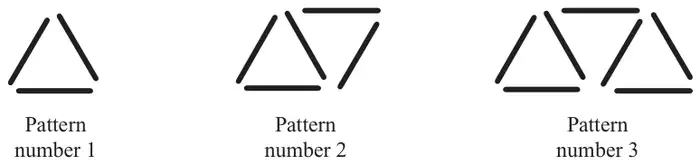
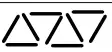
(a) Draw Pattern number 4 (1)
This rule can be used to find the number of sticks in one of these patterns.
Multiply the pattern number by 2 and then add 1
(b) Work out the number of sticks in Pattern number 10 (2)
(c) Work out the Pattern number of the pattern with 37 sticks. (2)
(d) Explain why it is not possible to make one of these patterns with 60 sticks. (1)
(e) \(n\) is the number of sticks in Pattern number \(p\).
Write down a formula for \(n\) in terms of \(p\). (3)
| Scheme | Marks |
|---|---|
 | B1 |
| (1) |
| Scheme | Marks |
|---|---|
| 10 × 2 + 1 | M1 |
| 21 | A1 |
| (2) |
Notes
A1: cao
| Scheme | Marks |
|---|---|
| \(\dfrac{37 - 1}{2}\) | M1 |
| 18 | A1 |
| (2) |
Notes
A1: cao
| Scheme | Marks |
|---|---|
| eg 60 is even, number of matchsticks is always odd, first number is odd and 2 is added each time, multiplying by 2 and adding 1 will always give an odd number of sticks | B1 |
| (1) |
Notes
B1: May refer to number sequence of matchstick pattern – need not do both
| Scheme | Marks |
|---|---|
| \(n = 2p + 1\) | B3 |
| (3) | |
| (Total 9 marks) |
Notes
B3: B2 for \(2p + 1\)
B1 for \(n =\) linear function of \(p\) eg \(n = p + 1\)