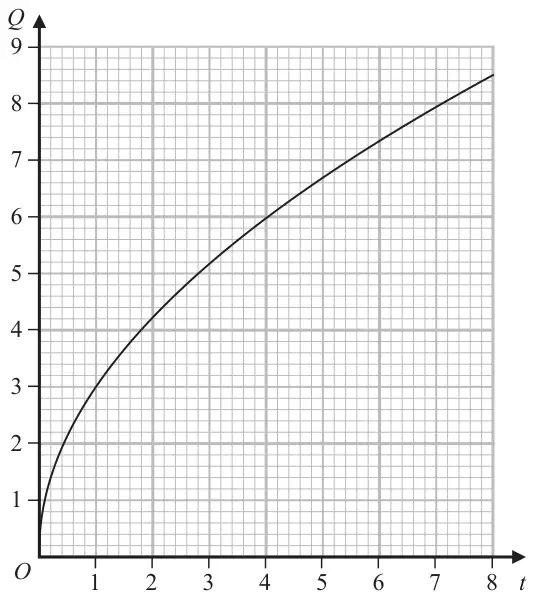
eg 6 × 1.2 = 7.2 and reading from \(Q\) = 7.2 to \(t\) axis and calculates \(t\) value ÷ 4 (or 0.04)
M1ft
Correct answer scores full marks (unless from obvious incorrect working) Answer: 44
A1
(2)
(5 marks)
Notes
M1ft: ft for an equation in the correct form Stating the multiplier \(1.2^2\) or 1.44 or 144 or showing the multiplier within a calculation or for using a pair of values and showing a correct calculation for the increase in \(t\), ft their \(k\) from (a) or correct calculation and use of graph
A1: allow 43 – 45 as long as not from incorrect working
(a) Find a formula for \(P\) in terms of \(y\) and \(a\) (3)
Given also that \(y\) is directly proportional to \(\sqrt{x}\) and when \(x = a\), \(P = 4a\)
(b) find a formula for \(P\) in terms of \(x\) and \(a\) (3)
Mark scheme (a)
Scheme
Marks
\(P = \dfrac{k}{y^2}\)
M1
eg \(a = \dfrac{k}{4^2}\) or \(k = 16a\)
M1
Correct answer scores full marks (unless from obvious incorrect working)
Answer: \(P = \dfrac{16a}{y^2}\)
A1
(3)
Notes
M1: oe (the constant term, \(k\), can be any other letter apart from \(a\) or \(P\) or \(y\))
M1: oe
A1: oe eg \(P = 16ay^{-2}\) or \(P = \dfrac{4^2a}{y^2}\)
Mark scheme (b)
Scheme
Marks
\(\sqrt{\text{``}{\dfrac{16a}{4a}}\text{''}} = c\sqrt{a}\) oe eg \(\dfrac{16a}{4a} = c^2a\) or \(4a = \dfrac{16a}{c^2a}\) or \(4a \times c^2a = 16a\) oe
or
(when \(P = 4a\)) \(y^2 = \dfrac{16a}{4a}\) or \(y^2 = 4\) or \(y = \sqrt{\dfrac{16a}{4a}}\;(= 2)\) oe
M1
\(c = \sqrt{\dfrac{4}{a}}\) or \(c = \dfrac{\pm 2}{\sqrt{a}}\) or \(c = \dfrac{\pm 2\sqrt{a}}{a}\) oe
allow the constant term squared eg \(c^2 = \dfrac{16a}{4a^2}\left(= \dfrac{4}{a}\right)\)
M1
Correct answer scores full marks (unless from obvious incorrect working)
Answer: \(P = \dfrac{4a^2}{x}\)
A1
(3)
(6 marks)
Notes
M1: ft a correct formula involving the constant term (\(c\) used here) and \(a\) or ft for an expression or value of \(y^2\) or \(y\) given for when \(P = 4a\)
M1: (implies previous M1) a correct value, in terms of \(a\), for the constant term or the constant term squared – need not be simplified
A1: oe eg \(P = \dfrac{16a}{\frac{4x}{a}}\) or \(P = \dfrac{16a^2}{4x}\)
14 \(T\) is directly proportional to the cube of \(r\) \(T = 21.76\) when \(r = 4\)
(a) Find a formula for \(T\) in terms of \(r\) (3)
(b) Work out the value of \(T\) when \(r = 6\) (1)
Mark scheme (a)
Scheme
Marks
\(T = kr^3\)
M1
\(21.76 = k \times 4^3\) oe or \(k = 0.34\)
M1
\(T = 0.34r^3\) oe
A1
(3)
Notes
M1: Allow \(r^3 = mT\) Do not allow \(T = r^3\)
M1: for correct substitution into a correct equation; implies first M1 Award M2 if \(k = 0.34\) stated unambiguously (\(m = 2.94\)) Condone use of proportional sign in place of equals sign
A1: Only award if \(T\) is the subject Award M2A1 if \(T = kr^3\) on answer line and \(k\) given as 0.34oe in working space.
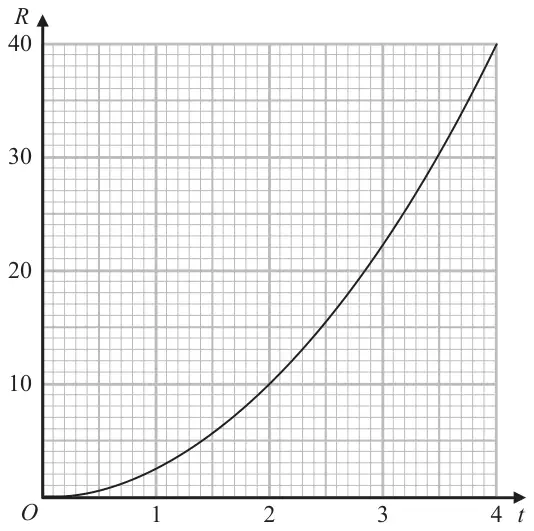
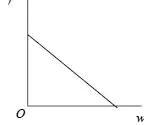
The graph shows the relationship between \(R\) and \(t\) for \(0 \leqslant t \leqslant 4\)
(a) Find a formula for \(R\) in terms of \(t\). (3)
Given also that \(R = \dfrac{8}{5x}\)
(b) show that \(t\) is inversely proportional to \(\sqrt{x}\) for \(t \gt 0\) (2)
Mark scheme (a)
Scheme
Marks
\(R = kt^2\) oe
M1
eg \(10 = k \times 2^2\) or \(40 = k \times 4^2\) or \(k = 2\tfrac{1}{2}\)
M1
Working required
Answer: \(R = \dfrac{5}{2}t^2\)
A1
(3)
Notes
M1: Equation consistent with \(R \propto t^2\)
M1: Substitute values at any point on the graph or find the value of \(k\). (Implies first M1.) Allow readings from graph for \(t\) ± 0.1 and \(R\) ± 1
A1: Award for \(R = kt^2\) if the value of \(k\) is shown clearly in (a) or (b).
20 \(R\) is inversely proportional to the square of \(c\). When \(c = 4\), \(R = 30\)
(a) Find a formula for \(R\) in terms of \(c\). (3)
(b) Calculate the positive value of \(c\) when \(R = 1920\) (2)
Mark scheme (a)
Scheme
Marks
\(R = \dfrac{k}{c^2}\)
M1
\(30 = \dfrac{k}{4^2}\) or \(k = 480\) oe
M1
\(R = \dfrac{480}{c^2}\) oe
A1
(3)
Notes
M1: for \(R = \dfrac{k}{c^2}\) but not for \(R = \dfrac{1}{c^2}\)
Also award for correct equation in \(R\), \(c^2\) and a constant or for \(R\) = numerical value ÷ \(c^2\)
M1: for \(30 = \dfrac{k}{4^2}\) or for correct substitution into an equation which scores the first method mark (may be implied by correct evaluation of the constant)
A1: Award 3 marks if answer is \(R = \dfrac{k}{c^2}\) but \(k\) is evaluated in part (b). SCB2 for correct formula for \(c\) in terms of \(R\).
Mark scheme (b)
Scheme
Marks
\(c^2 = \dfrac{480}{1920}\) or \(c^2 = \dfrac{30}{1920} \times 4^2\)
M1ft
0.5oe
A1
(2)
(5 marks)
Notes
M1ft: for substitution and rearrangement into form \(c^2 = \dfrac{k}{1920}\) with their value of \(k\) substituted except for \(k = 1\)
17 \(P\) is directly proportional to \(q^3\) \(P = 270\) when \(q = 7.5\)
(a) Find a formula for \(P\) in terms of \(q\) (3)
(b) Work out the positive value of \(q\) when \(P = q\) (2)
Mark scheme (a)
Scheme
Marks
\(P = kq^3\)
M1
\(270 = k(7.5)^3\) oe or \(k = \dfrac{270}{7.5^3}\) oe
M1
\(P = \dfrac{16}{25}q^3\)
A1
(3)
Notes
M1: Allow \(kP = q^3\) oe Do not allow \(P = q^3\)
M1: for correct substitution in a correct equation. Implies first M1
A1: \(P = 0.64q^3\) oe with \(P\) the subject Award M2A1 if \(P = kq^3\) on answer line and \(k\) evaluated as \(\frac{16}{25}\) in part (a) or part (b)
Mark scheme (b)
Scheme
Marks
Eg \(q^2 = \dfrac{25}{16}\) or \(\dfrac{1}{q^2} = \dfrac{16}{25}\) or \(1 = \dfrac{16}{25}q^2\) or \(q^2 = \dfrac{1}{0.64}\)
Or \(P^2 = \dfrac{25}{16}\) or \(\dfrac{1}{P^2} = \dfrac{16}{25}\) or \(1 = \dfrac{16}{25}P^2\) or \(P^2 = \dfrac{1}{0.64}\)
M1
\(1\frac{1}{4}\)
A1
(2)
(5 marks)
Notes
M1: Correct equation involving \(q^2\) or \(p^2\) ft \(k\) from an equation of the form \(P = kq^3\) if \(k \neq 1\)
A1: \(\dfrac{5}{4}\), 1.25 [ignore 0 or negative value.]
14 \(D\) is directly proportional to \(t^2\) When \(t = 4\), \(D = 8\)
(a) Find a formula for \(D\) in terms of \(t\). (3)
(b) Find the positive value of \(t\) when \(D = 50\) (2)
Mark scheme (a)
Scheme
Marks
\(D = kt^2\)
M1
\(8 = k \times 16\) oe or \(8 = k \times 4^2\)
M1
\(D = \frac{1}{2}t^2\)
A1
(3)
Notes
M1: for \(D = kt^2\) but not for \(D = t^2\)
A1: for \(D = \frac{1}{2}t^2\) oe with \(D\) the subject Award 3 marks if answer is \(D = kt^2\) and \(k\) is evaluated as \(\frac{1}{2}\) in part (a) or part (b)
16 The pressure \(P\), of water leaving a cylindrical pipe, is inversely proportional to the square of the radius, \(r\), of the pipe. \(P = 22.5\) when \(r = 2\)
(a) Find a formula for \(P\) in terms of \(r\). (3)
(b) Calculate the value of \(P\) when \(r = 1.5\) (1)
(c) Calculate the value of \(r\) when \(P = 10\) (2)
21 When a photograph is taken, the exposure time, \(t\), is directly proportional to the square of the size, \(f\), of the opening in the camera lens.
\(t = 0.02\) when \(f = 8\)
(a) Find a formula for \(t\) in terms of \(f\). (3)
(b) Calculate the value of \(f\) when \(t = 0.0098\) (2)
Mark scheme (a)
Scheme
Marks
\(t = kf^2\)
M1
\(0.02 = k \times 8^2\) or \(k = \dfrac{1}{3200}\) or
\(k = 0.0003125\) or \(3.125 \times 10^{-4}\)
M1
\(t = 0.0003125f^2\) or \(t = \dfrac{1}{3200}f^2\)
A1
(3)
Notes
M1: for \(t = kf^2\) but not for \(t = f^2\) Also award for correct equation in \(t\), \(f^2\) and a constant or for \(t\) = some numerical value \(\times f^2\)
M1: for \(0.02 = k \times 8^2\) or for correct substitution into an equation which scores the first method mark (may be implied by correct evaluation of the constant)
A1: Award 3 marks if answer is \(t = kf^2\) but \(k\) is evaluated in part (b)
Mark scheme (b)
Scheme
Marks
\(f^2 = \dfrac{0.0098}{0.0003125}\) or \(f^2 = \dfrac{0.0098}{0.02} \times 8^2\)
M1
5.6 oe
A1
(2)
Notes
M1: for substitution and rearrangement into form \(f^2 = \dfrac{0.0098}{k}\) with their value of \(k\) except for \(k = 1\) or \(f^2 = \dfrac{0.0098}{0.02} \times 8^2\)
15 Two small magnets attract each other with a force, \(F\) newtons. \(F\) is inversely proportional to the square of the distance, \(d\) cm, between them. When \(d = 2\), \(F = 12\)
(a) Express \(F\) in terms of \(d\). (3)
(b) Calculate the value of \(F\) when \(d = 5\) (1)
(c) Calculate the value of \(d\) when \(F = 3\) (2)
Mark scheme (a)
Scheme
Marks
\(F = \text{“}k\text{”}/d^2\)
M1
\(12 = k/2^2\)
M1
\(k = 48\) Answer: \(F = 48/d^2\)
A1
(3)
Notes
M1: \(k\) = letter not number.
A1: Award 3 marks for \(F = \text{“}k\text{”}/d^2\) and \(k = 48\) stated anywhere, unless contradicted by later work.
16 \(P\) is inversely proportional to \(V\). \(P = 18\) when \(V = 24\)
(a) Express \(P\) in terms of \(V\). (3)
(b) Find the positive value of \(V\) when \(P = 3V\) (2)
Mark scheme (a)
Scheme
Marks
\(P = \dfrac{k}{V}\)
M1
\(18 = \dfrac{k}{24}\)
M1
\(P = \dfrac{432}{V}\)
A1
(3)
Notes
M1: for \(P = \dfrac{k}{V}\) but not for \(P = \dfrac{1}{V}\)
Also award for a correct equation in \(P\), \(V\) and a constant
or \(P\) = some numerical value \(\times \dfrac{1}{V}\)
M1: for \(18 = \dfrac{k}{24}\) or for correct substitution into an equation which scores first method mark (may be implied by correct evaluation of the constant)
A1: Award 3 marks if answer is \(P = \dfrac{k}{V}\) but \(k\) is evaluated as 432 in any part
Mark scheme (b)
Scheme
Marks
\(3V^2 = 432\) or \(3V \times V = 432\)
M1
12
A1
(2)
(5 marks)
Notes
M1: for \(3V^2 = 432\) or \(3V \times V = 432\) or \(V^2 = 144\)
15 The light intensity, \(E\), at a surface is inversely proportional to the square of the distance, \(r\), of the surface from the light source. \(E = 4\) when \(r = 50\)
(a) Express \(E\) in terms of \(r\). (3)
(b) Calculate the value of \(E\) when \(r = 20\) (1)
(c) Calculate the value of \(r\) when \(E = 1600\) (2)
Mark scheme (a)
Scheme
Marks
\(E = \dfrac{k}{r^2}\)
M1
\(4 = \dfrac{k}{50^2}\)
M1
\(\dfrac{10000}{r^2}\)
A1
(3)
Notes
M1: for \(E = \dfrac{k}{r^2}\) but not for \(E = \dfrac{1}{r^2}\)
A1: Award 3 marks if answer is \(E = \dfrac{k}{r^2}\) but \(k\) is evaluated as 10 000 in any part
Mark scheme (b)
Scheme
Marks
25
B1
(1)
Notes
B1: ft from \(\dfrac{\text{“}10000\text{”}}{400}\) except for \(k = 1\), if at least M1 scored in (a)
Mark scheme (c)
Scheme
Marks
\(r^2 = \dfrac{10000}{1600}\) oe
M1
2.5 oe
A1
(2)
(6 marks)
Notes
M1: for substitution and rearrangement into form \(r^2 = \dfrac{k}{1600}\) or \(r = \dfrac{\sqrt{k}}{40}\) with their value of \(k\) except for \(k = 1\)
17 The distance, \(d\) kilometres, of the horizon from a person is directly proportional to the square root of the person’s height, \(h\) metres, above sea level. When \(h = 225\), \(d = 54\)
(a) Find a formula for \(d\) in terms of \(h\). (3)
(b) Calculate the distance of the horizon from a person whose height above sea level is 64 metres. (1)
(c) Calculate the height above sea level of a person, when the distance of the horizon is 61.2 kilometres. (2)
Mark scheme (a)
Scheme
Marks
\(d = k\sqrt{h}\)
M1
\(54 = 15k\)
M1
\(3.6\sqrt{h}\) oe
A1
(3)
Notes
M1: for \(d = k\sqrt{h}\) but not for \(d = \sqrt{h}\)
Also award for \(d =\) some numerical value \(\times \sqrt{h}\)
M1: for \(54 = 15k\)
Also award for \(54 = k\sqrt{225}\)
A1: for \(3.6\sqrt{h}\) oe
Award 3 marks if answer is \(d = k\sqrt{h}\) but \(k\) is evaluated as 3.6 oe in any part
Mark scheme (b)
Scheme
Marks
28.8
B1
(1)
Notes
B1: ft from “3.6” × 8 except for \(k = 1\), if at least M1 scored in (a) (1 d.p. accuracy or better in follow through)
Mark scheme (c)
Scheme
Marks
\(\sqrt{h} = \dfrac{61.2}{\text{“}3.6\text{”}}\)
M1
289
A1
(2)
(6 marks)
Notes
M1: for \(\sqrt{h} = \dfrac{61.2}{\text{“}3.6\text{”}}\) except for \(k = 1\)
19 A wind turbine generates a power of \(P\) kilowatts when the wind speed is \(w\) m/s. \(P\) is proportional to \(w^3\). \(P = 300\) when \(w = 12\)
(a) Find a formula for \(P\) in terms of \(w\). (3)
(b) Calculate the value of \(P\) when \(w = 7.5\) Give your answer correct to 3 significant figures. (2)
(c) When the wind speed is \(x\) m/s, the wind turbine generates twice as much power as it does when the wind speed is 10 m/s. Calculate the value of \(x\). Give your answer correct to 3 significant figures. (4)
16 Kate is going to mark some examination papers. When she marks for \(n\) hours each day, she takes \(d\) days to mark the papers. \(d\) is inversely proportional to \(n\). When \(n = 9\), \(d = 15\)
(a) Find a formula for \(d\) in terms of \(n\). (3)
(b) Kate marks for \(7\frac{1}{2}\) hours each day. Calculate the number of days she takes to mark the papers. (2)
Mark scheme (a)
Scheme
Marks
\(d = \dfrac{k}{n}\) or \(d \propto \dfrac{1}{n}\)
17 An electrician has wires of the same length made from the same material. The electrical resistance, \(R\) ohms, of a wire is inversely proportional to the square of its radius, \(r\) mm. When \(r = 2\), \(R = 0.9\)
(a)
(i) Express \(R\) in terms of \(r\).
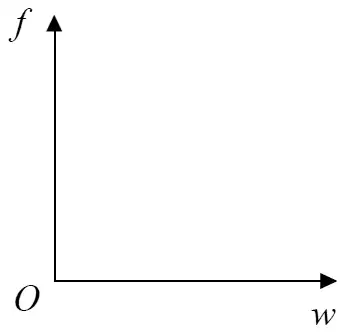
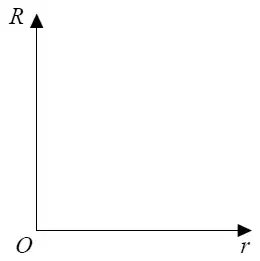
(ii) On the axes, sketch the graph of \(R\) against \(r\).(4)
One of the electrician’s wires has a radius of 3 mm.
(b) Calculate the electrical resistance of this wire. (1)
Mark scheme (a)
Scheme
Marks
(i) \(R = \dfrac{k}{r^2}\)
M1
\(R = \dfrac{3.6}{r^2}\)
A1
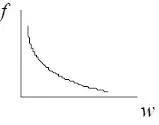
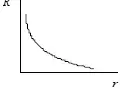
(ii) Answer:
B2
(4)
Notes
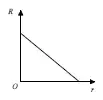
B2: B1 for graph with negative gradient (increasing or constant) even if it touches or crosses one or both axes eg
We'd like to use Google Analytics cookies to count visits and see which pages help most. They're optional, and the site works exactly the same either way. Privacy policy