
Higher January 2020 Paper 1R Q10
10 The diagram shows a regular hexagon, \(ABCDEF\), and an isosceles triangle, \(GHJ\).
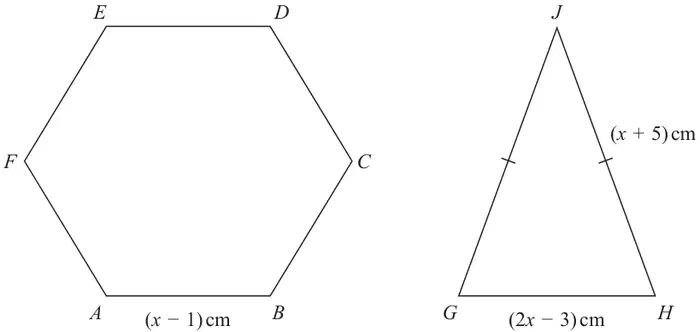
Diagram NOT accurately drawn
The perimeter of the hexagon is equal to the perimeter of the triangle.
Find the length of each side of the hexagon.
Show clear algebraic working.
(5)
| Scheme | Marks |
|---|---|
| e.g. \(6(x - 1)\) (= \(6x - 6\)) | M1 |
| e.g. \(2(x + 5) + 2x - 3\) (= \(4x + 7\)) | M1 |
| \(\text{“}6x - 6\text{”} = \text{“}4x + 7\text{”}\) | M1 |
| e.g. \(6x - 4x = 7 + 6\) | M1 |
| Working required Answer: 5.5 | A1 |
| (5) | |
| (5 marks) |
Notes
M1: method to find expression for perimeter of hexagon
M1: method to find expression for perimeter of triangle
M1: (dep on at least M1) for equating both expressions
M1: (dep on previous M1 and equation of the form \(ax + b = cx + d\)) for rearranging the \(x\) terms on one side and the numerical terms on the other and all expansions correct.
A1: oe (dep on M2)