or \(k = (\pm)\left(\dfrac{7p - 5}{8 + 3p}\right)^{0.5}\) (condone omission of \(\pm\))
NB: to award A1 we must see \(k = (\pm)\sqrt{\dfrac{7p - 5}{8 + 3p}}\) in working if \((\pm)\sqrt{\dfrac{7p - 5}{8 + 3p}}\) alone is given as an answer
(a) Make \(y\) the subject of \(\quad w = 3y - d\) (2)
Diego buys \(b\) boxes of crayons and \(p\) packets of crayons.
There are 12 crayons in each box. There are 3 crayons in each packet.
Diego buys a total of \(T\) crayons.
(b) Write down a formula for \(T\) in terms of \(b\) and \(p\) (3)
Mark scheme (a)
Scheme
Marks
\(w + d = 3y\) oe or \(-3y = -w - d\) oe or
\(\dfrac{w}{3} = y - \dfrac{d}{3}\) oe or \(\dfrac{w + d}{3}\) oe or \(y = w + d \div 3\)
M1
Working not required, so correct answer scores full marks (unless from obvious incorrect working)
Answer: \(y = \dfrac{w + d}{3}\)
A1
(2)
Notes
M1: for a correct first step
A1: oe eg \(y = \dfrac{-d - w}{-3}\) or \(y = \dfrac{w}{3} + \dfrac{d}{3}\) oe or
\(y = (w + d) \div 3\)
(must see \(y\) = … on answer line or in working)
Mark scheme (b)
Scheme
Marks
\(T = 12b + 3p\)
B3
(3)
(5 marks)
Notes
B3: for \(T = 12b + 3p\) oe [accept \(T = 12 \times b + 3 \times p\)]
B2 for \(12b + 3p\) or \(T = 12b + xp\) or \(T = yb + 3p\) or a correct equation with other letters eg \(T = 12m + 3n\)
B1 for \(12b + xp\) or \(12b\) or \(yb + 3p\) or \(3p\) or \(12p + 3b\) or \(T = kb + cp\) where \(k \neq 0\) or \(k \neq 12\) and \(c \neq 0\) or \(c \neq 3\)
Accept upper or lower case for \(T\), \(b\) and \(p\) including a mixture of these for B3, B2 and B1
eg \(9x + 6 - 10x - 5 = 15x\) oe or \(1 - x = 15x\) oe
eg \(9x + 6 = 15x + 10x + 5\)
or
\(\dfrac{-x + 1}{15} = \dfrac{15x}{15}\) or \(-\dfrac{16}{15}x = -\dfrac{1}{15}\)
M1
Working required
Answer: \(\dfrac{1}{16}\)
A1
(3)
Notes
M1: Writing fractions over a common denominator or removing denominator or writing each term separately – if student has expanded/multiplied at this stage, then allow one of the 4 terms on the LHS incorrect.
If the student has removed the denominator at this stage then a correct method must be shown or implied
M1: An equation with no brackets or fractions or an equation with a common denominator for all terms with numerators simplified (allow one error for the 4 terms on the LHS only (they may have moved these to the RHS) across the 2 M marks and ft for simplifying)
A1: oe 0.0625 (allow 0.062 or 0.063) dep on M1
Mark scheme (b)
Scheme
Marks
\(f^2 = \dfrac{a + bc}{c - d}\)
M1
eg \(cf^2 - df^2 = a + bc\)
M1
eg \(cf^2 - bc = a + df^2\)
M1
Correct answer scores full marks (unless from obvious incorrect working)
Answer: \(c = \dfrac{a + df^2}{f^2 - b}\)
A1
(4)
(7 marks)
Notes
M1: for squaring both sides in a correct equation
M1: for multiplying by the denominator and expanding in a correct equation
M1: for isolating terms in \(c\) on one side and other terms the other in a correct equation
M1: For correct factorisation or correct use of quadratic formula \(\dfrac{-4 \pm \sqrt{4^2 - 4 \times 3 \times -32}}{2 \times 3}\) or as far as \(\dfrac{-4 \pm \sqrt{400}}{6}\)
\(\left(y - \dfrac{8}{3}\right)(y + 4)\) is not valid factorisation, unless preceded by division of quadratic by 3, so no marks
A1: dep on M1 for correct critical values (allow 2.6 or better or 2.7 )
A1: oe dep on M1 (allow use of \(x\) rather than \(y\))
or \((-\infty, -4), \left(\dfrac{8}{3}, (+)\infty\right)\) or \((-\infty, -4) \cup \left(\dfrac{8}{3}, (+)\infty\right)\) oe
15 Make \(n\) the subject of the formula \(x = \dfrac{3p - n}{3n + 4}\)
(3)
Mark scheme
Scheme
Marks
\(3nx + 4x = 3p - n\)
M1
\(3nx + n = 3p - 4x\) or \(4x - 3p = -n - 3nx\)
M1ft
Working not required, so correct answer scores full marks (unless from obvious incorrect working) Answer: \(n = \dfrac{3p - 4x}{3x + 1}\)
A1
(3 marks)
Notes
M1: for removing the denominator and expanding in a correct equation
M1ft: for gathering terms in \(n\) on one side and other terms the other side in an equation ft their equation dep on 2 terms in \(n\) and 2 other terms
A1: oe eg \(n = \dfrac{4x - 3p}{-1 - 3x}\) oe (must see “\(n =\)”… on answer line or in working)
\(4^{\frac{1}{2}n}\), \(4^{\frac{1}{2}x^2}\), \(4^{2x}\) and \(4^{\frac{3}{2}}\)or \(8^{\frac{1}{3}n}\), \(8^{\frac{1}{3}x^2}\) and \(8^{\frac{4}{3}x}\)or \(16^{\frac{1}{4}n}\), \(16^{\frac{1}{4}x^2}\) and \(16^{\frac{3}{4}}\)
M1
\(n = x^2 + 4x + 3\) oe or \(x^2 + 4x + 3 - n = 0\)
17 Make \(x\) the subject of \(\;y = \sqrt[3]{\dfrac{6 + 5x}{x + 4}}\)
(4)
Mark scheme
Scheme
Marks
\(y^3 = \dfrac{6 + 5x}{x + 4}\)
M1
\(xy^3 + 4y^3 = 6 + 5x\) oe
or
\(x - \dfrac{5x}{y^3} = \dfrac{6}{y^3} - 4\)
M1
\(xy^3 - 5x = 6 - 4y^3\)
M1
Correct answer scores full marks (unless from obvious incorrect working)
Answer: \(x = \dfrac{6 - 4y^3}{y^3 - 5}\)
A1
(4)
(4 marks)
Notes
M1: for removing cube root
M1: for multiplying by denominator and expanding in a correct equation or for gathering \(x\) terms on one side and the other terms on the other side in a correct equation in fractional form
M1: for gathering terms in \(x\) on one side and other terms the other side in a correct equation or for removing all fractions
A1: or \(x = \dfrac{4y^3 - 6}{5 - y^3}\)
SCB2 for \(x = \dfrac{6 - 4y^{\frac{1}{3}}}{y^{\frac{1}{3}} - 5}\) or \(x = \dfrac{4y^{\frac{1}{3}} - 6}{5 - y^{\frac{1}{3}}}\)
(d) Make \(t\) the subject of \(\quad c = t^3 - 8v\) (2)
Mark scheme (a)
Scheme
Marks
\(a^{11}\)
B1
(1)
Mark scheme (b)
Scheme
Marks
\(w^{12}\)
B1
(1)
Mark scheme (c)
Scheme
Marks
\(64x^{10}y^6\)
B2
(2)
Notes
B2: if not B2 then award B1 for 2 correct parts as part of a product eg \(kx^{10}y^6\) where \(k \neq 64\) or \(64x^ky^6\) where \(k \neq 10\) or \(64x^{10}y^k\) where \(k \neq 6\)
Mark scheme (d)
Scheme
Marks
\(c + 8v = t^3\)
M1
\(t = \sqrt[3]{c + 8v}\)
A1
(2)
(6 marks)
Notes
A1: oe
SCB1 for an answer of \(t = \dfrac{c + 8v}{3}\) oe
(d) Make \(t\) the subject of \(c = t^3 - 8v\) (2)
Mark scheme (a)
Scheme
Marks
\(a^{11}\)
B1
(1)
Mark scheme (b)
Scheme
Marks
\(w^{12}\)
B1
(1)
Mark scheme (c)
Scheme
Marks
\(64x^{10}y^6\)
B2
(2)
Notes
B2: if not B2 then award B1 for 2 correct parts as part of a product eg \(kx^{10}y^6\) where \(k \ne 64\) or \(64x^ky^6\) where \(k \ne 10\) or \(64x^{10}y^k\) where \(k \ne 6\)
Mark scheme (d)
Scheme
Marks
\(c + 8v = t^3\)
M1
\(t = \sqrt[3]{c + 8v}\)
A1
(2)
(6 marks)
Notes
A1: oe
SCB1 for an answer of \(t = \dfrac{c + 8v}{3}\) oe
Correct answer scores full marks (unless from obvious incorrect working) Answer: \((6y + 5)(y - 1)\)
A1
(2)
Notes
M1: for \((6y \pm 5)(y \pm 1)\) or \((6y \pm 1)(y \pm 5)\) or \((ay + 5)(by - 1)\) where \(ab = 6\) or \(5b - a = -1\) or \((6y + p)(y + q)\) where \(pq = -5\) or \(6q + p = -1\) Condone use of a different letter to \(y\)
Correct answer scores full marks (unless from obvious incorrect working)
Answer: \(f = \dfrac{8w - 3}{2 + w}\)
A1
(3)
Notes
M1: for multiplying by denominator and expanding in a correct equation
M1: for gathering terms in \(f\) on one side and other terms the other side in a correct equation ft their equation dep on 2 terms in \(f\) and two other terms
(b) Make \(t\) the subject of the formula \(\quad p = at - d\) (2)
Given that \(\quad \dfrac{w^5 \times w^n}{w^3} = w^{10}\)
(c) work out the value of \(n\). (2)
Mark scheme (a)
Scheme
Marks
\(6x^2 + 9x - 3x^2 - 5x\)
M1
Working not required, so correct answer scores full marks (unless from obvious incorrect working) Answer: \(3x^2 + 4x\)
A1
(2)
Notes
M1: expansion with at least 3 correct terms (must see for example, \(6x^2\) and not just \(3x \times 2x\))(can assume that no sign in front of a number is a + if terms written in a list or table)
A1: or \(4x + 3x^2\) or \(x(3x + 4)\) or \(x(4 + 3x)\)
Mark scheme (b)
Scheme
Marks
\(p + d = at\) or \(-at = -d - p\) or \(\dfrac{p}{a} = \dfrac{at}{a} - \dfrac{d}{a}\) oe
M1
Working not required, so correct answer scores full marks
Answer: \(t = \dfrac{p + d}{a}\)
A1
(2)
Notes
M1: Correct first stage in rearrangement
A1: oe eg \(t = \dfrac{p}{a} + \dfrac{d}{a}\) or \(t = \dfrac{-p - d}{-a}\) Must have “\(t =\)” either in working or on answer line
Mark scheme (c)
Scheme
Marks
\(w^2 \times w^n = w^{10}\) or \(w^5 \times w^n = w^{13}\) or \(w^5 \times w^{n-3} = w^{10}\)
or \(\dfrac{w^{5+n}}{w^3} = w^{10}\) oe
or \(5 + n - 3 = 10\) or \(2 + n = 10\) or \(5 + n = 13\)
M1
Working not required, so correct answer scores full marks (unless from obvious incorrect working) Answer: 8
A1
(2)
(6 marks)
Notes
M1: A correct first stage simplifying at least one index in a correct equation or a correct equation using indices only
A1: accept \(w^8\) (trial and error gains full marks if correct and no marks if incorrect unless a rule of indices is clearly shown)
(b) Make \(t\) the subject of the formula \(p = at - d\) (2)
Given that \(\dfrac{w^5 \times w^n}{w^3} = w^{10}\)
(c) work out the value of \(n\). (2)
Mark scheme (a)
Scheme
Marks
\(6x^2 + 9x - 3x^2 - 5x\)
M1
Working not required, so correct answer scores full marks (unless from obvious incorrect working) Answer: \(3x^2 + 4x\)
A1
(2)
Notes
M1: expansion with at least 3 correct terms (must see for example, \(6x^2\) and not just \(3x \times 2x\))(can assume that no sign in front of a number is a + if terms written in a list or table)
A1:or \(4x + 3x^2\) or \(x(3x + 4)\) or \(x(4 + 3x)\)
Mark scheme (b)
Scheme
Marks
eg \(p + d = at\) or \(-at = -d - p\) or \(\dfrac{p}{a} = \dfrac{at}{a} - \dfrac{d}{a}\) oe
M1
Working not required, so correct answer scores full marks
Must have “\(t =\)” either in working or on answer line
Mark scheme (c)
Scheme
Marks
\(w^2 \times w^n = w^{10}\) or \(w^5 \times w^n = w^{13}\) or
\(w^5 \times w^{n - 3} = w^{10}\)
or \(\dfrac{w^{5 + n}}{w^3} = w^{10}\) oe
or \(5 + n - 3 = 10\) or \(2 + n = 10\) or \(5 + n = 13\)
M1
Working not required, so correct answer scores full marks (unless from obvious incorrect working) Answer: 8
A1
(2)
(6 marks)
Notes
M1: A correct first stage simplifying at least one index in a correct equation or a clearly correct subsequent stage showing correct use of a rule of indices eg \(w^5 \times w^n = w^{30}\) and \(w^n = w^{30 - 5}\) or a correct equation using indices only
A1: accept \(w^8\) (trial and error gains full marks if correct and no marks if incorrect unless a rule of indices is clearly shown)
M1: For clear intention to multiply all terms by 20 (or 4 × 5) or a multiple of 20 oe or to express LHS as two fractions over 20 (or 4 × 5) or a multiple of 20 oe or as a single fraction with a denominator of 20 (or 4 × 5) or a multiple of 20 oe
if expanded numerator, allow one error
M1: Expanding brackets and multiplying by denominator with no more than one sign error
A1: dep on M1
Mark scheme (b)
Scheme
Marks
\(p^2 = \dfrac{ac + 8}{3 + c}\)
M1
\(3p^2 + cp^2 = ac + 8\)
M1
\(cp^2 - ac = 8 - 3p^2\) or \(3p^2 - 8 = ac - cp^2\)
M1ft
Correct answer scores full marks (unless from obvious incorrect working)
Answer: \(c = \dfrac{8 - 3p^2}{p^2 - a}\)
A1
(4)
(7 marks)
Notes
M1: for removing square root
M1: for multiplying by denominator and expanding in a correct equation
M1ft: for gathering terms in \(c\) on one side and other terms the other side ft their equation dep on 2 terms in \(c\) and two other terms
(c) Make \(p\) the subject of the formula \(\quad f = 3p - d\) (2)
Sergio buys \(m\) boxes of seeds and \(n\) packets of seeds.
Each box contains 10 seeds. Each packet contains 6 seeds.
The total number of seeds that Sergio buys is \(T\).
(d) Write down a formula for \(T\) in terms of \(m\) and \(n\). (3)
Mark scheme (a)
Scheme
Marks
\(5x - x^2\)
B1
(1)
Mark scheme (b)
Scheme
Marks
\(3(y - 7)\)
B1
(1)
Mark scheme (c)
Scheme
Marks
\(f + d = 3p\) or \(\dfrac{f}{3} = p - \dfrac{d}{3}\)
M1
\(p = \dfrac{f + d}{3}\)
A1
(2)
Notes
M1: A correct first stage in a correct formula
A1: for \(p = \dfrac{f + d}{3}\) (must see \(p =\) … at some stage)
(SCB1 for \(p = \dfrac{f - d}{3}\))
Mark scheme (d)
Scheme
Marks
\(T = 10m + 6n\)
B3
(3)
(7 marks)
Notes
B3: for \(T = 10m + 6n\) oe (B2 for \(10m + 6n\) or \(T = 10m + an\) or \(T = bm + 6n\) or \(T = 6m + 10n\)) (B1 for \(10m + an\) or \(bm + 6n\) or \(6m + 10n\)) or for \(T =\) an incorrect expression in \(m\) and \(n\)
Working required Answer: \(2x^3 - 7x^2 - 43x - 42\)
A1
(3)
Notes
M1: For multiplying a pair of brackets and getting 3 out of 4 terms correct.
M1dep: For multiplying the product of the first 2 brackets (ft from the 1st stage) by the 3rd bracket, and getting at least 3 out of 6 or 4 out of 8 terms correct
A1: Fully correct. isw extra work as long as correct e.g. \(x(2x^2 - 7x - 43) - 42\)
Mark scheme (a) ALT
Scheme
Marks
Alternative (all in one method) \((x + 2)(2x + 3)(x - 7) =\) \(2x^3 - 14x^2 + 3x^2 - 21x + 4x^2 - 28x + 6x - 42\)
M2
Working required Answer: \(2x^3 - 7x^2 - 43x - 42\)
A1
Notes
M2: For at least 6 out of 8 correct terms (M1 for 4 or 5 out of 8 correct terms)
Mark scheme (b)
Scheme
Marks
\(p^2(2m - y) = x + m\) \(2p^2m - p^2y = x + m\)
M1
e.g. \(2p^2m - m = x + p^2y\) \(m(2p^2 - 1) = x + p^2y\)
M1
\(m = \dfrac{x + p^2y}{2p^2 - 1}\)
A1
(3)
(6 marks)
Notes
M1:Multiplying by denominator and expanding bracket
M1: Collect terms in \(m\) and factorise in a correct equation
M1: for a first step of subtracting 7 or dividing by 4 in a correct equation
A1: oe
Note: the printed scheme lists \(-g = \dfrac{r - 7}{4}\) among the correct first steps. This is not a correct equation: from \(-4g = 7 - r\) it should be \(-g = \dfrac{7 - r}{4}\) (or \(g = \dfrac{r - 7}{4}\)).
Mark scheme (c)
Scheme
Marks
e.g. \(6y - 2y = 8 + 3\) or \(2y - 6y = -3 - 8\) oe
e.g. \(4y - 3 = 8\) or \(6y = 2y + 11\) or \(-3 = -4y + 8\) or \(6y - 11 = 2y\)
M1
e.g. \(4y = 11\) or \(-4y = -11\) or
M1
\(\dfrac{11}{4}\)
A1
(3)
(8 marks)
Notes
M1: for correct rearrangement with \(y\) terms on one side and numbers on the other side e.g. \(6y - 2y = 8 + 3\) or for the correct simplification of either \(y\) terms or numbers on one side in a correct equation e.g. \(4y - 3 = 8\) or \(6y = 2y + 11\)
M1: for correct rearrangement with \(y\) terms on one side and numbers on the other and correct simplification of terms on both sides or for \(4y - 11 = 0\) or for \(11 - 4y = 0\)
A1: dep on M1 accept 2.75 or \(2\dfrac{3}{4}\) oe
Award full marks for a correct answer if at least 1 method mark awarded
If no correct algebraic working then award no marks
Edith buys \(p\) pencils and \(r\) rulers. The total cost is \(T\) dollars.
(c) Write down a formula for \(T\) in terms of \(p\) and \(r\). (3)
Mark scheme (a)
Scheme
Marks
\(7x - x = -18 - 3\) \((6x = -21)\) oe
M1
−3.5
A1
(2)
Notes
M1: Collect terms in ‘\(x\)’ on one side and number terms on the other.
Mark scheme (b)
Scheme
Marks
\(7w = t - 3\) oe
M1
\(w = \dfrac{t - 3}{7}\)
A1
(2)
Notes
M1: Isolating term in \(w\)
A1: Must have \(w\) =
Mark scheme (c)
Scheme
Marks
\(T = 2p + 3r\)
B3
(3)
(7 marks)
Notes
B3: For \(T = 2p + 3r\) oe (B2 for \(2p + 3r\) or \(T = 3p + r\) or \(T = p + 2r\) or \(T = 3p + 2r\)) (B1 for \(2p + r\) or \(p + 3r\) or \(3p + 2r\) or or \(3p + r\) or \(p + 2r\))
M1: Any correct partially factorised expression with at least 2 terms in the common factor or for the correct common factor and a 2 term expression inside the brackets with just one error
M1: Any correct partially factorised expression with at least 2 terms in the common factor or for the correct common factor and a 2 term expression inside the brackets with just one error
(b) Make \(p\) the subject of \(p + 4q = 3p + 5\) (2)
(c) Expand and simplify \((2y + 3)(4y - 1)\) (2)
(d) Simplify \((8a^6b^3)^{\frac{1}{3}}\) (2)
Mark scheme (a)
Scheme
Marks
e.g. \(\dfrac{a^{11}}{a^7}\) or \(\dfrac{a^6}{a^2}\) or \(\dfrac{a^9}{a^5}\) oe
M1
\(a^4\)
A1
(2)
Notes
M1: For \(\dfrac{a^{11}}{a^7}\) or any index law used correctly
Mark scheme (b)
Scheme
Marks
\(4q - 5 = 3p - p\) oe eg \(-2p = 5 - 4q\)
M1
\(p = \dfrac{4q - 5}{2}\)
A1
(2)
Notes
M1: For correctly collecting terms in \(p\) one side and other terms on the other side
A1: oe, eg \(p = 2q - 2.5\)
Mark scheme (c)
Scheme
Marks
\(8y^2 - 2y + 12y - 3\)
M1
\(8y^2 + 10y - 3\)
A1
(2)
Notes
M1: For any three correct terms or for 4 correct terms ignoring signs or for \(8y^2 + 10y + k\) for any non-zero value of \(k\) or for \(\ldots + 10y - 3\)
Mark scheme (d)
Scheme
Marks
\(2a^2b\)
B2
(2)
Notes
B2: B1 for two of 2 or \(a^2\) or \(b\) as part of a product
M1: LHS may be two separate fractions or one single fraction (brackets may or may not be removed on RHS and denominator)
M1: LHS may be two separate fractions or one single fraction; if one fraction, numerator on LHS may or may not be simplified (implies previous M1) (brackets may or may not be removed on RHS and denominator)
M1: (brackets may or may not be removed on RHS) (implies previous two M1s)
M1: LHS factorised correctly - expression in bracket on LHS may or may not be simplified
A1: \(\dfrac{3x(x+4)}{3x+4}\) or \(\dfrac{3x^2+12x}{3x+4}\)
a fully correct method must be seen in order to award full marks
A1: or \(n = \dfrac{3}{(t+1)(t-1)}\) or \(n = \dfrac{-3}{1 - t^2}\) or \(n = \dfrac{-3}{(1-t)(1+t)}\)
(corrected from the printed mark scheme: the fractions in “\(t^2 = \)” and in the answer “\(n = \)” are blank in the printed scheme; filled in here as \(\dfrac{n+3}{n}\) and \(\dfrac{3}{t^2-1}\))
B2: B1 for 3 correct terms with correct signs or 4 correct terms ignoring signs
B2: B1 for 3 correct terms with correct signs or 4 correct terms ignoring signs N.B. \(-2y\) (with no more \(y\) terms) implies \(+5y - 7y\)
Apart from questions 5, 7, 13c, 16b, 20, 21 and 22 (where the mark scheme states otherwise) the correct answer, unless clearly obtained by an incorrect method, should be taken to imply a correct method.
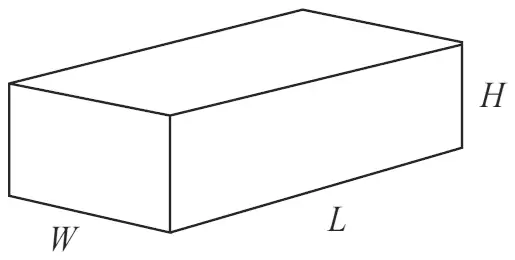
13 Here is a cuboid with length \(L\), width \(W\) and height \(H\).
The total surface area, \(A\), of the cuboid is given by the formula\[A = 2(LW + HW + HL)\]
(a) \(A = 70 \quad W = 4 \quad H = 2\) Work out the value of \(L\). (3)
(b) Make \(W\) the subject of the formula \(A = 2(LW + WH + HL)\) (4)
Mark scheme (a)
Scheme
Marks
\(12L + 16 = 70\) or \(8L + 4L = 54\) or \(12L = 54\) or \(6L + 8 = 35\) or \(4L + 2L = 27\) or \(6L = 27\)
M2
4.5 oe
A1
(3)
Notes
M2: for correctly collecting \(L\)s or constants or both M1 for correct substitution in given formula or in a correct rearrangement of the given formula in which \(L\) is not the subject eg \(70 = 2(4L + 2 \times 4 + 2L)\) or \(70 = 2(4L + 8 + 2L)\) or \(35 = 4L + 2 \times 4 + 2L\) or \(35 = 4L + 8 + 2L\) or \(70 - 2 \times 2 \times 4 = 8L + 4L\) or \(35 - 2 \times 4 = 4L + 2L\)
A1: depends on M2
Alternative method
\(L = \dfrac{A - 2HW}{2(W + H)}\) oe M1 for making \(L\) the subject of the given formula
eg \(\dfrac{70 - 2 \times 2 \times 4}{2(4 + 2)}\) M1 for correct substitution into a correct expression for \(L\)
4.5 oe A1 depends on both method marks
Mark scheme (b)
Scheme
Marks
\(A = 2LW + 2WH + 2HL\)
or \(\dfrac{A}{2} = LW + WH + HL\)
M1
\(A - 2HL = 2LW + 2WH\)
or \(\dfrac{A}{2} - HL = LW + WH\)
M1
\(A - 2HL = 2W(L + H)\)
or \(A - 2HL = W(2L + 2H)\)
or \(\dfrac{A}{2} - HL = W(L + H)\)
M1
\(\dfrac{A - 2HL}{2(L + H)}\) or \(\dfrac{A - 2HL}{2L + 2H}\) or \(\dfrac{\frac{A}{2} - HL}{L + H}\) oe
A1
(4)
(7 marks)
Notes
M1: for a correct equation following expansion or division by 2 May be implied by second M1
M1: for correct equation with \(W\) terms isolated
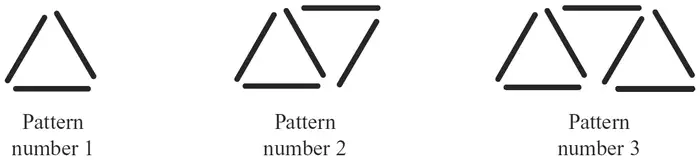
This rule can be used to find the number of sticks in one of these patterns.
Multiply the pattern number by 2 and then add 1
(a) \(n\) is the number of sticks in Pattern number \(p\). Write down a formula for \(n\) in terms of \(p\). (3)
(b) Make \(p\) the subject of your formula. (2)
Mark scheme (a)
Scheme
Marks
\(n = 2p + 1\) oe
B3
(3)
Notes
B3: for \(n = 2p + 1\) oe eg \(n = p2 + 1\), \(1 + p \times 2 = n\), \(n = p + p + 1\) B2 for \(2p + 1\) oe B1 for \(n =\) linear function of \(p\) eg \(n = p + 1\)
Mark scheme (b)
Scheme
Marks
\(2p = n - 1\) or \(\dfrac{n}{2} = p + \dfrac{1}{2}\)
M1
\(\dfrac{n - 1}{2}\) oe
A1
(2)
(5 marks)
Notes
M1: for \(2p = n - 1\) or \(\dfrac{n}{2} = p + \dfrac{1}{2}\)
A1: for \(\dfrac{n - 1}{2}\) oe inc \(\dfrac{n}{2} - \dfrac{1}{2}\)
(a) Hanif uses the formula to work out an estimate for the value of \(v\) without using a calculator when \(g = 9.812\) and \(h = 0.819\) Write down approximate values for \(g\) and \(h\) that Hanif could use. (2)
(b) Make \(h\) the subject of the formula \(v = \sqrt{2gh}\) (2)
We'd like to use Google Analytics cookies to count visits and see which pages help most. They're optional, and the site works exactly the same either way. Privacy policy