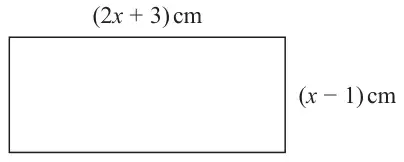
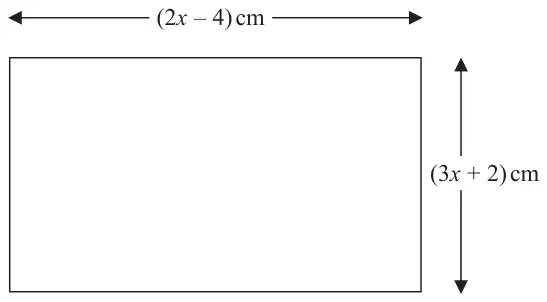
M1: for a correct method to find the critical values
Minimum evidence for quadratic formula is a two-term discriminant, eg \(\dfrac{7 \pm \sqrt{49 + 120}}{4}\) (must have the \(\pm\))
Allow \((x + 1.5)(2x - 10)\) as a correct factorisation, but do not allow \(\left(x + \dfrac{3}{2}\right)(x - 5)\) unless preceeded by division of the quadratic by 2
A1: dep on M1 for correct critical values oe
A1: dep on M1
for correct inequalities (must be separate inequalities)
or \(\left]-\infty, -\dfrac{3}{2}\right[ \cup \left]5, \infty\right[\) or \(\left]-\infty, -\dfrac{3}{2}\right[, \left]5, \infty\right[\)
Acceptable notation: allow a comma, space, “or”, “and” or “\(\cup\)” to link the two regions
Do not allow as a single inequality \(-\dfrac{3}{2} \gt x \gt 5\)
Allow M1A1 for the correct critical values AND evidence of another algebraic method that has led to these: eg \(x(2x + 3) - 5(2x + 3)\) and the correct critical values or \(2x(x - 5) + 3(x - 5)\) and the correct critical values or \((2x + 3)(2x - 10)\) and the correct critical values
M1: for a correct method to solve the quadratic equation \(4x^2 + 4x - 15 = 0\)
Allow \((4x - 6)(x + 2.5)\) or \((4x + 10)(x - 1.5)\) or \((4x - 6)(4x + 10)\) leading to \((x - 1.5)(x + 2.5)\) or \((4x - 6)(4x + 10)\) leading to correct values of \(x\)
Do not allow \((x - 1.5)(x + 2.5)\) without previous working
(If using formula allow some simplification – allow as far as \(\dfrac{-4 \pm \sqrt{16 + 240}}{8}\))
A1: oe dep on M1
A1: oe dep on M1 Allow \(x \gt -2.5\) (and) \(x \lt 1.5\) oe Allow any variable as long as used all the way through
M1: A correct method to solve the quadratic; correct factors or correct substitution into the formula or can be simplified as far as \(\dfrac{-11 \pm \sqrt{121 + 840}}{20}\) or correctly completing the square.
\((10)(x + 2.1)(x - 1)\) is not a correct factorisation – it is working backwards from calculator answers.
A1: dep on M1 for correct critical values
A1: dep on M1
oe eg \(x \gt -2.1\) (and) \(x \lt 1\) (do not penalise ‘or’)
or \(\dfrac{-21}{10} \lt x \lt 1\) etc
including the open interval (–2.1, 1) or ]–2.1, 1[
M1: first step to finding the critical values - if factorising (in the form \((ax + b)\) where \(a\) and \(b\) are integers), allow brackets which expanded give 2 out of 3 terms correct
(if using formula or completing the square allow one sign error and some simplification – allow as far as
M1: For correct factorisation or correct use of quadratic formula \(\dfrac{-4 \pm \sqrt{4^2 - 4 \times 3 \times -32}}{2 \times 3}\) or as far as \(\dfrac{-4 \pm \sqrt{400}}{6}\)
\(\left(y - \dfrac{8}{3}\right)(y + 4)\) is not valid factorisation, unless preceded by division of quadratic by 3, so no marks
A1: dep on M1 for correct critical values (allow 2.6 or better or 2.7 )
A1: oe dep on M1 (allow use of \(x\) rather than \(y\))
or \((-\infty, -4), \left(\dfrac{8}{3}, (+)\infty\right)\) or \((-\infty, -4) \cup \left(\dfrac{8}{3}, (+)\infty\right)\) oe
21 The curve T has equation \(\;y = x^3 - 2x^2 - 9x + 15\)
(a) Find \(\dfrac{\mathrm{d}y}{\mathrm{d}x}\) (2)
(b) Find the range of values of \(x\) for which T has a positive gradient. Give your values correct to 3 significant figures. Show your working clearly. (4)
Mark scheme (a)
Scheme
Marks
\(3x^2\) or \(-2 \times 2x\) or \(-4x\) or \(-9\) oe
M1
\(3x^2 - 4x - 9\)
A1
(2)
Notes
M1: for differentiating one term correctly
A1: for a correct expression Allow \(3x^2 - 2 \times 2x - 9\)
or \(3\left[\left(x - \dfrac{2}{3}\right)^2 - \left(\dfrac{2}{3}\right)^2\right] - 9\;(= 0)\)
M1
\(-1.19\) and 2.52
A1
\(x \lt -1.19\)
A1
\(x \gt 2.52\)
A1
(4)
(6 marks)
Notes
M1: for finding the critical values for a 3-term quadratic using any correct method - if using formula or completing the square allow one sign error and some simplification
– allow as far as eg \(\dfrac{4 \pm \sqrt{16 + 108}}{6}\) oe
or eg \(3\left(x - \dfrac{2}{3}\right)^2 - 10\dfrac{1}{3}\) oe)
A1: for critical values of \(-1.19\) and 2.52 or better
(for this A1 mark allow \(-1.2\) or \(-1.18\) and 2.5
Working must be seen for both accuracy marks as asked for in question
Answer: \(-7 \leqslant x \leqslant \dfrac{5}{6}\)
A1
(3)
(3 marks)
Notes
M1: A correct method to solve the quadratic equation \(6x^2 + 37x - 35\;(= 0)\) using any correct method (if factorising, allow brackets which expanded give 2 out of 3 terms correct) (if using formula allow one sign error in substitution and some simplification – allow as far as \(\dfrac{-37 \pm \sqrt{1369 + 840}}{12}\)) or completing the square as far as shown on left
A1: dep on M1 correct critical values (allow 0.83…)
M1: Writing fractions over a common denominator or removing denominator If the student has removed the denominator at this stage then a correct method must be shown or implied
M1ft: ft dep on previous M1 removing brackets and fractions correctly in an equation
M1ft: ft dep on previous M1 terms in \(x\) on one side and number terms the other
Working required Answer: \(-2.5 \leqslant y \leqslant 6\)
A1
(3)
(7 marks)
Notes
M1: A correct method to solve the quadratic - allow factorisation that gives 2 out of 3 terms correct when expanded or use of quadratic formula – if using formula, allow one sign error and allow if simplified as far as \(\dfrac{7 \pm \sqrt{49 + 240}}{4}\) or use of completing the square with one sign error as far as shown
A1: Correct critical values dep on M1
A1: oe eg \(y \geqslant -2.5\) (and) \(y \leqslant 6\) or \([-2.5, 6]\) (do not penalise change of variable eg \(y\) to \(x\)) dep on M1
or \(2\left(x + \dfrac{1}{4}\right)^2 - 2\left(\dfrac{1}{4}\right)^2 - 78 = 0\)
M1
\(x = 6\)
A1
\(1 \lt x \lt 6\)
A1
(5)
(5 marks)
Notes
B1: For writing the correct inequality sign with a correct calculation or correct value – this could be initially or saying that \(x \lt 6\) at the end
M1: rearranged to form correct quadratic \(\lt 0\) (allow = 0 or other incorrect inequality sign) oe
M1: first step to find critical values from the correct quadratic
A1: \(x = 6\) identified as critical value, ignore –6.5 if given
Correct answer scores full marks (unless from obvious incorrect working)
Answer: \(2 \lt x \lt \dfrac{7}{2}\)
A1
(5)
(5 marks)
Notes
M1: condone incorrect symbol
M1: expanding and rearranging to get a correct 3 term quadratic, condone incorrect symbol
M1: first step to find the critical values dep on M1 for solving their 3 term quadratic using any correct method (allow one sign error and some simplification – allow as far as the equivalent of \(\dfrac{11 \pm \sqrt{121 + 840}}{12}\)) or if factorising, allow brackets which expanded give 2 out of 3 terms correct)
A1: oe the positive critical value only or both critical values (if both they must be correct)
A1: accept \(2 \leqslant x \lt \dfrac{7}{2}\) may be seen as two separate inequalities \(x \gt 2\) (\(x \geqslant 2\)) and \(x \lt \dfrac{7}{2}\)
(corrected from the printed mark scheme: “(\(x \leqslant 2\))”)
12 The curve \(C\) has equation \(y = \dfrac{1}{3}x^3 - 9x + 1\)
(a) Find \(\dfrac{\text{d}y}{\text{d}x}\) (2)
(b) Find the range of values of \(x\) for which \(C\) has a negative gradient. (3)
Mark scheme (a)
Scheme
Marks
\(3 \times \dfrac{1}{3}x^2 - 9\)
M1
\(x^2 - 9\) oe
A1
(2)
Notes
M1: for \(3 \times \dfrac{1}{3}x^2\) oe or −9 oe
A1: or for \(1x^2 - 9\) oe
Mark scheme (b)
Scheme
Marks
\(-3 \lt x \lt 3\) oe
B3
(3)
(5 marks)
Notes
B3: may be seen as two separate inequalities if not B3 then award B2 for \(x \lt 3\) or \(x \gt -3\) or \(-3 \leqslant x \leqslant 3\) if not B2 then award B1 for \(x^2 - 9 \lt 0\) or \(x^2 \lt 9\) oe or for \((x - 3)(x + 3)\) or for (\(x\) =) \(\pm 3\) (values maybe seen in incorrect inequalities) SC: If no marks awarded and M1 awarded in (a) then award B1 for “quadratic” < 0
M1: (dep on two critical values having been found) for a diagram showing the inequalities OR \(x \lt a\) and \(x \gt b\) where \(a\) is their lower critical value and \(b\) is their upper critical value OR \(x \gt 2\) OR \(x \lt \dfrac{-3}{4}\) OR \(\dfrac{-3}{4} \gt x \gt 2\)
M1: ft from “their (a)” (=0) for 3 term quadratic, for correct factorisation or correct use of quadratic formula to find the two critical values, allow 1 sign error. [−(−4) could be 4 and (−4)² could be 4²] (condone missing brackets)
M1: Both critical values correct Accept -1.66… rounded or truncated to 3SF.
\(\sqrt{76}\) or \(\sqrt{36 + 40}\) or \(2\sqrt{19}\) or 8.71.....
M1
1.47, −0.272
A1
(3)
Notes
M1: for correct substitution; condone one sign error ; condone missing brackets around \((-6)^2\); accept 6 and \(6^2\) in place of \(--6\) and \((-6)^2\) There may be partial evaluation – if so, this must be correct
M1: (independent) for correct simplification of discriminant (if evaluated, at least 3sf rounded or truncated)
A1: for −0.27 to −0.272 and 1.47 to 1.472 Award 3 marks if first M1 scored and answer correct
B2: B1 for \(x \lt 4\) or \(x \gt -4\) or \(x \lt \pm 4\) or \(x \lt \sqrt{16}\)
SC B1 for \(-4 \leqslant x \leqslant 4\)
Apart from Questions 3, 13(b) and 17(f) (where the mark scheme states otherwise), the correct answer, unless clearly obtained by an incorrect method, should be taken to imply a correct method.
We'd like to use Google Analytics cookies to count visits and see which pages help most. They're optional, and the site works exactly the same either way. Privacy policy