
Higher January 2019 Paper 2 Q20
20
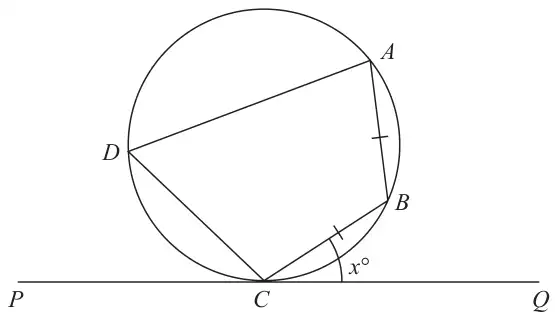
Diagram NOT accurately drawn
\(A\), \(B\), \(C\) and \(D\) are points on a circle.
\(PCQ\) is a tangent to the circle.
\(AB = CB\).
Angle \(BCQ = x°\)
Prove that angle \(CDA = 2x°\)
Give reasons for each stage in your working.
(5)
| Scheme | Marks |
|---|---|
| angle \(CDB = x\) or angle \(CAB = x\) | M1 |
| angle \(CBA = 180 - 2x\) | M1 |
| angle \(CDA = 180 - (180 - 2x) = 2x\) | M1 |
| B1 | |
| proof with reasons | A1 |
| (5) | |
| (5 marks) |
Notes
B1: dep on M1 for any one appropriate circle theorem reason
A1: for complete proof with full reasons
alternate segment theorem, angles in a triangle sum to 180º, isosceles triangle, opposite angles of a cyclic quadrilateral sum to 180º
| Scheme | Marks |
|---|---|
| Alternative method angle \(CDB = x\) or angle \(CAB = x\) | M1 |
| angle \(ACB = x\) | M1 |
| angle \(ACQ = 2x\) and angle \(CDA = 2x\) | M1 |
| B1 | |
| proof with reasons | A1 |
Notes
B1: dep on M1 for any one appropriate circle theorem reason
A1: for complete proof with full reasons
alternate segment theorem, isosceles triangle
| Scheme | Marks |
|---|---|
| Alternative method angle \(OCB = 90 - x\) | M1 |
| angle \(BOC = 180 - 2(90 - x)\) (\(=2x\)) | M1 |
| angle \(AOB = 2x\) and angle \(CDA = 2x\) | M1 |
| B1 | |
| proof with reasons | A1 |
Notes
B1: dep for any one appropriate circle theorem reason
A1: for complete proof with full reasons
angle between tangent and radius is 90º oe, angles in a triangle sum to 180º, isosceles triangle, angle at centre is twice angle at circumference oe
| Scheme | Marks |
|---|---|
| Alternative method where students assume \(CDA = 2x\) and must work to show that \(BCQ = x\) eg angle \(ABC = 180 - 2x\) | M1 |
| Angle \(CAB\) = angle \(ACB = [180 - (180 - 2x)] \div 2 = x\) | M1 |
| \(BCQ = CAB = x\) | M1 |
| B1 | |
| A1 |
Notes
B1: Dep on M1 for any one appropriate circle theorem reason
A1: For complete proof with reasons
e.g. opposite angles of cyclic quadrilateral sum to 180°
angles in triangle sum to 180°
isosceles triangle
alternate segment theorem