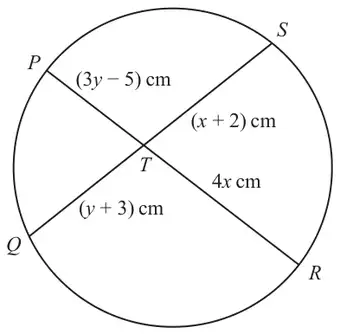
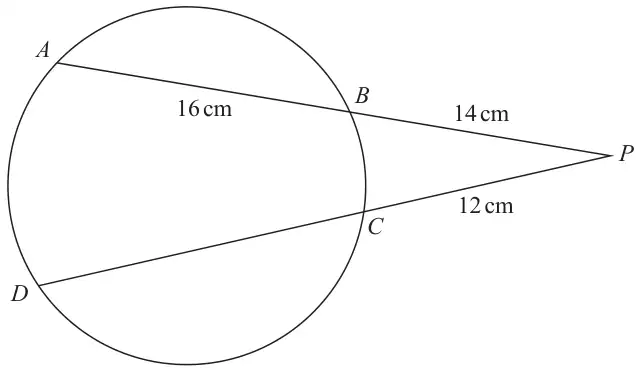
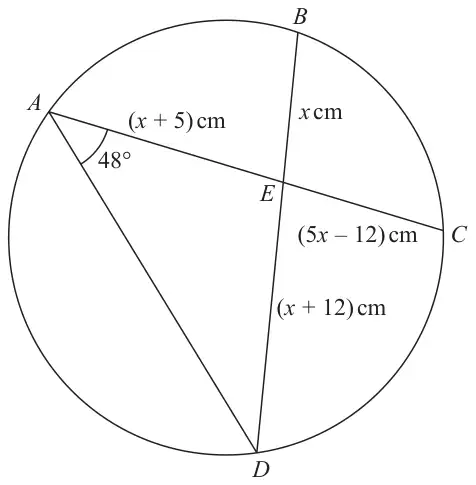
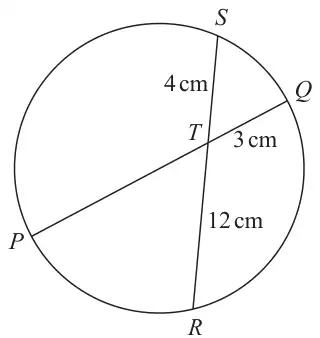
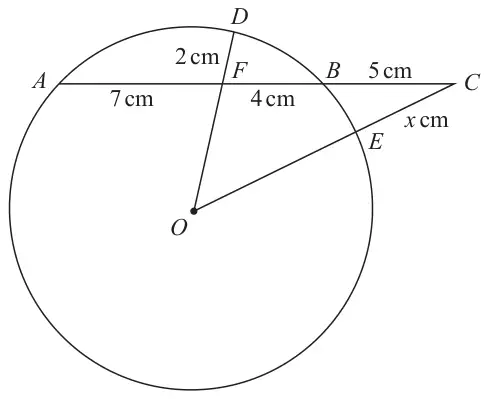
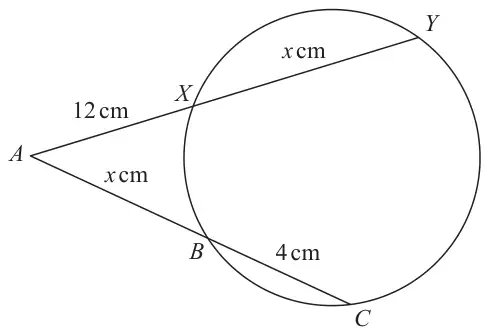
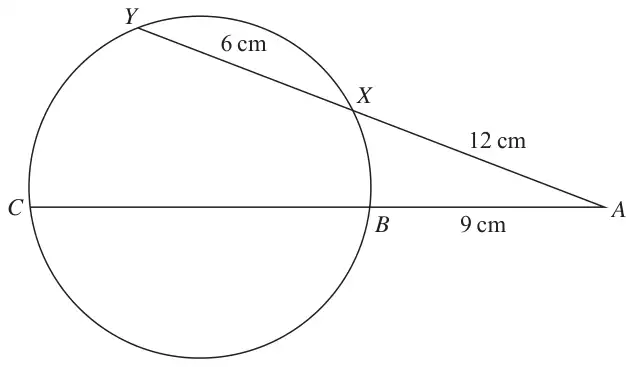
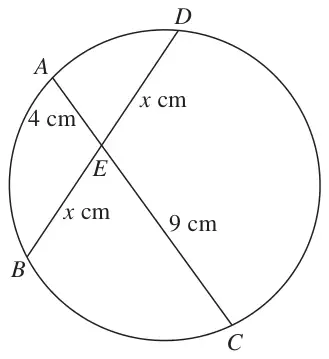
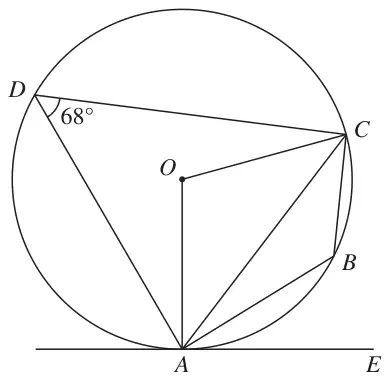
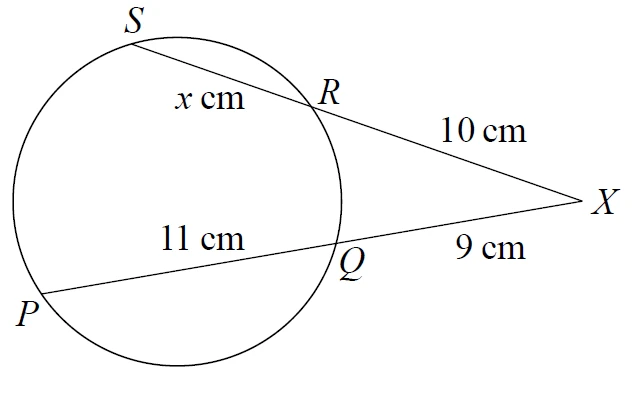
eg \(23x + 6 = y(11x - 2)\) or \(20x + 3x + 6 = y(12x - x - 2)\)
M1ft
Correct answer scores full marks (unless from obvious incorrect working)
Answer: \(\dfrac{23x + 6}{11x - 2}\)
A1
(5)
(5 marks)
Notes
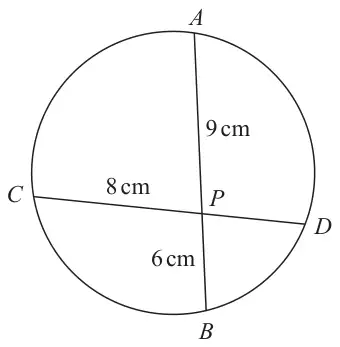
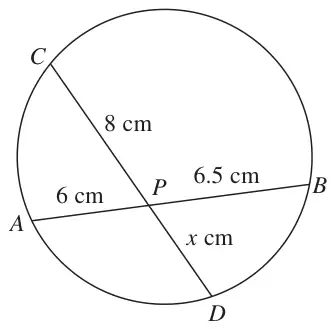
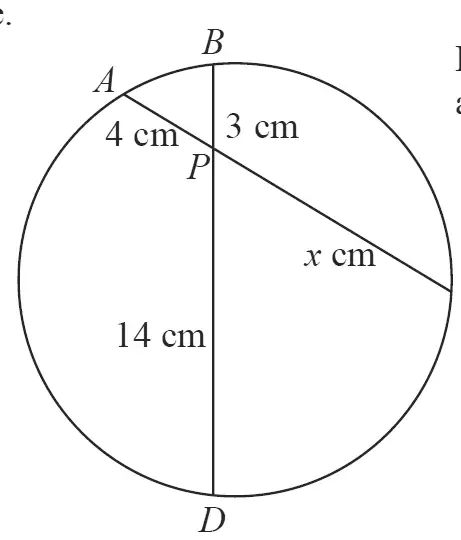
M1: for correct use of intersecting chords theorem to form an equation
M1: for expanding the brackets or for removing the fractions and expanding the brackets, allow one error in one term we can ft \(4x(y + 3) = (x + 2)(3y - 5)\) oe for the 2nd, 3rd and 4th method marks
M1ft: dep on previous M1 for correctly collecting all the \(y\) terms on one side and non-\(y\) terms on the other side
M1ft: dep on 2nd M mark for factorising, for \(y\), an equation in the form \(ax + b = cxy + dy\) (may not be simplified) the factorisation must be correct
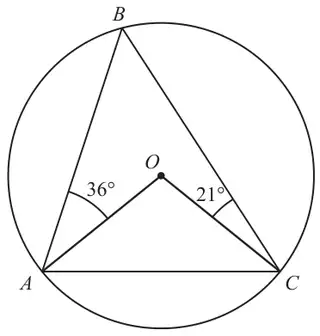
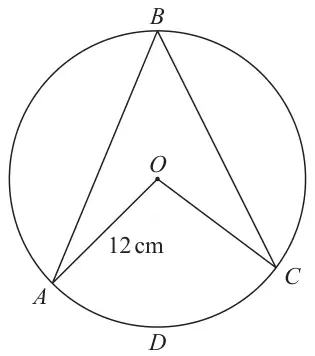
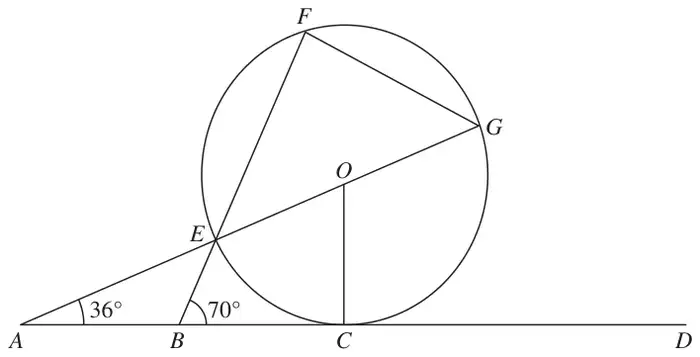
15 \(A\), \(B\) and \(C\) are points on a circle, centre \(O\)
Diagram NOT accurately drawn
Angle \(BAO = 36^\circ\) Angle \(BCO = 21^\circ\)
Work out the size of angle \(ACO\)
(3)
Mark scheme
Scheme
Marks
\(ABC = 21 + 36\;(= 57)\) or angle \(ABO = 36\) and angle \(CBO = 21\) and \(21 + 36\;(=57)\) or (reflex) \(AOC = 360 - (21 + 21 + 36 + 36)\;(= 246)\) or (obtuse) \(AOC = 2 \times (21 + 36)\;(=114)\)
or \(BAX = 90 - 36\;(= 54)\) with the tangent at \(A\) drawn oe or \(BCY = 90 - 21\;(= 69)\) with the tangent at \(C\) drawn oe or angle \(ADB = 180 - 90 - 36\;(= 54)\) OR eg \(x\) = angle \(ACO\) and \(y = ABC\) and \(x + x + 2y = 180\) oe and \(y + (x + 36) + (x + 21) = 180\) oe
Correct answer only scores full marks (unless from obviously incorrect working) Answer: 33
A1
(3)
(3 marks)
Notes
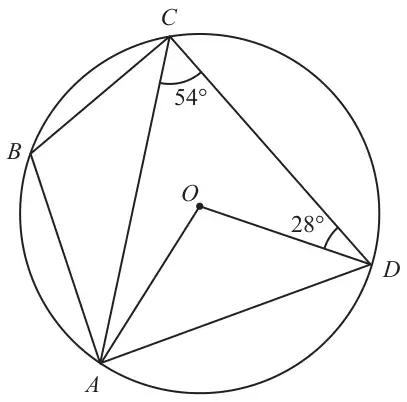
M1: for a method to find one of the angles on the scheme; for this mark, values and calculations must be linked to the correct angle by notation or by being marked on the diagram. May also be awarded for a correct method to set up and solve an equation to find one of these angles; the variable must be clearly defined
where \(X\) is a point on the tangent at \(A\) where \(Y\) is a point on the tangent at \(C\) where \(AD\) is a diameter OR for any correct pair of simultaneous equations with clearly defined variables one of which must be angle \(ACO\)
or any correct equation in terms of \(ACO\) only
M1: for a complete method to find angle \(ACO\) OR forms a correct equation in terms of \(ACO\) only and solves to get a value (condone arithmetic errors)
implies the 1st M mark (provided no incorrect working seen)
Correct answer of 38 scores 3 marks (unless from obvious incorrect working) Answer: 38
A1
B2
(5)
(5 marks)
Notes
M1: angles to be identified either by notation or correctly positioned on the diagram.
M1: (dep on M1) angles to be identified either by notation or correctly positioned on the diagram.
B2: dep on a fully correct method to find \(OBD\) for correct reasons for method used.
(B1 dep on M1 for a correct circle theorem for their method)
Opposite angles of a cyclic quadrilateral sum to 180° Angle at the centre is 2 × (double) angle at circumference / angle at circumference is ½ angle at centre
Angles around a point add up to 360° Isosceles triangle Angles in a triangle add to 180° Angles in a triangle add to 180°
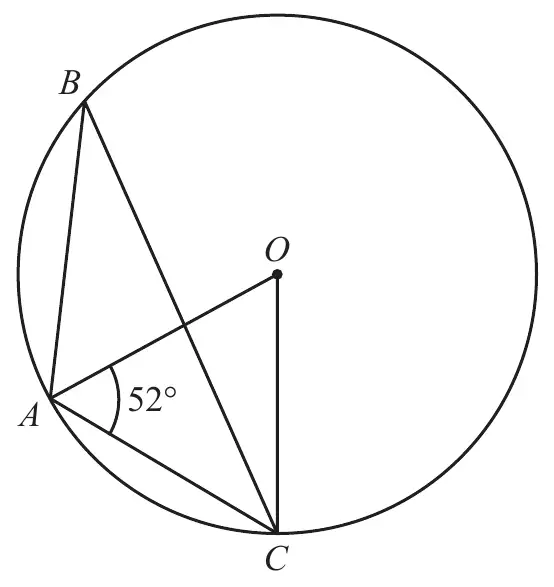
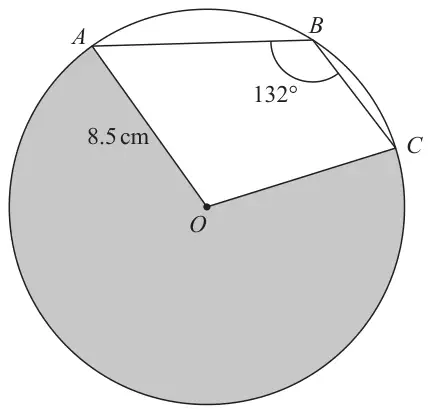
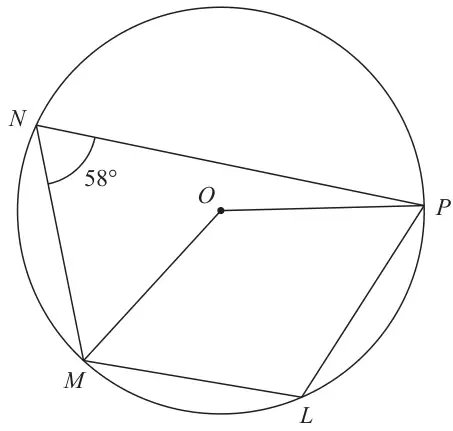
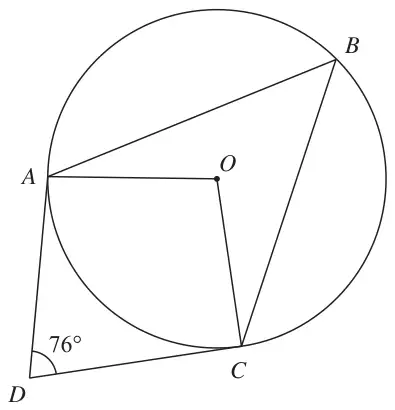
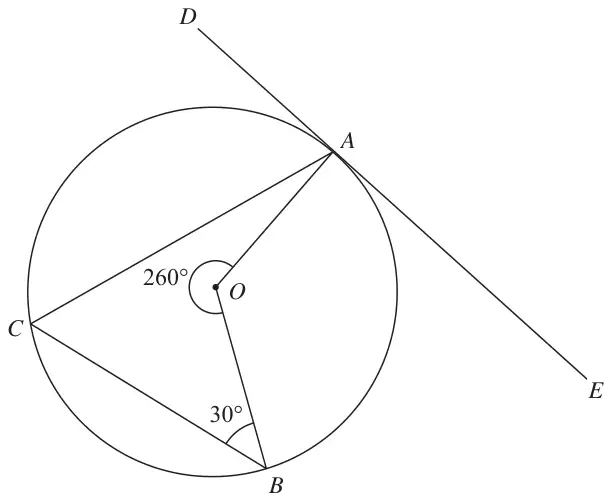
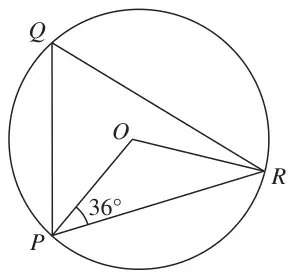
\(A\), \(B\) and \(C\) are points on a circle, centre \(O\)
Angle \(OAC = 52^\circ\)
Find the size of angle \(ABC\) Give reasons for your working.
(3)
Mark scheme
Scheme
Marks
(\(AOC =\)) 180 – (2 × 52) (= 76)
M1
Working not required, so correct answer scores full marks (unless from obvious incorrect working) Answer: 38°
A1
2 correct reasons
B1
(3 marks)
Notes
M1: must not be contradicted on diagram
A1: If labelled on the diagram then it must be in the correct place
B1: dep on M1 for at least 2 valid reasons for their method including a correct circle property angle at the centre is 2 × (double/twice) angle at circumference or angle at circumference is ½ (half) angle at centre and one from (i) Base angles in an isosceles triangle (are equal) (ii) Angles in a triangle sum to 180°
Mark scheme (alternative method)
Scheme
Marks
tangent drawn at \(A\) with a right angle shown or 38° shown between the line \(AC\) and the tangent at \(A\)
M1
Working not required, so correct answer scores full marks (unless from obvious incorrect working) Answer: 38°
A1
38 and correct reason
B1
(3 marks)
Notes
M1: for a correct tangent drawn with right angle shown or 38° shown between the line \(AC\) and the tangent at \(A\)
A1: If labelled on the diagram, then it must be correct
B1: dep on M1 for 38 and alternate segment theorem and angle between radius/diameter and tangent = 90
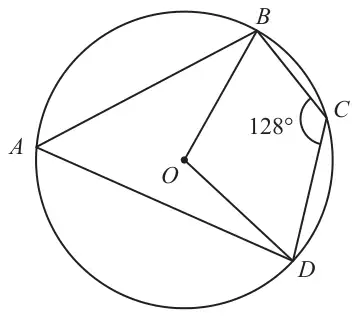
Correct answer scores full marks (unless from obvious incorrect working) Answer: 24
A1
(2)
(2 marks)
Notes
M1: for a complete correct method to find angle \(ABC\). This is not awarded if the angles are incorrectly labelled unless they have clearly started again (Ignore incorrect angles on the diagram if a student shows a correct method leading to the required answer)
A1: award full marks if 24 is seen in the correct place on the diagram unless contradicted on the answer line
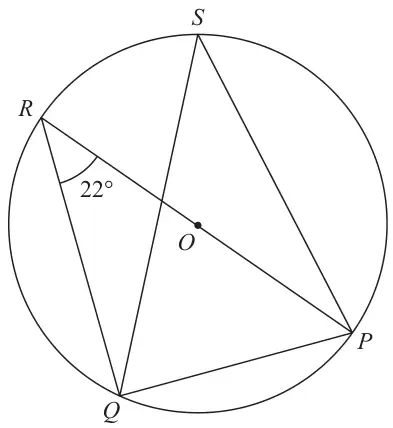
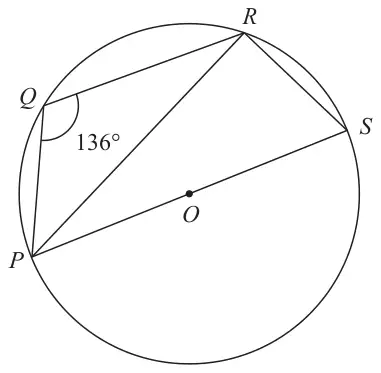
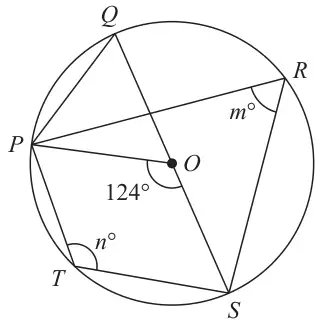
\(P\), \(Q\), \(R\) and \(S\) are points on a circle, centre \(O\) \(ROP\) is a diameter of the circle. Angle \(PRQ = 22^\circ\)
(a)
(i) Find the size of angle \(RQP\) (1)
(ii) Give a reason for your answer. (1)
(b)
(i) Find the size of angle \(PSQ\) (1)
(ii) Give a reason for your answer. (1)
Mark scheme (a)
Scheme
Marks
(i) Answer: 90
B1
(ii) Answer: Angle in a semicircle is 90° oe Angle in a semicircle is 90° oe Triangle in semicircle is 90° oe Angle at centre is double (oe eg ×2) angle at circumference oe Angle at circumference is half (oe) angle at centre. oe
B1
(2)
Notes
B1: dep on B1 in (a)(i)
Valid reason given, underlined words give minimally acceptable answer.
Mark scheme (b)
Scheme
Marks
(i) Answer: 22
B1
(ii) Answer: Angles in the same segment (are equal) or angles at the circumference subtended from the same arc of the circle or angles on the same chord
B1
(2)
(4 marks)
Notes
B1: dep on B1 in (b)(i)
Valid reason given, underlined words give minimally acceptable answer.
Correct answer scores full marks (unless from obvious incorrect working) Answer: 24.4
A1
(5)
(5 marks)
Notes
M1: for setting up a correct equation
A1: for writing the correct quadratic expression in the form \(ax^2 + bx + c\;(= 0)\) allow \(ax^2 + bx = c\)
M1: (dep on M1) for a complete method to solve their 3-term quadratic (allow one sign error and some simplification – allow as far as \(\dfrac{-1 \pm \sqrt{1 + 960}}{8}\))
Allow + instead of ± in quadratic formula
M1: for a complete method for \(ADE\). Allow use of \(x = -4\) for this mark
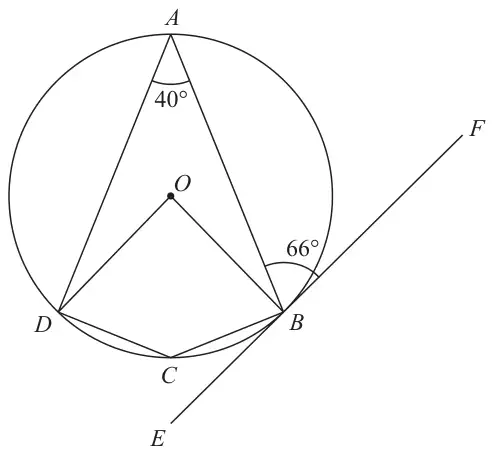
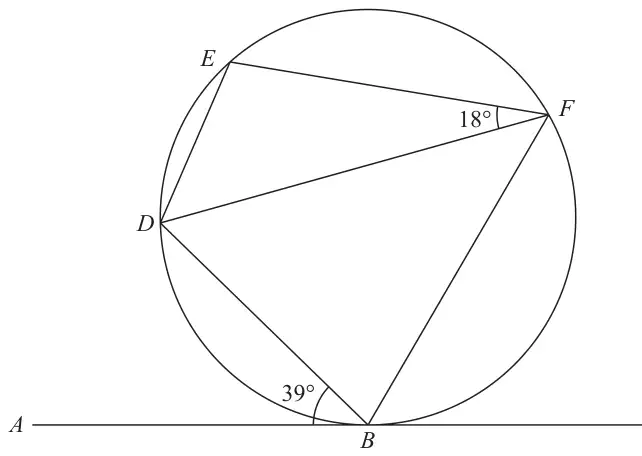
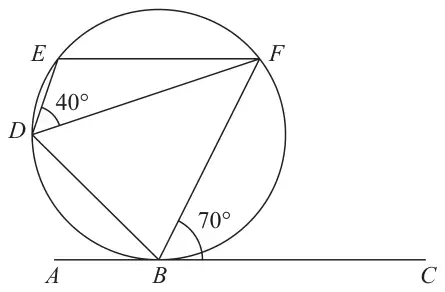
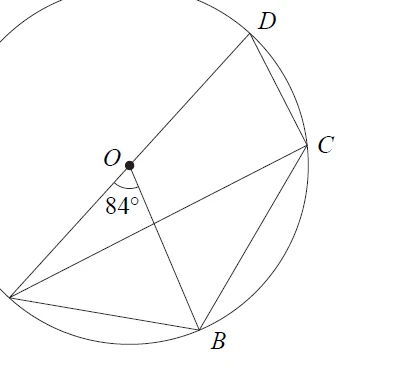
14 \(A\), \(B\), \(C\) and \(D\) are points on a circle, centre \(O\)
\(EBF\) is the tangent to the circle at \(B\)
Diagram NOT accurately drawn
(a)
(i) Work out the size of angle \(DCB\) (1)
(ii) Give a reason for your answer to (a)(i) (1)
(b) Work out the size of angle \(ADO\) (3)
Mark scheme (a)
Scheme
Marks
(i) 140
B1
(ii) opposite angles of a cyclicquadrilateral (add to 180°) oe
B1
(2)
Notes
B1: dep on B1 in (a)(i) or seeing 180 – 40 with no contradiction oe eg angle at centre is double (2 ×) angle at circumference oe ANDangles around a point (or point 360)
Mark scheme (b)
Scheme
Marks
\(ADB = 66\) or
\(ABO = 90 - 66\;(= 24)\) or
\(BAO = 90 - 66\;(= 24)\) or
\(ODB = \dfrac{180 - 80}{2}\;(= 50)\) or
\(DOB\) reflex = 280
M1
For 2 of:
\(ADB = 66\) or
\(ABO = 90 - 66\;(= 24)\) or
\(BAO = 90 - 66\;(= 24)\) or
\(ODB = \dfrac{180 - 80}{2}\;(= 50)\)
\(DOB\) reflex = 280
M1
Correct answer scores full marks (unless from obvious incorrect working) Answer: 16
A1
(3)
(5 marks)
Notes
M1: Clearly labelled in working or shown on diagram
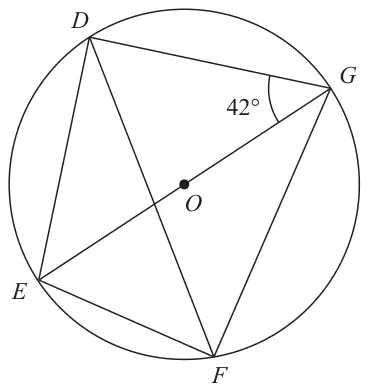
16 \(D\), \(E\), \(F\) and \(G\) are points on a circle, centre \(O\)
Diagram NOT accurately drawn
\(EOG\) is a diameter of the circle. Angle \(EGD = 42°\)
Calculate the size of angle \(DFG\) Give a reason for each stage of your working.
(4)
Mark scheme
Scheme
Marks
\(DFE = 42°\) or \(DOG = 180 - 2 \times 42\;(= 96)\) or \(EFG = 90°\) or \(EDG = 90°\) or \(DEG = 90 - 42\;(= 48)\)
M1
48°
A1
angles in same segmentor angles from same chordor angles at the circumference subtended from the same arc of the circle angles in a semicircle are 90° angles in a semicircle are 90° angle subtended by diameter is 90° angle at centre twice angle at circumference oe angles in a triangle add to 180 angles in a triangle add to 180
B2
(4)
(4 marks)
Notes
M1: used or seen in diagram (must be clearly labelled if not in diagram)
A1: award 2 marks for 48 unless from an incorrect method
B2: Dep on a fully correct method to find angle \(DFG\) for a full set of reasons relevant to their method. B1 dep on M1 for at least one relevant circle theorem.
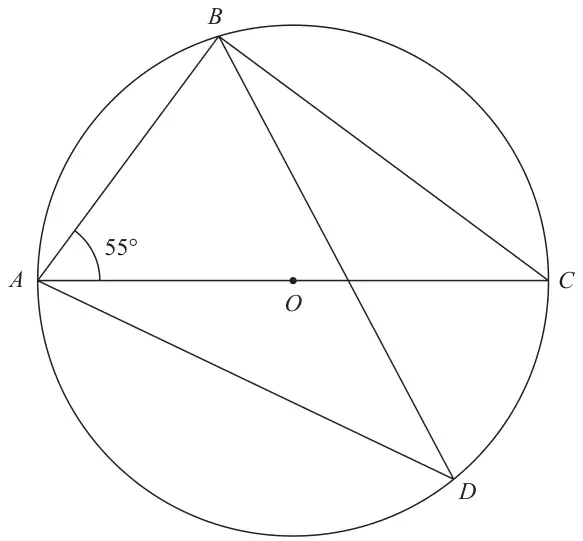
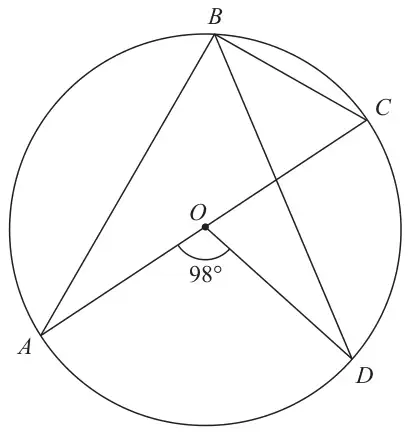
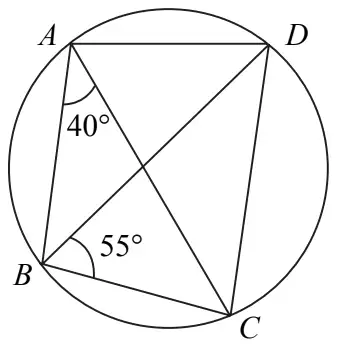
\(A\), \(B\), \(C\) and \(D\) are points on a circle, centre \(O\) \(AOC\) is a diameter of the circle.
Angle \(BAC = 55^\circ\)
Work out the size of angle \(ADB\) Give a reason for each stage of your working.
(4)
Mark scheme
Scheme
Marks
\(ABC = 90^\circ\) and \(ACB\ (= ADB) = 180 - 90 - 55\ (= 35)\) or \(ABO = 55^\circ\) and \(AOB = 180 - 2 \times 55\ (= 70)\) or \(BDC = 55^\circ\), \(ADC = 90^\circ\) and \(ADB = 90 - 55\ (= 35)\)
M1
Working required Answer: 35
A1
Angles in a semicircle are 90° Angles in a triangle add to 180° (Angles in a triangle add to 180°) Angles in the same segment (are equal) OR angles at the circumference subtend(ed) from the same arc/chord of the circle (are equal) or Angles in an isosceles triangle (are equal) Angles in a triangle sum to 180° (Angles in a triangle add to 180°) Angle at the centre is 2 × (double) angle at circumference / angle at circumference is ½ angle at centre or Angles in the same segment (are equal) OR angles at the circumference subtend(ed) from the same arc/chord of the circle Angles in a semicircle are 90°
B2
(4)
(4 marks)
Notes
A1: for \(ADB = 35\)
B2: (dep on M1) for all 3 reasons appropriate to their method
B1 (dep on M1) for one correct circle theorem appropriate to their method)
NB For the third method only 2 reasons are required
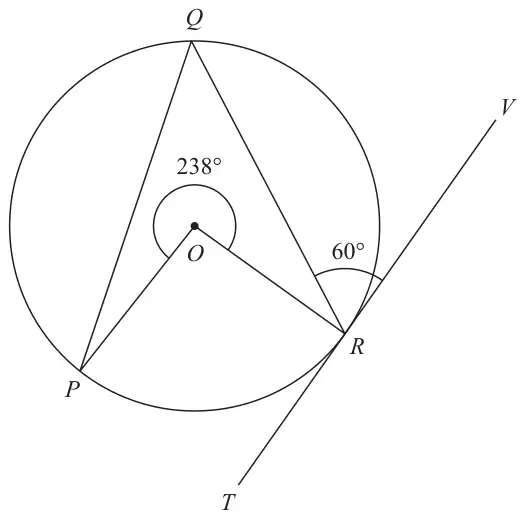
15 \(P\), \(Q\) and \(R\) are points on a circle, centre \(O\). \(TRV\) is the tangent to the circle at \(R\).
Diagram NOT accurately drawn
Reflex angle \(POR = 238°\) Angle \(QRV = 60°\)
Calculate the size of angle \(OPQ\). Give a reason for each stage of your working.
(4)
Mark scheme
Scheme
Marks
\(ORQ = 90 - 60\ (= 30)\) or \(OQR = 30\)
or
\(PQR = 0.5 \times (360 - 238)\ (= 61)\)
or
\(QPR = 60\)
or
\(OPR = \dfrac{180 - (360 - 238)}{2}\ (= 29)\)
M1
Working not required, so correct answer scores M1A1 (unless from obvious incorrect working) Answer: 31
A1
NB: degrees symbol not essential for reasons We will allow the symbol Δ for ‘triangle’ ∠ for angle Σ for sum Answer: full reasons for method used
B2
(4)
(4 marks)
Notes
M1: The correct working or the correct angle for ORQorOQRorPQRorQPRorOPR. Must be clearly stated as the correct angle or shown on the diagram in correct position. (eg just seeing 30 in working without a label is not sufficient for the award of this mark)
A1: if not on answer line, may be seen on diagram or clearly labelled
B2: (dep on a fully correct method that should lead to the answer) for fully correct reasons for method used (underlined words must be seen) eg Angle between tangent and radius is 90° Angles around a point total 360° Angle at centre is twice angle at circumference/edge Total of angles in triangle is 180° / triangle 180° Base angles in an isosceles triangle (or 2 sides equal, so 2 angles equal) Angles in a quadrilateral total 360° or quadrilateral 360° / Accept “4-sided shape” or “quad” Alternate segment theorem (B1 dep on M1 for at least one reason for method used)
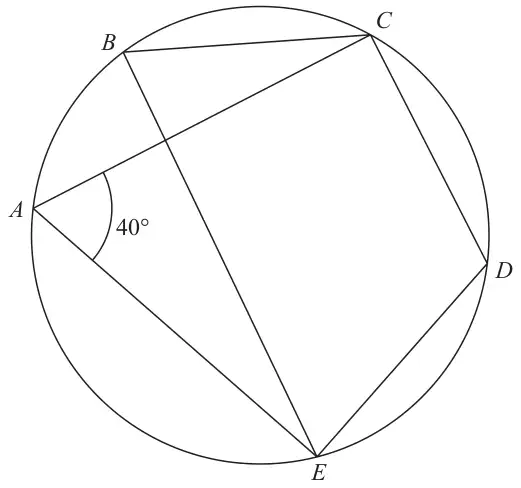
\(A\), \(B\), \(C\), \(D\) and \(E\) are points on a circle.
Angle \(EAC = 40^\circ\)
(a)
(i) Write down the size of angle \(EBC\). (1)
(ii) Give a reason for your answer. (1)
(b) Find the size of angle \(EDC\). (1)
Mark scheme (a)
Scheme
Marks
(i) Answer: 40
B1
(ii) Answer: Angles in same segment (are equal)
B1
(2)
Notes
B1: cao (may be written on the diagram)
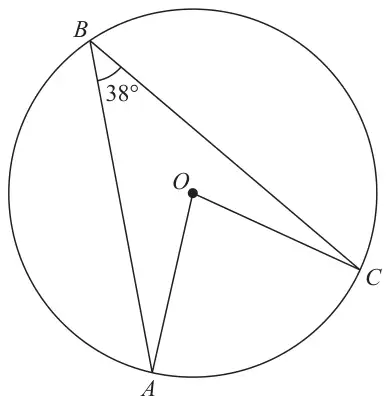
B1:orangles at the circumferencefrom the same arc of the circle orangleson the samearc of the circle Alternatively: (two applications of) Opposite angles of a cyclic quadrilateral sum to 180°
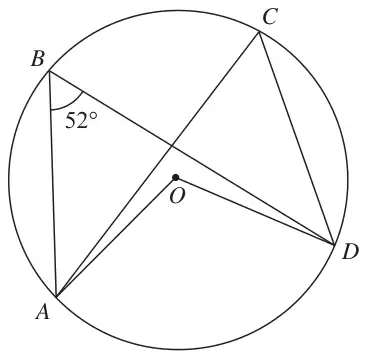
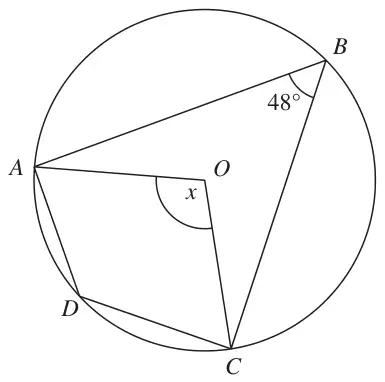
\(A\), \(B\) and \(C\) are points on a circle, centre \(O\).
Angle \(ABC = 38^\circ\)
Work out the size of angle \(OAC\). Give a reason for each stage of your working.
(4)
Mark scheme
Scheme
Marks
(\(AOC\) =) 38 × 2 (= 76)
M1
52
A1
B2
(4)
(4 marks)
Notes
B2: (dep on M1) for all reasons relevant to their method – underlined words must be seen. angle at the centre is 2 × (double) angle at circumference / angle at circumference is ½ angle at centre angles in a triangle add to 180° or angles in a triangle add to 180° base angles in an isosceles triangle (are equal) If not B2 then award B1 (dep on M1) for a correct circle theorem
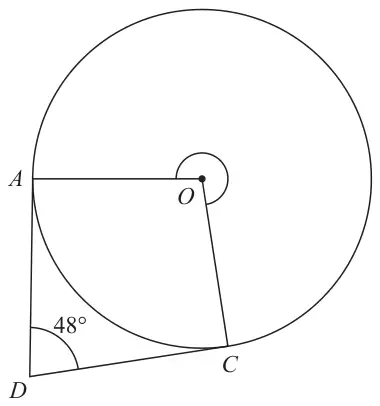
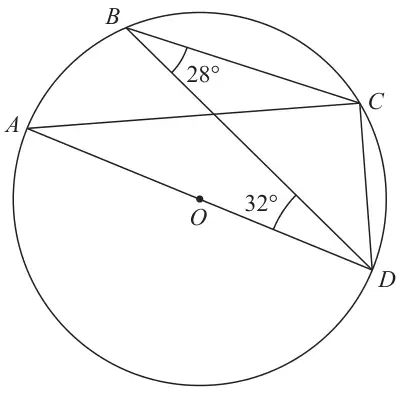
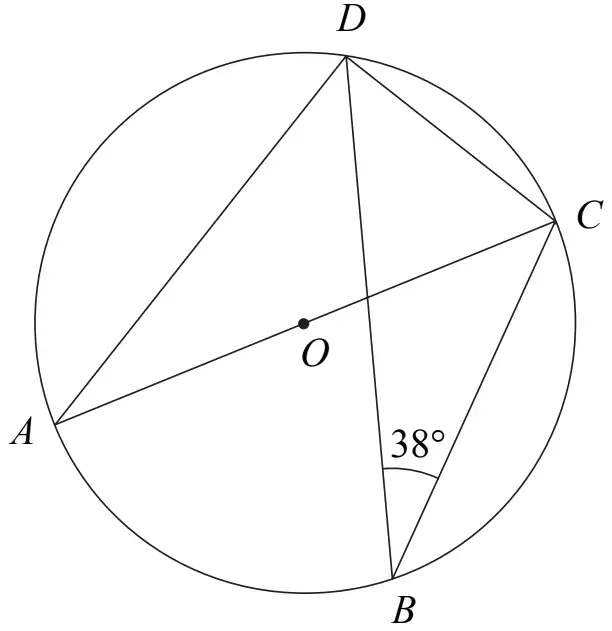
\(A\), \(B\), \(C\) and \(D\) are points on a circle, centre \(O\). \(AOD\) is a diameter of the circle.
Angle \(CBD = 28^\circ\) Angle \(BDA = 32^\circ\)
Find the size of angle \(BDC\). Give a reason for each stage of your working.
(4)
Mark scheme
Scheme
Marks
Angle \(CAD = 28^\circ\) or angle \(ACB = 32^\circ\) or angle \(ACD = 90^\circ\) or angle \(ABD = 90^\circ\)
M1
30°
A1
Angles in the same segment are equal, angle in a semicircle is 90° (or angle at centre is double angle at circumference oe) angles in a triangle add up to 180°/angles in a triangle isosceles triangle alternate angles vertically opposite angles (or vertically opposite) angles at a point opposite angles in a cyclic quadrilateral angle between tangent and radius (diameter) alternate segment theorem angles subtended by the same arc (or chord) at the circumference (or on the circle)
B2
(4)
(4 marks)
Notes
A1: For a correct answer of 30
B2: Dep on M1 for all correct reasons for their method used (if not B2 then award B1 (dep on M1) for a correct circle theorem reason)
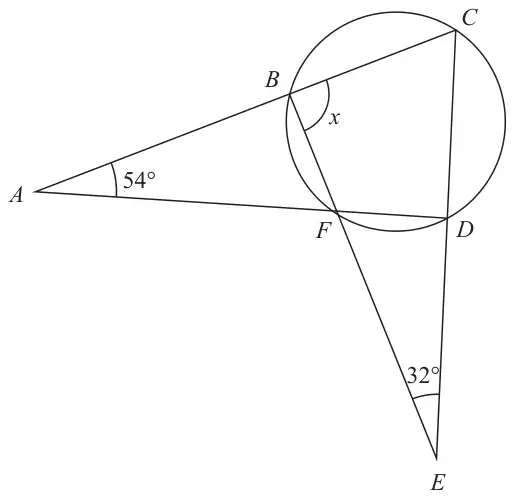
\(B\), \(C\), \(D\) and \(F\) are points on a circle. \(ABC\), \(AFD\), \(BFE\) and \(CDE\) are straight lines. Work out the size of angle \(x\). Show your working clearly.
(4)
Mark scheme
Scheme
Marks
\(ABF = 180 - x\) or \(CDF = 180 - x\)
M1
\(FDE = 180 - (180 - x)\) (\(= x\)) \(AFB\) or \(ACE = 180 - (180 - x) - 54\) (\(= x - 54\)) \(DFE\) or \(ACE = 180 - x - 32\) (\(= 148 - x\)) e.g. \(54 + y + 180 - x = 180\) where \(AFB = y\) \(32 + y + (180 - (180 - x)) = 180\) where \(DFE = y\)
M1
e.g. \(32 + x + x - 54 = 180\) or \(54 + 180 - x + 148 - x = 180\) or \(x - 54 = 148 - x\) oe or \(54 + y + 180 - x = 180\) and \(32 + y + (180 - (180 - x)) = 180\) where \(AFB = DFE = y\)
M1
Working required Answer: 101
A1
(4)
(4 marks)
Notes
M1: for finding an expression for \(ABF\) or \(CDF\). May be seen on diagram.
M1: method to find \(FDE\) and \(AFB\) or method to find \(FDE\) and \(DFE\) or method to find \(ACE\) or method to find \(FDE\) and an equation for \(AFB\) e.g. \(54 + y + 180 - x = 180\) where \(AFB = y\) or method to find \(FDE\) and an equation for \(DFE\) e.g. \(32 + y + (180 - (180 - x)) = 180\) where \(DFE = y\) May be seen on diagram.
M1: for setting up an equation or a pair of correct simultaneous equations to solve for \(x\)
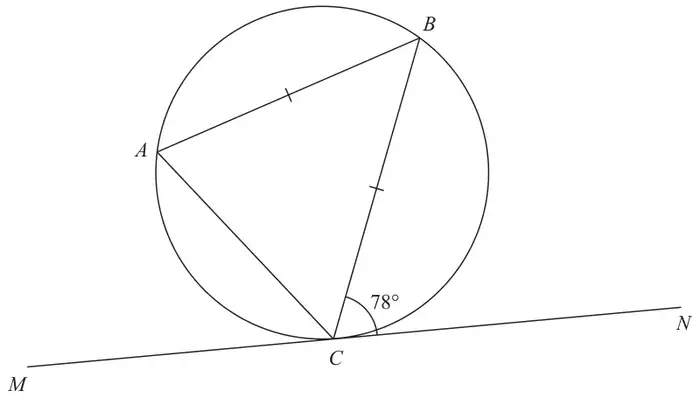
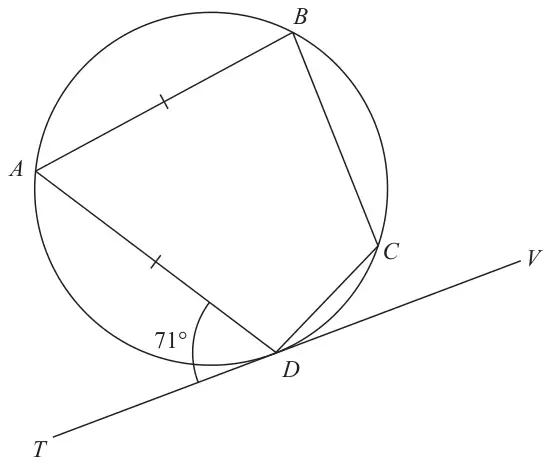
\(A\), \(B\), \(C\) and \(D\) are points on a circle. \(TDV\) is the tangent to the circle at \(D\).
\(AB = AD\) Angle \(ADT = 71^\circ\)
Work out the size of angle \(BCD\). Give a reason for each stage of your working.
(5)
Mark scheme
Scheme
Marks
Students can use other methods to gain the correct answer angle \(ABD = 71\) or angle \(ACD = 71\) or using \(O\) as centre of circle, angle \(ADO\) = 90 – 71 (=19)
M1
angle \(ADB = 71\) or angle \(ACB = 71\) or angle \(BAD\) = 19 × 2 (=38) or reflex angle \(BOD\) = 2 × 142 (=284)
M1
angle \(BCD = 142\) Answer: 142
A1
B2
(5)
(5 marks)
Notes
M1: clearly labelled or stated
M1: dep clearly labelled or stated
A1: Clearly labelled or stated, from no incorrect working for their method
B2: dep on A1 for fully correct reasons for each stage of working, repeated if used more than once. eg alternate segment theorem, base angles in an isosceles triangle are equal, angles in a triangle sum to 180°, angle between tangent and radius(diameter) is 90° congruent triangles (equal triangles) oe opposite angles of a cyclic quadrilateral sum to 180° angles in the same segment angle at the centre is 2 × angle at circumference oe equal chords subtend equal angles at the circumference If not B2 then award B1 dep on M1 for any one correct circle theorem reason associated with angle(s) found
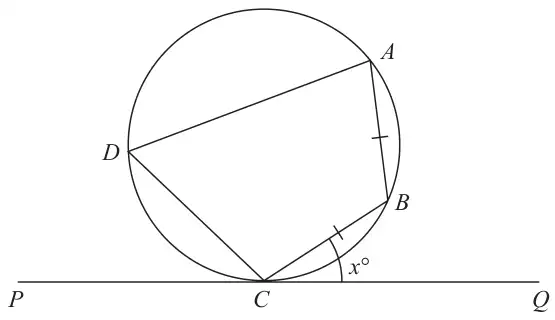
\(A\), \(B\), \(C\) and \(D\) are points on a circle. \(PCQ\) is a tangent to the circle. \(AB = CB\).
Angle \(BCQ = x°\)
Prove that angle \(CDA = 2x°\) Give reasons for each stage in your working.
(5)
Mark scheme
Scheme
Marks
angle \(CDB = x\) or angle \(CAB = x\)
M1
angle \(CBA = 180 - 2x\)
M1
angle \(CDA = 180 - (180 - 2x) = 2x\)
M1
B1
proof with reasons
A1
(5)
(5 marks)
Notes
B1: dep on M1 for any one appropriate circle theorem reason
A1: for complete proof with full reasons alternate segment theorem, angles in a triangle sum to 180º, isosceles triangle, opposite angles of a cyclic quadrilateral sum to 180º
Mark scheme (ALT 1)
Scheme
Marks
Alternative method angle \(CDB = x\) or angle \(CAB = x\)
M1
angle \(ACB = x\)
M1
angle \(ACQ = 2x\) and angle \(CDA = 2x\)
M1
B1
proof with reasons
A1
Notes
B1: dep on M1 for any one appropriate circle theorem reason
A1: for complete proof with full reasons alternate segment theorem, isosceles triangle
Mark scheme (ALT 2)
Scheme
Marks
Alternative method angle \(OCB = 90 - x\)
M1
angle \(BOC = 180 - 2(90 - x)\) (\(=2x\))
M1
angle \(AOB = 2x\) and angle \(CDA = 2x\)
M1
B1
proof with reasons
A1
Notes
B1: dep for any one appropriate circle theorem reason
A1: for complete proof with full reasons angle between tangent and radius is 90º oe, angles in a triangle sum to 180º, isosceles triangle, angle at centre is twice angle at circumference oe
Mark scheme (ALT 3)
Scheme
Marks
Alternative method where students assume \(CDA = 2x\) and must work to show that \(BCQ = x\) eg angle \(ABC = 180 - 2x\)
B1: Dep on M1 for any one appropriate circle theorem reason
A1: For complete proof with reasons e.g. opposite angles of cyclic quadrilateral sum to 180° angles in triangle sum to 180° isosceles triangle alternate segment theorem
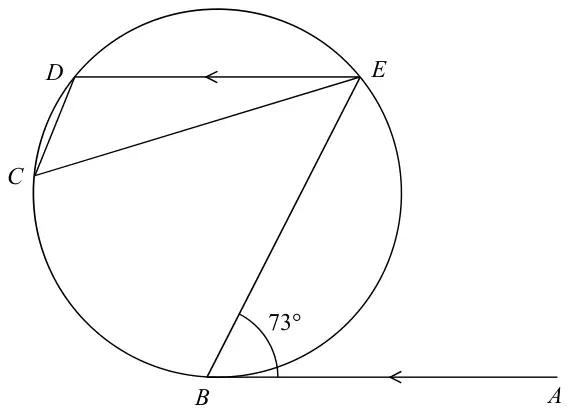
Angle \(DEB = 73^\circ\) and Angle \(DCB\) = 180−73 (=107°)or Angle \(DEB = 73^\circ\) and Angle \(DBE\) = 180−73×2 (=34°)
M1
Angle \(DCE = 34^\circ\) Answer: 34
A1
eg Alternate segment theorem Opposite angles of a cyclic quadrilateral sum to 180° Alternate angles are equal Angles in the Same segment are equal Angles in a triangle sum to 180
B2
(5)
(5 marks)
Notes
M1: angles may be written on the diagram
B2: for a full set of reasons relevant to their method (B1 for at least one relevant circle theorem)
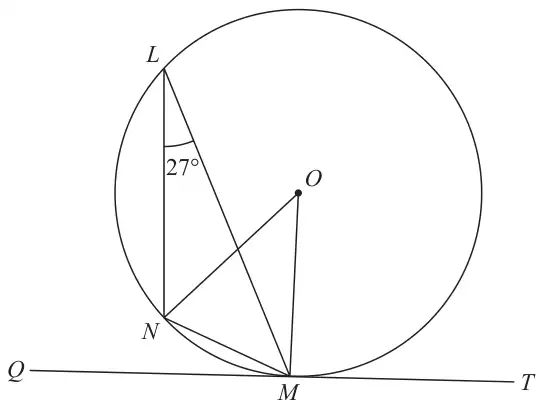
\(L\), \(M\) and \(N\) are points on a circle, centre \(O\). \(QMT\) is the tangent to the circle at \(M\).
(a)
(i) Find the size of angle \(NOM\).
(ii) Give a reason for your answer. (2)
(b)
(i) Find the size of angle \(NMQ\).
(ii) Give a reason for your answer. (2)
Mark scheme (a)
Scheme
Marks
(i) 54
B1
(ii) angle at centre is twice angle at circumference
B1
(2)
Notes
B1: cao
B1: dep on B1 in (a)(i) accept alternative reasons eg. angle at circumference is half the angle at the centre
Mark scheme (b)
Scheme
Marks
(i) 27
B1
(ii) alternate segment theorem
B1
(2)
(4 marks)
Notes
B1: ft from (a)(i) for \(\dfrac{\text{``}{54}\text{''}}{2}\)
B1: dep on B1 in (b)(i) accept alternative reason angle between tangent and radius is 90° If answer for (b)(i) is ft from (a)(i) then reason must be angle between tangent and radius is 90°
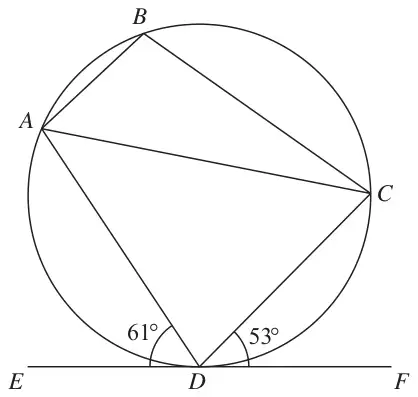
\(A\), \(B\), \(C\) and \(D\) are points on a circle. \(EDF\) is the tangent to the circle at \(D\). Angle \(ADE = 61^\circ\) and angle \(CDF = 53^\circ\)
(a)
(i) Write down the size of angle \(ACD\).
(ii) Give a reason for your answer. (2)
(b) Work out the size of angle \(ABC\). (2)
Mark scheme (a)
Scheme
Marks
(i) Answer: 61°
B1
(ii) Answer: Alternate segment theorem
B1
(2)
Notes
B1: Dep on B1 for (a)(i) Accept alternate segment(s) Accept angles in alternate segments are equal or Accept Angle between a chord and a tangent is equal to the angle on the circumference subtended/made by the same chord
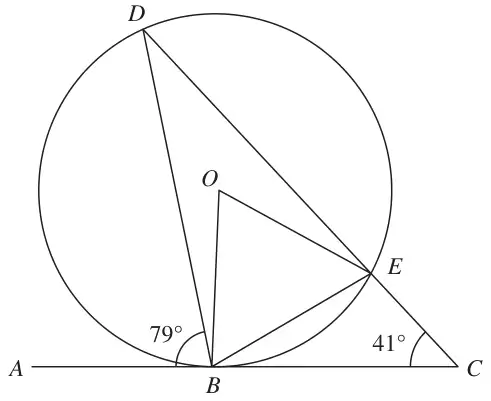
\(B\), \(D\) and \(E\) are points on a circle, centre \(O\). \(ABC\) is a tangent to the circle. \(DEC\) is a straight line. Angle \(ABD = 79^\circ\) and angle \(ECB = 41^\circ\)
(a) Write down the size of angle \(BED\). (1)
(b) Work out the size of angle \(BOE\). (2)
Mark scheme (a)
Scheme
Marks
79°
B1
(1)
Mark scheme (b)
Scheme
Marks
\(\angle BDE = 79 - 41\) or 180 − 101 − 41(= 38) or \(\angle OBE = 90 - 38\) or 90 − (180 − 101 − 41) (=52)
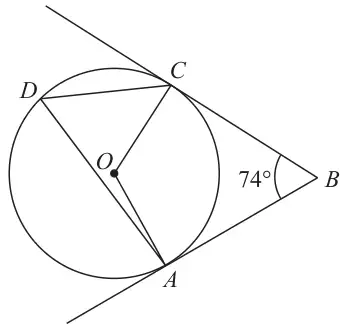
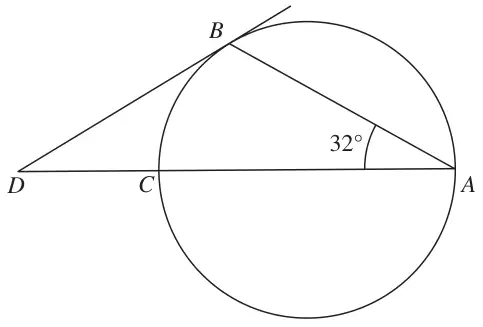
\(A\), \(B\) and \(C\) are three points on a circle. \(DCA\) is a straight line. \(CA\) is a diameter of the circle. \(DB\) is a tangent to the circle.
Calculate the size of angle \(CDB\).
(3)
Mark scheme
Scheme
Marks
Angle \(CBD = 32^\circ\) or angle \(ABC = 90^\circ\) or angle \(DBO = 90^\circ\) or angle \(OBA = 32^\circ\) or angle \(BOD = 2 \times 32\) (= 64) (where \(O\) is the centre of the circle)
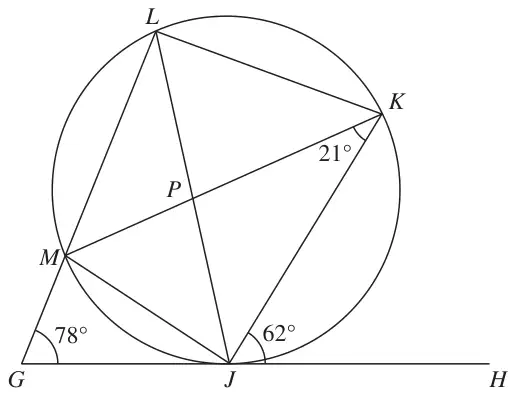
17 \(J\), \(K\), \(L\) and \(M\) are points on the circumference of a circle. \(GJH\) is the tangent to the circle at \(J\). \(MK\) and \(JL\) intersect at the point \(P\). \(GML\) is a straight line. Angle \(HJK = 62^\circ\), angle \(JKM = 21^\circ\) and angle \(JGL = 78^\circ\)
Diagram NOT accurately drawn
(a) Write down the size of angle \(MLJ\). (1)
(b) Write down the size of angle \(JLK\). (1)
(c) Work out the size of angle \(KPL\). (3)
Mark scheme (a)
Scheme
Marks
21
B1
(1)
Mark scheme (b)
Scheme
Marks
62
B1
(1)
Mark scheme (c)
Scheme
Marks
\(\angle KJL = 37^\circ\) or \(\angle PJM = 60^\circ\) or \(\angle LKM = 60^\circ\) or \(\angle LMP = 37^\circ\) or \(\angle MPJ = 58^\circ\) or \(MPL = 122^\circ\) or \(JPK = 122^\circ\)
M2
58
A1
(3)
Notes
M2: If not M2 then M1 for: \(\angle GJL = 81^\circ\) or \(\angle GMJ = 81^\circ\) or \(JKL = 81^\circ\) or \(JML = 99^\circ\) Angles may be marked on the diagram or labelled in the working.
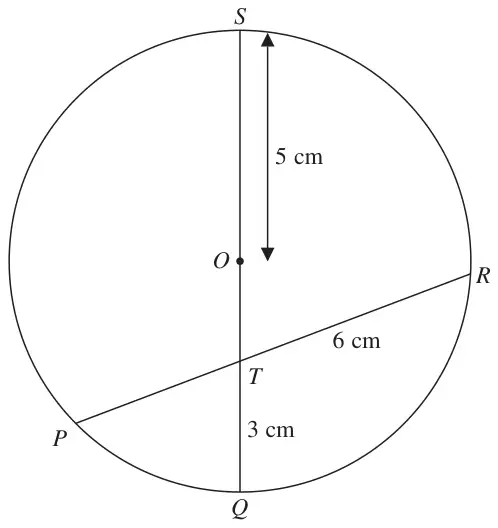
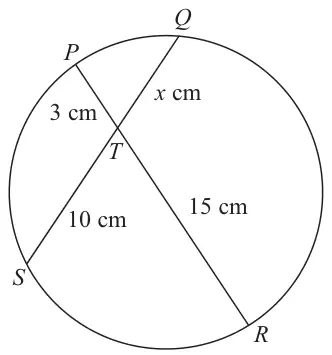
P, Q, R and S are points on a circle, centre O. QS is a diameter of the circle. QS and PR intersect at the point T. \(OS = 5\) cm, \(QT = 3\) cm and \(TR = 6\) cm.
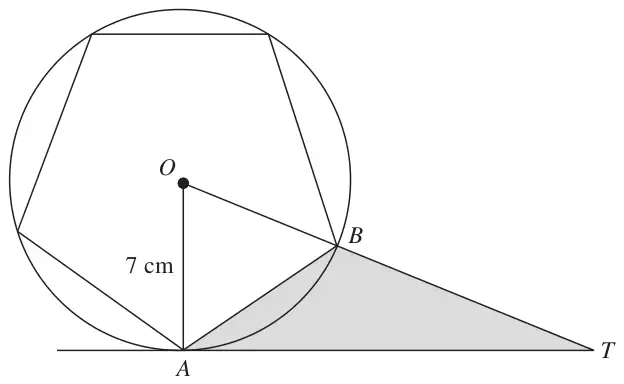
The diagram shows a regular pentagon inside a circle, centre \(O\). The points \(A\) and \(B\) lie on the circle such that \(AB\) is a side of the pentagon. \(OA = 7\) cm. \(TA\) is a tangent to the circle and \(OBT\) is a straight line.
Calculate the area of triangle \(ABT\). Give your answer correct to 3 significant figures.
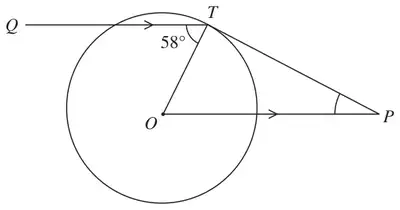
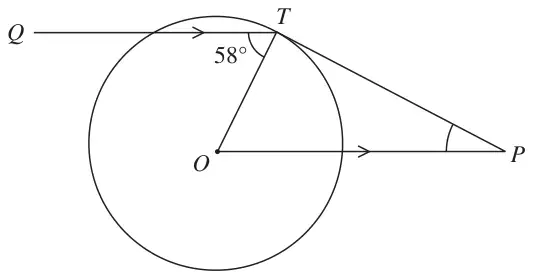
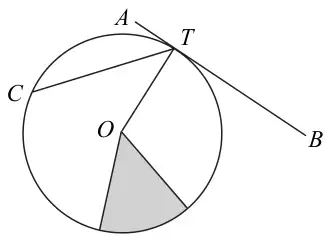
\(T\) is a point on a circle, centre \(O\). \(Q\) is a point such that angle \(QTO = 58^\circ\) \(P\) is the point such that \(OP\) is parallel to \(QT\) and \(PT\) is a tangent to the circle.
\(T\) is a point on a circle, centre \(O\). \(Q\) is a point such that angle \(QTO = 58^\circ\) \(P\) is the point such that \(OP\) is parallel to \(QT\) and \(PT\) is a tangent to the circle.
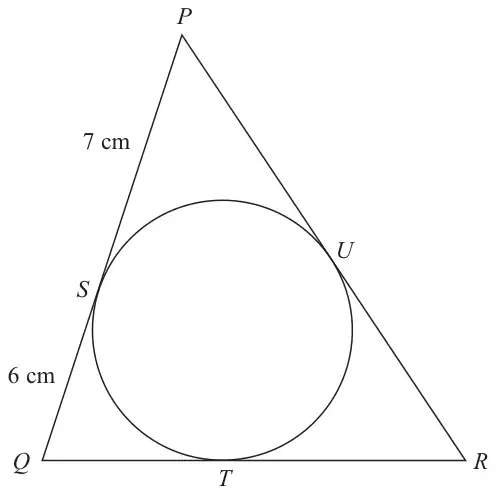
19 The sides of triangle \(PQR\) are tangents to a circle. The tangents touch the circle at the points \(S\), \(T\) and \(U\). \(QS = 6\) cm. \(PS = 7\) cm.
Diagram NOT accurately drawn
(a)
(i) Write down the length of \(QT\).
(ii) Give a reason for your answer.
(2)
The perimeter of triangle \(PQR\) is 42 cm.
(b) Calculate the size of angle \(PQR\). Give your answer correct to 1 decimal place. (4)
Mark scheme (a)
Scheme
Marks
(i) 6
B1
(ii) Tangents from a point to a circle are equal in length
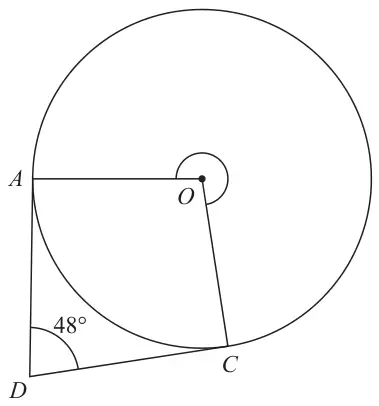
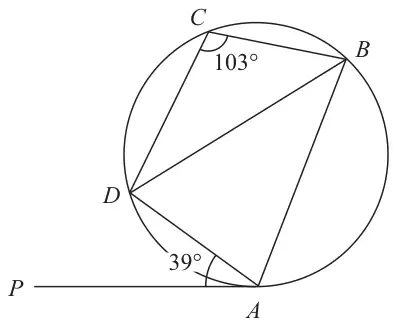
\(A\), \(B\), \(C\) and \(D\) are points on a circle. \(PA\) is a tangent to the circle. Angle \(PAD = 39^\circ\) Angle \(BCD = 103^\circ\)
Calculate the size of angle \(ADB\).
(3)
Mark scheme
Scheme
Marks
NB : M2 cannot be awarded if angles are marked incorrectly on the diagram 180 − 77 − 39 or \(\angle BAD = 77^\circ\) and \(\angle ABD = 39^\circ\) or \(\angle BA\text{“}x\text{”} = 64^\circ\) where \(x\) is on \(PA\) produced or a fully correct method to find angle \(ADB\)
M2
64
A1
(3)
Notes
M2: also accept 103 −39 M1 for \(\angle BAD = 77^\circ\) or \(\angle ABD = 39^\circ\)
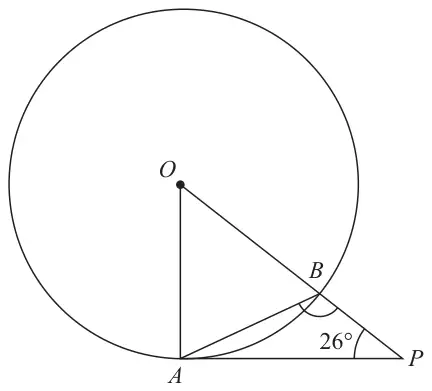
\(A\) and \(B\) are points on a circle, centre \(O\). \(PA\) is the tangent to the circle at \(A\). \(OBP\) is a straight line. Angle \(APO = 26^\circ\)
Calculate the size of angle \(ABP\).
(3)
Mark scheme
Scheme
Marks
\(\angle OAP = 90^\circ\) or \(\angle AOB = 64^\circ\)
B1
\(\angle OAB = 58^\circ\) or \(\angle OBA = 58^\circ\)
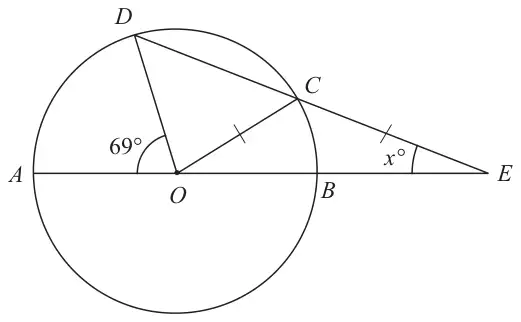
\(A\), \(B\), \(C\) and \(D\) are points on a circle, centre \(O\). \(AOBE\) and \(DCE\) are straight lines. \(CO = CE\). Angle \(AOD = 69^\circ\) Angle \(CEO = x^\circ\)
Calculate the value of \(x\). Show your working clearly.
(6)
Mark scheme
NB The mark scheme for Q18 covers the majority of methods but there are other possible approaches. If you encounter a mathematically correct method which is not covered and (i) the answer is correct – award full marks or (ii) the answer is not correct – send the response, appropriately annotated, to Review.
Scheme
Marks
\(\angle COE = x\)
B1
\(\angle OCD = 2x\) or \(69 - x\) or \(34\frac{1}{2} + \frac{1}{2}x\)
B1
\(\angle ODC = 2x\) or \(69 - x\) or \(34\frac{1}{2} + \frac{1}{2}x\) \(\angle COD = 180 - 4x\) or \(111 - x\) Accept \(x + y = 69\) or \(y - \frac{1}{2}x = 34\frac{1}{2}\) (where \(\angle OCD = \angle ODC = y\))
B1
\(3x = 69\)
M2
23
A1
(Total 6 marks)
Notes
M2: M1 for a correct unsimplified equation in \(x\) eg \(69 + 180 - 4x + x = 180\) \(69 = 2x + x\) \(69 - x = 2x\) \(55.5 + 55.5 + 2x + x = 180\) \(111 - x + 2x + 2x = 180\) \(34\frac{1}{2} + \frac{1}{2}x = 2x\)
A1: cao Award 6 marks for an answer of 23 if M1 or M2 scored
B1 B1 B1: May be stated, marked on diagram or part of an equation. B1 for each correct expression for an angle up to a max of 2. Award all 3 B marks if M1 or M2 scored.
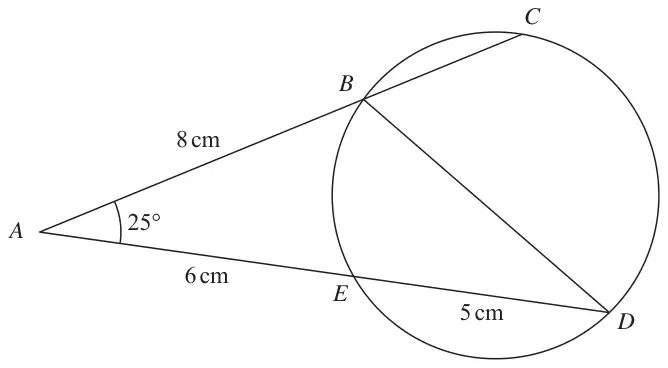
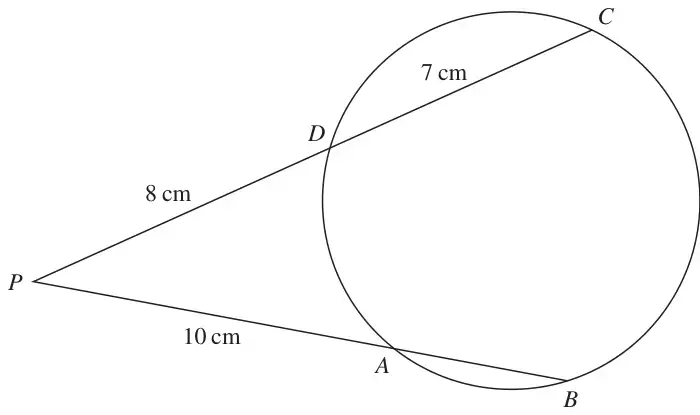
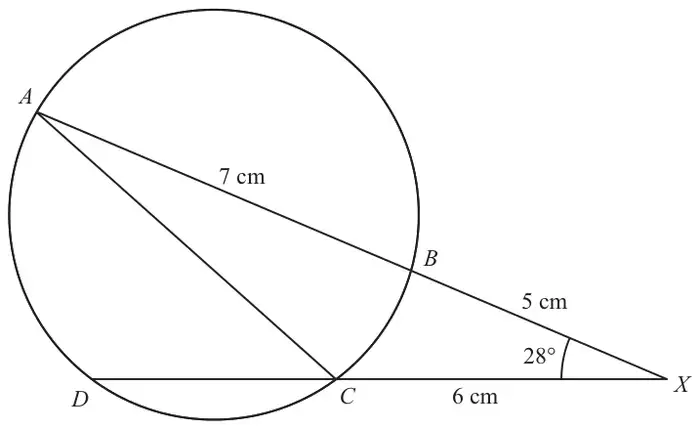
\(A\), \(B\), \(C\) and \(D\) are four points on a circle. \(ABX\) and \(DCX\) are straight lines. \(AB\) = 7 cm, \(BX\) = 5 cm and \(CX\) = 6 cm. Angle \(BXC = 28^\circ\)
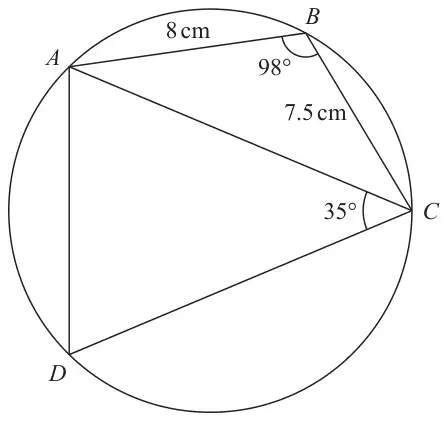
(a) Calculate the length of \(AC\). Give your answer correct to 3 significant figures. (3)
Apart from questions 5, 7, 13c, 16b, 20, 21 and 22 (where the mark scheme states otherwise) the correct answer, unless clearly obtained by an incorrect method, should be taken to imply a correct method.
Mark scheme (b)
Scheme
Marks
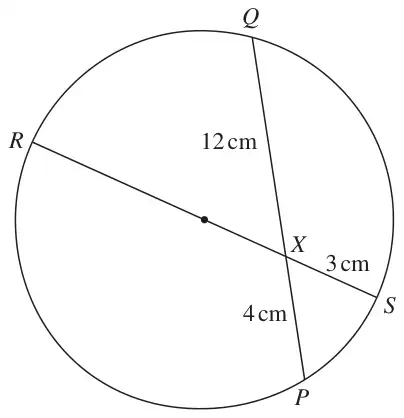
6 × “DX” = 12 × 5
M1
“DX” = (12 × 5 ÷ 6) (=10) “DC” = “10” − 6
M1
4
A1
(3)
(Total 6 marks)
Notes
M1: M1 for an attempt to use intersecting chord theorem (external or internal case e.g 7 × 5 = 6 × “x”)
M1: must see a correct justification for the value 10 seen
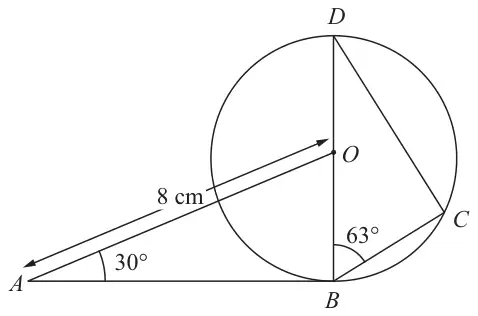
\(B\), \(C\) and \(D\) are points on a circle, centre \(O\). \(BOD\) is a diameter of the circle. \(AB\) is the tangent to the circle at \(B\). \(AO\) = 8 cm. Angle \(BAO = 30^\circ\) Angle \(CBD = 63^\circ\)
Calculate the length of \(BC\). Give your answer correct to 3 significant figures.
(4)
Mark scheme
Scheme
Marks
(\(OB\) =) 8 sin 30° or 4
M1
(\(BD\) =) 2 × “4” or 8
M1
A complete correct method eg (\(BC\) =) “8” cos 63°
M1
3.63
A1
(Total 4 marks)
Notes
A1: for ans rounding to 3.63 (3.63192…)
Apart from Questions 9, 13, 18, 20 and 21 (where the mark scheme states otherwise) the correct answer, unless clearly obtained by an incorrect method, should be taken to imply a correct method.
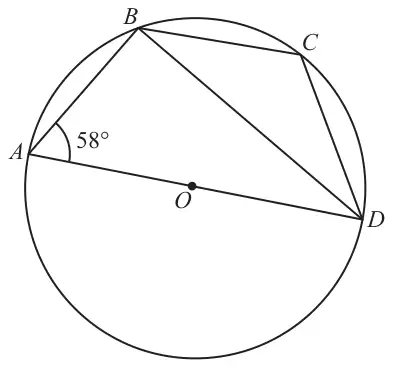
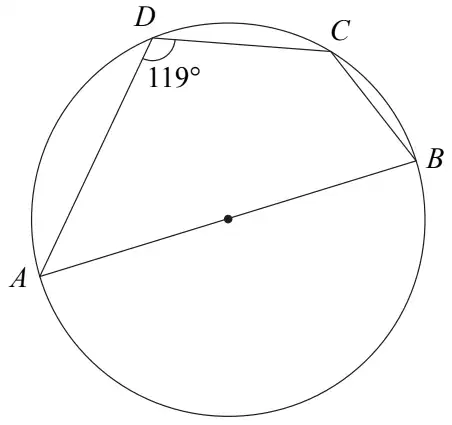
\(A\), \(B\), \(C\) and \(D\) are four points on a circle, centre \(O\). \(AD\) is a diameter of the circle. Angle \(BAD = 58^\circ\)
(a) Calculate the size of angle \(ADB\). (2)
(b)
(i) Calculate the size of angle \(BCD\).
(ii) Give a reason for your answer.
(2)
Mark scheme (a)
Scheme
Marks
180 − (90 + 58) (oe)
M1
32
A1
(2)
Notes
M1: i.e. 90 − 58
Apart from questions 5, 7, 13c, 16b, 20, 21 and 22 (where the mark scheme states otherwise) the correct answer, unless clearly obtained by an incorrect method, should be taken to imply a correct method.
Mark scheme (b)
Scheme
Marks
(i) 122
B1
(ii) Oppositeangles in a cyclic quad ( =180°)
B1
(2)
(Total 4 marks)
Notes
B1: Accept abbreviations if meaning is clear. B0 for incorrect statements
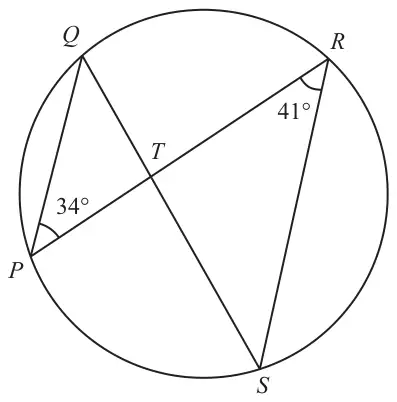
\(P\), \(Q\), \(R\) and \(S\) are points on the circumference of a circle. \(PR\) and \(QS\) intersect at \(T\). Angle \(QPR = 34^\circ\) and angle \(PRS = 41^\circ\)
(a)
(i) Find the size of angle \(PQS\).
(ii) Give a reason for your answer.
(2)
(b)
(i) Find the size of angle \(PTS\).
(ii) Explain why \(T\) cannot be the centre of the circle.
(2)
Mark scheme (a)
Scheme
Marks
(i) 41°
B1
(ii) Angles in same segment (are equal)
B1
(2)
Notes
B1: Accept “from same chord”, “on same arc”.
Mark scheme (b)
Scheme
Marks
(i) 75°
B1
(ii) Angle at centre/middle is not 2 × angle at circumference / edge / perimeter / arc or Angle \(PQT \neq QPT\) or \(PRS \neq RSQ\) (oe) or 34 ≠ 41
B1
(2)
(Total 4 marks)
Notes
B1: Accept 75 ≠ 2 × 41 or 75 ≠ 2 × 34 or using idea of isosceles triangles but must mention angles.
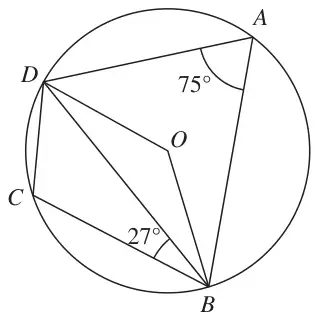
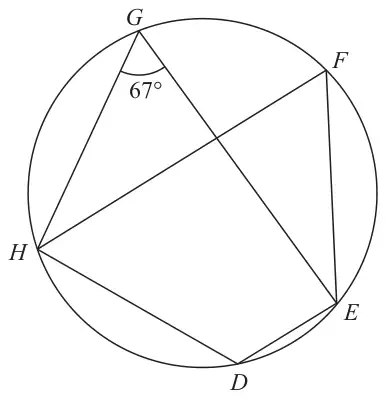
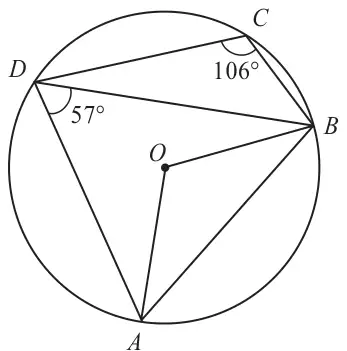
\(A\), \(B\), \(C\) and \(D\) are points on a circle, centre \(O\). Angle \(ADB = 57^\circ\). Angle \(BCD = 106^\circ\).
(a)
(i) Calculate the size of angle \(AOB\).
(ii) Give a reason for your answer.
(2)
(b) Calculate the size of angle \(BAD\). (1)
Mark scheme (a)
Scheme
Marks
(i) 114
B1
(ii) eg angle at the centre = 2 × angle at circumference
B1
(2)
Notes
B1: cao
B1: Three key points must be mentioned 1. Angle at centre/middle/O/origin 2. Twice, double, 2× or half/\(\frac{1}{2}\) as appropriate 3. angle at circumference/edge/perimeter (NOT e.g. angle \(D\), angle \(ADB\), angle at top, angle at outside)
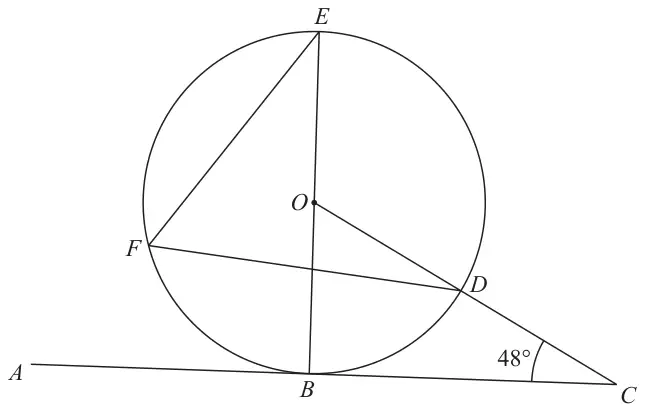
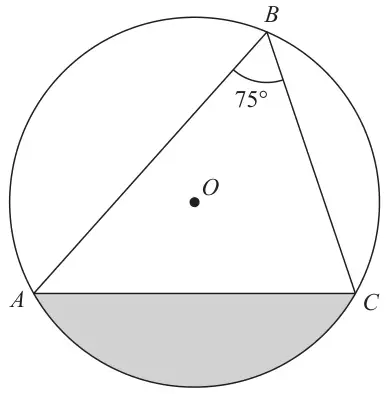
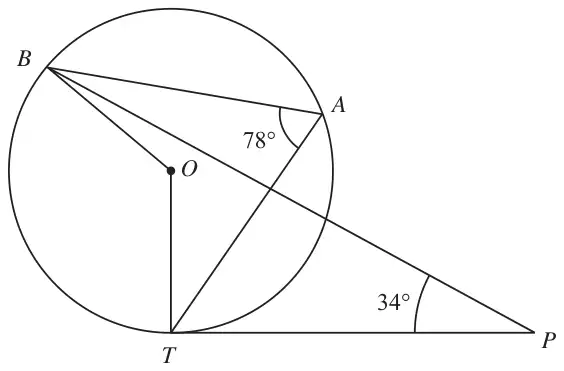
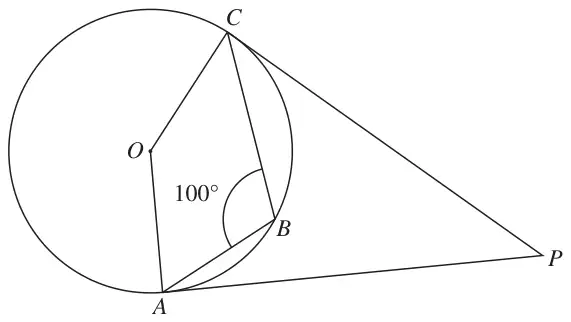
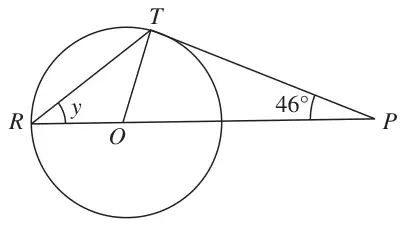
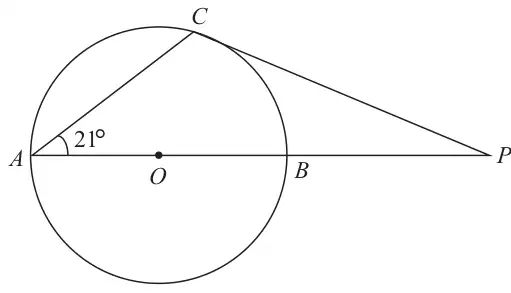
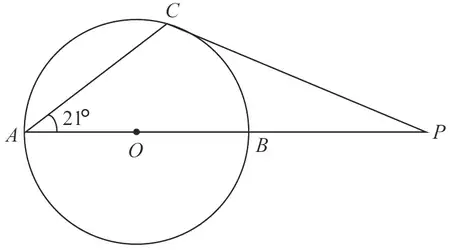
\(A\), \(B\) and \(C\) are points on a circle, centre \(O\). \(AB\) is a diameter of the circle. \(PC\) is a tangent to the circle. \(ABP\) is a straight line. Angle \(BAC = 21^\circ\).
Work out the size of angle \(APC\).
(4)
Mark scheme
Scheme
Marks
\(\angle ACO = 21^\circ\) or \(\angle COB = 42^\circ\) or \(\angle ACB = 90^\circ\)
B1
\(\angle OCP = 90^\circ\) or \(\angle CBP = 111^\circ\) or \(\angle BCP = 21^\circ\)
B1
180 − 21 − (90 + 21) or 180 − 42 − 90 or 180 − 21 − 111
M1
48
A1
(4)
(Total 4 marks)
Notes
B1: Angles may be stated or marked on diagram
A1: Award 4 marks for an answer of 48, unless obtained by a clearly incorrect method.
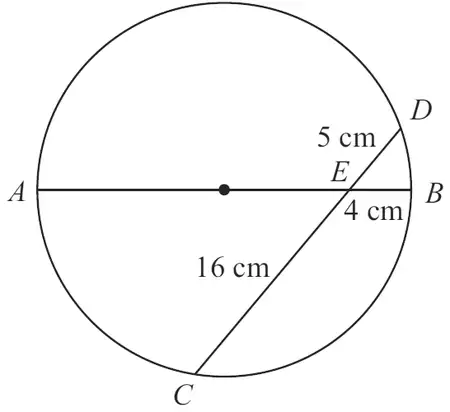
\(AB\) is a diameter of a circle. \(CD\) is a chord of the circle. \(AB\) and \(CD\) intersect at \(E\). \(BE = 4\) cm, \(CE = 16\) cm and \(DE = 5\) cm.
(a) Calculate the length of \(AE\). (2)
(b)
(i) Find the radius of the circle.
(ii) Calculate the size of angle \(AED\). Give your answer correct to 1 decimal place.
\(A\), \(B\) and \(C\) are points on a circle, centre \(O\). \(AB\) is a diameter of the circle. \(PC\) is a tangent to the circle. \(ABP\) is a straight line. Angle \(BAC = 21^\circ\).
Work out the size of angle \(APC\).
(4)
Mark scheme
Scheme
Marks
\(\angle ACO = 21^\circ\) or \(\angle COB = 42^\circ\) or \(\angle ACB = 90^\circ\)
B1
\(\angle OCP = 90^\circ\) or \(\angle CBP = 111^\circ\) or \(\angle BCP = 21^\circ\)
B1
180 − 21 − (90 + 21) or 180 − 42 − 90 or 180 − 21 − 111
M1
48
A1
(4)
(4 marks)
Notes
B1: Angles may be stated or marked on diagram
A1: Award 4 marks for an answer of 48, unless obtained by a clearly incorrect method.
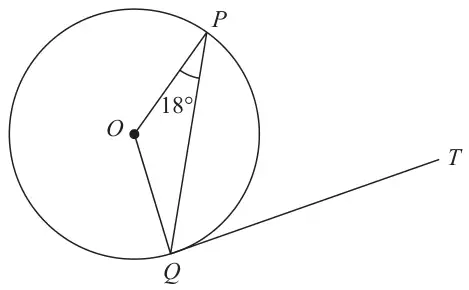
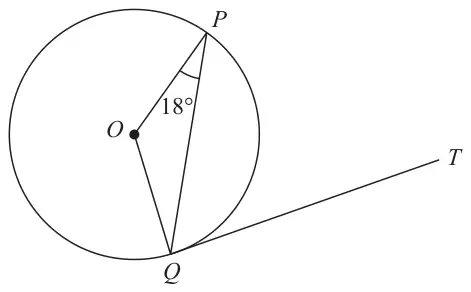
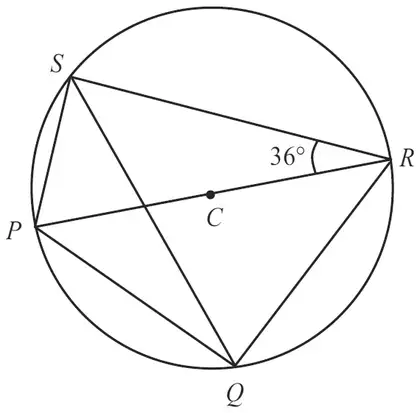
\(P\), \(Q\), \(R\) and \(S\) are points on a circle, centre \(C\). \(PCR\) is a straight line. Angle \(PRS = 36^\circ\).
Calculate the size of angle \(RQS\). Give a reason for each step in your working.
(4)
Mark scheme
There are 4 independent requirements to consider when marking this question but the order in which they are satisfied will vary. Focus on these 4 key points, ignoring irrelevant or incorrect statements.
Scheme
Marks
\(\angle PQS = 36^\circ\) or \(\angle SPR = 54^\circ\)
B1
angles in the same segment
B1
\(\angle PQR = 90^\circ\) or \(\angle PSR = 90^\circ\) and angle in a semicircle is a right angle
B1
54
B1
(4)
(4 marks)
Notes
B1: May be stated or marked on diagram
B1: Award if ‘same segment’, ‘same arc’, or ‘same chord’
B1: Angle may be stated or marked on diagram. Condone omission of ‘is a right angle’ oe.
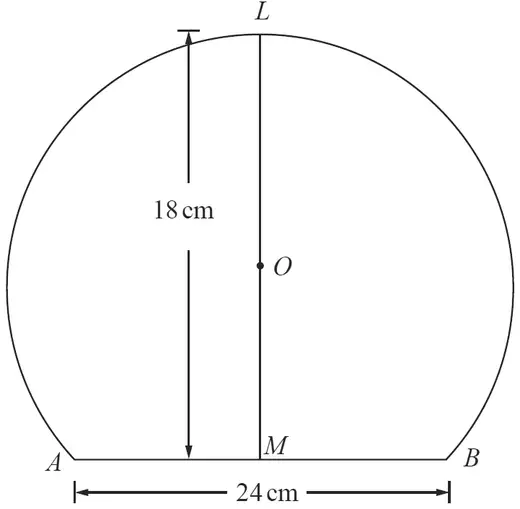
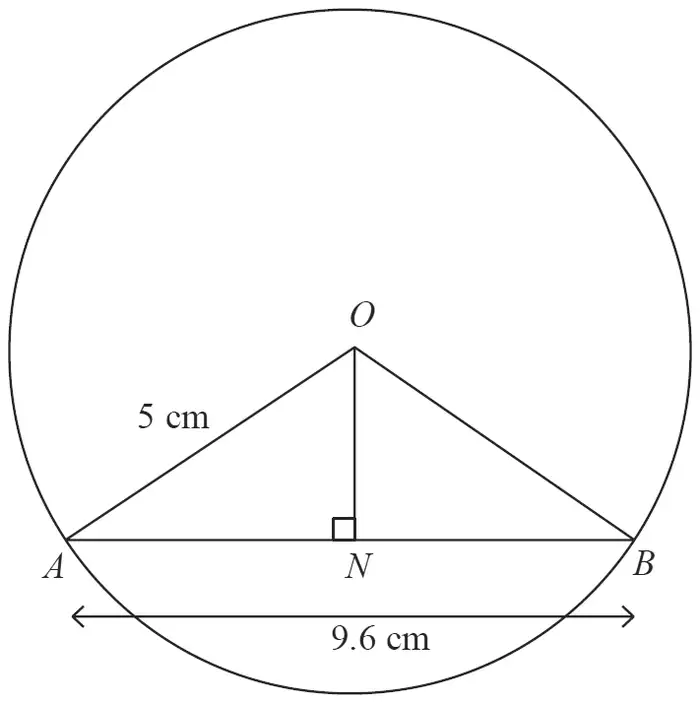
\(A\), \(B\) and \(L\) are points on a circle, centre \(O\). \(AB\) is a chord of the circle. \(M\) is the midpoint of \(AB\). \(LOM\) is a straight line. \(AB = 24\) cm. \(LM = 18\) cm.
Alternative 1: \(AM = 12\), \(OM = 5\), \(OA = 13\) and \(13 + 5 = 18\) or \(18 - 5 = 13\): M3 for use of Pythagorean triple 5-12-13 or use of \(OM = 5\) Pythagoras to obtain \(\sqrt{5^2 + 12^2} = 13\) for \(OA\) and justification; 26 A1 dep on M3
Alternative 2: M1 for a complete, correct method for finding \(\angle AOM\) or \(\angle BOM\) or \(\angle OAB\) or \(\angle OBA\), eg \(\tan\angle ALM = \frac{12}{18}\), \(\angle ALM = 33.69°\), \(\angle AOM = 2 \times 33.69° = 67.38°\) or \(AL = \sqrt{12^2 + 18^2} = \sqrt{468} = 21.63\) cm, \(\cos\angle ALB = \frac{468 + 468 - 576}{2 \times 468} = 0.3846\), \(\angle ALB = 67.38°\), \(\angle ALM = 33.69°\), \(\angle AOM = 67.38°\) or \(\tan\angle ALM = \frac{12}{18}\), \(\angle ALM = 33.69°\), \(\angle OAM = 90° - 2 \times 33.69° = 22.62°\)
M1 for a correct numerical expression for the length of \(OA\) or \(OM\), eg \(\frac{12}{\sin 67.38°}\) or \(\frac{24\sin 22.62°}{\sin 134.76°}\) (= 13) or \(\frac{12}{\tan 67.38°}\) or \(12\tan 22.62°\) (= 5)
M1 for the length of \(OA\) or \(OM\) used to find the diameter, eg 2 × “13” or 2 × (18 − “5”), dep on both previous M1s
26 A1 dep on all method marks. Accept answer rounding to 26.0
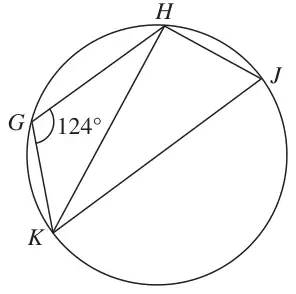
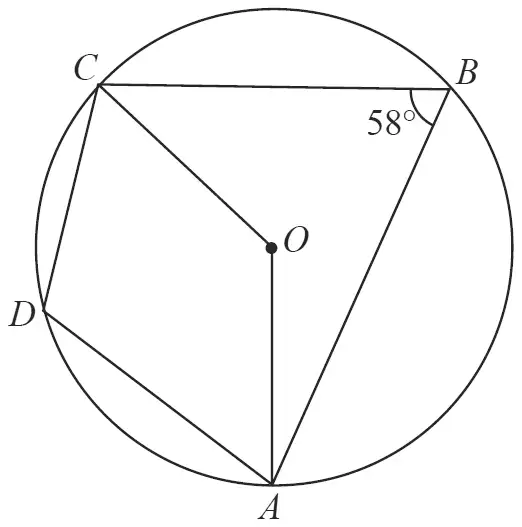
\(A\), \(B\), \(C\) and \(D\) are points on a circle, centre \(O\). Angle \(ABC = 58°\).
(a)
(i) Calculate the size of angle \(AOC\).
(ii) Give a reason for your answer. (2)
(b)
(i) Calculate the size of angle \(ADC\).
(ii) Give a reason for your answer. (2)
Mark scheme (a)
Scheme
Marks
(i) 2 × 58 Answer: 116
B1
(ii) Answer: eg angle at the centre = 2 × angle at the circumference
B1
(2)
Notes
B1: cao
B1: Three key points must be mentioned 1. angle at centre/middle/\(O\)/origin 2. twice/double/ 2× or half/ ½ as appropriate 3. angle at circumference/ edge/ perimeter/arc (NOT e.g. angle \(B\), angle \(ABC\), angle at top, angle at outside)
Mark scheme (b)
Scheme
Marks
(i) 180 − 58 Answer: 122
B1
(ii) Answer: eg sum of opposite angles of a cyclic quadrilateral = 180°
B1
(2)
(4 marks)
Notes
B1: cao
B1: Accept reason which includes ‘opposite’ and ‘cyclic’ and nothing incorrect Also award if (b)(i) is correct and reason is given as ‘angle at the centre = 2 × angle at the circumference’ oe Ignore additional reason(s)
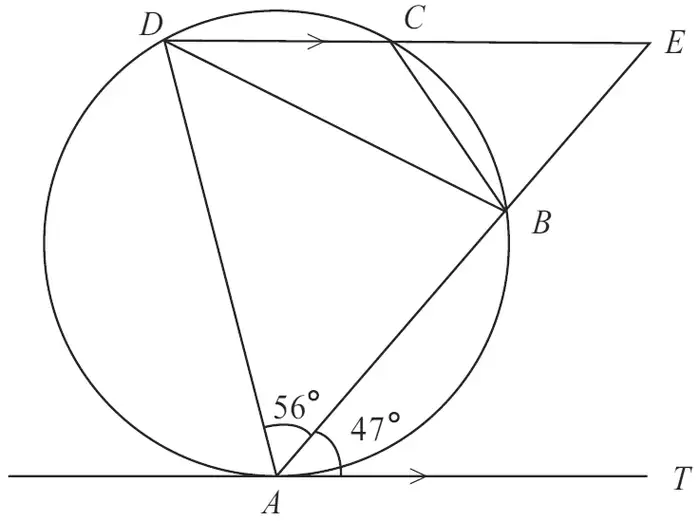
\(A\), \(B\), \(C\) and \(D\) are points on a circle. \(ABE\) and \(DCE\) are straight lines. \(AT\) is a tangent to the circle. \(DCE\) is parallel to \(AT\). Angle \(EAT = 47^\circ\). Angle \(BAD = 56^\circ\).
(a)
(i) Find the size of angle \(AED\).
(ii) Give a reason for your answer.
(2)
(b) Find the size of angle \(BCD\). (1)
(c)
(i) Find the size of angle \(ADB\).
(ii) Give a reason for your answer.
(2)
Mark scheme (a)
Scheme
Marks
(i) Answer: 47
B1
(ii) Answer: alternate angles
B1
(2)
Notes
B1: cao
B1: Award this mark if ‘alternate’ appears
Mark scheme (b)
Scheme
Marks
124
B1
(1)
Notes
B1: cao
Mark scheme (c)
Scheme
Marks
(i) Answer: 47
B1
(ii) Answer: angle between a chord and a tangent = angle in the alternate segment
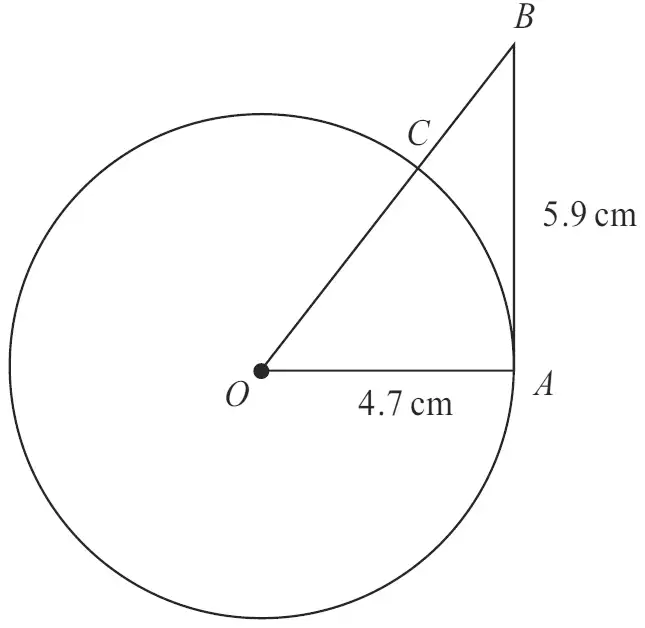
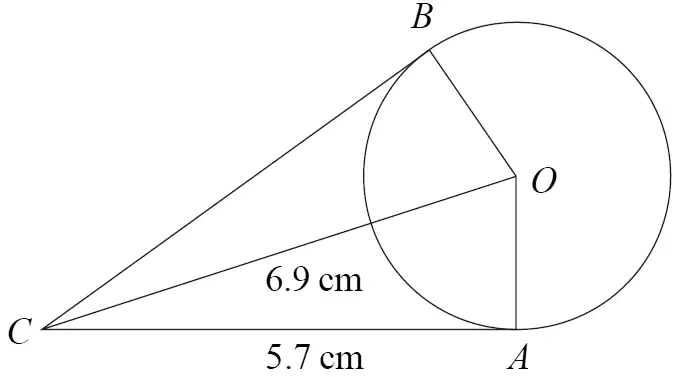
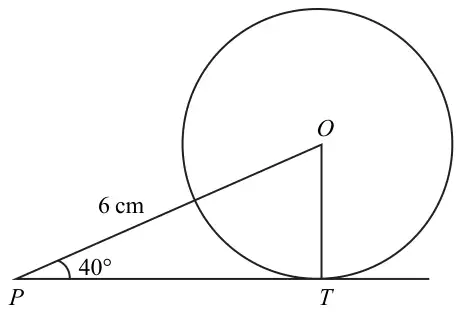
\(A\) is a point on a circle with centre \(O\) and radius 4.7 cm. \(AB\) is the tangent to the circle at \(A\). \(AB = 5.9\) cm. \(OB\) intersects the circle at \(C\).
Calculate the length of \(BC\). Give your answer correct to 3 significant figures.
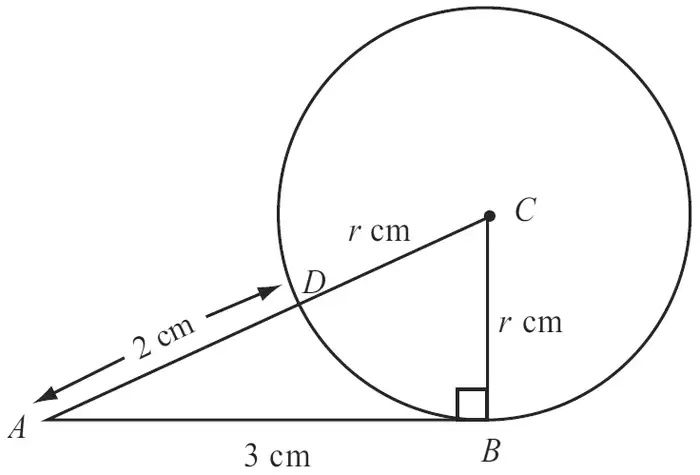
\(B\) and \(D\) are points on a circle, centre \(C\). \(AB\) is the tangent to the circle at \(B\). \(ADC\) is a straight line. \(AB = 3\) cm. \(AD = 2\) cm.
The radius of the circle is \(r\) cm. Find the value of \(r\).
(5)
Mark scheme
Scheme
Marks
eg \(r^2 + 9 = (r + 2)^2\)
\(r^2 + 3^2 = (r + 2)^2\)
\(r = \sqrt{(r + 2)^2 - 9}\)
\(r + 2 = \sqrt{r^2 + 9}\)
M2
\(r^2 + 9 = r^2 + 4r + 4\)
B1
\(4r = 5\)
M1
\(1\frac{1}{4}\) or 1.25
A1
(5)
(5 marks)
Notes
M2: for correct use of Pythagoras’ Rule M1 for \(r^2 + 3^2\) or \(r^2 + 9\) or \((r + 2)^2\)
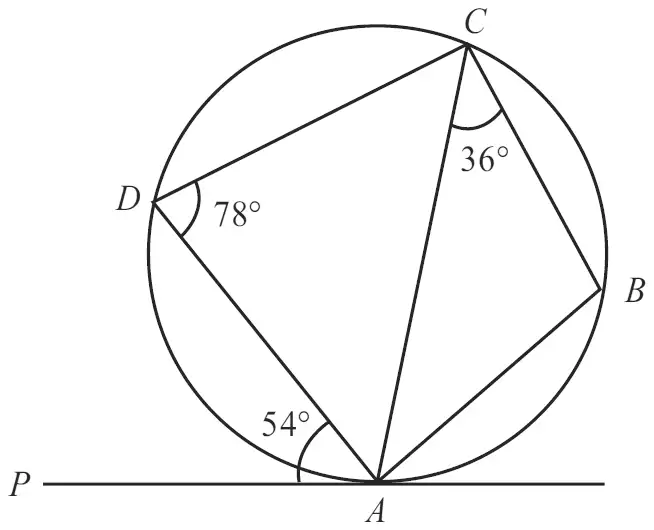
\(A\), \(B\), \(C\) and \(D\) are points on a circle. \(PA\) is the tangent to the circle at \(A\). Angle \(PAD = 54^\circ\), angle \(ACB = 36^\circ\) and angle \(ADC = 78^\circ\).
(a)
(i) Find the size of angle \(ACD\).
(ii) Give a reason for your answer.
(2)
(b) Explain why \(BD\) is a diameter of the circle. (2)
(c)
(i) Work out the size of angle \(ABC\).
(ii) Give a reason for your answer.
(2)
Mark scheme (a)
Scheme
Marks
(i) Answer: 54
B1
(ii) Answer: angle between chord & tangent = angle in alternate segment
B1
(2)
Notes
B1: Accept ‘alternate segment’
Mark scheme (b)
Scheme
Marks
angle \(BCD = 90^\circ\)
B1
angle in a semicircle is a right angle
B1
(2)
Notes
B1: Accept if ‘semicircle’ seen
Mark scheme (c)
Scheme
Marks
(i) Answer: 102
B1
(ii) Answer: opposite angles of a cyclic quadrilateral are supplementary
B1
(2)
(6 marks)
Notes
B1: Accept if ‘opposite’ and ‘cyclic’ seen (‘Alternate segment’ is an alternative)
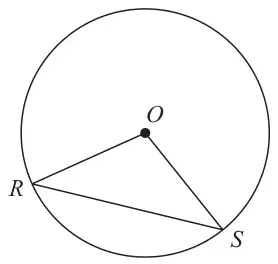
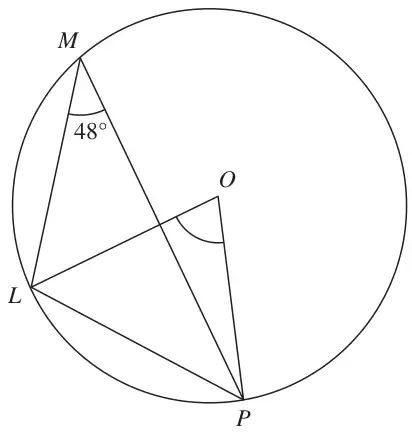
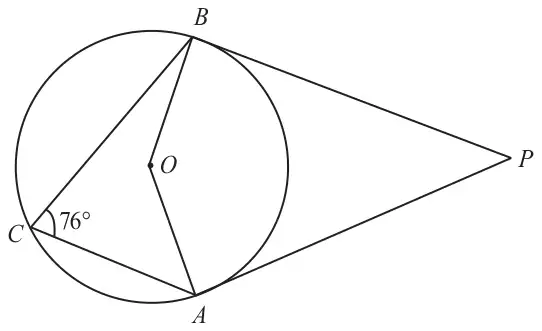
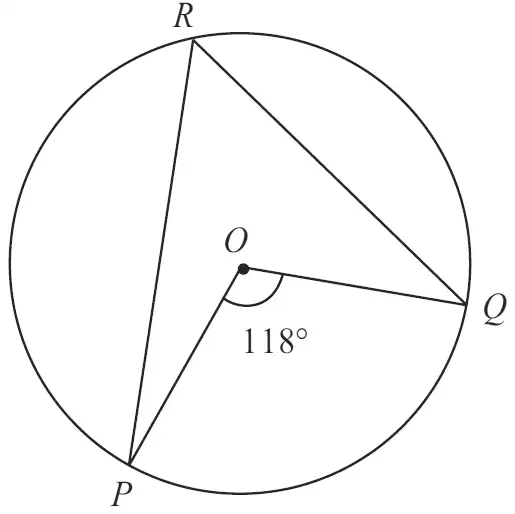
\(P\), \(Q\) and \(R\) are points on a circle, centre \(O\).
(i) Find the size of angle \(PRQ\).
(ii) Give a reason for your answer.
(2)
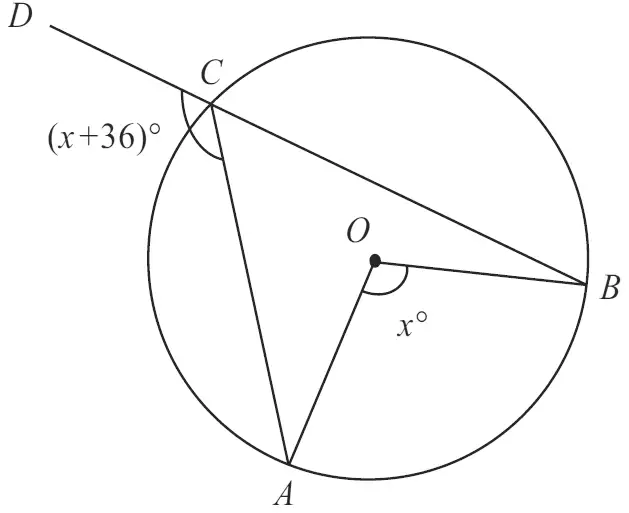
(b)
Diagram NOT accurately drawn
\(A\), \(B\) and \(C\) are points on a circle, centre \(O\). \(BCD\) is a straight line. Find the value of \(x\). (5)
Mark scheme (a)
Scheme
Marks
(i) Answer: 59
B1
(ii) Answer: angle at the centre = twice angle at the circumference or angle at the circumference = half the angle at the centre
B1
(2)
Notes
B1: cao
B1: Three key points must be mentioned 1. angle at centre/middle/\(O\)/origin 2. twice/double/2× or half/\(\frac{1}{2}\) as appropriate 3. angle at circumference/edge/perimeter (NOT e.g. angle \(R\), angle \(PRQ\), angle at top, angle at outside)
Mark scheme (b)
Scheme
Marks
\(180 - (x + 36)\) oe seen (possibly marked on diagram as size of \(\angle ACB\))
\(3x = 360 - 72\) or \(3x = 288\) or \(\frac{3}{2}x = 180 - 36\) or \(\frac{3}{2}x = 144\)
M1
96
A1
(5)
(7 marks)
Notes
B1: for \(180 - (x + 36)\) oe seen, either on its own or as part of an equation (This mark may still be scored, even if brackets are later removed incorrectly.)
A1: cao
SC
(Max of 2 M marks) for omission of brackets in \(-(x + 36)\) or their incorrect removal: \(x = 2(180 - x + 36)\) or \(180 - x + 36 = \frac{1}{2}x\) or \(180 - 36 + x = \frac{1}{2}x\) M1 \(x = 360 - 2x + 72\) or \(x + \frac{1}{2}x = 180 + 36\) M1 (Note - incorrect simplification results in an answer of \(x = 144\))
Alternative
\(\dfrac{x}{2}\) oe seen (possibly marked on diagram as size of \(\angle ACB\)) B1 \(x + 36 + \dfrac{x}{2} = 180\) M1
The rest of this alternative method is cut off in the source.
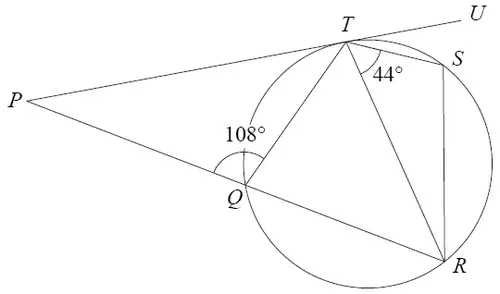
\(Q\), \(R\), \(S\) and \(T\) are points on the circumference of a circle. \(PU\) is a tangent to the circle at \(T\). \(PQR\) is a straight line. Angle \(PQT = 108^\circ\). Angle \(STR = 44^\circ\).
Work out the size of angle \(STU\). You must give a reason for each step in your working.
(5)
Mark scheme
Scheme
Marks
\(\angle RST = 108^\circ\)
B1
opposite angles of a cyclic quadrilateral
B1
\(\angle SRT = 28^\circ\)
B1
angle between chord & tangent = angle in alternate segment
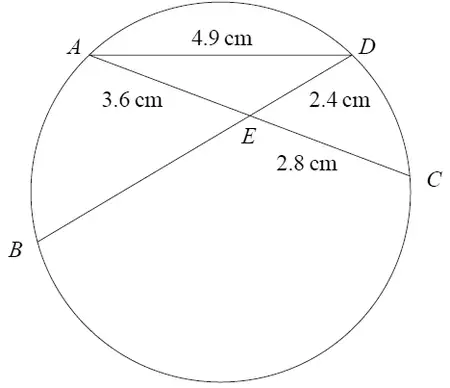
\(A\), \(B\), \(C\) and \(D\) are four points on the circumference of a circle. The chords \(AC\) and \(BD\) intersect at \(E\). \(AE = 3.6\) cm, \(CE = 2.8\) cm, \(DE = 2.4\) cm and \(AD = 4.9\) cm.
(a) Calculate the length of \(BE\). (3)
(b) Calculate the size of angle \(AED\). Give your answer correct to 3 significant figures. (3)
We'd like to use Google Analytics cookies to count visits and see which pages help most. They're optional, and the site works exactly the same either way. Privacy policy