16 Show that \(\dfrac{4}{3\sqrt{5} + 7}\) can be written in the form \(a - \sqrt{b}\) where \(a\) and \(b\) are integers. Show each stage of your working.
15 \(\left(\sqrt{3}\right)^5 = k\sqrt{3}\) where \(k\) is an integer.
(a) Find the value of \(k\) (1)
(b) Show that \(\dfrac{21}{3 - \sqrt{2}}\) can be written in the form \(c + \sqrt{d}\) where \(c\) and \(d\) are integers. Show each stage of your working clearly. (3)
(a) Use algebra to show that \(0.3\dot{7}\dot{2} = \dfrac{41}{110}\) (2)
(b) Express \(\dfrac{\sqrt{125} + \sqrt{80}}{\sqrt{3}}\) in the form \(\sqrt{n}\) where \(n\) is an integer. Show your working clearly.(3)
Mark scheme (a)
Scheme
Marks
eg \(x = 0.372...\) and \(100x = 37.272...\) or \(10x = 3.72...\) and \(1000x = 372.72...\)
M1
eg \(100x - x = 37.272... - 0.372... = 36.9\) and \(\dfrac{36.9}{99} = \dfrac{41}{110}\) or \(1000x - 10x = 372.72... - 3.72... = 369\) and \(\dfrac{369}{990} = \dfrac{41}{110}\) or \(100y - y = 7.2727... - 0.072... = 7.2\) and \(\dfrac{3}{10} + \dfrac{7.2}{99} = \dfrac{297 + 72}{990} = \dfrac{369}{990} = \dfrac{41}{110}\) oe Working required
A1
(2)
Notes
M1: For 2 recurring decimals that when subtracted give a whole number or terminating decimal with intention to subtract. (At least one of the numbers must be shown with recurring dots or to at least 5 sf) or 0.3 + 0.0727… and eg \(y = 0.072...\), \(100y = 7.2727...\) with intention to subtract.
A1: Shown. Dep on M1 and use of algebra for completion to \(\dfrac{41}{110}\) NB: this is a ‘show that’ question and requires students to clearly show steps that could be used to change the recurring decimal into the given fraction
Mark scheme (b)
Scheme
Marks
eg \(\dfrac{\sqrt{125} + \sqrt{80}}{\sqrt{3}} \times \dfrac{\sqrt{3}}{\sqrt{3}}\) or \(\dfrac{\sqrt{375} + \sqrt{240}}{3}\) or \(\dfrac{5\sqrt{5} + 4\sqrt{5}}{\sqrt{3}} \times \dfrac{\sqrt{3}}{\sqrt{3}}\) or \(\dfrac{5\sqrt{15} + 4\sqrt{15}}{3}\) or \(\dfrac{9\sqrt{5}}{\sqrt{3}} \times \dfrac{\sqrt{3}}{\sqrt{3}}\) or \(\dfrac{9\sqrt{15}}{3}\) or \(\sqrt{\dfrac{405}{3}}\)
M1
eg \(\dfrac{5\sqrt{5} + 4\sqrt{5}}{\sqrt{3}}\) or \(\dfrac{5\sqrt{15} + 4\sqrt{15}}{3}\)
M1
Working required Answer: \(\sqrt{135}\)
A1
(3)
(5 marks)
Notes
M1: (first) For rationalising by multiplying by \(\dfrac{\sqrt{3}}{\sqrt{3}}\) or for \(\sqrt{\dfrac{405}{3}}\)
M1: (second) For simplifying the individual surds – either before rationalisation or after rationalisation (for the given surds, we do not need to see the denominator)
Award method marks in either order
A1: dep on M2 SCB1 for 135 gained with no method marks awarded SCB2 for 135 and rationalisation also shown or 135 and simplifying the numerator shown
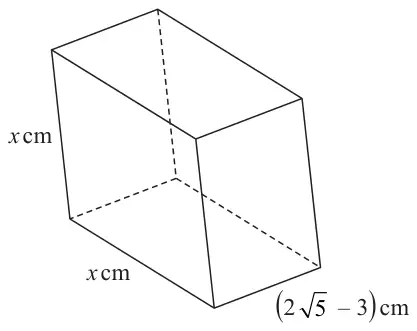
23 The diagram shows a cuboid with a square cross section.
Diagram NOT accurately drawn
The volume of the cuboid is \(\left(13 + 6\sqrt{5}\right)\) cm³
Without using a calculator, find the value of \(x\) Give your answer in the form \(\;a + \sqrt{b}\;\) where \(a\) and \(b\) are integers. Show your working clearly.
M1: expanding bracket and collecting terms. Condone one error
A1: oe must be a correct fraction with irrational numerator and denominator
M1: (indep) Multiplying the numerator and denominator of their fraction by \(\sqrt{3} + 1\) oe or showing 2 or −2 as the denominator and multiplying the numerator by \(\sqrt{3} + 1\) oe
or rationalising their denominator, so long as it is of the form \(p + q\sqrt{3}\) where \(p\) and \(q\) are non zero integers
(condone missing brackets provided meaning is clear)
17 Given that \(\;8\sqrt{m} + \sqrt{49m} - \sqrt{9m} = k\sqrt{m}\) where \(k\) is an integer and \(m\) is a prime number,
(a) work out the value of \(k\) (1)
(b) Show that \(\;\dfrac{5 - \sqrt{18}}{1 - \sqrt{2}}\;\) can be written in the form \(\;a + b\sqrt{2}\) where \(a\) and \(b\) are integers. Show each stage of your working clearly. (3)
\((\text{‘}{8}\text{’})(\text{‘}{2\sqrt{8}}\text{’})\) or \(\sqrt{2048}\) or \(16\sqrt{8}\) or \(32\sqrt{2}\) or \(8\sqrt{32}\) or \(8\sqrt{8 \times 4}\) oe
M1
Working required Answer: 8
A1
(3)
(3 marks)
Notes
M1: for correct substitutions into expression for \(a + b\) and \(a - b\)
or expand the expression to get \(a^2 - b^2\) and substitute into this expression.
\(\dfrac{8\left(\sqrt{5} + 1\right)}{4}\) or \(\dfrac{8\sqrt{5} + 8}{4}\) oe
M1
Working required
Answer: \(2\sqrt{5} + 2\)
A1
\(\sqrt{20} + 2\)
B1ft
(3)
(3 marks)
Notes
M1: for rationalising the denominator – award for seeing intention to multiply by \(\dfrac{\sqrt{5} + 1}{\sqrt{5} + 1}\) or \(\dfrac{-\sqrt{5} - 1}{-\sqrt{5} - 1}\)
A1: from correct working
B1ft: for \(k\sqrt{5} + c = \sqrt{5k^2} + c\) where \(5k^2\) is a single integer
(a) Use algebra to show that \(4.\dot{5}\dot{7} = 4\dfrac{19}{33}\) (2)
(b) Show that \(\dfrac{2}{6 - 3\sqrt{2}}\) can be written in the form \(\dfrac{a + \sqrt{a}}{b}\) where \(a\) and \(b\) are integers. Show your working clearly. (3)
Mark scheme (a)
Scheme
Marks
E.g. \(x = 4.57\ldots\) and \(100x = 457.57\ldots\) or \(10x = 45.757\ldots\) and \(1000x = 4575.7\ldots\) or \(x = 0.57\ldots\) and \(100x = 57.57\ldots\) or \(10x = 5.757\ldots\) and \(1000x = 575.7\ldots\)
M1
E.g.
\(100x - x = 457.57\ldots - 4.57\ldots = 453\) and \(\dfrac{453}{99} = \dfrac{151}{33}\) or \(4\dfrac{19}{33}\)
or
\(1000x - 10x = 4575.7\ldots - 45.757\ldots = 4530\) and \(\dfrac{4530}{990} = \dfrac{151}{33}\) or \(4\dfrac{19}{33}\)
or
\(100x - x = 57.57\ldots - 0.57\ldots = 57\) and \(\dfrac{57}{99}\) or \(\dfrac{19}{33}\) (so) \(4.\dot{5}\dot{7} = 4\dfrac{19}{33}\)
or
\(1000x - 10x = 575.7\ldots - 5.757\ldots = 570\) and \(\dfrac{570}{990}\) or \(\dfrac{57}{99}\) or \(\dfrac{19}{33}\) (so) \(4.\dot{5}\dot{7} = 4\dfrac{19}{33}\)
Working required
Answer: Shown
A1
(2)
Notes
M1: for selecting 2 recurring decimals that when subtracted give a whole number or terminating decimal eg 453 or 4530 etc eg \(100x = 457.57\ldots\) and \(x = 4.57\ldots\) or \(1000x = 4575.7\ldots\) and \(10x = 45.757\ldots\) with intention to subtract. (If recurring dots not shown then allow \(10x = 45.757\), \(100x = 457.57\), and \(1000x = 4575.7\) to at least 5sf) or \(4 + 0.5757\) and eg \(x = 0.57\ldots\), \(100x = 57.57\ldots\) with intention to subtract.
A1: for completion to \(\dfrac{151}{33}\) or \(4\dfrac{19}{33}\)
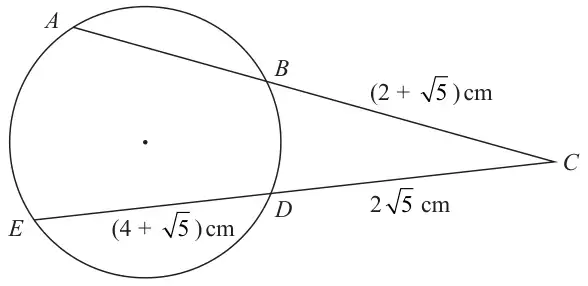
M1: for using the intersecting chord theorem correctly eg may label \(AB = x\) or \(AC = x\) oe
M1: dep 1st M1 for rearranging for \(AC\)
may use \(AB + 2 + \sqrt{5}\) on LHS
M1: indep for multiplying by the conjugate of the denominator of their fraction, so long as fraction in the form \(\dfrac{a + b\sqrt{5}}{c + d\sqrt{5}}\)
M1: for correct expansion of brackets showing four terms (need not be simplified)
or
for the use of \((a + b)^2 = a^2 + 2ab + b^2\)
or
for showing or stating \(\sqrt{12} = 2\sqrt{3}\) oe
M1: (dep on M1)
A1: for fully correct working leading to given expression
Mark scheme (b)
Scheme
Marks
E.g.
\(\left(\dfrac{3a^4}{t^5}\right)^{-2}\) or \(\left(\dfrac{t^{15}}{27a^{12}}\right)^{\frac{2}{3}}\) or \(\left(\dfrac{729a^{24}}{t^{30}}\right)^{-\frac{1}{3}}\)
M1
E.g.
\(\left(\dfrac{9a^8}{t^{10}}\right)^{-1}\) or \(\dfrac{3^{-2}a^{-8}}{t^{-10}}\) or \(\dfrac{\frac{1}{9}a^{-8}}{t^{-10}}\) or \(\left(\dfrac{t^5}{3a^4}\right)^2\) or
\(\left(\dfrac{t^{30}}{729a^{24}}\right)^{\frac{1}{3}}\) or \(\dfrac{a^{-8}}{9t^{-10}}\)
M1
\(\dfrac{t^{10}}{9a^8}\)
A1
(3)
(6 marks)
Notes
M1: for one of
cube rooting or inverting or squaring
or \(\dfrac{ka^{-8}}{t^{-10}}\) where \(k\) is an integer \(\neq 0\)
M1: for two of
cube rooting or inverting or squaring
or \(\dfrac{t^{10}}{ka^8}\) where \(k\) is an integer \(\neq 0\)
A1: Allow \(\dfrac{t^{10}a^{-8}}{9}\) or \(\dfrac{1}{9}t^{10}a^{-8}\)
(a) Use algebra to show that \(\;0.5\dot{7}\dot{2} = \dfrac{63}{110}\) (2)
Given that \(y\) is a prime number,
(b) express \(\;\dfrac{3}{2 - \sqrt{y}}\;\) in the form \(\;\dfrac{a + b\sqrt{y}}{c - y}\;\) where \(a\), \(b\) and \(c\) are integers. (2)
Mark scheme (a)
Scheme
Marks
e.g. \(x = 0.57272\ldots\) and \(100x = 57.272\ldots\) OR e.g. \(10x = 5.7272\ldots\) and \(1000x = 572.72\ldots\)
M1
e.g. \(100x - x = 57.272\ldots - 0.57272\ldots = 56.7\) and \(\dfrac{56.7}{99} = \dfrac{63}{110}\)
or \(1000x - 10x = 572.72\ldots - 5.7272\ldots = 567\) and \(\dfrac{567}{990} = \dfrac{63}{110}\)
Working required
Answer: Shown
A1
(2)
Notes
M1: For 2 recurring decimals with correct algebraic labels that when subtracted give a whole number or terminating decimal eg 56.7 or 567 etc e.g. \(100x = 57.272\ldots\) and \(x = 0.57272\ldots\) OR \(1000x = 572.72\ldots\) and \(10x = 5.7272\ldots\) with intention to subtract. (If recurring dots not shown then showing at least the digits 57272, ie 5sf)
A1: for completion to \(\dfrac{63}{110}\)
Mark scheme (b)
Scheme
Marks
\(\dfrac{3}{2 - \sqrt{y}} \times \dfrac{2 + \sqrt{y}}{2 + \sqrt{y}}\) or \(6 + 3\sqrt{y}\) or \(4 - y\)
M1
\(\dfrac{6 + 3\sqrt{y}}{4 - y}\)
A1
(2)
(4 marks)
Notes
M1: for multiplying numerator and denominator by \((2 + \sqrt{y})\) or a correct expression for the numerator or denominator
(a) Rationalise the denominator of \(\dfrac{a + \sqrt{4b}}{a - \sqrt{4b}}\) where \(a\) is an integer and \(b\) is a prime number. Simplify your answer. (3)
(b) Given that \(\left(\sqrt{\dfrac{y}{x}}\right)^{-5} = \dfrac{x^m}{y^m}\) where \(x \ne y\) find the value of \(m\). (1)
(a) Use algebra to show that \(0.4\dot{3}\dot{6} = \dfrac{24}{55}\) (2)
(b) Show that \(\dfrac{\sqrt{20} + \sqrt{80}}{\sqrt{3}}\) can be expressed in the form \(\sqrt{a}\) where \(a\) is an integer. Show your working clearly. (3)
Mark scheme (a)
Scheme
Marks
eg \(x = 0.4\dot{3}\dot{6}\) and \(100x = 43.6\dot{3}\dot{6}\) or \(10x = 4.\dot{3}\dot{6}\) and \(1000x = 436.\dot{3}\dot{6}\)
M1
\(99x = 43.2\), \(x = \dfrac{43.2}{99}\)
or \(990x = 432\), \(x = \dfrac{432}{990}\)
Answer: show
A1
(2)
Notes
M1: eg two decimals that when subtracted give a finite decimal
A1: ‘show that’ completed: arrives at the given answer from correct working.
Mark scheme (b)
Scheme
Marks
M1
M1dep
\(\sqrt{60}\)
A1
(3)
(5 marks)
Notes
M1: for \(\sqrt{20} = 2\sqrt{5}\) and \(\sqrt{80} = 4\sqrt{5}\) or \(\dfrac{\sqrt{20} + \sqrt{80}}{\sqrt{3}} \times \dfrac{\sqrt{3}}{\sqrt{3}}\) or \(\dfrac{\sqrt{20} + 2\sqrt{20}}{\sqrt{3}}\)
M1dep: for \(\dfrac{6\sqrt{15}}{3}\) or \(2\sqrt{15}\) or \(\dfrac{3\sqrt{60}}{3}\) oe
(a) \(\sqrt{50} + \sqrt{128} - \sqrt{200} = n\sqrt{2}\) where \(n\) is an integer. Find the value of \(n\). Show each stage of your working. (2)
Given that \(a\) is a prime number,
(b) simplify \(\dfrac{5\sqrt{a} + a}{10\sqrt{a}}\) Give your answer in the form \(x + y\sqrt{a}\), where \(x\) and \(y\) are fractions. Show your working clearly. (2)
(b) Show that \(\dfrac{14}{\sqrt{245}} = \dfrac{2\sqrt{5}}{5}\) You must write down each stage of your working. (2)
\(\left(e - 2\sqrt{3}\right)^2 = f - 20\sqrt{3}\) where \(e\) and \(f\) are integers.
(c) Find the value of \(e\) and the value of \(f\) (3)
Mark scheme (a)
Scheme
Marks
(i) −3
B1
(ii) 0
B1
(iii) \(\dfrac{3}{2}\)
B1
(3)
Notes
B1: 1.5, \(1\dfrac{1}{2}\)
Mark scheme (b)
Scheme
Marks
Eg \(\sqrt{245} = \sqrt{49} \times \sqrt{5}\) or \(\sqrt{245} = \sqrt{49 \times 5}\) or
\(\dfrac{14}{\sqrt{49 \times 5}}\) or \(\dfrac{14}{\sqrt{49} \times \sqrt{5}}\)
\(\dfrac{14}{\sqrt{245}} \times \dfrac{\sqrt{245}}{\sqrt{245}}\) or \(\dfrac{14\sqrt{245}}{245}\) or \(\dfrac{14 \times 7\sqrt{5}}{245}\)
M1
\(\dfrac{2\sqrt{5}}{5}\)
A1
(2)
Notes
M1: For simplifying \(\sqrt{245}\) or for rationalising the denominator.
A1: For simplifying \(\sqrt{245}\) and for rationalising the denominator.
NB: The solution must be fully correct (cso)
NB: Do not accept \(\dfrac{2}{\sqrt{5}} = \dfrac{2\sqrt{5}}{5}\) as sufficient method for rationalising the denominator.
Note: To rationalise \(\dfrac{14}{\sqrt{245}}\) accept \(\dfrac{14}{\sqrt{245}} \times \dfrac{\sqrt{245}}{\sqrt{245}}\) or \(\dfrac{14\sqrt{245}}{245}\)
To rationalise \(\dfrac{2}{\sqrt{5}}\) or \(\dfrac{14}{7\sqrt{5}}\), etc, only accept \(\dfrac{2}{\sqrt{5}} \times \dfrac{\sqrt{5}}{\sqrt{5}}\) or \(\dfrac{14}{7\sqrt{5}} \times \dfrac{\sqrt{5}}{\sqrt{5}}\) etc.
Mark scheme (c)
Scheme
Marks
\(e^2 - 2e\sqrt{3} - 2e\sqrt{3} + (2\sqrt{3})^2\) or
\(e^2 - 4e\sqrt{3} + 12\)
M1
\(e = 5\)
A1
\(f = 37\)
A1
(3)
Notes
M1: Expand brackets with 3 correct terms with correct signs
Eg \(e^2 - 4e\sqrt{3}\) or \(e^2 - 2e\sqrt{3} - 2e\sqrt{3}\) or \(e^2 - 2e\sqrt{3} + 12\), etc or
all 4 correct terms with signs missing eg \(e^2\), \(4e\sqrt{3}\), 12 or \(e^2\), \(2e\sqrt{3}\), \(2e\sqrt{3}\), 12
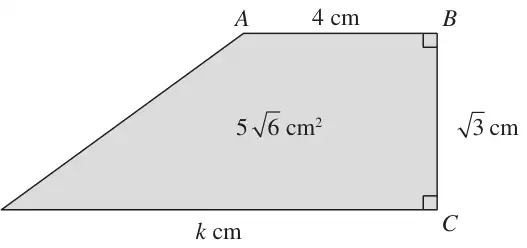
18 A trapezium ABCD has an area of \(5\sqrt{6}\) cm2.
Diagram NOT accurately drawn
\(AB = 4\) cm. \(BC = \sqrt{3}\) cm. \(DC = k\) cm.
Calculate the value of \(k\), giving your answer in the form \(a\sqrt{b} - c\) where \(a\), \(b\) and \(c\) are positive integers. Show each step in your working.
(a) Expand \(\;(5 + 3\sqrt{2})^2\) Give your answer in the form \((a + b\sqrt{2})\), where \(a\) and \(b\) are integers. Show your working clearly. (2)
(b) \((5 + 3\sqrt{2})^2 = p + \dfrac{q}{\sqrt{8}}\), where \(p\) and \(q\) are integers. Find the value of \(q\). (3)
Mark scheme (a)
Scheme
Marks
\(25 + 15\sqrt{2} + 15\sqrt{2} + 9 \times 2\)
or \(25 + 15\sqrt{2} + 15\sqrt{2} + 18\)
or \(25 + 30\sqrt{2} + 9 \times 2\)
or \(25 + 30\sqrt{2} + 18\)
M1
\(43 + 30\sqrt{2}\)
A1
(2)
Notes
M1: Expand to give four terms – (must have surds not decimals), at least three correct,
or three terms with irrational term and one other correct.
Accept \(\left(\sqrt{2}\right)^2\) for 2
A1: dep on M1 awarded
Working required in part (a): the correct answer alone does not imply a correct method.
Mark scheme (b)
Scheme
Marks
\(\sqrt{8} = 2\sqrt{2}\) or \((q =)\sqrt{8} \times \text{“}30\sqrt{2}\text{”}\)
M1
\(\dfrac{1}{\sqrt{2}} = \dfrac{\sqrt{2}}{2}\) or \(\dfrac{1}{\sqrt{8}} = \dfrac{\sqrt{8}}{8}\) or \((q =)30\sqrt{16}\) or
\((q =)60\sqrt{4}\) or \((q =)30\sqrt{2} \times 2\sqrt{2}\)
M1
120
A1
(3)
(5 marks)
Notes
A1: ft 4 × “30” from (a)
M1 M1: Award M marks independently for simplifying \(\sqrt{8}\) and rationalising the denominator, seen at any points in the solution. ft from (a) for \(30\sqrt{16}\)
19 Given that \(x\) and \(y\) are positive integers such that \((1 + \sqrt{x})(3 + \sqrt{x}) = y + 4\sqrt{5}\) find the value of \(x\) and the value of \(y\).
16 Show that \((3 - \sqrt{5})^2 = 14 - 6\sqrt{5}\)
(2)
Mark scheme
Scheme
Marks
eg \(9 - 3\sqrt{5} - 3\sqrt{5} + \sqrt{5}^2\)
\(9 - 2 \times 3\sqrt{5} + \sqrt{5}^2\)
B2
(2)
(2 marks)
Notes
B2: B1 for \(9 + \sqrt{5}^2\) or \(9 + \sqrt{5}\sqrt{5}\) or \(9 + \sqrt{25}\) or \(3^2 + \sqrt{5}^2\) or \(3^2 + \sqrt{5}\sqrt{5}\) or \(3^2 + \sqrt{25}\)
B1 for \(-3\sqrt{5} - 3\sqrt{5}\) or for \(-2 \times 3\sqrt{5}\)
B1 B1: B1 for use of \(\sqrt{8} = 2\sqrt{2}\) or \(\sqrt{8} \times \sqrt{2} = \sqrt{16}\)
B1 for multiplication of numerator and denominator by \(\sqrt{2}\) or \(\sqrt{8}\) (in either order)
SC B1 for \(12 = 3\sqrt{16}\) or for both \(\left(\dfrac{12}{\sqrt{8}}\right)^2 = \dfrac{144}{8} = 18\) and \((3\sqrt{2})^2 = 9 \times 2 = 18\) NB only total of 1 mark for either of these approaches
We'd like to use Google Analytics cookies to count visits and see which pages help most. They're optional, and the site works exactly the same either way. Privacy policy