Angles (Including Parallel Lines)

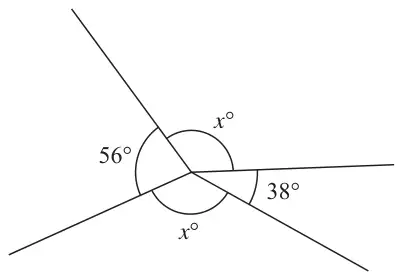
More questions on this topic: GCSE Shape & Space: Angles (Including Parallel Lines) (346)

Your progress
0 of 165 done
Ticks are kept only in this browser: clearing your browsing data or changing device loses them. · ·
From a Foundation paper

Edexcel

Edexcel · Old spec

Foundation June 2025 Paper 2 Q8

EdexcelFoundationCurrent spec3 marksAngles (Including Parallel Lines)

8

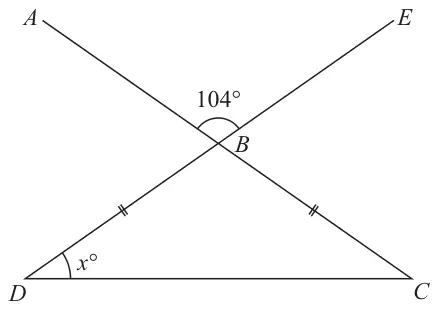
Straight lines ABC and EBD cross at B. Angle ABE is 104°. Triangle BCD has BD = BC, marked with dashes, and angle BDC is x°

Diagram NOT accurately drawn
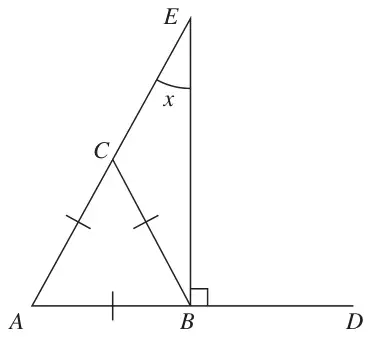
\(ABC\) and \(EBD\) are straight lines.
Triangle \(BCD\) is isosceles with \(BD = BC\)

Angle \(ABE = 104^\circ\)

Work out the value of \(x\)

(3)

Foundation June 2025 Paper 1R Q7

7

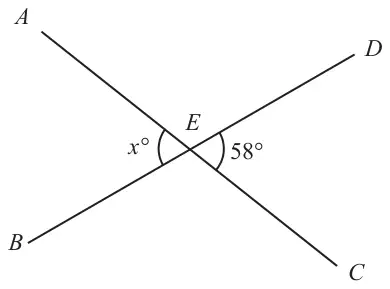
Straight lines AEC and BED cross at E. Angle AEB is marked x° and angle DEC is 58°

Diagram NOT accurately drawn

\(AEC\) and \(BED\) are straight lines.

Sergio says that the value of \(x\) is 58

(a) Give a reason why Sergio is correct. (1)

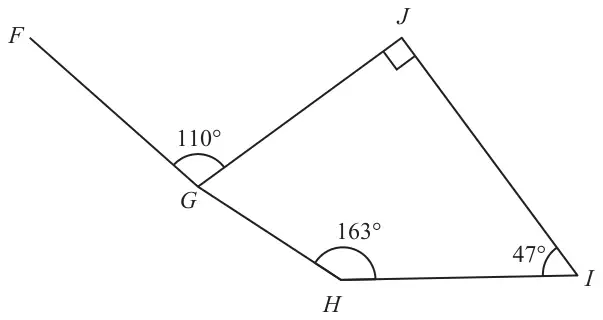
In the diagram, \(GHIJ\) is a quadrilateral.

Quadrilateral GHIJ with angle J = 90°, angle GHI = 163°, angle HIJ = 47°. Line FG is drawn from G, and angle FGJ = 110°

Diagram NOT accurately drawn

Chloe says “\(FGH\) is a straight line”

(b) Show that Chloe is wrong.
Give a reason for each stage of your working. (4)

Foundation June 2025 Paper 1R Q3

EdexcelFoundationCurrent spec4 marksAngles (Including Parallel Lines)Angles in Polygons

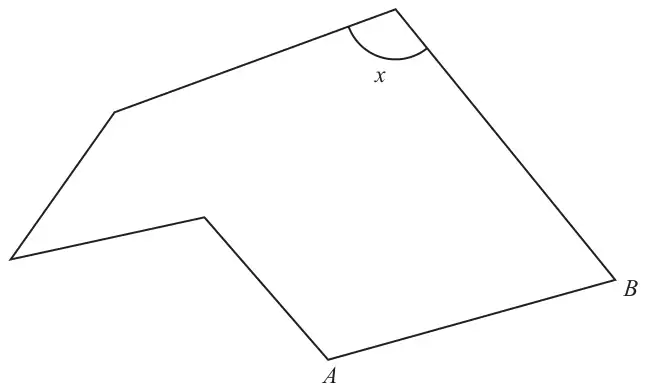
3 The diagram shows a 6-sided polygon.

A 6-sided polygon with side AB and an angle marked x
(a) Measure the length of the side \(AB\)
Give the units of your answer. (2)
(b) Measure the size of the angle marked \(x\) (1)
(c) Write down the mathematical name of a 6-sided polygon. (1)

Foundation November 2024 Paper 2 Q11

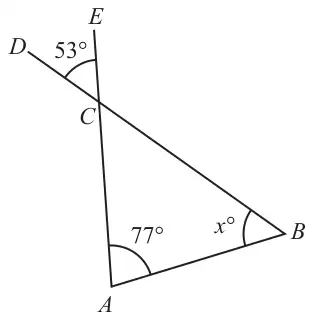
EdexcelFoundationCurrent spec2 marksAngles (Including Parallel Lines)

11

Triangle ABC with angle A = 77° and angle B = x°; BC is extended to D and AC is extended to E, and angle DCE = 53°

Diagram NOT accurately drawn

\(ABC\) is a triangle.
\(BCD\) and \(ACE\) are straight lines.

Work out the value of \(x\)

(2)

Foundation November 2024 Paper 1 Q7

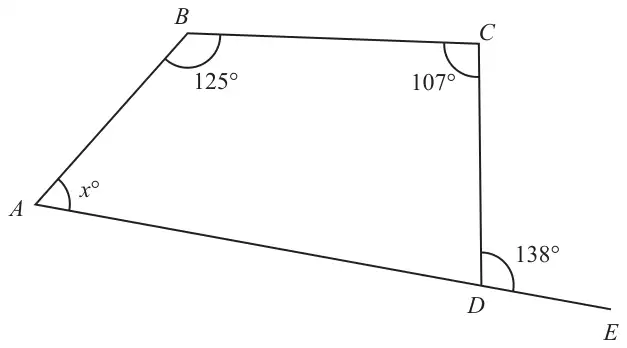
EdexcelFoundationCurrent spec4 marksAngles (Including Parallel Lines)Angles in Polygons

7

Quadrilateral ABCD with angle B = 125°, angle C = 107° and angle A = x°; AD is extended to E and the angle CDE = 138°

Diagram NOT accurately drawn

\(ABCD\) is a quadrilateral.

\(ADE\) is a straight line.

Work out the value of \(x\)
Give a reason for each stage of your working.

(4)

Foundation June 2024 Paper 1R Q12

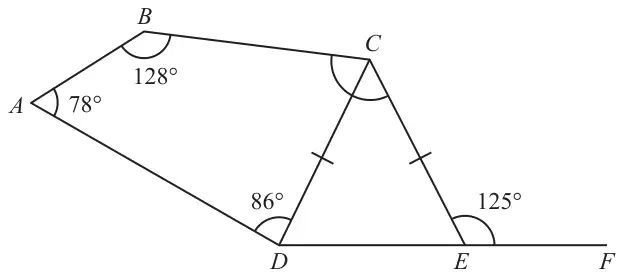
EdexcelFoundationCurrent spec5 marksAngles (Including Parallel Lines)Angles in Polygons

12

Quadrilateral ABCD with angle A = 78 degrees, angle B = 128 degrees and angle ADC = 86 degrees; isosceles triangle CDE with CD = CE; D, E and F on a straight line with angle CEF = 125 degrees

Diagram NOT accurately drawn

\(ABCD\) is a quadrilateral.
\(CDE\) is an isosceles triangle with \(CD = CE\)
\(DEF\) is a straight line.

Work out the size of angle \(BCE\)
Give a reason for each stage of your working.

(5)

Foundation June 2024 Paper 1R Q6

EdexcelFoundationCurrent spec4 marksAngles (Including Parallel Lines)Angles in Polygons

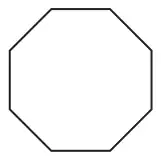
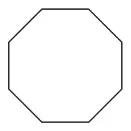
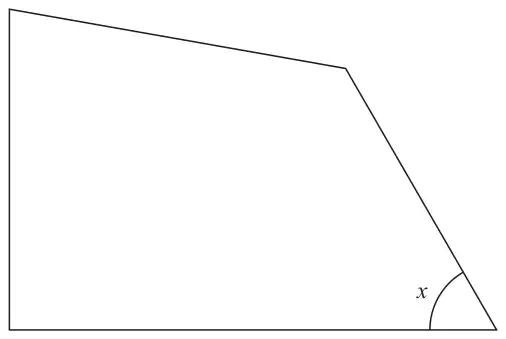
6 The diagram shows a regular octagon.

A regular octagon
(a) Write down the number of lines of symmetry of a regular octagon. (1)

Here is a shape.

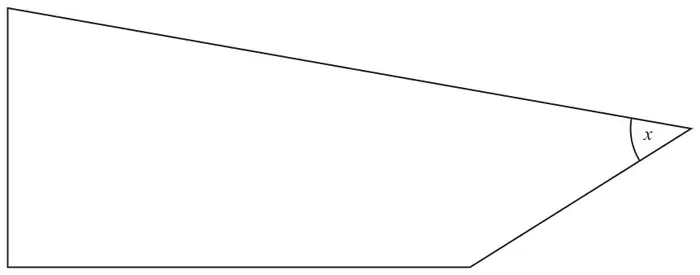
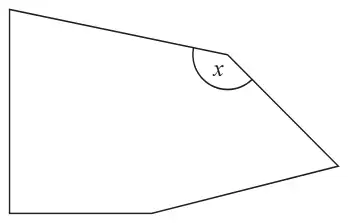
A four-sided shape with a vertical left side, a horizontal base, a long sloping top edge and a short sloping edge meeting at a sharp angle marked x on the right
(b) On the shape, mark with a letter \(R\) a right angle. (1)
(c) On the shape, mark with a letter \(O\) an obtuse angle. (1)
(d) Find, by measuring, the size of the angle marked \(x\) (1)

Foundation June 2024 Paper 1 Q6

EdexcelFoundationCurrent spec5 marksAngles (Including Parallel Lines)Angles in Polygons

6

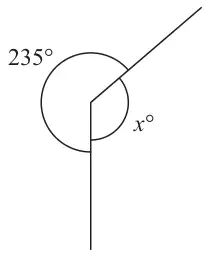
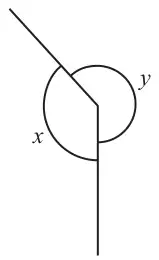
Two lines meeting at a point; the reflex angle between them is 235 degrees and the other angle is x degrees

Diagram NOT accurately drawn

(a)
(i) Work out the value of \(x\) (1)
(ii) Give a reason for your answer. (1)
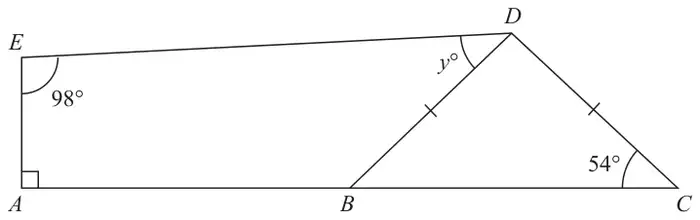
Quadrilateral ABDE with a right angle at A and angle 98 degrees at E; triangle BCD with BD = DC, angle 54 degrees at C and angle y degrees at D between DE and DB; A, B and C lie on a straight line

Diagram NOT accurately drawn

\(ABDE\) is a quadrilateral.
\(BCD\) is an isosceles triangle.
\(ABC\) is a straight line.

(b) Work out the value of \(y\) (3)

Foundation November 2023 Paper 1 Q9

EdexcelFoundationCurrent spec4 marksAngles (Including Parallel Lines)

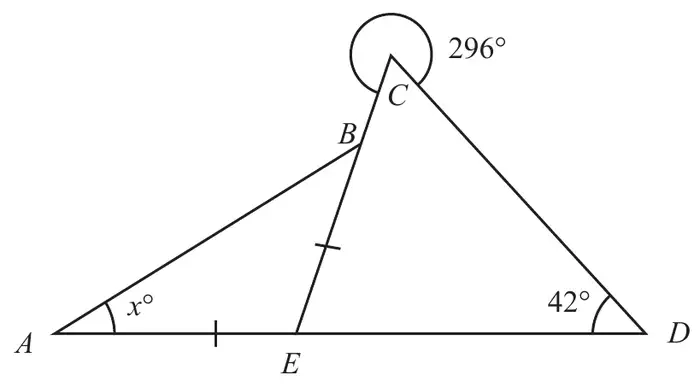
9 The diagram shows two triangles \(ABE\) and \(ECD\)

Triangles ABE and ECD; reflex angle at C is 296 degrees, angle at D is 42 degrees, angle at A is x degrees, AE = EB marked

Diagram NOT accurately drawn

Triangle \(ABE\) is isosceles with \(AE = EB\)
\(AED\) and \(EBC\) are straight lines.

Angle \(CDE = 42^\circ\)
The reflex angle \(ECD = 296^\circ\)
Angle \(BAE = x^\circ\)

Work out the value of \(x\)

(4)

Foundation November 2023 Paper 2 Q8

EdexcelFoundationCurrent spec4 marksAngles (Including Parallel Lines)

8

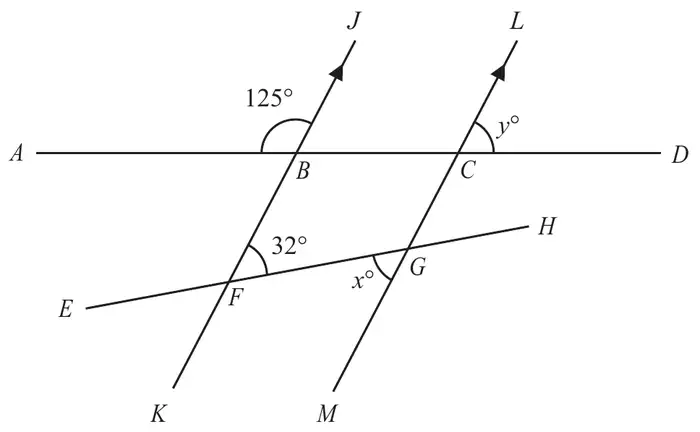
Parallel lines KFBJ and MGCL crossed by straight lines ABCD and EFGH; angle ABJ = 125 degrees, angle BFG = 32 degrees, angle FGM = x degrees, angle LCD = y degrees

Diagram NOT accurately drawn

\(ABCD\) and \(EFGH\) are straight lines.
\(KFBJ\) and \(MGCL\) are parallel straight lines.

angle \(ABJ = 125^\circ\)    angle \(BFG = 32^\circ\)    angle \(FGM = x^\circ\)    angle \(LCD = y^\circ\)

(a) Write down the value of \(x\) (1)
(b)
(i) Work out the value of \(y\) (2)
(ii) Give a reason for your answer to (b) (i) (1)

Foundation November 2023 Paper 1 Q3

3

(a)
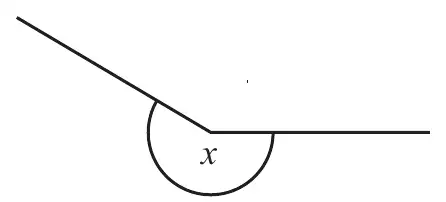
An angle x marked between two lines, greater than 180 degrees
Write down the mathematical name of the angle marked \(x\) (1)
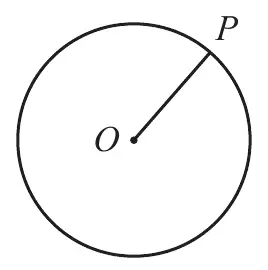
Circle with centre O and a line from O to a point P on the circle

\(P\) is a point on a circle with centre \(O\)

(b) Write down the mathematical name of the line \(OP\) (1)

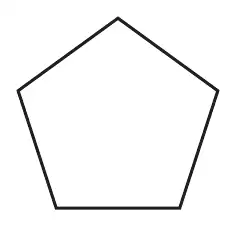
Here is a polygon.

A regular five-sided polygon
(c) Write down the mathematical name of this polygon. (1)

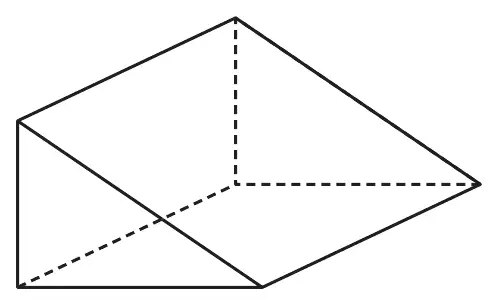
Here is a solid prism.

A triangular prism
(d) Write down the number of edges of this solid prism. (1)

Foundation June 2023 Paper 2 Q19

EdexcelFoundationCurrent spec4 marksAngles (Including Parallel Lines)Angles in Polygons

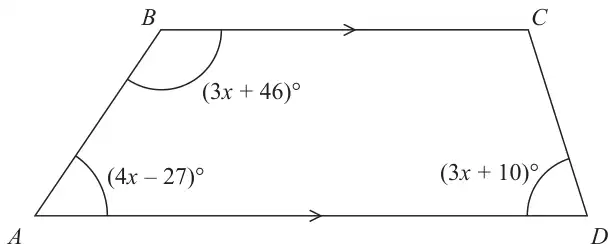
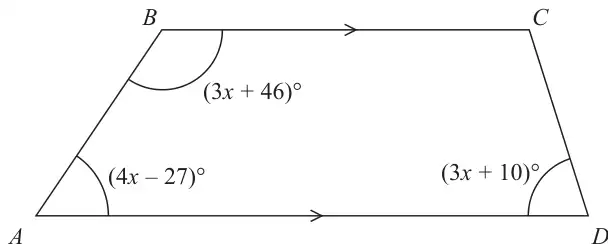
19 \(ABCD\) is a trapezium.

Trapezium ABCD with BC parallel to AD; angle A = (4x - 27) degrees, angle B = (3x + 46) degrees, angle D = (3x + 10) degrees

Diagram NOT accurately drawn

\(BC\) is parallel to \(AD\)

Find the size of the largest angle inside the trapezium.

(4)

Foundation June 2023 Paper 1R Q10

EdexcelFoundationCurrent spec5 marksAngles (Including Parallel Lines)Angles in Polygons

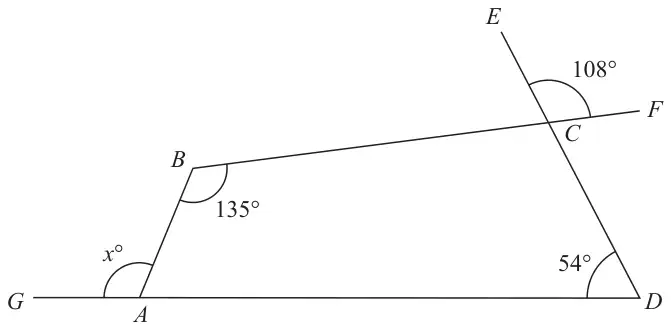
10 The diagram shows quadrilateral \(ABCD\)

Quadrilateral ABCD; GAD is a straight line with angle x degrees at A between AG and AB; angle ABC is 135 degrees; ECD and BCF are straight lines crossing at C with angle ECF 108 degrees; angle ADC is 54 degrees

Diagram NOT accurately drawn

\(ECD\), \(BCF\) and \(GAD\) are straight lines.

Work out the value of \(x\)
Give a reason for each stage of your working.

(5)

Foundation June 2023 Paper 2R Q9

EdexcelFoundationCurrent spec3 marksAngles (Including Parallel Lines)Angles in Polygons

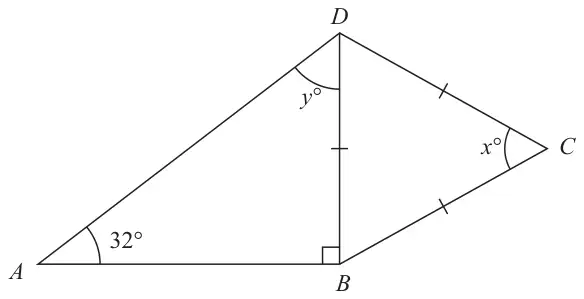
9 The diagram shows quadrilateral \(ABCD\)

Quadrilateral ABCD with diagonal DB; angle DBA is a right angle, angle DAB is 32 degrees, angle ADB is y degrees, angle BCD is x degrees; BC, CD and DB are marked equal

Diagram NOT accurately drawn

\(BC = CD = DB\)
angle \(DBA = 90^\circ\) and angle \(DAB = 32^\circ\)

(a) Work out the value of \(x\) (1)
(b)
(i) Work out the value of \(y\) (1)
(ii) Give a reason for your answer to (b)(i). (1)

Higher June 2023 Paper 2 Q3

EdexcelHigherCurrent spec4 marksAngles (Including Parallel Lines)

3 \(ABCD\) is a trapezium.

Trapezium ABCD with BC parallel to AD; angle A is (4x - 27) degrees, angle B is (3x + 46) degrees and angle D is (3x + 10) degrees

Diagram NOT accurately drawn

\(BC\) is parallel to \(AD\)

Find the size of the largest angle inside the trapezium.

(4)

Foundation January 2023 Paper 2R Q25

EdexcelFoundationCurrent spec4 marksAngles (Including Parallel Lines)Angles in Polygons

25

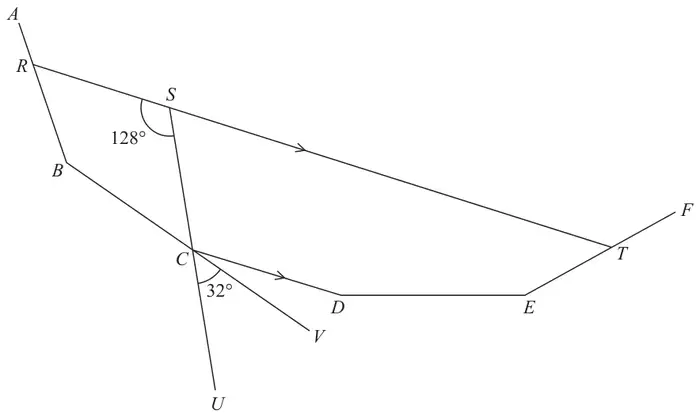
Five sides AB, BC, CD, DE and EF of a regular polygon; straight line RST parallel to CD; straight line SCU through C with angle RSC = 128 degrees; straight line BCV with angle UCV = 32 degrees

Diagram NOT accurately drawn

\(AB\), \(BC\), \(CD\), \(DE\) and \(EF\) are five sides of a regular polygon.

\(RST\), \(SCU\) and \(BCV\) are straight lines.

\(RST\) is parallel to \(CD\)

Angle \(RSC = 128^\circ\)
Angle \(UCV = 32^\circ\)

Work out how many sides the polygon has.
Show your working clearly.

(4)

Foundation January 2023 Paper 2 Q15

EdexcelFoundationCurrent spec4 marksAngles (Including Parallel Lines)

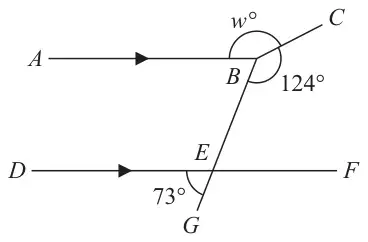
15 The diagram shows two parallel lines \(AB\) and \(DEF\)

Parallel lines AB and DEF, with a straight line from B through E to G and a line BC from B; angle DEG is 73 degrees, angle EBC is 124 degrees and angle ABC is w degrees

Diagram NOT accurately drawn

\(BEG\) is a straight line.

angle \(DEG = 73^\circ\)    angle \(EBC = 124^\circ\)    angle \(ABC = w^\circ\)

Work out the value of \(w\)
Give reasons for each stage of your working.

(4)

Higher January 2023 Paper 2R Q11

11

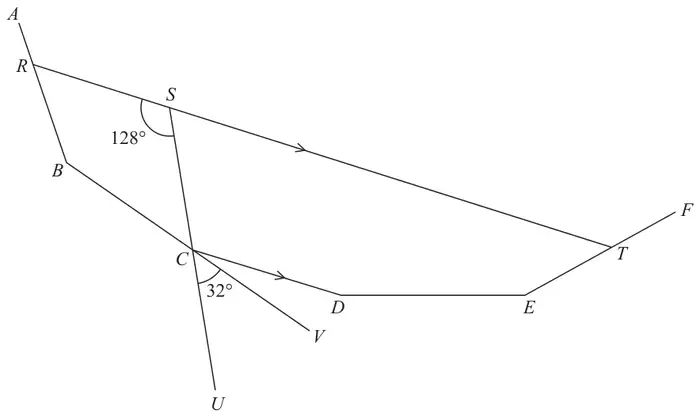
Five sides AB, BC, CD, DE, EF of a regular polygon; line RST parallel to CD; line SCU crosses RST at S and passes through C; BC extended to V; angle RSC = 128° and angle UCV = 32°

Diagram NOT accurately drawn

\(AB\), \(BC\), \(CD\), \(DE\) and \(EF\) are five sides of a regular polygon.

\(RST\), \(SCU\) and \(BCV\) are straight lines.
\(RST\) is parallel to \(CD\)
Angle \(RSC = 128°\)
Angle \(UCV = 32°\)

Work out how many sides the polygon has.
Show your working clearly.

(4)

Foundation January 2023 Paper 1R Q9

EdexcelFoundationCurrent spec4 marksAngles (Including Parallel Lines)Angles in Polygons

9

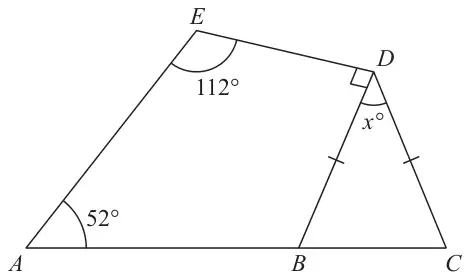
Quadrilateral ABDE with A, B and C on a straight line; angle EAB is 52 degrees, angle AED is 112 degrees, angle EDB is a right angle, BD and CD are marked equal, and angle BDC is x degrees

Diagram NOT accurately drawn

\(BCD\) is an isosceles triangle with \(BD = CD\)
\(ABC\) is a straight line.
\(ABDE\) is a quadrilateral.

Work out the value of \(x\)
Give a reason for each stage of your working.

(4)

Foundation January 2023 Paper 2 Q4

4

(a) In the space below, draw a line of length 6.5 cm (1)

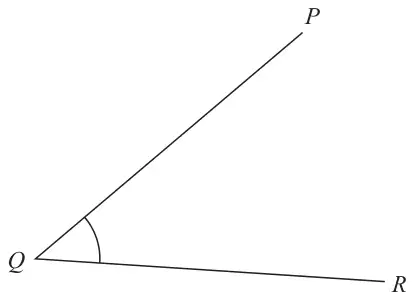
The diagram shows the straight lines \(QP\) and \(QR\)

Two straight lines QP and QR meeting at Q, with the angle PQR marked
(b) Measure the size of angle \(PQR\) (1)

Foundation January 2023 Paper 2R Q3

EdexcelFoundationCurrent spec4 marksAngles (Including Parallel Lines)Circles & Sectors

3

(a) Write down the mathematical name for an 8-sided polygon. (1)
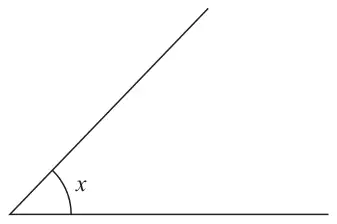
Two straight lines meeting at a point, with the angle x marked between them
(b) What type of angle is the angle marked \(x\)? (1)
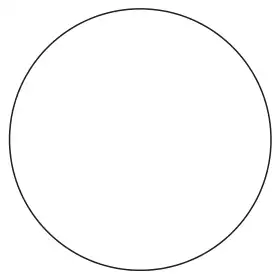
A circle
(c) On the diagram above, draw a chord of the circle. (1)
(d) Change 3.6 metres into centimetres. (1)

Foundation June 2022 Paper 1R Q12

EdexcelFoundationCurrent spec3 marksAngles (Including Parallel Lines)

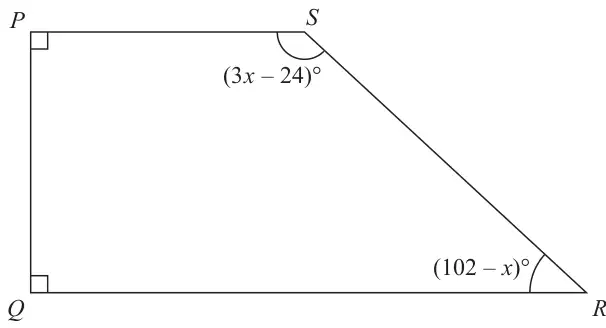
12 The diagram below shows the trapezium \(PQRS\)

Trapezium PQRS with right angles at P and Q; angle PSR is (3x − 24)° and angle QRS is (102 − x)°

Diagram NOT accurately drawn

Angle \(PQR\) and angle \(QPS\) are right angles.

Find the value of \(x\)

(3)

Foundation June 2022 Paper 1R Q10

EdexcelFoundationCurrent spec5 marksAngles (Including Parallel Lines)

10

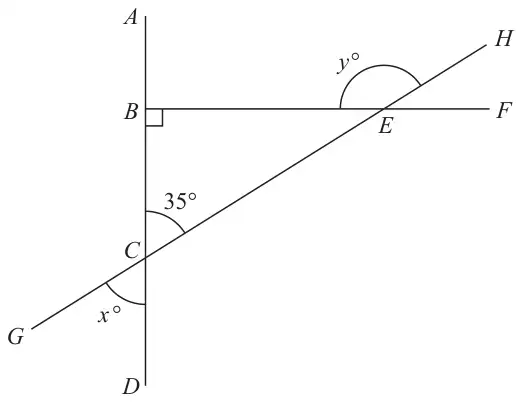
Vertical line ABCD; horizontal line BEF with a right angle at B; line GCEH crosses ABCD at C and BEF at E. Angle BCE is 35°, angle x° is between CG and CD, angle y° is angle BEH

Diagram NOT accurately drawn

In the diagram, \(BCE\) is a right-angled triangle.
\(ABCD\), \(BEF\) and \(GCEH\) are straight lines.

Angle \(BCE = 35^\circ\)

(a)
(i) Find the value of \(x\) (1)
(ii) Give a reason for your answer. (1)
(b)
(i) Work out the value of \(y\) (2)
(ii) Give a reason for your answer. (1)

Foundation June 2022 Paper 1 Q6

EdexcelFoundationCurrent spec5 marksAngles (Including Parallel Lines)Angles in Polygons

6

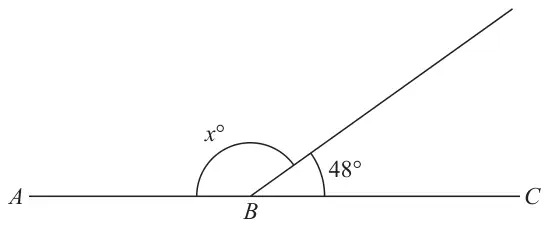
Straight line ABC with a line from B; angle x degrees between BA and the line, 48 degrees between the line and BC

Diagram NOT accurately drawn

\(ABC\) is a straight line.

(a)
(i) Work out the value of \(x\) (1)
(ii) Give a reason for your answer to (i) (1)
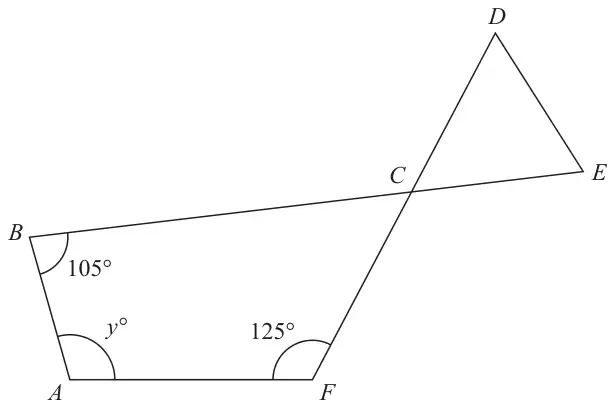
Quadrilateral ABCF with angle ABC = 105 degrees, angle BAF = y degrees, angle AFC = 125 degrees; BC extends to E and FC extends to D, with CDE a triangle

Diagram NOT accurately drawn

\(CDE\) is an equilateral triangle.
\(ABCF\) is a quadrilateral.

\(BCE\) and \(DCF\) are straight lines.

(b) Work out the value of \(y\)
You must show your working. (3)

Foundation June 2022 Paper 1R Q5

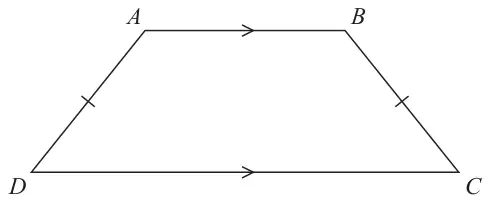
5 The diagram shows the trapezium \(ABCD\)

Isosceles trapezium ABCD with AB parallel to DC and equal sides AD and BC marked
(a) How many lines of symmetry has \(ABCD\)? (1)

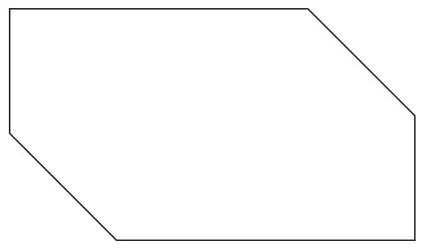
Here is another shape.

A hexagon made from a rectangle with two opposite corners cut off
(b) Write down the order of rotational symmetry of this shape. (1)
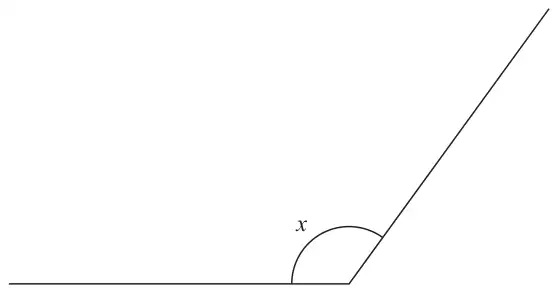
(c) Find, by measuring, the size of the angle marked \(x\) (1)
Two lines meeting at a point, with the obtuse angle between them marked x

Foundation June 2022 Paper 1R Q2

EdexcelFoundationCurrent spec3 marksAngles (Including Parallel Lines)Angles in Polygons

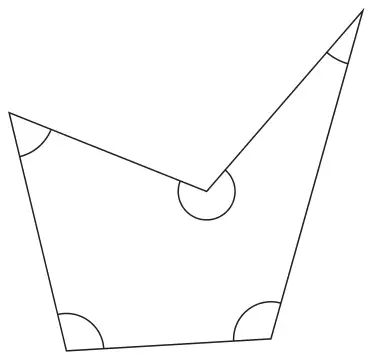
2 Here is a 5-sided polygon.

A five-sided polygon with one reflex interior angle; each interior angle is marked with an arc
(a) Write down the mathematical name for a 5-sided polygon. (1)
(b) On the diagram, mark with a letter \(A\) an acute angle. (1)
(c) On the diagram, mark with a letter \(R\) a reflex angle. (1)

Foundation January 2022 Paper 2 Q9

EdexcelFoundationCurrent spec4 marksAngles (Including Parallel Lines)

9 The diagram shows triangle \(ABD\)

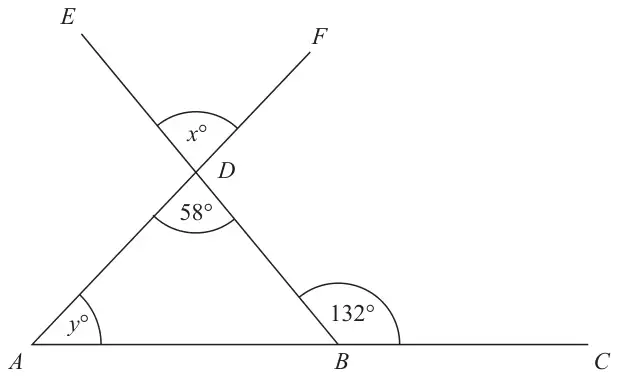
Triangle ABD with AB on a straight line ABC. Lines BDE and ADF cross at D. Angle ADB is 58°, the angle EDF opposite it is x°, angle DAB is y° and the exterior angle CBD is 132°

Diagram NOT accurately drawn

\(ABC\), \(BDE\) and \(ADF\) are straight lines.

angle \(CBD = 132°\)        angle \(ADB = 58°\)

(a)
(i) Write down the value of \(x\)
(ii) Give a reason for your answer. (2)
(b) Work out the value of \(y\) (2)

Foundation January 2022 Paper 1R Q8

EdexcelFoundationCurrent spec5 marksAngles (Including Parallel Lines)

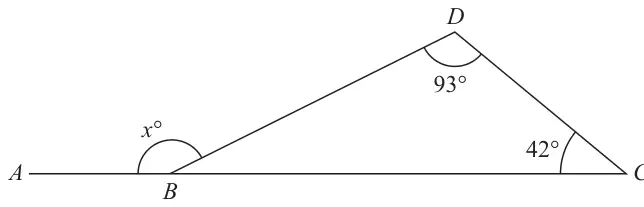
8 \(ABC\) is a straight line and \(BCD\) is a triangle.

Straight line ABC with triangle BCD above it; angle D is 93 degrees, angle C is 42 degrees, and the angle x degrees is between AB and BD

Diagram NOT accurately drawn

(a) Work out the value of \(x\) (2)

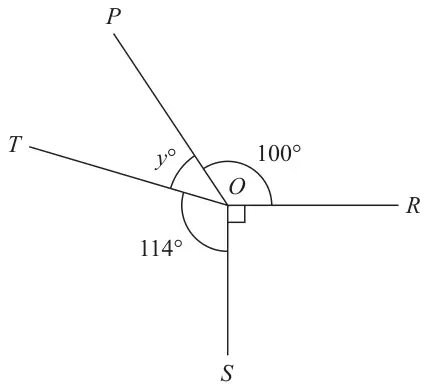
\(PO\), \(RO\), \(SO\) and \(TO\) are four straight lines.

Four lines from O to P, R, S and T; angle POR is 100 degrees, angle ROS is a right angle, angle SOT is 114 degrees and angle TOP is y degrees

Diagram NOT accurately drawn

(b)
(i) Work out the value of \(y\) (2)
(ii) Give a reason for your answer. (1)

Foundation January 2022 Paper 1 Q4

EdexcelFoundationCurrent spec5 marksAngles (Including Parallel Lines)Angles in Polygons

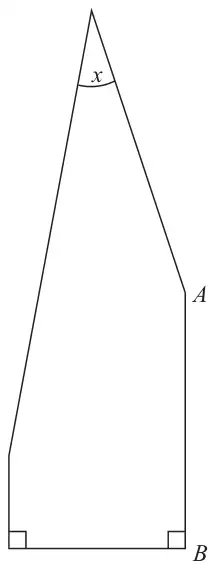
4 The diagram shows a 5-sided polygon.

A five-sided polygon with two right angles at the bottom, vertical side AB on the right, and an acute angle x at the top vertex
(a) Measure the length of the side \(AB\)
Give the units of your answer. (2)
(b) Measure the size of the angle marked \(x\) (1)
(c) On the diagram, mark with arrows (>>) a pair of parallel sides. (1)
(d) Write down the mathematical name of a 5-sided polygon. (1)

Foundation November 2021 Paper 2 Q8

EdexcelFoundationCurrent spec3 marksAngles (Including Parallel Lines)Angles in Polygons

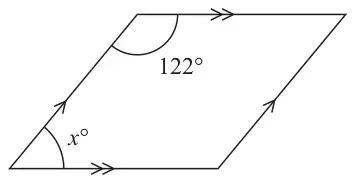
8 Here is a rhombus.

Rhombus with one obtuse angle of 122 degrees at the top left and an angle x degrees at the bottom left; arrows mark opposite sides parallel

Diagram NOT accurately drawn

Work out the value of \(x\).
Give a reason for your answer.

(3)

Foundation June 2021 Paper 2 Q19

EdexcelFoundationCurrent spec5 marksAngles (Including Parallel Lines)

19

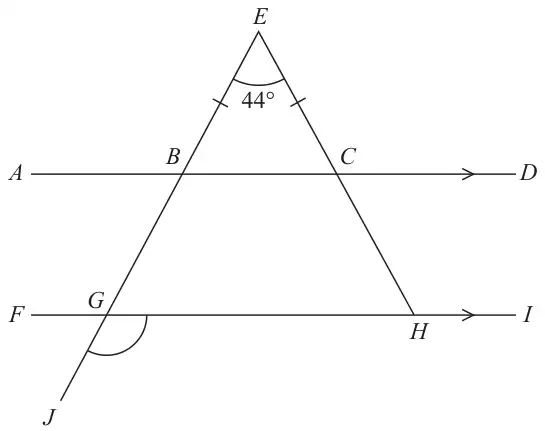
Lines ABCD and FGHI are parallel, with arrows. Line EBGJ passes through B and G and continues to J below. Line ECH passes through C to H. BE and CE are marked equal. Angle BEC is 44 degrees. Angle JGH is marked below line FGHI, between GJ and GH

Diagram NOT accurately drawn

\(ABCD\) and \(FGHI\) are parallel straight lines.
\(EBGJ\) and \(ECH\) are straight lines.

\(BE = CE\)
Angle \(BEC\) = 44°

Work out the size of angle \(JGH\).
Give a reason for each stage of your working.

(5)

Higher June 2021 Paper 2 Q5

EdexcelHigherCurrent spec5 marksAngles (Including Parallel Lines)

5

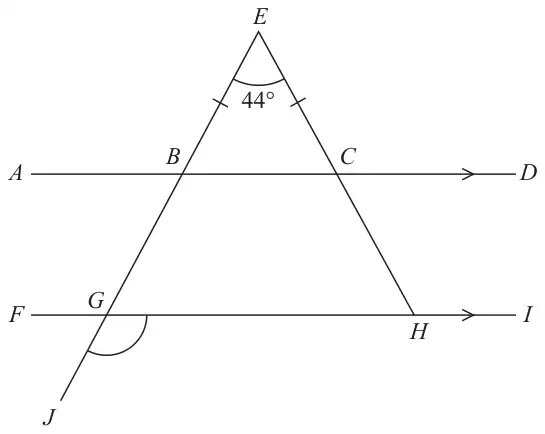
Two parallel horizontal lines: ABCD on top and FGHI below. E is above the top line; EBGJ is a straight line through B and G continuing to J below FGHI, and ECH is a straight line through C to H. Angle BEC = 44°

Diagram NOT accurately drawn

\(ABCD\) and \(FGHI\) are parallel straight lines.
\(EBGJ\) and \(ECH\) are straight lines.

\(BE = CE\)
Angle \(BEC = 44°\)

Work out the size of angle \(JGH\).
Give a reason for each stage of your working.

(5)

Foundation June 2021 Paper 2 Q2

2

(a) Write down the order of rotational symmetry of a square. (1)
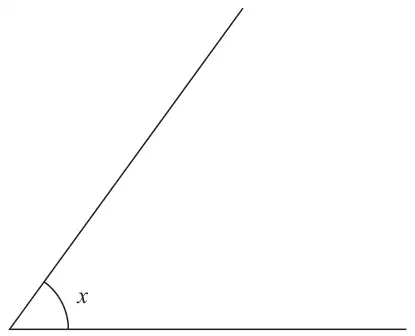
Two straight lines meeting at a point, with the angle x marked between them
(b)
(i) Measure the size of the angle marked \(x\).
(ii) Write down the mathematical name of this type of angle. (2)

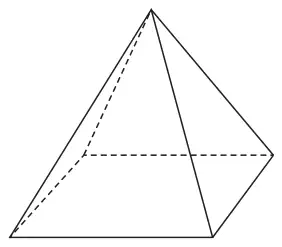
Here is a 3-D shape.

A square-based pyramid, with hidden edges shown as dashed lines
(c)
(i) Write down the mathematical name of this 3-D shape.
(ii) How many edges does this shape have? (2)

Foundation January 2021 Paper 2 Q11

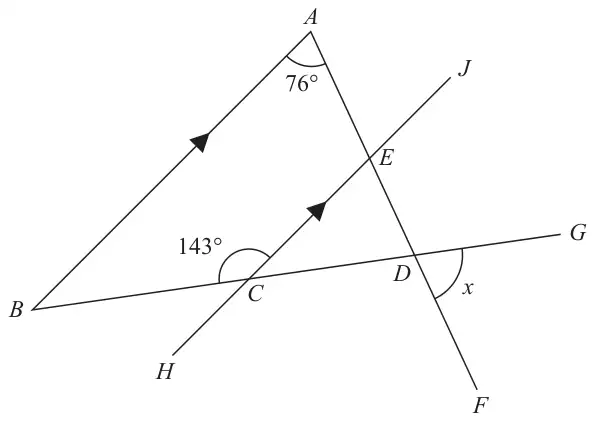
EdexcelFoundationCurrent spec3 marksAngles (Including Parallel Lines)

11

Triangle ABD with angle BAD 76 degrees; line HCEJ parallel to BA crosses BD at C and AD at E; angle 143 degrees at C; x is the angle at D between DG and DF

Diagram NOT accurately drawn

\(ABD\) is a triangle.

\(AEDF\), \(BCDG\) and \(HCEJ\) are straight lines.
\(BA\) is parallel to \(HCEJ\).

Work out the size of the angle marked \(x\).

(3)

Foundation January 2021 Paper 1 Q9

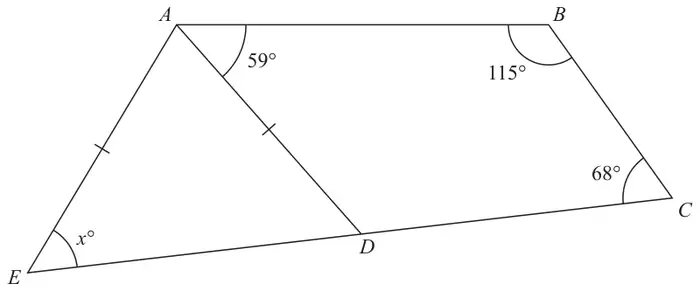
EdexcelFoundationCurrent spec4 marksAngles (Including Parallel Lines)Angles in Polygons

9 The diagram shows quadrilateral \(ABCD\) and isosceles triangle \(ADE\), where \(AE = AD\).

Quadrilateral ABCD with angle BAD 59 degrees, angle ABC 115 degrees and angle BCD 68 degrees; triangle ADE with AE = AD marked, E, D and C on a straight line, and angle AED marked x degrees

\(EDC\) is a straight line.

Work out the value of \(x\).
Give a reason for each stage of your working.

(4)

Foundation January 2021 Paper 1R Q3

EdexcelFoundationCurrent spec4 marksAngles (Including Parallel Lines)

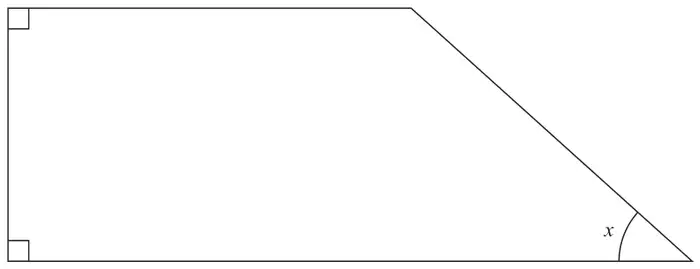
3 Here is a quadrilateral.

Quadrilateral with a vertical left side, horizontal top and bottom sides with right angles at the top-left and bottom-left corners, and a slanted right side; the acute angle at the bottom-right corner is marked x
(a) What is the mathematical name of this quadrilateral? (1)
(b) Measure the size of the angle marked \(x\). (1)
(c) On the quadrilateral, mark with arrows (>>) a pair of parallel lines. (1)

The quadrilateral has four angles.

(d) How many of these angles are right angles? (1)

Foundation November 2020 Paper 2 Q18

EdexcelFoundationCurrent spec5 marksAngles (Including Parallel Lines)

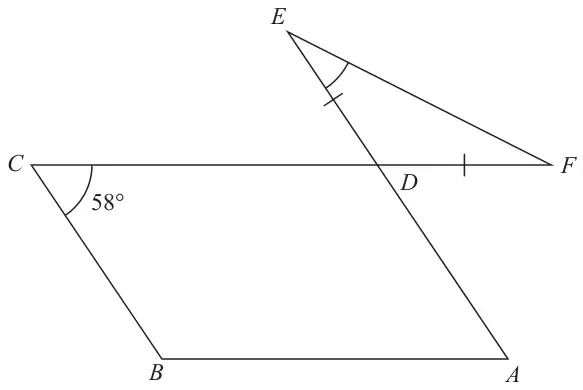
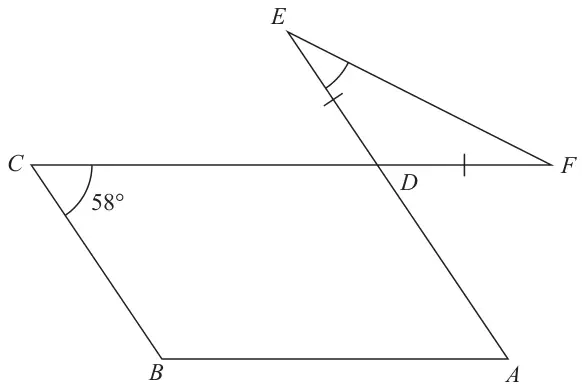
18

Parallelogram ABCD with angle BCD = 58°; CD is extended to F and AD is extended to E, forming triangle DEF with DE = DF marked equal; angle DEF is marked

Diagram NOT accurately drawn

The diagram shows a parallelogram \(ABCD\) and an isosceles triangle \(DEF\) in which \(DE = DF\)

\(CDF\) and \(ADE\) are straight lines.
Angle \(BCD = 58°\)

Work out the size of angle \(DEF\).
Give a reason for each stage of your working.

(5)

Foundation November 2020 Paper 2R Q7

EdexcelFoundationCurrent spec4 marksAngles (Including Parallel Lines)

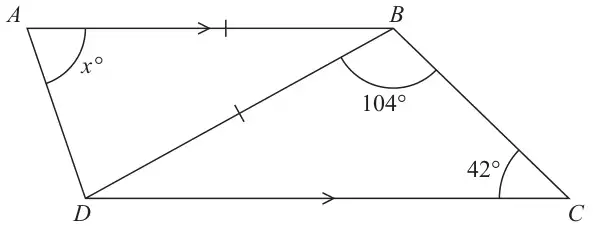
7 The diagram shows a trapezium \(ABCD\) in which \(AB\) and \(DC\) are parallel.

Trapezium ABCD with AB parallel to DC and diagonal DB; angle DAB is x degrees, angle DBC is 104 degrees, angle BCD is 42 degrees; AB and DB are marked equal

Diagram NOT accurately drawn

\(AB = DB\)

Work out the value of \(x\).
Give a reason for each stage of your working.

(4)

Foundation November 2020 Paper 1 Q4

EdexcelFoundationCurrent spec4 marksAngles (Including Parallel Lines)Similar Shapes

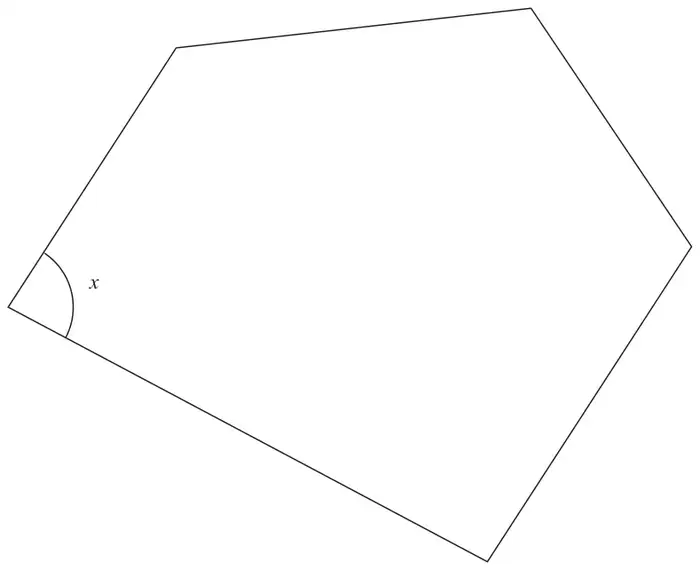
4 Here is a polygon with five sides.

A five-sided polygon with the angle at the left-hand vertex marked x; two of its sides are parallel
(a) Write down the mathematical name of a polygon with five sides. (1)
(b) Measure the size of the angle marked \(x\). (1)

Two sides of the polygon are parallel.

(c) On the polygon, mark with arrows (>>) this pair of parallel lines. (1)

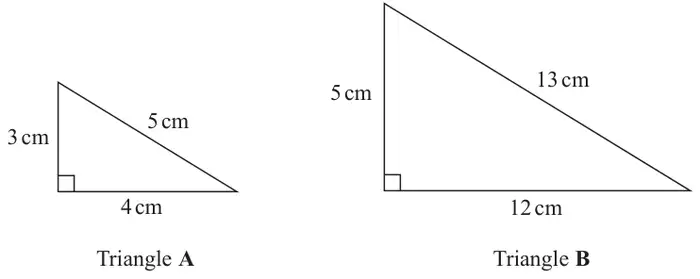
Here are two triangles.

Right-angled triangle A with sides 3 cm, 4 cm and 5 cm, and right-angled triangle B with sides 5 cm, 12 cm and 13 cm

Diagram NOT accurately drawn

(d) Are triangle A and triangle B similar triangles?
You must give a reason for your answer. (1)

Higher November 2020 Paper 2 Q3

EdexcelHigherCurrent spec5 marksAngles (Including Parallel Lines)

3

Parallelogram ABCD with angle BCD = 58 degrees; CD is extended to F and AD is extended to E, forming isosceles triangle DEF with DE = DF

Diagram NOT accurately drawn

The diagram shows a parallelogram \(ABCD\) and an isosceles triangle \(DEF\) in which \(DE = DF\)

\(CDF\) and \(ADE\) are straight lines.
Angle \(BCD = 58°\)

Work out the size of angle \(DEF\).
Give a reason for each stage of your working.

(5)

Foundation January 2020 Paper 2R Q15

EdexcelFoundationCurrent spec4 marksAngles (Including Parallel Lines)

15

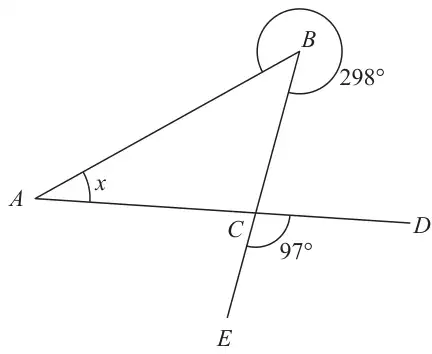
Triangle ABC with angle x at A. AC is extended to D and BC is extended to E. The reflex angle at B is 298° and angle ECD is 97°

Diagram NOT accurately drawn

\(ABC\) is a triangle.
\(D\) and \(E\) are points such that \(ACD\) and \(BCE\) are straight lines.

reflex angle \(ABC = 298^\circ \)
angle \(ECD = 97^\circ \)

Work out the size of angle \(x\).
Give a reason for each stage of your working.

(4)

Foundation January 2020 Paper 1 Q7

EdexcelFoundationCurrent spec5 marksAngles (Including Parallel Lines)Angles in Polygons

7

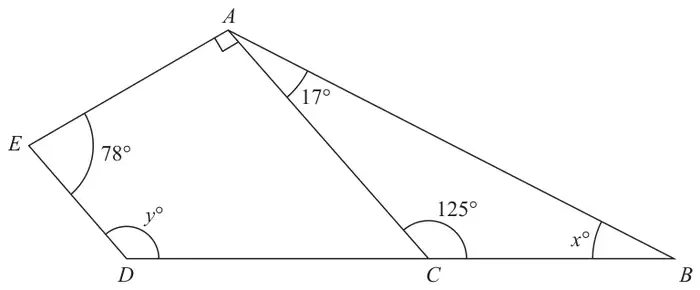
Quadrilateral ABDE with D, C and B on a straight line at the bottom and the line AC drawn. Angle AED = 78°, angle EDC = y°, angle EAC = 90° (right angle), angle CAB = 17°, angle ACD = 125°, angle ABC = x°

Diagram NOT accurately drawn

\(ABDE\) is a quadrilateral.
\(ABC\) is a triangle.
\(DCB\) is a straight line.

(a)
(i) Work out the value of \(x\). (1)
(ii) Give a reason for your answer. (1)
(b) Work out the value of \(y\).
Give a reason for each stage of your working. (3)

Higher January 2020 Paper 2 Q4

EdexcelHigherCurrent spec4 marksAngles (Including Parallel Lines)

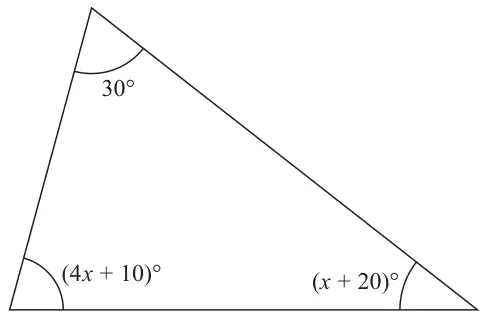
4 The diagram shows a triangle.

Triangle with angles 30 degrees, (4x + 10) degrees and (x + 20) degrees

Diagram NOT accurately drawn

Work out the value of \(x\).

(4)

Foundation January 2020 Paper 2R Q3

EdexcelFoundationCurrent spec2 marksAngles (Including Parallel Lines)Circles & Sectors

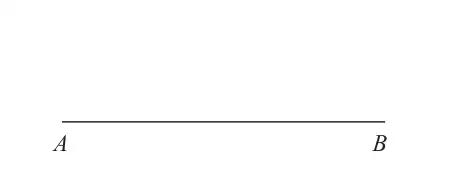
3 The diagram shows a line \(AB\).

A horizontal line segment with A at the left end and B at the right end
(a) At the point \(A\) draw an acute angle.
Label your acute angle \(a\). (1)

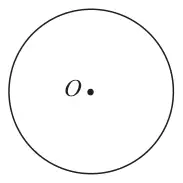
The diagram shows a circle with centre \(O\).

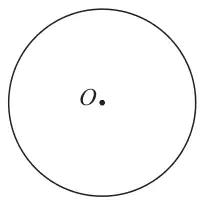
A circle with its centre O marked
(b) Draw a diameter of the circle. (1)

Foundation June 2019 Paper 1 Q8

EdexcelFoundationCurrent spec5 marksAngles (Including Parallel Lines)

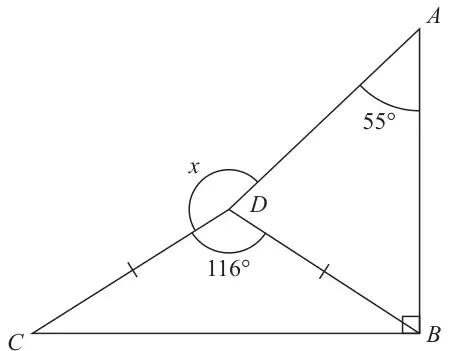
8 The diagram shows two triangles, \(CDB\) and \(BDA\).

Triangles CDB and BDA sharing side DB; A is above B and C is to the left of B with a right angle at B; angle DAB is 55 degrees, angle CDB is 116 degrees, DC and DB are marked equal, and the reflex angle ADC at D is marked x

Diagram NOT accurately drawn

\(DC = DB\)
Angle \(ABC = 90^\circ\)
Angle \(CDB = 116^\circ\)
Angle \(DAB = 55^\circ\)

Work out the size of the angle marked \(x\).
Give a reason for each stage of your working.

(5)

Foundation June 2019 Paper 1R Q6

EdexcelFoundationCurrent spec3 marksAngles (Including Parallel Lines)Circles & Sectors

6

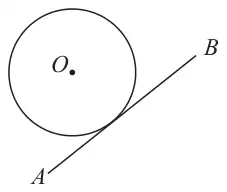
(a) The diagram shows a circle with centre \(O\).
Circle with centre O and a straight line AB touching the circle at one point
Write down the word from the box that describes the line \(AB\).
sector      segment      tangent      chord      diameter
(1)
(b) The diagram shows a circle with centre \(O\).
Circle with centre O
On the diagram, draw a radius of the circle. (1)
(c)
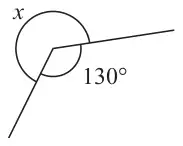
Two lines meeting at a point, one angle between them is 130 degrees and the other angle is marked x

Diagram NOT accurately drawn

Work out the size of the angle marked \(x\). (1)

Foundation June 2019 Paper 2R Q3

EdexcelFoundationCurrent spec2 marksAngles (Including Parallel Lines)Angles in Polygons

3 Here is a pentagon.

A pentagon with one angle marked x
acute        obtuse        reflex        right
(a) Write down the word from the box that describes the angle marked \(x\). (1)
(b) Write down the mathematical name of the following polygon.
A regular polygon with 8 sides
(1)

Foundation January 2019 Paper 2R Q14

EdexcelFoundationCurrent spec4 marksAngles (Including Parallel Lines)

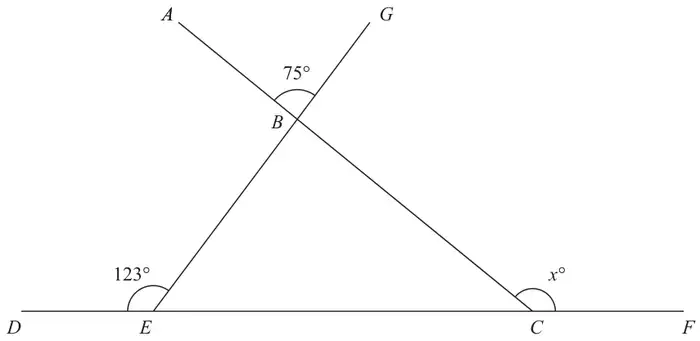
14

Straight line DECF; line EBG makes 123 degrees with ED at E; line ABC crosses EBG at B, where angle ABG is 75 degrees; angle x is between CB and CF at C

Diagram NOT accurately drawn

\(ABC\), \(DECF\) and \(EBG\) are straight lines.

Work out the value of \(x\).
Give a reason for each stage of your working.

(4)

Foundation January 2019 Paper 2 Q13

EdexcelFoundationCurrent spec5 marksAngles (Including Parallel Lines)

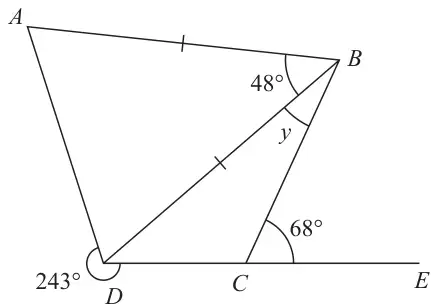
13

Triangle ABD with AB = DB; C on line DE with BC drawn. Angle ABD = 48°, angle BCE = 68°, reflex angle ADC = 243°, angle DBC marked y

Diagram NOT accurately drawn

\(ABD\) is an isosceles triangle with \(AB = DB\).
\(DCE\) is a straight line.

Angle \(ABD\) = 48°
Angle \(BCE\) = 68°
Reflex angle \(ADC\) = 243°

Work out the size of the angle marked \(y\).
Give a reason for each stage in your working.

(5)

Higher January 2019 Paper 1 Q5

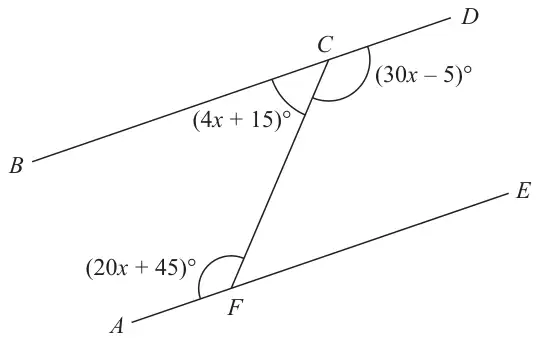
5

Straight line BCD and straight line AFE joined by the line CF; angle BCF = (4x + 15)°, angle DCF = (30x − 5)° and angle AFC = (20x + 45)°

Diagram NOT accurately drawn

\(BCD\) and \(AFE\) are straight lines.
Show that \(BCD\) is parallel to \(AFE\).
Give reasons for your working.

(5)

Foundation June 2018 Paper 1R Q21

EdexcelFoundationCurrent spec3 marksAngles (Including Parallel Lines)

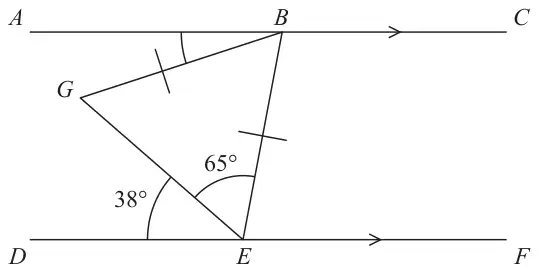
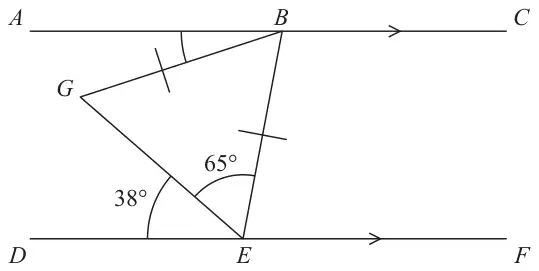
21

Parallel lines ABC and DEF marked with arrows; G is joined to B and to E; BG and BE are marked equal; angle DEG is 38 degrees and angle GEB is 65 degrees; angle ABG is marked

Diagram NOT accurately drawn

\(ABC\) and \(DEF\) are parallel lines.

\(BG = BE\)
Angle \(DEG = 38°\)
Angle \(GEB = 65°\)

Find the size of angle \(ABG\).

(3)

Foundation June 2018 Paper 2 Q15

EdexcelFoundationCurrent spec3 marksAngles (Including Parallel Lines)

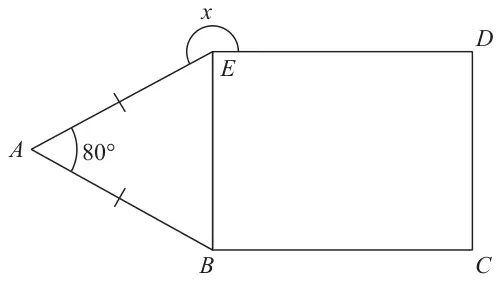
15

Rectangle BCDE with isosceles triangle ABE attached on side BE; AB = AE marked; angle BAE is 80 degrees; reflex angle x marked at E outside the shape

Diagram NOT accurately drawn

\(BCDE\) is a rectangle.
\(ABE\) is an isosceles triangle.

\(AB = AE\)
Angle \(BAE\) = 80°

Work out the size of angle \(x\).

(3)

Higher June 2018 Paper 2 Q12

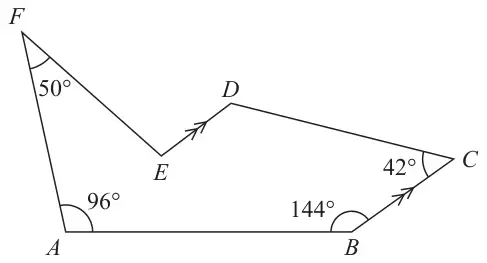
12

Hexagon ABCDEF with angle FAB = 96 degrees, angle ABC = 144 degrees, angle BCD = 42 degrees, angle EFA = 50 degrees; E is a reflex vertex pointing into the hexagon; BC and ED are marked with arrows as parallel

Diagram NOT accurately drawn

The diagram shows a hexagon \(ABCDEF\).
\(BC\) is parallel to \(ED\).

Work out the size of the obtuse angle \(DEF\).

(5)

Foundation June 2018 Paper 2 Q12

EdexcelFoundationCurrent spec5 marks2D Area & PerimeterAngles (Including Parallel Lines)

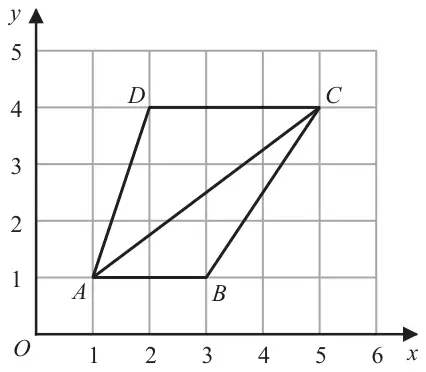
12 The diagram shows a quadrilateral \(ABCD\) on a centimetre grid.

Centimetre grid with x from 0 to 6 and y from 0 to 5; A at (1, 1), B at (3, 1), C at (5, 4), D at (2, 4); quadrilateral ABCD with diagonal AC drawn
(a) Work out the area of triangle \(ABC\).
You must include the units with your answer. (3)
(b) Give a reason why angle \(ACD\) is equal to angle \(CAB\). (1)
(c) Write down an equation for the straight line that passes through \(D\) and \(C\). (1)

Foundation June 2018 Paper 1 Q8

EdexcelFoundationCurrent spec5 marksAngles (Including Parallel Lines)Angles in Polygons

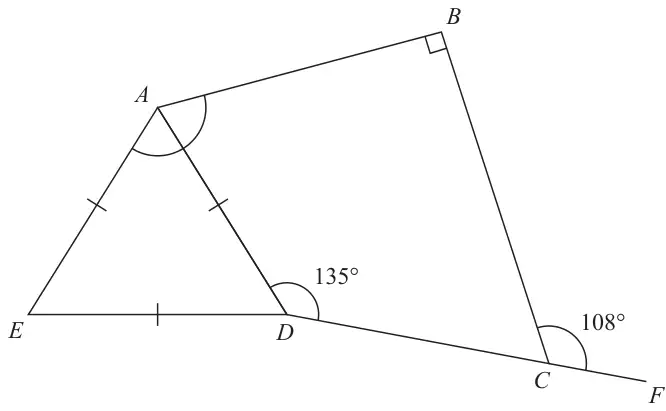
8

Quadrilateral ABCD with a right angle at B; equilateral triangle ADE with equal sides marked; DCF is a straight line; angle ADC is 135 degrees and angle BCF is 108 degrees; angle EAB is marked

Diagram NOT accurately drawn

\(ABCD\) is a quadrilateral.
\(ADE\) is an equilateral triangle.
\(DCF\) is a straight line.

Work out the size of angle \(EAB\).
Give a reason for each stage of your working.

(5)

Higher June 2018 Paper 1R Q6

EdexcelHigherCurrent spec3 marksAngles (Including Parallel Lines)

6

Parallel lines ABC and DEF marked with arrows; G is joined to B and to E; BG and BE are marked equal; angle DEG is 38 degrees and angle GEB is 65 degrees; angle ABG is marked

Diagram NOT accurately drawn

\(ABC\) and \(DEF\) are parallel lines.

\(BG = BE\)
Angle \(DEG = 38°\)
Angle \(GEB = 65°\)

Find the size of angle \(ABG\).

(3)

Foundation June 2018 Paper 1R Q4

4

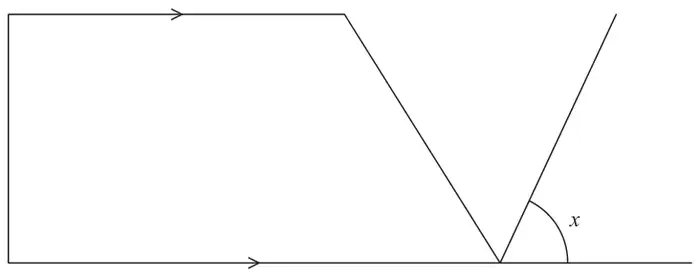
Diagram: a quadrilateral with two parallel horizontal sides marked with arrows and a vertical left side; from the bottom right corner a line rises to the right, making the marked angle x with the horizontal line
(a) On the diagram, mark a right angle with the letter \(R\). (1)

There is a quadrilateral in the diagram.

(b) Write down the mathematical name of this quadrilateral. (1)
(c) Measure the size of angle \(x\). (1)

4MA0 Higher January 2018 Paper 4R Q19

19 The four angles, in degrees, of quadrilateral \(ABCD\) are

angle \(A = (x^2 - 105)\)
angle \(B = (x^2 - 65)\)
angle \(C = (470 - 30x)\)
angle \(D = (510 - 30x)\)

Show that \(ABCD\) is a trapezium.
Show clear algebraic working.

(6)

4MA0 Foundation January 2018 Paper 1R Q15

EdexcelFoundationOld spec4 marksAngles (Including Parallel Lines)

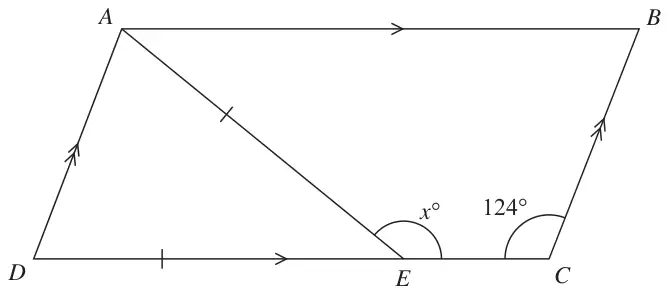
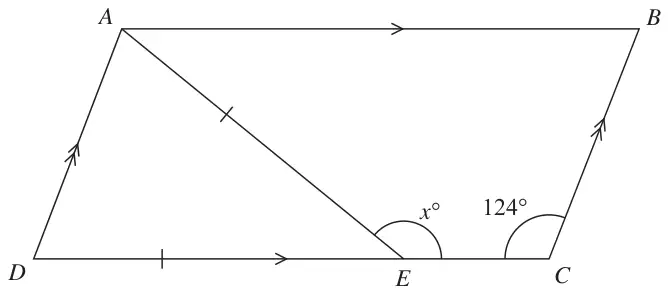
15 \(ABCD\) is a parallelogram.

Parallelogram ABCD with E on DC joined to A; AE = DE, angle AEC = x degrees and angle DCB = 124 degrees

Diagram NOT accurately drawn

Angle \(DCB = 124^\circ\)
\(E\) is the point on \(DC\) such that \(AE = DE\).
Angle \(AEC = x^\circ\)

Work out the value of \(x\).

(4)

4MA0 Foundation January 2018 Paper 1R Q12

EdexcelFoundationOld spec3 marksAngles (Including Parallel Lines)

12

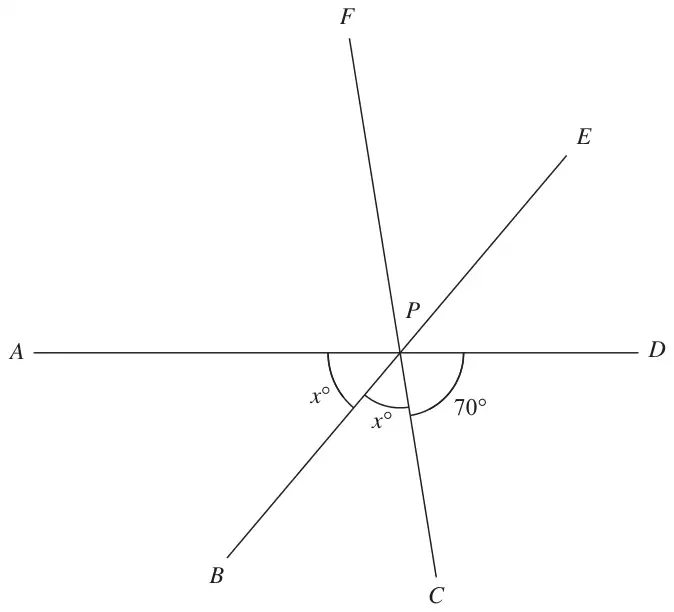
Straight lines APD, BPE and CPF meeting at P, with angle CPD = 70° and angles APB and BPC marked x°

Diagram NOT accurately drawn

\(APD\), \(BPE\) and \(CPF\) are straight lines.
Angle \(CPD = 70^\circ\)
Angle \(APB\) = angle \(BPC = x^\circ\)

(a) Find the size of angle \(FPA\). (1)
(b) Work out the value of \(x\). (2)

4MA0 Foundation January 2018 Paper 1 Q11

EdexcelFoundationOld spec5 marksAngles (Including Parallel Lines)

11

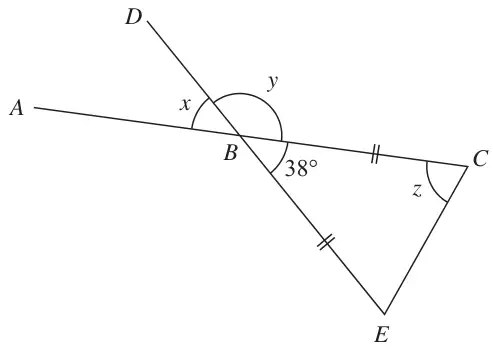
Straight lines ABC and DBE crossing at B, with angles x, y and 38° at B, triangle BCE with BC = BE and angle z at C

Diagram NOT accurately drawn

\(ABC\) and \(DBE\) are straight lines.

(a) Find the size of angle \(x\). (1)
(b)
(i) Work out the size of angle \(y\).
(ii) Give a reason for your answer.
(2)

\(BC = BE\)

(c) Work out the size of angle \(z\). (2)

4MA0 Foundation January 2018 Paper 1 Q4

EdexcelFoundationOld spec3 marksAngles (Including Parallel Lines)

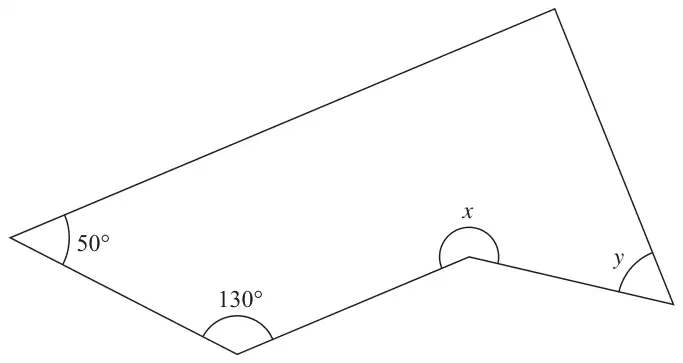
4 Here is a shape.

Quadrilateral-shaped figure with angles 50° and 130°, a reflex angle x and an angle y
(a) What type of angle is the angle marked \(x\)? (1)
(b) Measure the size of the angle marked \(y\). (1)
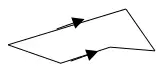
(c) On the diagram, mark with arrows (>>) the pair of parallel lines. (1)

4MA0 Foundation January 2018 Paper 1R Q2

EdexcelFoundationOld spec4 marksAngles (Including Parallel Lines)

2

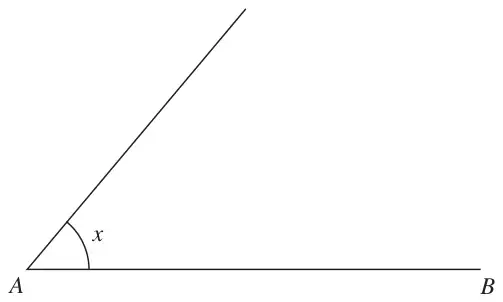
Line AB with a second line from A making angle x
(a) Measure the length of the line \(AB\).
State the units of your answer. (2)
(b)
(i) What type of angle is the angle marked \(x\)?
(ii) Measure the size of the angle marked \(x\).
(2)

4MA0 Higher January 2018 Paper 3R Q2

EdexcelHigherOld spec4 marksAngles (Including Parallel Lines)

2 \(ABCD\) is a parallelogram.

Parallelogram ABCD with E on DC joined to A; AE = DE, angle AEC = x degrees and angle DCB = 124 degrees

Diagram NOT accurately drawn

Angle \(DCB = 124^\circ\)
\(E\) is the point on \(DC\) such that \(AE = DE\).
Angle \(AEC = x^\circ\)

Work out the value of \(x\).

(4)

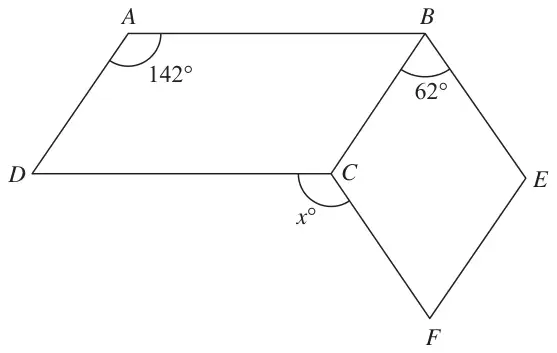
4MA0 Foundation June 2017 Paper 1R Q18

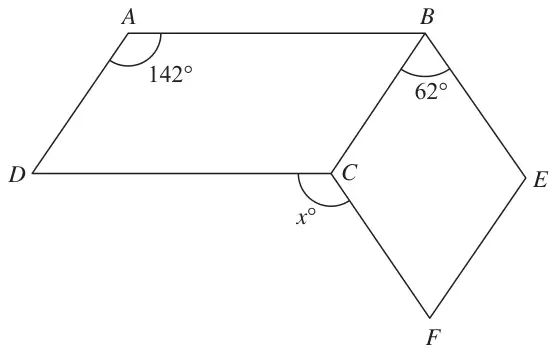
18

Parallelogram ABCD with angle DAB = 142 degrees, joined along BC to rhombus BEFC with angle CBE = 62 degrees; angle x is marked at C between D and F

Diagram NOT accurately drawn

\(ABCD\) is a parallelogram.
\(BEFC\) is a rhombus.

Angle \(DAB = 142^\circ\)
Angle \(CBE = 62^\circ\)

Calculate the value of \(x\).

(3)

4MA0 Foundation June 2017 Paper 1R Q12

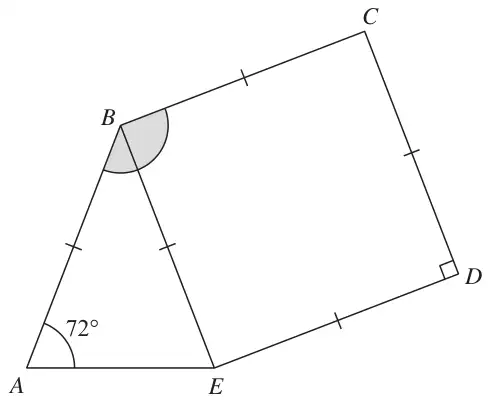
12 \(ABE\) is an isosceles triangle and \(BCDE\) is a square.

Isosceles triangle ABE with AB = BE and angle BAE = 72 degrees, joined along BE to square BCDE; angle ABC is shaded

Diagram NOT accurately drawn

Angle \(BAE = 72^\circ\)

Work out the size of angle \(ABC\).

(3)

4MA0 Foundation June 2017 Paper 1 Q9

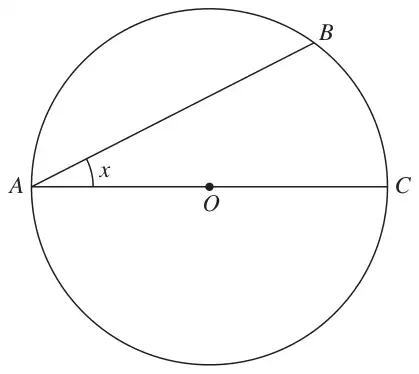
9 \(A\), \(B\) and \(C\) are points on a circle, centre \(O\).

Circle centre O with diameter AC and chord AB; angle x at A between AB and AC
(a)
(i) Write down the mathematical name for the line \(OC\).
(ii) Measure the size of the angle marked \(x\).
(2)

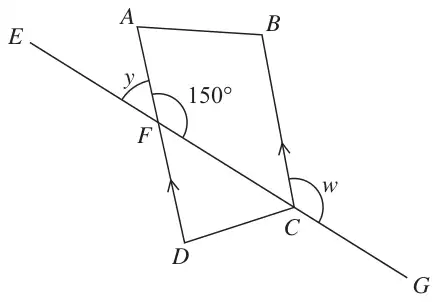
In the diagram, \(ABCD\) is a quadrilateral.

Quadrilateral ABCD with DA parallel to CB; line EFCG crosses AD at F, with angle 150° at F and angles y and w marked

Diagram NOT accurately drawn

\(DA\) and \(CB\) are parallel lines.
\(AFD\) and \(EFCG\) are straight lines.

(b)
(i) Find the size of angle \(y\).
(ii) Give a reason for your answer.
(2)
(c)
(i) Find the size of angle \(w\).
(ii) Give a reason for your answer.
(2)

4MA0 Foundation June 2017 Paper 1R Q5

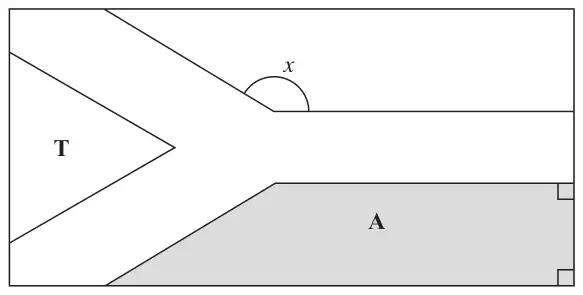
5 The diagram shows the design for a flag.

Rectangular flag with a triangle T on the left, a Y-shaped band with an angle x marked, and a shaded quadrilateral A at the bottom right with two right angles
(a) What type of angle is marked \(x\)? (1)

Triangle T is an equilateral triangle.

(b) What is the size of each angle in an equilateral triangle? (1)
(c) Write down the mathematical name for the shaded quadrilateral A. (1)

4MA0 Higher June 2017 Paper 3R Q3

3

Parallelogram ABCD with angle DAB = 142 degrees, and rhombus BEFC on side BC with angle CBE = 62 degrees; angle x is marked at C between CD and CF

Diagram NOT accurately drawn

\(ABCD\) is a parallelogram.
\(BEFC\) is a rhombus.

Angle \(DAB = 142^\circ\)
Angle \(CBE = 62^\circ\)

Calculate the value of \(x\).

(3)

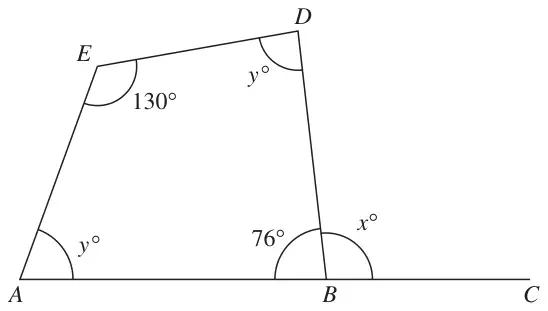
4MA0 Foundation January 2017 Paper 1R Q11

11

Quadrilateral ABDE with A and B on the straight line ABC; angle AED = 130 degrees, angles EAB and EDB are both y degrees, angle ABD = 76 degrees and angle DBC = x degrees

Diagram NOT accurately drawn

\(ABC\) is a straight line.
\(ABDE\) is a quadrilateral.

(a)
(i) Work out the value of \(x\).
(ii) Give a reason for your answer.
(2)
(b) Work out the value of \(y\). (3)

Each exterior angle of a regular polygon is 18°

(c) Work out the number of sides of this regular polygon. (2)

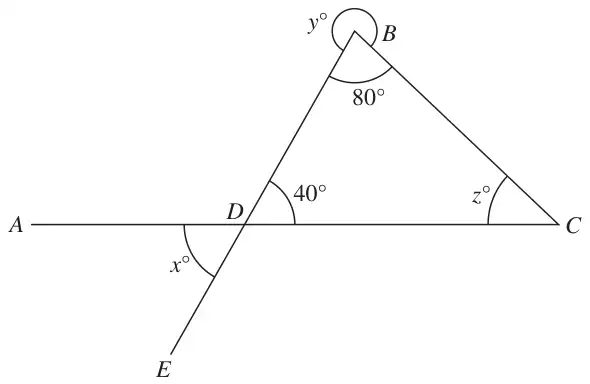
4MA0 Foundation January 2017 Paper 2R Q9

EdexcelFoundationOld spec4 marksAngles (Including Parallel Lines)

9

Straight line ADC and straight line BDE crossing at D; triangle BDC with angle DBC = 80 degrees, angle BDC = 40 degrees and angle z at C; reflex angle y at B; angle x at D between A and E

Diagram NOT accurately drawn

\(ADC\) is a straight line.
\(BDE\) is a straight line.

Angle \(DBC = 80^\circ\)
Angle \(BDC = 40^\circ\)

(a) Write down the value of \(x\). (1)
(b) Work out the value of \(y\). (1)
(c) Work out the value of \(z\). (2)

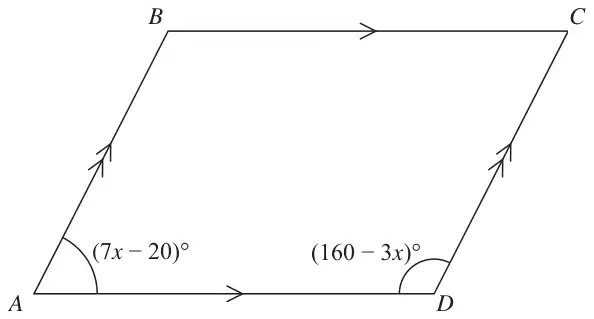
4MA0 Higher January 2017 Paper 4R Q8

8 The diagram shows a parallelogram \(ABCD\).

Parallelogram ABCD with angle at A marked (7x − 20)° and angle at D marked (160 − 3x)°

Diagram NOT accurately drawn

Angle \(BAD = (7x - 20)°\)
Angle \(ADC = (160 - 3x)°\)

Work out the value of \(x\).
Show clear algebraic working.

(3)

4MA0 Foundation January 2017 Paper 1 Q7

EdexcelFoundationOld spec4 marksAngles (Including Parallel Lines)

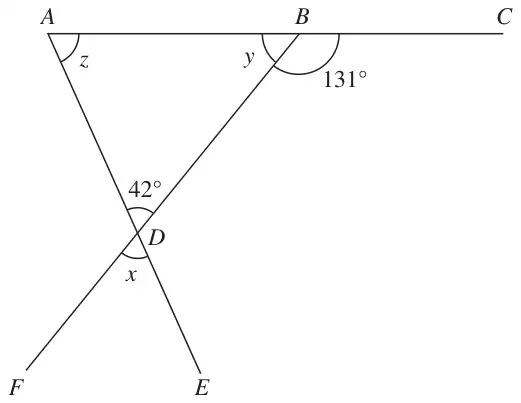
7

Straight line ABC at the top; lines BDF and ADE cross at D; angle z at A, angle y at B inside triangle ABD, angle CBD = 131 degrees, angle ADB = 42 degrees and angle x at D opposite it

Diagram NOT accurately drawn

\(ABC\), \(BDF\) and \(ADE\) are straight lines.

(a) Write down the size of angle \(x\). (1)
(b) Work out the size of angle \(y\). (1)
(c)
(i) Work out the size of angle \(z\).
(ii) Give a reason for your answer.
(2)

4MA0 Foundation January 2017 Paper 2 Q2

EdexcelFoundationOld spec3 marksAngles (Including Parallel Lines)

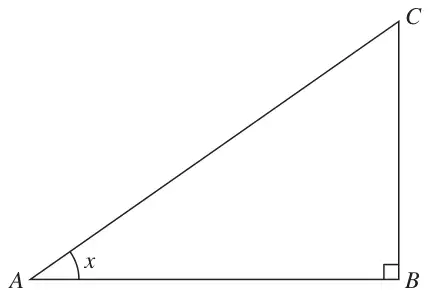
2 The diagram shows triangle \(ABC\).

Right-angled triangle ABC with the right angle at B; angle x is marked at A
(a) Measure the length of \(AB\). (1)
(b) Measure the size of the angle marked \(x\). (1)

The angle at \(B\) is 90°

(c) What is the mathematical name for an angle of 90°? (1)

4MA0 Foundation June 2016 Paper 2 Q16

16

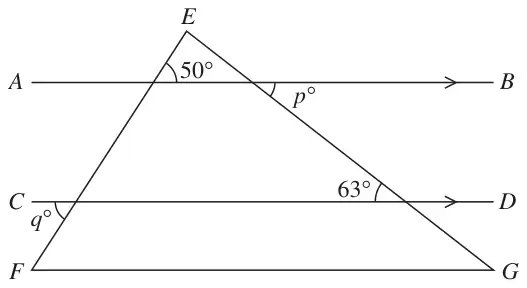
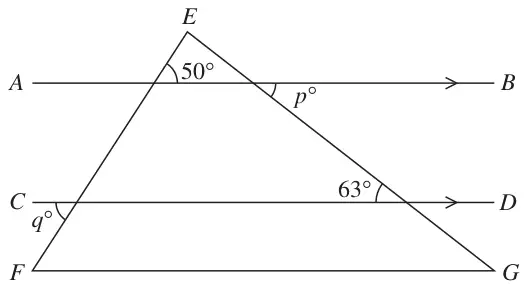
Triangle EFG crossed by parallel lines AB and CD; angle 50° at E, p° where EG meets AB, 63° where EG meets CD, q° where EF meets CD

Diagram NOT accurately drawn

EFG is a triangle.
AB is parallel to CD.

(a) Write down the value of \(p\) (1)
(b) Write down the value of \(q\) (1)

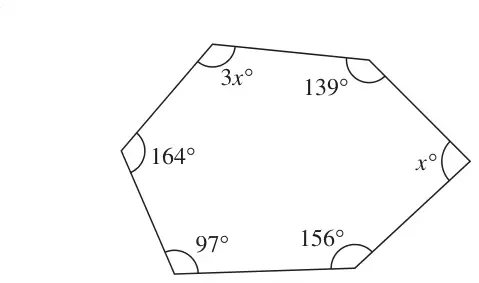
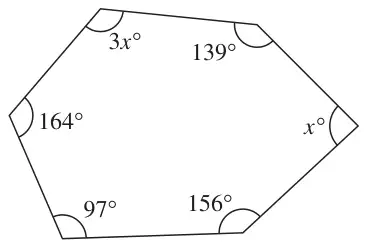
Here is a hexagon.

Hexagon with interior angles 3x°, 139°, x°, 156°, 97° and 164°

Diagram NOT accurately drawn

(c) Work out the value of \(x\) (3)

4MA0 Foundation June 2016 Paper 2R Q10

EdexcelFoundationOld spec3 marksAngles (Including Parallel Lines)

10

Equilateral triangle ABC; ABD and ACE are straight lines; angle EBD is a right angle; angle x at E

Diagram NOT accurately drawn

ABC is an equilateral triangle.
ABD and ACE are straight lines.
Angle EBD = 90°

Work out the size of angle \(x\).

(3)

4MA0 Foundation June 2016 Paper 1R Q9

EdexcelFoundationOld spec5 marksAngles (Including Parallel Lines)

9

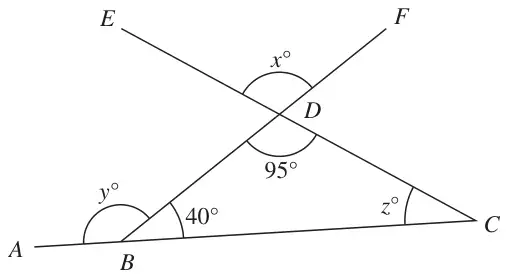
Lines ABC, CDE and BDF; angle x° at D above, 95° at D below, angle 40° and y° at B, angle z° at C

Diagram NOT accurately drawn

ABC, CDE and BDF are straight lines.

(a) Write down the value of \(x\). (1)
(b)
(i) Find the value of \(y\).
(ii) Give a reason for your answer.
(2)
(c) Find the value of \(z\). (2)

4MA0 Higher June 2016 Paper 4R Q4

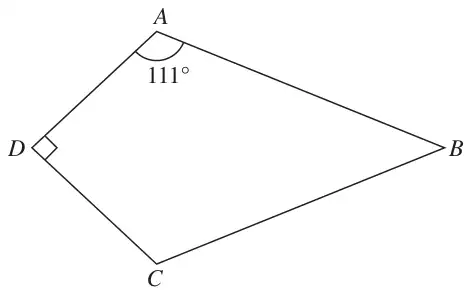
4 Here is a kite \(ABCD\).

Kite ABCD with angle DAB = 111° and right angle at D

Diagram NOT accurately drawn

Angle \(DAB\) = 111°
Angle \(ADC\) = 90°

(a) Work out the size of angle \(ABC\). (2)

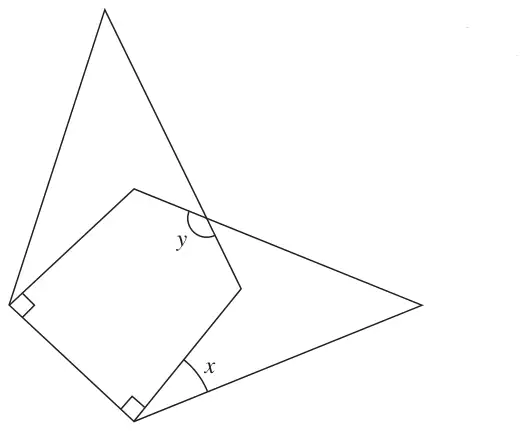
Two of these kites are arranged so that a shorter side of one of the kites is placed on top of a shorter side of the other kite, as shown in the diagram below.

Two of the kites placed with a shorter side of one on a shorter side of the other, with angles x and y marked

Diagram NOT accurately drawn

(b) Work out the size of angle \(x\). (2)
(c) Work out the size of angle \(y\). (3)

4MA0 Higher June 2016 Paper 4 Q4

4

Triangle EFG crossed by parallel lines AB and CD, with angle 50° at E, angle p° and 63° at the line through E and G, and angle q° at C

Diagram NOT accurately drawn

\(EFG\) is a triangle.
\(AB\) is parallel to \(CD\).

(a) Write down the value of \(p\) (1)
(b) Write down the value of \(q\) (1)

Here is a hexagon.

Hexagon with interior angles 3x°, 139°, x°, 156°, 97° and 164°

Diagram NOT accurately drawn

(c) Work out the value of \(x\) (3)

4MA0 Foundation June 2016 Paper 2R Q3

EdexcelFoundationOld spec4 marksAngles (Including Parallel Lines)

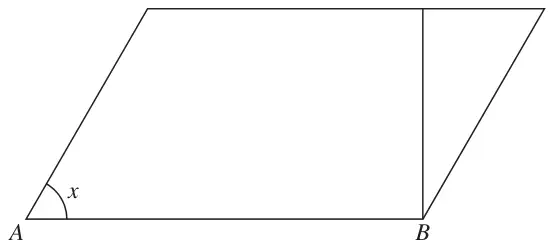
3

Parallelogram with base AB; angle x at A; a vertical line drawn up from B
(a) On the diagram, mark a right angle with the letter R. (1)
(b) Measure the size of the angle marked \(x\). (1)
(c) Measure the length of the line AB.
State the units of your answer. (2)

4MA0 Foundation June 2016 Paper 1 Q3

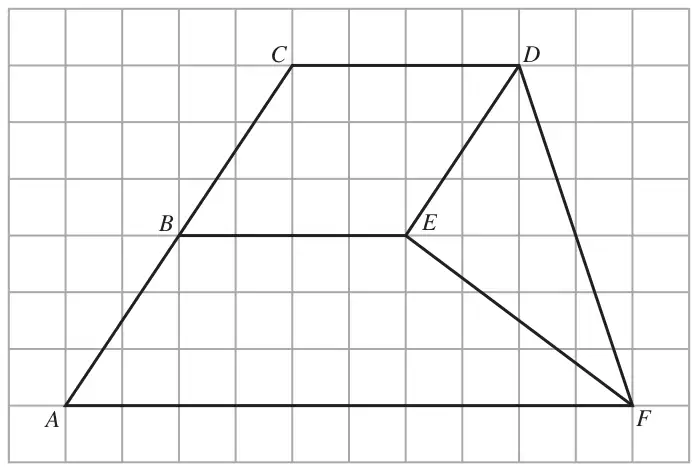
3 The diagram shows two quadrilaterals and a triangle on a square grid.

Square grid with points A, B, C, D, E, F joined to form quadrilaterals ABEF and BCDE and triangle DEF
(a) Measure the length of DF.
State the units of your answer. (2)
(b) On the diagram, mark with arrows (>) a pair of parallel lines. (1)
(c) Write down the mathematical name of quadrilateral ABEF. (1)
(d) On the diagram, mark an obtuse angle with the letter O. (1)

4MA0 Foundation January 2016 Paper 2R Q23

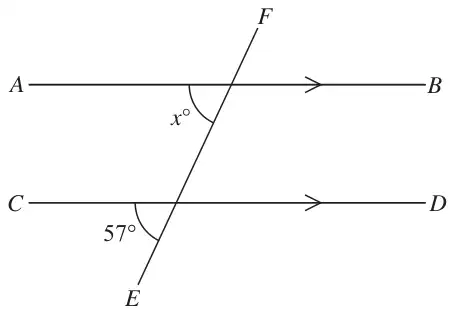
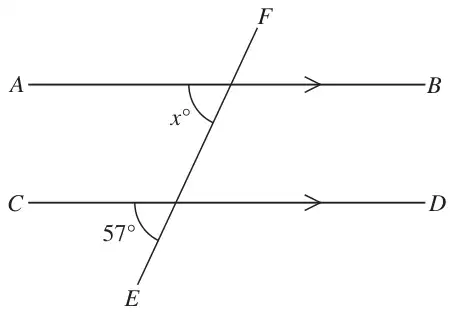
23

Parallel lines AB and CD crossed by the straight line EF; angle x° at AB and angle 57° at CD

Diagram NOT accurately drawn

\(AB\) is parallel to \(CD\)
\(EF\) is a straight line.

(a)
(i) Find the value of \(x\)
(ii) Give a reason for your answer.
(2)

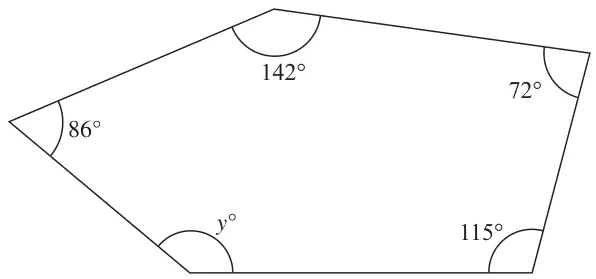
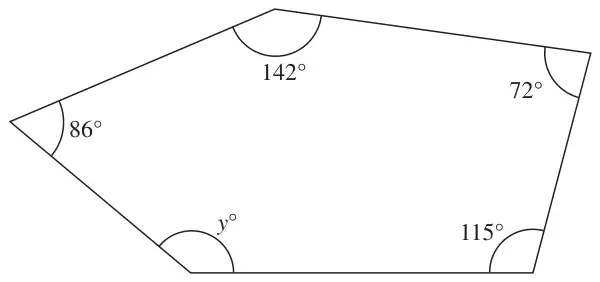
Here is a pentagon.

Pentagon with angles 86°, 142°, 72°, 115° and y°

Diagram NOT accurately drawn

(b) Work out the value of \(y\). (3)

4MA0 Foundation January 2016 Paper 2 Q14

EdexcelFoundationOld spec3 marksAngles (Including Parallel Lines)

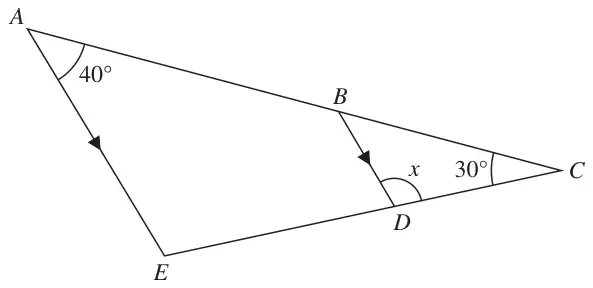
14

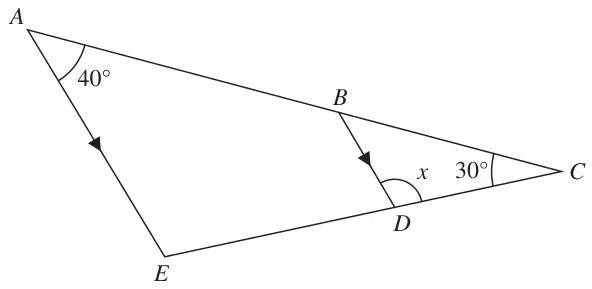
Triangle ACE with B on AC and D on EC; BD parallel to AE; angle EAC = 40°, angle ACE = 30°, angle x is angle BDC

Diagram NOT accurately drawn

ABC and EDC are straight lines.
AE is parallel to BD.
Angle EAC = 40°
Angle ACE = 30°

Work out the size of angle \(x\).
Give reasons for your answer.

(3)

4MA0 Foundation January 2016 Paper 1R Q10

EdexcelFoundationOld spec7 marksAngles (Including Parallel Lines)

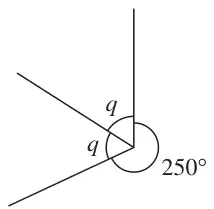
10

Three lines meeting at a point, making two angles q and an angle of 250°

Diagram NOT accurately drawn

(a) Work out the size of angle \(q\). (2)
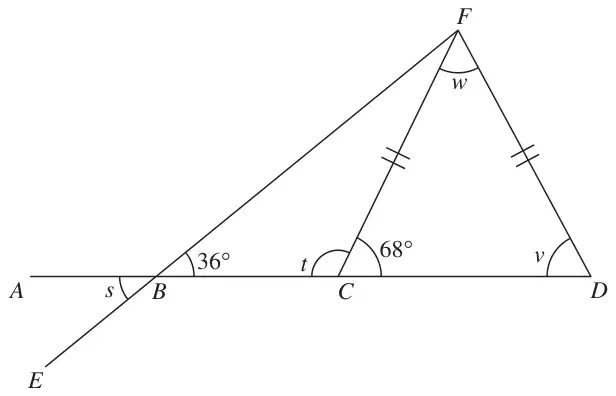
Triangle BFD with C on BD; ABCD and EBF are straight lines, angle FBC = 36°, angle FCD = 68°, FC = FD; angles s at B, t and 68° at C, v at D and w at F

Diagram NOT accurately drawn

\(ABCD\) and \(EBF\) are straight lines.
Angle \(FBC = 36^\circ\) and angle \(FCD = 68^\circ\)
\(FC = FD\)

(b) Write down the size of angle \(s\). (1)
(c) Work out the size of angle \(t\). (1)
(d) Explain why angle \(v = 68^\circ\) (1)
(e) Work out the size of angle \(w\). (2)

4MA0 Foundation January 2016 Paper 1 Q9

EdexcelFoundationOld spec6 marksAngles (Including Parallel Lines)

9

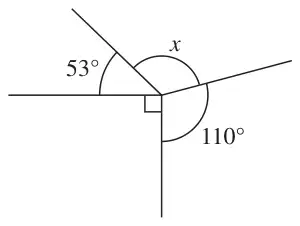
(a)
Angles at a point: 53°, x, 110° and a right angle

Diagram NOT accurately drawn

(i) Work out the size of angle \(x\).
(ii) Give a reason for your answer.
(3)
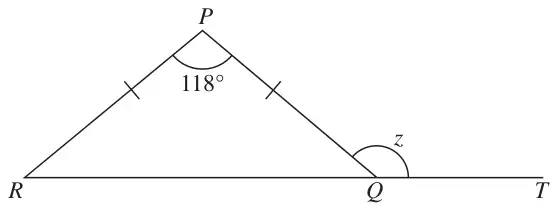
(b) PQR is an isosceles triangle.
PQ = PR
Angle RPQ = 118°
RQT is a straight line.
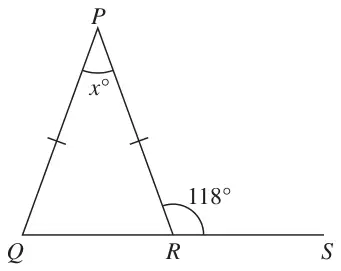
Isosceles triangle PQR with angle RPQ = 118°; RQ extended to T; angle z is angle PQT

Diagram NOT accurately drawn

Work out the size of angle \(z\).

(3)

4MA0 Higher January 2016 Paper 4 Q5

EdexcelHigherOld spec3 marksAngles (Including Parallel Lines)

5

Triangle ACE with B on AC and D on EC, BD parallel to AE, angle EAC = 40°, angle ACE = 30° and angle x at D

Diagram NOT accurately drawn

\(ABC\) and \(EDC\) are straight lines.
\(AE\) is parallel to \(BD\).

Angle \(EAC\) = 40°
Angle \(ACE\) = 30°

Work out the size of angle \(x\).
Give reasons for your answer.

(3)

4MA0 Foundation January 2016 Paper 2R Q4

EdexcelFoundationOld spec3 marksAngles (Including Parallel Lines)

4

Two line segments AB and BC meeting at B, with the angle x marked at B
(a) Measure the length of the line \(BC\).
Give your answer in millimetres. (1)
(b) Measure the size of angle \(x\). (1)
acuterightobtusereflex
(c) Choose the word from the box that best describes angle \(x\) in the diagram. (1)

4MA0 Higher January 2016 Paper 4R Q2

2

Parallel lines AB and CD crossed by the straight line EF; angle x at the upper line and 57 degrees at the lower line

Diagram NOT accurately drawn

\(AB\) is parallel to \(CD\)
\(EF\) is a straight line.

(a)
(i) Find the value of \(x\)
(ii) Give a reason for your answer.
(2)

Here is a pentagon.

Pentagon with interior angles 142, 72, 115, y and 86 degrees

Diagram NOT accurately drawn

(b) Work out the value of \(y\). (3)

4MA0 Foundation January 2016 Paper 2 Q2

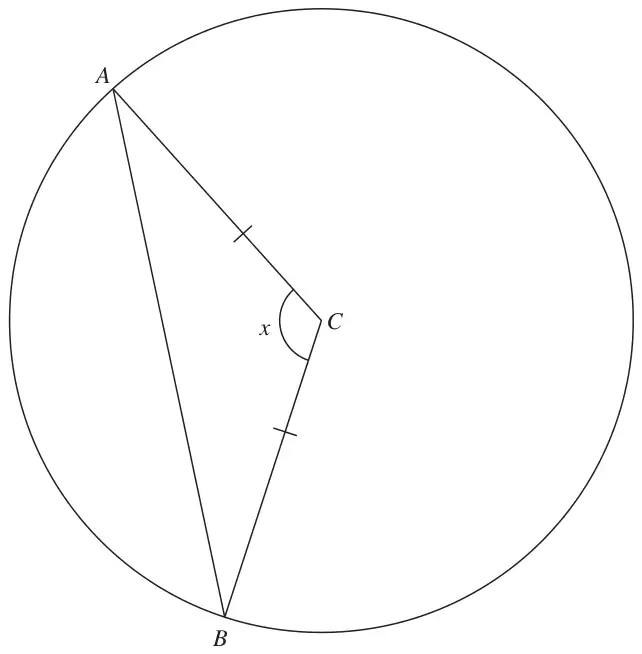
2

Circle centre C with radii CA and CB; angle x at C between them

A and B are points on a circle, centre C.
AC = BC.

(a)
(i) Measure the size of angle \(x\).
(ii) Write down the mathematical name for angle \(x\).
(2)
(b) Write down the mathematical name for triangle ABC. (1)

4MA0 Foundation June 2015 Paper 2 Q17

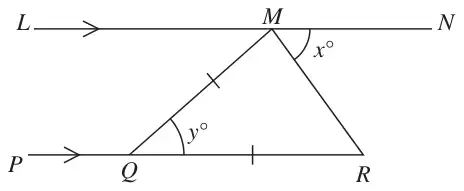
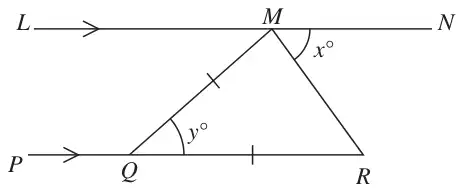
17

Parallel lines LMN and PQR; triangle MQR with QM = QR, angle RMN = x° and angle MQR = y°

Diagram NOT accurately drawn

\(LMN\) is parallel to \(PQR\).
\(QM = QR\).
Angle \(RMN = x^\circ\)
Angle \(MQR = y^\circ\)

(a) Write down an expression for \(y\) in terms of \(x\). (2)
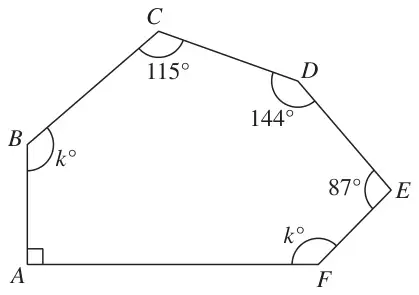
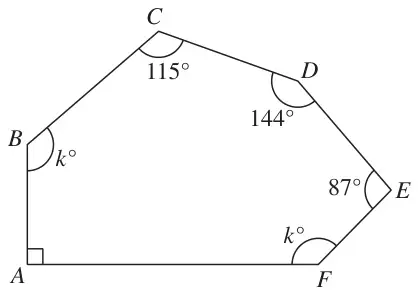
Hexagon ABCDEF with a right angle at A, angles 115° at C, 144° at D, 87° at E, and k° at B and at F

Diagram NOT accurately drawn

\(ABCDEF\) is a hexagon.

(b) Work out the value of \(k\). (4)

4MA0 Foundation June 2015 Paper 1 Q10

EdexcelFoundationOld spec3 marksAngles (Including Parallel Lines)

10

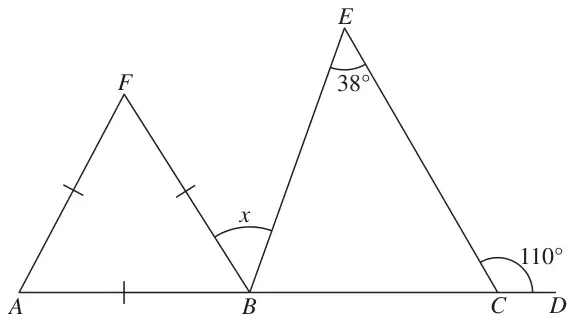
Equilateral triangle ABF and triangle BCE on the straight line ABCD; angle BEC = 38°, angle ECD = 110°, angle x between BF and BE

Diagram NOT accurately drawn

\(ABCD\) is a straight line.
Triangle \(ABF\) is equilateral.
Angle \(ECD = 110^\circ\)
Angle \(BEC = 38^\circ\)

Work out the size of angle \(x\).

(3)

4MA0 Foundation June 2015 Paper 1R Q9

EdexcelFoundationOld spec5 marksAngles (Including Parallel Lines)

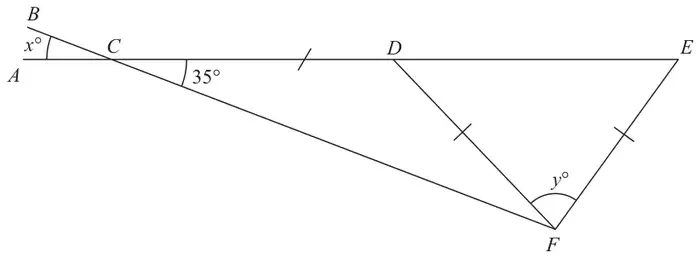
9 \(CDF\) and \(DEF\) are isosceles triangles.
\(CD = DF = EF\).
\(ACDE\) and \(BCF\) are straight lines.

Straight lines ACDE and BCF crossing at C; angle x° between CA and CB, angle 35° between CD and CF; triangles CDF and DEF with CD = DF = EF; angle y° at F in triangle DEF

Diagram NOT accurately drawn

(a)
(i) Find the value of \(x\).
(ii) Give a reason for your answer.
(2)
(b) Calculate the value of \(y\). (3)

4MA0 Higher June 2015 Paper 4 Q6

6

Parallel lines LMN and PQR; triangle MQR with QM = QR; angle x at M and angle y at Q

Diagram NOT accurately drawn

\(LMN\) is parallel to \(PQR\).
\(QM = QR\).
Angle \(RMN = x^\circ\)
Angle \(MQR = y^\circ\)

(a) Write down an expression for \(y\) in terms of \(x\). (2)
Hexagon ABCDEF with a right angle at A, angles 115 at C, 144 at D, 87 at E and k at B and at F

Diagram NOT accurately drawn

\(ABCDEF\) is a hexagon.

(b) Work out the value of \(k\). (4)

4MA0 Foundation January 2015 Paper 2R Q19

EdexcelFoundationOld spec4 marksAngles (Including Parallel Lines)

19

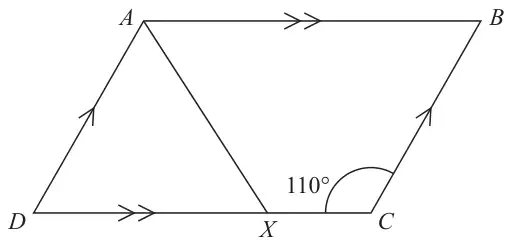
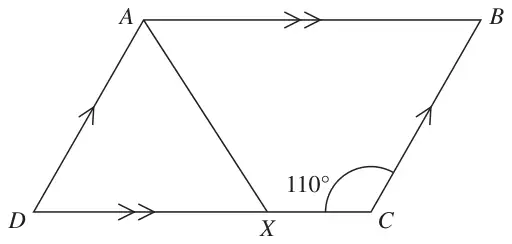
Parallelogram ABCD with X on DC; line AX drawn; angle DCB = 110°

Diagram NOT accurately drawn

\(ABCD\) is a parallelogram.
Angle \(DCB = 110^\circ\)
\(X\) is the point on \(DC\) such that \(AX\) bisects the angle \(DAB\).

Calculate the size of angle \(AXC\).

(4)

4MA0 Foundation January 2015 Paper 1 Q12

EdexcelFoundationOld spec5 marksAngles (Including Parallel Lines)

12

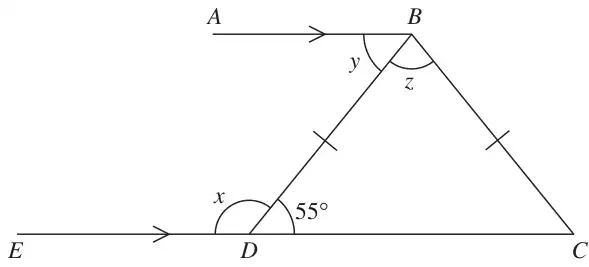
AB parallel to EDC; triangle BDC with BD = BC; angle x at D on the E side, angle BDC = 55°, angle y between BA and BD, angle z = DBC

Diagram NOT accurately drawn

\(AB\) and \(EDC\) are parallel lines.
\(BD = BC\)
Angle \(BDC = 55^\circ\)

(a)
(i) Work out the size of angle \(x\).
(ii) Give a reason for your answer.
(2)
(b) Find the size of angle \(y\). (1)
(c) Work out the size of angle \(z\). (2)

4MA0 Foundation January 2015 Paper 2 Q6

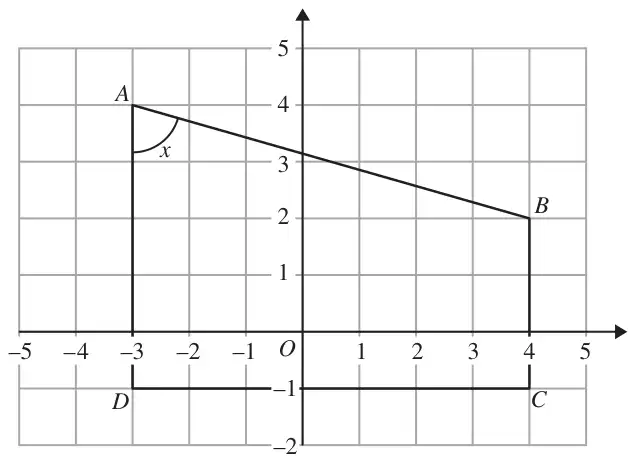
6 The diagram shows a quadrilateral \(ABCD\) on a grid.

Grid with x from -5 to 5 and y from -2 to 5; quadrilateral with A(-3, 4), B(4, 2), C(4, -1), D(-3, -1); angle x marked at A
(a) Write down the coordinates of the point
(i) \(B\)
(ii) \(D\)
(2)
(b) Write down the mathematical name for the quadrilateral \(ABCD\). (1)
(c)
(i) Write down the mathematical name for the angle marked \(x\).
(ii) Measure the size of the angle marked \(x\).
(2)

4MA0 Foundation January 2015 Paper 2R Q3

EdexcelFoundationOld spec3 marksAngles (Including Parallel Lines)

3 Here is a shape.

Quadrilateral with a right angle at the bottom left and an angle x marked at the bottom right
(a)
(i) What type of angle is the angle marked \(x\)?
(ii) Write down the size of the angle marked \(x\).
(2)
(b) On the shape, mark the right angle.
Label your angle R. (1)

4MA0 Higher January 2015 Paper 4R Q3

EdexcelHigherOld spec4 marksAngles (Including Parallel Lines)

3

Parallelogram ABCD with AB parallel to DC; X on DC with line AX drawn; angle DCB = 110°

Diagram NOT accurately drawn

ABCD is a parallelogram.
Angle \(DCB = 110^\circ\)
X is the point on DC such that AX bisects the angle DAB.

Calculate the size of angle AXC.

(4)

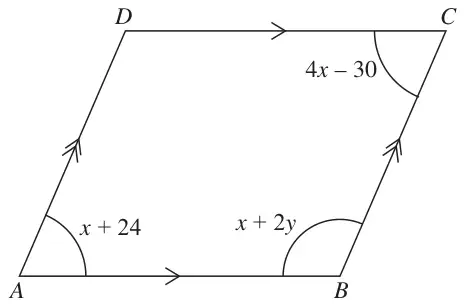
4MA0 Foundation June 2014 Paper 2R Q23

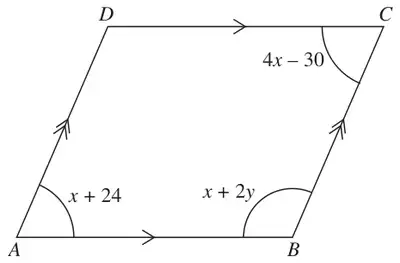
23 The diagram shows a parallelogram \(ABCD\).
In the diagram, all the angles are in degrees.

Parallelogram ABCD with angle A = x + 24, angle B = x + 2y and angle C = 4x - 30

Diagram NOT accurately drawn

(a) Work out the value of \(x\) and the value of \(y\). (4)
(b) Find the size of angle \(BAD\). (1)

4MA0 Foundation June 2014 Paper 2R Q13

EdexcelFoundationOld spec5 marksAngles (Including Parallel Lines)

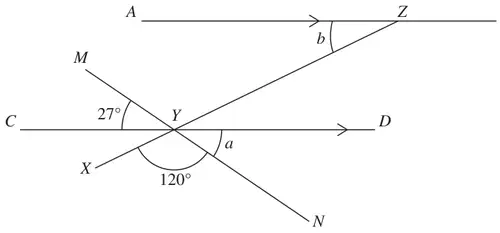
13 In the diagram, the straight line \(AZB\) is parallel to the straight line \(CYD\).
\(XYZ\) and \(MYN\) are straight lines.

Parallel lines AZB and CYD crossed by lines XYZ and MYN; angle 27 degrees, angle 120 degrees, angles a and b marked

Diagram NOT accurately drawn

(a) Write down the mathematical name of an angle with size \(120^\circ\) (1)
(b)
(i) Write down the size of the angle marked \(a\).
(ii) Give a reason for your answer.
(2)
(c) Work out the size of the angle marked \(b\). (2)

4MA0 Foundation June 2014 Paper 1 Q10

EdexcelFoundationOld spec4 marksAngles (Including Parallel Lines)

10

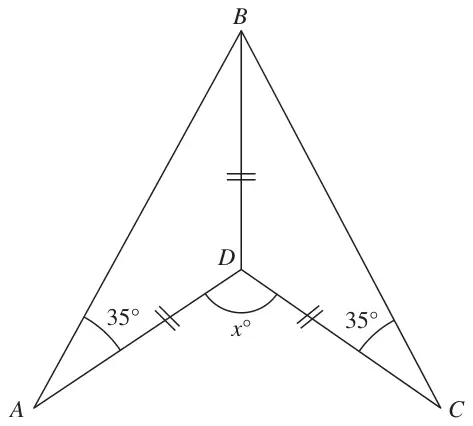
Quadrilateral ABCD made of two isosceles triangles ABD and CBD with DA = DB = DC; angles BAD and BCD are 35°; angle ADC = x° marked

Diagram NOT accurately drawn

The diagram shows a quadrilateral \(ABCD\).
The quadrilateral \(ABCD\) is made from two identical isosceles triangles, \(ABD\) and \(CBD\).
\(DA = DB = DC\).
Angle \(BAD\) = Angle \(BCD = 35^\circ\)
Angle \(ADC = x^\circ\)

Work out the value of \(x\).

(4)

4MA0 Foundation June 2014 Paper 1R Q10

EdexcelFoundationOld spec5 marksAngles (Including Parallel Lines)

10

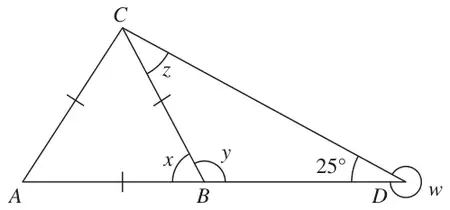
Triangle ABC with equal sides marked, ABD a straight line, angle BDC 25 degrees, angles w, x, y, z marked

Diagram NOT accurately drawn

In the diagram, \(ABD\) is a straight line.
\(AB = BC = CA\) and angle \(BDC = 25^\circ\)

(a) Work out the size of angle \(w\). (1)
(b) Write down the size of angle \(x\). (1)
(c) Work out the size of angle \(y\). (1)
(d) Work out the size of angle \(z\). (2)

4MA0 Higher June 2014 Paper 4R Q9

EdexcelHigherOld spec4 marksAngles (Including Parallel Lines)

9 The diagram shows a parallelogram \(ABCD\).
In the diagram, all the angles are in degrees.

Parallelogram ABCD with angle A = x + 24, angle B = x + 2y and angle C = 4x - 30

Diagram NOT accurately drawn

Work out the value of \(x\) and the value of \(y\).

(4)

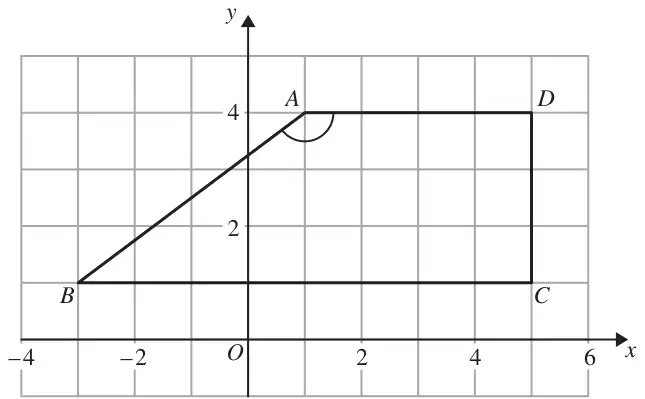
4MA0 Foundation June 2014 Paper 1 Q5

5 The diagram shows quadrilateral \(ABCD\) on a centimetre grid.

Grid with x from -4 to 6 and y from 0 to 4; quadrilateral with A(1, 4), D(5, 4), C(5, 1), B(-3, 1); angle BAD marked
(a) Write down the coordinates of the point \(A\). (1)
(b) Write down the coordinates of the point \(B\). (1)
(c) Write down the mathematical name for quadrilateral \(ABCD\). (1)
(d)
(i) Measure the size of angle \(BAD\).
(ii) Write down the mathematical name for this type of angle.
(2)
(e) Work out the area of quadrilateral \(ABCD\). (2)

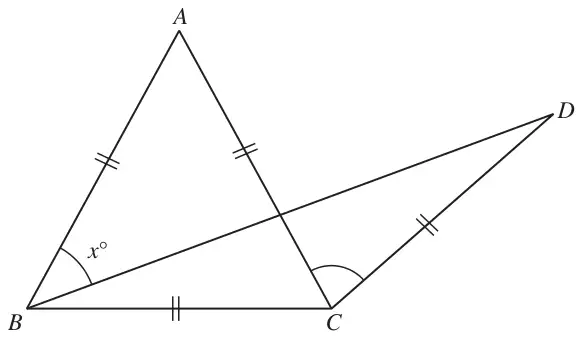
4MA0 Higher January 2014 Paper 4 Q12

EdexcelHigherOld spec4 marksAngles (Including Parallel Lines)

12

Equilateral triangle ABC and isosceles triangle BCD with CD = BC; angle ABD = x degrees; angle ACD marked

Diagram NOT accurately drawn

The diagram shows an equilateral triangle \(ABC\) and an isosceles triangle \(BCD\).
\(AB = AC = BC = CD\).
Angle \(ABD = x^\circ\)

Express the size of angle \(ACD\) in terms of \(x^\circ\), giving your answer as simply as possible.
Give a reason for each step in your working.

(4)

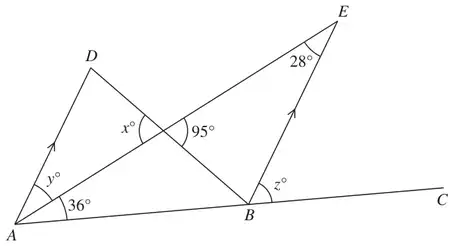
4MA0 Foundation January 2014 Paper 2R Q11

EdexcelFoundationOld spec5 marksAngles (Including Parallel Lines)

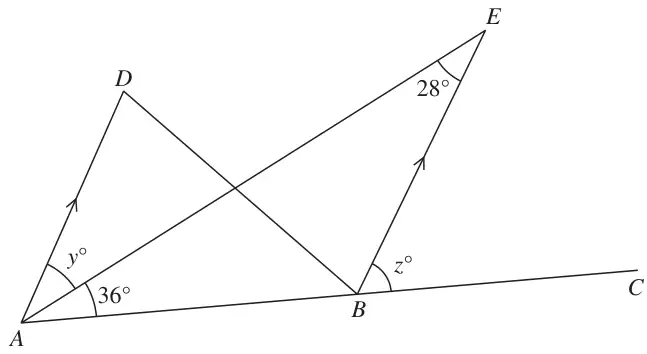
11

Triangles ADB and AEB with ABC a straight line and AD parallel to BE; angles 36, 95 and 28 degrees and x, y, z marked

Diagram NOT accurately drawn

\(ADB\) and \(AEB\) are triangles.
\(ABC\) is a straight line.
\(AD\) is parallel to \(BE\).

(a)
(i) Find the value of \(x\).
(ii) Give a reason for your answer.
(2)
(b) Find the value of \(y\). (1)
(c) Find the value of \(z\). (2)

4MA0 Foundation January 2014 Paper 1 Q9

9

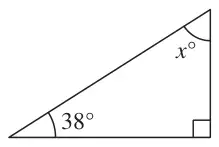
(a)
Right-angled triangle with angles 38 degrees and x degrees

Diagram NOT accurately drawn

The diagram shows a right-angled triangle.
Work out the value of \(x\). (2)
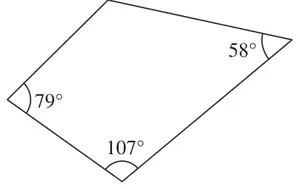
(b)
Quadrilateral with angles 79, 107 and 58 degrees marked

Diagram NOT accurately drawn

Three of the angles of a quadrilateral are \(79^\circ\), \(107^\circ\) and \(58^\circ\)
Work out the size of the fourth angle of the quadrilateral. (2)

4MA0 Higher January 2014 Paper 3 Q6

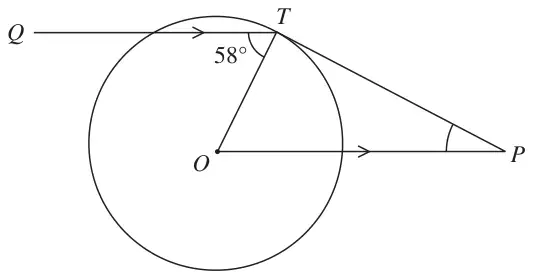
6

Circle centre O with T on the circle; QT parallel to OP; PT is a tangent at T; angle QTO = 58 degrees

Diagram NOT accurately drawn

\(T\) is a point on a circle, centre \(O\).
\(Q\) is a point such that angle \(QTO = 58^\circ\)
\(P\) is the point such that \(OP\) is parallel to \(QT\) and \(PT\) is a tangent to the circle.

Work out the size of angle \(OPT\).

(3)

4MA0 Higher January 2014 Paper 4R Q3

EdexcelHigherOld spec3 marksAngles (Including Parallel Lines)

3

Triangles ADB and AEB with ABC a straight line and AD parallel to BE; angle EAB = 36 degrees, angle AEB = 28 degrees, angle y at A and angle z at B

Diagram NOT accurately drawn

\(ADB\) and \(AEB\) are triangles.
\(ABC\) is a straight line.
\(AD\) is parallel to \(BE\).

(a) Find the value of \(y\). (1)
(b) Find the value of \(z\). (2)

4MA0 Foundation June 2013 Paper 2R Q19

19

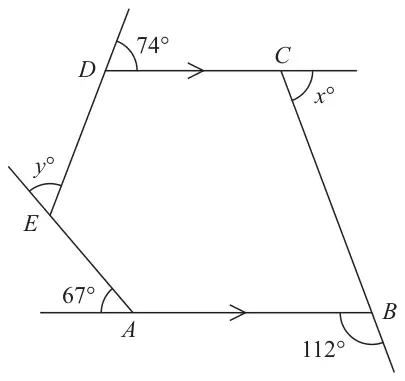
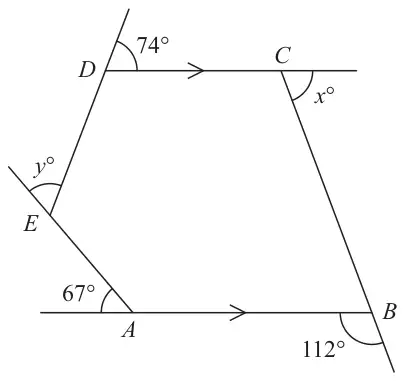
Pentagon ABCDE with DC parallel to AB and exterior angles 67° at A, 112° at B, x° at C, 74° at D and y° at E

Diagram NOT accurately drawn

The diagram shows a pentagon \(ABCDE\).
\(DC\) is parallel to \(AB\).

The size of an exterior angle at \(A\) is \(67^\circ\)
The size of an exterior angle at \(B\) is \(112^\circ\)
The size of an exterior angle at \(C\) is \(x^\circ\)
The size of an exterior angle at \(D\) is \(74^\circ\)
The size of an exterior angle at \(E\) is \(y^\circ\)

(a)
(i) Work out the value of \(x\).
(ii) Work out the value of \(y\).
(4)
(b) Work out the sum of the interior angles of the pentagon \(ABCDE\). (2)

4MA0 Foundation June 2013 Paper 1 Q16

16

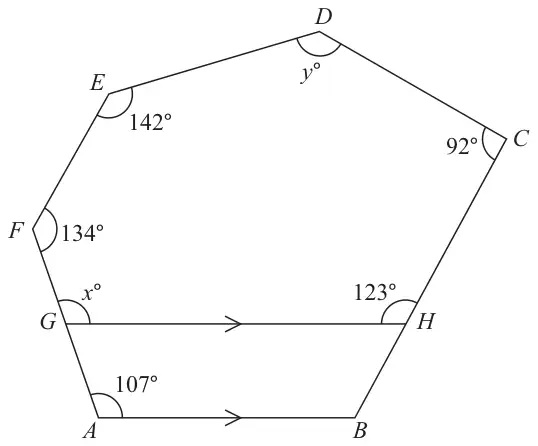
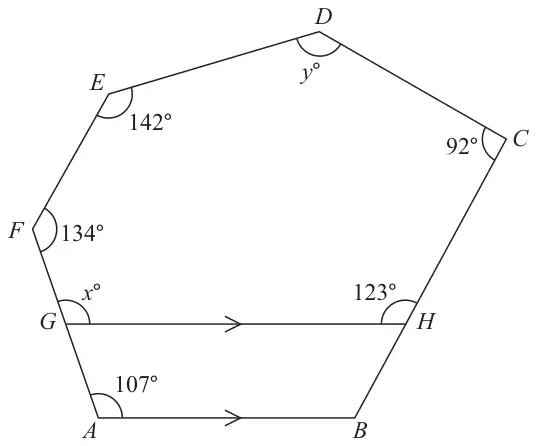
Hexagon ABCDEF with angles A 107°, C 92°, E 142°, F 134°, D y°, line GH parallel to AB with angle FGH x° and angle GHC 123°

Diagram NOT accurately drawn

\(ABCDEF\) is a hexagon.
\(G\) is a point on \(AF\).
\(H\) is a point on \(BC\).
\(GH\) is parallel to \(AB\).

(a) Give a reason why \(x = 107\) (1)
(b) Work out the value of \(y\). (4)

4MA0 Foundation June 2013 Paper 1 Q11

EdexcelFoundationOld spec4 marksAngles (Including Parallel Lines)

11

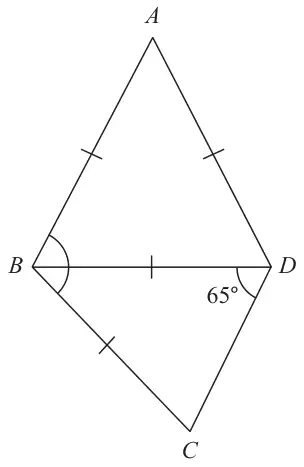
Triangle ABD with equal sides marked, and triangle BCD below BD with BC = BD and angle BDC = 65°

Diagram NOT accurately drawn

In triangle \(ABD\), \(AB = AD = BD\).
In triangle \(BCD\), angle \(BDC = 65^\circ\) and \(BC = BD\).

Work out the size of angle \(ABC\).

(4)

4MA0 Foundation June 2013 Paper 2 Q9

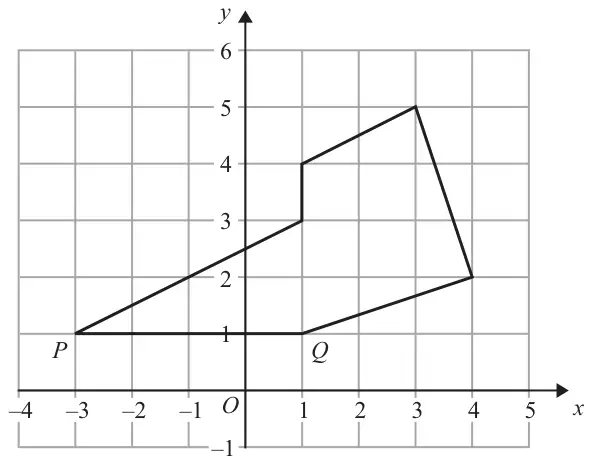
9 The diagram shows a shape drawn on a centimetre grid.

Shape with vertices P(-3, 1), Q(1, 1), (4, 2), (3, 5), (1, 4), (1, 3) on a centimetre grid
(a) On the shape, mark with crosses (×) a pair of perpendicular lines. (1)
(b) On the shape, mark an obtuse angle.
Label your angle A. (1)
(c) Write down the coordinates of the point \(P\). (1)
(d) Write down the equation of the line \(PQ\). (1)
(e) Find the area of the shape.
Give the units of your area. (3)

4MA0 Higher June 2013 Paper 4R Q6

6

Pentagon ABCDE with DC parallel to AB; exterior angles 67° at A, 112° at B, x° at C, 74° at D and y° at E

Diagram NOT accurately drawn

The diagram shows a pentagon \(ABCDE\).
\(DC\) is parallel to \(AB\).

The size of an exterior angle at \(A\) is 67°
The size of an exterior angle at \(B\) is 112°
The size of an exterior angle at \(C\) is \(x\)°
The size of an exterior angle at \(D\) is 74°
The size of an exterior angle at \(E\) is \(y\)°

(a)
(i) Work out the value of \(x\).
(ii) Work out the value of \(y\).
(4)
(b) Work out the sum of the interior angles of the pentagon \(ABCDE\). (2)

4MA0 Higher June 2013 Paper 3 Q4

4

Hexagon ABCDEF with angles 142° at E, y° at D, 92° at C, 134° at F, 123° at H and 107° at A; G on AF and H on BC with GH parallel to AB; angle x° at G

Diagram NOT accurately drawn

\(ABCDEF\) is a hexagon.
\(G\) is a point on \(AF\).
\(H\) is a point on \(BC\).
\(GH\) is parallel to \(AB\).

(a) Give a reason why \(x = 107\) (1)
(b) Work out the value of \(y\). (4)

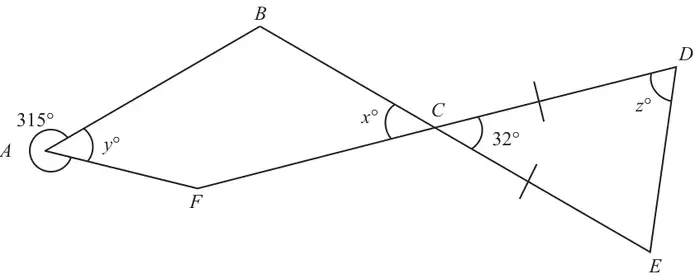
4MA0 Foundation January 2013 Paper 1 Q7

EdexcelFoundationOld spec6 marksAngles (Including Parallel Lines)

7

Quadrilateral ABCF with reflex angle 315° and angle y° at A, angle x° at C, lines BCE and FCD crossing at C with angle 32°, triangle CDE with angle z° at D

Diagram NOT accurately drawn

\(BCE\) and \(FCD\) are straight lines.
\(CD = CE\)

(a)
(i) Find the value of \(x\).
(ii) Give a reason for your answer.
(2)
(b)
(i) Work out the value of \(y\).
(ii) Give a reason for your answer.
(2)
(c) Work out the value of \(z\). (2)

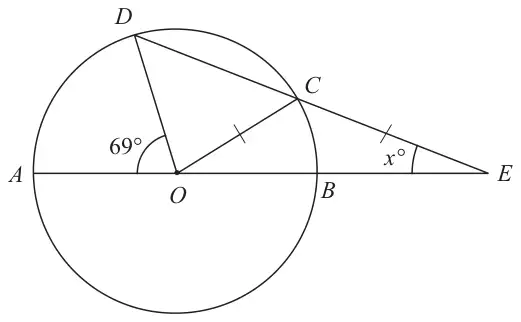
4MA0 Higher June 2012 Paper 3 Q18

18

Circle centre O with diameter AOB extended to E, D and C on the circle, DCE a straight line, angle AOD = 69 degrees, CO = CE and angle CEO = x degrees

Diagram NOT accurately drawn

\(A\), \(B\), \(C\) and \(D\) are points on a circle, centre \(O\).
\(AOBE\) and \(DCE\) are straight lines.
\(CO = CE\).
Angle \(AOD = 69^\circ\)
Angle \(CEO = x^\circ\)

Calculate the value of \(x\).
Show your working clearly.

(6)

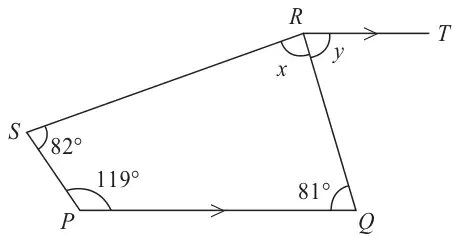
4MA0 Foundation June 2012 Paper 1 Q10

10

Quadrilateral PQRS with angle S 82°, angle P 119°, angle Q 81°; angle x at R inside the quadrilateral and angle y between RQ and the line RT, which is parallel to PQ

Diagram NOT accurately drawn

The diagram shows a quadrilateral \(PQRS\) and a straight line \(RT\).
\(PQ\) is parallel to \(RT\).

(a) Work out the size of angle \(x\). (2)
(b)
(i) Find the size of angle \(y\).
(ii) Give a reason for your answer.
(2)

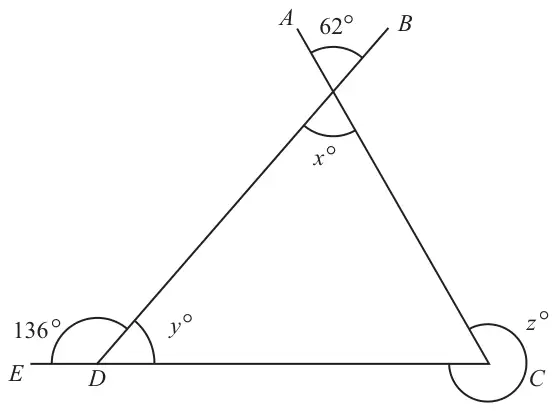
4MA0 Foundation June 2012 Paper 2 Q10

10 \(AC\), \(BD\) and \(EDC\) are straight lines.

Triangle with lines AC and BD crossing near the top; angle 62° between A and B, x° below the crossing; at D on EDC the angle EDB is 136° and y° is inside the triangle; z° is the reflex angle at C

Diagram NOT accurately drawn

(a)
(i) Find the value of \(x\).
(ii) Give a reason for your answer.
(2)
(b) Find the value of \(y\). (1)
(c) Find the value of \(z\). (2)

4MA0 Foundation June 2012 Paper 1 Q3

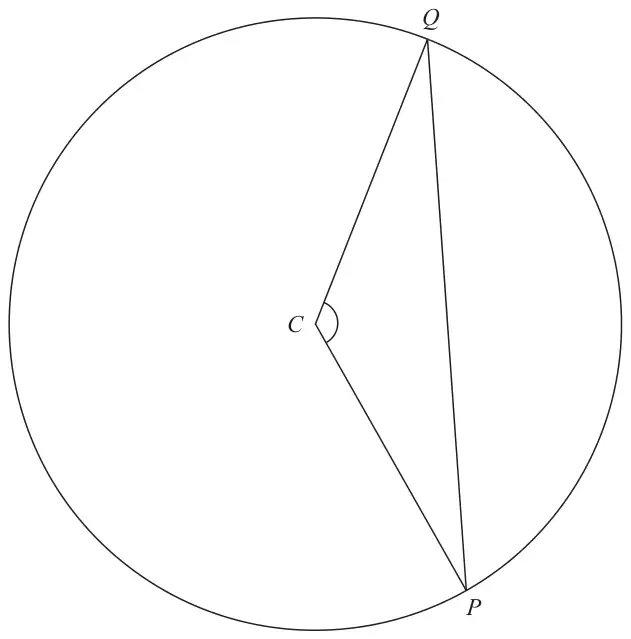
3

Circle with centre C; points P and Q on the circle joined to C and to each other to form triangle CPQ

\(P\) and \(Q\) are points on a circle, centre \(C\).

(a) Write down the mathematical name for the line \(CP\). (1)
(b) Measure the length of the line \(CP\). (1)
(c)
(i) Measure the size of angle \(C\).
(ii) Write down the mathematical name for this type of angle.
(2)
(d) On the diagram, draw the line of symmetry of triangle \(CPQ\). (1)
(e) Write down the mathematical name for triangle \(CPQ\). (1)

4MA0 Foundation January 2012 Paper 2 Q12

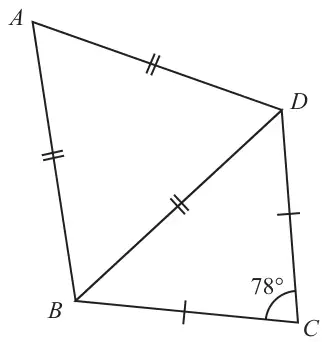
12

Quadrilateral ABCD with diagonal BD; AB, BD and AD marked equal, CB and CD marked equal, angle BCD = 78°

Diagram NOT accurately drawn

The diagram shows a quadrilateral \(ABCD\).
\(AB = BD = AD\).
\(CB = CD\).
Angle \(BCD = 78^\circ\)

Work out the size of angle \(ABC\).

(4)

4MA0 Foundation January 2012 Paper 1 Q3

EdexcelFoundationOld spec4 marksAngles (Including Parallel Lines)

3

Three lines meeting at a point, with angles x and y marked

Diagram NOT accurately drawn

(a) Explain why the diagram is wrong for \(x = 135^\circ\) and \(y = 245^\circ\) (2)
(b) Write down the mathematical name for
(i) an angle of 135°
(ii) an angle of 245°
(2)

4MA0 Foundation June 2011 Paper 1 Q7

EdexcelFoundationOld spec5 marksAngles (Including Parallel Lines)

7

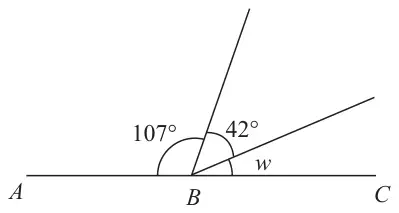
(a)
Straight line ABC with two lines from B making angles 107°, 42° and w

Diagram NOT accurately drawn

\(ABC\) is a straight line.

(i) Work out the size of angle \(w\).
(ii) Give a reason for your answer.
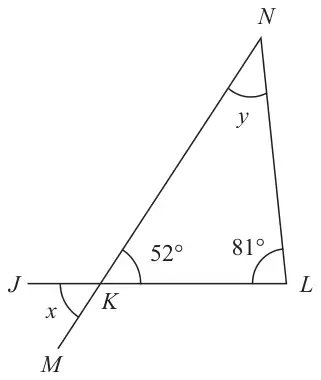
(2)
(b)
Triangle KLN with angle K = 52° and angle L = 81°, angle y at N; JKL and MKN are straight lines and angle x is between KJ and KM

Diagram NOT accurately drawn

\(JKL\) and \(MKN\) are straight lines.

(i) Find the size of angle \(x\).
(ii) Find the size of angle \(y\).
(3)

4400 Foundation November 2010 Paper 1 Q16

EdexcelFoundationOld spec4 marksAngles (Including Parallel Lines)

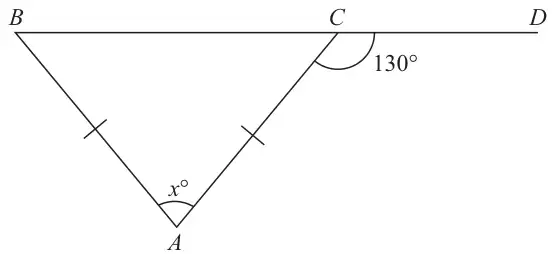
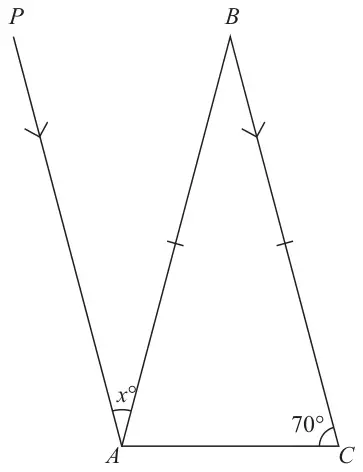
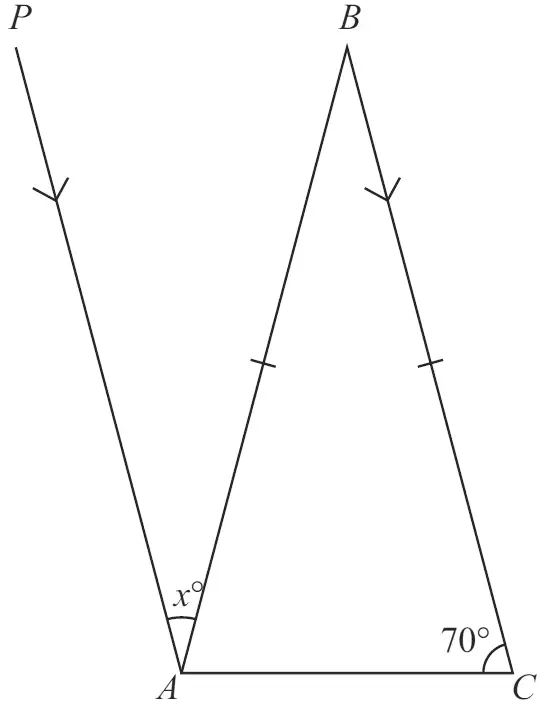
16. \(ABC\) is an isosceles triangle.
\(BA = BC\).
\(PA\) is parallel to \(BC\).
Angle \(ACB = 70^\circ\).

Isosceles triangle ABC with BA = BC and angle ACB = 70°; line PA parallel to BC; angle PAB marked x°

Diagram NOT accurately drawn

Find the value of \(x\).
Give a reason for each step in your working.

(4)

4400 Foundation November 2010 Paper 2 Q12

12.

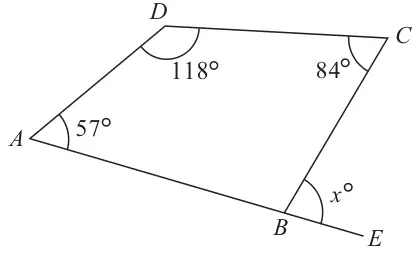
Quadrilateral ABCD with angle A = 57°, angle D = 118°, angle C = 84°; AB extended to E with angle CBE = x°

Diagram NOT accurately drawn

The diagram shows a quadrilateral \(ABCD\).
Angle \(BAD = 57^\circ\).
Angle \(ADC = 118^\circ\).
Angle \(BCD = 84^\circ\).
\(ABE\) is a straight line.
Angle \(CBE = x^\circ\).

Work out the value of \(x\).

(3)

4400 Foundation November 2010 Paper 1 Q3

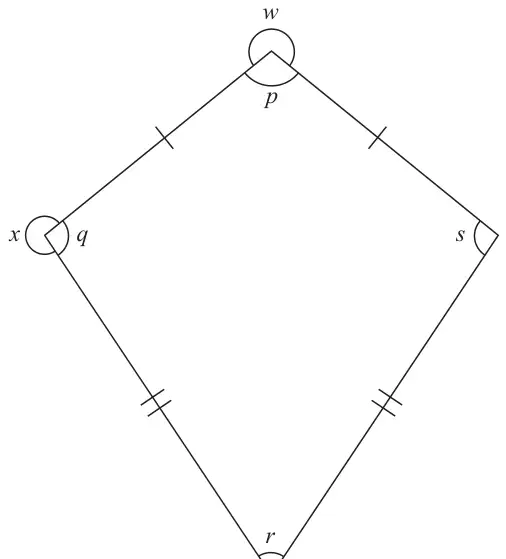
3. The diagram shows a quadrilateral with two pairs of equal sides.

Quadrilateral with two pairs of equal adjacent sides; angles marked w (outside, top), p (inside, top), x (outside, left), q (inside, left), s (right) and r (bottom)
(a) What is the mathematical name for this quadrilateral? (1)
(b) Write down a letter which marks
(i) an acute angle,
(ii) a reflex angle.
(2)

4400 Higher November 2010 Paper 3 Q3

EdexcelHigherOld spec4 marksAngles (Including Parallel Lines)

3

Isosceles triangle ABC with BA = BC; line PA parallel to BC; angle x between PA and AB at A; angle ACB = 70 degrees

Diagram NOT accurately drawn

\(ABC\) is an isosceles triangle.
\(BA = BC\).
\(PA\) is parallel to \(BC\).
Angle \(ACB = 70^\circ\).

Find the value of \(x\).
Give a reason for each step in your working.

(4)

4400 Foundation June 2010 Paper 1 Q13

EdexcelFoundationOld spec4 marksAngles (Including Parallel Lines)

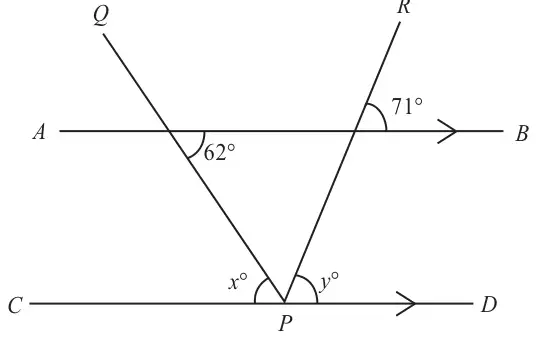
13.

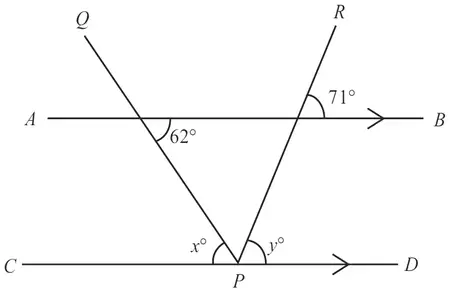
Parallel lines AB and CPD; lines PQ and PR from P cross AB; angle 62° between PQ and AB, angle 71° between PR and AB; angles x° and y° at P on line CD

Diagram NOT accurately drawn

\(AB\) and \(CPD\) are parallel straight lines.
\(PQ\) and \(PR\) are straight lines.

(a)
(i) Find the value of \(x\).
(ii) Give a reason for your answer.
(2)
(b)
(i) Find the value of \(y\).
(ii) Give a reason for your answer.
(2)

4400 Foundation June 2010 Paper 2 Q10

EdexcelFoundationOld spec5 marksAngles (Including Parallel Lines)

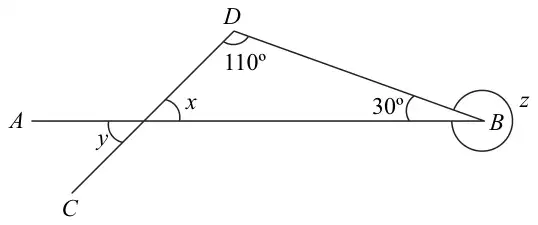
10. In the diagram, \(AB\), \(CD\) and \(DB\) are straight lines.

Line CD crosses line AB; triangle with D at the top, angle D = 110°, angle at B = 30°; angle x between CD and AB inside the triangle, angle y vertically below on the other side, and reflex angle z at B

Diagram NOT accurately drawn

Work out the size of

(a) angle \(x\), (2)
(b) angle \(y\), (1)
(c) angle \(z\). (2)

4400 Foundation June 2010 Paper 1 Q4

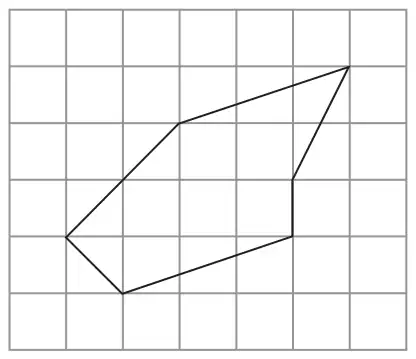
4. A polygon is shown on a grid of centimetre squares.

Six-sided polygon drawn on a centimetre-square grid
(a) On the polygon, mark with arrows (>) a pair of parallel lines. (1)
(b) On the polygon, mark with crosses (×) a pair of perpendicular lines. (1)
(c) Find the area of the polygon. (2)

4400 Higher June 2010 Paper 3 Q2

EdexcelHigherOld spec4 marksAngles (Including Parallel Lines)

2

Parallel lines AB and CPD; lines PQ and PR cross AB; angle 62 degrees between AB and PQ, angle 71 degrees between AB and PR; angles x and y at P on line CD

Diagram NOT accurately drawn

\(AB\) and \(CPD\) are parallel straight lines.
\(PQ\) and \(PR\) are straight lines.

(a)
(i) Find the value of \(x\).
(ii) Give a reason for your answer. (2)
(b)
(i) Find the value of \(y\).
(ii) Give a reason for your answer. (2)

4400 Foundation November 2009 Paper 2 Q15

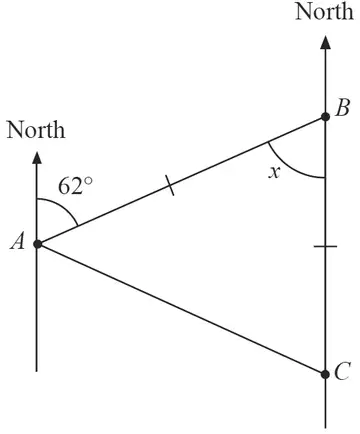
15

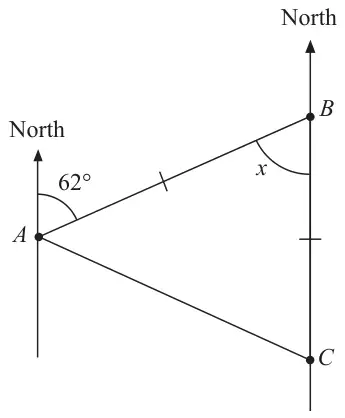
Points A, B and C with North lines at A and at B; angle 62° at A between North and AB; angle x at B between BA and the line BC; AB and CB marked equal

Diagram NOT accurately drawn

The bearing of \(B\) from \(A\) is 062°.
\(C\) is due south of \(B\).
\(AB = CB\).

(a)
(i) Find the size of angle \(x\).
(ii) Give a reason for your answer.
(2)
(b) Work out the bearing of \(C\) from \(A\). (2)

4400 Foundation November 2009 Paper 2 Q10

EdexcelFoundationOld spec3 marksAngles (Including Parallel Lines)

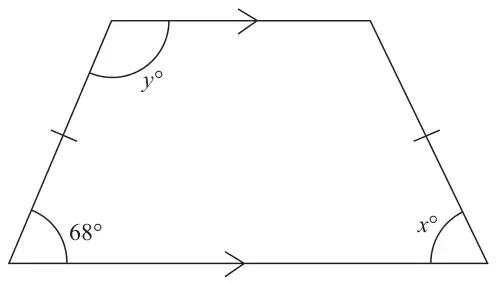
10 The diagram shows a trapezium with two equal sides.

Trapezium with parallel top and bottom sides and equal sloping sides; bottom left angle 68°, bottom right angle x°, top left angle y°

Diagram NOT accurately drawn

(a) Write down the value of \(x\). (1)
(b) Work out the value of \(y\). (2)

4400 Foundation November 2009 Paper 2 Q8

EdexcelFoundationOld spec5 marksAngles (Including Parallel Lines)

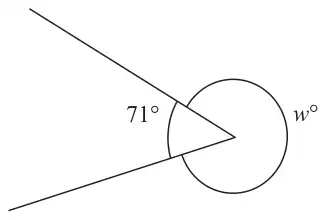
8

Two lines from a point making an angle of 71°; the reflex angle is w°

Diagram NOT accurately drawn

(a)
(i) Work out the value of \(w\).
(ii) Give a reason for your answer.
(2)
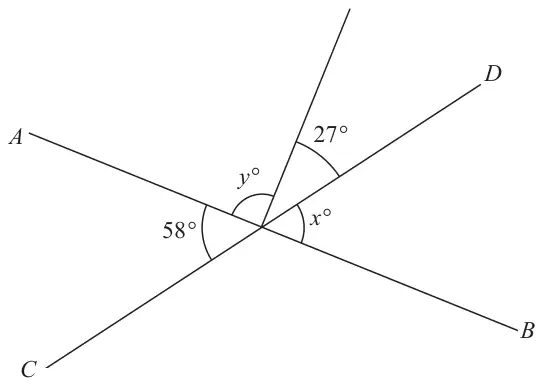
Straight lines AB and CD crossing, with a third line from the crossing point; angles 58°, y°, 27° and x° marked

Diagram NOT accurately drawn

\(AB\) and \(CD\) are straight lines.

(b) Give a reason why \(x = 58\) (1)
(c)
(i) Work out the value of \(y\).
(ii) Give a reason for your answer.
(2)

4400 Higher November 2009 Paper 4 Q3

3

A and B with North lines; angle 62 degrees at A between North and AB; angle x at B between BA and the North-South line through B; C due south of B; AB and CB marked equal

The bearing of \(B\) from \(A\) is 062°.
\(C\) is due south of \(B\).
\(AB = CB\).

(a)
(i) Find the size of angle \(x\).
(ii) Give a reason for your answer. (2)
(b) Work out the bearing of \(C\) from \(A\). (2)

4400 Foundation June 2009 Paper 1 Q11

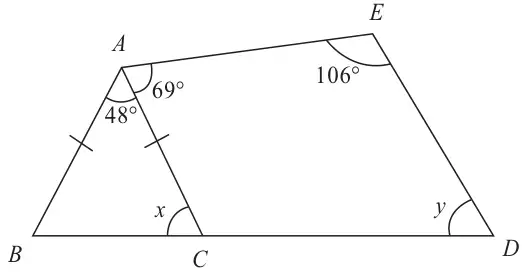
11

Triangle ABC with AB = AC and angle BAC = 48°, joined to quadrilateral ACDE; angle CAE = 69°, angle AED = 106°, angle x at C, angle y at D; BCD a straight line

Diagram NOT accurately drawn

\(BCD\) is a straight line.
\(AB = AC\)

(a) Work out the size of angle \(x\). (2)
(b) Work out the size of angle \(y\). (3)

4400 Foundation June 2009 Paper 2 Q2

2

(a) Write down the mathematical name for each of these quadrilaterals.
Three quadrilaterals: (i) a kite, (ii) a parallelogram, (iii) a trapezium
(3)
(b)
Triangle with an angle x marked at the left vertex and the reflex angle y marked at the top vertex
Write down the mathematical name for
(i) angle \(x\),
(ii) angle \(y\).
(2)

4400 Foundation November 2008 Paper 1 Q8

EdexcelFoundationOld spec5 marksAngles (Including Parallel Lines)

8

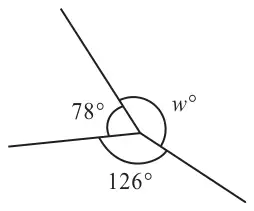
Three lines meeting at a point with angles 78°, 126° and w°

Diagram NOT accurately drawn

(a)
(i) Find the value of \(w\).
(ii) Give a reason for your answer.
(2)
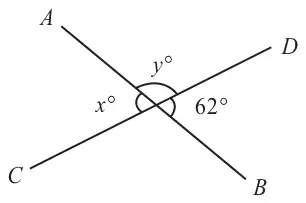
Straight lines AB and CD crossing, with angles x°, y° and 62° marked

Diagram NOT accurately drawn

\(AB\) and \(CD\) are straight lines.

(b) Find the value of \(x\). (1)
(c)
(i) Find the value of \(y\).
(ii) Give a reason for your answer.
(2)

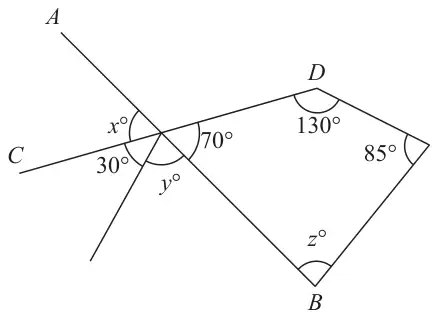
4400 Foundation June 2008 Paper 2 Q10

10 \(AB\) and \(CD\) are straight lines.

Straight lines AB and CD cross. Around the crossing point: angle x° between A and the line to D side, 30° between C and a third line going down, y° between that line and the line to B, 70° between the line to D and the line to B. Quadrilateral with D angle 130°, a vertex with 85°, and angle z° at B

Diagram NOT accurately drawn

Find the value of

(a) \(x\) (1)
(b) \(y\) (2)
(c) \(z\) (2)

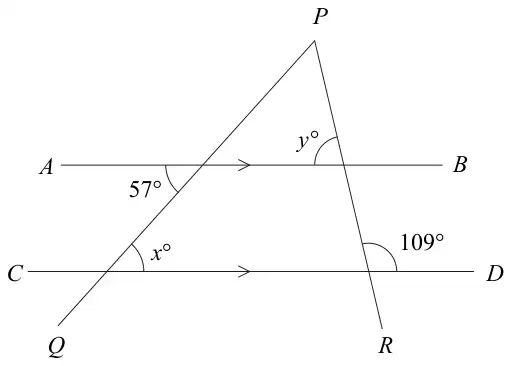
4400 Foundation November 2007 Paper 2 Q15

EdexcelFoundationOld spec4 marksAngles (Including Parallel Lines)

15

Parallel lines AB and CD crossed by lines PQ and PR from P; angle 57° between AB and PQ at their intersection, angle x° between PQ and CD, angle y° between PR and AB, angle 109° between PR and CD

Diagram NOT accurately drawn

\(AB\) and \(CD\) are parallel straight lines.
\(PQ\) and \(PR\) are straight lines.

(a)
(i) Find the value of \(x\).
(ii) Give a reason for your answer.
(2)
(b) Find the value of \(y\).
Give a reason for each step in your working. (2)

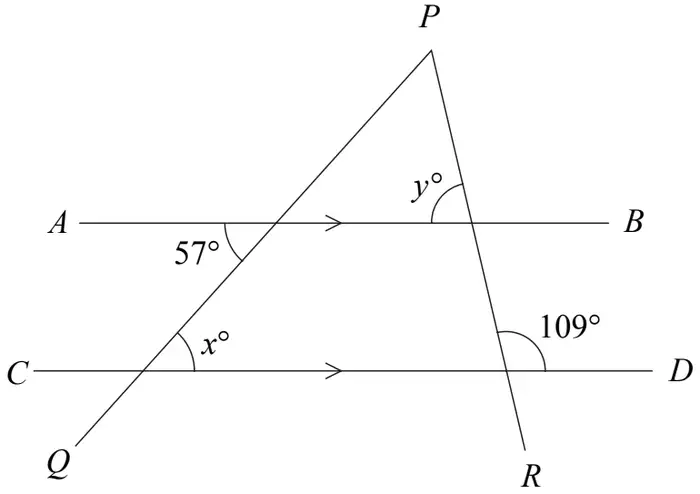
4400 Higher November 2007 Paper 4 Q6

EdexcelHigherOld spec4 marksAngles (Including Parallel Lines)

6

Parallel lines AB and CD crossed by straight lines PQ and PR meeting at P; 57 degrees between AB and PQ, x degrees between CD and PQ, y degrees at the crossing of AB and PR, 109 degrees between CD and PR

Diagram NOT accurately drawn

\(AB\) and \(CD\) are parallel straight lines.
\(PQ\) and \(PR\) are straight lines.

(a)
(i) Find the value of \(x\).
(ii) Give a reason for your answer. (2)
(b) Find the value of \(y\).
Give a reason for each step in your working. (2)

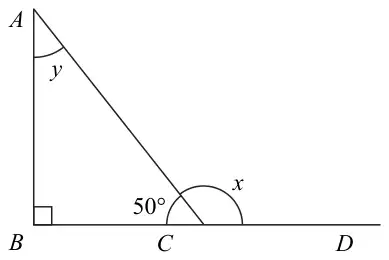
4400 Foundation June 2007 Paper 2 Q11

EdexcelFoundationOld spec3 marksAngles (Including Parallel Lines)

11

Right-angled triangle ABC with the right angle at B; BCD a straight line; angle ACB = 50°, angle ACD = x and angle BAC = y

Diagram NOT accurately drawn

In the diagram \(BCD\) is a straight line.

(a) Work out the size of angle \(x\). (1)
(b)
(i) Work out the size of angle \(y\).
(ii) Give a reason for your answer to part (b)(i).
(2)

4400 Foundation June 2007 Paper 1 Q2

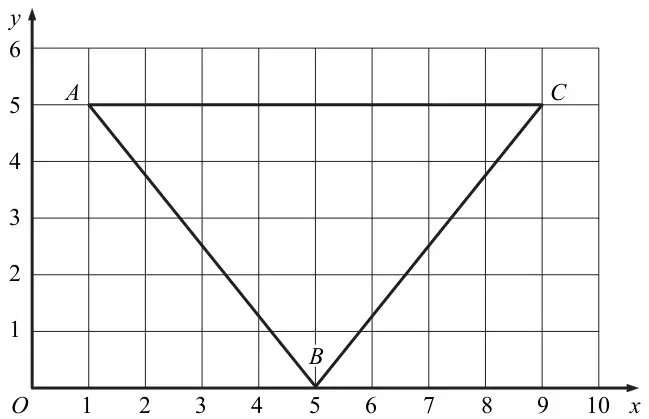
2 The diagram shows a triangle \(ABC\) on a centimetre grid.

Centimetre grid with x from 0 to 10 and y from 0 to 6 showing triangle ABC with A at (1, 5), B at (5, 0) and C at (9, 5)
(a) Write down the coordinates of the point
(i) \(A\),
(ii) \(B\).
(2)
(b) Measure the length of the line \(AB\).
Give your answer in millimetres. (1)
(c) Find the perimeter of triangle \(ABC\). (2)
(d) Write down the special name for triangle \(ABC\). (1)
(e)
(i) Measure the size of angle \(B\).
(ii) Write down the special name for this type of angle.
(2)

4400 Foundation November 2006 Paper 2 Q9

EdexcelFoundationOld spec4 marksAngles (Including Parallel Lines)

9

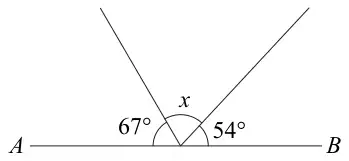
Straight line AB with two lines meeting it at one point; angles 67°, x and 54° on the line

Diagram NOT accurately drawn

\(AB\) is a straight line.

(a)
(i) Work out the size of angle \(x\).
(ii) Give a reason for your answer. (2)
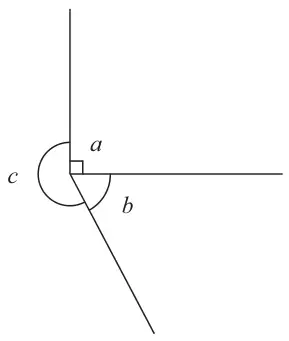
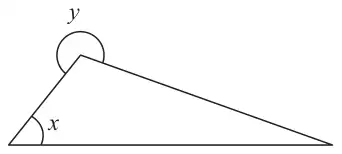
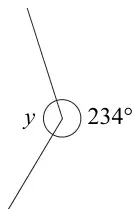
Two lines meeting at a point; the reflex angle 234° and the other angle y

Diagram NOT accurately drawn

(b)
(i) Work out the size of angle \(y\).
(ii) What type of angle is angle \(y\)? (2)

4400 Foundation June 2006 Paper 2 Q15

EdexcelFoundationOld spec4 marksAngles (Including Parallel Lines)

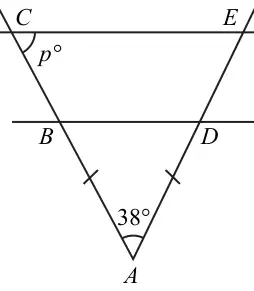
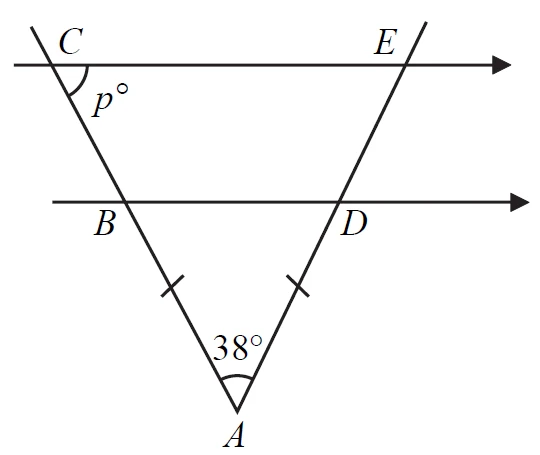
15 In the diagram, \(ABC\) and \(ADE\) are straight lines.
\(CE\) and \(BD\) are parallel.
\(AB = AD\).
Angle \(BAD = 38^\circ\).

Triangle ACE with B on AC and D on AE; BD parallel to CE; AB = AD; angle BAD = 38 degrees; angle p at C between CE and CA

Diagram NOT accurately drawn

Work out the value of \(p\).

Give a reason for each step in your working.

(4)

4400 Foundation June 2006 Paper 1 Q9

EdexcelFoundationOld spec6 marksAngles (Including Parallel Lines)

9

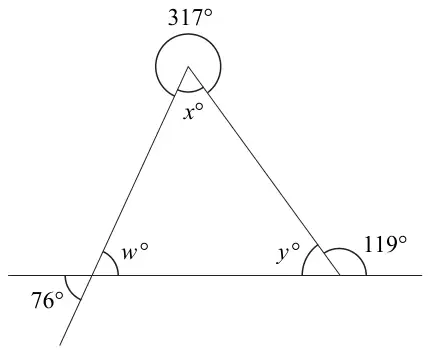
Triangle with a horizontal base line extended both ways and the left side extended below the line; angles 317° (reflex, at the top vertex), x° inside at the top, w° and y° inside at the base, 76° below the line at the left vertex and 119° outside at the right vertex

Diagram NOT accurately drawn

(a)
(i) Find the value of \(w\).
(ii) Give a reason for your answer. (2)
(b)
(i) What type of angle is the 317° angle?
(ii) Find the value of \(x\). (2)
(c)
(i) Find the value of \(y\).
(ii) Give a reason for your answer. (2)

4400 Higher June 2006 Paper 4 Q1

EdexcelHigherOld spec4 marksAngles (Including Parallel Lines)

1 In the diagram, \(ABC\) and \(ADE\) are straight lines.
\(CE\) and \(BD\) are parallel.
\(AB = AD\).
Angle \(BAD = 38^\circ\).

Triangle ACE with B on AC and D on AE; BD parallel to CE; AB = AD; angle BAD = 38 degrees; angle p at C between CE and CA

Diagram NOT accurately drawn

Work out the value of \(p\).

Give a reason for each step in your working.

(4)

4400 Foundation November 2005 Paper 1 Q17

EdexcelFoundationOld spec5 marksAngles (Including Parallel Lines)

17

Trapezium ABCD with AB parallel to DC, AD = DC, diagonal AC; angle BAC = 18 degrees, angle ABC = 20 degrees

Diagram NOT accurately drawn

\(ABCD\) is a trapezium.
\(AB\) is parallel to \(DC\).
Angle \(BAC = 18^\circ\).
Angle \(ABC = 20^\circ\).
\(AD = DC\).

Calculate the size of angle \(ADC\).
Give a reason for each step in your working.

(5)

4400 Foundation November 2005 Paper 2 Q12

EdexcelFoundationOld spec6 marksAngles (Including Parallel Lines)

12

(a) \(AB\) and \(CD\) are straight lines.
Straight lines AB and CD crossing, with a third line going down from the crossing point; angle 28° between A and C, x° between C and B, y° between B and D, 70° between D and the third line, z° between the third line and A

Diagram NOT accurately drawn

Find the value of
(i) \(x\),
(ii) \(y\),
(iii) \(z\). (4)
(b) \(PQR\) is a straight line.
Triangle with base PQ on the straight line PQR; angle 50° at P, 110° at the top vertex, and exterior angle e° at Q

Diagram NOT accurately drawn

Find the value of \(e\).
Give your reasons. (2)

4400 Higher November 2005 Paper 3 Q5

EdexcelHigherOld spec5 marksAngles (Including Parallel Lines)

5

Trapezium ABCD with AB parallel to DC, AD = DC, diagonal AC; angle BAC = 18 degrees, angle ABC = 20 degrees

Diagram NOT accurately drawn

\(ABCD\) is a trapezium.
\(AB\) is parallel to \(DC\).
Angle \(BAC = 18^\circ\).
Angle \(ABC = 20^\circ\).
\(AD = DC\).

Calculate the size of angle \(ADC\).
Give a reason for each step in your working.

(5)

4400 Foundation November 2005 Paper 1 Q2

2 A shaded shape is shown on a grid of centimetre squares.

Shaded hexagon on a centimetre grid with two sloping sides parallel, a vertical edge and a reflex angle where the shape is cut in
(a) Mark with arrows (>) a pair of parallel lines. (1)
(b) Mark with crosses (×) a pair of perpendicular lines. (1)
(c) Mark with the letter R a reflex angle. (1)
(d) Work out the area of the shaded shape. (2)

4400 Foundation June 2005 Paper 2 Q12

EdexcelFoundationOld spec5 marksAngles (Including Parallel Lines)

12 In the diagram, \(PQR\) and \(PST\) are straight lines.
\(QS\) and \(RT\) are parallel lines.
Angle \(QRT = 70^\circ\).
Angle \(QST = 120^\circ\).

Triangle PRT with Q on PR and S on PT; QS parallel to RT; angle x at P, angle QRT = 70 degrees, angle QST = 120 degrees

Diagram NOT accurately drawn

(a) Work out the value of \(x\). (3)
(b) Give a reason for each step in your working. (2)

4400 Higher June 2005 Paper 4 Q3

EdexcelHigherOld spec5 marksAngles (Including Parallel Lines)

3 In the diagram, \(PQR\) and \(PST\) are straight lines.
\(QS\) and \(RT\) are parallel lines.
Angle \(QRT = 70^\circ\).
Angle \(QST = 120^\circ\).

Triangle PRT with Q on PR and S on PT; QS parallel to RT; angle x at P, angle QRT = 70 degrees, angle QST = 120 degrees

Diagram NOT accurately drawn

(a) Work out the value of \(x\). (3)
(b) Give a reason for each step in your working. (2)

4400 Foundation November 2004 Paper 2 Q11

EdexcelFoundationOld spec5 marksAngles (Including Parallel Lines)

11

Straight line DEF; triangle EFG with EF = EG marked equal; angle DEG = 142°, angle GEF = x and angle EGF = y

Diagram NOT accurately drawn

\(DEF\) is a straight line.
In triangle \(EFG\), \(EF = EG\).

(a)
(i) Work out the size of angle \(x\).
(ii) Give a reason for your answer.
(2)
(b)
(i) Work out the size of angle \(y\).
(ii) Give reasons for your answer.
(3)

4400 Foundation June 2004 Paper 1 Q11

EdexcelFoundationOld spec4 marksAngles (Including Parallel Lines)

11

Straight line AB crossed by straight line CD; triangle formed with a third line from D down to AB; angles 52° (between A and C), w° (vertically opposite), x° inside the triangle, 117° outside on AB towards B, y° at D

Diagram NOT accurately drawn

In the diagram, \(AB\) and \(CD\) are straight lines.

(a) Write down the value of \(w\). (1)
(b) Work out the value of \(x\). (1)
(c) Work out the value of \(y\). (2)

4400 Foundation June 2004 Paper 2 Q2

EdexcelFoundationOld spec5 marksAngles (Including Parallel Lines)

2

Triangle with vertices A and B on a horizontal base and a third vertex at the top left; angle x is the obtuse angle at A inside the triangle; angle y is the reflex angle outside the triangle at the top-left vertex
(a) Measure the length of the side \(AB\) of the triangle.
Give your answer to the nearest millimetre. (1)
(b)
(i) What type of angle is angle \(x\)?
(ii) Measure the size of angle \(x\). (2)
(c)
(i) What type of angle is angle \(y\)?
(ii) Find the size of angle \(y\). (2)