Transformations of Shapes

More questions on this topic: GCSE Shape & Space: Transformations of Shapes (334) Level 2 FM Shape & Space: Matrices (23)

Your progress
0 of 187 done
Ticks are kept only in this browser: clearing your browsing data or changing device loses them. · ·
From a Foundation paper

Edexcel

Edexcel · Old spec

Foundation June 2025 Paper 2R Q20

EdexcelFoundationCurrent spec4 marksTransformations of Shapes

20

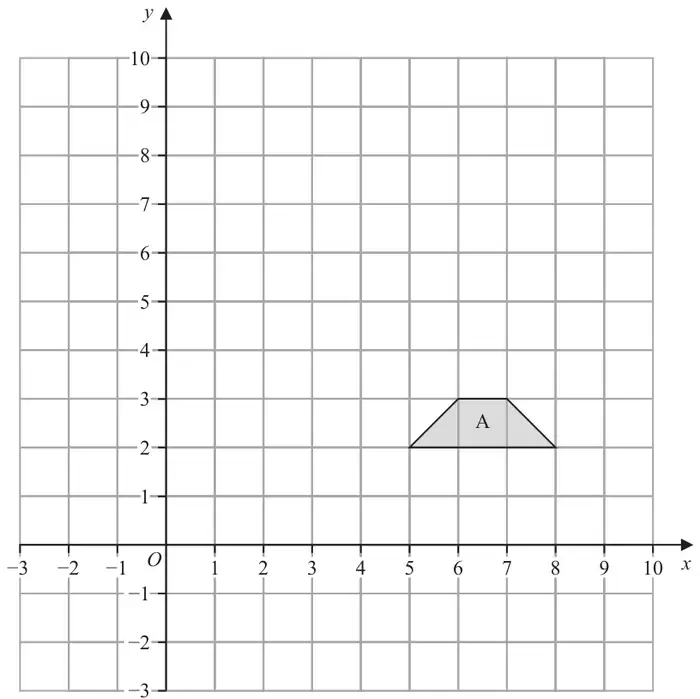
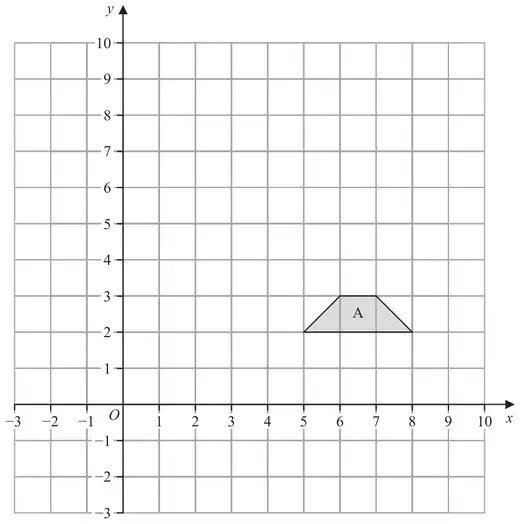
Grid with x from -3 to 10 and y from -3 to 10 showing shape A, a trapezium with vertices (5, 2), (6, 3), (7, 3) and (8, 2)
(a) On the grid above, reflect shape A in the line \(y = x\) (2)
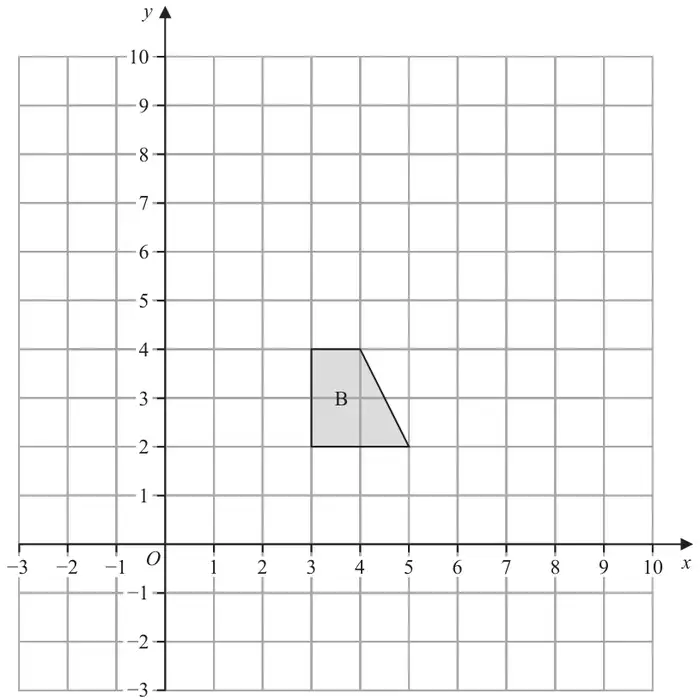
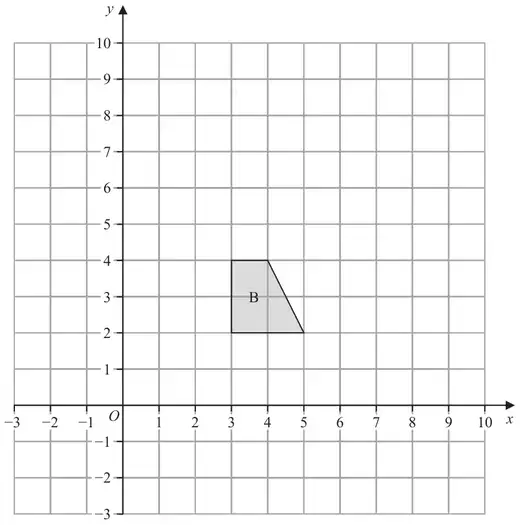
Grid with x from -3 to 10 and y from -3 to 10 showing shape B with vertices (3, 2), (3, 4), (4, 4) and (5, 2)
(b) On the grid above, enlarge shape B by scale factor 2 with centre \((1, 1)\) (2)

Foundation June 2025 Paper 2 Q19

EdexcelFoundationCurrent spec5 marksTransformations of Shapes

19

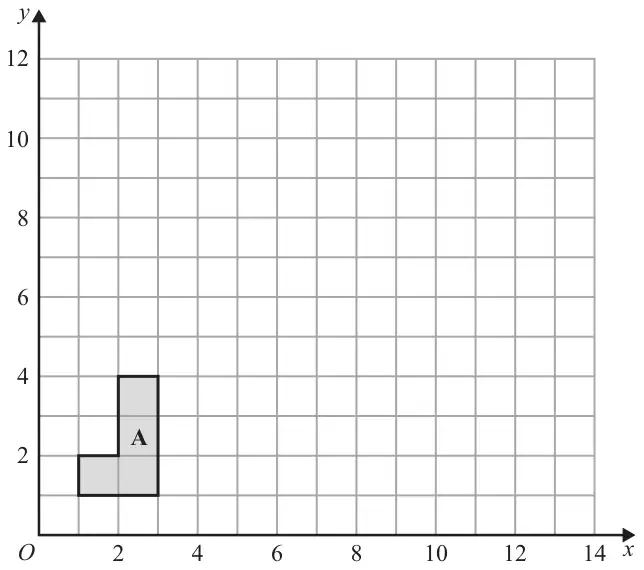
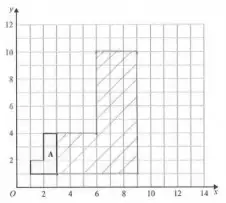
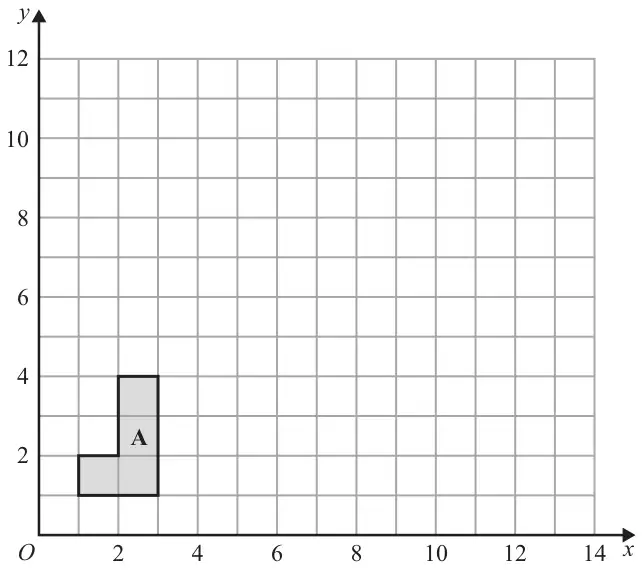
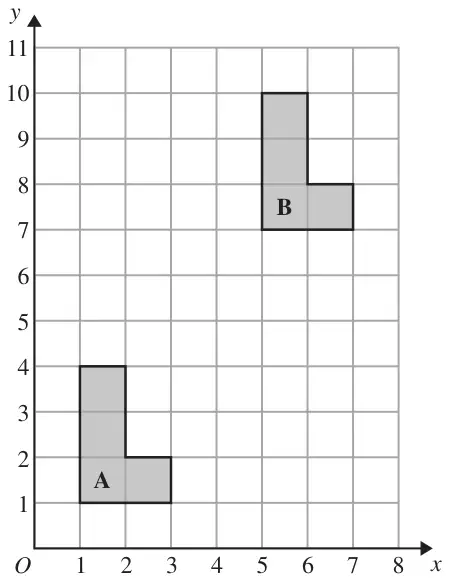
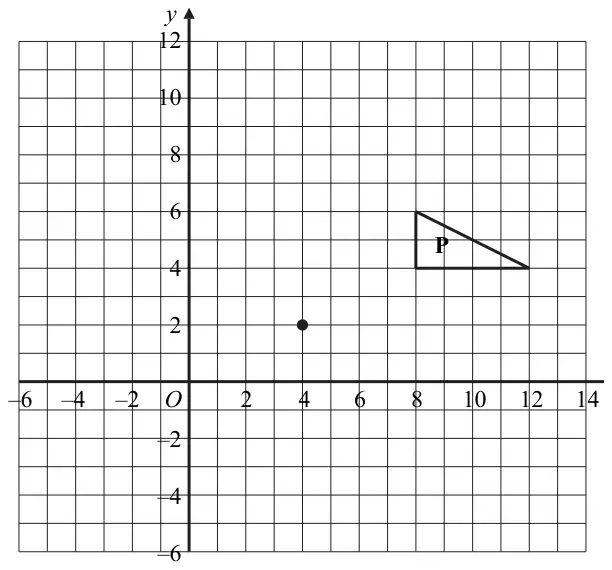
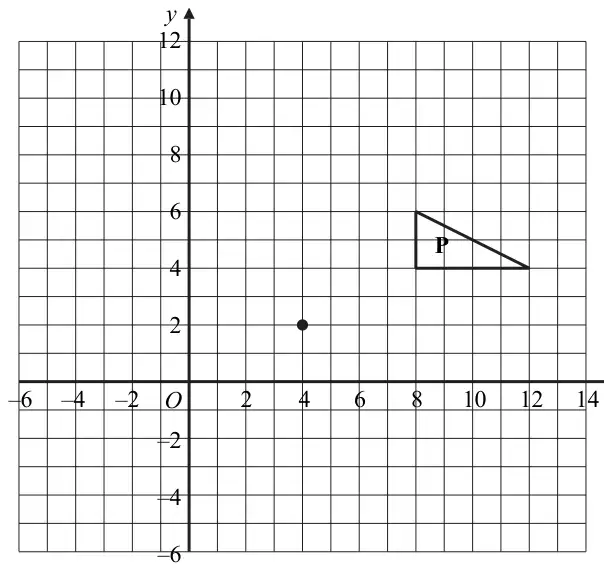
Grid with x from 0 to 14 and y from 0 to 12 showing an L-shaped shape A with vertices (1, 1), (3, 1), (3, 4), (2, 4), (2, 2) and (1, 2)
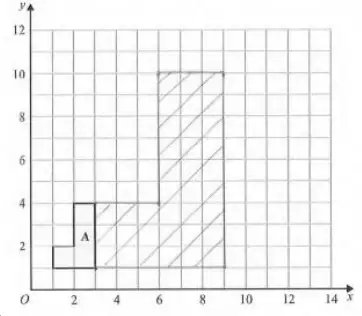
(a) On the grid, enlarge shape A with scale factor 3 and centre \((0, 1)\) (2)
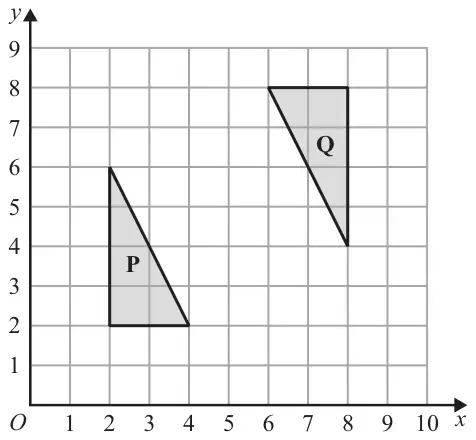
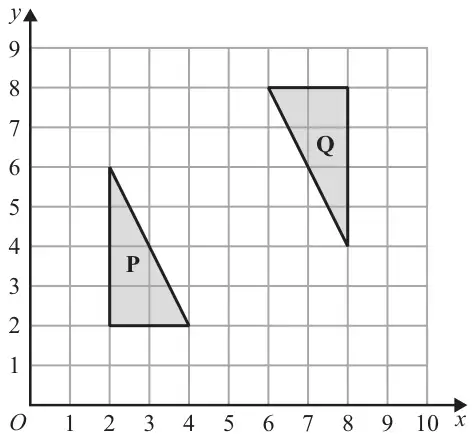
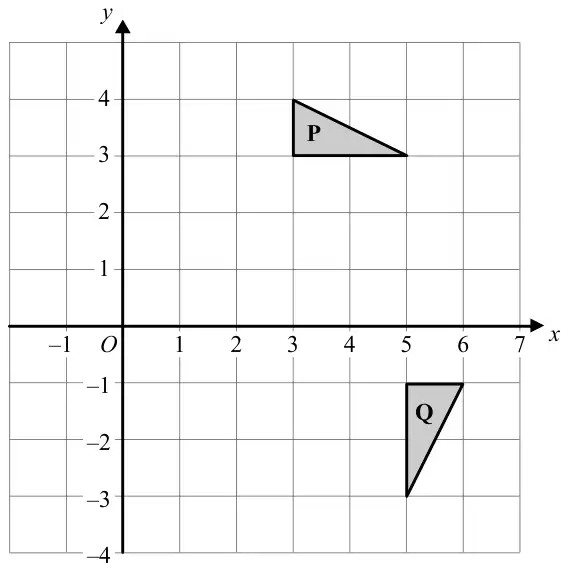
Grid with x from 0 to 10 and y from 0 to 9 showing triangle P with vertices (2, 2), (4, 2) and (2, 6), and triangle Q with vertices (8, 8), (6, 8) and (8, 4)
(b) Describe fully the single transformation that maps triangle P onto triangle Q (3)

Higher June 2025 Paper 2R Q5

EdexcelHigherCurrent spec4 marksTransformations of Shapes

5

Grid with x from -3 to 10 and y from -3 to 10 showing shape A, a trapezium with vertices (5, 2), (6, 3), (7, 3) and (8, 2)
(a) On the grid above, reflect shape A in the line \(y = x\) (2)
Grid with x from -3 to 10 and y from -3 to 10 showing shape B with vertices (3, 2), (3, 4), (4, 4) and (5, 2)
(b) On the grid above, enlarge shape B by scale factor 2 with centre \((1, 1)\) (2)

Foundation June 2025 Paper 2R Q3

EdexcelFoundationCurrent spec4 marksPlans, Elevations & NetsTransformations of Shapes

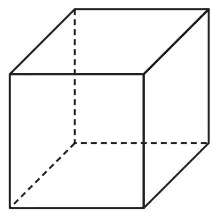
3 Here is a 3-D shape.

A cube
(a)
(i) Write down the mathematical name of this shape. (1)
(ii) Write down the number of edges of this shape. (1)

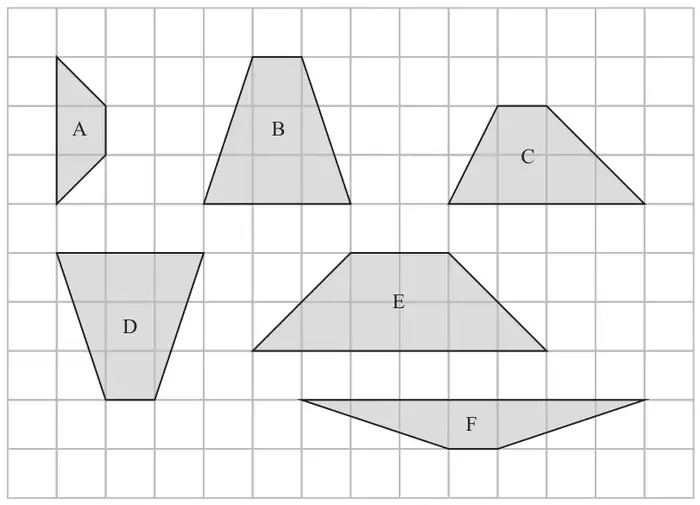
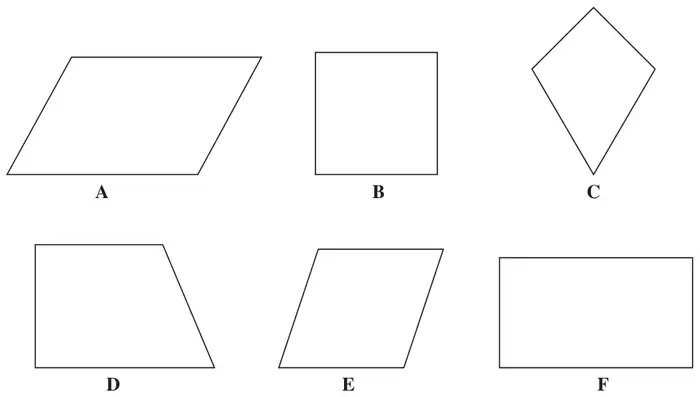
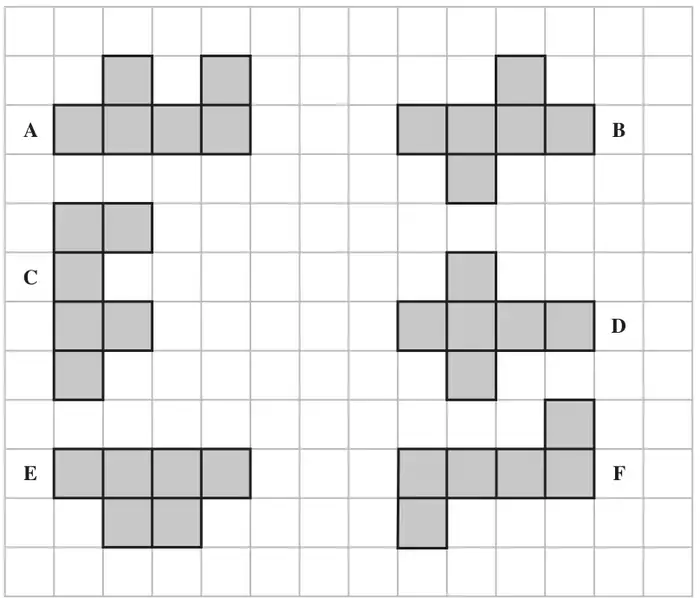
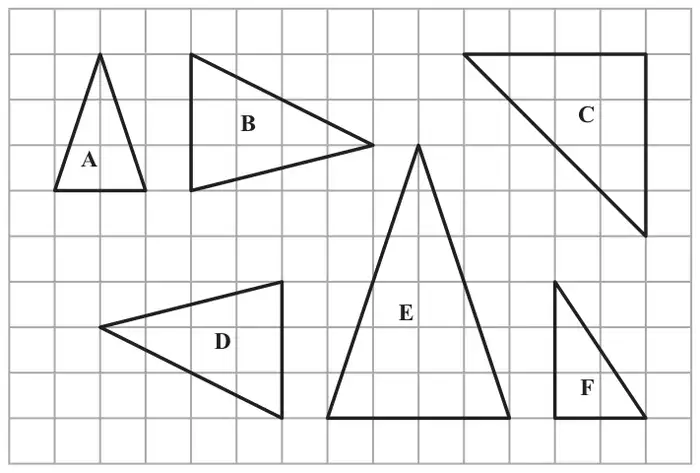
Here are six quadrilaterals on a grid.

Six shaded quadrilaterals labelled A to F on a square grid

Two of the quadrilaterals are congruent.

(b) Write down the letters of these two quadrilaterals. (1)
(c) Write down the letter of the quadrilateral with no lines of symmetry. (1)

Higher June 2025 Paper 2 Q2

EdexcelHigherCurrent spec5 marksTransformations of Shapes

2

Grid with x from 0 to 14 and y from 0 to 12 showing an L-shaped shape A with vertices (1, 1), (3, 1), (3, 4), (2, 4), (2, 2) and (1, 2)
(a) On the grid, enlarge shape A with scale factor 3 and centre \((0, 1)\) (2)
Grid with x from 0 to 10 and y from 0 to 9 showing triangle P with vertices (2, 2), (4, 2) and (2, 6), and triangle Q with vertices (8, 8), (6, 8) and (8, 4)
(b) Describe fully the single transformation that maps triangle P onto triangle Q (3)

Foundation November 2024 Paper 1 Q17

EdexcelFoundationCurrent spec2 marksTransformations of Shapes

17

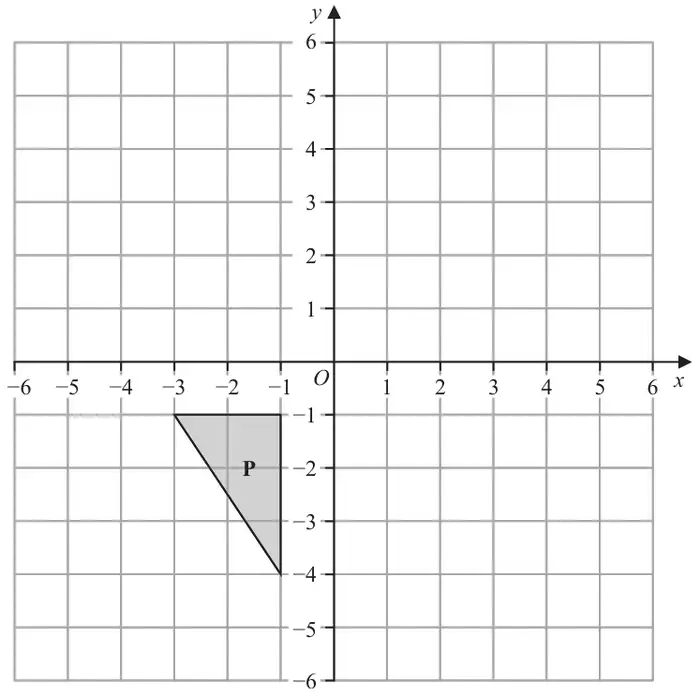
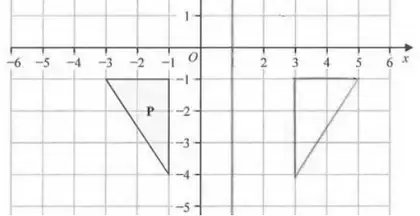
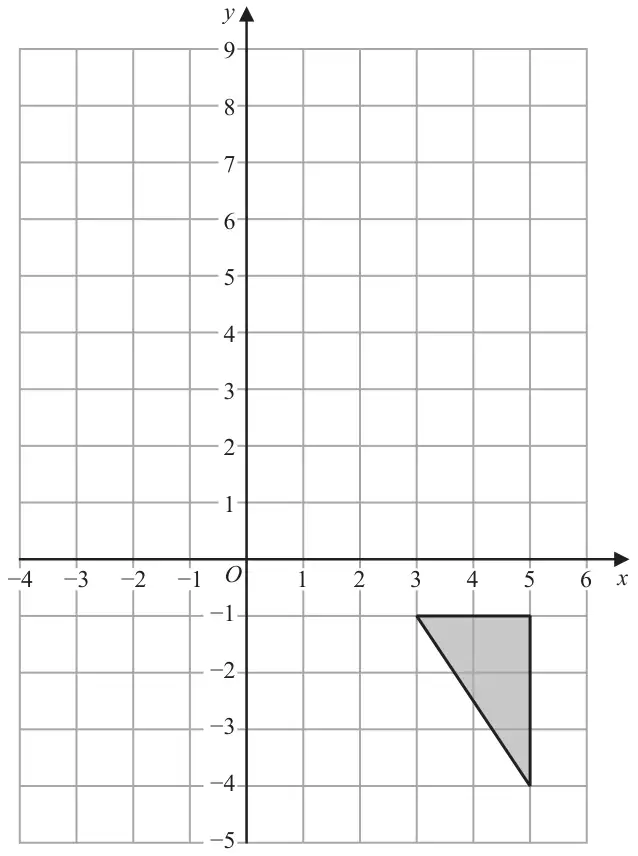
Coordinate grid with x and y from −6 to 6; shaded triangle P with vertices (−3, −1), (−1, −1) and (−1, −4)

Reflect shape P in the line \(x = 1\)

(2)

Foundation November 2024 Paper 2 Q15

EdexcelFoundationCurrent spec3 marksTransformations of Shapes

15

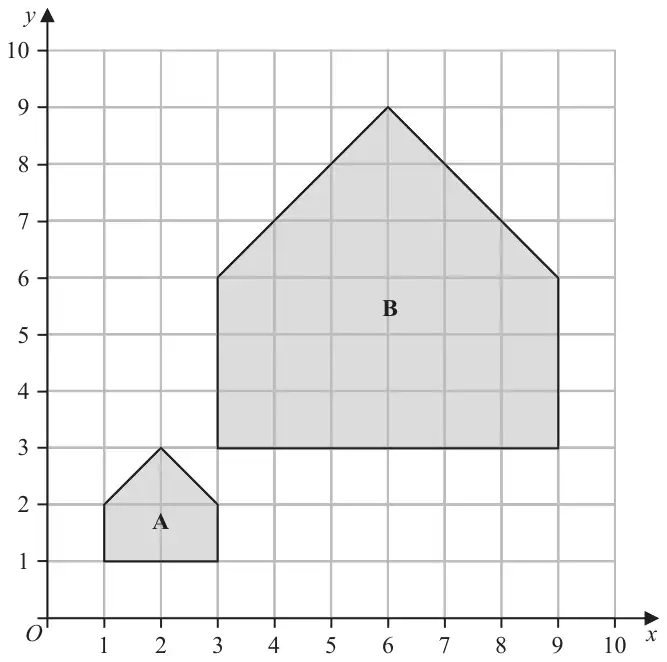
Coordinate grid, x and y from 0 to 10. Shape A has vertices (1, 1), (3, 1), (3, 2), (2, 3), (1, 2). Shape B has vertices (3, 3), (9, 3), (9, 6), (6, 9), (3, 6)

Describe fully the single transformation that maps shape A onto shape B

(3)

Foundation November 2024 Paper 1 Q2

EdexcelFoundationCurrent spec4 marksAngles in PolygonsTransformations of Shapes

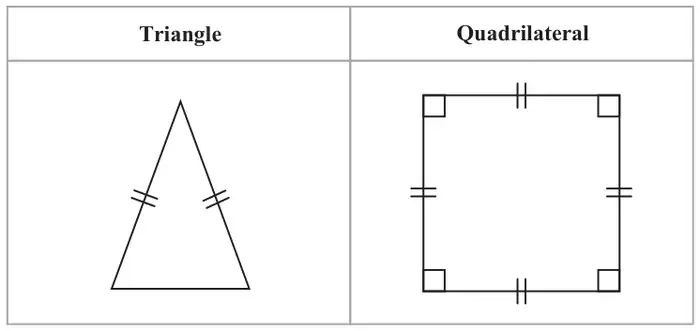
2 Here are two shapes.

Table with two columns. Triangle: a triangle with two sides marked equal. Quadrilateral: a four-sided shape with all four sides marked equal and four right angles
(a) Write down the mathematical name of the
(i) triangle, (1)
(ii) quadrilateral. (1)
(b) On the triangle, draw the line of symmetry. (1)
(c) Write down the order of rotational symmetry of the quadrilateral. (1)

Foundation June 2024 Paper 2R Q18

EdexcelFoundationCurrent spec4 marksTransformations of Shapes

18

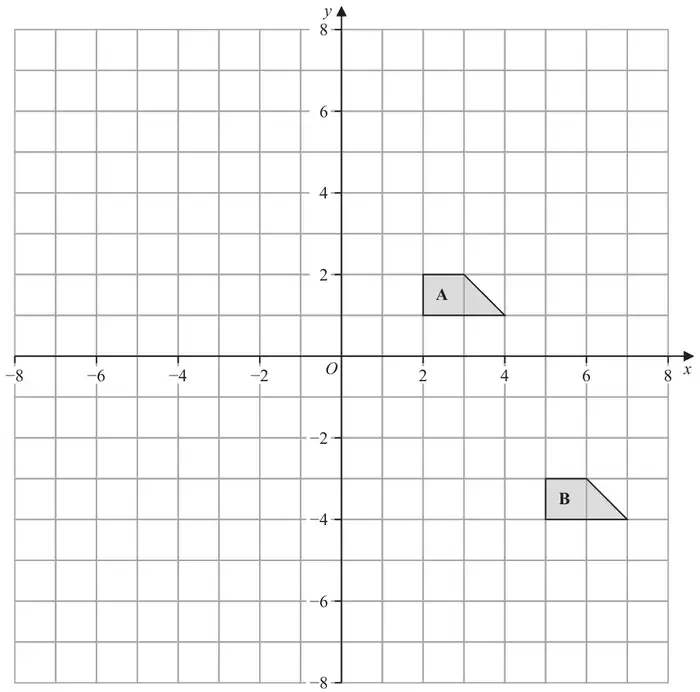
Coordinate grid with x and y from -8 to 8 showing trapezium A with vertices (2, 1), (2, 2), (3, 2), (4, 1) and trapezium B with vertices (5, -4), (5, -3), (6, -3), (7, -4)
(a) Describe fully the single transformation that maps shape A onto shape B (2)
(b) On the grid above, rotate shape A 180° about (−1, 0)
Label your shape C (2)

Foundation June 2024 Paper 2 Q14

EdexcelFoundationCurrent spec4 marksTransformations of Shapes

14

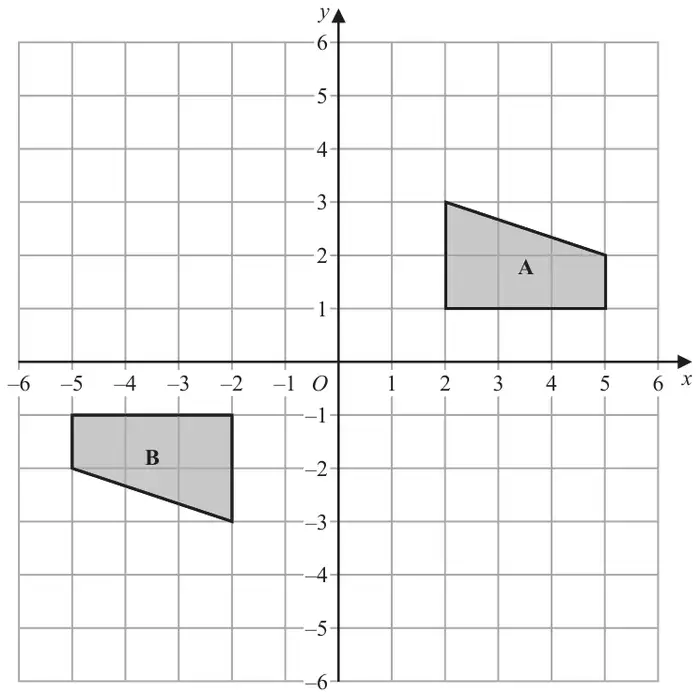
Coordinate grid from -6 to 6 on both axes showing shape A with vertices (2, 1), (2, 3), (5, 2), (5, 1) and shape B with vertices (-2, -1), (-2, -3), (-5, -2), (-5, -1)
(a) Describe fully the single transformation that maps shape A onto shape B (2)
(b) On the grid, reflect shape A in the line with equation \(\;y = -1\) (2)

Higher June 2024 Paper 2R Q2

EdexcelHigherCurrent spec4 marksTransformations of Shapes

2

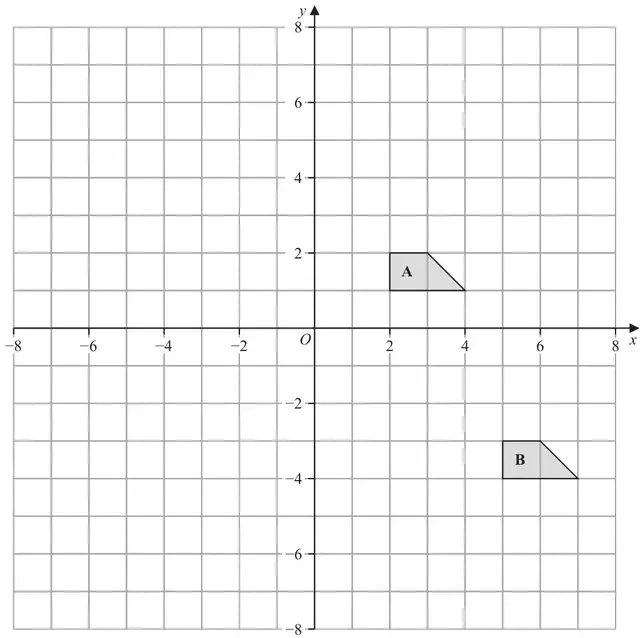
Coordinate grid from -8 to 8 on both axes; shape A is a trapezium with vertices (2, 1), (2, 2), (3, 2), (4, 1); shape B is the same shape with vertices (5, -4), (5, -3), (6, -3), (7, -4)
(a) Describe fully the single transformation that maps shape A onto shape B (2)
(b) On the grid above, rotate shape A 180° about \((-1, 0)\)
Label your shape C (2)

Foundation June 2024 Paper 2 Q2

EdexcelFoundationCurrent spec6 marks2D Area & PerimeterTransformations of Shapes

2

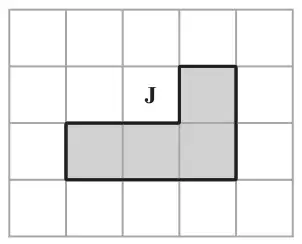
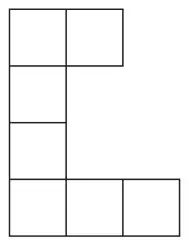
Shape J, an L-shape, drawn on a square grid
(a) On the grid, draw a shape that is congruent to shape J (1)
Blank square grid
(b) On the grid, draw a shape that is an enlargement of shape J with scale factor 2 (2)
Blank square grid

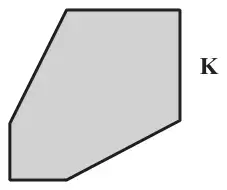
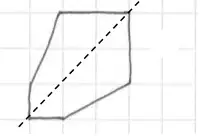
The diagram shows shape K
Shape K has exactly one line of symmetry.

(c) Draw this line of symmetry on shape K (1)
Shaded hexagon K

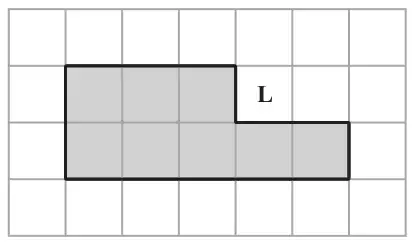
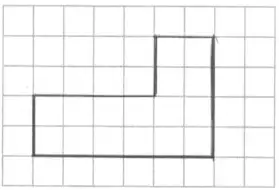
The diagram shows shape L drawn on a centimetre grid.

Shaded L-shape L drawn on a centimetre grid
(d) Work out the perimeter of shape L (1)
(e) Work out the area of shape L (1)

Foundation November 2023 Paper 2 Q19

EdexcelFoundationCurrent spec5 marksTransformations of Shapes

19

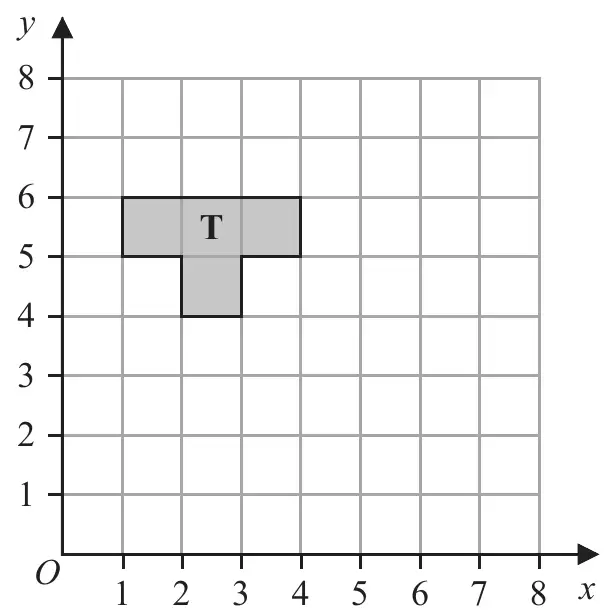
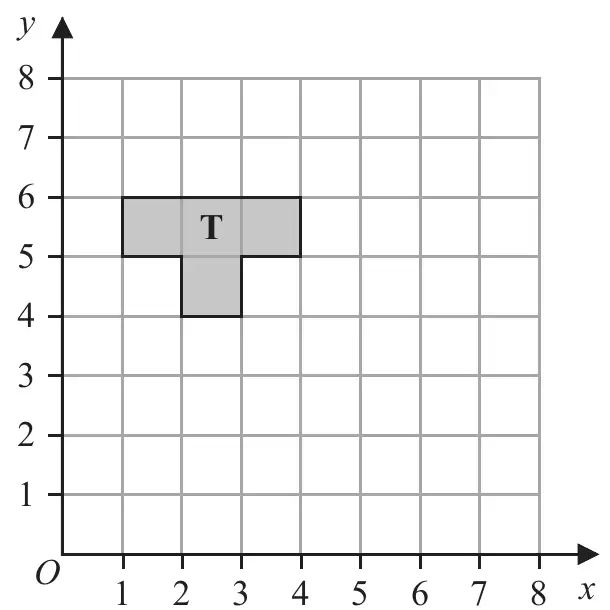
Grid with shape T made of squares between x = 1 and x = 4, y = 4 and y = 6
(a) Reflect shape T in the line \(y = x\) (2)
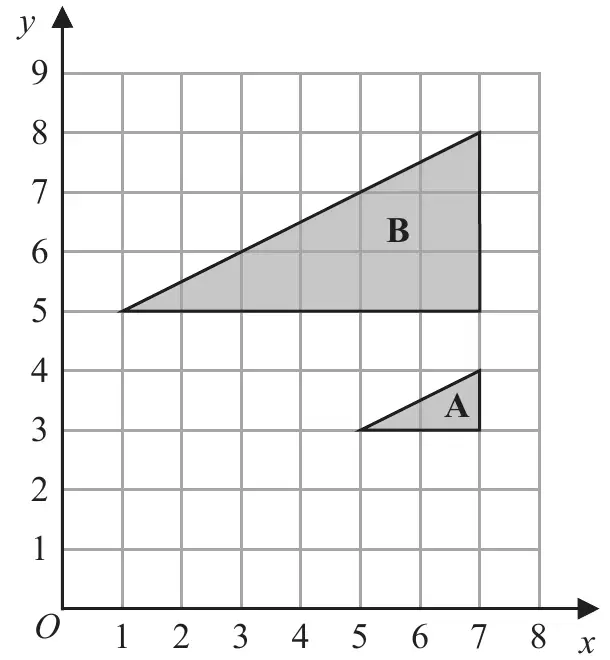
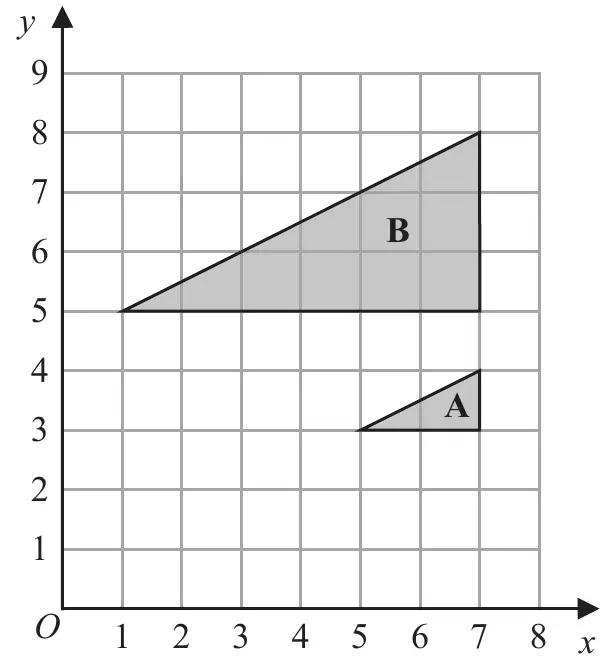
Grid with triangle A with vertices (5, 3), (7, 3), (7, 4) and triangle B with vertices (1, 5), (7, 5), (7, 8)
(b) Describe fully the single transformation that maps triangle A onto triangle B (3)

Foundation November 2023 Paper 1 Q4

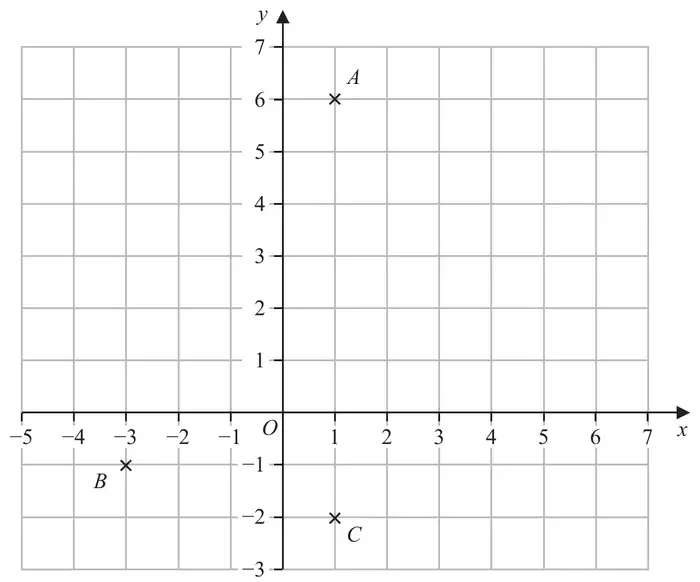
4 The diagram shows three points, \(A\), \(B\) and \(C\), marked on a grid.

Grid with A at (1, 6), B at (-3, -1) and C at (1, -2)
(a) Write down the coordinates of point \(A\) (1)
(b) Write down the coordinates of point \(B\) (1)

\(M\) is the midpoint of the line \(AC\)

(c) On the grid, mark with a cross (×) the point \(M\)
Label the point \(M\) (1)

The point \(D\) is such that the shape \(ABCD\) is a kite.

(d) On the grid, mark with a cross (×) the point \(D\)
Label the point \(D\) (1)
(e) How many lines of symmetry has kite \(ABCD\)? (1)

Higher November 2023 Paper 2 Q3

EdexcelHigherCurrent spec5 marksTransformations of Shapes

3

Grid with shape T made of squares between x = 1 and x = 4, y = 4 and y = 6
(a) Reflect shape T in the line \(y = x\) (2)
Grid with triangle A with vertices (5, 3), (7, 3), (7, 4) and triangle B with vertices (1, 5), (7, 5), (7, 8)
(b) Describe fully the single transformation that maps triangle A onto triangle B (3)

Foundation June 2023 Paper 1R Q26

EdexcelFoundationCurrent spec2 marksTransformations of Shapes

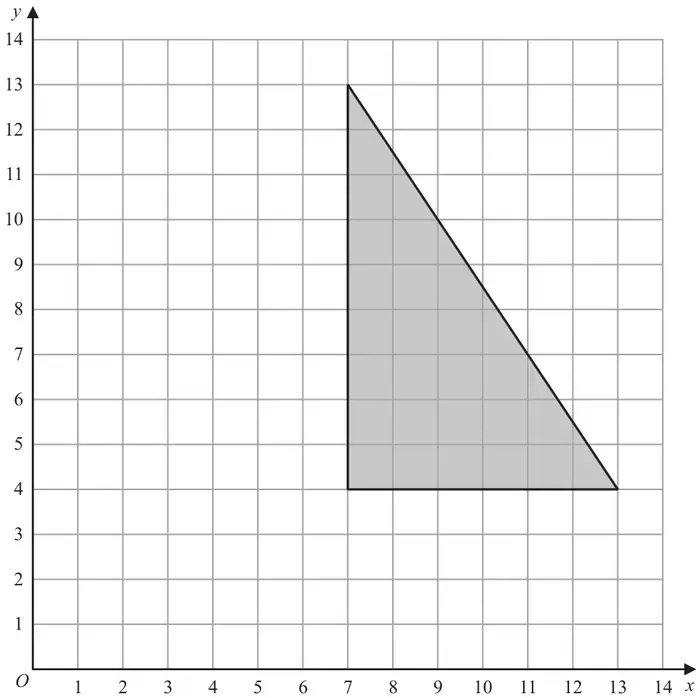
26

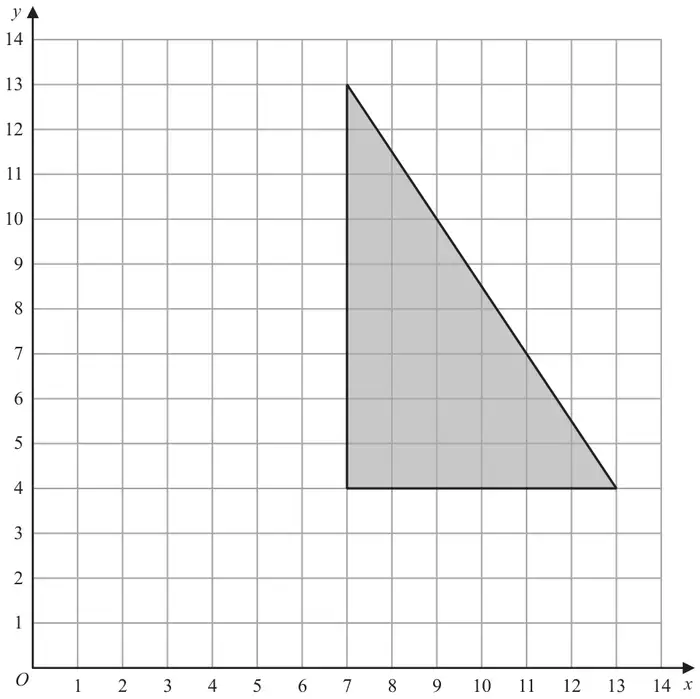
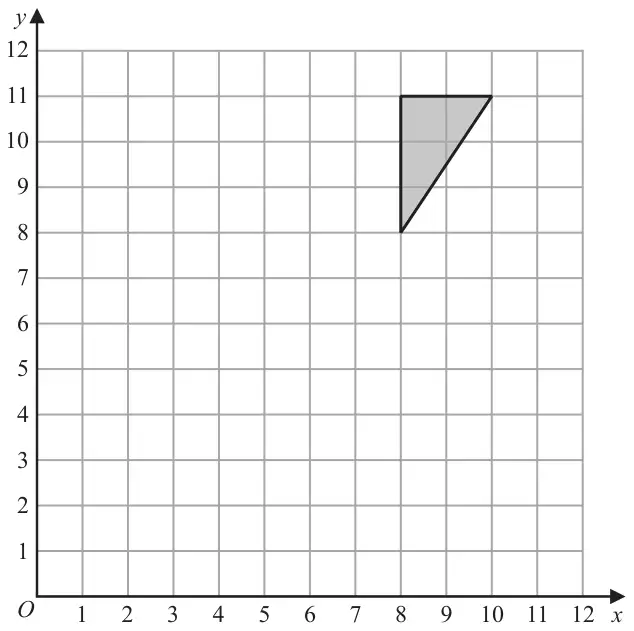
Grid with x and y from 0 to 14 showing a shaded right-angled triangle with vertices (7, 4), (7, 13) and (13, 4)

On the grid, enlarge the shaded shape with scale factor \(\dfrac{1}{3}\) and centre (1, 7)

(2)

Foundation June 2023 Paper 1 Q19

EdexcelFoundationCurrent spec8 marksTransformations of Shapes

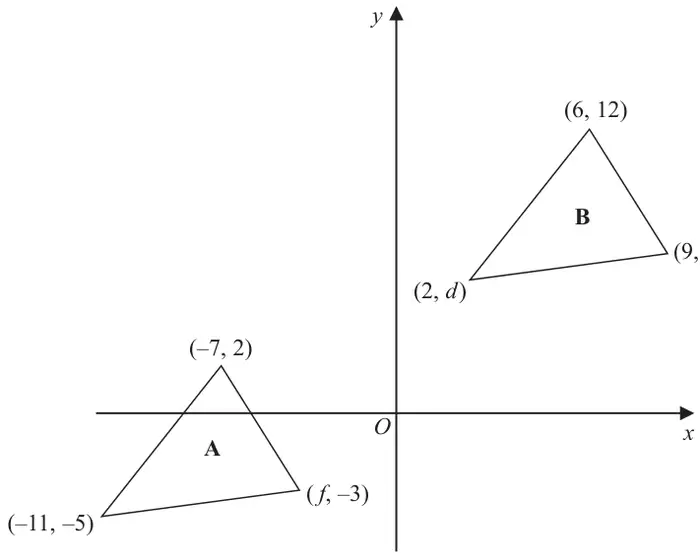
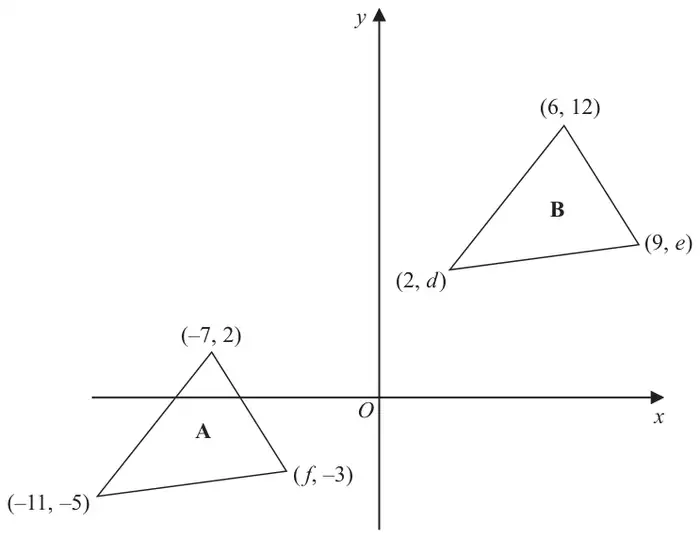
19 The diagram shows a sketch of triangle A and triangle B on a coordinate grid.

Sketch on axes: triangle A with vertices (-7, 2), (-11, -5) and (f, -3); triangle B with vertices (6, 12), (2, d) and (9, e)

Diagram NOT accurately drawn

(a) Given that triangle A has been translated to give triangle B, work out the value of \(d\), the value of \(e\) and the value of \(f\) (3)

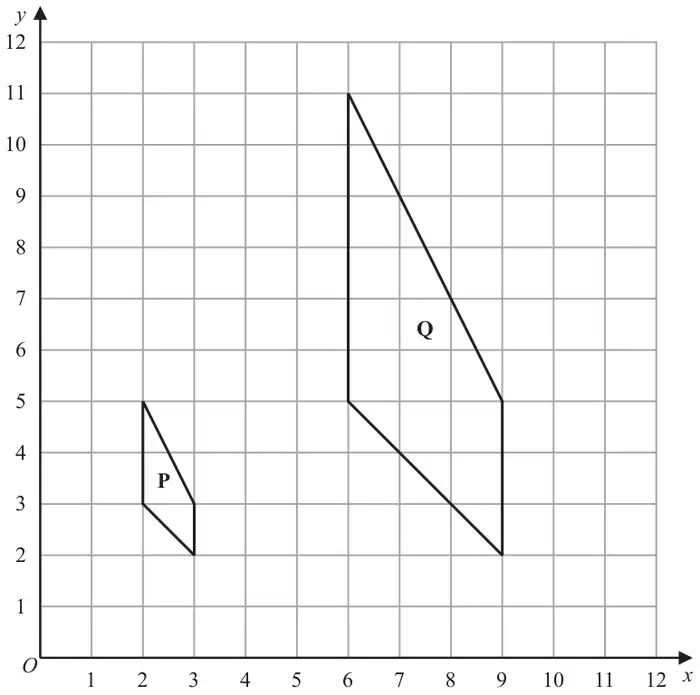
The diagram shows shape P and shape Q drawn on a grid.

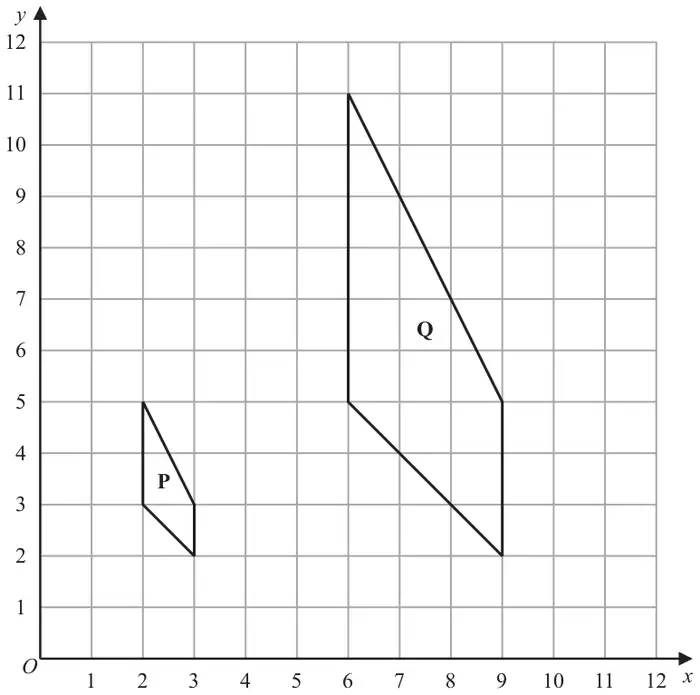
Grid with x and y from 0 to 12: shape P has vertices (2, 5), (2, 3), (3, 2), (3, 3); shape Q has vertices (6, 11), (6, 5), (9, 2), (9, 5)
(b) Describe fully the single transformation that maps shape P onto shape Q (3)
(c) On the grid above, rotate shape P 90° clockwise about (3, 5)
Label your shape R (2)

Higher June 2023 Paper 1R Q10

EdexcelHigherCurrent spec2 marksTransformations of Shapes

10

Grid with x and y from 0 to 14 showing a shaded right-angled triangle with vertices (7, 4), (13, 4) and (7, 13)

On the grid, enlarge the shaded shape with scale factor \(\dfrac{1}{3}\) and centre \((1, 7)\)

(2)

Higher June 2023 Paper 1 Q4

EdexcelHigherCurrent spec8 marksTransformations of Shapes

4 The diagram shows a sketch of triangle A and triangle B on a coordinate grid.

Sketch on coordinate axes: triangle A with vertices (-7, 2), (-11, -5) and (f, -3); triangle B with vertices (6, 12), (2, d) and (9, e)

Diagram NOT accurately drawn

(a) Given that triangle A has been translated to give triangle B, work out the value of \(d\), the value of \(e\) and the value of \(f\) (3)

The diagram shows shape P and shape Q drawn on a grid.

Grid with x and y from 0 to 12; shape P has vertices (2, 5), (3, 3), (3, 2), (2, 3); shape Q has vertices (6, 11), (9, 5), (9, 2), (6, 5)
(b) Describe fully the single transformation that maps shape P onto shape Q (3)
(c) On the grid above, rotate shape P 90° clockwise about \((3, 5)\)
Label your shape R (2)

Foundation June 2023 Paper 2R Q2

EdexcelFoundationCurrent spec4 marksPlans, Elevations & NetsTransformations of Shapes

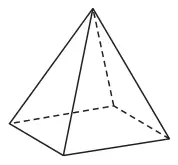
2 Here is a solid shape.

A square-based pyramid
(a) Write down the number of edges of this shape. (1)
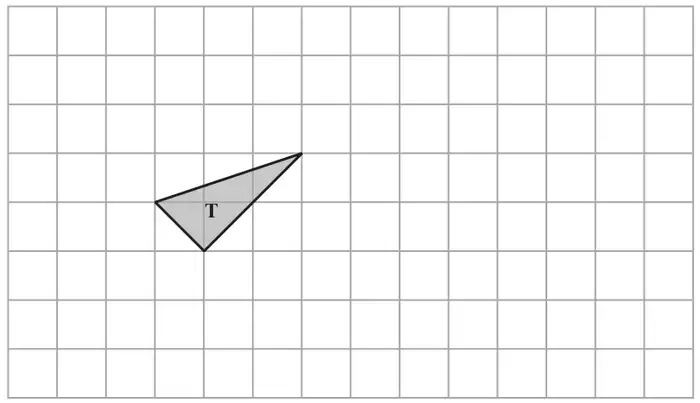
(b) On the grid below, draw a shape that is congruent to shape T
Square grid with a shaded triangle labelled T
(1)

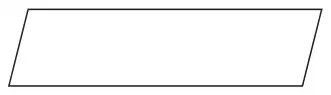
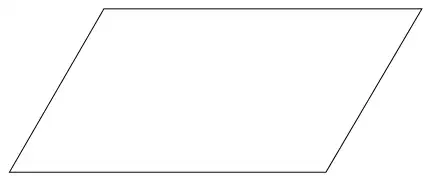
Here is a parallelogram.

A parallelogram
(c) Write down the order of rotational symmetry of the parallelogram. (1)

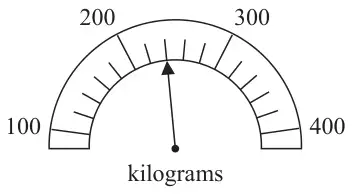
Here is a scale.

Semicircular scale in kilograms marked 100, 200, 300 and 400 with small divisions, and an arrow pointing between 200 and 300
(d) Write down the weight marked by the arrow. (1)

Foundation January 2023 Paper 2R Q16

EdexcelFoundationCurrent spec3 marksTransformations of Shapes

16

Grid with x from -6 to 6 and y from -6 to 6 showing shaded triangle A with vertices (3, 1), (3, 2) and (5, 1)
(a) On the grid, rotate triangle A 180° about (1, –1)
Label the new triangle B (2)
(b) On the grid, translate triangle A by the vector \(\begin{pmatrix} -7 \\ 3 \end{pmatrix}\)
Label the new triangle C (1)

Foundation January 2023 Paper 1 Q14

EdexcelFoundationCurrent spec4 marksTransformations of Shapes

14

Grid with x and y from -6 to 6 showing triangle A with vertices (2, -1), (2, -3) and (5, -3)
(a) On the grid, rotate triangle A 90° anticlockwise about centre \(O\) (2)
Grid with x from -2 to 10 and y from -2 to 10 showing triangle B with vertices (1, 2), (1, 3) and (3, 2) and triangle C with vertices (3, 6), (3, 9) and (9, 6)
(b) Describe fully the single transformation that maps triangle B onto triangle C (2)

Higher January 2023 Paper 2R Q2

EdexcelHigherCurrent spec3 marksTransformations of Shapes

2

Grid with x and y from −6 to 6 showing triangle A with vertices (3, 1), (3, 2) and (5, 1)
(a) On the grid, rotate triangle A 180° about (1, −1)
Label the new triangle B (2)
(b) On the grid, translate triangle A by the vector \(\begin{pmatrix} -7 \\ 3 \end{pmatrix}\)
Label the new triangle C (1)

Foundation June 2022 Paper 2R Q18

EdexcelFoundationCurrent spec4 marksTransformations of Shapes

18

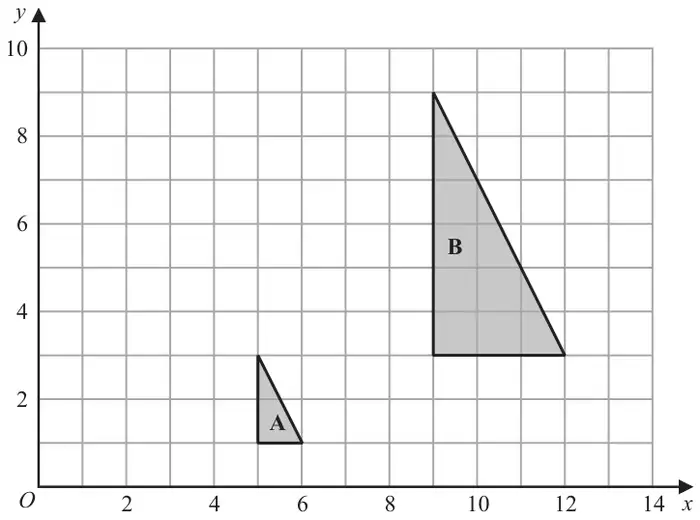
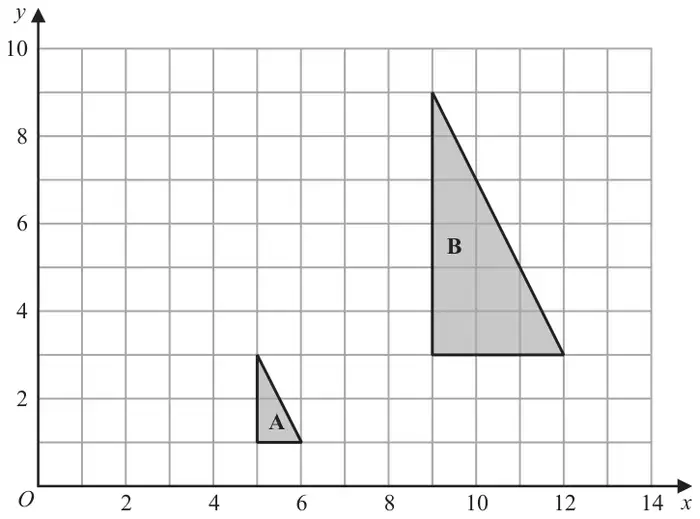
Grid with x from 0 to 14 and y from 0 to 10. Triangle A has vertices (5, 1), (5, 3), (6, 1). Triangle B has vertices (9, 3), (9, 9), (12, 3)
(a) Describe fully the single transformation that maps triangle A onto triangle B (3)
(b) On the grid above, translate triangle A by the vector \(\begin{pmatrix} -4 \\ 3 \end{pmatrix}\)
Label your triangle C (1)

Foundation June 2022 Paper 2 Q14

EdexcelFoundationCurrent spec4 marksTransformations of Shapes

14

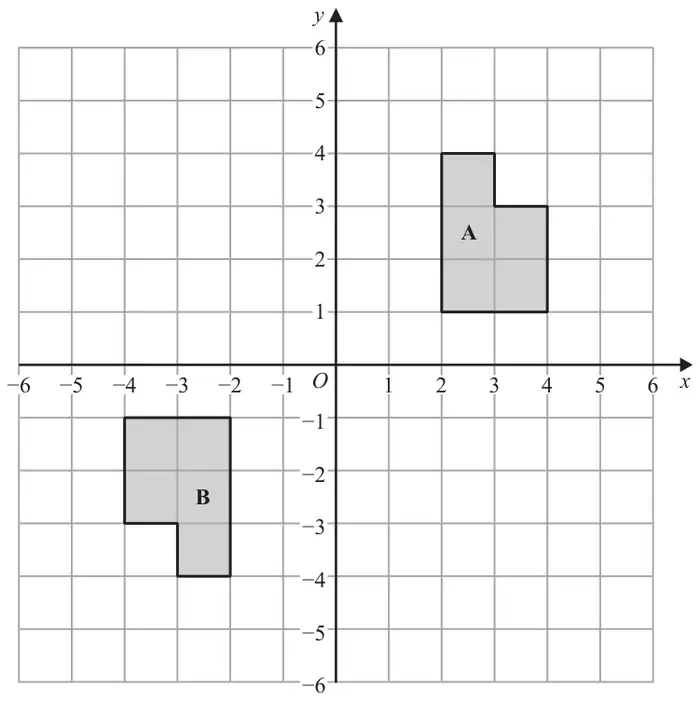
Grid with x and y from -6 to 6; shape A with vertices (2, 1), (4, 1), (4, 3), (3, 3), (3, 4), (2, 4); shape B with vertices (-2, -1), (-4, -1), (-4, -3), (-3, -3), (-3, -4), (-2, -4)
(a) Describe fully the single transformation that maps shape A onto shape B. (2)
(b) On the grid, reflect shape A in the line with equation \(x = -1\) (2)

Foundation June 2022 Paper 1R Q5

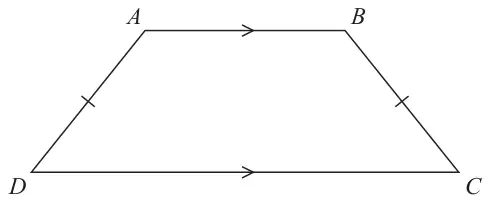
5 The diagram shows the trapezium \(ABCD\)

Isosceles trapezium ABCD with AB parallel to DC and equal sides AD and BC marked
(a) How many lines of symmetry has \(ABCD\)? (1)

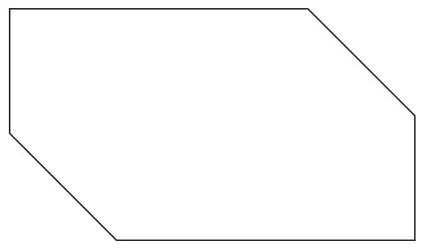
Here is another shape.

A hexagon made from a rectangle with two opposite corners cut off
(b) Write down the order of rotational symmetry of this shape. (1)
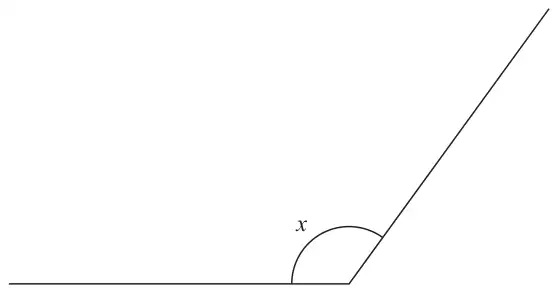
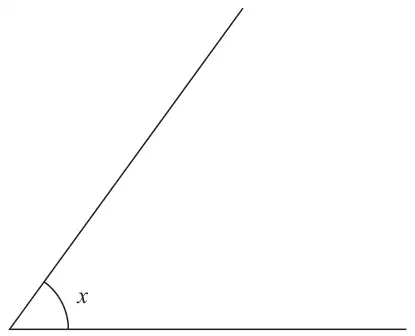
(c) Find, by measuring, the size of the angle marked \(x\) (1)
Two lines meeting at a point, with the obtuse angle between them marked x

Higher June 2022 Paper 2R Q1

EdexcelHigherCurrent spec4 marksTransformations of Shapes

1

A coordinate grid with x from 0 to 14 and y from 0 to 10. Triangle A has vertices (5, 1), (6, 1) and (5, 3). Triangle B has vertices (9, 3), (12, 3) and (9, 9)
(a) Describe fully the single transformation that maps triangle A onto triangle B (3)
(b) On the grid above, translate triangle A by the vector \(\begin{pmatrix} -4 \\ 3 \end{pmatrix}\)
Label your triangle C (1)

Foundation January 2022 Paper 1 Q15

EdexcelFoundationCurrent spec4 marksTransformations of Shapes

15

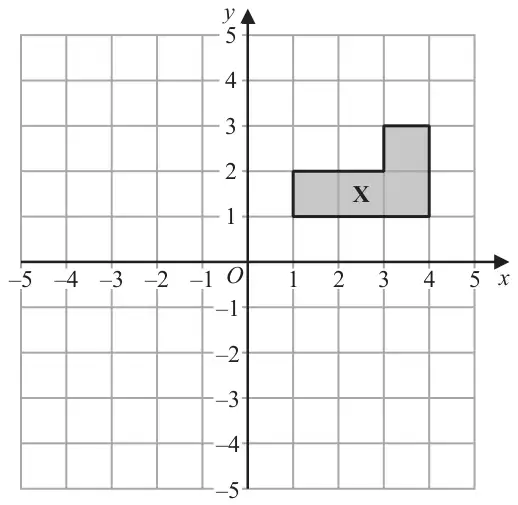
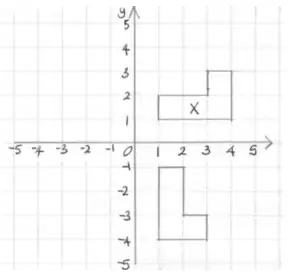
Grid with x and y from −5 to 5; shape X is an L-shape made of the rectangle from (1, 1) to (4, 2) and the square from (3, 2) to (4, 3)
(a) On the grid above, rotate shape X 90° clockwise about \(O\) (2)
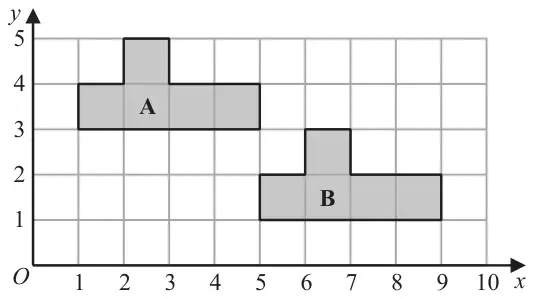
Grid with x from 0 to 10 and y from 0 to 5 showing shapes A and B; A has a base from (1, 3) to (5, 4) with a square on top from (2, 4) to (3, 5); B has a base from (5, 1) to (9, 2) with a square on top from (6, 2) to (7, 3)
(b) Describe fully the single transformation that maps shape A onto shape B (2)

Foundation January 2022 Paper 1R Q12

EdexcelFoundationCurrent spec4 marksTransformations of Shapes

12

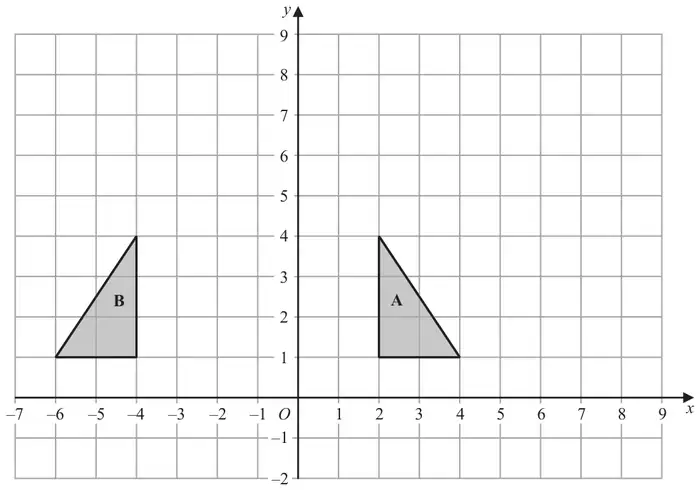
Grid with x from -7 to 9 and y from -2 to 9; triangle A has vertices (2, 1), (2, 4) and (4, 1); triangle B has vertices (-4, 1), (-4, 4) and (-6, 1)
(a) Describe fully the single transformation that maps triangle A onto triangle B (2)
(b) On the grid above, enlarge triangle A with scale factor 2 and centre \(O\)
Label your triangle C (2)

Foundation January 2022 Paper 2 Q6

EdexcelFoundationCurrent spec4 marksAngles in PolygonsTransformations of Shapes

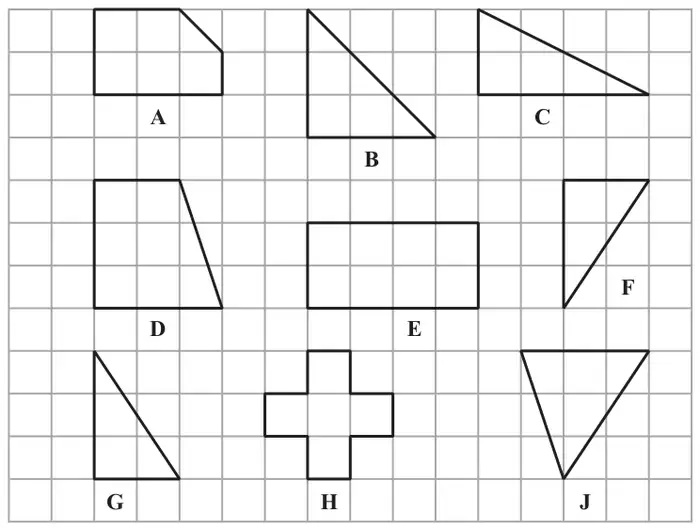
6 Here are nine shapes drawn on a grid of squares.

Nine shapes A to J on a square grid. D is a quadrilateral with one vertical side and one sloping side (two parallel horizontal sides). E is a 4 by 2 rectangle. G and F are right-angled triangles with legs 2 and 3. H is a plus-shaped cross

Shape D is a quadrilateral.

(a) What is the mathematical name of this quadrilateral? (1)

One of the shapes is congruent to shape G

(b) Write down the letter of this shape. (1)
(c) Write down the order of rotational symmetry of shape H (1)
(d) How many lines of symmetry has shape E? (1)

Foundation January 2022 Paper 1R Q2

EdexcelFoundationCurrent spec3 marksAngles in PolygonsTransformations of Shapes

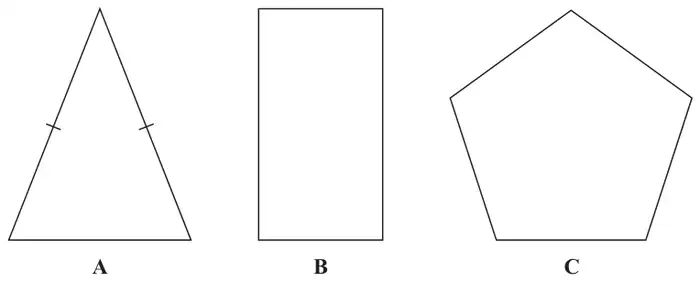
2 Here are three shapes.

Shape A: a triangle with two sides marked equal; shape B: a rectangle; shape C: a regular pentagon

Shape A is a triangle.

(a) Write down the mathematical name for this type of triangle. (1)

Shape B is a rectangle.

(b) On shape B, draw its lines of symmetry. (1)

Shape C is a regular polygon.

(c) Write down the order of rotational symmetry of shape C. (1)

Foundation November 2021 Paper 1 Q12

EdexcelFoundationCurrent spec5 marksTransformations of Shapes

12

Grid with x from -6 to 10 and y from -2 to 12; shape P has vertices (1, 2), (1, 3), (2, 3), (3, 4), (3, 2); shape Q has vertices (3, 6), (3, 9), (6, 9), (9, 12), (9, 6)
(a) Describe fully the single transformation that maps shape P onto shape Q. (3)
(b) On the grid, reflect shape P in the line with equation \(x = 5\)
Label your shape R. (2)

Foundation June 2021 Paper 1 Q12

EdexcelFoundationCurrent spec5 marksTransformations of Shapes

12 The diagram shows a shaded shape on a grid.

Grid with x from 0 to 13 and y from 0 to 12; shaded quadrilateral with vertices (1, 1), (2, 5), (6, 4) and (3, 3)
(a) On the grid, reflect the shape in the line with equation \(x = 6\) (2)

The diagram below shows triangle P and triangle Q drawn on a grid.

Grid with x from 0 to 12 and y from 0 to 7; triangle P has vertices (1, 1), (1, 2) and (4, 1); triangle Q has vertices (3, 3), (3, 6) and (12, 3)
(b) Describe fully the single transformation that maps triangle P onto triangle Q. (3)

Foundation June 2021 Paper 2 Q2

2

(a) Write down the order of rotational symmetry of a square. (1)
Two straight lines meeting at a point, with the angle x marked between them
(b)
(i) Measure the size of the angle marked \(x\).
(ii) Write down the mathematical name of this type of angle. (2)

Here is a 3-D shape.

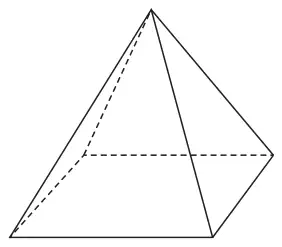
A square-based pyramid, with hidden edges shown as dashed lines
(c)
(i) Write down the mathematical name of this 3-D shape.
(ii) How many edges does this shape have? (2)

Foundation January 2021 Paper 2R Q16

EdexcelFoundationCurrent spec6 marksTransformations of Shapes

16 Here is a shape P drawn on a grid of squares.

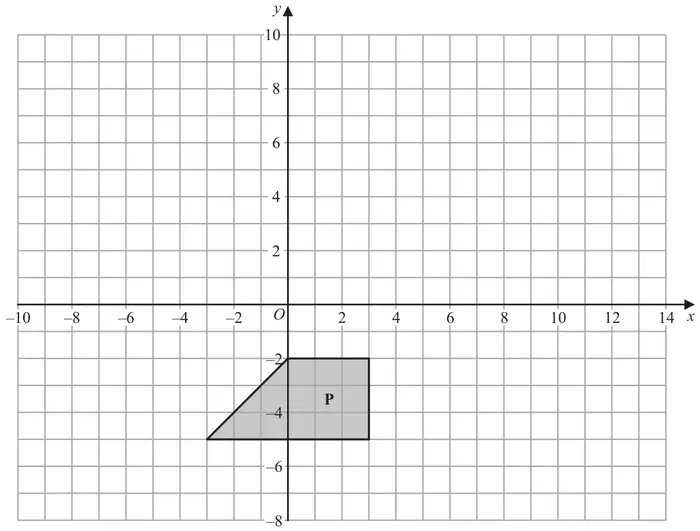
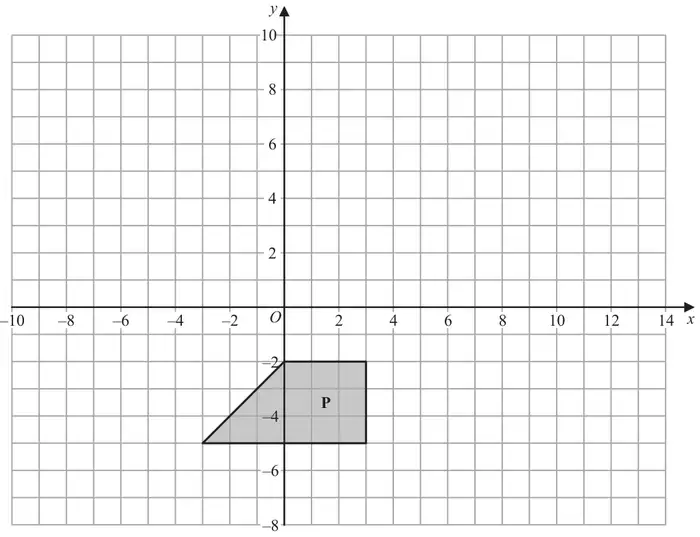
Coordinate grid with x from −10 to 14 and y from −8 to 10; shaded quadrilateral P with vertices (0, −2), (3, −2), (3, −5) and (−3, −5)
(a) On the grid, rotate shape P 180° about the point (–3, 2)
Label the new shape Q. (2)
(b) On the grid, translate shape P by the vector \(\begin{pmatrix} 10 \\ 8 \end{pmatrix}\)
Label the new shape R. (1)

Here are triangle T and triangle U drawn on a grid of squares.

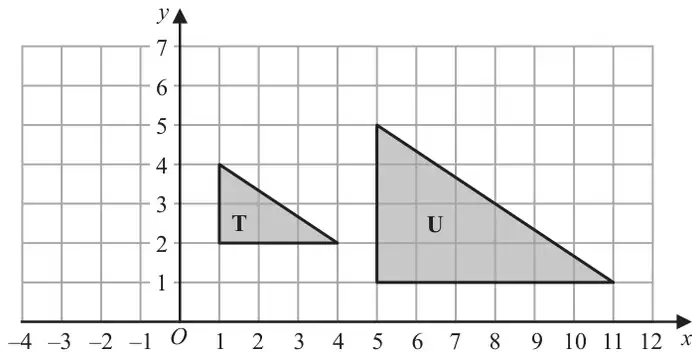
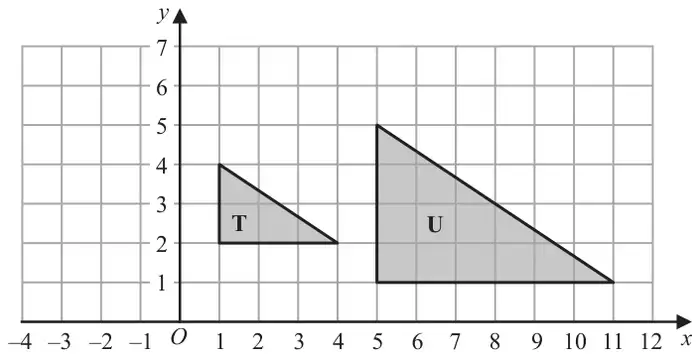
Coordinate grid with x from −4 to 12 and y from 0 to 7; triangle T with vertices (1, 2), (1, 4), (4, 2) and triangle U with vertices (5, 1), (5, 5), (11, 1)
(c) Describe fully the single transformation that maps triangle T onto triangle U. (3)

Foundation January 2021 Paper 1 Q14

EdexcelFoundationCurrent spec5 marksTransformations of Shapes

14

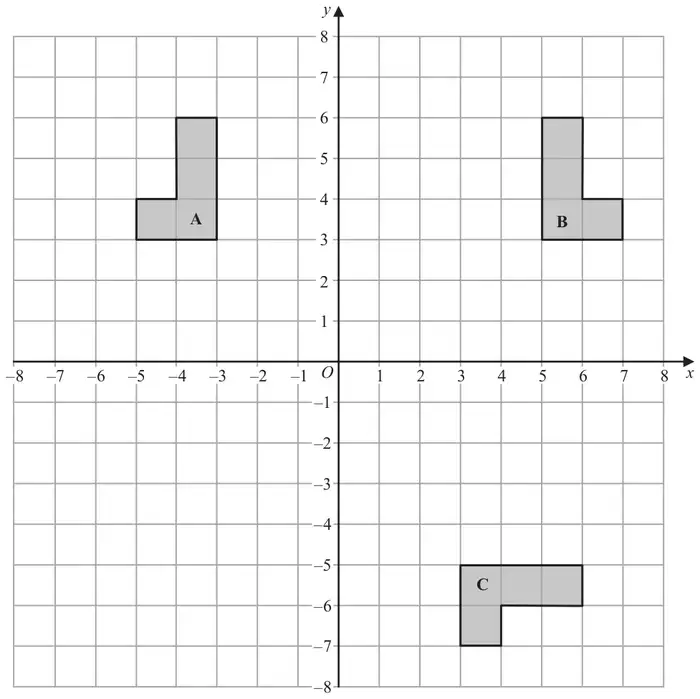
Coordinate grid from −8 to 8 on both axes showing three L-shapes: A with vertices including (−5, 3), (−3, 3), (−3, 6), (−4, 6), (−4, 4), (−5, 4); B with vertices including (5, 3), (7, 3), (7, 4), (6, 4), (6, 6), (5, 6); C with vertices including (3, −5), (6, −5), (6, −6), (4, −6), (4, −7), (3, −7)
(a) Describe fully the single transformation that maps shape A onto shape B. (2)
(b) Describe fully the single transformation that maps shape B onto shape C. (3)

Higher January 2021 Paper 2R Q5

EdexcelHigherCurrent spec6 marksTransformations of Shapes

5 Here is a shape P drawn on a grid of squares.

Grid with x from -10 to 14 and y from -8 to 10; shape P is a trapezium with vertices (-3, -5), (0, -2), (3, -2) and (3, -5)
(a) On the grid, rotate shape P 180° about the point \((-3, 2)\)
Label the new shape Q. (2)
(b) On the grid, translate shape P by the vector \(\begin{pmatrix} 10 \\ 8 \end{pmatrix}\)
Label the new shape R. (1)

Here are triangle T and triangle U drawn on a grid of squares.

Grid with x from -4 to 12 and y from 0 to 7; triangle T has vertices (1, 2), (1, 4) and (4, 2); triangle U has vertices (5, 1), (5, 5) and (11, 1)
(c) Describe fully the single transformation that maps triangle T onto triangle U. (3)

Foundation November 2020 Paper 2R Q13

EdexcelFoundationCurrent spec3 marksTransformations of Shapes

13

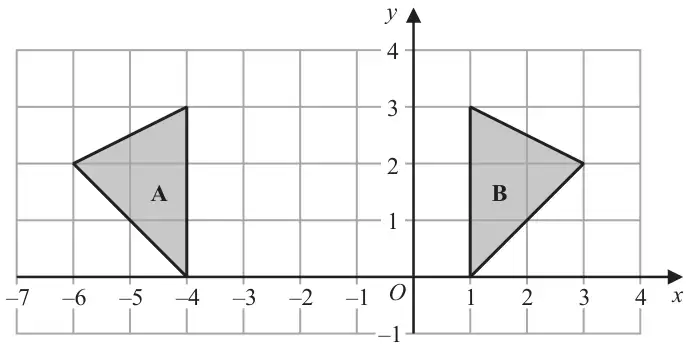
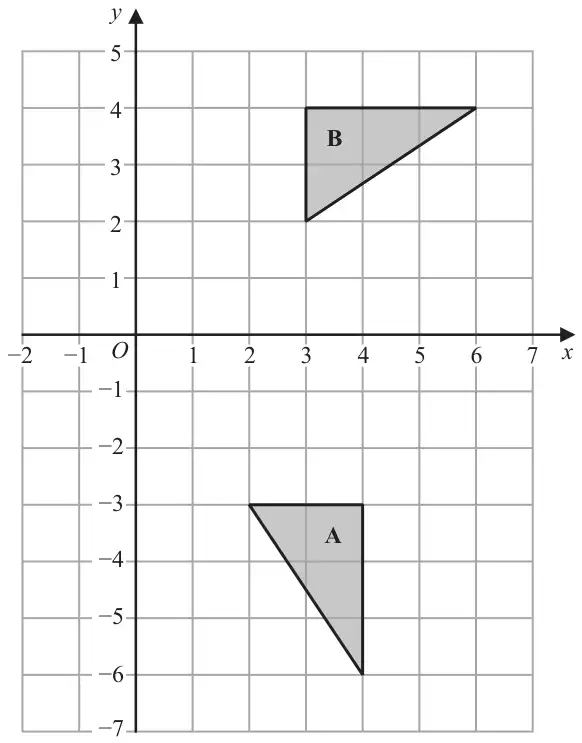
Grid with x from -7 to 4 and y from -1 to 4: triangle A with vertices (-6, 2), (-4, 3), (-4, 0) and triangle B with vertices (1, 3), (3, 2), (1, 0)

On the grid above, triangle A is the reflection of triangle B in the mirror line M.

(a) On the grid, draw the mirror line M.
Label the line M. (1)
Grid with x from -7 to 7 and y from -6 to 6: shaded shape C with vertices (2, 1), (4, 1), (5, 3) and (2, 3)
(b) On the grid above, rotate the shaded shape C 90° anticlockwise about the point with coordinates (0, 0) (2)

Foundation November 2020 Paper 1 Q13

EdexcelFoundationCurrent spec5 marksTransformations of Shapes

13

(a) On the grid, reflect the shaded triangle in the line with equation \(y = 2\)
Coordinate grid with x from −4 to 6 and y from −5 to 9; the shaded triangle has vertices (3, −1), (5, −1) and (5, −4)
(2)
Coordinate grid with x from −2 to 7 and y from −7 to 5; triangle A has vertices (2, −3), (4, −3) and (4, −6), and triangle B has vertices (3, 2), (3, 4) and (6, 4)
(b) Describe fully the single transformation that maps triangle A onto triangle B. (3)

Foundation January 2020 Paper 1 Q19

EdexcelFoundationCurrent spec2 marksTransformations of Shapes

19

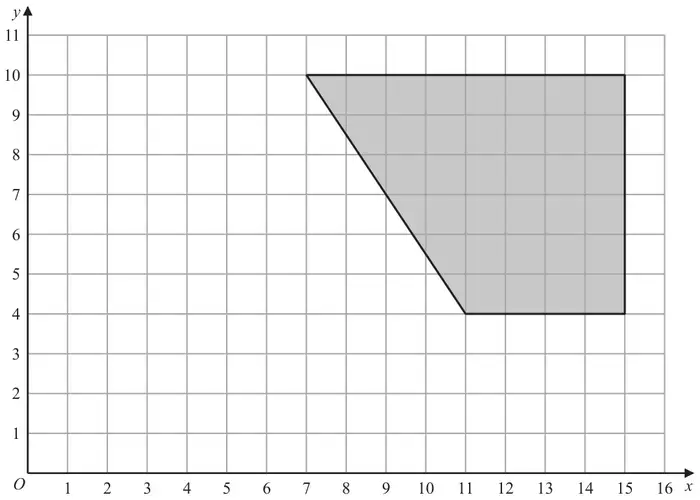
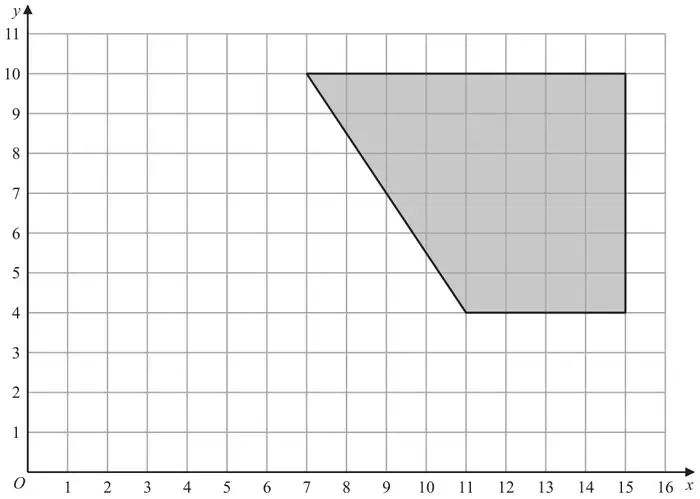
Grid with x from 0 to 16 and y from 0 to 11. Shaded trapezium with vertices (7, 10), (15, 10), (15, 4) and (11, 4)

On the grid, enlarge the shaded shape with scale factor \(\dfrac{1}{2}\) and centre \((1, 2)\)

(2)

Foundation January 2020 Paper 2 Q14

EdexcelFoundationCurrent spec2 marksTransformations of Shapes

14

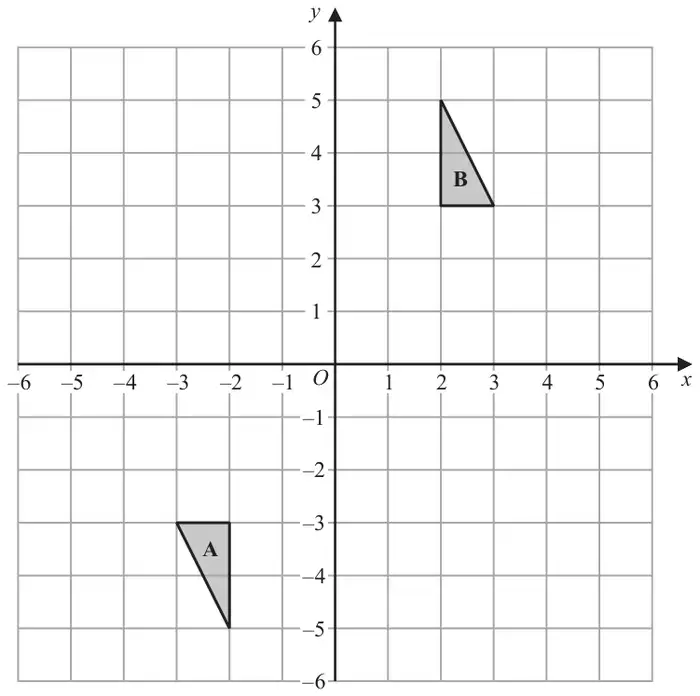
Grid with x and y from −6 to 6. Triangle A has vertices (−3, −3), (−2, −3) and (−2, −5). Triangle B has vertices (3, 3), (2, 3) and (2, 5)

Describe fully the single transformation that maps triangle A onto triangle B.

(2)

Foundation January 2020 Paper 1R Q13

EdexcelFoundationCurrent spec5 marksTransformations of Shapes

13

Grid with x and y from −7 to 7 and −6 to 6. Shape P is an L shape with vertices (2, 1), (2, 4), (3, 4), (3, 2), (4, 2), (4, 1). Shape Q has vertices (1, −2), (4, −2), (4, −3), (2, −3), (2, −4), (1, −4)
(a) Describe fully the single transformation that maps shape P onto shape Q. (3)
(b) On the grid, reflect shape P in the line \(\;x = -1\)
Label the new shape R. (2)

Higher January 2020 Paper 1 Q8

EdexcelHigherCurrent spec2 marksTransformations of Shapes

8

Grid with x from 0 to 16 and y from 0 to 11 showing a shaded trapezium with vertices (7, 10), (15, 10), (15, 4) and (11, 4)

On the grid, enlarge the shaded shape with scale factor \(\dfrac{1}{2}\) and centre \((1, 2)\)

(2)

Foundation June 2019 Paper 1R Q14

EdexcelFoundationCurrent spec4 marksTransformations of Shapes

14

Grid with x from −4 to 8 and y from −4 to 6; shaded L-shape P with vertices (2, 1), (4, 1), (4, 4), (3, 4), (3, 2), (2, 2)
(a) On the grid above, translate shape P by the vector \(\begin{pmatrix} -5 \\ 2 \end{pmatrix}\) (1)
Grid with x from −2 to 4 and y from −4 to 4; shape P as before and shaded shape T with vertices (1, −2), (2, −2), (2, −3), (4, −3), (4, −4), (1, −4)
(b) Describe fully the single transformation that maps shape P onto shape T. (3)

Foundation June 2019 Paper 1 Q11

EdexcelFoundationCurrent spec4 marksTransformations of Shapes

11

Grid with x and y from 0 to 12; shaded triangle with vertices (8, 8), (8, 11) and (10, 11)
(a) On the grid above, rotate the triangle 180° about (7, 6) (2)
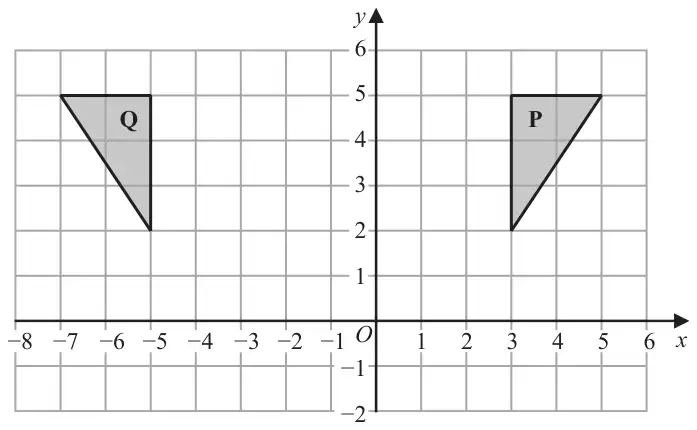
Grid with x from −8 to 6 and y from −2 to 6; triangle P with vertices (3, 2), (3, 5), (5, 5); triangle Q with vertices (−5, 2), (−5, 5), (−7, 5)
(b) Describe fully the single transformation that maps triangle P onto triangle Q. (2)

Foundation June 2019 Paper 2 Q4

EdexcelFoundationCurrent spec4 marksAngles in PolygonsTransformations of Shapes

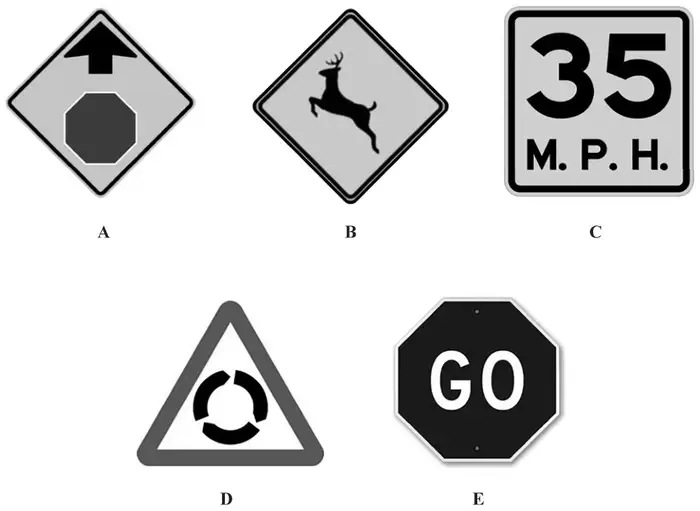
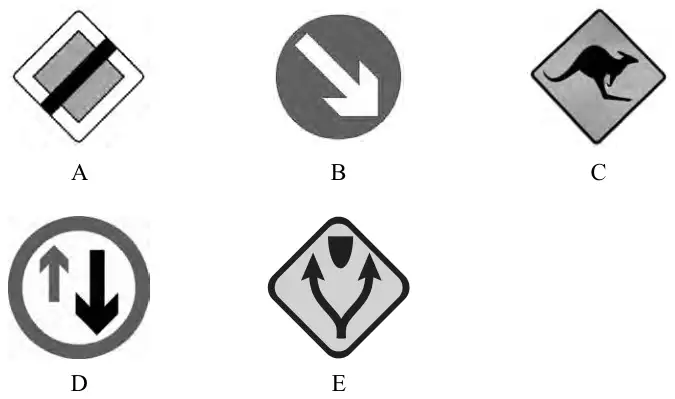
4 Here are five road signs.

Five road signs: A a diamond with an arrow above an octagon, B a diamond with a leaping deer, C a rectangle reading 35 M.P.H., D a triangle with a roundabout symbol of three arrows, E an octagon reading GO

One of these five road signs has one line of symmetry.

(a) Write down the letter of this road sign. (1)

One of these five road signs has an order of rotational symmetry greater than 1

(b)
(i) Write down the letter of this road sign.
(ii) Write down the order of rotational symmetry of this road sign.
(2)

Road sign E is in the shape of a polygon with 8 sides.

(c) Write down the name of a polygon with 8 sides. (1)

Foundation January 2019 Paper 1 Q16

EdexcelFoundationCurrent spec6 marksTransformations of Shapes

16

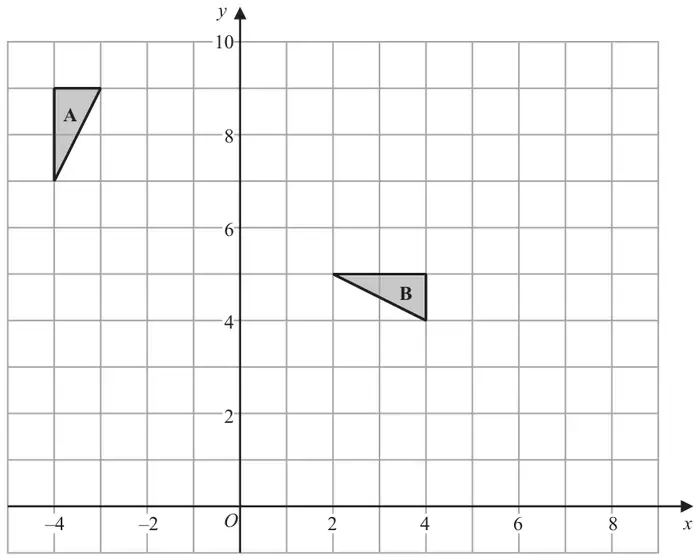
Grid with x from −4 to 9 and y from −1 to 10 showing triangle A with vertices (−4, 9), (−3, 9), (−4, 7) and triangle B with vertices (2, 5), (4, 5), (4, 4)
(a) Describe fully the single transformation that maps triangle A onto triangle B. (3)
(b) On the grid, translate triangle A by the vector \(\begin{pmatrix} 2 \\ -5 \end{pmatrix}\)
Label the new triangle C. (1)
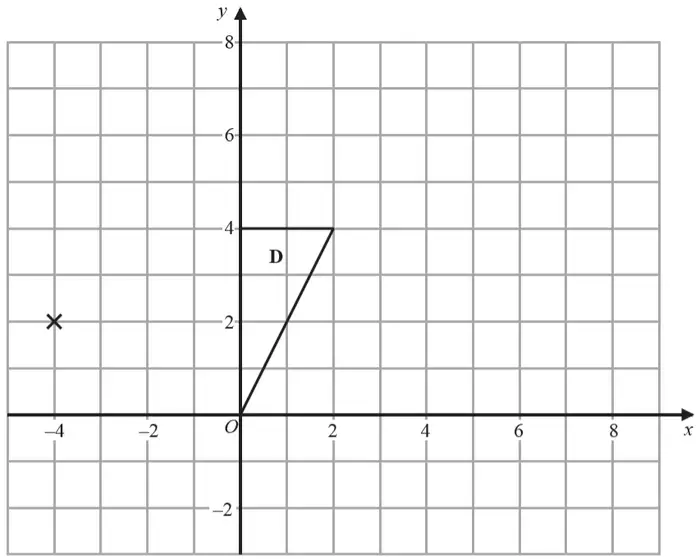
Grid with x from −5 to 9 and y from −3 to 8 showing triangle D with vertices (0, 0), (0, 4), (2, 4) and a cross at (−4, 2)
(c) On the grid, enlarge triangle D with scale factor \(\dfrac{1}{2}\) and centre \((-4, 2)\) (2)

Foundation January 2019 Paper 1R Q11

EdexcelFoundationCurrent spec5 marksTransformations of Shapes

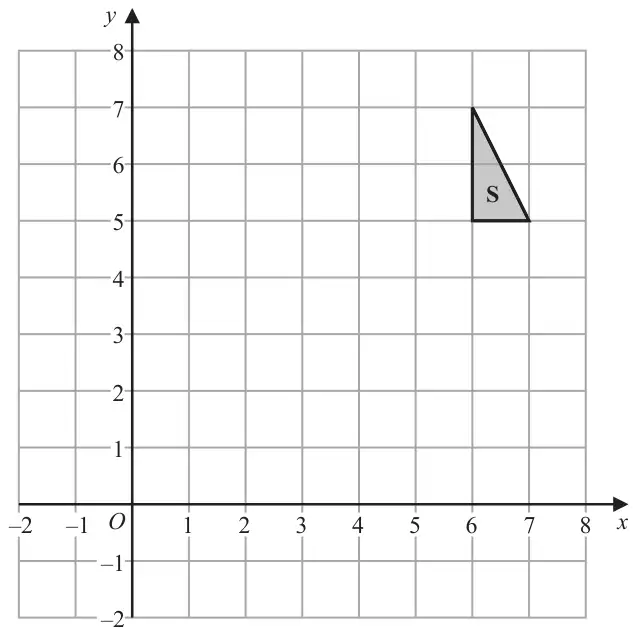
11 Here is a triangle S drawn on a grid of squares.

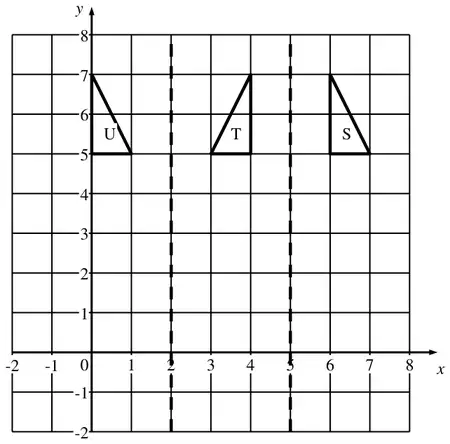
Grid with x from -2 to 8 and y from -2 to 8; triangle S has vertices (6, 5), (7, 5) and (6, 7)
(a) On the grid, reflect triangle S in the line with equation \(x = 5\)
Label the new triangle T. (2)
(b) On the grid, reflect triangle T in the line with equation \(x = 2\)
Label the new triangle U. (1)
(c) Describe fully the single transformation that maps triangle S onto triangle U. (2)

Higher January 2019 Paper 1 Q2

EdexcelHigherCurrent spec6 marksTransformations of Shapes

2

Grid with x from −5 to 9 and y from −1 to 10 showing triangle A with vertices (−4, 7), (−4, 9), (−3, 9) and triangle B with vertices (2, 5), (4, 5), (4, 4)
(a) Describe fully the single transformation that maps triangle A onto triangle B. (3)
(b) On the grid, translate triangle A by the vector \(\begin{pmatrix} 2 \\ -5 \end{pmatrix}\)
Label the new triangle C. (1)
Grid with x from −5 to 9 and y from −3 to 8 showing triangle D with vertices (0, 0), (0, 4), (2, 4) and a cross marked at (−4, 2)
(c) On the grid, enlarge triangle D with scale factor \(\dfrac{1}{2}\) and centre \((-4, 2)\) (2)

Foundation June 2018 Paper 1R Q17

EdexcelFoundationCurrent spec5 marksTransformations of Shapes

17

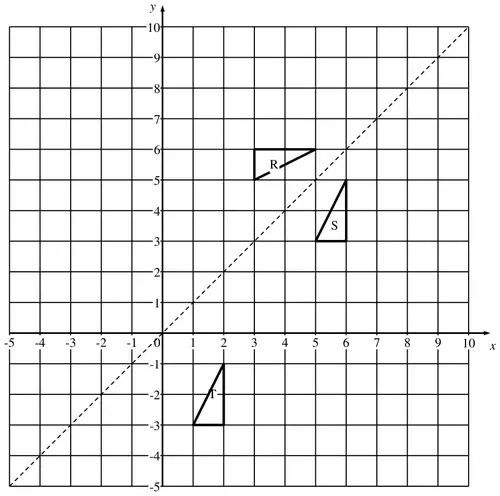
Grid with x from -5 to 10 and y from -5 to 8; triangle S has vertices (5, 3), (6, 3) and (6, 5)
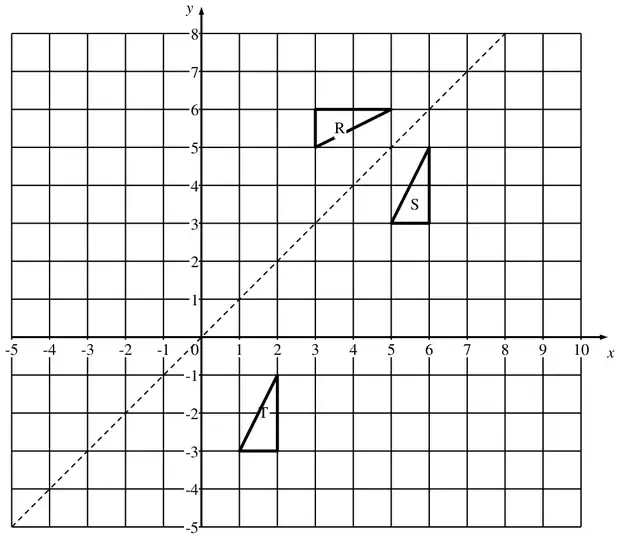
(a) Reflect triangle S in the line \(y = x\)
Label the new triangle R. (2)
(b) Translate triangle S by the vector \(\begin{pmatrix} -4 \\ -6 \end{pmatrix}\)
Label the new triangle T. (1)
Grid with x from -2 to 8 and y from -2 to 14; triangle P has vertices (1, 2), (2, 2) and (1, 4); triangle Q has vertices (3, 6), (6, 6) and (3, 12)
(c) Describe fully the single transformation that maps triangle P onto triangle Q. (2)

Foundation June 2018 Paper 1 Q12

EdexcelFoundationCurrent spec4 marksTransformations of Shapes

12

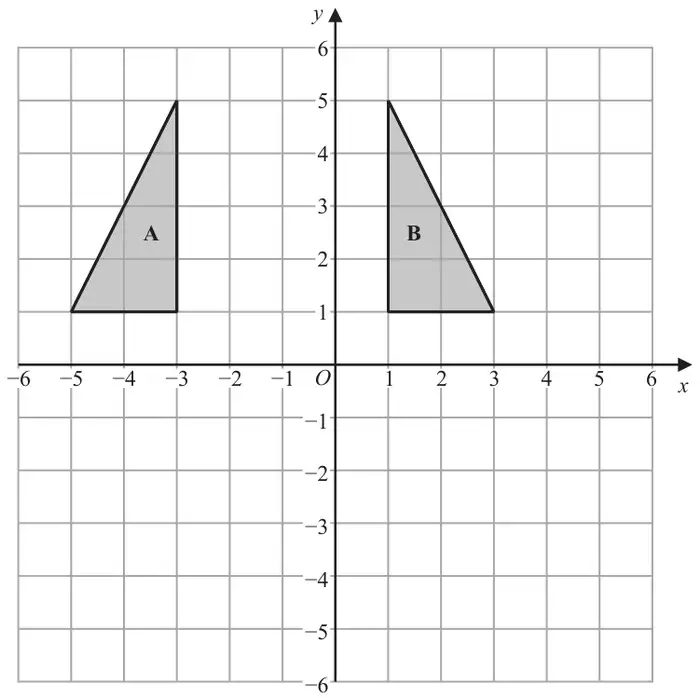
Grid with x and y from -6 to 6; triangle A has vertices (-5, 1), (-3, 1), (-3, 5); triangle B has vertices (1, 1), (3, 1), (1, 5)
(a) Describe fully the single transformation that maps triangle A onto triangle B. (2)
(b) On the grid, translate triangle B by the vector \(\begin{pmatrix} 2 \\ -6 \end{pmatrix}\)
Label your triangle C. (1)
(c) Describe fully the single transformation that maps triangle C onto triangle B. (1)

Higher June 2018 Paper 1R Q3

EdexcelHigherCurrent spec3 marksTransformations of Shapes

3

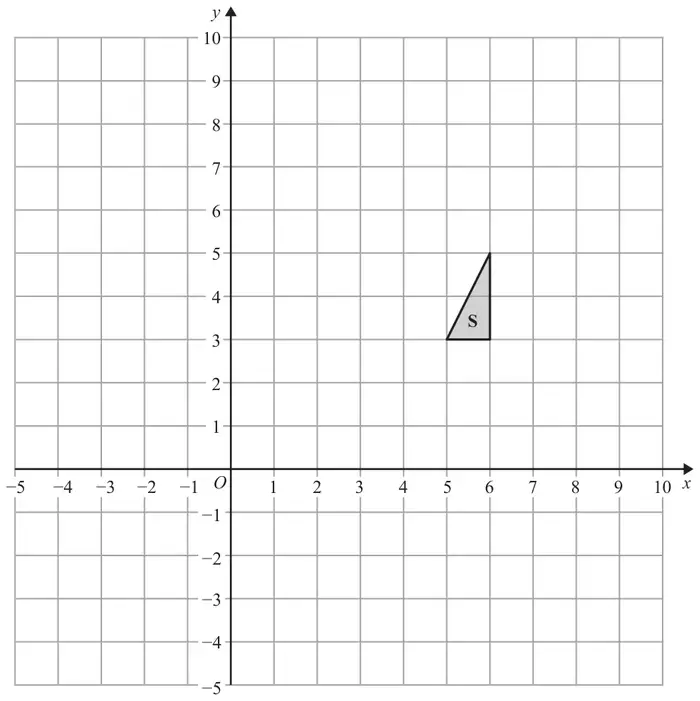
Grid with x from -5 to 10 and y from -5 to 10; triangle S has vertices (5, 3), (6, 3) and (6, 5)
(a) Reflect triangle S in the line \(y = x\)
Label the new triangle R. (2)
(b) Translate triangle S by the vector \(\begin{pmatrix} -4 \\ -6 \end{pmatrix}\)
Label the new triangle T. (1)

4MA0 Foundation January 2018 Paper 2 Q19

EdexcelFoundationOld spec2 marksTransformations of Shapes

19

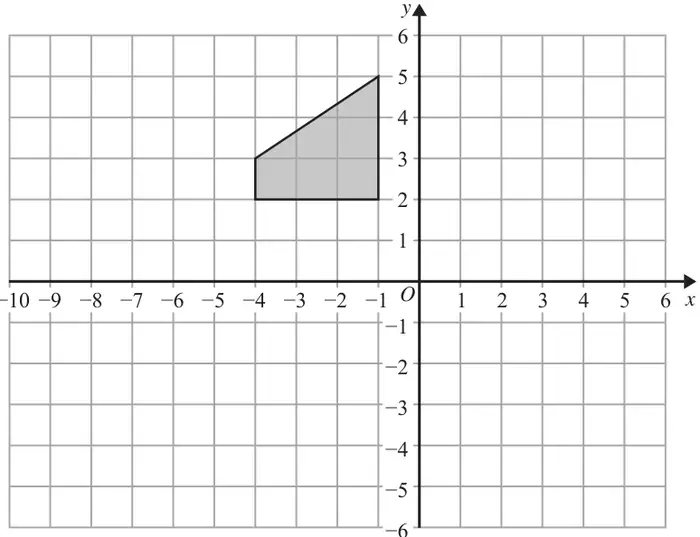
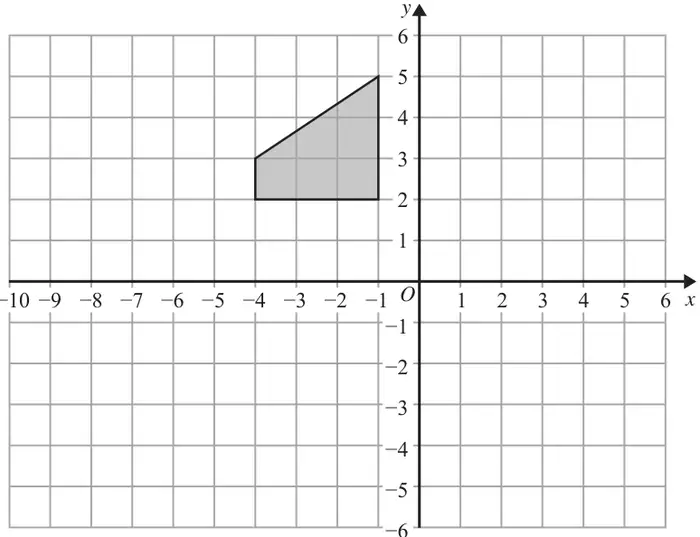
Grid with x from -10 to 6 and y from -6 to 6; a shaded quadrilateral with vertices (-4, 2), (-1, 2), (-1, 5) and (-4, 3)

Rotate the shaded shape 90° clockwise about the point (−2, −1)

(2)

4MA0 Foundation January 2018 Paper 2R Q12

EdexcelFoundationOld spec6 marksSimilar ShapesTransformations of Shapes

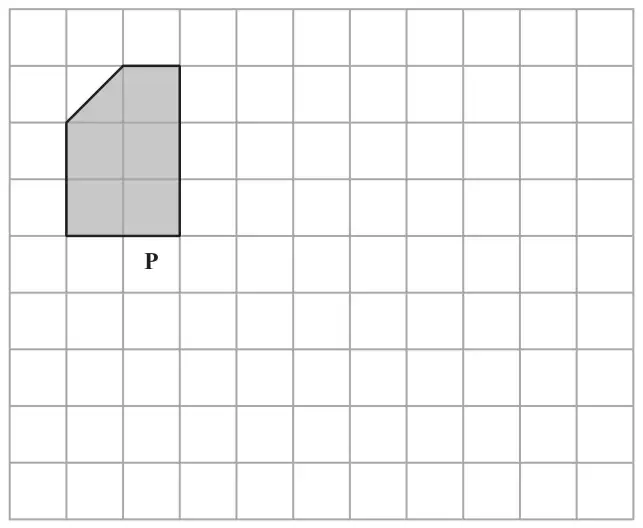
12 The diagram shows shape P on a centimetre grid.

Centimetre grid with shaded shape P
(a)
(i) Find the area of shape P.
(ii) On the grid above, draw a shape that is similar but not congruent to shape P.
(2)

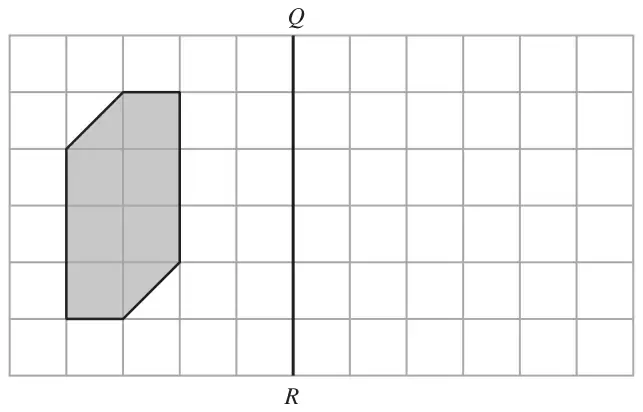
The diagram shows a shape on a centimetre grid and a line \(QR\).

Centimetre grid with a shaded shape to the left of the vertical line QR
(b) On the grid, reflect the shape in the line \(QR\). (2)

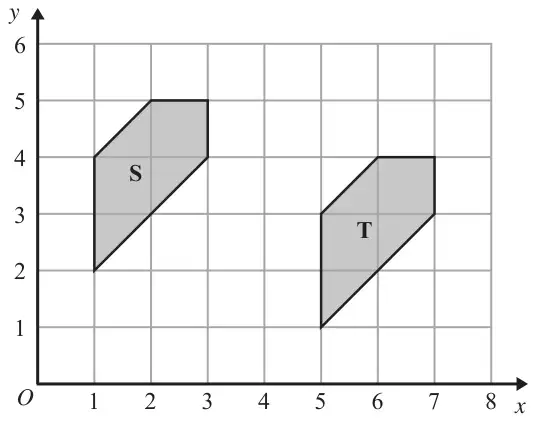
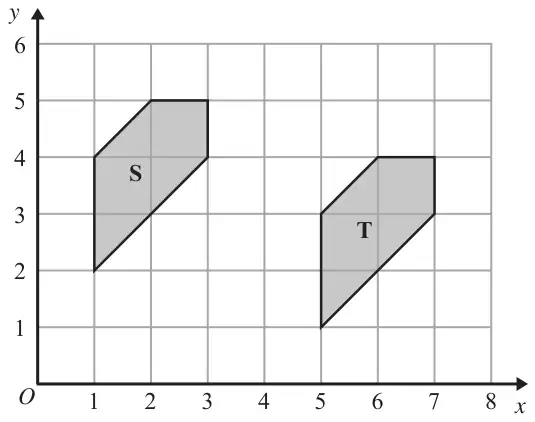
The diagram shows shape S and shape T on a centimetre grid.

Grid with x from 0 to 8 and y from 0 to 6 showing shaded shapes S and T
(c) Describe fully the single transformation that maps shape S onto shape T. (2)

4MA0 Foundation January 2018 Paper 1 Q10

EdexcelFoundationOld spec2 marksTransformations of Shapes

10

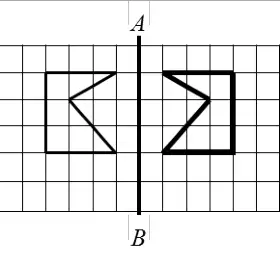
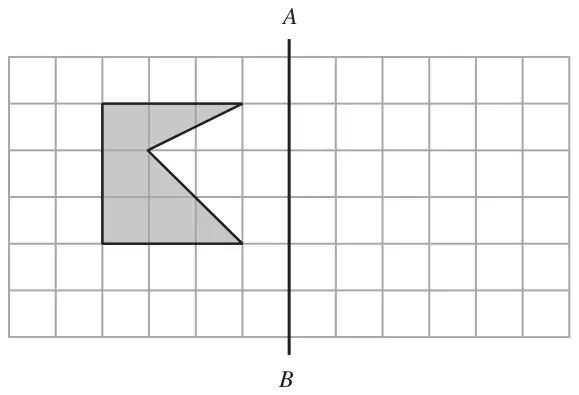
(a) On the grid, reflect the shaded shape in the line \(AB\).
Grid with a shaded shape to the left of the vertical line AB
(1)

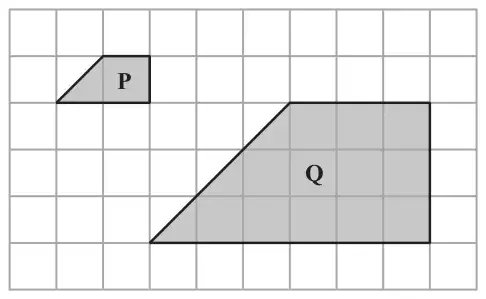
Shape Q is an enlargement of shape P.

Grid with small shaded shape P and larger shaded shape Q
(b) Write down the scale factor of the enlargement. (1)

4MA0 Higher January 2018 Paper 4 Q6

EdexcelHigherOld spec2 marksTransformations of Shapes

6

Grid with x from -10 to 6 and y from -6 to 6; a shaded quadrilateral with vertices (-4, 2), (-1, 2), (-1, 5) and (-4, 3)

Rotate the shaded shape 90° clockwise about the point (−2, −1)

(2)

4MA0 Higher January 2018 Paper 4R Q5

EdexcelHigherOld spec4 marksTransformations of Shapes

5 The diagram shows shape S and shape T on a centimetre grid.

Grid with x from 0 to 8 and y from 0 to 6 showing shaded shapes S and T; S has vertices (1, 2), (1, 4), (2, 5), (3, 5), (3, 4) and T has vertices (5, 1), (5, 3), (6, 4), (7, 4), (7, 3)
(a) Describe fully the single transformation that maps shape S onto shape T. (2)
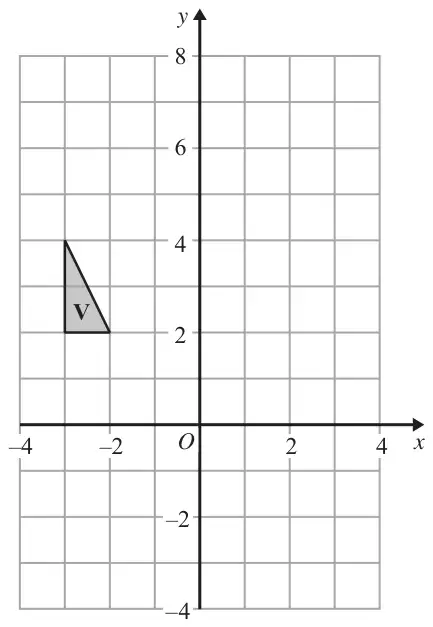
(b) On the grid, rotate triangle V 90° anticlockwise about the point (2, 2)
Grid with x from -4 to 4 and y from -4 to 8 showing shaded triangle V with vertices (-3, 2), (-2, 2) and (-3, 4)
(2)

4MA0 Foundation January 2018 Paper 2R Q3

EdexcelFoundationOld spec6 marksAngles in PolygonsTransformations of Shapes

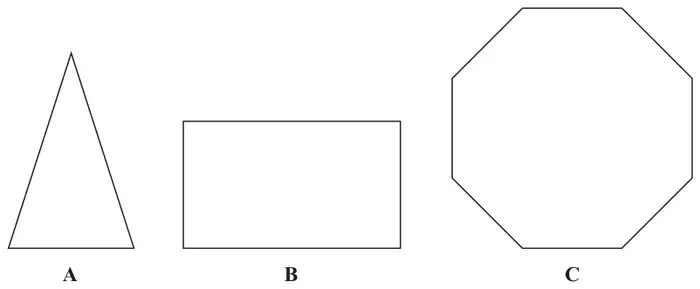
3 Here are three shapes.

Shape A a triangle, shape B a rectangle and shape C a regular octagon

Shape A is a triangle with 2 equal sides.

(a)
(i) What type of triangle is shape A?
(ii) On this triangle, draw its line of symmetry.
(2)

Shape B is a rectangle.

(b) Write down the order of rotational symmetry of shape B. (1)

Shape C is a regular polygon with sides of length 2 cm.

(c)
(i) Write down the name of shape C. (1)
(ii) Find the perimeter of shape C. (2)

4MA0 Foundation January 2018 Paper 2 Q3

EdexcelFoundationOld spec4 marks2D Area & PerimeterTransformations of Shapes

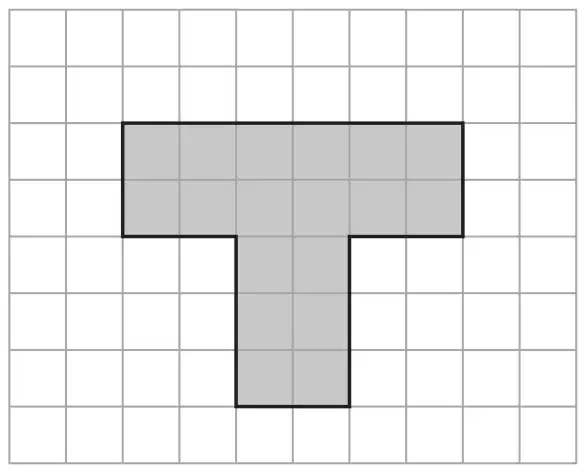
3 Here is a shaded shape drawn on a grid of centimetre squares.

T-shaped shaded shape on a centimetre grid
(a) Find the area of the shape. (1)
(b) Find the perimeter of the shape. (1)
(c) How many lines of symmetry does the shape have? (1)
(d) In the space below, sketch a hexagon. (1)

4MA0 Foundation June 2017 Paper 1R Q23

EdexcelFoundationOld spec3 marksTransformations of Shapes

23

Coordinate grid with x and y from -5 to 5; shape S is a trapezium with vertices (2, 1), (2, 2), (4, 4) and (4, 1)
(a) On the grid above, translate shape S by 1 square to the left and 3 squares down. (1)
Coordinate grid with x from -5 to 5 and y from -6 to 6; triangle T with vertices (2, 1), (4, 1) and (4, 4)
(b) On the grid, rotate triangle T 90° clockwise about (0, 2). (2)

4MA0 Foundation June 2017 Paper 1 Q15

EdexcelFoundationOld spec4 marksTransformations of Shapes

15

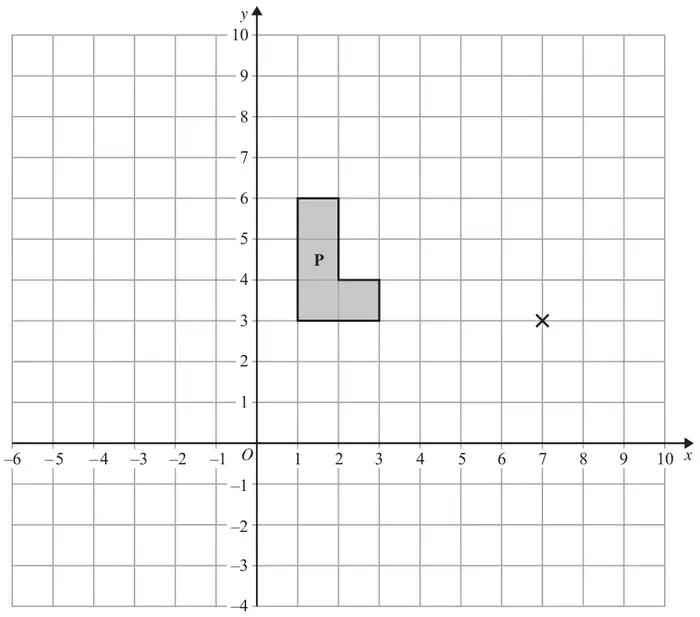
Grid with x from -6 to 10 and y from -4 to 10; shaded L-shape P with vertices (1, 3), (1, 6), (2, 6), (2, 4), (3, 4), (3, 3), and a cross at (7, 3)
(a) On the grid, enlarge shape P with scale factor 2 and centre (7, 3)
Label the new shape Q. (2)
(b) On the grid, rotate shape P through 90° anticlockwise about the point (7, 3)
Label the new shape R. (2)

4MA0 Foundation June 2017 Paper 1R Q11

EdexcelFoundationOld spec4 marksTransformations of Shapes

11 Here is a shape.

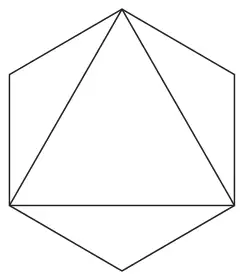
Regular hexagon with an equilateral triangle drawn inside joining three alternate vertices
(a) On the shape, draw all the lines of symmetry of the shape. (2)
(b) Write down the order of rotational symmetry of the shape. (1)

Here is a different shape.

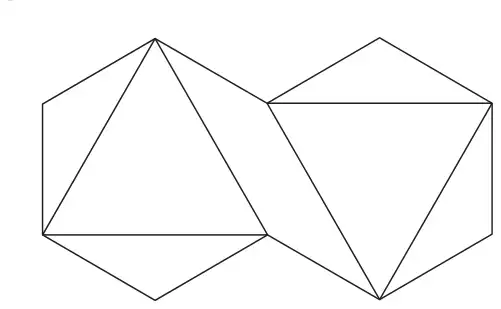
Two regular hexagons side by side sharing a vertex; the left one has a triangle drawn inside pointing up and the right one a triangle pointing down
(c) Write down the order of rotational symmetry of this shape. (1)

4MA0 Higher June 2017 Paper 3R Q8

EdexcelHigherOld spec3 marksTransformations of Shapes

8

Grid with x from -5 to 5 and y from -6 to 6; triangle T with vertices (2, 1), (4, 1) and (4, 4)
(a) On the grid above, rotate triangle T 90° clockwise about (0, 2). (2)
Grid with x from -5 to 5 and y from -5 to 5; shape S with vertices (2, 1), (4, 1), (4, 4) and (2, 2)
(b) On the grid, translate shape S by the vector \(\begin{pmatrix} -1 \\ -3 \end{pmatrix}\). (1)

4MA0 Higher June 2017 Paper 3 Q2

EdexcelHigherOld spec4 marksTransformations of Shapes

2

Grid with x from -6 to 10 and y from -4 to 10; shaded L-shape P with vertices (1, 3), (1, 6), (2, 6), (2, 4), (3, 4), (3, 3), and a cross at (7, 3)
(a) On the grid, enlarge shape P with scale factor 2 and centre (7, 3)
Label the new shape Q. (2)
(b) On the grid, rotate shape P through 90° anticlockwise about the point (7, 3)
Label the new shape R. (2)

4MA0 Foundation June 2017 Paper 1 Q1

EdexcelFoundationOld spec5 marks2D Area & PerimeterTransformations of Shapes

1 The diagram shows a shape on a centimetre grid.

Cross-shaped shape on a centimetre grid
(a) Find the area of the shape. (1)
(b) Find the perimeter of the shape. (1)
(c) Write down the order of rotational symmetry of the shape. (1)
(d) On the shape, draw all the lines of symmetry. (2)

4MA0 Foundation January 2017 Paper 1R Q15

EdexcelFoundationOld spec4 marksTransformations of Shapes

15

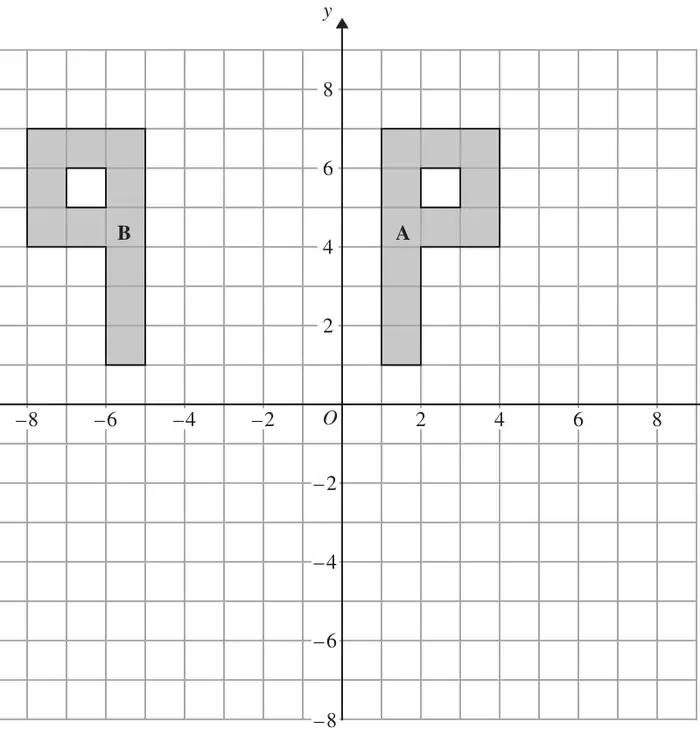
Grid with x from -8 to 8 and y from -8 to 8; shape A with vertices (1, 2), (1, 5), (3, 5), (6, 2) and shape B with vertices (1, -4), (1, -7), (3, -7), (6, -4)
(a) Describe fully the single transformation that maps shape A onto shape B. (2)
(b) On the grid, rotate shape A 90° anticlockwise about (0, 0)
Label the new shape C. (2)

4MA0 Higher January 2017 Paper 4 Q11

EdexcelHigherOld spec5 marksTransformations of Shapes

11

Grid with x from -4 to 6 and y from -4 to 5; shaded triangle Q with vertices (5, 0), (5, -2) and (3, -3)
(a) On the grid, reflect triangle Q in the line \(x = 1\)
Label the new triangle R. (2)

Triangle R is mapped onto triangle S by a reflection in the line \(y = 0\)

(b) Describe fully the single transformation that maps triangle Q onto triangle S. (3)

4MA0 Foundation January 2017 Paper 2 Q11

EdexcelFoundationOld spec5 marks2D Area & PerimeterTransformations of Shapes

11 The diagram shows triangle P drawn on a centimetre grid.

Centimetre grid with x from -3 to 7 and y from -6 to 3; shaded triangle P with vertices (-1, 1), (3, 1) and (0, -2)
(a) Work out the area of triangle P. (1)

Triangle E is an enlargement of triangle P with centre \(O\) and scale factor 2

(b) On the grid, draw triangle E. (2)
Grid with x from -4 to 6 and y from -4 to 5; shaded triangle Q with vertices (5, 0), (5, -2) and (3, -3)
(c) On the grid, reflect triangle Q in the line \(x = 1\) (2)

4MA0 Foundation January 2017 Paper 1 Q8

EdexcelFoundationOld spec3 marksTransformations of Shapes

8

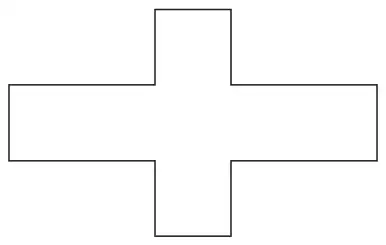
Cross-shaped figure (a plus sign)
(a) On the shape above, draw the lines of symmetry of the shape. (1)
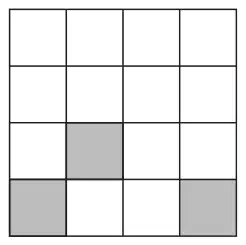
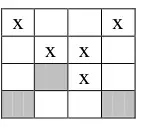
(b) Shade 5 more squares of the shape below so that the shape has rotational symmetry of order 4
4 by 4 square grid with 3 squares shaded: row 3 column 2, row 4 column 1 and row 4 column 4
(1)
(c) On the grid, draw a quadrilateral with 1 line of symmetry and no rotational symmetry.
Empty square grid of 9 by 5 squares
(1)

4MA0 Higher January 2017 Paper 3R Q6

EdexcelHigherOld spec4 marksTransformations of Shapes

6

Grid with x from -8 to 8 and y from -8 to 8; shape A with vertices (1, 2), (1, 5), (3, 5) and (6, 2); shape B with vertices (1, -4), (1, -7), (3, -7) and (6, -4)
(a) Describe fully the single transformation that maps shape A onto shape B. (2)
(b) On the grid, rotate shape A 90° anticlockwise about (0, 0)
Label the new shape C. (2)

4MA0 Foundation January 2017 Paper 2R Q3

EdexcelFoundationOld spec4 marks2D Area & PerimeterTransformations of Shapes

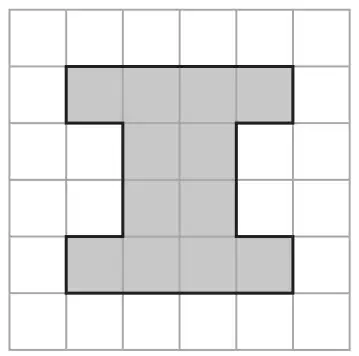
3 The diagram shows a shape drawn on a centimetre grid.

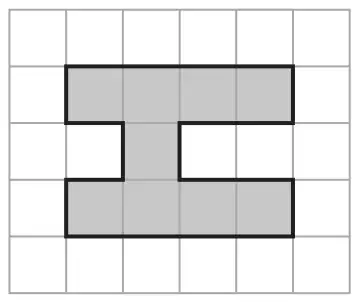
Shaded I-shaped figure on a centimetre grid: a top bar 4 squares wide, a middle stem 2 squares wide and a bottom bar 4 squares wide
(a)
(i) Find the area of the shape.
(ii) Find the perimeter of the shape.
(iii) On the grid, draw the line of symmetry of the shape.
(3)

Here is a different shape.

A quadrilateral with one obtuse angle
(b) On this shape, mark an obtuse angle.
Label your angle O (1)

4MA0 Foundation June 2016 Paper 1R Q22

EdexcelFoundationOld spec4 marksTransformations of Shapes

22

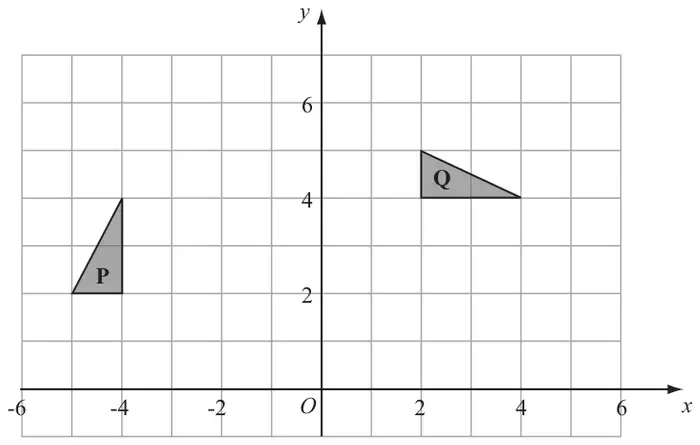
Grid with x and y from -5 to 5; shape P with vertices (-3, 1), (-3, 3), (-2, 3), (-2, 2); shape Q with vertices (2, -3), (2, -1), (3, -1), (3, -2)
(a) Describe fully the single transformation that maps shape P onto shape Q. (2)
(b) Rotate shape Q 90° clockwise about (1, 0)
Label the new shape R. (2)

4MA0 Foundation June 2016 Paper 2 Q18

EdexcelFoundationOld spec6 marksTransformations of Shapes

18

Grid with x from -4 to 12 and y from -3 to 7; triangle A with vertices (2, 2), (5, 2), (2, 3); triangle B with vertices (3, 4), (9, 4), (3, 6)
(a) Describe fully the single transformation that maps triangle A onto triangle B. (3)
(b) On the grid, translate triangle A 5 units in the positive \(x\) direction and 4 units in the negative \(y\) direction.
Label the new shape C. (1)
Grid with x from -4 to 7 and y from -5 to 6; triangle D with vertices (2, 2), (5, 2), (2, 3)
(c) On the grid, rotate triangle D 90° anticlockwise with centre (3, 1) (2)

4MA0 Foundation June 2016 Paper 2R Q15

EdexcelFoundationOld spec3 marksTransformations of Shapes

15

Grid with x from -2 to 11 and y from -2 to 11; shape S with vertices (2, 3), (4, 3), (4, 4), (3, 4); a cross marks the point (1, 1)
(a) Enlarge shape S, by scale factor 2, centre (1, 1).
Label the new shape T. (2)
(b) Describe fully the single transformation that maps shape T onto shape S. (1)

4MA0 Foundation June 2016 Paper 1 Q9

EdexcelFoundationOld spec8 marksAngles in PolygonsTransformations of Shapes

9 Here are six quadrilaterals.

Six quadrilaterals: A a parallelogram, B a square, C a kite, D a trapezium, E a rhombus, F a rectangle
(a) Write down the mathematical name for quadrilateral C. (1)

Two of the quadrilaterals have no lines of symmetry.

(b) Write down the letters of these two quadrilaterals. (2)

Two of the quadrilaterals have 2 lines of symmetry and rotational symmetry of order 2

(c) Write down the letters of these two quadrilaterals. (2)
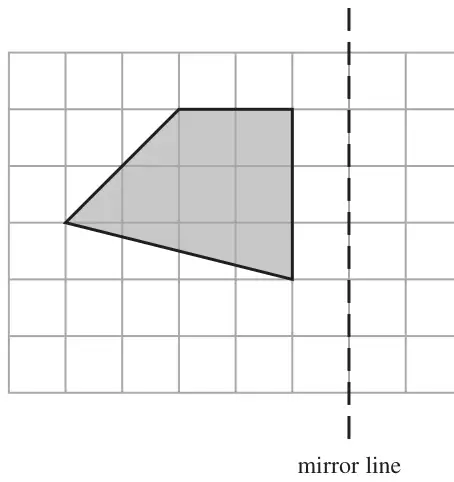
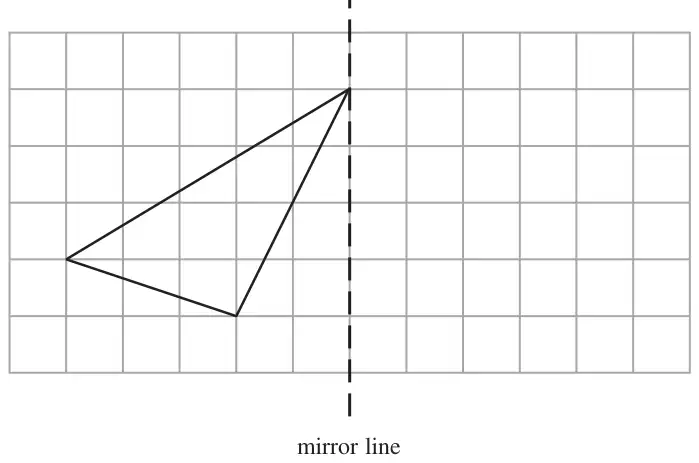
(d) On the grid, reflect the shaded shape in the mirror line.
Square grid with a shaded quadrilateral to the left of a vertical dashed mirror line
(1)

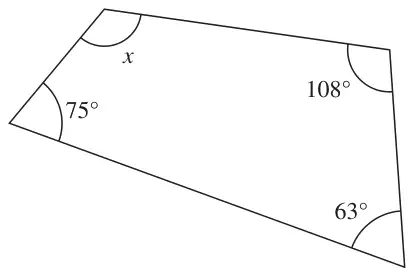
Here is a different quadrilateral.

Quadrilateral with angles 75°, x, 108° and 63°

Diagram NOT accurately drawn

(e) Work out the size of the angle marked \(x\). (2)

4MA0 Higher June 2016 Paper 3R Q8

EdexcelHigherOld spec4 marksTransformations of Shapes

8

Grid with x and y from −5 to 5 showing shape P with vertices (−3, 1), (−3, 3), (−2, 3), (−2, 2) and shape Q with vertices (2, −3), (2, −1), (3, −1), (3, −2)
(a) Describe fully the single transformation that maps shape P onto shape Q. (2)
(b) Rotate shape Q 90° clockwise about (1,0)
Label the new shape R. (2)

4MA0 Higher June 2016 Paper 4 Q8

EdexcelHigherOld spec6 marksTransformations of Shapes

8

Grid with triangle A with vertices (2, 2), (2, 3), (5, 2) and triangle B with vertices (3, 4), (3, 6), (9, 4)
(a) Describe fully the single transformation that maps triangle A onto triangle B. (3)
(b) On the grid, translate triangle A by the vector \(\begin{pmatrix} 5 \\ -4 \end{pmatrix}\)
Label the new shape C. (1)
Grid with triangle D with vertices (2, 2), (2, 3), (5, 2)
(c) On the grid, rotate triangle D 90° anticlockwise with centre (3, 1) (2)

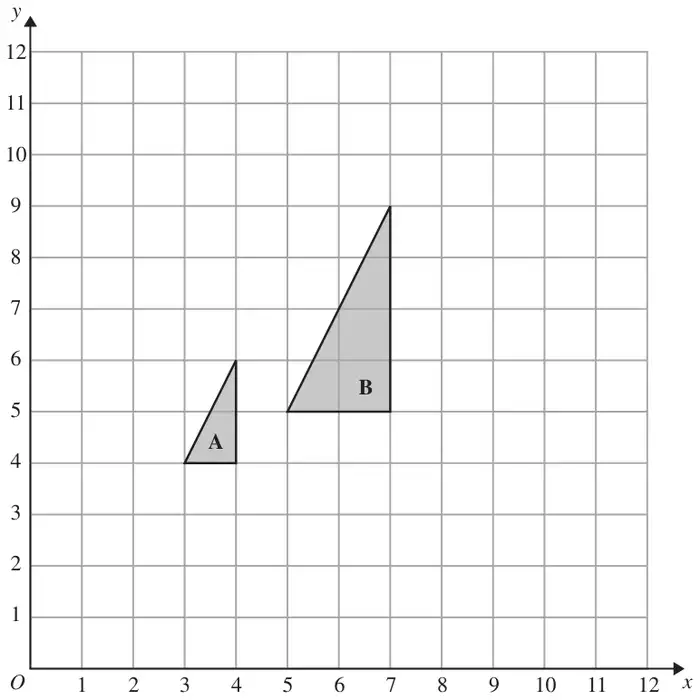
4MA0 Foundation June 2016 Paper 2R Q5

EdexcelFoundationOld spec3 marksSimilar ShapesTransformations of Shapes

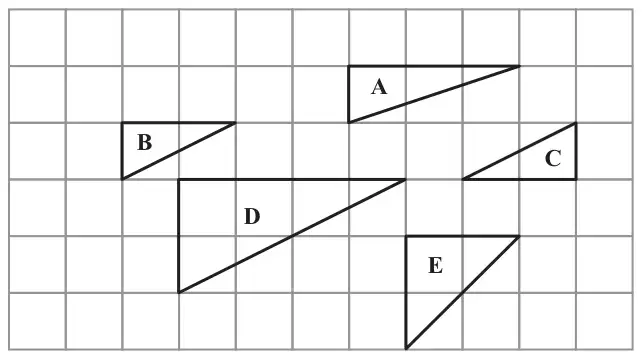
5 Here are five triangles drawn on a square grid.

Five right-angled triangles A, B, C, D and E on a square grid
(a) Write down the letters of the two triangles that are congruent. (1)

One of the triangles is similar to triangle B.

(b) Write down the letter of this triangle. (1)
(c) Write down the letter of the triangle that has one line of symmetry. (1)

4MA0 Higher June 2016 Paper 4R Q1

EdexcelHigherOld spec3 marksTransformations of Shapes

1

Grid with x from −2 to 11 and y from −2 to 11 showing shape S with vertices (2, 3), (3, 4), (4, 4), (4, 3) and the point (1, 1) marked with a cross
(a) Enlarge shape S, by scale factor 2, centre (1,1).
Label the new shape T. (2)
(b) Describe fully the single transformation that maps shape T onto shape S. (1)

4MA0 Foundation January 2016 Paper 1R Q13

EdexcelFoundationOld spec6 marksTransformations of Shapes

13

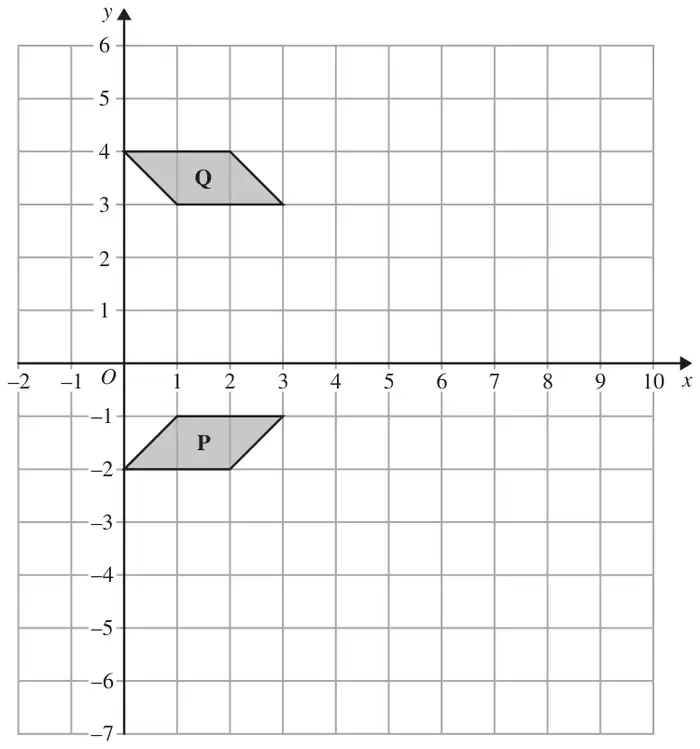
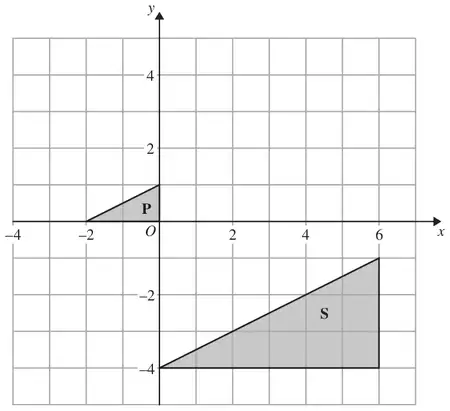
Grid with x from -2 to 10 and y from -7 to 6 showing parallelogram P with vertices (0, -2), (1, -1), (3, -1), (2, -2) and parallelogram Q with vertices (0, 4), (1, 3), (3, 3), (2, 4)
(a) Describe fully the single transformation that maps shape P onto shape Q. (2)
(b) On the grid above, enlarge shape P with scale factor 3 and centre \(O\). (2)
Grid with x from -6 to 6 and y from -6 to 6 showing parallelogram R with vertices (0, 4), (1, 3), (3, 3), (2, 4)
(c) On the grid above, rotate shape R \(90^\circ\) anticlockwise with centre (0, 1) (2)

4MA0 Foundation January 2016 Paper 1 Q7

EdexcelFoundationOld spec4 marks2D Area & PerimeterTransformations of Shapes

7 The diagram shows triangle ABC drawn on a centimetre grid.

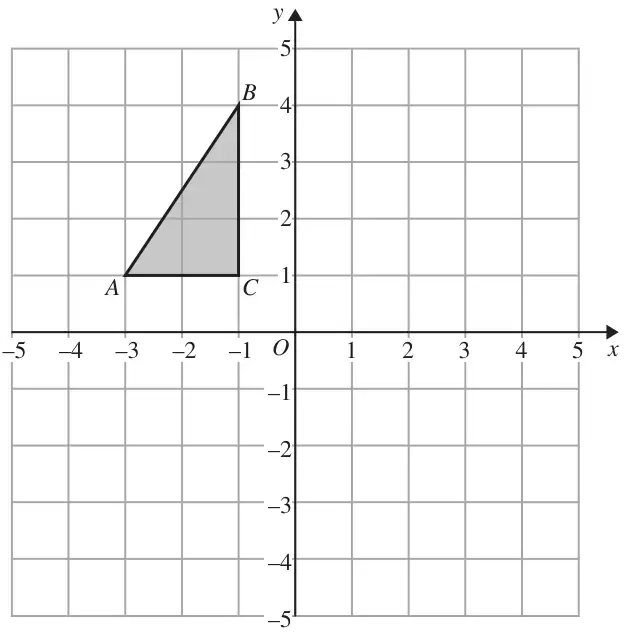
Grid with x and y from -5 to 5; shaded triangle ABC with A(-3, 1), B(-1, 4) and C(-1, 1)
(a) Write down the coordinates of point A. (1)
(b) Reflect triangle ABC in the \(x\)-axis. (1)
(c) Work out the area of triangle ABC.
You must include the units with your answer. (2)

4MA0 Foundation January 2016 Paper 2R Q6

EdexcelFoundationOld spec4 marks2D Area & PerimeterTransformations of Shapes

6 Here are six shapes made from centimetre squares.

Six shapes A to F, each made from five or six centimetre squares, on a square grid
(a) Write down the letter of a shape with rotational symmetry of order 2 (1)
(b) How many lines of symmetry has shape D? (1)
(c) Work out the perimeter of shape E. (1)

Two of the shapes are congruent.

(d) Write down the letters of these two shapes. (1)

4MA0 Foundation January 2016 Paper 2 Q4

EdexcelFoundationOld spec4 marks2D Area & PerimeterTransformations of Shapes

4

(a) On the rectangle, draw all the lines of symmetry.
A rectangle
(2)
(b) Write down the order of rotational symmetry of a rectangle. (1)

Here is a shape made from centimetre squares.

L-shaped shape made from 6 centimetre squares
(c) Find the perimeter of the shape. (1)

4MA0 Higher January 2016 Paper 3R Q3

EdexcelHigherOld spec6 marksTransformations of Shapes

3

Grid with x from -2 to 10 and y from -7 to 6 showing shaded parallelograms P and Q
(a) Describe fully the single transformation that maps shape P onto shape Q. (2)
(b) On the grid above, enlarge shape P with scale factor 3 and centre \(O\). (2)
Grid with x from -6 to 6 and y from -6 to 6 showing shaded parallelogram R
(c) On the grid above, rotate shape R 90° anticlockwise with centre (0, 1) (2)

4MA0 Foundation June 2015 Paper 1R Q17

EdexcelFoundationOld spec4 marksTransformations of Shapes

17

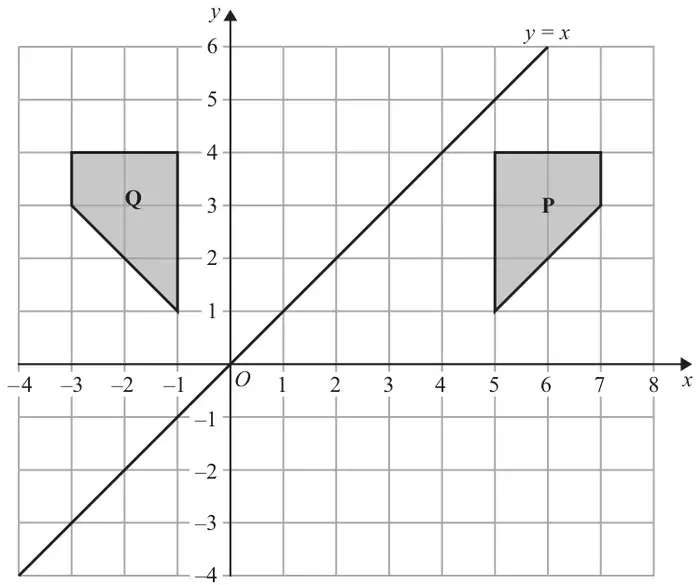
Grid with x from -4 to 8 and y from -4 to 6 showing the line y = x, shape P with vertices (5, 1), (5, 4), (7, 4), (7, 3) and shape Q with vertices (-1, 1), (-1, 4), (-3, 4), (-3, 3)
(a) Describe fully the single transformation which maps shape P onto shape Q. (2)
(b) Reflect the shape Q in the line \(y = x\)
Label the new shape R. (2)

4MA0 Foundation June 2015 Paper 2 Q13

EdexcelFoundationOld spec6 marksSimilar ShapesTransformations of Shapes

13

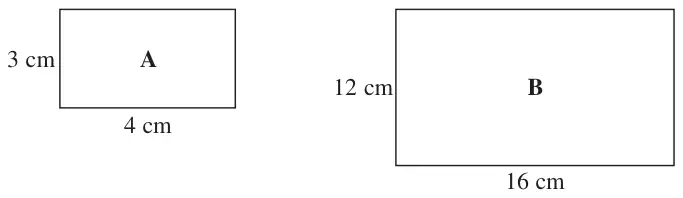
Rectangle A, 4 cm by 3 cm, and rectangle B, 16 cm by 12 cm

Diagram NOT accurately drawn

Rectangle B is an enlargement of rectangle A.

(a) Write down the scale factor of this enlargement. (1)
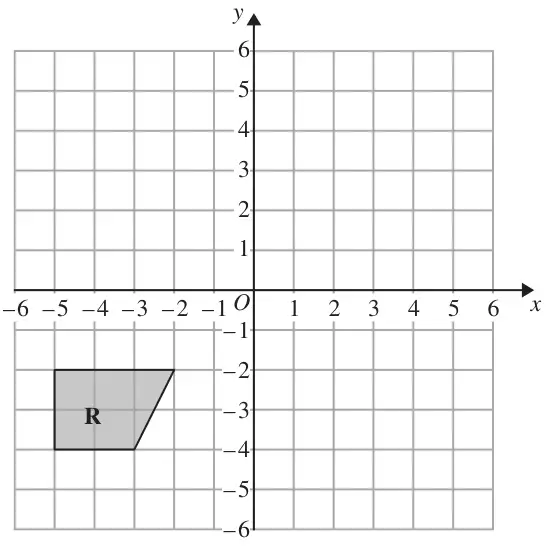
Grid with x and y from -6 to 6 showing shape R with vertices (-5, -2), (-2, -2), (-3, -4), (-5, -4)
(b) On the grid above, reflect shape R in the line \(y = -x\) (2)
Grid with x from -2 to 7 and y from -6 to 6 showing triangle P with vertices (2, 2), (2, 5), (4, 2) and triangle Q with vertices (3, -3), (6, -3), (3, -5)
(c) Describe fully the single transformation that maps triangle P onto triangle Q. (3)

4MA0 Higher June 2015 Paper 4 Q5

EdexcelHigherOld spec5 marksTransformations of Shapes

5

Grid with x and y from -6 to 6 showing shape R in the third quadrant
(a) On the grid above, reflect shape R in the line \(y = -x\) (2)
Grid with x from -2 to 7 and y from -6 to 6 showing triangles P and Q
(b) Describe fully the single transformation that maps triangle P onto triangle Q. (3)

4MA0 Higher June 2015 Paper 3R Q5

EdexcelHigherOld spec6 marksTransformations of Shapes

5

Grid with x from -4 to 8 and y from -4 to 6 showing shapes P and Q and the line y = x
(a) Describe fully the single transformation which maps shape P onto shape Q. (2)
(b) Reflect the shape Q in the line \(y = x\).
Label the new shape R. (2)
Grid with x from -4 to 8 and y from -4 to 6 showing shape S
(c) Enlarge shape S with scale factor \(\dfrac{1}{2}\) and centre (1, 3) (2)

4MA0 Foundation June 2015 Paper 2R Q5

EdexcelFoundationOld spec4 marksSimilar ShapesTransformations of Shapes

5 The diagram shows six triangles on a square grid.

Six triangles labelled A to F on a square grid
(a) Write down the mathematical name for triangle A. (1)
(b) Write down the letters of the two triangles that are similar but not congruent. (1)
(c) Triangle D can be mapped onto triangle B by a rotation.
(i) On the grid, mark with a cross (×) the centre of this rotation.
(ii) Write down the angle of this rotation.
(2)

4MA0 Foundation January 2015 Paper 2 Q17

EdexcelFoundationOld spec4 marksTransformations of Shapes

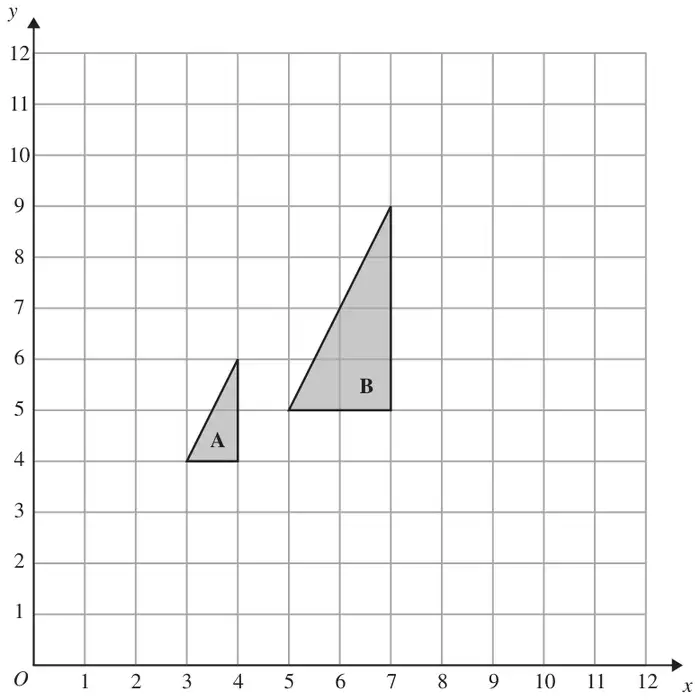
17

Grid with x and y from 0 to 12; triangle A with vertices (3, 4), (4, 4), (4, 6); triangle B with vertices (5, 5), (7, 5), (7, 9)
(a) Describe fully the single transformation that maps triangle A onto triangle B. (3)
(b) On the grid, translate triangle A 5 squares to the right and 2 squares down. (1)

4MA0 Foundation January 2015 Paper 1R Q16

EdexcelFoundationOld spec3 marksTransformations of Shapes

16

Grid with a triangle to the left of a vertical dashed mirror line, one vertex on the mirror line
(a) On the grid, reflect the shape in the mirror line. (1)
Grid with x from 0 to 8 and y from 0 to 11; L-shape A with vertices (1, 1), (3, 1), (3, 2), (2, 2), (2, 4), (1, 4); L-shape B with vertices (5, 7), (7, 7), (7, 8), (6, 8), (6, 10), (5, 10)
(b) Describe fully the single transformation that maps shape A onto shape B. (2)

4MA0 Foundation January 2015 Paper 1 Q9

EdexcelFoundationOld spec6 marks2D Area & PerimeterTransformations of Shapes

9 The diagram shows a shape on a centimetre grid and a line \(AB\).

Centimetre grid with a shaded shape made of squares to the left of a vertical line AB
(a) Measure the length of the line \(AB\). (1)
(b) Write down the order of rotational symmetry of the shape. (1)
(c) Work out the perimeter of the shape. (1)
(d) Work out the area of the shape. (1)
(e) Reflect the shape in the line \(AB\). (2)

4MA0 Foundation January 2015 Paper 2 Q9

EdexcelFoundationOld spec3 marksTransformations of Shapes

9

(a) On the rectangle, draw all the lines of symmetry.
A rectangle
(1)
(b) Here are four quadrilaterals.
Four quadrilaterals: A a parallelogram, B an isosceles trapezium, C a square, D a parallelogram
(i) One of these quadrilaterals has rotational symmetry of order 4
Write down the letter of this quadrilateral.
(ii) One of these quadrilaterals has no lines of symmetry and rotational symmetry of order 2
Write down the letter of this quadrilateral.
(2)

4MA0 Higher January 2015 Paper 4 Q5

EdexcelHigherOld spec4 marksTransformations of Shapes

5

Grid with x and y from 0 to 12 showing small triangle A with vertices (3, 4), (4, 4), (4, 6) and larger triangle B with vertices (5, 5), (7, 5), (7, 9)
(a) Describe fully the single transformation that maps triangle A onto triangle B. (3)
(b) On the grid, translate triangle A by the vector \(\begin{pmatrix} 5 \\ -2 \end{pmatrix}\) (1)

4MA0 Foundation January 2015 Paper 1R Q3

EdexcelFoundationOld spec5 marksAngles in PolygonsTransformations of Shapes

3

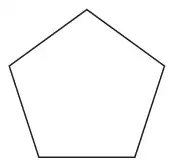
(a) The diagram shows a regular polygon.
A regular pentagon
(i) Write down the mathematical name of this polygon.
(ii) Write down the order of rotational symmetry of this polygon.
(2)
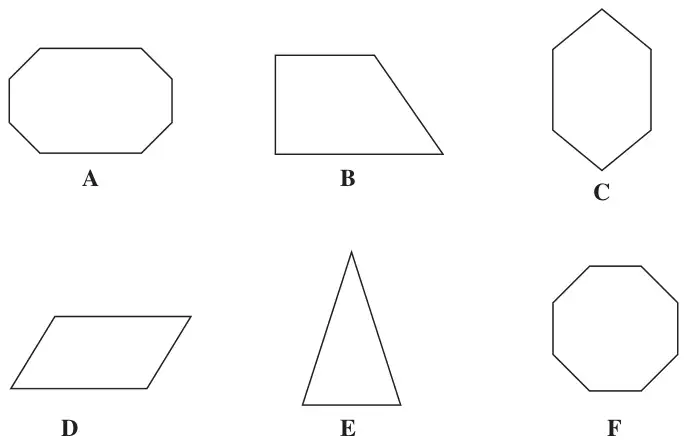
(b) Here are six more polygons.
Six polygons: A an octagon with four long and four short sides, B a right-angled trapezium, C a hexagon elongated vertically, D a parallelogram, E an isosceles triangle, F a regular octagon
(i) Write down the letter of the polygon that has exactly one line of symmetry.
(ii) Write down the letters of the two polygons that have rotational symmetry of order 2 and exactly 2 lines of symmetry.
(3)

4MA0 Foundation June 2014 Paper 2R Q18

EdexcelFoundationOld spec4 marksTransformations of Shapes

18

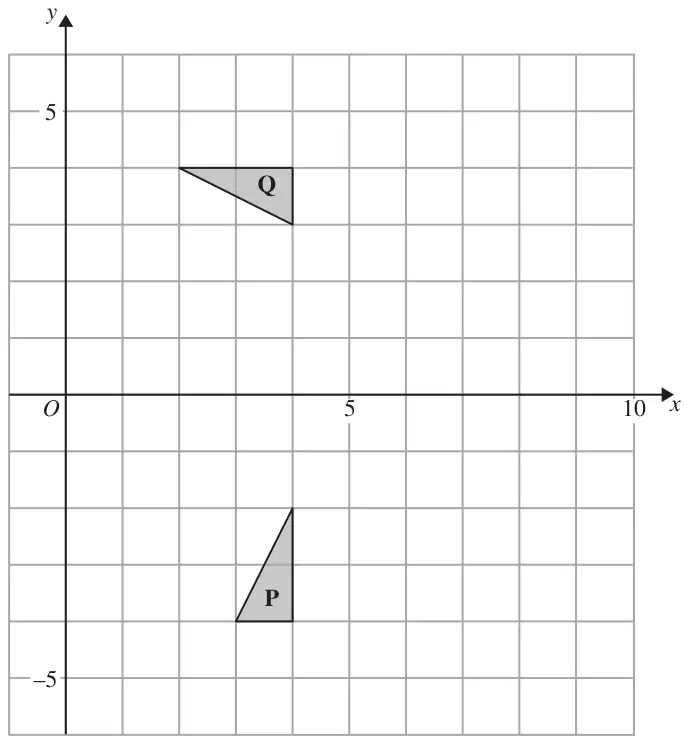
Coordinate grid with triangles P and Q, x from 0 to 10 and y from -5 to 5
(a) Describe fully the single transformation that maps triangle P onto triangle Q. (3)
(b) On the grid, translate triangle P 3 squares to the right and 5 squares up.
Label the new triangle R. (1)

4MA0 Foundation June 2014 Paper 1 Q15

EdexcelFoundationOld spec4 marksTransformations of Shapes

15

Grid with x and y from -8 to 8; shape A in the first quadrant and shape B its mirror image to the left
(a) Describe fully the single transformation that maps shape A onto shape B. (2)
(b) On the grid, rotate shape A 90° clockwise about the origin \(O\).
Label the new shape C. (2)

4MA0 Foundation June 2014 Paper 2R Q8

EdexcelFoundationOld spec4 marksTransformations of Shapes

8 The shaded shape X has been drawn on a centimetre grid.

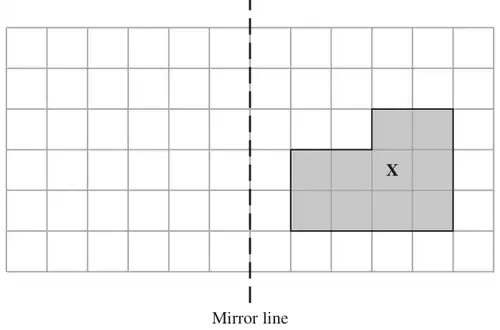
Shaded shape X on a centimetre grid to the right of a vertical dashed mirror line
(a) Reflect the shaded shape X in the mirror line.
Label the new shape Y. (2)

\(\dfrac{2}{5}\) of the centimetre squares in the shaded shape X are going to be coloured black.

(b) How many squares in the shaded shape X are going to be coloured black? (2)

4MA0 Higher June 2014 Paper 4R Q4

EdexcelHigherOld spec4 marksTransformations of Shapes

4

Grid with x from 0 to 10 and y from -5 to 6 showing triangle P and triangle Q
(a) Describe fully the single transformation that maps triangle \(\mathbf{P}\) onto triangle \(\mathbf{Q}\). (3)
(b) On the grid, translate triangle \(\mathbf{P}\) 3 squares to the right and 5 squares up.
Label the new triangle \(\mathbf{R}\). (1)

4MA0 Foundation June 2014 Paper 1 Q3

EdexcelFoundationOld spec5 marks2D Area & PerimeterTransformations of Shapes

3 Here is a shape made from centimetre squares.

Shape of 6 centimetre squares: a column of 3 squares with a row of 3 more squares to the right of the middle square; the two squares next to the column are shaded
(a) On the shape above, draw the line of symmetry. (1)
(b) What fraction of the shape is shaded?
Give your fraction in its simplest form. (2)
(c) Find the perimeter of the shape. (1)
(d) Add two squares to the shape below to make a shape with rotational symmetry of order two.
The same shape of 6 squares
(1)

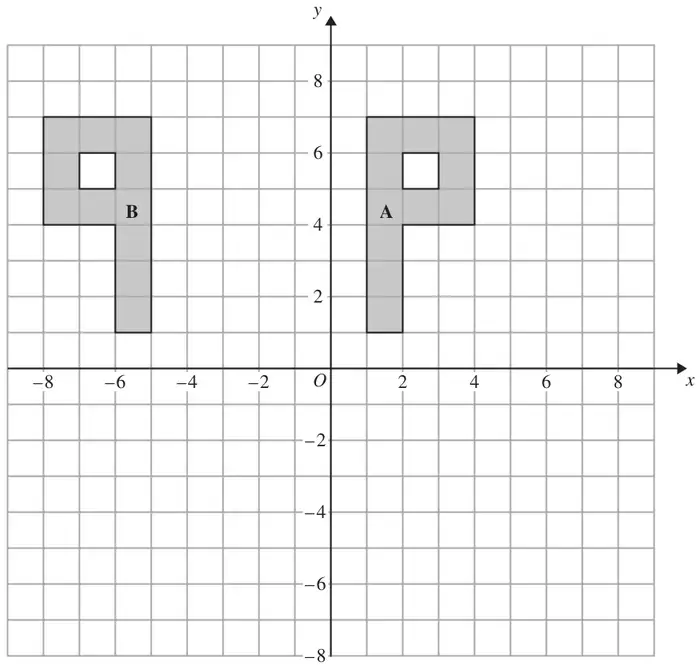
4MA0 Higher June 2014 Paper 3 Q3

EdexcelHigherOld spec4 marksTransformations of Shapes

3

Grid with x and y from -8 to 8 showing shaded shape A in the first quadrant (x from 1 to 4, y from 1 to 7) and its mirror image shape B (x from -8 to -5)
(a) Describe fully the single transformation that maps shape A onto shape B. (2)
(b) On the grid, rotate shape A 90° clockwise about the origin O.
Label the new shape C. (2)

4MA0 Foundation June 2014 Paper 1R Q1

EdexcelFoundationOld spec4 marks2D Area & PerimeterTransformations of Shapes

1 The diagram shows a shape on a centimetre grid.

Shaded I-shaped shape on a centimetre grid
(a) On the grid, draw all the lines of symmetry of the shape. (2)
(b) Write down the order of rotational symmetry of the shape. (1)
(c) Find the area of the shape. (1)

4MA0 Foundation January 2014 Paper 1R Q17

EdexcelFoundationOld spec6 marksSimilar ShapesTransformations of Shapes

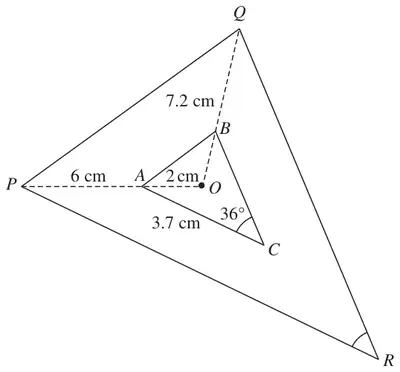
17

Triangle PQR is an enlargement centre O of triangle ABC; OA 2 cm, AP 6 cm, BQ 7.2 cm, AC 3.7 cm, angle C 36 degrees

Diagram NOT accurately drawn

Triangle \(PQR\) is an enlargement, centre \(O\), of triangle \(ABC\).
\(OAP\) and \(OBQ\) are straight lines.
\(OA = 2\) cm.
\(AP = 6\) cm.
\(BQ = 7.2\) cm.
\(AC = 3.7\) cm.
Angle \(C = 36^\circ\)

(a) Find the size of angle \(R\). (1)
(b) Work out the length of \(OB\). (2)
(c) Work out the length of \(PR\). (3)

4MA0 Foundation January 2014 Paper 2 Q16

EdexcelFoundationOld spec6 marksTransformations of Shapes

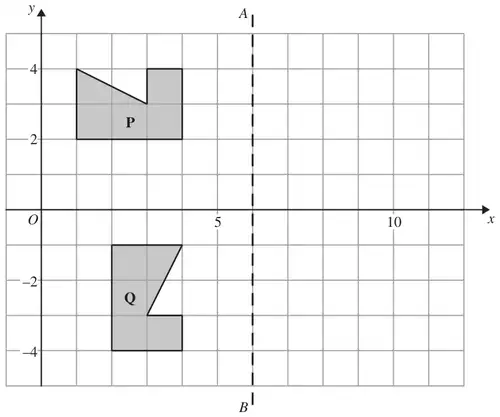
16 The diagram shows a shape P, a shape Q and a line \(AB\).

Grid with shapes P and Q and a vertical dashed line AB
(a) Write down an equation of the line \(AB\). (1)
(b) Reflect shape P in the line \(AB\). (2)
(c) Describe fully the single transformation which maps shape P onto shape Q. (3)

4MA0 Foundation January 2014 Paper 2R Q16

EdexcelFoundationOld spec6 marksTransformations of Shapes

16

Coordinate grid with triangles P and S, x from -4 to 6 and y from -4 to 4
(a) On the grid, translate triangle P 2 squares to the right and 1 square down.
Label the new triangle Q. (1)
(b) On the grid, reflect triangle P in the line \(y = 2\)
Label the new triangle R. (2)
(c) Describe fully the single transformation that maps triangle P onto triangle S. (3)

4MA0 Foundation January 2014 Paper 1 Q12

EdexcelFoundationOld spec4 marksTransformations of Shapes

12

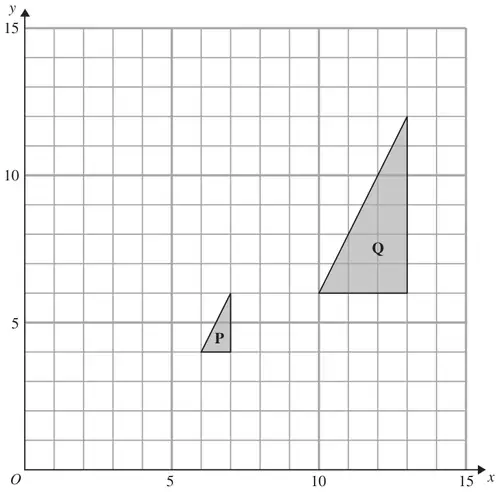
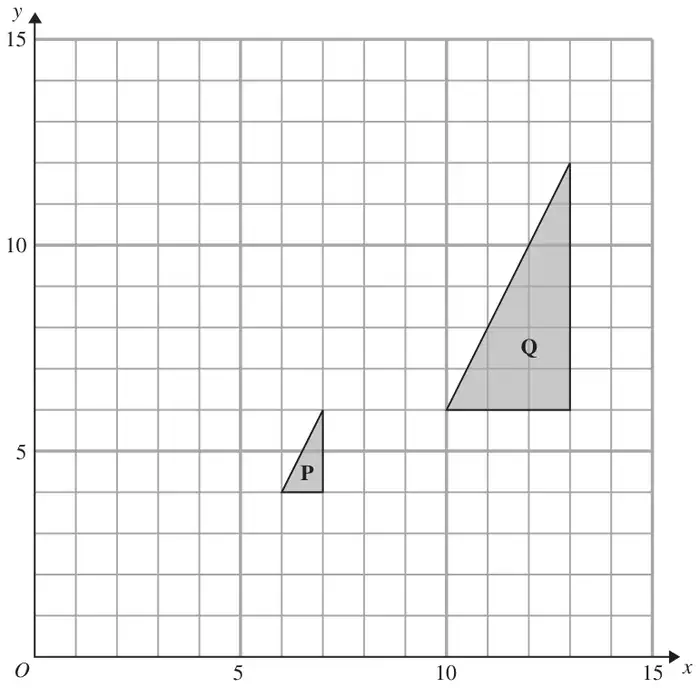
Grid with x and y from 0 to 15 showing triangles P and Q
(a) Describe fully the single transformation which maps triangle P onto triangle Q. (3)
(b) On the grid, translate triangle Q 8 units to the left and 2 units up.
Label the new triangle R. (1)

4MA0 Higher January 2014 Paper 3 Q9

EdexcelHigherOld spec6 marksTransformations of Shapes

9

Grid with x and y from 0 to 15 showing triangle P and triangle Q
(a) Describe fully the single transformation which maps triangle \(\mathbf{P}\) onto triangle \(\mathbf{Q}\). (3)
(b) On the grid, translate triangle \(\mathbf{Q}\) by the vector \(\begin{pmatrix} -8 \\ 2 \end{pmatrix}\)
Label the new triangle \(\mathbf{R}\). (1)
(c) Describe fully the single transformation which maps triangle \(\mathbf{R}\) onto triangle \(\mathbf{P}\). (2)

4MA0 Higher January 2014 Paper 4R Q7

EdexcelHigherOld spec4 marksTransformations of Shapes

7

Grid with x from -4 to 7 and y from -4 to 5 showing triangle P and triangle S
(a) On the grid, translate triangle \(\mathbf{P}\) by the vector \(\begin{pmatrix} 2 \\ -1 \end{pmatrix}\)
Label the new triangle \(\mathbf{Q}\). (1)
(b) Describe fully the single transformation that maps triangle \(\mathbf{P}\) onto triangle \(\mathbf{S}\). (3)

4MA0 Higher January 2014 Paper 4 Q5

EdexcelHigherOld spec3 marksTransformations of Shapes

5 The diagram shows a shape \(\mathbf{P}\), and a shape \(\mathbf{Q}\).

Grid with x from 0 to 13 and y from -4 to 5 showing shape P and shape Q

Describe fully the single transformation which maps shape \(\mathbf{P}\) onto shape \(\mathbf{Q}\).

(3)

4MA0 Foundation January 2014 Paper 1 Q4

EdexcelFoundationOld spec10 marks2D Area & PerimeterTransformations of Shapes

4

(a) Here is a shaded quadrilateral drawn on a grid of centimetre squares.
Shaded rectangle 4 squares by 2 squares on a centimetre grid
(i) Write down the mathematical name of this shaded quadrilateral.
(ii) Find the perimeter of this shaded quadrilateral.
(2)
(b) Here is another shaded quadrilateral drawn on a grid of centimetre squares.
Shaded quadrilateral with one pair of parallel sides on a centimetre grid
(i) Write down the mathematical name of this shaded quadrilateral.
(ii) On this shaded quadrilateral, mark with arrows (>) a pair of parallel lines.
(iii) Find the area of this shaded quadrilateral.
(4)
(c) The lines \(AB\) and \(CD\) are the 2 lines of symmetry of a quadrilateral.
The diagram shows part of the quadrilateral.
On the grid, complete the drawing of the quadrilateral.
Grid with dashed lines AB and CD crossing at right angles and a shaded right-angled triangle showing part of the quadrilateral
(2)
(d) A quadrilateral has rotational symmetry of order 4 about the point \(P\).
The diagram shows one side of the quadrilateral.
On the grid, complete the drawing of the quadrilateral.
Grid with one side of the quadrilateral drawn above the point P
(2)

4MA0 Foundation January 2014 Paper 1R Q2

EdexcelFoundationOld spec11 marks2D Area & PerimeterTransformations of Shapes

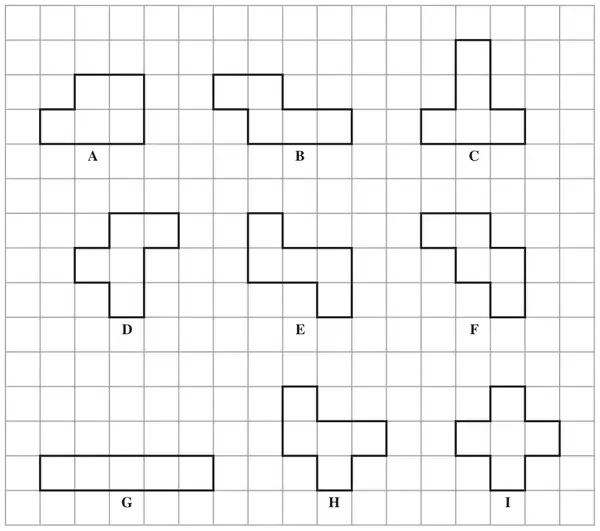
2 Here are nine shapes on a grid of centimetre squares.

Nine shapes labelled A to I drawn on a centimetre grid
(a) Shape A is a 6-sided polygon.
Write down the mathematical name for a 6-sided polygon. (1)
(b) Find the area of shape B. (1)
(c) Find the perimeter of shape C. (1)
(d) Two of the shapes each have exactly 1 line of symmetry.
Write down the letters of these two shapes. (2)
(e) On shape I, draw all its lines of symmetry. (2)
(f) Write down the letter of the shape which has
(i) rotational symmetry of order 2 and 2 lines of symmetry,
(ii) rotational symmetry of order 2 but no lines of symmetry.
(2)
(g) Two of the shapes are congruent.
Write down the letters of these two shapes. (1)
(h) Explain why shape I is not a regular polygon. (1)

4MA0 Foundation January 2014 Paper 2R Q2

EdexcelFoundationOld spec4 marksAngles in PolygonsTransformations of Shapes

2 The diagram shows a quadrilateral on a square grid.

Quadrilateral with vertices (1, 3), (4, 5), (6, 3) labelled P, and (4, 1) on a grid
(a) What is the mathematical name for this quadrilateral? (1)
(b) On the quadrilateral, draw its line of symmetry. (1)
(c) Write down the coordinates of the point \(P\). (1)

The size of the angle at \(P\) is \(90^\circ\)

(d) Write down the mathematical name for an angle of \(90^\circ\) (1)

4MA0 Foundation June 2013 Paper 2R Q16

EdexcelFoundationOld spec2 marksTransformations of Shapes

16

Grid from 0 to 5 with triangles P and Q

Describe fully the single transformation which maps triangle P onto triangle Q.

(2)

4MA0 Foundation June 2013 Paper 1R Q15

EdexcelFoundationOld spec6 marksTransformations of Shapes

15

Grid from -8 to 12 across and -4 to 14 up with shapes P and Q and the line AB through y = 2
(a) Describe fully the single transformation that maps shape P onto shape Q. (3)
(b) On the grid, reflect shape P in the line \(AB\).
Label the new shape R. (2)
(c) Write down an equation of the line \(AB\). (1)

4MA0 Foundation June 2013 Paper 2 Q14

EdexcelFoundationOld spec5 marksTransformations of Shapes

14

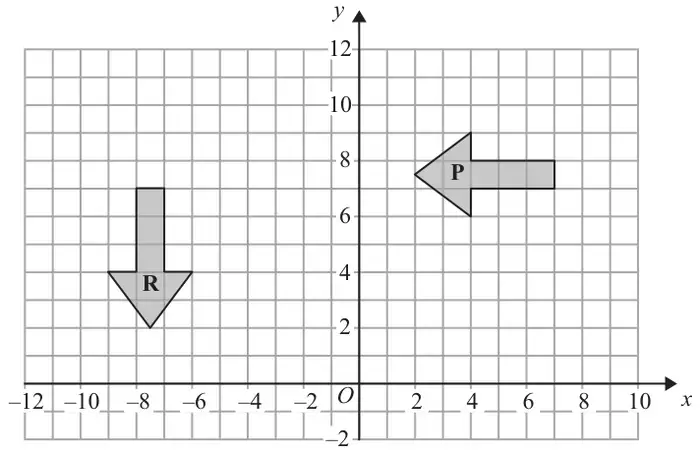
Grid from -12 to 10 with arrow shape P pointing left and arrow shape R pointing down
(a) On the grid, reflect shape P in the \(y\)-axis.
Label the new shape Q. (2)
(b) Describe fully the single transformation that maps shape P onto shape R. (3)

4MA0 Higher June 2013 Paper 3R Q6

EdexcelHigherOld spec5 marksTransformations of Shapes

6

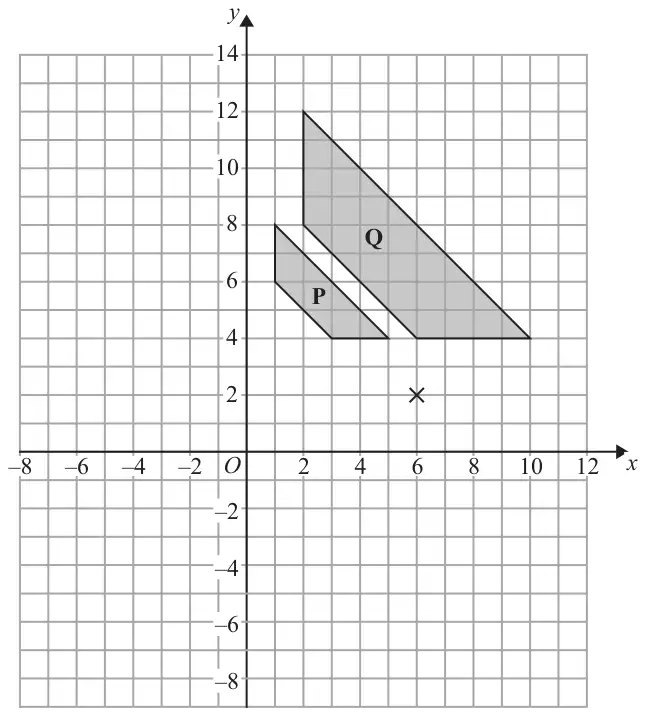
Grid with x from −8 to 12 and y from −8 to 14 showing triangle-like shapes P and Q and a cross marked at (6, 2)
(a) Describe fully the single transformation that maps shape P onto shape Q. (3)
(b) On the grid, rotate shape Q 180° about the point (6, 2).
Label the new shape R. (2)

4MA0 Higher June 2013 Paper 4 Q4

EdexcelHigherOld spec5 marksTransformations of Shapes

4

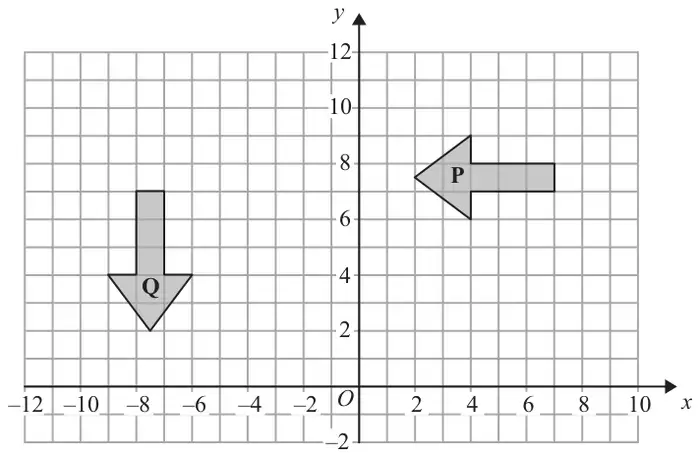
Grid with x from −12 to 10 and y from −2 to 12 showing arrow shape P pointing left near (2 to 7, 6 to 9) and arrow shape Q pointing down near (−9 to −6, 2 to 7)
(a) Describe fully the single transformation that maps shape P onto shape Q. (3)
(b) On the grid, translate shape P by the vector \(\begin{pmatrix} -6 \\ 2 \end{pmatrix}\)
Label the new shape R. (2)

4MA0 Higher June 2013 Paper 4R Q2

EdexcelHigherOld spec2 marksTransformations of Shapes

2

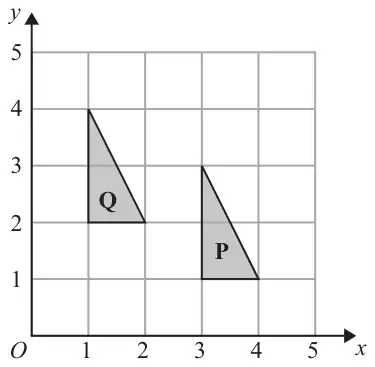
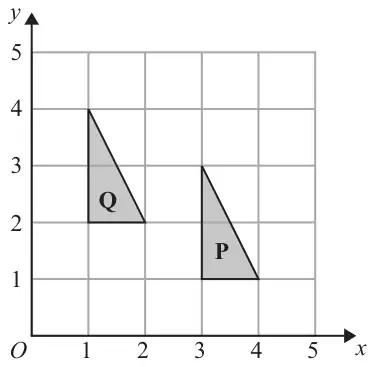
Grid with x and y from 0 to 5 showing triangle Q with vertices (1, 2), (1, 4), (2, 2) and triangle P with vertices (3, 1), (3, 3), (4, 1)

Describe fully the single transformation which maps triangle P onto triangle Q.

(2)

4MA0 Foundation January 2013 Paper 1 Q15

EdexcelFoundationOld spec5 marksTransformations of Shapes

15

Grid from -12 to 12 across and -6 to 14 up with T-shaped shape P and a cross at (-8, 7)
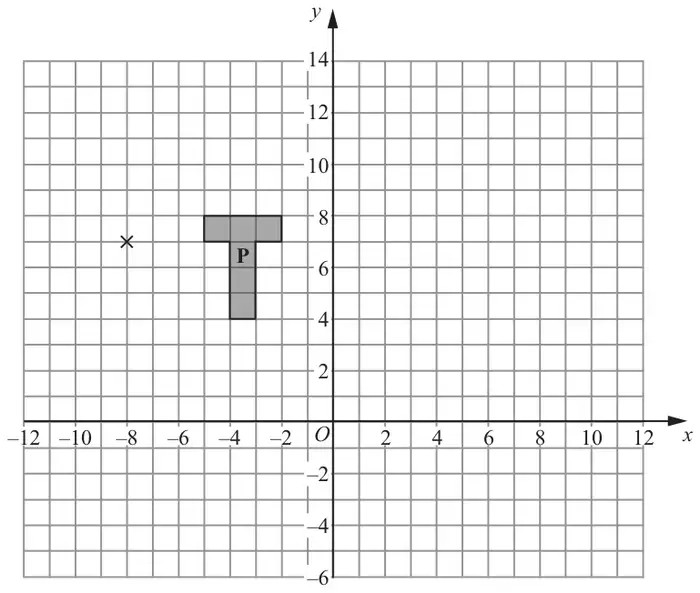
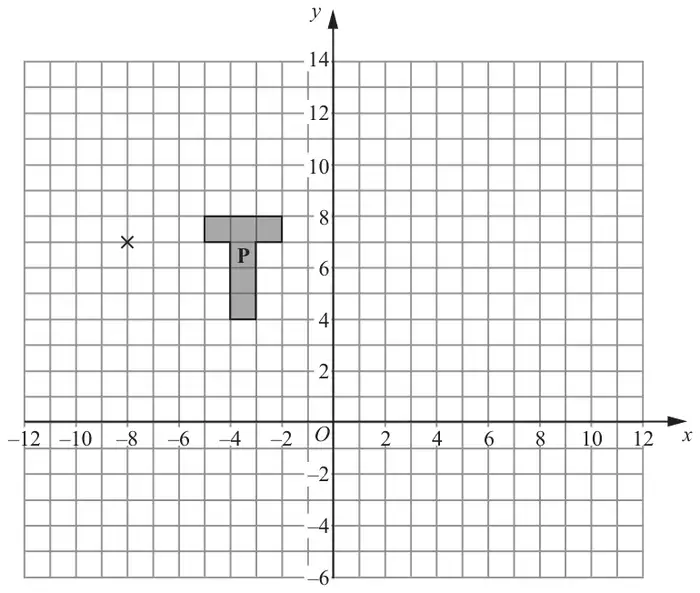
(a) On the grid, enlarge shape P with scale factor 3 and centre (−8, 7).
Label the new shape Q. (3)
(b) On the grid, rotate shape P through 90° clockwise about the point (−8, 7).
Label the new shape R. (2)

4MA0 Foundation January 2013 Paper 2 Q9

EdexcelFoundationOld spec5 marksTransformations of Shapes

9 Here are nine mathematical symbols.

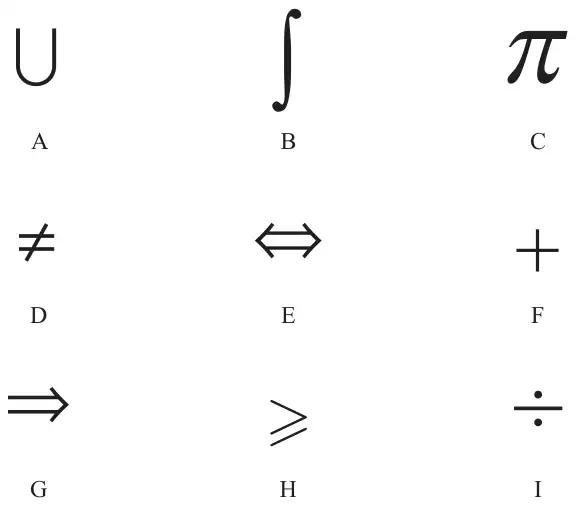
Nine symbols: A union, B integral, C pi, D not equal, E double arrow, F plus, G implies arrow, H greater than or equal, I divide
(a) Write down the letters of the two symbols which have 2 lines of symmetry and rotational symmetry of order 2 (2)
(b) Write down the letters of the two symbols which have no lines of symmetry and rotational symmetry of order 2 (2)
(c) Write down the order of rotational symmetry of symbol F. (1)

4MA0 Higher January 2013 Paper 3 Q4

EdexcelHigherOld spec5 marksTransformations of Shapes

4

Grid with x from −12 to 12 and y from −6 to 14 showing T-shape P between x = −5 and −2, y = 4 and 8, and a cross at (−8, 7)
(a) On the grid, enlarge shape P with scale factor 3 and centre (−8, 7).
Label the new shape Q. (3)
(b) On the grid, rotate shape P through 90° clockwise about the point (−8, 7).
Label the new shape R. (2)

4MA0 Foundation June 2012 Paper 2 Q15

EdexcelFoundationOld spec4 marksTransformations of Shapes

15

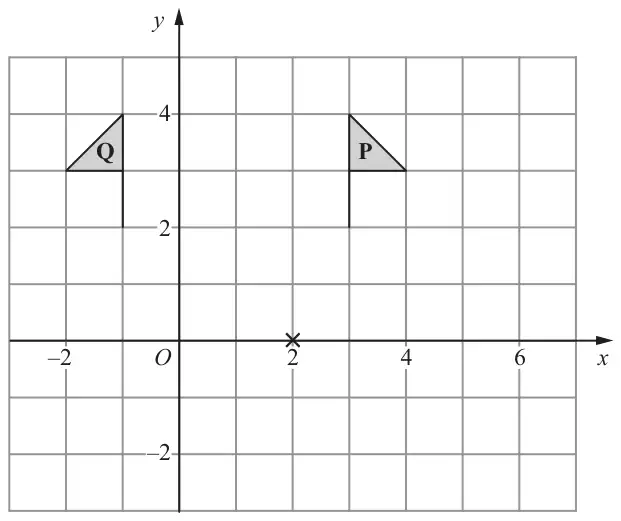
Grid with x from −2 to 7 and y from −3 to 5 showing flag shapes P and Q, and a cross at (2, 0)
(a) Describe fully the single transformation that maps shape P onto shape Q. (2)
(b) On the grid, rotate shape P 90° clockwise about the point (2, 0).
Label the new shape R. (2)

4MA0 Foundation June 2012 Paper 1 Q7

EdexcelFoundationOld spec4 marksTransformations of Shapes

7 Braille is a system of writing for blind people.
A rectangular pattern of 6 dots represents each letter of the alphabet.
Some of the dots are large and some are small.

Here are the patterns for 6 letters.

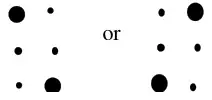
Braille dot patterns of 6 dots each, some large and some small, for the letters C, D, S, T, U and X
(a) How many lines of symmetry has the pattern for D? (1)
(b) Write down the letter whose pattern has
(i) rotational symmetry of order 2 and 2 lines of symmetry,
(ii) rotational symmetry of order 2 but no lines of symmetry.
(2)
(c) On the grid below, use 2 large dots and 4 small dots to make a pattern which has rotational symmetry of order 2 but no lines of symmetry.
Empty grid for a 6-dot braille pattern, 2 dots wide and 3 dots high
(1)

4MA0 Higher June 2012 Paper 4 Q4

EdexcelHigherOld spec4 marksTransformations of Shapes

4

Grid with x from -2 to 6 and y from -2 to 4 showing triangular flag shapes P and Q and a cross at the point (2, 0)
(a) Describe fully the single transformation that maps shape P onto shape Q. (2)
(b) On the grid, rotate shape P 90° clockwise about the point (2, 0).
Label the new shape R. (2)

4MA0 Foundation January 2012 Paper 2 Q19

EdexcelFoundationOld spec4 marksTransformations of Shapes

19

Grid with x from 0 to 11 and y from −5 to 5 showing triangles P and Q
(a) Describe fully the single transformation which maps triangle P onto triangle Q. (3)
(b) On the grid, translate triangle Q 4 squares to the right and 2 squares down.
Label the new triangle R. (1)

4MA0 Higher January 2012 Paper 4 Q12

EdexcelHigherOld spec6 marksTransformations of Shapes

12

Grid with x from 0 to 11 and y from -5 to 5 showing triangles P and Q
(a) Describe fully the single transformation which maps triangle P onto triangle Q. (3)
(b) On the grid, translate triangle Q by the vector \(\begin{pmatrix} 4 \\ -2 \end{pmatrix}\)
Label the new triangle R. (1)
(c) Describe fully the single transformation which maps triangle P onto triangle R. (2)

4MA0 Foundation January 2012 Paper 1 Q9

EdexcelFoundationOld spec5 marksTransformations of Shapes

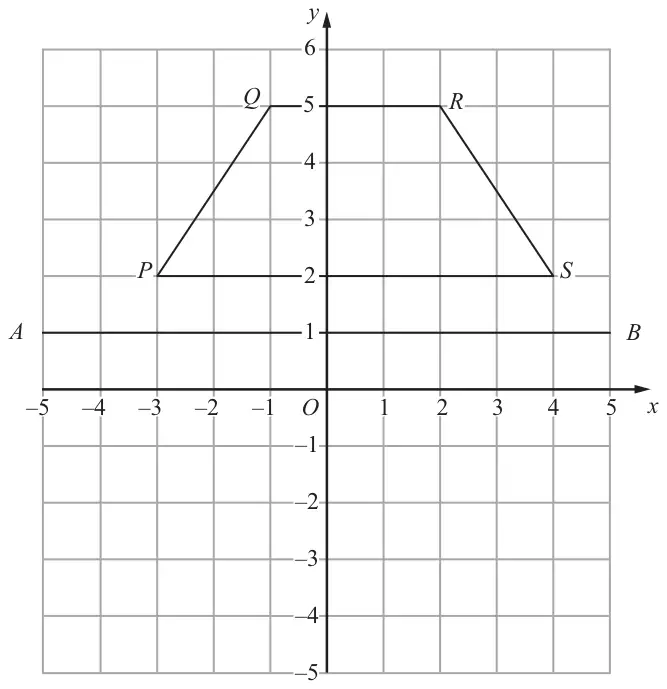
9 The diagram shows a trapezium \(PQRS\) and a line \(AB\) on a centimetre grid.

Grid with x and y from −5 to 5 (y up to 6) showing trapezium PQRS with P(−3, 2), Q(−1, 5), R(2, 5), S(4, 2) and the horizontal line AB through y = 1
(a) Measure the length of \(RS\).
Give your answer in millimetres. (1)
(b) Write down the coordinates of \(Q\). (1)
(c) Write down the equation of the line \(AB\). (1)
(d) Reflect the trapezium \(PQRS\) in the line \(AB\). (2)

4MA0 Foundation January 2012 Paper 2 Q6

EdexcelFoundationOld spec4 marksTransformations of Shapes

6

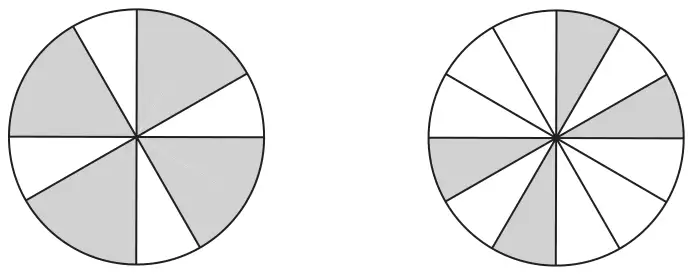
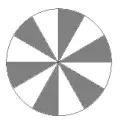
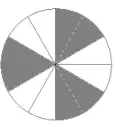
(a) Write down the order of rotational symmetry of each diagram.
Two circles divided into sectors with some sectors shaded: diagram (i) on the left and diagram (ii) on the right
(2)
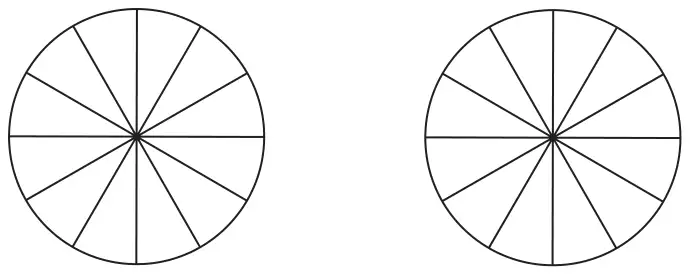
(b) Shade 6 sectors on each diagram so that the completed diagram has rotational symmetry of
(i) order 6
(ii) order 3
Two circles each divided into 12 equal sectors, unshaded: (i) on the left and (ii) on the right
(2)

4MA0 Foundation January 2012 Paper 2 Q3

EdexcelFoundationOld spec5 marksAngles in PolygonsTransformations of Shapes

3

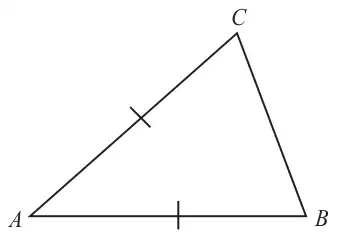
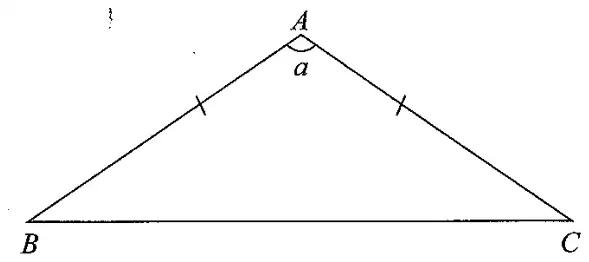
(a) The diagram shows triangle \(ABC\).
Triangle ABC with AB and AC marked equal
(i) \(AB = AC\).
What type of triangle is triangle \(ABC\)?
(ii) On the triangle, draw the line of symmetry.
(2)
(b)
(i) In the space below, draw a quadrilateral which has exactly one line of symmetry.
(ii) On the quadrilateral, draw its line of symmetry.
(iii) Write down the mathematical name of this quadrilateral.
(3)

4MA0 Foundation June 2011 Paper 1 Q19

EdexcelFoundationOld spec5 marksTransformations of Shapes

19

Grid with x from −6 to 6 and y from 0 to 7 showing triangles P and Q
(a) Describe fully the single transformation which maps triangle P onto triangle Q. (3)
(b) Reflect triangle Q in the line \(y = x\).
Label the new triangle R. (2)

4MA0 Foundation June 2011 Paper 2 Q6

EdexcelFoundationOld spec3 marksTransformations of Shapes

6 Here are five road signs.

Five road signs labelled A, B, C, D and E

Two of these five road signs have only one line of symmetry.

(a) Write down the letters of each of these two road signs. (1)

Only one of these five road signs has rotational symmetry.

(b)
(i) Write down the letter of this road sign.
(ii) Write down the order of rotational symmetry of this road sign.
(2)

4MA0 Higher June 2011 Paper 3 Q6

EdexcelHigherOld spec5 marksTransformations of Shapes

6

Grid with x from -6 to 6 and y from 0 to 7 showing triangles P and Q
(a) Describe fully the single transformation which maps triangle P onto triangle Q. (3)
(b) Reflect triangle Q in the line \(y = x\).
Label the new triangle R. (2)

4400 Foundation November 2010 Paper 2 Q20

EdexcelFoundationOld spec5 marksTransformations of Shapes

20.

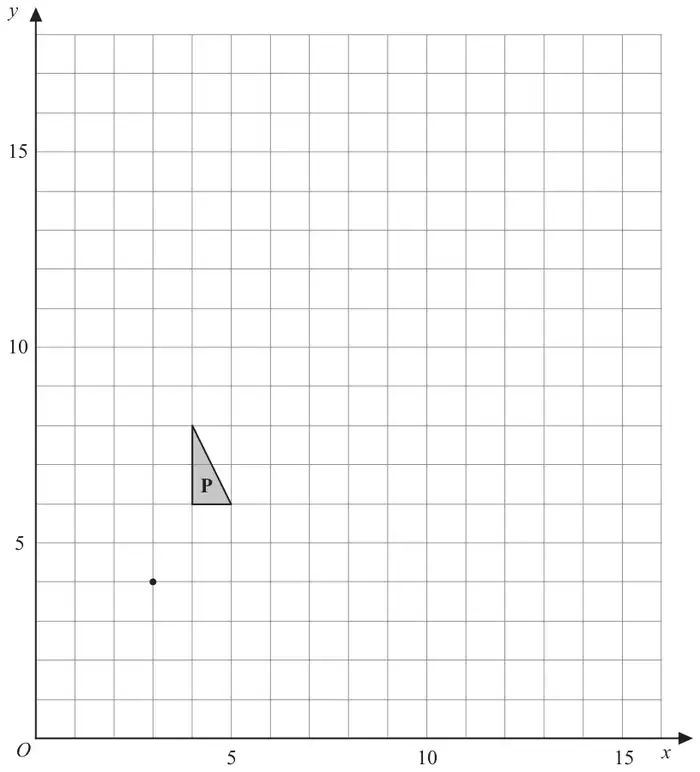
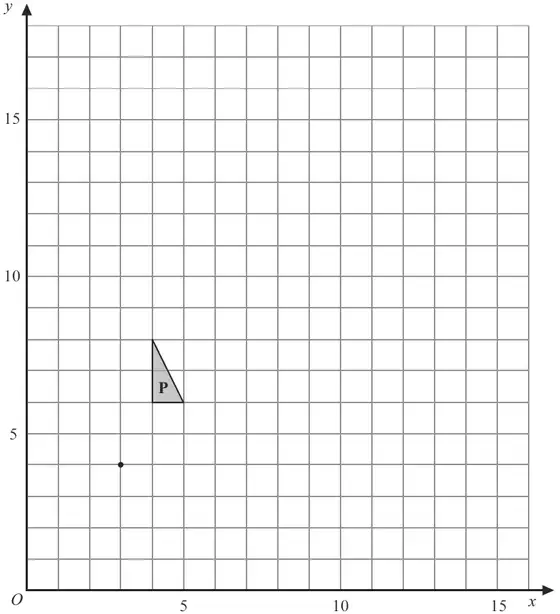
Grid with x and y from 0 to 15 showing triangle P with vertices (4, 6), (5, 6), (4, 8) and the point (3, 4) marked
(a) On the grid, enlarge triangle P with scale factor 3 and centre (3, 4).
Label the new triangle Q. (3)
(b) On the grid, rotate triangle P through 90° clockwise about the point (3, 4).
Label the new triangle R. (2)

4400 Foundation November 2010 Paper 1 Q10

EdexcelFoundationOld spec3 marksSimilar ShapesTransformations of Shapes

10. Here are some triangles drawn on a centimetre grid.

Centimetre grid with five right-angled triangles labelled A, B, C, D and E
(a) Write down the letters of the two triangles which are congruent. (1)
(b) Write down the letters of two triangles which are similar but not congruent. (1)
(c) What type of transformation will map triangle B onto triangle C? (1)

4400 Foundation November 2010 Paper 2 Q7

EdexcelFoundationOld spec6 marksTransformations of Shapes

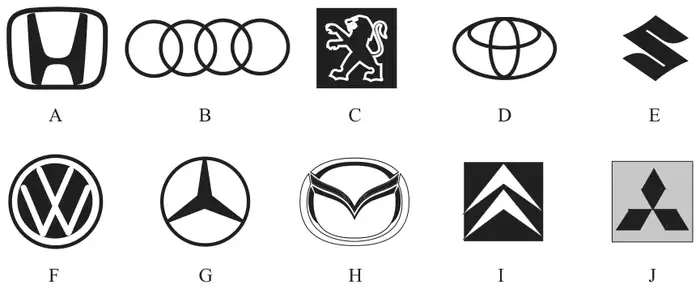
7. Here are 10 car badges.

Ten car badges labelled A to J
(a) Write down the letters of the two badges which have
(i) no lines of symmetry,
(ii) rotational symmetry of order 2
(4)
(b) Describe fully all the symmetries of badge G. (2)

4400 Higher November 2010 Paper 4 Q7

EdexcelHigherOld spec7 marksTransformations of Shapes

7

Grid with x from 0 to 16 and y from 0 to 18; triangle P with vertices (4, 6), (5, 6) and (4, 8); a dot at (3, 4)
(a) On the grid, enlarge triangle P with scale factor 3 and centre (3, 4).
Label the new triangle Q. (3)
(b) On the grid, translate triangle Q by the vector \(\begin{pmatrix} 4 \\ -8 \end{pmatrix}\)
Label the new triangle R. (2)
(c) Describe fully the single transformation which maps triangle P onto triangle R. (2)

4400 Foundation June 2010 Paper 1 Q19

EdexcelFoundationOld spec4 marksTransformations of Shapes

19.

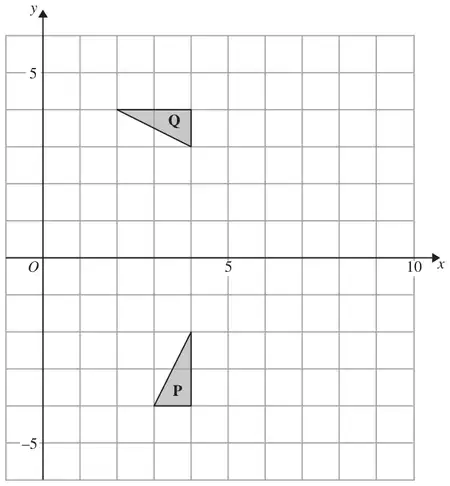
Grid with x and y from −6 to 6 showing triangle P with vertices (2, 3), (3, 3), (3, 5), triangle Q with vertices (−5, −3), (−3, −3), (−3, −2), and the point (−1, 1) marked with a cross
(a) Describe fully the single transformation which maps triangle P onto triangle Q. (2)
(b) Rotate triangle Q through 90° anti-clockwise about the point (−1, 1).
Label the new triangle R. (2)

4400 Higher June 2010 Paper 3 Q9

EdexcelHigherOld spec6 marksTransformations of Shapes

9

Grid with x and y from -6 to 6; triangle P with vertices (2, 3), (3, 3), (3, 5); triangle Q with vertices (-5, -3), (-3, -3), (-3, -2); a cross at (-1, 1)
(a) Describe fully the single transformation which maps triangle P onto triangle Q. (2)
(b) Rotate triangle Q through 90° anti-clockwise about the point (−1, 1).
Label the new triangle R. (2)
(c) Describe fully the single transformation which maps triangle P onto triangle R. (2)

4400 Foundation June 2010 Paper 2 Q7

EdexcelFoundationOld spec4 marksSimilar ShapesTransformations of Shapes

7.

(a) Here are some shapes.
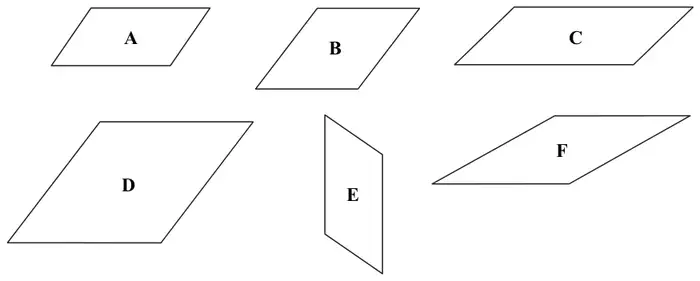
Six parallelograms labelled A to F
Write down the letter of the shape that is
(i) congruent to shape A,
(ii) an enlargement of shape B.
(2)
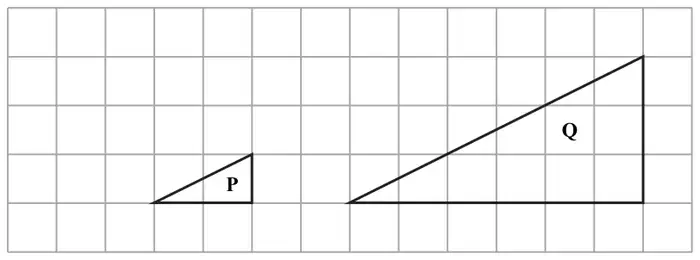
(b) Triangle Q is an enlargement of triangle P.
Grid showing a small right-angled triangle P and a larger right-angled triangle Q
(i) Find the scale factor of the enlargement.
(ii) On the diagram, mark with a cross (x), the centre of enlargement.
(2)

4400 Foundation June 2010 Paper 2 Q5

EdexcelFoundationOld spec5 marksAngles in PolygonsTransformations of Shapes

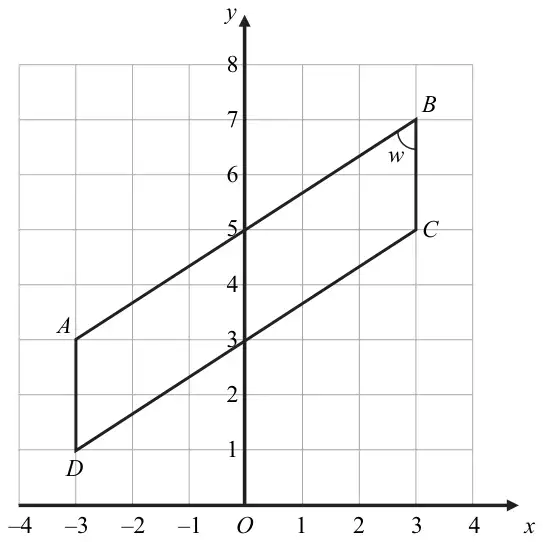
5. The diagram shows a quadrilateral \(ABCD\) drawn on a centimetre grid.

Centimetre grid, x from −4 to 4 and y from 0 to 8, with quadrilateral ABCD: A(−3, 3), B(3, 7), C(3, 5), D(−3, 1); angle w marked at B
(a) Write down the coordinates of \(B\). (1)
(b) Write down the coordinates of \(D\). (1)
(c) Write down the mathematical name for quadrilateral \(ABCD\). (1)
(d) How many lines of symmetry has quadrilateral \(ABCD\)? (1)
(e) Measure and write down the size of angle \(w\). (1)

4400 Foundation November 2009 Paper 2 Q18

EdexcelFoundationOld spec5 marksTransformations of Shapes

18

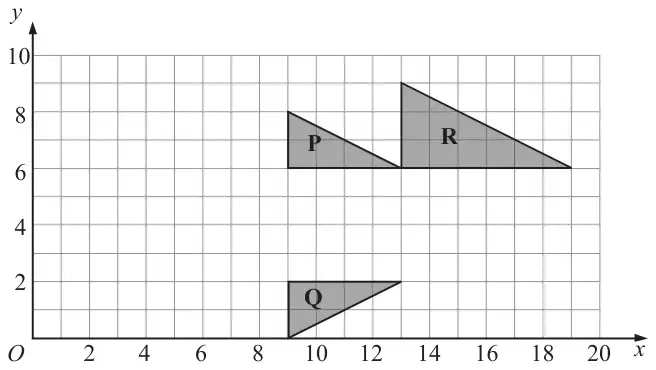
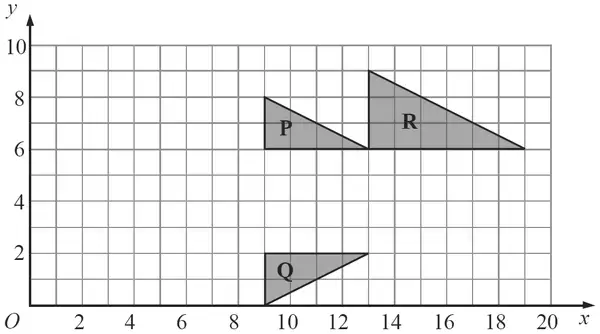
Grid with x from 0 to 20 and y from 0 to 10 showing shaded triangles P, Q and R
(a) Describe fully the single transformation which maps triangle P onto triangle Q. (2)
(b) Describe fully the single transformation which maps triangle P onto triangle R. (3)

4400 Higher November 2009 Paper 4 Q6

EdexcelHigherOld spec5 marksTransformations of Shapes

6

Grid with x from 0 to 20 and y from 0 to 10 showing shaded triangles P, Q and R
(a) Describe fully the single transformation which maps triangle \(\mathbf{P}\) onto triangle \(\mathbf{Q}\). (2)
(b) Describe fully the single transformation which maps triangle \(\mathbf{P}\) onto triangle \(\mathbf{R}\). (3)

4400 Foundation November 2009 Paper 1 Q3

EdexcelFoundationOld spec4 marksAngles in PolygonsTransformations of Shapes

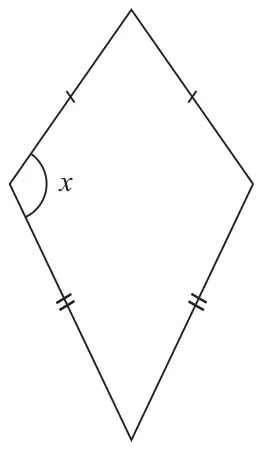
3. Here is a quadrilateral.

Quadrilateral with two pairs of equal adjacent sides (upper pair and lower pair marked); angle x at the left vertex
(a) What is the mathematical name of this quadrilateral? (1)
(b) What type of angle is angle \(x\)? (1)
(c) How many lines of symmetry does this quadrilateral have? (1)
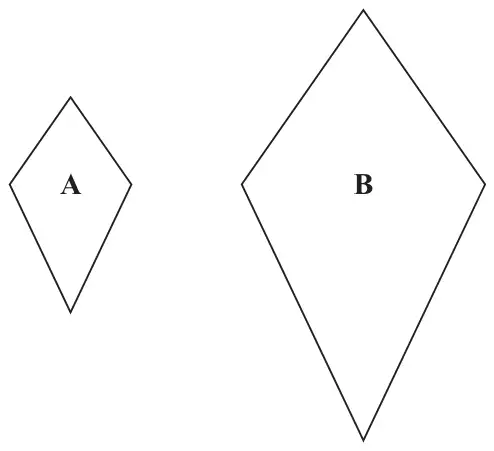
(d) Quadrilateral B is an enlargement of quadrilateral A.
Find the scale factor of the enlargement.
Small quadrilateral A and a larger quadrilateral B of the same shape
(1)

4400 Foundation June 2009 Paper 1 Q14

EdexcelFoundationOld spec3 marksTransformations of Shapes

14

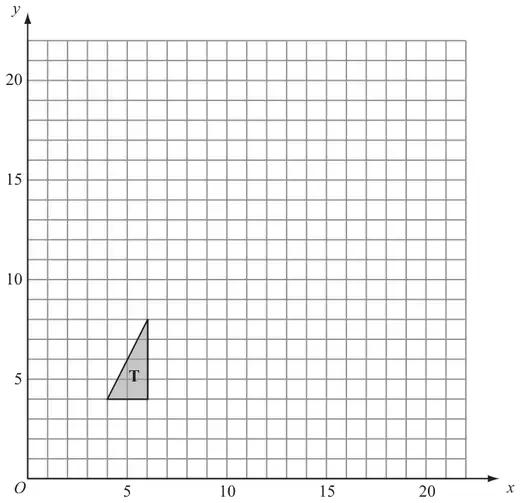
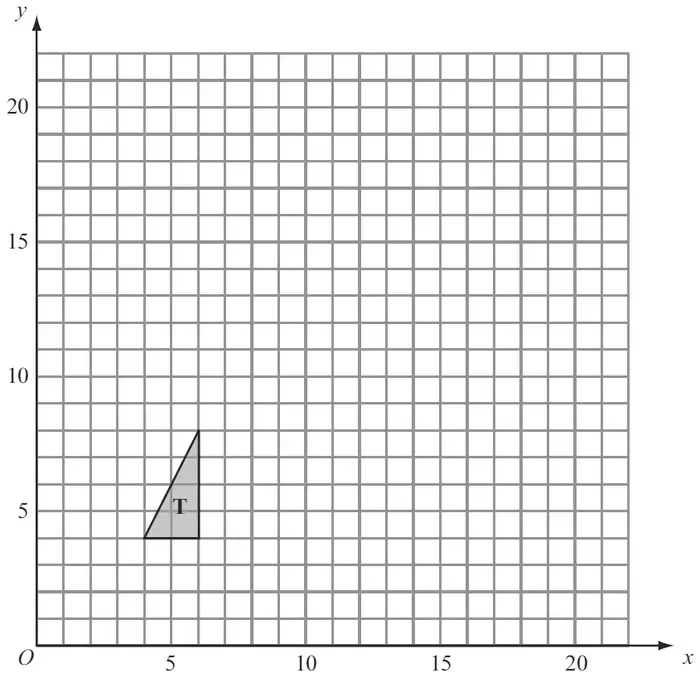
Grid with x and y from 0 to 22 showing triangle T with vertices (4, 4), (6, 4) and (6, 8)

On the grid, enlarge triangle T with a scale factor of \(2\tfrac{1}{2}\) and centre (0, 0).

(3)

4400 Foundation June 2009 Paper 2 Q10

EdexcelFoundationOld spec5 marks2D Area & PerimeterTransformations of Shapes

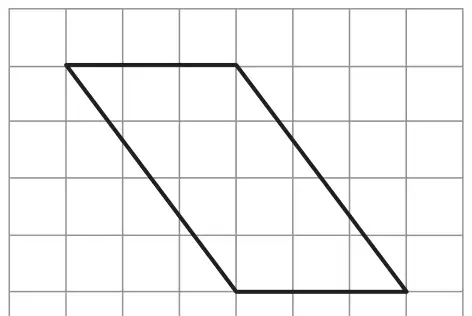
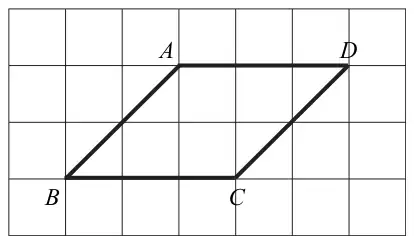
10 The diagram shows a parallelogram drawn on a 1 cm grid.

Parallelogram drawn on a 1 cm grid
(a) Find the area of the parallelogram.
State the units of your answer. (3)
(b)
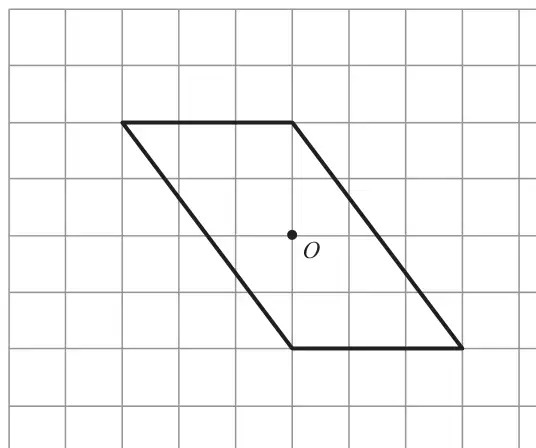
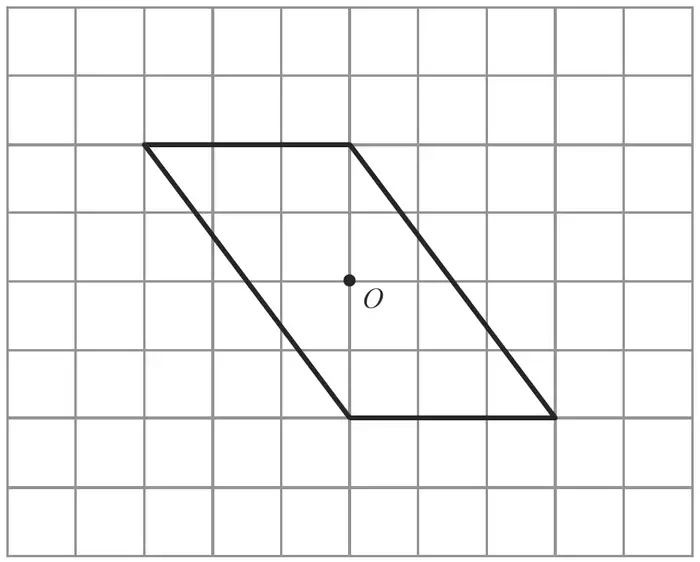
The parallelogram on a 1 cm grid with the point O marked
On the grid, rotate the parallelogram through 90° anticlockwise about the point \(O\). (2)

4400 Higher June 2009 Paper 4 Q7

EdexcelHigherOld spec4 marksTransformations of Shapes

7 The diagram shows a parallelogram.

(a) On the grid, rotate the parallelogram through \(90^\circ\) anticlockwise about the point \(O\).
Square grid with a parallelogram and the point O marked inside it
(2)
(b)
Coordinate grid, x and y from -5 to 5, with triangle Q in the second quadrant and triangle P in the fourth quadrant
Describe fully the single transformation that maps triangle P onto triangle Q. (2)

4400 Foundation June 2009 Paper 1 Q5

EdexcelFoundationOld spec10 marksAngles in PolygonsTransformations of Shapes

5 Here are 4 flags. Each flag is a square.

Four square flags A, B, C and D with shaded shapes
(a)
(i) On flag A, draw the line of symmetry.
(ii) Write down the special name for the shaded triangle.
(2)
(b) On flag B, draw all its lines of symmetry. (2)
(c) On flag B, the shaded shape is an 8-sided polygon.
(i) Write down the special name for an 8-sided polygon.
(ii) Explain why the shaded polygon is not a regular polygon.
(2)
(d)
(i) How many lines of symmetry has flag C?
(ii) Write down the order of rotational symmetry of flag C.
(2)
(e)
(i) What fraction of flag D is white?
(ii) Write your fraction as a decimal.
(2)

4400 Higher June 2009 Paper 3 Q3

EdexcelHigherOld spec3 marksTransformations of Shapes

3 On the grid, enlarge triangle T with a scale factor of \(2\frac{1}{2}\) and centre (0, 0).

Grid with x and y from 0 to 22 showing triangle T with vertices (4, 4), (6, 4) and (6, 8)

(3)

4400 Foundation November 2008 Paper 1 Q17

EdexcelFoundationOld spec5 marksTransformations of Shapes

17

Grid with x from −5 to 5 and y from −1 to 5 showing shaded triangles P, Q and R
(a) Describe fully the single transformation which maps triangle P onto triangle Q. (2)
(b) Describe fully the single transformation which maps triangle P onto triangle R. (3)

4400 Higher November 2008 Paper 3 Q4

EdexcelHigherOld spec5 marksTransformations of Shapes

4

Coordinate grid, x from -5 to 5 and y from -1 to 5, showing triangles P, Q and R
(a) Describe fully the single transformation which maps triangle P onto triangle Q. (2)
(b) Describe fully the single transformation which maps triangle P onto triangle R. (3)

4400 Foundation June 2008 Paper 1 Q15

EdexcelFoundationOld spec5 marksTransformations of Shapes

15

Coordinate grid with x and y from 0 to 10 showing triangle P with vertices (3, 4), (4, 4), (4, 6); triangle Q with vertices (5, 5), (7, 5), (7, 9); triangle R with vertices (4, 4), (6, 4), (4, 3)
(a) Describe fully the single transformation that maps triangle P onto triangle Q. (3)
(b) Describe fully the single transformation that maps triangle P onto triangle R. (2)

4400 Foundation June 2008 Paper 1 Q6

EdexcelFoundationOld spec10 marks2D Area & PerimeterTransformations of Shapes

6 A parallelogram \(ABCD\) has been drawn on the centimetre grid.

Centimetre grid with x from 0 to 9 and y from 0 to 6 showing parallelogram ABCD with A(0, 1), B(6, 1), C(8, 5), D(2, 5); angle x marked at B inside the parallelogram
(a) Work out the area of the parallelogram. (2)
(b) Find, by measuring, the perimeter of the parallelogram. (2)
(c) Write down how many lines of symmetry the parallelogram has. (1)
(d) Write down the order of rotational symmetry of the parallelogram. (1)
(e)
(i) Measure the size of angle \(x\).
(ii) What type of angle is angle \(x\)?
(2)
(f) Find the coordinates of the midpoint of \(AC\). (2)

4400 Foundation June 2008 Paper 2 Q5

EdexcelFoundationOld spec3 marksSimilar ShapesTransformations of Shapes

5 Here are four triangles drawn on a centimetre grid.

Four triangles on a centimetre grid: A is a tall triangle with two equal sides, B is a small right-angled triangle, C is a larger right-angled triangle the same shape as B, D is a right-angled triangle the same size and shape as B
(a) Write down the mathematical name for triangle A. (1)
(b) Which two triangles are congruent? (1)
(c) What type of transformation will map triangle B onto triangle C? (1)

4400 Higher June 2008 Paper 3 Q3

EdexcelHigherOld spec5 marksTransformations of Shapes

3

Grid with x and y from 0 to 10 showing triangles P, Q and R
(a) Describe fully the single transformation that maps triangle P onto triangle Q. (3)
(b) Describe fully the single transformation that maps triangle P onto triangle R. (2)

4400 Higher November 2007 Paper 4 Q4

EdexcelHigherOld spec2 marksTransformations of Shapes

4

Grid with x from 0 to 8 and y from 0 to 4; triangle T with vertices (1, 1), (2, 1), (3, 3) and triangle U with vertices (5, 3), (6, 1), (7, 1)

Describe fully the single transformation which maps triangle T onto triangle U.

(2)

4400 Foundation November 2007 Paper 1 Q2

EdexcelFoundationOld spec4 marksAngles in PolygonsTransformations of Shapes

2

(a) Complete this shape to show a kite.
Two line segments meeting at a point on the left, forming half of a kite
(2)
(b) Here is a parallelogram.
A parallelogram
(i) How many lines of symmetry does this parallelogram have?
(ii) What is the order of rotational symmetry of this parallelogram?
(2)

4400 Foundation June 2007 Paper 1 Q16

EdexcelFoundationOld spec5 marksTransformations of Shapes

16

Grid with x from −2 to 8 and y from −3 to 5 showing triangle P with vertices (2, 2), (2, 4), (3, 2); triangle Q with vertices (5, 1), (5, 3), (6, 1); triangle R with vertices (5, −1), (7, −1), (5, −2)
(a) Describe fully the single transformation which maps triangle P onto triangle Q. (2)
(b) Describe fully the single transformation which maps triangle P onto triangle R. (3)

4400 Foundation June 2007 Paper 2 Q9

EdexcelFoundationOld spec5 marks2D Area & PerimeterTransformations of Shapes

9 The diagram shows a triangle drawn on a 1 cm grid.

Right-angled triangle on a 1 cm grid, base 3 squares and height 4 squares
(a) Work out the area of the triangle.
State the units of your answer. (3)
(b)
The same triangle on a grid with a vertical dotted line through it

On the grid, reflect the triangle in the dotted line.

(2)

4400 Foundation June 2007 Paper 1 Q5

EdexcelFoundationOld spec5 marksTransformations of Shapes

5 Here are 9 flags.

Nine flags labelled A to I: A a horizontal band design with a circle split in half; B a crescent and star; C a flower emblem; D a diagonal stripe; E two horizontal bands with a star; F a cross; G a three-legged symbol; H a diamond containing a circle; I rays from a central circle
(a) Write down the letter of the flag which has
(i) exactly one line of symmetry
(ii) rotational symmetry of order 4
(iii) 2 lines of symmetry and rotational symmetry of order 2
(iv) no lines of symmetry and rotational symmetry of order 2
(4)
(b) Write down the letter of the flag which has a rhombus on it. (1)

4400 Higher June 2007 Paper 3 Q4

EdexcelHigherOld spec5 marksTransformations of Shapes

4

Grid with x from −2 to 8 and y from −3 to 5; triangle P with vertices (2, 2), (2, 4), (3, 2); triangle Q with vertices (5, 1), (5, 3), (6, 1); triangle R with vertices (5, −1), (5, −2), (7, −1)
(a) Describe fully the single transformation which maps triangle P onto triangle Q. (2)
(b) Describe fully the single transformation which maps triangle P onto triangle R. (3)

4400 Foundation November 2006 Paper 2 Q22

EdexcelFoundationOld spec3 marksTransformations of Shapes

22

Grid with x from 0 to 11 and y from 0 to 9; triangle A with vertices (2, 3), (4, 3), (4, 4); triangle B with vertices (4, 5), (10, 5), (10, 8)

Describe fully the single transformation which maps triangle A onto triangle B.

(3)

4400 Higher November 2006 Paper 4 Q11

EdexcelHigherOld spec5 marksTransformations of Shapes

11

Grid with x from 0 to 11 and y from 0 to 9; triangle A with vertices (2, 3), (4, 3), (4, 4); triangle B with vertices (4, 5), (10, 5), (10, 8)
(a) Describe fully the single transformation which maps triangle A onto triangle B. (3)
(b) On the grid, translate triangle A by the vector \(\begin{pmatrix} -1 \\ 3 \end{pmatrix}\).
Label the new triangle C. (2)

4400 Higher November 2006 Paper 3 Q10

EdexcelHigherOld spec4 marksTransformations of Shapes

10

Grid with x and y from −5 to 5; triangle P with vertices (1, 3), (1, 4), (3, 3)

Reflect triangle P in the \(y\)-axis to give triangle Q.
Then rotate triangle Q about \(O\) through 90° clockwise to give triangle R.
Describe fully the single transformation which maps triangle P onto triangle R.

(4)

4400 Foundation November 2006 Paper 1 Q5

EdexcelFoundationOld spec3 marksTransformations of Shapes

5 The diagram shows a triangle \(ABC\).
\(AB = AC = BC = 5\) cm.

Equilateral triangle ABC with each side 5 cm, A at the top
(a) How many lines of symmetry has triangle \(ABC\)? (1)
(b) On the diagram, draw the line of symmetry that goes through \(A\). (1)
(c) Write down the order of rotational symmetry of triangle \(ABC\). (1)

4400 Foundation June 2006 Paper 1 Q15

EdexcelFoundationOld spec2 marksTransformations of Shapes

15

Grid with x and y from 0 to 6; triangle S with vertices (2, 5), (4, 5), (4, 4); triangle T with vertices (2, 1), (4, 1), (4, 2)

Describe fully the single transformation that maps triangle S onto triangle T.

(2)

4400 Foundation June 2006 Paper 2 Q8

EdexcelFoundationOld spec6 marks2D Area & PerimeterTransformations of Shapes

8 The diagram shows three points, \(P\), \(Q\) and \(R\), on a 1 cm grid.

Grid with x and y from 0 to 9; points P(3, 1), Q(1, 4) and R(3, 6) with lines PQ and QR drawn
(a) Write down the coordinates of \(Q\). (1)

The line \(PR\) is the line of symmetry of the quadrilateral \(PQRS\).

(b) Complete the quadrilateral \(PQRS\). (1)
(c) Find the area of \(PQRS\). (2)
(d) On the grid, reflect \(PQRS\) in the mirror line \(x = 5\) (2)

4400 Higher June 2006 Paper 3 Q3

EdexcelHigherOld spec2 marksTransformations of Shapes

3

Grid with x and y from 0 to 6; triangle S with vertices (2, 5), (4, 5), (4, 4); triangle T with vertices (2, 1), (4, 1), (4, 2)

Describe fully the single transformation that maps triangle \(\mathbf{S}\) onto triangle \(\mathbf{T}\).

(2)

4400 Foundation November 2005 Paper 1 Q20

EdexcelFoundationOld spec4 marksTransformations of Shapes

20

(a)
Grid with x from −6 to 14 and y from −6 to 12; triangle P with vertices (8, 6), (8, 4) and (12, 4); the point (4, 2) is marked
On the grid, rotate triangle P 90° anti-clockwise about the point \((4, 2)\). (2)
(b)
Grid with x from −6 to 14 and y from −6 to 12; triangle P with vertices (8, 6), (8, 4) and (12, 4); the point (4, 2) is marked
On the grid, enlarge triangle P with scale factor \(\frac{1}{2}\) and centre \((4, 2)\). (2)

4400 Foundation November 2005 Paper 2 Q18

EdexcelFoundationOld spec5 marksSimilar ShapesTransformations of Shapes

18

Grid with x from −2 to 7 and y from −4 to 5; triangle P with vertices (3, 4), (3, 3), (5, 3); triangle Q with vertices (5, −1), (6, −1), (5, −3)
(a) Describe fully the single transformation that maps \(\mathbf{P}\) onto \(\mathbf{Q}\). (3)
(b) Another shape, \(\mathbf{R}\), is enlarged by scale factor 2 to give shape \(\mathbf{S}\).

Write down whether each of the following statements is a true statement or a false statement.

(i) The lengths in \(\mathbf{R}\) and \(\mathbf{S}\) are the same.
(ii) The angles in \(\mathbf{R}\) and \(\mathbf{S}\) are the same.
(iii) Shapes \(\mathbf{R}\) and \(\mathbf{S}\) are similar.
(iv) Shapes \(\mathbf{R}\) and \(\mathbf{S}\) are congruent. (2)

4400 Foundation November 2005 Paper 2 Q11

EdexcelFoundationOld spec4 marksTransformations of Shapes

11

Grid with triangle PQR, P(2, 1), Q(3, 4), R(4, 1), and triangle ABC, A(1, 1), B(3, 7), C(5, 1)

Triangle \(PQR\) has been enlarged to give triangle \(ABC\).

(a) Find the scale factor of the enlargement. (1)
(b) Mark on the diagram the centre of enlargement. Use the letter \(X\). (1)
(c) Write down the equation of the line of symmetry of the triangles. (2)

4400 Foundation November 2005 Paper 2 Q10

EdexcelFoundationOld spec4 marksAngles in PolygonsTransformations of Shapes

10

(a) What is the mathematical name for a triangle with all three sides equal? (1)
(b) Complete the diagram below to show a trapezium.
Two lines meeting at a corner: a horizontal base and a sloping side going up to the right
(2)
(c) Complete the shape below so that it has exactly two lines of symmetry.
Two equal sloping lines meeting at a top vertex, like an upside-down V
(1)

4400 Higher November 2005 Paper 3 Q9

EdexcelHigherOld spec4 marksTransformations of Shapes

9

(a)
Grid with x from −6 to 14 and y from −6 to 12; triangle P with vertices (8, 6), (8, 4) and (12, 4); the point (4, 2) is marked
On the grid, rotate triangle P 90° anti-clockwise about the point \((4, 2)\). (2)
(b)
Grid with x from −6 to 14 and y from −6 to 12; triangle P with vertices (8, 6), (8, 4) and (12, 4); the point (4, 2) is marked
On the grid, enlarge triangle P with scale factor \(\frac{1}{2}\) and centre \((4, 2)\). (2)

4400 Foundation November 2005 Paper 1 Q7

EdexcelFoundationOld spec8 marksAngles in PolygonsTransformations of Shapes

7 The 6-sided polygon is made from a square and 2 equilateral triangles.

Hexagon made of a square with an equilateral triangle on each of two opposite sides; angle x at the left vertex, angle y at the bottom-left vertex, bottom side 7 cm

Diagram NOT accurately drawn

(a) Write down the special name for a 6-sided polygon. (1)
(b) Explain why this polygon is not a regular polygon. (1)
(c) For the polygon, write down
(i) how many lines of symmetry it has,
(ii) its order of rotational symmetry. (2)
(d) The length of each side of the square is 7 cm.
Work out the perimeter of the polygon. (2)
(e)
(i) Find the value of \(x\).
(ii) Work out the value of \(y\). (2)

4400 Higher November 2005 Paper 4 Q6

EdexcelHigherOld spec5 marksSimilar ShapesTransformations of Shapes

6

Grid with x from −2 to 7 and y from −4 to 5; triangle P with vertices (3, 4), (3, 3), (5, 3); triangle Q with vertices (5, −1), (6, −1), (5, −3)
(a) Describe fully the single transformation that maps \(\mathbf{P}\) onto \(\mathbf{Q}\). (3)
(b) Another shape, \(\mathbf{R}\), is enlarged by scale factor 2 to give shape \(\mathbf{S}\).

Write down whether each of the following statements is a true statement or a false statement.

(i) The lengths in \(\mathbf{R}\) and \(\mathbf{S}\) are the same.
(ii) The angles in \(\mathbf{R}\) and \(\mathbf{S}\) are the same.
(iii) Shapes \(\mathbf{R}\) and \(\mathbf{S}\) are similar.
(iv) Shapes \(\mathbf{R}\) and \(\mathbf{S}\) are congruent. (2)

4400 Foundation June 2005 Paper 1 Q15

EdexcelFoundationOld spec3 marksTransformations of Shapes

15

Coordinate grid, x from 0 to 20 and y from 0 to 15, with triangle T at (5, 3), (8, 3), (5, 5) and a cross at (2, 1)

On the grid, enlarge triangle \(\mathbf{T}\) with a scale factor of 3 and centre \((2, 1)\).

(3)

4400 Foundation June 2005 Paper 1 Q9

EdexcelFoundationOld spec5 marksTransformations of Shapes

9 Here are 8 letters.

A F H N
P S U X

(a) Write down the two letters which have exactly one line of symmetry. (1)
(b) Write down the two letters which have rotational symmetry of order 2 and two lines of symmetry. (2)
(c) Write down the two letters which have rotational symmetry of order 2 and no lines of symmetry. (2)

4400 Higher June 2005 Paper 3 Q4

EdexcelHigherOld spec3 marksTransformations of Shapes

4

Coordinate grid, x from 0 to 20 and y from 0 to 15, with triangle T at (5, 3), (8, 3), (5, 5) and a cross at (2, 1)

On the grid, enlarge triangle \(\mathbf{T}\) with a scale factor of 3 and centre \((2, 1)\).

(3)

4400 Foundation June 2005 Paper 2 Q3

EdexcelFoundationOld spec6 marksAngles in PolygonsTransformations of Shapes

3 The diagram shows a triangle \(ABC\).

Triangle ABC with base BC, apex A at the top; AB and AC marked equal; angle a at A
(a) Measure the length of \(BC\). (1)
(b) Measure the size of angle \(a\). (1)
(c) \(AB = AC\)
(i) What type of triangle is \(ABC\)?
(ii) What does this mean about angles \(B\) and \(C\)? (2)
(d) On the diagram, draw the line of symmetry of the triangle. (2)

4400 Foundation November 2004 Paper 1 Q5

EdexcelFoundationOld spec12 marks2D Area & PerimeterTransformations of Shapes

5 The diagram shows a quadrilateral \(ABCD\) drawn on a 1 cm grid.

Parallelogram ABCD on a 1 cm grid: AD and BC horizontal, 3 squares long, with AD one square to the right of BC and two squares above
(a) What is the mathematical name for this quadrilateral? (1)
(b) Measure the length of \(AB\). (1)
(c) Work out the perimeter of the quadrilateral \(ABCD\). (2)
(d) On the diagram, mark an obtuse angle.
Label your angle \(X\). (1)
(e) Work out the area of the quadrilateral \(ABCD\).
Give the units of your answer. (3)
(f) State the order of rotational symmetry of quadrilateral \(ABCD\). (1)
(g) How many lines of symmetry does quadrilateral \(ABCD\) have? (1)
Parallelogram ABCD on a grid with a vertical line PQ to the right of D
(h) On the above diagram, reflect quadrilateral \(ABCD\) in the line \(PQ\). (2)

4400 Foundation June 2004 Paper 2 Q18

EdexcelFoundationOld spec5 marksTransformations of Shapes

18

Coordinate grid from -5 to 5 on both axes with the line y = x drawn; triangle Q has vertices (2, 2), (2, 1) and (4, 2); triangle P has vertices (1, -2), (2, -2) and (2, -4)
(a) Describe fully the single transformation which maps triangle \(\mathbf{P}\) onto triangle \(\mathbf{Q}\). (3)
(b) Reflect triangle \(\mathbf{Q}\) in the line with equation \(y = x\). (2)

4400 Foundation June 2004 Paper 1 Q15

EdexcelFoundationOld spec3 marksTransformations of Shapes

15

Square grid showing point C, shape P (a quadrilateral 2 squares wide with vertical sides of 3 and 4 squares) and the bottom side of shape Q, 6 squares long, labelled Q

Shape P is shown on the grid.
With centre \(C\), shape P is enlarged to obtain shape Q.
One side of shape Q has been drawn for you.

(a) Write down the scale factor of the enlargement. (1)
(b) On the grid, complete shape Q. (2)

4400 Foundation June 2004 Paper 1 Q8

EdexcelFoundationOld spec4 marksTransformations of Shapes

8

6 by 6 grid with a shaded pattern of squares
(a) On the above pattern, draw all the lines of symmetry. (2)
(b) On the grid below, a pattern is to be drawn.
It is to have rotational symmetry of order 4.
The pattern has been started.
Complete the pattern.
6 by 6 grid with 8 squares shaded in the top three rows
(2)

4400 Higher June 2004 Paper 4 Q6

EdexcelHigherOld spec5 marksTransformations of Shapes

6

Coordinate grid from -5 to 5 on both axes with the line y = x drawn; triangle Q has vertices (2, 2), (2, 1) and (4, 2); triangle P has vertices (1, -2), (2, -2) and (2, -4)
(a) Describe fully the single transformation which maps triangle \(\mathbf{P}\) onto triangle \(\mathbf{Q}\). (3)
(b) Reflect triangle \(\mathbf{Q}\) in the line with equation \(y = x\). (2)