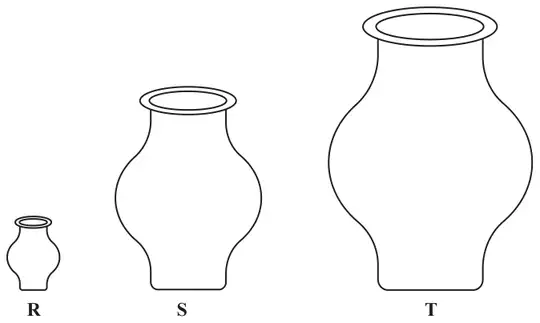
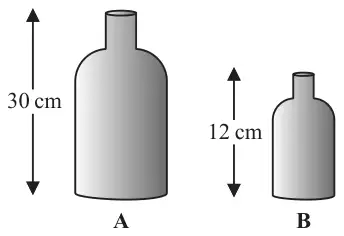
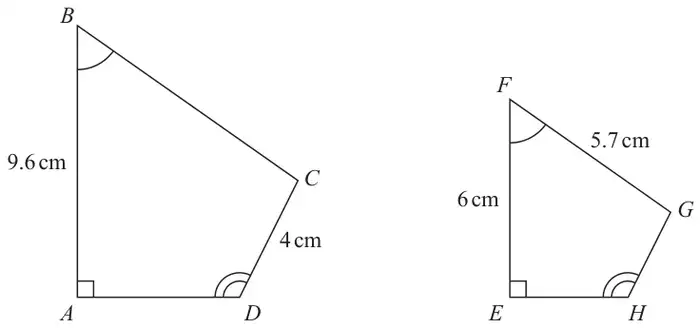
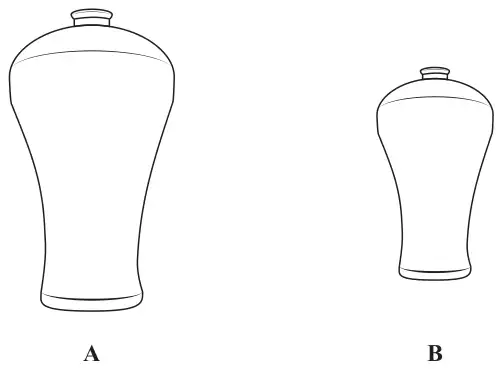
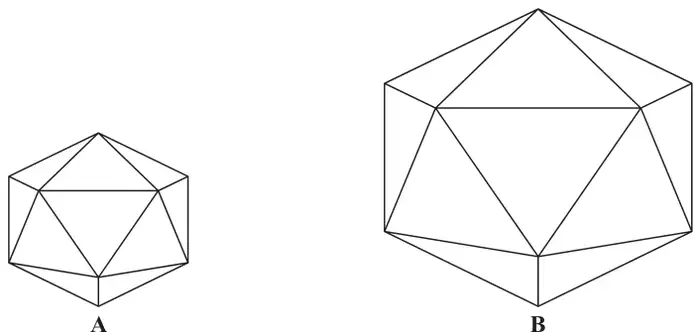
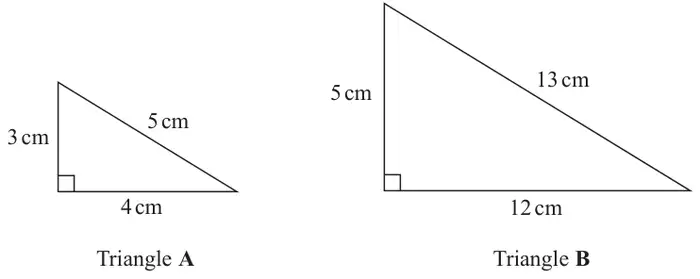
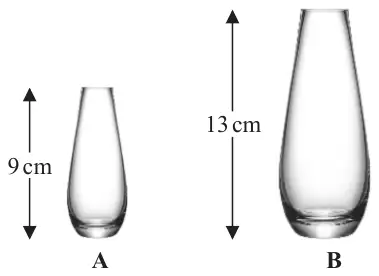
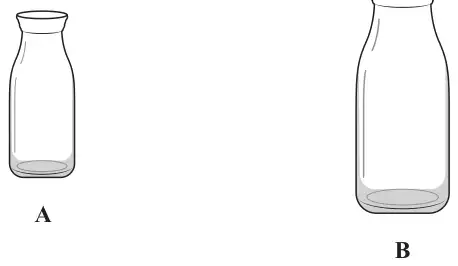
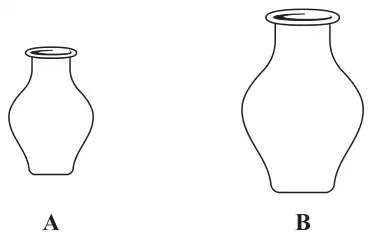
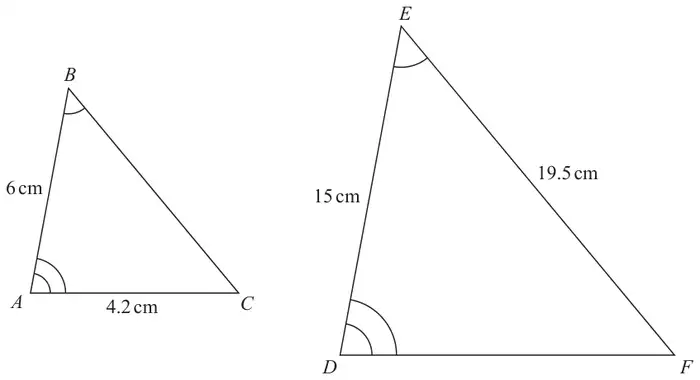
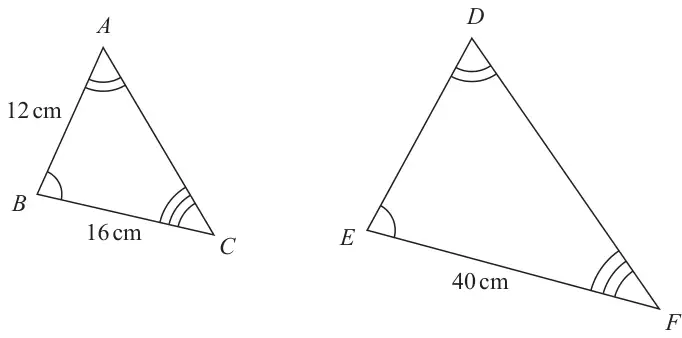
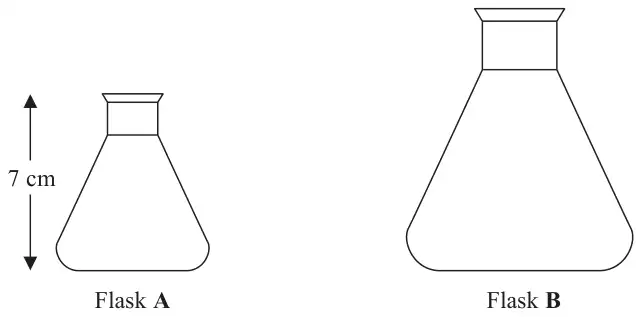
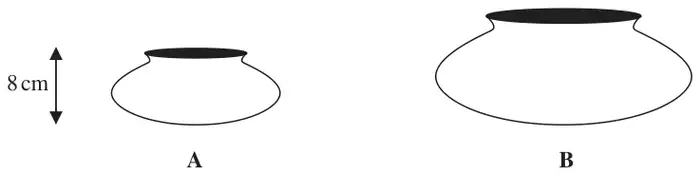
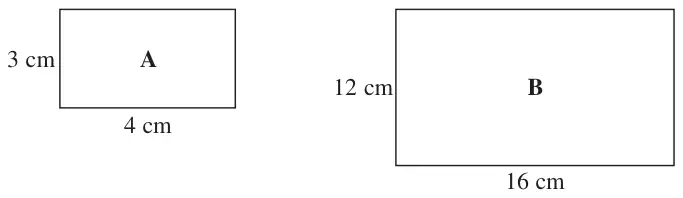
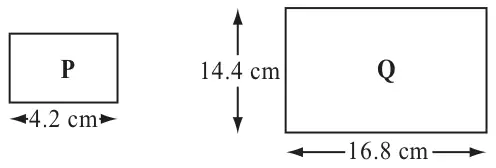
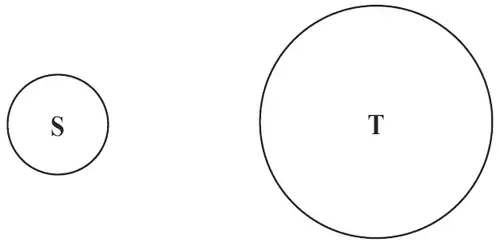
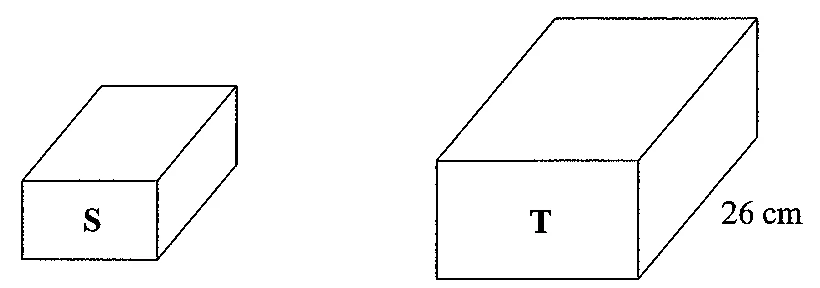
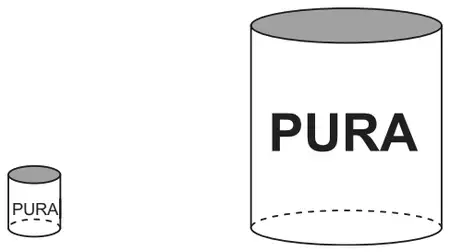
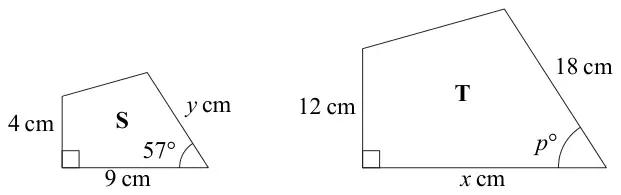
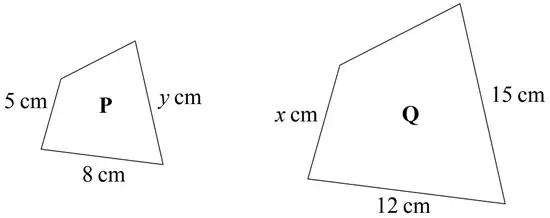
The volume of vase S is 72.8% more than the volume of vase R
The height of vase R is \(h\) cm The height of vase T is \(6h\) cm
The surface area of vase S is \(A\) cm2 The surface area of vase T is \(kA\) cm2
Work out the value of \(k\)
(4)
Mark scheme
Scheme
Marks
eg \(\sqrt[3]{1.728}(= 1.2)\) oe or
(length R : S =) 1 : 1.2 oe eg 5 : 6 or
(length R : S : T =) 1 : 1.2 : 6 oe eg 5 : 6 : 30 or
(volume S : T = ) 1.728 : 216 or 216 ÷ 1.728 (= 125)
M1
eg 6 ÷ “1.2” (= 5) or \(\sqrt[3]{\dfrac{216}{1.728}}(= 5)\)
(length S : T =) 1 : 5 or \(\sqrt[3]{1.728} : \sqrt[3]{216}\)
(area S : T =) “1.2”2 : 62 oe or
(area S : T =) 62 : 302 oe or
(area R : S : T =) 1 : “1.2”2 : 62 oe or
(area R : S : T =) 52 : 62 : 302 oe
M1
eg “5”2or
(area S : T =) 12 : “5”2or
(area S : T =) 1 : 25 or
\((k =)\dfrac{36}{1.44}\) oe
M1
Correct answer scores full marks (unless from obvious incorrect working) Answer: 25
A1
(4)
(4 marks)
Notes
M1: for method to find the scale factor between the heights of R and Sor for a correct ratio for the lengths R : Sor for a correct ratio for the lengths R : S : T or for a correct ratio or scale factor for the volumes S : T
M1: for method to find the scale factor between the heights of S and Tor for a correct ratio of the heights of S and T in the form 1 : \(n\) or for a correct method to find the ratio for the areas S : T ft their ratio of lengths or for a correct method to find the ratio for the areas R : S : T ft their ratio of lengths (maybe seen as the two separate ratios of R : S and R : T)
M1: for squaring the scale factor of the heights of S and Tor for a correct ratio in the form 1 : \(n\) for the areas S : T ft their ratio of areas, may be implied by their final answer or for a correct calculation using the area ratio of S : T to find the value of \(k\)
Here is some information about solid A and solid B
solid A
solid B
Height (cm)
\(3^x\)
Area (cm\(^2\))
7776
486
Volume (cm\(^3\))
\(8^x\)
\(2^{x+4}\)
Work out the height of solid B Give your answer as a decimal.
(5)
Mark scheme
Scheme
Marks
\(\sqrt{\dfrac{7776}{486}}\) or 16 or 4 oe or \(\sqrt{\dfrac{486}{7776}}\) or \(\dfrac{1}{16}\) or \(\dfrac{1}{4}\) oe
M1
\(\dfrac{8^x}{\text{“}4\text{”}^3} = 2^{x+4}\) oe eg \(\dfrac{8^x}{4^3} = 2^{x+4}\) oe or \(\left(\text{“}\dfrac{1}{4}\text{”}\right)^3 \times 8^x = 2^{x+4}\) oe Alternative for M2 (a correct equation linking area and volume): \(\left(\dfrac{486}{7776}\right)^{\frac{3}{2}} = \dfrac{2^{x+4}}{8^x}\) oe or \(\left(\dfrac{7776}{486}\right)^{\frac{3}{2}} = \dfrac{8^x}{2^{x+4}}\) oe
M1
eg \(2^{3x} = 2^6 \times 2^{x+4}\) or \(\dfrac{2^{3x}}{2^{6}} = 2^{x+4}\) oe or \(\dfrac{1}{2^{12}} = \dfrac{2^{x+4}}{2^{3x}}\) or \(12 = 6x - 2x - 8\) oe or \(3x - 6 = x + 4\) oe or \(x = 5\)
M1
\(\dfrac{3^5}{4}\) oe or \(3^5 \times \dfrac{1}{4}\) oe
M1
Answer: 60.75 cm
A1
(5 marks)
Notes
M1: (first) for a correct linear scale factor
M1: (second) for setting up a correct equation for volume
M1: (third) for a correct equation using just powers of 2 or powers of 4 (or 8 or 16) or a correct linear equation in \(x\) or the correct value for \(x\)
M1: (fourth) a correct calculation for the height of solid B
\(\dfrac{6}{15} = \dfrac{x}{\text{height}}\) or height \(= \dfrac{15}{6}x = \dfrac{5}{2}x\) oe or (vol small cone =) \(\left(\dfrac{x}{6}\right)^3 V\) or \(\left(\dfrac{x}{6}\right)^3 \times 180\pi\) or (vol small cone =) \(\text{“}180\pi\text{”} - \dfrac{4212}{25}\pi\;\left(= \dfrac{288}{25}\pi = 11.52\pi = 36.19...\right)\)
M1
eg \(\dfrac{1}{3}\pi x^2 \times \dfrac{5}{2}x\;\left(= \dfrac{5}{6}\pi x^3\right)\) oe or linear SF \(= \sqrt[3]{\dfrac{180}{288/25}}\;(= 2.5)\) oe or \(\sqrt[3]{\dfrac{288/25}{180}}\;(= 0.4)\) oe
M1
eg \(\dfrac{1}{3}\pi \times 6^2 \times 15 - \dfrac{1}{3}\pi x^2 \times \dfrac{5}{2}x = \dfrac{4212}{25}\pi\) or \(180 - \dfrac{5}{6}x^3 = \dfrac{4212}{25}\) oe or \(\left(1 - \left(\dfrac{x}{6}\right)^3\right) \times 180 = \dfrac{4212}{25}\) oe or \(x = \dfrac{6}{2.5}\) or \(h = \dfrac{15}{2.5} = 6\) and \(\dfrac{1}{3}\pi x^2 \times 6 = \dfrac{288}{25}\pi\;(= 11.52\pi)\)
M1
Working required Answer: 2.4
A1
(5 marks)
Notes
M1: (first) a correct expression for volume of large cone
M1: (second) working with the scale factor used or formula for volume of small cone (where \(V\) = vol of large cone) (ft their vol of large cone dep on a correct method)
M1: (third) dep on previous M1: correct formula for volume of small cone in terms of \(x\) only, could be seen as part of an equation and \(\pi\) could be cancelled out, or correct calculation for linear SF of \(v\) to \(V\). 2.5 and 0.4 must be from correct working seen to award the mark (not from height/radius)
M1: (fourth) dep on M3: a correct equation in \(x\) (if using 2.5 this must come from a correct method)
24 The surface area of sphere A is nine times the surface area of sphere B The difference between the volume of sphere A and the volume of sphere B is \(117\pi\) cm3
Find the radius of the smaller sphere. Show your working clearly.
(5)
Mark scheme
Scheme
Marks
eg \(4\pi R^2 = 9 \times 4\pi r^2\) oe or
M1
\(R = 3r\) oe or
1:3 or 3:1 or 3 or \(\dfrac{1}{3}\)
M1
eg
\(\dfrac{4}{3}\pi(3r)^3 - \dfrac{4}{3}\pi r^3 = 117\pi\) oe or
\(\dfrac{4}{3}\pi r^3 - \dfrac{4}{3}\pi\left(\dfrac{1}{3}r\right)^3 = 117\pi\) or
surface area of vase B \(= \dfrac{25}{64} \times\) surface area of vase A
and that
volume of vase A – volume of vase B = 541.8 cm3
Calculate the volume of vase B
(4)
Mark scheme
Scheme
Marks
eg \(\sqrt{\dfrac{25}{64}}\left(= \dfrac{5}{8} = 0.625\right)\) or \(\sqrt{\dfrac{64}{25}}\left(= \dfrac{8}{5} = 1.6\right)\) or
\(\sqrt{25} : \sqrt{64}\;(5:8)\) or \(\sqrt{64} : \sqrt{25}\;(8:5)\) or
\(\dfrac{(\sqrt{25})^3}{(\sqrt{64})^3} = \left(\dfrac{125}{512} = 0.244140625\right)\) oe or \(\dfrac{512}{125} = 4.096\)
\(\dfrac{25^3}{64^3} = \dfrac{(\text{vol of }\mathbf{B})^2}{(\text{vol of }\mathbf{B} + 541.8)^2}\) or \(\dfrac{25}{64} = \dfrac{(\text{vol of }\mathbf{B})^{\frac{2}{3}}}{(\text{vol of }\mathbf{B} + 541.8)^{\frac{2}{3}}}\) oe
or eg \(\mathbf{A}\left(1 - \dfrac{125}{512}\right) = 541.8\) or \(\dfrac{387}{512}\mathbf{A} = 541.8\)
\((8^3)k - (5^3)k\;(= 387k) = 541.8\)
or eg \((k =)\;\dfrac{541.8}{387}\left(= \dfrac{7}{5}\right)\)
M1
eg \((\mathbf{B})\;541.8 \div \text{``}{\dfrac{387}{125}}\text{''}\) or \(541.8 \div \text{``}{3.096}\text{''}\) or eg \(125 \times \text{``}{\dfrac{7}{5}}\text{''}\) or
Correct answer scores full marks (unless from obvious incorrect working) Answer: 175
A1
(4)
(4 marks)
Notes
M1: for a correct scale factor for length – may be given as a fraction or decimal or ratio or a correct scale factor for volume given as a fraction or decimal or ratio or a correct equation for the volume of vase B
M1: For a correct equation for the volume of B or a correct equation for the volume of A
M1: For a completely correct method to find the volume of vase B or vase A
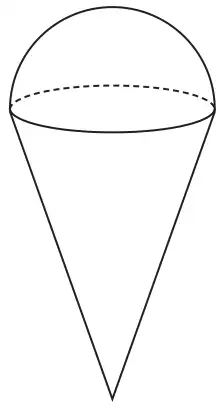
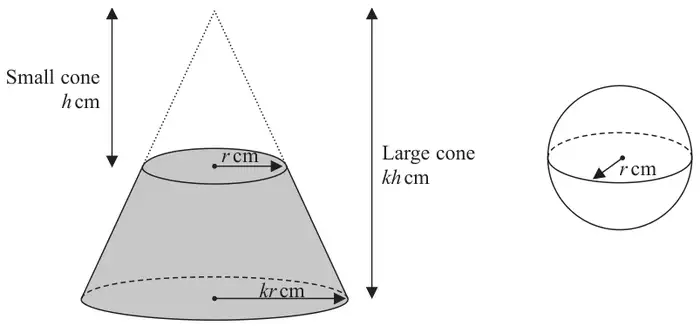
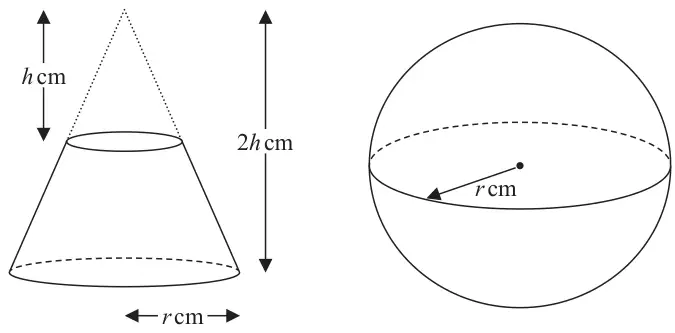
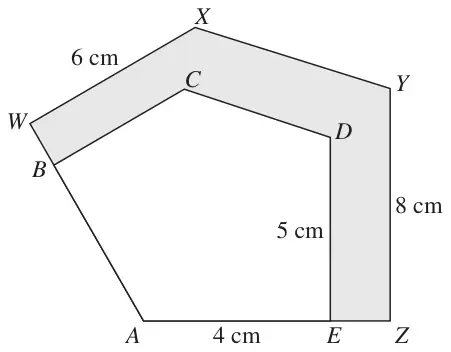
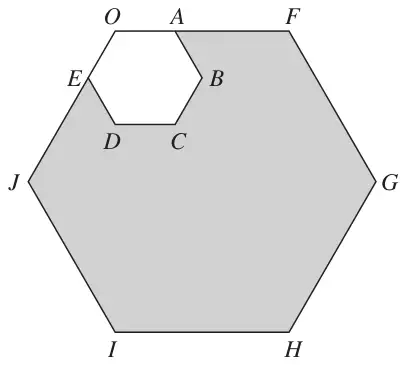
24 The diagram shows a frustum of a cone, and a sphere.
The frustum, shown shaded in the diagram, is made by removing the small cone from the large cone. The small cone and the large cone are similar.
Diagram NOT accurately drawn
The height of the small cone is \(h\) cm and the radius of the base of the small cone is \(r\) cm. The height of the large cone is \(kh\) cm and the radius of the base of the large cone is \(kr\) cm. The radius of the sphere is \(r\) cm.
The sphere is divided into two hemispheres, each of radius \(r\) cm.
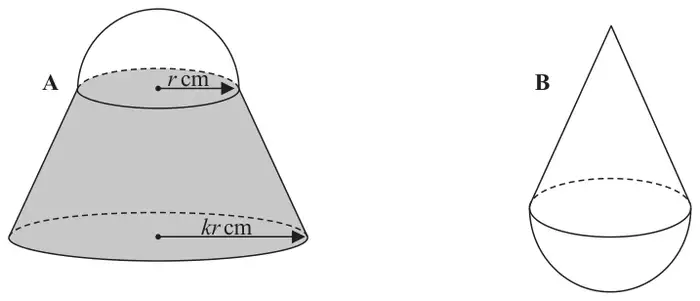
Solid A is formed by joining one of the hemispheres to the frustum. The plane face of the hemisphere coincides with the upper plane face of the frustum, as shown in the diagram below.
Solid B is formed by joining the other hemisphere to the small cone that was removed from the large cone. The plane face of the hemisphere coincides with the plane face of the base of the small cone, as shown in the diagram below.
Diagram NOT accurately drawn
The volume of solid A is 6 times the volume of solid B.
Given that \(k \gt \sqrt[3]{7}\) find an expression for \(h\) in terms of \(k\) and \(r\)
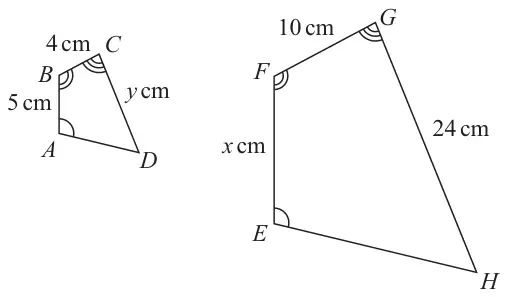
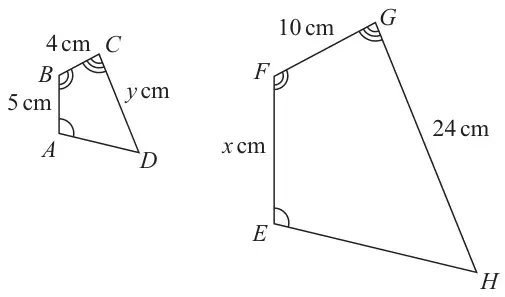
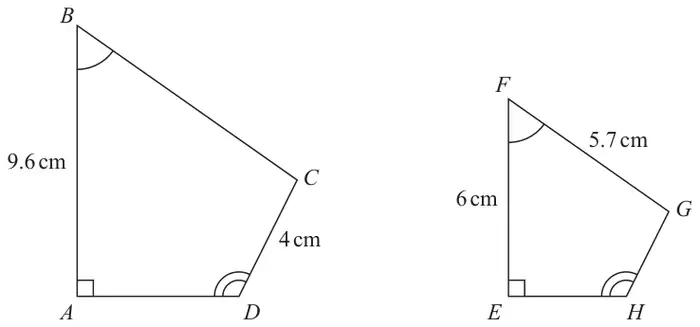
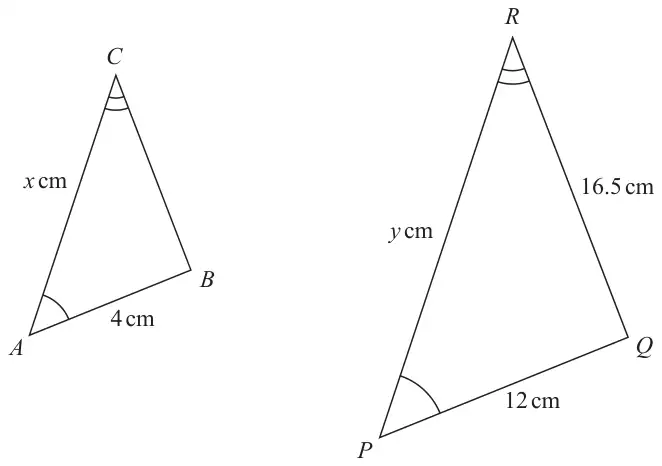
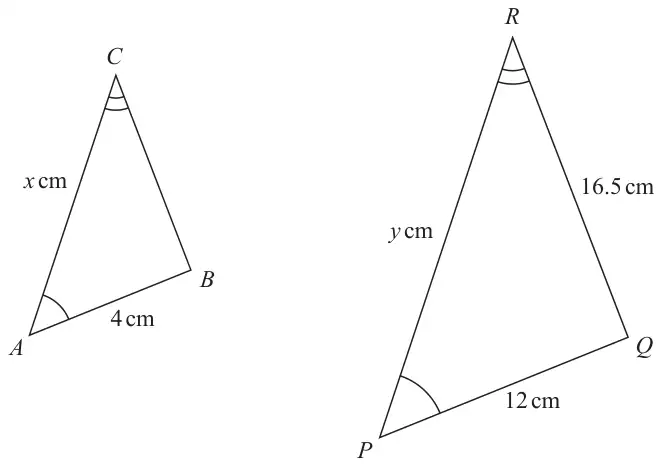
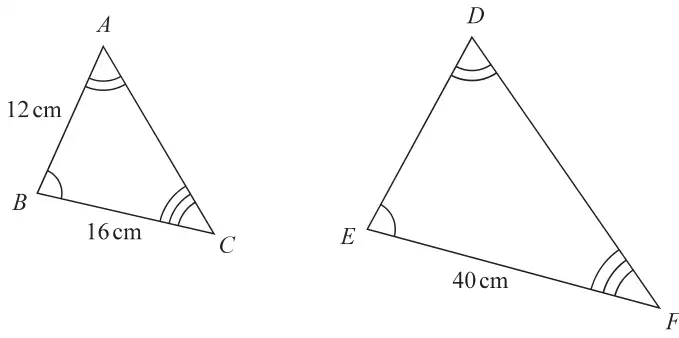
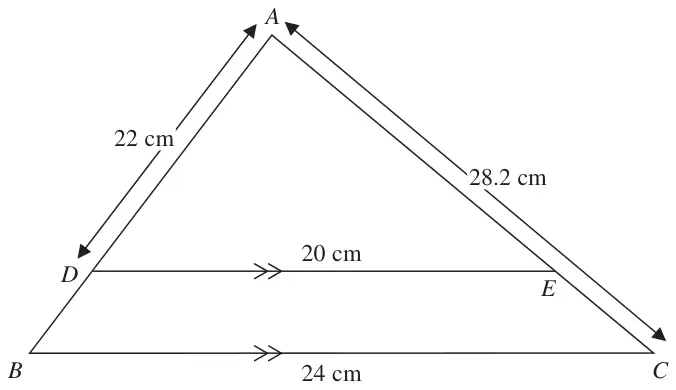
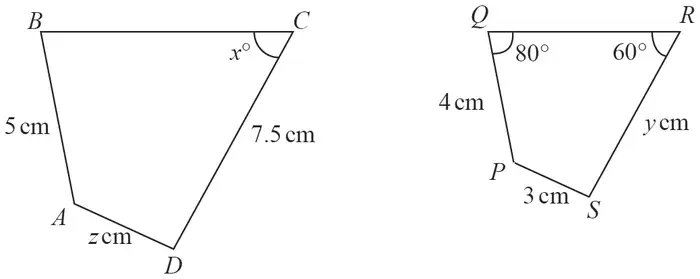
\(AB = 4\) cm \(PQ = 12\) cm \(RQ = 16.5\) cm \(AC = x\) cm \(PR = y\) cm
(a) Calculate the length of \(BC\) (2)
(b) Write down an expression for \(y\) in terms of \(x\) (1)
Mark scheme (a)
Scheme
Marks
\(\dfrac{12}{4}\;(= 3)\) or \(\dfrac{4}{12}\;(= 0.\dot{3})\) or \(\dfrac{BC}{4} = \dfrac{16.5}{12}\)
or \(BC \div 16.5 = 4 \div 12\) or \((BC =)\;16.5 \div \dfrac{12}{4}\) oe
M1
5.5
A1
(2)
Notes
M1: correct scale factor (given as 3 or a fraction or a ratio) or correct equation using \(BC\) or a correct expression for \(BC\) (award for SF even if not used)
Mark scheme (b)
Scheme
Marks
\(3x\)
B1
(1)
(3 marks)
Notes
B1: allow \(3 \times x\) or \(x \times 3\) ft their “3” in (a)
20 Mathematically similar wooden blocks are made in a workshop.
There are small blocks and there are large blocks.
The volume of each small block is 300 cm3
Given that
the surface area of each small block : the surface area of each large block = 25 : 36
work out the volume of each large block.
(3)
Mark scheme
Scheme
Marks
eg \(\sqrt{\dfrac{36}{25}}\ \left(= \dfrac{6}{5}\right)\) or \(\sqrt{\dfrac{25}{36}}\ \left(= \dfrac{5}{6}\right)\) or
\(\sqrt{36} : \sqrt{25}\ (6 : 5)\) or \(\sqrt{25} : \sqrt{36}\ (5 : 6)\) or
\(\dfrac{(\sqrt{25})^3}{(\sqrt{36})^3} = \left(\dfrac{125}{216}\right)\) oe or
\(\dfrac{36^3}{25^3} = \dfrac{(\text{vol of large})^2}{300^2}\) or \(\dfrac{36}{25} = \dfrac{(\text{vol of large})^{\frac{2}{3}}}{300^{\frac{2}{3}}}\) oe
M1
eg \(300 \times \left(\text{``}\dfrac{6}{5}\text{''}\right)^3\) or \(300 \div \left(\text{``}\dfrac{5}{6}\text{''}\right)^3\) oe or
\(\sqrt{\dfrac{300^2 \times 36^3}{25^3}}\) or \(\left(\dfrac{36 \times 300^{\frac{2}{3}}}{25}\right)^{\frac{3}{2}}\) oe
M1
Working not required, so correct answer scores full marks (unless from obvious incorrect working) Answer: 518.4
A1
(3)
(3 marks)
Notes
M1: for a correct scale factor for length – may be given as a fraction or ratio or a correct scale factor for volume given as a fraction or ratio or a correct equation for the volume of each large block
M1: for a complete method to find the volume of a large block
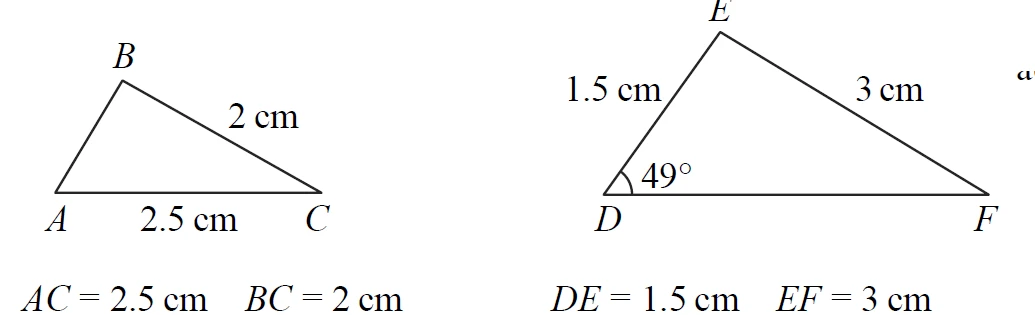
Note: the printed scheme labels the second method “\(CE = 6.4 \div \dfrac{8}{20} + 6.4\)”; this expression gives \(BE\) (= \(CE + BC\)), so it is shown here as \(BE\).
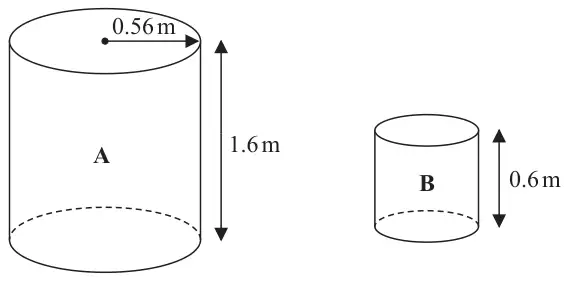
(a) Work out the curved surface area of cylinder A. Give your answer in m2 correct to 3 significant figures. (2)
Cylinder B is mathematically similar to cylinder A. The height of cylinder B is 0.6 m.
(b) Work out the radius of cylinder B. (2)
Mark scheme (a)
Scheme
Marks
\(2 \times \pi \times 0.56 \times 1.6\)
M1
5.63
A1
(2)
Notes
M1: Award even if part of a calculation including 1 or 2 circles
A1: awrt 5.63
Mark scheme (b)
Scheme
Marks
\(\dfrac{0.6}{1.6}\) (=0.375) or \(\dfrac{1.6}{0.6} \left(= \dfrac{8}{3} = 2.\dot{6}\right)\) or
\(\dfrac{r}{0.56} = \dfrac{0.6}{1.6}\) or \((r =) \dfrac{0.56 \times 0.6}{1.6}\) or \(0.56 \div 2.\dot{6}\) oe
M1
0.21
A1
(2)
(4 marks)
Notes
M1: Correct scale factor (given as a fraction or a ratio) or correct equation in \(r\) or a correct expression for \(r\). Allow 2.6666... to 1 dp rounded or truncated
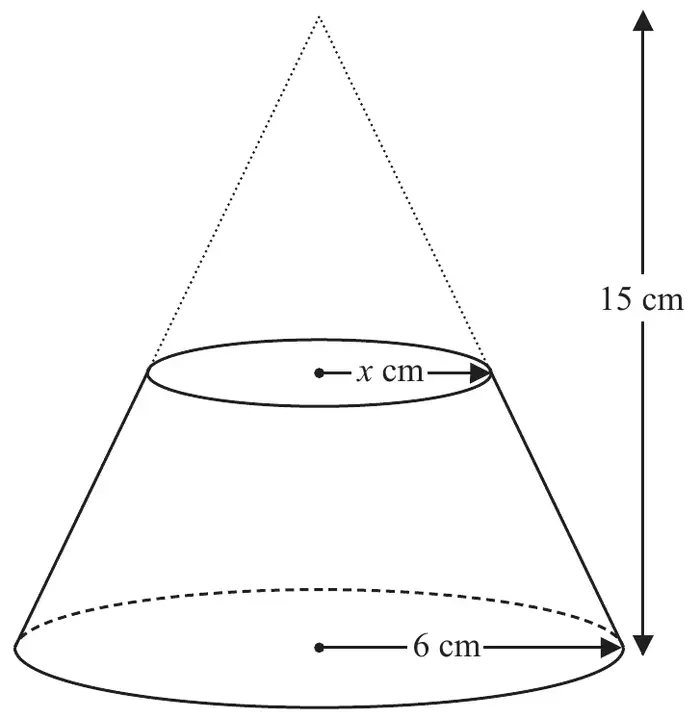
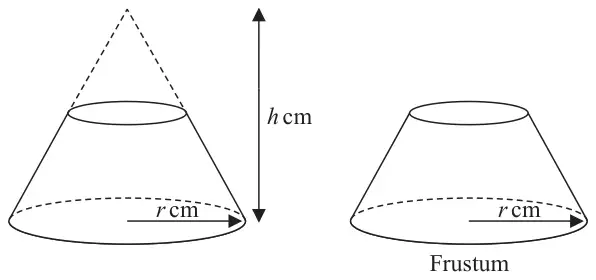
16 A frustum is made by removing a small cone from a large cone. The cones are mathematically similar.
Diagram NOT accurately drawn
The large cone has base radius \(r\) cm and height \(h\) cm.
Given that\[\frac{\text{volume of frustum}}{\text{volume of large cone}} = \frac{98}{125}\]find an expression, in terms of \(h\), for the height of the frustum.
(4)
Mark scheme
Scheme
Marks
\(1 - \dfrac{98}{125} \left(= \dfrac{27}{125}\right)\) or 0.216 or 125 – 98 (=27)
M1
\(\sqrt[3]{\text{``}{\dfrac{27}{125}}\text{''}} \left(= \dfrac{3}{5}\right)\) or \(\sqrt[3]{\text{``}{\dfrac{125}{27}}\text{''}} \left(= \dfrac{5}{3}\right)\)
M1
\(1 - \text{``}{\dfrac{3}{5}}\text{''}\) or \(h - \text{``}{\dfrac{3}{5}}\text{''}h\) oe
M1
\(\dfrac{2}{5}h\) oe
A1
(4)
(4 marks)
Notes
M1: for the length scale factor may be seen as a ratio E.g. 3 : 5
A1: for \(\dfrac{2}{5}h\) oe (may not be simplified)
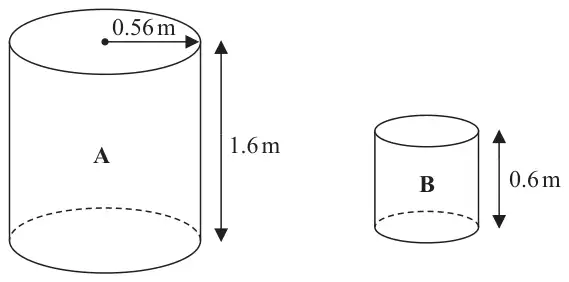
(a) Work out the curved surface area of cylinder A. Give your answer in m2 correct to 3 significant figures. (2)
Cylinder B is mathematically similar to cylinder A. The height of cylinder B is 0.6 m.
(b) Work out the radius of cylinder B. (2)
Mark scheme (a)
Scheme
Marks
\(2 \times \pi \times 0.56 \times 1.6\)
M1
5.63
A1
(2)
Notes
M1: Award even if part of a calculation including 1 or 2 circles
A1: awrt 5.63
Mark scheme (b)
Scheme
Marks
\(\dfrac{0.6}{1.6}\) (=0.375) or \(\dfrac{1.6}{0.6} \left(= \dfrac{8}{3} = 2.\dot{6}\right)\) or
\(\dfrac{r}{0.56} = \dfrac{0.6}{1.6}\) or \((r =) \dfrac{0.56 \times 0.6}{1.6}\) or \(0.56 \div 2.\dot{6}\) oe
M1
0.21
A1
(2)
(4 marks)
Notes
M1: Correct scale factor (given as a fraction or ratio) or correct equation in \(r\) or a correct expression for \(r\). Allow 2.6666... to 1 dp rounded or truncated
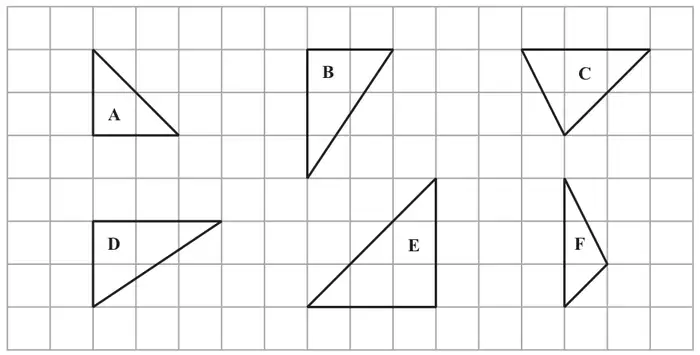
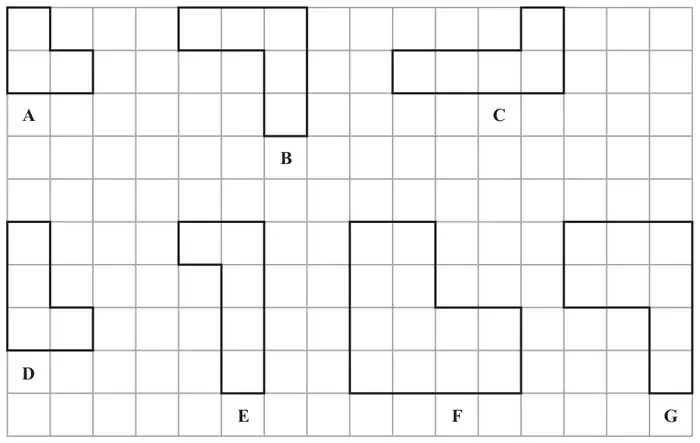
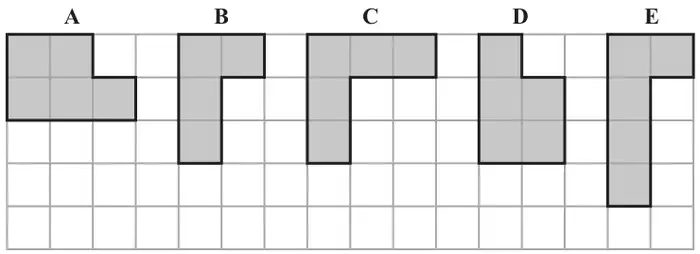
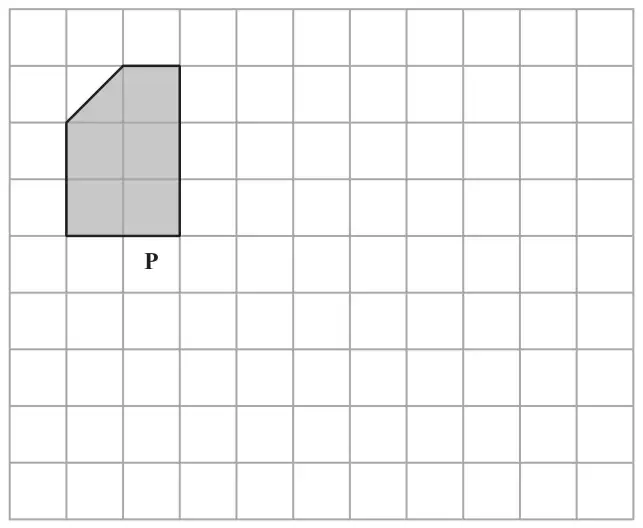
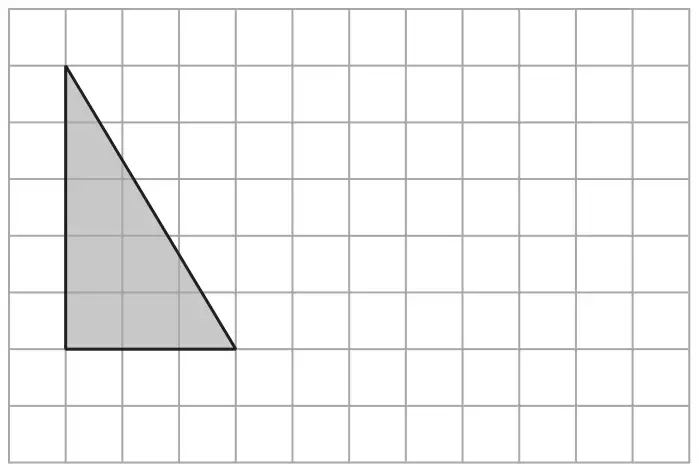
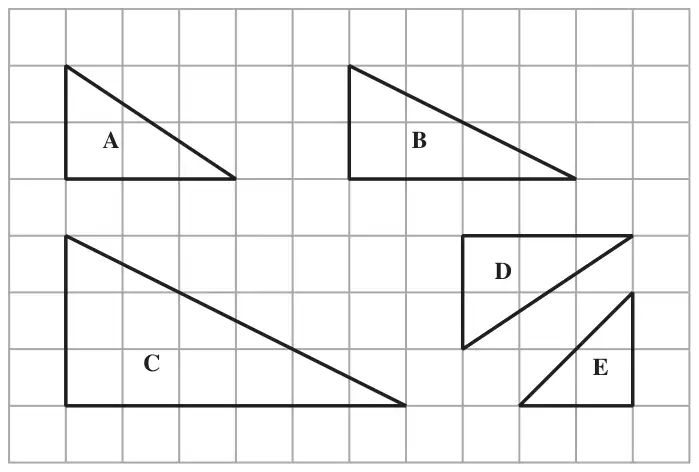
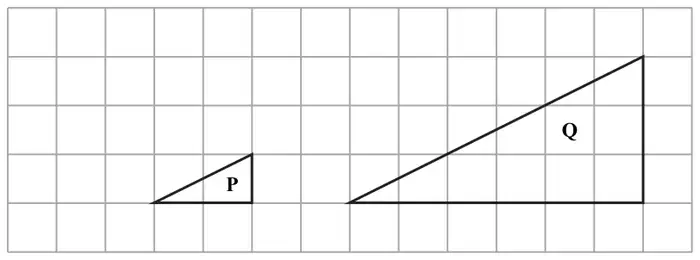
12 The diagram shows shape P on a centimetre grid.
(a)
(i) Find the area of shape P.
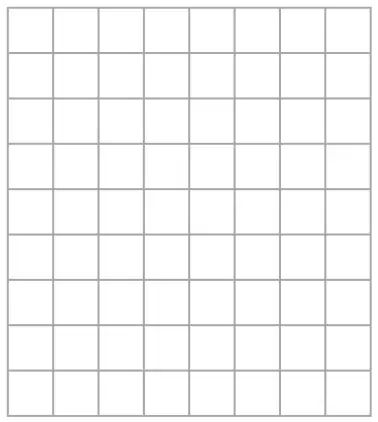
(ii) On the grid above, draw a shape that is similar but not congruent to shape P.
(2)
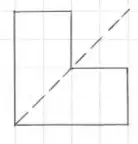
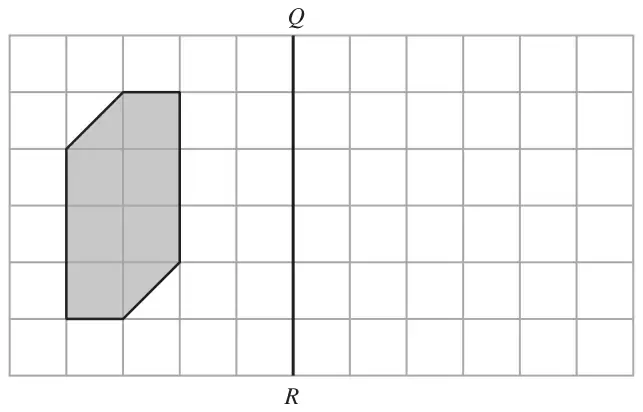
The diagram shows a shape on a centimetre grid and a line \(QR\).
(b) On the grid, reflect the shape in the line \(QR\). (2)
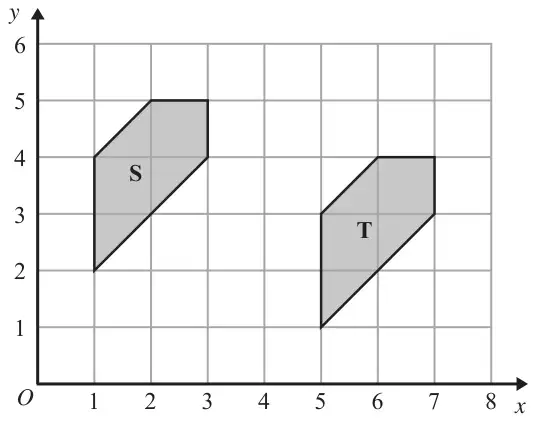
The diagram shows shape S and shape T on a centimetre grid.
(c) Describe fully the single transformation that maps shape S onto shape T. (2)
Mark scheme (a)
Scheme
Marks
(i) 5.5
B1
(ii) Correct shape
B1
(2)
Mark scheme (b)
Scheme
Marks
M1
Correct reflection
A1
(2)
Notes
M1: 4 or 5 correct lines
A1: SCB1 for correct shape and orientation in wrong position
Mark scheme (c)
Scheme
Marks
Translation 4 to the right and 1 down
B2
(2)
Notes
B2: For translation and 4 to the right and 1 down B1 for translation or 4 to the right and 1 down Accept \(\begin{pmatrix} 4 \\ -1 \end{pmatrix}\) NB: No marks for multiple transformations
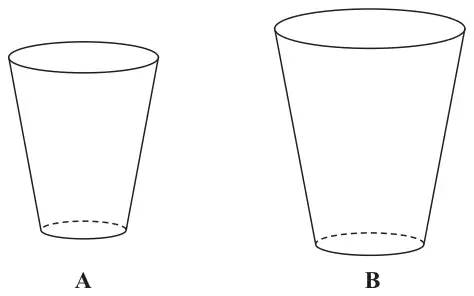
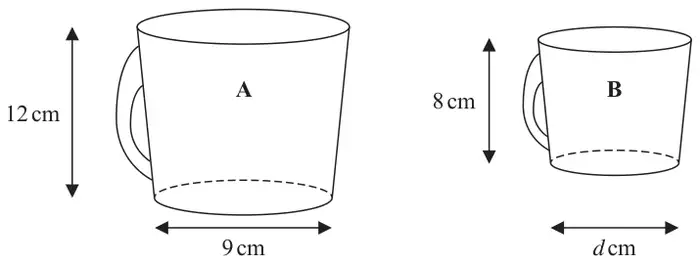
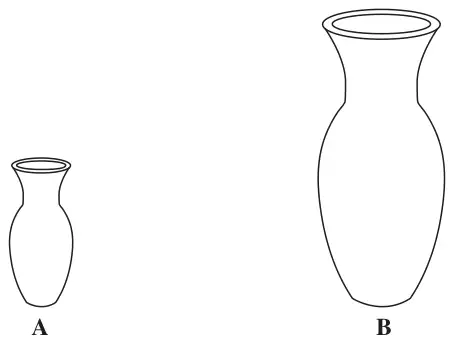
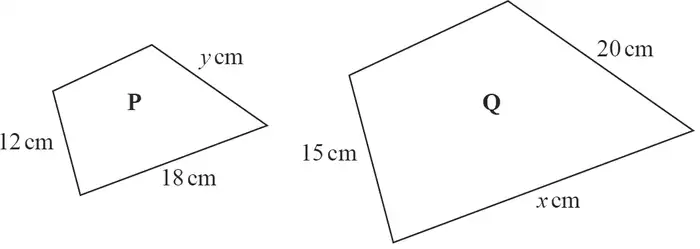
13 Here are two mathematically similar cups, A and B.
Diagram NOT accurately drawn
A has height 12 cm and base diameter 9 cm. B has height 8 cm and base diameter \(d\) cm.
(a) Work out the value of \(d\). (2)
The volume of B is 160 millilitres.
(b) Work out the volume of A. (2)
Two solid plates, P and Q, are mathematically similar and made of the same material.
The surface area of P is \(p\) cm² The surface area of Q is \(q\) cm² The weight of P is \(w\) grams.
(c) Find an expression for the weight of Q. Give your answer in terms of \(p\), \(q\) and \(w\). (2)
Mark scheme (a)
Scheme
Marks
E.g. \(\dfrac{8}{12}\) (= 0.66...) or \(\dfrac{12}{8}\) (=1.5) or \(\dfrac{d}{9} = \dfrac{8}{12}\) oe
or
\(\dfrac{9}{12}\) (= 0.75) or \(\dfrac{12}{9}\) (=1.33...)
M1
6
A1
(2)
Notes
M1: for a correct scale factor or a correct equation (may be in ratio form e.g. 12 : 8 = 9 : \(d\)) accept 0.66… or 1.33… rounded or truncated to 2 or more decimal places
Mark scheme (b)
Scheme
Marks
\(160 \times \left(\dfrac{12}{8}\right)^3\) oe or \(\sqrt[3]{\dfrac{V}{160}} = \dfrac{12}{8}\)
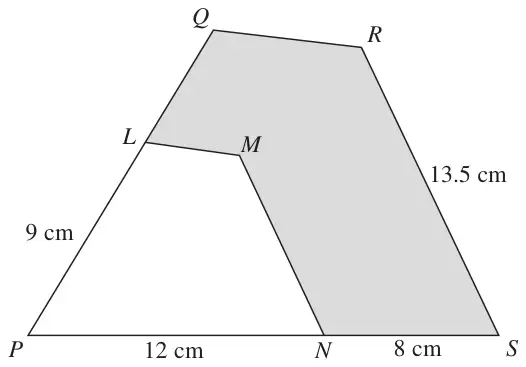
13 \(PQRS\) and \(PLMN\) are similar quadrilaterals. \(PN = 12\) cm, \(NS = 8\) cm, \(PL = 9\) cm and \(RS = 13.5\) cm. \(LM\) is parallel to \(QR\) and \(MN\) is parallel to \(RS\).
Diagram NOT accurately drawn
(a) Work out the length of \(MN\). (2)
(b) Work out the length of \(LQ\). (2)
The area of \(PLMN\) is \(A\) cm2 The area of \(PQRS\) is \(kA\) cm2
(c) Find the value of \(k\). (1)
The area of the shaded region is 105.6 cm2
(d) Work out the value of \(A\). (3)
Mark scheme (a)
Scheme
Marks
Eg. \(\dfrac{12}{12 + 8}\) or \(\dfrac{3}{5}\) or 0.6 or \(\dfrac{12 + 8}{12}\) or \(\dfrac{5}{3}\) or 1.66(66...) or
M1: for correct scale factor or correct equation involving \(MN\) or correct expression for \(MN\)
Allow use of 1.66(66....) in place of \(\dfrac{5}{3}\) if rounded or truncated to at least 3 significant figures
A1: oe
Mark scheme (b)
Scheme
Marks
Eg \(\dfrac{PQ}{9} = \dfrac{12 + 8}{12}\) oe or \(\dfrac{PQ}{9} = \dfrac{13.5}{\text{"}8.1\text{"}}\) or \(PQ = 9 \times \dfrac{12 + 8}{12}\) oe or
\(PQ = 9 \times \dfrac{13.5}{\text{"}8.1\text{"}}\) oe or \(PQ = 15\)
or \(\dfrac{LQ}{9} = \dfrac{8}{12}\) oe or \((LQ =)\;9 \times \dfrac{8}{12}\) oe
M1
6
A1
(2)
Notes
M1: Correct expression for \(PQ\) or \(LQ\) (eg \(9 \times \dfrac{5}{3}\) oe or \(9 \times \dfrac{2}{3}\) oe)
Correct equation involving \(PQ\) or \(LQ\) (eg \(\dfrac{PQ}{9} = \dfrac{5}{3}\) oe or \(\dfrac{LQ}{9} = \dfrac{2}{3}\) oe)
Allow use of 1.66(66....) in place of \(\dfrac{5}{3}\) or 0.666(66...) in place of \(\dfrac{2}{3}\) if rounded or truncated to at least 3 significant figures
Mark scheme (c)
Scheme
Marks
\(\dfrac{25}{9}\) oe
B1
(1)
Notes
B1: Accept \(2\dfrac{7}{9}\)
Accept 2.77(777...) rounded or truncated to at least 3 significant figures
Also accept \(\left(\dfrac{20}{12}\right)^2\) or \(\left(\dfrac{5}{3}\right)^2\)
Mark scheme (d)
Scheme
Marks
Eg \(\text{"}\left(\dfrac{25}{9}\right)\text{"}A - A = 105.6\) or \(A\left(\text{"}\left(\dfrac{25}{9}\right)\text{"} - 1\right) = 105.6\) or
\(A\left(\text{"}\left(\dfrac{16}{9}\right)\text{"}\right) = 105.6\) or \(\text{"}\left(\dfrac{25}{9}\right)\text{"}A = 105.6 + A\) or
\(\dfrac{105.6 + A}{\text{"}25/9\text{"}} = A\)
M1
\((A =)\;\dfrac{105.6}{\frac{25}{9} - 1}\) or \((A =)\;\dfrac{105.6}{1.77\ldots}\) or \((A =)\;\dfrac{105.6 \times 9}{16}\)
M1
59.4
A1
(3)
Notes
M1: For a correct equation involving \(A\) ft from part (c)
M1: For correct expression for \(A\). ft from part (c) Decimal values should be rounded or truncated correct to at least 3SF
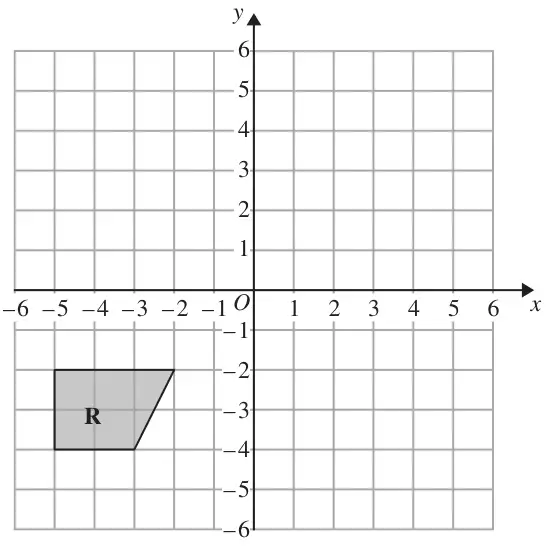
(a) Write down the scale factor of this enlargement. (1)
(b) On the grid above, reflect shape R in the line \(y = -x\) (2)
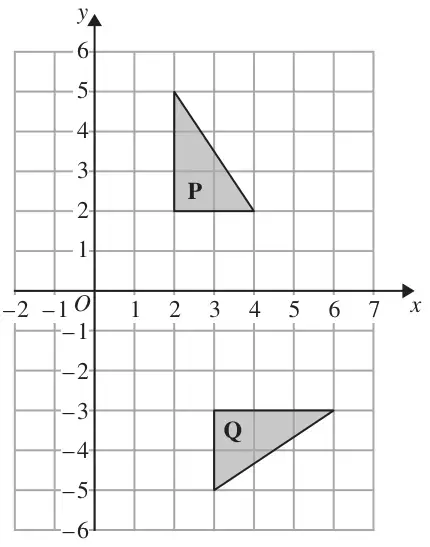
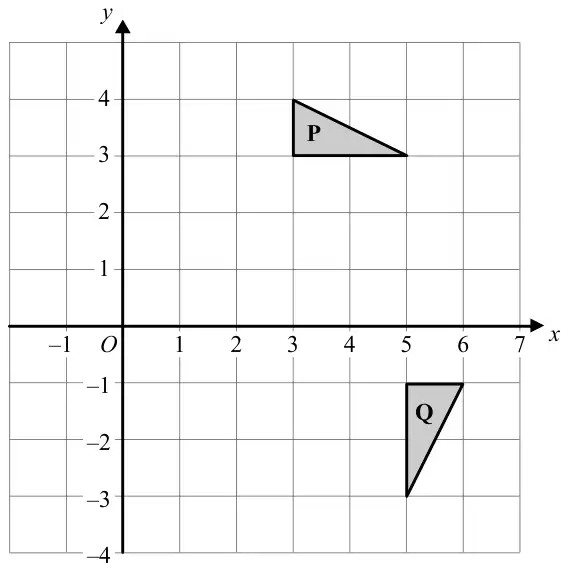
(c) Describe fully the single transformation that maps triangle P onto triangle Q. (3)
Mark scheme (a)
Scheme
Marks
4
B1
(1)
Notes
B1: accept ×4
Mark scheme (b)
Scheme
Marks
\(y = -x\) drawn
M1
(2,2) (2,5) (4,5) (4,3)
A1
(2)
Notes
M1: \(y = -x\) drawn or a congruent shape with the correct orientation in the 1st quadrant or a correct reflection in \(y = x\)
Mark scheme (c)
Scheme
Marks
Rotation about (0, −1) \(90^\circ\) clockwise
B1 B1 B1
(3)
Total 6 marks
Notes
B1 B1 B1: Rotation (not turn) (centre) (0, −1) \(90^\circ\) clockwise or \(-90^\circ\) or \(270^\circ\) anti-clockwise or \(+270^\circ\) NB. If more than one transformation given then no marks should be awarded
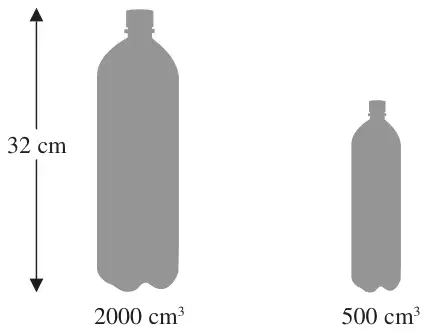
Zane buys mineral water in large bottles and in small bottles. The large bottles are mathematically similar to the small bottles. Large bottles have a height of 32 cm and a volume of 2000 cm3 Small bottles have a volume of 500 cm3
Work out the height of a small bottle. Give your answer correct to 3 significant figures.
(3)
Mark scheme
Scheme
Marks
\(\left(\dfrac{h}{32}\right)^3 = \dfrac{500}{2000}\) or \(\sqrt[3]{\dfrac{500}{2000}}\) oe or \(\sqrt[3]{\dfrac{2000}{500}}\) or \(\dfrac{2000}{500}\) or 4 or \(\dfrac{500}{2000}\) or
\(\dfrac{1}{4}\) or 500 : 2000 oe or 2000 : 500 oe
M1
Eg \((h =)\sqrt[3]{\dfrac{500}{2000} \times 32^3}\) or \(\sqrt[3]{\dfrac{1}{4} \times 32768}\) or \(\sqrt[3]{8192}\) or \(\sqrt[3]{\dfrac{1}{4}} \times 32\) oe
M1
20.2
A1
(3 marks)
Notes
M1: Accept 1.58(7401052......) or 0.629(9605249......) rounded or truncated to at least 3 SF
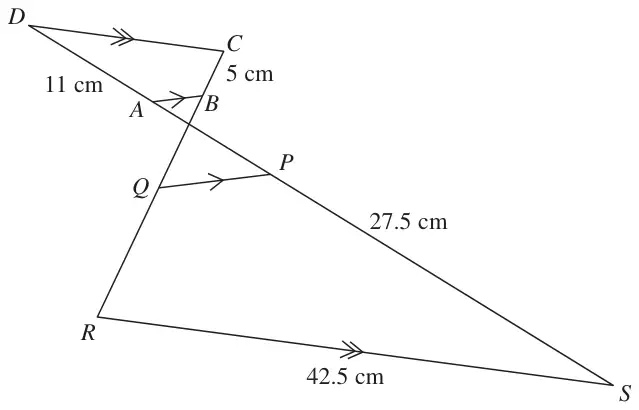
12 In the diagram, \(DAPS\) and \(CBQR\) are straight lines. \(AB\) is parallel to \(QP\) and \(DC\) is parallel to \(RS\). \(AD = 11\) cm, \(BC = 5\) cm, \(PS = 27.5\) cm and \(RS = 42.5\) cm.
Diagram NOT accurately drawn
Quadrilateral \(ABCD\) is similar to quadrilateral \(PQRS\).
(a) Find the ratio of the length of \(AB\) to the length of \(PQ\). Give your answer in the form \(1 : n\) (2)
(b) Work out the length of \(RQ\). (2)
(c) Work out the length of \(CD\). (2)
The area of quadrilateral \(ABCD\) is 54 cm2
(d) Work out the area of quadrilateral \(PQRS\). (2)
Mark scheme (a)
Scheme
Marks
\(\frac{27.5}{11}\) or \(\frac{11}{27.5}\)
M1
2.5
A1
(2)
Notes
A1: oe
Mark scheme (b)
Scheme
Marks
\(5 \times\) “2.5” or \(5 \times \frac{27.5}{11}\) or \(\frac{RQ}{5} = \frac{27.5}{11}\) oe
or \(\dfrac{5}{11} = \dfrac{RQ}{27.5}\) oe
M1
12.5
A1
(2)
Notes
M1: Correct expression for \(RQ\) or correct equation to give \(RQ\). ft their answer to (a)
Mark scheme (c)
Scheme
Marks
\(42.5 \div\) “2.5” or \(42.5 \times \dfrac{11}{27.5}\) or \(42.5 \times \dfrac{5}{\text{“}12.5\text{”}}\)
or \(\dfrac{CD}{42.5} = \dfrac{11}{27.5}\) or \(\dfrac{CD}{42.5} = \dfrac{5}{\text{“}12.5\text{”}}\) oe
M1
17
A1
(2)
Notes
M1: Correct expression for \(CD\) or correct equation to give \(CD\). ft their \(RQ\), if used. ft their answer to (a)
Mark scheme (d)
Scheme
Marks
\(54 \times (\text{“}2.5\text{”})^2\) oe or \(\dfrac{\text{Area}}{54} = \left(\dfrac{27.5}{11}\right)^2\) oe
M1
337.5
A1
(2)
(8 marks)
Notes
M1: Correct expression for area or correct equation to give area. ft ratio from (a), if used.
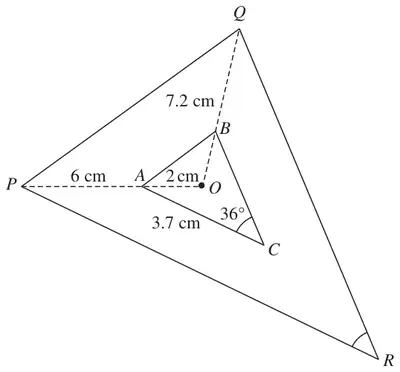
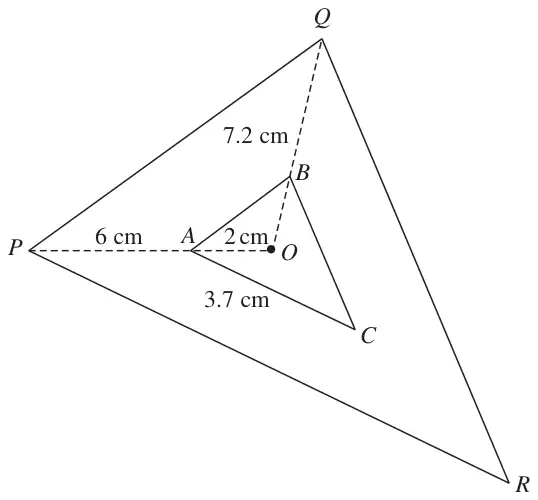
Triangle \(PQR\) is an enlargement, centre \(O\), of triangle \(ABC\). \(OAP\) and \(OBQ\) are straight lines. \(OA = 2\) cm. \(AP = 6\) cm. \(BQ = 7.2\) cm. \(AC = 3.7\) cm. Angle \(C = 36^\circ\)
(a) Find the size of angle \(R\). (1)
(b) Work out the length of \(OB\). (2)
(c) Work out the length of \(PR\). (3)
Mark scheme (a)
Scheme
Marks
36
B1
(1)
Notes
B1: cao
Mark scheme (b)
Scheme
Marks
\(\dfrac{7.2 \times 2}{6}\) or \(7.2 \div \dfrac{6}{2}\)
M1
2.4
A1
(2)
Notes
A1: cao
Mark scheme (c)
Scheme
Marks
scale factor = \(\dfrac{8}{2}\) or 4 or \(\dfrac{2}{8}\) or \(\dfrac{1}{4}\)
M1
\(3.7 \times 4\) or \(3.7 \div \dfrac{1}{4}\)
M1
14.8
A1
(3)
(Total 6 marks)
Notes
M1: for \(\dfrac{8}{2}\) or 4 or \(\dfrac{2}{8}\) or \(\dfrac{1}{4}\)
M1: Also award for \(3.7 \times 3\) or \(3.7 \div \dfrac{1}{3}\)
Triangle \(PQR\) is an enlargement, centre \(O\), of triangle \(ABC\). \(OAP\) and \(OBQ\) are straight lines. \(OA = 2\) cm. \(AP = 6\) cm. \(BQ = 7.2\) cm. \(AC = 3.7\) cm.
(a) Work out the length of \(OB\). (2)
(b) Work out the length of \(PR\). (3)
The area of triangle \(PQR\) is 72 cm2
(c) Work out the area of triangle \(ABC\). (2)
Mark scheme (a)
Scheme
Marks
\(7.2 \times \dfrac{2}{6}\) or \(7.2 \div \dfrac{6}{2}\)
M1
2.4
A1
(2)
Notes
A1: cao
Mark scheme (b)
Scheme
Marks
scale factor = \(\dfrac{8}{2}\) or 4 or \(\dfrac{2}{8}\) or \(\dfrac{1}{4}\)
M1
\(3.7 \times 4\) or \(3.7 \div \dfrac{1}{4}\)
M1
14.8
A1
(3)
Notes
M1: for \(\dfrac{8}{2}\) or 4 or \(\dfrac{2}{8}\) or \(\dfrac{1}{4}\)
M1: (dep)
A1: Cao SC: M1 for answer of 11.1
Mark scheme (c)
Scheme
Marks
\(4^2\) or \((8 \div 2)^2\) or \((2 \div 8)^2\) or \((1 \div 4)^2\)
M1
4.5oe
A1
(2)
(7 marks)
Notes
M1: or for complete correct method of finding vert ht (\(h\) cm) of \(\Delta PQR\) and vert ht (\(H\) cm) of \(\Delta ABC\)
eg \(\frac{1}{2} \times \text{“}14.8\text{”} \times h = 72\)
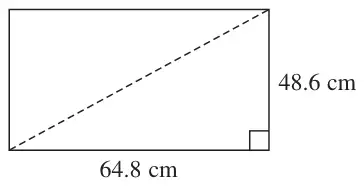
A TV screen is rectangular. The width of the rectangle is 64.8 cm and the height is 48.6 cm. The length of a diagonal of the rectangle gives the ‘size’ of the TV screen.
(a) Calculate the ‘size’ of the TV screen. (3)
Diagram NOT accurately drawn
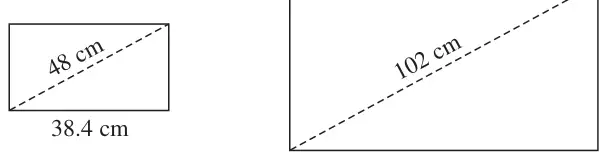
The diagram shows two rectangular TV screens. The rectangles are similar. The ‘size’ of the smaller screen is 48 cm. The width of the smaller screen is 38.4 cm. The ‘size’ of the larger screen is 102 cm.
(b) Calculate the width of the larger TV screen. (2)
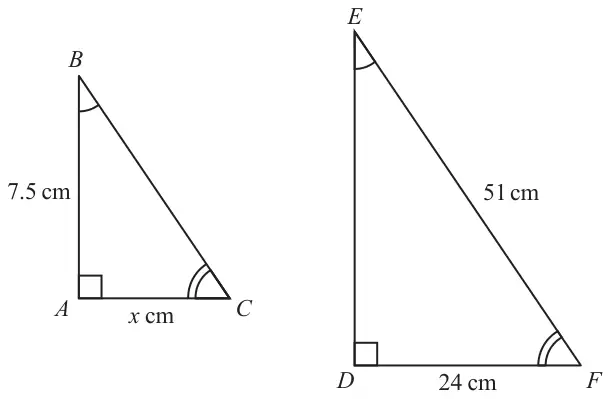
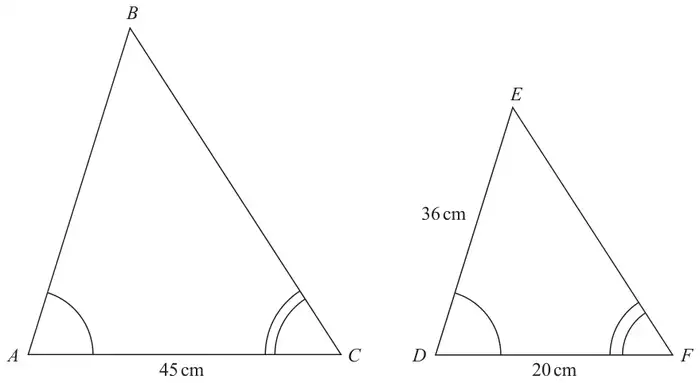
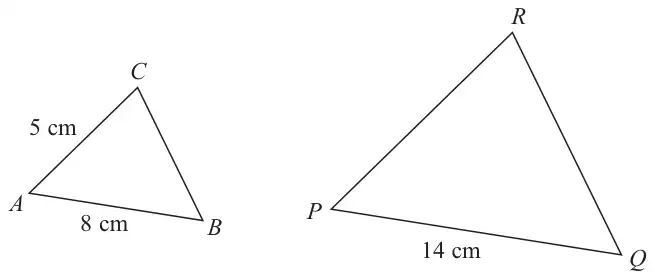
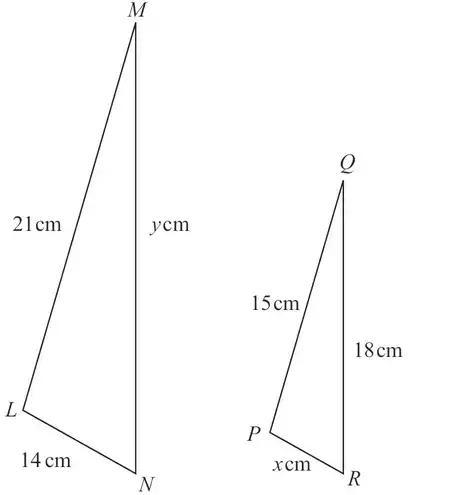
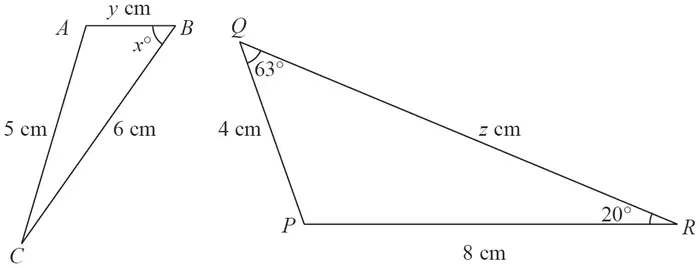
Triangle \(ABC\) is similar to triangle \(PQR\). \(AB\) corresponds to \(PQ\). \(AC\) corresponds to \(PR\). \(AB = 8\) cm. \(AC = 5\) cm. \(PQ = 14\) cm.
(a) Calculate the length of \(PR\). (2)
The area of triangle \(ABC\) is 16 cm2
(b) Calculate the area of triangle \(PQR\). (3)
Mark scheme (a)
Scheme
Marks
\(\dfrac{PR}{5} = \dfrac{14}{8}\) or \(\dfrac{PR}{14} = \dfrac{5}{8}\)
M1
8.75
A1
(2)
Notes
M1: or for \(5 \times \dfrac{14}{8}\) oe
Mark scheme (b)
Scheme
Marks
\(\dfrac{14}{8}\) or \(\dfrac{7}{4}\) or 1.75 or \(\dfrac{8}{14}\) or \(\dfrac{4}{7}\) or 0.571...
(May be implied by second M1)
Allow ratio notation
M1
\(1.75^2\) oe eg 3.0625, \(\dfrac{49}{16}\) or \(\left(\dfrac{4}{7}\right)^2\) oe eg \(\dfrac{16}{49}\), 0.326... allow ratio notation
M1
49
A1
(3)
Notes
A1: cao SC : B1 for an answer of 28
Alternative method M1 for \(\dfrac{1}{2} \times 8 \times 5 \times \sin A\) and \(\sin A = 0.8\) M1 (dep) for \(\dfrac{1}{2} \times 14 \times \text{“}8.75\text{”} \times 0.8\)
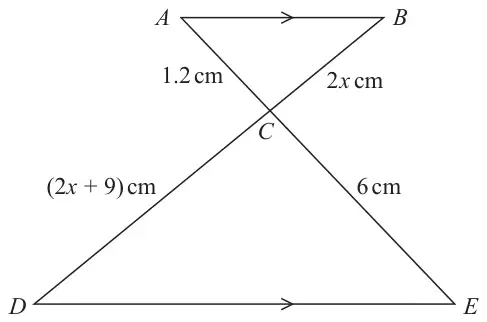
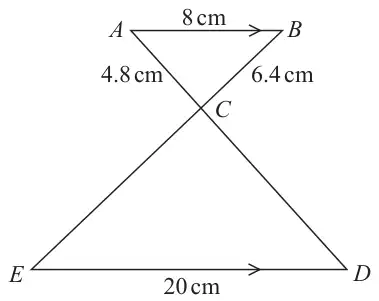
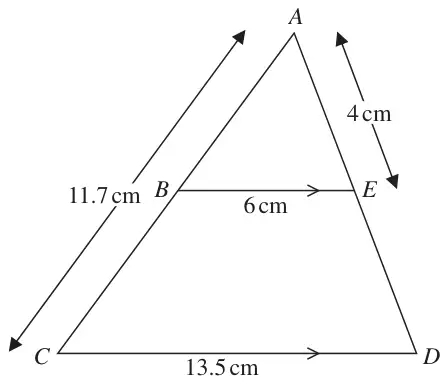
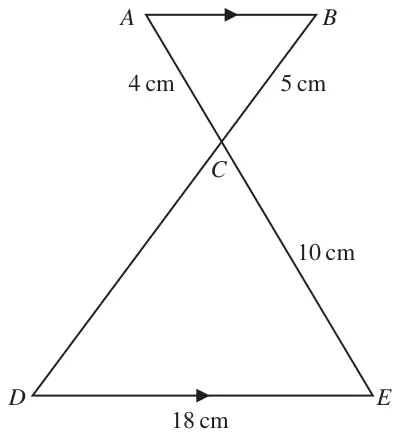
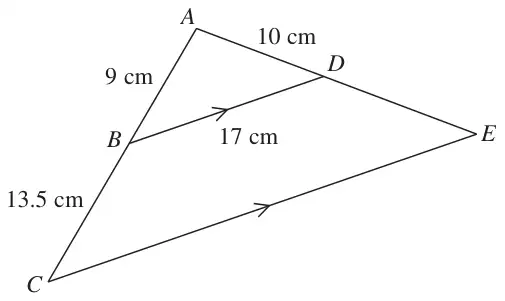
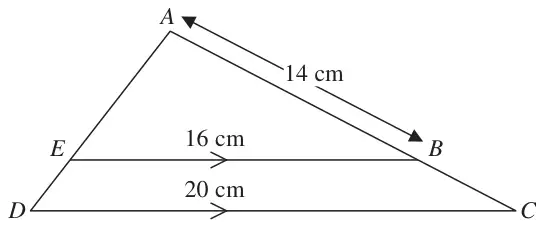
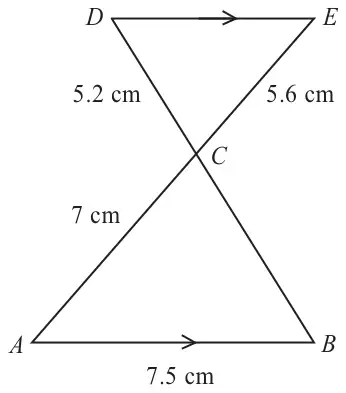
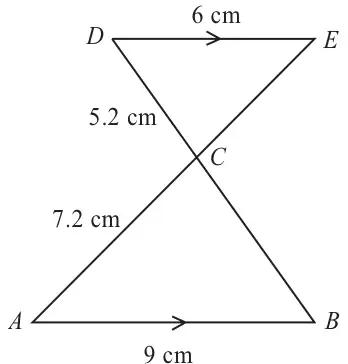
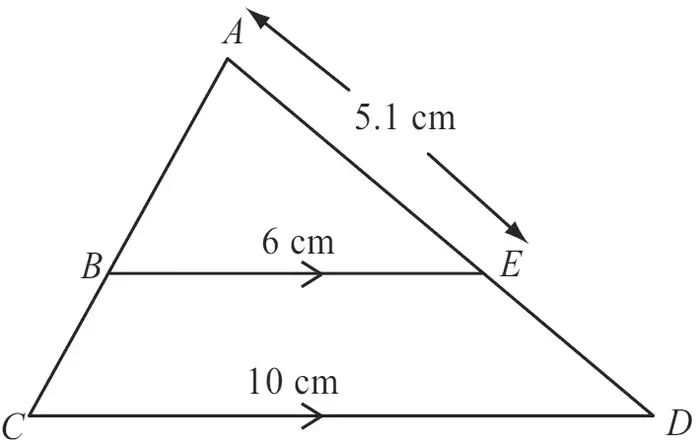
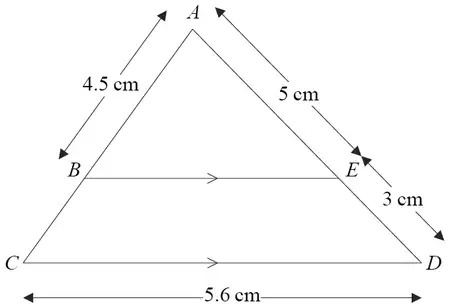
\(AB\) is parallel to \(DE\). The lines \(AE\) and \(BD\) intersect at \(C\). \(AB\) = 7.5 cm, \(AC\) = 7 cm, \(CD\) = 5.2 cm, \(CE\) = 5.6 cm.
(a) Calculate the length of \(BC\). (2)
(b) Calculate the length of \(DE\). (2)
(c) The area of triangle \(ABC\) is 21 cm2 Calculate the area of triangle \(EDC\). (3)
Mark scheme (a)
Scheme
Marks
\(\dfrac{BC}{5.2} = \dfrac{7}{5.6}\) oe or \(\dfrac{BC}{7} = \dfrac{5.2}{5.6}\) oe
M1
6.5
A1
(2)
Notes
M1: for correct, relevant proportionality statement with 3 values substituted
A1: cao
Mark scheme (b)
Scheme
Marks
\(\dfrac{DE}{7.5} = \dfrac{5.6}{7}\) oe or \(\dfrac{DE}{5.6} = \dfrac{7.5}{7}\) oe
or \(\dfrac{DE}{5.2} = \dfrac{7.5}{\text{“}6.5\text{”}}\) oe or \(\dfrac{DE}{7.5} = \dfrac{5.2}{\text{“}6.5\text{”}}\)
M1
6
A1
(2)
Notes
M1: for correct, relevant proportionality statement with 3 values substituted
A1: cao
Mark scheme (c)
Scheme
Marks
(scale factor) eg \(\dfrac{7}{5.6}\) or \(\dfrac{5.6}{7}\) or \(\dfrac{4}{5}\) oe or \(\dfrac{5}{4}\) oe
(May be implied by second M1)
allow ratio notation
M1
(scale factor)2 eg \(\left(\dfrac{4}{5}\right)^2\) oe or 0.64 or \(\left(\dfrac{5}{4}\right)^2\) oe 1.5625
allow ratio notation
M1
13.44
A1
(3)
Notes
M1: Also award M1 for ht of \(\triangle CDE = \dfrac{4}{5} \times \dfrac{21}{\tfrac{1}{2} \times 7.5}\) (= 4.48)
M1: Also award M1 for \(\tfrac{1}{2} \times \text{“}6\text{”} \times \text{“}4.48\text{”}\)
A1: Also accept 13.4 if both method marks scored
M2 for eg (Area \(\triangle ABC\) =) \(\tfrac{1}{2} \times 7 \times \text{“}6.5\text{”} \sin C = 21\) and (Area \(\triangle CDE\) =) \(\tfrac{1}{2} \times 5.2 \times 5.6 \sin C\)
Also award M2 for \(s = \dfrac{5.2 + 5.6 + \text{“}6\text{”}}{2}\) (= 8.4) and Area = \(\sqrt{\text{“}8.4\text{”}(\text{“}8.4\text{”} - 5.2)(\text{“}8.4\text{”} - 5.6)(\text{“}8.4\text{”} - \text{“}6\text{”})}\)
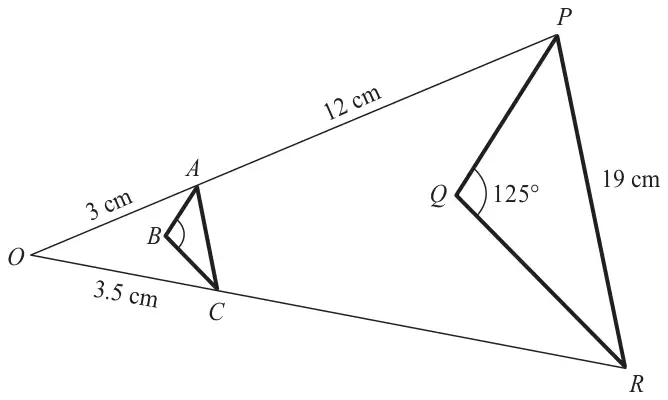
Triangle \(PQR\) is an enlargement, centre \(O\), of triangle \(ABC\). \(OAP\) and \(OCR\) are straight lines. \(OA = 3\) cm. \(AP = 12\) cm. \(OC = 3.5\) cm. \(PR = 19\) cm. Angle \(Q = 125^\circ\)
(a) Find the size of angle \(B\). (1)
(b) Work out the length of \(CR\). (2)
(c) Work out the length of \(AC\). (3)
Mark scheme (a)
Scheme
Marks
125
B1
(1)
Notes
B1: cao
Mark scheme (b)
Scheme
Marks
\(\dfrac{12}{3} \times 3.5\) or \(\dfrac{15}{3} \times 3.5 - 3.5\)
M1
14
A1
(2)
Notes
M1: for \(\dfrac{12}{3}\) or 4 or \(\dfrac{15}{3}\) or 5
A1: cao
Mark scheme (c)
Scheme
Marks
scale factor = \(\dfrac{15}{3}\) or 5 or \(\dfrac{3}{15}\) or \(\dfrac{1}{5}\)
M1
19 ÷ 5 or \(19 \times \dfrac{1}{5}\)
M1
3.8
A1
(3)
(Total 6 marks)
Notes
M1: for \(\dfrac{15}{3}\) or 5 or \(\dfrac{3}{15}\) or \(\dfrac{1}{5}\)
M1: Also award for 19 ÷ 4 or \(19 \times \dfrac{1}{4}\)
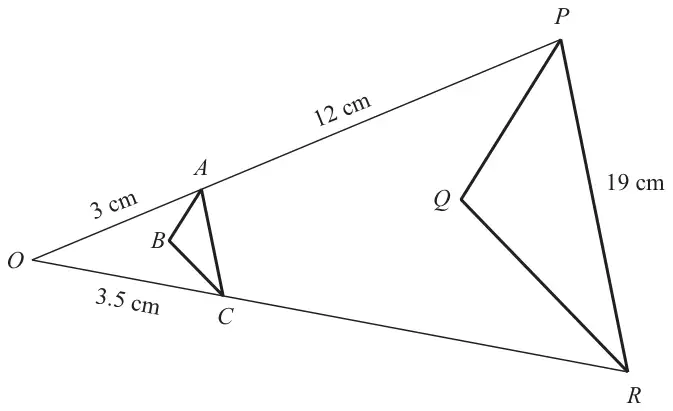
Triangle \(PQR\) is an enlargement, centre \(O\), of triangle \(ABC\). \(OAP\) and \(OCR\) are straight lines. \(OA\) = 3 cm. \(AP\) = 12 cm. \(OC\) = 3.5 cm. \(PR\) = 19 cm.
(a) Work out the length of \(CR\). (2)
(b) Work out the length of \(AC\). (3)
The area of triangle \(ABC\) is 2 cm\(^2\)
(c) Work out the area of triangle \(PQR\). (2)
Mark scheme (a)
Scheme
Marks
\(\dfrac{12}{3} \times 3.5\) or \(\dfrac{15}{3} \times 3.5 - 3.5\)
M1
14
A1
(2)
Notes
M1: for \(\dfrac{12}{3}\) or 4 or \(\dfrac{15}{3}\) or 5
A1: cao
Apart from Questions 9, 13, 18, 20 and 21 (where the mark scheme states otherwise) the correct answer, unless clearly obtained by an incorrect method, should be taken to imply a correct method.
Mark scheme (b)
Scheme
Marks
scale factor = \(\dfrac{15}{3}\) or 5 or \(\dfrac{3}{15}\) or \(\dfrac{1}{5}\)
M1
19 ÷ 5 or \(19 \times \dfrac{1}{5}\)
M1
3.8
A1
(3)
Notes
M1: for \(\dfrac{15}{3}\) or 5 or \(\dfrac{3}{15}\) or \(\dfrac{1}{5}\)
M1: Also award for 19 ÷ 4 or \(19 \times \dfrac{1}{4}\)
May be implied by 4.75
A1: cao
Mark scheme (c)
Scheme
Marks
“5”\(^2\) or “25”
M1
50
A1
(2)
(Total 7 marks)
Notes
M1: for squaring their scale factor
(must be one of 5, 4, \(\frac{1}{5}\), \(\frac{1}{4}\))
or for \(\left(\dfrac{19}{3.8}\right)^2\) oe
or for complete correct method of finding vert ht (\(h\) cm) of \(\Delta ABC\) and vert ht (\(H\) cm) of \(\Delta PQR\)
eg \(\frac{1}{2} \times \text{“}3.8\text{”} \times h = 2\)
The two supermarket price tickets are mathematically similar. The area of the smaller ticket is 7 cm\(^2\). Calculate the area of the larger ticket.
(2)
Mark scheme
Scheme
Marks
\(7 \times 3^2\)
M1
63
A1
(Total 2 marks)
Notes
M1: M1 for \(3^2\) or 9 or \(\frac{1}{9}\) or \((\frac{1}{3})^2\)
Apart from questions 5b, 8, 15d, 20b, 21b, 23, 24b (where the mark scheme states otherwise) the correct answer, unless clearly obtained by an incorrect method, should be taken to imply correct working.
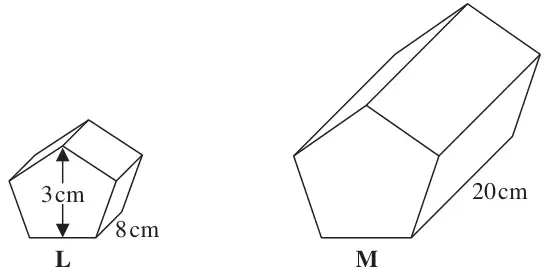
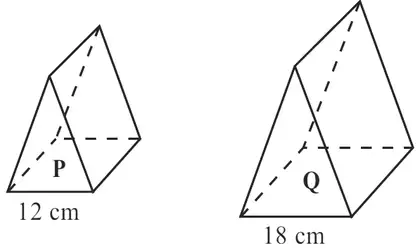
Two prisms, P and Q, are similar. The cross-section of prism P is a triangle with a base of length 12 cm. The cross-section of prism Q is a triangle with a base of length 18 cm. The total surface area of prism P is 544 cm2.
Calculate the total surface area of prism Q.
(3)
Mark scheme
Scheme
Marks
\(\dfrac{18}{12}\) or 1.5 oe or 18 : 12 oe
M1
\(544 \times 1.5^2\)
M1
1224
A1
(3)
(3 marks)
Notes
M1: for \(\dfrac{18}{12}\) or 1.5 oe or 18 : 12 oe
Also award for \(\dfrac{12}{18}\) or \(\dfrac{2}{3}\) or 12 : 18 oe
M1: for \(1.5^2\) or 2.25 or \(\frac{9}{4}\) or 9 : 4 oe
Also award for \(\left(\frac{2}{3}\right)^2\) or \(\frac{4}{9}\) or 4 : 9 oe
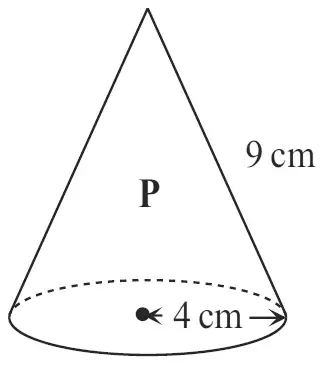
A solid cone, P, has a base radius of 4 cm and a slant height of 9 cm.
(a) Calculate the total surface area of the cone. Give your answer correct to 3 significant figures. (2)
Another solid cone, Q, is similar to P. The base radius of Q is 6 cm. The volume of Q is \(k\) times the volume of P.
(b) Calculate the value of \(k\). (2)
Mark scheme (a)
Scheme
Marks
\(\pi \times 4^2 + \pi \times 4 \times 9\)
M1
163
A1
(2)
Notes
A1: for ans rounding to 163 (\(\pi \to\) 163.3628... 3.14 \(\to\) 163.28 3.142 \(\to\) 163.384)
Mark scheme (b)
Scheme
Marks
\(\dfrac{6}{4}\) or 1.5 oe or 6 : 4 oe
or \(\dfrac{4}{6}\) oe or 4 : 6 oe
M1
3.375 oe
A1
(2)
(4 marks)
Notes
M1: May be implied by 13.5 or 12.09... Also award for cube of any correct values or cube of correct ratios
A1: for 3.375 or \(3\frac{3}{8}\) or \(\frac{27}{8}\) oe Accept 3.38 if M1 scored Do not award A1 if slant heights used as \(h\) in \(V = \frac{1}{3}\pi r^2 h\)
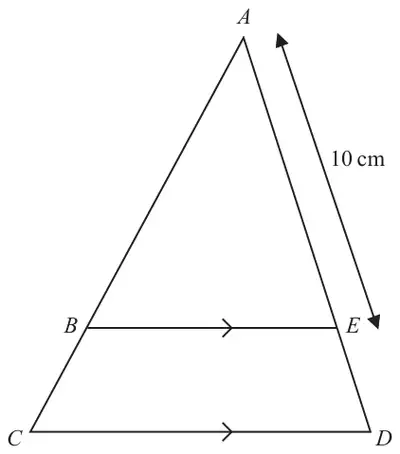
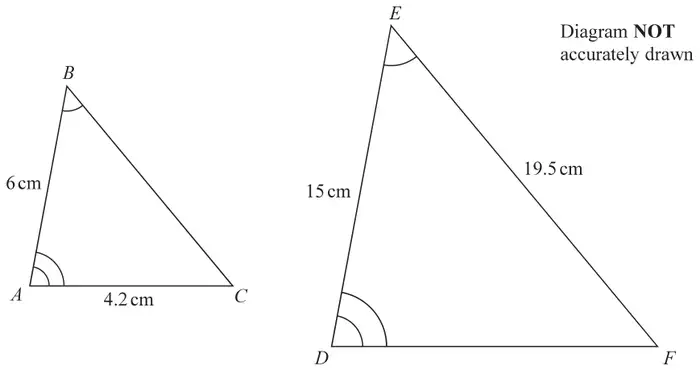
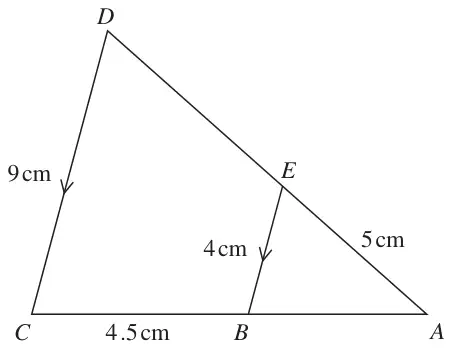
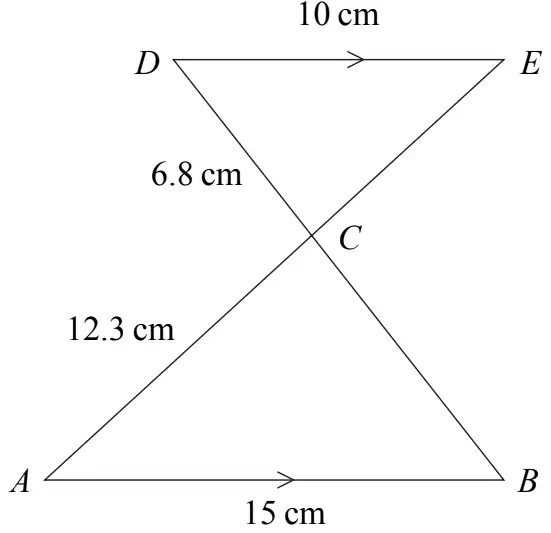
\(AB\) is parallel to \(DE\). The lines \(AE\) and \(BD\) intersect at the point \(C\). \(AB = 15\) cm, \(AC = 12.3\) cm, \(CD = 6.8\) cm, \(DE = 10\) cm.
(a) Work out the length of \(BC\). (2)
(b) Work out the length of \(CE\). (2)
(c) \(\dfrac{\text{Area of triangle } ABC}{\text{Area of triangle } CDE} = k\) Work out the value of \(k\). (2)
Mark scheme (a)
Scheme
Marks
\(6.8 \times \dfrac{15}{10}\)
M1
10.2
A1
(2)
Notes
A1: cao
Mark scheme (b)
Scheme
Marks
\(12.3 \times \dfrac{10}{15}\)
M1
8.2
A1
(2)
Notes
A1: cao
Mark scheme (c)
Scheme
Marks
\(\dfrac{15}{10}\) or 1.5 oe
M1
2.25 oe
A1
(2)
(6 marks)
Notes
M1: for \(\dfrac{15}{10}\) or 1.5 oe
or for \(\left(\dfrac{10}{15}\right)^2\) or \(\dfrac{4}{9}\) or \(0.\dot{4}\) oe
or for correct expression which, if accurately evaluated, gives the correct answer
or for the area of one of the triangles evaluated correctly
Area \(\triangle ABC\) rounds to 62.3 (62.2700...) NOT 62.73
Area \(\triangle CDE\) rounds to 27.7 (27.6755...) NOT 27.88
Note: the angles of the triangle are 42.5°, 54.5° and 83.1°.
A1: for 2.25 or \(2\frac{1}{4}\) or \(\frac{9}{4}\) or for answer rounding to 2.25 Even if M1 awarded, do not award A1 for a correct answer, if there are any errors in the working.
M2: M1 for each term Also award for values rounding to 24.6 and to 49.2 or 49.3
A1: for 73.9 or for answer which rounds to 73.9
Mark scheme (b)
Scheme
Marks
\(\sqrt[3]{125}\) or 5 seen
M1
\(25 \times 73.89...\)
M1
1850
A1
(3)
(6 marks)
Notes
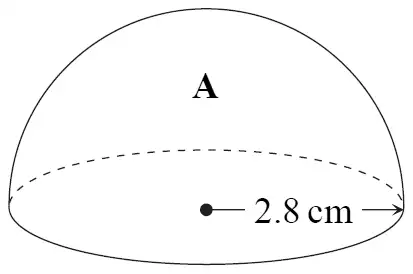
M1: for 25 × (a) or for \(\pi \times (2.8 \times 5)^2 + 2\pi \times (2.8 \times 5)^2\) or for substituting \(r = 2.8 \times 5\) in the expression used in (a)
A1: for 1850 or for any value in range 1846.3 − 1847.5 ft from 25 × (a)
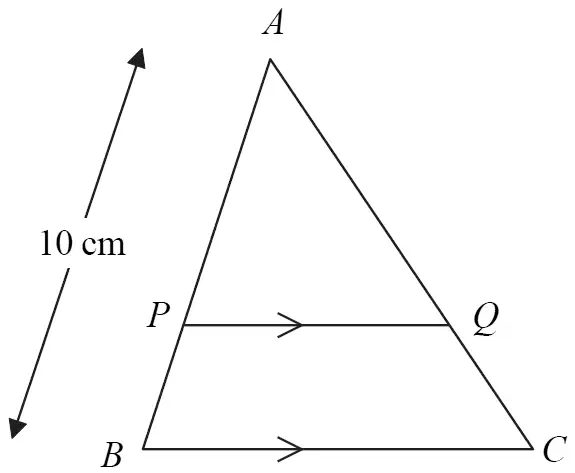
(a) The ratio of the areas of two similar triangles is \(1 : k\). Write down, in terms of \(k\), the ratio of the lengths of their corresponding sides. (1)
(b)
Diagram NOT accurately drawn
\(AB = 10\) cm. \(PQ\) is parallel to \(BC\). The area of triangle \(APQ\) is half the area of triangle \(ABC\). Calculate the length of \(AP\). Give your answer correct to 2 significant figures. (2)
14 Oil is stored in either small drums or large drums. The shapes of the drums are mathematically similar.
Diagram NOT accurately drawn
A small drum has a volume of 0.006 m3 and a surface area of 0.2 m2. The height of a large drum is 3 times the height of a small drum.
(a) Calculate the volume of a large drum. (2)
(b) The cost of making a drum is $1.20 for each m2 of surface area. A company wants to store 3240 m3 of oil in large drums. Calculate the cost of making enough large drums to store this oil. (4)
Mark scheme (a)
Scheme
Marks
\(0.006 \times 3^3\)
M1
0.162
A1
(2)
Mark scheme (b)
Scheme
Marks
\(\dfrac{3240}{\text{her } 0.162}\) or 20 000 seen
We'd like to use Google Analytics cookies to count visits and see which pages help most. They're optional, and the site works exactly the same either way. Privacy policy