
Foundation June 2019 Paper 1 Q8
8 The diagram shows two triangles, \(CDB\) and \(BDA\).
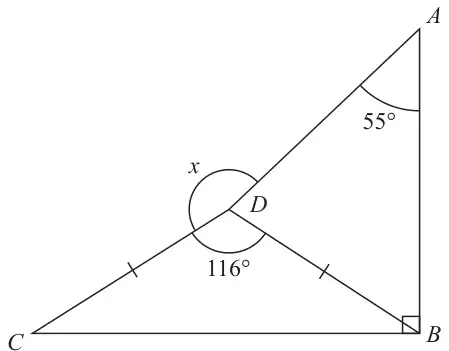
Diagram NOT accurately drawn
\(DC = DB\)
Angle \(ABC = 90^\circ\)
Angle \(CDB = 116^\circ\)
Angle \(DAB = 55^\circ\)
Work out the size of the angle marked \(x\).
Give a reason for each stage of your working.
(5)
| Scheme | Marks |
|---|---|
| angle \(DBC\) (or \(DCB\)) = (180 – 116) ÷ 2 (=32) | M1 |
| angle \(ADB\) = 180 – (90 –“32”) – 55 (=67) or angle \(ADB\) = 360 – 116 – “32” – 55 – 90 (=67) | M1 |
| \(x\) = 360 – 116 – “67” (= 177) | M1 |
| 177 with reasons | A2 |
| (5) | |
| (5 marks) |
Notes
M1: angles may be seen on diagram
M1: dep
M1: dep
A2: for 177 and full reasons
base angles in an isosceles triangle are equal
angles in a triangle add up to 180°
angles at a point add up to 360°
If not A2 then A1 for 177 with 1 correct reason
(SCB1 dep on M1 for a correct reason explicitly linked to their correct method)
(corrected from the printed mark scheme: the first line prints “angle \(DBC\) (or \(DBC\))”; the other base angle is \(DCB\).)