
Higher November 2020 Paper 2 Q3
3
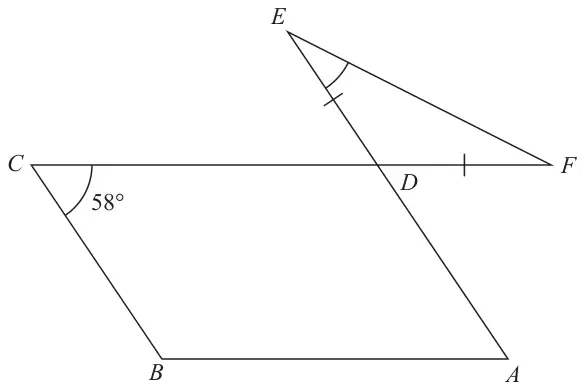
Diagram NOT accurately drawn
The diagram shows a parallelogram \(ABCD\) and an isosceles triangle \(DEF\) in which \(DE = DF\)
\(CDF\) and \(ADE\) are straight lines.
Angle \(BCD = 58°\)
Work out the size of angle \(DEF\).
Give a reason for each stage of your working.
(5)
| Scheme | Marks |
|---|---|
| \(ADC\) = 180 – 58 (= 122) or \(EDF\) = 122 or \(CDE\) = 58 or \(ADF\) = 58 | M1 |
| e.g. \(DEF\) = 58 ÷ 2 or \(DEF\) = (180 – 122) ÷ 2 | M1 |
| Correct answer scores full marks (unless from obvious incorrect working) Answer: 29 | A1 |
| B2 | |
| (5) | |
| (5 marks) |
Notes
M1: may be seen marked on the diagram
M1: complete method to find angle \(DEF\)
B2: dep on M2 for fully correct reasons for their method
(B1 dep on M1 for one correct reason stated and used)
e.g. Allied angles, co-interior angles, Alternate angles, Corresponding angles, Vertically opposite angles are equal (or Vertically opposite angles are equal), Angles on a straight line add up to 180° (or angles on a straight line add to 180°), Sum of two angles in a triangle are equal to opposite exterior angle, Angles in a triangle add up to 180° (or Angles in a triangle add up to 180°), Base angles in an isosceles triangle
Angles in a quadrilateral add up to 360. (accept “4-sided shape” or parallelogram)
Opposite angles of a parallelogram are equal