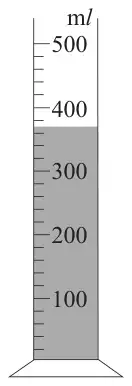
9 Roy has 2 litres of orange juice in a jug and some empty cups. He pours orange juice from the jug to completely fill as many cups as possible. He pours 180 millilitres of orange juice into each cup.
Work out how much orange juice Roy has left in the jug after he has completely filled as many cups as possible. Give your answer in millilitres.
11 × 180 (= 1980) or 11 × 0.18 (= 1.98) or 180, 360, 540, 720, …. 1800, 1980 or 2000, 1820, 1640, 1460 …. 200, 20
M1
Working not required, so correct answer scores full marks (unless from obvious incorrect working) Answer: 20
A1
(4)
(4 marks)
Notes
B1: Can be implied from correct working
M1: ft their millilitres ÷ 180 or 2 ÷ their litres for this mark NB Repeated subtraction must continue to a number less than 180 eg 200 ÷ 180 or 200 – 180 gains this mark only eg 500 ÷ 180 or 500 – 180 – 180 gains this mark only eg 2 ÷ 1.8 or 2 – 1.8 gains this mark only Allow one arithmetic error for repeated addition or repeated subtraction for this mark
M1: dep on B1 or for an answer of 0.02 No errors allowed for repeated addition or repeated subtraction for this mark
(b) Find the difference between a length of 3 metres and a length of 85 centimetres. Give your answer in centimetres. (2)
Mark scheme (a)
Scheme
Marks
5
B1
(1)
Mark scheme (b)
Scheme
Marks
3 × 100 (= 300) or 3 – 0.85 (= 2.15) or digits 300 – 85 or 85 – digits 300
M1
Correct answer scores full marks (unless from obvious incorrect working) Answer: 215
A1
(2)
(3 marks)
Notes
M1: for conversion to centimetres or a method to work out the difference in metres or a method to find the difference in centimetres using their converted 300
For digits 300, allow 30, 300, 3000, 0.3, 0.03 and so on, but NOT 3
Correct answer scores full marks (unless from obvious incorrect working) Answer: 550
A1
(4)
(4 marks)
Notes
B1: for one correct conversion
M1: can gain this mark for adding their converted figures even if incorrect but some attempt must have been made to convert 2 relevant values. (eg incorrect but 350 + 950 + 180 + 1200)
M1ft: Correct compatible units ft their total dep on Marion’s distance being less than Talha’s
5 Mina has 5 litres of water in a bottle and some empty cups. She fills as many cups as possible with water from the bottle. She fills each cup with 280 millilitres of water.
Work out how many cups Mina completely fills.
(3)
Mark scheme
Scheme
Marks
\(5 \times 1000\) or 5000 or \(280 \div 1000\) or 0.28
M1
eg \(5000 \div 280\) or \(5 \div 0.28\) or 17.8…… or \(\dfrac{125}{7}\) or \(17\tfrac{6}{7}\) oe
M1
Working not required, so correct answer scores full marks (unless from obvious incorrect working) Answer: 17
A1
(3)
(3 marks)
Notes
M1: for a correct conversion between ml and litres
M1: for a complete method ft incorrect conversion but an attempt must have been made to convert
M2 for \(17 \times 280\) or 4760 or \(17 \times 0.28\) oe or 4.76 oe
Working not required, so correct answer scores full marks (unless from obvious incorrect working) Answer: 1750
A1
(3)
(3 marks)
Notes
B1: For at least one correct conversion eg 800 (m) = 0.8 (km) or 2 (km) = 2000 (m) or 1.7 (km) = 1700 (m) or 6250 (m) = 6.25 (km)
M1: For a correct equation in \(x\) or a correct calculation for \(x\) using their 2 converted values (but not original values throughout…some conversion must have been done)
A1: An answer of 1.75 (or 1.75 km) or a choice of answers with no units ie 1.75 and 1750 scores 2 marks only (B1M1) 1750 m with 1.75 km on the answer line scores full marks
6 Niran is organising a baking competition and needs to buy 9.25 kilograms of flour.
Flour is sold in bags that each contain 750 grams of flour.
Each of these bags costs 58 Baht. Niran can only buy whole bags of flour.
Niran buys the least number of bags of flour that he needs.
Work out the cost of the flour that he buys.
(4)
Mark scheme
Scheme
Marks
eg 9.25 × 1000 (= 9250) or 750 ÷ 1000 (= 0.75)
M1
eg “9250” ÷ 750 (= 12(.333…) or 13) or 9.25 ÷ “0.75” (= 12(.333…) or 13) or 750 × 12 (= 9000) or 0.75 × 12 (= 9) or eg 750, 1500, 2250, ……., 9000 or 0.75, 1.5, 2.25, …….., 9 or 9250, 8500, 7750, ……., 250 or 9.25, 8.5, 7.75, ……., 0.25
M1
eg “13” × 58
M1
Correct answer scores full marks (unless from obvious incorrect working) Answer: 754
A1
(4)
(4 marks)
Notes
M1: for a correct conversion
M1: for a method to calculate the number of bags required. Ft incorrect conversion or for repeated addition to at least 9000 or 9 (allow one error) or for repeated subtraction to at least 250 or 0.25 (allow one error)
M2 for 750 × 13 (= 9750)
M1: for a complete method. Ft incorrect conversion – an attempt must have been made at a conversion to gain this mark. “13” must come from a number that is rounded up or ft subtraction/addition method to find the number of bags allowing only one error “13” must come from a number that is rounded up
(a) Write the time 8 30 pm using the 24-hour clock. (1)
Ella started watching television at 10 50 am.
Ella watched
a comedy programme lasting 45 minutes a sports programme lasting 1 hour 10 minutes a history programme
There were no breaks and no advertisements between the programmes.
Ella finished watching television at 2 20 pm.
(b) How long did the history programme last? Give your answer in minutes. (3)
Mark scheme (a)
Scheme
Marks
20 30
B1
(1)
Notes
B1: allow eg 20.30 or 20:30
Mark scheme (b)
Scheme
Marks
eg 10:50am + 45mins = 11:35am or 10:50am + 1hr10mins = 12:00pm or 2:20pm – 45mins = 1:35pm or 2:20pm – 1hr10mins = 1:10pm or 45mins + 1hr10mins = 1hr55mins or 115mins or 10:50am to 2:20pm = 3hr30mins or 210mins
M1
eg 10:50am + 45mins + 1hr10mins = 12:45pm or 10:50am + 1hr55mins = 12:45pm or 2:20pm – 45mins – 1hr10mins = 12:25pm or 2:20pm – 1hr55mins = 12:25pm
M1ft
Correct answer scores full marks (unless from obvious incorrect working) Answer: 95
A1
(3)
(4 marks)
Notes
M1: for correctly working with two times
condone missing am or pm
M1ft: for getting to a time one step from the answer or 1hr35mins or a correct ft from a previous error
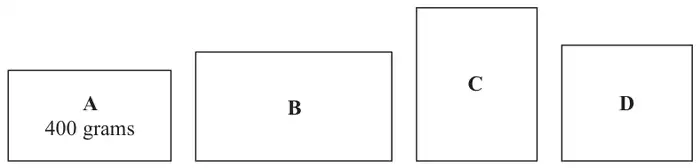
The weight of parcel A is 400 grams. The weight of parcel B is 350 grams more than the weight of parcel A The weight of parcel C is twice the weight of parcel A
The total weight of the 4 parcels is 2.5 kilograms.
Work out the weight, in grams, of parcel D
(4)
Mark scheme
Scheme
Marks
eg 2.5 kg = 2500 g or 400 g = 0.4 kg or 350 g = 0.35 kg
B1
eg 400 + 350 (= 750) or 0.4 + 0.35 (= 0.75) or 400 × 2 (= 800) or 0.4 × 2 (= 0.8)
Correct answer scores full marks (unless from obvious incorrect working) Answer: 100 g or 0.1 kg
A1
Notes
M1: for repeated addition to at least 4900 or 4.9 (allow one error) or for repeated subtraction to at least 100 or 0.1 (allow one error)
M1: for repeated addition to 4900 or 4.9 (no errors) or clearly indicated e.g. at the end of their list, circled, underlined etc or for repeated subtraction to 100 or 0.1 (no errors) clearly indicated e.g. at the end of their list, circled, underlined etc
10 It takes a machine 8 seconds to produce a bolt. Each day, the machine starts producing bolts at 09 30 The machine produces bolts continuously every 8 seconds until it stops at 16 10 on the same day.
Work out how many bolts the machine produces each day.
(4)
Mark scheme
Scheme
Marks
6 hrs 40 mins or \(6\dfrac{2}{3}\) or \(\dfrac{20}{3}\) or 400 mins
B1
e.g. (6 × 60 + 40) × 60 (= 24 000) oe
or “their 400” × 60 (= 24 000) oe
or \(\dfrac{60}{8}\) (= 7.5) oe
or \(\dfrac{60 \times 60}{8}\) (= 450) oe or 7.5 × 60 (= 450) oe
M1
e.g. “24 000” ÷ 8 oe
or “their 400” × “7.5” oe
or “their \(6\dfrac{2}{3}\)” × “450” oe
M1
3000
A1
(4)
(4 marks)
Notes
M1: for converting their time difference into seconds or finding the number of bolts produced in 1 minute oe or finding the number of bolts produced in one hour oe
M1: for a complete method to find how many bolts are produced
14 Iman walked for 3 hours 15 minutes. He walked a distance of 18.2 kilometres.
Work out Iman’s average speed for his walk. Give your answer in km/h
(3)
Mark scheme
Scheme
Marks
3 hours 15 mins = 3.25 (hours) or \(3\frac{1}{4}\) (hours)
or \(3\dfrac{15}{60}\) (hours) or 195 (mins)
B1
18.2 ÷ “\(3\frac{1}{4}\)” oe or 18.2 ÷ “195” × 60
M1
5.6
A1
(3)
(3 marks)
Notes
B1: For converting 3 hrs 15 minutes into hours or minutes
M1: For use of D ÷ T allow 18.2 ÷ 3.15 or their incorrect time conversion (must be clear that this is their time conversion) If B mark awarded then the value that gained that mark must be used here to gain this method mark.
8 Mairi has a 2 metre length of string. She cuts from the string as many lengths of 35 centimetres as possible.
Work out the length of string that she has left. Give your answer in centimetres.
(3)
Mark scheme
Scheme
Marks
2 m written as 200 cm or 35 cm written as 0.35 m
B1
“200” ÷ 35 or 2 ÷ “0.35” \(\left(= \dfrac{40}{7} \text{ or } 5.714\ldots\right)\)
or indication of 175 (cm) or 1.75 (m)
M1
25
A1
(3)
(3 marks)
Notes
B1: may be seen in working
M1:or clearly adding on 35 or 0.35 at least 5 times with no more than one error or clearly subtracting 35 or 0.35 at least 5 times from 200 or 2 with no more than one error ft incorrect conversion but attempt must have been made to convert
Lauren has 3 litres of fruit juice. She is going to use the fruit juice to make some drinks for a party. Each cup of drink will contain 225 millilitres of fruit juice.
Lauren is going to make as many cups of drink as possible.
(c) Work out how much fruit juice Lauren has left when she has made as many cups of drink as possible. Give your answer in millilitres. (4)
Working not required, so correct answer scores full marks (unless from obvious incorrect working eg a wrong conversion) Answer: 200 millilitres or 0.2 litres
A1
(3)
(3 marks)
Notes
B1: oe for a correct conversion within working
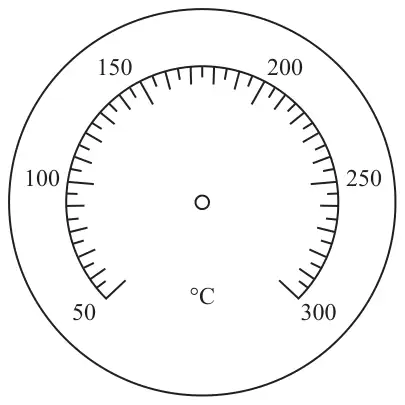
M1: Allow use of their converted values Allow 300 + …. + 300 = 1800 or 0.3 + …. + 0.3 = 1.8 If adding 300 or 0.3 they must have sufficient values just below or just above their amount of squash
A1: Must have correct units (ml or l can be used) Must come from correct working
Working not required, so correct answer scores full marks (unless from obvious incorrect working) Answer: 690
A1
(3)
(3 marks)
Notes
B1:For correctly writing the time as a time in hours or minutes or for a correct calculation to do this
M1: For use of speed = distance ÷ time (use of their time in hours – if used minutes, then must multiply by 60) (allow 5658 ÷ 8.12 (= 696.79…) for this mark if B0 awarded (allow 696 – 697))
7 Here are five times, in a single day, using the 24-hour clock.
A
B
C
D
E
11 53
15 20
08 20
18 12
16 45
(a) Write down the letter of the time nearest to 6 pm (1)
(b) Work out the difference, in hours and minutes, between time A and time E. (2)
Francesco uses the rule below to find the time, in minutes, to cook a chicken in his oven.
Number of minutes to cook a chicken
Multiply the weight of the chicken, in kg, by 40 and then add 15
The clock on Francesco’s oven shows time B. Francesco starts cooking a chicken at this time. He stops cooking the chicken when the clock on his oven shows time E.
(c) Work out the weight of the chicken. (3)
(d) Use Francesco’s rule to write down a formula for the time, \(T\) minutes, to cook a chicken of weight \(k\) kilograms. (2)
Mark scheme (a)
Scheme
Marks
D
B1
(1)
Mark scheme (b)
Scheme
Marks
4 hours 52 minutes
B1 B1
(2)
Mark scheme (c)
Scheme
Marks
time = 40 + 45 (= 85 minutes oe) or 1 hr 25 min
M1
(“85” – 15) ÷ 40
M1
1.75
A1
(3)
Notes
M1: accept 60 + 25 May be implied by 70 ÷ 40
M1: dep 1st M1
A1: oe eg 1.750 or \(\dfrac{7}{4}\)
Mark scheme (d)
Scheme
Marks
\(T = 40k + 15\)
B2
(2)
(8 marks)
Notes
B2: B1 for \(40k + 15\) or \(T = 40k + a\) (\(a \neq 15\)) Accept \(40 \times k\) etc
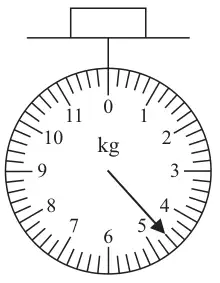
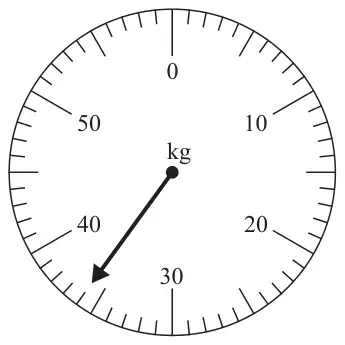
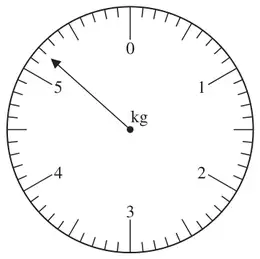
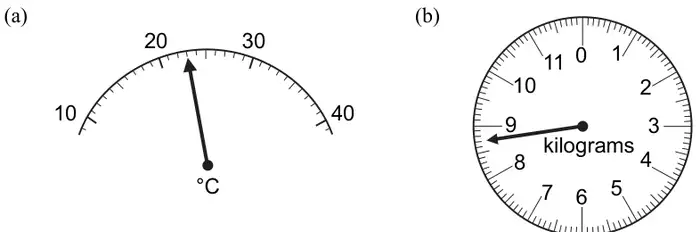
He weighs his suitcase on the weighing scales at the airport. The reading on the scale gives the weight of Amir’s suitcase.
An excess luggage charge has to be paid when the weight of a suitcase is greater than 25 kg. This charge is 7.45 euros for each kilogram over the 25 kg limit.
Work out the excess luggage charge that Amir has to pay.
(3)
Mark scheme
Scheme
Marks
(36 – 25) × 7.45 oe
M2
81.95
A1
(3)
(3 marks)
Notes
M2: for a complete method (M1 for 36 – 25 (= 11) or for \(W\) × 7.45 where \(W\) is their weight)
1 A plane has a length of 73 metres. A scale model is made of the plane. The scale of the model is 1 : 200 Work out the length of the scale model. Give your answer in centimetres.
(3)
Mark scheme
Scheme
Marks
\(73 \div 200\) (=0.365) or \(73 \times 100\) (= 7300) or 1 cm = 2 m oe
M1
\(\text{``}{0.365}\text{''} \times 100\) or \(\text{``}{7300}\text{''} \div 200\) \(73 \div 2\)
M1
36.5
A1
(3)
(3 marks)
Notes
M1: Allow their incorrectly converted 73 m \(\div\) 200
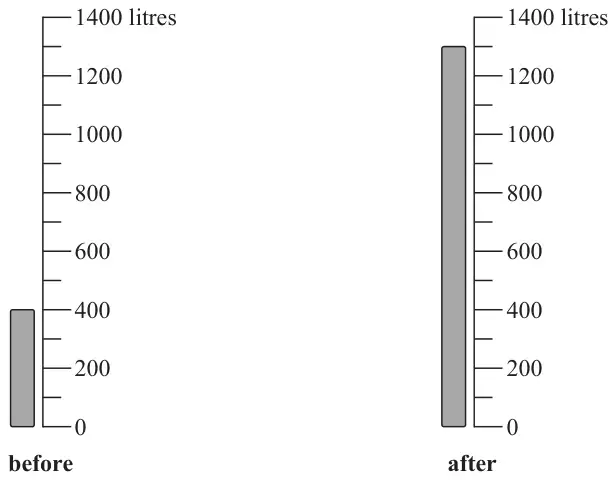
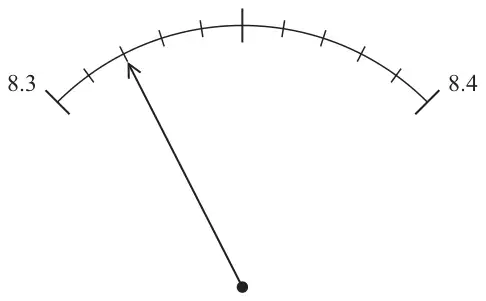
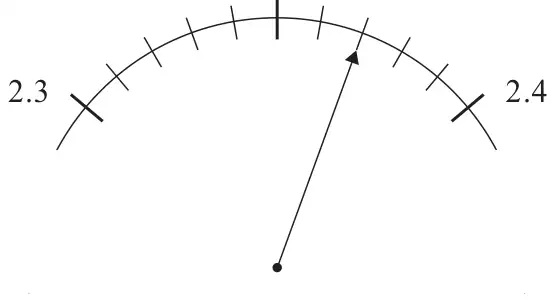
3 Joseph buys some heating oil. He puts it in his oil tank.
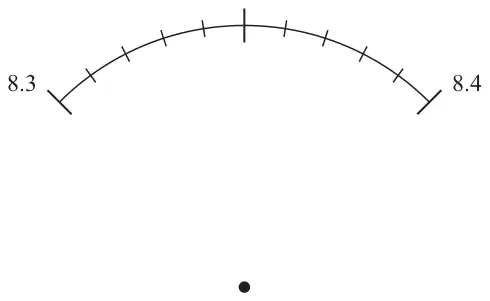
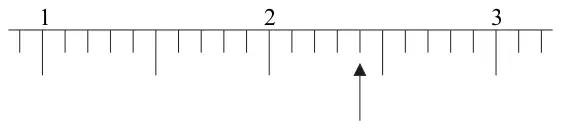
The scales show the numbers of litres of oil in the tank immediately before and immediately after Joseph puts the oil in the tank.
The oil Joseph buys costs 0.40 euros per litre.
Work out the total cost of the oil that Joseph buys.
(3)
Mark scheme
Scheme
Marks
400 and 1300 or 900
M1
(1300 − 400) × 0.4 or “520” – “160”
M1
360
A1
(3)
(3 marks)
Notes
M1: read scales correctly or 1300 × 0.4 (=520) or 400 × 0.4 (=160) or 9 × 0.4 (=3.6) or (\(x - y\)) × 0.4 where \(x\) and \(y\) are readings and \(x\) = 1300 or \(y\) = 400
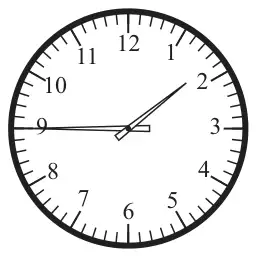
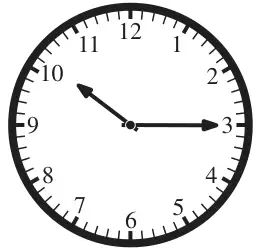
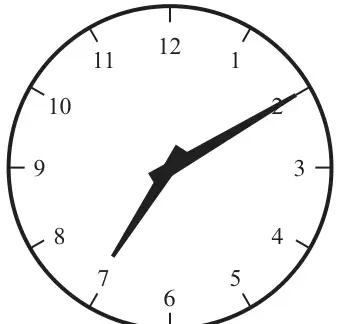
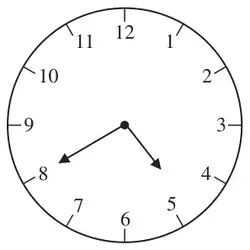
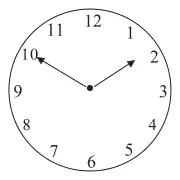
(a) One morning, Lizzy went on a bus journey. The clock shows the time that she left home.
(i) Write down this time using the 12-hour clock.
Lizzy got home at ten to four in the afternoon.
(ii) Write down this time using the 24-hour clock.
(2)
(b) On another day, Lizzy drove by car to visit her aunt. She left home at 9 30 am. Lizzy arrived at her aunt’s house at 11 15 am. She drove a distance of 140 km. Work out, in km/h, Lizzy’s average speed for the journey. (3)
Mark scheme (a)
Scheme
Marks
(i) 10:15 am
B1
(ii) 15:50
B1
(2)
Mark scheme (b)
Scheme
Marks
1.75 or \(1\dfrac{3}{4}\) or 105
M1
140 ÷ “1.75” or \(\dfrac{140}{\text{“105”}} \times 60\)
M1
80
A1
(3)
Notes
M1: for correctly converting “1hr 45 mins” into a decimal or fraction or minutes (eg. 1.75h or 105 min)
M1: independent but “1.75” or “105” must be correct for their duration accept 140 ÷ 1.45
3 The table shows information about five different tablet computers.
Name
Price
Weight (kg)
Length (mm)
Width (mm)
Thickness (mm)
E-bk
£179
0.315
194
127
11.0
Praxus
£165
0.340
199
120
10.6
Reader
£159
0.395
193
137
10.3
Star
£200
0.345
194
122
10.5
Tpad
£269
0.308
200
135
7.2
(a) Write down the name of the tablet computer with the least weight. (1)
The E-bk tablet computer has a weight of 0.315 kg.
(b) Change 0.315 kg into grams. (1)
The Reader tablet computer has a width of 137 mm.
(c) Change 137 mm into centimetres. (1)
Martin is the manager of a company. He buys each person in his sales team a Praxus tablet computer. Martin has a budget of £1000 There are 6 people in the sales team.
(d) How much money is left in Martin’s budget after buying 6 Praxus tablet computers? (3)
Mark scheme (a)
Scheme
Marks
Tpad
B1
(1)
Mark scheme (b)
Scheme
Marks
315
B1
(1)
Mark scheme (c)
Scheme
Marks
13.7
B1
(1)
Mark scheme (d)
Scheme
Marks
165 × 6 (=990) oe or subtraction of at least 165 from 1000
14 A ferry leaves Palermo at 7.45 pm and arrives in Salerno at 6.15 am the next day.
(a) Work out how long the ferry takes to go from Palermo to Salerno. (2)
Speed at sea is measured in knots. 1 knot = 1.852 kilometres per hour.
A ferry takes 12 hours to go from Trapani to Cagliari. The ferry goes at an average speed of 16 knots.
(b) Work out the distance the ferry goes from Trapani to Cagliari. Give your answer in kilometres correct to the nearest kilometre. (3)
Mark scheme (a)
Scheme
Marks
\(10\tfrac{1}{2}\) hrs
B2
(2)
Notes
B2: B2 for \(10\tfrac{1}{2}\) hrs or 10.5 hrs or 630 minutes or 10h 30 min oe (B1 for ‘correct time’ but units incorrect, partially correct or missing Eg. \(10\tfrac{1}{2}\), 630, 10:30, 10:30 mins, 10.3, 10.3 hours)
Mark scheme (b)
Scheme
Marks
12 × 16 (= 192) or 16 × 1.852 (= 29.632) or 12 × 1.852 (= 22.224)
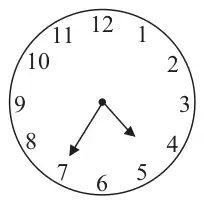
12 Saki arrives at the railway station in Tokyo. The clock shows the time in the afternoon that she arrived.
(a) Write this time using the 24-hour clock. (1)
Saki’s train leaves Tokyo at 16 50 and arrives in Kyoto at 19 12
(b)
(i) Write 16 50 using the 12-hour clock.
(ii) Find the time taken by the train to travel from Tokyo to Kyoto.
(3)
The train continues to Hakata. It leaves Kyoto at 19 14 and takes 2 hours 45 minutes to reach Hakata.
(c) Work out the time that the train arrives in Hakata. (1)
The distance from Kyoto to Hakata is 638 kilometres. The train journey from Kyoto to Hakata takes 2 hours 45 minutes.
(d) Work out the average speed, in kilometres per hour, of the train from Kyoto to Hakata. (3)
Mark scheme (a)
Scheme
Marks
15 55
B1
(1)
Notes
B1: Accept any separator or a space between hours and minutes.
Mark scheme (b)
Scheme
Marks
(i) Answer: 4.50 pm
B1
(ii) 10 min + 2 hr + 12 min or 18 hr 72 min − 16 hr 50 min or 3 hr − (50 − 12) min
M1
2 hour 22 minutes
A1
(3)
Notes
B1: Allow 10 minutes to 5 pm or 50 minutes past 4 pm Accept any separator or a space between hours and minutes.
M1: An attempt to find difference between 1650 and 1912 that demonstrates 60 minutes in an hour.
Mark scheme (c)
Scheme
Marks
2159
B1
(1)
Notes
B1: Accept 9.59 pm oe
Mark scheme (d)
Scheme
Marks
\(\dfrac{638}{2.75}\) or \(\dfrac{638}{2\frac{3}{4}}\) or \(\dfrac{638}{11/4}\) or \(\dfrac{638}{11} \times 4\) or \(\dfrac{638}{165} \times 60\) oe
M2
232
A1
(3)
Total 8 marks
Notes
M2: M1 for 638 ÷ 2.45 or 260(.408....) rounded or truncated to 3 or more significant figures or 638 ÷ 165 or 3.86(6666...) rounded or truncated to 3 or more significant figures
14 Here is part of a timetable for the Paris to Montpellier express train service.
Paris
06 07
10 07
12 07
18 07
20 07
Valence
08 22
12 24
14 24
20 24
22 24
Nimes
09 09
13 05
15 05
21 05
23 05
Montpellier
09 37
13 34
15 34
21 34
23 34
(a) At what time should the 12 07 from Paris get to Nimes? (1)
One day, the 06 07 from Paris arrived at Montpellier \(\dfrac{3}{4}\) of an hour late.
(b) At what time did this train arrive at Montpellier? (2)
(c) Work out how long it should take the 20 07 train from Paris to get to Montpellier. (1)
The average speed of the 20 07 train from Paris is 224 km/h.
(d) Work out the distance this train travels from Paris to Montpellier. (3)
Mark scheme (a)
Scheme
Marks
1505
B1
(1)
Mark scheme (b)
Scheme
Marks
0937 + 45
M1
1022
A1
(2)
Notes
M1: 0937 + 45
Mark scheme (c)
Scheme
Marks
3 h 27 min
B1
(1)
Notes
B1: 3h 27 min (accept 207 min)
Mark scheme (d)
Scheme
Marks
3.45 or \(3\dfrac{27}{60}\)
M1
\(\text{“}3\dfrac{27}{60}\text{”} \times 224\) or “3.45” × 224
M1
772.8
A1
(3)
(Total 7 marks)
Notes
M1: for correctly converting ‘3h 27m’ into a decimal (e.g. 3.45) For '3h 27m' there must be some indication that this is the elapsed time from 20:07 to 23:34 or ft from (c)
M1: (independent) allow '3h 27m' × 224 or 3.27 × 224 For '3h 27m' there must be some indication that this is the elapsed time from 20:07 to 23:34 or ft from (c) NB. 224 × 20 07 gets M0
2 Here is part of a timetable for the Paris to Montpellier express train service.
Paris
06 07
10 07
12 07
18 07
20 07
Valence
08 22
12 24
14 24
20 24
22 24
Nimes
09 09
13 05
15 05
21 05
23 05
Montpellier
09 37
13 34
15 34
21 34
23 34
The average speed of the 20 07 train from Paris is 224 km/h.
Work out the distance this train travels from Paris to Montpellier.
(3)
Mark scheme
Scheme
Marks
3.45 or \(3\dfrac{27}{60}\)
M1
\(\text{“}3\dfrac{27}{60}\text{”} \times 224\) or “3.45” × 224
M1
772.8
A1
(3)
(3 marks)
Notes
M1: for correctly converting ‘3h 27m’ into a decimal (eg. 3.45) For ‘3h 27m’ there must be some indication that this is the elapsed time from 20:07 to 23:34
M1: (independent) allow ‘3h 27m’ × 224 or 3.27 × 224 For ‘3h 27m’ there must be some indication that this is the elapsed time from 20:07 to 23:34
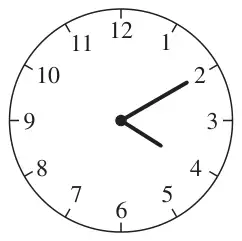
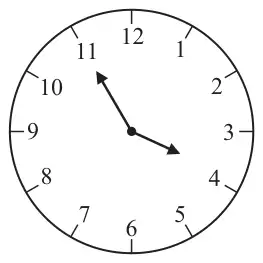
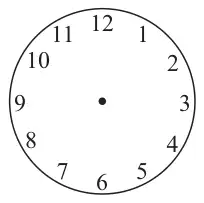
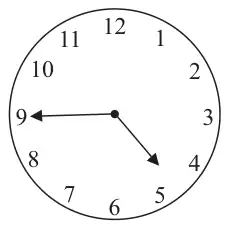
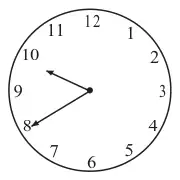
(a) The clock shows the time in the afternoon at which a train leaves Colombo for Kandy.Write down this time using the 12-hour clock. (1)
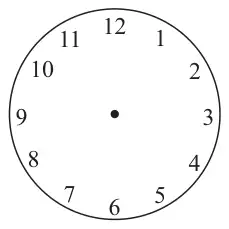
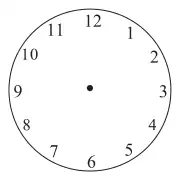
(b) The train arrives in Kandy at five to eight in the evening. On the clock face, draw hands to show a time of five to eight.(1)
(c) Umar buys 7 first class tickets and 9 second class tickets for the train journey from Colombo to Kandy. The total cost is 4500 Sri Lankan rupees. The cost of each first class ticket is 360 Sri Lankan rupees. Work out the cost of each second class ticket. (3)
Mark scheme (a)
Scheme
Marks
4 35 pm
B1
(1)
Mark scheme (b)
Scheme
Marks
one hand \(\to\) 11 and \(7 \lt\) one hand \(\lt 8\)
B1
(1)
Notes
B1: Ignore lengths of hands
Mark scheme (c)
Scheme
Marks
\(360 \times 7\) or 2520
M1
\(\dfrac{4500 - \text{``}{2520}\text{''}}{9}\) or \(\dfrac{1980}{9}\)
M1
220
A1
(3)
Notes
M1: (dep) for subtraction from 4500 and division by 9
8 The table shows information about the time in each of three cities. For each city, it shows the number of hours time difference from the time in London.
+ shows that the time is ahead of the time in London. − shows that the time is behind the time in London.
City
Time difference from London (hours)
Nairobi
+3
New York
−5
San Francisco
−8
Chicago
(a) Work out the time difference between
(i) Nairobi and New York,
(ii) New York and San Francisco.
(2)
(b) The time in Chicago is 1 hour behind the time in New York. Complete the table to show the time difference of Chicago from London. (1)
5 Here is some information from a weather forecast website for Chicago for one day in January.
Probability of snow
85%
Maximum temperature
−2°C
Minimum temperature
−9°C
Sunrise
7 05 am
Sunset
5 02 pm
(a) Write 85% as a decimal. (1)
(b) Write 85% as a fraction. Give your fraction in its simplest form. (2)
(c) How many degrees higher is the maximum temperature than the minimum temperature? (2)
(d) Write 5 02 pm as a time using the 24-hour clock. (1)
(e) Work out the length of time between 7 05 am and 5 02 pm. Give your answer in hours and minutes. (3)
(f) The probability that it will snow is 85%. Work out the probability that it will not snow. (1)
Mark scheme (a)
Scheme
Marks
0.85
B1
(1)
Notes
B1: cao
Mark scheme (b)
Scheme
Marks
\(\dfrac{85}{100}\)
M1
\(\dfrac{17}{20}\)
A1
(2)
Notes
A1: cao
Mark scheme (c)
Scheme
Marks
−2 − (−9) or −7
M1
7
A1
(2)
Notes
A1: cao
Mark scheme (d)
Scheme
Marks
17 02
B1
(1)
Mark scheme (e)
Scheme
Marks
eg 55 min + 9 h + 2 min 9 h + 55 min + 2 min 10 h − 3 min
M2
9 (hours) 57 (minutes)
A1
(3)
Notes
M2: M1 for each of the following up to a maximum of 2 marks 1. 17 02 − 7 05 but not 7 05 − 5 02 2. An attempt to make some use of a counting on method (for example, a list of 3 or more relevant times may be taken as sufficient evidence of this) 3. 9 on the hours answer line 4. 57 on the minutes answer line SC If no method marks scored, award B1 for 10 h 3 mins
A1: cao
Mark scheme (f)
Scheme
Marks
15%
B1
(1)
(Total 10 marks)
Notes
B1: Also accept 0.15 oe (corrected from the printed mark scheme: the answer is printed as 15, without the % sign)
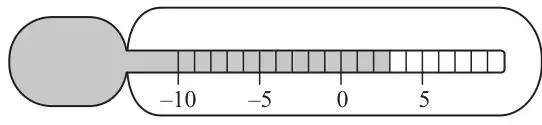
7 The temperature of food in a freezer is −18°C. The temperature of food in a fridge is 3°C.
(a) What is the difference between the temperature of food in the freezer and the temperature of food in the fridge? (2)
(b) Alison took a pie from the freezer. The temperature of the pie was −18°C. One hour later, the temperature of the pie was 11°C higher. Work out the temperature of the pie after one hour. (2)
(c) At 14 25 Zak takes a chicken from the fridge. 10 minutes later he places the chicken in an oven to cook. The cooking time is 1 hour 45 minutes.
(i) Write 14 25 using pm.
(ii) At what time will the chicken be cooked?
(3)
Mark scheme (a)
Scheme
Marks
3 + 18 or −18 − 3
M1
21
A1
(2)
Notes
A1: (accept −21)
Mark scheme (b)
Scheme
Marks
−18 + 11
M1
−7
A1
(2)
Notes
A1: cao
Mark scheme (c)
Scheme
Marks
(i) Answer: (0)2 25 pm
B1
(ii) 25 + 10 + 45 (=80) or 25 + 10 + 105 (=140) or 14 25 + 2hrs – 5mins or 2.25 + 2hrs – 5 mins or 14 25 + 1 hr 55mins or 2.25 + 1 hr 55 mins
M1
16 20
A1
(3)
(Total 7 marks)
Notes
B1: allow 2.25, 2:25, with leading zeros, 25(mins) past 2 pm
M1: intention to add all minute components conversion of cooking time to minutes & intention to add
7 Michael started work at 07 30 and finished at 14 15 He had one break of 30 minutes and another break of 45 minutes. He worked all the rest of the time.
Work out the time for which Michael worked. Give your answer in hours and minutes.
(4)
Mark scheme
Scheme
Marks
30 + 45 (= 1 h 15m or 75m)
M1
1415 – 0730 (= 6h 45m) or 1415 – “1h15m” (= 1300) or 0730 + 30 + 45 (= 845)
8 The table shows information about the time in each of five cities. For each city, it shows the number of hours time difference from the time in London. + shows that the time is ahead of the time in London. − shows that the time is behind the time in London.
City
Time difference from London (hours)
Cairo
+2
Montreal
−5
Bangkok
+7
Rio de Janeiro
−3
Los Angeles
−8
Mexico City
(a) When the time in London is 6 a.m., what is the time in
(i) Bangkok,
(ii) Los Angeles.
(2)
(b) The time in Mexico City is 2 hours ahead of the time in Los Angeles. Complete the table to show the time difference of Mexico City from London. (1)
(c) Write down the name of the city in which the time is 10 hours behind Bangkok. (1)
10 A mobile phone company makes a special offer. Usually one minute of call time costs 5 cents. For the special offer, this call time is increased by 20%.
(a) Calculate the call time which costs 5 cents during the special offer. Give your answer in seconds. (2)
(b) Calculate the cost per minute for the special offer. (2)
(c) Calculate the percentage decrease in the cost per minute for the special offer. (3)
Mark scheme (a)
Scheme
Marks
60 × 20/100 or 12 sec or 1.2 min seen
M1
72
A1
(2)
Mark scheme (b)
Scheme
Marks
5 / 72 × 60 or 5 / 1.2
M1
4.16 to 4.17
A1f
(2)
Notes
M1: or 5/6 × 5
A1f: or 4 or 4.2 with wking (eg 5:72 = \(x\):60) ft only if wking \(\quad\) NB!!! 80% of 5 = 4
Mark scheme (c)
Scheme
Marks
“4.167”/5 × 100 \(\quad\) or \(\quad\) 5 − “4.167”
M1
100 − “83.3…” \(\quad\) or \(\quad\) “0.833..”/5 × 100
6 There are 72 players in a football club. \(\frac{3}{4}\) of these players are male.
(a) How many of the players are female? (3)
(b) 30 players from the club went on a tour. What fraction of the 72 players went on the tour? Give your answer in its simplest form. (2)
(c) On the first day of the tour, the players left home at 10.30 a.m. The journey took 4 hours 40 minutes. At what time did they arrive? Give your answer as a time on the 24-hour clock. (2)
(d) Ice creams cost £0.85 each. The captain has £25 to spend on ice creams. Can the captain buy ice creams for all 30 players? You must show your working.(3)
Mark scheme (a)
Scheme
Marks
\(\frac{3}{4} \times 72\) or 54
M1
72 − “54”
M1
18
A1
(3)
Notes
M1: dep
A1: cao
Alternative
\(\frac{1}{4} \times 72\)
M2
18
A1
No official mark scheme was available for this paper; this one was written by Westie's Workshop.
Mark scheme (b)
Scheme
Marks
\(\frac{30}{72}\)
M1
\(\frac{5}{12}\)
A1
(2)
Notes
A1: cao
No official mark scheme was available for this paper; this one was written by Westie's Workshop.
Mark scheme (c)
Scheme
Marks
15 10
B2
(2)
Notes
B2: Accept 1510, 15:10, 15.10 B1 for 3.10 (pm) or for 4 hours 40 minutes correctly added to a wrong start time
No official mark scheme was available for this paper; this one was written by Westie's Workshop.
Mark scheme (d)
Scheme
Marks
30 × 0.85 or 25 ÷ 0.85
M1
25.5(0) or 29(.4…)
A1
No
B1
(3)
(Total 10 marks)
Notes
B1: dep on M1 A1; e.g. “No, 30 ice creams cost £25.50”
No official mark scheme was available for this paper; this one was written by Westie's Workshop.
(a) At the airport a bottle of cola costs $2.25 Mahmoud has $15 to spend on cola. He buys as many bottles as he can.
(i) How many bottles does he buy?
(ii) How much change should he get?
(4)
(b) His flight takes off at 2230 and lands at 0445 How long is the flight in hours and minutes? (3)
(c) The floors in his hotel are numbered as 7, 6, 5, ..........., –3 The top floor is number 7. The ground floor is number 0. The lowest floor below the ground floor is number –3.
(i) Mahmoud starts from the gym, on floor number –3. He goes to his room on floor 5. How many floors does he go up?
(ii) Later Mahmoud starts at floor 5. He goes down 6 floors to the restaurant. On which floor is the restaurant?
(4)
Mark scheme (a)
Scheme
Marks
(i) 15 / 2.25 or 6.6666…
M1
6
A1
(ii) 15 - 6 x 2.25
M1
$1.50
A1
(4)
Mark scheme (b)
Scheme
Marks
1h 30 mins + 4h 45 mins or \(1\frac{1}{2} + 4\frac{3}{4}\)
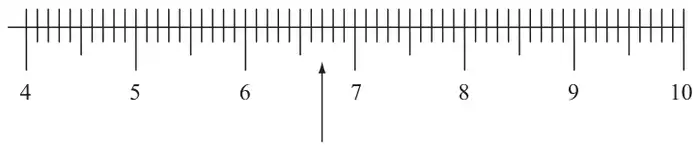
(a) Complete the following sentence by writing a sensible metric unit on each of the dotted lines. An average adult male gorilla is 1.75 .................... tall and weighs 195 .................... (2)
(b) Change 1.5 litres to millilitres. (1)
Mark scheme (a)
Scheme
Marks
metres or m
B1
kilograms or kg
B1
(2)
Notes
B1: Accept metre, metres, m
B1: Accept kilogram, kilos, kg
No official mark scheme was available for this paper; this one was written by Westie's Workshop.
Mark scheme (b)
Scheme
Marks
1500
B1
(1)
(3 marks)
Notes
B1: cao
No official mark scheme was available for this paper; this one was written by Westie's Workshop.
We'd like to use Google Analytics cookies to count visits and see which pages help most. They're optional, and the site works exactly the same either way. Privacy policy