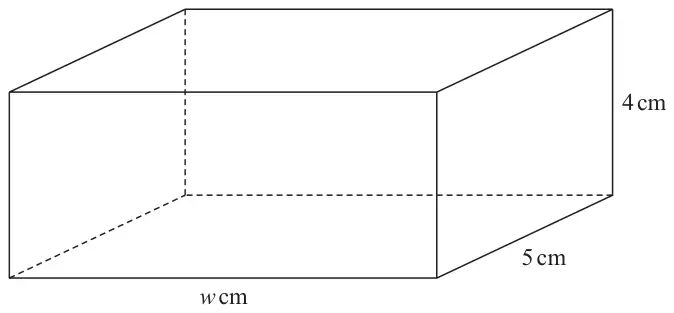
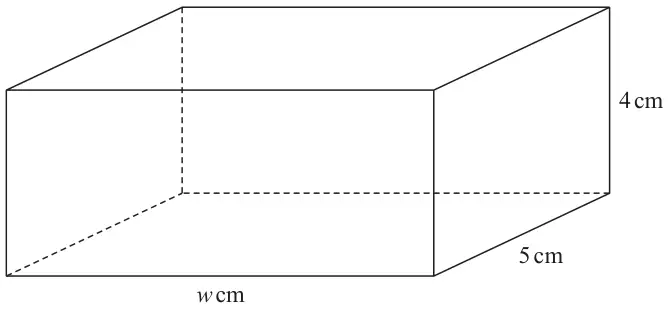
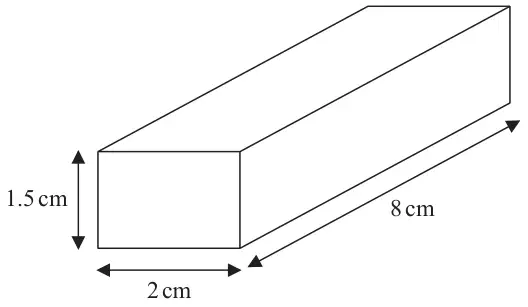
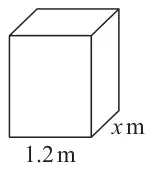
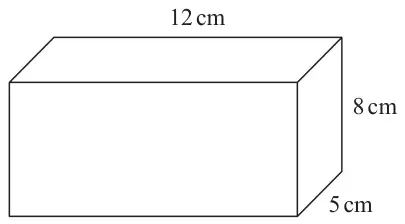
27 The diagram shows a block of iron in the shape of a cuboid.
Diagram NOT accurately drawn
The block has length \(w\) cm, width 5 cm and height 4 cm
The density of iron is 7.8 g/cm3 The mass of the block is 1950 g
Work out the value of \(w\)
(3)
Mark scheme
Scheme
Marks
\((V =)\;\dfrac{1950}{7.8}\;(= 250)\) or \(7.8 = \dfrac{1950}{w \times 5 \times 4}\) or \(7.8 = \dfrac{1950}{w \times 20}\)
M1
eg
\(w = \dfrac{1950}{7.8 \times 5 \times 4}\)
or \(20w = \dfrac{1950}{7.8}\)
or \(20w\) = “250”
or 4 × 5 × \(w\) = “250”
OR
eg
\(\dfrac{1950}{5 \times 4 \times 7.8}\)
or 1950 ÷ (20 × 7.8)
or 1950 ÷ 156
or “250” ÷ 20
M1
Correct answer scores full marks (unless from obvious incorrect working) Answer: 12.5
A1
(3)
(3 marks)
Notes
M1: for correct method to find volume using mass ÷ density or a correct equation with correct expression for volume (may be embedded in another calculation)
M1: for a fully correct equation in \(w\) or a fully correct calculation to find the value of \(w\) (may be labelled eg \(x\) or \(L\))
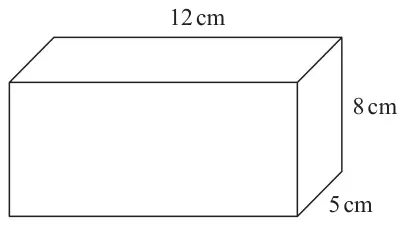
11 The diagram shows a block of iron in the shape of a cuboid.
Diagram NOT accurately drawn
The block has length \(w\) cm, width 5 cm and height 4 cm
The density of iron is 7.8 g/cm3 The mass of the block is 1950 g
Work out the value of \(w\)
(3)
Mark scheme
Scheme
Marks
\((V =)\;\dfrac{1950}{7.8}\;(= 250)\) or \(7.8 = \dfrac{1950}{w \times 5 \times 4}\) or \(7.8 = \dfrac{1950}{w \times 20}\)
M1
eg
\(w = \dfrac{1950}{7.8 \times 5 \times 4}\)
or \(20w = \dfrac{1950}{7.8}\)
or \(20w\) = “250”
or 4 × 5 × \(w\) = “250”
OR
eg
\(\dfrac{1950}{5 \times 4 \times 7.8}\)
or 1950 ÷ (20 × 7.8)
or 1950 ÷ 156
or “250” ÷ 20
M1
Correct answer scores full marks (unless from obvious incorrect working) Answer: 12.5
A1
(3)
(3 marks)
Notes
M1: for correct method to find volume using mass ÷ density or a correct equation with correct expression for volume (may be embedded in another calculation)
M1: for a fully correct equation in \(w\) or a fully correct calculation to find the value of \(w\) (may be labelled eg \(x\) or \(L\))
3 Anjali travels on the Eurostar train from Paris to Amsterdam.
The distance the train travels between Paris and Amsterdam is 515 km. The time taken by the train to travel between Paris and Amsterdam is 3 hours 18 minutes.
Work out the average speed of the train. Give your answer in km/h correct to the nearest whole number.
(3)
Mark scheme
Scheme
Marks
3.3 or \(\dfrac{33}{10}\) or \(3\dfrac{3}{10}\) or \(3\dfrac{18}{60}\) oe or 180 + 18 or 198 oe
B1
515 ÷ 3.3 or \(515 \div \dfrac{33}{10}\) or \(515 \div 3\dfrac{3}{10}\) or
19 An aeroplane travelled from New York City to Los Angeles.
The aeroplane travelled a distance of 3980 kilometres in 5 hours 24 minutes.
Work out the average speed of the aeroplane. Give your answer in kilometres per hour correct to the nearest whole number.
(3)
Mark scheme
Scheme
Marks
For sight of 5 hrs 24 mins = 5.4 (hrs) or \(5\dfrac{24}{60}\left(= 5\dfrac{2}{5}\right)\) oe or 324 (mins)
B1
3980 ÷ 5.4 oe or \(\dfrac{3980}{324} \times 60\)
M1
737
A1
(3)
(3 marks)
Notes
M1: For distance ÷ time that should give a speed in km/h. (SC allow 3980 ÷ 5.24 (= 759.5… or 760) for this mark unless mark has been awarded for 324 minutes or 5.4 hours oe )
M1: correct method to calculate density (if volume is incorrect, their value can be used if clearly labelled) accept use of 7.04 or an incorrect conversion from kg to g for mass
3 An aeroplane travelled from New York City to Los Angeles.
The aeroplane travelled a distance of 3980 kilometres in 5 hours 24 minutes.
Work out the average speed of the aeroplane. Give your answer in kilometres per hour correct to the nearest whole number.
(3)
Mark scheme
Scheme
Marks
For sight of 5 hrs 24 mins = 5.4 (hrs) or \(5\dfrac{24}{60}\left(= 5\dfrac{2}{5}\right)\) oe or
324 (mins) or 19440 (secs)
B1
3980 ÷ 5.4 or \(\dfrac{3980}{324} \times 60\) oe
M1
737
A1
(3)
(3 marks)
Notes
M1: For distance ÷ time that should give the correct speed in km/h. (SC allow 3980 ÷ 5.24 (= 759.5…or 760) for this mark unless mark has been awarded for 324 minutes or 5.4 hours oe )
21 Milly went on a car journey. She travelled from Anesey to Breigh to Clando and then to Duckbridge.
For Anesey to Breigh, Milly drove the 245 km in 2.5 hours. For Breigh to Clando, Milly drove the 220 km at an average speed of 80 km/h For Clando to Duckbridge, Milly drove at an average speed of 72 km/h in 50 minutes.
Work out Milly’s average speed, in km/h, for the journey from Anesey to Duckbridge. Give your answer correct to one decimal place.
14 Iman walked for 3 hours 15 minutes. He walked a distance of 18.2 kilometres.
Work out Iman’s average speed for his walk. Give your answer in km/h
(3)
Mark scheme
Scheme
Marks
3 hours 15 mins = 3.25 (hours) or \(3\frac{1}{4}\) (hours)
or \(3\dfrac{15}{60}\) (hours) or 195 (mins)
B1
18.2 ÷ “\(3\frac{1}{4}\)” oe or 18.2 ÷ “195” × 60
M1
5.6
A1
(3)
(3 marks)
Notes
B1: For converting 3 hrs 15 minutes into hours or minutes
M1: For use of D ÷ T allow 18.2 ÷ 3.15 or their incorrect time conversion (must be clear that this is their time conversion) If B mark awarded then the value that gained that mark must be used here to gain this method mark.
7 Milly went on a car journey. She travelled from Anesey to Breigh to Clando and then to Duckbridge.
For Anesey to Breigh, Milly drove the 245 km in 2.5 hours. For Breigh to Clando, Milly drove the 220 km at an average speed of 80 km/h For Clando to Duckbridge, Milly drove at an average speed of 72 km/h in 50 minutes.
Work out Milly’s average speed, in km/h, for the journey from Anesey to Duckbridge. Give your answer correct to one decimal place.
Working not required, so correct answer scores full marks (unless from obvious incorrect working) Answer: 690
A1
(3)
(3 marks)
Notes
B1: for correctly writing the time as a time in hours or minutes or for a correct calculation to do this
M1: for use of speed = distance ÷ time (use of their time in hours – if used minutes, then must multiply by 60) (allow 5658 ÷ 8.12 (= 696.79…) for this mark if B0 awarded (allow 696 – 697))
Working not required, so correct answer scores full marks (unless from obvious incorrect working) Answer: 690
A1
(3)
(3 marks)
Notes
B1:For correctly writing the time as a time in hours or minutes or for a correct calculation to do this
M1: For use of speed = distance ÷ time (use of their time in hours – if used minutes, then must multiply by 60) (allow 5658 ÷ 8.12 (= 696.79…) for this mark if B0 awarded (allow 696 – 697))
17 A metal block has a mass of 5 kg, correct to the nearest 50 grams. The block has a volume of \((1.84 \times 10^{-3})\) m3, correct to 3 significant figures.
Work out the upper bound for the density of the block. Give your answer in kg/m3 correct to 1 decimal place. Show your working clearly.
(4)
Mark scheme
Scheme
Marks
5025 or 5.025 or 4975 or 4.975
B1
\(1.845 \times 10^{-3}\) oe or \(1.835 \times 10^{-3}\) oe
A box, in the shape of a cuboid, is going to be put on a table. The whole of one face of the box will be in contact with the table. The force exerted by the box on the table is always 105 newtons. The box is 5 m by 4 m by 3 m. The greatest pressure exerted by the box on the table is \(P\) newtons/m2 The least pressure exerted by the box on the table is \(Q\) newtons/m2 Work out the value of \(P - Q\)
13 A train travels at a constant speed of \(v\) kilometres per hour. The train crosses a bridge.
The length of the bridge is \(b\) metres. The length of the train is \(x\) metres.
\(T\) seconds is the time between the instant that the front of the train moves onto the bridge and the instant that the back of the train leaves the bridge.
Find a formula for \(T\) in terms of \(b\), \(x\) and \(v\). Give your answer in its simplest form.
(3)
Mark scheme
Scheme
Marks
Total distance = \(b + x\) or \(v\) km/h = \(v \times 1000 \div 3600\) m/s
M1
\((T =)\;(b + x)\,/\,(v \times 1000 \div 3600)\)
M1
\(T = \dfrac{18(b + x)}{5v}\)
A1
(3)
Notes
M1: for total distance or conversion from km/h to m/s
M1: for any correct expression for \(T\)
A1: correct and fully simplified (numerator may not be factorised)
18 There were 2.1 million people living in Dubai in 2013 1.75 million of these people were not born in Dubai.
(a) Work out 1.75 as a percentage of 2.1 Give your answer correct to 1 decimal place. (2)
The unit of currency in Dubai is the dirham. The exchange rate is £1 = 5.52 dirham. The cost of a pair of running shoes in Dubai is 343 dirham. The cost of an identical pair of running shoes in the UK is £54.99 The pair of running shoes is more expensive in Dubai than in the UK.
(b) How much more expensive? Give your answer to the nearest dirham. (3)
A plane flies a distance of 5522 km from London to Abu Dhabi in 7 hours 24 minutes.
(c) Work out the average speed of the plane. Give your answer in kilometres per hour, correct to 3 significant figures. (3)
Mark scheme (a)
Scheme
Marks
\(\dfrac{1.75}{2.1} \times 100\) oe
M1
83.3
A1
(2)
Notes
M1: Fully correct method to find %
A1: 83.3 or better
Mark scheme (b)
Scheme
Marks
54.99 × 5.52 (= 303.(54...)) or 343 ÷ 5.52 (=62.(137...))
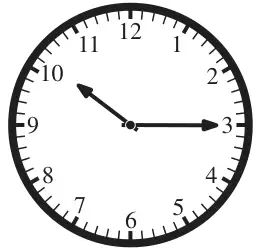
(a) One morning, Lizzy went on a bus journey. The clock shows the time that she left home.
(i) Write down this time using the 12-hour clock.
Lizzy got home at ten to four in the afternoon.
(ii) Write down this time using the 24-hour clock.
(2)
(b) On another day, Lizzy drove by car to visit her aunt. She left home at 9 30 am. Lizzy arrived at her aunt’s house at 11 15 am. She drove a distance of 140 km. Work out, in km/h, Lizzy’s average speed for the journey. (3)
Mark scheme (a)
Scheme
Marks
(i) 10:15 am
B1
(ii) 15:50
B1
(2)
Mark scheme (b)
Scheme
Marks
1.75 or \(1\dfrac{3}{4}\) or 105
M1
140 ÷ “1.75” or \(\dfrac{140}{\text{“105”}} \times 60\)
M1
80
A1
(3)
Notes
M1: for correctly converting “1hr 45 mins” into a decimal or fraction or minutes (eg. 1.75h or 105 min)
M1: independent but “1.75” or “105” must be correct for their duration accept 140 ÷ 1.45
9 A plane flew from Bogotá to Quito. The distance the plane flew was 725 km. The time taken by the plane was 1 hour 24 minutes. Work out the average speed of the plane. Give your answer correct to 3 significant figures.
(3)
Mark scheme
Scheme
Marks
\(1\dfrac{24}{60}\) oe or 1.4 or 84
B1
\(\dfrac{725}{1.4}\) oe or \(\dfrac{725}{84} \times 60\)
14 A ferry leaves Palermo at 7.45 pm and arrives in Salerno at 6.15 am the next day.
(a) Work out how long the ferry takes to go from Palermo to Salerno. (2)
Speed at sea is measured in knots. 1 knot = 1.852 kilometres per hour.
A ferry takes 12 hours to go from Trapani to Cagliari. The ferry goes at an average speed of 16 knots.
(b) Work out the distance the ferry goes from Trapani to Cagliari. Give your answer in kilometres correct to the nearest kilometre. (3)
Mark scheme (a)
Scheme
Marks
\(10\tfrac{1}{2}\) hrs
B2
(2)
Notes
B2: B2 for \(10\tfrac{1}{2}\) hrs or 10.5 hrs or 630 minutes or 10h 30 min oe (B1 for ‘correct time’ but units incorrect, partially correct or missing Eg. \(10\tfrac{1}{2}\), 630, 10:30, 10:30 mins, 10.3, 10.3 hours)
Mark scheme (b)
Scheme
Marks
12 × 16 (= 192) or 16 × 1.852 (= 29.632) or 12 × 1.852 (= 22.224)
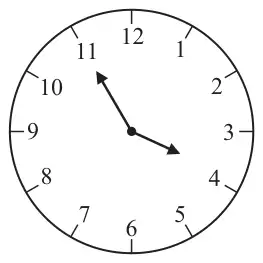
12 Saki arrives at the railway station in Tokyo. The clock shows the time in the afternoon that she arrived.
(a) Write this time using the 24-hour clock. (1)
Saki’s train leaves Tokyo at 16 50 and arrives in Kyoto at 19 12
(b)
(i) Write 16 50 using the 12-hour clock.
(ii) Find the time taken by the train to travel from Tokyo to Kyoto.
(3)
The train continues to Hakata. It leaves Kyoto at 19 14 and takes 2 hours 45 minutes to reach Hakata.
(c) Work out the time that the train arrives in Hakata. (1)
The distance from Kyoto to Hakata is 638 kilometres. The train journey from Kyoto to Hakata takes 2 hours 45 minutes.
(d) Work out the average speed, in kilometres per hour, of the train from Kyoto to Hakata. (3)
Mark scheme (a)
Scheme
Marks
15 55
B1
(1)
Notes
B1: Accept any separator or a space between hours and minutes.
Mark scheme (b)
Scheme
Marks
(i) Answer: 4.50 pm
B1
(ii) 10 min + 2 hr + 12 min or 18 hr 72 min − 16 hr 50 min or 3 hr − (50 − 12) min
M1
2 hour 22 minutes
A1
(3)
Notes
B1: Allow 10 minutes to 5 pm or 50 minutes past 4 pm Accept any separator or a space between hours and minutes.
M1: An attempt to find difference between 1650 and 1912 that demonstrates 60 minutes in an hour.
Mark scheme (c)
Scheme
Marks
2159
B1
(1)
Notes
B1: Accept 9.59 pm oe
Mark scheme (d)
Scheme
Marks
\(\dfrac{638}{2.75}\) or \(\dfrac{638}{2\frac{3}{4}}\) or \(\dfrac{638}{11/4}\) or \(\dfrac{638}{11} \times 4\) or \(\dfrac{638}{165} \times 60\) oe
M2
232
A1
(3)
Total 8 marks
Notes
M2: M1 for 638 ÷ 2.45 or 260(.408....) rounded or truncated to 3 or more significant figures or 638 ÷ 165 or 3.86(6666...) rounded or truncated to 3 or more significant figures
2 The distance from Kyoto to Hakata is 638 kilometres. The train journey from Kyoto to Hakata takes 2 hours 45 minutes. Work out the average speed, in kilometres per hour, of the train from Kyoto to Hakata.
(3)
Mark scheme
Scheme
Marks
\(\dfrac{638}{2.75}\) or \(\dfrac{638}{2\frac{3}{4}}\) or \(\dfrac{638}{11/4}\) or \(\dfrac{638}{11} \times 4\) or \(\dfrac{638}{165} \times 60\) oe
M2
232
A1
(3)
Notes
M2: M1 for 638 ÷ 2.45 or 260(.408....) rounded or truncated to 3 or more significant figures or 638 ÷ 165 or 3.86(6666...) rounded or truncated to 3 or more significant figures.
19 Rachael walks to school. The distance to school is 2.8 km, correct to the nearest 0.1 km. She walks at a speed of 5 km/h, correct to the nearest km/h.
Calculate the upper bound, in minutes, for the time Rachael takes to walk to school.
(3)
Mark scheme
Scheme
Marks
2.85 x 60 ÷ 4.5 oe
M2
38
A1
(3 marks)
Notes
M2: M1 for 4.5 or 2.85 selected or used. Accept \(4.4\dot{9}\) or \(2.84\dot{9}\)
A1: 38 must come from correct working, although 38 without working gets M2A1
14 Here is part of a timetable for the Paris to Montpellier express train service.
Paris
06 07
10 07
12 07
18 07
20 07
Valence
08 22
12 24
14 24
20 24
22 24
Nimes
09 09
13 05
15 05
21 05
23 05
Montpellier
09 37
13 34
15 34
21 34
23 34
(a) At what time should the 12 07 from Paris get to Nimes? (1)
One day, the 06 07 from Paris arrived at Montpellier \(\dfrac{3}{4}\) of an hour late.
(b) At what time did this train arrive at Montpellier? (2)
(c) Work out how long it should take the 20 07 train from Paris to get to Montpellier. (1)
The average speed of the 20 07 train from Paris is 224 km/h.
(d) Work out the distance this train travels from Paris to Montpellier. (3)
Mark scheme (a)
Scheme
Marks
1505
B1
(1)
Mark scheme (b)
Scheme
Marks
0937 + 45
M1
1022
A1
(2)
Notes
M1: 0937 + 45
Mark scheme (c)
Scheme
Marks
3 h 27 min
B1
(1)
Notes
B1: 3h 27 min (accept 207 min)
Mark scheme (d)
Scheme
Marks
3.45 or \(3\dfrac{27}{60}\)
M1
\(\text{“}3\dfrac{27}{60}\text{”} \times 224\) or “3.45” × 224
M1
772.8
A1
(3)
(Total 7 marks)
Notes
M1: for correctly converting ‘3h 27m’ into a decimal (e.g. 3.45) For '3h 27m' there must be some indication that this is the elapsed time from 20:07 to 23:34 or ft from (c)
M1: (independent) allow '3h 27m' × 224 or 3.27 × 224 For '3h 27m' there must be some indication that this is the elapsed time from 20:07 to 23:34 or ft from (c) NB. 224 × 20 07 gets M0
2 Here is part of a timetable for the Paris to Montpellier express train service.
Paris
06 07
10 07
12 07
18 07
20 07
Valence
08 22
12 24
14 24
20 24
22 24
Nimes
09 09
13 05
15 05
21 05
23 05
Montpellier
09 37
13 34
15 34
21 34
23 34
The average speed of the 20 07 train from Paris is 224 km/h.
Work out the distance this train travels from Paris to Montpellier.
(3)
Mark scheme
Scheme
Marks
3.45 or \(3\dfrac{27}{60}\)
M1
\(\text{“}3\dfrac{27}{60}\text{”} \times 224\) or “3.45” × 224
M1
772.8
A1
(3)
(3 marks)
Notes
M1: for correctly converting ‘3h 27m’ into a decimal (eg. 3.45) For ‘3h 27m’ there must be some indication that this is the elapsed time from 20:07 to 23:34
M1: (independent) allow ‘3h 27m’ × 224 or 3.27 × 224 For ‘3h 27m’ there must be some indication that this is the elapsed time from 20:07 to 23:34
17 Wendy travelled on the Eurostar train from St Pancras station to the Gare du Nord station. The Eurostar train travelled a distance of 495 km. The journey time was 2 hours 15 minutes.
Work out the average speed of the Eurostar train in kilometres per hour.
(3)
Mark scheme
Scheme
Marks
\(495 \div 2.25\)
M2
220
A1
(3)
Notes
M2: M1 for \(495 \div 2.15\) or 230.2... rounded or truncated to 3 or more sig figs
A1: cao
Alternative
Scheme
Marks
\(495 \div 135\) or \(3.\dot{6}\) or 3.666.. rounded or truncated to 3 or more sig figs
2 Wendy travelled on the Eurostar train from St Pancras station to the Gare du Nord station. The Eurostar train travelled a distance of 495 km. The journey time was 2 hours 15 minutes.
Work out the average speed of the Eurostar train in kilometres per hour.
(3)
Mark scheme
Scheme
Marks
495 ÷ 2.25
M2
220
A1
(3)
Notes
M2: M1 for 495÷2.15 or 230.2... rounded or truncated to 3 or more sig figs
A1: cao
Alternative
Scheme
Marks
495÷135 or \(3.\dot{6}\) or 3.666.. rounded or truncated to 3 or more sig figs
24 On Monday, Nalim made a journey. On Tuesday, she made the same journey. Her average speed on Tuesday was 25% greater than her average speed on Monday.
Calculate the percentage reduction in the time her journey took on Tuesday compared with Monday.
\(t_1 = \dfrac{d}{s}\) and \(t_2 = \dfrac{d}{(1 + 0.25)s}\) or \(\dfrac{t_2}{t_1} = 0.8\)
M1
1 − 0.8 oe eg \(1 - \tfrac{4}{5}\), 100% − 80%
M1
20
A1
(3)
Notes
A1: cao
Alternative method (assigns values to distance and average speed) M1 for calculating both times correctly M1 (dep) for finding \(\dfrac{\text{Mon time} - \text{Tues time}}{\text{Mon time}}\)
14 Joseph travels to work each day by train. The weekly cost of his train journey is £45 Joseph’s weekly pay is £625
(a) Work out 45 as a percentage of 625 (2)
(b) The weekly cost of his train journey increases by 8%. Increase £45 by 8%. (3)
(c) Joseph’s weekly pay increases to £640 Calculate the percentage increase from 625 to 640 (3)
(d) Joseph decides to cycle to work. He cycles 18 km to work. His journey to work takes 1 hour 20 minutes. Calculate his average speed in kilometres per hour. (3)
Mark scheme (a)
Scheme
Marks
\(\dfrac{45}{625} \times 100\)
M1
7.2
A1
(2)
Mark scheme (b)
Scheme
Marks
\(\dfrac{8}{100} \times 45\;(= 3.6)\)
M1
45 + “3.6”
M1 dep
48.6(0)
A1
(3)
Notes
M1: or M2 for \(45 \times 1.08\)
Mark scheme (c)
Scheme
Marks
640 – 625 (= 15)
M1
“15” / 625 or “15” / 640
M1 dep
2.4
A1
(3)
Notes
or 640/625 (= 1.024) then “1.024” – 1 (= 0.024) or 625/640 (= 0.976.. or 0.977) then 1 – “0.976” (= 0.0234)
Mark scheme (d)
Scheme
Marks
\(18 \div 1\frac{1}{3}\) or \(18 \div 1.33\) (2dp or better) or \(18 \div 80 \times 60\)
M2
13.5
A1
(3)
Notes
M2: M1 for \(1\frac{1}{3}\) or \(18 \div 1.2\;(= 15)\) or \(18 \div 1.3\;(13.8..)\) or \(18 \div 80\;(= 0.225)\)
3 Joseph travels to work each day by train. The weekly cost of his train journey is £45 Joseph’s weekly pay is £625
(a) Work out 45 as a percentage of 625 (2)
(b) The weekly cost of his train journey increases by 8%. Increase £45 by 8%. (3)
(c) Joseph’s weekly pay increases to £640 Calculate the percentage increase from 625 to 640 (3)
(d) Joseph decides to cycle to work. He cycles 18 km to work. His journey to work takes 1 hour 20 minutes. Calculate his average speed in kilometres per hour. (3)
Mark scheme (a)
Scheme
Marks
45/625 x 100
M1
7.2
A1
(2)
Mark scheme (b)
Scheme
Marks
8/100 x 45 (= 3.6)
M1
45 + “3.6”
M1
48.6(0)
A1
(3)
Notes
M1: dep
or M2 for 45 x 1.08
Mark scheme (c)
Scheme
Marks
640 − 625 (= 15)
M1
“15” / 625 or “15” / 640
M1
2.4
A1
(3)
Notes
M1: dep
or M1 for 640/625 (= 1.024), M1 dep for “1.024” − 1 (= 0.024) or M1 for 625/640 (= 0.976.. or 0.977), M1 dep for 1 − “0.976” (= 0.0234)
Mark scheme (d)
Scheme
Marks
18 ÷ \(1\tfrac{1}{3}\) or 18 ÷ 1.33 (2dp or better) or 18 ÷ 80 x 60
M2
13.5
A1
(3)
Notes
M2: M1 for \(1\tfrac{1}{3}\) or 18 ÷1.2 (=15) or 18 ÷ 1.3 (13.8..) or 18 ÷ 80 (=0.225)
2 An aeroplane flew from Qatar to Bahrain. The distance flown was 135 km. The average speed was 180 km/h. Work out the time taken. Give your answer in minutes.
(3)
Mark scheme
Scheme
Marks
\(\dfrac{135}{180}\)
M1
0.75 oe
A1
45
A1
(Total 3 marks)
Notes
A1: cao
Apart from Questions 3, 13(b) and 17(f) (where the mark scheme states otherwise), the correct answer, unless clearly obtained by an incorrect method, should be taken to imply a correct method.
(a) Rachael uses her car for work. Her company pays her 32 cents for every kilometre she travels by car. Yesterday, her company paid her $48 for the distance she travelled by car. Work out the distance she travelled by car yesterday. (3)
(b) The length of the journey from her home to work is 72 km. The journey takes 1 hour 20 minutes. Work out her average speed in km/h. (3)
Mark scheme (a)
Scheme
Marks
48 ÷ 0.32 oe
M2
150
A1
(3)
Notes
M2: (M1 for 48 × 100 or 32/100 i.e attempt to have equal units)
Mark scheme (b)
Scheme
Marks
\(72 \div 1\frac{1}{3}\) oe
M2
54
A1
(3)
(Total 6 marks)
Notes
M2: accept 72 ÷ 1.33 (2dp or better) or 0.9 × 60 (B1 M0 for 72 ÷ 1.2(0) {=60} or 72 ÷ 80 {=0.9} or 72 ÷ 1.3 {=55.4} or better)
4 The length of Rachael’s journey from her home to work is 72 km. The journey takes 1 hour 20 minutes. Work out her average speed in km/h.
(3)
Mark scheme
Scheme
Marks
\(72 \div 1\frac{1}{3}\) oe
B1M1
54
A1
(Total 3 marks)
Notes
B1M1: accept 72 ÷ 1.33 (2dp or better) or 0.9 × 60 (B1 M0 for 72 ÷ 1.2(0){=60} or 72 ÷ 80 {=0.9} or 72 ÷ 1.3 {=55.4 or better}) or 72000 ÷ 1.33( or better)
A1: cao
Apart from questions 5b, 8, 15d, 20b, 21b, 23, 24b (where the mark scheme states otherwise) the correct answer, unless clearly obtained by an incorrect method, should be taken to imply correct working.
(a) Rosetta drives 85 kilometres in 1 hour 15 minutes. Work out her average speed in kilometres per hour. (2)
(b) Rosetta drives a total distance of 136 kilometres. Work out 85 as a percentage of 136 (2)
(c) Sometimes Rosetta travels by train to save money. The cost of her journey by car is £12 The cost of her journey by train is 15% less than the cost of her journey by car. Work out the cost of Rosetta’s journey by train. (3)
Mark scheme (a)
Scheme
Marks
\(\dfrac{85}{1.25}\)
M1
68
A1
(2)
Notes
M1: or \(\dfrac{85}{75}\) condone \(\dfrac{85}{1.15}\)
(a) Rosetta drives 85 kilometres in 1 hour 15 minutes. Work out her average speed in kilometres per hour. (2)
(b) Rosetta drives a total distance of 136 kilometres. Work out 85 as a percentage of 136 (2)
(c) Sometimes Rosetta travels by train to save money. The cost of her journey by car is £12 The cost of her journey by train is 15% less than the cost of her journey by car. Work out the cost of Rosetta’s journey by train. (3)
Mark scheme (a)
Scheme
Marks
85/1.25
M1
68
A1
(2)
Notes
M1: accept 85/75 or 85/1.15 accept 85000 in place of 85
23 In a race, Paula runs 25 laps of a track. Each lap of the track is 400 m, correct to the nearest metre. Paula’s average speed is 5.0 m/s, correct to one decimal place.
Calculate the upper bound for the time that Paula takes to run the race. Give your answer in minutes and seconds, correct to the nearest second.
13 Omar travelled from Nairobi to Mombasa by train. The journey took 13 hours 15 minutes. The average speed was 40 km/h.
Work out the distance from Nairobi to Mombasa.
(3)
Mark scheme
Scheme
Marks
M2
530
A1
(3)
(Total 3 marks)
Notes
M2: for 40 × 13.25 oe or \(\dfrac{40}{60}\times 795\) oe
M1 for \(\dfrac{40}{60}\times(13\times 60 + 15)\) or for 40 × time eg 40 × 13.15 or 526 seen or 40 × 795 or 40 × 13. …
A1: cao
(corrected from the printed mark scheme: its Working column for the M2 row shows \(\dfrac{180 - 48}{2}\), copied from Question 11; it has been left out.)
4 A train travels 165 km. Its average speed for the journey is 60 km/h. Work out the time that this journey takes. Give your answer in hours and minutes.
(a) A train travels the 38.5 km in 21 minutes. Work out the average speed of the train. Give your answer in km/h. (3)
(b) To make the tunnel, a cylindrical hole 38.5 km long was drilled. The radius of the cylindrical hole was 4.19 m. Work out the volume of earth, in m3, which was removed to make the hole. Give your answer correct to 3 significant figures. (3)
Mark scheme (a)
Scheme
Marks
\(\dfrac{38.5}{21} \times 60\) or \(\dfrac{21}{60} = 0.35\); \(\dfrac{38.5}{0.35}\)
M1
M1
110
A1
(3)
Notes
M1: for \(\dfrac{38.5}{21}\) or 1.8333… or \(\dfrac{38.5}{0.21}\) or 183.33… or \(\dfrac{21}{60}\) or 0.35
M1: for ‘1.8333…’ × 60 or \(\dfrac{38.5}{\text{‘}0.35\text{’}}\)
A1: cao
Mark scheme (b)
Scheme
Marks
\(\pi \times 4.19^2 \times 38500\)
M2
2 120 000
A1
(3)
(Total 6 marks)
Notes
M2: M1 for \(\pi \times\) (no with digits 419)\(^2\) \(\times\) no with digits 385
A1: for 2 120 000 or for answer which rounds to 2 120 000 (π → 2123433.419 3.14 → 2122356.929 3.142 → 2123708.749)
(a) A train travels the 38.5 km in 21 minutes. Work out the average speed of the train. Give your answer in km/h. (3)
(b) To make the tunnel, a cylindrical hole 38.5 km long was drilled. The radius of the cylindrical hole was 4.19 m. Work out the volume of earth, in m3, which was removed to make the hole. Give your answer correct to 3 significant figures. (3)
Mark scheme (a)
Scheme
Marks
\(\dfrac{38.5}{21} \times 60\) or \(\dfrac{21}{60} = 0.35\); \(\dfrac{38.5}{0.35}\)
M1
M1
110
A1
(3)
Notes
M1: for \(\dfrac{38.5}{21}\) or 1.83 or better
or \(\dfrac{38.5}{0.21}\) or 183.3 or better
or \(\dfrac{21}{60}\) or 0.35
M1: for ‘1.8333...’ × 60 or \(\dfrac{38.5}{\text{‘}0.35\text{’}}\)
A1: cao
Mark scheme (b)
Scheme
Marks
\(\pi \times 4.19^2 \times 38500\)
M2
2 120 000
A1
(3)
(6 marks)
Notes
M2: M1 for \(\pi \times\) (no with digits 419)\(^2\) × no with digits 385
A1: for 2 120 000 or for answer which rounds to 2 120 000
5 Bridget flew from the UK to Dubai. Her flight from the UK to Dubai covered a distance of 5456 km. The flight time was 7 hours 45 minutes. Work out the average speed of the flight.
We'd like to use Google Analytics cookies to count visits and see which pages help most. They're optional, and the site works exactly the same either way. Privacy policy