
Higher June 2018 Paper 2R Q23
23 \(OAB\) is a triangle.
\(\overrightarrow{OA} = \mathbf{a}\) \(\overrightarrow{OB} = \mathbf{b}\)
\(C\) is the midpoint of \(OA\).
\(D\) is the point on \(AB\) such that \(AD : DB = 3 : 1\)
\(E\) is the point such that \(\overrightarrow{OB} = 2\overrightarrow{BE}\)
Using a vector method, prove that the points \(C\), \(D\) and \(E\) lie on the same straight line.
(5)
| Scheme | Marks |
|---|---|
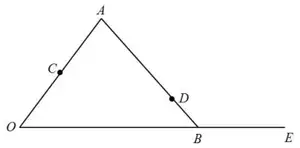 | M1 |
\(\overrightarrow{AD} = \dfrac{3}{4}(\mathbf{b} - \mathbf{a})\) or \(\overrightarrow{DA} = \dfrac{3}{4}(\mathbf{a} - \mathbf{b})\) or \(\overrightarrow{DB} = \dfrac{1}{4}(\mathbf{b} - \mathbf{a})\) or \(\overrightarrow{BD} = \dfrac{1}{4}(\mathbf{a} - \mathbf{b})\) | M1 |
\(\overrightarrow{CD} = \dfrac{1}{2}\mathbf{a} + \dfrac{3}{4}(\mathbf{b} - \mathbf{a}) \left(= \dfrac{3}{4}\mathbf{b} - \dfrac{1}{4}\mathbf{a}\right)\) or \(\overrightarrow{DE} = \dfrac{1}{4}(\mathbf{b} - \mathbf{a}) + \dfrac{1}{2}\mathbf{b} \left(= \dfrac{3}{4}\mathbf{b} - \dfrac{1}{4}\mathbf{a}\right)\) or \(\overrightarrow{CE} = -\dfrac{1}{2}\mathbf{a} + \mathbf{b} + \dfrac{1}{2}\mathbf{b} \left(= \dfrac{3}{2}\mathbf{b} - \dfrac{1}{2}\mathbf{a}\right)\) | M1 |
| M1 | |
| Correct simplified vectors for two of \(\overrightarrow{CD}\), \(\overrightarrow{DE}\), \(\overrightarrow{CE}\) with a correct explanation | A1 |
| (5) | |
| (5 marks) |
Notes
M1: Correct diagram (only points needed, condone missing vector labels) OR for finding \(\overrightarrow{AB}\) or \(\overrightarrow{BA}\) – may be seen as part of later working
M1: method to find \(\overrightarrow{AD}\) or \(\overrightarrow{DA}\) or \(\overrightarrow{DB}\) or \(\overrightarrow{BD}\) – may be seen as part of later working
M1: oe, method to find \(\overrightarrow{CD}\) or \(\overrightarrow{DE}\) or \(\overrightarrow{CE}\)
M1: A correct vector expression in terms of \(\mathbf{a}\) and \(\mathbf{b}\) for two of \(\overrightarrow{CD}\), \(\overrightarrow{DE}\), \(\overrightarrow{CE}\)
A1: A correct conclusion eg
\(\overrightarrow{CD} = \overrightarrow{DE}\) so \(CDE\) is a straight line
\(\overrightarrow{CE} = 2\overrightarrow{CD}\) so \(CDE\) is a straight line
\(\overrightarrow{CE} = 2\overrightarrow{DE}\) so \(CDE\) is a straight line