Question Bank › IGCSE Shape & Space › Vectors
Vectors Topic Angles (Including Parallel Lines) (0) Angles in Polygons (2) Constructions & Bearings (3) Circle Theorems (3) Volume & Surface Area (4) Prisms (4) 2D Area & Perimeter (3) Circles & Sectors (3) Similar Shapes (4) Transformations of Shapes (2) Vectors (4) Basic Trigonometry (6) Advanced Trigonometry (7) Pythagoras (4) Plans, Elevations & Nets (0) Current PowerPoint version
All specs Current spec All series June 2025 November 2024 Any marks 1 to 4 marks 5 to 8 marks 9+ marks
Questions Step through List
‹ Previous All questions Next ›
Higher June 2025 Paper 1 Q23
23
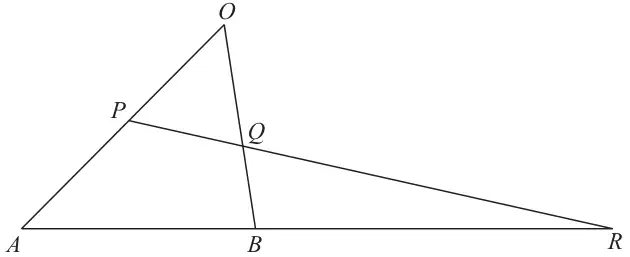
Diagram NOT accurately drawn
\(OAB\) is a triangle.
\(ABR\) and \(PQR\) are straight lines.
\(\overrightarrow{OA} = 12\mathbf{a}\) \(\overrightarrow{OB} = 8\mathbf{b}\)
(a) Express \(\overrightarrow{AB}\) in terms of \(\mathbf{a}\) and \(\mathbf{b}\) (1)
\(AB : BR = 1 : 2\) \(\overrightarrow{OQ} = n\mathbf{b}\)
(b) Use a vector method to find the value of \(n\) (4)
Mark scheme (a) Mark scheme (b)
Mark scheme (a) Scheme Marks \(-12\mathbf{a} + 8\mathbf{b}\) B1 (1)
Mark scheme (b) Scheme Marks \(\left(\overrightarrow{PR} =\right)6\mathbf{a} + 3\left(\text{``}{-12\mathbf{a} + 8\mathbf{b}}\text{''}\right)\left(= -30\mathbf{a} + 24\mathbf{b}\right)\) oe
or \(\left(\overrightarrow{RP} =\right) -3\left(\text{``}{-12\mathbf{a} + 8\mathbf{b}}\text{''}\right) - 6\mathbf{a}\left(= 30\mathbf{a} - 24\mathbf{b}\right)\)
M1 \(\left(\overrightarrow{PQ} =\right) -6\mathbf{a} + n\mathbf{b}\) oe eg \(\left(\overrightarrow{PQ} =\right) -6\mathbf{a} + m \times 8\mathbf{b}\)
or \(\left(\overrightarrow{OQ} =\right)\) 6a + \(k\)(“–30a + 24b ”) or \(\left(\overrightarrow{AQ} =\right) -12\mathbf{a} + n\mathbf{b}\)
M1 \(\overrightarrow{PQ} = \lambda \overrightarrow{PR}\) eg \(-6\mathbf{a} + n\mathbf{b} = \lambda\left(\text{``}{-30\mathbf{a} + 24\mathbf{b}}\text{''}\right)\)
or \(-6 = -30\lambda\) oe or \(\lambda = \dfrac{1}{5}\) oe
OR \(\mu \overrightarrow{PQ} = \overrightarrow{PR}\) eg \(\mu\left(-6\mathbf{a} + n\mathbf{b}\right) = \text{``}{-30\mathbf{a} + 24\mathbf{b}}\text{''}\)
or \(-6\mu = -30\) oe or \(\mu = 5\)
OR \(\overrightarrow{OQ} = \overrightarrow{OP} + k\overrightarrow{PR}\) eg \(n\)b = 6a + \(k\)(“–30a + 24b ”)
or 0 = 6 – 30\(k\) or \(k = \dfrac{1}{5}\) oe
OR \(\overrightarrow{AQ} = \overrightarrow{AR} + x\overrightarrow{RP}\) eg
\(-12\mathbf{a} + n\mathbf{b} = 3\left(\text{``}{-12\mathbf{a} + 8\mathbf{b}}\text{''}\right) + x\left(\text{``}{30\mathbf{a} - 24\mathbf{b}}\text{''}\right)\)
or \(-36 + 30x = -12\) or \(x = \dfrac{4}{5}\) oe
M1 Working required A1 (4) (5 marks)
Notes M1: for method to find \(\overrightarrow{PR}\) or \(\overrightarrow{RP}\), ft their \(\overrightarrow{AB}\)
M1: for method to find \(\overrightarrow{PQ}\) or \(\overrightarrow{OQ}\) or \(\overrightarrow{AQ}\)
M1: for setting up an equation to find the value of the unknown coefficient(s)
A1: oe eg \(\dfrac{24}{5}\), dep on M1
Higher June 2025 Paper 2R Q18
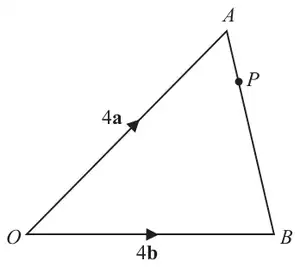
18 \(OAB\) is a triangle.
Diagram NOT accurately drawn
\(\overrightarrow{OA} = 4\mathbf{a}\)
\(\overrightarrow{OB} = 4\mathbf{b}\)
\(P\) is the point on \(AB\) such that \(AP : PB = 1 : 3\)
(a) Write down \(\overrightarrow{AB}\) in terms of \(\mathbf{a}\) and \(\mathbf{b}\) (1)
(b) Express \(\overrightarrow{OP}\) in terms of \(\mathbf{a}\) and \(\mathbf{b}\)(2)
Mark scheme (a) Mark scheme (b)
Mark scheme (a) Scheme Marks \(-4\mathbf{a} + 4\mathbf{b}\) B1 (1)
Notes B1: oe eg \(4(\mathbf{b} - \mathbf{a})\)
Mark scheme (b) Scheme Marks \(4\mathbf{a} + \dfrac{1}{4}(-4\mathbf{a} + 4\mathbf{b})\) oe or \(4\mathbf{a} + \dfrac{1}{4}[\overrightarrow{AB}]\)
or
\(4\mathbf{b} - \dfrac{3}{4}(-4\mathbf{a} + 4\mathbf{b})\) oe or \(4\mathbf{b} - \dfrac{3}{4}[\overrightarrow{AB}]\)
M1ft Correct answer only scores full marks (unless from obviously incorrect working) A1 (2) (3 marks)
Notes M1ft: for a correct expression ft their (a)
A1: allow \(\mathbf{b} + 3\mathbf{a}\)
Higher November 2024 Paper 1 Q24
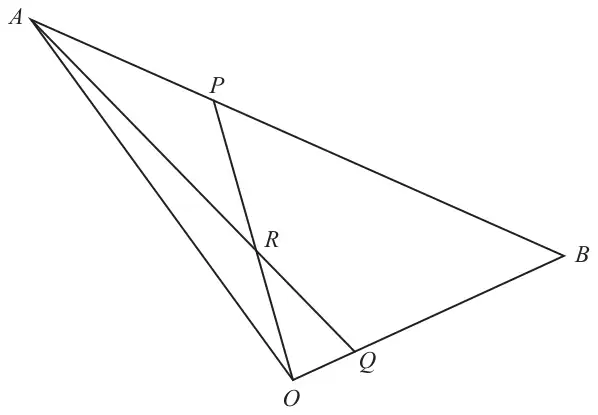
24 \(OAB\) is a triangle.
Diagram NOT accurately drawn
\(\overrightarrow{OA} = 10\mathbf{a}\) \(\overrightarrow{OB} = 10\mathbf{b}\)
\(ARQ\) and \(ORP\) are straight lines.
\(\overrightarrow{AP} = \dfrac{1}{4}\overrightarrow{AB}\) and \(\overrightarrow{OQ} = \dfrac{1}{5}\overrightarrow{OB}\)
Write the following vectors in terms of \(\mathbf{a}\) and \(\mathbf{b}\)
(i) \(\overrightarrow{AQ}\) (1)
(ii) \(\overrightarrow{OP}\) (1)
(iii) \(\overrightarrow{OR}\) (4)
Mark scheme (i) Mark scheme (ii) Mark scheme (iii)
Mark scheme (i) Scheme Marks \(-10\mathbf{a} + 2\mathbf{b}\) B1 (1)
Notes B1: or \(2\mathbf{b} - 10\mathbf{a}\)
Mark scheme (ii) Scheme Marks \(\dfrac{15}{2}\mathbf{a} + \dfrac{5}{2}\mathbf{b}\) B1 (1)
Notes B1: oe eg \(7\dfrac{1}{2}\mathbf{a} + 2\dfrac{1}{2}\mathbf{b}\) or \(7.5\mathbf{a} + 2.5\mathbf{b}\)
Must be simplified
Mark scheme (iii) Scheme Marks eg
\(\left(\overrightarrow{OR} = \text{“}k\text{”}\overrightarrow{OP} =\right)\;\text{“}k\text{”}\left(\text{“}\dfrac{15}{2}\mathbf{a} + \dfrac{5}{2}\mathbf{b}\text{”}\right)\) oe
M1 eg
\(\left(\overrightarrow{OR} = \overrightarrow{OA} + \overrightarrow{AR} =\right)\;10\mathbf{a} + \text{“}\lambda\text{”}(\text{“}{-10}\mathbf{a} + 2\mathbf{b}\text{”})\;\left(= (10 - 10\text{“}\lambda\text{”})\mathbf{a} + 2\text{“}\lambda\text{”}\mathbf{b}\right)\) oe
or
\(\left(\overrightarrow{OR} = \overrightarrow{OQ} + \overrightarrow{QR} =\right)\;2\mathbf{b} - \text{“}\mu\text{”}(\text{“}{-10}\mathbf{a} + 2\mathbf{b}\text{”})\;\left(= 10\text{“}\mu\text{”}\mathbf{a} + (2 - 2\text{“}\mu\text{”})\mathbf{b}\right)\) oe
M1 eg
\(\dfrac{15}{2}\text{“}k\text{”} = 10 - 10\text{“}\lambda\text{”}\) oe and \(\dfrac{5}{2}\text{“}k\text{”} = 2\text{“}\lambda\text{”}\) oe or \(\text{“}\lambda\text{”} = \dfrac{5}{8}\) oe or
\(\dfrac{5}{2}\text{“}k\text{”} = 2 - 2\text{“}\mu\text{”}\) and \(\dfrac{15}{2}\text{“}k\text{”} = 10\text{“}\mu\text{”}\) oe or “\(k\)” = 0.5 oe
M1 Correct answer scores full marks (unless from obvious incorrect working)
Answer: \(\dfrac{15}{4}\mathbf{a} + \dfrac{5}{4}\mathbf{b}\)
A1 (4) (6 marks)
Notes M1: ft from part (ii) for \(\overrightarrow{OR}\)
M1: ft from part (i) for another path for \(\overrightarrow{OR}\)
M1: for correct equations
A1: oe eg \(3\dfrac{3}{4}\mathbf{a} + 1\dfrac{1}{4}\mathbf{b}\) or \(3.75\mathbf{a} + 1.25\mathbf{b}\)
Higher November 2024 Paper 2 Q17
17 Here are two vectors.
\(\overrightarrow{FG} = \begin{pmatrix} -5 \\ 2 \end{pmatrix}\) \(\overrightarrow{HG} = \begin{pmatrix} 4 \\ 14 \end{pmatrix}\)
Calculate the magnitude of the vector \(\overrightarrow{HF}\)
(3)
Mark scheme
Mark scheme Scheme Marks \((\overrightarrow{HF} =)\;\begin{pmatrix} 4 \\ 14 \end{pmatrix} + \begin{pmatrix} 5 \\ -2 \end{pmatrix}\left[= \begin{pmatrix} 9 \\ 12 \end{pmatrix}\right]\) or \(\begin{pmatrix} 4 \\ 14 \end{pmatrix} - \begin{pmatrix} -5 \\ 2 \end{pmatrix}\left[= \begin{pmatrix} 9 \\ 12 \end{pmatrix}\right]\) oe
\((\overrightarrow{FH} =)\;\begin{pmatrix} -5 \\ 2 \end{pmatrix} + \begin{pmatrix} -4 \\ -14 \end{pmatrix}\left[= \begin{pmatrix} -9 \\ -12 \end{pmatrix}\right]\) or \(\begin{pmatrix} -5 \\ 2 \end{pmatrix} - \begin{pmatrix} 4 \\ 14 \end{pmatrix}\left[= \begin{pmatrix} -9 \\ -12 \end{pmatrix}\right]\)
oe
M1 \(\sqrt{\text{``}{9}\text{''}^2 + \text{``}{12}\text{''}^2}\) or \(\sqrt{(\text{``}{-9}\text{''})^2 + (\text{``}{-12}\text{''})^2}\)
Allow a complete method using their values for \(\overrightarrow{HF}\) or \(\overrightarrow{FH}\)
Provided it is from \(\begin{pmatrix} \pm 4 \\ \pm 14 \end{pmatrix} - \begin{pmatrix} \pm 5 \\ \pm 2 \end{pmatrix}\)
M1indep Correct answer scores full marks (unless from obvious incorrect working) A1 (3) (3 marks)
Notes M1: a correct calculation for \(\overrightarrow{HF}\) or \(\overrightarrow{FH}\)i + 12j
M1indep: Allow their \(\overrightarrow{HF}\) or \(\overrightarrow{FH}\) provided it is from \(\begin{pmatrix} \pm 4 \\ \pm 14 \end{pmatrix} - \begin{pmatrix} \pm 5 \\ \pm 2 \end{pmatrix}\) allowing any sign error
A1: from fully correct figuresnot gain this accuracy mark
No questions match these filters.