Question Bank › IGCSE Shape & Space › Prisms
Prisms Topic Angles (Including Parallel Lines) (0) Angles in Polygons (2) Constructions & Bearings (3) Circle Theorems (3) Volume & Surface Area (4) Prisms (4) 2D Area & Perimeter (3) Circles & Sectors (3) Similar Shapes (4) Transformations of Shapes (2) Vectors (4) Basic Trigonometry (6) Advanced Trigonometry (7) Pythagoras (4) Plans, Elevations & Nets (0) Current PowerPoint version
All specs Current spec All series June 2025 November 2024 Any marks 1 to 4 marks 5 to 8 marks 9+ marks
Questions Step through List
‹ Previous All questions Next ›
Higher June 2025 Paper 2 Q21
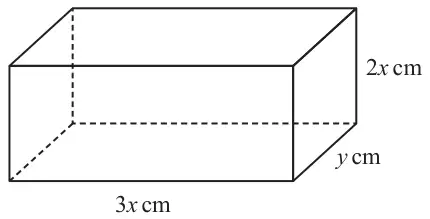
21 The diagram shows a cuboid.
Diagram NOT accurately drawn
The cuboid measures \(3x\) cm by \(2x\) cm by \(y\) cm
The volume of the cuboid is 1014 cm3 2
Show that \(A = 12x^2 + \dfrac{1690}{x}\)
You must show all the stages of your working.
(3)
Mark scheme
Mark scheme Scheme Marks \(3x \times 2x \times y = 1014\) oe or M1 \(2 \times 3x \times y + 2 \times 2x \times y + 2 \times 3x \times 2x\) oe or M1 Using \(y = \dfrac{1014}{6x^2}\left(= \dfrac{169}{x^2}\right)\) in formula for surface area to obtain correct expression
eg
(SA =) \(2 \times 5x \times \dfrac{169}{x^2} + 2 \times 6x^2 = 12x^2 + \dfrac{1690}{x}\)
or equating their surface area equations
eg \(10xy + 12x^2 = 12x^2 + \dfrac{1690}{x}\) leading to \(x^2y = 169\) oe
Working required
Answer: Shown
A1 (3) (3 marks)
Notes M1: for an equation for volume in terms of \(x\) and \(y\)
M1: (indep) for a correct expression for the surface area
NB May not explicitly see the surface area expression in terms of \(y\) eg
\(2 \times 3x \times \dfrac{169}{x^2} + 2 \times 2x \times \dfrac{169}{x^2} + 2 \times 3x \times 2x\) oe
May be fully substituted using \(y = \dfrac{169}{x^2}\) oe
A1: dep on M2
Higher June 2025 Paper 1R Q10
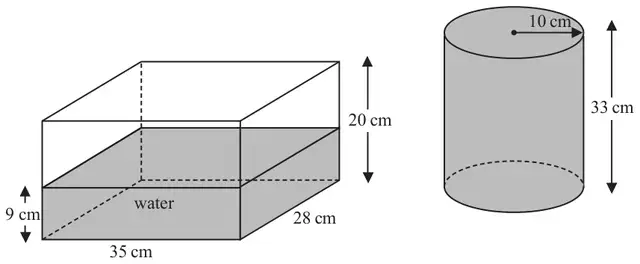
10 The diagram shows two water containers.
Diagram NOT accurately drawn
The cuboid measures 35 cm by 28 cm by 20 cm
The cylinder has a radius of 10 cm and a height of 33 cm
Izzy is going to pour all the water from the cylinder into the cuboid.
Show that the cuboid will not be completely full of water.
(3)
Mark scheme
Mark scheme Scheme Marks (volume of water =) \(9 \times 35 \times 28 (= 8820)\)or (total volume of cuboid =) \(20 \times 35 \times 28 (= 19600)\)or (volume of space =) \((20 - 9) \times 35 \times 28 (= 10780)\) M1 \(\pi \times 10^2 \times 33\) (= \(3300\pi\) or 10367(.25...)) oe M1 (total volume of water =) “8820” + “10367(.25...)” (= 19187(.25...))Working required A1 (3) (3 marks)
Notes M1: for a method to find a relevant volume for the cuboid
M1: (indep) for a method to find the volume of the cylinder, accept a volume in the range 10362 to 10368.6
Allow 3.14… or \(\dfrac{22}{7}\) for \(\pi\)
A1: correct workings with accurate figures
Value 1 Value 2 10780 10367(.25…) 19600 19187(.25…) 8820 9232(.74…) 412(.74…) or 413 none needed
Higher June 2025 Paper 1 Q7
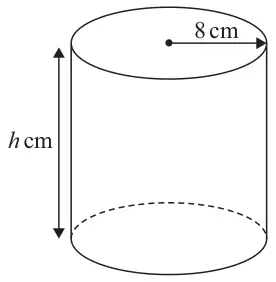
7 Here is a solid cylinder.
Diagram NOT accurately drawn
The radius of the cylinder is 8 cm
The volume of the cylinder is 3892 cm3
Work out the value of \(h\)
(3)
Mark scheme
Mark scheme Scheme Marks \(3892 = \pi \times 8^2 \times h\) or \(\pi \times 8^2 \left(= 64\pi = 201\ldots\right)\) M1 \((h =)\dfrac{3892}{\pi \times 8^2}\) oe eg 3892 ÷ 64 = 60.8… and 60.8… ÷ π M1 Correct answer scores full marks (unless from obvious incorrect working) A1 (3) (3 marks)
Notes M1: allow use of 3.14… or \(\dfrac{22}{7}\) for \(\pi\)
M1: allow use of 3.14… or \(\dfrac{22}{7}\) for \(\pi\)
A1: allow 19.3 – 19.4
Higher November 2024 Paper 2 Q6
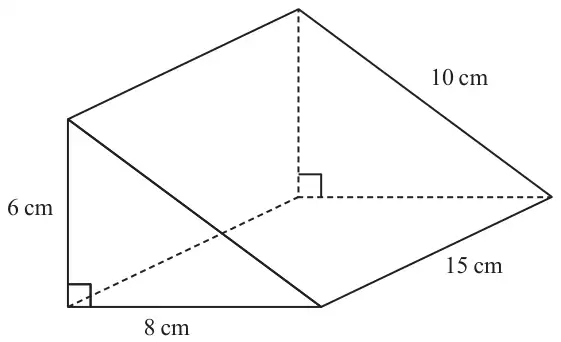
6 The diagram shows a solid triangular prism.
Diagram NOT accurately drawn
Work out the total surface area of the triangular prism.
(3)
Mark scheme
Mark scheme Scheme Marks 8 × 6 (= 48) M1 0.5 × 8 × 6 (= 24 ) (× 2 (= 48) ) oe M1 Correct answer scores full marks (unless from obvious incorrect working) A1 (3) (3 marks)
Notes M1: For a correct method to find the areas of 2 different faces (ie not 2 triangles)
M1: for adding together 4 or 5 values for area (condone 48 as 1 or 2 areas) at least 3 of which are from a correct method
A1: cao
No questions match these filters.