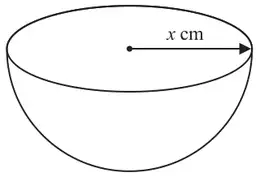
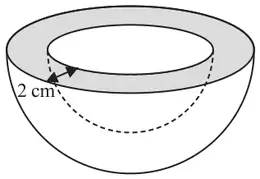
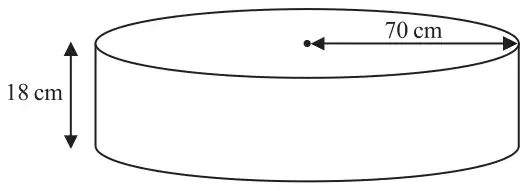
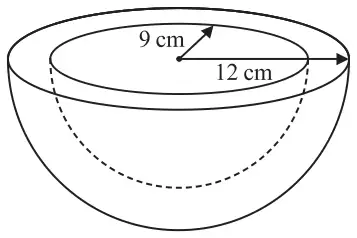
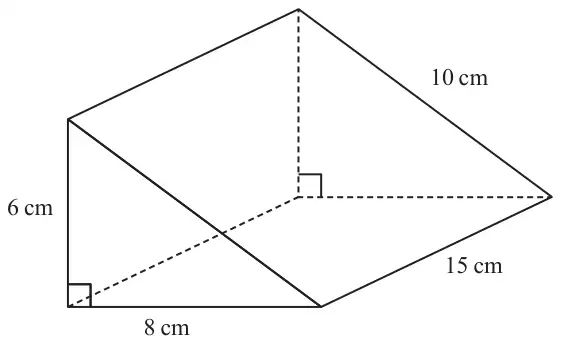
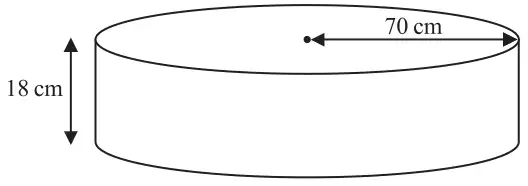
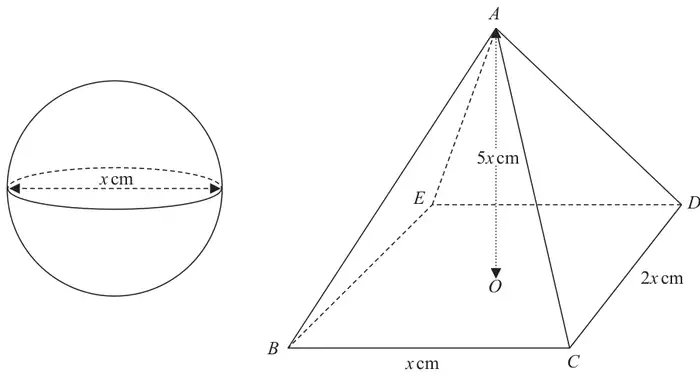
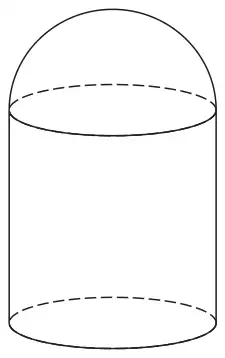
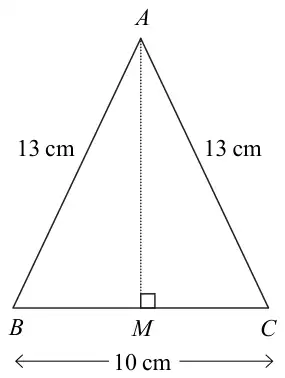
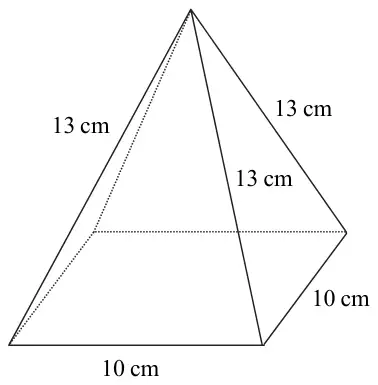
Correct answer only scores full marks (unless from obviously incorrect working) Answer: \(1684\pi\)
A1
(5)
(5 marks)
Notes
M1: oe for forming a correct equation; allow use of any letter
M1: for a correct method to find the radius of the hemisphere
M1ft: for a method to find the area of the top of the bowl or the total area of the two curved surfaces of the bowl
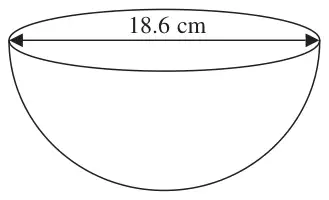
where [21] is what they believe to be radius of the hemisphere
M1ft: ft their [21] for a complete method
A1: cao
SCB4 for \(2028\pi\) (use of 23 as the outer radius)
M2 for use of formula for total surface area of hemispherical shell in a complete method, eg \(3\pi([21])^2 + \pi([21] - 2)^2\) oe If not M2, allow M1 for this formula used with omission of \(\pi\) eg \(3([21])^2 + ([21] - 2)^2\)
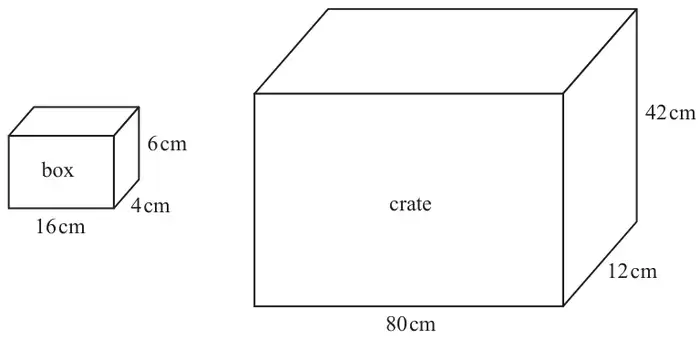
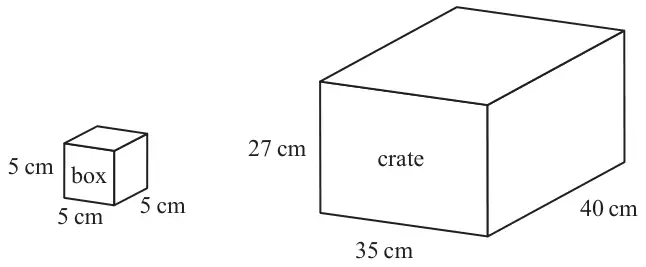
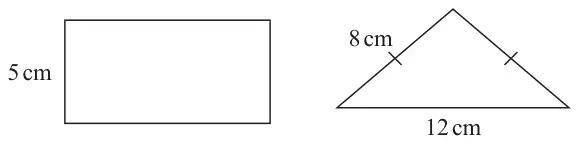
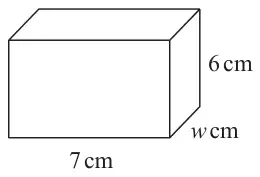
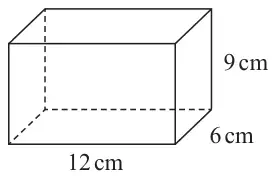
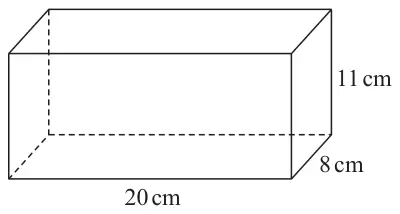
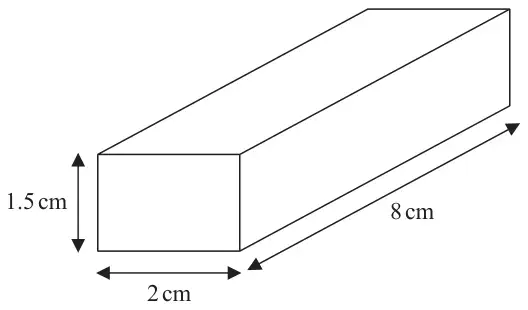
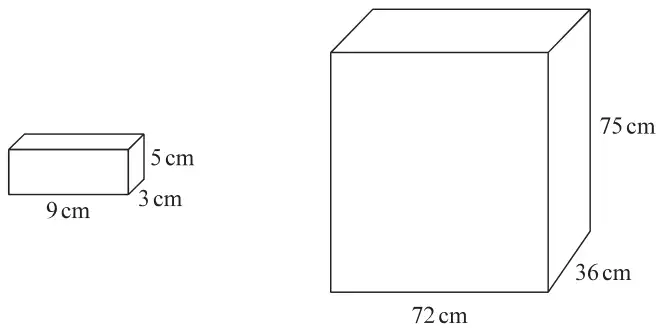
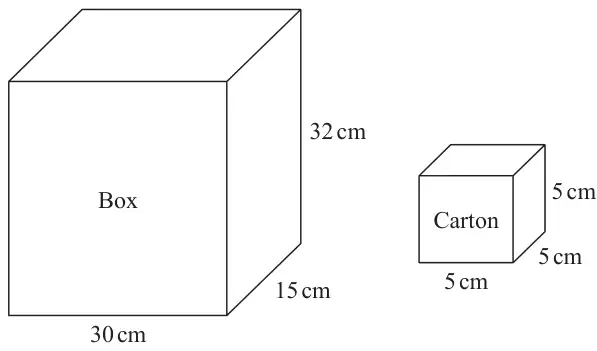
Each box is a cuboid, 16 cm by 4 cm by 6 cm The crate is a cuboid, 80 cm by 12 cm by 42 cm
Work out the greatest number of boxes that can be put into the crate.
(3)
Mark scheme
Scheme
Marks
eg 80 × 12 × 42 (= 40 320)
or
16 × 4 × 6 (= 384)
eg 42 ÷ 6 (= 7) or 12 ÷ 4 (= 3) or 80 ÷ 16 (= 5) or \(\dfrac{80 \times 12}{16 \times 4}\) (= 15) or \(\dfrac{80 \times 42}{16 \times 6}\) (= 35) or \(\dfrac{42 \times 12}{6 \times 4}\) (= 21)
M1
“40 320” ÷ “384”
eg “7” × “3” × “5” or “15” × “7” or “35” × “3” or “21” × “5”
M1
Correct answer scores full marks (unless from obvious incorrect working) Answer: 105
A1
(3)
(3 marks)
Notes
M1: for method to find the volume of the crate or the box or method to find the number of boxes along one dimension of the crate or for dividing the areas of corresponding faces
M1: for a complete method to find the number of boxes
Correct answer scores full marks (unless from obvious incorrect working) Answer: 408
A1
(3)
(3 marks)
Notes
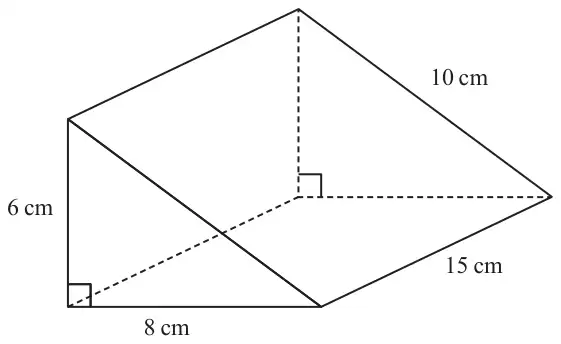
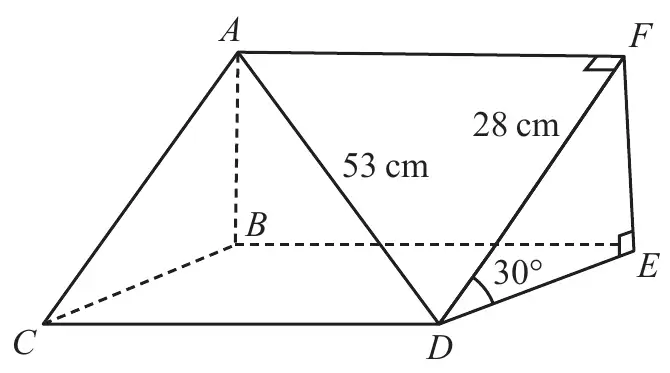
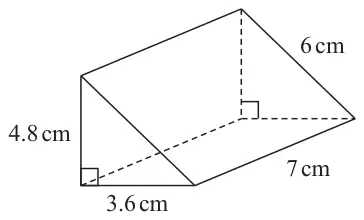
M1: For a correct method to find the areas of 2 different faces (ie not 2 triangles) allow 8 × 6 as one area
(allow if included with incorrect areas for this mark)
M1: for adding together 4 or 5 values for area, at least 3 of which are from a correct method
NB: (6 + 8 + 10) × 15 (= 360) is 3 faces but only award this if clearly not intended to be the volume – eg by the addition of the area of a triangular end.
A1: cao SCB2 for an answer of 456 if no other marks awarded
(measurements with intention to add for the 2nd M mark)
Surface area = “120” + “90” + “150” + “24” + “24”
[allow “120” + “90” + “150” + “48” + “48”]
M1
Correct answer scores full marks (unless from obvious incorrect working) Answer: 408
A1
(3)
(3 marks)
Notes
M1: For a correct method to find the areas of 2 different faces (ie not 2 triangles) allow 8 × 6 as one area
(allow with incorrect areas for this mark)
M1: for adding together 4 or 5 values for area (condone 48 as 1 or 2 areas) at least 3 of which are from a correct method
NB: (6 + 8 + 10) × 15 (sum must be seen) is 3 faces but only award this if clearly not intended to be the volume – eg by the addition of the area of a triangular end.
A1: cao SCB2 for an answer of 456 if no other marks awarded
Correct answer scores full marks (unless from obvious incorrect working) Answer: 2800
A1
(4)
(4 marks)
Notes
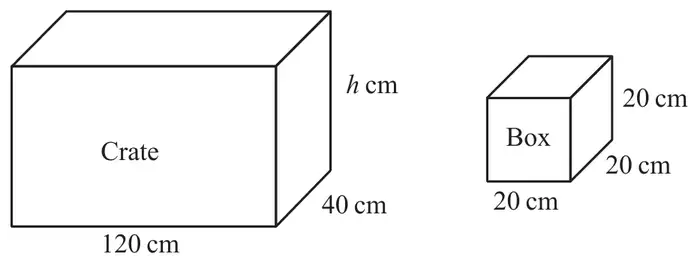
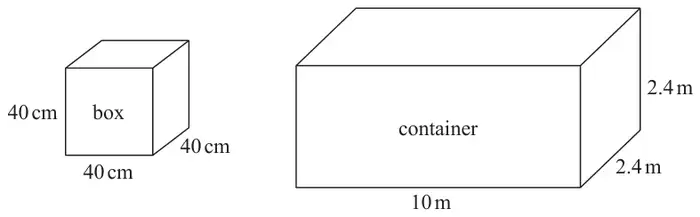
M1: for finding the number of boxes that fit along a side of the crate or the volume of the box or the volume taken up by the boxes
M1: for finding the total number of boxes that will fit in the crate and the volume of the box or the number of cm remaining without a box or the volume of the crate and the total volume of the boxes that fit or the volume of space left at the top in terms of number of boxes
M1: for a fully correct method to find the volume of space left
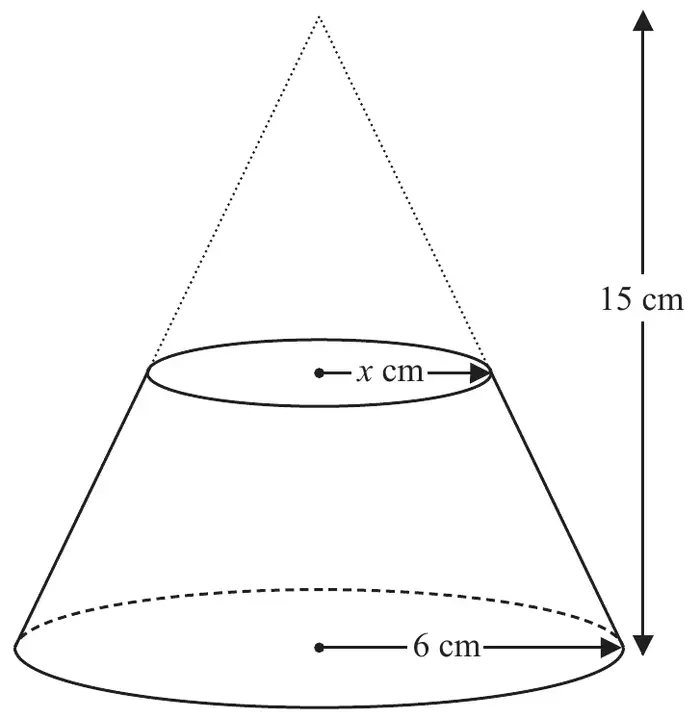
\(\dfrac{6}{15} = \dfrac{x}{\text{height}}\) or height \(= \dfrac{15}{6}x = \dfrac{5}{2}x\) oe or (vol small cone =) \(\left(\dfrac{x}{6}\right)^3 V\) or \(\left(\dfrac{x}{6}\right)^3 \times 180\pi\) or (vol small cone =) \(\text{“}180\pi\text{”} - \dfrac{4212}{25}\pi\;\left(= \dfrac{288}{25}\pi = 11.52\pi = 36.19...\right)\)
M1
eg \(\dfrac{1}{3}\pi x^2 \times \dfrac{5}{2}x\;\left(= \dfrac{5}{6}\pi x^3\right)\) oe or linear SF \(= \sqrt[3]{\dfrac{180}{288/25}}\;(= 2.5)\) oe or \(\sqrt[3]{\dfrac{288/25}{180}}\;(= 0.4)\) oe
M1
eg \(\dfrac{1}{3}\pi \times 6^2 \times 15 - \dfrac{1}{3}\pi x^2 \times \dfrac{5}{2}x = \dfrac{4212}{25}\pi\) or \(180 - \dfrac{5}{6}x^3 = \dfrac{4212}{25}\) oe or \(\left(1 - \left(\dfrac{x}{6}\right)^3\right) \times 180 = \dfrac{4212}{25}\) oe or \(x = \dfrac{6}{2.5}\) or \(h = \dfrac{15}{2.5} = 6\) and \(\dfrac{1}{3}\pi x^2 \times 6 = \dfrac{288}{25}\pi\;(= 11.52\pi)\)
M1
Working required Answer: 2.4
A1
(5 marks)
Notes
M1: (first) a correct expression for volume of large cone
M1: (second) working with the scale factor used or formula for volume of small cone (where \(V\) = vol of large cone) (ft their vol of large cone dep on a correct method)
M1: (third) dep on previous M1: correct formula for volume of small cone in terms of \(x\) only, could be seen as part of an equation and \(\pi\) could be cancelled out, or correct calculation for linear SF of \(v\) to \(V\). 2.5 and 0.4 must be from correct working seen to award the mark (not from height/radius)
M1: (fourth) dep on M3: a correct equation in \(x\) (if using 2.5 this must come from a correct method)
24 The surface area of sphere A is nine times the surface area of sphere B The difference between the volume of sphere A and the volume of sphere B is \(117\pi\) cm3
Find the radius of the smaller sphere. Show your working clearly.
(5)
Mark scheme
Scheme
Marks
eg \(4\pi R^2 = 9 \times 4\pi r^2\) oe or
M1
\(R = 3r\) oe or
1:3 or 3:1 or 3 or \(\dfrac{1}{3}\)
M1
eg
\(\dfrac{4}{3}\pi(3r)^3 - \dfrac{4}{3}\pi r^3 = 117\pi\) oe or
\(\dfrac{4}{3}\pi r^3 - \dfrac{4}{3}\pi\left(\dfrac{1}{3}r\right)^3 = 117\pi\) or
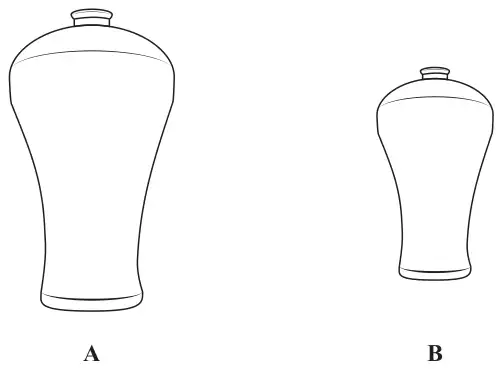
surface area of vase B \(= \dfrac{25}{64} \times\) surface area of vase A
and that
volume of vase A – volume of vase B = 541.8 cm3
Calculate the volume of vase B
(4)
Mark scheme
Scheme
Marks
eg \(\sqrt{\dfrac{25}{64}}\left(= \dfrac{5}{8} = 0.625\right)\) or \(\sqrt{\dfrac{64}{25}}\left(= \dfrac{8}{5} = 1.6\right)\) or
\(\sqrt{25} : \sqrt{64}\;(5:8)\) or \(\sqrt{64} : \sqrt{25}\;(8:5)\) or
\(\dfrac{(\sqrt{25})^3}{(\sqrt{64})^3} = \left(\dfrac{125}{512} = 0.244140625\right)\) oe or \(\dfrac{512}{125} = 4.096\)
\(\dfrac{25^3}{64^3} = \dfrac{(\text{vol of }\mathbf{B})^2}{(\text{vol of }\mathbf{B} + 541.8)^2}\) or \(\dfrac{25}{64} = \dfrac{(\text{vol of }\mathbf{B})^{\frac{2}{3}}}{(\text{vol of }\mathbf{B} + 541.8)^{\frac{2}{3}}}\) oe
or eg \(\mathbf{A}\left(1 - \dfrac{125}{512}\right) = 541.8\) or \(\dfrac{387}{512}\mathbf{A} = 541.8\)
\((8^3)k - (5^3)k\;(= 387k) = 541.8\)
or eg \((k =)\;\dfrac{541.8}{387}\left(= \dfrac{7}{5}\right)\)
M1
eg \((\mathbf{B})\;541.8 \div \text{``}{\dfrac{387}{125}}\text{''}\) or \(541.8 \div \text{``}{3.096}\text{''}\) or eg \(125 \times \text{``}{\dfrac{7}{5}}\text{''}\) or
Correct answer scores full marks (unless from obvious incorrect working) Answer: 175
A1
(4)
(4 marks)
Notes
M1: for a correct scale factor for length – may be given as a fraction or decimal or ratio or a correct scale factor for volume given as a fraction or decimal or ratio or a correct equation for the volume of vase B
M1: For a correct equation for the volume of B or a correct equation for the volume of A
M1: For a completely correct method to find the volume of vase B or vase A
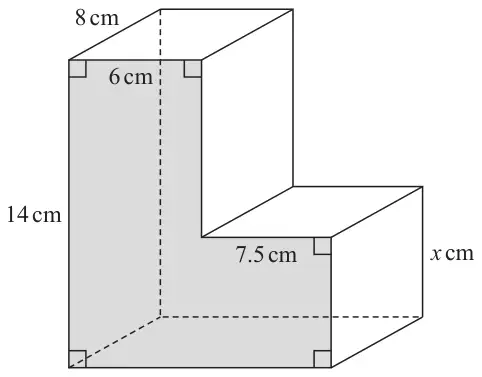
eg 6 × 14 (= 84) or 13.5 × 14 (= 189) or 7.5 × \(x\) (= 7.5\(x\)) or 924 ÷ 8 (= 115.5) or any correct calculation that leads to an area linked to the cross section of the shapeor eg 14 × 6 × 8 ( = 672) or 7.5 × \(x\) × 8 ( = 60\(x\)) or 13.5 × 14 × 8 ( = 1512) any correct calculation that leads to a volume linked to the 3D shape
M1
\(\dfrac{924}{8} - 84\;(= 115.5 - 84 = 31.5)\) oe
or 6 × 14 + 7.5\(x\) = “115.5” oeor
\(\dfrac{924 - \text{“}672\text{”}}{8}\left(= \dfrac{252}{8} = 31.5\right)\) or
eg \(\left(\dfrac{924}{8} - \text{“}84\text{”}\right) \div 7.5\;(= 31.5 \div 7.5)\) or
\(\dfrac{\text{“}115.5\text{”} - \text{“}84\text{”}}{7.5}\) oe or
“33.6” ÷ 8
M1
Correct answer scores full marks (unless from obvious incorrect working) Answer: 4.2
A1
(4)
(4 marks)
Notes
M1: a correct calculation linked to the area of the cross section of the shape – can be numerical or algebraic and maybe part of another calculation. or a correct calculation linked to the volume of the shape – can be numerical or algebraic and may be part of another calculation
M1: a calculation that leads to a value one step away from the value of \(x\) eg a calculation leading to 31.5 (one step remains which is to divide by 7.5) or a correct equation in \(x\)
M1: a fully correct calculation that leads to the value for \(x\)
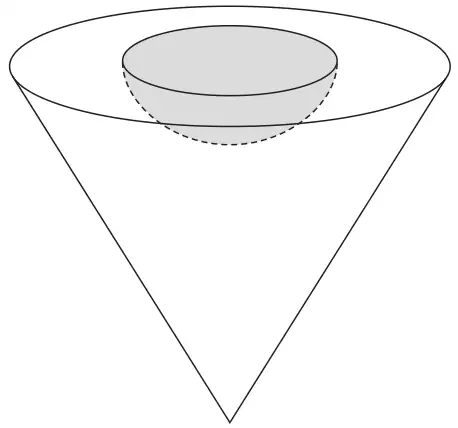
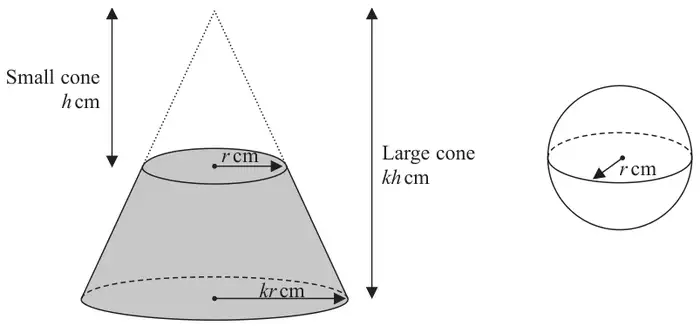
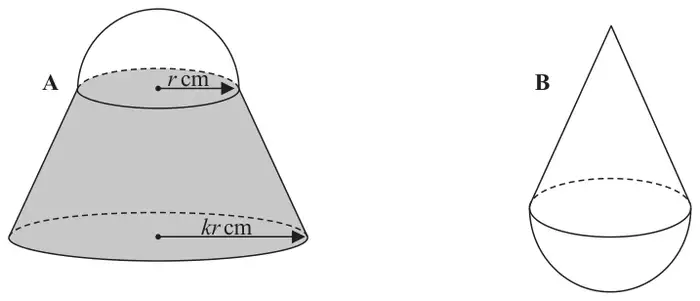
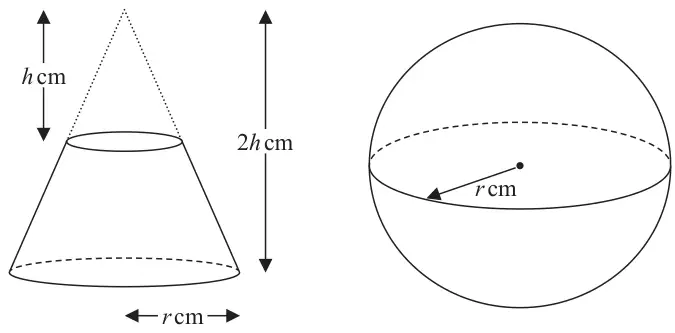
24 The diagram shows a frustum of a cone, and a sphere.
The frustum, shown shaded in the diagram, is made by removing the small cone from the large cone. The small cone and the large cone are similar.
Diagram NOT accurately drawn
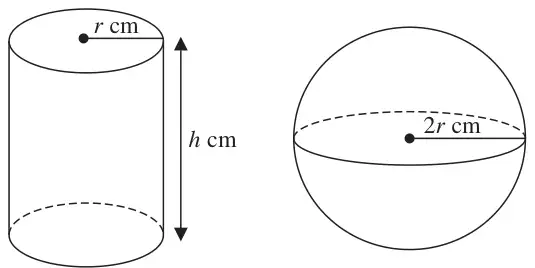
The height of the small cone is \(h\) cm and the radius of the base of the small cone is \(r\) cm. The height of the large cone is \(kh\) cm and the radius of the base of the large cone is \(kr\) cm. The radius of the sphere is \(r\) cm.
The sphere is divided into two hemispheres, each of radius \(r\) cm.
Solid A is formed by joining one of the hemispheres to the frustum. The plane face of the hemisphere coincides with the upper plane face of the frustum, as shown in the diagram below.
Solid B is formed by joining the other hemisphere to the small cone that was removed from the large cone. The plane face of the hemisphere coincides with the plane face of the base of the small cone, as shown in the diagram below.
Diagram NOT accurately drawn
The volume of solid A is 6 times the volume of solid B.
Given that \(k \gt \sqrt[3]{7}\) find an expression for \(h\) in terms of \(k\) and \(r\)
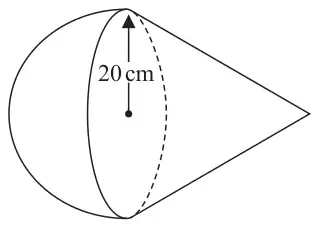
The circular plane face of the hemisphere coincides with the circular base of the cone. The radius of the hemisphere and the radius of the circular base of the cone are both 20 cm.
The curved surface area of the cone is \(580\pi\) cm2
‘288’ + 2 × ‘\(72\sqrt{26}\)’ + 2 × ‘\(72\sqrt{101}\)’ or
‘288’ + 2 × ‘367.129’… + 2 × ‘723.59…’ oe
M1
Correct answer scores full marks (unless from obvious incorrect working) Answer: 2469
A1
(6)
(6 marks)
Notes
M1: for using the formula for the volume of a sphere correctly and equating it to \(288\pi\)
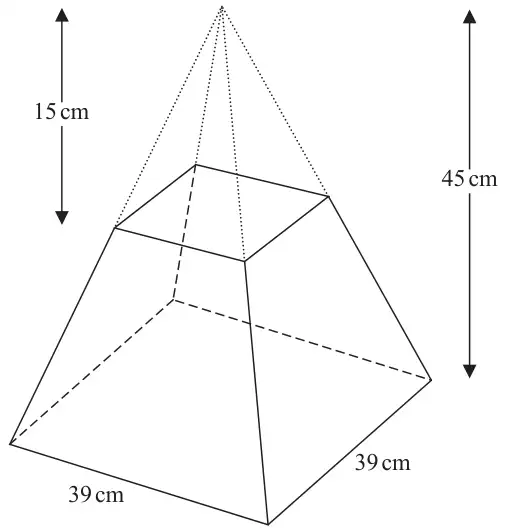
M1: (dep on first M1 and using their value for \(x\)) for using Pythagoras to find the perp height of faces CAD or BAE or a correct method to find angle CAD or BAE
M1: (dep on first M1 and using their value for \(x\)) for using Pythagoras to find the perp height of faces ABC or AED or a correct method to find angle BAC or DAE
M1: (dep on first M1 using their value for \(x\) and correct working for heights of each triangle) for working out the total surface area of the pyramid
M1: Allow use of 3.14... or \(\dfrac{22}{7}\) for \(\pi\) and use of 226... for \(72\pi\)
M1: method to isolate \(h\) (may be seen in several stages)
M1: method to find the area of the two circles or curved surface area – use of their \(h\), dep on M1 (NB may get this mark for area of 2 circles with no previous marks awarded)
M1: complete method to find the total surface area ft their \(h\) dep on 1st M1, including intention to add, to find the total surface area
Correct answer scores full marks (unless from obvious incorrect working) Answer: 207
A1
(5)
(5 marks)
Notes
M1: Allow use of 3.14... or \(\dfrac{22}{7}\) for \(\pi\) and use of 226... for \(72\pi\)
M1: method to isolate \(h\) (may be seen in several stages)
M1: method to find the area of the two circles or curved surface area – use of their \(h\), dep on 1st M1 (NB may get this mark for total area of 2 circles with no previous marks awarded)
M1: method to find total surface area ft their \(h\) dep on 1st M1, including intention to add, to find the total surface area
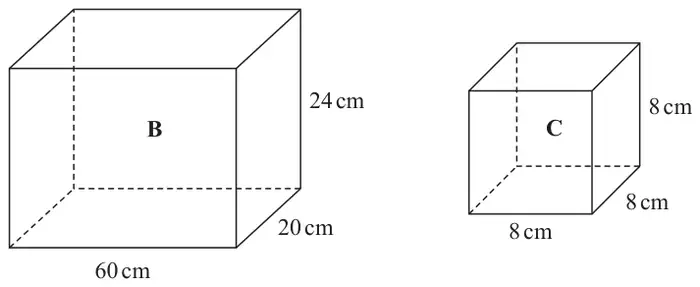
Bricks needed in 1 crate = 5700 ÷ 4 (= 1425) Max no: of bricks in 1 crate = 8 × 12 × 15 (= 1440) or 194400 ÷ 135 (= 1440)
M3
Yes as 777600 > 769500 or Yes as 1440 > 1425
A1
(4)
(4 marks)
Notes
M3: for calculations leading to any 3 of 135, 769500, 194400, 777600, 1425 or 1440 M2 for any 2 of the above M1 for any 1 of the above NB: sight of 769500 implies 135 and sight of 777600 implies 194400
A1: Comparing 777600 with 769500 or Comparing 1440 with 1425 NB. To get A1 they have to state that there is enough room for the bricks or “Yes”) and justify this by referring explicitly to 2 values e.g 777600 – 769500 (= 8100)
Alternative scheme: max number of bricks in 4 crates v 5700
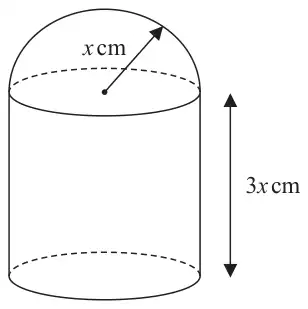
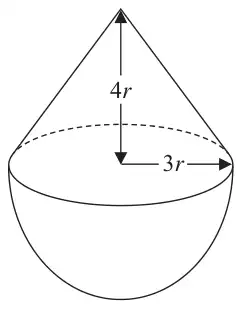
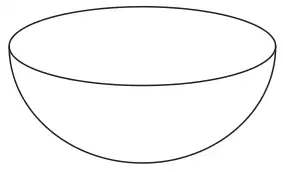
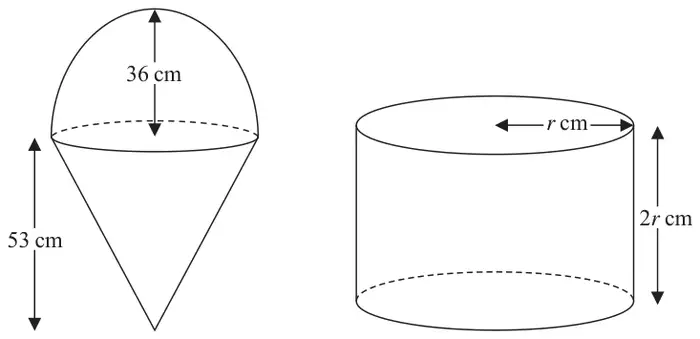
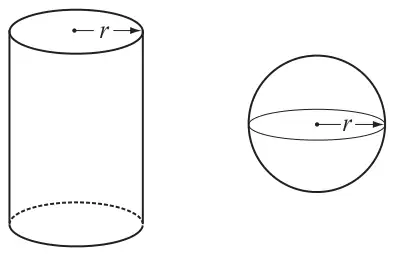
15 The total surface area of a solid hemisphere is equal to the curved surface area of a cylinder. The radius of the hemisphere is \(r\) cm. The radius of the cylinder is twice the radius of the hemisphere. Given that
volume of hemisphere : volume of cylinder = 1 : \(m\)
M1: for use of, for example, \(r\) and \(2r\) in an equation condone omission of flat surface area
A1: for a correct expression for either \(r\) or \(h\)
M1: dep on award of first M1 ft for candidate’s expression for \(r\) or \(h\) for correct expressions for volume of hemisphere and volume of cylinder; both in terms of either \(r\) or \(h\)
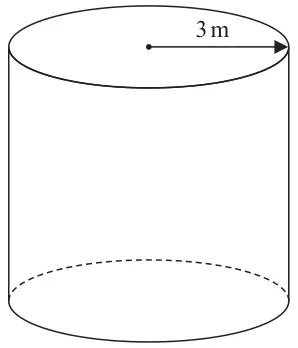
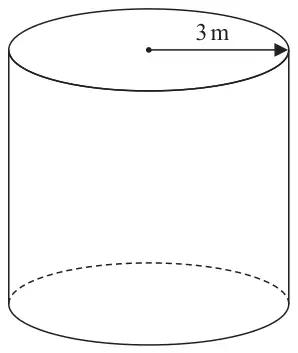
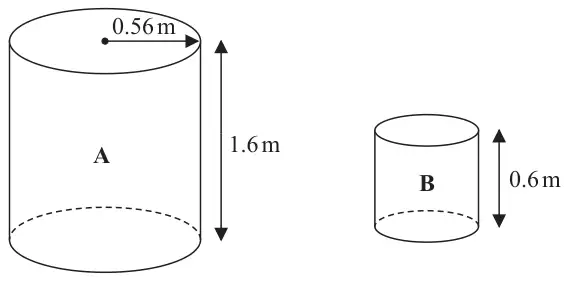
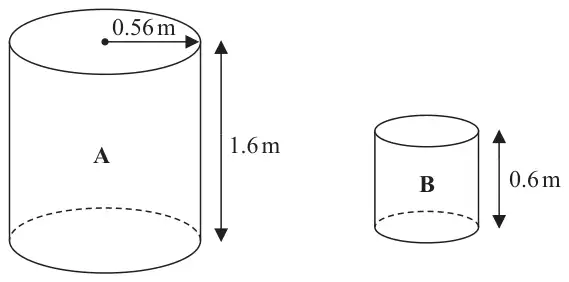
(a) Work out the curved surface area of cylinder A. Give your answer in m2 correct to 3 significant figures. (2)
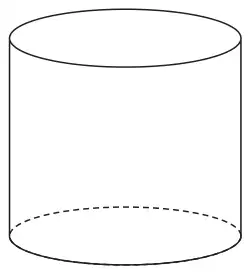
Cylinder B is mathematically similar to cylinder A. The height of cylinder B is 0.6 m.
(b) Work out the radius of cylinder B. (2)
Mark scheme (a)
Scheme
Marks
\(2 \times \pi \times 0.56 \times 1.6\)
M1
5.63
A1
(2)
Notes
M1: Award even if part of a calculation including 1 or 2 circles
A1: awrt 5.63
Mark scheme (b)
Scheme
Marks
\(\dfrac{0.6}{1.6}\) (=0.375) or \(\dfrac{1.6}{0.6} \left(= \dfrac{8}{3} = 2.\dot{6}\right)\) or
\(\dfrac{r}{0.56} = \dfrac{0.6}{1.6}\) or \((r =) \dfrac{0.56 \times 0.6}{1.6}\) or \(0.56 \div 2.\dot{6}\) oe
M1
0.21
A1
(2)
(4 marks)
Notes
M1: Correct scale factor (given as a fraction or a ratio) or correct equation in \(r\) or a correct expression for \(r\). Allow 2.6666... to 1 dp rounded or truncated
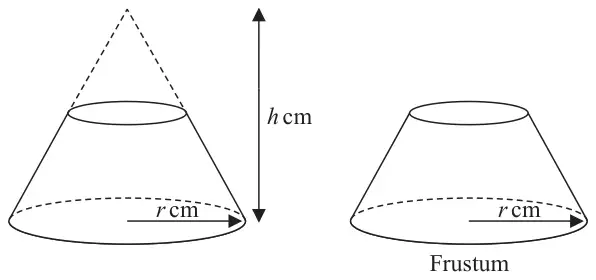
16 A frustum is made by removing a small cone from a large cone. The cones are mathematically similar.
Diagram NOT accurately drawn
The large cone has base radius \(r\) cm and height \(h\) cm.
Given that\[\frac{\text{volume of frustum}}{\text{volume of large cone}} = \frac{98}{125}\]find an expression, in terms of \(h\), for the height of the frustum.
(4)
Mark scheme
Scheme
Marks
\(1 - \dfrac{98}{125} \left(= \dfrac{27}{125}\right)\) or 0.216 or 125 – 98 (=27)
M1
\(\sqrt[3]{\text{``}{\dfrac{27}{125}}\text{''}} \left(= \dfrac{3}{5}\right)\) or \(\sqrt[3]{\text{``}{\dfrac{125}{27}}\text{''}} \left(= \dfrac{5}{3}\right)\)
M1
\(1 - \text{``}{\dfrac{3}{5}}\text{''}\) or \(h - \text{``}{\dfrac{3}{5}}\text{''}h\) oe
M1
\(\dfrac{2}{5}h\) oe
A1
(4)
(4 marks)
Notes
M1: for the length scale factor may be seen as a ratio E.g. 3 : 5
A1: for \(\dfrac{2}{5}h\) oe (may not be simplified)
(a) Work out the curved surface area of cylinder A. Give your answer in m2 correct to 3 significant figures. (2)
Cylinder B is mathematically similar to cylinder A. The height of cylinder B is 0.6 m.
(b) Work out the radius of cylinder B. (2)
Mark scheme (a)
Scheme
Marks
\(2 \times \pi \times 0.56 \times 1.6\)
M1
5.63
A1
(2)
Notes
M1: Award even if part of a calculation including 1 or 2 circles
A1: awrt 5.63
Mark scheme (b)
Scheme
Marks
\(\dfrac{0.6}{1.6}\) (=0.375) or \(\dfrac{1.6}{0.6} \left(= \dfrac{8}{3} = 2.\dot{6}\right)\) or
\(\dfrac{r}{0.56} = \dfrac{0.6}{1.6}\) or \((r =) \dfrac{0.56 \times 0.6}{1.6}\) or \(0.56 \div 2.\dot{6}\) oe
M1
0.21
A1
(2)
(4 marks)
Notes
M1: Correct scale factor (given as a fraction or ratio) or correct equation in \(r\) or a correct expression for \(r\). Allow 2.6666... to 1 dp rounded or truncated
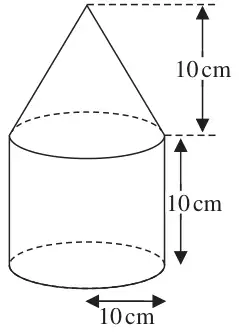
The diagram shows a solid shape made from a cone on top of a cylinder.
The cone has a radius of 10 cm and a height of 10 cm. The cylinder has a radius of 10 cm and a height of 10 cm. The centre of the base of the cone coincides with the centre of the top face of the cylinder.
The total surface area of the solid is \(A\) cm²
Show that \(A = (300 + 100\sqrt{2})\pi\)
(4)
Mark scheme
Scheme
Marks
\(\pi \times 20 \times 10\) or \(200\pi\) or 628.(318…) oe
M1
\(\sqrt{10^2 + 10^2}\) or \(10\sqrt{2}\) or 14.1(421…) oe
M1
\(\pi \times 10 \times 10\sqrt{2}\) or \(100\pi\sqrt{2}\) or 444.(288…) or
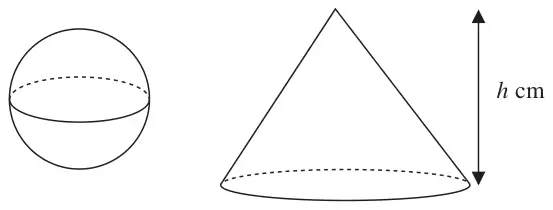
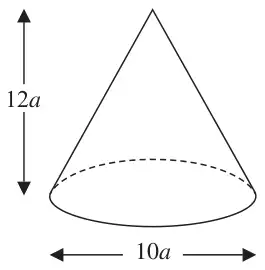
The cone has height \(h\) cm. The radius of the base of the cone is 3 times the radius of the sphere.
Given that the volume of the sphere is equal to the volume of the cone, find an expression for the radius of the sphere in terms of \(h\). Give your expression in its simplest form.
(3)
Mark scheme
Scheme
Marks
\(\dfrac{1}{3}\pi(3r)^2h\)
M1
\(\dfrac{4}{3}\pi r^3 = \dfrac{1}{3}\pi(3r)^2h\)
M1
\(\dfrac{9h}{4}\) oe
A1
(3)
Notes
M1: or \(\dfrac{4}{3}\pi\left(\dfrac{y}{3}\right)^3\)
Condone missing brackets around \(3r\) or \(\dfrac{y}{3}\) for this mark only
Allow use of 3.14 consistently (or other correct value)
M1: or \(\dfrac{4}{3}\pi\left(\dfrac{y}{3}\right)^3 = \dfrac{1}{3}\pi y^2h\)
A1: for \(\dfrac{9h}{4}\) oe or \(r = \dfrac{9h}{4}\)
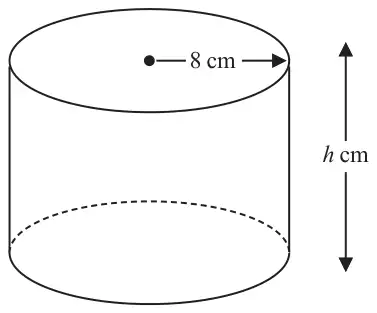
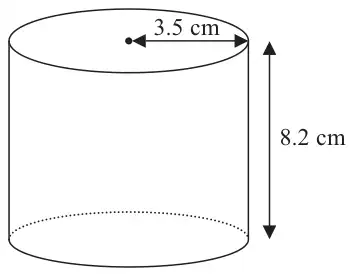
A solid cylinder has radius 3.5 cm and height 8.2 cm.
Work out the total surface area of the cylinder. Give your answer correct to 3 significant figures.
(3)
Mark scheme
Scheme
Marks
\(2 \times \pi \times 3.5 \times 8.2 + 2 \times \pi \times 3.5^2\) or \(57.4\pi + 24.5\pi\) or \(81.9\pi\) or 180(.327..) + 76.9(690...) or \(2 \times \pi \times 3.5 \times 8.2 + \pi \times 3.5^2\) or 180(.327..) + 38.4(845...) or 218(.81....)
M2
257
A1
(3)
Total 3 marks
Notes
M2: Allow 76.9(690...), 180(.327...), 38.4(845...) and 218(.81...) if rounded or truncated to at least 3 significant figures. M1 for \(2 \times \pi \times 3.5 \times 8.2\) or \(57.4\pi\) or 180(.3274…) or \(2 \times \pi \times 3.5^2\) or \(24.5\pi\) or 77 or 76.9(690…)
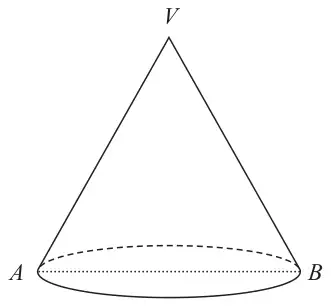
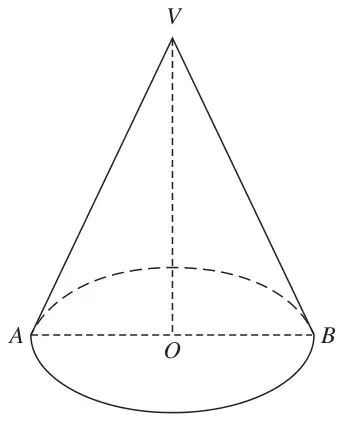
The diagram shows a solid cone. The base of the cone is a horizontal circle, centre \(O\), with radius 4.5 cm. \(AB\) is a diameter of the base and \(OV\) is the vertical height of the cone. The curved surface area of the cone is 130 cm2
Calculate the size of the angle \(AVB\). Give your answer correct to 1 decimal place.
M1: For exact expression or answer which rounds to 9.2
M1: For a correct expression for sin \(AVO\) or cos AVB \(\cos(AVB) = (\text{“}9.2\text{”}^2 + \text{“}9.2\text{”}^2 - 9) / 2 \times \text{“}9.2\text{”} \times \text{“}9.2\text{”}\) (=0.521...)
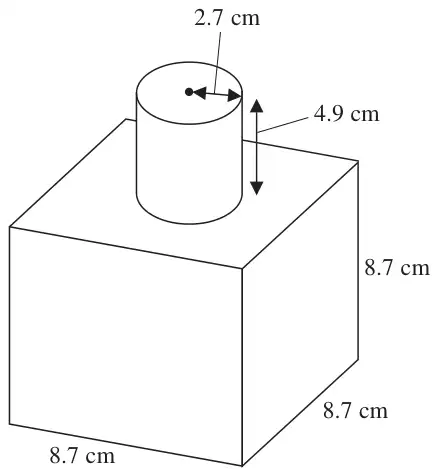
The diagram shows a shape made from a solid cube and a solid cylinder. The cube has sides of length 8.7 cm. The cylinder has a radius of 2.7 cm and a height of 4.9 cm.
Calculate the total surface area of the solid shape. Give your answer correct to 3 significant figures.
(3)
Mark scheme
Scheme
Marks
\(2 \times \pi \times 2.7 \times 4.9\) or 83(.12654...)
M1
\(6 \times 8.7^2\) oe or 454.14
M1
537
A1
(3)
(3 marks)
Notes
M1: May be rounded or truncated to at least 2 sf (83.0844 if 3.14 used)
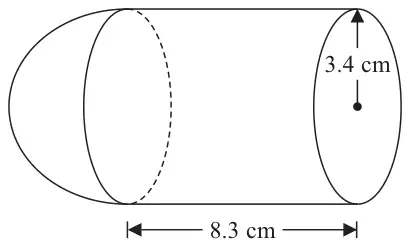
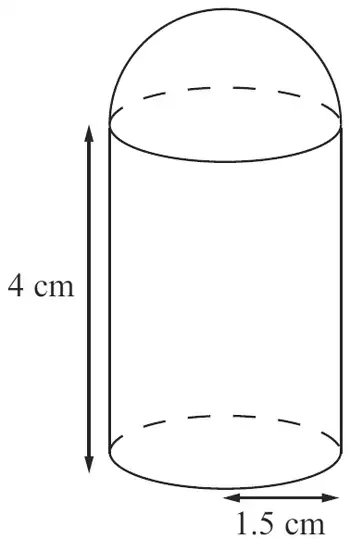
The diagram shows a shape made from a solid cylinder and a solid hemisphere. The cylinder has a radius of 3.4 cm and a length of 8.3 cm. The hemisphere has a radius of 3.4 cm.
Calculate the total surface area of the solid shape. Give your answer correct to 3 significant figures.
(4)
Mark scheme
Scheme
Marks
\(2 \times \pi \times 3.4 \times 8.3\) or \(56.44\pi\) or 177.3...
M1
\(\pi \times 3.4^2\) or \(11.56\pi\) or 36.31...
M1
\(2 \times \pi \times 3.4^2\) or \(23.12\pi\) or 72.63..
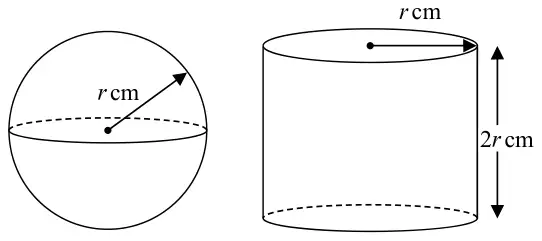
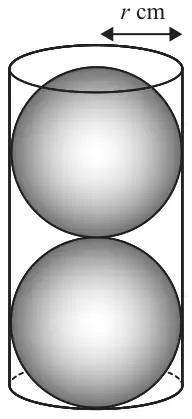
Two solid spheres, each of radius \(r\) cm, fit exactly inside a hollow cylinder. The radius of the cylinder is \(r\) cm. The height of the cylinder is equal to \(4r\) cm.
The volume of the space inside the cylinder, not occupied by the spheres, is \(\dfrac{125}{6}\pi\) cm\(^3\)
Calculate the value of \(r\). Show your working clearly.
M2: Any equation based on cylinder – 2 spheres = space oe \(h = 4r\) must be implicit for award of M2 {decimal form: \(12.6r^3 - 8.4r^3 = 65.4\) (1 dp or better)} If not M2 then M1 for \(\pi r^2 \times 4r\) or better
M1: One occurrence of \(r^3\) in correct equation.
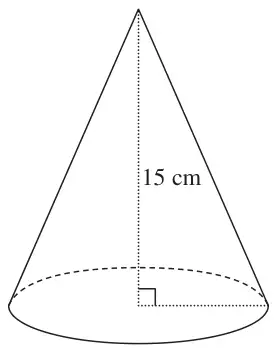
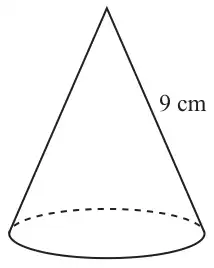
A solid cone has a slant height of 9 cm. The curved surface area of the cone is 100 cm\(^2\). Calculate the volume of the cone. Give your answer correct to 3 significant figures.
(5)
Mark scheme
Scheme
Marks
\(\pi \times r \times 9 = 100\) oe
M1
(\(r\) =) 3.53677…
A1
\(\sqrt{9^2 - \text{“}3.53...\text{”}^2}\)
M1
(\(h\) =) 8.2759…
A1
108
A1
(Total 5 marks)
Notes
A1: for 3.53 or for value rounding to 3.54 (3.14 → 3.53857…)
A1: for 8.27 or for value rounding to 8.28
A1: for answer rounding to 108 (\(\pi\) → 108.40… 3.14 → 108.45…) If both M1s scored , award 5 marks for an answer which rounds to 108
Apart from Questions 3, 13(b) and 17(f) (where the mark scheme states otherwise), the correct answer, unless clearly obtained by an incorrect method, should be taken to imply a correct method.
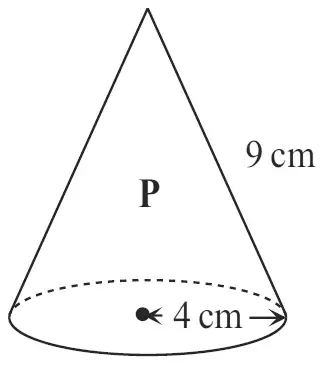
A solid cone, P, has a base radius of 4 cm and a slant height of 9 cm.
(a) Calculate the total surface area of the cone. Give your answer correct to 3 significant figures. (2)
Another solid cone, Q, is similar to P. The base radius of Q is 6 cm. The volume of Q is \(k\) times the volume of P.
(b) Calculate the value of \(k\). (2)
Mark scheme (a)
Scheme
Marks
\(\pi \times 4^2 + \pi \times 4 \times 9\)
M1
163
A1
(2)
Notes
A1: for ans rounding to 163 (\(\pi \to\) 163.3628... 3.14 \(\to\) 163.28 3.142 \(\to\) 163.384)
Mark scheme (b)
Scheme
Marks
\(\dfrac{6}{4}\) or 1.5 oe or 6 : 4 oe
or \(\dfrac{4}{6}\) oe or 4 : 6 oe
M1
3.375 oe
A1
(2)
(4 marks)
Notes
M1: May be implied by 13.5 or 12.09... Also award for cube of any correct values or cube of correct ratios
A1: for 3.375 or \(3\frac{3}{8}\) or \(\frac{27}{8}\) oe Accept 3.38 if M1 scored Do not award A1 if slant heights used as \(h\) in \(V = \frac{1}{3}\pi r^2 h\)
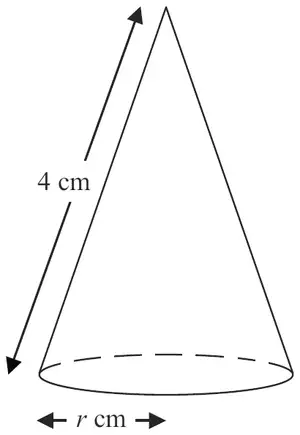
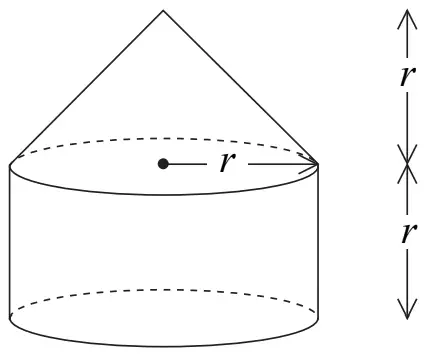
The diagram shows a solid made from a cone and a cylinder. The cylinder has radius \(r\) and height \(r\). The cone has base radius \(r\) and height \(r\).
(a) Show that the total volume of the solid is equal to the volume of a sphere of radius \(r\). (2)
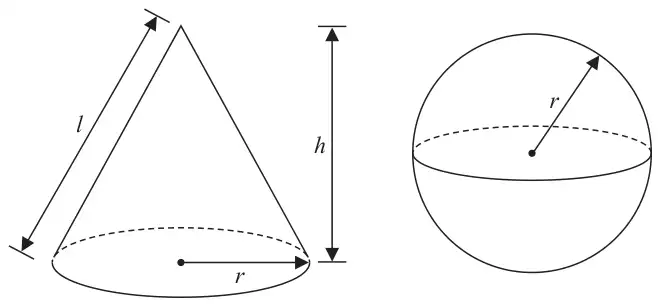
The curved surface area of a cylinder with base radius \(r\) and height \(h\) is \(2\pi rh\). The curved surface area of a cone with base radius \(r\) and slant height \(l\) is \(\pi rl\).
(b) Show that the total surface area of the above solid is greater than the surface area of a sphere of radius \(r\). (3)
Mark scheme (a)
Scheme
Marks
\(\frac{1}{3}\pi r^2 \times r + \pi r^2 \times r\) or \(\frac{1}{3}\pi r^3 + \pi r^3\)
M2: M1 for each term Also award for values rounding to 24.6 and to 49.2 or 49.3
A1: for 73.9 or for answer which rounds to 73.9
Mark scheme (b)
Scheme
Marks
\(\sqrt[3]{125}\) or 5 seen
M1
\(25 \times 73.89...\)
M1
1850
A1
(3)
(6 marks)
Notes
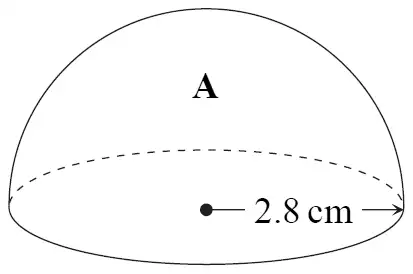
M1: for 25 × (a) or for \(\pi \times (2.8 \times 5)^2 + 2\pi \times (2.8 \times 5)^2\) or for substituting \(r = 2.8 \times 5\) in the expression used in (a)
A1: for 1850 or for any value in range 1846.3 − 1847.5 ft from 25 × (a)
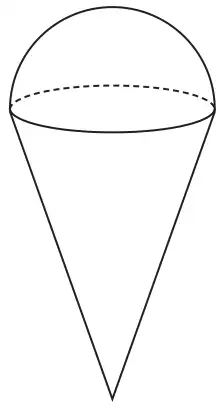
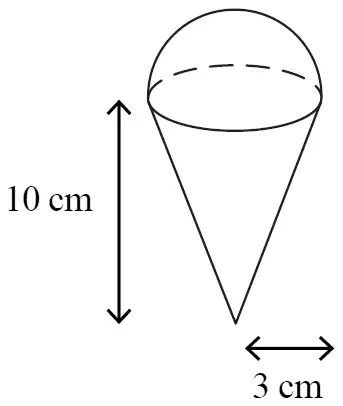
A Maxicool consists of a cone full of ice cream with a hemisphere of ice cream on top. The radius of the hemisphere is 3 cm. The radius of the base of the cone is 3 cm. The height of the cone is 10 cm.
Diagram NOT accurately drawn
Calculate the total volume of ice cream in a Maxicool. Give your answer correct to 3 significant figures.
We'd like to use Google Analytics cookies to count visits and see which pages help most. They're optional, and the site works exactly the same either way. Privacy policy