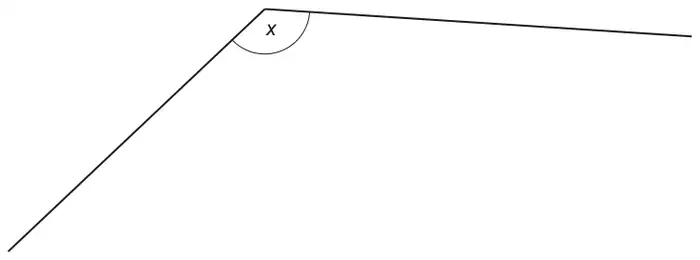
(b) The angles of a triangle are \(27^\circ\), \(126^\circ\) and \(27^\circ\).
Explain how you know the triangle is isosceles. [1]
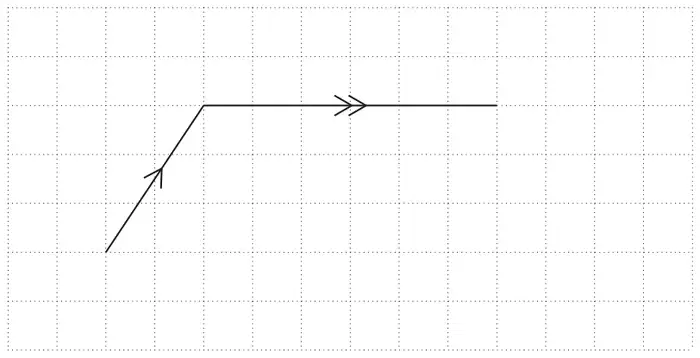
(c) The diagram shows two sides of a parallelogram drawn on a one-centimetre grid.
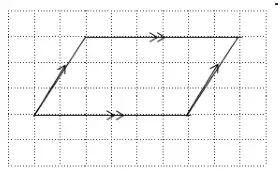
(i) Complete the drawing of the parallelogram. Include notation to show that the drawing is a parallelogram. [2]
(ii) Work out the area of the parallelogram. [2]
Mark scheme (a)
Answer
Marks
Part marks and guidance
133
1
Allow 131 to 135
Mark scheme (b)
Answer
Marks
Part marks and guidance
2 of the angles are equal oe
1
Must refer to angles not sides, statements must not be contradicted
Appendix
Exemplar responses for Q3b
Response
Mark
Two angles are identical and one is different.
1
Only two of the angles are the same so it cannot be equilateral.
1
Because two of the angles being the same means it is equal lines.
1
Two angles of an isosceles have to be the same.
1
27\(^\circ\) and 27\(^\circ\) are equal meaning it has two equal sides.
1
Only 2 numbers are the same and it's not all equal
1 bod
Because others don’t have same two angles
1 bod
Because others don’t have two angles the same/2 same angles
1 bod
Base angles in an isosceles triangle are always equal.
1 bod
Because isosceles triangles have equal sides and they are 27\(^\circ\).
0
Because 2 sides of the triangle are the same which is 27\(^\circ\) and the last side is different.
0
One angle is bigger than the others
0
Because they’re both 27 degree angles'
0
2 sides are the same
0
Both of isosceles have the same number
0
Mark scheme (c)
Answer
Marks
Part marks and guidance
(i)
1
Correct parallelogram drawn
Accept reasonable freehand, tolerance \(\pm\) 2mm by eye
1 dep
dep on parallelogram drawn Accept other, complete, standard notations that indicate a parallelogram eg two pairs of opposite sides have equal length or two pairs of opposite angles are equal or any combination of these properties that define a parallelogram
Mark intent
Arrows must be correct single/double and pointing in correct direction
(ii) 18 nfww
2
FTtheir parallelogram
M1 for their length \(\times\) their perpendicular height oe
e.g. \(6 + 3 + 6 + 3 = 18\) scores 0 M1 and 2 marks are dependent on a parallelogram being drawn in (i) Must be in cm\(^2\)
If not 6 and 3 their dimensions need to be verifiable eg shown on the diagram eg M0 for \(\sqrt{13}\) or 3.6… etc as their perpendicular height
oe includes two triangles + the \(4 \times 3\) rectangle or the \(8 \times 3\) rectangle – two triangles
Need to be certain that 3 is slant height to withhold the marks
We'd like to use Google Analytics cookies to count visits and see which pages help most. They're optional, and the site works exactly the same either way. Privacy policy