
Higher June 2025 Paper 5 Q12
12
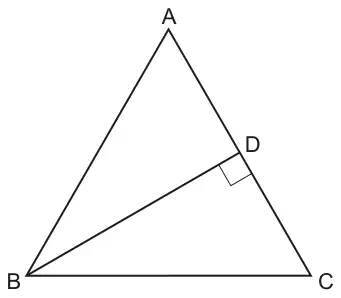
Not to scale
ABC is an equilateral triangle.
BD is perpendicular to AC.
Prove that triangle ABD is congruent to triangle CBD. [4]
| Answer | Marks | Part marks and guidance | |
|---|---|---|---|
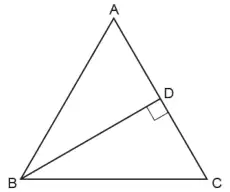 e.g. | For the M marks, must be clear distinct statements involving equalities of pairs of named sides or pairs of named angles with the reason (if given) alongside the statement Throughout accept A for angle BAD and C for angle BCD. | ||
| [Angle] ADB = [Angle] CDB = 90° BD is common oe AB = BC equilateral [triangle] or given oe OR [Angle] ABD = [Angle] CBD = 30° BD is common oe AB = BC equilateral [triangle] or given | M3 | M2 for 2 correct statements with reason[s] or 3 correct statements but incorrect/no reason[s] or M1 for 1 correct statement with reason or 2 correct but incorrect/no reasons | Do not accept ADB = 90 alone without = angle CDB, accept right angle for 90 Accept e.g. BD = BD, BD is shared, BD is in both If more than 3 statements given, mark to candidates advantage and isw incorrect/incomplete statements alongside correct work for method marks Accept equivalent proofs for AAS involving any two of the three angles and either BD is common or AB = BC (given) Accept [Angle] BAD= [Angle] BCD = 60 or equilateral [triangle] Do not accept AD = DC |
| [Triangle BDC is congruent to triangle BAD] (RHS) or (SAS) | A1 | Dep on M3 and no incorrect work seen and condition must fit statements given | See Appendix 2 |
Appendix 2: Question 12
For the M marks, statements may be embedded within longer text but they must be clear distinct statements involving equalities of pairs of named sides or pairs of named angles with (if given) the reason alongside the statement. Do not accept annotation on the diagram as implying method. This question is also assessing clear communication of the mathematics.
| Example | Candidate response | Comment |
|---|---|---|
| A | All sides equal Line BD is perpendicular to AC, meaning its the mid point Splitting a equilateral triangle creates 2 right angle triangles and because its equilateral it should be the same on both sides. RHS, Right angle they both have, hypotenuse is the same and the side is the same. Yes, it is congruent as said by RHS. This means they are congruent as they all have a right angle, hypotenuse is the same and side is the same as it was equilateral | Within the text there is no specific named equality of pairs of sides or pairs of angles stated. It is done in more general terms and this is not acceptable so M0 |
| B | Equilateral = all angles are the same \(\angle ABC = \angle BAC = \angle BCA\) Each angle \(= \frac{180}{3} = 60\) \(\triangle ABD\): \(\angle ABD = 60/2 = 30°\), so \(\angle BAD = 180 - (30 + 90) = 60°\) \(\triangle CBD\): \(\angle CBD = 60/3 = 30°\), so \(\angle BCD = 180 - (30 + 90) = 60°\) → Both are right angled triangles that shares line BD → Both share the same angles of 90°, 30°, 60° → They form an equilateral triangle which has angles of the same angles (60, 60, 60) so both triangles must be equal | There are no clear distinct equality statements of pairs of sides or pairs of angles with reasons. The statement BD is shared appears in the text and earns M1 |
| C | \(\angle DBC\) and \(\angle DBA\) both equal 30° as angle \(\angle BAD\) and \(\angle DCB\) both are 60° as triangle ABC is equilateral so with the perpendicular line creating 90° angles in order to get the full 180° they must be 30° so therefore ABD is congruent to CBD | Within the text there are two clear distinct statement of equality of angles DBC = DBA = 30 and BAD = DCB = 60 with reasons. There is no statement about equalities of pairs of sides Award M2 |
| D | BDA = BDC so BDA is 90°. BD is the same in both triangles. SAS AC runs along both triangles so AD = AC so triangles are SAS. | BDA = BDC stated and 90 is given for BDA next to the statement BOD M1 BD is shared earns M1 Award M2 |