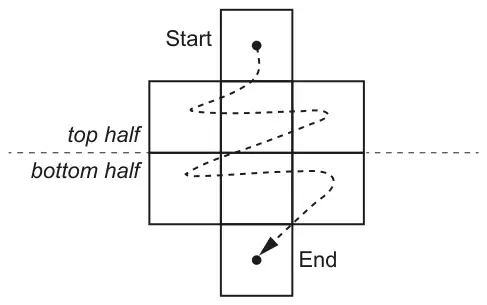
10 Eight consecutive numbers are written in ascending order in this grid, starting from the top and working left to right.
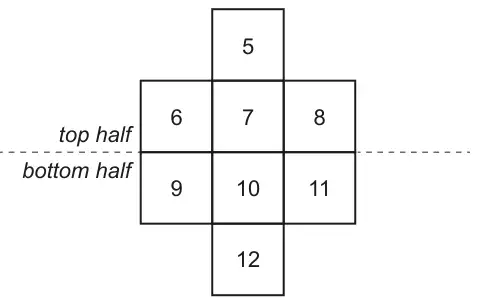
(a) Kareem writes the numbers 5 to 12 in the grid.
Show that for Kareem’s grid, the sum of the numbers in the top half of the grid is 16 less than the sum of the numbers in the bottom half of the grid. [1]
(b)Use algebra to prove that for any set of eight consecutive numbers written in this grid in the same way, the sum of the numbers in the top half of the grid is 16 less than the sum of the numbers in the bottom half of the grid. [5]
Mark scheme (a)
Answer
Marks
Part marks and guidance
(9 + 10 + 11 + 12) – (5 + 6 + 7 + 8) = 16
1
May be shown in stages Accept 42 – 26 = 16
May be explained via sum of differences of paired cells eg 4 × 4 from (9 – 5), (10 – 6) etc
For M2 and M1 FT expressions of form \(an + b\), \(b \ne 0\) eg. Top half: \(2n + (2n + 1) + (2n + 2) + (2n + 3) = 8n + 6\) Bottom half: \((2n + 4) + (2n + 5) + (2n + 6) + (2n + 7) = 8n + 22\) Accept unsimplified or simplified for M marks
M2 for algebraic sums for top half and bottom half of grid or M1 for algebraic sum for top half or bottom half of grid
AND
A1dep for sum of bottom half – sum of top half = 16 shown algebraically or explained from correct working.
A1 is dep on B2M2 scored Condone \(\begin{array}{r} 4n + 22 \\ [-]\ 4n + 6 \\ \hline 16 \end{array}\) A0 for \(4n + 22 - 4n + 6\) or for just 22 – 6 or for use of \(2n\), \(2n + 1\), \(2n + 2\) etc as their algebraic terms
Alternative method for pairs of numbers B2 as above AND M2 for the difference of four pairs of algebraic terms from top and bottom calculated or M1 for the one pair of algebraic terms from top and bottom calculated AND A1dep for all four differences summed to 16 shown numerically or explained from correct working
eg. “difference between \(n\)+4 and \(n\) is 4”
If 0 scored, allow SC1 for a correct numerical or described example showing an overall difference of 16