
Higher November 2023 Paper 6 Q16
16 The graph of \(y = x^5 - 70x - 150\) is sketched below.
The root of the equation \(x^5 - 70x - 150 = 0\) is \(p\).
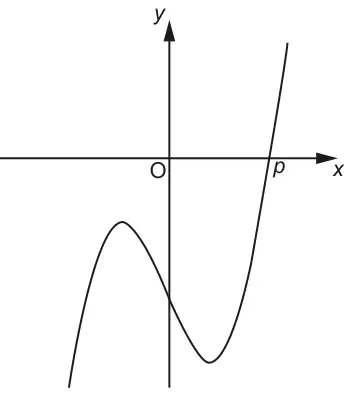
(a) Show that \(3 < p < 4\). [3]
(b) Find a smaller interval that contains the value of \(p\).
You must show calculations to support your answer. [3]
You must show calculations to support your answer. [3]
| Answer | Marks | Part marks and guidance | |
|---|---|---|---|
| \(3^5 - 70 \times 3 - 150 = -117\) and \(4^5 - 70 \times 4 - 150 = 594\) Sign change so solution between \(x = 3\) and \(x = 4\) | 3 | M2 for \(3^5 - 70 \times 3 - 150 = -117\) and \(4^5 - 70 \times 4 - 150 = 594\) or M1 for \(3^5 - 70 \times 3 - 150\) soi by −117 or \(4^5 - 70 \times 4 - 150\) soi by 594 | Accept other values of \(x\) used between 3 and 4 (see table in part (b)). For full marks, the two values need to produce a sign change or values either side of 150 if using alternative method. Examples just sufficient for third mark include: Change of sign −117 < 0 < 594 \(x = 3\) gives an answer < 0 and \(x = 4\) gives an answer > 0 Examples insufficient for third mark: so \(x\) lies between 3 and 4 |
| Alternative method After \(x^5 - 70x = 150\) seen M2 for \(3^5 - 70 \times 3 = 33\) and \(4^5 - 70 \times 4 = 744\) A1 for 33 < 150 and 744 > 150 so solution between \(x = 3\) and \(x = 4\) OR M1 for \(3^5 - 70 \times 3\) soi by 33 or \(4^5 - 70 \times 4\) soi by 744 | |||
| Alternative method SC3 for using an iterative equation that converges to a value in the range 3.25 and 3.35 and concluding statement that 3 < 3.25 to 3.35 < 4 oe or SC2 for using an iterative equation that converges to a value in the range 3.25 to 3.35 | If within part (a) candidates refer to their working in part (b), award marks for this final alternative method. | ||
| Answer | Marks | Part marks and guidance | ||||||||||||||||||||||||||||||||||||||||||||||||||||||||||||||||
|---|---|---|---|---|---|---|---|---|---|---|---|---|---|---|---|---|---|---|---|---|---|---|---|---|---|---|---|---|---|---|---|---|---|---|---|---|---|---|---|---|---|---|---|---|---|---|---|---|---|---|---|---|---|---|---|---|---|---|---|---|---|---|---|---|---|---|
| Examples: when \(x = 3.1\) \(y = -80[.7\ldots]\), so \(3.1 < p < 4\) when \(x = 3.5\) \(y = 130[.2\ldots]\), so \(3 < p < 3.5\) when \(x = 3.1\) \(y = -80[.7\ldots]\) and when \(x = 3.5\) \(y = 130[.2\ldots]\), so \(3.1 < p < 3.5\) | 3 | Dependent on achieving at least M2 M2 for one further value of \(y\) evaluated correctly, possibly rot or truncated to 2 or more sf, for a value of \(x\) such that \(3 < x < 4\) OR M1 for working shown to calculate one further value of \(y\) for a value of \(x\) such that \(3 < x < 4\) Alternative method After \(x^5 - 70x = 150\) seen Award marks as for the main method, but with one evaluation being < 150 and the other being > 150 Note after SC considered in part (a): if SC2 was awarded then they must use a value of \(x\) that produces a smaller interval than \(3 < x <\) their \(x\)-value in (a) or their \(x\)-value in (a) \(< x < 4\) If 0 scored, instead award SC1 or SC2 if evidence for M1 or M2 has not been credited in part (a) | Likely values: accept rot to 2+sf
Calculations in support of \(x = 3\) or \(x = 4\) need not be repeated from part (a) | |||||||||||||||||||||||||||||||||||||||||||||||||||||||||||||||