
Higher June 2019 Paper 1 Q20
20 \(A\), \(B\) and \(C\) are points on a circle.
\(CD\) is a tangent.
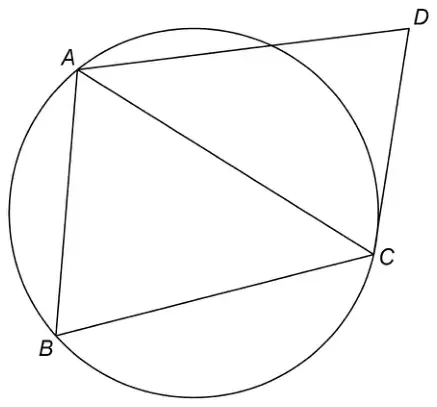
Not drawn accurately
Prove that \(AB\) is parallel to \(DC\). [4 marks]
Tick the two boxes for the statements that must be correct. [1 mark]
- \(AB\) is parallel to \(DC\)
- \(AC\) bisects angle \(BCD\)
- \(AC\) bisects angle \(BAD\)
| Answer | Mark | Comments |
|---|---|---|
| Alternative method 1: shows that \(BAC = ACD\) and alternate angles | ||
| \(ACD = ABC\) | M1 | accept both with same letter on diagram |
| \(ABC = BAC\) | M1 | accept both with same letter on diagram |
| \(BAC = ACD\) and alternate segment (theorem) with M2 awarded | M1dep | dep on M2 |
| Other two correct reasons given with M3 awarded | A1 | eg (base angles of) isosceles triangle and alternate angles |
| Alternative method 2: shows that \(ABC + BCD = 180\) and co-interior angles | ||
| \(ACD = ABC\) | M1 | accept both with same letter on diagram |
| \(ABC = BAC\) | M1 | accept both with same letter on diagram |
| \(BCD = 180 - (BAC + ABC) + ACD\) and \(ABC + BCD = 180\) and alternate segment (theorem) with M2 awarded | M1dep | oe dep on M2 |
| Other two correct reasons given with M3 awarded | A1 | eg (base angles of) isosceles triangle and (co-)interior angles or allied angles |
| Alternative method 3: line from midpoint of \(AB\) to \(C\) is perpendicular to \(AB\) and \(CD\) | ||
| Let \(M\) be the midpoint of \(AB\) and \(MC\) is perpendicular to \(AB\) | M1 | any letter |
| \(MC\) is perpendicular to \(CD\) | M1 | |
| \(AB\) and \(CD\) are both perpendicular to \(MC\) with M2 awarded | M1dep | oe dep on M2 |
| Three correct reasons given with M3 awarded | A1 | eg (perpendicular bisector of) isosceles triangle and \(MC\) goes through the centre of the circle and tangent is perpendicular to radius |
Additional guidance
Other correct methods can be found by extending one or more of the lines. For example, by extending \(BC\) it is possible to use corresponding angles as a proof instead of alternating angles. This should be reflected in the reasons required for the last mark
In the scheme, \(ACD\) (for example) means angle \(ACD\) and not triangle \(ACD\)
Accept equality of angles indicated by labelling with the same letter, but not by arcs
Accept (angle) \(B\) for angle \(ABC\)
Do not accept (angle) \(A\) for angle \(BAC\) or (angle) \(C\) for angle \(ACB\) unless intention is clear from annotation of the diagram
For the third mark in alternative method 2, accept algebraic expressions for angles if clearly marked on the diagram
Do not award marks for an argument based only on assumed values of angles, but ignore 60° marked on diagram, which is for (b)
Ignore an angle marked at \(ADC\)
Ignore incorrect statements that do not affect the proof
eg \(ACD\) is an isosceles triangle (but not used in proof)
| Answer | Mark | Comments |
|---|---|---|
| ✓ \(AB\) is parallel to \(DC\) ✓ \(AC\) bisects angle \(BCD\) ☐ \(AC\) bisects angle \(BAD\) | B1 |