
Higher November 2023 Paper 2 Q18
18
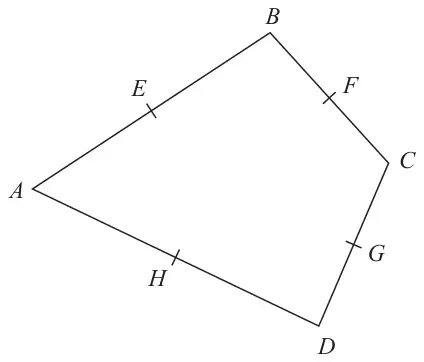
\(ABCD\) is a quadrilateral.
\(E\), \(F\), \(G\) and \(H\) are the midpoints of \(AB\), \(BC\), \(CD\) and \(DA\).
\[\overrightarrow{AH} = \mathbf{a} \qquad \overrightarrow{AE} = \mathbf{b} \qquad \overrightarrow{DG} = \mathbf{c}\]Prove, using vectors, that \(EFGH\) is a parallelogram. (4)
| Answer | Mark | Mark scheme |
|---|---|---|
| Proof | B1 | for \(\overrightarrow{EH} = -\mathbf{b} + \mathbf{a}\) or \(\overrightarrow{HE} = -\mathbf{a} + \mathbf{b}\) or \(\overrightarrow{HG} = \mathbf{a} + \mathbf{c}\) or \(\overrightarrow{GH} = -\mathbf{c} - \mathbf{a}\) |
| B1 | for \(\overrightarrow{BC} = -2\mathbf{b} + 2\mathbf{a} + 2\mathbf{c}\) or \(\overrightarrow{CB} = 2\mathbf{b} - 2\mathbf{a} - 2\mathbf{c}\) | |
| B1 | for \(\overrightarrow{EF} = \mathbf{b} + \tfrac{1}{2}(-2\mathbf{b} + 2\mathbf{a} + 2\mathbf{c})\ (= \mathbf{a} + \mathbf{c})\) or \(\overrightarrow{FE} = \tfrac{1}{2}(2\mathbf{b} - 2\mathbf{a} - 2\mathbf{c}) - \mathbf{b}\ (= -\mathbf{a} - \mathbf{c})\) or \(\overrightarrow{FG} = \tfrac{1}{2}(-2\mathbf{b} + 2\mathbf{a} + 2\mathbf{c}) - \mathbf{c}\ (= -\mathbf{b} + \mathbf{a})\) or \(\overrightarrow{GF} = \mathbf{c} + \tfrac{1}{2}(2\mathbf{b} - 2\mathbf{a} - 2\mathbf{c})\ (= -\mathbf{a} + \mathbf{b})\) | |
| A1 | for completing proof, \(\overrightarrow{EH} = \overrightarrow{FG}\) or \(\overrightarrow{HG} = \overrightarrow{EF}\) (so \(EFGH\) is a parallelogram) |