
Foundation November 2017 Paper 2 Q14
14 Halina cycled from A to B at an average speed of 26 km per hour.
She then cycled from B to C at an average speed of 20 km per hour.
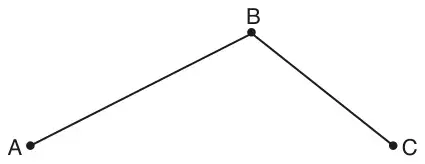
Not to scale
She left A at 10.00 am, did not stop at B and arrived at C at 3.00 pm.
(a) It took Halina \(x\) hours to cycle from A to B.
(i) Explain why the distance from A to B, in kilometres, is \(26x\). [1]
(ii) Write down an expression, in terms of \(x\), for the time taken to cycle from B to C. [2]
(iii) Hence show that the distance from B to C, in kilometres, is \(100 - 20x\). [1]
(b) The total distance cycled by Halina from A to C is 118 km.
Find the distance from A to B. [4]
| Answer | Marks | Part marks and guidance | |
|---|---|---|---|
| (i) Valid explanation | 1 | Such as ‘distance is time times speed’ | Need to see ‘multiply’ oe See Appendix |
| (ii) \(5 - x\) | 2 | M1 for time to travel from A to C = 5 [hours] soi | Must be seen in this part |
| (iii) \(20(5 - x) = 100 - 20x\) | 1 | ||
Appendix
Exemplar responses for Q14ai
| Response | Mark |
|---|---|
| Because it’s the average speed x the number of hours it takes | 1 |
| Because the average speed to A to B was 26km per hour so it’s 26 x hours | 1 |
| Because you need to work at how many hours it took and times it by the speed | 1 |
| Because she cycled at 26 kmph and the x is how long it took so you multiply them (26kmph implies speed) | 1 bod |
| Since to find the average speed you do distance x time so 26 x x \(\to\) 26x | 0 |
| Because she did 26 km per hour and we don’t know how many hours yet so we put x to show the number of hours | 0 |
| Because it’s 26x the 1 hour | 0 |
| Because her average speed is 26 | 0 |
| Answer | Marks | Part marks and guidance | |
|---|---|---|---|
| 78 | 4 | M1 for \(26x + 100 - 20x = 118\) M1 for their \(6x\) = their 18 M1 for \(x = \dfrac{\textit{their } 18}{\textit{their } 6}\) soi | Simplifying their equation to \(ax = b\) Simplifying their \(ax = b\) to \(x = \dfrac{b}{a}\) |