
Higher November 2017 Paper 6 Q14
14 The diagram shows a cross placed on a number grid.
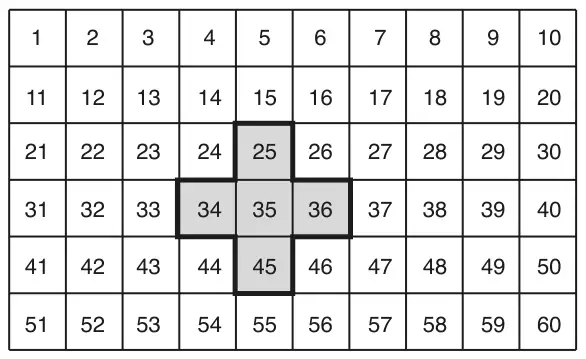
\(L\) is the product of the left and right numbers of the cross.
\(T\) is the product of the top and bottom numbers of the cross.
\(M\) is the middle number of the cross.
(a) Show that when \(M = 35\), \(L - T = 99\). [2]
(b) Prove that, for any position of the cross on the number grid above, \(L - T = 99\). [5]
| Answer | Marks | Part marks and guidance | |
|---|---|---|---|
| (34 × 36) – (25 × 45) = 99 | 2 | M1 for either 34 × 36 or 25 × 45 soi by 1224 or 1125 | |
| Answer | Marks | Part marks and guidance | |
|---|---|---|---|
| Eg. If \(M = n\) \(L = (n - 1)(n + 1) = n^2 - 1\) \(T = (n - 10)(n + 10) = n^2 - 100\) \(L - T = (n^2 - 1) - (n^2 - 100) = 99\) | 5 | B2 for defining relative positions algebraically Eg. \(n - 1\), \(n + 1\), \(n - 10\), \(n + 10\) or B1 for at least two relative positions defined algebraically | Or equivalent algebraic representation of relative positions. Condone poor notation for B marks eg B2 for n − 1 × n + 1 − n − 10 × n + 10 |
| AND M2 for [\(L\) =] \((n - 1)(n + 1) = n^2 - 1\) and [\(T\) =] \((n - 10)(n + 10) = n^2 - 100\) or M1 for [\(L\) =] \((n - 1)(n + 1) = n^2 - 1\) or [\(T\) =] \((n - 10)(n + 10) = n^2 - 100\) or \(L - T\) = (their \((n - 1)(n + 1)\) – (their \((n - 10)(n + 10)\)) If 0 scored, allow SC1 for one further numerical example | For M marks, follow through allowed for working with their relative positions described algebraically as linear expressions: ie.
M2 may be embedded | ||