11 Amelia buys a new car. The expected future value of this car, £\(V\), is given by
\[V = 16000 \times 0.75^t\]
where \(t\) is the age of the car in complete years.
(a)
(i) Write down the value of the car when new. [1]
(ii) Write down the annual percentage decrease in the expected value of the car. [1]
(iii) Show that the expected value of the car when 2 years old is £9000. [2]
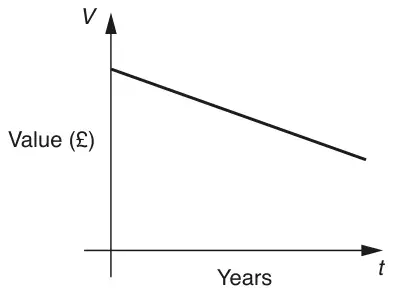
(b) Amelia sketches a graph to show the expected value of her car as it gets older.
Explain how you know that Amelia’s graph is incorrect. [1]
(c) Amelia assumes that her car will have no value at all after 20 years.
Explain why her assumption is mathematically incorrect. [1]
Mark scheme (a)
Answer
Marks
Part marks and guidance
(i) 16 000
1
(ii) 25
1
(iii) \(16\,000 \times 0.75^2\) oe with no subsequent error
M2
M1 for \(16\,000 \times 0.75^2\) with subsequent error or 16 000 × 0.75 oe or for their 12 000 × 0.75
M1 implied by 12000
Mark scheme (b)
Answer
Marks
Part marks and guidance
Equation does not give a straight line oe isw
1
Accept ‘There is not a constant decrease’ oe isw See AG
Appendix: exemplar responses for Q11(b)
Response
Mark
The graph should be a [decreasing] curve
1
It is 4000 for the first year and 3000 for the second year …
1
Because it would not be a steady decline
1
Mark scheme (c)
Answer
Marks
Part marks and guidance
If you calculate a value for a 20 year-old car it is greater than 0 oe
1
Accept ‘the graph will never reach the \(x\)-axis’ oe, It will have scrap value The answer is always positive etc Condone additional ‘opinion based’ information