
Foundation June 2018 Paper 3 Q21
21 The diagram below shows two triangles.
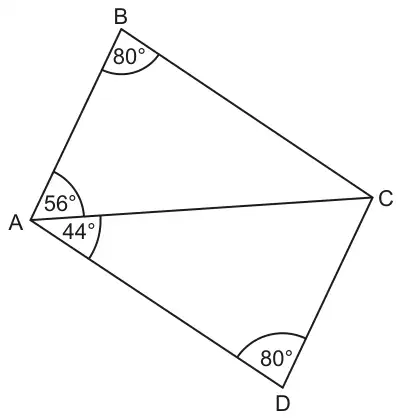
Not to scale
Prove that triangle ABC is congruent to triangle ACD. [4]
| Answer | Marks | Part marks and guidance | |
|---|---|---|---|
| angle \(BCA = 44^\circ\) and angles [in a] triangle [\(= 180^\circ\)] or angle \(DCA = 56^\circ\) and angles [in a] triangle [\(= 180^\circ\)] | 1 | \(C = 44\) (or 56) is not sufficient. Accept angles shown on diagram. 0 if alternate angles is given as the reason unless the parallelogram has been justified | |
| Best two statements from: (i) [side] \(AC\) is common (ii) [angle] \(ACB\) = [angle] \(CAD\) (iii) [angle] \(BAC\) = [angle] \(ACD\) (iv) angle \(B\) = angle \(D\) or [angle] \(ABC\) = [angle] \(CDA\) | 2 | B1 for each to a max of 2 | Notation needed for these marks. 44 = 44 is not sufficient. 56 = 56 is not sufficient “angle” required if using just \(B\) or \(D\) |
| Conclusion and third statement [congruent because] ASA after stating (i), (ii), (iii) AAS after stating (i), (ii), (iv) or (i), (iii), (iv) | 1 | If 0 or 1 scored then, to a maximum total of 2 marks, allow: SC1 for angle \(BCA = 44^\circ\) and angle \(DCA = 56^\circ\) stated or on diagram and SC1 for a correct statement lacking precision eg “both triangles have a common side”, “both triangles have an angle of 80”, “all the angles are the same° | Final mark needs a third statement (ignore superfluous ones) and the appropriate congruence conclusion. Possible marks (without SC): 1 + 2 + 1, 1 + 2 + 0, 1 + 1 + 0, 0 + 2 + 1, 0 + 2 + 0, 0 + 1 + 0, 0 + 0 + 0. |