
Higher June 2018 Paper 6 Q12
12 The diagram below shows two right-angled triangles.
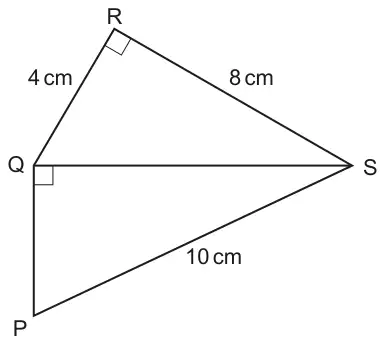
Not to scale
Prove that triangles PQS and QRS are similar. [5]
| Answer | Marks | Part marks and guidance | |
|---|---|---|---|
| [\(QS\) =] \(\sqrt{80}\), \(4\sqrt{5}\) oe or 8.9[4..] | 2 | M2 for [\(QS\) =] \(\sqrt{4^2 + 8^2}\) oe or M1 for \(4^2 + 8^2\) | Accept QS on diagram First M2 may be implied by \(QP = 2\sqrt{5}\) oe or 4.47[…] |
| Best two from: (i) shows a pair of corresponding angles are equal (ii) shows a second pair of corrresponding angles are equal or states [angle] QRS = [angle] PQS (iii) shows two pairs of corresponding sides are in the same ratio (iv) shows the third pair of corresponding sides have the same ratio. Ratios of corresponding sides need to be seen in equiavlent form. | 2 | B1 for each to a max of 2 For these marks, answers to calculations are sufficient, but corresponding pairs must be either exact or the same when rot to 3sf. In (ii) accept QRS and PQS are both right angles oe (iii) and (iv) can be shown using scale factors eg QS = 1.118 × RS and PS = 1.118 × QS Note: there is no mark for just finding QP = \(\sqrt{20}\) | Example values: angle RSQ = \(\tan^{-1}\left(\dfrac{4}{8}\right) = \cos^{-1}\left(\dfrac{8}{\sqrt{80}}\right) = \sin^{-1}\left(\dfrac{4}{\sqrt{80}}\right)\) = 26.5(…) or 26.6 angle QSP = \(\tan^{-1}\left(\dfrac{\sqrt{20}}{\sqrt{80}}\right) = \cos^{-1}\left(\dfrac{\sqrt{80}}{10}\right) = \sin^{-1}\left(\dfrac{\sqrt{20}}{10}\right)\) = 26.5(…) or 26.6 Accept as fractions or ratios. \(\dfrac{PS}{QS} = \dfrac{10}{\sqrt{80}} = \dfrac{\sqrt{5}}{2}\) =1.118[…] \(PS : QS = 10 : \sqrt{80}\) oe \(\dfrac{QS}{RS} = \dfrac{\sqrt{80}}{8}\) with any of the above \(\dfrac{PS}{QS}\) is insufficient for (iii) and (iv) as it is not clear that the ratios are the same. |
| Conclusion: two (or three) equal angles oe after showing (i) and (ii) or three pairs of corresponding sides in the same ratio after showing (iii) and (iv) or two pairs of corresponding sides in the same ratio and an equal angle between them oe after showing relevant combination of (i)/(ii) and (iii) | 1 | In all cases, it must be clear which angles and ratios are being used to support the conclusion made, usually by using labels or from values on a diagram. If it is not clear, withold the final mark. Where more than two facts are shown, allow the final mark if the conclusion is fully supported. | |