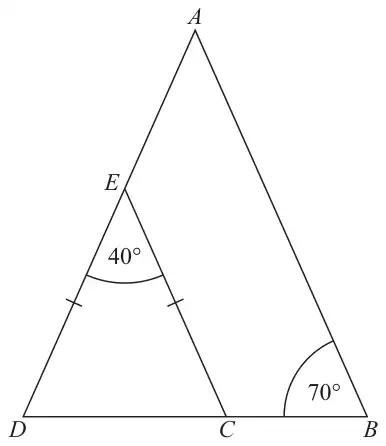
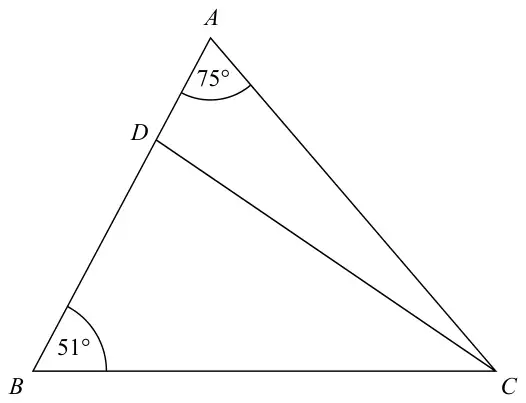
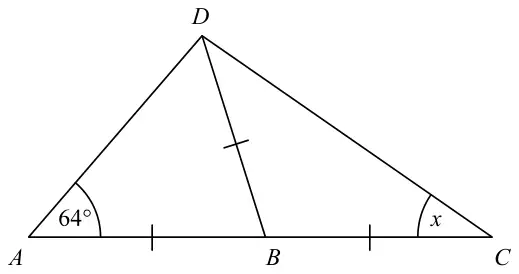
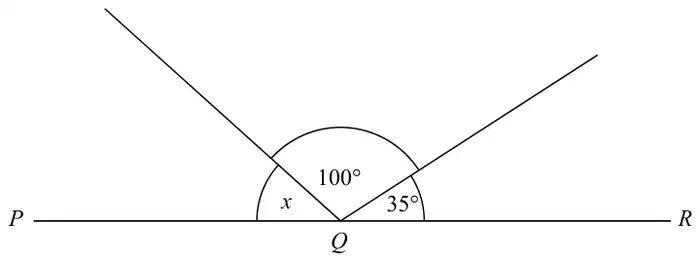
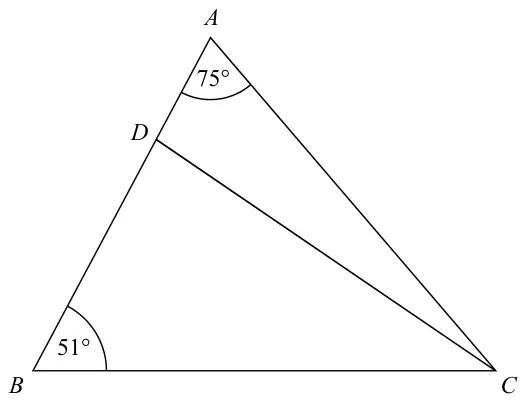
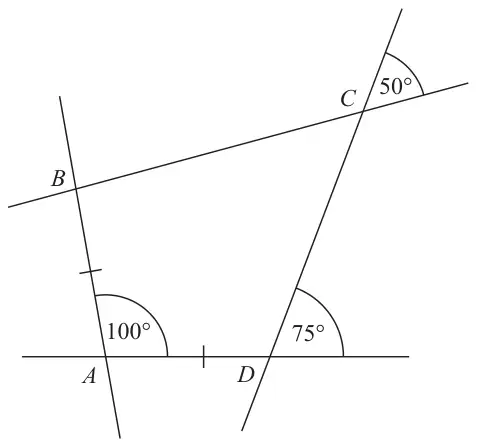
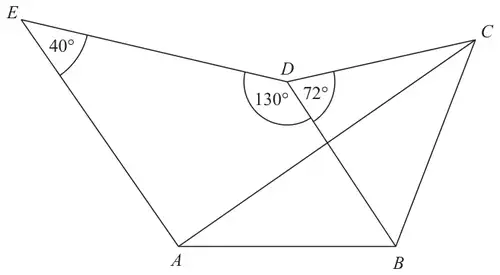
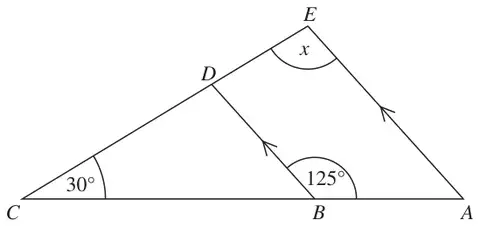
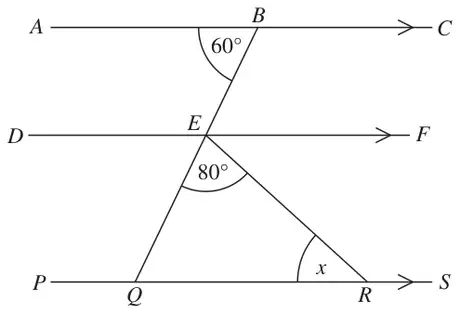
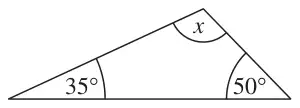
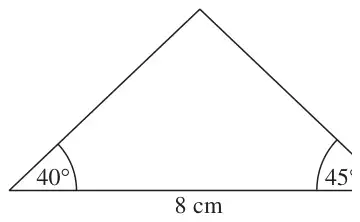
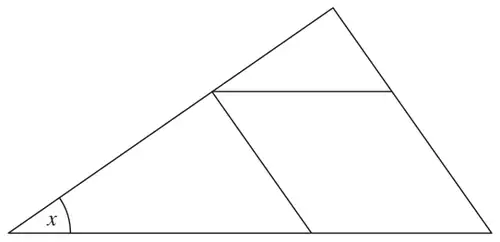
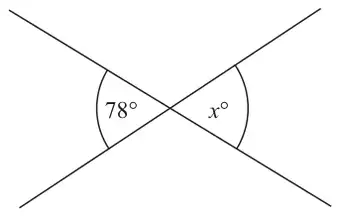
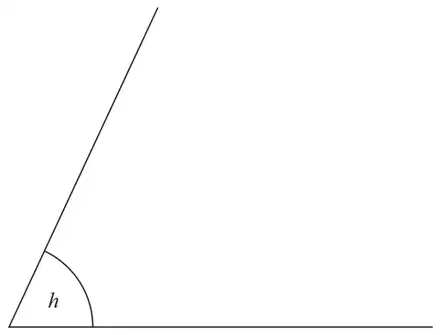
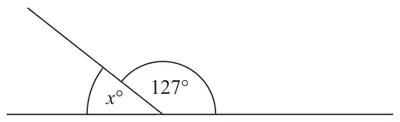
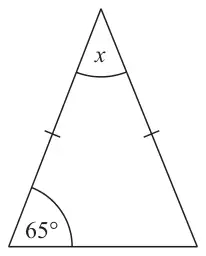
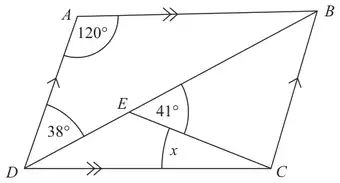
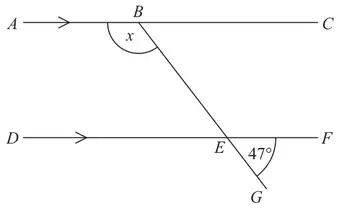
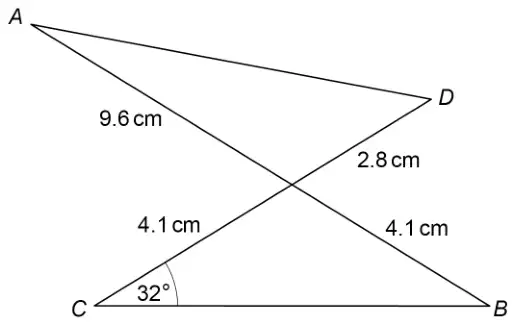
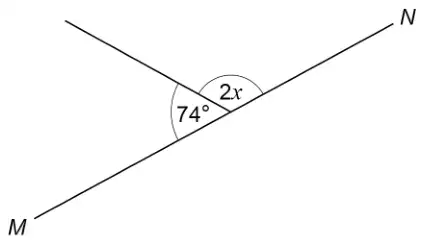
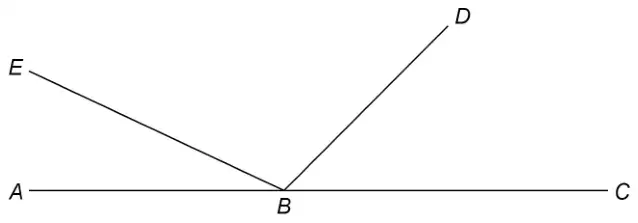
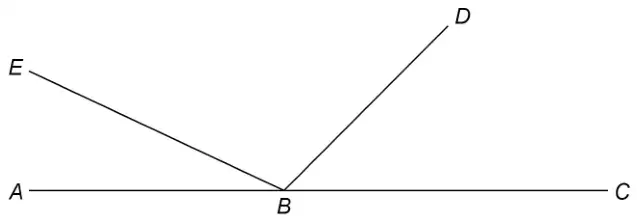
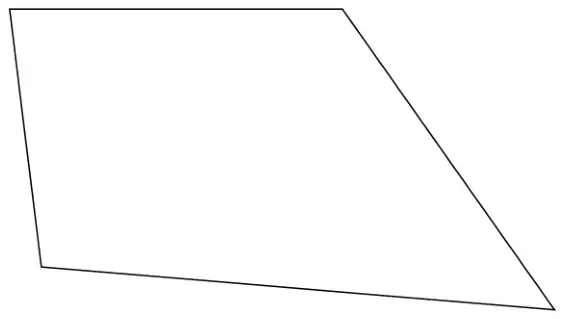
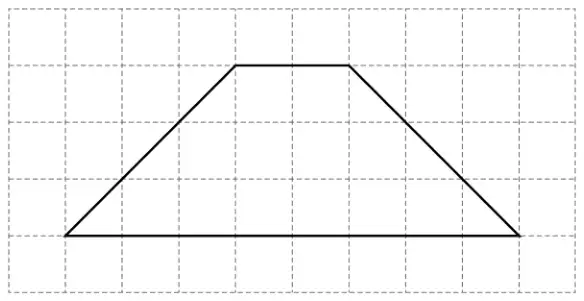
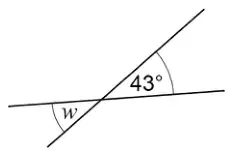
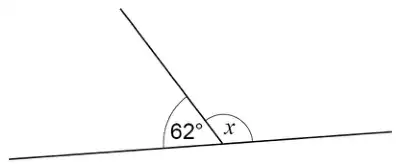
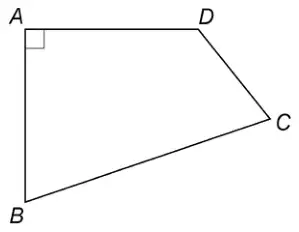
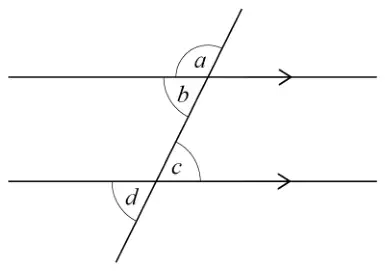
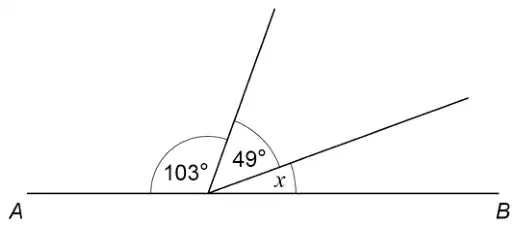
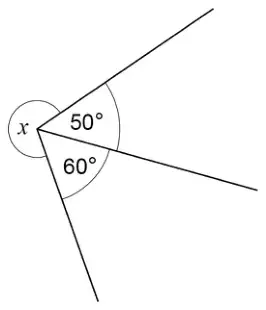
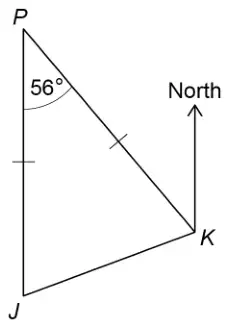
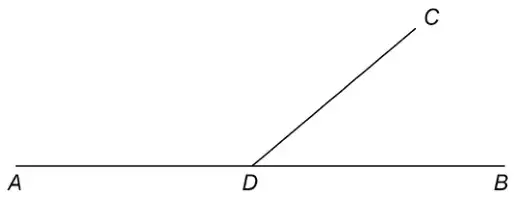
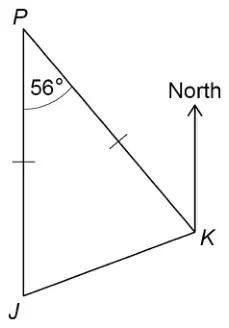
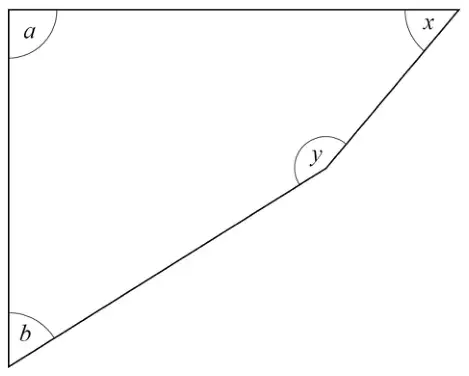
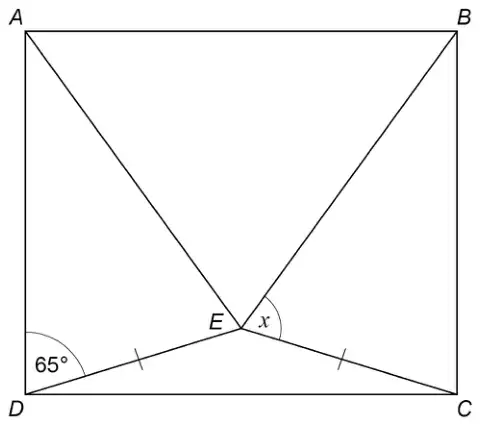
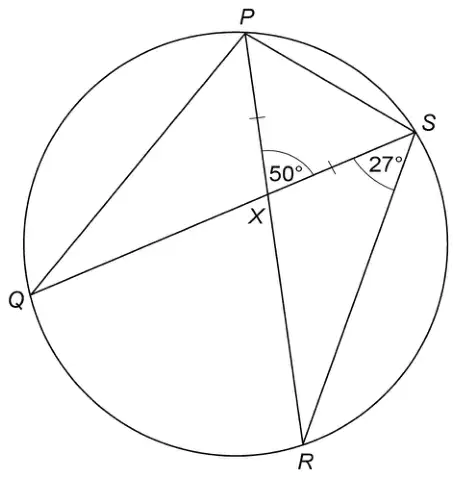
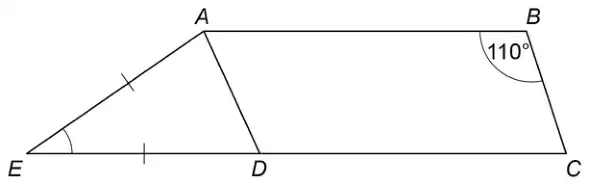
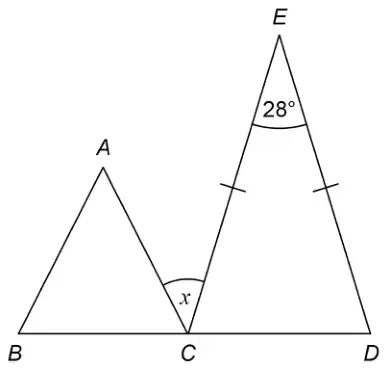
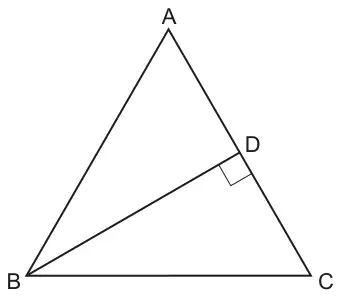
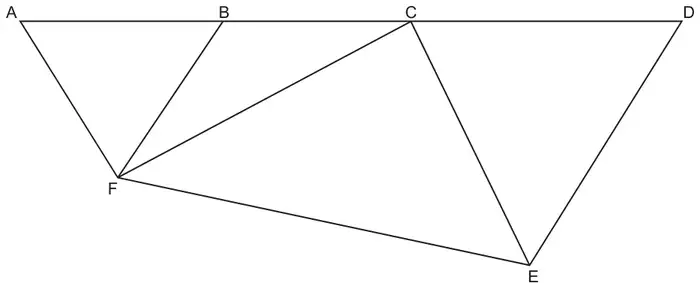
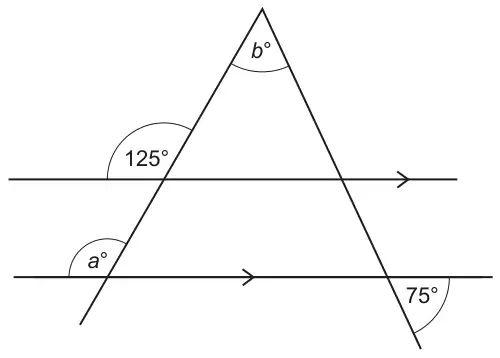
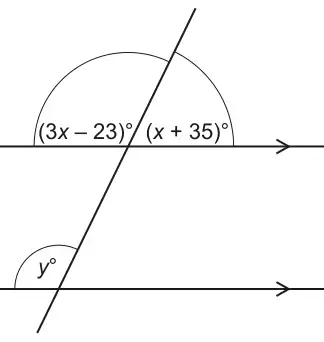
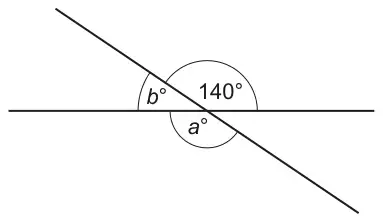
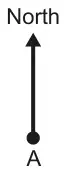
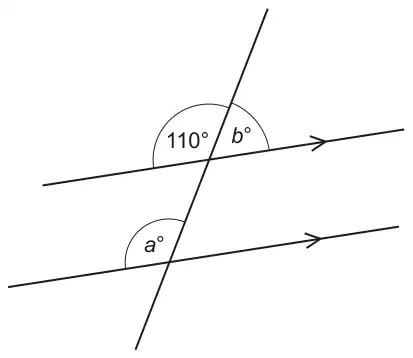
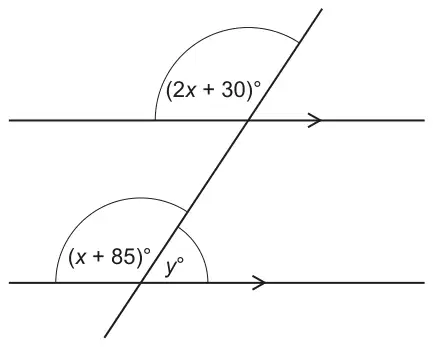
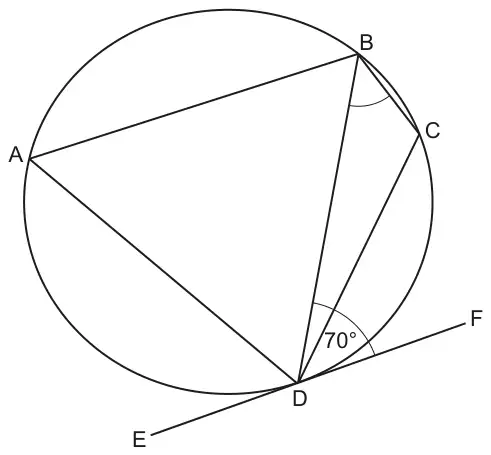
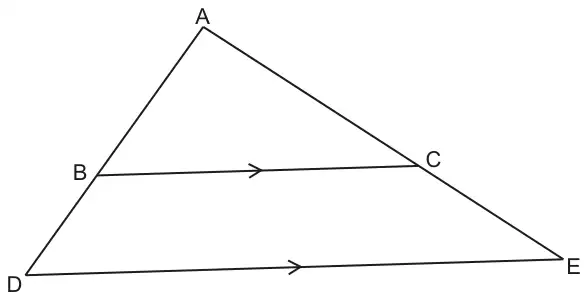
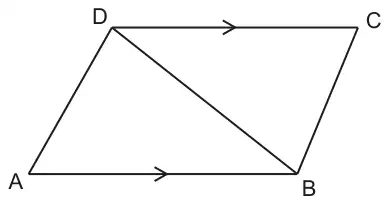
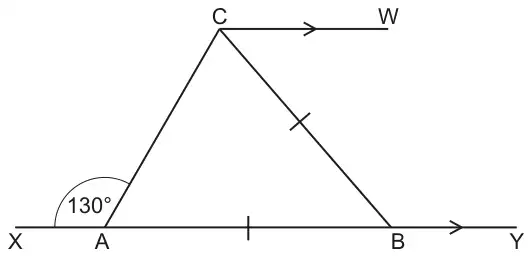
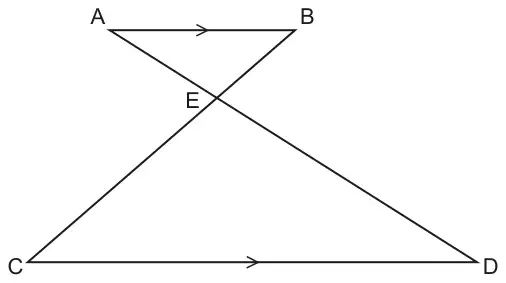
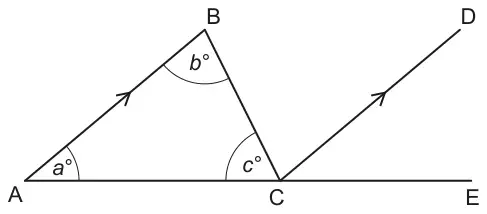
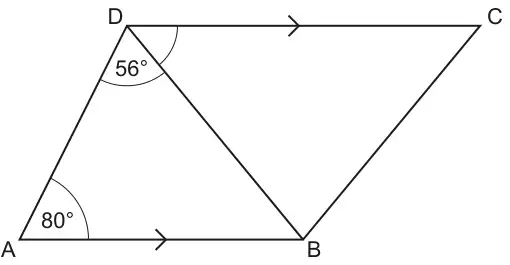
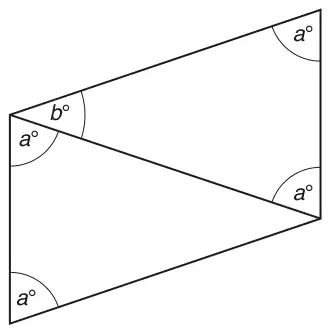
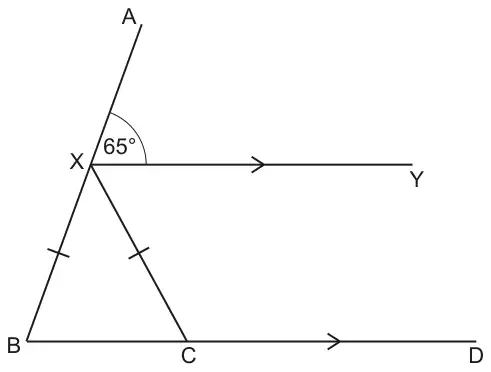
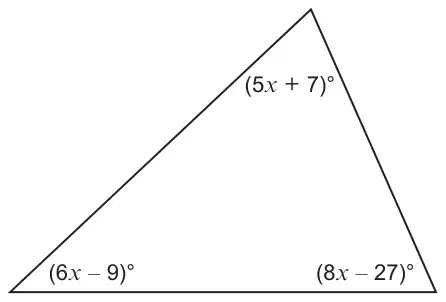
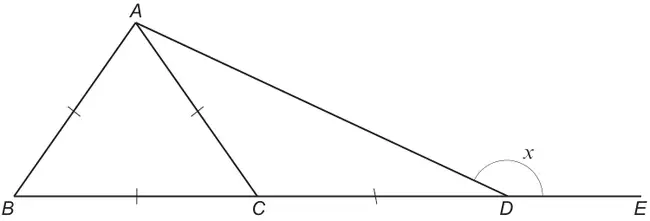
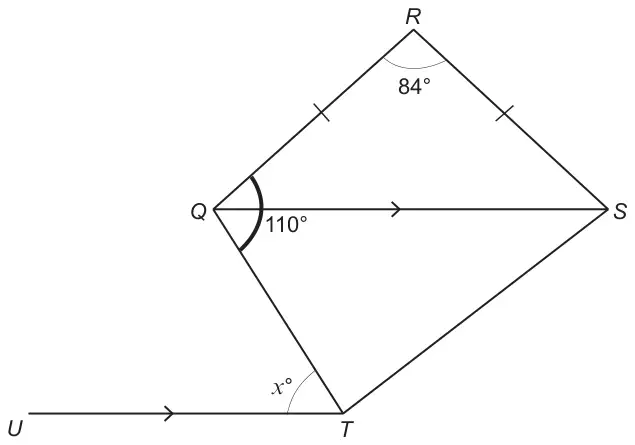
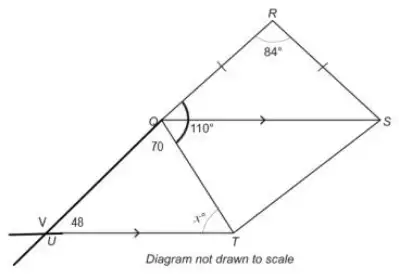
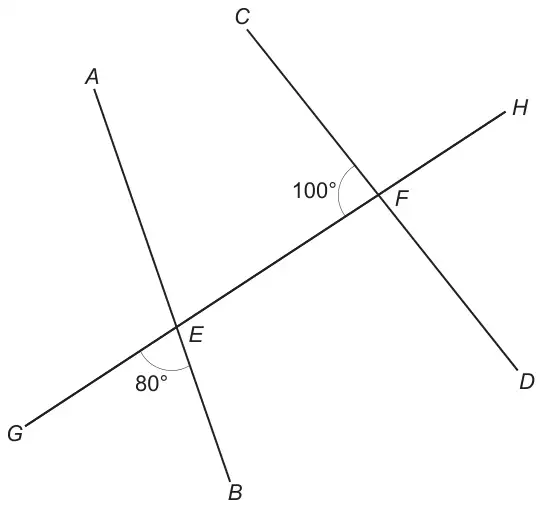
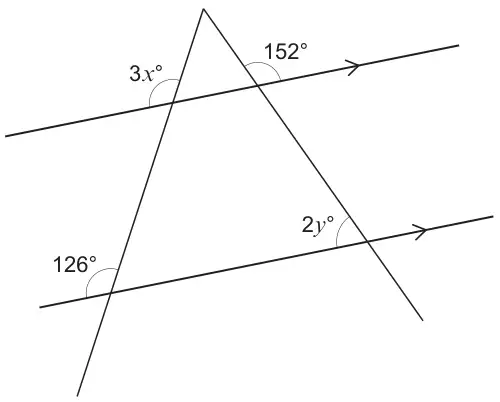
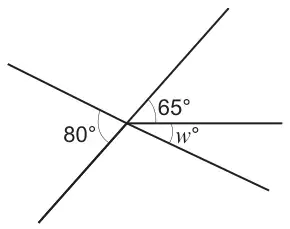
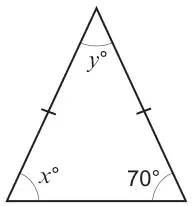
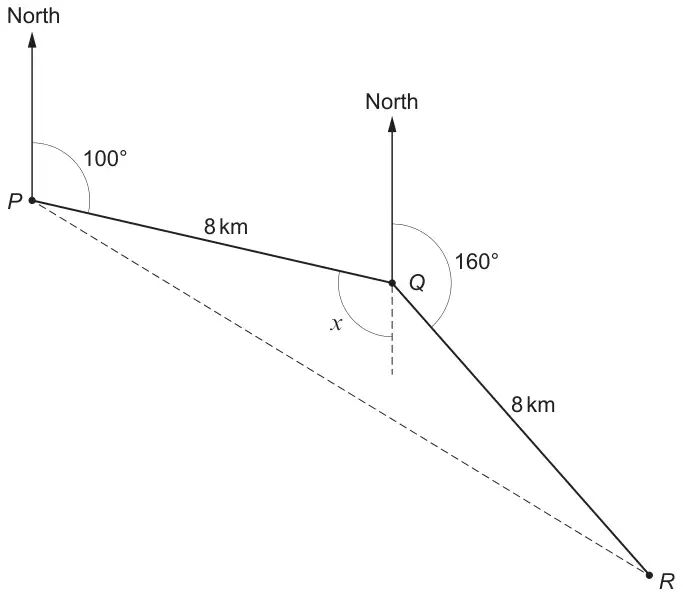
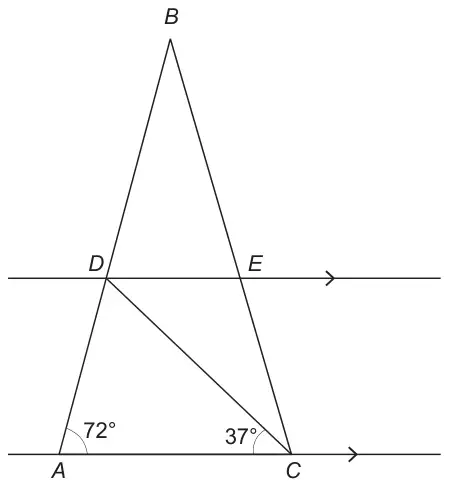
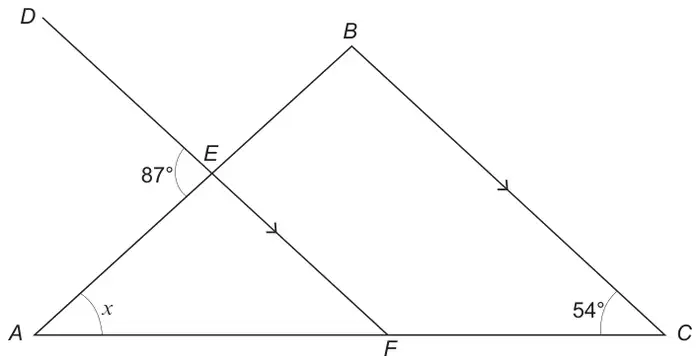
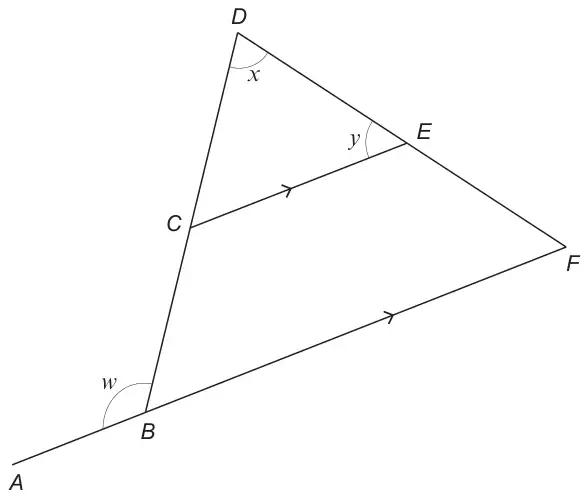
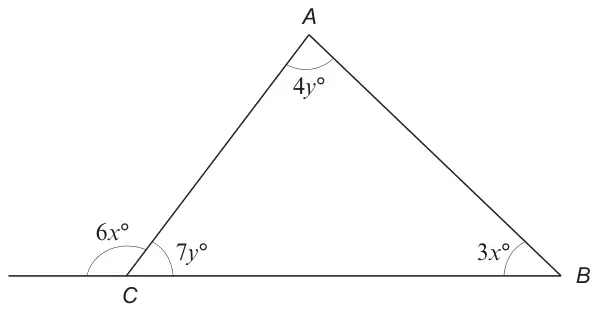
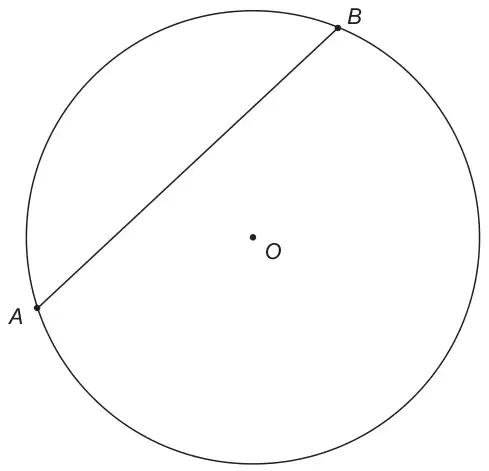
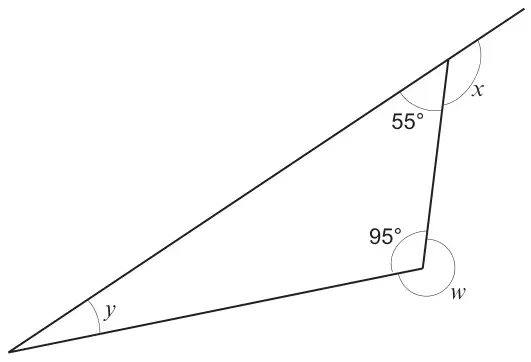
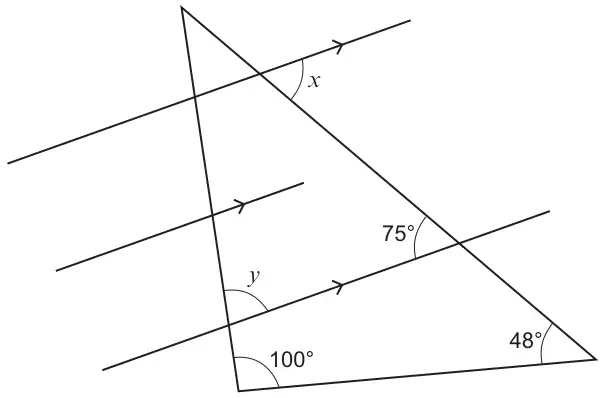
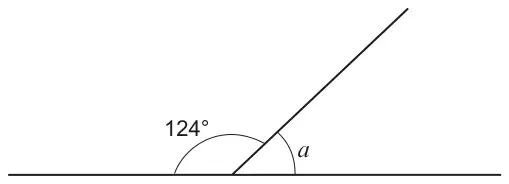
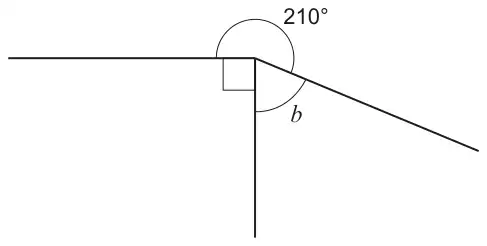
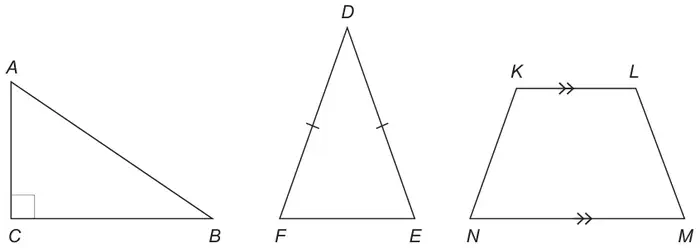
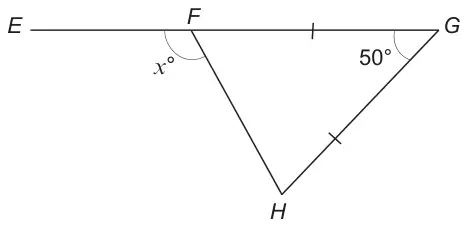
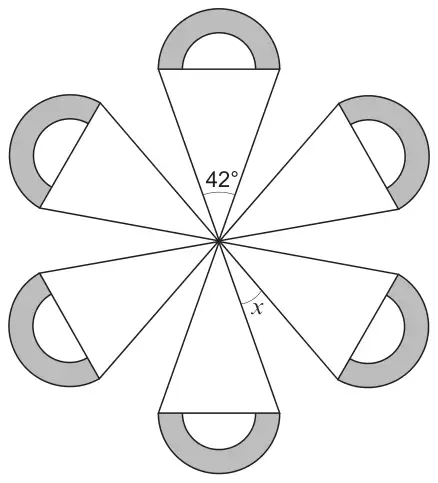
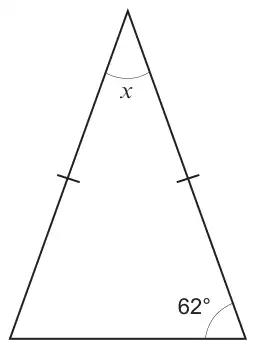
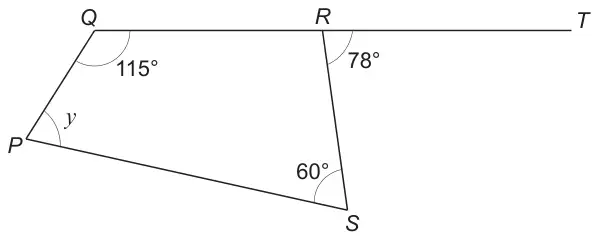
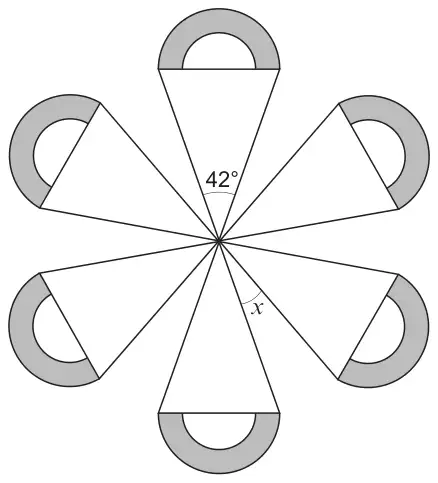
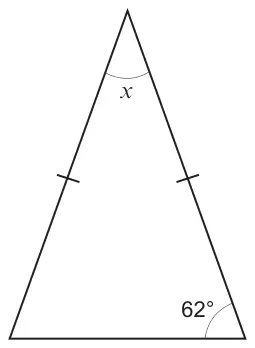
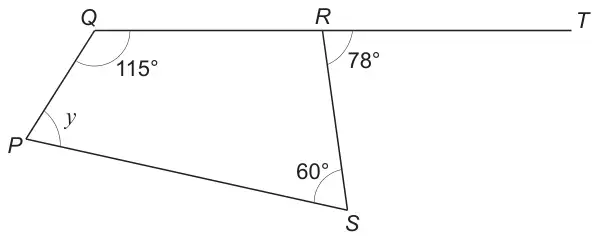
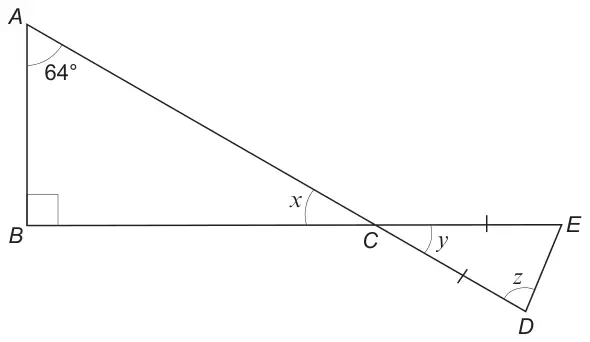
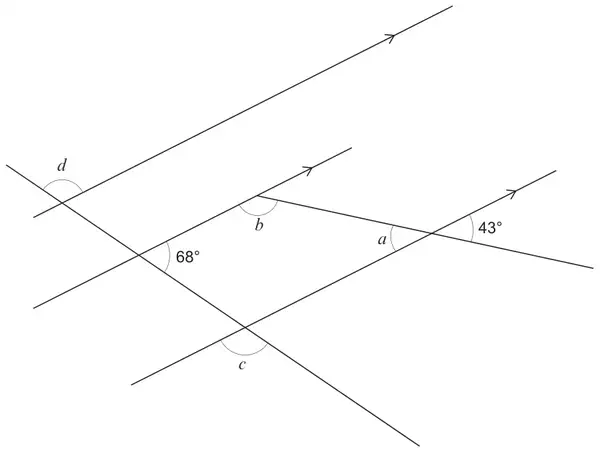
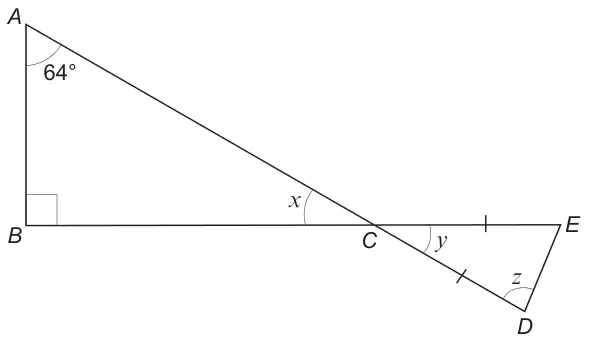
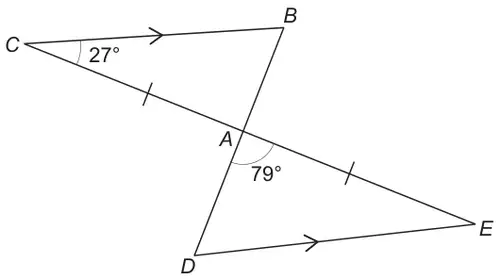
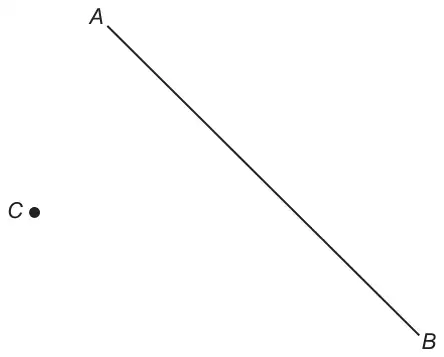
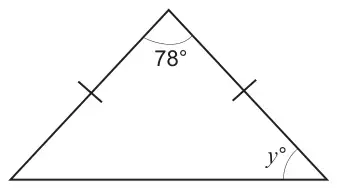
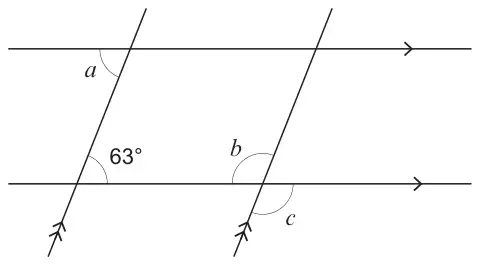
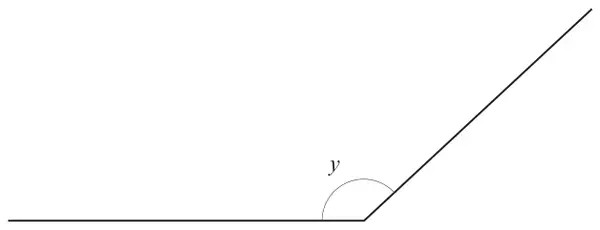
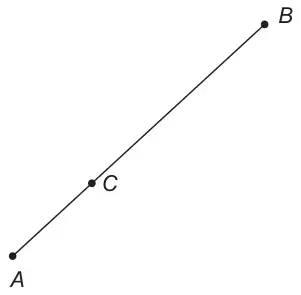
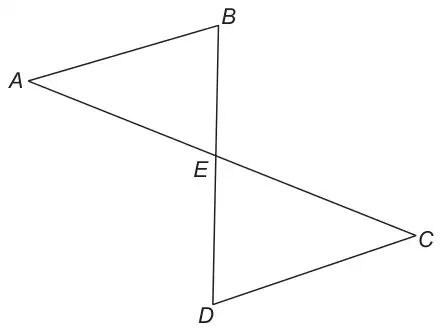
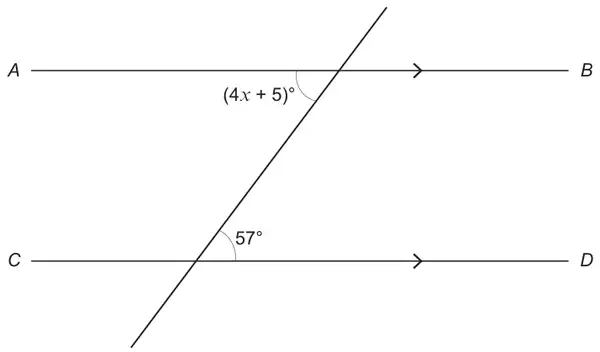
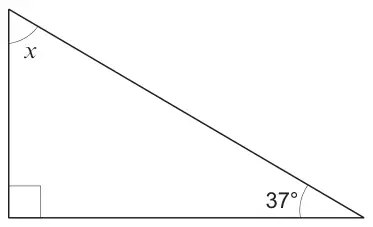
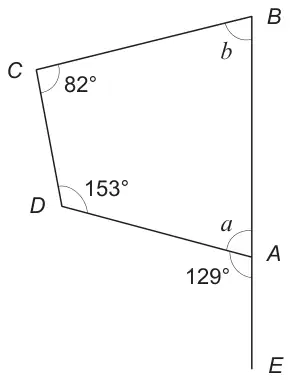
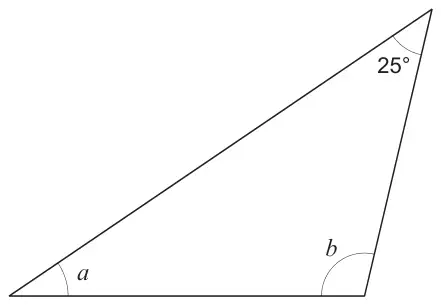
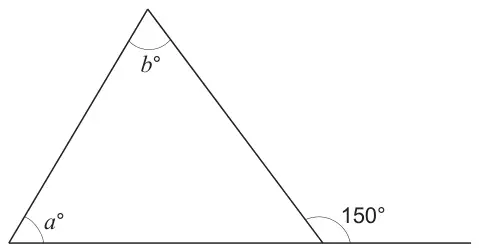
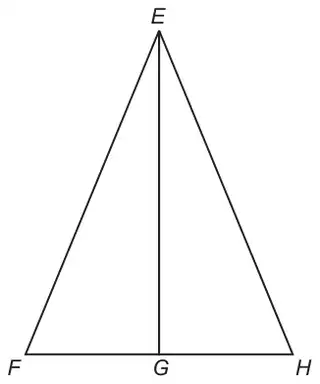
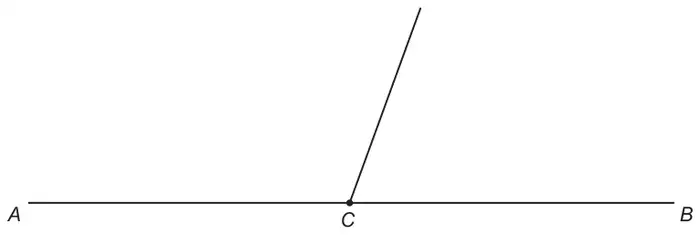
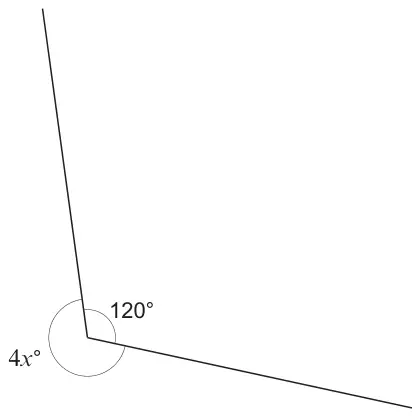
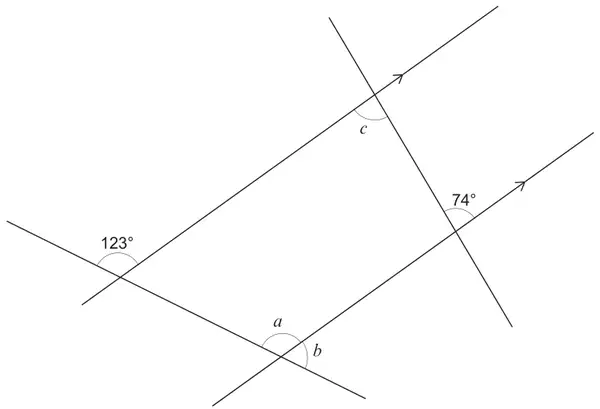
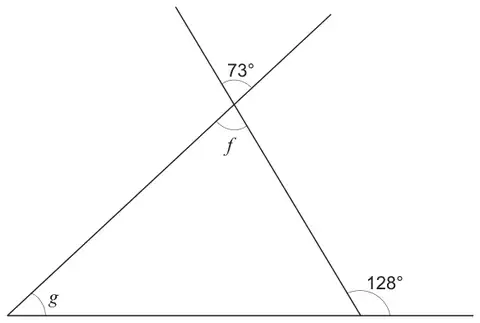
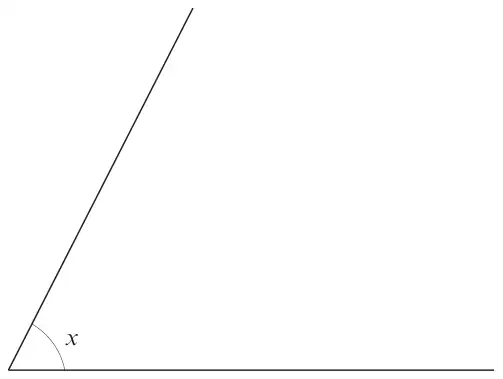
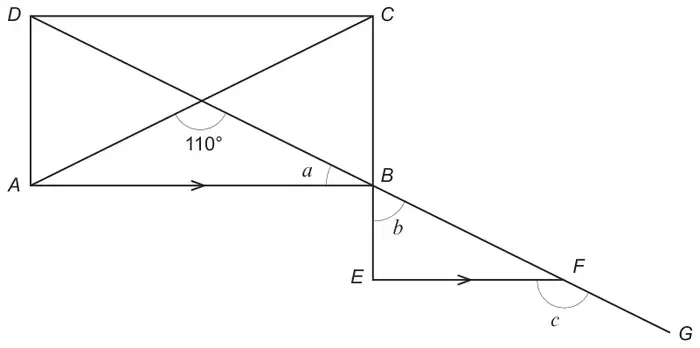
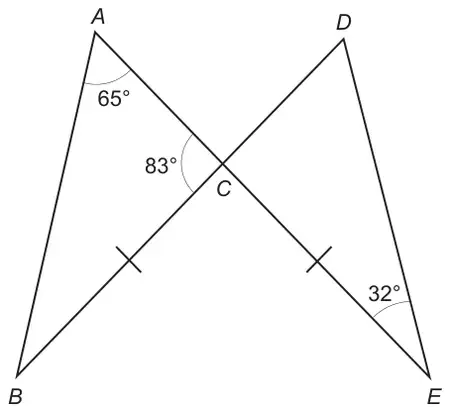
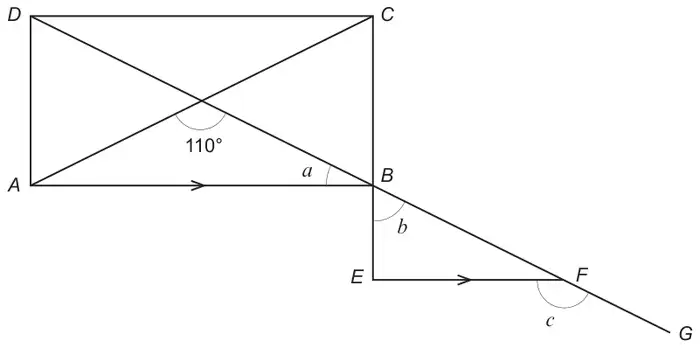
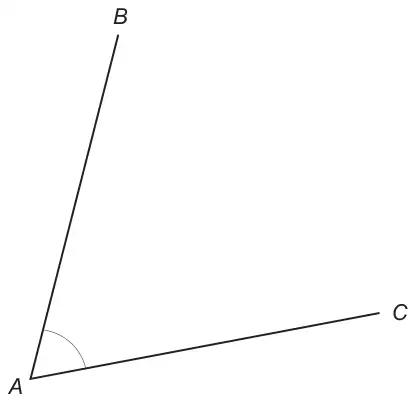
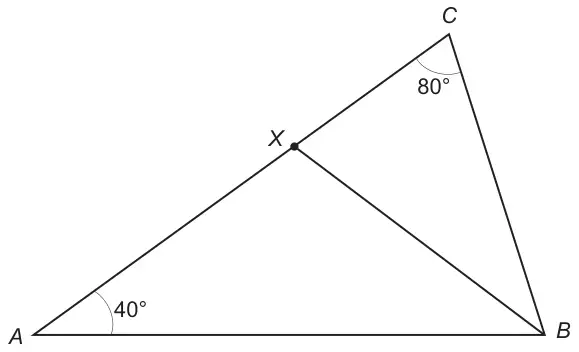
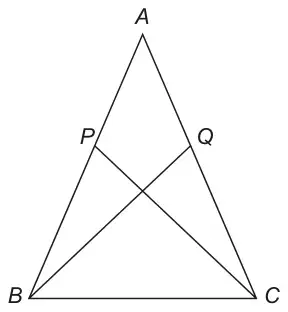
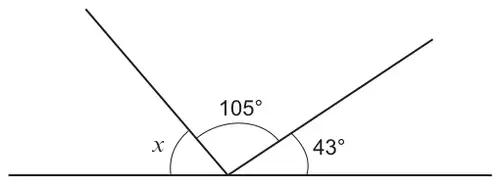
\(AED\) and \(BCD\) are straight lines. \(ED = EC\)
Show that \(EC\) is parallel to \(AB\). Give a reason for each stage of your working. (4)
Mark scheme
Answer
Mark
Mark scheme
Shown
C1
for angle \(ECD = 70\) or for angle \(ADB = 70\) and angle \(DAB = 40\)
C1
for a correct relevant reason relating to finding an angle in a triangle, eg • base angles of an isosceles triangle are equal • sum of angles in a triangle is 180
C1
for comparison of angles which would show that \(EC\) is parallel to \(AB\), eg • angle \(ECD\) = angle \(ABC\) (= 70) • angle \(BAD\) = angle \(CED\) (= 40) • angle \(BCX\) = angle \(ABC\) (= 70) • angle \(AEY\) = angle \(BAD\) (= 40) • angle \(ECB = 110\) and angle \(ECB\) + angle \(CBA = 180\) • angle \(AEC = 140\) and angle \(BAD\) + angle \(AEC = 180\) • angle \(ECD\) = angle \(ABD\) (= 70) and angle \(DAB\) = angle \(DEC\) (= 40)
C1
for a correct reason relating to angles in parallel lines which would show that \(EC\) is parallel to \(AB\), eg • corresponding angles are equal with angle \(ECD\) = angle \(ABC\) (= 70) • corresponding angles are equal with angle \(BAD\) = angle \(CED\) (= 40) • alternate angles are equal with angle \(BCX\) = angle \(ABC\) (= 70) • alternate angles are equal with angle \(AEY\) = angle \(BAD\) (= 40) • co-interior angles add to 180 with angle \(ECB\) + angle \(CBA = 180\) • co-interior angles add to 180 with angle \(BAD\) + angle \(AEC = 180\) • similar triangleswith angle \(ECD\) = angle \(ABD\) (= 70) and angle \(DAB\) = angle \(DEC\) (= 40)
Additional guidance
May be seen on the diagram
Do not award if an incorrect statement about angles in triangles seen.
Allow alternative correct labelling of angles eg angle \(ABD\) for angle \(ABC\) Must be identified in some way, not just angles written on diagram. Angles must be unambiguously identified. Where \(X\) is a point on \(EC\) extended. Where \(Y\) is a point on \(CE\) extended.
Reason must be consistent with their method. If superfluous reasons seen then we need the correct appropriate reason to be linked to the comparison of angles. Incorrect statement(s) seen is maximum 3 marks.
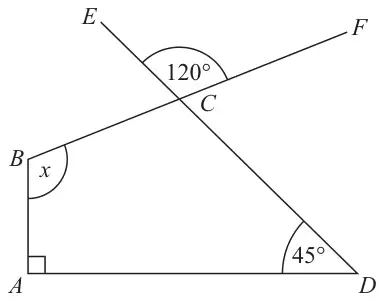
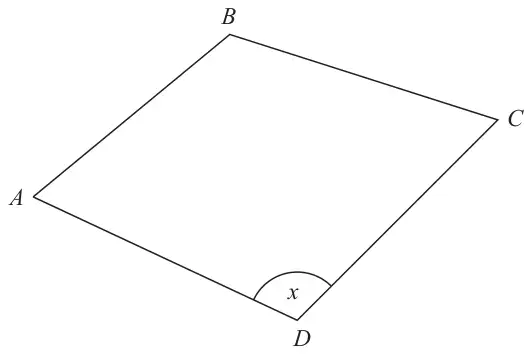
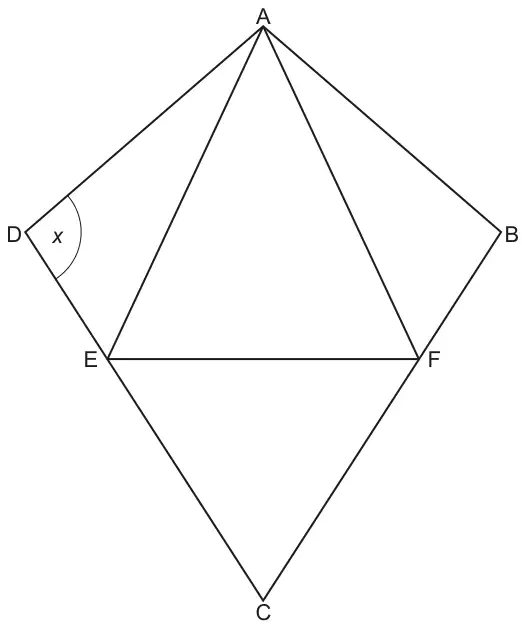
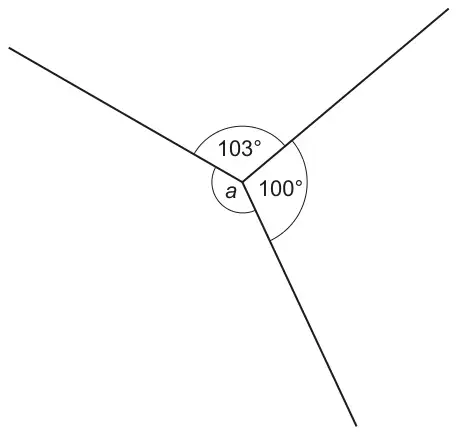
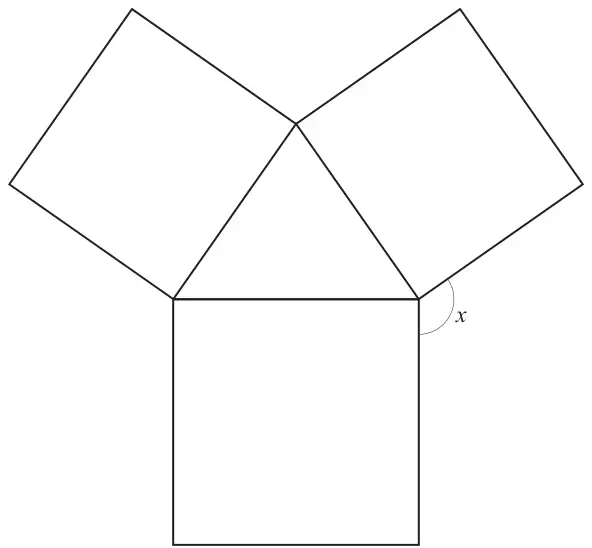
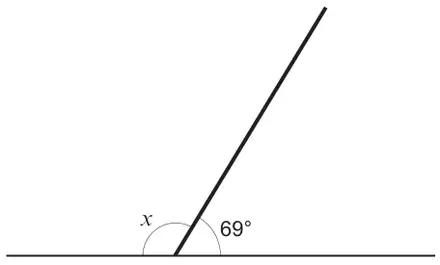
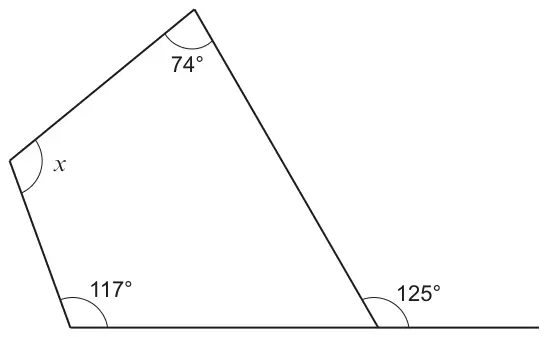
13 \(ABCD\) is a quadrilateral. \(BCF\) and \(DCE\) are straight lines.
Work out the size of the angle marked \(x\). Give a reason for each stage of your working. (4)
Mark scheme
Answer
Mark
Mark scheme
105
M1
for a method to find an unknown angle, eg angle \(BCD = 120\) or angle \(BCD = 360 - 120 - 2 \times (180 - 120)\ (= 120)\) or angle \(BCE = 180 - 120\ (= 60)\) or angle \(DCF = 180 - 120\ (= 60)\)
M1
for a complete method to find the value of \(x\), eg \((x =)\ 360 - \text{``}120\text{''} - 45 - 90\ (= 105)\)
C2
for 105 as the answer and full reasons for their method, eg vertically opposite angles are equal OR vertically opposite angles are equal angles in a quadrilateral add up to 360 or angles on a straight line add up to 180 angles at a point add up to 360 angles in a quadrilateral add up to 360 or angles on a straight line add up to 180 angles in a quadrilateral add up to 360
(C1
(dep M1) for one correct reason)
Additional guidance
Angles may be seen on diagram. Angles must be clearly labelled on the diagram or otherwise identified.
Underlined words need to be shown; reasons need to be linked to their method; if student gives any reasons not linked to their method, award maximum C1 only
Accept “\(\angle\)s” for “angles” Accept “4-sided shape” for “quadrilateral”
For C1, ignore any reasons not linked to their method
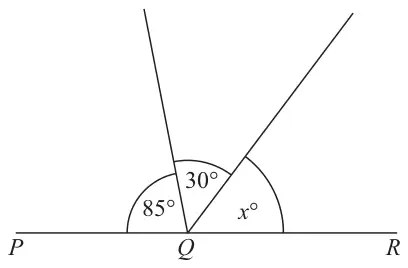
for a complete method eg \(180 - 85 - 30\) or \(360 - 180 - 85 - 30\)
A1
cao
(ii) Reason
C1
for Angles on a straight line add up to 180 orAngles at a point add up to 360
Additional guidance
(i) May be seen on the diagram \(85 + 30 + 65 = 180\) scores M1A0 unless 65 clearly identified
(ii) Reason must be for their chosen method If M0 awarded in (i) answer must be in the range 35 to 95 to award C1 Underlined words must be seen Condone use of \(\angle\)s for angles
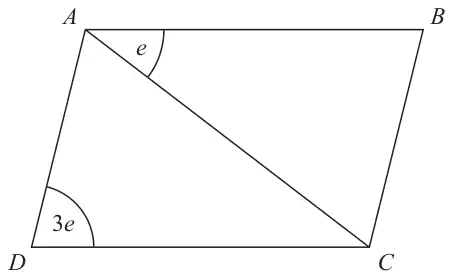
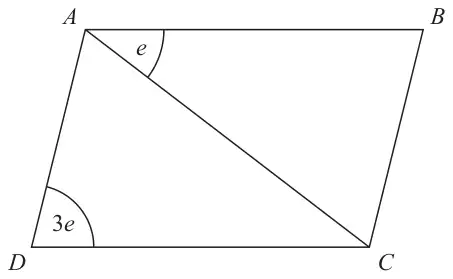
Find an expression, in terms of \(e\), for the size of angle \(CAD\). Give a reason for each stage of your working. (3)
Mark scheme
Answer
Mark
Mark scheme
\(180 - 4e\) and reason
M1
for angle \(ACD = e\)
or for angle \(ADC\) + angle \(BAD = 180\)
or for angle \(BAX = 3e\) (where \(X\) lies on \(DA\) extended)
A1
for \(180 - 4e\) oe
C1
(dep M1) for an appropriate reason relating to parallel lines from alternate angles are equal or allied angles / co-interior angles add up to 180 or for corresponding angles are equal
Additional guidance
Angles must be clearly labelled on the diagram or otherwise identified
May be unsimplified
Underlined words need to be shown Reason needs to be linked to their method, which can be implied from correctly identified angles (stated or written on the diagram)
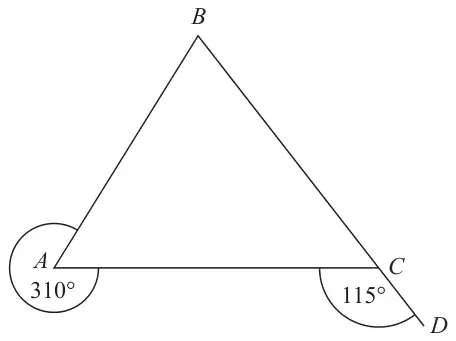
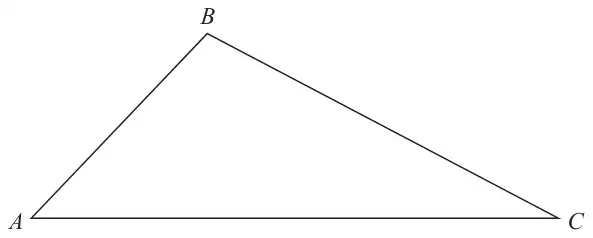
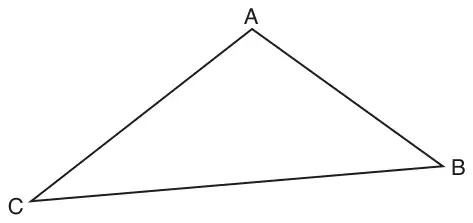
Show that triangle \(ABC\) is isosceles. Give a reason for each stage of your working. (4)
Mark scheme
Answer
Mark
Mark scheme
Shown
M1
for a method leading to the evaluation of another angle, (\(BAC =\)) \(360 - 310\ (= 50)\) or (\(ACB =\)) \(180 - 115\ (= 65)\)
M1
for a method to find at least 2 angles, eg (\(BAC =\)) \(360 - 310\ (= 50)\) and (\(ACB =\)) \(180 - 115\ (= 65)\)
C2
(dep M2) \(CBA = 65^\circ\) and statement and appropriate angle reasons, eg statement \(ACB = CBA\ (= 65^\circ)\) or two angles are equal (so it is isosceles) and angles at a point add up to 360, angles on a straight line add up to 180, angles in a triangle add up to 180,
OR (dep M2) \(CBA = 65^\circ\) and statement and appropriate angle reasons, eg statement \(ACB = CBA\ (= 65^\circ)\) or two angles are equal (so it is isosceles) and the exterior angle of a triangle is equal to the sum of the interior opposite anglesandangles on a straight line add up to 180 orangles in a triangle add up to 180
(C1
(dep on M1) for any one appropriate reason related to method shown)
Additional guidance
Angles may be seen on diagram
Underlined words need to be shown; reasons need to be linked to their method.
Find an expression, in terms of \(e\), for the size of angle \(CAD\). Give a reason for each stage of your working. (3)
Mark scheme
Answer
Mark
Mark scheme
\(180 - 4e\) and reason
M1
for angle \(ACD = e\)
or for angle \(ADC\) + angle \(BAD = 180\)
or for angle \(BAX = 3e\) (where \(X\) lies on \(DA\) extended)
A1
for \(180 - 4e\) oe
C1
(dep M1) for an appropriate reason relating to parallel lines from eg alternate angles are equal or allied angles / co-interior angles add up to 180 or for corresponding angles are equal
Additional guidance
Angles must be clearly labelled on the diagram or otherwise identified
May be unsimplified
Underlined words need to be shown Reason needs to be linked to their method, which can be implied from correctly identified angles (stated or written on the diagram)
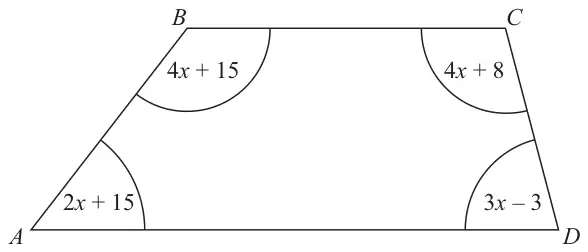
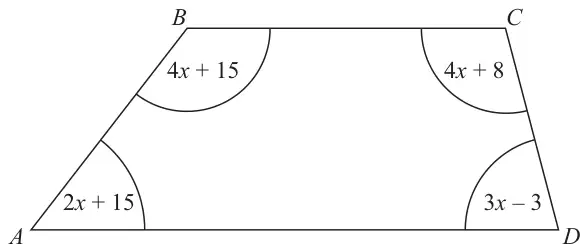
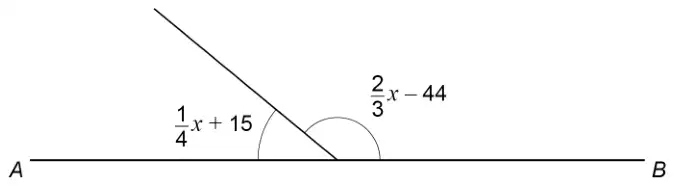
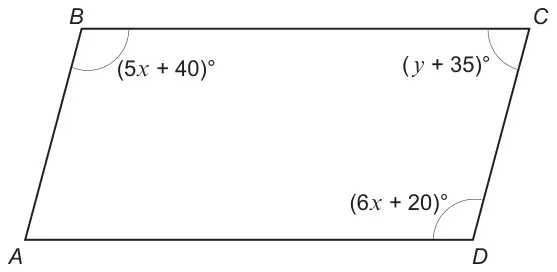
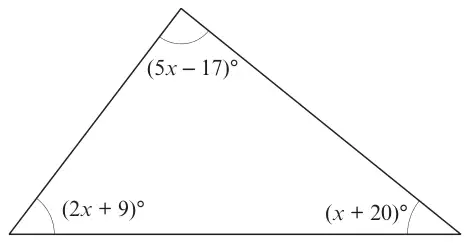
for deriving a suitable equation, eg \(4x + 15 + 2x + 15 + 4x + 8 + 3x - 3 = 360\) or \(13x + 35 = 360\) or \(4x + 15 + 2x + 15 = 180\) or \(6x + 30 = 180\) or \(4x + 8 + 3x - 3 = 180\) or \(7x + 5 = 180\)
M1
(dep) for a method to isolate terms in \(x\), eg \(4x + 2x + 4x + 3x = 360 - 15 - 15 - 8 + 3\) or \(4x + 2x = 180 - 15 - 15\) or \(4x + 3x = 180 - 8 + 3\)
A1
for solving equation to \(x = 25\)
C1
for substituting \(x = 25\) into \(A + B\) or \(C + D\) and showing \(= 180\), and gives a suitable statement, eg co-interior/allied angles (sum to 180), or since \(A + B = 180\) the lines are parallel
Additional guidance
May be seen in an equation
If starting with an equation = 180 need to substitute into the opposite pair.
Alternative solution assuming it is a trapezium
Answer
Mark
Mark scheme
Shown
M1
for deriving a suitable equation, eg \(4x + 15 + 2x + 15 = 4x + 8 + 3x - 3\) or \(6x + 30 = 7x + 5\)
M1
(dep) for a method to isolate terms in \(x\), eg \(15 + 15 - 8 + 3 = 4x + 3x - 4x - 2x\)
A1
for solving equation to \(x = 25\)
C1
for a fully correct statement, eg since \(A + B = 180\) the lines are parallel
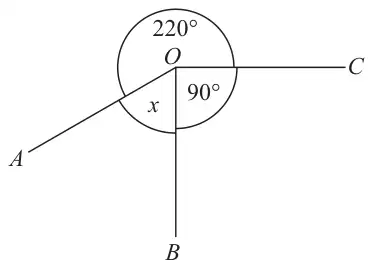
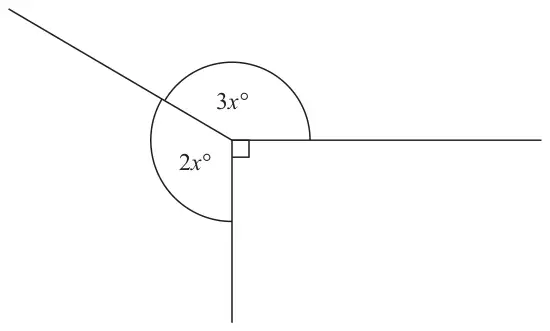
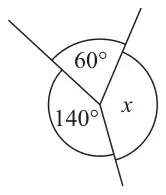
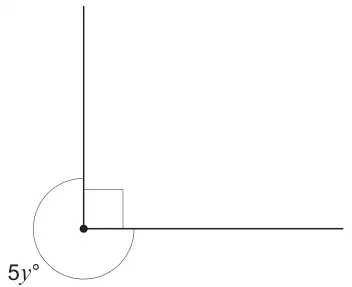
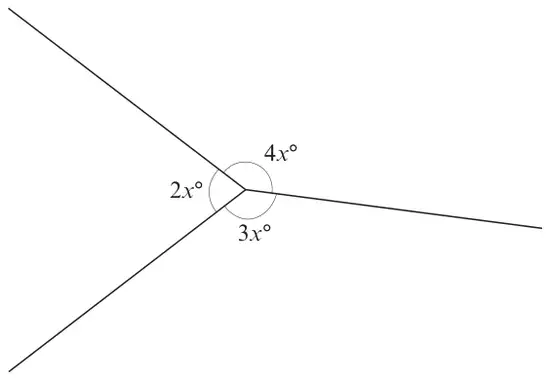
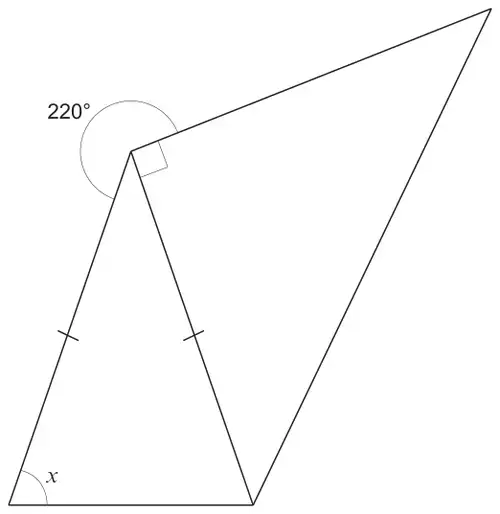
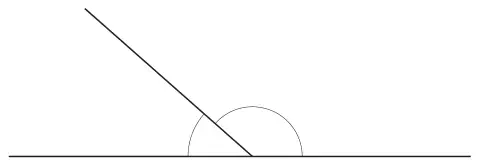
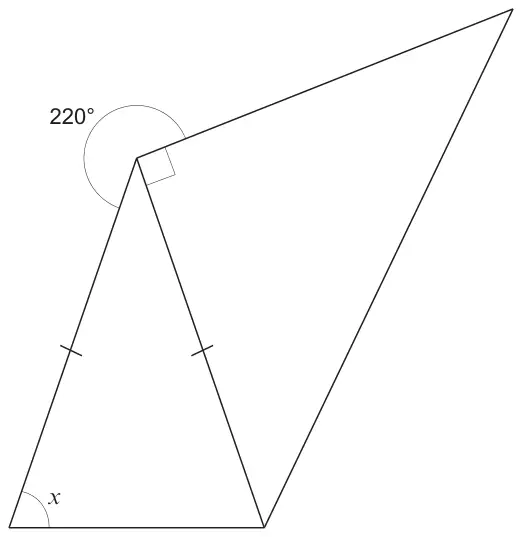
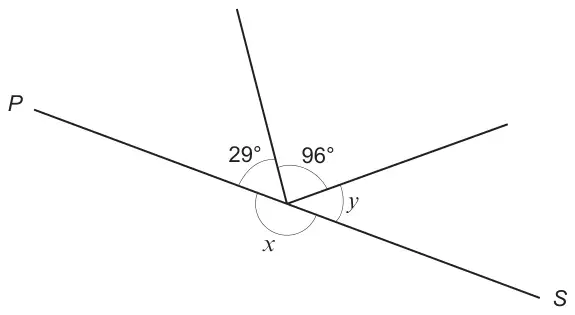
8 \(OA\), \(OB\) and \(OC\) are three straight lines.
(i) Work out the size of the angle marked \(x\). (2)
(ii) Give a reason for your answer. (1)
Mark scheme (i)
Answer
Mark
Mark scheme
50
M1
for \(360 - 220 - 90\) oe
A1
cao
Mark scheme (ii)
Answer
Mark
Mark scheme
Reason
C1
for angles at a point add up to 360
Acceptable examples • A full turn adds up to 360 • Full rotation is 360
Not acceptable examples • Angles in a circle add to 360 • A whole circle adds up to 360 • It must add up to 360 degrees • \(220 + 90 = 310,\ 360 - 310\) • Angles at a point add up to 180 • Angles on a straight line add to 180
Additional guidance
Underlined words need to be shown
Note: If line \(AO\) or \(OC\) or \(BO\) is extended and used to find \(x\) in (i) then allow C1 for angles on a straight line add to 180
(dep) for a method to isolate terms in \(x\), eg \(4x + 2x + 4x + 3x = 360 - 15 - 15 - 8 + 3\) or \(4x + 2x = 180 - 15 - 15\) or \(4x + 3x = 180 - 8 + 3\)
A1
for solving equation to \(x = 25\)
C1
for substituting \(x = 25\) into \(A + B\) or \(C + D\) and showing = 180, and gives a suitable statement, eg co-interior/allied angles (sum to 180), or since \(A + B = 180\) the lines are parallel
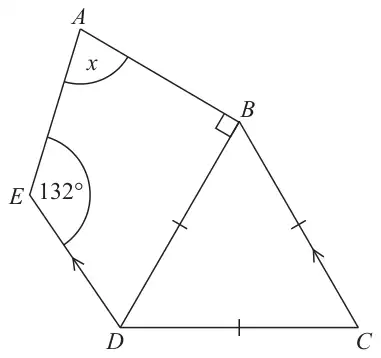
19 The diagram shows a quadrilateral \(ABDE\) and an equilateral triangle \(BCD\).
\(CB\) is parallel to \(DE\).
Angle \(AED\) = 132°
Work out the size of the angle marked \(x\). You must give a reason for each stage of your working. (4)
Mark scheme
Answer
Mark
Mark scheme
78
M1
for finding one angle within the triangle is \(180 \div 3\ (= 60)\)
M1
for method to use parallel lines, eg \(BDE = DBC\) or \(BCD + CDE = 180\)
C2
(dep M2) for (\(x =\)) 78 with a correct reason relating to parallel lines and one other correct reason given, with no unused reasons.
(C1
(dep M1) for one correct reason given for their chosen method,
angles in an equilateral triangle are equal alternate angles are equal angles in a quadrilateral add up to 360 angles in a triangle add up to 180 Allied angles / Co-interior angles add up to 180
Additional guidance
Angles must be clearly labelled on the diagram or otherwise identified. Correct method can be implied from angles on the diagram if no ambiguity or contradiction. If \(x\) is clearly identified as 78 award M2 (implied)
Underlined words need to be shown; reasons need to be linked to their method, which can be implied from correctly identified angles (stated or written on the diagram).
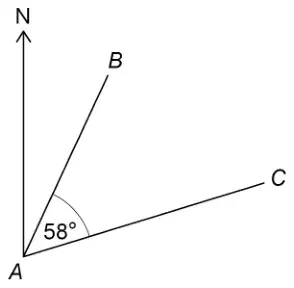
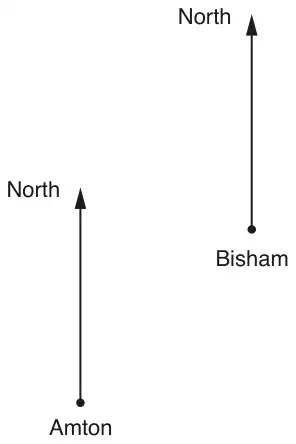
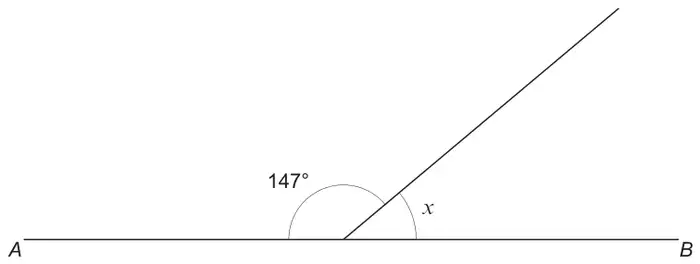
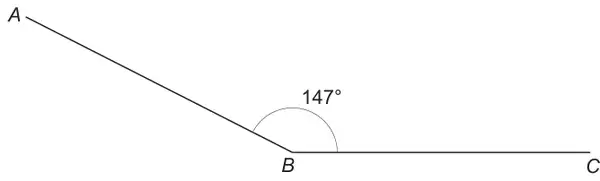
6 The bearing of port \(B\) from port \(A\) is 147°
Work out the bearing of port \(A\) from port \(B\). (2)
Mark scheme
Answer
Mark
Mark scheme
327
M1
for \(147 + 180\) or for \(360 - (180 - 147)\), or for drawing a suitable diagram with 147 in the correct position and with the bearing of A from B indicated
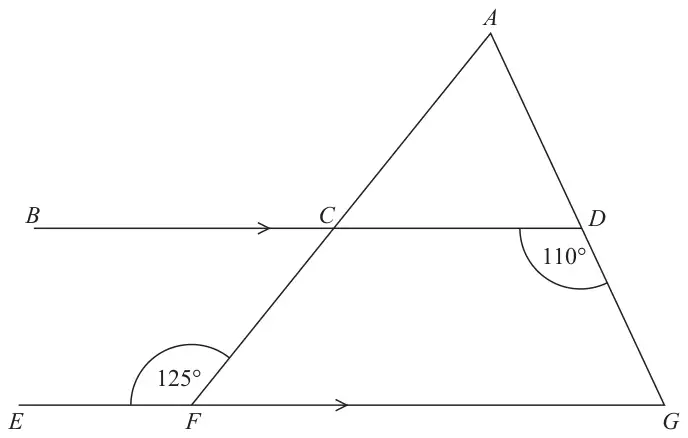
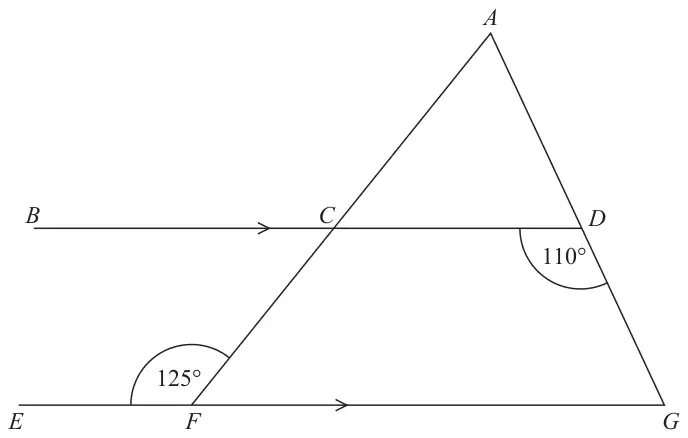
22 \(ACF\) and \(ADG\) are straight lines. \(BCD\) and \(EFG\) are parallel lines.
Show that triangle \(ACD\) is isosceles. Give a reason for each stage of your working. (5)
Mark scheme
Answer
Mark
Mark scheme
Shown with reasons
M1
for method to find \(ACD\) using parallel lines eg \(BCA = 125\) and \(ACD = 180 - 125\ (= 55)\) or \(BCF = 180 - 125\ (= 55) = ACD\) or \(FCD = 125\) and \(ACD = 180 - 125\ (= 55)\) or \(CFG = 180 - 125\ (= 55) = ACD\)
M1
for method to find \(ADC\) eg \(180 - 110\ (= 70)\) or for method to find \(CAD\) eg \(180 - (\text{``}70\text{''} + \text{``}55\text{''})\ (= 55)\) or \(110 - \text{``}55\text{''}\ (= 55)\)
A1
for \(ACD = 55\) and \(CAD = 55\)
C1
for one correct parallel lines reason linked to their method eg Corresponding angles are equal Allied angles / Co-interior angles add up to 180 Alternate angles are equal
C1
for one other reason stated linked to their method eg Angles on a straight line add up to 180 Angles in a triangle add up to 180 Vertically opposite angles are equal OR Vertically opposite angles are equal The exterior angle of a triangle is equal to the sum of the interior opposite angles. Angles in a quadrilateral add up to 360. Accept “4-sided shape”
Additional guidance
Angles must be clearly labelled on the diagram or otherwise identified. Correct method can be implied from angles on the diagram if no ambiguity or contradiction.
Underlined words need to be shown; reasons need to be linked to their method, which can be implied from correctly identified angles (stated or written on the diagram).
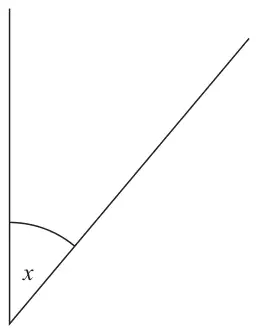
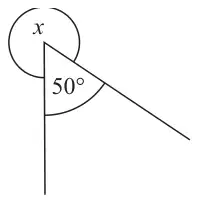
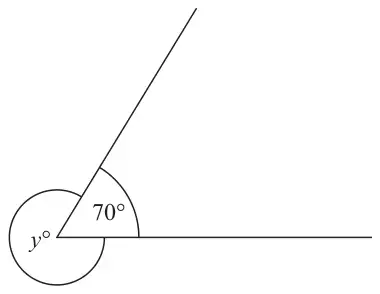
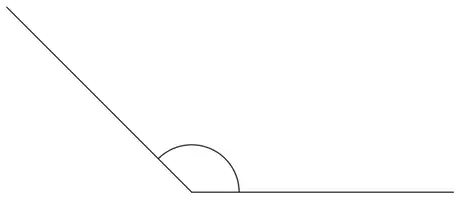
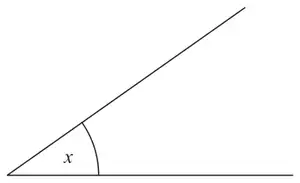
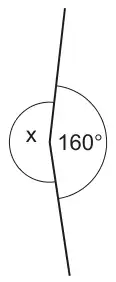
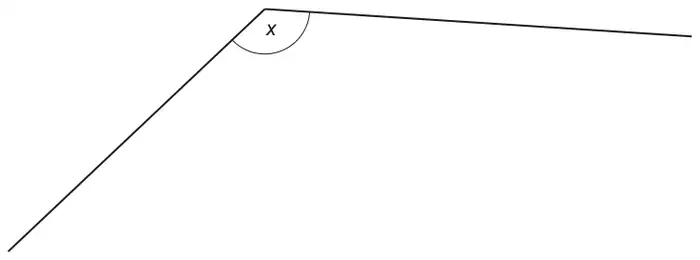
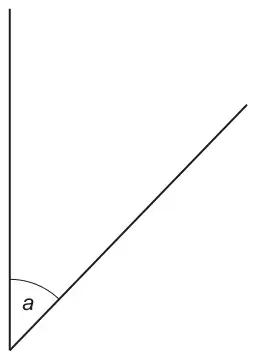
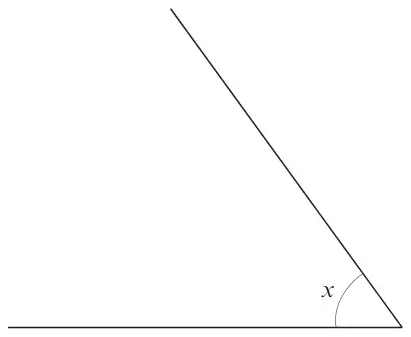
(a) Work out the size of the angle marked \(x\). (2)
A student says that an angle of \(50^\circ\) is an obtuse angle.
The student is wrong.
(b) Explain why. (1)
Mark scheme (a)
Answer
Mark
Mark scheme
310
M1
for \(360 - 50\)
A1
cao
Mark scheme (b)
Answer
Mark
Mark scheme
Explanation
C1
for explanation relating to the type of angle \(50^\circ\) is, or an explanation why it is not an obtuse angle
Acceptable examples It’s \((50^\circ)\) an acute angle an angle below 90 is acute because it \((50^\circ)\) is less than 90 It \((50^\circ)\) is too small to be an obtuse angle an obtuse angle is greater than 90 (but less than 180) an obtuse angle is greater than 50
Not acceptable examples because \(50^\circ\) is not an obtuse angle an angle of \(50^\circ\) is a reflex angle an obtuse angle is all angles greater than 90 an obtuse angle is an angle greater than 120 an obtuse angle is 90 or more
Additional guidance
Do not accept contradictions in the answer, eg. “an obtuse angle is greater than 180 so 50 is an acute angle” or “an obtuse angle is greater than 90 and less than 270”
3 \(ACF\) and \(ADG\) are straight lines. \(BCD\) and \(EFG\) are parallel lines.
Show that triangle \(ACD\) is isosceles. Give a reason for each stage of your working. (5)
Mark scheme
Answer
Mark
Mark scheme
Shown with reasons
M1
for method to find \(ACD\) using parallel lines eg \(BCA = 125\) and \(ACD = 180 - 125\ (= 55)\) or \(BCF = 180 - 125\ (= 55) = ACD\) or \(FCD = 125\) and \(ACD = 180 - 125\ (= 55)\) or \(CFG = 180 - 125\ (= 55) = ACD\)
M1
for method to find \(ADC\) eg \(180 - 110\ (= 70)\) or for method to find \(CAD\) eg \(180 - (\text{``}70\text{''} + \text{``}55\text{''})\ (= 55)\) or \(110 - \text{``}55\text{''}\ (= 55)\)
A1
for \(ACD = 55\) and \(CAD = 55\)
C1
for one correct parallel lines reason linked to their method eg Corresponding angles are equal Allied angles / Co-interior angles add up to 180 Alternate angles are equal
C1
for one other reason stated linked to their method eg Angles on a straight line add up to 180 Angles in a triangle add up to 180 Vertically opposite angles are equal OR Vertically opposite angles are equal The exterior angle of a triangle is equal to the sum of the interior opposite angles. Angles in a quadrilateral add up to 360. Accept “4-sided shape”
Additional guidance
Angles must be clearly labelled on the diagram or otherwise identified. Correct method can be implied from angles on the diagram if no ambiguity or contradiction.
Underlined words need to be shown; reasons need to be linked to their method, which can be implied from correctly identified angles (stated or written on the diagram).
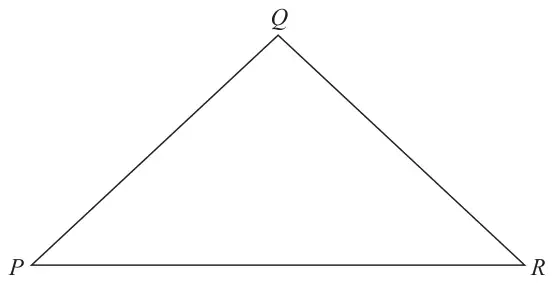
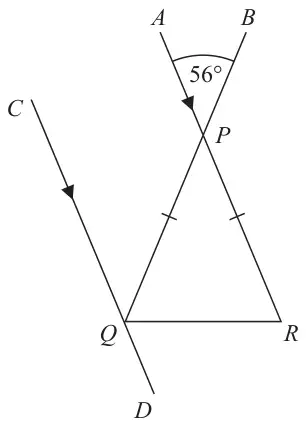
20 In the diagram, \(PQR\) is an isosceles triangle with \(PQ = PR\).
\(APR\) and \(CQD\) are parallel lines. \(BPQ\) is a straight line.
Angle \(APB = 56^\circ\)
Work out the size of angle \(CQR\). Give a reason for each stage of your working. (5)
Mark scheme
Answer
Mark
Mark scheme
118 with reasons
M1
for angle \(QPR = 56\) or \(CQP = 56\)
M1
for angle \(PQR = (180 - 56) \div 2\ (= 62)\)
C1
(dep on a previous M1) for giving a reason relating to parallel lines: angle \(CQR = 180 - \text{``}62\text{''}\) (Allied angles / Co-interior angles add up to 180) or angle \(CQP = 56\) (corresponding angles are equal) or use “angle \(QPR\)” (alternate angles are equal)
C1
(dep on a previous M1) for at least one reason given from: vertically opposite angles are equal OR vertically opposite angles are equal or base angles of an isosceles triangle are equal orAngles in a triangle add up to 180
A1
for 118
Additional guidance
Angles must be clearly labelled on the diagram or otherwise identified. Full solution must be seen. Correct method can be implied from angles on the diagram if no ambiguity or contradiction.
When reasons are given the key words underlined must be present. Reasons need to be linked to their method; any reasons not linked, do not credit. There should be no incorrect reasons given.
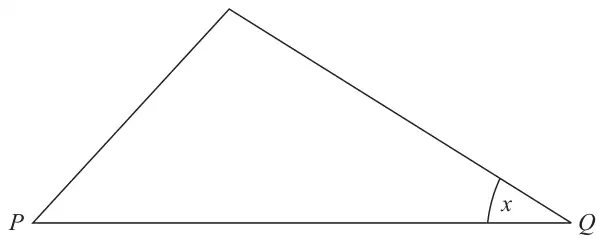
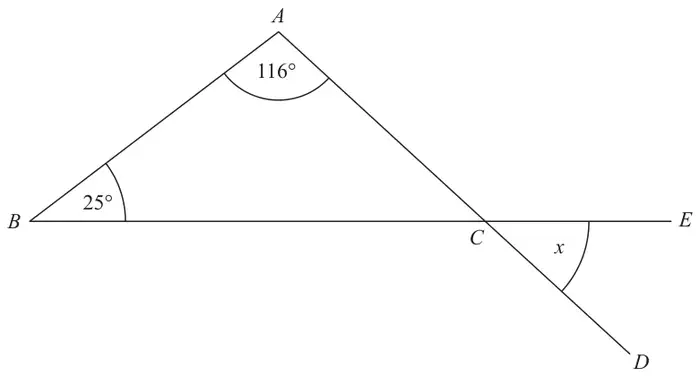
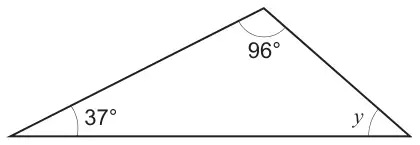
Work out the size of the angle marked \(x\). Give a reason for each stage of your working.(3)
Mark scheme
Answer
Mark
Mark scheme
39 with reasoning
M1
for a method to find angle \(ACB\) eg \(180 - 116 - 25\)
A1
for 39
C1
for \(x = 39\) with reasoning eg Angles in a triangle add up to 180 and Vertically opposite angles are equal or Verticallyopposite angles are equal or Angles on a straight line add up to 180 OR The exteriorangle of a triangle is equal to the sum of theinterioroppositeanglesandAngles on a straight line add up to 180
Additional guidance
\(ACB = 39\) or \(x = 39\) or \(C = 39\) or just 39 is acceptable for this accuracy mark
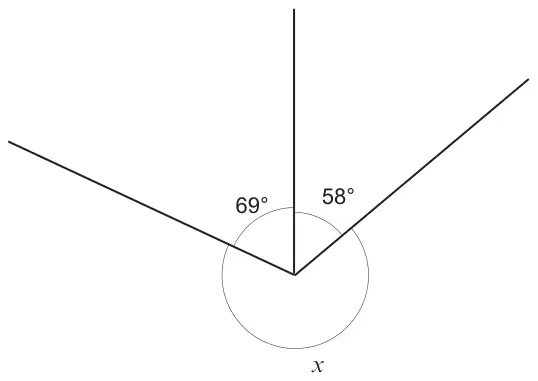
Angle may be shown on diagram if no ambiguity or contradiction The key words underlined must be present. There should be no incorrect reasons given. All reasons given should be used, not just a list of angle facts.
15 Jenna measures all the angles around a point. Her results are 23°, 145°, 23° and 69°
Explain why these results cannot be true. (1)
Mark scheme
Answer
Mark
Mark scheme
Explanation
C1
for explanation Acceptable examples They do not add to 360 They add to 100 too least It is missing a 100 angle / It needs 100 more Because the total has to be 360 A whole circle is 360 Not acceptable examples They add up to 260 One of the angles is wrong A shape with 4 angles adds up to 360
(dep on first M1) for two correct reasons appropriate to their method from
base angles of isosceles triangle are equal sum of angles in a triangle = 180 sum of angles on a straight line = 180 the exterior angle of a triangle is equal to the sum of the interior opposite angles
Additional guidance
May be shown on the diagram
Correct method can be implied from angles on the diagram if no ambiguity or contradiction.
Underlined words need to be shown; reasons need to be linked to their method; any reasons not linked, do not credit. There should be no incorrect reasons given.
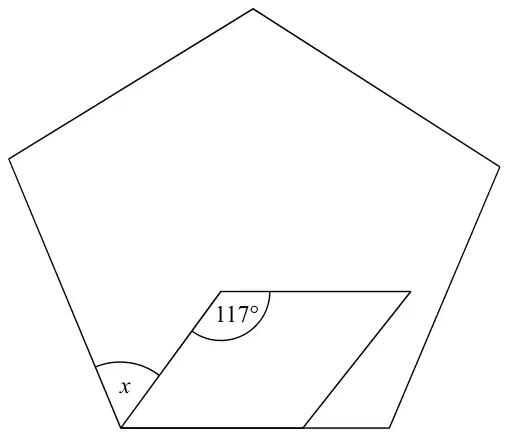
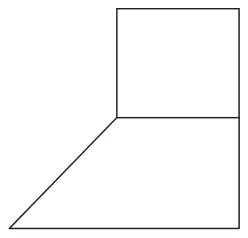
8 The diagram shows a regular pentagon and a parallelogram.
Work out the size of the angle marked \(x\). You must show all your working. (4)
Mark scheme
Answer
Mark
Mark scheme
45
P1
for \(180 - 117\ (= 63)\) or states, or uses, exterior angle + \(x = 117\)
P1
for process to find the exterior or the interior angle of the pentagon, eg \(360 \div 5\ (= 72)\) or \(180 - (360 \div 5)\ (= 108)\) or \(((5 - 2) \times 180) \div 5\ (= 108)\)
P1
for a complete process to find \(x\), eg \(180 - \text{``}72\text{''} - \text{``}63\text{''}\) or \(\text{``}108\text{''} - \text{``}63\text{''}\) or \(117 - \text{``}72\text{''}\)
A1
cao
Additional guidance
Angles may be shown on the diagram. Any angle labelled correctly as 63 and not contradicted scores this mark
Exterior = 108 or interior = 72 does not score the mark
An answer of 45 with no supporting working scores 0
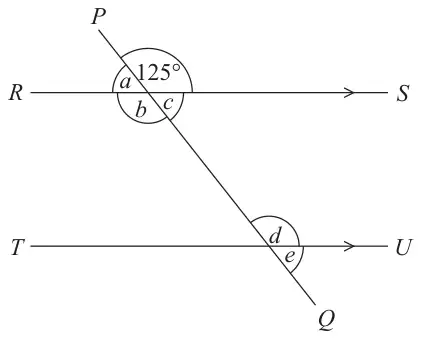
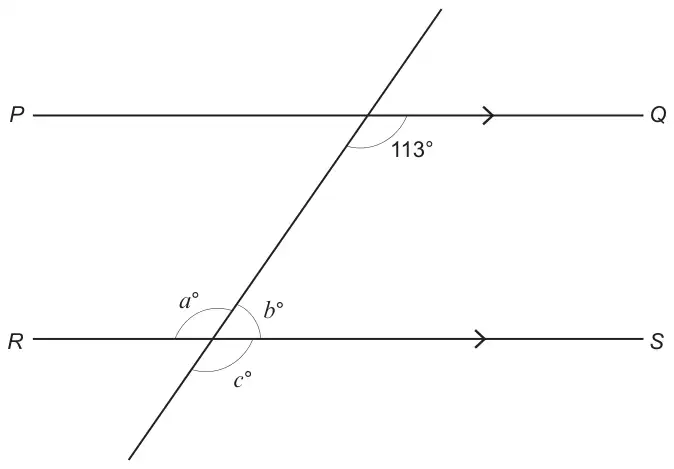
\(RS\) and \(TU\) are parallel lines. \(PQ\) is a straight line.
An angle of size 125° is shown on the diagram.
(b)
(i) Write down the letter of one other angle of size 125° Give a reason for your answer. (2)
(ii) Explain why \(a + b + c = 235^\circ\) (1)
Mark scheme (a)
Answer
Mark
Mark scheme
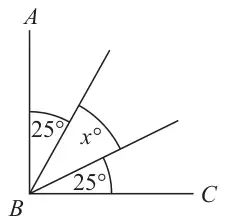
40
M1
for using 90, eg \(90 - 25 - 25\)
A1
cao
Additional guidance
\(90 - 25\) is enough for this mark
Mark scheme (b)(i)
Answer
Mark
Mark scheme
b or d with reason
B1
for \(b\) or \(d\) (or both)
C1
(dep) for appropriate reason(s) vertically opposite angles are equal vertically opposite angles are equal corresponding angles are equal alternate angles are equal angles on a straight line add up to 180
Additional guidance
For the B1: A correct answer can be implied by writing 125 immediately next to \(b\) or \(d\) (or both) as long as 125 is not written next to an incorrect angle.
For the C1: Underlined words need to be shown; reasons need to be linked to their method; any reasons not linked, do not credit. There should be no incorrect reasons given.
Mark scheme (b)(ii)
Answer
Mark
Mark scheme
reason
C1
for correct explanation using 360 or a full explanation using angles around a point Acceptable examples Because 360 around a point \(360 - 125 = 235\) \(125 + 235 = 360\) Because they add to 360 Not acceptable examples Because b is 125
Additional guidance
Using 360 appropriately and not in an incorrect setting
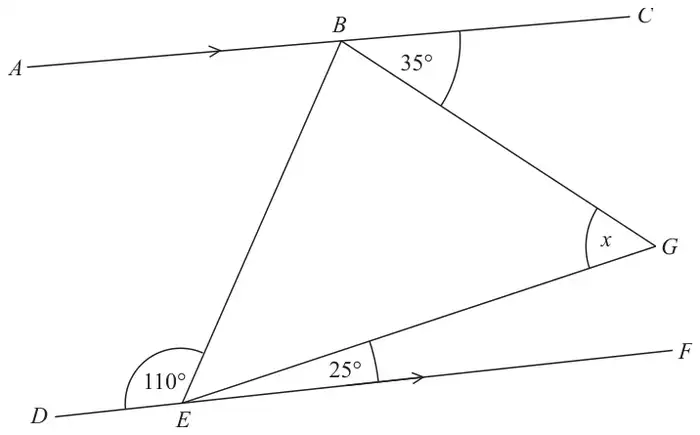
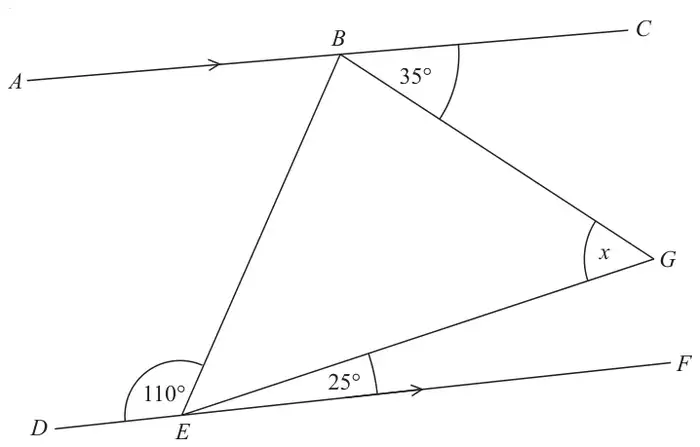
Work out the size of angle \(x\). Give a reason for each stage of your working. (4)
Mark scheme
Answer
Mark
Mark scheme
60
M1
use of parallel lines to find an angle eg \(ABE = 70\) or \(EBG = 75\) or \(EBC = 110\) or shows parts of \(x\) as 35 or 25
M1
for a complete method to find angle \(x\); could be in working or on the diagram
A1
for \(x = 60\)
C1
(dep on M1) for one reason linked to parallel lines and one other reason, supported by working taken from: alternate angles are equal, allied angles / co-interior angles add up to 180, angles on a straight line add up to 180, angles in a triangle add up to 180°
Additional guidance
Parts of \(x\) should be identified on the diagram by the insertion of a dividing line through angle \(x\) (need not be identified or drawn parallel).
Correct method can be implied from angles on the diagram if no ambiguity or contradiction.
Underlined words need to be shown; reasons need to be linked to their method; any reasons not linked do not credit. There should be no incorrect reasons given.
14 The diagram shows quadrilateral \(ABCD\) with each of its sides extended.
\(AB = AD\)
Show that \(ABCD\) is a kite. Give a reason for each stage of your working. (4)
Mark scheme
Answer
Mark
Mark scheme
shown
M1
for method to find angle \(ADC\), eg \(180 - 75\ (= 105)\)
M1
for angle \(BCD = 50\)
M1
for method to find angle \(ABC\), eg \(360 - 100 - 50 - \text{``}105\text{''}\)
C1
(dep M3) for angles \(ADC\), \(BCD\) and \(ABC\) correct and at least 2 appropriate reasons, eg vertically oppositeangles are equal or verticallyopposite angles are equal, angles on a straight line add to 180°, angles in a quadrilateral/kite add up to 360°; angles at a point add up to 360°
Additional guidance
Must be clear link to angle \(ADC\), may be marked on diagram
Must be clear method/explanation shown. Angle marked on diagram is not sufficient.
Underlined words need to be shown; reasons need to be linked to their method
Work out the size of angle \(x\). Give a reason for each stage of your working. (4)
Mark scheme
Answer
Mark
Mark scheme
60
M1
use of parallel lines to find an angle eg \(ABE = 70\) or \(EBG = 75\) or \(EBC = 110\) or shows parts of \(x\) as 35 or 25
M1
for a complete method to find angle \(x\); could be in working or on the diagram
A1
for \(x = 60\)
C1
(dep on M1) for one reason linked to parallel lines and one other reason, supported by working taken from: alternate angles are equal, allied angles / co-interior angles add up to 180, angles on a straight line add up to 180, angles in a triangle add up to 180°
Additional guidance
Parts of \(x\) should be identified on the diagram by the insertion of a dividing line through angle \(x\) (need not be identified or drawn parallel).
Correct method can be implied from angles on the diagram if no ambiguity or contradiction.
Underlined words need to be shown; reasons need to be linked to their method; any reasons not linked do not credit. There should be no incorrect reasons given.
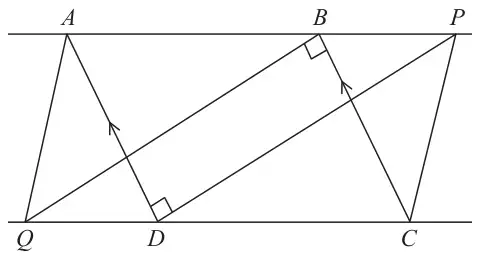
\(ABCD\) is a parallelogram. \(ABP\) and \(QDC\) are straight lines. Angle \(ADP\) = angle \(CBQ = 90^\circ\)
(a) Prove that triangle \(ADP\) is congruent to triangle \(CBQ\). (3)
(b) Explain why \(AQ\) is parallel to \(PC\). (2)
Mark scheme (a)
Answer
Mark
Mark scheme
Proof
C1
for starting the proof, identifying a pair of relevant equal sides or angles with reasons from \(AD = BC\) (opposite sides of a parallelogram are equal) angle \(PAD\) = angle \(QCB\) (opposite angles of a parallelogram are equal) angle \(ADP\) = angle \(CBQ\) (given or both 90°)
C1
(dep C1) for complete identification of all three equal aspects with reasons
C1
(dep C2) for conclusion of congruency proof
Additional guidance
Congruency conclusion must include a reference to ASA
Mark scheme (b)
Answer
Mark
Mark scheme
Explanation
C1
for identifying a pair of equal sides or angles in \(APCQ\), with reason, eg \(AP = QC\) since triangle \(ADP\) is congruent to triangle \(CBQ\)
C1
(dep C1) for reasoning that \(APCQ\) is a parallelogram so opposite sides of a parallelogram are parallel
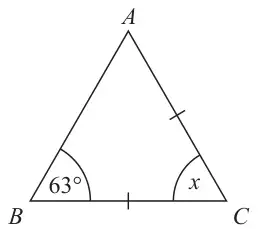
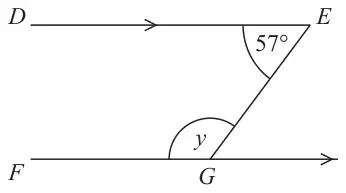
15 Mary needs to work out the size of angle \(x\) in this diagram.
She writes
\(x = 63^\circ\) because base angles of an isosceles triangle are equal.
Mary is wrong.
(a) Explain why. (1)
William needs to work out the size of angle \(y\) in this diagram.
William writes
Working
Reason
angle \(EGH = 57^\circ\)
because corresponding angles are equal
\(y = 180^\circ - 57^\circ\) \(y = 123^\circ\)
because angles on a straight line add up to \(180^\circ\)
One of William’s reasons is wrong.
(b) Write down the correct reason. (1)
Mark scheme (a)
Answer
Mark
Mark scheme
Correct evaluation
C1
for explanation eg \(x\) is not a base angle or states \(x = 54^\circ\)
Mark scheme (b)
Answer
Mark
Mark scheme
Correct or corrected reasoning given
C1
eg (because) alternate angles are equal, or Allied angles / Co-interior angles add up to 180 or they are not corresponding (they are alternate) OR selects correct reason used by William
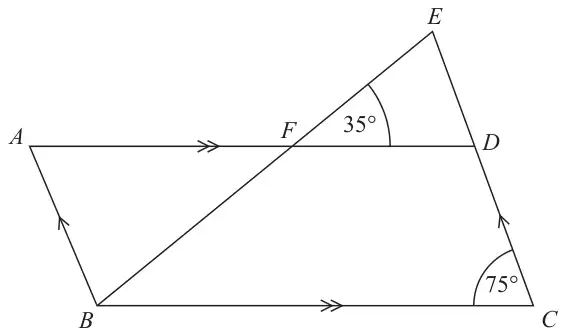
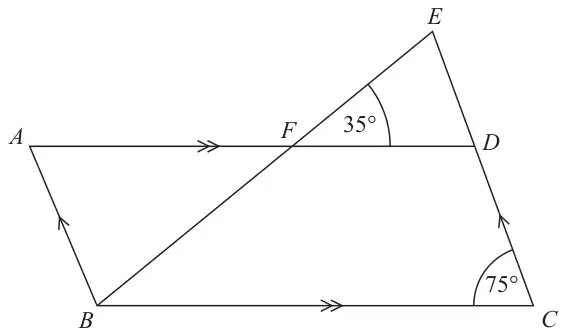
\(ABCD\) is a parallelogram. \(EDC\) is a straight line. \(F\) is the point on \(AD\) so that \(BFE\) is a straight line.
Angle \(EFD = 35^\circ\) Angle \(DCB = 75^\circ\)
Show that angle \(ABF = 70^\circ\) Give a reason for each stage of your working. (4)
Mark scheme
Working
Answer
Mark
Notes
\(CB\) extended to form \(CG\)
Reasoning
B1
for 35 or 75 or 145 or 105 or \(DEF = 70\), marked on the diagram or 3 letter description
M1
for \(180 - 70 - 35\) or \(180 - 75 - 35\) or a correct pair of angles that would lead to 75 or 70, eg \(AFB = 35\) and \(FAB = 75\) or \(AFB = 35\) and \(ABG = 75\) or \(FBC = 35\) and \(ABG = 75\) or \(EDF = 75\) and \(DEF = 70\) or \(FDC = 105\) and \(FBC = 35\) or \(ABC = 105\) and \(FBC = 35\)
C2
(dep on B1M1) All figures correct with all appropriate reasons stated. Angles must be clearly labelled or on the diagram. Full solution must be seen
(C1
(dep on B1 or M1) for one reason clearly used and stated.) Corresponding angles are equal, alternate angles are equal, opposite angles in a parallelogram are equal, angles in a triangle sum to 180, angles on a straight line sum to 180, vertically oppositeangles are equal, vertically opposite angles are equal, angles in a quadrilateral sum to 360, co-interior angles sum to 180, allied angles sum to 180, angles around a point sum to 360
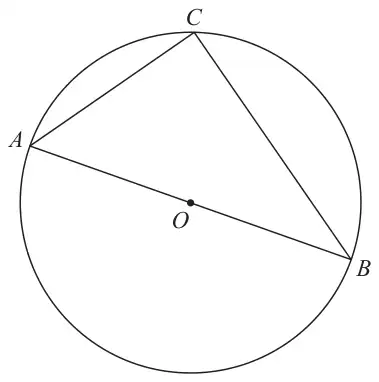
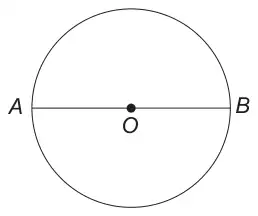
\(A\), \(B\) and \(C\) are points on the circumference of a circle, centre \(O\). \(AOB\) is a diameter of the circle.
Prove that angle \(ACB\) is \(90^\circ\) You must not use any circle theorems in your proof. (4)
Mark scheme
Answer
Mark
Notes
Proof
C1
draws \(OC\) and considers angles in an isosceles triangle (algebraic notation may be used, eg two angles labelled \(x\))
C1
finds sum of angles in triangle \(ABC\), eg \(x + x + y + y = 180\), or sum of angles at \(O\), eg \(180 - 2x + 180 - 2y\)
C1
complete method leading to \(ACB = 90\)
C1
complete proof with all reasons given, eg base angles of an isoscelestriangle are equal, angles in a triangle add up to \(180^\circ\), angles on a straight line add up to \(180^\circ\)
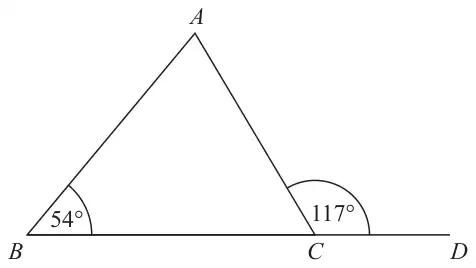
\(BCD\) is a straight line. \(ABC\) is a triangle.
Show that triangle \(ABC\) is an isosceles triangle. Give a reason for each stage of your working. (4)
Mark scheme
Answer
Mark
Notes
shown
M1
for (angle \(BCA\)) \(= 180 - 117\ (= 63)\)
M1
for (angle \(CAB\)) \(= 180 - \text{``}63\text{''} - 54\ (= 63)\) or (angle \(CAB\)) \(= 117 - 54\ (= 63)\)
C2
for statement, eg. isosceles since angle \(BCA =\) angle \(CAB = 63\) with fully correct reasons, from: angles on a straight line add up to 180° angles in a triangle add up to 180° exterior angle of a triangle is equal to sum of interior opposite angles
[C1
for angle \(BCA = 63\) and angle \(CAB = 63\) and one of the above reasons]
OR
M1
for \(\dfrac{(180 - 54)}{2}\ (= 63)\)
M1
for identification of two angles in triangle \(ABC\) being “63”
C2
for statement, eg. isosceles since angle \(BCA =\) angle \(CAB = 63\) andangles on a straight line add up to 180°and fully correct reasons: base angles of an isosceles triangle are equal and angles in a triangle add up to 180°
[C1
for angle \(BCA = 63\) and angle \(CAB = 63\) and one reason from: base angles of an isosceles triangle are equal angles in a triangle add up to 180°]
\(ABCD\) is a parallelogram. \(EDC\) is a straight line. \(F\) is the point on \(AD\) so that \(BFE\) is a straight line.
Angle \(EFD = 35^\circ\) Angle \(DCB = 75^\circ\)
Show that angle \(ABF = 70^\circ\) Give a reason for each stage of your working. (4)
Mark scheme
Working
Answer
Mark
Notes
\(CB\) extended to form \(CG\)
Reasoning
B1
for 35 or 75 or 145 or 105 or \(DEF = 70\), marked on the diagram or 3 letter description
M1
for \(180-70-35\) or \(180-75-35\) or a correct pair of angles that would lead to 75 or 70, eg \(AFB = 35\) and \(FAB = 75\) or \(AFB = 35\) and \(ABG = 75\) or \(FBC = 35\) and \(ABG = 75\) or \(EDF = 75\) and \(DEF = 70\) or \(FDC = 105\) and \(FBC = 35\) or \(ABC = 105\) and \(FBC = 35\)
C2
(dep on B1M1) All figures correct with all appropriate reasons stated. Angles must be clearly labelled or on the diagram. Full solution must be seen
(C1
(dep on B1 or M1) for one reason clearly used and stated.) Corresponding angles are equal, alternate angles are equal, opposite angles in a parallelogram are equal, angles in a triangle sum to 180, angles on a straight line sum to 180, vertically oppositeangles are equal, vertically opposite angles are equal, angles in a quadrilateral sum to 360, co-interior angles sum to 180, allied angles sum to 180, angles around a point sum to 360
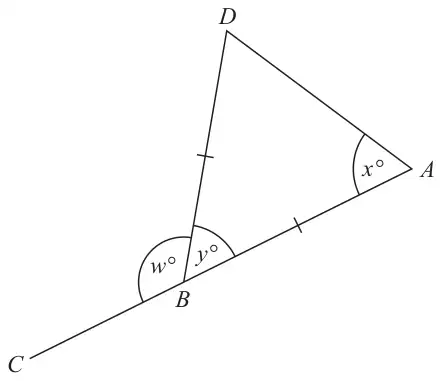
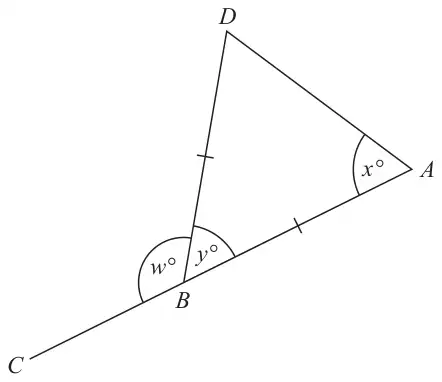
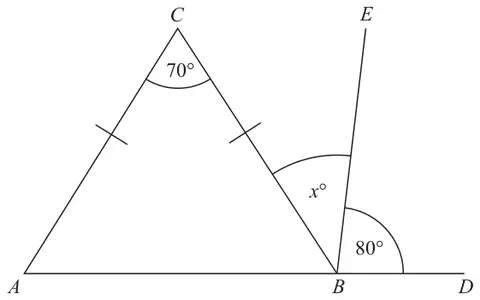
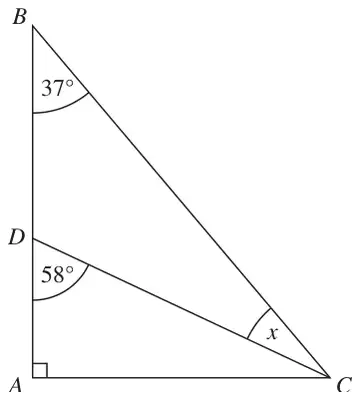
\(AC = BC\) ABD is a straight line. Angle \(ACB = 70^\circ\) Angle \(EBD = 80^\circ\) Angle \(CBE = x^\circ\)
Work out the value of \(x\). Give reasons for your answer. (4)
Mark scheme
Answer
Mark
Notes
45
4
M1 for complete method to find angle ABC e.g. \((180 - 70) \div 2\) (= 55) M1 for complete method to find \(x\) e.g. angle CBD = \(180 - \text{``}55\text{''}\) (= 125) and \(\text{``}125\text{''} - 80\) A1 cao C1 base angles of an isosceles triangle are equal and the sum of the angles in a triangle is 180 and the sum of the angles on a straight line is 180
or M1 for complete method to find angle BAC e.g. \((180 - 70) \div 2\) (= 55) M1 for complete method to find \(x\) e.g. \(70 + \text{``}55\text{''}\) (= 125) and \(\text{``}125\text{''} - 80\) A1 cao C1 base angles of an isosceles triangle are equal and the exterior angle of a triangle is equal to the sum of the two interior opposite angles
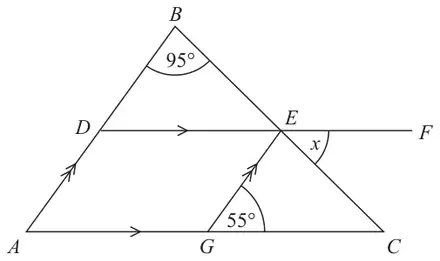
\(AGC\) and \(DEF\) are parallel lines. \(ADB\) and \(GE\) are parallel lines. \(BEC\) is a straight line.
Angle \(DBE = 95^\circ\) Angle \(CGE = 55^\circ\)
Work out the size of the angle marked \(x\). Give reasons for each stage of your working. (4)
Mark scheme
Answer
Mark
Notes
\(x = 30^\circ\) with complete reasons
4
M1 for a correct first step, eg angle \(GED = 55\) or angle \(GAD = 55\) or angle \(EGA = 180 - 55\) (= 125) A1 for 30 C2 for 30 with full reasons, appropriate to their given method eg alternate angles are equal andcorrespondingangles are equal andangles on a straight line add up to 180 eg corresponding angles are equal andangles in a triangle add up to 180andalternate angles are equal (C1 (dep on at least M1) for one appropriate reason relating to parallel lines or opposite angles of a parallelogram)
ABC and EDC are straight lines. AE and BD are parallel. Angle \(ABD = 125^\circ\) Angle \(BCD = 30^\circ\)
Work out the size of the angle marked \(x\). Give reasons for your answer. (4)
Mark scheme
Answer
Mark
Notes
\(95^\circ\) with reasons
4
M1 for angle \(DBC = 180 - 125\) (= 55) or angle \(EAC = 180 - 125\) (= 55) (May be on diagram) A1 for \(x = 95\) C2 (dep on M1) with full reasons for their given method, e.g. angles on a straight line add up to 180°andangles in a triangle add up to 180°andcorresponding angles are equal orallied angles / co-interior angles add up to 180°andangles in a triangle add up to 180° (C1 (dep on M1) for one appropriate reason linked to parallel lines)
M1 for angle \(CDB = 125 - 30\) (= 95) (May be on diagram) A1 for \(x = 95\) C2 (dep on M1) for full reasons, for their given method, e.g. exterior angles are equal to the sum of the interior opposite angles andcorresponding angles are equal (C1 (dep on M1) for one of these appropriate reasons linked to parallel lines)
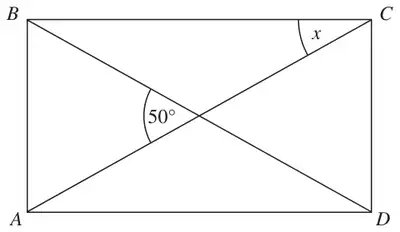
ABCD is a rectangle. AC and BD are straight lines. The angle between AC and BD is \(50^\circ\).
Work out the size of the angle marked \(x\). (3)
Mark scheme
Answer
Mark
Notes
25
3
M1 for (opposite angle =) 50 May be marked on the diagram M1 for complete method eg \(90 - (180 - \text{``}50\text{''}) \div 2\) or \(50 \div 2\) A1 cao
or M1 for \(180 - 50\) (= 130) May be marked on the diagram M1 for complete method eg \((180 - \text{``}130\text{''}) \div 2\) A1 cao
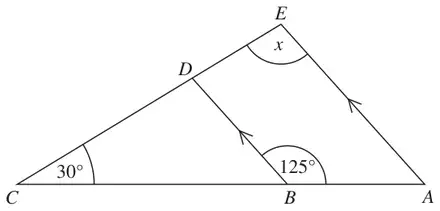
\(ABC\) and \(EDC\) are straight lines. \(AE\) and \(BD\) are parallel. Angle \(ABD = 125^\circ\) Angle \(BCD = 30^\circ\)
Work out the size of the angle marked \(x\). Give reasons for your answer. (4)
Mark scheme
Answer
Mark
Notes
\(95^\circ\) with reasons
4
M1 for angle \(DBC = 180 - 125\) (= 55) or angle \(EAC = 180 - 125\) (=55) (May be on diagram) A1 for \(x = 95\) C2 (dep on M1) with full reasons for their given method, e.g. angles on a straight line add up to 180°andangles in a triangle add up to 180°andcorrespondingangles are equal orallied angles / co-interiorangles add up to 180° andangles in a triangle add up to 180° (C1 (dep on M1) for one appropriate reason linked to parallel lines)
M1 for angle \(CDB = 125 - 30\) (= 95) (May be on diagram) A1 for \(x = 95\) C2 (dep on M1) for full reasons, for their given method, e.g. exterior angles are equal to the sum of the interior opposite angles andcorresponding angles are equal (C1 (dep on M1) for one of these appropriate reasons linked to parallel lines)
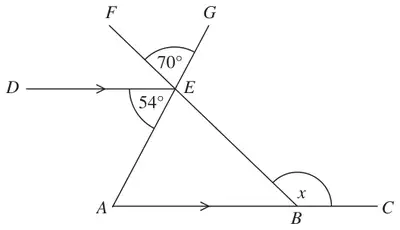
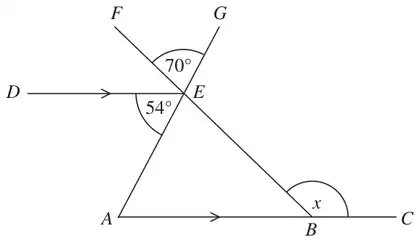
ABC and DE are parallel lines. AEG and BEF are straight lines. Angle \(AED = 54^\circ\) Angle \(FEG = 70^\circ\)
Work out the size of the angle marked \(x\). Give a reason for each stage of your working. (4)
Mark scheme
Answer
Mark
Notes
\(124^\circ\) with reasons
4
M1 for a method to find any angle eg. angle DEF = \(180 - 70 - 54\) (= 56) or angle AEB = 70 or angle EAB = 54 or angle GEB = \(180 - 70\) (= 110) A1 for \(x = 124\) NB: Angles may be shown on the diagram C2 for full reasons, appropriate to their given method, with no additional reasons (C1 for one appropriate reason relating to parallel lines)
Possible reasons: corresponding angles are equal; alternate angles are equal co-interior (allied) angles add up to 180; angles on a straight line add up to 180; angles in a triangle add up to 180 vertically opposite angles are equal; the exterior angle of a triangle is equal to the sum of the interior opposite angles; angles at a point add up to 360;
\(ABC\) and \(DE\) are parallel lines. \(AEG\) and \(BEF\) are straight lines.
Angle \(AED = 54^\circ\) Angle \(FEG = 70^\circ\)
Work out the size of the angle marked \(x\). Give a reason for each stage of your working. (4)
Mark scheme
Answer
Mark
Notes
\(124^\circ\) with reasons
4
M1 for a method to find any angle, eg. angle \(DEF = 180 - 70 - 54\) (= 56) or angle \(AEB = 70\) or angle \(EAB = 54\) or angle \(GEB = 180 - 70\) (= 110) A1 for \(x = 124\) NB: angles may be just shown on the diagram
C2 for full reasons, appropriate to their given method, with no additional reasons (C1 for one appropriate reason relating to parallel lines)
Possible reasons: corresponding angles are equal; alternate angles are equal; co-interior angles (allied) add up to 180 angles on a straight line add up to 180 ; angles in a triangle add up to 180; vertically opposite angles are equal ; the exterior angle of a triangle is equal to the sum of the interior opposite angles; angles at a point add up to 360;
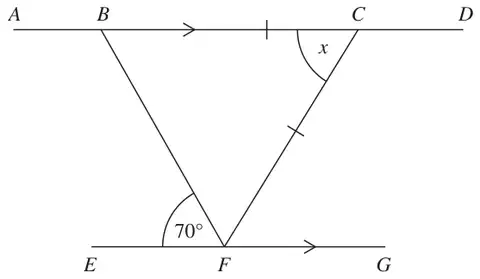
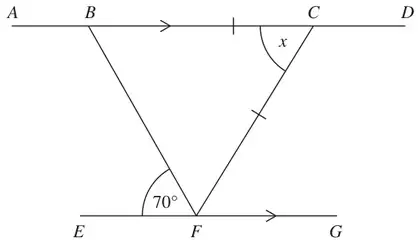
\(ABCD\) and \(EFG\) are parallel lines. \(BC = CF\) Angle \(BFE = 70^\circ\)
Work out the size of the angle marked \(x\). Give reasons for each stage of your working. (4)
Mark scheme
Answer
Mark
Notes
\(40^\circ\)
4
M1 for angle \(FBC = 70\) or \(CFG = x\) or \(ABF = 110\) may be seen in diagram M1 for angle \(CBF = BFC = 70\) or \(90 - \tfrac{1}{2}x\) may be seen in diagram A1 for 40 supported by working C1 (dep on M2) for full reasons linked to appropriate working, eg alternate angles are equal; allied angles / co-interior angles add up to \(180^\circ\); base angles of an isosceles triangle are equal, angles on a straight line add up to \(180^\circ\), angles in a triangle add up to \(180^\circ\)
\(ABCD\) and \(EFG\) are parallel lines. \(BC = CF\) Angle \(BFE = 70^\circ\)
Work out the size of the angle marked \(x\). Give reasons for each stage of your working. (4)
Mark scheme
Answer
Mark
Notes
\(40^\circ\)
4
M1 for angle \(FBC = 70\) or \(CFG = x\) or \(ABF = 110\) may be seen in diagram M1 for angle \(CBF = BFC = 70\) or \(90 - \tfrac{1}{2}x\) A1 for 40 supported by working C1 (dep on M2) for all reasons and linked to appropriate working, e.g. Alternate angles are equal; Allied angles / Co-interior angles add up to \(180^\circ\); Base angles of an isosceles triangle are equal; angles in a triangle add to \(180^\circ\), angles on a straight line equals \(180^\circ\)
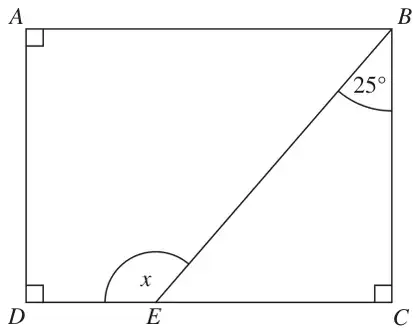
\(ABCD\) is a rectangle. \(E\) is a point on \(DC\). Angle \(EBC = 25^\circ\)
Work out the size of the angle marked \(x\). Give reasons for your answer. (3)
Mark scheme
Answer
Mark
Notes
\(x = 115^\circ\) with complete reasons
3
M1 for angle \(CEB = 180 - 25 - 90\) (= 65) or angle \(ABE = 90 - 25\) (= 65) or for \(x = 25 + 90\) A1 for 115 C1 (dep on M1) for full reasons, appropriate to their given method e.g. angles in a triangle add up to \(180^\circ\) and angles on a straight line add up to \(180^\circ\) e.g. the exterior angle of a triangle is equal to the sum of the interior opposite angles e.g. angles in a quadrilateral add up to \(360^\circ\) e.g. alternate angles are equal
\(ABC\), \(DEF\) and \(PQRS\) are parallel lines. \(BEQ\) is a straight line.
Angle \(ABE = 60^\circ\) Angle \(QER = 80^\circ\)
Work out the size of the angle marked \(x\). Give reasons for each stage of your working. (4)
Mark scheme
Answer
Mark
Notes
\(40^\circ\) with reasons
4
M1 for finding one related angle using parallel lines A1 for \(x = 40(^\circ)\) C2 for full reasons linked to appropriate method eg. alternate angles are equal and angles in a triangle add up to \(180^\circ\) eg. angles on a straight line add up to \(180^\circ\) and corresponding angles are equal and alternate angles are equal eg. co-interior (allied) angles add up to \(180^\circ\) and exterior angle of a triangle is equal to sum of interior opposite angles Other solutions may include reasons such as: vertically opposite angles are equal the sum of angles at a point is equal to \(360^\circ\) (C1 (dep on M1) for one appropriate reason linked to parallel lines)
(b) In the space below, make an accurate drawing of this triangle. (3)
Mark scheme (a)
Answer
Mark
Notes
(i) 95
2
B1 cao
(ii) Reason
B1 angles in a triangle add to \(180^\circ\)
Mark scheme (b)
Answer
Mark
Notes
Drawing
3
B3 for a fully correct triangle (B2 for a triangle with 2 of the 3 aspects: line of 8cm; angle of \(40^\circ\); angle of \(45^\circ\)) (B1 for 1 of the 3 aspects)
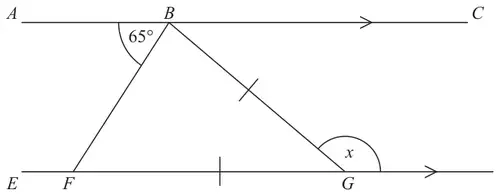
Work out the size of the angle marked \(x\). Give reasons for your answer. (4)
Mark scheme
Answer
Mark
Notes
130 + correct reasons
4
M1 for angle \(BFG = 65\) (may be seen on diagram) M1 (dep) for correct method to calculate \(x\) eg (\(x =\)) \(65 + 65\) (= 130) or (\(x =\)) \(180 - (180 - 2 \times 65)\) (= 130) C2 for \(x = 130\) and full appropriate reasons related to method shown (C1 (dep on M1) for any one appropriate reason related to method shown) eg alternate angles are equal; base angles in an isosceles triangle are equal; angles in a triangle add up to \(180^\circ\); angles on a straight line add up to \(180^\circ\); exterior angle of triangle = sum of two interior opposite angles co-interior angles (allied angles) add up to \(180^\circ\)
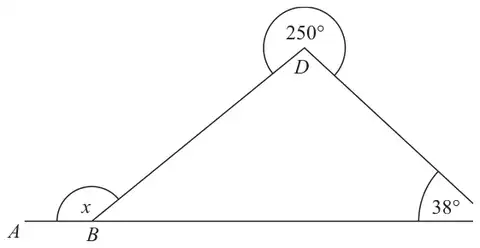
\(ABC\) is a straight line. Angle \(BCD = 38^\circ\) The reflex angle \(BDC = 250^\circ\)
Work out the size of the angle marked \(x\). Give reasons for your answer. (4)
Mark scheme
Answer
Mark
Notes
\(148^\circ\)
4
M1 for (angle \(BDC =\)) \(360 - 250\) (= 110) M1 (dep) for \(180 - (180 - \text{‘}110\text{’} - 38)\) (= 148) or for \(\text{‘}110\text{’} + 38\) (= 148) C2 (dep on M2) for \(x = 148\) with full reasons, relevant to the complete correct method used, for example: Angles at a point add up to \(360^\circ\) and angles in a triangle add up to \(180^\circ\) and angles on a straight line add up to \(180^\circ\); Or Angles at a point add up to \(360^\circ\) and exterior angle of a triangle is equal to the sum of the interior opposite angles or (C1 (dep on at least M1) for one reason relevant to correct method)
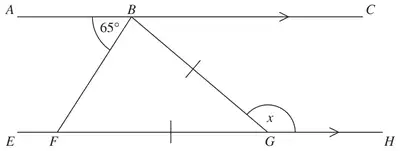
Work out the size of the angle marked \(x\). Give reasons for your answer. (4)
Mark scheme
Answer
Mark
Notes
\(x = 130\) + correct reasons
4
M1 for angle \(BFG = 65\) may be seen on diagram M1 (dep) for correct method to calculate \(x\), eg \((x =)\ 65 + 65\) (=130) or \((x =)\ 180 - (180 - 2 \times 65)\) (=130) C2 for \(x = 130\) and full appropriate reasons related to method shown (C1 (dep on M1) for any one appropriate reason related to method shown) eg alternate angles; base angles in an isosceles triangle are equal; angles in a triangle add up to \(180^\circ\); angles on a straight line add up to \(180^\circ\); exterior angle of triangle = sum of two interior opposite angles; co-interior angles add up to \(180^\circ\) (allied angles) NB Any reasons stated must be used
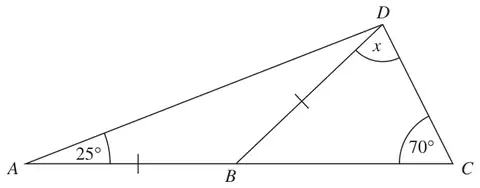
\(ABC\) is a straight line. \(AB = BD\) Angle \(BAD = 25^\circ\) Angle \(BCD = 70^\circ\)
Work out the size of the angle marked \(x\). Give reasons for your answer. (4)
Mark scheme
Working
Answer
Mark
Notes
base angles of isosceles triangle are equal and angles on a straight line add up to 180° and angles in a triangle add up to 180° OR base angles of isosceles triangle are equal and angles in a triangle add up to 180° OR base angles of isosceles triangle are equal and exterior angle of a triangle is equal to the sum of the interior opposite angles
60° with reasons
4
B1 for angle \(ADB = 25\) can be shown on the diagram M1 for a complete method to find \(x\) C2 (dep 2 previous marks) for 60 with full reasoning seen (C1 (dep 1 previous mark) for one reason) QWC: Reasons must be appropriate to the method shown.
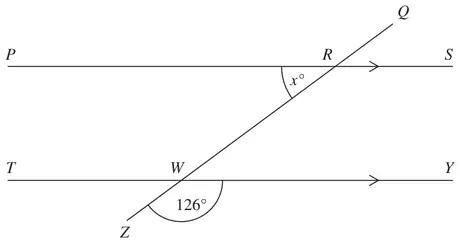
\(PRS\) and \(TWY\) are parallel straight lines. \(QRWZ\) is a straight line.
Work out the value of \(x\). Give reasons for your answer. (3)
Mark scheme
Answer
Mark
Notes
54 with reasons
3
M1 for angle \(RWY\) or angle \(TWZ = 180 - 126\) (= 54) or angle \(TWR\) or angle \(WRS = 126\) (may be marked on diagram) A1 for 54 C1 for appropriate reasons for method shown eg. Angles on a straight line add up to 180 and Alternate angles are equal OR Corresponding angles are equal and Angles on a straight line add up to 180 OR Vertically opposite angles are equal and Allied angles / Co-interior angles add up to 180 OR Angles at a point add up to 360 with other reasons as above.
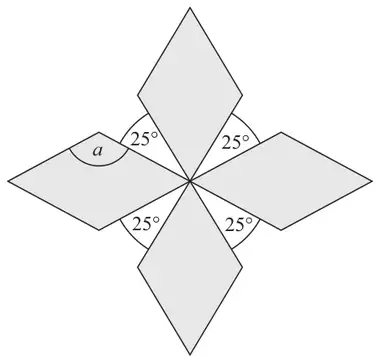
24 The diagram shows a pattern using four identical rhombuses.
Diagram NOT accurately drawn
Work out the size of the angle marked \(a\).
You must show your working.(4)
Mark scheme
Answer
Mark
Notes
115
4
M1 for 360 − 4 × 25 (=260) M1 (dep) for “260” ÷ 4 (= 65) M1 for 180 – “65” or (360 − 2 × “65”) ÷ 2 A1 for 115 with working OR M1 for 360 ÷ 4 (= 90) M1 (dep) for “90” − 25 (=65) M1 for 180 – “65” or (360 – 2 × “65”) ÷ 2 A1 for 115 with working
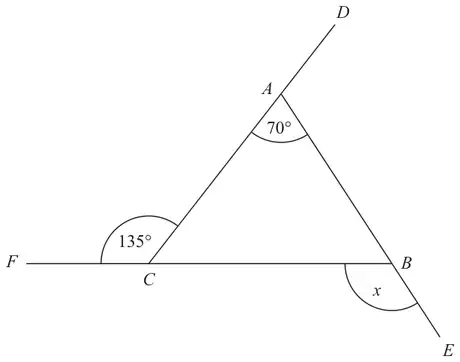
(Method 1) Angle ACB = 180 – 135 (= 45) (sum of angles on a straight line = 180) Angle ABC = 180 – 70 – 45 (=65) (sum of angles in a triangle = 180) (x =) 180 – 65 (=115) (sum of angles on a straight line = 180) OR (Method 2) Angle ACB = 180 – 135 (= 45) (sum of angles on a straight line = 180) (x =) 70 + 45 (=115) (exterior angle = sum of interior opposite angles) OR (Method 3) Angle DAB = 180 – 70 = 110 (sum of angles on a straight line = 180) (x =) 360 – 135 – 110 (sum of exterior angles of a polygon = 360)
\(x = 115\)
5
M1 for correct method to find angle DAB or angle ACB or angle ABC (may be implied by correct angle marked in diagram) M1 for complete correct method to find \(x\) A1 for \(x = 115\) C2 (dep on M1) for fully correct reasons for chosen method no extras (C1 (dep on M1) for one correct reason for chosen method) [NB \(x = 115\) must be stated explicitly, 115 only scores A0]
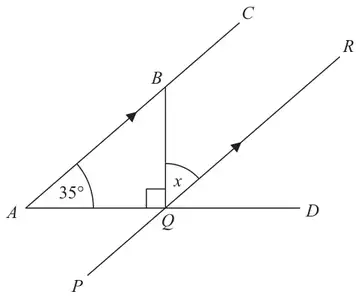
\(ABC\), \(PQR\) and \(AQD\) are straight lines. \(ABC\) is parallel to \(PQR\).
Angle \(BAQ = 35^\circ\) Angle \(BQA = 90^\circ\)
Work out the size of the angle marked \(x\). Give reasons for each stage of your working. (4)
Mark scheme
Answer
Mark
Notes
55
4
M1 for a correct method to find a different angle using 35° M1 for setting up a complete process to calculate angle \(x\) A1 cao B1 states one of the following reasons relating to their chosen method: Alternate angles are equal; Corresponding angles are equal; Allied angles / Co-interior angles add up to 180; the exterior angle of a triangle is equal to the sum of the interior opposite angles.
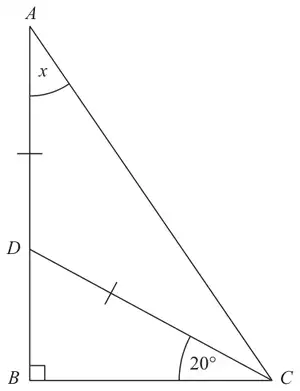
Triangle \(ABC\) is a right-angled triangle. \(ADB\) is a straight line. \(DA = DC\) Angle \(BCD = 20^\circ\)
Work out the size of the angle marked \(x\). You must give reasons for each stage of your working. (4)
Mark scheme
Answer
Mark
Notes
\(35^\circ\) with reasons
4
M1 for correct method to find one angle eg 70 or 110 (angles could be on the diagram) M1 for a complete correct method to work out \(x\) A1 (dep on M1) for \(35^\circ\) C1 for complete geometric reasons for their chosen method without extras eg exterior angle = sum of interior opposite angles and base angles of an isosceles triangle are equal OR angles in a triangle add up to 180 and angles on a straight line add up to 180 and base angles of an isosceles triangle are equal
OR M1 \(x + x + 20 + 90 = 180\) M1 for a complete correct method to work out \(x\) A1 (dep on M1) for \(35^\circ\) C1 for complete geometric reasons for their chosen method without extras eg angles in a triangle add up to 180 and base angles of an isosceles triangle are equal
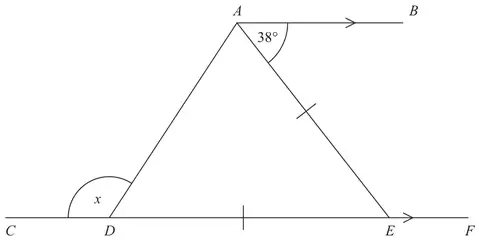
\(CDEF\) is a straight line. \(AB\) is parallel to \(CF\). \(DE = AE\).
Work out the size of the angle marked \(x\). You must give reasons for your answer. (4)
Mark scheme
Working
Answer
Mark
Notes
Angle \(AED = 38\) alternate angles are equal Angle \(ADE = (180 - 38) \div 2 = 71\) \(x = 180 - 71\) base angles of an isosceles triangle are equal angles in a triangle add up to 180 angles on a straight line sum to 180 OR angle \(AEF = 142\) allied angles/co-interior angles add up to 180 \(ADE = 142 \div 2 = 71\) base angles of an isosceles triangle are equal exterior angle of a triangle is equal to the sum of the interior opposite angles, \(x = 180 - 71\) angles in a straight line add to 180 OR Angle \(AED = 38\) alternate angles are equal for angles \(BAE\) and \(AED\) and \(BAD\) and \(ADC\) (\(x\)) Angle \(DAE = (180 - 38) \div 2 = 71\) base angles of an isosceles triangle are equal angles in a triangle add up to 180 Or Angle \(AED = 38\) alternate angles are equal Angle \(ADE = (180 - 38) \div 2 = 71\) base angles of an isosceles triangle are equal and angles in a triangle sum to 180 \(x = 38 + 71\) alternate angles \(BAD\) and \(ADC\) (\(x\)) are equal
\(x = 109\)
4
B1 for angle \(AED = 38\) or \(AEF = 142\) M1 for a complete method to find one of the base angles of the isosceles triangle C2 (dep M1) for \(x = 109\) with complete reasons (C1 (dep M1) for one reason correctly used and stated)
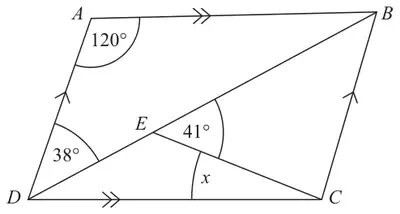
Calculate the size of angle \(x\). You must give reasons for your answer. (4)
Mark scheme
Working
Answer
Mark
Notes
Angle \(DEC = 180 - 41 = 139\) Angles on a straight line sum to 180° Angle \(EDC = 60 - 38\) or Angle \(ABD = 180 - 120 - 38\) (=22) Co-interior/Allied angles of parallel lines sum to 180° or Angles in a triangle sum to 180° and Alternate angles (\(x =\)) \(180 - \text{`}139\text{'} - \text{`}22\text{'}\) (=19) Angles in a triangle sum to 180° OR Angle \(ADC = 180^\circ - 120^\circ = 60^\circ\) Co-interior/Allied angles of parallel lines sum to 180° Angle \(EDC = 22^\circ\) Angle \(ECD = 41^\circ - 22^\circ = 19^\circ\) Exterior angle of triangle equals sum of the two opposite interior angles OR Angle \(DBC = 38^\circ\) Alternate angles Angle \(BCE = 101^\circ\) Angle sum of a triangle is 180° Angle \(BCD = 120^\circ\) Opposite angles of a parallelogram are equal Angle \(ECD = 120^\circ - 101^\circ = 19^\circ\)
\(x = 19^\circ\) and reasons
4
M1 for \(DBC = 38^\circ\) or \(ADC = 60^\circ\) (can be implied by \(BDC = 22^\circ\)) or \(ABC = 60^\circ\) or \(DCB = 120^\circ\) or (\(ABD =\)) \(180 - 120 - 38\) (=22) M1 for (\(BDC =\)) \(60 - 38\) (=22) or \(BDC = \text{`}22\text{'}\) or (\(DEC =\)) \(180 - 41\) (=139) or (\(BCE =\)) \(180 - 41 - 38\) (=101) M1 (dep on both previous M1) for complete correct method to find \(x\) or (\(x =\)) 19 C1 for \(x = 19^\circ\) AND Co-interior/allied angles of parallel lines sum to 180° or Opposite angles of a parallelogram are equal or Alternate angles AND Angles on a straight line sum to 180° or Angles in a triangle sum to 180° or Exterior angle of triangle equals sum of the two opposite interior angles or Angles in a quadrilateral sum to 360°
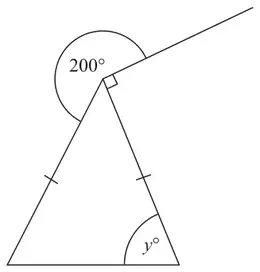
Work out the value of \(y\). Give reasons for your answer. (4)
Mark scheme
Working
Answer
Mark
Notes
\(360 - 200 - 90\) (=70) \((180 - \text{`}70\text{'}) \div 2\) angles at a point add to 360°, angles in a triangle add to 180°, base angles of an isosceles triangle are equal
\(y = 55\) reasons
4
M1 for \(360 - 200 - 90\) oe M1 for \((180 - \text{`}70\text{'}) \div 2\) Reasons: angles at a point add up to 360° angles in a triangle add up to 180° base angles of an isosceles triangle are equal C2 for \(y = 55^\circ\) and all correct reasons Note: An answer of 55° alone, is not enough; \(y = 55^\circ\) must be explicitly stated or clearly shown on the diagram (C1 for one correct reason) Note: the award of any C mark is dependant upon the award of at least M1
Calculate the size of angle \(x\). You must give reasons for your answer. (4)
Mark scheme
Working
Answer
Mark
Notes
Angle \(DEC = 180 - 41 = 139\) Angles on a straight line sum to 180° Angle \(EDC = 60 - 38\) or Angle \(ABD = 180 - 120 - 38\) (=22) Co-interior/allied angles of parallel lines sum to 180° or Angles in a triangle sum to 180° and Alternate angles \(x = 180 -\) ‘139’ – ‘22’ (=19) Angles in a triangle sum to 180° OR Angle \(ADC = 180^\circ - 120^\circ = 60^\circ\) Co-interior/allied angles of parallel lines sum to 180° Angle \(EDC = 22^\circ\) Angle \(ECD = 41^\circ - 22^\circ = 19^\circ\) Exterior angle of triangle equals sum of the two opposite interior angles OR Angle \(DBC = 38^\circ\) Alternate angles Angle \(BCE = 101^\circ\) Angle sum of a triangle is 180° Angle \(BCD = 120^\circ\) Opposite angles of a parallelogram are equal Angle \(ECD = 120^\circ - 101^\circ = 19^\circ\)
\(x = 19^\circ\) and reasons
4
M1 for \(DBC = 38^\circ\) or \(ADC = 60^\circ\) (can be implied by \(BDC = 22^\circ\)) or \(ABC = 60^\circ\) or \(DCB = 120^\circ\) or (\(ABD =\)) \(180 - 120 - 38\) (=22) M1 for (\(BDC =\)) \(60 - 38\) (=22) or \(BDC =\) ‘22’ or (\(DEC =\)) \(180 - 41\) (=139) or (\(BCE =\)) \(180 - 41 - 38\) (=101) M1 (dep on both previous M1) for complete correct method to find \(x\) or (\(x =\)) 19 C1 for \(x = 19^\circ\) AND Co-interior/allied angles of parallel lines sum to 180° or Opposite angles of a parallelogram are equal or Alternate angles AND Angles on a straight line sum to 180° or Angles in a triangle sum to 180° or Exterior angle of triangle equals sum of the two opposite interior angles or Angles in a quadrilateral sum to 360°
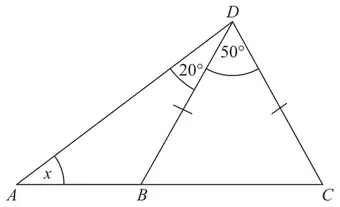
\(ABC\) is a straight line. \(BD = CD\). Angle \(BDC = 50^\circ\). Angle \(ADB = 20^\circ\).
Work out the size of the angle marked \(x\). Give reasons for your answer. (4)
Mark scheme
Working
Answer
Mark
Notes
Angle \(DBC = (180 - 50) \div 2\) Base angles of isosceles triangle are equal Angle \(ABD = 180 - 65\) Angles on a straight line add up to 180 \(x = 180 - 20 - 115\) Angles in a triangle add up to 180 OR Angle \(DBC = (180 - 50) \div 2\) Base angles of isosceles triangle are equal \(x = 65 - 20\) Exterior angle of triangle is equal to sum of interior opposite angles OR Angle \(DCB = (180 - 50) \div 2\) Base angles of isosceles triangle are equal \(x = 180 - 50 - 20 - 65\) Angles in a triangle add up to 180
45 with reasons
4
M1 for \((180 - 50) \div 2\) oe or 65 seen M1 for \(180 - 20 - (180 -\) “65”) or “65” \(- 20\) or \(180 - 50 - 20 -\) ‘65’ oe C2 for \(x\) identified as 45 with full reasons QWC: Reasons clearly laid out with correct geometrical language used (C1 (dep on M1) for one reason QWC: Reasons clearly laid out with correct geometrical language used ) NOTE: \(x = 45\) with no working or without any correct angles marked on the diagram cannot score.
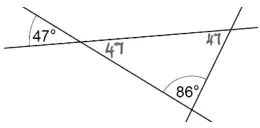
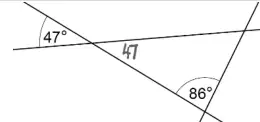
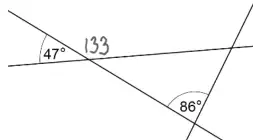
\(ABC\) and \(DEF\) are parallel lines. \(BEG\) is a straight line. Angle \(GEF = 47^\circ\).
Work out the size of the angle marked \(x\). Give reasons for your answer. (3)
Mark scheme
Working
Answer
Mark
Notes
180 – 47
133
3
M1 for 180 – 47 A1 for 133 C1 (dep on M1) for full reasons e.g. angles on a straight line add up to 180°andalternate angles are equal OR corresponding angles are equal andangles on a straight line add up to 180° OR vertically opposite angles (or vertically opposite angles) are equal andallied angles (or co-interior angles) add up to 180°
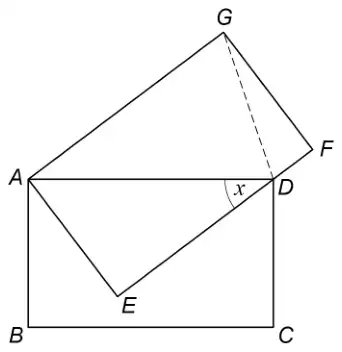
\(ABCD\) and \(AEFG\) are congruent rectangles \(D\) lies on \(EF\) angle \(ADE = x\)
Not drawn accurately
Prove that \(GD\) bisects angle \(ADF\). [4 marks]
Mark scheme
Answer
Mark
Comments
Response showing that \(GD\) bisects angle \(ADF\) and all reasons
B4
B3 response showing that \(GD\) bisects angle \(ADF\) B2 correct expressions for two angles in terms of \(x\) (angles must be above \(AD\)) or two correct statements about a pair of angles (angles must be above \(AD\)) B1 correct expression for one angle in terms of \(x\) (angle must be above \(AD\)) or one correct statement about a pair of angles (angles must be above \(AD\))
Additional guidance
Correct expressions for angles (which may be seen on the diagram) include angle \(DAG = x\) angle \(ADF = 180 - x\) angle \(ADG = \dfrac{180 - x}{2}\) or \(90 - \dfrac{x}{2}\) angle \(AGD = \dfrac{180 - x}{2}\) or \(90 - \dfrac{x}{2}\) angle \(GDF = 180 - x - \dfrac{180 - x}{2}\) or \(\dfrac{180 - x}{2}\) or \(90 - \dfrac{x}{2}\) angle \(DGF = \dfrac{x}{2}\)
Expressions must be explicit eg do not accept angle \(ADF + x = 180\) unless recovered
Correct statements about a pair of angles include angle \(AGD\) = angle \(GDF\) angle \(AGD\) = angle \(ADG\) angle \(ADG\) = angle \(GDF\) angle \(AGD = 90 -\) angle \(DGF\) angle \(GDF = 90 -\) angle \(DGF\)
Accept eg angle \(AGD\) and angle \(ADG\) both labelled \(y\) as a correct statement about a pair of angles
Accept eg \(\widehat{DAG}\) for angle \(DAG\)
Do not accept a single upper case letter for an angle unless shown on the diagram
For up to B2 allow assumption that \(GD\) bisects angle \(ADF\)
Reasons needed will depend on the approach used and will include some of alternate angles (are equal) (base) angles of isosceles triangle (are equal) angles in rectangle are 90 angles of triangle (add up to 180) (adjacent) angles on a (straight) line (add to 180)
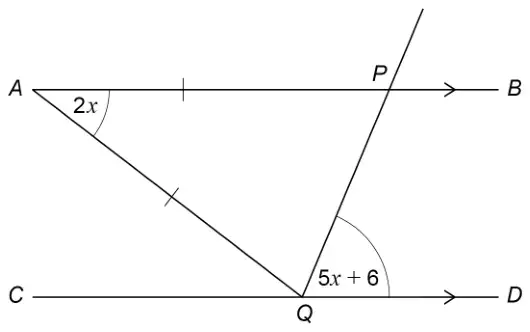
15 \(AB\) and \(CD\) are straight, parallel lines.
\(P\) is a point on \(AB\).
\(Q\) is a point on \(CD\).
\(AP = AQ\)
Not drawn accurately
Work out the value of \(x\). [4 marks]
Mark scheme
Answer
Mark
Comments
14
B4
B3 correct equation eg \(2x + 5x + 6 + 5x + 6 = 180\) or \(5x + 6 = 90 - x\) or \(2x + 90 - x + 5x + 6 = 180\) or \(5x + 6 = 174 - 7x\) B2 correct expressions for two angles or two different correct expressions for the same angle B1 correct expression for one angle
Additional guidance
Correct expressions for angles (which may be seen on the diagram) include angle \(AQC = 2x\) angle \(APQ = 5x + 6\) angle \(AQP = 5x + 6\) angle \(APQ = \dfrac{180 - 2x}{2}\) or \(90 - x\) angle \(AQP = \dfrac{180 - 2x}{2}\) or \(90 - x\) angle \(APQ = 180 - 2x - (5x + 6)\) or \(174 - 7x\) angle \(AQP = 180 - 2x - (5x + 6)\) or \(174 - 7x\) angle \(QPB = 180 - (5x + 6)\) or \(174 - 5x\) angle \(ZPB = 5x + 6\) (\(Z\) is the end of line \(QP\) produced) angle \(ZPA = 180 - (5x + 6)\) or \(174 - 5x\) (\(Z\) is the end of line \(QP\) produced)
B2 may be awarded for the same expression for two different angles eg angle \(APQ = 5x + 6\) and angle \(AQP = 5x + 6\)
B2
Accept eg \(\widehat{AQP}\) for angle \(AQP\)
Do not accept eg (angle) \(P\) for angle \(APQ\) unless shown on the diagram
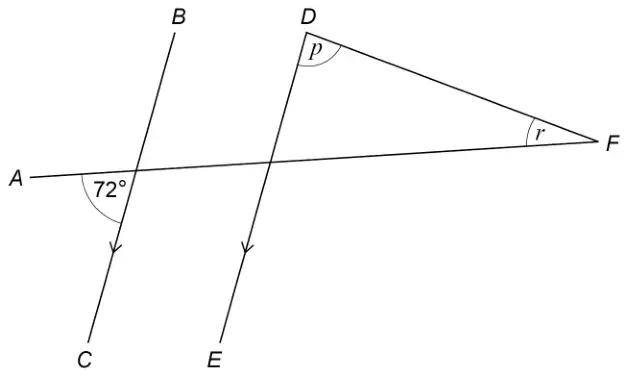
27 \(AF\), \(BC\), \(DE\) and \(DF\) are straight lines.
\(BC\) and \(DE\) are parallel.
Not drawn accurately
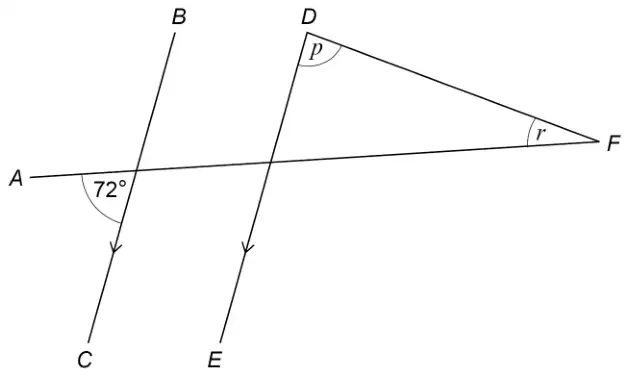
\(p\) is three times \(r\).
Work out the size of angle \(p\). [3 marks]
Mark scheme
Answer
Mark
Comments
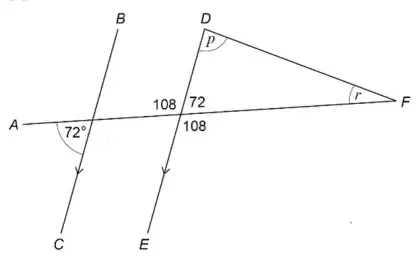
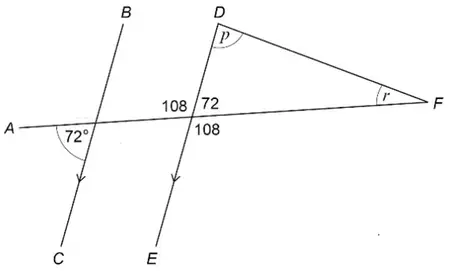
Angle labelled as 72 for the correct interior angle of the triangle or angle labelled as 108 for a correct exterior angle of the triangle or \(3r + r + 72 = 180\) or \(4r = 180 - 72\) or \(4r = 108\)
M1
oe
\(\dfrac{180 - 72}{3 + 1}\) or \(\dfrac{108}{4}\) or 27 or \(108 \times \dfrac{3}{4}\) or \(\dfrac{4p}{3} = 108\)
12 \(AF\), \(BC\), \(DE\) and \(DF\) are straight lines.
\(BC\) and \(DE\) are parallel.
Not drawn accurately
\(p\) is three times \(r\).
Work out the size of angle \(p\). [3 marks]
Mark scheme
Answer
Mark
Comments
Angle labelled as 72 for the correct interior angle of the triangle or angle labelled as 108 for a correct exterior angle of the triangle or \(3r + r + 72 = 180\) or \(4r = 180 - 72\) or \(4r = 108\)
M1
oe
\(\dfrac{180 - 72}{3 + 1}\) or \(\dfrac{108}{4}\) or 27 or \(108 \times \dfrac{3}{4}\) or \(\dfrac{4p}{3} = 108\)
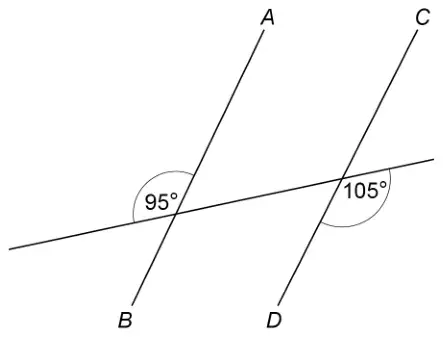
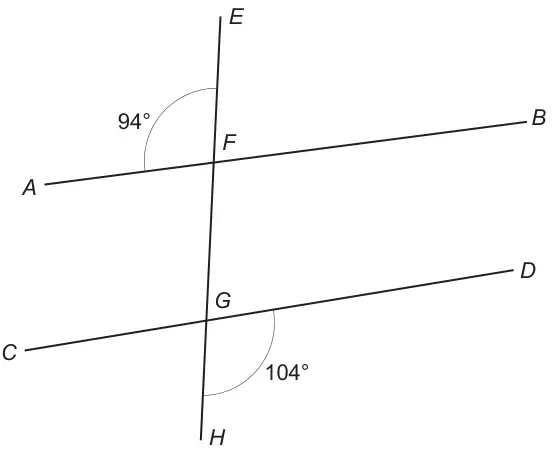
No ticked and appropriate working to show \(AB\) and \(CD\) are not parallel
B2
B1 any correct angle on the diagram eg 105 opposite the 105 given eg 85 written next to the 95 given or any correct angle which assumes lines are parallel eg 95 written opposite the 105 given or any correct angle evaluation seen in working eg \(180 - 105 = 75\)
Additional guidance
Angles must be shown on diagram or clearly identified to score B2
Ignore any incorrect or irrelevant terminology alongside correct working
“No” may be implied
Condone an incorrect angle if not subsequently used
Crossed out angles on diagram may be used to support working
No and 95 should be 105
B2
No and 95 written opposite the given 95 and 95 is not equal to 105
B2
No and 105 opposite the given 105 and 85 next to the 95 and \(105 + 85 = 190\) (or should be 180)
B2
No and 85 written next to the given 95 and 75 written next to the given 105 and \(85 \neq 75\)
B2
No and 75 written alongside 105 and 75 written underneath 95 and \(95 + 75 = 170\) (or should be 180)
B2
No and 95 written opposite 105 and the other two angles 75 and \(95 + 75 + 75 + 105 = 350\) (or should be 360)
B2
\(95 + 105 = 200\) is not a correct angle evaluation No and \(95 + 105 = 200\) and if it is 180 they will be parallel
9 For each statement, tick the correct box. [3 marks]
Always true
Sometimes true
Never true
One of the three angles of a triangle is \(90^\circ\)
One of the three angles of a triangle is obtuse
One of the three angles of a triangle is reflex
Mark scheme
Answer
Mark
Comments
One of the three angles of a triangle is \(90^\circ\): Sometimes true One of the three angles of a triangle is obtuse: Sometimes true One of the three angles of a triangle is reflex: Never true
B3
B1 for each
Additional guidance
Allow any unambiguous indication
eg if a cross is the only indication in a row, take that as the answer
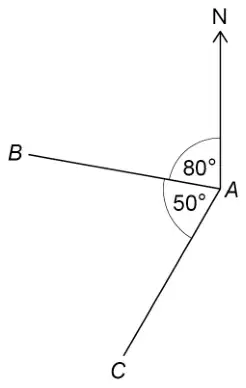
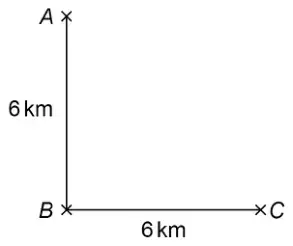
6 km due South of \(A\) and 6 km due West of \(C\).
Not drawn accurately
Work out the bearing of \(A\) from \(C\). [2 marks]
(b) Here is a scale drawing.
A ship is going to sail from \(D\) to \(E\).
Mia works out that the ship needs to sail on a bearing of 068°
Why must Mia be wrong? [1 mark]
Mark scheme (a)
Answer
Mark
Comments
\(\dfrac{180 - 90}{2}\) or \(\tan^{-1} \dfrac{6}{6}\) or 45
M1
oe may be seen on diagram eg \(\sin^{-1}\left(\dfrac{6}{\sqrt{72}}\right)\)
315
A1
SC1 answer of 135 (bearing of \(C\) from \(A\))
Additional guidance
\(\tan \dfrac{6}{6}\) unless recovered
M0
Mark scheme (b)
Answer
Mark
Comments
Correct explanation that the ship would be on land or 068° is the bearing of \(D\) from \(E\) or the bearing must be over 180° or the actual bearing is [246, 250]°
B1
eg that would take the ship over land 068° is from \(E\) 068° is the bearing from \(E\) to \(D\) the bearing is 248°
Additional guidance
Ignore irrelevant statements and compass points eg bearings go clockwise, bearings are measured from north, NE, south west
Do not accept incorrect statement or bearing alongside a correct statement
Bearings measured or stated outside of [246, 250]° range
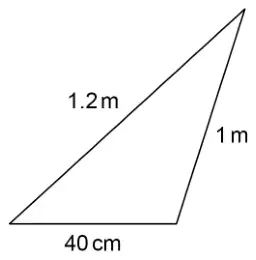
Work out \(\dfrac{\text{length of shortest side}}{\text{length of longest side}}\)
Give your answer as a fraction in its simplest form. [2 marks]
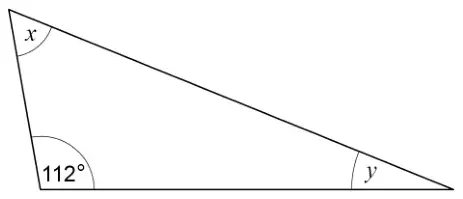
(b) Here is a different triangle.
Not drawn accurately
\(x = 3y\)
Work out the size of angle \(y\). [3 marks]
Mark scheme (a)
Answer
Mark
Comments
\(\dfrac{1}{3}\)
B2
B1 (may be seen in diagram) 120 or 100 or 0.4(0) may be seen in a fraction eg \(\dfrac{120}{40}\) or \(\dfrac{0.4}{1.2}\) or correct, but unsimplified fraction eg \(\dfrac{20}{60}\) or their fraction written in simplest form
SC1 1 : 3
Additional guidance
Ignore units on answer line
Do not ignore further work after \(\dfrac{1}{3}\) seen
If converting to mm both values must be correct
\(\dfrac{1}{3}\) given as a decimal or percentage must be correct to 2sf or better
B1
B1 for simplifying their fraction can only be awarded from the use of digits 1, 12 and 4, eg \(\dfrac{40}{1200}\), answer \(\dfrac{1}{30}\) \(\dfrac{1200}{40}\), answer 30 \(\dfrac{40}{1200}\), answer \(\dfrac{1}{3}\) \(\dfrac{2}{4}\), answer \(\dfrac{1}{2}\)
B1 B1 B0 B0
\(\dfrac{0.04}{1.2}\), answer \(\dfrac{1}{30}\)
B1
\(\dfrac{1}{40}\) or \(\dfrac{40}{1} = 40\)
B0
Mark scheme (b)
Answer
Mark
Comments
\(180 - 112\) or 68 or \(3y + y + 112 = 180\)
M1
oe
their 68 \(\div (3 + 1)\) or their 68 \(\div\) 4 or \(y = \dfrac{\text{their } 68}{4}\) or 51 or \(x = 17\)
M1
oe their 68 must be \(\lt 180\) but not 112 51 or \(x = 17\) imply M1M1
17
A1
Additional guidance
Check diagram for workings and answer
17 seen in diagram or working and 51 on answer line
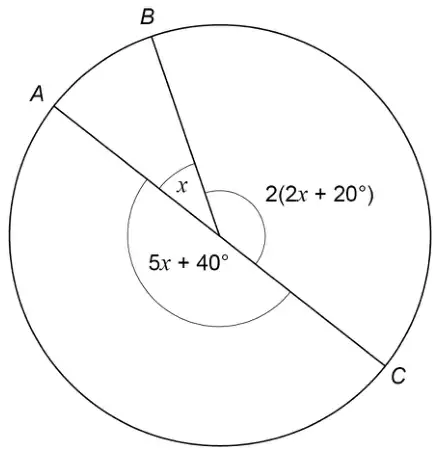
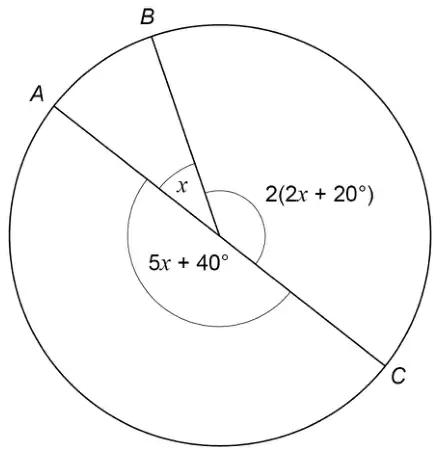
oe equation eg \(10x + 80 = 360\) \((x =)\) 28 may be on the diagram
\(140 + 40 = 180\) and Yes or \(28 + 152 = 180\) and Yes
A1
oe must obtain \((x =)\) 28 from one expression and substitute \((x =)\) 28 into a different expression
Alternative method 3 Assumes line is a diameter. Derives and solves an equation for angles on a line using \(5x + 40\) and substitutes into \(x + 2(2x + 20)\) or \(x + 2(2x + 20) + 5x + 40\)
\(5x + 40 = 180\)
M1
\((x =)\ (180 - 40) \div 5\) or \((x =)\) 28
M1dep
oe \((x =)\) 28 may be on the diagram
\(28 + 152 = 180\) and Yes or \(28 + 152 + 140 + 40 = 360\) and Yes
A1
oe must obtain \((x =)\) 28 from one expression and substitute \((x =)\) 28 into a different expression
Alternative method 4 Assumes line is a diameter. Derives and solves an equation for angles on a line using \(x + 2(2x + 20)\) and substitutes into \(5x + 40\) or \(x + 2(2x + 20) + 5x + 40\)
\(x + 2(2x + 20) = 180\) or \(x + 4x + 40 = 180\)
M1
\((x =)\ (180 - 40) \div 5\) or \((x =)\) 28
M1dep
oe \((x =)\) 28 may be on the diagram
\(140 + 40 = 180\) and Yes or \(28 + 152 + 140 + 40 = 360\) and Yes
A1
oe must obtain \((x =)\) 28 from one expression and substitute \((x =)\) 28 into a different expression
Alternative method 5 Assumes line is a diameter. Derives and solves two equations for angles on a line/angles at a point
Obtains \((x =)\) 28 from two equations for angles on a line/angles at a point and Yes
A1
Additional guidance
Choose the scheme that favours the student
Up to M2 may be awarded for correct work, with no or incorrect answer, even if this is seen amongst multiple attempts
Correct response with other incorrect work
M1M1A0
Alt 1 \(2(2x + 20) = 4x + 20\) followed by \(x + 4x + 20\) Alt 1 \(x + 4x + 20\) with \(2(2x + 20) = 4x + 20\) not seen Apply marks in a similar way in alts 2, 4 and 5
M0M1 M0M0
\((x =)\) 28
M1M1
Allow \((x =)\) 28 to be embedded
M1M1
No method marks scored with a value of \(x\) \((\ne 28)\) substituted into \(5x + 40\) and \(x + 2(2x + 20)\) giving the same value
M0M0A0
Yes can be implied eg Alt 1 \(x + 4x + 40 = 5x + 40\) and It is a diameter
oe equation eg \(10x + 80 = 360\) \((x =)\ 28\) may be on the diagram
\(140 + 40 = 180\) and Yes or \(28 + 152 = 180\) and Yes
A1
oe must obtain \((x =)\ 28\) from one expression and substitute \((x =)\ 28\) into a different expression
Alternative method 3 Assumes line is a diameter. Derives and solves an equation for angles on a line using \(5x + 40\) and substitutes into \(x + 2(2x + 20)\) or \(x + 2(2x + 20) + 5x + 40\)
\(5x + 40 = 180\)
M1
\((x =)\ (180 - 40) \div 5\) or \((x =)\ 28\)
M1dep
oe \((x =)\ 28\) may be on the diagram
\(28 + 152 = 180\) and Yes or \(28 + 152 + 140 + 40 = 360\) and Yes
A1
oe must obtain \((x =)\ 28\) from one expression and substitute \((x =)\ 28\) into a different expression
Alternative method 4 Assumes line is a diameter. Derives and solves an equation for angles on a line using \(x + 2(2x + 20)\) and substitutes into \(5x + 40\) or \(x + 2(2x + 20) + 5x + 40\)
\(x + 2(2x + 20) = 180\) or \(x + 4x + 40 = 180\)
M1
\((x =)\ (180 - 40) \div 5\) or \((x =)\ 28\)
M1dep
oe \((x =)\ 28\) may be on the diagram
\(140 + 40 = 180\) and Yes or \(28 + 152 + 140 + 40 = 360\) and Yes
A1
oe must obtain \((x =)\ 28\) from one expression and substitute \((x =)\ 28\) into a different expression
Alternative method 5 Assumes line is a diameter. Derives and solves two equations for angles on a line/angles at a point
Obtains \((x =)\ 28\) from two equations for angles on a line/ angles at a point and Yes
A1
Additional guidance
Choose the scheme that favours the student
Up to M2 may be awarded for correct work, with no or incorrect answer, even if this is seen amongst multiple attempts
Correct response with other incorrect work
M1M1A0
Alt 1 \(2(2x + 20) = 4x + 20\) followed by \(x + 4x + 20\) Alt 1 \(x + 4x + 20\) with \(2(2x + 20) = 4x + 20\) not seen Apply marks in a similar way in alts 2, 4 and 5
M0M1 M0M0
\((x =)\ 28\)
M1M1
Allow \((x =)\ 28\) to be embedded
M1M1
No method marks scored with a value of \(x\ (\ne 28)\) substituted into \(5x + 40\) and \(x + 2(2x + 20)\) giving the same value
M0M0A0
Yes can be implied eg Alt 1 \(x + 4x + 40 = 5x + 40\) and It is a diameter
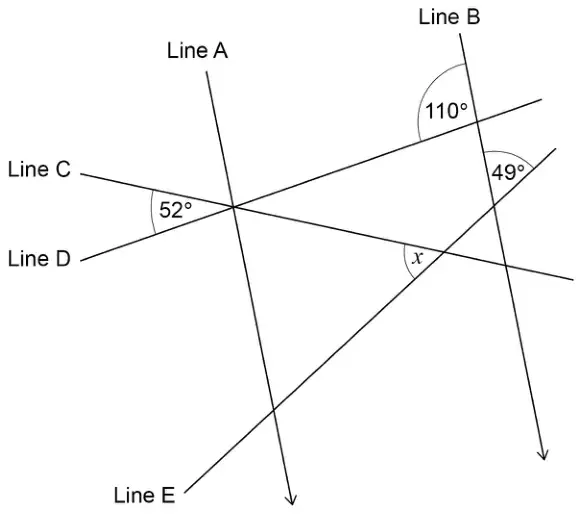
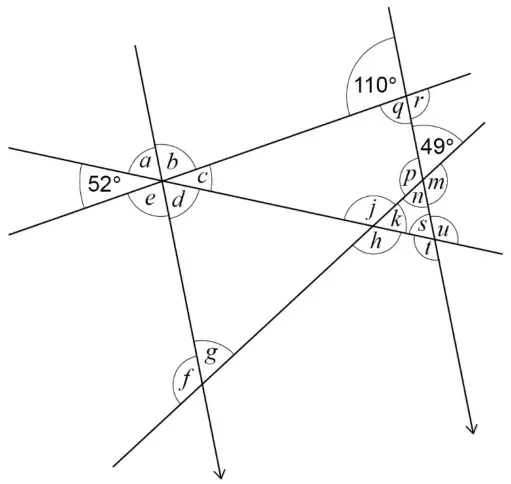
B2 \(180 - 110 + 52 - 49\) oe calculation or \(h = 107\) or \(j = 107\) or \(k = 73\) or \(g = 49\) and \(d = 58\) or \(g = 49\) and \(e = 70\) or \(f = 131\) and \(d = 58\) B1 any angle correct (others may be incorrect)
Additional guidance
Angles will usually be seen on the diagram
Angles must be unambiguously linked to the correct position eg 131 seen in working but not on the diagram or in wrong position
B0
\(a = 58 \quad b = 70 \quad c = 52 \quad d = 58 \quad e = 70\) \(f = 131 \quad g = 49 \quad h = 107 \quad j = 107 \quad k = 73\) \(m = 131 \quad n = 49 \quad p = 131 \quad q = 70 \quad r = 110\) \(s = 58 \quad t = 122 \quad u = 122\)
Alternative method 2: assumes both angles are equal and uses sum of angles in a quadrilateral
\((b =)\ 90 \div 5 \times 3\) or 54
M1
oe may be on diagram for \(b\) or \(x\)
90 + their 54 + their 54 + \(3 \times\) their 54 or 360 – 90 – their 54 – their 54 and either \(3 \times\) their 54 or their \(162 \div 3\) or their \(162 \div 54\)
M1dep
oe addition of the four angles in the quadrilateral or subtraction of 90 and the two equal angles from 360 and multiplication to work out the fourth angle or division of the fourth angle by 3 or 54 to act as a check
90 + 54 + 54 + 162 = 360 and \(54 \times 3 = 162\) or 360 – 90 – 54 – 54 = 162 and \(162 \div 3 = 54\) or \(162 \div 54 = 3\)
A1
oe
Alternative method 3: assumes both angles are equal and uses ratio to check 90°
20 \(P\), \(Q\), \(R\) and \(S\) are points on a circle.
\(PXR\) and \(QXS\) are straight lines.
\(PX = SX\)
Not drawn accurately
Prove that \(QS\) is not a diameter of the circle. [4 marks]
Mark scheme
Answer
Mark
Comments
Alternative method 1
angle \(QPR = 27\)
M1
may be seen on diagram
angle \(XPS = \dfrac{180 - 50}{2}\) or 65
M1
may be seen on diagram
angle \(QPR = 27\) and angle \(XPS = 65\) and angle \(QPS = 92\) and angle in a semicircle is a right angle
A1
oe accept \(92 \ne 90\)
all reasons for angle facts: angles in same segment (are equal) and angle sum of triangle (is 180) and base angles of isosceles triangle (are equal)
A1
oe
Alternative method 2
angle \(SXR = 180 - 50\) or 130 and angle \(XRS = 180 -\) their \(130 - 27\) and angle \(PQS =\) their 23
M1
may be seen on diagram angle \(XRS = 23\)
angle \(XSP = \dfrac{180 - 50}{2}\) or 65
M1
may be seen on diagram
angle \(SXR = 130\) and angle \(XRS = 23\) and angle \(PQS = 23\) and \(XSP = 65\) and angle \(QPS = 92\) and angle in a semicircle is a right angle
A1
oe accept \(92 \ne 90\)
all reasons for angle facts: angles on a straight line (add up to 180) and angle sum of triangle (is 180) and angles in same segment (are equal) and base angles of isosceles triangle (are equal)
15 Trapezium \(ABCE\) is made from parallelogram \(ABCD\) and isosceles triangle \(ADE\).
\(AE = DE\)
Not drawn accurately
Work out the size of angle \(AED\). [3 marks]
Mark scheme
Answer
Mark
Comments
\(ADC = 110\) or \(BAD = 180 - 110\) or \(BAD = 70\) or \(BCD = 180 - 110\) or \(BCD = 70\) or any indication that angle \(EAD\) = angle \(EDA\) or any indication that angle \(BCD\) = angle \(ADE\)
M1
may be seen on diagram
eg both written as \(x\) or both having the same value
\(EDA = 180 - 110\) or \(EDA = 70\) or \(EAD = 180 - 110\) or \(EAD = 70\)
M1dep
may be seen on diagram
40
A1
Additional guidance
Angle values must be identified with the correct angle, either by notation or use of the diagram Notation such as \(D = 110\) or \(C = 70\) is not acceptable (although marks may still be awarded for correct position of angles on diagram)
Work on the diagram can score up to M2
Subject to the previous comment, award the higher mark for work seen on diagram and work seen in working space
Ignore incorrect angles when awarding up to M2, but any incorrect work cannot score M2A1
40 marked as angle \(AED\) on diagram but :- 180 on answer line or no sign of 40 as final answer in working
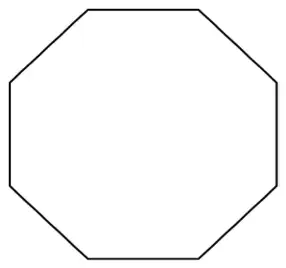
(b) Amba is working out the size of an interior angle of a regular octagon.
Not drawn accurately
Her method is \(\qquad\) Interior angle \(= 360 \div 8\)
Is her method correct?
Tick a box.
Yes
No
Give a reason for your answer. [1 mark]
Mark scheme (a)
Answer
Mark
Comments
\(180 \div 3\) or 60
M1
oe eg \(60 + 60 + 60 = 180\)
\((180 - 28) \div 2\) or \(152 \div 2\) or 76
M1
oe eg \(76 + 76 + 28 = 180\)
\(180 -\) their \(60 -\) their 76
M1dep
oe eg \(44 + 60 + 76 = 180\) dep on M1M1
44
A1
Additional guidance
60 or 76 seen in appropriate place on diagram or in working scores one mark for each
Answer 44 not from wrong working
M3A1
\(180 - 28 \div 2\) unless recovered
2nd M0
Mark scheme (b)
Answer
Mark
Comments
No and gives correct reason
B1
eg it should be \(180 - (360 \div 8)\) it should be \(1080 \div 8\) this gives the exterior (not the interior) angle it should be obtuse not acute accept any unambiguous indication of No
Additional guidance
A correct reason may be
showing a correct method
correction of her method (error and replacement shown)
correction of her answer (answer and replacement shown)
No, It should be 135 not 45 (3)
B1
No, It should be 1080 not 360 (2)
B1
No, because the interior angles should be 1080 not 360 (2)
B1
No, she needs to subtract her answer from 180 (1)
B1
No, \(((8 - 2) \times 180) \div 8\) (1)
B1
No, It should be \(((n - 2) \times 180) \div 8\) (doesn’t use \(n = 8\))
B0
Any numbers quoted must be correct but ignore other non-contradictory statements
eg No, It should be 720. She’s worked out the exterior angle
B0
No, There’s not 360 in an octagon or No, Angles in an octagon do not add up to 360
13 Tick all the statements that are true for any rhombus. [1 mark]
The diagonals are lines of symmetry
The diagonals bisect each other
The diagonals are perpendicular
The diagonals are equal in length
Mark scheme
Answer
Mark
Comments
The diagonals are lines of symmetry ✓ The diagonals bisect each other ✓ The diagonals are perpendicular ✓ The diagonals are equal in length (not ticked)
\(2x + 10 = 60\) or \(2x = 60 - 10\) or \(2x = 50\) or \(x = 25\)
M1
\(3 \times\) their \(25 - 20\) or 55 or \(180 - 55\) or 125
M1dep
oe
\((y =)\) 125 and bigger or (\(y\) is) 15 bigger
A1ft
oe ft their (a)
Additional guidance
Note: A complete logical explanation of the effect of lines not being parallel eg \(w\) is smaller so \(2x + 10\) is smaller so \(x\) is smaller so \(3x - 20\) is smaller so \(y\) is bigger
\(2x + 10 = 60\) or \(2x = 60 - 10\) or \(2x = 50\) or \(x = 25\)
M1
\(3 \times\) their \(25 - 20\) or 55 or \(180 - 55\) or 125
M1dep
oe
(\(y =\)) 125 and bigger or (\(y\) is) 15 bigger
A1ft
oe ft their (a)
Additional guidance
Note: A complete logical explanation of the effect of lines not being parallel eg \(w\) is smaller so \(2x + 10\) is smaller so \(x\) is smaller so \(3x - 20\) is smaller so \(y\) is bigger
ABC is an equilateral triangle. BD is perpendicular to AC.
Prove that triangle ABD is congruent to triangle CBD. [4]
Mark scheme
Answer
Marks
Part marks and guidance
Proof of congruency e.g.
For the M marks, must be clear distinct statements involving equalities of pairs of named sides or pairs of named angles with the reason (if given) alongside the statement Throughout accept A for angle BAD and C for angle BCD.
[Angle] ADB = [Angle] CDB = 90°
BD is common oe
AB = BC equilateral [triangle] or given oe
OR
[Angle] ABD = [Angle] CBD = 30°
BD is common oe
AB = BC equilateral [triangle] or given
M3
M2 for 2 correct statements with reason[s] or 3 correct statements but incorrect/no reason[s] or M1 for 1 correct statement with reason or 2 correct but incorrect/no reasons
Do not accept ADB = 90 alone without = angle CDB, accept right angle for 90 Accept e.g. BD = BD, BD is shared, BD is in both
If more than 3 statements given, mark to candidates advantage and isw incorrect/incomplete statements alongside correct work for method marks
Accept equivalent proofs for AAS involving any two of the three angles and either BD is common or AB = BC (given) Accept [Angle] BAD= [Angle] BCD = 60 or equilateral [triangle] Do not accept AD = DC
[Triangle BDC is congruent to triangle BAD] (RHS) or (SAS)
A1
Dep on M3 and no incorrect work seen and condition must fit statements given
See Appendix 2
Appendix 2: Question 12
For the M marks, statements may be embedded within longer text but they must be clear distinct statements involving equalities of pairs of named sides or pairs of named angles with (if given) the reason alongside the statement. Do not accept annotation on the diagram as implying method. This question is also assessing clear communication of the mathematics.
Example
Candidate response
Comment
A
All sides equal Line BD is perpendicular to AC, meaning its the mid point Splitting a equilateral triangle creates 2 right angle triangles and because its equilateral it should be the same on both sides. RHS, Right angle they both have, hypotenuse is the same and the side is the same. Yes, it is congruent as said by RHS. This means they are congruent as they all have a right angle, hypotenuse is the same and side is the same as it was equilateral
Within the text there is no specific named equality of pairs of sides or pairs of angles stated. It is done in more general terms and this is not acceptable so M0
B
Equilateral = all angles are the same \(\angle ABC = \angle BAC = \angle BCA\) Each angle \(= \frac{180}{3} = 60\) \(\triangle ABD\): \(\angle ABD = 60/2 = 30°\), so \(\angle BAD = 180 - (30 + 90) = 60°\) \(\triangle CBD\): \(\angle CBD = 60/3 = 30°\), so \(\angle BCD = 180 - (30 + 90) = 60°\) → Both are right angled triangles that shares line BD → Both share the same angles of 90°, 30°, 60° → They form an equilateral triangle which has angles of the same angles (60, 60, 60) so both triangles must be equal
There are no clear distinct equality statements of pairs of sides or pairs of angles with reasons. The statement BD is shared appears in the text and earns M1
C
\(\angle DBC\) and \(\angle DBA\) both equal 30° as angle \(\angle BAD\) and \(\angle DCB\) both are 60° as triangle ABC is equilateral so with the perpendicular line creating 90° angles in order to get the full 180° they must be 30° so therefore ABD is congruent to CBD
Within the text there are two clear distinct statement of equality of angles DBC = DBA = 30 and BAD = DCB = 60 with reasons. There is no statement about equalities of pairs of sides Award M2
D
BDA = BDC so BDA is 90°. BD is the same in both triangles. SAS AC runs along both triangles so AD = AC so triangles are SAS.
BDA = BDC stated and 90 is given for BDA next to the statement BOD M1 BD is shared earns M1
(a) The diagram shows a triangle with one side extended.
Not to scale
Work out the value of \(a\). [2]
(b) Complete the statement below using the correct symbol and value from this list.\[< 90^\circ \qquad = 90^\circ \qquad > 90^\circ \qquad < 180^\circ \qquad = 180^\circ \qquad > 180^\circ\]
When the two smallest angles in a triangle are added the answer is always .................. [1]
Mark scheme (a)
Answer
Marks
Part marks and guidance
122
2
M1 for 180 – 40 – 82 oe or for 40 + 82
Answer 58 with no working scores 0 M1 may be implied by 58 e.g. seen in correct position on diagram
Must be explicit with no extras
Mark scheme (b)
Answer
Marks
Part marks and guidance
\(< 180\)
1
Mark answer line. If line blank accept any clear indication e.g. ringed, others deleted in list
18 The diagram shows two straight lines AB and DC that intersect at P. DA is parallel to BC.
Complete these statements to show that triangle PAD is similar to triangle PBC.
Angle ADP = angle BCP because they are alternate angles
Angle APD = angle ................ because they are ................................ angles
Angle ................ = angle ................ because they are ................................ angles
Triangle PAD is similar to triangle PBC because ................................................ [4]
Mark scheme
Answer
Marks
Part marks and guidance
BPC or CPB and [vertically] opposite
B2
B1 for BPC or CPB
Must use 3-letter notation
DAP or PAD, CBP or PBC, alternate
B1
Must have angle and reason
Condone • A and B if clear for e.g. A for PAD and B for CBP • Changed order e.g. CBP and PAD • Use of B or C for P e.g. DAB for DAP For reason, condone poor spelling (alternative) and accept “third angle in triangle” oe
AAA oe
B1dep
Dependent on previous B2 and B1
Accept completely correct statements e.g. “All corresponding angles equal” but not “All angles equal” or “They have the same angles” See Appendix
(b) The angles of a triangle are \(27^\circ\), \(126^\circ\) and \(27^\circ\).
Explain how you know the triangle is isosceles. [1]
(c) The diagram shows two sides of a parallelogram drawn on a one-centimetre grid.
(i) Complete the drawing of the parallelogram. Include notation to show that the drawing is a parallelogram. [2]
(ii) Work out the area of the parallelogram. [2]
Mark scheme (a)
Answer
Marks
Part marks and guidance
133
1
Allow 131 to 135
Mark scheme (b)
Answer
Marks
Part marks and guidance
2 of the angles are equal oe
1
Must refer to angles not sides, statements must not be contradicted
Appendix
Exemplar responses for Q3b
Response
Mark
Two angles are identical and one is different.
1
Only two of the angles are the same so it cannot be equilateral.
1
Because two of the angles being the same means it is equal lines.
1
Two angles of an isosceles have to be the same.
1
27\(^\circ\) and 27\(^\circ\) are equal meaning it has two equal sides.
1
Only 2 numbers are the same and it's not all equal
1 bod
Because others don’t have same two angles
1 bod
Because others don’t have two angles the same/2 same angles
1 bod
Base angles in an isosceles triangle are always equal.
1 bod
Because isosceles triangles have equal sides and they are 27\(^\circ\).
0
Because 2 sides of the triangle are the same which is 27\(^\circ\) and the last side is different.
0
One angle is bigger than the others
0
Because they’re both 27 degree angles'
0
2 sides are the same
0
Both of isosceles have the same number
0
Mark scheme (c)
Answer
Marks
Part marks and guidance
(i)
1
Correct parallelogram drawn
Accept reasonable freehand, tolerance \(\pm\) 2mm by eye
1 dep
dep on parallelogram drawn Accept other, complete, standard notations that indicate a parallelogram eg two pairs of opposite sides have equal length or two pairs of opposite angles are equal or any combination of these properties that define a parallelogram
Mark intent
Arrows must be correct single/double and pointing in correct direction
(ii) 18 nfww
2
FTtheir parallelogram
M1 for their length \(\times\) their perpendicular height oe
e.g. \(6 + 3 + 6 + 3 = 18\) scores 0 M1 and 2 marks are dependent on a parallelogram being drawn in (i) Must be in cm\(^2\)
If not 6 and 3 their dimensions need to be verifiable eg shown on the diagram eg M0 for \(\sqrt{13}\) or 3.6… etc as their perpendicular height
oe includes two triangles + the \(4 \times 3\) rectangle or the \(8 \times 3\) rectangle – two triangles
Need to be certain that 3 is slant height to withhold the marks
19 The diagram shows the positions of three towns A, B and C.
Not to scale
The bearing of town B from town A is 053°. The bearing of town C from town B is 108°. AB = 35 km and BC = 61 km.
Calculate AC. You must show your working. [5]
Mark scheme
Answer
Marks
Part marks and guidance
85.99… to 86 with correct working
5
B4 for 7395[…] with correct working
“Correct working” requires at least M1 from cosine rule
OR M2 for correct method to find angle 125 e.g. 53 + 180 – 108 or 360 – 108 – (180 – 53) or M1 for correct method to find angle 72 or 127 e.g. 180 – 108 or 180 – 53 and M2 for \(\sqrt{35^2 + 61^2 - 2 \times 35 \times 61 \times \cos(\textit{their } 125)}\) or M1 for [AC2 =] 352 + 612 – 2×35×61×cos(their 125)
M2 implied by [angle ABC =] 125
If 0, 1 or 2 marks scored, instead award SC3 for answer 85.99… to 86 with no or insufficient working If 0 or 1 mark scored, instead award SC2 for answer 7395[…] with no or insufficient working
12 The diagram shows two straight lines crossing a pair of parallel lines.
Not to scale
(a)
(i) Find the value of \(x\).
Give a geometrical reason for your answer. [2]
(ii) Find the value of \(y\).
Give a geometrical reason for your answer. [2]
(b) Find the value of \(z\). [2]
Mark scheme (a)
Answer
Marks
Part marks and guidance
(i) \(x = 59\) and alternate angles [are equal]
2
B1 for each
Alternative Explanation: Co-interior/Allied Angles [add to 180] and Angles on a Straight Line =180 Corresponding Angles [are equal] and Angles on a Straight Line =180
(ii) \(y = 42\) and corresponding angles [are equal]
2
B1 for each
Alternative Explanation: Co-interior/Allied Angles [add to 180] and Angles on a Straight Line =180 Alternate Angles [are equal] and Angles on a Straight Line =180
Mark scheme (b)
Answer
Marks
Part marks and guidance
101
2
B1 for 79 or M1 for \(59 + 42\) oe
79 could be seen in a correct position of the diagram but not on answer line.
8 The diagram shows four triangles that are joined together.
Not to scale
Points A, B, C and D lie on a straight line.
Triangles ABF and CDE are equilateral triangles.
Triangle BCF is an isosceles triangle with BF = BC.
Show that triangle CEF is a right-angled triangle. Give a reason for each stage of your working. Use the template below to help present your work. You may not need all of the lines.
Angle …… = ……° because ……
Angle …… = ……° because ……
Angle …… = ……° because ……
Angle …… = ……° because ……
Angle …… = ……° because ……
Angle …… = ……° because ……
Angle …… = ……° because …… [5]
Mark scheme
Answer
Marks
Part marks and guidance
ABF 60 equilateral/all angles equal
1
If 0 or 1 scored, instead award SC2 for all of these angles correct in template or on diagram
Ignore other angles Accept in any order Condone spelling
FBC 120 straight line/line adds to 180
1
BCF 30 isosceles/ BCF=BFC and angles in triangle add to 180
1
If 0 scored, instead award SC1 for two of the first four angles correct in template or on diagram
ECD 60 equilateral/all angles equal
1
For full marks, must be convinced they are working forwards and not backwards
18 In the diagram, line AB is parallel to line ED. The points A, C and D lie on a straight line. The points B, C and E lie on a straight line.
Not to scale
Angle BCA = \(45^\circ\), angle ABC = \(x^\circ\) and angle CDE = \(y^\circ\). The ratio \(x : y\) is 3 : 2.
Work out the value of \(x\). [4]
Mark scheme
Answer
Marks
Part marks and guidance
81
4
B1 for 135
AND
M2 for their \((180 - 45) \div (3 + 2)\) [\(\times k\)] oe (\(k\) = 1, 2 or 3) or M1 for \(x + y =\) their \((180 - 45)\) or ECD = 45 or DEC = \(x\) or BAC = \(y\)
7 The diagram shows a straight line crossing a pair of parallel lines.
Not to scale
Find the value of \(y\). You must show your working. [5]
Mark scheme
Answer
Marks
Part marks and guidance
103 with correct working
5
B3 for \(x\) = 42 or M2 for 4\(x\) = 180 – 35 + 23 oe or 3\(x\) – 23 = 103 or better
or M1 for 3\(x\) – 23 + \(x\) + 35 = 180 oe A1 for \(x\) = 42
AND M1 for 3 × their \(x\) – 23 or their \(x\) + 35
If 0 or 1 scored, instead award SC2 for answer 103 with no or insufficient working
If 0 scored, instead award SC1 for [\(x\) =] 42
“Correct working” requires evidence of at least M2 or M1M1 Accept equivalents for M2 e.g. (180 – 35 + 23) ÷ 4 if no algebra seen Accept e.g. 3\(x\) – 23 and \(x\) + 35 = 180
Using trial, allow correct substitution into 3\(x\) – 23 + \(x\) + 35 to imply M1 if 180 also stated
5 B is 12 km due east of A. C is south-east of A and on a bearing of 225° from B.
Complete the diagram to show the positions of A, B and C. Show clearly the values of all three angles in triangle ABC.
Scale: 1 cm represents 2 km
[4]
Mark scheme
Answer
Marks
Part marks and guidance
Accurate and correct isosceles triangle with A, B and C points labelled and angles 45°, 45° and 90° correctly labelled
4
B1 for B 6 cm (± 2 mm) due east of A (± 2°)
B1 for C from A
B1 for C from their B
For those who put B due west of A, award the second B1 if their C is marked at 225 ± 2° from A and the third B1 if their C is marked at 135 ± 2° from B
condone dotted lines and accept symbol for 90°
line accurately drawn or point B marked 6 cm (±2 mm) and east (90 ± 2°) from A
line accurately drawn or C marked at 135 ± 2° from A
line accurately drawn or C marked at 225 ± 2° from B
23 The diagram shows a straight line crossing two parallel lines.
Not to scale
Find the value of \(y\). You must show your working. [6]
Mark scheme
Answer
Marks
Part marks and guidance
40 with correct working
6
M1 for \(x + 85 = 2x + 30\) M1dep for \(\pm x = k\) or \(kx = \pm 55\) (\(k \ne 0\)) A1 for \(x = 55\)
or
M1 for at least two trials of \(x + 85\) or evaluated for \(x = 55\) M1 for at least two trials of \(2x + 30\) or evaluated for \(x = 55\) A1 both expressions evaluated as 140 when \(x = 55\)
AND
M1 for their \(x + 85\) or \(2 \times\) their \(x + 30\) M1 for \(y = 180 - (\)their \(x + 85)\) oe
If 0 scored SC2 for answer 40 with no working or insufficient working or SC1 for \(x = 55\) with no or insufficient working
“Correct working” requires evidence of at least M1 AND M1 i.e. we expect to see a minimum of an equation or trials leading to \(x = 55\) and the substitution
18 A, B, C and D are points on the circumference of a circle. EF is the tangent to the circle at D. Angle BDF = 70°.
Not to scale
The ratio angle BCD : angle CBD is 5 : 2.
Work out angle CBD. You must show your working. [5]
Mark scheme
Answer
Marks
Part marks and guidance
44 with correct working
5
For full marks “correct working” requires evidence of at least M1 AND M1 ie at least a correct angle and some ratio work Ignore geometric reasons if given
B3 for angle BCD = 110 with correct working or M1 for angle BAD = 70 or for angle BDE = 180 – 70 or 110 M1 for angle BCD = 180 – their angle BAD
For B3 “correct working” requires at least M1 or alternate convincing approach
Angles may be indicated on diagram for part marks
AND
M2 for their angle BCD ÷ 5 × 2 oe or M1 for their angle BCD ÷ 5 oe
If 0 scored SC2 for answer 44 or SC1 for angle BCD = 110
B lies on AD and C lies on AE. BC is parallel to DE.
Complete these statements to show that triangles ABC and ADE are similar.
Angle ABC = angle ADE because they are corresponding angles. Angle ACB = angle ........ because ........ Angle BAC is ........ Triangles ABC and ADE are similar because ........
[3]
Mark scheme
Answer
Marks
Part marks and guidance
AED or DEA and corresponding
1
accept CED, DEC
common oe
1
accept “same as angle DAE” oe ignore any reasons
correct reason e.g. AAA or both triangles have the same angles oe
9 In the diagram, AB and DC are parallel lines of equal length.
Not to scale
Prove that angle DAB = angle BCD. [4]
Mark scheme
Answer
Marks
Part marks and guidance
Angle ABD = Angle CDB (alternate) BD is common oe AB = CD given oe
M3
M2 for 2 correct statements with reason[s] or 3 correct but no/incorrect reason[s] M1 for 1 correct statement with reason or 2 correct but no/incorrect reasons
If 0 scored, SC1 for any attempt to prove congruency
Not alternative angles
Accept BD = BD, BD is shared Accept same length oe for ‘given’
eg attempt to list pairs of equal sides or equal angles (2 or more even if incorrect)
SAS so triangles are congruent and Angle DAB = angle BCD
Work out angle BDC. Give a reason for each angle you work out. [4]
Mark scheme
Answer
Marks
Part marks and guidance
angle BDC = 44
2
B1 for angle ABD = 44 or angle ADC = 100 or M1their BDC = their ABD
Notation not required but values need to be identified eg the angle must be named or the value written in the correct place in the diagram or for BDC, on the answer line
Ignore answer line if angle BDC is identified correctly in working If BDC is only correctly labelled on the diagram max B1 scored
correct reasons leading to angle BDC = 44
2
two marks for [co-]interior angles [add up to 180]
or allied angles [add up to 180]
or angles between parallel lines [ add up to 180]
OR
one mark for each relevant reason (maximum of two) from
[angles in a] triangle [add up to] 180
alternate [angles are equal]
corresponding [angles are equal]
angles on a straight line [add up to] 180
Reasons must be correct for their method leading to angle BDC = 44.
180 may be implied in these reasons by a correct calculation
At least two of the reasons given above but must include allied/co-interior angles
E1
Award E1 provided at least B1 B1 awarded
Alternative final two marks (using properties of a parallelogram)
Scheme
Marks
Comments
\(x\) = (360 – 2 × (59 + 48)) ÷ 2 = 73(°) (opposite angles in a parallelogram are equal and sum to 360°)
B1
At least two of the reasons given above but must include opposite angles in a parallelogram are equal and sum to 360°
E1
Award E1 provided at least B1 B1 awarded Allow pairs of angles in a parallelogram are equal
Note to markers Allow other full and complete methods to prove that \(x\) = 73(°) with appropriate reasons e.g. \(P\hat{R}S\) = 48(°) (alternate angles) and \(P\hat{R}S + R\hat{P}S + P\hat{S}R\) = 48 + 59 + 73 = 180(°) (angles in a triangle = 180°)
The board's mark scheme printed “8 ÷ 12/9 = = 6” and “9 × 10/7·5 = = 12”. Changed to “8 ÷ 12/9 = 6” and “9 × 10/7·5 = 12” because the equals sign was printed twice by mistake (in both the B2 and B1 lists). Our text already showed a single “=”.
Original: see the board's mark scheme PDF (link above).
(a) Four triangles are shown in the diagram below.
Diagram not drawn to scale
For each of the following statements choose ‘True’, ‘False’ or ‘Need more information’. Tick one box for each statement. [2]
Statement
True
False
Need more information
Triangle A is congruent to Triangle B
Triangle C is congruent to Triangle D
Triangle A is congruent to Triangle C
(b) Is it possible to draw an isosceles triangle with an exterior angle of \(60^\circ\)? Tick the appropriate box and show working to explain your reason. [2]
Yes ☐ No ☐
(c) Two triangles are shown in the diagram below.
Diagram not drawn to scale
Show that the two triangles are mathematically similar. [2]
Mark scheme (a)
Scheme
Marks
Comments
True
False
Need more information
✓
✓
✓
B2
For all three correct B1 for any two correct
Mark scheme (b)
Scheme
Marks
Comments
Yes indicated or clearly implied (with indication of one \(120^\circ\) angle) with two \(30^\circ\) angles.
B2
B1 for a clear indication of interior angle of \(120^\circ\)
OR \(\left(\frac{7.5}{10} = \frac{9}{12} = \frac{6}{8}\right)\) same scale factor \(= \frac{3}{4}\) oe
B2
B1 just for \(\frac{10}{7.5} = \frac{12}{9} = \frac{8}{6}\) OR \(\frac{7.5}{10} = \frac{9}{12} = \frac{6}{8}\)
Award no marks if the ratios of less than three pairs of sides compared.
Alternative method 1
Scheme
Marks
Comments
12:10:8 and 9:7·5:6 both simplify to 6:5:4 oe OR both equivalent to 108:90:72 oe
B2
B1 for stating 12:10:8 = 9:7·5:6 without simplifying to 6:5:4
Alternative method 2
Scheme
Marks
Comments
B2 for any one of the following: \(7.5\times\frac{12}{9} = 10\) AND \(6\times\frac{12}{9} = 8\) \(10\div\frac{12}{9} = 7.5\) AND \(8\div\frac{12}{9} = 6\) \(9\times\frac{10}{7{\cdot}5} = 12\) AND \(6\times\frac{10}{7{\cdot}5} = 8\) \(12\div\frac{10}{7{\cdot}5} = 9\) AND \(8\div\frac{10}{7{\cdot}5} = 6\) \(9\times\frac{8}{6} = 12\) AND \(7{\cdot}5\times\frac{8}{6} = 10\) \(12\div\frac{8}{6} = 9\) AND \(10\div\frac{8}{6} = 7{\cdot}5\)
B2
B1 for any one of the following: \(7.5\times\frac{12}{9} = 10\) OR \(6\times\frac{12}{9} = 8\) \(10\div\frac{12}{9} = 7.5\) OR \(8\div\frac{12}{9} = 6\) \(9\times\frac{10}{7{\cdot}5} = 12\) OR \(6\times\frac{10}{7{\cdot}5} = 8\) \(12\div\frac{10}{7{\cdot}5} = 9\) OR \(8\div\frac{10}{7{\cdot}5} = 6\) \(9\times\frac{8}{6} = 12\) OR \(7{\cdot}5\times\frac{8}{6} = 10\) \(12\div\frac{8}{6} = 9\) OR \(10\div\frac{8}{6} = 7{\cdot}5\)
(6)
Corrected by Westie's Workshop
The board's mark scheme printed “8 ÷ 12/9 = = 6” and “9 × 10/7·5 = = 12”. Changed to “8 ÷ 12/9 = 6” and “9 × 10/7·5 = 12” because the equals sign was printed twice by mistake (in both the B2 and B1 lists). Our text already showed a single “=”.
Original: see the board's mark scheme PDF (link above).
(b) Show that the triangle below is not isosceles. You must use an algebraic method and not trial and improvement. [5]
Diagram not drawn to scale
Mark scheme (a)
Scheme
Marks
Comments
\(8a + 22\) OR \(2(4a + 11)\)
B2
B1 for one of the following: \(8a + k\) where \(k \ne 0\) \(ka + 22\) where \(k \ne 0\) \(15a - 6 - 7a + 28\)
Mark final answer for B2 only -1 for incorrect further work
Mark scheme (b)
Scheme
Marks
Comments
\(5x + 7 + 6x - 9 + 8x - 27 = 180\)
M1
May be seen in stages Allow M1 for (180-7+9+27) ÷ (5+6+8)
\(19x = 209\)
A1
Implies M1 Allow 209 ÷ 19
\(x = 11\)
A1
FT from \(ax = b\) OR ‘their 209’ ÷ ‘their 19’ provided M1 awarded For FT, accept answer written as a correctly simplified, improper fraction (unless it gives a whole number), mixed number or decimal. If answer is only given as a decimal, it must be correct to 1 decimal place – rounded or truncated.
Method to calculate all three angles e.g. \(5\times11 + 7\) (= 62) \(6\times11 - 9\) (= 57) \(8\times11 - 27\) (= 61) OR calculates two angles by substitution and the third by subtracting sum from 180
M1
If \(x \ne 11\) FT ‘their \(x\)’ provided \(x \geqslant 4\) and M1 previously awarded.
M1 implied if three angles correctly found (without working shown) from FT of ‘their \(x\)’
All three angles correctly calculated: 62(°), 57(°), 61(°) (so not isosceles)
A1
CAO
If no marks, award: SC2 for \(x = 11\), obtained with no working shown or trials used AND angles of 62(°), 57(°), 61(°) (so not isosceles) OR SC1 for \(x = 11\) obtained with no working shown or trials used.
Alternative method – showing that if two angles are equal, angle sum is not 180(°)
Scheme
Marks
Comments
One pair of angles equated e.g. \(6x - 9 = 5x + 7\)
M1
Correct value of \(x\) obtained e.g. \(x = 16\) AND correct angle sum calculated e.g. 275(°)
A1
Both other pairs of angles equated e.g. \(8x - 27 = 5x + 7\) AND \(8x - 27 = 6x - 9\)
M1
Both equations solved correctly \(x = 11\frac13\) AND \(x = 9\) AND correct angle sums calculated e.g. \(186\frac13\)(°) and 142(°)
A2
A1 for one correct value of \(x\) and the correct angle sum provided M1 awarded.
16. In the diagram below, \(BE\) is a straight line.
Diagram not drawn to scale
Show that \(x\) = 150°. You must give a reason for each step of your working. [4]
Mark scheme
Scheme
Marks
Comments
\(A\hat{C}B\) = 60(°) or \(A\hat{B}C\) = 60(°) or \(B\hat{A}C\) = 60(°) AND \(A\hat{C}D\) = 120(°) AND \(A\hat{D}C\) = 30(°)
B2
Angles may be seen on diagram. B1 for any two of the three angles 30(°), 120(°) and 60(°)
A correctly labelled and explained solution
\(A\hat{C}B\) = 60(°) equilateral triangle
\(A\hat{C}D\) = 120(°) angles on a straight line \(A\hat{D}C\) = 30(°) angles in an isosceles triangle (so \(x\) = 150°)
OR starting with the 150(°)
\(A\hat{D}C\) = 30(°) angles on a straight line \(A\hat{C}D\) = 120(°) angles in an isosceles triangle \(A\hat{C}B\) = 60(°) so \(ABC\) is an equilateral triangle
OR working from both sides
\(A\hat{C}B\) = 60(°) as an equilateral triangle \(A\hat{D}C\) = 30(°) angles on a straight line \(A\hat{C}D\) = 120(°) angles in an isosceles triangle AND 120 + 60 = 180 angles on a straight line
E2
E2 and E1 dependent on B2 being awarded.
Accept \(A\hat{C}B\) = 60(°) as ‘all angles (in \(ABC\)) are equal/60°’
Accept \(A\hat{D}C\) = 30(°) as ‘two angles (in \(ACD\)) are equal’
E1 for either:
full explanations but incorrect labelling e.g. \(C\) = 120(°) or \(BDC\) = 120(°)
correct labelling but one explanation missing or incorrect
(4)
Corrected by Westie's Workshop
The board's mark scheme printed “as all angles (in ABC) are equal/60°’”. Changed to “as ‘all angles (in ABC) are equal/60°’” because the quoted reason had a closing quote mark but no opening one.
The board's mark scheme printed “as two angles (in ACD) are equal’”. Changed to “as ‘two angles (in ACD) are equal’” because the quoted reason had a closing quote mark but no opening one.
The board's mark scheme printed “working from both side”. Changed to “working from both sides” because “side” should be “sides”.
Original: see the board's mark scheme PDF (link above).
The exterior angle of a regular polygon is \(24^\circ\).
(i) How many sides does it have? [2]
(ii) Calculate the sum of all the interior angles of this polygon. [2]
(b)
The diagram below shows a quadrilateral QRST. QS is parallel to UT. \(Q\hat{R}S = 84^\circ\), \(R\hat{Q}T = 110^\circ\) and QR = RS.
Diagram not drawn to scale
Calculate the value of \(x\). Give a reason for each step of your answer. [4]
Mark scheme (a)
Scheme
Marks
Comments
(i) 360 ÷ 24
M1
= 15 (sides)
A1
(ii) (180 – 24) × 15 oe
M1
FT ‘their number of sides’ if > 4
= 2340(°)
A1
FT
Alternative
Alternative Method for (ii)
Scheme
Marks
Comments
(15 – 2) × 180 oe
M1
FT ‘their number of sides’ if > 4
= 2340(°)
A1
FT
Mark scheme (b)
Scheme
Marks
Comments
Answers may be seen on the diagram
(RSQ or RQS =) 48 (°)
B2
B1 for (180 – 84) ÷ 2 oe
\(x = 62\)
B1
FT ‘their 48’ provided B1 previously awarded
At least two reasons given, including (SQT = QTU) alternate angles AND base angles in an isosceles triangle are equal.
E1
Dependent on at least B1 B1 previously awarded.
(8)
Alternative
Alternative method (extending RQ and UT to meet at a point V)
Scheme
Marks
Comments
(RSQ or RQS =) 48 (°)
B2
B1 for (180 – 84) ÷ 2 oe
\(x = 62\)
B1
FT ‘their 48’ provided B1 previously awarded
At least two reasons given, including (RQS = QVT) corresponding angles or (SQV + QVT = 180) co-interior angles AND base angles in an isosceles triangle are equal.
16. The diagram shows a ship’s journey from P to Q to R.
Diagram not drawn to scale
The ship travels on a bearing of 100° for 8 km from P to Q. It then travels on a bearing of 160° for 8 km from Q to R.
(a) Explain why the angle \(x\) is 100°. [1]
(b) Work out the bearing of R from P. Give a reason for each step of your answer. [4]
Mark scheme (a)
Scheme
Marks
Comments
Valid explanation e.g. ‘Alternate angles (between parallel lines)’
E1
Allow ‘Alt’ but not ‘Alternative’, not ‘Alternating’; ignore correct embellishments such as Z angles; do not ignore incorrect embellishments
E0 for e.g. ‘It is congruent to angle P’ without any justification
Mark scheme (b)
Scheme
Marks
Comments
Angles may be seen on the diagram; degrees symbol may be omitted
\(P\hat{Q}R\) = (100° + 20° =) 120° (Angles on a straight line (sum to 180))
B1
\(Q\hat{P}R\) = 30° (Base angles of an isosceles triangle (are equal))
B1
FT ‘their \(P\hat{Q}R\)’
(Bearing =) 130°
B1
At least one correct reason stated appropriately
E1
(5)
Corrected by Westie's Workshop
The board's mark scheme diagram shows “10 km” on both legs. It should say “8 km” because the question says each leg is 8 km. The lengths do not change the answer.
Original: see the board's mark scheme PDF (link above).
FT ‘their 20’ for possible M2 provided previous M1 awarded. May be seen in stages.
M1 for a correct equation \(5x + 40 + y + 35 = 180\) or \(6x + 20 + y + 35 = 180\) or \(5x + 40 + y + 35 + 6x + 20 + y + 35 = 360\)
\(y = 5\)
A1
CAO
(5)
Alternative
Alternative method (using simultaneous equations)
Scheme
Marks
Comments
Writes two correct equations in \(x\) and \(y\) \(5x + 40 + y + 35 = 180\) or \(6x + 20 + y + 35 = 180\) or \(5x + 40 + y + 35 + 6x + 20 + y + 35 = 360\)
M2
M1 for each correct equation May be simplified
Method to eliminate variable, e.g. equal coefficients and method to find second variable
m1
Allow one error in one term but not with equal coefficients
Show that \(AB\) and \(CD\) are not parallel. Give a reason for each step of your answer. [2]
(b)
Diagram not drawn to scale
(i) Calculate the value of \(x\). Give reasons and calculations to support your answer. [3]
\(x\) = ……… °
(ii) Write down the mathematical name for triangle \(PQR\). Give a reason for your answer. [1]
Mark scheme (a)
Scheme
Marks
Comments
\(B\hat{F}G\) indicated as 94° or 104° OR \(C\hat{G}F\) indicated as 94° or 104° OR \(A\hat{F}G\) indicated as 76° or 86° and a correct value of another suitable angle indicated OR \(D\hat{G}F\) indicated as 76° or 86° and a correct value of another suitable angle indicated
E1
Any one of these, ignoring others; may be marked on diagram; if not marked on diagram must be correctly described e.g. using 3 letters or marking \(x\) on diagram and finding \(x\) in answer space
Clear and correct reasoning using correct angles
e.g. \(B\hat{F}G\) or \(C\hat{G}F\) Corresponding angles should be equal or Vertically opposite angles should be equal
\(C\hat{G}F\) and \(B\hat{F}G\) or \(A\hat{F}G\) and \(D\hat{G}F\) Alternate angles should be equal
\(A\hat{F}G\) and \(C\hat{G}H\) or \(B\hat{F}E\) and \(B\hat{F}G\) or \(B\hat{F}E\) and \(D\hat{G}F\) or \(C\hat{G}F\) and \(C\hat{G}H\) Angles on a straight line should sum to 180
E1
dependent on the first mark; other forms of reasoning may be possible but the argument made must be complete and correct for the angles they have found.
Allow e.g. ‘No angles are corresponding’ or ‘They are not corresponding’ or ‘Corresponding angles are (not) equal’ Allow e.g. ‘Opposite angles are equal.’
Allow e.g. ‘Alt angles are the same.’
Must be correct form of reasoning, do not allow F or Z angles or alternative angles
Mark scheme (b)
Scheme
Marks
Comments
(i) Complete correct method to find \(x\), e.g. 146 – 112 (alternate angles are equal)
OR (\(QPR\) =) 180 – 146 (= 34) (angles on a straight line) and (\(QRP\) =) 180 – 112 – 34 (= 34) (angles in a triangle)
M1
Angles may be marked on the diagram
FT ‘their 34’ for the second angle M0 for use of 180 – 112 = 68, 68 ÷ 2 = 34
34° (alternate angles are equal)
A1
CAO; 34° only is M0 A0
An appropriate reason linked to an angle
E1
(one reason only is sufficient for this mark)
(ii) Correct name and reason
B1
FT ‘their (i)’; answer must be consistent with their values from part (i) EXCEPT allow a restart with correct calculations to show equal base angles If (i) correct ‘Isosceles’ and equal base angles or two equal angles oe stated or shown; may be seen in (i) e.g. on the diagram If (i) incorrect ‘Scalene’ and no equal angles oe stated or shown; may be seen in (i) e.g. on the diagram Reason referencing sides only is not sufficient; condone poor spelling if intention is clear
(6)
Alternative method
Scheme
Marks
Comments
(i)\(y\) = 180 – 146 (allied angles) and 180 – 112 – 34 (angles on a straight line)
M1
Angles may be marked on the diagram
FT ‘their 34’M0 for use of 180 – 112 = 68, 68 ÷ 2 = 34
34°
A1
CAO; 34° only is M0 A0
An appropriate reason linked to an angle
E1
(one reason only is sufficient for this mark) Allow ‘interior angles’ or ‘co-interior angles’
Allow for comment e.g. ‘Pythagorean triple is 6, 8, 10.’ or ‘6, 8, 10 is a right-angled triangle.’ (must be clear it is a triple and not just listing the 3 values from the diagram)
Allow poor use of notation if intent is clear.
10
A1
does not imply M1 unless it is clear that BD = 10 (either in a statement, on the diagram or from \(\tan x = \dfrac{10}{10}\)).
\(3x - 80 + 125 = 360\) or \(3x - 80 = 360 - 125\) or \(3x = 315\)
B1
Implies previous B1 FT ‘their \(x + 5 + x - 10 + x - 75\)’ provided it contains at least 2 of the appropriate angle terms, simplified and correctly equated
\(x = 105\)
B1
CAO. An answer ‘\(x = 105\)’ without previous equation is awarded B0
Find the value of \(x\). You must show all your working. [3]
Mark scheme
Scheme
Marks
Comments
\((BD =)\ \sqrt{6^2 + 8^2}\)
M1
Allow for comment e.g. ‘Pythagorean triple is 6, 8, 10.’ or ‘6, 8, 10 is a right-angled triangle.’ (must be clear it is a triple and not just listing the 3 values from the diagram)
Allow poor use of notation if intent is clear.
10
A1
does not imply M1 unless it is clear that BD = 10 (either in a statement, on the diagram or from \(\tan x = \dfrac{10}{10}\)).
Write an equation in terms of \(x\) and solve it. You must show all your working.[3]
Mark scheme
Scheme
Marks
Comments
Sight of \(x + 5 + x - 10 + x - 75\ (+125)\)
B1
\(3x - 80 + 125 = 360\) or \(3x - 80 = 360 - 125\) or \(3x = 315\)
B1
Implies previous B1 FT ‘their \(x + 5 + x - 10 + x - 75\)’ provided it contains at least 2 of the appropriate angle terms, simplified and correctly equated
\(x = 105\)
B1
CAO. An answer ‘\(x = 105\)’ without previous equation is awarded B0
The diagram shows two triangles ABC and BDC. These triangles are both congruent and isosceles.
Find the size of \(B\hat{A}C\). [4]
(b)
Diagram not drawn to scale
The diagram shows part of a garden gate made from straight metal bars.
Show that the top bar is parallel to the bottom bar. Label the diagram with any angles you use. Give a reason for each step. [3]
Mark scheme (a)
Scheme
Marks
Comments
\(\frac{360 - 128}{2}\) or \(180 - \frac{128}{2}\) (= 116)
M2
Or M1 for 360 – 128 (= 232) or 128 ÷ 2 (= 64)
\(\frac{180 - 116}{2}\)
m1
FT ‘their 116’ ; dependent on M2
32
A1
Alternative
Alternative method using exterior angles
Scheme
Marks
Comments
128 ÷ 2
M1
64 is BAC + ABC seen or implied and 64 ÷ 2
M2
32
A1
Mark scheme (b)
Scheme
Marks
Comments
Valid combination of angles/reasons e.g. \(a\) = 90 angles on a straight line \(b\) = 90 vertically opposite \(c\) = 55 angles in a quadrilateral
or Top is parallel to middle corresponding angles \(d\) = 55 angles on a straight line or \(e\) = 55 angles on a straight line
B2
NB Other valid reasons are possible, but reasons based on parallel lines must be justified.
Longer methods must be complete for B2
B1 for two correct angles with at least one reason stated or for 3 correct relevant angles with no reasons stated and no incorrect angles seen or for showing the top is parallel to the middle or the middle is parallel to the bottom
and completion of argument e.g. ‘(Parallel as) alternate angles are equal.’ or ‘Middle is parallel to bottom corresponding angles (so top parallel to bottom).’
E1
Do not accept ‘F angles’ or ‘Z angles’ as reasons.
8. David is laying a small circle of paving stones in his garden. The diagram shows the shape of each paving stone.
Diagram not drawn to scale
(a) How many paving stones will David need to make a circle? [1]
(b)
David wants his circle to be at least 1 metre in diameter.
Will David’s circle be the size he wants? [1]
Yes ☐ No ☐
Explain how you decide.
(c)
David is going to fill the space around the paving stones with gravel. He works out that he needs 18 small bags of gravel.
Green Garden Centre Offer of the week Any small bag of gravel £7.19 Buy 3 bags for the price of 2
(i)Estimate how much David will have to pay in total for his gravel from Green Garden Centre. You must show all your working. [3]
(ii)
Is your answer to part (i) an over-estimate or an under-estimate of the cost of David’s gravel?
Over-estimate ☐ Under-estimate ☐
Give a reason for your decision. [1]
Mark scheme (a)
Scheme
Marks
Comments
6
B1
Mark scheme (b)
Scheme
Marks
Comments
Yes with valid explanation e.g. ‘because 52cm × 2 = 104 cm’ or ‘the diameter will be 104 cm = 1.04 m’ or ‘the diameter is more than 100.’
B1
Mark scheme (c)
Scheme
Marks
Comments
(i) Use of 12 or 10 bags
M1
Suitable calculation e.g. (£)7[.00] × 12 or (£)7.2[0] × 12 or (£)7[.00] × 10 or (£)7.2[0] × 10 or (£)7.19 × 10
M1
or equivalent; allow (£)7.5[0] × 12 or (£)7.5[0] × 10
or a less accurate rounding e.g. (£)10 × 12 or (£)10 × 10
Correct evaluation e.g. (£)84[.00] or (£)86.4[0] or (£)70[.00] or (£)72[.00] or (£)71.9[0]
A1
Method must be shown; allow (£)90[.00] or (£)75.00
If first M0, allow M1 for (£)7[.00] × 18 or (£)7[.00] × 20 or (£)7.2[0] × 18 or (£)7.2[0] × 20 or (£)7.19 × 20 or (£)7.5[0] × 18 or (£)7.5[0] × 20 or equivalent or for a less accurate rounding e.g. 10 × 20
and A1 for correct evaluation e.g. (£)126[.00] or (£)140[.00] or (£)129.6[0] or (£)144[.00] or (£)143.80 or (£)135[.00] or (£)150[.00]
If M1 M0, allow SC1 for [12 × 7.19 =] £86.28 rounded to £86[.00] or £90[.00]
(ii) Appropriate answer e.g. ‘Under-estimate as I rounded down.’
E1
Dependent on their calculation for (c)(i); cannot be awarded if (c)(i) is not attempted.
The diagram shows a triangle BDF. The straight lines CE and ABF are parallel.
Prove that \(w = x + y\). Give a reason for each statement you make in your proof. [3]
Mark scheme
Scheme
Marks
Comments
Two correct angles
or
\(x + y + DCE = 180\) (Angles in a triangle (sum to 180°)) \(DCE = DBF\) (Corresponding angles (are equal)) \(w + DBF = 180\) (Angles on a straight line (sum to 180°))
B1
May be shown on diagram; angles need to be indicated in some way
Angle DFB = \(y\) or Angle DFA = \(y\) (Corresponding angles (are equal)) and Angle DBF = 180 − \(x - y\) (Corresponding angles (are equal) or Angles in a triangle (sum to 180°))
or
Angle DCE = 180 − \(x - y\) (Angles in a triangle (sum to 180°)) or Angle DCE = 180 − \(w\) (Corresponding angles (are equal)) and Angle DBF = 180 − \(x - y\) (Corresponding angles (are equal) or Angles in a triangle (sum to 180°)) or Angle DBF = 180 − \(w\) (Angles on a straight line (sum to 180°))
A correct reason linked to a correct statement
B1
Fully correct and justified complete argument to prove \(w = x + y\)
B1
Must be fully justified with all valid reasons
Alternative method
Scheme
Marks
Comments
Angle DFB = \(y\) or Angle DFA = \(y\) Corresponding angles are equal or angle BCE = \(w\) alternate angle are equal
B1
\(w = x + y\) The exterior angle is equal to the sum of the two opposite interior angles
B2
(3)
Corrected by Westie's Workshop
The board's mark scheme printed “(Corresponding angles (are equal)”. Changed to “(Corresponding angles (are equal))” because a closing bracket was missing.
Original: see the board's mark scheme PDF (link above).
(a) Use the angles in the triangle to complete the following equation. [1]
\(3x + 11y = \ldots\ldots\ldots\ldots\)
(b) Use the angles on the straight line at C to obtain a further equation.
Use the two equations to show that ABC is an isosceles triangle. You must use an algebraic method. [6]
Mark scheme (a)
Scheme
Marks
Comments
\((3x + 11y =)\ 180\)
B1
Mark scheme (b)
Scheme
Marks
Comments
\(6x + 7y = 180\)
B1
Method to eliminate variable, e.g. equal coefficients and method to find second variable
M1
FT provided at least one equation is correct and the other is of equivalent difficulty. Allow 1 error in one term, not one with equal coefficients
First variable
A1
\(x = 16\) or \(y = 12\)
Second variable OR (from 1st variable \(y = 12\)) \(3x = 48\)
A1
FT their first variable provided M1 previously awarded
Decision to evaluate (\(7y\) (=84),) \(4y\) (=48) and \(3x\) (=48) with a conclusion, e.g. ‘\(ABC\) is an isosceles triangle as \(4y = 3x = 48\)’
E2
CAO, not FT. Accept ‘therefore’ as a conclusion correct angles stated FT for award of E1 only, for an attempt to evaluate at least \(4y\) with \(3x\) using ‘their \(x\)’ and ‘their \(y\)’
(7)
Alternative
\(6x + 7y = 180\)
B1
\(6x + 7y = 3x + 11y\) or \(6x = 4y + 3x\) or equivalent
M1
\(6x - 3x = 11y - 7y\) or \(6x - 3x = 4y\)
A1
(so) \(3x = 4y\)
A1
Conclusion that this gives 2 equal angles in the triangle (so it is isosceles)
Sight of \(9x = 180\) implies previous B1 FT ‘their \(x + 2x + 4x + 2x\)’ provided it contains at least 3 of the appropriate terms, simplified and ‘= 180’ If previously B0 then allow this B1 for sight of \(nx = 180\) where \(7 \leqslant n \leqslant 11\)
\(x = 20\)
B1
CAO. An answer ‘\(x = 20\)’ without previous equation is awarded the final B1 only
If no marks, award SC2 for a calculation (\(x\) =) 180 ÷ 9 giving an answer \(x = 20\)
Which one of the following statements is correct? Circle the correct answer.
The triangles must be congruent
The triangles could be congruent
The triangles cannot be congruent
You must show your working and justify your answer. [2]
Mark scheme
Scheme
Marks
Comments
Missing angle(s) is/are 42° OR 63° or stated in later reasoning AND ‘The triangles could be congruent’ circled.
B1
Check diagrams Working space takes precedence. If two angles are given, they must both be correct.
Valid explanation e.g.
having equal angles alone is not a sufficient condition for congruence
the (corresponding) side lengths could be different / same (even though the angles are equal).
E1
Dependent on B1. Accept equivalent statements, e.g.
the triangles are similar (but not necessarily congruent)
if (a pair of corresponding) side lengths were known, we could apply ASA to test for congruency.
Do not allow ‘They have the same angles’ (as need to mention sides).
If angle(s) calculated, but no statement identified, award B1E1 for a full alternative explanation e.g. the triangles are similar but not necessarily congruent.
Calculate the value of \(x\). You must show all your working. [3]
Mark scheme
Scheme
Marks
Comments
\(2(x) + 3(x) + 4(x)\) OR \(9(x)\) AND 360
B1
\((x =)\) 360 ÷ 9
M1
FT ‘their 360’ ÷ 9 or 360 ÷ ‘their 9’ provided ‘their 9’ > 4.
40
A1
CAO
Award B1M1A1 for a trial and improvement method where the final attempt is correct and not contradicted by \(x \neq 40\)
Corrected by Westie's Workshop
The board's mark scheme printed “a trail and improvement method”. Changed to “a trial and improvement method” because the method is called trial and improvement.
Original: see the board's mark scheme PDF (link above).
17. The shape below has rotational symmetry of order 6.
Diagram not drawn to scale
Find the size of angle \(x\). You must show all your working. [4]
Mark scheme
Scheme
Marks
Comments
(\(6x\) =) 360 – (42 × 6) (= 108(°))
M2
Check diagram for answers. Sight of 108(°) implies M2. Award M1 for sight of 42 × 6 or 252(°).
÷ 6
m1
Award m1 only if M2 awarded.
(\(x\) =) 18(°)
A1
CAO. Mark final answer. Unsupported 18 is awarded M2m1A1.
Allow an embedded answer but penalise -1 if contradicted by \(x \neq 18\) or equivalent
Award SC1 for a final answer of 30(°) or 9·4…(°) (must be clearly using rotational symmetry of order 5 or 7).
Alternative method 1
Scheme
Marks
Comments
360 ÷ 6
M1
Sight of 60(°) implies M1 A1
60(°)
A1
(\(x\) =) 60 – 42 or 42 + \(x\) = 60
m1
FT ‘their derived 60’– 42, provided M1 awarded and ‘their derived 60’ > 42. Unsupported 18 is awarded M1A1m1A1.
18(°)
A1
Mark final answer. Allow an embedded answer but penalise -1 if contradicted by \(x \neq 18\) or equivalent If FT leads to a whole number answer, it must be shown as a whole number. Otherwise accept a fraction. Award SC1 for a final answer of 30(°) or 9·4…(°) (must be clearly using rotational symmetry of order 5 or 7).
Alternative method 2
Scheme
Marks
Comments
\(6(42 + x) = 360\) or \(42 + x = 360 \div 6\)
B2
Award B1 for sight of \(6(42 + x)\) or 360 ÷ 6
\(252 + 6x = 360\) or \(42 + x = 60\)
B1
FT from \(6x = k\), if B2 B0 previously awarded.
(\(x\) =) 18(°)
B1
Mark final answer. Allow an embedded answer but penalise -1 if contradicted by \(x \neq 18\) or equivalent If FT leads to a whole number answer, it must be shown as a whole number. Otherwise accept a fraction. Award SC1 for a final answer of 30(°) or 9·4…(°) (must be clearly using rotational symmetry of order 5 or 7).
Corrected by Westie's Workshop
The board's mark scheme printed “Unsupported 18 is awarded M1A1M1A1”. Changed to “Unsupported 18 is awarded M1A1m1A1” because the third mark in this method is the dependent method mark m1 (as shown in the marks column), and the main method also writes it as m1 (M2m1A1).
Original: see the board's mark scheme PDF (link above).
8. The shape below has rotational symmetry of order 6.
Diagram not drawn to scale
Find the size of angle \(x\). You must show all your working. [4]
Mark scheme
Scheme
Marks
Comments
\((6x =)\) 360 – (42 × 6) (= 108(\(^\circ\)))
M2
Check diagram for answers. Sight of 108(\(^\circ\)) implies M2. Award M1 for sight of 42 × 6 or 252(\(^\circ\)).
÷ 6
m1
Award m1 only if M2 awarded.
\((x =)\) 18(\(^\circ\))
A1
CAO. Mark final answer. Unsupported 18 is awarded M2m1A1.
Allow an embedded answer but penalise -1 if contradicted by \(x \neq 18\) or equivalent
Award SC1 for a final answer of 30(\(^\circ\)) or 9·4...(\(^\circ\)) (must be clearly using rotational symmetry of order 5 or 7).
Alternative method 1
Scheme
Marks
Comments
360 ÷ 6 60(\(^\circ\))
M1 A1
Sight of 60(\(^\circ\)) implies M1 A1
\((x =)\) 60 – 42 or 42 + \(x\) = 60
m1
FT ‘their derived 60’– 42, provided M1 awarded and ‘their derived 60’ > 42. Unsupported 18 is awarded M1A1m1A1.
18(\(^\circ\))
A1
Mark final answer. Allow an embedded answer but penalise -1 if contradicted by \(x \neq 18\) or equivalent If FT leads to a whole number answer, it must be shown as a whole number. Otherwise accept a fraction. Award SC1 for a final answer of 30(\(^\circ\)) or 9·4... (\(^\circ\)) (must be clearly using rotational symmetry of order 5 or 7).
Alternative method 2
Scheme
Marks
Comments
\(6(42 + x) = 360\) or \(42 + x = 360 \div 6\)
B2
Award B1 for sight of \(6(42 + x)\) or 360 ÷ 6
\(252 + 6x = 360\) or \(42 + x = 60\)
B1
FT from \(6x = k\), if B2 B0 previously awarded.
\((x =)\) 18(\(^\circ\))
B1
Mark final answer. Allow an embedded answer but penalise -1 if contradicted by \(x \neq 18\) or equivalent If FT leads to a whole number answer, it must be shown as a whole number. Otherwise accept a fraction. Award SC1 for a final answer of 30(\(^\circ\)) or 9·4... (\(^\circ\)) (must be clearly using rotational symmetry of order 5 or 7).
Both alternative methods are printed in italics in the original.
Corrected by Westie's Workshop
The board's mark scheme printed “M1A1M1A1”. Changed to “M1A1m1A1” because the third mark in this method is a dependent method mark, written m1 (small m), as in the table.
Original: see the board's mark scheme PDF (link above).
(a) Jamie has 5 lessons with Hannah’s School of Driving. Work out the total cost of these lessons. [2]
(b) Lynne also had lessons with Hannah’s School of Driving to prepare for her driving test. The total cost of Lynne’s lessons was £521. How many lessons did Lynne have? You must show all your working. [3]
(c) During her test, the examiner asked Lynne to park the car parallel to the pavement. Which diagram shows a car parked parallel to a pavement? Circle your answer. [1]
(d)
During the test, Lynne had to reverse around a corner. The angle of the corner is shown below.
What is the name for this angle? Circle your answer. [1]
Acute angle Right angle Obtuse angle Straight line Reflex angle
Mark scheme (a)
Scheme
Marks
Comments
(£)45 + 4 × (£)28 (£)157
M1 A1
If no marks, award SC1 for a final answer of £140 from 5×(£)28
Mark scheme (b)
Scheme
Marks
Comments
(521 – 45) ÷ 28 (476 ÷ 28)
M1
May be seen in stages Allow M1 for 521 – 45 ÷ 28 seen
For those candidates who do repeated addition or subtraction, there must be full evidence of the method to award M1 e.g.
521 – 45 = 476 and adding on at least 10 lots of 28
521 – 45 evaluated incorrectly and adding on at least 10 lots of 28
Subtracting at least 10 lots of 28 from 476
Subtracting at least 10 lots of 28 from their 521 - 45
521 – 45 – 28 – 28……….. (using at least 10 lots of 28)
45 + 28 + 28 …… (using at least 10 lots of 28)
17 (lessons)
A1
Unsupported answer of 17 gains M1A1B0
(total number of lessons =) 18
B1
Must come from supported working (17 + 1 shown = 18 gains M1A1B1) FT ‘their 17’ + 1 provided M1 awarded
If M1A0B0 awarded, award SC1 for 45 + (17 lots of 28) seen i.e. they have shown that there are 18 lessons in total without stating 18. Eg 45 (+) 28 (+) 28 (+) 28 (+) 28 (+) 28 (+) 28 (+) 28 (+) 28 (+) 28 (+) 28 (+) 28 (+) 28 (+) 28 (+) 28 (+) 28 (+) 28 (+) 28 (= 521) or equivalent
If no marks, award SC2 for
an unsupported answer of 18
an answer of 18 with work that doesn’t support an answer of 18
521 ÷ 28 = 18 (rounding down)
If no marks, award SC1 for any one of the following:
sight of 521 ÷ 28
answer of 18.6(07… ) or 19 provided it comes from 521 ÷ 28
An unsupported answer of 19 gains no marks
Alternative
The alternative method is printed in italics in the mark scheme.
2(b) Alternative method (using part (a))
Scheme
Marks
Comments
FT ‘their 157’ from (a)
(521 – 157) ÷ 28
M1
Allow M1 for 521 – 157 ÷ 28 seen
For those candidates who do repeated addition or subtraction, there must be full evidence of the method to award M1 e.g.
521 – 157 = 364 and adding on at least 6 lots of 28
521 – 157 evaluated incorrectly and adding on at least 6 lots of 28
Subtracting at least 6 lots of 28 from 364
Subtracting at least 6 lots of 28 from ‘their 521 – 157’
521 – 157 – 28 – 28……….. (using at least 6 lots of 28)
157 + 28 + 28 …… (using at least 6 lots of 28)
13 (lessons)
A1
Unsupported answer of 13 gets M0A0 unless use of answer in (a) is seen
The actual flying time is 133 minutes. The plane flies at an average speed of 8 miles per minute.
(i)
Calculate the flying distance between Cardiff and Faro. Give your answer in miles. [2]
(ii)
Calculate the plane’s average speed in miles per hour. [2]
(b)
Idris takes a cabin bag on board his flight. His bag measures 55 cm by 40 cm by 23 cm. The label on his cabin bag says,
Bag capacity is greater than 48 litres.
Is this label correct?
Yes ☐ No ☐
You must show all your working and give a reason for your answer. [3]
(c)
Idris looks out of the aeroplane window. He notices a village below. Idris takes a photograph of the village to try to work out where he is. From the photograph, he draws a sketch including some parallel streets.
His sketch is shown below.
Diagram not drawn to scale
Find the size of each of the angles \(a\), \(b\), \(c\) and \(d\). [4]
FT from (a)(i) 60 × ‘their 1064’ ÷ 133 or ‘their 1064’ ÷ \(\frac{133}{60}\) or ‘their 1064’ ÷ 2.2(166…)
480 (mph)
A1
Allow A1 for 479 (mph) < answer ≤ 483.64 (mph) from 1064 ÷ 2.2(1666…) rounded or truncated to at least 1 d.p. or similar for a correctly evaluated ‘their 1064’ ÷ 2.2(166..)
Mark scheme (b)
Scheme
Mark
Comments
55 × 40 × 23
M1
50 600 (cm3) or 50 600 ml or 50.6 litres
A1
Unambiguously implies ‘Yes’ with one of the following:
(48 litres =) 48 000 cm3
50.6 (litres)
a suitable appropriate statement, e.g. ‘50 litres is more than 48 litres’
E1
FT from M1 A0 provided appropriate conclusion and conversion is shown Allow ‘Yes’ with clear use of 1 litre = 1000 cm3, e.g.
(48 litres is less than) 50(.6 litres)
50(.6 litres is greater than 48 litres)
50 000 (cm3) is greater than 48 000 (cm3)
Mark scheme (c)
Scheme
Mark
Comments
a = 43(°)
B1
b = 137(°)
B1
FT b = 180 - ‘their a’, provided ‘their b’ > 90 and ‘their b’ ≠ 112
The actual flying time is 133 minutes. The plane flies at an average speed of 8 miles per minute.
(i)
Calculate the flying distance between Cardiff and Faro. Give your answer in miles. [2]
(ii)
Calculate the plane’s average speed in miles per hour. [2]
(b)
Idris takes a cabin bag on board his flight. His bag measures 55 cm by 40 cm by 23 cm. The label on his cabin bag says,
Bag capacity is greater than 48 litres.
Is this label correct?
Yes ☐ No ☐
You must show all your working and give a reason for your answer. [3]
(c)
Idris looks out of the aeroplane window. He notices a village below. Idris takes a photograph of the village to try to work out where he is. From the photograph, he draws a sketch including some parallel streets.
His sketch is shown below.
Diagram not drawn to scale
Find the size of each of the angles \(a\), \(b\), \(c\) and \(d\). [4]
FT from (a)(i) 60 × ‘their 1064’ ÷ 133 or ‘their 1064’ ÷ \(\dfrac{133}{60}\) or ‘their 1064’ ÷ 2.2(166…)
480 (mph)
A1
Allow A1 for 479 (mph) < answer ≤ 483.64 (mph) from 1064 ÷ 2.2(1666…) rounded or truncated to at least 1 d.p. or similar for a correctly evaluated ‘their 1064’ ÷ 2.2(166..)
Mark scheme (b)
Scheme
Marks
Comments
55 × 40 × 23
M1
50 600 (cm\(^{3}\)) or 50 600 ml or 50.6 litres
A1
Unambiguously implies ‘Yes’ with one of the following:
(48 litres =) 48 000 cm\(^{3}\)
50.6 (litres)
a suitable appropriate statement, e.g. ‘50 litres is more than 48 litres’
E1
FT from M1 A0 provided appropriate conclusion and conversion is shown Allow ‘Yes’ with clear use of 1 litre = 1000 cm\(^{3}\), e.g.
(48 litres is less than) 50(.6 litres)
50(.6 litres is greater than 48 litres)
50 000 (cm\(^{3}\)) is greater than 48 000 (cm\(^{3}\))
Mark scheme (c)
Scheme
Marks
Comments
a = 43(°)
B1
b = 137(°)
B1
FT b = 180 - ‘their a’, provided ‘their b’ > 90 and ‘their b’ ≠ 112
c = 112(°)
B1
FT 360 – (68 + ‘their a’ + ‘their b’), provided:
112 < ‘their a’ + ‘their b’ < 202
c ≠ 137
‘their c’ ≠ ‘their b’
d = 112(°)
B1
FT d = ‘their c’, provided 90 < ‘their c’ < 180
Corrected by Westie's Workshop
The board's mark scheme printed “their c’ ≠ ‘their b’”. Changed to “‘their c’ ≠ ‘their b’” because the opening quotation mark is missing.
Original: see the board's mark scheme PDF (link above).
18. The points B, C, D and E lie on the circumference of a circle, with centre O. AF is a tangent to the circle. AO is a straight line.
Diagram not drawn to scale
(a) Explain how you know that AOB is a right-angled triangle. [1]
(b) Calculate the size of angle \(x\). You must show all your working. [3]
Mark scheme (a)
Scheme
Marks
Comments
Statement explaining that, ‘The tangent at any point on a circle is perpendicular (or equivalent) to the radius at that point’.
E1
Accept unambiguous similar wording. e.g. ‘Radius and tangent 90(°)’ ‘The angle between a tangent and radius is 90(°)’ Diameter could be used in place of radius. Must refer to tangent and radius by name (not simply AF and OB or description).
Prove that triangles \(ABC\) and \(ADE\) are congruent. You must show all your working and explain your reasoning. [2]
Diagram not drawn to scale
Mark scheme
Scheme
Marks
Comments
Formally identifying (in writing) two appropriate pairs of equal angles e.g. BAC = DAE and BCA = DEA (CA = AE given) or BAC = 79˚ and DEA = 27˚ (CA = AE given) AND Explanation that the triangles are congruent due to angle, side, angle or ASA or equivalent.
E2
(Check diagram) If all three angles are used, they must all be correct. For reference:
BAC = DAE = 79° (vertically opposite angles)
BCA = DEA = 27° (alternate angles)
ABC = ADE = 74° (angles in a triangle with alternate angles)
Award E1 for one of the following:
formally identifying at least one correct pair of angles AND explanation that the triangles are congruent due to angle, side, angle or ASA or equivalent.
OR
a correctly completed diagram (at least two pairs of angles) AND Explanation that the triangles are congruent due to angle, side, angle or ASA or equivalent.
OR
formally identifying (in writing) two pairs of matching angles (with no incorrect angles) e.g. BAC = DAE and BCA = DEA (CA = AE given) or BAC = 79˚ and DEA = 27˚ (CA = AE given)
5. Treviso is a company that designs and builds bicycles.
(a)
Treviso has designed this new bike frame. The missing angles need to be calculated.
Diagram not drawn to scale
Find the size of each of the angles \(a\), \(b\) and \(c\). [3]
\(a\) = …………… ° \(b\) = …………… ° \(c\) = …………… °
(b)
Each wheel on Treviso’s new bike has a diameter of 29 inches.
(i)
Remember: 1 foot = 12 inches
Ollie tests Treviso’s new bike over a distance of 1000 feet. How many times will a wheel rotate during the test? [4]
(ii)
Remember: 12 inches ≈ 30 cm
What is the diameter of each wheel in millimetres? [3]
Diameter is …………… mm
(c) Ollie uses the new bike in a 48 km race. He completes the race in a time of 1 hour 30 minutes. Calculate his average speed for the race. Give your answer in km / h. [3]
Average speed is …………… km / h
Mark scheme (a)
Scheme
Marks
Comments
Answer spaces take precedence, if blank check the diagram
a = 54°
B1
b = 54°
B1
FT ‘their a’
c = 78°
B1
FT 132 – ‘their a’ or 132 – ‘their b’
Mark scheme (b)
Scheme
Marks
Comments
(i) (Number of revolutions is) \(\dfrac{1000}{\pi \times 29 \div 12}\) or \(\dfrac{1000 \times 12}{\pi \times 29}\) or equivalent
1. The scale drawing below shows a plan of Amir’s garden. It shows the position of the shed, flower bed, play area and the back of the house.
(a)
Amir wants to put a hot tub in his garden.
The base of Amir’s hot tub is rectangular. It is 3 m long and 2 m wide.
(i)
Amir wants the rectangular hot tub to be:
at least 2 m from the back of the house
at least 1 m from everything else.
Draw a possible position for the hot tub on the scale drawing above. [2]
(ii)
What is the area of the base of the hot tub? Circle your answer. [1]
6 m2 6 m 5 m2 10 m 10 m2
(b)
Amir is building a swing for the play area.
The 2 long posts that meet at the top at each end of the swing need to be at an angle of 42°.
(i)
What type of angle is 42°? Circle your answer. [1]
an acute angle a right angle a straight line an obtuse angle a reflex angle
(ii)
Amir is joining 2 long posts together. One post is lying on horizontal ground. Draw an angle of 42° at point T. [1]
(iii)
Each long post makes an angle of 69° with the horizontal ground. The diagram below shows one of these posts. Calculate the size of angle \(x\). [2]
Diagram not drawn to scale
Mark scheme (a)
Scheme
Marks
Comments
(i) A 3cm by 2cm rectangle drawn so that it is
at least 2cm from the back of the house
B1
Penalise -1 once only if the diagram is not a 3cm by 2cm rectangle but is another sized square or rectangle.
at least 1cm from everything else.
B1
(ii) 6 m2
B1
Do NOT FT from ‘their rectangle’ drawn in (a)(i)
Mark scheme (b)
Scheme
Marks
Comments
(i) an acute angle
B1
(ii) 42° (±2°) drawn at T
B1
Use of overlay
NOTE: The angle drawn must be drawn at point T, using the given horizontal line.
However, do award B1 if they redraw the given diagram and the angle of 42° (±2°) is correct. Award B1 for an angle of 42° (±2°) clearly indicated if they use a vertical line at T or have extended the horizontal line to the left of T (i.e. drawn 138° and then indicated 42°).
22. \(P\), \(Q\) and \(R\) are points on the circumference of a circle with centre \(O\).
Diagram not drawn to scale
Calculate the value of \(x\). You must state all the angle properties that you use. You must show all your working. [4]
Mark scheme
Scheme
Marks
Comments
Check diagram for answers.
\(POQ\) = 180 – ( 2 × 38)
M1
104 (°)
A1
Award M1A1 for sight of 104.
\(x\) = 52(°)
B1
FT ‘their 104’ ÷ 2.
For two valid angle properties appropriately stated with at least one circle property (e.g. two radii make an isosceles triangle AND angle subtended by an arc at the centre of a circle is twice the angle subtended at the circumference).
E1
Award E1 for any one correct appropriate angle property AND any one appropriate correct circle property associated with correct workings. ISW any other incorrect properties. Allow
“the angles in a triangle (add to 180°)” for the ‘angle’ property
“angle at the centre (theorem)”
“equal radii” for isosceles.
Alternative method
Scheme
Marks
Comments
22. Alternative method – angles in a semi-circle Extending the line (PO or QO) to create a right-angled triangle
S1
Shown on diagram.
180 – 90 – 38
M1
M1 implies S1.
\(x\) = 52(°)
A1
For two valid angle properties appropriately stated with at least one circle property (e.g. the angle subtended at the circumference by a semicircle is a right angle AND that angles in the same segment are equal)
E1
The alternative method is printed in italics in the original.
13. In the following diagram, the lines AC and BDbisect each other.
Diagram not drawn to scale
Prove that triangles ABE and CDE are congruent. You must state the condition of congruence. [3]
Mark scheme
Scheme
Marks
Comments
AE = CE (Given) BE = DE (Given) Angle AEB = Angle CED (Vertically opposite angles)
B2
All 3 stated. ‘Notches’ or ‘arcs’ (or labelling) on the diagram are insufficient. B1 for 1 or 2 stated. Additional (correct or incorrect) statements may be ignored.
SAS (therefore triangle ABE and triangle CDE are congruent)
E1
FT provided at least B1 awarded. Allow an equivalent statement e.g. ‘two sides and the included angle’ (but not e.g. ‘two sides and an angle’).
12.In this question, you will be assessed on the quality of your organisation and communication.
In the diagram below, AF is a straight line.
Diagram not drawn to scale
Calculate the size of angle \(x\). You must show all your working. [4 + 1 OC]
Mark scheme
Scheme
Marks
Comments
(Angle EBC = 180 – 112 = ) 68 (°)
B1
Check diagram for answers.
(Angle BED or Angle AED =) 360 – (123 + 110 + 68) or equivalent
M1
Award M1 for complete method to find Angle BED or intention of complete method provided not contradicted e.g. 360 – 123 + 110 + 68 with 123 + 110 + 68 added incorrectly but attempt to subtract from 360. FT 360 – (123 + 110 + ‘their 68’), provided ‘their 68’:
≠ 112
and < 127.
59 (°)
A1
\(x\) = 121 (°)
B1
FT 180(°) – ‘their derived 59(°)’, provided < 180
Unsupported answer (may be on diagram) is awarded B1M1A1B1.
Organisation and Communication.
OC1
For OC1, candidates will be expected to:
present their response in a structured way
explain to the reader what they are doing at each step of their response
lay out their explanation and working in a way that is clear and logical
write a conclusion that draws together their results and explains what their answer means
Iwan recorded his gas usage for a week. His meter reading was 21 345 kWh at the start of the week. His meter reading was 21 640 kWh at the end of the week.
Gas costs 7.2p per kWh. VAT at 5% is payable on the cost of any gas used.
Calculate the total cost of Iwan’s gas for the week. You must show all your working. [5]
(b)
For the first 7 days of October, the mean daily outside temperature at midday where Iwan lives was 13·2°C. The temperatures at midday for the next 2 days of October were 12·2°C and 12·4°C.
Calculate the total of the temperatures for the first 7 days. Hence, calculate the mean midday temperature for the first 9 days of October. You must show all your working. [4]
The mean midday temperature for the first 9 days of October was …………………… °C
(c)
The plan of the streets where Iwan lives is shown below.
Diagram not drawn to scale
Find the size of each of the angles \(a\), \(b\) and \(c\). [3]
4. A jewellery designer makes brooches. Each brooch consists of a number of identical pieces of metal.
These brooches come in different designs. These designs follow a simple pattern.
The first three designs are shown below. Design 1 consists of 3 pieces of metal.
(a)
How many pieces of metal will be used to make the brooch in Design 5? [1]
(b)
Which design uses 11 pieces of metal? [1]
(c)
A customer says,
“To find how many pieces of metal are used in every design, you multiply the design number by 3, because Design 1 has three pieces of metal.”
Is the customer correct for every design?
Yes ☐ No ☐
Give a reason for your answer. [1]
(d)
One customer decides to order a special brooch with a horizontal bar at the top.
The designer knows two of the angles. These are shown in the diagram below.
Diagram not drawn to scale
Calculate the size of angle \(x\). [2]
\(x =\) …………………… °
(e)
The designer uses the following formula to calculate how much he will charge for a brooch.
Charge for a brooch (in £) = 2 × cost of materials + 14
A customer spends £30 on a brooch for a friend.
Calculate the cost of the materials for this brooch. [2]
Cost of materials is £ ……………………
Mark scheme (a)
Scheme
Marks
Comments
7
B1
Mark scheme (b)
Scheme
Marks
Comments
9
B1
Mark scheme (c)
Scheme
Marks
Comments
No and valid reason given e.g.
‘No because you add two onto each of the design numbers’ ‘No because it is the design + 2’ ‘No because that rule doesn’t work for Design 2’ ‘No because Design 2 uses 4 pieces (not 6)’ ‘No, because for design 2, 2 × 3 = 6, design 3, 3×3 = 9 and both totals are not correct’ ‘No, because design 3 has 5 pieces of metal which shows it is not multiplied by 3’ ‘No because design 3 would be 9 and not 5’ ‘No because the rule is n + 2 not n × 3’
E1
Ignore any further spurious comments.
Do not accept ‘No, because the designs add one more piece of metal each time’ ‘No because you add on 1 each time’
Do not accept values from incorrect number work e.g. ‘No because design 3 would be 6 and not 5’
Mark scheme (d)
Scheme
Marks
Comments
180 – (55 + 90) or 90 - 55
M1
35(°)
A1
Mark scheme (e)
Scheme
Marks
Comments
(30 – 14) ÷ 2
M1
May be seen in stages
Allow sight of embedded 8 for M1, e.g.
2 × 8 + 14 = 30
2 × 8 = 16 + 14 = 30
Award M1 for sight of two correctly evaluated improving trials e.g. 2 × 6 + 14 = 26 AND 2 × 7 + 14 = 28
(£)8
A1
Answer line takes precedence – do not award A1 if answer line states £30 If answer line is blank, accept embedded answers provided that it is not contradicted (e.g. if they say cost of materials is 30)
3.In this question, you will be assessed on the quality of your organisation, communication and accuracy in writing.
In the diagram below, AF is a straight line.
Diagram not drawn to scale
Calculate the size of angle \(x\). You must show all your working.[4 + 2 OCW]
Mark scheme
Scheme
Marks
Comments
(Angle EBC = 180 – 112 = ) 68 (°)
B1
Check diagram for answers.
(Angle BED or Angle AED =) 360 – (123 + 110 + 68) or equivalent
M1
Award M1 for complete method to find Angle BED or intention of complete method provided not contradicted e.g. 360 – 123 + 110 + 68 with 123 + 110 + 68 added incorrectly but attempt to subtract from 360. FT 360 – (123 + 110 + ‘their 68’), provided ‘their 68’:
≠ 112
and < 127.
59 (°)
A1
\(x\) = 121 (°)
B1
FT 180(°) – ‘their derived 59(°)’, provided < 180
Unsupported answer (may be on diagram) is awarded B1M1A1B1.
Organisation and Communication.
OC1
For OC1, candidates will be expected to:
present their response in a structured way
explain to the reader what they are doing at each step of their response
lay out their explanation and working in a way that is clear and logical
write a conclusion that draws together their results and explains what their answer means
Accuracy of writing.
W1
For W1, candidates will be expected to:
show all their working
make few, if any, errors in spelling, punctuation and grammar
In this part of the question, you will be assessed on the quality of your organisation, communication and accuracy in writing.
Iwan recorded his gas usage for a week. His meter reading was 21 345 kWh at the start of the week. His meter reading was 21 640 kWh at the end of the week.
Gas costs 7.2p per kWh. VAT at 5% is payable on the cost of any gas used.
Calculate the total cost of Iwan’s gas for the week. You must show all your working. [5 + 2 OCW]
(b)
For the first 7 days of October, the mean daily outside temperature at midday where Iwan lives was 13·2°C. The temperatures at midday for the next 2 days of October were 12·2°C and 12·4°C.
Calculate the total of the temperatures for the first 7 days. Hence, calculate the mean midday temperature for the first 9 days of October. You must show all your working. [4]
The mean midday temperature for the first 9 days of October was …………… °C
(c)
The plan of the streets where Iwan lives is shown below.
Diagram not drawn to scale
Find the size of each of the angles \(a\), \(b\) and \(c\). [3]
\(a\) = …………… ° \(b\) = …………… ° \(c\) = …………… °
Mark scheme (a)
Scheme
Marks
Comments
Incorrect unit of money is penalised – 1 once only on the first occurrence, by withholding an A or B mark
(Gas usage 21640 – 21345 =) 295 (kWh)
B1
(Cost of gas excluding VAT) 295 × 7.2 or 295 × 0.072
M1
FT ‘their 21640 – 21345’ for M1 and possible A1
FT ‘their number of units’ including use of 21640 or 21345 or 21640 + 21345 for M1 but A0 Treat ‘× 0.72’ as incorrect units, allow M1 but A0
2124(p) or (£)21.24
A1
(Cost of gas including VAT) 2230(.2p) or (£)22.30(2)
B2
FT ‘their cost of gas excluding VAT’, accepting rounding or truncation to a penny
B1 for one of the following:
(Cost of gas including VAT) 21(.)24 × 1.05
(VAT) 106(.2p) or (£)1.06(2)
Organisation and communication
OC1
For OC1, candidates will be expected to: • present their response in a structured way • explain to the reader what they are doing at each step of their response • lay out their explanations and working in a way that is clear and logical • write a conclusion that draws together their results and explains what their answer means
Writing
W1
For W1, candidates will be expected to: • show all their working • make few, if any, errors in spelling, punctuation and grammar • use correct mathematical form in their working • use appropriate terminology, units, etc.
Mark scheme (b)
Scheme
Marks
Comments
13.2 × 7 + 12.2 + 12.4 (= 117)
M2
M1 for sight of one of the following:
13.2 × 7 or equivalent
92.4
a sum shown with a given total of 92 to 93 inclusive for 7 possible temperatures
÷ 9
m1
FT from M2 or from 12.2 + 12.4 + ‘their sum with a total of 92 to 93 inclusive for 7 possible temperatures
13 (°C)
A1
CAO from 117 ÷ 9 Answer space takes precedence
Mark scheme (c)
Scheme
Marks
Comments
Answer space takes precedence
a = 98(°)
B1
b = 63(°)
B1
c = 117(°)
B1
FT 180 – ‘their b’ provided ‘their b’ ≠ 90° or ≠ 180°
Calculate the size of angle \(x\). You must show all your working. [4]
\(x\) = …………………… °
Mark scheme
Scheme
Marks
Comments
360 – 90 – 220 or equivalent
M1
Answer line takes precedence. Note: 360 – 310 or 270 – 220 or 140 – 90 Award M1 for complete method or intention of complete method provided not contradicted e.g. brackets missing 360 - 90 + 220
= 50(°)
A1
May be seen in later working
(\(x\) = ) (180 - 50) ÷ 2 or equivalent
M1
May be seen in stages FT (180 – ‘their 50’) ÷ 2
= 65(°)
A1
Alternative
14. Alternative method
Scheme
Marks
Comments
(Exterior angle = sum of the two opposite interior angles =) 220 – 90(=) 130(°)
6. Waintram Housing has a plan for building some new houses. The plan below shows the layout of the drains for some of the houses. Some of the angles still need to be found.
Diagram not drawn to scale
Find the size of each of the angles \(a\), \(b\) and \(c\). [3]
\(a\) = …………… ° \(b\) = …………… ° \(c\) = …………… °
Mark scheme
Scheme
Marks
Comments
(a =) 32(°)
B1
(b =) 148(°)
B1
FT 180 – ‘their a’ provided a ≠ 90
(c =) 122(°)
B1
FT 90 + ‘their a’ provided a ≠ 90 or 270 – ‘their b’ provided b ≠ 90
Calculate the size of angle \(x\). You must show all your working. [4]
\(x =\) ……………………………… °
Mark scheme
Scheme
Marks
Comments
360 – 90 – 220 or equivalent
M1
Answer line takes precedence. Note: 360 – 310 or 270 – 220 or 140 – 90. Award M1 for complete method or intention of complete method provided not contradicted e.g. brackets missing 360 - 90 + 220.
= 50(°)
A1
May be seen in later working. May be seen in stages.
(\(x\) = ) (180 - 50) ÷ 2 or equivalent
M1
FT (180 – ‘their 50’) ÷ 2
= 65(°)
A1
Alternative method
Scheme
Marks
Comments
(Exterior angle = sum of the two opposite interior angles =) 220 – 90(=) 130(°)
FT from \(4x = k\). Accept \(x = k/4\) (but, if on FT \(k\) is a multiple of 4, final answer must be given as a whole number.) M1A1A0 for ‘\(x = 52/4\)’ Mark final answer. Allow (M1)A1A1 for a correct embedded answer BUT only (M1)A1A0 if contradicted by \(x \ne 13\).
FT from 4x = k. Accept x = k/4 (but, if on FT k is a multiple of 4, final answer must be given as a whole number.) M1A1A0 for ‘x = 52/4’ Mark final answer. Allow (M1)A1A1 for a correct embedded answer BUT only (M1)A1A0 if contradicted by x ≠ 13.
4. Show that the triangle below is not a right-angled triangle. [5]
Diagram not drawn to scale
Mark scheme
Scheme
Marks
Comments
\(5x - 17 + 2x + 9 + x + 20 = 180\)
M1
\(8x = 168\)
A1
\(x = 21\)
A1
F.T. from \(ax = b\). Allow all 3 marks for \(x = 21\).
Substituting \(x = 21\) into at least one expression.
M1
If \(x \ne 21\) FT ‘their derived value of \(x\)’. F.T. for this A1 if \(x \geqslant 4\).
\((5x - 17 =)\ 88(^\circ)\) \((2x + 9 =)\ 51(^\circ)\) \((x + 20 =)\ 41(^\circ)\) (So not a right-angled triangle)
A1
Any two of these expressions correctly evaluated with no incorrect evaluation, provided the sum of the two found is > 90. (statement not required). Note If further work indicates that the values found are not treated as angles (e.g. showing \(51^2 + 41^2 \ne 88^2\)) then award final M0A0.
Alternative method
Scheme
Marks
Comments
\(5x - 17 = 90\) OR \(2x + 9 = 90\) OR \(x + 20 = 90\)
M1
\(x = 21{\cdot}4\) AND \(x = 40{\cdot}5\) AND \(x = 70\)
A2
Award A1 for any one of these: \(x = 21{\cdot}4\) OR \(x = 40{\cdot}5\) OR \(x = 70\)
Then verifying: If \(x = 21{\cdot}4\): \(5x - 17 + 2x + 9 + x + 20 = 183.2\) AND If \(x = 40{\cdot}5\): \(5x - 17 + 2x + 9 + x + 20 = 336\) AND If \(x = 70\): \(5x - 17 + 2x + 9 + x + 20 = 572\) (So not a right-angled triangle)
A2
Award A1 for any one of these: If \(x = 21{\cdot}4\): \(5x - 17 + 2x + 9 + x + 20 = 183.2\) OR If \(x = 40{\cdot}5\): \(5x - 17 + 2x + 9 + x + 20 = 336\) OR If \(x = 70\): \(5x - 17 + 2x + 9 + x + 20 = 572\)
In 2018, Geraint Thomas was the first Welshman to win the Tour de France.
(a) The total distance of the 2018 Tour de France was approximately 3 351 000 m. Write down, in words, the number 3 351 000. [1]
(b) The Tour de France that Geraint Thomas won took place in July 2018. He was born on 25 May 1986. How old was Geraint when he won the Tour de France? [1]
…………………… years old
(c) Geraint Thomas completed the race in 83 hours 17 minutes and 13 seconds. Tom Dumoulin took 1 minute and 51 seconds longer than Geraint Thomas to complete the race.
How long did Tom Dumoulin take to complete the race? [2]
…………………… hours …………………… minutes …………………… seconds
(d) The cards below show information about ten Tour de France races. Each card shows the year of the race and the name and country of the winning cyclist.
2011
Cadel Evans
Australia
2012
Bradley Wiggins
Great Britain
2013
Chris Froome
Great Britain
2014
Vincenzo Nibali
Italy
2015
Chris Froome
Great Britain
2016
Chris Froome
Great Britain
2017
Chris Froome
Great Britain
2018
Geraint Thomas
Great Britain
2019
Egan Bernal
Colombia
2020
Tadej Pogačar
Slovenia
One card is chosen at random. Which of the words below best describes the chance that a cyclist from Great Britain will be chosen? Circle your answer. [1]
certain likely an even chance unlikely impossible
(e) For some of the faster parts of the race, cyclists can use wheels with three straight spokes. This is shown on the sketch below. The straight spokes are equally spaced around the wheel.
Diagram not drawn to scale
Complete the scale diagram of the wheel below. One of the three straight spokes has been drawn for you. [2]
Mark scheme (a)
Scheme
Marks
Comments
Three million, three hundred (and) fifty one thousand
B1
Mark scheme (b)
Scheme
Marks
Comments
32 (years old)
B1
Answer space takes precedence
Mark scheme (c)
Scheme
Marks
Comments
83 (hours) 19 (minutes) (0)4 (seconds)
B2
B1 for 83 (hours) AND 19 (minutes) OR B1 for 83 (hours) AND (0)4 (seconds) OR B1 for 83 (hours) 18 (minutes) 64 (seconds) seen B1 for 83 (hours) 15 (minutes) 22 (seconds) (from subtracting)
Mark scheme (d)
Scheme
Marks
Comments
likely
B1
Mark scheme (e)
Scheme
Marks
Comments
Two lines drawn within the tolerance
B2
B1 for one correct angle drawn within tolerance OR for sight of 360(°) ÷ 3 or 120(°) Use OVERLAY for top two angles If B2 not awarded, check using ANGLE MEASURER for bottom angle, for a possible B1 or B2
Maisie has been asked to design a new shape of chip. One of her designs is shown below.
Maisie thinks that the angle between the two straight edges is an obtuse angle. Do you agree? You must use the diagram to give a reason for your answer. [1]
Yes ☐ No ☐
(c)
Maisie’s design is shown on the centimetre-squared grid below.
The face of one of the original chips has an area of 13 cm2.
Maisie thinks her new design has a greater area than the original.
Decide whether or not Maisie is correct. You must show all your working. [3]
Mark scheme (a)
Scheme
Marks
Comments
Equilateral
B1
Mark scheme (b)
Scheme
Marks
Comments
No and a valid reason e.g. ‘No because the angle is 78(±2˚) (which is less than 90(˚))’ ‘No as the angle is smaller than a right angle’ ‘No because an obtuse angle is greater than 90 (but less than 180)’ ‘No because it’s less than 90’ ‘No, it’s below 90’ ‘No, obtuse is over 90’ ‘No because it is an acute angle’
E1
Reasons may be indicated on the diagram.
Do not accept ‘No because they are not straight lines’ ‘Yes because it is an angle below 90’ ‘Yes because obtuse angles are 90’ ‘No, it is over 90’
Mark scheme (c)
Scheme
Marks
Comments
Evidence of counting squares inside shape
M1
Answer in range 14 – 22
A1
Answers may be on diagram
Maisie correct (accept yes)
E1
This mark is dependent on ‘their area’ FT ‘their area’ Award E1 if there is clearly enough working for area to be able to decide whether Maisie is correct or not. Award E0 for explanations clearly based on perimeters. Must clearly indicate that Maisie is correct but may be implied in their statement eg there are more than 13 cm2, there are approximately 18.
(a) Is it possible for an isosceles triangle to have an angle of 140°? Circle your answer. You must give an explanation for your answer. [1]
YES NO
(b)
Diagram not drawn to scale
Which of the following equations is correct for the diagram shown above? Circle your answer. [1]
\(a + b = 30\) \(a + b = 210\) \(b - a = 150\)
\(a - b = 150\) \(a + b = 150\)
Mark scheme (a)
Scheme
Marks
Comments
YES AND a valid explanation. e.g. ‘ the other two angles would be (both) 20(°)’ e.g. diagram showing (isosceles) triangle with angles of 140°, 20° and 20°.
E1
A valid explanation implies YES circled if not otherwise contradicted (by circling NO).
Explanations must engage with the specific triangle given (with an angle of 140°) and not isosceles triangles in general.
(a) Is it possible for an isosceles triangle to have an angle of 140°? Circle your answer. You must give an explanation for your answer. [1]
YES NO
(b) Is it possible for a rhombus to have an angle of 120° and an angle of 30°? Circle your answer. You must give an explanation for your answer. [1]
YES NO
(c)
Diagram not drawn to scale
Which of the following equations is correct for the diagram shown above? Circle your answer. [1]
\(a + b = 30\) \(a + b = 210\) \(b - a = 150\)
\(a - b = 150\) \(a + b = 150\)
Mark scheme (a)
Scheme
Marks
Comments
YES AND a valid explanation. e.g. ‘ the other two angles would be (both) 20(°)’ e.g. diagram showing (isosceles) triangle with angles of 140°, 20° and 20°.
E1
A valid explanation implies YES circled if not otherwise contradicted (by circling NO).
Explanations must engage with the specific triangle given (with an angle of 140°) and not isosceles triangles in general.
Mark scheme (b)
Scheme
Marks
Comments
NO AND a valid explanation. e.g. ‘120(°) + 30(°) ≠ 180(°)’ ‘the two angles add to 150(°), not 180(°) ‘120(°) + 30(°) + 120(°) + 30(°) ≠ 360(°)’ ‘the four angles add to 300(°), not 360(°)
E1
Allow ‘the two angles must equal 180°’. Do not accept ‘the four angles must equal 360°’ unless it is made clear that the rhombus has two pairs of equal angles. A valid explanation implies NO circled if not otherwise contradicted (by circling YES).
A plan for a new housing estate includes 2 roads crossing, as shown below. One of the angles is 35°.
Diagram not drawn to scale
What is the size of angle \(x\)? [1]
\(x\) = …………………… °
(b)
The housing estate includes a park for children. This park is triangular in shape. A sketch of the park is shown below.
Diagram not drawn to scale
Complete a scale drawing of the park. Use a scale of 1 cm represents 10 m. The 90 m line has been drawn for you. Use your scale drawing to find the actual length of the other 2 sides of the park. [6]
1 cm represents 10 m
On screen this diagram may not be shown at actual size. To measure it, use the question paper (PDF) printed at 100%.
Actual lengths of the other 2 sides of the park are:
…………………… m and …………………… m
Mark scheme (a)
Scheme
Marks
Comments
35˚
B1
Mark scheme (b)
Scheme
Marks
Comments
53˚ drawn (±2˚) in correct place 78˚ drawn (±2˚) in correct place
B1 B1
If B0, B0 but 53˚ (±2˚) and 78˚ (±2˚) swapped, award SC1
Triangle completed
B1
Award this B1 provided at least one previous B1 or SC1 awarded
Two sides measured correctly (9.5 cm and 11.7 cm)
B2
B1 for each line. Allow ±2 mm. (Range is: 9.3cm to 9.7cm and 11.5cm to 11.9cm) FT their completed triangle This may be implied by their final answers
95 (m) and 117 (m)
B1
(Range is 93m to 97m and 115m to 119m) FT ‘their measurements’ provided a triangle drawn
If previous B2 is awarded B0 or B1 then FT for the final B1 for at least one of ‘their measurements’ × 10 or at least one of ‘their measurements rounded to the nearest whole number of cms’ × 10
eg for 8.4cm award final B1 for 80 or 82 to 86
Note: the 2 answers given must correspond in size to the sides of the triangle.
Corrected by Westie's Workshop
The board's mark scheme printed “115m to 117m”. Changed to “115m to 119m” because the line above gives 11.5 cm to 11.9 cm, and ten times that is 115 to 119, so the upper end must be 119.
Original: see the board's mark scheme PDF (link above).
M1 for 4x + 120 = 360 OR for (4x =) 360 – 120 OR for sight of 240 OR for \(\dfrac{\text{‘their 360’} - 120}{4}\), where ‘their 360’ > 120 M0 for \(\dfrac{120}{4}\)
(b) One of the angles below is a reflex angle. Circle the correct answer. [1]
45° 90° 135° 180° 225°
(c) The diagram below shows two angles on a straight line. The large angle is 5 times the size of the small angle. Find the size of each angle. [2]
Diagram not drawn to scale
Small angle = …………… ° Large angle = …………… °
Mark scheme (a)
Scheme
Marks
Comments
65 (°)
B1
Allow ±2°
Mark scheme (b)
Scheme
Marks
Comments
225°
B1
Mark scheme (c)
Scheme
Marks
Comments
(Small angle = 180 ÷ 6 =) 30(°)
B1
Check diagram, though answer space takes precedence.
(Large angle = 5 × Small angle =) 150 (°)
B1
F.T. 'their small angle' × 5 or 180 - 'their small angle ', provided answer is less than 180°. If no marks awarded, award B1 for both correct angles given in reverse.
5. Here is a diagram of a snooker table. The dotted lines on the diagram show the path of a ball as it bounces off the side of the table.
Diagram not drawn to scale
(a) Find the size of angle \(b\). [2]
(b)
What is the special name given to angle \(b\)? [1]
right angle obtuse angle acute angle reflex angle straight angle
All the red balls at the beginning of a snooker game are placed on the table in the shape of an equilateral triangle. Here is part of the pattern of how the red balls are placed. There are 5 rows of red balls in the complete pattern.
(c)
Denise says,
“There are 15 red balls on the table at the beginning of a snooker game”.
Using the pattern of balls above, show that Denise is correct. [1]
(d)
There are 22 balls on the table at the beginning of a snooker game. 15 of the balls are red. Denise picks one ball, at random, from the table at the beginning of a game. Which of the words below describes the chance that she will pick a red ball? Circle your answer. [1]
certain likely even chance unlikely impossible
Mark scheme (a)
Scheme
Marks
Comments
180(°) – 40(°) – 40(°) 100(°)
M1 A1
Accept embedded answers
Mark scheme (b)
Scheme
Marks
Comments
obtuse angle
B1
If incorrect, F.T their answer for angle \(b\) in 5(a)
Mark scheme (c)
Scheme
Marks
Comments
Full explanation e.g. “(there should be 15 because) 1+2+3+4+5 = 15” “(there should be 15 because) (6)+4+5” “you have to add an extra 9” “it’s a triangular number”
E1
Allow “it’s 15 because every row goes up one” Accept complete diagram of 15 balls E0 for correctly completed diagram followed by an explanation which contradicts the diagram
5. In some schools, pupils complete a cycling test. This involves cycling around cones and knowing how you should ride safely on the road.
The diagram shows part of the route that cyclists follow.
Diagram not drawn to scale
(a)
What is the special name given to the angle marked as 210° in the diagram? Circle your answer. [1]
acute right angle obtuse reflex straight line
(b)
Draw an accurate scale diagram of the route shown above. Use the space below. Use the scale: 1 cm represents 10 m. The first part of the diagram has been drawn for you. [3]
On screen this diagram may not be shown at actual size. To measure it, use the question paper (PDF) printed at 100%.
(c)
Of a class of 27 pupils, \(\dfrac{2}{9}\) did not complete their cycling test.
How many pupils did complete their cycling test? [3]
Mark scheme (a)
Scheme
Marks
Comments
Reflex
B1
Mark scheme (b)
Scheme
Marks
Comments
For 100˚ (± 2˚) in the correct place
B1
Measurements must be seen in the correct order
For 210˚ (± 2˚) in the appropriate place (at the end of ‘their 6cm’ line)
B1
For 6cm (± 2mm) AND 5cm (± 2mm) lines in the correct place (with 6cm 1st and 5cm 2nd)
18. In the triangle ABC shown below, \(B\hat{A}C = 40^\circ\) and \(A\hat{C}B = 80^\circ\). X is a point on side AC such that BX = BC.
Diagram not drawn to scale
Prove that AX = BX. Give reasons for each step of your proof. You must show all your working. [5]
Mark scheme
Scheme
Marks
Comments
Angles shown on the diagram take precedence. If any angle is not named then it must be unambiguously identified either on the diagram, from a given reason or in further work. (e.g. must be convincing that X = 80 is referring to BXC and not AXB.) If initial incorrect assumptions are made then allow correct FT methods to calculate other relevant angles.
∠BXC = 80(°) Reason: ‘BX = BC’ OR ‘Isosceles triangle’
B1
∠AXB (= 180 – 80 ) = 100(°) Reason: ‘Angles on a straight line’.
B1
FT 180 – ‘their ∠BXC’
∠ABX (= 180 – 40 – 100) = 40(°) Reason: ‘Angles in a triangle’.
B1
FT 180 – 40 − ‘their ∠AXB’.
Statement ‘So AX = BX’, Reason: ‘Two equal angles (in a triangle)’ OR ∠ ABX = ∠BAX OR ‘Isosceles triangle’.
B1
Only available if ∠ABX stated or shown to be 40(°)
Sight of at least TWO of the above reasons.
E1
Reasons must be appropriate AND are dependent on associated B1 gained.
Alternative method 1.
Scheme
Marks
Comments
∠BXC = 80(°) Reason: ‘BX = BC’ OR ‘Isosceles triangle’.
B1
∠CBX (= 180 – 80 − 80) = 20(°) Reason: ‘Angles in a triangle’.
B1
FT 180 – 80 − ‘their ∠BXC’.
∠ABX (= 180 – 80 – 40 – 20) = 40(°) Reason: ‘Angles in a triangle’.
B1
FT 180 – 80 – 40 − ‘their ∠CBX’.
Statement ‘So AX = BX’. Reason: ‘Two equal angles (in a triangle)’ OR ∠ABX = ∠BAX OR ‘Isosceles triangle’.
B1
Only available if ∠ABX stated or shown to be 40(°)
Sight of at least TWO of the above reasons.
E1
Reasons must be appropriate AND are dependent on associated B1 gained.
Alternative method 2. (Assumption that AX = BX).
Scheme
Marks
Comments
∠ABX = 40(°) Reason: ‘AX = BX’ OR ‘Isosceles triangle’.
B1
∠AXB (= 180 – 40 − 40) = 100(°) Reason: ‘Angles in a triangle’.
B1
FT 180 – 40 − ‘their ∠ABX’.
∠ BXC = 80(°) Reason: ‘Angles on a straight line’.
B1
FT 180 − ‘their ∠AXB’.
Statement ‘So BX = BC’ (as given) Reason: ‘Two equal angles (in a triangle)’ OR ‘∠BXC = ∠BCX’ OR ‘Isosceles triangle’.
B1
Only available if ∠BXC stated or shown to be 80(°)
Sight of at least TWO of the above reasons.
E1
Reasons must be appropriate AND are dependent on associated B1 gained.
Alternative method 3. (Assumption that AX = BX).
Scheme
Marks
Comments
∠ABX = 40(°) Reason: ‘AX = BX’ OR ‘Isosceles triangle’.
B1
∠CBX (= 180 – 80 − 40− 40) = 20(°) Reason: ‘Angles in a triangle’.
B1
FT 180 – 80 – 40 − ‘their ∠ABX’.
∠ BXC (= 180 – 80 – 20) = 80(°) Reason: ‘Angles in a triangle’.
B1
FT 180 – 80 − ‘their ∠CBX’.
Statement ‘So BX = BC’ (as given) Reason: ‘Two equal angles (in a triangle)’ OR ‘∠BXC = ∠BCX’ OR ‘Isosceles triangle’.
B1
Only available if ∠BXC stated or shown to be 80(°)
Sight of at least TWO of the above reasons.
E1
Reasons must be appropriate AND are dependent on associated B1 gained.
(The alternative methods are printed in italics in the original, with their headings underlined.)
9.In this question, you will be assessed on the quality of your organisation, communication and accuracy in writing.
In the triangle \(ABC\) shown below, \(B\hat{A}C = 40^\circ\) and \(A\hat{C}B = 80^\circ\). \(X\) is a point on side \(AC\) such that \(BX = BC\).
Diagram not drawn to scale
Prove that \(AX = BX\). Give reasons for each step of your proof. You must show all your working. [5 + 2 OCW]
Mark scheme
Scheme
Marks
Comments
Angles shown on the diagram take precedence. If any angle is not named then it must be unambiguously identified either on the diagram, from a given reason or in further work. (e.g. must be convincing that X = 80 is referring to BXC and not AXB.) If initial incorrect assumptions are made then allow correct FT methods to calculate other relevant angles.
∠BXC = 80(°) Reason: ‘BX = BC’ OR ‘Isosceles triangle’
B1
∠AXB (= 180 – 80 ) = 100(°) Reason: ‘Angles on a straight line’.
B1
FT 180 – ‘their ∠BXC’
∠ABX (= 180 – 40 – 100) = 40(°) Reason: ‘Angles in a triangle’.
B1
FT 180 – 40 − ‘their ∠AXB’.
Statement ‘So AX = BX’, Reason: ‘Two equal angles (in a triangle)’ OR ∠ ABX = ∠BAX OR ‘Isosceles triangle’
B1
Only available if ∠ABX stated or shown to be 40(°)
Sight of at least TWO of the above reasons.
E1
Reasons must be appropriate AND are dependent on associated B1 gained.
Organisation and Communication.
OC1
For OC1, candidates will be expected to:
present their response in a structured way
explain to the reader what they are doing at each step of their response
lay out their explanation and working in a way that is clear and logical
Accuracy of writing.
W1
For W1, candidates will be expected to:
show all their working
make few, if any, errors in spelling, punctuation and grammar
use correct mathematical form in their working
use appropriate terminology, units, etc
Alternative method 1.
Scheme
Marks
Comments
∠BXC = 80(°) Reason: ‘BX = BC’ OR ‘Isosceles triangle’.
B1
∠CBX (= 180 – 80 − 80) = 20(°) Reason: ‘Angles in a triangle’.
B1
FT 180 – 80 − ‘their ∠BXC’.
∠ABX (= 180 – 80 – 40 – 20) = 40(°) Reason: ‘Angles in a triangle’.
B1
FT 180 – 80 − 40 − ‘their ∠CBX’.
Statement ‘So AX = BX’. Reason: ‘Two equal angles (in a triangle)’ OR ∠ABX = ∠BAX OR ‘Isosceles triangle’
B1
Only available if ∠ABX stated or shown to be 40(°)
Sight of at least TWO of the above reasons.
E1
Reasons must be appropriate AND are dependent on associated B1 gained.
Alternative method 2.(Assumption that AX = BX).
Scheme
Marks
Comments
∠ABX = 40(°) Reason: ‘AX = BX’ OR ‘Isosceles triangle’.
B1
∠AXB (= 180 – 40 − 40) = 100(°) Reason: ‘Angles in a triangle’.
B1
FT 180 – 40 − ‘their ∠ABX’.
∠BXC = 80(°) Reason: ‘Angles on a straight line’.
B1
FT 180 − ‘their ∠AXB’.
Statement ‘So BX = BC’ (as given) Reason: ‘Two equal angles (in a triangle)’ OR ‘∠BXC = ∠BCX’ OR ‘Isosceles triangle’.
B1
Only available if ∠BXC stated or shown to be 80(°)
Sight of at least TWO of the above reasons.
E1
Reasons must be appropriate AND are dependent on associated B1 gained.
Alternative method 3.(Assumption that AX = BX).
Scheme
Marks
Comments
∠ABX = 40(°) Reason: ‘AX = BX’ OR ‘Isosceles triangle’.
B1
∠CBX (= 180 – 80 – 40 − 40) = 20(°) Reason: ‘Angles in a triangle’.
B1
FT 180 – 80 – 40 − ‘their ∠ABX’.
∠BXC (= 180 – 80 – 20) = 80(°) Reason: ‘Angles in a triangle’.
B1
FT 180 – 80 − ‘their ∠CBX’.
Statement ‘So BX = BC’ (as given) Reason: ‘Two equal angles (in a triangle)’ OR ‘∠BXC = ∠BCX’ OR ‘Isosceles triangle’.
B1
Only available if ∠BXC stated or shown to be 80(°)
Sight of at least TWO of the above reasons.
E1
Reasons must be appropriate AND are dependent on associated B1 gained.
18.ABCD is a quadrilateral. \(A\hat{B}C\) = 93°, \(B\hat{C}D\) = 122° and \(A\hat{D}C\) = 85°. Points P and Q lie on the quadrilateral as shown, such that AP = AQ.
Prove that triangle APQ is an equilateral triangle. You must show all your working. [5]
Diagram not drawn to scale
Mark scheme
Scheme
Marks
Comments
This is a ‘proof’ question so the work for the M1 mark must be seen before the A1 mark can be awarded.
(\(B\hat{A}D\) =) 360 – ( 85 + 122 + 93)
M1
= 60(°)
A1
(APQ = AQP = ) \(\dfrac{180 - 60}{2}\)
M1
F.T. ‘their 60’ only if previous M1 awarded Allow reference to isosceles triangle
= 60(°)
A1
A convincing statement AND the three angles shown as, or stated to be 60(°)
E1
Independent of previous marks. Must refer to three (all) angles being equal. Three angles of 60° must be shown or stated as part of a convincing statement. Reference to equal sides alone is E0.
14. The two triangles shown below are not drawn to scale.
Which one of the following statements is correct? Give full reasons for your answer. [2]
A: the triangles must be congruent
B: the triangles could be congruent
C: the triangles cannot be congruent
The correct statement is ……………………
This is because …………………………………………
Mark scheme
Scheme
Marks
Comments
Missing angle(s) is/are 59° or 84° AND statement B (identified or implied)
B1
(Check diagrams) If two angles are given, they must both be correct.
Explanation that having equal angles is not a sufficient condition for congruency or Explanation that the (corresponding) side lengths could be different / same (even though the angles are equal)
E1
Accept valid alternatives e.g. the triangles are similar but not necessarily congruent or e.g. if (a pair of corresponding) side lengths were known, we could apply ASA to test for congruency
10. The line \(GH\) is a tangent to the circle at point \(Y\). The line \(EF\) is parallel to the line \(GH\). The vertices of triangle \(EFY\) lie on the circle. \(E\hat{Y}G\) = 60°.
Diagram not drawn to scale
Prove that \(EFY\) is an equilateral triangle. Give a reason for each step to justify your proof. [3]
Mark scheme
Scheme
Marks
Comments
For a correct proof: i.e. each angle within the triangle is correctly evaluated as 60° AND with correct reasons. No assumptions can be made at any stage of the proof for the evaluation of any angles.
E1 E1 E1
If any other angle is used within the proof e.g. angle FYH, then a correct reason must again be stated (there is no E1 for this angle as it is working towards one of the angles within the triangle).
Award E2 for two angles within the triangle correctly evaluated as 60° AND with correct reasons.
Award E1 for one angle within the triangle correctly evaluated as 60° AND with correct reason(s).
*Do not accept 'Z' angles for alternate angles.
Examples
<EFY = 60° AND Alternate Segment Theorem; E1 <FEY = 60° AND Alternate angles; E1 (<EYF = 60° AND) angles in a triangle (therefore equilateral) OR (<EYF = 60° AND) therefore equilateral E1
<FEY = 60° AND Alternate angles E1 <FYH = 60° AND Alternate Segment Theorem <FYE = (180°–60°–60°)=60° AND straight line E1 (<EFY = 60° AND) angles in a triangle (therefore equilateral) OR (<EFY = 60° AND) therefore equilateral E1
<EFY = 60° AND Alternate Segment Theorem E1 <FYH = 60° AND Alternate angles <FYE = (180°–60°–60°)=60° AND straight line E1 (<FEY = 60° AND) angles in a triangle (therefore equilateral) OR (<FEY = 60° AND) therefore equilateral E1
<EFY = 60° AND Alternate Segment Theorem E1 <FYE = 60° AND Interior angles E1 (<FEY = (180°–60°–60°)=60° AND) angles in a triangle (therefore equilateral) OR (<FEY = 60° AND) therefore equilateral E1
12. Show that the triangle below is not a right-angled triangle. [5]
Diagram not drawn to scale
Mark scheme
Scheme
Marks
Comments
3x − 2 + 2x + 1 + 5x − 9 = 180
M1
10x = 190
A1
x = 19
A1
F.T. from ax = b. Allow all 3 marks for x = 19.
Substituting x = 19 into at least one expression.
M1
If x ≠ 19 F.T. ‘their derived value of x’.
(3x – 2 =) 55(°) (2x + 1 =) 39(°) (5x – 9 =) 86(°) (So not a right-angled triangle)
A1
F.T. for this A1 if x > 2. Any two of these expressions correctly evaluated with no incorrect evaluation, provided the sum of the two found is > 90. (statement not required)
9. Kari is making a jigsaw puzzle. She has designed the pattern on a piece of paper. Kari plans to make each piece of the jigsaw a different colour.
Part of her plan is shown below.
Diagram not drawn to scale
Kari now sketches a diagram of the red piece of the jigsaw, which is shown below. She shows some extended lines and indicates all the angles she needs to find.
Diagram not drawn to scale
Find the 4 missing angles in the red piece of the jigsaw. Draw the red piece of Kari’s jigsaw accurately. One side has been drawn for you. [6]
7. Kari is making a jigsaw puzzle. She has designed the pattern on a piece of paper. Kari plans to make each piece of the jigsaw a different colour.
Part of her plan is shown below.
Diagram not drawn to scale
Kari now sketches a diagram of the red piece of the jigsaw, which is shown below. She shows some extended lines and indicates all the angles she needs to find.
Diagram not drawn to scale
Find the 4 missing angles in the red piece of the jigsaw. Draw the red piece of Kari’s jigsaw accurately. One side has been drawn for you. [6]
2. Show that the triangle below is not a right-angled triangle. [5]
Diagram not drawn to scale
Mark scheme
Scheme
Marks
Comments
3x − 2 + 2x + 1 + 5x − 9 = 180
M1
10x = 190
A1
x = 19
A1
F.T. from ax = b. Allow all 3 marks for x = 19.
Substituting x = 19 into at least one expression.
M1
If x ≠ 19 F.T. ‘their derived value of x’.
(3x – 2 =) 55(°) (2x + 1 =) 39(°) (5x – 9 =) 86(°) (So not a right-angled triangle)
A1
F.T. for this A1 if x ≥ 2. Any two of these expressions correctly evaluated with no incorrect evaluation, provided the sum of the two found is > 90. (statement not required)
We'd like to use Google Analytics cookies to count visits and see which pages help most. They're optional, and the site works exactly the same either way. Privacy policy