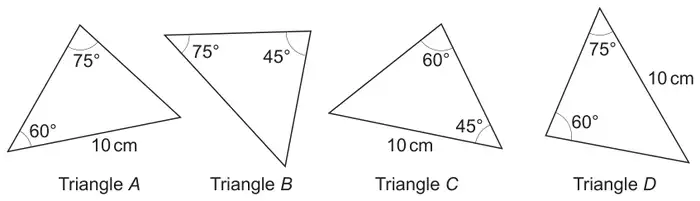
(a) Four triangles are shown in the diagram below.
Diagram not drawn to scale
For each of the following statements choose ‘True’, ‘False’ or ‘Need more information’. Tick one box for each statement. [2]
Statement
True
False
Need more information
Triangle A is congruent to Triangle B
Triangle C is congruent to Triangle D
Triangle A is congruent to Triangle C
(b) Is it possible to draw an isosceles triangle with an exterior angle of \(60^\circ\)? Tick the appropriate box and show working to explain your reason. [2]
Yes ☐ No ☐
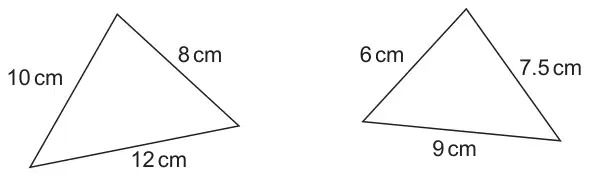
(c) Two triangles are shown in the diagram below.
Diagram not drawn to scale
Show that the two triangles are mathematically similar. [2]
Mark scheme (a)
Scheme
Marks
Comments
True
False
Need more information
✓
✓
✓
B2
For all three correct B1 for any two correct
Mark scheme (b)
Scheme
Marks
Comments
Yes indicated or clearly implied (with indication of one \(120^\circ\) angle) with two \(30^\circ\) angles.
B2
B1 for a clear indication of interior angle of \(120^\circ\)
OR \(\left(\frac{7.5}{10} = \frac{9}{12} = \frac{6}{8}\right)\) same scale factor \(= \frac{3}{4}\) oe
B2
B1 just for \(\frac{10}{7.5} = \frac{12}{9} = \frac{8}{6}\) OR \(\frac{7.5}{10} = \frac{9}{12} = \frac{6}{8}\)
Award no marks if the ratios of less than three pairs of sides compared.
Alternative method 1
Scheme
Marks
Comments
12:10:8 and 9:7·5:6 both simplify to 6:5:4 oe OR both equivalent to 108:90:72 oe
B2
B1 for stating 12:10:8 = 9:7·5:6 without simplifying to 6:5:4
Alternative method 2
Scheme
Marks
Comments
B2 for any one of the following: \(7.5\times\frac{12}{9} = 10\) AND \(6\times\frac{12}{9} = 8\) \(10\div\frac{12}{9} = 7.5\) AND \(8\div\frac{12}{9} = 6\) \(9\times\frac{10}{7{\cdot}5} = 12\) AND \(6\times\frac{10}{7{\cdot}5} = 8\) \(12\div\frac{10}{7{\cdot}5} = 9\) AND \(8\div\frac{10}{7{\cdot}5} = 6\) \(9\times\frac{8}{6} = 12\) AND \(7{\cdot}5\times\frac{8}{6} = 10\) \(12\div\frac{8}{6} = 9\) AND \(10\div\frac{8}{6} = 7{\cdot}5\)
B2
B1 for any one of the following: \(7.5\times\frac{12}{9} = 10\) OR \(6\times\frac{12}{9} = 8\) \(10\div\frac{12}{9} = 7.5\) OR \(8\div\frac{12}{9} = 6\) \(9\times\frac{10}{7{\cdot}5} = 12\) OR \(6\times\frac{10}{7{\cdot}5} = 8\) \(12\div\frac{10}{7{\cdot}5} = 9\) OR \(8\div\frac{10}{7{\cdot}5} = 6\) \(9\times\frac{8}{6} = 12\) OR \(7{\cdot}5\times\frac{8}{6} = 10\) \(12\div\frac{8}{6} = 9\) OR \(10\div\frac{8}{6} = 7{\cdot}5\)
(6)
Corrected by Westie's Workshop
The board's mark scheme printed “8 ÷ 12/9 = = 6” and “9 × 10/7·5 = = 12”. Changed to “8 ÷ 12/9 = 6” and “9 × 10/7·5 = 12” because the equals sign was printed twice by mistake (in both the B2 and B1 lists). Our text already showed a single “=”.
Original: see the board's mark scheme PDF (link above).
We'd like to use Google Analytics cookies to count visits and see which pages help most. They're optional, and the site works exactly the same either way. Privacy policy