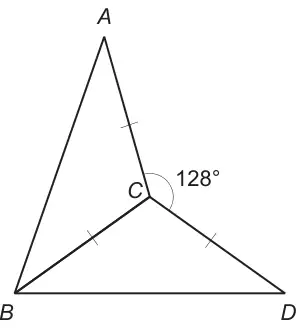
The diagram shows two triangles ABC and BDC. These triangles are both congruent and isosceles.
Find the size of \(B\hat{A}C\). [4]
(b)
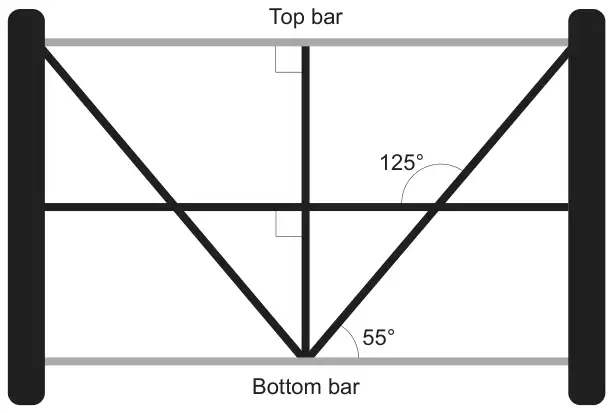
Diagram not drawn to scale
The diagram shows part of a garden gate made from straight metal bars.
Show that the top bar is parallel to the bottom bar. Label the diagram with any angles you use. Give a reason for each step. [3]
Mark scheme (a)
Scheme
Marks
Comments
\(\frac{360 - 128}{2}\) or \(180 - \frac{128}{2}\) (= 116)
M2
Or M1 for 360 – 128 (= 232) or 128 ÷ 2 (= 64)
\(\frac{180 - 116}{2}\)
m1
FT ‘their 116’ ; dependent on M2
32
A1
Alternative
Alternative method using exterior angles
Scheme
Marks
Comments
128 ÷ 2
M1
64 is BAC + ABC seen or implied and 64 ÷ 2
M2
32
A1
Mark scheme (b)
Scheme
Marks
Comments
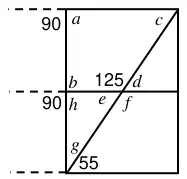
Valid combination of angles/reasons e.g. \(a\) = 90 angles on a straight line \(b\) = 90 vertically opposite \(c\) = 55 angles in a quadrilateral
or Top is parallel to middle corresponding angles \(d\) = 55 angles on a straight line or \(e\) = 55 angles on a straight line
B2
NB Other valid reasons are possible, but reasons based on parallel lines must be justified.
Longer methods must be complete for B2
B1 for two correct angles with at least one reason stated or for 3 correct relevant angles with no reasons stated and no incorrect angles seen or for showing the top is parallel to the middle or the middle is parallel to the bottom
and completion of argument e.g. ‘(Parallel as) alternate angles are equal.’ or ‘Middle is parallel to bottom corresponding angles (so top parallel to bottom).’
E1
Do not accept ‘F angles’ or ‘Z angles’ as reasons.
We'd like to use Google Analytics cookies to count visits and see which pages help most. They're optional, and the site works exactly the same either way. Privacy policy